Tổng hợp đề thi Tiếng Anh có lời giải (Đề số 24)
64 câu hỏi
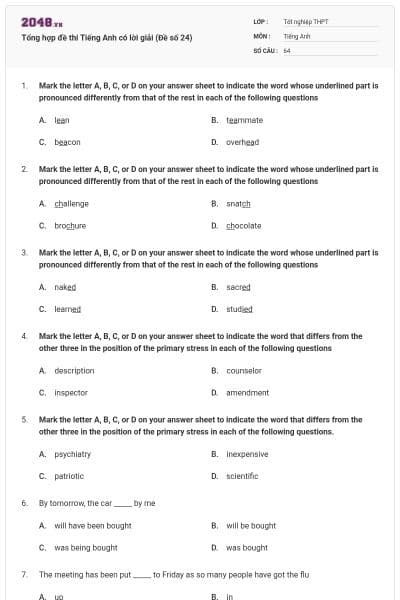
Mark the letter A, B, C, or D on your answer sheet to indicate the word whose underlined part is pronounced differently from that of the rest in each of the following questions
lean
teammate
beacon
overhead
Đáp án D
“ea” trong từ “overhead” phát âm là /e/, trong các từ còn lại phát âm là /i:/
Mark the letter A, B, C, or D on your answer sheet to indicate the word whose underlined part is pronounced differently from that of the rest in each of the following questions
challenge
snatch
brochure
chocolate
Đáp án C
“ch” trong từ “brochure” phát âm là /∫/, trong các từ còn lại phát âm là /t∫/.
Mark the letter A, B, C, or D on your answer sheet to indicate the word whose underlined part is pronounced differently from that of the rest in each of the following questions
naked
sacred
learned
studied
Đáp án C
Phần gạch chân trong từ “learned” phát âm là /d/, trong các từ còn lại phát âm là /id/ trong đó 2 từ “naked” và “sacred” là trường hợp đặc biệt. "ied" trong từ studied được phát âm là id
Mark the letter A, B, C, or D on your answer sheet to indicate the word that differs from the other three in the position of the primary stress in each of the following questions
description
counselor
inspector
amendment
Đáp án B
Trọng âm của từ counselor rơi vào âm tiết thứ nhất, các từ còn lại rơi vào âm tiết thứ hai.
Mark the letter A, B, C, or D on your answer sheet to indicate the word that differs from the other three in the position of the primary stress in each of the following questions.
psychiatry
inexpensive
patriotic
scientific
Đáp án A
Trọng âm của từ psychiatry rơi vào âm tiết thứ nhất, các từ còn lại rơi vào âm tiết thứ hai
By tomorrow, the car _____ by me
will have been bought
will be bought
was being bought
was bought
Đáp án A
Dấu hiệu “by tomorrow”: By+ thời điểm trong tương lai -> thì tương lai hoàn thành và “by me”-> Câu bị động=> câu bị động với thì tương lai hoàn thành: S+ will have been+ PP+ by+ O.
The meeting has been put _____ to Friday as so many people have got the flu
up
in
out
back
Đáp án D
Put up= đề ra, put in= giao nhiệm vụ, put out= thoát khỏi, put back= hoãn lại. Dịch: Cuộc họp bị … tới thứ sáu vì quá nhiều người bị cúm -> chọn từ “back”.
A: “John got married again.” - B: “Really? Who _____?”
with
at
to
about
Đáp án: C
Giải thích:
Get married to: kết hôn với ai. Ở đây cụm “got married” được hiểu ngầm vì đã được nhắc đến ở câu trước.
Dịch: A: "John kết hôn lần nữa rồi?" - B: "Thật sao? Với ai thế?"
The child was told to _____ for being rude to his uncle
excuse
apologize
forgive
confess
Đáp án B
Dịch: Đứa trẻ dược bảo … vì vô lễ với chú của mình. -> cần xin lỗi-> apologize + for+ N/V_ing: xin lỗi vì việc gì.
Mai: “Wow, I’ve never seen such a nice cell phone, Nam” - Nam: “_____”.
Oh, I don’t know
Thank you. I’m glad you like it
You’re welcome
I agree with you
Đáp án B
Mai: “ tớ chưa bao giờ thấy một chiếc di động đẹp như vậy, Nam ạ”-> lời khen-> Nam nên cảm ơn: “Thank you. I’m glad you like it”.
A: “Are you interested in scuba diving?” - B: “A lot. Undersea life is _____.”
fascinating
fascinate
fascinates
fascinated
Đáp án A
Sau Tobe là tính từ. Loại đáp án B,C vì là động từ. “fascinating”V_ing: tính từ thể chủ động thể hiện bản chất sự vật, “fascinated” V_ed: tính từ thể bị động, chỉ vật bị tác động. Câu này đang miêu tả đến bản chất "undersea life" nên ta chọn fascinating
"_____ anyone ring while I’m away, please take a message."
Will
May
Should
Would
Đáp án C
Đảo ngữ câu điều kiện loại 1 dạng mệnh lệnh: Should + S+ Vinf, Vinf. Thường thêm từ “please”.
The meeting has been brought _____ to Monday due to the seriousness of the situation.
on
out
down
forward
Đáp án D
Dịch: Cuộc họp đã … sang Thứ Hai bởi vì mức độ nghiêm trọng của vấn đề.-> tổ chức sớm để giải quyết vẫn đề-> bring forward= sớm hơn.
The chief foods eaten in any country depend largely on _____ best in its climate and soil
what grows
it grows
does it grow
what does it grow
Đáp án A
The chief foods eaten in any country depend largely on _____ best in its climate and soil.” Chủ ngữ là “the chief foods” “eaten in any country” là rút gọn mệnh đề dạng bị động. “depend on” là động từ -> cần danh từ -> “what” đứng đầu mệnh đề tạo mệnh đề danh từ bổ nghĩa : what + Vs/es.
A: “Can I smoke in here?” - B: “I’d rather you _____.”
don’t
didn’t
won’t
can’t
Đáp án B
Cấu trúc: would rather+ S+ V(qkđ): thích hơn là …
The grape is the _____, juicy fruit of a woody vine
skin which is smooth
skinned is smooth
smooth-skinned
smooth skin
Đáp án C
Dịch: Nho là 1 loại quả …, mọng nước của cây leo thân gỗ. -> cần tính từ song song với tình từ “juicy” -> smonth-skinned: vỏ mịn
The ___ collar workers received a rise, but the workers on the shop-door were told they had to wait
blue
black
grey
white
Đáp án D
The white collar worker= công nhân áo cổ trắng= nhân viên văn phòng
The more you talk about the situation, ______.
it seems worse
the worse does it seem
the worse it seems
it seems the worse
Đáp án C
Cấu trúc so sánh “càng …càng…”: The+ so sánh hơn + S+ V, The+ so sánh hơn + S+ V
Those boys took a long ladder______
in order to get the ball from the roof
so they will get the ball from the roof
so that the ball from the roof can be gotten
and then get the ball from the roof
Đáp án A
Cấu trúc : in order to + V: để làm gì. Các đáp án còn lại không hợp nghĩa.
Mark the letter A, B , C or D on your answer sheet to indicate the sentence that is CLOSEST in meaning to each of the following questions
Peter always trusts me with his interest
Peter does not always keep the secrets I tell him
I always confide in Peter
Peter often fails to keep the secrets I tell him
Peter always confides in me
Đáp án D
Câu gốc: Peter luôn tin tưởng tôi với sự quan tâm. Đáp án D: Peter luôn tin cậy tôi, confide in somebody= tin tưởng ai
Mark the letter A, B , C or D on your answer sheet to indicate the sentence that is CLOSEST in meaning to each of the following questions
Less is known about the cause of the common cold than about the causes of many more serious diseases
The causes of less serious diseases than the common cold are better known than it is
We know less than we should about the causes of the common cold and more serious diseases
We know less about the cause of the common cold than we do about the causes of more serious diseases
The cause of the common cold is better known than the causes of more serious diseases
Đáp án C
Câu gốc: Hiểu biết về nguyên nhân của bệnh cảm thông thường ít hơn về nguyên nhân của các bệnh nghiêm trọng. -> đáp án C: chúng ta biết ít về nguyên nhân bệnh cảm thường hơn là nguyên nhân các bệnh nghiêm trọng
Mark the letter A, B , C or D on your answer sheet to indicate the sentence that is CLOSEST in meaning to each of the following questions
He never suspected that the money had been stolen
He knew that his money would be stolen
Never he suspected that the money had been stolen
At no time did he suspect that the money had been stolen
At no time he suspected that the money had been stolen
Đáp án: B
Giải thích:
Kiến thức: Đảo ngữ
Khi các trạng từ phủ định như never, at no time, rarely, seldom được đặt lên đầu câu để nhấn mạnh, ta phải sử dụng cấu trúc đảo ngữ:
[Trạng từ phủ định] + trợ động từ + chủ ngữ + động từ chính
Phân tích các đáp án:
A. He knew that his money would be stolen.
Sai nghĩa, câu này mang ý là Anh ấy biết tiền sẽ bị đánh cắp, không phù hợp với câu gốc.
B. Never he suspected that the money had been stolen.
Sai cấu trúc đảo ngữ. Phải là Never did he suspect...
C. At no time did he suspect that the money had been stolen.
Đúng cấu trúc đảo ngữ: At no time + did + chủ ngữ + động từ nguyên thể → Diễn đạt đúng ý nghĩa của câu gốc.
D. At no time he suspected that the money had been stolen.
Sai cấu trúc đảo ngữ, thiếu did sau trạng từ phủ định.
Chọn C.
Dịch: Anh ấy không bao giờ nghi ngờ rằng số tiền đã bị đánh cắp.
Mark the letter A, B, C or D on your answer sheet to indicate the word or phrase that is OPPOSITE in meaning to the underlined part in each of the following questions
Adversereviews in the press may greatly change the prospects of a product
encouraging
additional
sensible
favorable
Đáp án D
Adverse= chống đối>< favorable= tán thành, encouraging = khuyến khích, additional= thêm vào, sensible= hợp lý
Mark the letter A, B, C or D on your answer sheet to indicate the word or phrase that is OPPOSITE in meaning to the underlined part in each of the following questions
There is practically no difference between the two options
virtually
hardly
usually
exactly
Đáp án B
Practically= virtually= gần như>< hardly= gần như không, usually= thường xuyên, exactly= chính xác.
Circle the letter A, B, C, or D to show the underlined part that needs correction in each of the following questions
Mrs. Stevens, along with (A) her cousins (B) from New Mexico, are (C)planning to (D) attend the festivities
with
her cousins
are
to
Đáp án C
Cấu trúc: A+ along with+ B+ V(A): A cùng B ( chia động từ theo A). Nên “are”-> “is”.
Circle the letter A, B, C, or D to show the underlined part that needs correction in each of the following questions
The teacher asked him why (A) hadn’t he done (B) his homework, but (C)he said nothing(D) .
why
hadn’t he done
but
said nothing
Đáp án B
Khi “Why” và các từ để hỏi đứng giữa câu thì có dạng : WH/how+ S+ V. Nên “hadn’t he done”-> “he hadn’t done”.
Circle the letter A, B, C, or D to show the underlined part that needs correction in each of the following questions
Hardly had he entered (A) the room than (B) all the lights (C) went (D) out.
had he entered
than
the lights
went
Đáp án B
Cấu trúc: hardly…when…:ngay khi…thì… Nên phải sửa “than”-> “when”.
Circle the letter A, B, C, or D to show the underlined part that needs correction in each of the following questions
Since (A) fireworks are dangerous(B) , many countries have laws preventing (C)businesses to sell (D) them
Since
are dangerous
preventing
to sell
Đáp án D
Cấu trúc: prevent+ somebody + from+ N/V_ing: bảo vệ ai khỏi cái gì. Nên sửa “to sell”-> “from selling”.
Circle the letter A, B, C, or D to show the underlined part that needs correction in each of the following questions
Exploration of the Solar System is continuing(A) , and at the present rate of progress(B) all the planets will have been contacted within (C)the near(D) 50 years
continuing
progress
within
near
Đáp án: D
Giải thích:
Khi nói về thời gian sắp đến thì dùng “next”.
Sửa: near → next
Dịch: Việc khám phá Hệ Mặt trời vẫn đang được tiếp tục và với tốc độ tiến triển hiện tại, tất cả các hành tinh sẽ được liên lạc trong vòng 50 năm tới.
Read the following passage and mark the letter A, B, C or D on your answer sheet to indicate the correct answer to each of the questions
In the world today, particular in the two most industrialized areas, North America and Europe, recycling is the big news. People are talking about it, practicing it, and discovering new ways to be sensitive to the environment. Recycling means finding ways to use products a second time. The motto of the recycling movement is “Reduce, Reuse, Recycle”.
The first step is to reduce garbage. In stores, a shopper has to buy products in blister packs, boxes and expensive plastic wrappings. A hamburger from a fast food restaurant comes in lots of packaging: usually paper, a box and a bag. All that packaging is wasted resources. People should try to buy things that are wrapped simply, and to reuse cups and utensils. Another way to reduce waste is to buy high-quality products. When low-quality appliances break, many customers throw them away and buy new ones - a loss of more resources and more energy. For example, if a customer buys a high-quality appliance that can be easily repaired, the manufacturer receives an important message. In the same way, if a customer chooses a product with less packaging, that customer sends an important message to the manufacturers. To reduce garbage, the throw-away must stop.
The second step is to reuse. It is better to buy juices and soft drinks in returnable bottles. After customers empty the bottles, they return them to the stores. The manufacturers of the drinks collect bottles, wash them, and then fill them again. The energy that is necessary to make new bottles is saved. In some parts of the world, returning bottles for money is a common practice. In those places, the garbage dumps have relatively little glass and plastic from throw-away bottles.
The third step being environmentally sensitive is to recycle. Spent motor oil can be cleaned and used again. Aluminum cans are expensive to make. It takes the same amount of energy to make one aluminum can as it does to run a color TV set for three hours. When people collect and recycle aluminum (for new cans), they help save one of the world’s precious resources
Which area is considered one of the most industrialized?
South America
Middle East
Europe
Asia
Đáp án A
Câu đầu tiên của bài “particular in the two most industrialized areas, North America and Europe”: đặc biệt ở 2 vùng công nghiệp lớn nhất, Bắc Mỹ và Châu Âu.
Read the following passage and mark the letter A, B, C or D on your answer sheet to indicate the correct answer to each of the questions
In the world today, particular in the two most industrialized areas, North America and Europe, recycling is the big news. People are talking about it, practicing it, and discovering new ways to be sensitive to the environment. Recycling means finding ways to use products a second time. The motto of the recycling movement is “Reduce, Reuse, Recycle”.
The first step is to reduce garbage. In stores, a shopper has to buy products in blister packs, boxes and expensive plastic wrappings. A hamburger from a fast food restaurant comes in lots of packaging: usually paper, a box and a bag. All that packaging is wasted resources. People should try to buy things that are wrapped simply, and to reuse cups and utensils. Another way to reduce waste is to buy high-quality products. When low-quality appliances break, many customers throw them away and buy new ones - a loss of more resources and more energy. For example, if a customer buys a high-quality appliance that can be easily repaired, the manufacturer receives an important message. In the same way, if a customer chooses a product with less packaging, that customer sends an important message to the manufacturers. To reduce garbage, the throw-away must stop.
The second step is to reuse. It is better to buy juices and soft drinks in returnable bottles. After customers empty the bottles, they return them to the stores. The manufacturers of the drinks collect bottles, wash them, and then fill them again. The energy that is necessary to make new bottles is saved. In some parts of the world, returning bottles for money is a common practice. In those places, the garbage dumps have relatively little glass and plastic from throw-away bottles.
The third step being environmentally sensitive is to recycle. Spent motor oil can be cleaned and used again. Aluminum cans are expensive to make. It takes the same amount of energy to make one aluminum can as it does to run a color TV set for three hours. When people collect and recycle aluminum (for new cans), they help save one of the world’s precious resources
What does the word “sensitive” means?
cautious
logical
responding
friendly
Đáp án D
Sensitive= nhạy cảm, Friendly= thân thiện, cautious= thận trọng, logical= hợp lý, responding= đáp lại.
Read the following passage and mark the letter A, B, C or D on your answer sheet to indicate the correct answer to each of the questions
In the world today, particular in the two most industrialized areas, North America and Europe, recycling is the big news. People are talking about it, practicing it, and discovering new ways to be sensitive to the environment. Recycling means finding ways to use products a second time. The motto of the recycling movement is “Reduce, Reuse, Recycle”.
The first step is to reduce garbage. In stores, a shopper has to buy products in blister packs, boxes and expensive plastic wrappings. A hamburger from a fast food restaurant comes in lots of packaging: usually paper, a box and a bag. All that packaging is wasted resources. People should try to buy things that are wrapped simply, and to reuse cups and utensils. Another way to reduce waste is to buy high-quality products. When low-quality appliances break, many customers throw them away and buy new ones - a loss of more resources and more energy. For example, if a customer buys a high-quality appliance that can be easily repaired, the manufacturer receives an important message. In the same way, if a customer chooses a product with less packaging, that customer sends an important message to the manufacturers. To reduce garbage, the throw-away must stop.
The second step is to reuse. It is better to buy juices and soft drinks in returnable bottles. After customers empty the bottles, they return them to the stores. The manufacturers of the drinks collect bottles, wash them, and then fill them again. The energy that is necessary to make new bottles is saved. In some parts of the world, returning bottles for money is a common practice. In those places, the garbage dumps have relatively little glass and plastic from throw-away bottles.
The third step being environmentally sensitive is to recycle. Spent motor oil can be cleaned and used again. Aluminum cans are expensive to make. It takes the same amount of energy to make one aluminum can as it does to run a color TV set for three hours. When people collect and recycle aluminum (for new cans), they help save one of the world’s precious resources
The word “motto” is closest in meaning to _______
meaning
value
belief
reference
Đáp án C
Motto= phương châm, belief= sự tin tưởng, meaning= ý nghĩa, value= giá trị, reference= tham khảo. “Motto” thể hiện mục đích hay niềm tin của một người/một nhóm người và trở thành khẩu hiệu/phương châm của hành động. Trong tất cả các đáp án thì C là gần nghĩa nhất
Read the following passage and mark the letter A, B, C or D on your answer sheet to indicate the correct answer to each of the questions
In the world today, particular in the two most industrialized areas, North America and Europe, recycling is the big news. People are talking about it, practicing it, and discovering new ways to be sensitive to the environment. Recycling means finding ways to use products a second time. The motto of the recycling movement is “Reduce, Reuse, Recycle”.
The first step is to reduce garbage. In stores, a shopper has to buy products in blister packs, boxes and expensive plastic wrappings. A hamburger from a fast food restaurant comes in lots of packaging: usually paper, a box and a bag. All that packaging is wasted resources. People should try to buy things that are wrapped simply, and to reuse cups and utensils. Another way to reduce waste is to buy high-quality products. When low-quality appliances break, many customers throw them away and buy new ones - a loss of more resources and more energy. For example, if a customer buys a high-quality appliance that can be easily repaired, the manufacturer receives an important message. In the same way, if a customer chooses a product with less packaging, that customer sends an important message to the manufacturers. To reduce garbage, the throw-away must stop.
The second step is to reuse. It is better to buy juices and soft drinks in returnable bottles. After customers empty the bottles, they return them to the stores. The manufacturers of the drinks collect bottles, wash them, and then fill them again. The energy that is necessary to make new bottles is saved. In some parts of the world, returning bottles for money is a common practice. In those places, the garbage dumps have relatively little glass and plastic from throw-away bottles.
The third step being environmentally sensitive is to recycle. Spent motor oil can be cleaned and used again. Aluminum cans are expensive to make. It takes the same amount of energy to make one aluminum can as it does to run a color TV set for three hours. When people collect and recycle aluminum (for new cans), they help save one of the world’s precious resources
It is a waste when customers buy low-quality products because _______
they have to be repaired many times
they will soon throw them away.
customers always change their idea
they are very cheap
Đáp án B
Dựa vào dòng 5,6 đoạn 2 “When low-quality appliances break, many customers throw them away” khi những thiết bị kém bị hỏng, nhiều khách hàng ném chúng đi.
Read the following passage and mark the letter A, B, C or D on your answer sheet to indicate the correct answer to each of the questions
In the world today, particular in the two most industrialized areas, North America and Europe, recycling is the big news. People are talking about it, practicing it, and discovering new ways to be sensitive to the environment. Recycling means finding ways to use products a second time. The motto of the recycling movement is “Reduce, Reuse, Recycle”.
The first step is to reduce garbage. In stores, a shopper has to buy products in blister packs, boxes and expensive plastic wrappings. A hamburger from a fast food restaurant comes in lots of packaging: usually paper, a box and a bag. All that packaging is wasted resources. People should try to buy things that are wrapped simply, and to reuse cups and utensils. Another way to reduce waste is to buy high-quality products. When low-quality appliances break, many customers throw them away and buy new ones - a loss of more resources and more energy. For example, if a customer buys a high-quality appliance that can be easily repaired, the manufacturer receives an important message. In the same way, if a customer chooses a product with less packaging, that customer sends an important message to the manufacturers. To reduce garbage, the throw-away must stop.
The second step is to reuse. It is better to buy juices and soft drinks in returnable bottles. After customers empty the bottles, they return them to the stores. The manufacturers of the drinks collect bottles, wash them, and then fill them again. The energy that is necessary to make new bottles is saved. In some parts of the world, returning bottles for money is a common practice. In those places, the garbage dumps have relatively little glass and plastic from throw-away bottles.
The third step being environmentally sensitive is to recycle. Spent motor oil can be cleaned and used again. Aluminum cans are expensive to make. It takes the same amount of energy to make one aluminum can as it does to run a color TV set for three hours. When people collect and recycle aluminum (for new cans), they help save one of the world’s precious resources
What is the topic of the passage?
How to live sensitively to the environment
How to reduce garbage disposal
What is involved in the recycling movement
What people understand the term “recycle”
Đáp án A
Dựa vào câu 2 đoạn 1 “People are talking about it, practicing it, and discovering new ways to be sensitive to the environment” mọi người nói về nó, thực hiện nó và khám phá ra cách mới để thân thiện với môi trường. Các đoạn về sau để phân tích cách làm đó
Read the following passage and mark the letter A, B, C or D on your answer sheet to indicate the correct answer to each of the questions
In the world today, particular in the two most industrialized areas, North America and Europe, recycling is the big news. People are talking about it, practicing it, and discovering new ways to be sensitive to the environment. Recycling means finding ways to use products a second time. The motto of the recycling movement is “Reduce, Reuse, Recycle”.
The first step is to reduce garbage. In stores, a shopper has to buy products in blister packs, boxes and expensive plastic wrappings. A hamburger from a fast food restaurant comes in lots of packaging: usually paper, a box and a bag. All that packaging is wasted resources. People should try to buy things that are wrapped simply, and to reuse cups and utensils. Another way to reduce waste is to buy high-quality products. When low-quality appliances break, many customers throw them away and buy new ones - a loss of more resources and more energy. For example, if a customer buys a high-quality appliance that can be easily repaired, the manufacturer receives an important message. In the same way, if a customer chooses a product with less packaging, that customer sends an important message to the manufacturers. To reduce garbage, the throw-away must stop.
The second step is to reuse. It is better to buy juices and soft drinks in returnable bottles. After customers empty the bottles, they return them to the stores. The manufacturers of the drinks collect bottles, wash them, and then fill them again. The energy that is necessary to make new bottles is saved. In some parts of the world, returning bottles for money is a common practice. In those places, the garbage dumps have relatively little glass and plastic from throw-away bottles.
The third step being environmentally sensitive is to recycle. Spent motor oil can be cleaned and used again. Aluminum cans are expensive to make. It takes the same amount of energy to make one aluminum can as it does to run a color TV set for three hours. When people collect and recycle aluminum (for new cans), they help save one of the world’s precious resources
People can do the following to reduce waste EXCEPT _______.
buy high-quality products
buy simply-wrapped things
reuse cups
buy more hamburgers
Đáp án D
Dựa vào các câu ở đoạn 2 “People should try to buy things that are wrapped simply, and to reuse cups and utensils. Another way to reduce waste is to buy high-quality products” -> chỉ đáp án D là không có trong bài
Read the following passage and mark the letter A, B, C or D on your answer sheet to indicate the correct answer to each of the questions
In the world today, particular in the two most industrialized areas, North America and Europe, recycling is the big news. People are talking about it, practicing it, and discovering new ways to be sensitive to the environment. Recycling means finding ways to use products a second time. The motto of the recycling movement is “Reduce, Reuse, Recycle”.
The first step is to reduce garbage. In stores, a shopper has to buy products in blister packs, boxes and expensive plastic wrappings. A hamburger from a fast food restaurant comes in lots of packaging: usually paper, a box and a bag. All that packaging is wasted resources. People should try to buy things that are wrapped simply, and to reuse cups and utensils. Another way to reduce waste is to buy high-quality products. When low-quality appliances break, many customers throw them away and buy new ones - a loss of more resources and more energy. For example, if a customer buys a high-quality appliance that can be easily repaired, the manufacturer receives an important message. In the same way, if a customer chooses a product with less packaging, that customer sends an important message to the manufacturers. To reduce garbage, the throw-away must stop.
The second step is to reuse. It is better to buy juices and soft drinks in returnable bottles. After customers empty the bottles, they return them to the stores. The manufacturers of the drinks collect bottles, wash them, and then fill them again. The energy that is necessary to make new bottles is saved. In some parts of the world, returning bottles for money is a common practice. In those places, the garbage dumps have relatively little glass and plastic from throw-away bottles.
The third step being environmentally sensitive is to recycle. Spent motor oil can be cleaned and used again. Aluminum cans are expensive to make. It takes the same amount of energy to make one aluminum can as it does to run a color TV set for three hours. When people collect and recycle aluminum (for new cans), they help save one of the world’s precious resources
What best describe the process of reuse?
The bottles are filled again after being returned, collected and washed
The bottles are collected, washed, returned and filled again
The bottles are washed, returned filled again and collected
The bottles are collected, returned, filled again and washed
Đáp án A
Dựa vào câu sau ở đoạn 3 “they return them to the stores. The manufacturers of the drinks collect bottles, wash them, and then fill them again.”-> quá trình là return, collect, wash, and fill again -> đáp án A là: sau khi được trả lại, thu lượm và rửa sạch, những cái chai được làm đầy lại.
Read the following passage and mark the letter A, B, C or D on your answer sheet to indicate the correct answer to each of the questions
In the world today, particular in the two most industrialized areas, North America and Europe, recycling is the big news. People are talking about it, practicing it, and discovering new ways to be sensitive to the environment. Recycling means finding ways to use products a second time. The motto of the recycling movement is “Reduce, Reuse, Recycle”.
The first step is to reduce garbage. In stores, a shopper has to buy products in blister packs, boxes and expensive plastic wrappings. A hamburger from a fast food restaurant comes in lots of packaging: usually paper, a box and a bag. All that packaging is wasted resources. People should try to buy things that are wrapped simply, and to reuse cups and utensils. Another way to reduce waste is to buy high-quality products. When low-quality appliances break, many customers throw them away and buy new ones - a loss of more resources and more energy. For example, if a customer buys a high-quality appliance that can be easily repaired, the manufacturer receives an important message. In the same way, if a customer chooses a product with less packaging, that customer sends an important message to the manufacturers. To reduce garbage, the throw-away must stop.
The second step is to reuse. It is better to buy juices and soft drinks in returnable bottles. After customers empty the bottles, they return them to the stores. The manufacturers of the drinks collect bottles, wash them, and then fill them again. The energy that is necessary to make new bottles is saved. In some parts of the world, returning bottles for money is a common practice. In those places, the garbage dumps have relatively little glass and plastic from throw-away bottles.
The third step being environmentally sensitive is to recycle. Spent motor oil can be cleaned and used again. Aluminum cans are expensive to make. It takes the same amount of energy to make one aluminum can as it does to run a color TV set for three hours. When people collect and recycle aluminum (for new cans), they help save one of the world’s precious resources
The word “practice” is closest in meaning to _______
training
exercise
deed
belief
Đáp án C
Dựa vào nội dung bài, “practice”=”deed”: hành động, exercise= luyện tập, training= huyến luyện, belief= sự tin tưởng
Read the following passage and mark the letter A, B, C or D on your answer sheet to indicate the correct answer to each of the questions
In the world today, particular in the two most industrialized areas, North America and Europe, recycling is the big news. People are talking about it, practicing it, and discovering new ways to be sensitive to the environment. Recycling means finding ways to use products a second time. The motto of the recycling movement is “Reduce, Reuse, Recycle”.
The first step is to reduce garbage. In stores, a shopper has to buy products in blister packs, boxes and expensive plastic wrappings. A hamburger from a fast food restaurant comes in lots of packaging: usually paper, a box and a bag. All that packaging is wasted resources. People should try to buy things that are wrapped simply, and to reuse cups and utensils. Another way to reduce waste is to buy high-quality products. When low-quality appliances break, many customers throw them away and buy new ones - a loss of more resources and more energy. For example, if a customer buys a high-quality appliance that can be easily repaired, the manufacturer receives an important message. In the same way, if a customer chooses a product with less packaging, that customer sends an important message to the manufacturers. To reduce garbage, the throw-away must stop.
The second step is to reuse. It is better to buy juices and soft drinks in returnable bottles. After customers empty the bottles, they return them to the stores. The manufacturers of the drinks collect bottles, wash them, and then fill them again. The energy that is necessary to make new bottles is saved. In some parts of the world, returning bottles for money is a common practice. In those places, the garbage dumps have relatively little glass and plastic from throw-away bottles.
The third step being environmentally sensitive is to recycle. Spent motor oil can be cleaned and used again. Aluminum cans are expensive to make. It takes the same amount of energy to make one aluminum can as it does to run a color TV set for three hours. When people collect and recycle aluminum (for new cans), they help save one of the world’s precious resources
Garbage dumps in some areas have relatively little glass and plastic because _______
people are ordered to return bottles
returned bottles are few
each returned bottle is paid
few bottles are made of glass or plastic
Đáp án C
Dòng 4 đoạn 3 “returning bottles for money is a common practice” trả lại chai lọ để lấy tiền là hành động phổ biến. -> nó làm giảm lượng thủy tinh và nhựa thải ra bãi rác.
Read the following passage and mark the letter A, B, C or D on your answer sheet to indicate the correct answer to each of the questions
In the world today, particular in the two most industrialized areas, North America and Europe, recycling is the big news. People are talking about it, practicing it, and discovering new ways to be sensitive to the environment. Recycling means finding ways to use products a second time. The motto of the recycling movement is “Reduce, Reuse, Recycle”.
The first step is to reduce garbage. In stores, a shopper has to buy products in blister packs, boxes and expensive plastic wrappings. A hamburger from a fast food restaurant comes in lots of packaging: usually paper, a box and a bag. All that packaging is wasted resources. People should try to buy things that are wrapped simply, and to reuse cups and utensils. Another way to reduce waste is to buy high-quality products. When low-quality appliances break, many customers throw them away and buy new ones - a loss of more resources and more energy. For example, if a customer buys a high-quality appliance that can be easily repaired, the manufacturer receives an important message. In the same way, if a customer chooses a product with less packaging, that customer sends an important message to the manufacturers. To reduce garbage, the throw-away must stop.
The second step is to reuse. It is better to buy juices and soft drinks in returnable bottles. After customers empty the bottles, they return them to the stores. The manufacturers of the drinks collect bottles, wash them, and then fill them again. The energy that is necessary to make new bottles is saved. In some parts of the world, returning bottles for money is a common practice. In those places, the garbage dumps have relatively little glass and plastic from throw-away bottles.
The third step being environmentally sensitive is to recycle. Spent motor oil can be cleaned and used again. Aluminum cans are expensive to make. It takes the same amount of energy to make one aluminum can as it does to run a color TV set for three hours. When people collect and recycle aluminum (for new cans), they help save one of the world’s precious resources
What are the two things mentioned as examples of recycling?
TV sets and aluminum cans
Hamburger wrappings and spent motor oil
Aluminum cans and plastic wrappings
Aluminum cans and spent motor oil
Đáp án D
Đoạn 3 có các ý “Spent motor oil can be cleaned and used again” và “people collect and recycle aluminum” : ví dụ về tái chế.
Read the following passage and circle the most suitable answer (A, B, C or D) to fill in each gap.
Most Americans eat three meals (40) ______ the day: breakfast, lunch, and dinner. Breakfast begins between 7:00 and 8:00am, lunch between 11:00 am and noon, and dinner between 6:00 and 8:00 pm. On Sundays "brunch" is a (41) ______ of breakfast and lunch, typically beginning at 11:00 am. Students often enjoy a "study break" or evening snack around 10:00 or 11:00 pm. Breakfast and lunch tend to be light meals, with only one (42) ______. Dinner is the main meal.
(43) ______ breakfast Americans will eat cereal with milk which are often mixed (44) ______ in a bowl, a glass of orange juice, and toasted bread or muffin with jam, butter, or margarine. Another common breakfast meal is scrambled eggs or (45) ______ omelet with potatoes and breakfast meat (bacon or sausage). People who are on (46) ______ eat just a cup of yogurt. Lunch and dinner are more (47) ______. When eating at a formal dinner, you may be overwhelmed by the number of utensils. How do you (48) ______ the difference between a salad fork, a butter fork, and a dessert fork? Most Americans do not know the answer (49) ______ But knowing which fork or spoon to use first is simple: use the outermost utensils first and the utensils closest to the plate last.Question 40
Đáp án D
Câu đầu tiên “Most Americans eat three meals ______ the day” hầu hết người Mỹ ăn 3 bữa… mỗi ngày -> chọn từ “during”= trong suốt là hợp lý nhất
Read the following passage and circle the most suitable answer (A, B, C or D) to fill in each gap.
Most Americans eat three meals (40) ______ the day: breakfast, lunch, and dinner. Breakfast begins between 7:00 and 8:00am, lunch between 11:00 am and noon, and dinner between 6:00 and 8:00 pm. On Sundays "brunch" is a (41) ______ of breakfast and lunch, typically beginning at 11:00 am. Students often enjoy a "study break" or evening snack around 10:00 or 11:00 pm. Breakfast and lunch tend to be light meals, with only one (42) ______. Dinner is the main meal.
(43) ______ breakfast Americans will eat cereal with milk which are often mixed (44) ______ in a bowl, a glass of orange juice, and toasted bread or muffin with jam, butter, or margarine. Another common breakfast meal is scrambled eggs or (45) ______ omelet with potatoes and breakfast meat (bacon or sausage). People who are on (46) ______ eat just a cup of yogurt. Lunch and dinner are more (47) ______. When eating at a formal dinner, you may be overwhelmed by the number of utensils. How do you (48) ______ the difference between a salad fork, a butter fork, and a dessert fork? Most Americans do not know the answer (49) ______ But knowing which fork or spoon to use first is simple: use the outermost utensils first and the utensils closest to the plate last.Question 41
addition
connection
combination
attachment
Đáp án C
Cấu trúc: combination of + A, B,.. +and+ N: sự kết hợp của A,B,… và N. Dịch dòng 3 : vào chủ nhật, bữa ăn nửa buổi là sự kết hợp của bữa sáng và trưa.
Read the following passage and circle the most suitable answer (A, B, C or D) to fill in each gap.
Most Americans eat three meals (40) ______ the day: breakfast, lunch, and dinner. Breakfast begins between 7:00 and 8:00am, lunch between 11:00 am and noon, and dinner between 6:00 and 8:00 pm. On Sundays "brunch" is a (41) ______ of breakfast and lunch, typically beginning at 11:00 am. Students often enjoy a "study break" or evening snack around 10:00 or 11:00 pm. Breakfast and lunch tend to be light meals, with only one (42) ______. Dinner is the main meal.
(43) ______ breakfast Americans will eat cereal with milk which are often mixed (44) ______ in a bowl, a glass of orange juice, and toasted bread or muffin with jam, butter, or margarine. Another common breakfast meal is scrambled eggs or (45) ______ omelet with potatoes and breakfast meat (bacon or sausage). People who are on (46) ______ eat just a cup of yogurt. Lunch and dinner are more (47) ______. When eating at a formal dinner, you may be overwhelmed by the number of utensils. How do you (48) ______ the difference between a salad fork, a butter fork, and a dessert fork? Most Americans do not know the answer (49) ______ But knowing which fork or spoon to use first is simple: use the outermost utensils first and the utensils closest to the plate last.Question 42
course
food
menu
goods
Đáp án A
“Breakfast and lunch tend to be light meals, with only one___”:bữa sáng và trưa hướng đến bữa nhẹ, chỉ với… -> có thể đoán được từ cần điền ở đây là món ăn= Course
Read the following passage and circle the most suitable answer (A, B, C or D) to fill in each gap.
Most Americans eat three meals (40) ______ the day: breakfast, lunch, and dinner. Breakfast begins between 7:00 and 8:00am, lunch between 11:00 am and noon, and dinner between 6:00 and 8:00 pm. On Sundays "brunch" is a (41) ______ of breakfast and lunch, typically beginning at 11:00 am. Students often enjoy a "study break" or evening snack around 10:00 or 11:00 pm. Breakfast and lunch tend to be light meals, with only one (42) ______. Dinner is the main meal.
(43) ______ breakfast Americans will eat cereal with milk which are often mixed (44) ______ in a bowl, a glass of orange juice, and toasted bread or muffin with jam, butter, or margarine. Another common breakfast meal is scrambled eggs or (45) ______ omelet with potatoes and breakfast meat (bacon or sausage). People who are on (46) ______ eat just a cup of yogurt. Lunch and dinner are more (47) ______. When eating at a formal dinner, you may be overwhelmed by the number of utensils. How do you (48) ______ the difference between a salad fork, a butter fork, and a dessert fork? Most Americans do not know the answer (49) ______ But knowing which fork or spoon to use first is simple: use the outermost utensils first and the utensils closest to the plate last.Question 43
For
In
At
With
Đáp án A
Giới từ đi trước các bữa ăn hàng ngày là “For”: for breakfast, for lunch, for dinner
Read the following passage and circle the most suitable answer (A, B, C or D) to fill in each gap.
Most Americans eat three meals (40) ______ the day: breakfast, lunch, and dinner. Breakfast begins between 7:00 and 8:00am, lunch between 11:00 am and noon, and dinner between 6:00 and 8:00 pm. On Sundays "brunch" is a (41) ______ of breakfast and lunch, typically beginning at 11:00 am. Students often enjoy a "study break" or evening snack around 10:00 or 11:00 pm. Breakfast and lunch tend to be light meals, with only one (42) ______. Dinner is the main meal.
(43) ______ breakfast Americans will eat cereal with milk which are often mixed (44) ______ in a bowl, a glass of orange juice, and toasted bread or muffin with jam, butter, or margarine. Another common breakfast meal is scrambled eggs or (45) ______ omelet with potatoes and breakfast meat (bacon or sausage). People who are on (46) ______ eat just a cup of yogurt. Lunch and dinner are more (47) ______. When eating at a formal dinner, you may be overwhelmed by the number of utensils. How do you (48) ______ the difference between a salad fork, a butter fork, and a dessert fork? Most Americans do not know the answer (49) ______ But knowing which fork or spoon to use first is simple: use the outermost utensils first and the utensils closest to the plate last.Question 44
each other
together
one another
others
Đáp án B
Cấu trúc: mix+ sth+and+sth+ together. Ở câu này, “together” được đảo lên sát với “mix”.
Read the following passage and circle the most suitable answer (A, B, C or D) to fill in each gap.
Most Americans eat three meals (40) ______ the day: breakfast, lunch, and dinner. Breakfast begins between 7:00 and 8:00am, lunch between 11:00 am and noon, and dinner between 6:00 and 8:00 pm. On Sundays "brunch" is a (41) ______ of breakfast and lunch, typically beginning at 11:00 am. Students often enjoy a "study break" or evening snack around 10:00 or 11:00 pm. Breakfast and lunch tend to be light meals, with only one (42) ______. Dinner is the main meal.
(43) ______ breakfast Americans will eat cereal with milk which are often mixed (44) ______ in a bowl, a glass of orange juice, and toasted bread or muffin with jam, butter, or margarine. Another common breakfast meal is scrambled eggs or (45) ______ omelet with potatoes and breakfast meat (bacon or sausage). People who are on (46) ______ eat just a cup of yogurt. Lunch and dinner are more (47) ______. When eating at a formal dinner, you may be overwhelmed by the number of utensils. How do you (48) ______ the difference between a salad fork, a butter fork, and a dessert fork? Most Americans do not know the answer (49) ______ But knowing which fork or spoon to use first is simple: use the outermost utensils first and the utensils closest to the plate last.Question 45
a
an
the
no article
Đáp án B
Trước từ “omelet”= trứng tráng thì điền giới từ “an” vì “o” là nguyên âm và “omelet” là danh từ chưa xác định
Read the following passage and circle the most suitable answer (A, B, C or D) to fill in each gap.
Most Americans eat three meals (40) ______ the day: breakfast, lunch, and dinner. Breakfast begins between 7:00 and 8:00am, lunch between 11:00 am and noon, and dinner between 6:00 and 8:00 pm. On Sundays "brunch" is a (41) ______ of breakfast and lunch, typically beginning at 11:00 am. Students often enjoy a "study break" or evening snack around 10:00 or 11:00 pm. Breakfast and lunch tend to be light meals, with only one (42) ______. Dinner is the main meal.
(43) ______ breakfast Americans will eat cereal with milk which are often mixed (44) ______ in a bowl, a glass of orange juice, and toasted bread or muffin with jam, butter, or margarine. Another common breakfast meal is scrambled eggs or (45) ______ omelet with potatoes and breakfast meat (bacon or sausage). People who are on (46) ______ eat just a cup of yogurt. Lunch and dinner are more (47) ______. When eating at a formal dinner, you may be overwhelmed by the number of utensils. How do you (48) ______ the difference between a salad fork, a butter fork, and a dessert fork? Most Americans do not know the answer (49) ______ But knowing which fork or spoon to use first is simple: use the outermost utensils first and the utensils closest to the plate last.Question 46
holiday
engagement
diet
duty
Đáp án C
Vì chủ đề ở đây là về các bữa ăn của người Mỹ-> chọn từ “diet”= ăn kiêng. Holiday= lễ hội, engagement= cam kết, duty= nhiệm vụ
Read the following passage and circle the most suitable answer (A, B, C or D) to fill in each gap.
Most Americans eat three meals (40) ______ the day: breakfast, lunch, and dinner. Breakfast begins between 7:00 and 8:00am, lunch between 11:00 am and noon, and dinner between 6:00 and 8:00 pm. On Sundays "brunch" is a (41) ______ of breakfast and lunch, typically beginning at 11:00 am. Students often enjoy a "study break" or evening snack around 10:00 or 11:00 pm. Breakfast and lunch tend to be light meals, with only one (42) ______. Dinner is the main meal.
(43) ______ breakfast Americans will eat cereal with milk which are often mixed (44) ______ in a bowl, a glass of orange juice, and toasted bread or muffin with jam, butter, or margarine. Another common breakfast meal is scrambled eggs or (45) ______ omelet with potatoes and breakfast meat (bacon or sausage). People who are on (46) ______ eat just a cup of yogurt. Lunch and dinner are more (47) ______. When eating at a formal dinner, you may be overwhelmed by the number of utensils. How do you (48) ______ the difference between a salad fork, a butter fork, and a dessert fork? Most Americans do not know the answer (49) ______ But knowing which fork or spoon to use first is simple: use the outermost utensils first and the utensils closest to the plate last.Question 47
vary
variety
varied
variously
Đáp án C
“Lunch and dinner are more___” sau Tobe cần điền 1 tính từ-> varied (adj)= đa dạng, vary(v), variety(n), variously(adv)
Read the following passage and circle the most suitable answer (A, B, C or D) to fill in each gap.
Most Americans eat three meals (40) ______ the day: breakfast, lunch, and dinner. Breakfast begins between 7:00 and 8:00am, lunch between 11:00 am and noon, and dinner between 6:00 and 8:00 pm. On Sundays "brunch" is a (41) ______ of breakfast and lunch, typically beginning at 11:00 am. Students often enjoy a "study break" or evening snack around 10:00 or 11:00 pm. Breakfast and lunch tend to be light meals, with only one (42) ______. Dinner is the main meal.
(43) ______ breakfast Americans will eat cereal with milk which are often mixed (44) ______ in a bowl, a glass of orange juice, and toasted bread or muffin with jam, butter, or margarine. Another common breakfast meal is scrambled eggs or (45) ______ omelet with potatoes and breakfast meat (bacon or sausage). People who are on (46) ______ eat just a cup of yogurt. Lunch and dinner are more (47) ______. When eating at a formal dinner, you may be overwhelmed by the number of utensils. How do you (48) ______ the difference between a salad fork, a butter fork, and a dessert fork? Most Americans do not know the answer (49) ______ But knowing which fork or spoon to use first is simple: use the outermost utensils first and the utensils closest to the plate last.Question 48
say
talk
speak
tell
Đáp án D
Tell the different= chỉ ra sự khác biệt.
Read the following passage and circle the most suitable answer (A, B, C or D) to fill in each gap.
Most Americans eat three meals (40) ______ the day: breakfast, lunch, and dinner. Breakfast begins between 7:00 and 8:00am, lunch between 11:00 am and noon, and dinner between 6:00 and 8:00 pm. On Sundays "brunch" is a (41) ______ of breakfast and lunch, typically beginning at 11:00 am. Students often enjoy a "study break" or evening snack around 10:00 or 11:00 pm. Breakfast and lunch tend to be light meals, with only one (42) ______. Dinner is the main meal.
(43) ______ breakfast Americans will eat cereal with milk which are often mixed (44) ______ in a bowl, a glass of orange juice, and toasted bread or muffin with jam, butter, or margarine. Another common breakfast meal is scrambled eggs or (45) ______ omelet with potatoes and breakfast meat (bacon or sausage). People who are on (46) ______ eat just a cup of yogurt. Lunch and dinner are more (47) ______. When eating at a formal dinner, you may be overwhelmed by the number of utensils. How do you (48) ______ the difference between a salad fork, a butter fork, and a dessert fork? Most Americans do not know the answer (49) ______ But knowing which fork or spoon to use first is simple: use the outermost utensils first and the utensils closest to the plate last.Question 49
too
either
so
neither
Đáp án B
Từ “either” đứng sau 1 cụm từ phủ định có tác dụng nhấn mạnh trong câu văn.
Read the following passage and mark the letter A, B, C, or D on your answer sheet to indicate the correct answer to each of the questions.
Over the past 600 years, English has grown from a language of few speakers to become the dominant language of international communication. English as we know it to day emerged around 1350, after having incorporated many elements of French that were introduced following the Norman invasion off 1066. Until the 1600s, English was, for the most part, spoken only in England and had not expanded even as far as Wales, Scotland, or Ireland. However, during the course of the next two century, English began to spread around the globe as a result of exploration, trade (including slave trade), colonization, and missionary work. Thus, small enclaves of English, speakers became established and grew in various parts of the world. As these communities proliferated, English gradually became the primary language of international business, banking, and diplomacy.
Currently, about 80 percent of the information scored on computer systems worldwide is in English. Two thirds of the world's science writing is in English, and English is the main language of technology, advertising, media, international airport, and air traffic controllers. Today there are more than 700 million English users in the world, and over half of these are non-native speakers, constituting the largest number of non-native users than any other language in the world.
What is the main topic of the passage?
The number of non-native users of English
The French influence on the English language
The expansion of English as an international language
The use of English for science and technology
Đáp án C
Đáp án C mang nghĩa khái quát toàn bài: sự phát triển của tiếng Anh như một ngôn ngữ toàn cầu
Read the following passage and mark the letter A, B, C, or D on your answer sheet to indicate the correct answer to each of the questions.
Over the past 600 years, English has grown from a language of few speakers to become the dominant language of international communication. English as we know it to day emerged around 1350, after having incorporated many elements of French that were introduced following the Norman invasion off 1066. Until the 1600s, English was, for the most part, spoken only in England and had not expanded even as far as Wales, Scotland, or Ireland. However, during the course of the next two century, English began to spread around the globe as a result of exploration, trade (including slave trade), colonization, and missionary work. Thus, small enclaves of English, speakers became established and grew in various parts of the world. As these communities proliferated, English gradually became the primary language of international business, banking, and diplomacy.
Currently, about 80 percent of the information scored on computer systems worldwide is in English. Two thirds of the world's science writing is in English, and English is the main language of technology, advertising, media, international airport, and air traffic controllers. Today there are more than 700 million English users in the world, and over half of these are non-native speakers, constituting the largest number of non-native users than any other language in the world.
In the first paragraph, the word "emerged" is closest in meaning to ______.
appeared
hailed
frequented
engaged
Đáp án A
Emerge= hiện ra, appear= xuất hiện, hail= kêu gọi, frequent= hay lui tới, engage= cam kết.
Read the following passage and mark the letter A, B, C, or D on your answer sheet to indicate the correct answer to each of the questions.
Over the past 600 years, English has grown from a language of few speakers to become the dominant language of international communication. English as we know it to day emerged around 1350, after having incorporated many elements of French that were introduced following the Norman invasion off 1066. Until the 1600s, English was, for the most part, spoken only in England and had not expanded even as far as Wales, Scotland, or Ireland. However, during the course of the next two century, English began to spread around the globe as a result of exploration, trade (including slave trade), colonization, and missionary work. Thus, small enclaves of English, speakers became established and grew in various parts of the world. As these communities proliferated, English gradually became the primary language of international business, banking, and diplomacy.
Currently, about 80 percent of the information scored on computer systems worldwide is in English. Two thirds of the world's science writing is in English, and English is the main language of technology, advertising, media, international airport, and air traffic controllers. Today there are more than 700 million English users in the world, and over half of these are non-native speakers, constituting the largest number of non-native users than any other language in the world.
In the first paragraph, the word "elements" is closest in meaning to ____
declaration
features
curiosities
customs
Đáp án B
Element = yếu tố, feature= đặc trưng, declaration= tuyên bố, curiosity= hiếu kỳ, custom= phong tục.
Read the following passage and mark the letter A, B, C, or D on your answer sheet to indicate the correct answer to each of the questions.
Over the past 600 years, English has grown from a language of few speakers to become the dominant language of international communication. English as we know it to day emerged around 1350, after having incorporated many elements of French that were introduced following the Norman invasion off 1066. Until the 1600s, English was, for the most part, spoken only in England and had not expanded even as far as Wales, Scotland, or Ireland. However, during the course of the next two century, English began to spread around the globe as a result of exploration, trade (including slave trade), colonization, and missionary work. Thus, small enclaves of English, speakers became established and grew in various parts of the world. As these communities proliferated, English gradually became the primary language of international business, banking, and diplomacy.
Currently, about 80 percent of the information scored on computer systems worldwide is in English. Two thirds of the world's science writing is in English, and English is the main language of technology, advertising, media, international airport, and air traffic controllers. Today there are more than 700 million English users in the world, and over half of these are non-native speakers, constituting the largest number of non-native users than any other language in the world.
Approximately when did English begin to be used beyond England?
In 1066
around 1350
before 1600
after 1600
Đáp án D
Dựa vào 2 ý sau “Until the 1600s, English was, for the most part, spoken only in England” -> tiếng anh nói chủ yếu ở nước Anh và “during the course of the next two century, English began to spread around the globe” -> 2 thế kỷ tiếp theo mới được phổ biến rộng rãi-> sau năm 1600
Read the following passage and mark the letter A, B, C, or D on your answer sheet to indicate the correct answer to each of the questions.
Over the past 600 years, English has grown from a language of few speakers to become the dominant language of international communication. English as we know it to day emerged around 1350, after having incorporated many elements of French that were introduced following the Norman invasion off 1066. Until the 1600s, English was, for the most part, spoken only in England and had not expanded even as far as Wales, Scotland, or Ireland. However, during the course of the next two century, English began to spread around the globe as a result of exploration, trade (including slave trade), colonization, and missionary work. Thus, small enclaves of English, speakers became established and grew in various parts of the world. As these communities proliferated, English gradually became the primary language of international business, banking, and diplomacy.
Currently, about 80 percent of the information scored on computer systems worldwide is in English. Two thirds of the world's science writing is in English, and English is the main language of technology, advertising, media, international airport, and air traffic controllers. Today there are more than 700 million English users in the world, and over half of these are non-native speakers, constituting the largest number of non-native users than any other language in the world.
According to the passage, all of the following contributed to the spread of English around the world EXCEPT_______
the slave trade
the Norman invasion
missionaries
colonization
Đáp án B
Dựa vào câu “a result of exploration, trade (including slave trade), colonization, and missionary work” thì chỉ có đáp án B là không xuất hiện
Read the following passage and mark the letter A, B, C, or D on your answer sheet to indicate the correct answer to each of the questions.
Over the past 600 years, English has grown from a language of few speakers to become the dominant language of international communication. English as we know it to day emerged around 1350, after having incorporated many elements of French that were introduced following the Norman invasion off 1066. Until the 1600s, English was, for the most part, spoken only in England and had not expanded even as far as Wales, Scotland, or Ireland. However, during the course of the next two century, English began to spread around the globe as a result of exploration, trade (including slave trade), colonization, and missionary work. Thus, small enclaves of English, speakers became established and grew in various parts of the world. As these communities proliferated, English gradually became the primary language of international business, banking, and diplomacy.
Currently, about 80 percent of the information scored on computer systems worldwide is in English. Two thirds of the world's science writing is in English, and English is the main language of technology, advertising, media, international airport, and air traffic controllers. Today there are more than 700 million English users in the world, and over half of these are non-native speakers, constituting the largest number of non-native users than any other language in the world.
In the first paragraph, the word "course" could best be replaced by _______
subject
policy
time
track
Đáp án C
Course = tiến trình, time= thời gian, subject= đề tài, policy= chính sách, track=đường rãnh
Read the following passage and mark the letter A, B, C, or D on your answer sheet to indicate the correct answer to each of the questions.
Over the past 600 years, English has grown from a language of few speakers to become the dominant language of international communication. English as we know it to day emerged around 1350, after having incorporated many elements of French that were introduced following the Norman invasion off 1066. Until the 1600s, English was, for the most part, spoken only in England and had not expanded even as far as Wales, Scotland, or Ireland. However, during the course of the next two century, English began to spread around the globe as a result of exploration, trade (including slave trade), colonization, and missionary work. Thus, small enclaves of English, speakers became established and grew in various parts of the world. As these communities proliferated, English gradually became the primary language of international business, banking, and diplomacy.
Currently, about 80 percent of the information scored on computer systems worldwide is in English. Two thirds of the world's science writing is in English, and English is the main language of technology, advertising, media, international airport, and air traffic controllers. Today there are more than 700 million English users in the world, and over half of these are non-native speakers, constituting the largest number of non-native users than any other language in the world.
In the first paragraph, the word "enclaves" is closest in meaning to ______
communities
organizations
regions
countries
Đáp án A
Enclave = vùng đất xung quanh, community= cộng đồng, region= vùng miền, country= quốc gia. Câu kế tiếp từ “enclaves” được thay thế bởi từ “communities”.
Read the following passage and mark the letter A, B, C, or D on your answer sheet to indicate the correct answer to each of the questions.
Over the past 600 years, English has grown from a language of few speakers to become the dominant language of international communication. English as we know it to day emerged around 1350, after having incorporated many elements of French that were introduced following the Norman invasion off 1066. Until the 1600s, English was, for the most part, spoken only in England and had not expanded even as far as Wales, Scotland, or Ireland. However, during the course of the next two century, English began to spread around the globe as a result of exploration, trade (including slave trade), colonization, and missionary work. Thus, small enclaves of English, speakers became established and grew in various parts of the world. As these communities proliferated, English gradually became the primary language of international business, banking, and diplomacy.
Currently, about 80 percent of the information scored on computer systems worldwide is in English. Two thirds of the world's science writing is in English, and English is the main language of technology, advertising, media, international airport, and air traffic controllers. Today there are more than 700 million English users in the world, and over half of these are non-native speakers, constituting the largest number of non-native users than any other language in the world.
In the second paragraph, the word "stored" is closest in meaning to _____
bought
saved
spent
valued
Đáp án B
Store= tích trữ, save= để dành, buy= mua sắm, spent= sử dụng, value= đánh giá
Read the following passage and mark the letter A, B, C, or D on your answer sheet to indicate the correct answer to each of the questions.
Over the past 600 years, English has grown from a language of few speakers to become the dominant language of international communication. English as we know it to day emerged around 1350, after having incorporated many elements of French that were introduced following the Norman invasion off 1066. Until the 1600s, English was, for the most part, spoken only in England and had not expanded even as far as Wales, Scotland, or Ireland. However, during the course of the next two century, English began to spread around the globe as a result of exploration, trade (including slave trade), colonization, and missionary work. Thus, small enclaves of English, speakers became established and grew in various parts of the world. As these communities proliferated, English gradually became the primary language of international business, banking, and diplomacy.
Currently, about 80 percent of the information scored on computer systems worldwide is in English. Two thirds of the world's science writing is in English, and English is the main language of technology, advertising, media, international airport, and air traffic controllers. Today there are more than 700 million English users in the world, and over half of these are non-native speakers, constituting the largest number of non-native users than any other language in the world.
In the second paragraph, the word "constituting" is closest in meaning to _______.
looking over
setting down
doing in
making up
Đáp án D
Constituting= thiết lập, making up= cấu tạo, looking over= duyệt nhanh, setting down= gạt đi.
Read the following passage and mark the letter A, B, C, or D on your answer sheet to indicate the correct answer to each of the questions.
Over the past 600 years, English has grown from a language of few speakers to become the dominant language of international communication. English as we know it to day emerged around 1350, after having incorporated many elements of French that were introduced following the Norman invasion off 1066. Until the 1600s, English was, for the most part, spoken only in England and had not expanded even as far as Wales, Scotland, or Ireland. However, during the course of the next two century, English began to spread around the globe as a result of exploration, trade (including slave trade), colonization, and missionary work. Thus, small enclaves of English, speakers became established and grew in various parts of the world. As these communities proliferated, English gradually became the primary language of international business, banking, and diplomacy.
Currently, about 80 percent of the information scored on computer systems worldwide is in English. Two thirds of the world's science writing is in English, and English is the main language of technology, advertising, media, international airport, and air traffic controllers. Today there are more than 700 million English users in the world, and over half of these are non-native speakers, constituting the largest number of non-native users than any other language in the world.
According to the passage, approximately how many non-native users of English are there in the world today ?
a quarter million
half a million
350 million
700 million
Đáp án C
Dựa vào thông tin trong bài “Today there are more than 700 million English users in the world, and over half of these are non-native speakers” ngày nay có hơn 700 triệu người sử dụng tiếng Anh trong đó hơn một nửa không phải người bản ngữ-> ½ của 700 là 350
______ for breakfast is bread and eggs
That I only like
Which better I like
What I like most
The food what I like
Đáp án C
Đây là mệnh đề danh từ, thường được bắt đầu bằng: that, when, where, who, why, how. Ở đây có 2 đáp án là mệnh đề danh từ là A và C. That: việc mà, what: những gì, cái mà. Cái mà tôi thích nhất cho bữa sáng là bánh mì và trứng.
Before he was 20, he developed ______ for the personal computer.
the world first computer's language
the world first computer's language
the world's first computer language
the first world's computer language
Đáp án C
Loại A vì sai vị trí của từ sở hữu. Loại B và D vì không dùng "first world", chúng ta chỉ có duy nhất 1 thế giới nên không có the 1,2,.. world. Số thứ tự được ưu tiên đặt lên trước trong cụm danh từ.=> đáp án C (ngôn ngữ máy tính đầu tiên của thế giới)
According to the conditions of my scholarship, after graduation, ______
I will be employed full-time by the university
I would be offered by the university
the university will employ me full-time
an employer will give me a full-time job
Đáp án A
Chủ ngữ phía sau phải là chủ ngữ được rút gọn của “after graduation”-> Chủ ngữ là “I”, loại đáp án C, D. Loại B vì thiếu tân ngữ trực tiếp. Cấu trúc : offer sth to sb/ offer sb sth -> bị động: sb be offered sth
He has been to the school library many times ______
if the semester has started
while the semester is starting
since the semester started
after the semester starts
Đáp án C
Dịch: anh ấy đã tới thư viện rất nhiều lần… chỗ cần điền là khoảng thời gian-> mệnh đề trạng ngữ chỉ thời gian. Cấu trúc: HTHT+ since+ QKĐ
That science book ____ again and again
is worth to read
is worthy reading
is worth reading
is worth being read
Đáp án C
Cấu trúc: It +tobe+ (not) worth +V-ing: nó thì (không) xứng đáng để làm gì.