Tổng hợp đề thi Tiếng Anh có lời giải (Đề số 23)
64 câu hỏi
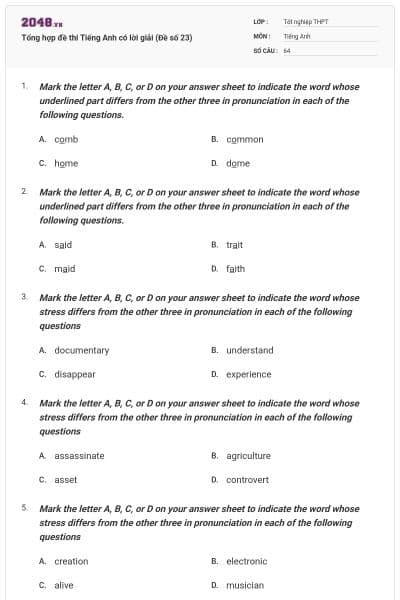
Mark the letter A, B, C, or D on your answer sheet to indicate the word whose underlined part differs from the other three in pronunciation in each of the following questions.
comb
common
home
dome
Đáp án : B
A./əʊ/ B./ɔ/ C. /əʊ/ D. /əʊ/
Mark the letter A, B, C, or D on your answer sheet to indicate the word whose underlined part differs from the other three in pronunciation in each of the following questions.
said
trait
maid
faith
Đáp án A
A./e/ B./ei/ C. /ei/ D. /ei/
Mark the letter A, B, C, or D on your answer sheet to indicate the word whose stress differs from the other three in pronunciation in each of the following questions
documentary
understand
disappear
experience
Đáp án D
Phần D trọng âm rơi vào âm tiết thứ 2, còn lại là thứ 3
Mark the letter A, B, C, or D on your answer sheet to indicate the word whose stress differs from the other three in pronunciation in each of the following questions
assassinate
agriculture
asset
controvert
Đáp án A
Phần A trọng âm rơi vào âm tiết thứ 2, còn lại là thứ nhất
Mark the letter A, B, C, or D on your answer sheet to indicate the word whose stress differs from the other three in pronunciation in each of the following questions
creation
electronic
alive
musician
Đáp án B
Phần B trọng âm rơi vào âm tiết thứ 3, còn lại là thứ 2
Young people have become increasingly committed ______ social activities
of
to
in
at
Đáp án B
Cấu trúc “commit + to st”: danh tình cảm, nỗ lực vào một cái gì đó một cách nghiêm túc
The company employs a_________ of nearly 6000
workman
workout
workload
workforce
Đáp án D
“workforce”: lực lượng công nhân
“workload”: khối lượng công việc (cần hoàn thành)
“workout”: buổi luyện tập (thể dục thể thao)
“workman”: công nhân, người lao động
_______ the time their babies arrive, the Johnsons hope to have finished painting the nursery
For
In
Till
By
Đáp án D
“by” + time: trước thời gian nào đó By the time their babies arrive, the Johnsons hope to have finished painting the nursery: Trước thời điểm
con của họ đến nơi, Johnsons hy vọng sẽ kết thúc việc sơn vườn ươm
Vietnamese marksman Nguyen Manh Tuong, who owned five gold medals during the Games, was awarded the most_________athlete title
impressive
remarkable
outstanding
admirable
Đáp án C
“outstanding”: nổi bật, nổi trội Vietnamese marksman Nguyen Manh Tuong, who owned five gold medals during the Games, was awarded the most outstanding athlete title: thiện xạ Việt Nam Nguyễn Mạnh Tường, người sở hữu năm
huy chương vàng trong the Games, đã được trao tặng danh hiệu vận động viên nổi bật nhất
We are_________ to encourage more local employers to work with us
interested
satisfied
willing
keen
Đáp án C
“willing” + to do st: sẵn lòng, tự nguyện làm gì đó
Water polo was the first_________ sport added to the Olympic program in 1900
adventure
team
individual
spectator
Đáp án B
Water polo (chơi bóng nước) là thể loại thể thao đồng đội (team sport)
The _________ part of the week is always busy for me
early
near
start
front
Đáp án A
“The early part of the week”: phần đầu tiên của tuần, những ngày đầu tuần
Microwaves are used for cooking, telecommunications, and ______
medical diagnosing
to diagnose medically
diagnosed medically
medical diagnosis
Đáp án D
Ở đây ta cần một danh từ vì phía trước đã có cooking, telecommunications
“diagnosis”: sự chuẩn đoán, phép chuẩn đoán
“medical diagnosis”: sự chuẩn đoán bệnh trong y học
The Party and State leaders, delegates, _________ and international guests, and 11 sports delegations from Southeast Asian countries to the 22nd SEA Games were warmly welcomed
host
family
household
domestic
Đáp án: D
Kiến thức: Từ vựng
A. host (n): chủ nhà, nước chủ nhà, (v) đăng cai
B. family (n): gia đình
C. household (n): hộ gia đình
D. domestic (adj): nội địa, trong nước
Ở đây ta căn cứ vào nghĩa câu, và vào cụm “international guests” (khách quốc tế) phía sau, ta thấy cần dùng một tính từ và đứng song hành với “international”, chọn D.
Dịch: Lãnh đạo Đảng, Nhà nước, các vị đại biểu, khách mời trong nước, quốc tế và 11 đoàn thể thao các nước Đông Nam Á tham dự SEA Games 22 đã được chào đón nồng nhiệt.
The host country, Laos, is expected to announce _________ sports for 25th SEA Games in November 2008
official
key
core
main
Đáp án: A
Giải thích:
Kiến thức: Từ vựng
A. official (adj): chính thức
B. key (adj): quan trọng
C. core (adj): cốt lõi
D. main (adj): chính
Dựa vào nghĩa, chọn A.
Dịch: Nước chủ nhà Lào dự kiến sẽ công bố môn thể thao chính thức của SEA Games lần thứ 25 vào tháng 11 năm 2008.
When the company had to close because of economic difficulties, many people became _____
deliberate
homeless
unsatisfactory
redundant
Đáp án D
“redundant”: thừa ra (nhân công – sẽ bị sa thải) When the company had to close because of economic difficulties, many people became redundant: Khi
công ty phải đóng cửa vì kinh tế khó khăn, nhiều người đã trở thành dư thừa
_________, the athlete broke the world's record with two attempts
Surprise
Surprised
Surprising
Surprisingly
Đáp án D
“Surprisingly” (trạng ngữ, thường đứng đầu câu): một cách đáng kinh ngạc
He just couldn't open the jar _______ hard he tried
whatever
however
moreover
even
Đáp án B
“however” ở đây không phải mang nghĩa là tuy nhiên, mà là “dù thế nào đi nữa..” He just couldn't open the jar however hard he tried: Anh ta không thể mở cái lọ dù anh đã cố gắng thế nào đi nữa
Your task is _____ mine but I have to be there all day
like to
alike
similar to
same like
Đáp án C
“similar” + to: giống với cái gì
“alike” không đi kèm tân ngữ ở sau. Nếu dùng alike thì phải viết là your task and mine are alike.
“the same as” là giống, không có same like
“like to” không đúng, like (giống) không có giới từ đi kèm
Not once did I see him ______ a finger to help in the home
move
lift
click
shift
Đáp án B
Cấu trúc lift (raise) a finger (hand) to do st: mó tay vào làm việc gì
On behalf of the referees and athletes, referee Hoang Quoc Vinh and shooter Nguyen Manh Tuong _________ an oath of "Solidarity, Honesty and Fair Play
spoke
said
swore
told
Đáp án C
“an oath”: lời tuyên thệ
Vì thế ở đây dùng swore (quá khứ của swear): thề
______ about gene-related diseases has increased is welcome news
Scientific knowledge
It was scientific knowledge
Though scientific knowledge
That scientific knowledge
Đáp án: D
Giải thích:
Nhận thấy 2 động từ trong câu là “has increased” và “is" => "______ about gene-related diseases has increased” là mệnh đề danh ngữ (có cấu trúc marker + SV), đứng đầu câu và đóng vai trò làm chủ ngữ, động từ đi sau nó chia dạng số ít => “is” là vị ngữ chính của câu.
=> Đáp án D. That scientific knowledge (That + S).
Dịch: Kiến thức khoa học về các bệnh liên quan đến gen ngày càng tăng là một tin đáng mừng.
A vacuum will neither conduct heat nor ______
transmit sound waves
transmitting sound waves
sound waves are transmitted
the transmission of sound waves
Đáp án A
Vế trước “conduct heat” động từ được dùng ở dạng nguyên thể, nên ở đây động từ cũng được chia ở dạng
nguyên thể
_______, the young mother appeared visibly very happy after the birth of her child
She was tired
Tired as she was
As tired
Despite tired
Đáp án B
Đảo tính từ lên trước nhằm nhấn mạnh tính chất của chủ ngữ Adj + as/though + S + be
Read the following passage and mark the letter A, B, C or D on your answer sheet to indicate the correct answer to each of the questions.
ACADEMICS AREN’T THE PROBLEM
Studies about how students use their time might shed light on whether they face increased academic and financial pressures compared with earlier eras.
Based on data about how students are spending time, academic or financial pressures don’t seem to be greater now than a generation ago.
The data show that full-time students in all types of colleges study much less now than they did a generation ago - a full 10 hours a week less. Students are also receiving significantly higher grades. So it appears that academic pressures are, in fact, considerably lower than they used to be.
The time-use data don’t suggest that students feel greater financial pressures, either. When the time savings and lower opportunity costs are factored in, college appears less expensive for most students than it was in the 1960s. And though there are now full-time students working to pay while in college, they study less even when paid work choices are held constantly.
In other words, full-time students do not appear to be studying less in order to work more. They appear to be studying less and spending the extra time on leisure activities or fun. It seems hard to imagine that students feeling increased financial pressures would respond by taking more leisure.
Based on how students are spending their time then, it doesn’t look as though academic or financial pressures are greater now than a generation ago. The time-use data don’t speak directly to social pressures, and it may well be that these have become more intense lately.
In one recent set of data, students reported spending more than 23 hours per week either socializing with friends or playing on the computer for fun. Social activities, in person or on computer, would seem to have become the major focus of campus life. It is hard to tell what kinds of pressures would be associated with this change
The study’s conclusion that students’ workload now is not greater than before is based on_________
what students achieve with greater load
how students work through college
how students spend their time
what college demands from students
Đáp án C
Thông tin ở câu đầu (đoạn đầu): Studies about how students use their time might shed light on whether they face increased academic and financial pressures compared with earlier eras: Các nghiên cứu về cách sinh viên sử dụng thời gian của họ có thể làm sáng tỏ liệu họ phải đối mặt với gia tăng áp lực học tập và
tài chính so với thời kỳ trước hay không
Và câu thứ 2 (đoạn 2) đã đưa ra câu trả lời: Based on data about how students are spending time,
academic or financial pressures don’t seem to be greater now than a generation ago: Dựa trên dữ liệu về sinh viên đang dành thời gian, áp lực học tập, tài chính dường như không lớn hơn so với thế hệ trước
Read the following passage and mark the letter A, B, C or D on your answer sheet to indicate the correct answer to each of the questions.
ACADEMICS AREN’T THE PROBLEM
Studies about how students use their time might shed light on whether they face increased academic and financial pressures compared with earlier eras.
Based on data about how students are spending time, academic or financial pressures don’t seem to be greater now than a generation ago.
The data show that full-time students in all types of colleges study much less now than they did a generation ago - a full 10 hours a week less. Students are also receiving significantly higher grades. So it appears that academic pressures are, in fact, considerably lower than they used to be.
The time-use data don’t suggest that students feel greater financial pressures, either. When the time savings and lower opportunity costs are factored in, college appears less expensive for most students than it was in the 1960s. And though there are now full-time students working to pay while in college, they study less even when paid work choices are held constantly.
In other words, full-time students do not appear to be studying less in order to work more. They appear to be studying less and spending the extra time on leisure activities or fun. It seems hard to imagine that students feeling increased financial pressures would respond by taking more leisure.
Based on how students are spending their time then, it doesn’t look as though academic or financial pressures are greater now than a generation ago. The time-use data don’t speak directly to social pressures, and it may well be that these have become more intense lately.
In one recent set of data, students reported spending more than 23 hours per week either socializing with friends or playing on the computer for fun. Social activities, in person or on computer, would seem to have become the major focus of campus life. It is hard to tell what kinds of pressures would be associated with this change
Research studies have shown that pressures put on students nowadays are __________
more diversified
getting ever greater
not greater than the past
much greater than the past
Đáp án C Thông tin ở câu cuối của đoạn 3: So it appears that academic pressures are, in fact, considerably lower than they used to be: Vì vậy, có vẻ như áp lực học tập, trên thực tế, thấp hơn đáng kể so với trước kia
Read the following passage and mark the letter A, B, C or D on your answer sheet to indicate the correct answer to each of the questions.
ACADEMICS AREN’T THE PROBLEM
Studies about how students use their time might shed light on whether they face increased academic and financial pressures compared with earlier eras.
Based on data about how students are spending time, academic or financial pressures don’t seem to be greater now than a generation ago.
The data show that full-time students in all types of colleges study much less now than they did a generation ago - a full 10 hours a week less. Students are also receiving significantly higher grades. So it appears that academic pressures are, in fact, considerably lower than they used to be.
The time-use data don’t suggest that students feel greater financial pressures, either. When the time savings and lower opportunity costs are factored in, college appears less expensive for most students than it was in the 1960s. And though there are now full-time students working to pay while in college, they study less even when paid work choices are held constantly.
In other words, full-time students do not appear to be studying less in order to work more. They appear to be studying less and spending the extra time on leisure activities or fun. It seems hard to imagine that students feeling increased financial pressures would respond by taking more leisure.
Based on how students are spending their time then, it doesn’t look as though academic or financial pressures are greater now than a generation ago. The time-use data don’t speak directly to social pressures, and it may well be that these have become more intense lately.
In one recent set of data, students reported spending more than 23 hours per week either socializing with friends or playing on the computer for fun. Social activities, in person or on computer, would seem to have become the major focus of campus life. It is hard to tell what kinds of pressures would be associated with this change
Students get higher grades as__________
academic workload appears less demanding
academic workload appears more attractive
students study much harder
college’s facilities are much better
Đáp án A
Thông tin ở 2 câu đầu của đoạn 3: The data show that full-time students in all types of colleges study much less now than they did a generation ago - a full 10 hours a week less. Students are also receiving significantly higher grades: Các dữ liệu cho thấy rằng sinh viên toàn thời gian trong tất cả các loại của
trường cao đẳng học tập ít hơn một thế hệ trước đây – ít hơn 10h một tuần. Sinh viên cũng được nhận
điểm cao hơn đáng kể
Read the following passage and mark the letter A, B, C or D on your answer sheet to indicate the correct answer to each of the questions.
ACADEMICS AREN’T THE PROBLEM
Studies about how students use their time might shed light on whether they face increased academic and financial pressures compared with earlier eras.
Based on data about how students are spending time, academic or financial pressures don’t seem to be greater now than a generation ago.
The data show that full-time students in all types of colleges study much less now than they did a generation ago - a full 10 hours a week less. Students are also receiving significantly higher grades. So it appears that academic pressures are, in fact, considerably lower than they used to be.
The time-use data don’t suggest that students feel greater financial pressures, either. When the time savings and lower opportunity costs are factored in, college appears less expensive for most students than it was in the 1960s. And though there are now full-time students working to pay while in college, they study less even when paid work choices are held constantly.
In other words, full-time students do not appear to be studying less in order to work more. They appear to be studying less and spending the extra time on leisure activities or fun. It seems hard to imagine that students feeling increased financial pressures would respond by taking more leisure.
Based on how students are spending their time then, it doesn’t look as though academic or financial pressures are greater now than a generation ago. The time-use data don’t speak directly to social pressures, and it may well be that these have become more intense lately.
In one recent set of data, students reported spending more than 23 hours per week either socializing with friends or playing on the computer for fun. Social activities, in person or on computer, would seem to have become the major focus of campus life. It is hard to tell what kinds of pressures would be associated with this change
According to the author, the fact that students have more time for leisure is a proof that_____
they are active with extra-curricular activities
they cannot find extra jobs
financial pressure on students is not a problem
academic work disinterests them
Đáp án C
Thông tin ở câu đầu đoạn 4 và câu cuối đoạn 5: - The time-use data don’t suggest that students feel greater financial pressures, either: Các dữ liệu sử dụng
thời gian cũng không cho rằng sinh viên cảm thấy áp lực tài chính lớn hơn - It seems hard to imagine that students feeling increased financial pressures would respond by taking more leisure: Nó có vẻ khó tưởng tượng rằng sinh viên cảm thấy tăng áp lực tài chính sẽ phản ứng bằng
cách tham gia nhiều hoạt động giải trí
Read the following passage and mark the letter A, B, C or D on your answer sheet to indicate the correct answer to each of the questions.
ACADEMICS AREN’T THE PROBLEM
Studies about how students use their time might shed light on whether they face increased academic and financial pressures compared with earlier eras.
Based on data about how students are spending time, academic or financial pressures don’t seem to be greater now than a generation ago.
The data show that full-time students in all types of colleges study much less now than they did a generation ago - a full 10 hours a week less. Students are also receiving significantly higher grades. So it appears that academic pressures are, in fact, considerably lower than they used to be.
The time-use data don’t suggest that students feel greater financial pressures, either. When the time savings and lower opportunity costs are factored in, college appears less expensive for most students than it was in the 1960s. And though there are now full-time students working to pay while in college, they study less even when paid work choices are held constantly.
In other words, full-time students do not appear to be studying less in order to work more. They appear to be studying less and spending the extra time on leisure activities or fun. It seems hard to imagine that students feeling increased financial pressures would respond by taking more leisure.
Based on how students are spending their time then, it doesn’t look as though academic or financial pressures are greater now than a generation ago. The time-use data don’t speak directly to social pressures, and it may well be that these have become more intense lately.
In one recent set of data, students reported spending more than 23 hours per week either socializing with friends or playing on the computer for fun. Social activities, in person or on computer, would seem to have become the major focus of campus life. It is hard to tell what kinds of pressures would be associated with this change
All factors considered, college now seems___________
ever more expensive
much more expensive
more costly
less expensive
Đáp án D
Thông tin ở câu thứ 2 của đoạn 4: When the time savings and lower opportunity costs are factored in, college appears less expensive for most students than it was in the 1960s: Khi các khoản tiết kiệm thời
gian và chi phí cơ hội thấp hơn được đưa vào, đại học dường như ít tốn kém cho hầu hết các sinh viên
hơn là trong những năm 1960.
Read the following passage and mark the letter A, B, C or D on your answer sheet to indicate the correct answer to each of the questions.
ACADEMICS AREN’T THE PROBLEM
Studies about how students use their time might shed light on whether they face increased academic and financial pressures compared with earlier eras.
Based on data about how students are spending time, academic or financial pressures don’t seem to be greater now than a generation ago.
The data show that full-time students in all types of colleges study much less now than they did a generation ago - a full 10 hours a week less. Students are also receiving significantly higher grades. So it appears that academic pressures are, in fact, considerably lower than they used to be.
The time-use data don’t suggest that students feel greater financial pressures, either. When the time savings and lower opportunity costs are factored in, college appears less expensive for most students than it was in the 1960s. And though there are now full-time students working to pay while in college, they study less even when paid work choices are held constantly.
In other words, full-time students do not appear to be studying less in order to work more. They appear to be studying less and spending the extra time on leisure activities or fun. It seems hard to imagine that students feeling increased financial pressures would respond by taking more leisure.
Based on how students are spending their time then, it doesn’t look as though academic or financial pressures are greater now than a generation ago. The time-use data don’t speak directly to social pressures, and it may well be that these have become more intense lately.
In one recent set of data, students reported spending more than 23 hours per week either socializing with friends or playing on the computer for fun. Social activities, in person or on computer, would seem to have become the major focus of campus life. It is hard to tell what kinds of pressures would be associated with this change
According to the author, the fact that more full-time students are working for pay________
shows that students are financially pressured
indicates that students are academically pressured
is not an indication of pressures
does not change students’ campus life
Đáp án C
Thông tin ở câu cuối đoạn 4: And though there are now full-time students working to pay while in college, they study less even when paid work choices are held constantly: Và mặc dù bây giờ có những sinh viên toàn thời gian làm việc để trả tiền trong khi học đại học, họ học tập ít hơn ngay cả khi lựa chọn
Read the following passage and mark the letter A, B, C or D on your answer sheet to indicate the correct answer to each of the questions.
ACADEMICS AREN’T THE PROBLEM
Studies about how students use their time might shed light on whether they face increased academic and financial pressures compared with earlier eras.
Based on data about how students are spending time, academic or financial pressures don’t seem to be greater now than a generation ago.
The data show that full-time students in all types of colleges study much less now than they did a generation ago - a full 10 hours a week less. Students are also receiving significantly higher grades. So it appears that academic pressures are, in fact, considerably lower than they used to be.
The time-use data don’t suggest that students feel greater financial pressures, either. When the time savings and lower opportunity costs are factored in, college appears less expensive for most students than it was in the 1960s. And though there are now full-time students working to pay while in college, they study less even when paid work choices are held constantly.
In other words, full-time students do not appear to be studying less in order to work more. They appear to be studying less and spending the extra time on leisure activities or fun. It seems hard to imagine that students feeling increased financial pressures would respond by taking more leisure.
Based on how students are spending their time then, it doesn’t look as though academic or financial pressures are greater now than a generation ago. The time-use data don’t speak directly to social pressures, and it may well be that these have become more intense lately.
In one recent set of data, students reported spending more than 23 hours per week either socializing with friends or playing on the computer for fun. Social activities, in person or on computer, would seem to have become the major focus of campus life. It is hard to tell what kinds of pressures would be associated with this change
Students nowadays seem to be studying less and__________
taking more extracurricular activities
giving more time to sports
spending more time doing odd jobs
spending more time on leisure
Đáp án C
Thông tin ở câu thứ 2 đoạn 5: They appear to be studying less and spending the extra time on leisure activities or fun: Họ dường như học ít hơn và dành nhiều thời gian cho các hoạt động giải trí hoặc vui
chơi = spending more time doing odd jobs (dành nhiều thời gian cho những việc vặt)
Read the following passage and mark the letter A, B, C or D on your answer sheet to indicate the correct answer to each of the questions.
ACADEMICS AREN’T THE PROBLEM
Studies about how students use their time might shed light on whether they face increased academic and financial pressures compared with earlier eras.
Based on data about how students are spending time, academic or financial pressures don’t seem to be greater now than a generation ago.
The data show that full-time students in all types of colleges study much less now than they did a generation ago - a full 10 hours a week less. Students are also receiving significantly higher grades. So it appears that academic pressures are, in fact, considerably lower than they used to be.
The time-use data don’t suggest that students feel greater financial pressures, either. When the time savings and lower opportunity costs are factored in, college appears less expensive for most students than it was in the 1960s. And though there are now full-time students working to pay while in college, they study less even when paid work choices are held constantly.
In other words, full-time students do not appear to be studying less in order to work more. They appear to be studying less and spending the extra time on leisure activities or fun. It seems hard to imagine that students feeling increased financial pressures would respond by taking more leisure.
Based on how students are spending their time then, it doesn’t look as though academic or financial pressures are greater now than a generation ago. The time-use data don’t speak directly to social pressures, and it may well be that these have become more intense lately.
In one recent set of data, students reported spending more than 23 hours per week either socializing with friends or playing on the computer for fun. Social activities, in person or on computer, would seem to have become the major focus of campus life. It is hard to tell what kinds of pressures would be associated with this change
The word “focus” in the last paragraph can be replaced with__________
biggest importance
headline
central activity
primary theme
Đáp án C
“focus” = central activity, trong bài được hiểu là các hoạt động trọng tâm, trọng yếu
Read the following passage and mark the letter A, B, C or D on your answer sheet to indicate the correct answer to each of the questions.
ACADEMICS AREN’T THE PROBLEM
Studies about how students use their time might shed light on whether they face increased academic and financial pressures compared with earlier eras.
Based on data about how students are spending time, academic or financial pressures don’t seem to be greater now than a generation ago.
The data show that full-time students in all types of colleges study much less now than they did a generation ago - a full 10 hours a week less. Students are also receiving significantly higher grades. So it appears that academic pressures are, in fact, considerably lower than they used to be.
The time-use data don’t suggest that students feel greater financial pressures, either. When the time savings and lower opportunity costs are factored in, college appears less expensive for most students than it was in the 1960s. And though there are now full-time students working to pay while in college, they study less even when paid work choices are held constantly.
In other words, full-time students do not appear to be studying less in order to work more. They appear to be studying less and spending the extra time on leisure activities or fun. It seems hard to imagine that students feeling increased financial pressures would respond by taking more leisure.
Based on how students are spending their time then, it doesn’t look as though academic or financial pressures are greater now than a generation ago. The time-use data don’t speak directly to social pressures, and it may well be that these have become more intense lately.
In one recent set of data, students reported spending more than 23 hours per week either socializing with friends or playing on the computer for fun. Social activities, in person or on computer, would seem to have become the major focus of campus life. It is hard to tell what kinds of pressures would be associated with this change
The author finds it hard to point out___________
what is associated with the change in students’ campus life
how students’ campus life becomes subject to academic pressure
how the background of students’ campus life is built
the cause to students’ financial pressure
Đáp án A
Thông tin ở câu cuối cùng của bài: It is hard to tell what kinds of pressures would be associated with this change: Thật khó để nói những loại áp lực gì sẽ gắn liền với sự thay đổi này
Read the following passage and mark the letter A, B, C or D on your answer sheet to indicate the correct answer to each of the questions.
ACADEMICS AREN’T THE PROBLEM
Studies about how students use their time might shed light on whether they face increased academic and financial pressures compared with earlier eras.
Based on data about how students are spending time, academic or financial pressures don’t seem to be greater now than a generation ago.
The data show that full-time students in all types of colleges study much less now than they did a generation ago - a full 10 hours a week less. Students are also receiving significantly higher grades. So it appears that academic pressures are, in fact, considerably lower than they used to be.
The time-use data don’t suggest that students feel greater financial pressures, either. When the time savings and lower opportunity costs are factored in, college appears less expensive for most students than it was in the 1960s. And though there are now full-time students working to pay while in college, they study less even when paid work choices are held constantly.
In other words, full-time students do not appear to be studying less in order to work more. They appear to be studying less and spending the extra time on leisure activities or fun. It seems hard to imagine that students feeling increased financial pressures would respond by taking more leisure.
Based on how students are spending their time then, it doesn’t look as though academic or financial pressures are greater now than a generation ago. The time-use data don’t speak directly to social pressures, and it may well be that these have become more intense lately.
In one recent set of data, students reported spending more than 23 hours per week either socializing with friends or playing on the computer for fun. Social activities, in person or on computer, would seem to have become the major focus of campus life. It is hard to tell what kinds of pressures would be associated with this change
The word “Academics” in the title mostly means___________
professors and research students
students’ workload in college
graduate students’ workload
college students and tutors
Đáp án B
“Academics” = students’ workload in college: khối lượng công việc của sinh viên trong trường đại học
Mark the letter A, B, C or D to indicate the word or phrase that is CLOSEST in meaning to the italic part in each of the following questions
The notice should be put in the most conspicuous place so that all the students can be wellinformed
easily seen
beautiful
popular
suspicious
Đáp án A
“conspicuous” = easily seen: dễ thấy, dễ nhận ra
Mark the letter A, B, C or D to indicate the word or phrase that is CLOSEST in meaning to the italic part in each of the following questions
Property prices have gone up, then gome down, then gone up again this year
fluctuated
fallen
changed
increased
Đáp án A
“gone up, then gome down, then gone up” = fluctuated: dao động, lên xuống thất thường
Mark the letter A, B, C or D to indicate the word or phrase that is CLOSEST in meaning to the italic part in each of the following questions
He didn’t bat an eye ( eyelid / eyelash) when he realized he failed the exam again
didn’t show surprise
wasn’t happy
didn’t want to see
didn’t care
Đáp án: A
Giải thích:
Kiến thức: Thành ngữ - Cụm từ đồng nghĩa
didn’t bat an eye (eyelid/eyelash): không bất ngờ, điềm nhiên
A. didn’t show surprise: không bất ngờ
B. didn’t want to see: không muốn xem
C. didn’t care: không quan tâm
D. wasn’t happy: không vui
→ didn’t bat an eye (eyelid/eyelash) = didn’t show surprise
Dịch: Anh ấy không hề ngạc nhiên khi nhận ra mình lại trượt kỳ thi.
Read the passage and mark A, B, C, or D to indicate the correct answer to each of the blanks.
My younger sister is a potential star of state and screen, or at least that's what she tells me. Last week she had an interview. It was for the (38)……………..of Juliet in Shakespear’s Romeo and Juliet. It went well and she starts (39)……………..next week. This is the first play that she has been in, but she has done quite a lot of TV advertising work and she has been in a couple of films. The last film she was in was called The magician. It was set in ancient Egypt and she was in a crowd (40)……………..with thousands of other people. When I went to see it, I sat in the front (41)……………..so that I could see the (42)…………….. really clearly, but I couldn’t pick out my sister in the crowd. She says the (43)……………..was one of the best professionals she has worked with but I must say the (44)……………..seemed a bit stupid to me. It was all about a very clever magician who had managed to travel back through time to the Court of Tutankhamen. The (45)……………..were magnificent and so were some of the sets but having an actor saying (46)……………..in present day American English just didn’t work. The ending was really ridiculous. The magician got accidentally buried with Tutankhamen. Funnily enough, the rest of the (47)……………..seemed to have rather enjoyed the film.Question 38
position
job
post
part
Đáp án D
“part” ở đây được hiểu là phân cảnh, vai diễn
It was for the part of Juliet in Shakespeare’s Romeo and Juliet: Nó là vai của Juliet trong Romeo và Juliet
của Shakespeare.
Read the passage and mark A, B, C, or D to indicate the correct answer to each of the blanks.
My younger sister is a potential star of state and screen, or at least that's what she tells me. Last week she had an interview. It was for the (38)……………..of Juliet in Shakespear’s Romeo and Juliet. It went well and she starts (39)……………..next week. This is the first play that she has been in, but she has done quite a lot of TV advertising work and she has been in a couple of films. The last film she was in was called The magician. It was set in ancient Egypt and she was in a crowd (40)……………..with thousands of other people. When I went to see it, I sat in the front (41)……………..so that I could see the (42)…………….. really clearly, but I couldn’t pick out my sister in the crowd. She says the (43)……………..was one of the best professionals she has worked with but I must say the (44)……………..seemed a bit stupid to me. It was all about a very clever magician who had managed to travel back through time to the Court of Tutankhamen. The (45)……………..were magnificent and so were some of the sets but having an actor saying (46)……………..in present day American English just didn’t work. The ending was really ridiculous. The magician got accidentally buried with Tutankhamen. Funnily enough, the rest of the (47)……………..seemed to have rather enjoyed the film.Question 39
exercises
training sessions
rehearsals
practices
Đáp án C
“rehearsals”: sự diễn tập, buổi diễn tập (cho vở kịch…)
Read the passage and mark A, B, C, or D to indicate the correct answer to each of the blanks.
My younger sister is a potential star of state and screen, or at least that's what she tells me. Last week she had an interview. It was for the (38)……………..of Juliet in Shakespear’s Romeo and Juliet. It went well and she starts (39)……………..next week. This is the first play that she has been in, but she has done quite a lot of TV advertising work and she has been in a couple of films. The last film she was in was called The magician. It was set in ancient Egypt and she was in a crowd (40)……………..with thousands of other people. When I went to see it, I sat in the front (41)……………..so that I could see the (42)…………….. really clearly, but I couldn’t pick out my sister in the crowd. She says the (43)……………..was one of the best professionals she has worked with but I must say the (44)……………..seemed a bit stupid to me. It was all about a very clever magician who had managed to travel back through time to the Court of Tutankhamen. The (45)……………..were magnificent and so were some of the sets but having an actor saying (46)……………..in present day American English just didn’t work. The ending was really ridiculous. The magician got accidentally buried with Tutankhamen. Funnily enough, the rest of the (47)……………..seemed to have rather enjoyed the film.Question 40
spot
scene
scenery
view
Đáp án B
“scene”: cảnh (trong phim)
Cần phân biệt với scenery: phong cảnh, dụng cụ dựng cảnh (trên sân khấu)
Read the passage and mark A, B, C, or D to indicate the correct answer to each of the blanks.
My younger sister is a potential star of state and screen, or at least that's what she tells me. Last week she had an interview. It was for the (38)……………..of Juliet in Shakespear’s Romeo and Juliet. It went well and she starts (39)……………..next week. This is the first play that she has been in, but she has done quite a lot of TV advertising work and she has been in a couple of films. The last film she was in was called The magician. It was set in ancient Egypt and she was in a crowd (40)……………..with thousands of other people. When I went to see it, I sat in the front (41)……………..so that I could see the (42)…………….. really clearly, but I couldn’t pick out my sister in the crowd. She says the (43)……………..was one of the best professionals she has worked with but I must say the (44)……………..seemed a bit stupid to me. It was all about a very clever magician who had managed to travel back through time to the Court of Tutankhamen. The (45)……………..were magnificent and so were some of the sets but having an actor saying (46)……………..in present day American English just didn’t work. The ending was really ridiculous. The magician got accidentally buried with Tutankhamen. Funnily enough, the rest of the (47)……………..seemed to have rather enjoyed the film.Question 41
file
row
line
queue
Đáp án B
“the front row”: hàng ghế đầu (trong nhà hát, rạp…)
Read the passage and mark A, B, C, or D to indicate the correct answer to each of the blanks.
My younger sister is a potential star of state and screen, or at least that's what she tells me. Last week she had an interview. It was for the (38)……………..of Juliet in Shakespear’s Romeo and Juliet. It went well and she starts (39)……………..next week. This is the first play that she has been in, but she has done quite a lot of TV advertising work and she has been in a couple of films. The last film she was in was called The magician. It was set in ancient Egypt and she was in a crowd (40)……………..with thousands of other people. When I went to see it, I sat in the front (41)……………..so that I could see the (42)…………….. really clearly, but I couldn’t pick out my sister in the crowd. She says the (43)……………..was one of the best professionals she has worked with but I must say the (44)……………..seemed a bit stupid to me. It was all about a very clever magician who had managed to travel back through time to the Court of Tutankhamen. The (45)……………..were magnificent and so were some of the sets but having an actor saying (46)……………..in present day American English just didn’t work. The ending was really ridiculous. The magician got accidentally buried with Tutankhamen. Funnily enough, the rest of the (47)……………..seemed to have rather enjoyed the film.Question 42
curtain
blind
screen
board
Đáp án C
“screen”: màn hình
Tác giả đang diễn tả 1 buổi xem phim, screen là màn hình đang chiếu phim đó
Read the passage and mark A, B, C, or D to indicate the correct answer to each of the blanks.
My younger sister is a potential star of state and screen, or at least that's what she tells me. Last week she had an interview. It was for the (38)……………..of Juliet in Shakespear’s Romeo and Juliet. It went well and she starts (39)……………..next week. This is the first play that she has been in, but she has done quite a lot of TV advertising work and she has been in a couple of films. The last film she was in was called The magician. It was set in ancient Egypt and she was in a crowd (40)……………..with thousands of other people. When I went to see it, I sat in the front (41)……………..so that I could see the (42)…………….. really clearly, but I couldn’t pick out my sister in the crowd. She says the (43)……………..was one of the best professionals she has worked with but I must say the (44)……………..seemed a bit stupid to me. It was all about a very clever magician who had managed to travel back through time to the Court of Tutankhamen. The (45)……………..were magnificent and so were some of the sets but having an actor saying (46)……………..in present day American English just didn’t work. The ending was really ridiculous. The magician got accidentally buried with Tutankhamen. Funnily enough, the rest of the (47)……………..seemed to have rather enjoyed the film.Question 43
director
conductor
master
chief
Đáp án A
“director”: đạo diễn
3 từ còn lại không có liên quan đến điện ảnh
Read the passage and mark A, B, C, or D to indicate the correct answer to each of the blanks.
My younger sister is a potential star of state and screen, or at least that's what she tells me. Last week she had an interview. It was for the (38)……………..of Juliet in Shakespear’s Romeo and Juliet. It went well and she starts (39)……………..next week. This is the first play that she has been in, but she has done quite a lot of TV advertising work and she has been in a couple of films. The last film she was in was called The magician. It was set in ancient Egypt and she was in a crowd (40)……………..with thousands of other people. When I went to see it, I sat in the front (41)……………..so that I could see the (42)…………….. really clearly, but I couldn’t pick out my sister in the crowd. She says the (43)……………..was one of the best professionals she has worked with but I must say the (44)……………..seemed a bit stupid to me. It was all about a very clever magician who had managed to travel back through time to the Court of Tutankhamen. The (45)……………..were magnificent and so were some of the sets but having an actor saying (46)……………..in present day American English just didn’t work. The ending was really ridiculous. The magician got accidentally buried with Tutankhamen. Funnily enough, the rest of the (47)……………..seemed to have rather enjoyed the film.Question 44
plot
dialogue
argument
letters
Đáp án A
“plot”: kịch bản (cho một bộ phim, một câu chuyện)
Read the passage and mark A, B, C, or D to indicate the correct answer to each of the blanks.
My younger sister is a potential star of state and screen, or at least that's what she tells me. Last week she had an interview. It was for the (38)……………..of Juliet in Shakespear’s Romeo and Juliet. It went well and she starts (39)……………..next week. This is the first play that she has been in, but she has done quite a lot of TV advertising work and she has been in a couple of films. The last film she was in was called The magician. It was set in ancient Egypt and she was in a crowd (40)……………..with thousands of other people. When I went to see it, I sat in the front (41)……………..so that I could see the (42)…………….. really clearly, but I couldn’t pick out my sister in the crowd. She says the (43)……………..was one of the best professionals she has worked with but I must say the (44)……………..seemed a bit stupid to me. It was all about a very clever magician who had managed to travel back through time to the Court of Tutankhamen. The (45)……………..were magnificent and so were some of the sets but having an actor saying (46)……………..in present day American English just didn’t work. The ending was really ridiculous. The magician got accidentally buried with Tutankhamen. Funnily enough, the rest of the (47)……………..seemed to have rather enjoyed the film.Question 45
dressings
customs
costumes
cloths
Đáp án C
“costumes”: trang phục được mặc bởi người (ví dụ như diễn viên) nhằm tạo sự giống với người hoặc cái
gì đó
Read the passage and mark A, B, C, or D to indicate the correct answer to each of the blanks.
My younger sister is a potential star of state and screen, or at least that's what she tells me. Last week she had an interview. It was for the (38)……………..of Juliet in Shakespear’s Romeo and Juliet. It went well and she starts (39)……………..next week. This is the first play that she has been in, but she has done quite a lot of TV advertising work and she has been in a couple of films. The last film she was in was called The magician. It was set in ancient Egypt and she was in a crowd (40)……………..with thousands of other people. When I went to see it, I sat in the front (41)……………..so that I could see the (42)…………….. really clearly, but I couldn’t pick out my sister in the crowd. She says the (43)……………..was one of the best professionals she has worked with but I must say the (44)……………..seemed a bit stupid to me. It was all about a very clever magician who had managed to travel back through time to the Court of Tutankhamen. The (45)……………..were magnificent and so were some of the sets but having an actor saying (46)……………..in present day American English just didn’t work. The ending was really ridiculous. The magician got accidentally buried with Tutankhamen. Funnily enough, the rest of the (47)……………..seemed to have rather enjoyed the film.Question 46
plays
lines
reading
scripts
Đáp án B
“line” trong lĩnh vực điện ảnh được hiểu là lời thoại của nhân vật
Read the passage and mark A, B, C, or D to indicate the correct answer to each of the blanks.
My younger sister is a potential star of state and screen, or at least that's what she tells me. Last week she had an interview. It was for the (38)……………..of Juliet in Shakespear’s Romeo and Juliet. It went well and she starts (39)……………..next week. This is the first play that she has been in, but she has done quite a lot of TV advertising work and she has been in a couple of films. The last film she was in was called The magician. It was set in ancient Egypt and she was in a crowd (40)……………..with thousands of other people. When I went to see it, I sat in the front (41)……………..so that I could see the (42)…………….. really clearly, but I couldn’t pick out my sister in the crowd. She says the (43)……………..was one of the best professionals she has worked with but I must say the (44)……………..seemed a bit stupid to me. It was all about a very clever magician who had managed to travel back through time to the Court of Tutankhamen. The (45)……………..were magnificent and so were some of the sets but having an actor saying (46)……………..in present day American English just didn’t work. The ending was really ridiculous. The magician got accidentally buried with Tutankhamen. Funnily enough, the rest of the (47)……………..seemed to have rather enjoyed the film.Question 47
spectators
viewers
audience
public
Đáp án C
“audience”: thính giả (vở kịch, ca nhạc, phim…)
“viewers”: khán giả truyền hình (xem thông qua TV)
“spectators”: khán giả (đi xem một sự kiện, thể thao, hoạt động …nào đó)
Mark the letter on your answer sheet to show the underlined part that needs correcting
It is said that Eiinstein felt very bad about the application of his theories for the creation of weapons of war
bad
It is said
felt
for the creation
Đáp án D
“for the creation” -> “to the creation”
“application to st” (ứng dụng cho cái gì) chứ không phải là for st It is said that Eiinstein felt very bad about the application of his theories to the creation of weapons of war: Người ta nói rằng Einstein cảm thấy rất tồi tệ về việc áp dụng các lý thuyết của ông cho việc tạo ra
các loại vũ khí chiến tranh.
Mark the letter on your answer sheet to show the underlined part that needs correcting
The author has rarely written anything that was not a best-selling.
written
best-selling
has
anything
Đáp án B
“best-selling” -> “best-seller”
“best-selling” (tính từ): bán được nhiều, bán chạy
“best-seller”: cuốn sách bán chạy nhất
Mark the letter on your answer sheet to show the underlined part that needs correcting
Chocolate is prepared by a complexity process of cleaning, blending, and roasting cocoa beans, which must be ground and mixed with sugar
blending
complexity
mixed with
which
Đáp án B
“complexity” -> “complex”
Ở đây ta cần một tính từ để bổ sung ý nghĩa cho danh từ process phía sau
Mark the letter on your answer sheet to show the underlined part that needs correcting
Some fishes live at enormous depths that they are almost complete blind
some fishes
enormous depths
blind
complete
Đáp án D
“complete” -> “completely”
Ở đây ta cần một trạng từ để bổ sung cho tính từ blind
Mark the letter on your answer sheet to show the underlined part that needs correcting
Political science, like the other social sciences, is not a right science
like
sciences
a right
other
Đáp án: C
Giải thích:
Kiến thức: Từ vựng
exact science: khoa học đòi hỏi sự chính xác
Sửa: a right → an exact
Dịch: Khoa học chính trị, giống như các khoa học xã hội khác, không phải là khoa học chính xác.
Mark the letter A, B, C or D on your answer sheet to indicate the word or phrase that is OPPOSITE in meaning to the underlined part in each of the following questions
“How do you do, Lan? Do take your weight off your leg.”
take a seat
walk
sit down
stand up
Đáp án D
Cụm “Do take your weight off your leg” (Làm mất trọng lượng của bạn khỏi chân của bạn) = sit down:
ngồi xuống
Trái nghĩa là stand up
Mark the letter A, B, C or D on your answer sheet to indicate the word or phrase that is OPPOSITE in meaning to the underlined part in each of the following questions
She is always tactful when she deals with angry students
strict
firm
discourteous
outspoken
Đáp án C
“tactful”: khéo xử, có tài xử trí
Trái nghĩa là discourteous: bất lịch sự
Read the following passage and mark the letter A, B, C or D on your answer sheet to indicate the correct answer to each of the questions.
Early peoples had no need of engineering works to supply their water. Hunters and nomads camped near natural sources of fresh water, and populations were so sparse that pollution of the water supply was not a serious problem. After community life developed and agricultural villages became urban centres, the problem of supplying water became important for inhabitants of a city, as well as for irrigation of the farms surrounding the city. Irrigation works were known in prehistoric times, and before 2000 BC the rulers of Babylonia and Egypt constructed systems of dams and canals to impound the flood waters of the Euphrates and Nile rivers, controlling floods and providing irrigation water throughout the dry season. Such irrigation canals also supplied water for domestic purposes. The first people to consider the sanitation of their water supply were the ancient Romans, who constructed a vast system of aqueducts to bring the clean waters of the Apennine Mountains into the city and built basins and filters along these mains to ensure the clarity of the water. The construction of such extensive water-supply systems declined when the Roman Empire disintegrated, and for several centuries local springs and wells formed the main source of domestic and industrial water.
The invention of the force pump in England in the middle of the 16th century greatly extended the possibilities of development of water-supply systems. In London, the first pumping waterworks was completed in 1562; it pumped river water to a reservoir about 37 m above the level of the River Thames and from the reservoir the water was distributed by gravity, through lead pipes, to buildings in the vicinity.
Increased per-capita demand has coincided with water shortages in many countries. Southeast England, for example, receives only 14 per cent of Britain's rainfall, has 30 per cent of its population, and has experienced declining winter rainfall since the 1980s.
In recent years a great deal of interest has been shown in the conversion of seawater to fresh water to provide drinking water for very dry areas, such as the Middle East. Several different processes, including distillation, electrodialysis, reverse osmosis, and direct-freeze evaporation, have been developed for this purpose. Some of these processes have been used in large facilities in the United States. Although these processes are successful, the cost of treating seawater is much higher than that for treating fresh water
Early peoples didn’t need water supply engineering works because ______
they had good ways to irrigate their farms
natural sources of fresh water nearby were always available
their community life had already developed
there was almost no dry season in prehistoric times
Đáp án B
Thông tin ở câu thứ 2 của đoạn đầu: Hunters and nomads camped near natural sources of fresh water and populations were so sparse that pollution of the water supply was not a serious problem: Thợ săn và
những người du mục cắm trại gần các nguồn tự nhiên của nước ngọt và dân số quá thưa thớt nên sự ô
nhiễm của nguồn cung cấp nước không phải là một vấn đề nghiêm trọng
Read the following passage and mark the letter A, B, C or D on your answer sheet to indicate the correct answer to each of the questions.
Early peoples had no need of engineering works to supply their water. Hunters and nomads camped near natural sources of fresh water, and populations were so sparse that pollution of the water supply was not a serious problem. After community life developed and agricultural villages became urban centres, the problem of supplying water became important for inhabitants of a city, as well as for irrigation of the farms surrounding the city. Irrigation works were known in prehistoric times, and before 2000 BC the rulers of Babylonia and Egypt constructed systems of dams and canals to impound the flood waters of the Euphrates and Nile rivers, controlling floods and providing irrigation water throughout the dry season. Such irrigation canals also supplied water for domestic purposes. The first people to consider the sanitation of their water supply were the ancient Romans, who constructed a vast system of aqueducts to bring the clean waters of the Apennine Mountains into the city and built basins and filters along these mains to ensure the clarity of the water. The construction of such extensive water-supply systems declined when the Roman Empire disintegrated, and for several centuries local springs and wells formed the main source of domestic and industrial water.
The invention of the force pump in England in the middle of the 16th century greatly extended the possibilities of development of water-supply systems. In London, the first pumping waterworks was completed in 1562; it pumped river water to a reservoir about 37 m above the level of the River Thames and from the reservoir the water was distributed by gravity, through lead pipes, to buildings in the vicinity.
Increased per-capita demand has coincided with water shortages in many countries. Southeast England, for example, receives only 14 per cent of Britain's rainfall, has 30 per cent of its population, and has experienced declining winter rainfall since the 1980s.
In recent years a great deal of interest has been shown in the conversion of seawater to fresh water to provide drinking water for very dry areas, such as the Middle East. Several different processes, including distillation, electrodialysis, reverse osmosis, and direct-freeze evaporation, have been developed for this purpose. Some of these processes have been used in large facilities in the United States. Although these processes are successful, the cost of treating seawater is much higher than that for treating fresh water
The word “impound” in paragraph 1 is closest in meaning to ______
irrigate
drain
supply
provide
Đáp án B
“impound” = drain: tháo, rút, tiêu (nước)
Read the following passage and mark the letter A, B, C or D on your answer sheet to indicate the correct answer to each of the questions.
Early peoples had no need of engineering works to supply their water. Hunters and nomads camped near natural sources of fresh water, and populations were so sparse that pollution of the water supply was not a serious problem. After community life developed and agricultural villages became urban centres, the problem of supplying water became important for inhabitants of a city, as well as for irrigation of the farms surrounding the city. Irrigation works were known in prehistoric times, and before 2000 BC the rulers of Babylonia and Egypt constructed systems of dams and canals to impound the flood waters of the Euphrates and Nile rivers, controlling floods and providing irrigation water throughout the dry season. Such irrigation canals also supplied water for domestic purposes. The first people to consider the sanitation of their water supply were the ancient Romans, who constructed a vast system of aqueducts to bring the clean waters of the Apennine Mountains into the city and built basins and filters along these mains to ensure the clarity of the water. The construction of such extensive water-supply systems declined when the Roman Empire disintegrated, and for several centuries local springs and wells formed the main source of domestic and industrial water.
The invention of the force pump in England in the middle of the 16th century greatly extended the possibilities of development of water-supply systems. In London, the first pumping waterworks was completed in 1562; it pumped river water to a reservoir about 37 m above the level of the River Thames and from the reservoir the water was distributed by gravity, through lead pipes, to buildings in the vicinity.
Increased per-capita demand has coincided with water shortages in many countries. Southeast England, for example, receives only 14 per cent of Britain's rainfall, has 30 per cent of its population, and has experienced declining winter rainfall since the 1980s.
In recent years a great deal of interest has been shown in the conversion of seawater to fresh water to provide drinking water for very dry areas, such as the Middle East. Several different processes, including distillation, electrodialysis, reverse osmosis, and direct-freeze evaporation, have been developed for this purpose. Some of these processes have been used in large facilities in the United States. Although these processes are successful, the cost of treating seawater is much higher than that for treating fresh water
Clean water supply was first taken into consideration by ______
the Egyptians
the English people
the US people
the ancient Romans
Đáp án D
Thông tin ở đoạn 1: The first people to consider the sanitation of their water supply were the ancient Romans: Những người đầu tiên xem xét các điều kiện vệ sinh của các nguồn cung cấp nước của họ là
những người La Mã cổ đại
Read the following passage and mark the letter A, B, C or D on your answer sheet to indicate the correct answer to each of the questions.
Early peoples had no need of engineering works to supply their water. Hunters and nomads camped near natural sources of fresh water, and populations were so sparse that pollution of the water supply was not a serious problem. After community life developed and agricultural villages became urban centres, the problem of supplying water became important for inhabitants of a city, as well as for irrigation of the farms surrounding the city. Irrigation works were known in prehistoric times, and before 2000 BC the rulers of Babylonia and Egypt constructed systems of dams and canals to impound the flood waters of the Euphrates and Nile rivers, controlling floods and providing irrigation water throughout the dry season. Such irrigation canals also supplied water for domestic purposes. The first people to consider the sanitation of their water supply were the ancient Romans, who constructed a vast system of aqueducts to bring the clean waters of the Apennine Mountains into the city and built basins and filters along these mains to ensure the clarity of the water. The construction of such extensive water-supply systems declined when the Roman Empire disintegrated, and for several centuries local springs and wells formed the main source of domestic and industrial water.
The invention of the force pump in England in the middle of the 16th century greatly extended the possibilities of development of water-supply systems. In London, the first pumping waterworks was completed in 1562; it pumped river water to a reservoir about 37 m above the level of the River Thames and from the reservoir the water was distributed by gravity, through lead pipes, to buildings in the vicinity.
Increased per-capita demand has coincided with water shortages in many countries. Southeast England, for example, receives only 14 per cent of Britain's rainfall, has 30 per cent of its population, and has experienced declining winter rainfall since the 1980s.
In recent years a great deal of interest has been shown in the conversion of seawater to fresh water to provide drinking water for very dry areas, such as the Middle East. Several different processes, including distillation, electrodialysis, reverse osmosis, and direct-freeze evaporation, have been developed for this purpose. Some of these processes have been used in large facilities in the United States. Although these processes are successful, the cost of treating seawater is much higher than that for treating fresh water
For several centuries after the disintegration of the Roman Empire, the main source of water supply was from ______
springs and wells
water pipes
dams and canals
systems of aqueducts
Đáp án A
Thông tin ở câu cuối đoạn 1: for several centuries local springs and wells formed the main source of domestic and industrial water: trong nhiều thế kỷ suối và giếng nước hình thành nguồn chính của nước
sinh hoạt và công nghiệp.
Read the following passage and mark the letter A, B, C or D on your answer sheet to indicate the correct answer to each of the questions.
Early peoples had no need of engineering works to supply their water. Hunters and nomads camped near natural sources of fresh water, and populations were so sparse that pollution of the water supply was not a serious problem. After community life developed and agricultural villages became urban centres, the problem of supplying water became important for inhabitants of a city, as well as for irrigation of the farms surrounding the city. Irrigation works were known in prehistoric times, and before 2000 BC the rulers of Babylonia and Egypt constructed systems of dams and canals to impound the flood waters of the Euphrates and Nile rivers, controlling floods and providing irrigation water throughout the dry season. Such irrigation canals also supplied water for domestic purposes. The first people to consider the sanitation of their water supply were the ancient Romans, who constructed a vast system of aqueducts to bring the clean waters of the Apennine Mountains into the city and built basins and filters along these mains to ensure the clarity of the water. The construction of such extensive water-supply systems declined when the Roman Empire disintegrated, and for several centuries local springs and wells formed the main source of domestic and industrial water.
The invention of the force pump in England in the middle of the 16th century greatly extended the possibilities of development of water-supply systems. In London, the first pumping waterworks was completed in 1562; it pumped river water to a reservoir about 37 m above the level of the River Thames and from the reservoir the water was distributed by gravity, through lead pipes, to buildings in the vicinity.
Increased per-capita demand has coincided with water shortages in many countries. Southeast England, for example, receives only 14 per cent of Britain's rainfall, has 30 per cent of its population, and has experienced declining winter rainfall since the 1980s.
In recent years a great deal of interest has been shown in the conversion of seawater to fresh water to provide drinking water for very dry areas, such as the Middle East. Several different processes, including distillation, electrodialysis, reverse osmosis, and direct-freeze evaporation, have been developed for this purpose. Some of these processes have been used in large facilities in the United States. Although these processes are successful, the cost of treating seawater is much higher than that for treating fresh water
The word “mains” in paragraph 1 could best be replaced by ______
lands
pipes
rivers
areas
Đáp án B
“mains” trong đoạn 1 được hiểu là pipes: đường ống
Read the following passage and mark the letter A, B, C or D on your answer sheet to indicate the correct answer to each of the questions.
Early peoples had no need of engineering works to supply their water. Hunters and nomads camped near natural sources of fresh water, and populations were so sparse that pollution of the water supply was not a serious problem. After community life developed and agricultural villages became urban centres, the problem of supplying water became important for inhabitants of a city, as well as for irrigation of the farms surrounding the city. Irrigation works were known in prehistoric times, and before 2000 BC the rulers of Babylonia and Egypt constructed systems of dams and canals to impound the flood waters of the Euphrates and Nile rivers, controlling floods and providing irrigation water throughout the dry season. Such irrigation canals also supplied water for domestic purposes. The first people to consider the sanitation of their water supply were the ancient Romans, who constructed a vast system of aqueducts to bring the clean waters of the Apennine Mountains into the city and built basins and filters along these mains to ensure the clarity of the water. The construction of such extensive water-supply systems declined when the Roman Empire disintegrated, and for several centuries local springs and wells formed the main source of domestic and industrial water.
The invention of the force pump in England in the middle of the 16th century greatly extended the possibilities of development of water-supply systems. In London, the first pumping waterworks was completed in 1562; it pumped river water to a reservoir about 37 m above the level of the River Thames and from the reservoir the water was distributed by gravity, through lead pipes, to buildings in the vicinity.
Increased per-capita demand has coincided with water shortages in many countries. Southeast England, for example, receives only 14 per cent of Britain's rainfall, has 30 per cent of its population, and has experienced declining winter rainfall since the 1980s.
In recent years a great deal of interest has been shown in the conversion of seawater to fresh water to provide drinking water for very dry areas, such as the Middle East. Several different processes, including distillation, electrodialysis, reverse osmosis, and direct-freeze evaporation, have been developed for this purpose. Some of these processes have been used in large facilities in the United States. Although these processes are successful, the cost of treating seawater is much higher than that for treating fresh water
Which of the following is NOT true about London’s water supply in the middle of the 16th century?
Water was conducted through canals.
Water ran from the reservoir to buildings.
Water was stored in a reservoir
Water was pumped from the River Thames.
Đáp án A
Thông tin ở đoạn 2: it pumped river water to a reservoir about 37 m above the level of the River Thames and from the reservoir the water was distributed by gravity, through lead pipes: nó bơm nước sông vào
một hồ chứa khoảng 37 m trên mực nước của sông Thames và từ hồ chứa nước đã được phân phối bởi lực
hấp dẫn, thông qua đường ống dẫn => nước được thông qua các đường ống chứ không phải qua kênh (canal)
Read the following passage and mark the letter A, B, C or D on your answer sheet to indicate the correct answer to each of the questions.
Early peoples had no need of engineering works to supply their water. Hunters and nomads camped near natural sources of fresh water, and populations were so sparse that pollution of the water supply was not a serious problem. After community life developed and agricultural villages became urban centres, the problem of supplying water became important for inhabitants of a city, as well as for irrigation of the farms surrounding the city. Irrigation works were known in prehistoric times, and before 2000 BC the rulers of Babylonia and Egypt constructed systems of dams and canals to impound the flood waters of the Euphrates and Nile rivers, controlling floods and providing irrigation water throughout the dry season. Such irrigation canals also supplied water for domestic purposes. The first people to consider the sanitation of their water supply were the ancient Romans, who constructed a vast system of aqueducts to bring the clean waters of the Apennine Mountains into the city and built basins and filters along these mains to ensure the clarity of the water. The construction of such extensive water-supply systems declined when the Roman Empire disintegrated, and for several centuries local springs and wells formed the main source of domestic and industrial water.
The invention of the force pump in England in the middle of the 16th century greatly extended the possibilities of development of water-supply systems. In London, the first pumping waterworks was completed in 1562; it pumped river water to a reservoir about 37 m above the level of the River Thames and from the reservoir the water was distributed by gravity, through lead pipes, to buildings in the vicinity.
Increased per-capita demand has coincided with water shortages in many countries. Southeast England, for example, receives only 14 per cent of Britain's rainfall, has 30 per cent of its population, and has experienced declining winter rainfall since the 1980s.
In recent years a great deal of interest has been shown in the conversion of seawater to fresh water to provide drinking water for very dry areas, such as the Middle East. Several different processes, including distillation, electrodialysis, reverse osmosis, and direct-freeze evaporation, have been developed for this purpose. Some of these processes have been used in large facilities in the United States. Although these processes are successful, the cost of treating seawater is much higher than that for treating fresh water
The word “vicinity” in paragraph 2 refers to ______
the neighborhood around a reservoir
the areas along the River Thames
the region where industry developed
the cities in South-east England
Đáp án A
“vicinity” = the neighborhood around a reservoir
“vicinity”: là vùng lân cận, ở đây được hiểu là vùng lân cận của hồ nước
Read the following passage and mark the letter A, B, C or D on your answer sheet to indicate the correct answer to each of the questions.
Early peoples had no need of engineering works to supply their water. Hunters and nomads camped near natural sources of fresh water, and populations were so sparse that pollution of the water supply was not a serious problem. After community life developed and agricultural villages became urban centres, the problem of supplying water became important for inhabitants of a city, as well as for irrigation of the farms surrounding the city. Irrigation works were known in prehistoric times, and before 2000 BC the rulers of Babylonia and Egypt constructed systems of dams and canals to impound the flood waters of the Euphrates and Nile rivers, controlling floods and providing irrigation water throughout the dry season. Such irrigation canals also supplied water for domestic purposes. The first people to consider the sanitation of their water supply were the ancient Romans, who constructed a vast system of aqueducts to bring the clean waters of the Apennine Mountains into the city and built basins and filters along these mains to ensure the clarity of the water. The construction of such extensive water-supply systems declined when the Roman Empire disintegrated, and for several centuries local springs and wells formed the main source of domestic and industrial water.
The invention of the force pump in England in the middle of the 16th century greatly extended the possibilities of development of water-supply systems. In London, the first pumping waterworks was completed in 1562; it pumped river water to a reservoir about 37 m above the level of the River Thames and from the reservoir the water was distributed by gravity, through lead pipes, to buildings in the vicinity.
Increased per-capita demand has coincided with water shortages in many countries. Southeast England, for example, receives only 14 per cent of Britain's rainfall, has 30 per cent of its population, and has experienced declining winter rainfall since the 1980s.
In recent years a great deal of interest has been shown in the conversion of seawater to fresh water to provide drinking water for very dry areas, such as the Middle East. Several different processes, including distillation, electrodialysis, reverse osmosis, and direct-freeze evaporation, have been developed for this purpose. Some of these processes have been used in large facilities in the United States. Although these processes are successful, the cost of treating seawater is much higher than that for treating fresh water
One of the causes of water shortages in South-east England is ______
increased demand
water evaporation
water-supply system decline
water pollution
Đáp án A
Thông tin ở câu đầu tiên của đoạn 3: Increased per-capita demand has coincided with water shortages in many countries: Tăng nhu cầu bình quân đầu người đã trùng hợp với tình trạng thiếu nước tại nhiều quốc gia
Read the following passage and mark the letter A, B, C or D on your answer sheet to indicate the correct answer to each of the questions.
Early peoples had no need of engineering works to supply their water. Hunters and nomads camped near natural sources of fresh water, and populations were so sparse that pollution of the water supply was not a serious problem. After community life developed and agricultural villages became urban centres, the problem of supplying water became important for inhabitants of a city, as well as for irrigation of the farms surrounding the city. Irrigation works were known in prehistoric times, and before 2000 BC the rulers of Babylonia and Egypt constructed systems of dams and canals to impound the flood waters of the Euphrates and Nile rivers, controlling floods and providing irrigation water throughout the dry season. Such irrigation canals also supplied water for domestic purposes. The first people to consider the sanitation of their water supply were the ancient Romans, who constructed a vast system of aqueducts to bring the clean waters of the Apennine Mountains into the city and built basins and filters along these mains to ensure the clarity of the water. The construction of such extensive water-supply systems declined when the Roman Empire disintegrated, and for several centuries local springs and wells formed the main source of domestic and industrial water.
The invention of the force pump in England in the middle of the 16th century greatly extended the possibilities of development of water-supply systems. In London, the first pumping waterworks was completed in 1562; it pumped river water to a reservoir about 37 m above the level of the River Thames and from the reservoir the water was distributed by gravity, through lead pipes, to buildings in the vicinity.
Increased per-capita demand has coincided with water shortages in many countries. Southeast England, for example, receives only 14 per cent of Britain's rainfall, has 30 per cent of its population, and has experienced declining winter rainfall since the 1980s.
In recent years a great deal of interest has been shown in the conversion of seawater to fresh water to provide drinking water for very dry areas, such as the Middle East. Several different processes, including distillation, electrodialysis, reverse osmosis, and direct-freeze evaporation, have been developed for this purpose. Some of these processes have been used in large facilities in the United States. Although these processes are successful, the cost of treating seawater is much higher than that for treating fresh water
Which of the following is NOT mentioned as a process of convertinging seawater to freshwater?
Water evaporation
Purification method
Steaming and cooling
Dissolving chemicals
Đáp án D
A,B,C đều được nhắc đến ở đoạn cuối: distillation, electrodialysis, reverse osmosis, and direct-freeze evaporation (khử muối, điện phân, lọc thẩm thấu ngược- Purification method, và trực tiếp đóng băng bốc
hơi - Steaming and cooling, Water evaporation)
Chỉ có D là không được nhắc đến
Read the following passage and mark the letter A, B, C or D on your answer sheet to indicate the correct answer to each of the questions.
Early peoples had no need of engineering works to supply their water. Hunters and nomads camped near natural sources of fresh water, and populations were so sparse that pollution of the water supply was not a serious problem. After community life developed and agricultural villages became urban centres, the problem of supplying water became important for inhabitants of a city, as well as for irrigation of the farms surrounding the city. Irrigation works were known in prehistoric times, and before 2000 BC the rulers of Babylonia and Egypt constructed systems of dams and canals to impound the flood waters of the Euphrates and Nile rivers, controlling floods and providing irrigation water throughout the dry season. Such irrigation canals also supplied water for domestic purposes. The first people to consider the sanitation of their water supply were the ancient Romans, who constructed a vast system of aqueducts to bring the clean waters of the Apennine Mountains into the city and built basins and filters along these mains to ensure the clarity of the water. The construction of such extensive water-supply systems declined when the Roman Empire disintegrated, and for several centuries local springs and wells formed the main source of domestic and industrial water.
The invention of the force pump in England in the middle of the 16th century greatly extended the possibilities of development of water-supply systems. In London, the first pumping waterworks was completed in 1562; it pumped river water to a reservoir about 37 m above the level of the River Thames and from the reservoir the water was distributed by gravity, through lead pipes, to buildings in the vicinity.
Increased per-capita demand has coincided with water shortages in many countries. Southeast England, for example, receives only 14 per cent of Britain's rainfall, has 30 per cent of its population, and has experienced declining winter rainfall since the 1980s.
In recent years a great deal of interest has been shown in the conversion of seawater to fresh water to provide drinking water for very dry areas, such as the Middle East. Several different processes, including distillation, electrodialysis, reverse osmosis, and direct-freeze evaporation, have been developed for this purpose. Some of these processes have been used in large facilities in the United States. Although these processes are successful, the cost of treating seawater is much higher than that for treating fresh water
In the passage, the author mainly discusses ______
the results of water shortages
the water pumping systems
the fresh water storage
the development of water supply
Đáp án D
Bài chủ yếu nói về the development of water supply (sự phát triển của nguồn cung cấp nước) theo thời
gian từ khi con người sử dụng nguồn nước ngọt từ giếng, suối, cho đến thời kì dẫn nước ngọt sơ khai cho
đến dần hoàn thiện