Tổng hợp đề thi Tiếng Anh có lời giải (Đề số 21)
64 câu hỏi
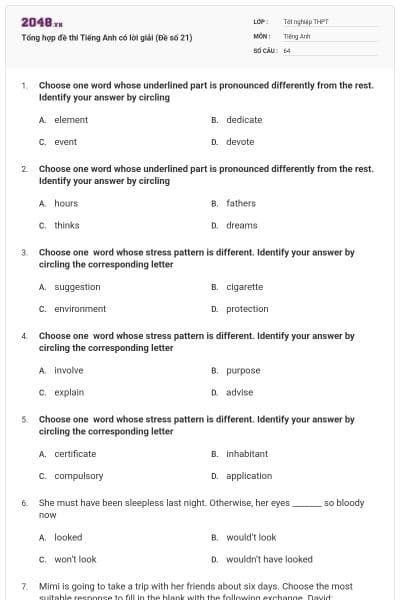
Choose one word whose underlined part is pronounced differently from the rest. Identify your answer by circling
element
dedicate
event
devote
Đáp án : D
“e” trong “devote” phát âm là /i/ , trong các từ còn lại phát âm là /e/
Choose one word whose underlined part is pronounced differently from the rest. Identify your answer by circling
hours
fathers
thinks
dreams
Đáp án : C
“s” trong “thinks” phát âm là /s/ , trong các từ còn lại phát âm là /z/.
Choose one word whose stress pattern is different. Identify your answer by circling the corresponding letter
suggestion
cigarette
environment
protection
Đáp án : B
Trọng âm của từ này rơi vào âm tiết thứ 3, các từ còn lại rơi vào âm tiết thứ 2
Choose one word whose stress pattern is different. Identify your answer by circling the corresponding letter
involve
purpose
explain
advise
Đáp án : B
Trọng âm của từ này rơi vào âm tiết thứ 1, các từ còn lại rơi vào âm tiết thứ 2
Choose one word whose stress pattern is different. Identify your answer by circling the corresponding letter
certificate
inhabitant
compulsory
application
Đáp án : D
Trọng âm của từ này rơi vào âm tiết thứ 3, các từ còn lại rơi vào âm tiết thứ 2
She must have been sleepless last night. Otherwise, her eyes _______ so bloody now
looked
would’t look
won’t look
wouldn’t have looked
Đáp án : B
Câu điều kiện hỗn hợp: had participle, would+ V: làm một việc trong quá khứ và để kết quả ở hiện tại. Dấu hiệu: “now” và “otherwise”= “if not” . Dịch: Có ấy hẳn đã mất ngủ tối qua, nếu không thì bây giờ mắt cô ấy đã không vằn đỏ
Mimi is going to take a trip with her friends about six days. Choose the most suitable response to fill in the blank with the following exchange. David: "_________________" Mimi: "Thank you. Goodbye."
May I introduce myself? My name's David Wilson
Nice to meet you, Mimi
Have a good trip!
How do you do?
Đáp án : C
David:” Chúc bạn có một chuyến đi vui vẻ” -> Lời chúc -> Đáp lại. Mimi: Cảm ơn. Tạm biệt”
The foreign visitor group wanted to pay their last respect to ________ Mr Vo Nguyen Giap used to live, so they waited hours to take the chance
that he
him and which
him and the place where
the place where and him
Đáp án : C
“Respect to” là: kính trọng đến ai -> “him”. Đại từ quan hệ “where” thay thế cho từ “ the place”. Dịch: ….. thể hiện sự kính trọng đến _____ nơi Mr Vo Nguyen Giap từng sống -> chọn đáp án có từ “where” ngay trước từ “ Mr Vo Nguyen Giap” -> C.
The last person _____ will have to turn off the lights
leaving
have left
to leave
left
Đáp án : C
Rút gọn mệnh đề quan hệ mang nghĩa chủ động khi có từ chỉ số thứ tự dùng To V. Dấu hiệu: từ “the last” chỉ thứ tự: cuối cùng.
Last week, John did an essay very well, which was complimented. Choose the most suitable response to fill in the blank with the following exchange. Teacher: "John, you've written a much better essay this time." John: "________________"
Thank you. It's really encouraging
You're welcome
Writing? Why?
What did you say? I'm so shy
Đáp án : A
Teacher: “ John, em đã viết bài luận lần này rất tốt” -> ý khen -> Cảm ơn. John: “Cảm ơn thầy. Nó khích lệ em rất nhiều.”
_______ the light rain, the baseball game will not be cancelled unless the other team concedes
Although
However
Despite
In spite
Đáp án : C
Tìm liên từ chỉ sự trái ngược đứng trước Danh từ -> “Despite”. Ba từ còn lại cũng chỉ sự trái ngược nhưng: “In spite” thiếu “of”, “Although” và “However” đứng trước mệnh đề. Dịch: Mặc dù cơn mưa nhẹ, trận bóng chày sẽ không bị hủy bỏ trừ khi đội còn lại thua.
My friend bought ___________ from a shop onTran Phu street
a nice brown leather belt
a brown nice leather belt
a leather brown nice belt
a nice leather brown belt
Đáp án : A
Trật tự tính từ: Opinion- Size- Age- Shape- Color- Origin- Material- Purpose + N
The teacher as well as his students____________ at the school meeting yet
hasn’t arrived
haven’t arrived
arrived
not arriving
Đáp án : A
“as well as”: cũng như -> chia theo chủ ngữ thứ nhất , “yet” -> Hiện tại hoàn thành
The use of computers aids in teaching, __________ the role of teachers is still very important.
yet
so that
because
although
Đáp án : A
Dịch: Việc sử dụng máy tình hỗ trợ việc giảng dạy, _____ vai trò của giáo viên vẫn rất quan trọng. -> chọn “yet”: nhưng
The boy waved his hands to his mother, who was standing at the school gate, to ________ her attention
attract
follow
tempt
pull
Đáp án: A
Giải thích:
attract (v): thu hút
follow (v): theo dõi
tempt (v): dụ dỗ, cám dỗ
pull (v): kéo
Cấu trúc: To catch/attract/draw one’s attention (v): thu hút sự chú ý của ai
Cần phân biệt với: To pay attention (to something) : chú ý đến, dành sự chú ý (đến cái gì)
Chọn A.
Dịch: Cậu bé vẫy tay chào mẹ đang đứng ở cổng trường để thu hút sự chú ý của mẹ.
It is essential thatAlice __________ about his responsibilities in the meeting tomorrow
must remind
will be reminded
will remind
be reminded
Đáp án : D
It is+ adj + that+ S+ bare_Infinitive, nghĩa bị động -> “Be reminded”. Dịch: Nó là cần thiết rằng Alice được nhắc nhở về trách nhiệm của anh ấy trong buổi họp ngày mai
When Carol _______ last night, I _______ my favorite show on television
had called / watched
called / have watched
was calling / watched
called / was watching
Đáp án : D
When+ S+ V-ed, S+ was/were+ V-ing: một việc đang xảy ra thì một việc khác xen vào
She is not really friendly. She does not ________ well with her classmates
get into
get up
get on
get out
Đáp án : C
Get on well with sb: hòa đồng với ai
Most doctors and nurses have to work on a ________ once or twice a week at the hospital
solution
household chores
night shift
special dishes
Đáp án: C
solution = giải pháp
household chores = việc nhà
night shift = ca đêm
special dishes = món đặc biệt
Dịch nghĩa: Hầu hết các bác sĩ và y tá phải làm việc ca đêm một hoặc hai lần một tuần tại bệnh viện.
After we each had been assigned an installment part of the project, we came back to our _______ section
respective
respectively
respectful
irrespective
Đáp án: A
Giải thích:
Kiến thức: Từ vựng - Từ loại
A. respective (adj): tương ứng, riêng biệt
B. respectively (adv): tương ứng
C. respectful (adj): tôn trọng
D. irrespective (adj): không liên quan
Vị trí cần điền là một tính từ đứng trước và bổ nghĩa cho danh từ “section”.
Dựa vào nghĩa, chọn A.
Dịch: Sau khi mỗi người được phân công một phần của dự án, chúng tôi quay lại phần việc của mình.
_________ of all the staff, I would like to wish you a happy retirement
On behalf
In place
On account
Instead
Đáp án : A
On behalf of= thay mặt cho, on account of= vì, do; in place of= instead of= thay vì
_____ that Marie was able to retire at the age of 50
So was her successful business
So successful was her business
So successful her business was
Her business was successful
Đáp án : B
Đảo ngữ với cấu trúc So… That: So+ adj/adv+ tobe/V+ S, that S+ V
Had I studied harder, I______________better in the last exam
wouldn’t have done
had done
would have done
would do
Đáp án : C
Đảo ngữ câu điều kiện loại 3: Had+ S+PII, S+ would (not)+ have+ PII
It cost me about sixty dollars to have my tooth ________.
filled
filling
to fill
fill
Đáp án : A
Bị động đặc biết: have something done: cái gì đó được làm
It gets______to understand what the professor has explained
the more difficult
more difficult than
difficult more and more
more and more difficult
Đáp án : D
Cấu trúc so sánh kép: more and more+ long adj/adv
Mark the letter A, B, C, or D on your answer sheet to show the underlined part that needs correction in each of the following questions
I think she will be (A) suitable for (B) the work because she has been working(C) like (D) a teacher for a long time
will be
for
has been working
like
Đáp án : D
Work as+ job= nghề nghiệp, sửa: like-> as, suitable for= phù hợp với.
Mark the letter A, B, C, or D on your answer sheet to show the underlined part that needs correction in each of the following questions
The longest mountain range(A) , the Mid-Atlantic Range, is not hardly(B) visible because most of(C) it lies under(D) the ocean
mountain range
not hardly
not hardly
under
Đáp án : B
Hardly= hầu như không, -> “not” và “hardly” không đứng cạnh nhau. Sửa: bỏ “not”
Mark the letter A, B, C, or D on your answer sheet to show the underlined part that needs correction in each of the following questions
The abilities to work(A) hard, follow directions, and thinking(B) independently are(C) some of the criteria for success(D) in the workplace
to work
thinking
are
for success
Đáp án: B
Giải thích:
Kiến thức: Cấu trúc song hành
Các động từ song song với nhau cần để ở cùng một dạng, các động “work”, “follow” nối với “think” bằng “and”, nên không dùng “thinking”.
Sửa: thinking → think
Dịch: Khả năng làm việc chăm chỉ, theo định hướng và suy nghĩ độc lập là những tiêu chuẩn để thành công tại công sở.
Mark the letter A, B, C, or D on your answer sheet to show the underlined part that needs correction in each of the following questions
Establishing(A) in 1984 for students(B) who wanted to study art and music subjects, LaGuardia was(C) the first public school of its kind(D)
Establishing
for students
was
of its kind
Đáp án : A
Rút gọn mệnh đề quan hệ dạng bị động ( do chủ ngữ là vật: school). Sửa: establishing -> established
Mark the letter A, B, C or D on your answer sheet to indicate the word or phrase that is CLOSEST in meaning to the underlined
He was one of the most outstanding performers at the live show last night
important
impressive
easy- looking
well- known
Đáp án : B
Outstanding= nổi bật, important= quan trọng, impressive= ấn tượng, easy-looking= ưa nhìn, well- known= nổi tiếng
Mark the letter A, B, C or D on your answer sheet to indicate the word or phrase that is CLOSEST in meaning to the underlined
He drives me to the edge because he never stops talking
frightens me
moves me
steers me
irritates me
Đáp án : D
Drive someone to the edge = irritage someone: làm ai tức phát điên, frighten= hoảng sợ, steer= lái xe, move= chuyển động. Dịch: Anh ta làm tôi tức phát điên vì anh ta không ngừng nói.
Mark the letter A, B, C or D on your answer sheet to indicate the word or phrase that is CLOSEST in meaning to the underlined
I think we can safely say now that we have got our money back, we are home and dry
have been successful
have not got wet
have got no water
have got home dry
Đáp án : A
To be home and dry: êm xuôi, thuận lợi -> successful. Dịch: Tôi nghĩ chúng ta có thể yên tâm nói rằng chúng ta đã lấy lại tiền, chúng ta đã thành công
Mark the letter A, B, C, or D on your answer sheet to indicate the word that is OPPOSITE in meaning to the underlinedpart in each of the following questions
Punctuality is imperative in your new job
Being efficient
Being courteous
Being cheerful
Being late
Đáp án : D
Punctuality = sự đúng giờ, efficient= hiệu quả, courteous= lịch sự, late= muộn giờ
Mark the letter A, B, C, or D on your answer sheet to indicate the word that is OPPOSITE in meaning to the underlinedpart in each of the following questions
Certain courses are compulsory; others are optional
voluntary
pressure
mandatory
free
Đáp án : C
Optional = tùy chọn, voluntary = tình nguyện, pressure= áp lực, mandatory= bắt buộc, free= tự do
Read the following passage and mark the letter A,B,C or D on your answer sheet to indicate the correct answer to each of the questions from 35 to 44
Course numbers are an indication of which courses are to various categories of students at the University. Undergraduate courses with the numbers 100 or 200 are generally courses with the numbers 300 or 400 often have prerequisites and are often to juniors and seniors only. Courses with the numbers 800 or above are open only to graduate students. Certain graduate courses, generally those devoted to introductory material, are numbered 400 for undergraduate students who qualify to take them and 600 for graduate students. Courses designed for students seeking a professional degree carry a 500 number for undergraduate students and a 700 number for graduate students. Courses numbered 99 or below are special interest courses that do not carry academic credit. If students elect to take a special interest course, it will not count toward the number of hours needed to complete graduation requirements.
Full-time undergraduate student is expected to take courses that total twelve to eighteen credit hours. A full-time graduate student is expected to take courses that total ten to sixteen credit hours. Student holding assistantships are expected to enroll for proportionately fewer hours. A part-time graduate may register for minimum of three credit hours. An overload, that is, more than the maximum number of hours, may be taken with the approval of an academic advisor. To register for an overload, students must submit the appropriate approval form when registering. Overloads above 24 hours will not be approved under any circumstances.(Source: Practice Exercises for the TOEFL iBT, by Pamela J. Sharpe, Ph.D)
Where would the passage most likely be found?
In a graduate course
In a syllabus
In an undergraduate course
In a college catalog
Đáp án : C
Đoạn văn nói về các khóa học ở đại học -> “In a college catalog”, syllabus= giáo trình.
Read the following passage and mark the letter A,B,C or D on your answer sheet to indicate the correct answer to each of the questions from 35 to 44
Course numbers are an indication of which courses are to various categories of students at the University. Undergraduate courses with the numbers 100 or 200 are generally courses with the numbers 300 or 400 often have prerequisites and are often to juniors and seniors only. Courses with the numbers 800 or above are open only to graduate students. Certain graduate courses, generally those devoted to introductory material, are numbered 400 for undergraduate students who qualify to take them and 600 for graduate students. Courses designed for students seeking a professional degree carry a 500 number for undergraduate students and a 700 number for graduate students. Courses numbered 99 or below are special interest courses that do not carry academic credit. If students elect to take a special interest course, it will not count toward the number of hours needed to complete graduation requirements.
Full-time undergraduate student is expected to take courses that total twelve to eighteen credit hours. A full-time graduate student is expected to take courses that total ten to sixteen credit hours. Student holding assistantships are expected to enroll for proportionately fewer hours. A part-time graduate may register for minimum of three credit hours. An overload, that is, more than the maximum number of hours, may be taken with the approval of an academic advisor. To register for an overload, students must submit the appropriate approval form when registering. Overloads above 24 hours will not be approved under any circumstances.(Source: Practice Exercises for the TOEFL iBT, by Pamela J. Sharpe, Ph.D)
The word "categories" in paragraph 1 is closest in meaning to______.
teachers
jobs
courses
groups
Đáp án : D
Category = hạng, loại, teacher= giáo viên, job= công việc, course= khóa học, group= nhóm
Read the following passage and mark the letter A,B,C or D on your answer sheet to indicate the correct answer to each of the questions from 35 to 44
Course numbers are an indication of which courses are to various categories of students at the University. Undergraduate courses with the numbers 100 or 200 are generally courses with the numbers 300 or 400 often have prerequisites and are often to juniors and seniors only. Courses with the numbers 800 or above are open only to graduate students. Certain graduate courses, generally those devoted to introductory material, are numbered 400 for undergraduate students who qualify to take them and 600 for graduate students. Courses designed for students seeking a professional degree carry a 500 number for undergraduate students and a 700 number for graduate students. Courses numbered 99 or below are special interest courses that do not carry academic credit. If students elect to take a special interest course, it will not count toward the number of hours needed to complete graduation requirements.
Full-time undergraduate student is expected to take courses that total twelve to eighteen credit hours. A full-time graduate student is expected to take courses that total ten to sixteen credit hours. Student holding assistantships are expected to enroll for proportionately fewer hours. A part-time graduate may register for minimum of three credit hours. An overload, that is, more than the maximum number of hours, may be taken with the approval of an academic advisor. To register for an overload, students must submit the appropriate approval form when registering. Overloads above 24 hours will not be approved under any circumstances.(Source: Practice Exercises for the TOEFL iBT, by Pamela J. Sharpe, Ph.D)
The word "those" in paragraph 1 refers to_______
course numbers
graduate students
introductory courses
graduate courses
Đáp án : B
“those devoted to introductory material, are numbered 400 for undergraduate students who qualify to take them and 600 for graduate students” -> Those thay thế cho Graduate students
Read the following passage and mark the letter A,B,C or D on your answer sheet to indicate the correct answer to each of the questions from 35 to 44
Course numbers are an indication of which courses are to various categories of students at the University. Undergraduate courses with the numbers 100 or 200 are generally courses with the numbers 300 or 400 often have prerequisites and are often to juniors and seniors only. Courses with the numbers 800 or above are open only to graduate students. Certain graduate courses, generally those devoted to introductory material, are numbered 400 for undergraduate students who qualify to take them and 600 for graduate students. Courses designed for students seeking a professional degree carry a 500 number for undergraduate students and a 700 number for graduate students. Courses numbered 99 or below are special interest courses that do not carry academic credit. If students elect to take a special interest course, it will not count toward the number of hours needed to complete graduation requirements.
Full-time undergraduate student is expected to take courses that total twelve to eighteen credit hours. A full-time graduate student is expected to take courses that total ten to sixteen credit hours. Student holding assistantships are expected to enroll for proportionately fewer hours. A part-time graduate may register for minimum of three credit hours. An overload, that is, more than the maximum number of hours, may be taken with the approval of an academic advisor. To register for an overload, students must submit the appropriate approval form when registering. Overloads above 24 hours will not be approved under any circumstances.(Source: Practice Exercises for the TOEFL iBT, by Pamela J. Sharpe, Ph.D)
Which classification of students would be eligible to enroll in Mechanical Engineering 850?
A full- time student
An undergraduate student
A graduate student
A part- time student
Đáp án : C
Dòng 3: “Courses with the numbers 800 or above are open only to graduate students” dịch: các khóa học 800 hay lớn hơn chỉ dành cho sinh viên đã tốt nghiệp
Read the following passage and mark the letter A,B,C or D on your answer sheet to indicate the correct answer to each of the questions from 35 to 44
Course numbers are an indication of which courses are to various categories of students at the University. Undergraduate courses with the numbers 100 or 200 are generally courses with the numbers 300 or 400 often have prerequisites and are often to juniors and seniors only. Courses with the numbers 800 or above are open only to graduate students. Certain graduate courses, generally those devoted to introductory material, are numbered 400 for undergraduate students who qualify to take them and 600 for graduate students. Courses designed for students seeking a professional degree carry a 500 number for undergraduate students and a 700 number for graduate students. Courses numbered 99 or below are special interest courses that do not carry academic credit. If students elect to take a special interest course, it will not count toward the number of hours needed to complete graduation requirements.
Full-time undergraduate student is expected to take courses that total twelve to eighteen credit hours. A full-time graduate student is expected to take courses that total ten to sixteen credit hours. Student holding assistantships are expected to enroll for proportionately fewer hours. A part-time graduate may register for minimum of three credit hours. An overload, that is, more than the maximum number of hours, may be taken with the approval of an academic advisor. To register for an overload, students must submit the appropriate approval form when registering. Overloads above 24 hours will not be approved under any circumstances.(Source: Practice Exercises for the TOEFL iBT, by Pamela J. Sharpe, Ph.D)
If an undergraduate student uses the number 520 to register a accounting course, what number would a graduate student probably use to register for the same course?
Accounting 820
Accounting 620
Accounting 520
Accounting 720
Đáp án : D
Dòng thứ 7 và 8 đoạn một: khóa học thiết kế cho sinh viên muốn có bằng cấp chuyên nghiệp có thể cho 500 sinh viên chưa tốt nghiệp và 700 cho sinh viên tốt nghiệp. 520-> 720.
Read the following passage and mark the letter A,B,C or D on your answer sheet to indicate the correct answer to each of the questions from 35 to 44
Course numbers are an indication of which courses are to various categories of students at the University. Undergraduate courses with the numbers 100 or 200 are generally courses with the numbers 300 or 400 often have prerequisites and are often to juniors and seniors only. Courses with the numbers 800 or above are open only to graduate students. Certain graduate courses, generally those devoted to introductory material, are numbered 400 for undergraduate students who qualify to take them and 600 for graduate students. Courses designed for students seeking a professional degree carry a 500 number for undergraduate students and a 700 number for graduate students. Courses numbered 99 or below are special interest courses that do not carry academic credit. If students elect to take a special interest course, it will not count toward the number of hours needed to complete graduation requirements.
Full-time undergraduate student is expected to take courses that total twelve to eighteen credit hours. A full-time graduate student is expected to take courses that total ten to sixteen credit hours. Student holding assistantships are expected to enroll for proportionately fewer hours. A part-time graduate may register for minimum of three credit hours. An overload, that is, more than the maximum number of hours, may be taken with the approval of an academic advisor. To register for an overload, students must submit the appropriate approval form when registering. Overloads above 24 hours will not be approved under any circumstances.(Source: Practice Exercises for the TOEFL iBT, by Pamela J. Sharpe, Ph.D)
How is a student who registers for eight credit hours classified?
Graduate student
Part- time student
Full- time student
Non-degree student
Đáp án : B
Full- time undergraduate student ….total twelve to eighteen hours, full- time graduate student…. total ten to sixteen hours => full- time student > ten hours. A part- time graduate … minimum of three credit hours -> sinh viên bán thời gian học khóa ít nhất 3 tín chỉ ( >3).
Read the following passage and mark the letter A,B,C or D on your answer sheet to indicate the correct answer to each of the questions from 35 to 44
Course numbers are an indication of which courses are to various categories of students at the University. Undergraduate courses with the numbers 100 or 200 are generally courses with the numbers 300 or 400 often have prerequisites and are often to juniors and seniors only. Courses with the numbers 800 or above are open only to graduate students. Certain graduate courses, generally those devoted to introductory material, are numbered 400 for undergraduate students who qualify to take them and 600 for graduate students. Courses designed for students seeking a professional degree carry a 500 number for undergraduate students and a 700 number for graduate students. Courses numbered 99 or below are special interest courses that do not carry academic credit. If students elect to take a special interest course, it will not count toward the number of hours needed to complete graduation requirements.
Full-time undergraduate student is expected to take courses that total twelve to eighteen credit hours. A full-time graduate student is expected to take courses that total ten to sixteen credit hours. Student holding assistantships are expected to enroll for proportionately fewer hours. A part-time graduate may register for minimum of three credit hours. An overload, that is, more than the maximum number of hours, may be taken with the approval of an academic advisor. To register for an overload, students must submit the appropriate approval form when registering. Overloads above 24 hours will not be approved under any circumstances.(Source: Practice Exercises for the TOEFL iBT, by Pamela J. Sharpe, Ph.D)
Which of the following courses would NOT be included in the list of courses for graduation?
English 90
English 300
English 100
English 400
Đáp án : B
Dịch dòng 2 và 3 đoạn một: Các khóa số lượng 100 và 200 chỉ dành cho sinh viên năm nhất( juniers) và năm hai ( seniers) => khóa 100 KHÔNG dành cho khóa tốt nghiệp
Read the following passage and mark the letter A,B,C or D on your answer sheet to indicate the correct answer to each of the questions from 35 to 44
Course numbers are an indication of which courses are to various categories of students at the University. Undergraduate courses with the numbers 100 or 200 are generally courses with the numbers 300 or 400 often have prerequisites and are often to juniors and seniors only. Courses with the numbers 800 or above are open only to graduate students. Certain graduate courses, generally those devoted to introductory material, are numbered 400 for undergraduate students who qualify to take them and 600 for graduate students. Courses designed for students seeking a professional degree carry a 500 number for undergraduate students and a 700 number for graduate students. Courses numbered 99 or below are special interest courses that do not carry academic credit. If students elect to take a special interest course, it will not count toward the number of hours needed to complete graduation requirements.
Full-time undergraduate student is expected to take courses that total twelve to eighteen credit hours. A full-time graduate student is expected to take courses that total ten to sixteen credit hours. Student holding assistantships are expected to enroll for proportionately fewer hours. A part-time graduate may register for minimum of three credit hours. An overload, that is, more than the maximum number of hours, may be taken with the approval of an academic advisor. To register for an overload, students must submit the appropriate approval form when registering. Overloads above 24 hours will not be approved under any circumstances.(Source: Practice Exercises for the TOEFL iBT, by Pamela J. Sharpe, Ph.D)
A graduate student may NOT_________
register for only one-hour course
enroll in an introductory course
register for courses if he has an assistantship
enroll in a course numbered 610
Đáp án : B
Dòng 3 đoạn một: introductory courses appropriate for freshmen or sophomores : khóa giới thiệu phù hợp sinh viên năm nhất hoặc năm hai -> Không dành cho Sinh viên tốt nghiệp
Read the following passage and mark the letter A,B,C or D on your answer sheet to indicate the correct answer to each of the questions from 35 to 44
Course numbers are an indication of which courses are to various categories of students at the University. Undergraduate courses with the numbers 100 or 200 are generally courses with the numbers 300 or 400 often have prerequisites and are often to juniors and seniors only. Courses with the numbers 800 or above are open only to graduate students. Certain graduate courses, generally those devoted to introductory material, are numbered 400 for undergraduate students who qualify to take them and 600 for graduate students. Courses designed for students seeking a professional degree carry a 500 number for undergraduate students and a 700 number for graduate students. Courses numbered 99 or below are special interest courses that do not carry academic credit. If students elect to take a special interest course, it will not count toward the number of hours needed to complete graduation requirements.
Full-time undergraduate student is expected to take courses that total twelve to eighteen credit hours. A full-time graduate student is expected to take courses that total ten to sixteen credit hours. Student holding assistantships are expected to enroll for proportionately fewer hours. A part-time graduate may register for minimum of three credit hours. An overload, that is, more than the maximum number of hours, may be taken with the approval of an academic advisor. To register for an overload, students must submit the appropriate approval form when registering. Overloads above 24 hours will not be approved under any circumstances.(Source: Practice Exercises for the TOEFL iBT, by Pamela J. Sharpe, Ph.D)
The word "appropriate" in the LAST paragraph is closest in meaning to______
interest
wrong
suitable
denial
Đáp án : A
Approciate= đánh giá, interest= quan tâm, wrong= sai, suitable= thích hợp, denial= từ chối
Read the following passage and mark the letter A,B,C or D on your answer sheet to indicate the correct answer to each of the questions from 35 to 44
Course numbers are an indication of which courses are to various categories of students at the University. Undergraduate courses with the numbers 100 or 200 are generally courses with the numbers 300 or 400 often have prerequisites and are often to juniors and seniors only. Courses with the numbers 800 or above are open only to graduate students. Certain graduate courses, generally those devoted to introductory material, are numbered 400 for undergraduate students who qualify to take them and 600 for graduate students. Courses designed for students seeking a professional degree carry a 500 number for undergraduate students and a 700 number for graduate students. Courses numbered 99 or below are special interest courses that do not carry academic credit. If students elect to take a special interest course, it will not count toward the number of hours needed to complete graduation requirements.
Full-time undergraduate student is expected to take courses that total twelve to eighteen credit hours. A full-time graduate student is expected to take courses that total ten to sixteen credit hours. Student holding assistantships are expected to enroll for proportionately fewer hours. A part-time graduate may register for minimum of three credit hours. An overload, that is, more than the maximum number of hours, may be taken with the approval of an academic advisor. To register for an overload, students must submit the appropriate approval form when registering. Overloads above 24 hours will not be approved under any circumstances.(Source: Practice Exercises for the TOEFL iBT, by Pamela J. Sharpe, Ph.D)
What is the purpose of the passage?
To inform
To criticize
To persuade
To apologize
Đáp án : A
Inform= thông báo, criticize= chỉ trích, persuade= thuyết phục, apologize= xin lỗi. Nội dung bài: đoạn 1 nói về “courses”- các khóa học, đoạn 2 nói về “credits hour”- đơn vị học trình (tương đương 15 tiết). Như vậy bài viết nhằm cung cấp thông tin -> A
Read the following passage and decide which answer bestfits each gap. Write your answer in the numbered box from 45 to 54.
c(45)_______ certain standards, and this includes independent schools as well as those that are (46)_______ by the Government. All qualifications are awarded by national agencies accredited by the Qualification and Curriculum Authority (QCA), (47)_______ the quality of the qualifications you will gain is guaranteed.
At many independent schools inEngland, you will be encouraged to take part (48)_______ extracurricular activities to develop your hobbies and learn new skills, and you may be encouraged to take graded music exams (49)_______ by the Associated Board of the Royal Schools of Music. The exam grades gained from these are widely accepted toward university entry (50)_______ .
Independent schools do not usually offer vocationally focused qualifications but if you are (51)_______ in these qualifications, you can find out more in the 'career-based and pre-university qualifications' section.
The (52)_______ you pay to attend independent school, include your course fees, accommodation and may include some or all extracurricular activities. Fees (53)_______ from school to school and are at the discretion of the institution; there are no national standards. You should expect to pay a minimum of £8,000 per year and fees can be (54)_______ high as £25,000.Question 45
notice
meet
see
look
Đáp án : B
Meet the standards= be good enough: có chất lượng
Read the following passage and decide which answer bestfits each gap. Write your answer in the numbered box from 45 to 54.
The UK Government ensures that all schools in theUK(45)_______ certain standards, and this includes independent schools as well as those that are (46)_______ by the Government. All qualifications are awarded by national agencies accredited by the Qualification and Curriculum Authority (QCA), (47)_______ the quality of the qualifications you will gain is guaranteed.
At many independent schools inEngland, you will be encouraged to take part (48)_______ extracurricular activities to develop your hobbies and learn new skills, and you may be encouraged to take graded music exams (49)_______ by the Associated Board of the Royal Schools of Music. The exam grades gained from these are widely accepted toward university entry (50)_______ .
Independent schools do not usually offer vocationally focused qualifications but if you are (51)_______ in these qualifications, you can find out more in the 'career-based and pre-university qualifications' section.
The (52)_______ you pay to attend independent school, include your course fees, accommodation and may include some or all extracurricular activities. Fees (53)_______ from school to school and are at the discretion of the institution; there are no national standards. You should expect to pay a minimum of £8,000 per year and fees can be (54)_______ high as £25,000.Question 46
indicated
worked
shown
run
Đáp án : D
Run by government= điều hành bởi chính quyền
Read the following passage and decide which answer bestfits each gap. Write your answer in the numbered box from 45 to 54.
The UK Government ensures that all schools in theUK(45)_______ certain standards, and this includes independent schools as well as those that are (46)_______ by the Government. All qualifications are awarded by national agencies accredited by the Qualification and Curriculum Authority (QCA), (47)_______ the quality of the qualifications you will gain is guaranteed.
At many independent schools inEngland, you will be encouraged to take part (48)_______ extracurricular activities to develop your hobbies and learn new skills, and you may be encouraged to take graded music exams (49)_______ by the Associated Board of the Royal Schools of Music. The exam grades gained from these are widely accepted toward university entry (50)_______ .
Independent schools do not usually offer vocationally focused qualifications but if you are (51)_______ in these qualifications, you can find out more in the 'career-based and pre-university qualifications' section.
The (52)_______ you pay to attend independent school, include your course fees, accommodation and may include some or all extracurricular activities. Fees (53)_______ from school to school and are at the discretion of the institution; there are no national standards. You should expect to pay a minimum of £8,000 per year and fees can be (54)_______ high as £25,000.Question 47
so
if
because
although
Đáp án : A
Câu 2 đoạn một: các bằng cấp được cấp bởi cơ quan quốc gia….Chất lượng của bằng cấp bạn đạt được được bảo đảm. => chọn liên từ chỉ kết quả
Read the following passage and decide which answer bestfits each gap. Write your answer in the numbered box from 45 to 54.
The UK Government ensures that all schools in theUK(45)_______ certain standards, and this includes independent schools as well as those that are (46)_______ by the Government. All qualifications are awarded by national agencies accredited by the Qualification and Curriculum Authority (QCA), (47)_______ the quality of the qualifications you will gain is guaranteed.
At many independent schools inEngland, you will be encouraged to take part (48)_______ extracurricular activities to develop your hobbies and learn new skills, and you may be encouraged to take graded music exams (49)_______ by the Associated Board of the Royal Schools of Music. The exam grades gained from these are widely accepted toward university entry (50)_______ .
Independent schools do not usually offer vocationally focused qualifications but if you are (51)_______ in these qualifications, you can find out more in the 'career-based and pre-university qualifications' section.
The (52)_______ you pay to attend independent school, include your course fees, accommodation and may include some or all extracurricular activities. Fees (53)_______ from school to school and are at the discretion of the institution; there are no national standards. You should expect to pay a minimum of £8,000 per year and fees can be (54)_______ high as £25,000.Question 48
in
on
into
for
Đáp án : A
Take part in= tham gia
Read the following passage and decide which answer bestfits each gap. Write your answer in the numbered box from 45 to 54.
The UK Government ensures that all schools in theUK(45)_______ certain standards, and this includes independent schools as well as those that are (46)_______ by the Government. All qualifications are awarded by national agencies accredited by the Qualification and Curriculum Authority (QCA), (47)_______ the quality of the qualifications you will gain is guaranteed.
At many independent schools inEngland, you will be encouraged to take part (48)_______ extracurricular activities to develop your hobbies and learn new skills, and you may be encouraged to take graded music exams (49)_______ by the Associated Board of the Royal Schools of Music. The exam grades gained from these are widely accepted toward university entry (50)_______ .
Independent schools do not usually offer vocationally focused qualifications but if you are (51)_______ in these qualifications, you can find out more in the 'career-based and pre-university qualifications' section.
The (52)_______ you pay to attend independent school, include your course fees, accommodation and may include some or all extracurricular activities. Fees (53)_______ from school to school and are at the discretion of the institution; there are no national standards. You should expect to pay a minimum of £8,000 per year and fees can be (54)_______ high as £25,000.Question 49
offer
offered
to offer
offering
Đáp án : B
Rút gọn mệnh đề quan hệ dạng bị động: PII, offered= exams which is offered by… bài kiểm tra được đề nghị bởi…
Read the following passage and decide which answer bestfits each gap. Write your answer in the numbered box from 45 to 54.
The UK Government ensures that all schools in theUK(45)_______ certain standards, and this includes independent schools as well as those that are (46)_______ by the Government. All qualifications are awarded by national agencies accredited by the Qualification and Curriculum Authority (QCA), (47)_______ the quality of the qualifications you will gain is guaranteed.
At many independent schools inEngland, you will be encouraged to take part (48)_______ extracurricular activities to develop your hobbies and learn new skills, and you may be encouraged to take graded music exams (49)_______ by the Associated Board of the Royal Schools of Music. The exam grades gained from these are widely accepted toward university entry (50)_______ .
Independent schools do not usually offer vocationally focused qualifications but if you are (51)_______ in these qualifications, you can find out more in the 'career-based and pre-university qualifications' section.
The (52)_______ you pay to attend independent school, include your course fees, accommodation and may include some or all extracurricular activities. Fees (53)_______ from school to school and are at the discretion of the institution; there are no national standards. You should expect to pay a minimum of £8,000 per year and fees can be (54)_______ high as £25,000.Question 50
questions
requirements
troubles
problems
Đáp án : B
Entry requirement= thực hiện thủ tục, question= câu hỏi, trouble= rắc rối, problem= vấn đề
Read the following passage and decide which answer bestfits each gap. Write your answer in the numbered box from 45 to 54.
The UK Government ensures that all schools in theUK(45)_______ certain standards, and this includes independent schools as well as those that are (46)_______ by the Government. All qualifications are awarded by national agencies accredited by the Qualification and Curriculum Authority (QCA), (47)_______ the quality of the qualifications you will gain is guaranteed.
At many independent schools inEngland, you will be encouraged to take part (48)_______ extracurricular activities to develop your hobbies and learn new skills, and you may be encouraged to take graded music exams (49)_______ by the Associated Board of the Royal Schools of Music. The exam grades gained from these are widely accepted toward university entry (50)_______ .
Independent schools do not usually offer vocationally focused qualifications but if you are (51)_______ in these qualifications, you can find out more in the 'career-based and pre-university qualifications' section.
The (52)_______ you pay to attend independent school, include your course fees, accommodation and may include some or all extracurricular activities. Fees (53)_______ from school to school and are at the discretion of the institution; there are no national standards. You should expect to pay a minimum of £8,000 per year and fees can be (54)_______ high as £25,000.Question 51
concerned
interested
excited
worried
Đáp án : B
Interested in= excited at: hứng thú với, concerned about= quan tâm đến, worry about= lo lắng về
Read the following passage and decide which answer bestfits each gap. Write your answer in the numbered box from 45 to 54.
The UK Government ensures that all schools in theUK(45)_______ certain standards, and this includes independent schools as well as those that are (46)_______ by the Government. All qualifications are awarded by national agencies accredited by the Qualification and Curriculum Authority (QCA), (47)_______ the quality of the qualifications you will gain is guaranteed.
At many independent schools inEngland, you will be encouraged to take part (48)_______ extracurricular activities to develop your hobbies and learn new skills, and you may be encouraged to take graded music exams (49)_______ by the Associated Board of the Royal Schools of Music. The exam grades gained from these are widely accepted toward university entry (50)_______ .
Independent schools do not usually offer vocationally focused qualifications but if you are (51)_______ in these qualifications, you can find out more in the 'career-based and pre-university qualifications' section.
The (52)_______ you pay to attend independent school, include your course fees, accommodation and may include some or all extracurricular activities. Fees (53)_______ from school to school and are at the discretion of the institution; there are no national standards. You should expect to pay a minimum of £8,000 per year and fees can be (54)_______ high as £25,000.Question 52
bills
funds
fees
donations
Đáp án : C
Cả đoạn cuối thường nhắc đến “fee”= học phí
Read the following passage and decide which answer bestfits each gap. Write your answer in the numbered box from 45 to 54.
The UK Government ensures that all schools in theUK(45)_______ certain standards, and this includes independent schools as well as those that are (46)_______ by the Government. All qualifications are awarded by national agencies accredited by the Qualification and Curriculum Authority (QCA), (47)_______ the quality of the qualifications you will gain is guaranteed.
At many independent schools inEngland, you will be encouraged to take part (48)_______ extracurricular activities to develop your hobbies and learn new skills, and you may be encouraged to take graded music exams (49)_______ by the Associated Board of the Royal Schools of Music. The exam grades gained from these are widely accepted toward university entry (50)_______ .
Independent schools do not usually offer vocationally focused qualifications but if you are (51)_______ in these qualifications, you can find out more in the 'career-based and pre-university qualifications' section.
The (52)_______ you pay to attend independent school, include your course fees, accommodation and may include some or all extracurricular activities. Fees (53)_______ from school to school and are at the discretion of the institution; there are no national standards. You should expect to pay a minimum of £8,000 per year and fees can be (54)_______ high as £25,000.Question 53
interfere
transfer
vary
exchange
Đáp án : C
“Fees….. from school to school”: Học phí…. Từ trường này đến trường khác. Interfere= can thiệp, transfer= chuyển nhượng, vary= khác nhau, exchange= trao đổi
Read the following passage and decide which answer bestfits each gap. Write your answer in the numbered box from 45 to 54.
The UK Government ensures that all schools in theUK(45)_______ certain standards, and this includes independent schools as well as those that are (46)_______ by the Government. All qualifications are awarded by national agencies accredited by the Qualification and Curriculum Authority (QCA), (47)_______ the quality of the qualifications you will gain is guaranteed.
At many independent schools inEngland, you will be encouraged to take part (48)_______ extracurricular activities to develop your hobbies and learn new skills, and you may be encouraged to take graded music exams (49)_______ by the Associated Board of the Royal Schools of Music. The exam grades gained from these are widely accepted toward university entry (50)_______ .
Independent schools do not usually offer vocationally focused qualifications but if you are (51)_______ in these qualifications, you can find out more in the 'career-based and pre-university qualifications' section.
The (52)_______ you pay to attend independent school, include your course fees, accommodation and may include some or all extracurricular activities. Fees (53)_______ from school to school and are at the discretion of the institution; there are no national standards. You should expect to pay a minimum of £8,000 per year and fees can be (54)_______ high as £25,000.Question 54
much
more
as
far
Đáp án : C
So sánh bằng: as + adj/adv+ as
Read the following passage and mark the letter A,B,C or D on your answer sheet to indicate the correct answer to each of the questions from 55 to 64
Long before they can actually speak, babies pay special attention to the speech they hear around them. Within the first month of their lives, babies' responses to the sound of the human voice will be different from their responses to other sorts of auditory stimuli. They will stop crying when they hear a person talking, but not if they hear a bell or the sound of a rattle. At first, the sounds that an infant notices might be only those words that receive the heaviest emphasis and that often occur at the ends of utterances. By the time they are six or seven weeks old, babies can detect the difference between syllables pronounced with rising and falling inflections. Very soon, these differences in adult stress and intonation can influence babies' emotional states and behavior. Long before they develop actual language comprehension, babies can sense when an adult is playful or angry, attempting to initiate or terminate new behavior, and so on, merely on the basis of cues such as the rate, volume, and melody of adult speech.
Adults make it as easy as they can for babies to pick up a language by exaggerating such cues. One researcher observed babies and their mothers in six diverse cultures and found that, in all six languages, the mothers used simplified syntax, short utterances and nonsense sounds, and transformed certain sounds into baby talk. Other investigators have noted that when mothers talk to babies who are only a few months old, they exaggerate the pitch, loudness, and intensity of their words. They also exaggerate their facial expressions, hold vowels longer, and emphasize certain words.
More significant for language development than their response to general intonation is observation that tiny babies can make relatively fine distinctions between speech sounds. In other words, babies enter the world with the ability to make precisely those perceptual discriminations that are necessary if they are to acquire aural language.
Babies obviously derive pleasure from sound input, too: even as young as nine months they will listen to songs or stories, although the words themselves are beyond their understanding. For babies, language is a sensory-motor delight rather than the route to prosaic meaning that it often is for adults
Which of the following can be inferred about the findings described in paragraph 2?
Babies ignore facial expressions in comprehending aural language
Babies who are exposed to more than one language can speak earlier than babies exposed to a single language
The mothers observed by the researchers were consciously teaching their babies to speak
Mothers from different cultures speak to their babies in similar ways
Đáp án : D
Dòng 3 đoạn 2: Ở cả 6 ngôn ngữ, các bà mẹ dùng ngữ pháp đơn giản, âm ngắn và biến đổi âm nói chuyện với trẻ. => dùng cùng 1 cách nói chuyện
Read the following passage and mark the letter A,B,C or D on your answer sheet to indicate the correct answer to each of the questions from 55 to 64
Long before they can actually speak, babies pay special attention to the speech they hear around them. Within the first month of their lives, babies' responses to the sound of the human voice will be different from their responses to other sorts of auditory stimuli. They will stop crying when they hear a person talking, but not if they hear a bell or the sound of a rattle. At first, the sounds that an infant notices might be only those words that receive the heaviest emphasis and that often occur at the ends of utterances. By the time they are six or seven weeks old, babies can detect the difference between syllables pronounced with rising and falling inflections. Very soon, these differences in adult stress and intonation can influence babies' emotional states and behavior. Long before they develop actual language comprehension, babies can sense when an adult is playful or angry, attempting to initiate or terminate new behavior, and so on, merely on the basis of cues such as the rate, volume, and melody of adult speech.
Adults make it as easy as they can for babies to pick up a language by exaggerating such cues. One researcher observed babies and their mothers in six diverse cultures and found that, in all six languages, the mothers used simplified syntax, short utterances and nonsense sounds, and transformed certain sounds into baby talk. Other investigators have noted that when mothers talk to babies who are only a few months old, they exaggerate the pitch, loudness, and intensity of their words. They also exaggerate their facial expressions, hold vowels longer, and emphasize certain words.
More significant for language development than their response to general intonation is observation that tiny babies can make relatively fine distinctions between speech sounds. In other words, babies enter the world with the ability to make precisely those perceptual discriminations that are necessary if they are to acquire aural language.
Babies obviously derive pleasure from sound input, too: even as young as nine months they will listen to songs or stories, although the words themselves are beyond their understanding. For babies, language is a sensory-motor delight rather than the route to prosaic meaning that it often is for adults
The passage mentions all of the followings as the ways adults modify their speech when talking to babies EXCEPT ______________
using meaningless sounds
speaking more loudly than normal
giving all words equal emphasis
speaking with shorter sentences
Đáp án : C
Đáp án A xuất hiện ở dòng 3 đoạn 2: sound= meaningless sound, đáp án B, dòng 5 đoạn 2: they exaggerate… loudness…: các bà mẹ phóng đại âm thanh. Đáp án D, dòng 3 đoạn 2: dòng 3 đoạn 2: short utterance= lời nói ngắn. => đáp án C không xuất hiện trong bài
Read the following passage and mark the letter A,B,C or D on your answer sheet to indicate the correct answer to each of the questions from 55 to 64
Long before they can actually speak, babies pay special attention to the speech they hear around them. Within the first month of their lives, babies' responses to the sound of the human voice will be different from their responses to other sorts of auditory stimuli. They will stop crying when they hear a person talking, but not if they hear a bell or the sound of a rattle. At first, the sounds that an infant notices might be only those words that receive the heaviest emphasis and that often occur at the ends of utterances. By the time they are six or seven weeks old, babies can detect the difference between syllables pronounced with rising and falling inflections. Very soon, these differences in adult stress and intonation can influence babies' emotional states and behavior. Long before they develop actual language comprehension, babies can sense when an adult is playful or angry, attempting to initiate or terminate new behavior, and so on, merely on the basis of cues such as the rate, volume, and melody of adult speech.
Adults make it as easy as they can for babies to pick up a language by exaggerating such cues. One researcher observed babies and their mothers in six diverse cultures and found that, in all six languages, the mothers used simplified syntax, short utterances and nonsense sounds, and transformed certain sounds into baby talk. Other investigators have noted that when mothers talk to babies who are only a few months old, they exaggerate the pitch, loudness, and intensity of their words. They also exaggerate their facial expressions, hold vowels longer, and emphasize certain words.
More significant for language development than their response to general intonation is observation that tiny babies can make relatively fine distinctions between speech sounds. In other words, babies enter the world with the ability to make precisely those perceptual discriminations that are necessary if they are to acquire aural language.
Babies obviously derive pleasure from sound input, too: even as young as nine months they will listen to songs or stories, although the words themselves are beyond their understanding. For babies, language is a sensory-motor delight rather than the route to prosaic meaning that it often is for adults
The word "diverse" is closest in meaning to ______________
different
surrounding
divided
stimulating
Đáp án : A
Diverse= different= khác biệt, surrounding= xung quanh, divided= đối lập, stimulating= hào hứng
Read the following passage and mark the letter A,B,C or D on your answer sheet to indicate the correct answer to each of the questions from 55 to 64
Long before they can actually speak, babies pay special attention to the speech they hear around them. Within the first month of their lives, babies' responses to the sound of the human voice will be different from their responses to other sorts of auditory stimuli. They will stop crying when they hear a person talking, but not if they hear a bell or the sound of a rattle. At first, the sounds that an infant notices might be only those words that receive the heaviest emphasis and that often occur at the ends of utterances. By the time they are six or seven weeks old, babies can detect the difference between syllables pronounced with rising and falling inflections. Very soon, these differences in adult stress and intonation can influence babies' emotional states and behavior. Long before they develop actual language comprehension, babies can sense when an adult is playful or angry, attempting to initiate or terminate new behavior, and so on, merely on the basis of cues such as the rate, volume, and melody of adult speech.
Adults make it as easy as they can for babies to pick up a language by exaggerating such cues. One researcher observed babies and their mothers in six diverse cultures and found that, in all six languages, the mothers used simplified syntax, short utterances and nonsense sounds, and transformed certain sounds into baby talk. Other investigators have noted that when mothers talk to babies who are only a few months old, they exaggerate the pitch, loudness, and intensity of their words. They also exaggerate their facial expressions, hold vowels longer, and emphasize certain words.
More significant for language development than their response to general intonation is observation that tiny babies can make relatively fine distinctions between speech sounds. In other words, babies enter the world with the ability to make precisely those perceptual discriminations that are necessary if they are to acquire aural language.
Babies obviously derive pleasure from sound input, too: even as young as nine months they will listen to songs or stories, although the words themselves are beyond their understanding. For babies, language is a sensory-motor delight rather than the route to prosaic meaning that it often is for adults
The word "They" refers to ______________
babies
investigators
words
mothers
Đáp án : D
Từ dòng 4 đoạn 2: các bà mẹ trò chuyện với con… họ nhấn mạnh cao độ, lớn giọng,… Họ cũng nhấn mạnh vẻ mặt,… “ They”-> mothers
Read the following passage and mark the letter A,B,C or D on your answer sheet to indicate the correct answer to each of the questions from 55 to 64
Long before they can actually speak, babies pay special attention to the speech they hear around them. Within the first month of their lives, babies' responses to the sound of the human voice will be different from their responses to other sorts of auditory stimuli. They will stop crying when they hear a person talking, but not if they hear a bell or the sound of a rattle. At first, the sounds that an infant notices might be only those words that receive the heaviest emphasis and that often occur at the ends of utterances. By the time they are six or seven weeks old, babies can detect the difference between syllables pronounced with rising and falling inflections. Very soon, these differences in adult stress and intonation can influence babies' emotional states and behavior. Long before they develop actual language comprehension, babies can sense when an adult is playful or angry, attempting to initiate or terminate new behavior, and so on, merely on the basis of cues such as the rate, volume, and melody of adult speech.
Adults make it as easy as they can for babies to pick up a language by exaggerating such cues. One researcher observed babies and their mothers in six diverse cultures and found that, in all six languages, the mothers used simplified syntax, short utterances and nonsense sounds, and transformed certain sounds into baby talk. Other investigators have noted that when mothers talk to babies who are only a few months old, they exaggerate the pitch, loudness, and intensity of their words. They also exaggerate their facial expressions, hold vowels longer, and emphasize certain words.
More significant for language development than their response to general intonation is observation that tiny babies can make relatively fine distinctions between speech sounds. In other words, babies enter the world with the ability to make precisely those perceptual discriminations that are necessary if they are to acquire aural language.
Babies obviously derive pleasure from sound input, too: even as young as nine months they will listen to songs or stories, although the words themselves are beyond their understanding. For babies, language is a sensory-motor delight rather than the route to prosaic meaning that it often is for adults
Why does the author mention "a bell and a rattle"?
To give examples of sounds that will cause a baby to cry
To explain how babies distinguish between different nonhuman sounds
To give examples of typical toys that babies do not like
To contrast the reactions of babies to human and nonhuman sounds
Đáp án : D
Câu 3 đoạn 1: trẻ con sẽ ngừng khóc khi nghe thất tiếng người, nhưng không với chuông hay cái lúc lắc. -> trẻ nhỏ có thể phân biệt human sound với nonhuman sound
Read the following passage and mark the letter A,B,C or D on your answer sheet to indicate the correct answer to each of the questions from 55 to 64
Long before they can actually speak, babies pay special attention to the speech they hear around them. Within the first month of their lives, babies' responses to the sound of the human voice will be different from their responses to other sorts of auditory stimuli. They will stop crying when they hear a person talking, but not if they hear a bell or the sound of a rattle. At first, the sounds that an infant notices might be only those words that receive the heaviest emphasis and that often occur at the ends of utterances. By the time they are six or seven weeks old, babies can detect the difference between syllables pronounced with rising and falling inflections. Very soon, these differences in adult stress and intonation can influence babies' emotional states and behavior. Long before they develop actual language comprehension, babies can sense when an adult is playful or angry, attempting to initiate or terminate new behavior, and so on, merely on the basis of cues such as the rate, volume, and melody of adult speech.
Adults make it as easy as they can for babies to pick up a language by exaggerating such cues. One researcher observed babies and their mothers in six diverse cultures and found that, in all six languages, the mothers used simplified syntax, short utterances and nonsense sounds, and transformed certain sounds into baby talk. Other investigators have noted that when mothers talk to babies who are only a few months old, they exaggerate the pitch, loudness, and intensity of their words. They also exaggerate their facial expressions, hold vowels longer, and emphasize certain words.
More significant for language development than their response to general intonation is observation that tiny babies can make relatively fine distinctions between speech sounds. In other words, babies enter the world with the ability to make precisely those perceptual discriminations that are necessary if they are to acquire aural language.
Babies obviously derive pleasure from sound input, too: even as young as nine months they will listen to songs or stories, although the words themselves are beyond their understanding. For babies, language is a sensory-motor delight rather than the route to prosaic meaning that it often is for adults
What does the passage mainly discuss?
How babies differentiate between the sound of the human voice and other sounds
How babies perceive and respond to the human voice in their earliest stages of language development
The response of babies to sounds other than the human voice
The differences between a baby's and an adult's ability to comprehend language
Đáp án : B
Bài văn chủ yếu nói về sự phát triển ngôn ngữ của trẻ giai đoạn đầu đời -> Đáp án B hợp lý nhất. Dịch: Cách trẻ nhận biết và đáp lại tiếng người trong giai đoạn đầu của sự phát triển ngôn ngữ
Read the following passage and mark the letter A,B,C or D on your answer sheet to indicate the correct answer to each of the questions from 55 to 64
Long before they can actually speak, babies pay special attention to the speech they hear around them. Within the first month of their lives, babies' responses to the sound of the human voice will be different from their responses to other sorts of auditory stimuli. They will stop crying when they hear a person talking, but not if they hear a bell or the sound of a rattle. At first, the sounds that an infant notices might be only those words that receive the heaviest emphasis and that often occur at the ends of utterances. By the time they are six or seven weeks old, babies can detect the difference between syllables pronounced with rising and falling inflections. Very soon, these differences in adult stress and intonation can influence babies' emotional states and behavior. Long before they develop actual language comprehension, babies can sense when an adult is playful or angry, attempting to initiate or terminate new behavior, and so on, merely on the basis of cues such as the rate, volume, and melody of adult speech.
Adults make it as easy as they can for babies to pick up a language by exaggerating such cues. One researcher observed babies and their mothers in six diverse cultures and found that, in all six languages, the mothers used simplified syntax, short utterances and nonsense sounds, and transformed certain sounds into baby talk. Other investigators have noted that when mothers talk to babies who are only a few months old, they exaggerate the pitch, loudness, and intensity of their words. They also exaggerate their facial expressions, hold vowels longer, and emphasize certain words.
More significant for language development than their response to general intonation is observation that tiny babies can make relatively fine distinctions between speech sounds. In other words, babies enter the world with the ability to make precisely those perceptual discriminations that are necessary if they are to acquire aural language.
Babies obviously derive pleasure from sound input, too: even as young as nine months they will listen to songs or stories, although the words themselves are beyond their understanding. For babies, language is a sensory-motor delight rather than the route to prosaic meaning that it often is for adults
The word "emphasize" is closest in meaning to ______________
repeat
leave out
stress
explain
Đáp án : C
Emphasize= stress: nhấn mạnh, repeat= lặp lại, leave out= bỏ sót, explain= giải thích
Read the following passage and mark the letter A,B,C or D on your answer sheet to indicate the correct answer to each of the questions from 55 to 64
Long before they can actually speak, babies pay special attention to the speech they hear around them. Within the first month of their lives, babies' responses to the sound of the human voice will be different from their responses to other sorts of auditory stimuli. They will stop crying when they hear a person talking, but not if they hear a bell or the sound of a rattle. At first, the sounds that an infant notices might be only those words that receive the heaviest emphasis and that often occur at the ends of utterances. By the time they are six or seven weeks old, babies can detect the difference between syllables pronounced with rising and falling inflections. Very soon, these differences in adult stress and intonation can influence babies' emotional states and behavior. Long before they develop actual language comprehension, babies can sense when an adult is playful or angry, attempting to initiate or terminate new behavior, and so on, merely on the basis of cues such as the rate, volume, and melody of adult speech.
Adults make it as easy as they can for babies to pick up a language by exaggerating such cues. One researcher observed babies and their mothers in six diverse cultures and found that, in all six languages, the mothers used simplified syntax, short utterances and nonsense sounds, and transformed certain sounds into baby talk. Other investigators have noted that when mothers talk to babies who are only a few months old, they exaggerate the pitch, loudness, and intensity of their words. They also exaggerate their facial expressions, hold vowels longer, and emphasize certain words.
More significant for language development than their response to general intonation is observation that tiny babies can make relatively fine distinctions between speech sounds. In other words, babies enter the world with the ability to make precisely those perceptual discriminations that are necessary if they are to acquire aural language.
Babies obviously derive pleasure from sound input, too: even as young as nine months they will listen to songs or stories, although the words themselves are beyond their understanding. For babies, language is a sensory-motor delight rather than the route to prosaic meaning that it often is for adults
What point does the author make to illustrate that babies are born with the ability to acquire language?
Babies notice even minor differences between speech sounds
Babies are more sensitive to sounds than are adults
Babies begin to understand words in songs
Babies exaggerate their own sounds and expressions
Đáp án : B
Câu cuối cùng: Với trẻ em, ngôn ngữ là môt cảm giác vui sướng hơn là một quas trình nhàm chán để hiểu nghĩa. => Đáp án B: trẻ em nhạy cảm với âm thanh hơn người lớn
Read the following passage and mark the letter A,B,C or D on your answer sheet to indicate the correct answer to each of the questions from 55 to 64
Long before they can actually speak, babies pay special attention to the speech they hear around them. Within the first month of their lives, babies' responses to the sound of the human voice will be different from their responses to other sorts of auditory stimuli. They will stop crying when they hear a person talking, but not if they hear a bell or the sound of a rattle. At first, the sounds that an infant notices might be only those words that receive the heaviest emphasis and that often occur at the ends of utterances. By the time they are six or seven weeks old, babies can detect the difference between syllables pronounced with rising and falling inflections. Very soon, these differences in adult stress and intonation can influence babies' emotional states and behavior. Long before they develop actual language comprehension, babies can sense when an adult is playful or angry, attempting to initiate or terminate new behavior, and so on, merely on the basis of cues such as the rate, volume, and melody of adult speech.
Adults make it as easy as they can for babies to pick up a language by exaggerating such cues. One researcher observed babies and their mothers in six diverse cultures and found that, in all six languages, the mothers used simplified syntax, short utterances and nonsense sounds, and transformed certain sounds into baby talk. Other investigators have noted that when mothers talk to babies who are only a few months old, they exaggerate the pitch, loudness, and intensity of their words. They also exaggerate their facial expressions, hold vowels longer, and emphasize certain words.
More significant for language development than their response to general intonation is observation that tiny babies can make relatively fine distinctions between speech sounds. In other words, babies enter the world with the ability to make precisely those perceptual discriminations that are necessary if they are to acquire aural language.
Babies obviously derive pleasure from sound input, too: even as young as nine months they will listen to songs or stories, although the words themselves are beyond their understanding. For babies, language is a sensory-motor delight rather than the route to prosaic meaning that it often is for adults
The word "noted" is closest in meaning to______________
observed
requested
theorized
disagreed
Đáp án : A
Note= chú ý, observe= quan sát, request= yêu cầu, theorize= lý luận, disagree= không đồng ý
Read the following passage and mark the letter A,B,C or D on your answer sheet to indicate the correct answer to each of the questions from 55 to 64
Long before they can actually speak, babies pay special attention to the speech they hear around them. Within the first month of their lives, babies' responses to the sound of the human voice will be different from their responses to other sorts of auditory stimuli. They will stop crying when they hear a person talking, but not if they hear a bell or the sound of a rattle. At first, the sounds that an infant notices might be only those words that receive the heaviest emphasis and that often occur at the ends of utterances. By the time they are six or seven weeks old, babies can detect the difference between syllables pronounced with rising and falling inflections. Very soon, these differences in adult stress and intonation can influence babies' emotional states and behavior. Long before they develop actual language comprehension, babies can sense when an adult is playful or angry, attempting to initiate or terminate new behavior, and so on, merely on the basis of cues such as the rate, volume, and melody of adult speech.
Adults make it as easy as they can for babies to pick up a language by exaggerating such cues. One researcher observed babies and their mothers in six diverse cultures and found that, in all six languages, the mothers used simplified syntax, short utterances and nonsense sounds, and transformed certain sounds into baby talk. Other investigators have noted that when mothers talk to babies who are only a few months old, they exaggerate the pitch, loudness, and intensity of their words. They also exaggerate their facial expressions, hold vowels longer, and emphasize certain words.
More significant for language development than their response to general intonation is observation that tiny babies can make relatively fine distinctions between speech sounds. In other words, babies enter the world with the ability to make precisely those perceptual discriminations that are necessary if they are to acquire aural language.
Babies obviously derive pleasure from sound input, too: even as young as nine months they will listen to songs or stories, although the words themselves are beyond their understanding. For babies, language is a sensory-motor delight rather than the route to prosaic meaning that it often is for adults
According to the author, why do babies listen to songs and stories, even though they cannot understand them?
They enjoy the sound
They understand the rhythm
They focus on the meaning of their parents' word
They can remember them easily
Đáp án : A
Câu đầu tiên đoạn cuối: Rõ ràng là trẻ em nhận được niềm vui thích từ giai điệu… mặc dù những từ đó nằm ngoài khả năng hiểu của trẻ. => chúng yêu thích âm thanh