Tổng hợp đề thi Tiếng Anh có lời giải (Đề số 19)
64 câu hỏi
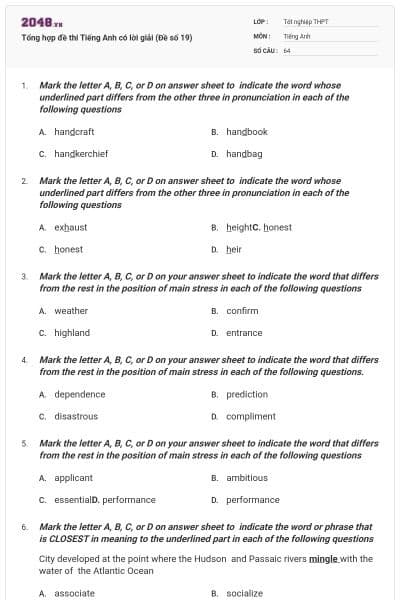
Mark the letter A, B, C, or D on answer sheet to indicate the word whose underlined part differs from the other three in pronunciation in each of the following questions
handcraft
handbook
handkerchief
handbag
Đáp án C
“d” trong “handkerchief” là âm câm, trong các từ còn lại phát âm là /d/
Mark the letter A, B, C, or D on answer sheet to indicate the word whose underlined part differs from the other three in pronunciation in each of the following questions
exhaust
heightC. honest
honest
heir
Đáp án B
“h” trong “height” phát âm là /h/, trong các từ còn lại là âm câm
Mark the letter A, B, C, or D on your answer sheet to indicate the word that differs from the rest in the position of main stress in each of the following questions
weather
confirm
highland
entrance
Đáp án B
Trọng âm của từ này rơi vào âm tiết thứ 2, các từ còn lại rơi vào âm tiết thứ 1
Mark the letter A, B, C, or D on your answer sheet to indicate the word that differs from the rest in the position of main stress in each of the following questions.
dependence
prediction
disastrous
compliment
Đáp án D
Trọng âm của từ này rơi vào âm tiết thứ 1, các từ còn lại rơi vào âm tiết thứ 2
Mark the letter A, B, C, or D on your answer sheet to indicate the word that differs from the rest in the position of main stress in each of the following questions
applicant
ambitious
essentialD. performance
performance
Đáp án A
Trọng âm của từ này rơi vào âm tiết thứ 1, các từ còn lại rơi vào âm tiết thứ 2
Mark the letter A, B, C, or D on answer sheet to indicate the word or phrase that is CLOSEST in meaning to the underlined part in each of the following questions
City developed at the point where the Hudson and Passaic rivers mingle with the water of the Atlantic Ocean
associate
socialize
mix
part
Đáp án C
Mingle with something = trộn lẫn với cái gì ≈ mix with something
Mark the letter A, B, C, or D on answer sheet to indicate the word or phrase that is CLOSEST in meaning to the underlined part in each of the following questions
Lack of water and nutrients has impeded the growth of these cherry tomato plants
promoted
assisted
realized
prevented
Đáp án D
Imped something = làm cản trở cái gì. Prevent = ngăn chặn. Promote = thúc đẩy. Assist = hỗ trợ. Realize = nhận ra
Mark the letter A, B, C, or D on answer sheet to indicate the word or phrase that is CLOSEST in meaning to the underlined part in each of the following questions
Bone and ivory are light, strong and accessiblematerials for Inuit artists
available
beautiful
economic
natural
Đáp án A
Accessible = có thể tiếp cận được, trong tầm tiếp cận. Available = sẵn có, có thể khai thác được
Mark the letter A, B, C, or D on answer sheet to indicate the word or phrase that is CLOSEST in meaning to the underlined part in each of the following questions
The consequences of the typhoon were disastrous due to the lack of precautionary measures
physical
severe
beneficial
damaging
Đáp án C
Disastrous = mang tính tai họa, gây ra nhiều thiệt hại. Beneficial = đem lại nhiều lợi ích. Physical = về vật chất. Severe = nghiêm trọng, nặng nề
Mark the letter A, B, C, or D on answer sheet to indicate the word or phrase that is CLOSEST in meaning to the underlined part in each of the following questions
Vietnam’s admission to the World Trade Organization (WTO) has promoted its trade relations with other countries
balanced
restricted
expanded
boosted
Đáp án B
Promote = thúc đẩy. Restrict = hạn chế, giới hạn. Balance = cân bằng. Expand = mở rộng. Boost = đẩy mạnh, đưa lên
Read the following passage and mark the letter A, B, C, or D on your answer sheet to choose the word or phrase that best fits each of the numbered blanks.
In addition to the challenge to be excellent, American schools have been facing novel problems. They must ….(11) … with an influx of immigrant children, many of whom speak little or no English. They must respond to demands ….(12) ….the curriculum reflect the various cultures of all children. Schools must make sure that students develop …(13) … skills for the job market, and they must consider the needs of nontraditional students, such as teenage mothers.
Schools are …(14)…. these problems in ways that reflect the diversity of theUSeducational system. They are hiring or training large numbers of teachers of English …(15)… a second language and, in some countries, setting up bilingual schools. They are opening …(16)… the traditional European-centered curriculum to embrace material from American, Asian, and other cultures.
Schools are also teaching cognitive skills to the …(17)… 40 percent of American students who do not go on to higher education. In the …(18).. of a recent report by the Commission on Achieving Necessary Skills, “A strong back, the willingness to work, and a high school diploma were once all that was necessary to …(19) ….
a start inAmerica. They are no longer. A well-developed mind, a continued willingness to learn and the ability to put knowledge to work are the new keys …(20) .. the future of our young people, the success of our business, and the economic well-being of the nation”.( Extracted from Info USA-CD Version).Question 11
do
stay
fightD. cope
cope
Đáp án D
Cope with something = giải quyết cái gì
Read the following passage and mark the letter A, B, C, or D on your answer sheet to choose the word or phrase that best fits each of the numbered blanks.
In addition to the challenge to be excellent, American schools have been facing novel problems. They must ….(11) … with an influx of immigrant children, many of whom speak little or no English. They must respond to demands ….(12) ….the curriculum reflect the various cultures of all children. Schools must make sure that students develop …(13) … skills for the job market, and they must consider the needs of nontraditional students, such as teenage mothers.
Schools are …(14)…. these problems in ways that reflect the diversity of theUSeducational system. They are hiring or training large numbers of teachers of English …(15)… a second language and, in some countries, setting up bilingual schools. They are opening …(16)… the traditional European-centered curriculum to embrace material from American, Asian, and other cultures.
Schools are also teaching cognitive skills to the …(17)… 40 percent of American students who do not go on to higher education. In the …(18).. of a recent report by the Commission on Achieving Necessary Skills, “A strong back, the willingness to work, and a high school diploma were once all that was necessary to …(19) ….
a start inAmerica. They are no longer. A well-developed mind, a continued willingness to learn and the ability to put knowledge to work are the new keys …(20) .. the future of our young people, the success of our business, and the economic well-being of the nation”.( Extracted from Info USA-CD Version).Question 12
that
who
whether
what
Đáp án A
Đại từ “that” đứng sau “demands” với nghĩa: những nhu cầu rằng + (mệnh đề)
Read the following passage and mark the letter A, B, C, or D on your answer sheet to choose the word or phrase that best fits each of the numbered blanks.
In addition to the challenge to be excellent, American schools have been facing novel problems. They must ….(11) … with an influx of immigrant children, many of whom speak little or no English. They must respond to demands ….(12) ….the curriculum reflect the various cultures of all children. Schools must make sure that students develop …(13) … skills for the job market, and they must consider the needs of nontraditional students, such as teenage mothers.
Schools are …(14)…. these problems in ways that reflect the diversity of theUSeducational system. They are hiring or training large numbers of teachers of English …(15)… a second language and, in some countries, setting up bilingual schools. They are opening …(16)… the traditional European-centered curriculum to embrace material from American, Asian, and other cultures.
Schools are also teaching cognitive skills to the …(17)… 40 percent of American students who do not go on to higher education. In the …(18).. of a recent report by the Commission on Achieving Necessary Skills, “A strong back, the willingness to work, and a high school diploma were once all that was necessary to …(19) ….
a start inAmerica. They are no longer. A well-developed mind, a continued willingness to learn and the ability to put knowledge to work are the new keys …(20) .. the future of our young people, the success of our business, and the economic well-being of the nation”.( Extracted from Info USA-CD Version).Question 13
base
basis
basic
basics
Đáp án C
Tính từ đứng trước danh từ để bổ nghĩa cho danh từ ấy. basic skill = kĩ năng cơ bản
Read the following passage and mark the letter A, B, C, or D on your answer sheet to choose the word or phrase that best fits each of the numbered blanks.
In addition to the challenge to be excellent, American schools have been facing novel problems. They must ….(11) … with an influx of immigrant children, many of whom speak little or no English. They must respond to demands ….(12) ….the curriculum reflect the various cultures of all children. Schools must make sure that students develop …(13) … skills for the job market, and they must consider the needs of nontraditional students, such as teenage mothers.
Schools are …(14)…. these problems in ways that reflect the diversity of theUSeducational system. They are hiring or training large numbers of teachers of English …(15)… a second language and, in some countries, setting up bilingual schools. They are opening …(16)… the traditional European-centered curriculum to embrace material from American, Asian, and other cultures.
Schools are also teaching cognitive skills to the …(17)… 40 percent of American students who do not go on to higher education. In the …(18).. of a recent report by the Commission on Achieving Necessary Skills, “A strong back, the willingness to work, and a high school diploma were once all that was necessary to …(19) ….
a start inAmerica. They are no longer. A well-developed mind, a continued willingness to learn and the ability to put knowledge to work are the new keys …(20) .. the future of our young people, the success of our business, and the economic well-being of the nation”.( Extracted from Info USA-CD Version).Question 14
addressing
delivering
distributing
discharging
Đáp án A
Address (v) = gọi tên, nêu ra. Address the problem = nêu lên vấn đề
Read the following passage and mark the letter A, B, C, or D on your answer sheet to choose the word or phrase that best fits each of the numbered blanks.
In addition to the challenge to be excellent, American schools have been facing novel problems. They must ….(11) … with an influx of immigrant children, many of whom speak little or no English. They must respond to demands ….(12) ….the curriculum reflect the various cultures of all children. Schools must make sure that students develop …(13) … skills for the job market, and they must consider the needs of nontraditional students, such as teenage mothers.
Schools are …(14)…. these problems in ways that reflect the diversity of theUSeducational system. They are hiring or training large numbers of teachers of English …(15)… a second language and, in some countries, setting up bilingual schools. They are opening …(16)… the traditional European-centered curriculum to embrace material from American, Asian, and other cultures.
Schools are also teaching cognitive skills to the …(17)… 40 percent of American students who do not go on to higher education. In the …(18).. of a recent report by the Commission on Achieving Necessary Skills, “A strong back, the willingness to work, and a high school diploma were once all that was necessary to …(19) ….
a start inAmerica. They are no longer. A well-developed mind, a continued willingness to learn and the ability to put knowledge to work are the new keys …(20) .. the future of our young people, the success of our business, and the economic well-being of the nation”.( Extracted from Info USA-CD Version).Question 15
as
from
with
like
Đáp án A
As = như là; với vai trò gì (đúng thực tế) (như ngôn ngữ thứ 2). From = từ (đâu, lúc nào). With = với. like = như thế là (thực tế không phải vậy)
Read the following passage and mark the letter A, B, C, or D on your answer sheet to choose the word or phrase that best fits each of the numbered blanks.
In addition to the challenge to be excellent, American schools have been facing novel problems. They must ….(11) … with an influx of immigrant children, many of whom speak little or no English. They must respond to demands ….(12) ….the curriculum reflect the various cultures of all children. Schools must make sure that students develop …(13) … skills for the job market, and they must consider the needs of nontraditional students, such as teenage mothers.
Schools are …(14)…. these problems in ways that reflect the diversity of theUSeducational system. They are hiring or training large numbers of teachers of English …(15)… a second language and, in some countries, setting up bilingual schools. They are opening …(16)… the traditional European-centered curriculum to embrace material from American, Asian, and other cultures.
Schools are also teaching cognitive skills to the …(17)… 40 percent of American students who do not go on to higher education. In the …(18).. of a recent report by the Commission on Achieving Necessary Skills, “A strong back, the willingness to work, and a high school diploma were once all that was necessary to …(19) ….
a start inAmerica. They are no longer. A well-developed mind, a continued willingness to learn and the ability to put knowledge to work are the new keys …(20) .. the future of our young people, the success of our business, and the economic well-being of the nation”.( Extracted from Info USA-CD Version).Question 16
on
into
for
up
Đáp án D
Open up = khai mạc, khai trương, dựng nên
Read the following passage and mark the letter A, B, C, or D on your answer sheet to choose the word or phrase that best fits each of the numbered blanks.
In addition to the challenge to be excellent, American schools have been facing novel problems. They must ….(11) … with an influx of immigrant children, many of whom speak little or no English. They must respond to demands ….(12) ….the curriculum reflect the various cultures of all children. Schools must make sure that students develop …(13) … skills for the job market, and they must consider the needs of nontraditional students, such as teenage mothers.
Schools are …(14)…. these problems in ways that reflect the diversity of theUSeducational system. They are hiring or training large numbers of teachers of English …(15)… a second language and, in some countries, setting up bilingual schools. They are opening …(16)… the traditional European-centered curriculum to embrace material from American, Asian, and other cultures.
Schools are also teaching cognitive skills to the …(17)… 40 percent of American students who do not go on to higher education. In the …(18).. of a recent report by the Commission on Achieving Necessary Skills, “A strong back, the willingness to work, and a high school diploma were once all that was necessary to …(19) ….
a start inAmerica. They are no longer. A well-developed mind, a continued willingness to learn and the ability to put knowledge to work are the new keys …(20) .. the future of our young people, the success of our business, and the economic well-being of the nation”.( Extracted from Info USA-CD Version).Question 17
slightly
mostly
fairly
nearly
Đáp án D
Nearly = gần với giá trị nào. Slightly = một chút. Fairly = khá là
Read the following passage and mark the letter A, B, C, or D on your answer sheet to choose the word or phrase that best fits each of the numbered blanks.
In addition to the challenge to be excellent, American schools have been facing novel problems. They must ….(11) … with an influx of immigrant children, many of whom speak little or no English. They must respond to demands ….(12) ….the curriculum reflect the various cultures of all children. Schools must make sure that students develop …(13) … skills for the job market, and they must consider the needs of nontraditional students, such as teenage mothers.
Schools are …(14)…. these problems in ways that reflect the diversity of theUSeducational system. They are hiring or training large numbers of teachers of English …(15)… a second language and, in some countries, setting up bilingual schools. They are opening …(16)… the traditional European-centered curriculum to embrace material from American, Asian, and other cultures.
Schools are also teaching cognitive skills to the …(17)… 40 percent of American students who do not go on to higher education. In the …(18).. of a recent report by the Commission on Achieving Necessary Skills, “A strong back, the willingness to work, and a high school diploma were once all that was necessary to …(19) ….
a start inAmerica. They are no longer. A well-developed mind, a continued willingness to learn and the ability to put knowledge to work are the new keys …(20) .. the future of our young people, the success of our business, and the economic well-being of the nation”.( Extracted from Info USA-CD Version).Question 18
minds
directions
words
ways
Đáp án C
Word = từ ngữ. In the words of a recent report = theo ngôn ngữ của một báo cáo gần đây
Read the following passage and mark the letter A, B, C, or D on your answer sheet to choose the word or phrase that best fits each of the numbered blanks.
In addition to the challenge to be excellent, American schools have been facing novel problems. They must ….(11) … with an influx of immigrant children, many of whom speak little or no English. They must respond to demands ….(12) ….the curriculum reflect the various cultures of all children. Schools must make sure that students develop …(13) … skills for the job market, and they must consider the needs of nontraditional students, such as teenage mothers.
Schools are …(14)…. these problems in ways that reflect the diversity of theUSeducational system. They are hiring or training large numbers of teachers of English …(15)… a second language and, in some countries, setting up bilingual schools. They are opening …(16)… the traditional European-centered curriculum to embrace material from American, Asian, and other cultures.
Schools are also teaching cognitive skills to the …(17)… 40 percent of American students who do not go on to higher education. In the …(18).. of a recent report by the Commission on Achieving Necessary Skills, “A strong back, the willingness to work, and a high school diploma were once all that was necessary to …(19) ….
a start inAmerica. They are no longer. A well-developed mind, a continued willingness to learn and the ability to put knowledge to work are the new keys …(20) .. the future of our young people, the success of our business, and the economic well-being of the nation”.( Extracted from Info USA-CD Version).Question 19
make
take
get
bring
Đáp án A
Make a start = tạo sự khởi đầu, bắt đầu
Read the following passage and mark the letter A, B, C, or D on your answer sheet to choose the word or phrase that best fits each of the numbered blanks.
In addition to the challenge to be excellent, American schools have been facing novel problems. They must ….(11) … with an influx of immigrant children, many of whom speak little or no English. They must respond to demands ….(12) ….the curriculum reflect the various cultures of all children. Schools must make sure that students develop …(13) … skills for the job market, and they must consider the needs of nontraditional students, such as teenage mothers.
Schools are …(14)…. these problems in ways that reflect the diversity of theUSeducational system. They are hiring or training large numbers of teachers of English …(15)… a second language and, in some countries, setting up bilingual schools. They are opening …(16)… the traditional European-centered curriculum to embrace material from American, Asian, and other cultures.
Schools are also teaching cognitive skills to the …(17)… 40 percent of American students who do not go on to higher education. In the …(18).. of a recent report by the Commission on Achieving Necessary Skills, “A strong back, the willingness to work, and a high school diploma were once all that was necessary to …(19) ….
a start inAmerica. They are no longer. A well-developed mind, a continued willingness to learn and the ability to put knowledge to work are the new keys …(20) .. the future of our young people, the success of our business, and the economic well-being of the nation”.( Extracted from Info USA-CD Version).Question 20
to
at
in
for
Đáp án A
The key to something = chìa khóa cho cái gì, vấn đề quan trọng đối với cái gì
Mark the letter A, B, C or D on your answer sheet t indicate the underlined part that needs correction in each of the following questions
Not until he got home he realized he had forgotten to give her the present
got
he realized
her
the present
Đáp án B
Cấu trúc đảo ngữ nhấn mạnh thời quá khứ: Not until + mốc thời gian/mệnh đề trong quá khứ + did + S + V không chia = ai đã không làm gì cho tới lúc nào. B -> did he realize
Mark the letter A, B, C or D on your answer sheet t indicate the underlined part that needs correction in each of the following questions
When you are writing or speaking English it is important to use language that includes both men and women equally the same
or speaking
it is
that
equally the same
Đáp án D
Equally = một cách bình đẳng, bằng nhau. The same = như nhau -> 2 từ này mang cùng sắc thái nghĩa, ko đặt cạnh nhau; thông thường chỉ dùng 1 trong 2
Mark the letter A, B, C or D on your answer sheet t indicate the underlined part that needs correction in each of the following questions
A lot of people stop smoking because they are afraid their heath will be affected and early death
A lot of
smoking
are
early death
Đáp án D
Trước “and” là một phân từ 2 (Affected) thì sau nó cũng phải là một phân từ 2, không phải là danh từ (early death = sự chết sớm)
Mark the letter A, B, C or D on your answer sheet t indicate the underlined part that needs correction in each of the following questions
The student must have her assessment form fill in by the examiner during the oral exam
must have
fill in
during
oral exam
Đáp án B
Cấu trúc bị động: have something + past participle = sắp xếp cho cái gì của mình được ai đó làm giúp -> Have her assessment form filled in = phải làm sao cho phiếu đánh giá được điền vào (bởi giám thị)
Mark the letter A, B, C or D on your answer sheet t indicate the underlined part that needs correction in each of the following questions
A novel is a story long enough to fill a complete book, in that the characters and events are usually imaginary
ong enough
complete
that
are usually
Đáp án C
Đại từ quan hệ chỉ sự vật có thể đi với giới từ (in) là “which”, không phải “that”
They live on a busy road. ……………………….. a lot of noise from traffic
There must have
It must have been
There must be
It must be
Đáp án C
Must + V có thể dùng để dự đoán chắc chắn một việc xảy ra trong hiện tại, hoặc tương lai -> dự đoán thực tại chắc hẳn có nhiều tiếng ồn (dùng cấu trúc There + be = có…)
Lora: “Do you mind if I turn on the fan?” Maria: “……………………”
Not for me
Not at all
Never mind
Not enough
Đáp án B
Lora: bạn có cảm thấy phiền nếu mình tắt quạt không? Maria: Không (phiền) chút nào. Not at all = không chút nào -> trả lời câu xin phép nếu làm phiền
………………… make a good impression on her
Only by doing so can I
Only so doing can I
Only by so doing I can
Only by doing so I can
Đáp án A
Cấu trúc đảo ngữ nhấn mạnh : Only by + Ving, do/does/can/did/could + S + V không chia = chỉ bằng cách… ai mới có thể làm gì
He came ………………….a lot of criticism for the remarks he made in a television interview
in for
over
out of
off
Đáp án A
Come in for something = gặp phải, nhận được những điều gì (tiêu cực)
No matter how angry he was, he would never ……………..to violence
refuse
resort
resist
resolve
Đáp án B
Resort to something = phải dùng đến cái gì vì là lựa chọn cuối cùng. Violence = bạo lực
The team were eager to make………………. the loss of the previous match
away with
off with
up for
up with
Đáp án C
Make up for something = đền bù cho cái gì
Read the following passage and mark the letter A, B, C or D on your answer sheet to indicate the correct answer to each of the following sentences
Learning means acquiring knowledge or developing the ability to perform new behaviors. It is common to think of learning as something that takes place in school, but much of human learning
occurs outside the classroom, and people continue to learn throughout their lives.
Even before they enter school, young children learn to walk, to talk, and to use their hands to manipulate toys, food, and other objects. They use all of their senses to learn about the sights, sounds, tastes, and smells in their environments. They learn how to interact with their parents, siblings, friends, and other people important to their world. When they enter school, children learn basic academic subjects such as reading, writing, and mathematics. They also continue to learn a great deal outside the classroom. They learn which behaviors are likely to be rewarded and which are likely to be punished. They learn social skills for interacting with other children. After they finish school, people must learn to adapt to the many major changes that affect their lives, such as getting married, raising children, and finding and keeping a job.
Because learning continues throughout our lives and affects almost everything we do, the study of learning is important in many different fields. Teachers need to understand the best ways to educate children. Psychologists, social workers, criminologists, and other human-service workers need to understand how certain experiences change people’s behaviors. Employers, politicians, and advertisers make use of the principles of learning to influence the behavior of workers, voters, and consumers.
Learning is closely related to memory, which is the storage of information in the brain. Psychologists who study memory are interested in how the brain stores knowledge, where this storage takes place, and how the brain later retrieves knowledge when we need it. In contrast, psychologists who study learning are more interested in behavior and how behavior changes as a result of a person’s experiences.
There are many forms of learning, ranging from simple to complex. Simple forms of learning involve a single stimulus. A stimulus is anything perceptible to the senses, such as a sight, sound, smell, touch, or taste. In a form of learning known as classical conditioning, people learn to associate two stimuli that occur in sequence, such as lightning followed by thunder. In operant conditioning, people learn by forming an association between a behavior and its consequences (reward or punishment). People and animals can also learn by observation - that is, by watching others perform behaviors. More complex forms of learning include learning languages, concepts, and motor skills.
According to the passage, which of the following is learning in broad view comprised of?
Knowledge acquisition and ability development
Acquisition of social and behavioural skills
Acquisition of academic knowledge
Knowledge acquisition outside the classroom
Đáp án A
Câu đầu tiên của bài: Learning means acquiring knowledge or developing the ability to perform new behaviors
Read the following passage and mark the letter A, B, C or D on your answer sheet to indicate the correct answer to each of the following sentences
Learning means acquiring knowledge or developing the ability to perform new behaviors. It is common to think of learning as something that takes place in school, but much of human learning
occurs outside the classroom, and people continue to learn throughout their lives.
Even before they enter school, young children learn to walk, to talk, and to use their hands to manipulate toys, food, and other objects. They use all of their senses to learn about the sights, sounds, tastes, and smells in their environments. They learn how to interact with their parents, siblings, friends, and other people important to their world. When they enter school, children learn basic academic subjects such as reading, writing, and mathematics. They also continue to learn a great deal outside the classroom. They learn which behaviors are likely to be rewarded and which are likely to be punished. They learn social skills for interacting with other children. After they finish school, people must learn to adapt to the many major changes that affect their lives, such as getting married, raising children, and finding and keeping a job.
Because learning continues throughout our lives and affects almost everything we do, the study of learning is important in many different fields. Teachers need to understand the best ways to educate children. Psychologists, social workers, criminologists, and other human-service workers need to understand how certain experiences change people’s behaviors. Employers, politicians, and advertisers make use of the principles of learning to influence the behavior of workers, voters, and consumers.
Learning is closely related to memory, which is the storage of information in the brain. Psychologists who study memory are interested in how the brain stores knowledge, where this storage takes place, and how the brain later retrieves knowledge when we need it. In contrast, psychologists who study learning are more interested in behavior and how behavior changes as a result of a person’s experiences.
There are many forms of learning, ranging from simple to complex. Simple forms of learning involve a single stimulus. A stimulus is anything perceptible to the senses, such as a sight, sound, smell, touch, or taste. In a form of learning known as classical conditioning, people learn to associate two stimuli that occur in sequence, such as lightning followed by thunder. In operant conditioning, people learn by forming an association between a behavior and its consequences (reward or punishment). People and animals can also learn by observation - that is, by watching others perform behaviors. More complex forms of learning include learning languages, concepts, and motor skills.
According to the passage, what are children NOT usually taught outside the classroom?
interpersonal communication
life skills
literacy and calculation
right from wrong
Đáp án C
Từ dòng 4 đoạn 2: When they enter school, children learn basic academic subjects such as reading, writing, and mathematics -> trẻ em được học đọc học viết (literacy), học toán (calculation) khi đến trường, không mấy khi được dạy ở ngoài trường học
Read the following passage and mark the letter A, B, C or D on your answer sheet to indicate the correct answer to each of the following sentences
Learning means acquiring knowledge or developing the ability to perform new behaviors. It is common to think of learning as something that takes place in school, but much of human learning
occurs outside the classroom, and people continue to learn throughout their lives.
Even before they enter school, young children learn to walk, to talk, and to use their hands to manipulate toys, food, and other objects. They use all of their senses to learn about the sights, sounds, tastes, and smells in their environments. They learn how to interact with their parents, siblings, friends, and other people important to their world. When they enter school, children learn basic academic subjects such as reading, writing, and mathematics. They also continue to learn a great deal outside the classroom. They learn which behaviors are likely to be rewarded and which are likely to be punished. They learn social skills for interacting with other children. After they finish school, people must learn to adapt to the many major changes that affect their lives, such as getting married, raising children, and finding and keeping a job.
Because learning continues throughout our lives and affects almost everything we do, the study of learning is important in many different fields. Teachers need to understand the best ways to educate children. Psychologists, social workers, criminologists, and other human-service workers need to understand how certain experiences change people’s behaviors. Employers, politicians, and advertisers make use of the principles of learning to influence the behavior of workers, voters, and consumers.
Learning is closely related to memory, which is the storage of information in the brain. Psychologists who study memory are interested in how the brain stores knowledge, where this storage takes place, and how the brain later retrieves knowledge when we need it. In contrast, psychologists who study learning are more interested in behavior and how behavior changes as a result of a person’s experiences.
There are many forms of learning, ranging from simple to complex. Simple forms of learning involve a single stimulus. A stimulus is anything perceptible to the senses, such as a sight, sound, smell, touch, or taste. In a form of learning known as classical conditioning, people learn to associate two stimuli that occur in sequence, such as lightning followed by thunder. In operant conditioning, people learn by forming an association between a behavior and its consequences (reward or punishment). People and animals can also learn by observation - that is, by watching others perform behaviors. More complex forms of learning include learning languages, concepts, and motor skills.
Getting married, raising children, and finding and keeping a job are mentioned in paragraph 2 as examples of ______
the changes to which people have to orient themselves
. the situations in which people cannot teach themselves
the ways people’s lives are influenced by education
the areas of learning which affect people’s lives
Đáp án A
Câu cuối đoạn 2: After they finish school, people must learn to adapt to the many major changes that affect their lives, such as getting married, raising children, and finding and keeping a job -> việc kết hôn, nuôi con và tìm, giữ công việc là những thay đổi quan trọng mà mỗi người phải học để thích ứng, tự định hướng bản thân (orient themselves)
Read the following passage and mark the letter A, B, C or D on your answer sheet to indicate the correct answer to each of the following sentences
Learning means acquiring knowledge or developing the ability to perform new behaviors. It is common to think of learning as something that takes place in school, but much of human learning
occurs outside the classroom, and people continue to learn throughout their lives.
Even before they enter school, young children learn to walk, to talk, and to use their hands to manipulate toys, food, and other objects. They use all of their senses to learn about the sights, sounds, tastes, and smells in their environments. They learn how to interact with their parents, siblings, friends, and other people important to their world. When they enter school, children learn basic academic subjects such as reading, writing, and mathematics. They also continue to learn a great deal outside the classroom. They learn which behaviors are likely to be rewarded and which are likely to be punished. They learn social skills for interacting with other children. After they finish school, people must learn to adapt to the many major changes that affect their lives, such as getting married, raising children, and finding and keeping a job.
Because learning continues throughout our lives and affects almost everything we do, the study of learning is important in many different fields. Teachers need to understand the best ways to educate children. Psychologists, social workers, criminologists, and other human-service workers need to understand how certain experiences change people’s behaviors. Employers, politicians, and advertisers make use of the principles of learning to influence the behavior of workers, voters, and consumers.
Learning is closely related to memory, which is the storage of information in the brain. Psychologists who study memory are interested in how the brain stores knowledge, where this storage takes place, and how the brain later retrieves knowledge when we need it. In contrast, psychologists who study learning are more interested in behavior and how behavior changes as a result of a person’s experiences.
There are many forms of learning, ranging from simple to complex. Simple forms of learning involve a single stimulus. A stimulus is anything perceptible to the senses, such as a sight, sound, smell, touch, or taste. In a form of learning known as classical conditioning, people learn to associate two stimuli that occur in sequence, such as lightning followed by thunder. In operant conditioning, people learn by forming an association between a behavior and its consequences (reward or punishment). People and animals can also learn by observation - that is, by watching others perform behaviors. More complex forms of learning include learning languages, concepts, and motor skills.
Which of the following can be inferred about the learning process from the passage?
. It becomes less challenging and complicated when people grow older
It plays a crucial part in improving the learner’s motivation in school
It takes place more frequently in real life than in academic institutions
It is more interesting and effective in school than that in life
Đáp án C
Đoạn 2 đề cập tới các kĩ năng và kiến thức con người học trong đời trước khi đến trường (before they enter school), khi đến trường (When they enter school), và sau khi rời trường học (After they finish school). Trong đó kiến thức thu được khi đến trường chỉ được tóm lược trong 1 câu (When they enter school, children learn basic academic subjects such as reading, writing, and mathematics), còn lại là các kiến thức học từ ngoài đời sống -> quá trình học tập thường xuyên xảy ra trong đời thực hơn là trong những cơ sở học tập như trường học
Read the following passage and mark the letter A, B, C or D on your answer sheet to indicate the correct answer to each of the following sentences
Learning means acquiring knowledge or developing the ability to perform new behaviors. It is common to think of learning as something that takes place in school, but much of human learning
occurs outside the classroom, and people continue to learn throughout their lives.
Even before they enter school, young children learn to walk, to talk, and to use their hands to manipulate toys, food, and other objects. They use all of their senses to learn about the sights, sounds, tastes, and smells in their environments. They learn how to interact with their parents, siblings, friends, and other people important to their world. When they enter school, children learn basic academic subjects such as reading, writing, and mathematics. They also continue to learn a great deal outside the classroom. They learn which behaviors are likely to be rewarded and which are likely to be punished. They learn social skills for interacting with other children. After they finish school, people must learn to adapt to the many major changes that affect their lives, such as getting married, raising children, and finding and keeping a job.
Because learning continues throughout our lives and affects almost everything we do, the study of learning is important in many different fields. Teachers need to understand the best ways to educate children. Psychologists, social workers, criminologists, and other human-service workers need to understand how certain experiences change people’s behaviors. Employers, politicians, and advertisers make use of the principles of learning to influence the behavior of workers, voters, and consumers.
Learning is closely related to memory, which is the storage of information in the brain. Psychologists who study memory are interested in how the brain stores knowledge, where this storage takes place, and how the brain later retrieves knowledge when we need it. In contrast, psychologists who study learning are more interested in behavior and how behavior changes as a result of a person’s experiences.
There are many forms of learning, ranging from simple to complex. Simple forms of learning involve a single stimulus. A stimulus is anything perceptible to the senses, such as a sight, sound, smell, touch, or taste. In a form of learning known as classical conditioning, people learn to associate two stimuli that occur in sequence, such as lightning followed by thunder. In operant conditioning, people learn by forming an association between a behavior and its consequences (reward or punishment). People and animals can also learn by observation - that is, by watching others perform behaviors. More complex forms of learning include learning languages, concepts, and motor skills.
According to the passage, the study of learning is important in many fields due to ______.
the need for certain experiences in various areas
the exploration of the best teaching methods
the great influence of the on-going learning process
the influence of various behaviours in the learning process
Đáp án C
Câu đầu đoạn 3: Because learning continues throughout our lives and affects almost everything we do, the study of learning is important in many different fields -> vì việc học tiếp diễn (on-going) xuyên suốt cuộc đời chúng ta và ảnh hưởng tới hầu hết mọi thứ ta làm (great influence)
Read the following passage and mark the letter A, B, C or D on your answer sheet to indicate the correct answer to each of the following sentences
Learning means acquiring knowledge or developing the ability to perform new behaviors. It is common to think of learning as something that takes place in school, but much of human learning
occurs outside the classroom, and people continue to learn throughout their lives.
Even before they enter school, young children learn to walk, to talk, and to use their hands to manipulate toys, food, and other objects. They use all of their senses to learn about the sights, sounds, tastes, and smells in their environments. They learn how to interact with their parents, siblings, friends, and other people important to their world. When they enter school, children learn basic academic subjects such as reading, writing, and mathematics. They also continue to learn a great deal outside the classroom. They learn which behaviors are likely to be rewarded and which are likely to be punished. They learn social skills for interacting with other children. After they finish school, people must learn to adapt to the many major changes that affect their lives, such as getting married, raising children, and finding and keeping a job.
Because learning continues throughout our lives and affects almost everything we do, the study of learning is important in many different fields. Teachers need to understand the best ways to educate children. Psychologists, social workers, criminologists, and other human-service workers need to understand how certain experiences change people’s behaviors. Employers, politicians, and advertisers make use of the principles of learning to influence the behavior of workers, voters, and consumers.
Learning is closely related to memory, which is the storage of information in the brain. Psychologists who study memory are interested in how the brain stores knowledge, where this storage takes place, and how the brain later retrieves knowledge when we need it. In contrast, psychologists who study learning are more interested in behavior and how behavior changes as a result of a person’s experiences.
There are many forms of learning, ranging from simple to complex. Simple forms of learning involve a single stimulus. A stimulus is anything perceptible to the senses, such as a sight, sound, smell, touch, or taste. In a form of learning known as classical conditioning, people learn to associate two stimuli that occur in sequence, such as lightning followed by thunder. In operant conditioning, people learn by forming an association between a behavior and its consequences (reward or punishment). People and animals can also learn by observation - that is, by watching others perform behaviors. More complex forms of learning include learning languages, concepts, and motor skills.
It can be inferred from the passage that social workers, employers, and politicians concern themselves with the study of learning because they need to ______
change the behaviours of the objects of their interest towards learning
thoroughly understand the behaviours of the objects of their interest
make the objects of their interest more aware of the importance of learning
understand how a stimulus relates to the senses of the objects of their interest
Dáp án B
Từ dòng 3 đoạn 3: Psychologists, social workers, … need to understand how certain experiences change people’s behaviors. Employers, politicians, and advertisers make use of the principles of learning to influence the behavior of workers, voters, and consumers -> nhân viên xã hội cần hiểu những kinh nghiệm nhất định ảnh hưởng hành vi con người thế nào, các chủ sử dụng lao động thì học cách gây ảnh hưởng cho nhân viên, chính trị gia thì học cách gây ảnh hưởng tới cử tri -> mỗi người học để hiểu hành động của đối tượng mình quan tâm
Read the following passage and mark the letter A, B, C or D on your answer sheet to indicate the correct answer to each of the following sentences
Learning means acquiring knowledge or developing the ability to perform new behaviors. It is common to think of learning as something that takes place in school, but much of human learning
occurs outside the classroom, and people continue to learn throughout their lives.
Even before they enter school, young children learn to walk, to talk, and to use their hands to manipulate toys, food, and other objects. They use all of their senses to learn about the sights, sounds, tastes, and smells in their environments. They learn how to interact with their parents, siblings, friends, and other people important to their world. When they enter school, children learn basic academic subjects such as reading, writing, and mathematics. They also continue to learn a great deal outside the classroom. They learn which behaviors are likely to be rewarded and which are likely to be punished. They learn social skills for interacting with other children. After they finish school, people must learn to adapt to the many major changes that affect their lives, such as getting married, raising children, and finding and keeping a job.
Because learning continues throughout our lives and affects almost everything we do, the study of learning is important in many different fields. Teachers need to understand the best ways to educate children. Psychologists, social workers, criminologists, and other human-service workers need to understand how certain experiences change people’s behaviors. Employers, politicians, and advertisers make use of the principles of learning to influence the behavior of workers, voters, and consumers.
Learning is closely related to memory, which is the storage of information in the brain. Psychologists who study memory are interested in how the brain stores knowledge, where this storage takes place, and how the brain later retrieves knowledge when we need it. In contrast, psychologists who study learning are more interested in behavior and how behavior changes as a result of a person’s experiences.
There are many forms of learning, ranging from simple to complex. Simple forms of learning involve a single stimulus. A stimulus is anything perceptible to the senses, such as a sight, sound, smell, touch, or taste. In a form of learning known as classical conditioning, people learn to associate two stimuli that occur in sequence, such as lightning followed by thunder. In operant conditioning, people learn by forming an association between a behavior and its consequences (reward or punishment). People and animals can also learn by observation - that is, by watching others perform behaviors. More complex forms of learning include learning languages, concepts, and motor skills.
The word “retrieves” in paragraph 4 is closest in meaning to _______
generates
creates
recovers
gains
Đáp án C
Retrieve = phục hồi, khôi phục. Recover = phục hồi
Read the following passage and mark the letter A, B, C or D on your answer sheet to indicate the correct answer to each of the following sentences
Learning means acquiring knowledge or developing the ability to perform new behaviors. It is common to think of learning as something that takes place in school, but much of human learning
occurs outside the classroom, and people continue to learn throughout their lives.
Even before they enter school, young children learn to walk, to talk, and to use their hands to manipulate toys, food, and other objects. They use all of their senses to learn about the sights, sounds, tastes, and smells in their environments. They learn how to interact with their parents, siblings, friends, and other people important to their world. When they enter school, children learn basic academic subjects such as reading, writing, and mathematics. They also continue to learn a great deal outside the classroom. They learn which behaviors are likely to be rewarded and which are likely to be punished. They learn social skills for interacting with other children. After they finish school, people must learn to adapt to the many major changes that affect their lives, such as getting married, raising children, and finding and keeping a job.
Because learning continues throughout our lives and affects almost everything we do, the study of learning is important in many different fields. Teachers need to understand the best ways to educate children. Psychologists, social workers, criminologists, and other human-service workers need to understand how certain experiences change people’s behaviors. Employers, politicians, and advertisers make use of the principles of learning to influence the behavior of workers, voters, and consumers.
Learning is closely related to memory, which is the storage of information in the brain. Psychologists who study memory are interested in how the brain stores knowledge, where this storage takes place, and how the brain later retrieves knowledge when we need it. In contrast, psychologists who study learning are more interested in behavior and how behavior changes as a result of a person’s experiences.
There are many forms of learning, ranging from simple to complex. Simple forms of learning involve a single stimulus. A stimulus is anything perceptible to the senses, such as a sight, sound, smell, touch, or taste. In a form of learning known as classical conditioning, people learn to associate two stimuli that occur in sequence, such as lightning followed by thunder. In operant conditioning, people learn by forming an association between a behavior and its consequences (reward or punishment). People and animals can also learn by observation - that is, by watching others perform behaviors. More complex forms of learning include learning languages, concepts, and motor skills.
Which of the following statements is NOT true according to the passage?
Psychologists studying memory are concerned with how the stored knowledge is used
Psychologists studying memory are concerned with the brain’s storage of knowledge
Psychologists are all interested in memory as much as behaviours
Psychologists studying learning are interested in human behaviours
Đáp án C
Theo đoạn 4, những nhà tâm lí học nghiên cứu trí nhớ quan tâm tới vấn đề lưu trữ kiến thức của não bộ; những nhà tâm lí học nghiên cứu việc học lại quan tâm tới hành vi và sự thay đổi hành vi => không phải các nhà tâm lí học đều quan tâm tới trí nhớ và việc học như nhau
Read the following passage and mark the letter A, B, C or D on your answer sheet to indicate the correct answer to each of the following sentences
Learning means acquiring knowledge or developing the ability to perform new behaviors. It is common to think of learning as something that takes place in school, but much of human learning
occurs outside the classroom, and people continue to learn throughout their lives.
Even before they enter school, young children learn to walk, to talk, and to use their hands to manipulate toys, food, and other objects. They use all of their senses to learn about the sights, sounds, tastes, and smells in their environments. They learn how to interact with their parents, siblings, friends, and other people important to their world. When they enter school, children learn basic academic subjects such as reading, writing, and mathematics. They also continue to learn a great deal outside the classroom. They learn which behaviors are likely to be rewarded and which are likely to be punished. They learn social skills for interacting with other children. After they finish school, people must learn to adapt to the many major changes that affect their lives, such as getting married, raising children, and finding and keeping a job.
Because learning continues throughout our lives and affects almost everything we do, the study of learning is important in many different fields. Teachers need to understand the best ways to educate children. Psychologists, social workers, criminologists, and other human-service workers need to understand how certain experiences change people’s behaviors. Employers, politicians, and advertisers make use of the principles of learning to influence the behavior of workers, voters, and consumers.
Learning is closely related to memory, which is the storage of information in the brain. Psychologists who study memory are interested in how the brain stores knowledge, where this storage takes place, and how the brain later retrieves knowledge when we need it. In contrast, psychologists who study learning are more interested in behavior and how behavior changes as a result of a person’s experiences.
There are many forms of learning, ranging from simple to complex. Simple forms of learning involve a single stimulus. A stimulus is anything perceptible to the senses, such as a sight, sound, smell, touch, or taste. In a form of learning known as classical conditioning, people learn to associate two stimuli that occur in sequence, such as lightning followed by thunder. In operant conditioning, people learn by forming an association between a behavior and its consequences (reward or punishment). People and animals can also learn by observation - that is, by watching others perform behaviors. More complex forms of learning include learning languages, concepts, and motor skills.
Read the following passage and mark the letter A, B, C or D on your answer sheet to indicate the correct answer to each of the following sentences
Learning means acquiring knowledge or developing the ability to perform new behaviors. It is common to think of learning as something that takes place in school, but much of human learning
occurs outside the classroom, and people continue to learn throughout their lives.
Even before they enter school, young children learn to walk, to talk, and to use their hands to manipulate toys, food, and other objects. They use all of their senses to learn about the sights, sounds, tastes, and smells in their environments. They learn how to interact with their parents, siblings, friends, and other people important to their world. When they enter school, children learn basic academic subjects such as reading, writing, and mathematics. They also continue to learn a great deal outside the classroom. They learn which behaviors are likely to be rewarded and which are likely to be punished. They learn social skills for interacting with other children. After they finish school, people must learn to adapt to the many major changes that affect their lives, such as getting married, raising children, and finding and keeping a job.
Because learning continues throughout our lives and affects almost everything we do, the study of learning is important in many different fields. Teachers need to understand the best ways to educate children. Psychologists, social workers, criminologists, and other human-service workers need to understand how certain experiences change people’s behaviors. Employers, politicians, and advertisers make use of the principles of learning to influence the behavior of workers, voters, and consumers.
Learning is closely related to memory, which is the storage of information in the brain. Psychologists who study memory are interested in how the brain stores knowledge, where this storage takes place, and how the brain later retrieves knowledge when we need it. In contrast, psychologists who study learning are more interested in behavior and how behavior changes as a result of a person’s experiences.
There are many forms of learning, ranging from simple to complex. Simple forms of learning involve a single stimulus. A stimulus is anything perceptible to the senses, such as a sight, sound, smell, touch, or taste. In a form of learning known as classical conditioning, people learn to associate two stimuli that occur in sequence, such as lightning followed by thunder. In operant conditioning, people learn by forming an association between a behavior and its consequences (reward or punishment). People and animals can also learn by observation - that is, by watching others perform behaviors. More complex forms of learning include learning languages, concepts, and motor skills.
According to the passage, the stimulus ina simple forms of learning ______
bears relation to perception
is created by the senses
is associated with natural phenomena
makes associations between behaviours
Đáp án A
Từ dòng 2 đoạn cuối: Simple forms of learning involve a single stimulus. A stimulus is anything perceptible to the senses -> dạng thức đơn giản của việc học bao gồm một kích thích đơn – là bất cứ thứ gì có th9ể nhận thức được đối với các giác quan => liên quan tới nhận thức
Read the following passage and mark the letter A, B, C or D on your answer sheet to indicate the correct answer to each of the following sentences
Learning means acquiring knowledge or developing the ability to perform new behaviors. It is common to think of learning as something that takes place in school, but much of human learning
occurs outside the classroom, and people continue to learn throughout their lives.
Even before they enter school, young children learn to walk, to talk, and to use their hands to manipulate toys, food, and other objects. They use all of their senses to learn about the sights, sounds, tastes, and smells in their environments. They learn how to interact with their parents, siblings, friends, and other people important to their world. When they enter school, children learn basic academic subjects such as reading, writing, and mathematics. They also continue to learn a great deal outside the classroom. They learn which behaviors are likely to be rewarded and which are likely to be punished. They learn social skills for interacting with other children. After they finish school, people must learn to adapt to the many major changes that affect their lives, such as getting married, raising children, and finding and keeping a job.
Because learning continues throughout our lives and affects almost everything we do, the study of learning is important in many different fields. Teachers need to understand the best ways to educate children. Psychologists, social workers, criminologists, and other human-service workers need to understand how certain experiences change people’s behaviors. Employers, politicians, and advertisers make use of the principles of learning to influence the behavior of workers, voters, and consumers.
Learning is closely related to memory, which is the storage of information in the brain. Psychologists who study memory are interested in how the brain stores knowledge, where this storage takes place, and how the brain later retrieves knowledge when we need it. In contrast, psychologists who study learning are more interested in behavior and how behavior changes as a result of a person’s experiences.
There are many forms of learning, ranging from simple to complex. Simple forms of learning involve a single stimulus. A stimulus is anything perceptible to the senses, such as a sight, sound, smell, touch, or taste. In a form of learning known as classical conditioning, people learn to associate two stimuli that occur in sequence, such as lightning followed by thunder. In operant conditioning, people learn by forming an association between a behavior and its consequences (reward or punishment). People and animals can also learn by observation - that is, by watching others perform behaviors. More complex forms of learning include learning languages, concepts, and motor skills.
Read the following passage and mark the letter A, B, C or D on your answer sheet to indicate the correct answer to each of the following sentences
Learning means acquiring knowledge or developing the ability to perform new behaviors. It is common to think of learning as something that takes place in school, but much of human learning
occurs outside the classroom, and people continue to learn throughout their lives.
Even before they enter school, young children learn to walk, to talk, and to use their hands to manipulate toys, food, and other objects. They use all of their senses to learn about the sights, sounds, tastes, and smells in their environments. They learn how to interact with their parents, siblings, friends, and other people important to their world. When they enter school, children learn basic academic subjects such as reading, writing, and mathematics. They also continue to learn a great deal outside the classroom. They learn which behaviors are likely to be rewarded and which are likely to be punished. They learn social skills for interacting with other children. After they finish school, people must learn to adapt to the many major changes that affect their lives, such as getting married, raising children, and finding and keeping a job.
Because learning continues throughout our lives and affects almost everything we do, the study of learning is important in many different fields. Teachers need to understand the best ways to educate children. Psychologists, social workers, criminologists, and other human-service workers need to understand how certain experiences change people’s behaviors. Employers, politicians, and advertisers make use of the principles of learning to influence the behavior of workers, voters, and consumers.
Learning is closely related to memory, which is the storage of information in the brain. Psychologists who study memory are interested in how the brain stores knowledge, where this storage takes place, and how the brain later retrieves knowledge when we need it. In contrast, psychologists who study learning are more interested in behavior and how behavior changes as a result of a person’s experiences.
There are many forms of learning, ranging from simple to complex. Simple forms of learning involve a single stimulus. A stimulus is anything perceptible to the senses, such as a sight, sound, smell, touch, or taste. In a form of learning known as classical conditioning, people learn to associate two stimuli that occur in sequence, such as lightning followed by thunder. In operant conditioning, people learn by forming an association between a behavior and its consequences (reward or punishment). People and animals can also learn by observation - that is, by watching others perform behaviors. More complex forms of learning include learning languages, concepts, and motor skills.
The passage mainly discusses ______
application of learning principles to formal education
simple forms of learning
practical examples of learning inside the classroom
general principles of learning
Đáp án D
Bài văn nói về việc học trong cả cuộc đời, đặc biệt là ngoài đời thực và vai trò của việc học, các dạng học => những quy tắc chung của việc học (trong và ngoài trường học, đơn giản và phức tạp)
Read the following passage and mark the letter A, B, C or D on your answer sheet to indicate the correct answer to each of the following sentences
Culture is a word in common use with complex meanings, and is derived, like the term broadcasting, from the treatment and care of the soil and of what grows on it. It is directly related to cultivation and the adjectives cultural and cultured are part of the same verbal complex. A person of culture has identifiable attributes, among them a knowledge of and interest in the arts, literature, and music. Yet the word culture does not refer solely to such knowledge and interest nor, indeed, to education. At least from the 19th century onwards, under the influence of anthropologists and sociologists, the word culture has come to be used generally both in the singular and the plural (cultures) to refer to a whole way of life of people, including their customs, laws, conventions, and values
Distinctions have consequently been drawn between primitive and advanced culture and cultures, between elite and popular culture, between popular and mass culture, and most recently between national and global cultures. Distinctions have been drawn too between culture and civilization; the latter is a word derived not, like culture or agriculture, from the soil, but from the city. The two words are sometimes treated as synonymous. Yet this is misleading. While civilization and barbarism are pitted against each other in what seems to be a perpetual behavioural pattern, the use of the word culture has been strongly influenced by conceptions of evolution in the 19th century and of development in the 20th century. Cultures evolve or develop. They are not static. They have twists and turns. Styles change. So do fashions. There are cultural processes. What, for example, the word cultured means has changed substantially since the study of classical (that is, Greek and Roman) literature, philosophy, and history ceased in the 20th century to be central to school and university education. No single alternative focus emerged, although with computers has come electronic culture, affecting kinds of study, and most recently digital culture. As cultures express themselves in new forms not everything gets better or more civilized.
The multiplicity of meanings attached to the word made and will make it difficult to define. There is no single, unproblematic definition, although many attempts have been made to establish one. The only non-problematic definitions go back to agricultural meaning (for example, cereal culture or strawberry culture) and medical meaning (for example, bacterial culture or penicillin culture). Since in anthropology and sociology we also acknowledge culture clashes, culture shock, and counter-culture, the range of reference is extremely wide
According to the passage, the word culture____
is related to the preparation and use of land for farming
develops from Greek and Roman literature and history
comes from a source that has not been identified
derives from the same root as civilization does
Đáp án A
Ngay từ câu đầu tiên: Culture is a word in common use with complex meanings, and is derived, …, from the treatment and care of the soil and of what grows on it -> nguồn gốc từ này liên quan tới sự chăm sóc đất đai và thực vật trồng trên đất; hay cũng là sự chuẩn bị đất và sử dụng đất cho nông nghiệp
Read the following passage and mark the letter A, B, C or D on your answer sheet to indicate the correct answer to each of the following sentences
Culture is a word in common use with complex meanings, and is derived, like the term broadcasting, from the treatment and care of the soil and of what grows on it. It is directly related to cultivation and the adjectives cultural and cultured are part of the same verbal complex. A person of culture has identifiable attributes, among them a knowledge of and interest in the arts, literature, and music. Yet the word culture does not refer solely to such knowledge and interest nor, indeed, to education. At least from the 19th century onwards, under the influence of anthropologists and sociologists, the word culture has come to be used generally both in the singular and the plural (cultures) to refer to a whole way of life of people, including their customs, laws, conventions, and values
Distinctions have consequently been drawn between primitive and advanced culture and cultures, between elite and popular culture, between popular and mass culture, and most recently between national and global cultures. Distinctions have been drawn too between culture and civilization; the latter is a word derived not, like culture or agriculture, from the soil, but from the city. The two words are sometimes treated as synonymous. Yet this is misleading. While civilization and barbarism are pitted against each other in what seems to be a perpetual behavioural pattern, the use of the word culture has been strongly influenced by conceptions of evolution in the 19th century and of development in the 20th century. Cultures evolve or develop. They are not static. They have twists and turns. Styles change. So do fashions. There are cultural processes. What, for example, the word cultured means has changed substantially since the study of classical (that is, Greek and Roman) literature, philosophy, and history ceased in the 20th century to be central to school and university education. No single alternative focus emerged, although with computers has come electronic culture, affecting kinds of study, and most recently digital culture. As cultures express themselves in new forms not everything gets better or more civilized.
The multiplicity of meanings attached to the word made and will make it difficult to define. There is no single, unproblematic definition, although many attempts have been made to establish one. The only non-problematic definitions go back to agricultural meaning (for example, cereal culture or strawberry culture) and medical meaning (for example, bacterial culture or penicillin culture). Since in anthropology and sociology we also acknowledge culture clashes, culture shock, and counter-culture, the range of reference is extremely wide
It is stated in paragraph 1 that a cultured person_____
has a job related to cultivation
takes care of the soil and what grows on it
has knowledge of arts, literature, and music
does a job relevant to education
Đáp án C
Từ cuối dòng 3 đoạn 1: A person of culture has identifiable attributes, among them a knowledge of and interest in the arts, literature, and music -> có những đặc điểm dễ nhận ra là có kiến thức và sự quan tâm tới nghệ thuật, văn chương và âm nhạc
Read the following passage and mark the letter A, B, C or D on your answer sheet to indicate the correct answer to each of the following sentences
Culture is a word in common use with complex meanings, and is derived, like the term broadcasting, from the treatment and care of the soil and of what grows on it. It is directly related to cultivation and the adjectives cultural and cultured are part of the same verbal complex. A person of culture has identifiable attributes, among them a knowledge of and interest in the arts, literature, and music. Yet the word culture does not refer solely to such knowledge and interest nor, indeed, to education. At least from the 19th century onwards, under the influence of anthropologists and sociologists, the word culture has come to be used generally both in the singular and the plural (cultures) to refer to a whole way of life of people, including their customs, laws, conventions, and values
Distinctions have consequently been drawn between primitive and advanced culture and cultures, between elite and popular culture, between popular and mass culture, and most recently between national and global cultures. Distinctions have been drawn too between culture and civilization; the latter is a word derived not, like culture or agriculture, from the soil, but from the city. The two words are sometimes treated as synonymous. Yet this is misleading. While civilization and barbarism are pitted against each other in what seems to be a perpetual behavioural pattern, the use of the word culture has been strongly influenced by conceptions of evolution in the 19th century and of development in the 20th century. Cultures evolve or develop. They are not static. They have twists and turns. Styles change. So do fashions. There are cultural processes. What, for example, the word cultured means has changed substantially since the study of classical (that is, Greek and Roman) literature, philosophy, and history ceased in the 20th century to be central to school and university education. No single alternative focus emerged, although with computers has come electronic culture, affecting kinds of study, and most recently digital culture. As cultures express themselves in new forms not everything gets better or more civilized.
The multiplicity of meanings attached to the word made and will make it difficult to define. There is no single, unproblematic definition, although many attempts have been made to establish one. The only non-problematic definitions go back to agricultural meaning (for example, cereal culture or strawberry culture) and medical meaning (for example, bacterial culture or penicillin culture). Since in anthropology and sociology we also acknowledge culture clashes, culture shock, and counter-culture, the range of reference is extremely wide
The author remarks that culture and civilization are the two words that_____
share the same word formation pattern
are both related to agriculture and cultivation
have nearly the same meaning
do not develop from the same meaning
Đáp án D
Từ dòng 3 đoạn 2: Distinctions have been drawn too between culture and civilization; the latter is a word derived not, like culture or agriculture, from the soil, but from the city -> điểm khác biệt là từ phía sau (civilization) không phải xuất phát từ đất đai như từ “culture” mà là từ thành thị -> nguồn gốc khác nhau
Read the following passage and mark the letter A, B, C or D on your answer sheet to indicate the correct answer to each of the following sentences
Culture is a word in common use with complex meanings, and is derived, like the term broadcasting, from the treatment and care of the soil and of what grows on it. It is directly related to cultivation and the adjectives cultural and cultured are part of the same verbal complex. A person of culture has identifiable attributes, among them a knowledge of and interest in the arts, literature, and music. Yet the word culture does not refer solely to such knowledge and interest nor, indeed, to education. At least from the 19th century onwards, under the influence of anthropologists and sociologists, the word culture has come to be used generally both in the singular and the plural (cultures) to refer to a whole way of life of people, including their customs, laws, conventions, and values
Distinctions have consequently been drawn between primitive and advanced culture and cultures, between elite and popular culture, between popular and mass culture, and most recently between national and global cultures. Distinctions have been drawn too between culture and civilization; the latter is a word derived not, like culture or agriculture, from the soil, but from the city. The two words are sometimes treated as synonymous. Yet this is misleading. While civilization and barbarism are pitted against each other in what seems to be a perpetual behavioural pattern, the use of the word culture has been strongly influenced by conceptions of evolution in the 19th century and of development in the 20th century. Cultures evolve or develop. They are not static. They have twists and turns. Styles change. So do fashions. There are cultural processes. What, for example, the word cultured means has changed substantially since the study of classical (that is, Greek and Roman) literature, philosophy, and history ceased in the 20th century to be central to school and university education. No single alternative focus emerged, although with computers has come electronic culture, affecting kinds of study, and most recently digital culture. As cultures express themselves in new forms not everything gets better or more civilized.
The multiplicity of meanings attached to the word made and will make it difficult to define. There is no single, unproblematic definition, although many attempts have been made to establish one. The only non-problematic definitions go back to agricultural meaning (for example, cereal culture or strawberry culture) and medical meaning (for example, bacterial culture or penicillin culture). Since in anthropology and sociology we also acknowledge culture clashes, culture shock, and counter-culture, the range of reference is extremely wide
It can be inferred from the passage that since the 20th century______
schools and universities have not taught classical literature, philosophy, and history
classical literature, philosophy, and history have been considered as core subjects
classical literature, philosophy, and history have not been taught as compulsory subjects
all schools and universities have taught classical literature, philosophy, and history
Đáp án C
Từ giữa dòng 9 đoạn 2: the study of classical (that is, Greek and Roman) literature, philosophy, and history ceased in the 20th century to be central to school and university education -> việc học văn chương, tâm lí, lịch sử cổ điển đã dừng lại ở thế kỉ 20, không còn làm trọng tâm đối với giáo dục trung học và đại học -> không còn là môn học bắt buộc
Read the following passage and mark the letter A, B, C or D on your answer sheet to indicate the correct answer to each of the following sentences
Culture is a word in common use with complex meanings, and is derived, like the term broadcasting, from the treatment and care of the soil and of what grows on it. It is directly related to cultivation and the adjectives cultural and cultured are part of the same verbal complex. A person of culture has identifiable attributes, among them a knowledge of and interest in the arts, literature, and music. Yet the word culture does not refer solely to such knowledge and interest nor, indeed, to education. At least from the 19th century onwards, under the influence of anthropologists and sociologists, the word culture has come to be used generally both in the singular and the plural (cultures) to refer to a whole way of life of people, including their customs, laws, conventions, and values
Distinctions have consequently been drawn between primitive and advanced culture and cultures, between elite and popular culture, between popular and mass culture, and most recently between national and global cultures. Distinctions have been drawn too between culture and civilization; the latter is a word derived not, like culture or agriculture, from the soil, but from the city. The two words are sometimes treated as synonymous. Yet this is misleading. While civilization and barbarism are pitted against each other in what seems to be a perpetual behavioural pattern, the use of the word culture has been strongly influenced by conceptions of evolution in the 19th century and of development in the 20th century. Cultures evolve or develop. They are not static. They have twists and turns. Styles change. So do fashions. There are cultural processes. What, for example, the word cultured means has changed substantially since the study of classical (that is, Greek and Roman) literature, philosophy, and history ceased in the 20th century to be central to school and university education. No single alternative focus emerged, although with computers has come electronic culture, affecting kinds of study, and most recently digital culture. As cultures express themselves in new forms not everything gets better or more civilized.
The multiplicity of meanings attached to the word made and will make it difficult to define. There is no single, unproblematic definition, although many attempts have been made to establish one. The only non-problematic definitions go back to agricultural meaning (for example, cereal culture or strawberry culture) and medical meaning (for example, bacterial culture or penicillin culture). Since in anthropology and sociology we also acknowledge culture clashes, culture shock, and counter-culture, the range of reference is extremely wide
The word “attributes” in paragraph 1 most likely means______
aspects
fields
qualities
skills
Đáp án C
Attribute = thuộc tính, đặc trưng. Quality = đặc trưng, chất lượng. aspect = khía cạnh. Field = lĩnh vực. Skill = kĩ năng
Read the following passage and mark the letter A, B, C or D on your answer sheet to indicate the correct answer to each of the following sentences
Culture is a word in common use with complex meanings, and is derived, like the term broadcasting, from the treatment and care of the soil and of what grows on it. It is directly related to cultivation and the adjectives cultural and cultured are part of the same verbal complex. A person of culture has identifiable attributes, among them a knowledge of and interest in the arts, literature, and music. Yet the word culture does not refer solely to such knowledge and interest nor, indeed, to education. At least from the 19th century onwards, under the influence of anthropologists and sociologists, the word culture has come to be used generally both in the singular and the plural (cultures) to refer to a whole way of life of people, including their customs, laws, conventions, and values
Distinctions have consequently been drawn between primitive and advanced culture and cultures, between elite and popular culture, between popular and mass culture, and most recently between national and global cultures. Distinctions have been drawn too between culture and civilization; the latter is a word derived not, like culture or agriculture, from the soil, but from the city. The two words are sometimes treated as synonymous. Yet this is misleading. While civilization and barbarism are pitted against each other in what seems to be a perpetual behavioural pattern, the use of the word culture has been strongly influenced by conceptions of evolution in the 19th century and of development in the 20th century. Cultures evolve or develop. They are not static. They have twists and turns. Styles change. So do fashions. There are cultural processes. What, for example, the word cultured means has changed substantially since the study of classical (that is, Greek and Roman) literature, philosophy, and history ceased in the 20th century to be central to school and university education. No single alternative focus emerged, although with computers has come electronic culture, affecting kinds of study, and most recently digital culture. As cultures express themselves in new forms not everything gets better or more civilized.
The multiplicity of meanings attached to the word made and will make it difficult to define. There is no single, unproblematic definition, although many attempts have been made to establish one. The only non-problematic definitions go back to agricultural meaning (for example, cereal culture or strawberry culture) and medical meaning (for example, bacterial culture or penicillin culture). Since in anthropology and sociology we also acknowledge culture clashes, culture shock, and counter-culture, the range of reference is extremely wide
The word “static” in paragraph 2 could best be replaced by “_____”.
regular
balanced
unchanged
dense
Đáp án C
Static = yên bình, ổn định. Unchanged = không đổi. balance = cân bằng. regular = thường xuyên. Dense = dày đặc
Read the following passage and mark the letter A, B, C or D on your answer sheet to indicate the correct answer to each of the following sentences
Culture is a word in common use with complex meanings, and is derived, like the term broadcasting, from the treatment and care of the soil and of what grows on it. It is directly related to cultivation and the adjectives cultural and cultured are part of the same verbal complex. A person of culture has identifiable attributes, among them a knowledge of and interest in the arts, literature, and music. Yet the word culture does not refer solely to such knowledge and interest nor, indeed, to education. At least from the 19th century onwards, under the influence of anthropologists and sociologists, the word culture has come to be used generally both in the singular and the plural (cultures) to refer to a whole way of life of people, including their customs, laws, conventions, and values
Distinctions have consequently been drawn between primitive and advanced culture and cultures, between elite and popular culture, between popular and mass culture, and most recently between national and global cultures. Distinctions have been drawn too between culture and civilization; the latter is a word derived not, like culture or agriculture, from the soil, but from the city. The two words are sometimes treated as synonymous. Yet this is misleading. While civilization and barbarism are pitted against each other in what seems to be a perpetual behavioural pattern, the use of the word culture has been strongly influenced by conceptions of evolution in the 19th century and of development in the 20th century. Cultures evolve or develop. They are not static. They have twists and turns. Styles change. So do fashions. There are cultural processes. What, for example, the word cultured means has changed substantially since the study of classical (that is, Greek and Roman) literature, philosophy, and history ceased in the 20th century to be central to school and university education. No single alternative focus emerged, although with computers has come electronic culture, affecting kinds of study, and most recently digital culture. As cultures express themselves in new forms not everything gets better or more civilized.
The multiplicity of meanings attached to the word made and will make it difficult to define. There is no single, unproblematic definition, although many attempts have been made to establish one. The only non-problematic definitions go back to agricultural meaning (for example, cereal culture or strawberry culture) and medical meaning (for example, bacterial culture or penicillin culture). Since in anthropology and sociology we also acknowledge culture clashes, culture shock, and counter-culture, the range of reference is extremely wide
Which of the following is NOT stated in the passage?
Anthropology and sociology have tried to limit the references to culture
. Distinctions have been drawn between culture and civilization
The word culture can be used to refer to a whole way of life of people
The use of the word culture has been changed since the 19th century
Đáp án A
Cuối đoạn cuối: Since in anthropology and sociology we also acknowledge culture clashes, culture shock, and counter-culture, the range of reference is extremely wide -> từ khi trong nhân chủng học và xã hội học, chúng ta thừa nhận những mâu thuẫn văn hóa, sốc văn hóa, phản văn hóa, thì phạm vi đề cập tới từ văn hóa trở nên cực kì rộng => không có nghĩa là nhân chủng học và xã hội học giới hạn phạm vi đề cập “culture”
Read the following passage and mark the letter A, B, C or D on your answer sheet to indicate the correct answer to each of the following sentences
Culture is a word in common use with complex meanings, and is derived, like the term broadcasting, from the treatment and care of the soil and of what grows on it. It is directly related to cultivation and the adjectives cultural and cultured are part of the same verbal complex. A person of culture has identifiable attributes, among them a knowledge of and interest in the arts, literature, and music. Yet the word culture does not refer solely to such knowledge and interest nor, indeed, to education. At least from the 19th century onwards, under the influence of anthropologists and sociologists, the word culture has come to be used generally both in the singular and the plural (cultures) to refer to a whole way of life of people, including their customs, laws, conventions, and values
Distinctions have consequently been drawn between primitive and advanced culture and cultures, between elite and popular culture, between popular and mass culture, and most recently between national and global cultures. Distinctions have been drawn too between culture and civilization; the latter is a word derived not, like culture or agriculture, from the soil, but from the city. The two words are sometimes treated as synonymous. Yet this is misleading. While civilization and barbarism are pitted against each other in what seems to be a perpetual behavioural pattern, the use of the word culture has been strongly influenced by conceptions of evolution in the 19th century and of development in the 20th century. Cultures evolve or develop. They are not static. They have twists and turns. Styles change. So do fashions. There are cultural processes. What, for example, the word cultured means has changed substantially since the study of classical (that is, Greek and Roman) literature, philosophy, and history ceased in the 20th century to be central to school and university education. No single alternative focus emerged, although with computers has come electronic culture, affecting kinds of study, and most recently digital culture. As cultures express themselves in new forms not everything gets better or more civilized.
The multiplicity of meanings attached to the word made and will make it difficult to define. There is no single, unproblematic definition, although many attempts have been made to establish one. The only non-problematic definitions go back to agricultural meaning (for example, cereal culture or strawberry culture) and medical meaning (for example, bacterial culture or penicillin culture). Since in anthropology and sociology we also acknowledge culture clashes, culture shock, and counter-culture, the range of reference is extremely wide
It is difficult to give the definitions of the word culture EXCEPT for its______
agricultural and medical meanings
historical and figurative meanings
philosophical and historical meanings
sociological and anthropological meanings
Đáp án A
Từ cuối dòng 2: The only non-problematic definitions go back to agricultural meaning (for example, cereal culture or strawberry culture) and medical meaning (for example, bacterial culture or penicillin culture) -> chỉ có nghĩa về mặt nông nghiệp và y tế là không có vấn đề gì
Read the following passage and mark the letter A, B, C or D on your answer sheet to indicate the correct answer to each of the following sentences
Culture is a word in common use with complex meanings, and is derived, like the term broadcasting, from the treatment and care of the soil and of what grows on it. It is directly related to cultivation and the adjectives cultural and cultured are part of the same verbal complex. A person of culture has identifiable attributes, among them a knowledge of and interest in the arts, literature, and music. Yet the word culture does not refer solely to such knowledge and interest nor, indeed, to education. At least from the 19th century onwards, under the influence of anthropologists and sociologists, the word culture has come to be used generally both in the singular and the plural (cultures) to refer to a whole way of life of people, including their customs, laws, conventions, and values
Distinctions have consequently been drawn between primitive and advanced culture and cultures, between elite and popular culture, between popular and mass culture, and most recently between national and global cultures. Distinctions have been drawn too between culture and civilization; the latter is a word derived not, like culture or agriculture, from the soil, but from the city. The two words are sometimes treated as synonymous. Yet this is misleading. While civilization and barbarism are pitted against each other in what seems to be a perpetual behavioural pattern, the use of the word culture has been strongly influenced by conceptions of evolution in the 19th century and of development in the 20th century. Cultures evolve or develop. They are not static. They have twists and turns. Styles change. So do fashions. There are cultural processes. What, for example, the word cultured means has changed substantially since the study of classical (that is, Greek and Roman) literature, philosophy, and history ceased in the 20th century to be central to school and university education. No single alternative focus emerged, although with computers has come electronic culture, affecting kinds of study, and most recently digital culture. As cultures express themselves in new forms not everything gets better or more civilized.
The multiplicity of meanings attached to the word made and will make it difficult to define. There is no single, unproblematic definition, although many attempts have been made to establish one. The only non-problematic definitions go back to agricultural meaning (for example, cereal culture or strawberry culture) and medical meaning (for example, bacterial culture or penicillin culture). Since in anthropology and sociology we also acknowledge culture clashes, culture shock, and counter-culture, the range of reference is extremely wide
Which of the following is NOT true about the word culture?
It is a word that cannot be defined
Its use has been considerably changed
It differs from the word civilization
It evolves from agriculture
Đáp án A
“culture” là từ khó định nghĩa (The multiplicity of meanings attached to the word made and will make it difficult to define) chứ không phải không định nghĩa được
Read the following passage and mark the letter A, B, C or D on your answer sheet to indicate the correct answer to each of the following sentences
Culture is a word in common use with complex meanings, and is derived, like the term broadcasting, from the treatment and care of the soil and of what grows on it. It is directly related to cultivation and the adjectives cultural and cultured are part of the same verbal complex. A person of culture has identifiable attributes, among them a knowledge of and interest in the arts, literature, and music. Yet the word culture does not refer solely to such knowledge and interest nor, indeed, to education. At least from the 19th century onwards, under the influence of anthropologists and sociologists, the word culture has come to be used generally both in the singular and the plural (cultures) to refer to a whole way of life of people, including their customs, laws, conventions, and values
Distinctions have consequently been drawn between primitive and advanced culture and cultures, between elite and popular culture, between popular and mass culture, and most recently between national and global cultures. Distinctions have been drawn too between culture and civilization; the latter is a word derived not, like culture or agriculture, from the soil, but from the city. The two words are sometimes treated as synonymous. Yet this is misleading. While civilization and barbarism are pitted against each other in what seems to be a perpetual behavioural pattern, the use of the word culture has been strongly influenced by conceptions of evolution in the 19th century and of development in the 20th century. Cultures evolve or develop. They are not static. They have twists and turns. Styles change. So do fashions. There are cultural processes. What, for example, the word cultured means has changed substantially since the study of classical (that is, Greek and Roman) literature, philosophy, and history ceased in the 20th century to be central to school and university education. No single alternative focus emerged, although with computers has come electronic culture, affecting kinds of study, and most recently digital culture. As cultures express themselves in new forms not everything gets better or more civilized.
The multiplicity of meanings attached to the word made and will make it difficult to define. There is no single, unproblematic definition, although many attempts have been made to establish one. The only non-problematic definitions go back to agricultural meaning (for example, cereal culture or strawberry culture) and medical meaning (for example, bacterial culture or penicillin culture). Since in anthropology and sociology we also acknowledge culture clashes, culture shock, and counter-culture, the range of reference is extremely wide
The passage mainly discusses______
the distinction between culture and civilization
the figurative meanings of the word culture
the derivatives of the word culture
the multiplicity of meanings of the word culture
Đáp án D
Bài văn nói về nghĩa gốc và các biến nghĩa của từ “culture” -> tính đa dạng trong ngữ nghĩa của từ “culture"
In many aspects, the problems that John faced are………….a young man and woman might face today
much like that
much like those
like much those
like much that
Đáp án B
Like (adv) + N = giống với ai/cái gì. Much là phó từ chỉ mức độ rất nhiều, đứng trước “like” để bổ nghĩa cho nó. Those = những thứ, những đối tượng đó (cách nói tắt); ở đây là những vấn đề
Tom: “ When are we leaving for the concert?”Kyle: “ ………………”
Straight away
That’s right
Certainly
No problem
Đáp án A
Tom hỏi về thời gian (khi nào chúng ta sẽ đến buổi hòa nhạc?) Straight away = ngay lập tức, ngay bây giờ. That’s right = đúng thế đấy. certainly = chắc chắn rồi. no problem = không vấn đề gì
The show was so ……….. that nobody knew who was coming on next
disorganzised
interesting
confused
A & C
Đáp án A
Cấu trúc : be + so + adj + that + mệnh đề = quá… đến mức mà. Disorganized = rối rắm, thiếu tổ chức. confused = bị bổi rối. interesting = thú vị
Mr. Hammond prefers to resign ………..part in such dishonest business deal
than take
than to take
rather than take
rather than to take
Đáp án C
prefer + to V + rather than + V: thích làm gì hơn làm gì... = prefer + V-ing + to + V-ing
Bit by bit , a child makes the necessary changes to make his language ……………..
as other people
as other people’s
like other people
like other people’s
Đáp án D
As = như là, với vai trò là (đúng thực tế). like = giống như thể là (không đúng thực tế). một đứa trẻ dần dần thay đổi để làm ngôn ngữ của mình giống như ngôn ngữ của người khác => giống như, chứ không phải ngôn ngữ của mình chính là ngôn ngữ của người khác, dùng “like”. Đồng thời, ngôn ngữ của người khác, không phải người khác -> other people’s language, viết tắt ở đây là other people’s
Can you wait while I run into the library? OK, ………..you hurry
even though
when
as long as
unless
Đáp án C
Hurry = nhanh chóng, vội vàng. As long as + mệnh đề = miễn là
They differ ………….their opinions
from
about
between
in
Đáp án D
Differ from something = khác với cái gì. Differ in something = khác nhau về mặt gì (khác nhau về quan điểm >< khác với quan điểm của ai đó)
Every evening since last Christmas, I ……….my dog out of for a walk in the park
take
took
have taken
had taken
Đáp án C
Since + một mốc thời gian/mệnh đề quá khứ = kể từ khi. -> dấu hiệu của thì hiện tại hoàn thành: một việc đã và đang xảy ra kể từ một mốc quá khứ
……………. I ask him for the money he owes me, he say he will bring it in a few days, but I don’t think he has got it at all
Whenever
However
Whatever
Wherever
Đáp án A
Whenever = bất cứ khi nào (bất cứ khi nào tôi hỏi về khoàn tiền anh ta nợ tôi). However = tuy nhiên. Whatever = bất cứ cái nào. Wherever = bất cứ nơi nào
She accepted that she had acted ……….and mistakenly, which broke up her marriage
unwisely
romantically
wisely
attractively
Đáp án: A
Giải thích:
Kiến thức: Từ vựng
A. unwisely (adv): một cách ngu xuẩn, không khôn ngoan
B. romantically (adv): một cách lãng mạn
C. wisely (adv): một cách khôn ngoan
D. attractively (adv): một cách cuốn hút
Dựa vào nghĩa, chọn A.
Dịch: Bà thừa nhận rằng bà đã hành động thiếu sáng suốt và sai lầm, điều này đã làm tan vỡ cuộc hôn nhân của bà.
………………………., he remained optimistic
Though badly wounded he was
Badly wounded as he was
As he was badly wounded
As badly wounded he was
Đáp án B
Adj + as/though + S + be = Although S + be + very + adj = mặc dù rất… Dịch: dù bị thương rất nặng, anh ta vẫn lạc quan
Speaking language …………..is important for effective communication
unpleasantly
actively
physically
accurately
Đáp án D
Accurately = một cách chính xác. Unpleasantly = một cách thiếu thú vị, nhạt nhẽo. actively = một cách năng động, chủ động. physically = về mặt thể chất, vật lý
After John ……….a rough outline of the model, he will begin painting
had drawn
has drawn
drew
is drawing
Đáp án B
Sau khi John vẽ xong khung mô hình thô sơ -> dùng thì hiện tại hoàn thành để nhấn mạnh việc đã hoàn thành vào thời điểm nói