Tổng hợp đề thi Tiếng Anh có lời giải (Đề số 18)
64 câu hỏi
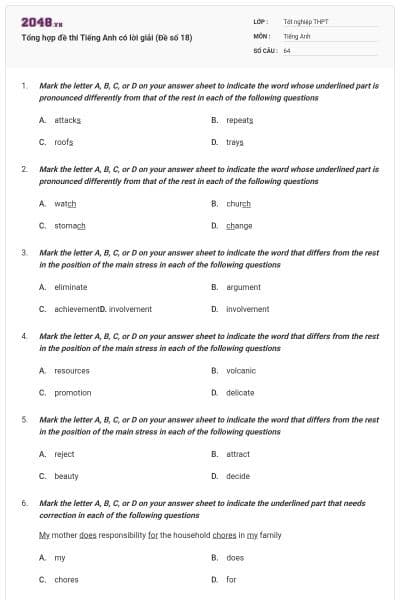
Mark the letter A, B, C, or D on your answer sheet to indicate the word whose underlined part is pronounced differently from that of the rest in each of the following questions
attacks
repeats
roofs
trays
Đáp án : D
“s” sau động từ kết thúc bằng âm /p, f, k, t, θ/ phát âm là /s/, sau từ kết thúc bằng âm /y/ thì phát âm là /z/
Mark the letter A, B, C, or D on your answer sheet to indicate the word whose underlined part is pronounced differently from that of the rest in each of the following questions
watch
church
stomach
change
Đáp án : C
“ch” trong “stomach” phát âm là /k/, trong các từ còn lại phát âm là/t∫/
Mark the letter A, B, C, or D on your answer sheet to indicate the word that differs from the rest in the position of the main stress in each of the following questions
eliminate
argument
achievementD. involvement
involvement
Mark the letter A, B, C, or D on your answer sheet to indicate the word that differs from the rest in the position of the main stress in each of the following questions
resources
volcanic
promotion
delicate
Đáp án : D
Trọng âm của từ này rơi vào âm tiết thứ nhất, các từ còn lại rơi vào âm tiết thứ 2
Mark the letter A, B, C, or D on your answer sheet to indicate the word that differs from the rest in the position of the main stress in each of the following questions
reject
attract
beauty
decide
Đáp án : C
Trọng âm của từ này rơi vào âm tiết thứ nhất, các từ còn lại rơi vào âm tiết thứ 2
Mark the letter A, B, C, or D on your answer sheet to indicate the underlined part that needs correction in each of the following questions
My mother does responsibility for the household chores in my family
my
does
chores
for
Đáp án : B
Have/take responsibility for N/Ving = Be responsible for + N/Ving = chịu trách nhiệm cho việc gì
Mark the letter A, B, C, or D on your answer sheet to indicate the underlined part that needs correction in each of the following questions
Mrs. Steven, along with her cousins from New Mexico, are planning to attend the festivities
with
to attend
her cousins
are
Đáp án : D
Chủ ngữ là : Mrs. Seven – danh từ số ít, động từ phải chia số ít. Trong câu có N1, along with + N2 thì chủ ngữ là N1, động từ chia theo N1
Mark the letter A, B, C, or D on your answer sheet to indicate the underlined part that needs correction in each of the following questions
After driving a car for ten miles, John suddenly realized that he has been driving in the wrong direction.
suddenly realized
driving
has been
direction
Đáp án: C
Giải thích:
Việc lái xe đã bắt đầu xảy ra từ trước khi John nhận ra → chia ở quá khứ hoàn thành tiếp diễn
Sửa: has been → had been
Dịch: Sau khi lái xe được mười dặm, John đột nhiên nhận ra rằng anh ấy đã lái xe đi sai hướng.
Mark the letter A, B, C, or D on your answer sheet to indicate the underlined part that needs correction in each of the following questions
Being the biggest expanse of brackish water in the world, the Baltic Sea is of special interesting to scientists
interesting
in the
is of
Being
Đáp án: A
Giải thích:
Cấu trúc danh từ: be of + danh từ → sau “of” phải là một danh từ, không dùng tính từ.
Trong câu:
"the Baltic Sea is of special interesting" → sai vì interesting là tính từ.
→ Phải sửa thành interest (danh từ): "is of special interest"
Sửa: interesting → interest
Dịch: Là vùng nước lợ lớn nhất thế giới, biển Baltic có ý nghĩa đặc biệt đối với các nhà khoa học.
Mark the letter A, B, C, or D on your answer sheet to indicate the underlined part that needs correction in each of the following questions
Not longer are contributions to the advancement of industry made primarily by individuals
advancement
contributions
madeD. Not longer
Not longer
Đáp án : D
No longer (có thể đứng đầu, giữa hoặc cuối câu) = not… any more = không còn… nữa
Mary asked me whether I _________ the football match on TV the day before
would watch
have watched
had watched
watch
Đáp án : C
Động từ trong câu gián tiếp phải lùi thời so với câu trực tiếp. Trong câu trực tiếp Mary hỏi tôi có xem trận bóng hôm trước không (the day before) -> quá khứ đơn -> lùi thành quá khứ hoàn thành trong câu gián tiếp
He managed to keep his job _________ the manager had threatened to sack him
therefore
although
despite
unless
Đáp án : B
Anh ta xoay sở để giữ được công việc… người giám đốc đã dọa sẽ sa thải anh ta. 2 mệnh đề này có quan hệ đối lập; dùng liên từ mang nghĩa “mặc dù”. Đồng thời, Although + mệnh đề = Despite + N/Ving
It’s no use _________ a language if you don’t try to use it
learned
learn
to learn
learning
Đáp án : D
It is no use + Ving = làm việc gì đó là vô nghĩa
There is _________ in my bed room
a square wooden old table
an old square wooden table
a square old wooden table
an old wooden square table
Đáp án: B
Giải thích:
Kiến thức: Trật tự tính từ trong cụm danh từ
Khi có nhiều tính từ cùng đứng trước 1 danh từ, sắp xếp chúng theo thứ tự: OSASCOMP + N. Trong đó:
O – opinion: quan điểm
S – size: kích thước
A – age: độ tuổi (mới, cũ, trẻ, già,...)
S – shape: hình dạng
C – color: màu sắc
O – origin: nguồn gốc
M - material: chất liệu
P - purpose: mục đích
Ta có:
square: hình vuông => shape
old: cổ => age
wooden: bằng gỗ => material
Vậy thứ tự là: old square wooden, chọn B.
Dịch: Có một chiếc bàn gỗ vuông cũ trong phòng ngủ của tôi.
____________ the phone rang later that night did Tom remember the appointment
Not until
Only
Just before
No sooner
Đáp án : A
Cấu trúc đảo ngữ nhấn mạnh hành động trong quá khứ: Not until + Clause (quá khứ đơn) + did + S +V (nguyên thể bỏ “to”) = cho đến lúc nào, ai đã không làm gì
When Tet holiday comes, Vietnamese people often feel inclined to ________ their houses
clean through
clean in
clean over
clean up
Đáp án: D
Kiến thức: Cụm động từ
Không có “clean through”, “clean in” và “clean over”.
clean up: dọn dẹp
Dịch: Mỗi khi Tết đến, người Việt thường có xu hướng dọn dẹp nhà cửa.
The more ________ and positive you look, the better you will feel
confidence
confidently
confident
confide
Đáp án: C
Giải thích:
A. confidence (n): sự tự tin
B. confidently (adv): mang phong thái tự tin
C. confident (adj): tự tin
D. confide (v): giao phó, phó thác, kể bí mật
Chú ý: (to) look + adj: trông như thế nào
Cấu trúc song hành: ta thấy vị trí cần điền nối với đoạn sau bằng “and”, “positive” là một tính từ, do đó vị trí cần điền cũng cần một tính từ.
Dịch: Bạn càng trông tự tin và tích cực thì bạn càng cảm thấy tốt hơn.
It’s essential that every student ________ all the lectures
attend
has attended
attends
attended
Đáp án : A
Cấu trúc giả định cách: It is/was + các tính từ mang tính quan trọng (essential/important/necessary…) + S + (should) +V (không chia)
Kate: “ How lovely your cats are!” - David: “ ____________”
Thank you, it is nice of you to say soB. Really? They are
Really? They are
I love them, too
Can you say it again
Đáp án : A
Câu cảm thán: How + adj + S + be! = cái gì đó thật là …! . Trước câu cảm thán khen con mèo của mình đáng yêu, David cảm ơn lịch sự: It is nice of you to say so = bạn thật tốt khi nói thế
I can't imagine _________ anywhere except here
that I study
to study
. study
studying
Đáp án : D
Imagine + that + mệnh đề. Hoặc : imagine + Ving = tưởng tượng việc gì
It is generally believed that “Men build the ________ and women make it home
bridge
hospital
school
house
Đáp án : D
Men build the house and women make it home = đàn ông xây nhà, đàn bà xây tổ ấm
_________ is the existence of a large number of different kinds of animals and plants which make a balanced environment
Extinction
Habitat
Biodiversity
Conservation
Đáp án : C
Biodiversity = sự đa dạng sinh học. Extinction = sự tuyệt chủng. Habitat = môi trường. Conservation = sự bảo tồn
My director is angry with me. I didn't do all the work I _________ last week
should have done
must have done
need to have done
may have done
Đáp án : A
Should have done = đáng lẽ ra nên làm trong quá khứ, nhưng đã không làm. Must have done = dự đoán chắc chắn ai đã làm gì trong quá khứ, dựa trên cơ sở rõ ràng
The boy __________ went to the hospital to ask for doctor's help
whose sister sicked
whose sick sister
whose sister was sick
who his sister is sick
Đáp án : C
Whose là đại từ quan hệ chỉ sự sở hữu của người đứng trước (the boy). Cậu ta – người mà chị bị ốm đã tới bệnh viện. Sau đại từ quan hệ là mệnh đề quan hệ với động từ như bình thường (was sick)
You have to move this box to __________ the new television set
pay attention to
. make room for
lose touch with
take notice of
Đáp án : B
Make room for N = để dành chỗ trống cho cái gì
She ran ________ an interesting article about fashion while she was reading the newspaper.
away
across
out
after
Đáp án: B
Giải thích:
Kiến thức: Cụm động từ
run away: chạy trốn
run across: vô tình bắt gặp
run out: hết
run after somebody/something: chạy theo bắt ai/cái gì
Dựa vào nghĩa câu, chọn B.
Dịch: Cô ấy tình cờ đọc được một bài viết thú vị về thời trang khi đang đọc báo.
Professor Smith was very interested in the diversity of cultures all over the world
changes
conservationC. variety
variety
difference
Đáp án : C
Diversity = sự đa dạng. Variety = sự phong phú
It’s a secret. You _________ let anyone know about it
may not
needn’t
mightn’t
mustn’t
Đáp án : D
Secret = bí mật. Nó là một điều bí mật, mày không được để ai biết. Mustn’t chỉ sự cấm đoán, không được phép làm gì
Dick: “I enjoyed myself so much at your birthday party.”- Patrice: “ _________. ”
Congratulations
Oh, I’m glad to hear that
It’s a pleasure
Oh, that’s kind of you
Đáp án : B
Enjoy oneself = be very happy. I’m glad to hear that = tôi thấy vui khi nghe điều đó. Congratulations = chúc mừng vì thành tích của ai. It’s a pleasure = đó làm niềm hân hạnh của tôi (để đáp lời cám ơn). That’s kind of you = bạn thật tốt bụng
Mark the letter A,B,C or D on your sheet to indicate the word(s) OPPOSITE in meaning to the underlined words in each of the following sentences.
That is a well-behaved boy whose behaviour has nothing to complain about
behaving cleverly
behaving improperly
behaving nice
good behavior
Đáp án: B
Giải thích:
Kiến thức: Từ vựng – Cụm từ trái nghĩa
well-behaved (adj): có cư xử đúng, có giáo dục
A. behaving cleverly: cư xử khéo léo
B. behaving improperly: cư xử không đúng mực
C. behaving nice: cư xử tử tế
D. good behaviour: cư xử đúng mực
→ well-behaved >< behaving improperly
Dịch: Đây là một cậu bé cư xử tốt người mà không có hành vi gì để phàn nàn.
Mark the letter A,B,C or D on your sheet to indicate the word(s) OPPOSITE in meaning to the underlined words in each of the following sentences.
After five days on trial, the court found him innocent of the crime and he was released
benevolent
innovative
guilty
naïve
Đáp án : C
Innocent of N /Ving= ngây thơ, vô tội gì. Guilty of N = mắc tội gì
Mark the letter A, B, C, or D on your answer sheet to indicate the word or phrase that is CLOSEST in meaning to the underlined part in each of the following questions.
My uncle, who is an accomplished guitarist, taught me how to play
perfect
famous
skillful
modest
Đáp án : C
Accomplished = thành thục, có kĩ năng = skillful
Mark the letter A, B, C, or D on your answer sheet to indicate the word or phrase that is CLOSEST in meaning to the underlined part in each of the following questions.
The dog saw his reflection in the pool of water
image
imagination
leash
bone
Đáp án : A
Reflection = ảo ảnh. Image = hình ảnh
Mark the letter A, B, C, or D on your answer sheet to indicate the word or phrase that is CLOSEST in meaning to the underlined part in each of the following questions.
The situation seems to be changing minute by minute
time after timeB. from time to time
from time to time
again and again
very rapidly
Đáp án : D
(change ) minute by minute = (thay đổi) từng phút, từng phút một -> thay đổi
Read the following passage and mark the letter A, B, C or D on your answer sheet to indicate the correct word that best fits each of the numbered blanks from 35 to 44.
Environmental Concerns
Earth is the only place we know of in the universe that can support human life. (35) _____ human activities are making the planet less fit to live on. As the western world (36) _____ on consuming two-thirds of the world's resources while half of the world's population do so just to stay alive we are rapidly destroying the (37) _____ resource we have by which all people can survive and prosper. Everywhere fertile soil is (38) _____ built on or washed into the sea. Renewable resources are exploited so much that they will never be able to recover (39) _____. We discharge pollutants into the atmosphere without any thought of the consequences. As a (40) _____ the planet's ability to support people is being reduced at the very time when rising human numbers and consumption are (41) _____ increasingly heavy demands on it.
The Earth's (42) _____ resources are there for us to use. We need food, water, air, energy, medicines, warmth, shelter and minerals to (43) _____ us fed, comfortable, healthy and active. If we are sensible in how we use the resources, they will (44) _____ indefinitely. But if we use them wastefully and excessively, they will soon run out and everyone will suffer.Question 35
Although
Yet
Still
Despite
Đáp án : B
Yet = thế nhưng. Although = mặc dù. Still = vẫn. despite = mặc dù
Read the following passage and mark the letter A, B, C or D on your answer sheet to indicate the correct word that best fits each of the numbered blanks from 35 to 44.
Environmental Concerns
Earth is the only place we know of in the universe that can support human life. (35) _____ human activities are making the planet less fit to live on. As the western world (36) _____ on consuming two-thirds of the world's resources while half of the world's population do so just to stay alive we are rapidly destroying the (37) _____ resource we have by which all people can survive and prosper. Everywhere fertile soil is (38) _____ built on or washed into the sea. Renewable resources are exploited so much that they will never be able to recover (39) _____. We discharge pollutants into the atmosphere without any thought of the consequences. As a (40) _____ the planet's ability to support people is being reduced at the very time when rising human numbers and consumption are (41) _____ increasingly heavy demands on it.
The Earth's (42) _____ resources are there for us to use. We need food, water, air, energy, medicines, warmth, shelter and minerals to (43) _____ us fed, comfortable, healthy and active. If we are sensible in how we use the resources, they will (44) _____ indefinitely. But if we use them wastefully and excessively, they will soon run out and everyone will suffer.Question 36
continues
repeats
follows
carries
Đáp án : D
Carry on Ving = tiếp tục làm gì = continue Ving. Repeat = lặp lại. Follow = theo sau
Read the following passage and mark the letter A, B, C or D on your answer sheet to indicate the correct word that best fits each of the numbered blanks from 35 to 44.
Environmental Concerns
Earth is the only place we know of in the universe that can support human life. (35) _____ human activities are making the planet less fit to live on. As the western world (36) _____ on consuming two-thirds of the world's resources while half of the world's population do so just to stay alive we are rapidly destroying the (37) _____ resource we have by which all people can survive and prosper. Everywhere fertile soil is (38) _____ built on or washed into the sea. Renewable resources are exploited so much that they will never be able to recover (39) _____. We discharge pollutants into the atmosphere without any thought of the consequences. As a (40) _____ the planet's ability to support people is being reduced at the very time when rising human numbers and consumption are (41) _____ increasingly heavy demands on it.
The Earth's (42) _____ resources are there for us to use. We need food, water, air, energy, medicines, warmth, shelter and minerals to (43) _____ us fed, comfortable, healthy and active. If we are sensible in how we use the resources, they will (44) _____ indefinitely. But if we use them wastefully and excessively, they will soon run out and everyone will suffer.Question 37
wastefully
rapidly
lonely
quicklyĐáp án : C
Lonely = duy nhất, cô đơn. Wastefully = một cách lãng phí. Rapidly = một cách nhanh chóng = quickly
Đáp án : C
Lonely = duy nhất, cô đơn. Wastefully = một cách lãng phí. Rapidly = một cách nhanh chóng = quickly
Read the following passage and mark the letter A, B, C or D on your answer sheet to indicate the correct word that best fits each of the numbered blanks from 35 to 44.
Environmental Concerns
Earth is the only place we know of in the universe that can support human life. (35) _____ human activities are making the planet less fit to live on. As the western world (36) _____ on consuming two-thirds of the world's resources while half of the world's population do so just to stay alive we are rapidly destroying the (37) _____ resource we have by which all people can survive and prosper. Everywhere fertile soil is (38) _____ built on or washed into the sea. Renewable resources are exploited so much that they will never be able to recover (39) _____. We discharge pollutants into the atmosphere without any thought of the consequences. As a (40) _____ the planet's ability to support people is being reduced at the very time when rising human numbers and consumption are (41) _____ increasingly heavy demands on it.
The Earth's (42) _____ resources are there for us to use. We need food, water, air, energy, medicines, warmth, shelter and minerals to (43) _____ us fed, comfortable, healthy and active. If we are sensible in how we use the resources, they will (44) _____ indefinitely. But if we use them wastefully and excessively, they will soon run out and everyone will suffer.Question 38
neither
sooner
rather
either
Đáp án : D
Either … or … = … hoặc…
Read the following passage and mark the letter A, B, C or D on your answer sheet to indicate the correct word that best fits each of the numbered blanks from 35 to 44.
Environmental Concerns
Earth is the only place we know of in the universe that can support human life. (35) _____ human activities are making the planet less fit to live on. As the western world (36) _____ on consuming two-thirds of the world's resources while half of the world's population do so just to stay alive we are rapidly destroying the (37) _____ resource we have by which all people can survive and prosper. Everywhere fertile soil is (38) _____ built on or washed into the sea. Renewable resources are exploited so much that they will never be able to recover (39) _____. We discharge pollutants into the atmosphere without any thought of the consequences. As a (40) _____ the planet's ability to support people is being reduced at the very time when rising human numbers and consumption are (41) _____ increasingly heavy demands on it.
The Earth's (42) _____ resources are there for us to use. We need food, water, air, energy, medicines, warmth, shelter and minerals to (43) _____ us fed, comfortable, healthy and active. If we are sensible in how we use the resources, they will (44) _____ indefinitely. But if we use them wastefully and excessively, they will soon run out and everyone will suffer.Question 39
utterly
completely
quite
greatly
Đáp án : B
Completely = hoàn toàn. Utterly = toàn bộ. Quite = khá là, hơi hơi. Greatly = vĩ đại, cực kì
Read the following passage and mark the letter A, B, C or D on your answer sheet to indicate the correct word that best fits each of the numbered blanks from 35 to 44.
Environmental Concerns
Earth is the only place we know of in the universe that can support human life. (35) _____ human activities are making the planet less fit to live on. As the western world (36) _____ on consuming two-thirds of the world's resources while half of the world's population do so just to stay alive we are rapidly destroying the (37) _____ resource we have by which all people can survive and prosper. Everywhere fertile soil is (38) _____ built on or washed into the sea. Renewable resources are exploited so much that they will never be able to recover (39) _____. We discharge pollutants into the atmosphere without any thought of the consequences. As a (40) _____ the planet's ability to support people is being reduced at the very time when rising human numbers and consumption are (41) _____ increasingly heavy demands on it.
The Earth's (42) _____ resources are there for us to use. We need food, water, air, energy, medicines, warmth, shelter and minerals to (43) _____ us fed, comfortable, healthy and active. If we are sensible in how we use the resources, they will (44) _____ indefinitely. But if we use them wastefully and excessively, they will soon run out and everyone will suffer.Question 40
result
reaction
development
product
Đáp án : A
As a result,… = kết quả là
Read the following passage and mark the letter A, B, C or D on your answer sheet to indicate the correct word that best fits each of the numbered blanks from 35 to 44.
Environmental Concerns
Earth is the only place we know of in the universe that can support human life. (35) _____ human activities are making the planet less fit to live on. As the western world (36) _____ on consuming two-thirds of the world's resources while half of the world's population do so just to stay alive we are rapidly destroying the (37) _____ resource we have by which all people can survive and prosper. Everywhere fertile soil is (38) _____ built on or washed into the sea. Renewable resources are exploited so much that they will never be able to recover (39) _____. We discharge pollutants into the atmosphere without any thought of the consequences. As a (40) _____ the planet's ability to support people is being reduced at the very time when rising human numbers and consumption are (41) _____ increasingly heavy demands on it.
The Earth's (42) _____ resources are there for us to use. We need food, water, air, energy, medicines, warmth, shelter and minerals to (43) _____ us fed, comfortable, healthy and active. If we are sensible in how we use the resources, they will (44) _____ indefinitely. But if we use them wastefully and excessively, they will soon run out and everyone will suffer.Question 41
making
doing
having
taking
Đáp án : A
Make + something = tạo ra cái gì
Read the following passage and mark the letter A, B, C or D on your answer sheet to indicate the correct word that best fits each of the numbered blanks from 35 to 44.
Environmental Concerns
Earth is the only place we know of in the universe that can support human life. (35) _____ human activities are making the planet less fit to live on. As the western world (36) _____ on consuming two-thirds of the world's resources while half of the world's population do so just to stay alive we are rapidly destroying the (37) _____ resource we have by which all people can survive and prosper. Everywhere fertile soil is (38) _____ built on or washed into the sea. Renewable resources are exploited so much that they will never be able to recover (39) _____. We discharge pollutants into the atmosphere without any thought of the consequences. As a (40) _____ the planet's ability to support people is being reduced at the very time when rising human numbers and consumption are (41) _____ increasingly heavy demands on it.
The Earth's (42) _____ resources are there for us to use. We need food, water, air, energy, medicines, warmth, shelter and minerals to (43) _____ us fed, comfortable, healthy and active. If we are sensible in how we use the resources, they will (44) _____ indefinitely. But if we use them wastefully and excessively, they will soon run out and everyone will suffer.Question 42
living
real
natural
genuine
Đáp án : C
Natural resources = các nguồn tài nguyên thiên nhiên
Read the following passage and mark the letter A, B, C or D on your answer sheet to indicate the correct word that best fits each of the numbered blanks from 35 to 44.
Environmental Concerns
Earth is the only place we know of in the universe that can support human life. (35) _____ human activities are making the planet less fit to live on. As the western world (36) _____ on consuming two-thirds of the world's resources while half of the world's population do so just to stay alive we are rapidly destroying the (37) _____ resource we have by which all people can survive and prosper. Everywhere fertile soil is (38) _____ built on or washed into the sea. Renewable resources are exploited so much that they will never be able to recover (39) _____. We discharge pollutants into the atmosphere without any thought of the consequences. As a (40) _____ the planet's ability to support people is being reduced at the very time when rising human numbers and consumption are (41) _____ increasingly heavy demands on it.
The Earth's (42) _____ resources are there for us to use. We need food, water, air, energy, medicines, warmth, shelter and minerals to (43) _____ us fed, comfortable, healthy and active. If we are sensible in how we use the resources, they will (44) _____ indefinitely. But if we use them wastefully and excessively, they will soon run out and everyone will suffer.Question 43
maintain
stay
hold
keep
Đáp án : D
Keep + N + past participle/adj = duy trì, giữ cho ai ở tình trạng nào.
Read the following passage and mark the letter A, B, C or D on your answer sheet to indicate the correct word that best fits each of the numbered blanks from 35 to 44.
Environmental Concerns
Earth is the only place we know of in the universe that can support human life. (35) _____ human activities are making the planet less fit to live on. As the western world (36) _____ on consuming two-thirds of the world's resources while half of the world's population do so just to stay alive we are rapidly destroying the (37) _____ resource we have by which all people can survive and prosper. Everywhere fertile soil is (38) _____ built on or washed into the sea. Renewable resources are exploited so much that they will never be able to recover (39) _____. We discharge pollutants into the atmosphere without any thought of the consequences. As a (40) _____ the planet's ability to support people is being reduced at the very time when rising human numbers and consumption are (41) _____ increasingly heavy demands on it.
The Earth's (42) _____ resources are there for us to use. We need food, water, air, energy, medicines, warmth, shelter and minerals to (43) _____ us fed, comfortable, healthy and active. If we are sensible in how we use the resources, they will (44) _____ indefinitely. But if we use them wastefully and excessively, they will soon run out and everyone will suffer.Question 44
remain
go
last
stand
Đáp án : B
Go + adj = trở nên thế nào. Remain + adj = duy trì ở tình trạng nào
Read the following passage and mark the letter A, B, C or D on your answer sheet to indicate the correct answer to each of the questions from 45 to 54.
Before the 1500’s, the western plains of North America were dominated by farmers. One group, the Mandans, lived in the upper Missouri River country, primarily in present – day North Dakota. They had large villages of houses built close together. The tight arrangement enabled the Mandans to protect themselves more easily from the attacks of others who might seek to obtain some of the food these highly capable farmers stored from one year to the next.
The women had primary responsibility for the fields. They had to exercise considerable skill to produce the desired results, for their northern location meant fleeting growing seasons. Winter often lingered; autumn could be ushered in by severe frost. For good measure, during the spring and summer, drought, heat, hail, grasshoppers, and other frustrations might await the wary grower.
Under such conditions, Mandan women had to grow maize capable of weathering adversity. They began as early as it appeared feasible to do so in the spring, clearing the land, using fire to clear stubble from the fields and then planting. From this point until the first green corn could be harvested, the crop required labor and vigilance.
Harvesting proceeded in two stages. In August the Mandans picked a smaller amount of the crop before it had matured fully. This green corn was boiled, dried and shelled, with some of the maize slated for immediate consumption and the rest stored in animal – skin bags. Later in the fall, the people picked the rest of the corn. They saved the best of the harvest for seeds or for trade, with the remainder eaten right away or stored for alter use in underground reserves. With appropriate banking of the extra food, the Mandans protected themselves against the disaster of crop failure and accompany hunger.
The woman planted another staple, squash, about the first of June, and harvested it near the time of the green corn harvest. After they picked it, they sliced it, dried it, and strung the slices before they stored them. Once again, they saved the seeds from the best of the year’s crop. The Mandans also grew sunflowers and tobacco; the latter was the particular task of the older men
What is the main topic of the passage ?
The agricultural activities of a North American Society
Various ways corn can be used
The problems encountered by farmers specializing in growing once crop
Weather conditions on the western plains
Đáp án : A
Ngay từ mở đầu, đoạn văn : the western plains of North America were dominated by farmers -> ám chỉ lĩnh vực nông nghiệp ở Tây Bắc Mĩ; sau đó đoạn văn tiếp tục đưa ra thông tin về các cánh đồng, mùa vụ
Read the following passage and mark the letter A, B, C or D on your answer sheet to indicate the correct answer to each of the questions from 45 to 54.
Before the 1500’s, the western plains of North America were dominated by farmers. One group, the Mandans, lived in the upper Missouri River country, primarily in present – day North Dakota. They had large villages of houses built close together. The tight arrangement enabled the Mandans to protect themselves more easily from the attacks of others who might seek to obtain some of the food these highly capable farmers stored from one year to the next.
The women had primary responsibility for the fields. They had to exercise considerable skill to produce the desired results, for their northern location meant fleeting growing seasons. Winter often lingered; autumn could be ushered in by severe frost. For good measure, during the spring and summer, drought, heat, hail, grasshoppers, and other frustrations might await the wary grower.
Under such conditions, Mandan women had to grow maize capable of weathering adversity. They began as early as it appeared feasible to do so in the spring, clearing the land, using fire to clear stubble from the fields and then planting. From this point until the first green corn could be harvested, the crop required labor and vigilance.
Harvesting proceeded in two stages. In August the Mandans picked a smaller amount of the crop before it had matured fully. This green corn was boiled, dried and shelled, with some of the maize slated for immediate consumption and the rest stored in animal – skin bags. Later in the fall, the people picked the rest of the corn. They saved the best of the harvest for seeds or for trade, with the remainder eaten right away or stored for alter use in underground reserves. With appropriate banking of the extra food, the Mandans protected themselves against the disaster of crop failure and accompany hunger.
The woman planted another staple, squash, about the first of June, and harvested it near the time of the green corn harvest. After they picked it, they sliced it, dried it, and strung the slices before they stored them. Once again, they saved the seeds from the best of the year’s crop. The Mandans also grew sunflowers and tobacco; the latter was the particular task of the older men
The Mandans built their houses close together in order to ____________
guard their supplies of food
share farming implements
protect themselves against the weather
allow more room for growing corn
Đáp án : A
Từ cuối dòng 3: The tight arrangement enabled the Mandans to protect themselves more easily from the attacks of others who might seek to obtain some of the food -> sự bố trí chặt chẽ này để phòng thủ khỏi những cuộc tấn công của những kẻ tìm thức ăn
Read the following passage and mark the letter A, B, C or D on your answer sheet to indicate the correct answer to each of the questions from 45 to 54.
Before the 1500’s, the western plains of North America were dominated by farmers. One group, the Mandans, lived in the upper Missouri River country, primarily in present – day North Dakota. They had large villages of houses built close together. The tight arrangement enabled the Mandans to protect themselves more easily from the attacks of others who might seek to obtain some of the food these highly capable farmers stored from one year to the next.
The women had primary responsibility for the fields. They had to exercise considerable skill to produce the desired results, for their northern location meant fleeting growing seasons. Winter often lingered; autumn could be ushered in by severe frost. For good measure, during the spring and summer, drought, heat, hail, grasshoppers, and other frustrations might await the wary grower.
Under such conditions, Mandan women had to grow maize capable of weathering adversity. They began as early as it appeared feasible to do so in the spring, clearing the land, using fire to clear stubble from the fields and then planting. From this point until the first green corn could be harvested, the crop required labor and vigilance.
Harvesting proceeded in two stages. In August the Mandans picked a smaller amount of the crop before it had matured fully. This green corn was boiled, dried and shelled, with some of the maize slated for immediate consumption and the rest stored in animal – skin bags. Later in the fall, the people picked the rest of the corn. They saved the best of the harvest for seeds or for trade, with the remainder eaten right away or stored for alter use in underground reserves. With appropriate banking of the extra food, the Mandans protected themselves against the disaster of crop failure and accompany hunger.
The woman planted another staple, squash, about the first of June, and harvested it near the time of the green corn harvest. After they picked it, they sliced it, dried it, and strung the slices before they stored them. Once again, they saved the seeds from the best of the year’s crop. The Mandans also grew sunflowers and tobacco; the latter was the particular task of the older men
The word “enabled” in the first paragraph is closest in meaning to ____________
covered
isolated
helped
reminded
Đáp án : C
Enable + N + to V = tạo điều kiện cho ai/cái gì làm gì
Read the following passage and mark the letter A, B, C or D on your answer sheet to indicate the correct answer to each of the questions from 45 to 54.
Before the 1500’s, the western plains of North America were dominated by farmers. One group, the Mandans, lived in the upper Missouri River country, primarily in present – day North Dakota. They had large villages of houses built close together. The tight arrangement enabled the Mandans to protect themselves more easily from the attacks of others who might seek to obtain some of the food these highly capable farmers stored from one year to the next.
The women had primary responsibility for the fields. They had to exercise considerable skill to produce the desired results, for their northern location meant fleeting growing seasons. Winter often lingered; autumn could be ushered in by severe frost. For good measure, during the spring and summer, drought, heat, hail, grasshoppers, and other frustrations might await the wary grower.
Under such conditions, Mandan women had to grow maize capable of weathering adversity. They began as early as it appeared feasible to do so in the spring, clearing the land, using fire to clear stubble from the fields and then planting. From this point until the first green corn could be harvested, the crop required labor and vigilance.
Harvesting proceeded in two stages. In August the Mandans picked a smaller amount of the crop before it had matured fully. This green corn was boiled, dried and shelled, with some of the maize slated for immediate consumption and the rest stored in animal – skin bags. Later in the fall, the people picked the rest of the corn. They saved the best of the harvest for seeds or for trade, with the remainder eaten right away or stored for alter use in underground reserves. With appropriate banking of the extra food, the Mandans protected themselves against the disaster of crop failure and accompany hunger.
The woman planted another staple, squash, about the first of June, and harvested it near the time of the green corn harvest. After they picked it, they sliced it, dried it, and strung the slices before they stored them. Once again, they saved the seeds from the best of the year’s crop. The Mandans also grew sunflowers and tobacco; the latter was the particular task of the older men
Why does the author believe that the Mandans were skilled farmers?
They developed new varieties of corn
They could grow crops despite adverse weather
They developed effective fertilizers
They could grow crops in most types of soil
Đáp án : B
Từ dòng đầu đoạn 2: They had to exercise considerable skill to produce the desired results, …, (đầu đoạn 3) Mandan women had to grow maize capable of weathering adversity -> họ phải có nhiều kĩ năng, (thời gian thuận lợi rất ngắn) điều kiện thời tiết bất lợi cho việc trồng cây
Read the following passage and mark the letter A, B, C or D on your answer sheet to indicate the correct answer to each of the questions from 45 to 54.
Before the 1500’s, the western plains of North America were dominated by farmers. One group, the Mandans, lived in the upper Missouri River country, primarily in present – day North Dakota. They had large villages of houses built close together. The tight arrangement enabled the Mandans to protect themselves more easily from the attacks of others who might seek to obtain some of the food these highly capable farmers stored from one year to the next.
The women had primary responsibility for the fields. They had to exercise considerable skill to produce the desired results, for their northern location meant fleeting growing seasons. Winter often lingered; autumn could be ushered in by severe frost. For good measure, during the spring and summer, drought, heat, hail, grasshoppers, and other frustrations might await the wary grower.
Under such conditions, Mandan women had to grow maize capable of weathering adversity. They began as early as it appeared feasible to do so in the spring, clearing the land, using fire to clear stubble from the fields and then planting. From this point until the first green corn could be harvested, the crop required labor and vigilance.
Harvesting proceeded in two stages. In August the Mandans picked a smaller amount of the crop before it had matured fully. This green corn was boiled, dried and shelled, with some of the maize slated for immediate consumption and the rest stored in animal – skin bags. Later in the fall, the people picked the rest of the corn. They saved the best of the harvest for seeds or for trade, with the remainder eaten right away or stored for alter use in underground reserves. With appropriate banking of the extra food, the Mandans protected themselves against the disaster of crop failure and accompany hunger.
The woman planted another staple, squash, about the first of June, and harvested it near the time of the green corn harvest. After they picked it, they sliced it, dried it, and strung the slices before they stored them. Once again, they saved the seeds from the best of the year’s crop. The Mandans also grew sunflowers and tobacco; the latter was the particular task of the older men
The word “consumption” in the paragraph is closest in meaning to _________
conversationB. decay
decay
eating
planting
Đáp án : C
Consumption = sự tiêu thụ, lượng tiêu thụ
Read the following passage and mark the letter A, B, C or D on your answer sheet to indicate the correct answer to each of the questions from 45 to 54.
Before the 1500’s, the western plains of North America were dominated by farmers. One group, the Mandans, lived in the upper Missouri River country, primarily in present – day North Dakota. They had large villages of houses built close together. The tight arrangement enabled the Mandans to protect themselves more easily from the attacks of others who might seek to obtain some of the food these highly capable farmers stored from one year to the next.
The women had primary responsibility for the fields. They had to exercise considerable skill to produce the desired results, for their northern location meant fleeting growing seasons. Winter often lingered; autumn could be ushered in by severe frost. For good measure, during the spring and summer, drought, heat, hail, grasshoppers, and other frustrations might await the wary grower.
Under such conditions, Mandan women had to grow maize capable of weathering adversity. They began as early as it appeared feasible to do so in the spring, clearing the land, using fire to clear stubble from the fields and then planting. From this point until the first green corn could be harvested, the crop required labor and vigilance.
Harvesting proceeded in two stages. In August the Mandans picked a smaller amount of the crop before it had matured fully. This green corn was boiled, dried and shelled, with some of the maize slated for immediate consumption and the rest stored in animal – skin bags. Later in the fall, the people picked the rest of the corn. They saved the best of the harvest for seeds or for trade, with the remainder eaten right away or stored for alter use in underground reserves. With appropriate banking of the extra food, the Mandans protected themselves against the disaster of crop failure and accompany hunger.
The woman planted another staple, squash, about the first of June, and harvested it near the time of the green corn harvest. After they picked it, they sliced it, dried it, and strung the slices before they stored them. Once again, they saved the seeds from the best of the year’s crop. The Mandans also grew sunflowers and tobacco; the latter was the particular task of the older men
Which of the following processes does the author imply was done by both men and women?
clearing fields
Harvesting corn
Harvesting squash
Planting corn
Đáp án : B
Việc thu hoạch ngô được nói đến trong đoạn 3, dòng 4: people picked the rest of the corn -> người thu hoạch là “people” nói chung, không phân biệt gái trai
Read the following passage and mark the letter A, B, C or D on your answer sheet to indicate the correct answer to each of the questions from 45 to 54.
Before the 1500’s, the western plains of North America were dominated by farmers. One group, the Mandans, lived in the upper Missouri River country, primarily in present – day North Dakota. They had large villages of houses built close together. The tight arrangement enabled the Mandans to protect themselves more easily from the attacks of others who might seek to obtain some of the food these highly capable farmers stored from one year to the next.
The women had primary responsibility for the fields. They had to exercise considerable skill to produce the desired results, for their northern location meant fleeting growing seasons. Winter often lingered; autumn could be ushered in by severe frost. For good measure, during the spring and summer, drought, heat, hail, grasshoppers, and other frustrations might await the wary grower.
Under such conditions, Mandan women had to grow maize capable of weathering adversity. They began as early as it appeared feasible to do so in the spring, clearing the land, using fire to clear stubble from the fields and then planting. From this point until the first green corn could be harvested, the crop required labor and vigilance.
Harvesting proceeded in two stages. In August the Mandans picked a smaller amount of the crop before it had matured fully. This green corn was boiled, dried and shelled, with some of the maize slated for immediate consumption and the rest stored in animal – skin bags. Later in the fall, the people picked the rest of the corn. They saved the best of the harvest for seeds or for trade, with the remainder eaten right away or stored for alter use in underground reserves. With appropriate banking of the extra food, the Mandans protected themselves against the disaster of crop failure and accompany hunger.
The woman planted another staple, squash, about the first of June, and harvested it near the time of the green corn harvest. After they picked it, they sliced it, dried it, and strung the slices before they stored them. Once again, they saved the seeds from the best of the year’s crop. The Mandans also grew sunflowers and tobacco; the latter was the particular task of the older men
The word “disaster” in paragraph 4 is closest in meaning to __________
catastrophe
history
history
avoidance
Đáp án : A
Disaster = thảm họa. Catastrophe = tai họa
Read the following passage and mark the letter A, B, C or D on your answer sheet to indicate the correct answer to each of the questions from 45 to 54.
Before the 1500’s, the western plains of North America were dominated by farmers. One group, the Mandans, lived in the upper Missouri River country, primarily in present – day North Dakota. They had large villages of houses built close together. The tight arrangement enabled the Mandans to protect themselves more easily from the attacks of others who might seek to obtain some of the food these highly capable farmers stored from one year to the next.
The women had primary responsibility for the fields. They had to exercise considerable skill to produce the desired results, for their northern location meant fleeting growing seasons. Winter often lingered; autumn could be ushered in by severe frost. For good measure, during the spring and summer, drought, heat, hail, grasshoppers, and other frustrations might await the wary grower.
Under such conditions, Mandan women had to grow maize capable of weathering adversity. They began as early as it appeared feasible to do so in the spring, clearing the land, using fire to clear stubble from the fields and then planting. From this point until the first green corn could be harvested, the crop required labor and vigilance.
Harvesting proceeded in two stages. In August the Mandans picked a smaller amount of the crop before it had matured fully. This green corn was boiled, dried and shelled, with some of the maize slated for immediate consumption and the rest stored in animal – skin bags. Later in the fall, the people picked the rest of the corn. They saved the best of the harvest for seeds or for trade, with the remainder eaten right away or stored for alter use in underground reserves. With appropriate banking of the extra food, the Mandans protected themselves against the disaster of crop failure and accompany hunger.
The woman planted another staple, squash, about the first of June, and harvested it near the time of the green corn harvest. After they picked it, they sliced it, dried it, and strung the slices before they stored them. Once again, they saved the seeds from the best of the year’s crop. The Mandans also grew sunflowers and tobacco; the latter was the particular task of the older men
The word “them” in the last paragraph refers to _________
women
seeds
slices
the Mandans
Đáp án : C
Them là để chỉ danh từ số nhiều đứng ở vế trước nó; they sliced it, dried it, and strung the slices before they stored them -> they được dùng tách riêng; vì vậy “them” chính là “slices”
Read the following passage and mark the letter A, B, C or D on your answer sheet to indicate the correct answer to each of the questions from 45 to 54.
Before the 1500’s, the western plains of North America were dominated by farmers. One group, the Mandans, lived in the upper Missouri River country, primarily in present – day North Dakota. They had large villages of houses built close together. The tight arrangement enabled the Mandans to protect themselves more easily from the attacks of others who might seek to obtain some of the food these highly capable farmers stored from one year to the next.
The women had primary responsibility for the fields. They had to exercise considerable skill to produce the desired results, for their northern location meant fleeting growing seasons. Winter often lingered; autumn could be ushered in by severe frost. For good measure, during the spring and summer, drought, heat, hail, grasshoppers, and other frustrations might await the wary grower.
Under such conditions, Mandan women had to grow maize capable of weathering adversity. They began as early as it appeared feasible to do so in the spring, clearing the land, using fire to clear stubble from the fields and then planting. From this point until the first green corn could be harvested, the crop required labor and vigilance.
Harvesting proceeded in two stages. In August the Mandans picked a smaller amount of the crop before it had matured fully. This green corn was boiled, dried and shelled, with some of the maize slated for immediate consumption and the rest stored in animal – skin bags. Later in the fall, the people picked the rest of the corn. They saved the best of the harvest for seeds or for trade, with the remainder eaten right away or stored for alter use in underground reserves. With appropriate banking of the extra food, the Mandans protected themselves against the disaster of crop failure and accompany hunger.
The woman planted another staple, squash, about the first of June, and harvested it near the time of the green corn harvest. After they picked it, they sliced it, dried it, and strung the slices before they stored them. Once again, they saved the seeds from the best of the year’s crop. The Mandans also grew sunflowers and tobacco; the latter was the particular task of the older men
Which of the following crops was cultivated primarily by men?
Squash
Sunflower
Corn
Tobacco
Đáp án : D
Câu cuối: The Mandans also grew sunflowers and tobacco; the latter was the particular task of the older men. -> họ trồng hướng dương và cây thuốc phiện; thứ được nhắc tới sau trong hai thứ (chính là thuốc phiện) là nhiệm vụ đặc biệt của những người đàn ông lớn hơn
Read the following passage and mark the letter A, B, C or D on your answer sheet to indicate the correct answer to each of the questions from 45 to 54.
Before the 1500’s, the western plains of North America were dominated by farmers. One group, the Mandans, lived in the upper Missouri River country, primarily in present – day North Dakota. They had large villages of houses built close together. The tight arrangement enabled the Mandans to protect themselves more easily from the attacks of others who might seek to obtain some of the food these highly capable farmers stored from one year to the next.
The women had primary responsibility for the fields. They had to exercise considerable skill to produce the desired results, for their northern location meant fleeting growing seasons. Winter often lingered; autumn could be ushered in by severe frost. For good measure, during the spring and summer, drought, heat, hail, grasshoppers, and other frustrations might await the wary grower.
Under such conditions, Mandan women had to grow maize capable of weathering adversity. They began as early as it appeared feasible to do so in the spring, clearing the land, using fire to clear stubble from the fields and then planting. From this point until the first green corn could be harvested, the crop required labor and vigilance.
Harvesting proceeded in two stages. In August the Mandans picked a smaller amount of the crop before it had matured fully. This green corn was boiled, dried and shelled, with some of the maize slated for immediate consumption and the rest stored in animal – skin bags. Later in the fall, the people picked the rest of the corn. They saved the best of the harvest for seeds or for trade, with the remainder eaten right away or stored for alter use in underground reserves. With appropriate banking of the extra food, the Mandans protected themselves against the disaster of crop failure and accompany hunger.
The woman planted another staple, squash, about the first of June, and harvested it near the time of the green corn harvest. After they picked it, they sliced it, dried it, and strung the slices before they stored them. Once again, they saved the seeds from the best of the year’s crop. The Mandans also grew sunflowers and tobacco; the latter was the particular task of the older men
Throughout the passage, the author implies that the Mandans _________
planned for the futureB. valued individualit
valued individuality
were open to strangersD. were very adventurous
were very adventurous
Đáp án : A
Người Mandans bố trí quy hoạch nhà sát nhau để bảo vệ thực phẩm(Đoạn 1: The tight arrangement enabled the Mandans to protect themselves more easily from the attacks of others who might seek to obtain some of the food), họ giữ lại những hạt giống tốt nhất cho mùa sau (đoạn 3: They saved the best of the harvest for seeds); họ dự trữ thực phẩm đề phòng mất mùa, thiên tai (cuối đoạn 3: With appropriate banking of the extra food, the Mandans protected themselves against the disaster of crop failure and accompany hunger ) -> họ luôn lập kế hoạch cho tương lai
Read the following passage and mark the letter A, B, C or D on your answer sheet to indicate the correct answer to each of the questions from 55 to 64.
Are you interested in seeing the beautiful fall foliage of New England but tired of traffic jams and overbooked hotels? Then this year forget the crowds in New England and see the beautiful colors of autumn in the Catskills.
These rugged mountains in New York State, just 90 miles northwest of New York City, are famous for the legendary tales of Rip Van Winkle, and more recently for the summer hotels that sprang up in the region during the 1940s, 1950s, and 1960s. Families trying to escape the heat of New York City found the Catskills to be the perfect place to stay for a month or so each summer. By the late 1950s there were over 500 resorts and hotels offering nighttime entertainment as well as all kinds of outdoor activities. Famous comedians like Jackie Gleason, Joan Rivers, and Sid Caesar all got their start touring the hotel clubs here. Since the introduction of air-conditioning and cheaper air travel, however, families have stopped coming to the Catskills in such large numbers, choosing instead more distant locations at different times of the year. Many of the Catskill hotels closed in the 1970s, but some remain and have expanded and changed their facilities to meet the needs of today's visitors.
Currently, there are many activities available to the traveler besides witnessing the changing colors of the leaves. There is an all-organic sheep farm where visitors can see how a traditional sheep farm operates. There are also hundreds of miles of scenic drives in the area. Route 42, for instance, is an excellent site for spotting bald eagles. For more information on vacations in the Catskills, call the Office of Public Information.
What is the author's main purpose in this passage?
to promote the Catskills as a vacation destination
to introduce visitors to famous Catskills entertainers
to describe the history of the Catskills regionD. to compare the Catskills to New England
to compare the Catskills to New England
Đáp án : A
Ngay từ mở đầu: người viết đã hướng độc giả tới việc tận hưởng mùa thu ở Catskills thay vì khu New England đông đúc: forget the crowds in New England and see the beautiful colors of autumn in the Catskills.
ð Đoạn văn để đẩy mạnh việc du lịch Catskills
Read the following passage and mark the letter A, B, C or D on your answer sheet to indicate the correct answer to each of the questions from 55 to 64.
Are you interested in seeing the beautiful fall foliage of New England but tired of traffic jams and overbooked hotels? Then this year forget the crowds in New England and see the beautiful colors of autumn in the Catskills.
These rugged mountains in New York State, just 90 miles northwest of New York City, are famous for the legendary tales of Rip Van Winkle, and more recently for the summer hotels that sprang up in the region during the 1940s, 1950s, and 1960s. Families trying to escape the heat of New York City found the Catskills to be the perfect place to stay for a month or so each summer. By the late 1950s there were over 500 resorts and hotels offering nighttime entertainment as well as all kinds of outdoor activities. Famous comedians like Jackie Gleason, Joan Rivers, and Sid Caesar all got their start touring the hotel clubs here. Since the introduction of air-conditioning and cheaper air travel, however, families have stopped coming to the Catskills in such large numbers, choosing instead more distant locations at different times of the year. Many of the Catskill hotels closed in the 1970s, but some remain and have expanded and changed their facilities to meet the needs of today's visitors.
Currently, there are many activities available to the traveler besides witnessing the changing colors of the leaves. There is an all-organic sheep farm where visitors can see how a traditional sheep farm operates. There are also hundreds of miles of scenic drives in the area. Route 42, for instance, is an excellent site for spotting bald eagles. For more information on vacations in the Catskills, call the Office of Public Information.
The word "rugged" in paragraph 2 could be best replaced by which of the following?
barren
rough
tall
lush
Đáp án : B
Rugged = gồ ghề, lởm chởm = rough
Read the following passage and mark the letter A, B, C or D on your answer sheet to indicate the correct answer to each of the questions from 55 to 64.
Are you interested in seeing the beautiful fall foliage of New England but tired of traffic jams and overbooked hotels? Then this year forget the crowds in New England and see the beautiful colors of autumn in the Catskills.
These rugged mountains in New York State, just 90 miles northwest of New York City, are famous for the legendary tales of Rip Van Winkle, and more recently for the summer hotels that sprang up in the region during the 1940s, 1950s, and 1960s. Families trying to escape the heat of New York City found the Catskills to be the perfect place to stay for a month or so each summer. By the late 1950s there were over 500 resorts and hotels offering nighttime entertainment as well as all kinds of outdoor activities. Famous comedians like Jackie Gleason, Joan Rivers, and Sid Caesar all got their start touring the hotel clubs here. Since the introduction of air-conditioning and cheaper air travel, however, families have stopped coming to the Catskills in such large numbers, choosing instead more distant locations at different times of the year. Many of the Catskill hotels closed in the 1970s, but some remain and have expanded and changed their facilities to meet the needs of today's visitors.
Currently, there are many activities available to the traveler besides witnessing the changing colors of the leaves. There is an all-organic sheep farm where visitors can see how a traditional sheep farm operates. There are also hundreds of miles of scenic drives in the area. Route 42, for instance, is an excellent site for spotting bald eagles. For more information on vacations in the Catskills, call the Office of Public Information.
According to the passage, which of the following caused the decline in the number of resorts in the 1970s?
television
shorter vacations
affordable air travel
more traffic
Đáp án : C
Từ dòng 7 đoạn 2: Since the introduction of air-conditioning and cheaper air travel, however, families have stopped coming to the Catskills in such large numbers, choosing instead more distant locations at different times of the year. Many of the Catskill hotels closed in the 1970s
-> vé máy bay du lịch rẻ hơn (affordable = có thể mua được) là một trong những nguyên nhân khiến các gia đình đi nghỉ xa hơn, ít đến Catskills và một số khách sạn ở đây phải đóng cửa
Read the following passage and mark the letter A, B, C or D on your answer sheet to indicate the correct answer to each of the questions from 55 to 64.
Are you interested in seeing the beautiful fall foliage of New England but tired of traffic jams and overbooked hotels? Then this year forget the crowds in New England and see the beautiful colors of autumn in the Catskills.
These rugged mountains in New York State, just 90 miles northwest of New York City, are famous for the legendary tales of Rip Van Winkle, and more recently for the summer hotels that sprang up in the region during the 1940s, 1950s, and 1960s. Families trying to escape the heat of New York City found the Catskills to be the perfect place to stay for a month or so each summer. By the late 1950s there were over 500 resorts and hotels offering nighttime entertainment as well as all kinds of outdoor activities. Famous comedians like Jackie Gleason, Joan Rivers, and Sid Caesar all got their start touring the hotel clubs here. Since the introduction of air-conditioning and cheaper air travel, however, families have stopped coming to the Catskills in such large numbers, choosing instead more distant locations at different times of the year. Many of the Catskill hotels closed in the 1970s, but some remain and have expanded and changed their facilities to meet the needs of today's visitors.
Currently, there are many activities available to the traveler besides witnessing the changing colors of the leaves. There is an all-organic sheep farm where visitors can see how a traditional sheep farm operates. There are also hundreds of miles of scenic drives in the area. Route 42, for instance, is an excellent site for spotting bald eagles. For more information on vacations in the Catskills, call the Office of Public Information.
Which of the following is closest in meaning to the word "legendary" in paragraph 2?
foolish
perplexing
mythical
humorous
Đáp án : C
Legendary = mang tính truyền thuyết. Mythical = huyền bí
Read the following passage and mark the letter A, B, C or D on your answer sheet to indicate the correct answer to each of the questions from 55 to 64.
Are you interested in seeing the beautiful fall foliage of New England but tired of traffic jams and overbooked hotels? Then this year forget the crowds in New England and see the beautiful colors of autumn in the Catskills.
These rugged mountains in New York State, just 90 miles northwest of New York City, are famous for the legendary tales of Rip Van Winkle, and more recently for the summer hotels that sprang up in the region during the 1940s, 1950s, and 1960s. Families trying to escape the heat of New York City found the Catskills to be the perfect place to stay for a month or so each summer. By the late 1950s there were over 500 resorts and hotels offering nighttime entertainment as well as all kinds of outdoor activities. Famous comedians like Jackie Gleason, Joan Rivers, and Sid Caesar all got their start touring the hotel clubs here. Since the introduction of air-conditioning and cheaper air travel, however, families have stopped coming to the Catskills in such large numbers, choosing instead more distant locations at different times of the year. Many of the Catskill hotels closed in the 1970s, but some remain and have expanded and changed their facilities to meet the needs of today's visitors.
Currently, there are many activities available to the traveler besides witnessing the changing colors of the leaves. There is an all-organic sheep farm where visitors can see how a traditional sheep farm operates. There are also hundreds of miles of scenic drives in the area. Route 42, for instance, is an excellent site for spotting bald eagles. For more information on vacations in the Catskills, call the Office of Public Information.
The phrase "sprangup" in paragraph 2 most probably refers to something that has
operated vigorously
spread out
burst forth
joined
Đáp án : C
Spring up = mọc lên, xuất hiện bất ngờ. Burst + adv = đột nhiên xuất hiện
Read the following passage and mark the letter A, B, C or D on your answer sheet to indicate the correct answer to each of the questions from 55 to 64.
Are you interested in seeing the beautiful fall foliage of New England but tired of traffic jams and overbooked hotels? Then this year forget the crowds in New England and see the beautiful colors of autumn in the Catskills.
These rugged mountains in New York State, just 90 miles northwest of New York City, are famous for the legendary tales of Rip Van Winkle, and more recently for the summer hotels that sprang up in the region during the 1940s, 1950s, and 1960s. Families trying to escape the heat of New York City found the Catskills to be the perfect place to stay for a month or so each summer. By the late 1950s there were over 500 resorts and hotels offering nighttime entertainment as well as all kinds of outdoor activities. Famous comedians like Jackie Gleason, Joan Rivers, and Sid Caesar all got their start touring the hotel clubs here. Since the introduction of air-conditioning and cheaper air travel, however, families have stopped coming to the Catskills in such large numbers, choosing instead more distant locations at different times of the year. Many of the Catskill hotels closed in the 1970s, but some remain and have expanded and changed their facilities to meet the needs of today's visitors.
Currently, there are many activities available to the traveler besides witnessing the changing colors of the leaves. There is an all-organic sheep farm where visitors can see how a traditional sheep farm operates. There are also hundreds of miles of scenic drives in the area. Route 42, for instance, is an excellent site for spotting bald eagles. For more information on vacations in the Catskills, call the Office of Public Information.
In what season would a tourist most likely have visited the Catskills in the 1950s?
fall
winter
spring
summer
Đáp án : D
Từ dòng 2 đoạn 2: more recently for the summer hotels that sprang up in the region during the 1940s, 1950s
Read the following passage and mark the letter A, B, C or D on your answer sheet to indicate the correct answer to each of the questions from 55 to 64.
Are you interested in seeing the beautiful fall foliage of New England but tired of traffic jams and overbooked hotels? Then this year forget the crowds in New England and see the beautiful colors of autumn in the Catskills.
These rugged mountains in New York State, just 90 miles northwest of New York City, are famous for the legendary tales of Rip Van Winkle, and more recently for the summer hotels that sprang up in the region during the 1940s, 1950s, and 1960s. Families trying to escape the heat of New York City found the Catskills to be the perfect place to stay for a month or so each summer. By the late 1950s there were over 500 resorts and hotels offering nighttime entertainment as well as all kinds of outdoor activities. Famous comedians like Jackie Gleason, Joan Rivers, and Sid Caesar all got their start touring the hotel clubs here. Since the introduction of air-conditioning and cheaper air travel, however, families have stopped coming to the Catskills in such large numbers, choosing instead more distant locations at different times of the year. Many of the Catskill hotels closed in the 1970s, but some remain and have expanded and changed their facilities to meet the needs of today's visitors.
Currently, there are many activities available to the traveler besides witnessing the changing colors of the leaves. There is an all-organic sheep farm where visitors can see how a traditional sheep farm operates. There are also hundreds of miles of scenic drives in the area. Route 42, for instance, is an excellent site for spotting bald eagles. For more information on vacations in the Catskills, call the Office of Public Information.
Which of the following most reflects the author's tone in this passage?
light and encouraging
informative and scientific
humorous and skeptical
regretful and reminiscent
Đáp án : A
Giọng văn mang tính cung cấp thông tin một cách đơn giản, để thúc đẩy độc giả tới thăm Catskills -> giọng văn nhẹ nhàng, khuyến khích
Read the following passage and mark the letter A, B, C or D on your answer sheet to indicate the correct answer to each of the questions from 55 to 64.
Are you interested in seeing the beautiful fall foliage of New England but tired of traffic jams and overbooked hotels? Then this year forget the crowds in New England and see the beautiful colors of autumn in the Catskills.
These rugged mountains in New York State, just 90 miles northwest of New York City, are famous for the legendary tales of Rip Van Winkle, and more recently for the summer hotels that sprang up in the region during the 1940s, 1950s, and 1960s. Families trying to escape the heat of New York City found the Catskills to be the perfect place to stay for a month or so each summer. By the late 1950s there were over 500 resorts and hotels offering nighttime entertainment as well as all kinds of outdoor activities. Famous comedians like Jackie Gleason, Joan Rivers, and Sid Caesar all got their start touring the hotel clubs here. Since the introduction of air-conditioning and cheaper air travel, however, families have stopped coming to the Catskills in such large numbers, choosing instead more distant locations at different times of the year. Many of the Catskill hotels closed in the 1970s, but some remain and have expanded and changed their facilities to meet the needs of today's visitors.
Currently, there are many activities available to the traveler besides witnessing the changing colors of the leaves. There is an all-organic sheep farm where visitors can see how a traditional sheep farm operates. There are also hundreds of miles of scenic drives in the area. Route 42, for instance, is an excellent site for spotting bald eagles. For more information on vacations in the Catskills, call the Office of Public Information.
What does the passage imply that a visitor might be lucky enough to do?
see fall leaves in color
see a kind of bird
work on a sheep farm
drive on scenic roads
Đáp án : B
Dòng 4 đoạn cuối: Route 42, for instance, is an excellent site for spotting bald eagles -> đường 42 là một khung cảnh tuyệt vời để tình cờ bắt gặp những con đại bàng đầu trắng -> phải may mắn mới gặp được loài chim quý này
Read the following passage and mark the letter A, B, C or D on your answer sheet to indicate the correct answer to each of the questions from 55 to 64.
Are you interested in seeing the beautiful fall foliage of New England but tired of traffic jams and overbooked hotels? Then this year forget the crowds in New England and see the beautiful colors of autumn in the Catskills.
These rugged mountains in New York State, just 90 miles northwest of New York City, are famous for the legendary tales of Rip Van Winkle, and more recently for the summer hotels that sprang up in the region during the 1940s, 1950s, and 1960s. Families trying to escape the heat of New York City found the Catskills to be the perfect place to stay for a month or so each summer. By the late 1950s there were over 500 resorts and hotels offering nighttime entertainment as well as all kinds of outdoor activities. Famous comedians like Jackie Gleason, Joan Rivers, and Sid Caesar all got their start touring the hotel clubs here. Since the introduction of air-conditioning and cheaper air travel, however, families have stopped coming to the Catskills in such large numbers, choosing instead more distant locations at different times of the year. Many of the Catskill hotels closed in the 1970s, but some remain and have expanded and changed their facilities to meet the needs of today's visitors.
Currently, there are many activities available to the traveler besides witnessing the changing colors of the leaves. There is an all-organic sheep farm where visitors can see how a traditional sheep farm operates. There are also hundreds of miles of scenic drives in the area. Route 42, for instance, is an excellent site for spotting bald eagles. For more information on vacations in the Catskills, call the Office of Public Information.
As used in paragraph 3, which of the following could best replace the word "spotting"?
photographing
seeing
painting
shooting
Đáp án : B
Spot = tình cờ thấy, ít khi mới được thấy
Read the following passage and mark the letter A, B, C or D on your answer sheet to indicate the correct answer to each of the questions from 55 to 64.
Are you interested in seeing the beautiful fall foliage of New England but tired of traffic jams and overbooked hotels? Then this year forget the crowds in New England and see the beautiful colors of autumn in the Catskills.
These rugged mountains in New York State, just 90 miles northwest of New York City, are famous for the legendary tales of Rip Van Winkle, and more recently for the summer hotels that sprang up in the region during the 1940s, 1950s, and 1960s. Families trying to escape the heat of New York City found the Catskills to be the perfect place to stay for a month or so each summer. By the late 1950s there were over 500 resorts and hotels offering nighttime entertainment as well as all kinds of outdoor activities. Famous comedians like Jackie Gleason, Joan Rivers, and Sid Caesar all got their start touring the hotel clubs here. Since the introduction of air-conditioning and cheaper air travel, however, families have stopped coming to the Catskills in such large numbers, choosing instead more distant locations at different times of the year. Many of the Catskill hotels closed in the 1970s, but some remain and have expanded and changed their facilities to meet the needs of today's visitors.
Currently, there are many activities available to the traveler besides witnessing the changing colors of the leaves. There is an all-organic sheep farm where visitors can see how a traditional sheep farm operates. There are also hundreds of miles of scenic drives in the area. Route 42, for instance, is an excellent site for spotting bald eagles. For more information on vacations in the Catskills, call the Office of Public Information.
The author implies that in the Catskills, there are few
leaves
eagles
people
sheepy adventurous
Đáp án : C