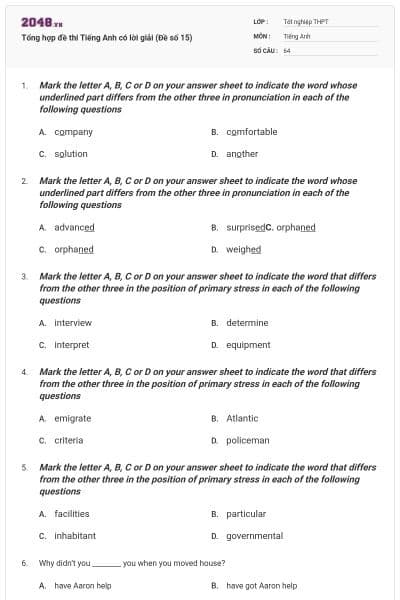
Tổng hợp đề thi Tiếng Anh có lời giải (Đề số 15)
64 câu hỏi
Mark the letter A, B, C or D on your answer sheet to indicate the word whose underlined part differs from the other three in pronunciation in each of the following questions
company
comfortable
solution
another
Đáp án : C
A. /ʌ/ B. /ʌ/ C./əʊ/ D. /ʌ/
Mark the letter A, B, C or D on your answer sheet to indicate the word whose underlined part differs from the other three in pronunciation in each of the following questions
advanced
surprisedC. orphaned
orphaned
weighed
Đáp án : A
A./t/ B./d/ C./d/ D./d/
Mark the letter A, B, C or D on your answer sheet to indicate the word that differs from the other three in the position of primary stress in each of the following questions
interview
determine
interpret
equipment
Đáp án : A
Trọng âm câu A rơi vào thứ nhất, còn lại là thứ 2
Mark the letter A, B, C or D on your answer sheet to indicate the word that differs from the other three in the position of primary stress in each of the following questions
emigrate
Atlantic
criteria
policeman
Đáp án : A
Trọng âm câu A rơi vào thứ nhất, còn lại là thứ 2
Mark the letter A, B, C or D on your answer sheet to indicate the word that differs from the other three in the position of primary stress in each of the following questions
facilities
particular
inhabitant
governmental
Đáp án : D
Trọng âm câu D rơi vào thứ 3, còn lại là thứ 2
Why didn’t you ________ you when you moved house?
have Aaron help
have got Aaron help
have Aaron helped
get Aaron help
Đáp án: A
Giải thích:
Cấu trúc phổ biến của câu sai khiến khi nhờ ai làm gì là:
Have + someone + V (bare infinitive): Nhờ ai đó làm việc gì.
Get + someone + to V: Cũng mang nghĩa tương tự nhưng ít trang trọng hơn.
Chọn A.
Dịch: Tại sao bạn không nhờ Aaron giúp khi bạn chuyển nhà?
Joining a gym ________, but I didn’t fancy the idea
was suggested me
to me was suggested
was suggested to me
was suggesting me
Đáp án : C
Động từ “sugguest” đi với giới từ “to” khi phía sau nó có một tân ngữ (vd: suggest to me/him/her,…). Ở câu này chủ ngữ là “joining a gym”, vì thế chia ở dạng bị động
The cat was afraid when it saw its _______ in the mirror
picture
look
sight
reflection
Đáp án : D
“reflection” (n): sự phản chiếu (thường là qua gương)
The passport she carried was ______
artificial
immitation
untrue
false
Đáp án: D
Giải thích:
Kiến thức: Từ vựng
A. artificial (adj): nhân tạo
B. imitation (n): vật mô phỏng, bắt chước
C. untrue (adj): không đúng, trái với sự thật
D. false (adj): sai, giả (nhìn giống thật)
Dựa vào nghĩa, chọn D.
Dịch: Hộ chiếu cô mang theo là giả.
Unless some rare plants _______, they might die out completely
protect them
are protected
protected
are protecting
Đáp án : B
Đây là câu điều kiện loại 1, phía giả định sẽ được chia ở thì hiện tại. Về nghĩa, chủ ngữ là “some rare plants” và động từ là “protect” vì thế vế này sẽ được chia bị động. Đáp án là “are protected”
The new speed restrictions were a _________ debated issue
heavily
hotlyC. deeply
deeply
profoundly
Đáp án : B
“hotly debated issue” có nghĩa là vấn đề gây ra tranh cãi nóng bỏng (giữa các bên)
Lack of sleep over the last few months is finally ______ Jane
catching up with
getting on with
coming over
putting on
Đáp án : A
Cụm “catch up with” được dịch là đuổi kịp (ai/cái gì)
________ since you started learning English?
How long agoB. When was it
When was it
How long is it
When is it
Đáp án : C
Vế sau xuất hiện “since you started learning English” tức là vế trước sẽ hỏi về thời gian (How long is it)
They’ve got some ________ shoes in the sale at Derbyshire’s
fantastic pink silk Russian ballet
fantastic pink Russian silk ballet
Russian fantastic ballet pink silk
fantastic Russian pink silk ballet
Đáp án : B
Thứ tự các tính từ khi đứng trước danh từ là:
Opinion – Cảm nghĩ, cảm xúc (fantastic) + Color – Màu sắc (pink) + Origin – Xuất xứ (Russian) + Material – Chất liệu (silk) + Noun
Jane gets good mark, _____ her family
that pleases
which pleases
that please
pleases
Đáp án : B
“which” ở đây là mệnh đề quan hệ, thay thế cho cả cụm “Jane gets good marks” ở phía trước. Câu này được dịch nghĩa: Jane đạt được nhiều điểm cao, điều này làm gia đình bạn ấy rất hài lòng
The book would have been perfect ______ the ending
had it not been forB. it hadn’t been for
it hadn’t been for
it had not been for
hadn’t it been for
Đáp án : A
Cấu trúc “Had it not been for” = “If it hadn’t been for” = “thanks to”: nhờ có (điều gì/ai đó) mà…
, people b______ eighteen centuryegan to realize that certain chemical are affected and changed by light
By the
The
It was the
That in the
Đáp án : A
Phía sau đề cập “eighteenth century”, vì thế ta cần một cụm từ để hoàn thành vị trí là trạng ngữ (By the eighteenth century: Trước thế kỷ 18)
Pumpkin seeds, ______ protein and iron, are a popular snack
that provide
provided
whose
which provide
Đáp án : D
Tương tự như câu 15, “which” ở đây là mệnh đề quan hệ, thay thế cho “Pumpkin seeds”, vì “seeds” là số nhiều nên động từ được chia là “provide”. Vậy đáp án là “which provide”
_____ the solar system may seem big it is a very small part of the universe
Despite
Although
In spite
Because
Đáp án : D
Tương tự như câu 15, “which” ở đây là mệnh đề quan hệ, thay thế cho “Pumpkin seeds”, vì “seeds” là số nhiều nên động từ được chia là “provide”. Vậy đáp án là “which provide
The foods that contain, _______ are made of animal fat whereas vegetables have the least energy
as much energy as
the more energy
the most energy
more energy than
Đáp án : C
Ta có thể dễ dàng nhận thấy sự đối sánh, khi ở vế sau nhắc đến “vegetables” với cụm “the least energy”; do vậy, ở đây ta điền “the most energy”
No sooner ________ than I smelt something burning
I came into the kitchen
did I come to the kitchen
had I come into the kitchen
I have come into the kitchen
Đáp án : C
Cấu trúc đảo ngữ với No sooner:
No sooner + had +S+done+O (tân ngữ) +… + than + mệnh đề ở thì quá khứ
Vincent: What are you going to do for your birthday? Neil: _________
Oh yes! I forgot it was my birthday
I thought maybe we could all go to the beach
I hope it will be sunny
I think we should have gone earlier
Đáp án : B
Vincent hỏi: Bạn có ý định gì trong dịp sinh nhật mình vậy?
Neil: Tớ nghĩ có thể tất cả chúng ta có thể đến biển chơi
Jane hardly ever goes out at night, _______?
doesn’t she
does she
will she
won’t she
Đáp án : B
Câu hỏi đuôi ở thì hiện tại. Khi vế trước xuất hiện những từ như hardly/barely/rarely thì câu hỏi đuôi là khẳng định
A number of wildlife _________ have been established so that a wide range of endangered species can have a chance to survive and develop
habitat’s reservations
habitat reserves
habitat’s reserves
habitat reservations
Đáp án : B
“habitat reserves”: khu bảo tồn môi trường sống. Đây là danh từ ghép, chúng ta không cần sử dụng sở hữu cách (‘s) ->loại C. Lưu ý, không chọn “reservation” dù “reservation” cũng mang nghĩa là khu bảo tồn, nhưng từ này chỉ áp dụng tại 1 số nơi (Mỹ)
Mark the letter A, B, C or D on you answer sheet to indicate the word(s) CLOSEST in meaning to the underlined word(s) in each of the following questions.
The most effectively way to feel more mentally alert and energetic is to engage in aerobic activity at least three times a week for 30 minutes.
vigorous
weak
agile
appealing
Đáp án : A
“energetic” = “vigorous” (adj): năng động, mạnh mẽ
Mark the letter A, B, C or D on you answer sheet to indicate the word(s) CLOSEST in meaning to the underlined word(s) in each of the following questions
The geologic history of the Earth reveals much information about the evolution of the continents, oceans, atmosphere, and biosphere.
teaches
discloses
traces
donates
Đáp án : B
“reveal” = “disclose” (v): tiết lộ, lộ ra
Mark the letter A, B, C or D on you answer sheet to indicate the word(s) CLOSEST in meaning to the underlined word(s) in each of the following questions
Slang can be defined as a set of lexical, grammatical, and phonological regularities used in informal speech
situational
casual
informative
uneducated
Đáp án : B
“informal” = “casual” (adj): sơ sài, không sang trọng (thường nói về quấn áo, văn phong ngôn ngữ)
Mark the letter A, B, C or D on your answer sheet to indicate the underlined part that needs correction in each of the following questions
Video cameras (A) pick up (B) the light (C) that reflecting (D) from an object.
cameras
up
light
reflecting
Đáp án : D
“reflecting” -> “reflects”. “that” được thay thế cho “the light” vì thế ở đây chia động từ theo ngôi số ít
Mark the letter A, B, C or D on your answer sheet to indicate the underlined part that needs correction in each of the following questions
Each of the musicians (A) in the orchestra were (B) rehearsing daily before (C) the concert tour began. (D)
musicians
were
daily before
began
Đáp án : B
“were” -> “was”. “Each of somebody/something” được tính là danh từ số ít, vì thế động từ to be nên sửa lại là “was”
Mark the letter A, B, C or D on your answer sheet to indicate the underlined part that needs correction in each of the following questions
The British labor movement developed (A) as a mean (B) of improving working conditions (C) through group efforts. (D)
developed
mean
conditions
group efforts
Đáp án : B
“mean” -> “means” = “way”: cách, phương tiện (để…)
Mark the letter A, B, C or D on your answer sheet to indicate the underlined part that needs correction in each of the following questions
Sweetly smelling (A) perfumes (B) are added (C) to soap to make it appealing. (D)
Sweetly smelling
perfumes
added
appealing
Đáp án : A
“sweetly smelling” -> “sweet-smelling”. Đây là một danh từ ghép, có nghĩa là “thơm”
Mark the letter A, B, C or D on your answer sheet to indicate the underlined part that needs correction in each of the following questions
J. David devoted his last year (A) to write (B) at his home (C) in Biloxi, Mississippi, near the Gulf (B) of Mexico
last year
to write
his home
the Gulf
Đáp án : B
“to write” -> “to writing”. Cấu trúc”devote to doing something” hoặc devote one’s time to doing something”: cống hiến trong việc làm gì
Read the following passage and mark the letter A, B, C or D on your answer sheet to indicate the correct word or phrase that best fits each of the numbered blanks from 33 to 42
Magnets
A solid object that has the power to attract iron and some metals is called a magnet. It does this through its magnetic field, a region of force surrounding it. The (33) _____ the magnet, the more intense is the field.
Objects that are attracted to the magnet feel a force (34) _____ as “magnetism” when they are inside the magnetic field. This magnetic force can pass (35) _____ some materials. Even a weak magnet will attract a pin to the other side of a (36) ______ of paper, for example.
Magnets come in (37) ______ shapes. A familiar one is the curved horseshoes magnet. There are also bar magnets in the form (38) _____ disc or a stubby cylinder. Every magnet has (39) ______ poles, called north and south, at opposite ends of it: at the two ends of a horseshoes magnet, for example, or on the two sides of a disc.
Powerful magnets can be (40) _______ by passing an electric current through wire coiled around a piece of iron. The (41) _____ is called and electromagnet. Magnets are (42) ______ in many household and everyday devices. They are also commonly used in industrial machinery, usually in the form of electromagnets.Question 33
smaller
stronger
weaker
thinner
Đáp án : B
Cấu trúc so sánh hơn “the more…., the more…” (càng….càng…). Ở đây, ta có thể hiểu là “Nam châm càng chắc/bền, thì từ trường càng mạnh”
Read the following passage and mark the letter A, B, C or D on your answer sheet to indicate the correct word or phrase that best fits each of the numbered blanks from 33 to 42
Magnets
c a magnet. It does this through its magnetic field, a region of force surrounding it. The (33) _____ the magnet, the more intense is the field.
Objects that are attracted to the magnet feel a force (34) _____ as “magnetism” when they are inside the magnetic field. This magnetic force can pass (35) _____ some materials. Even a weak magnet will attract a pin to the other side of a (36) ______ of paper, for example.
Magnets come in (37) ______ shapes. A familiar one is the curved horseshoes magnet. There are also bar magnets in the form (38) _____ disc or a stubby cylinder. Every magnet has (39) ______ poles, called north and south, at opposite ends of it: at the two ends of a horseshoes magnet, for example, or on the two sides of a disc.
Powerful magnets can be (40) _______ by passing an electric current through wire coiled around a piece of iron. The (41) _____ is called and electromagnet. Magnets are (42) ______ in many household and everyday devices. They are also commonly used in industrial machinery, usually in the form of electromagnets.Question 34
mentioned
called
known
said
Đáp án : C
“known as”: được biết như là
Read the following passage and mark the letter A, B, C or D on your answer sheet to indicate the correct word or phrase that best fits each of the numbered blanks from 33 to 42
Magnets
A solid object that has the power to attract iron and some metals is called a magnet. It does this through its magnetic field, a region of force surrounding it. The (33) _____ the magnet, the more intense is the field.
Objects that are attracted to the magnet feel a force (34) _____ as “magnetism” when they are inside the magnetic field. This magnetic force can pass (35) _____ some materials. Even a weak magnet will attract a pin to the other side of a (36) ______ of paper, for example.
Magnets come in (37) ______ shapes. A familiar one is the curved horseshoes magnet. There are also bar magnets in the form (38) _____ disc or a stubby cylinder. Every magnet has (39) ______ poles, called north and south, at opposite ends of it: at the two ends of a horseshoes magnet, for example, or on the two sides of a disc.
Powerful magnets can be (40) _______ by passing an electric current through wire coiled around a piece of iron. The (41) _____ is called and electromagnet. Magnets are (42) ______ in many household and everyday devices. They are also commonly used in industrial machinery, usually in the form of electromagnets.Question 35
through
away
outside
next
Đáp án : A
“pass through”: di chuyển/truyền qua…
Read the following passage and mark the letter A, B, C or D on your answer sheet to indicate the correct word or phrase that best fits each of the numbered blanks from 33 to 42
Magnets
A solid object that has the power to attract iron and some metals is called a magnet. It does this through its magnetic field, a region of force surrounding it. The (33) _____ the magnet, the more intense is the field.
Objects that are attracted to the magnet feel a force (34) _____ as “magnetism” when they are inside the magnetic field. This magnetic force can pass (35) _____ some materials. Even a weak magnet will attract a pin to the other side of a (36) ______ of paper, for example.
Magnets come in (37) ______ shapes. A familiar one is the curved horseshoes magnet. There are also bar magnets in the form (38) _____ disc or a stubby cylinder. Every magnet has (39) ______ poles, called north and south, at opposite ends of it: at the two ends of a horseshoes magnet, for example, or on the two sides of a disc.
Powerful magnets can be (40) _______ by passing an electric current through wire coiled around a piece of iron. The (41) _____ is called and electromagnet. Magnets are (42) ______ in many household and everyday devices. They are also commonly used in industrial machinery, usually in the form of electromagnets.Question 36
pane
block
pile
sheet
Đáp án : D
Với danh từ “paper” ta dùng số đếm cho nó là “sheet”: tờ (thường theo 1 khuôn chuẩn nào đó)
Read the following passage and mark the letter A, B, C or D on your answer sheet to indicate the correct word or phrase that best fits each of the numbered blanks from 33 to 42
Magnets
A solid object that has the power to attract iron and some metals is called a magnet. It does this through its magnetic field, a region of force surrounding it. The (33) _____ the magnet, the more intense is the field.
Objects that are attracted to the magnet feel a force (34) _____ as “magnetism” when they are inside the magnetic field. This magnetic force can pass (35) _____ some materials. Even a weak magnet will attract a pin to the other side of a (36) ______ of paper, for example.
Magnets come in (37) ______ shapes. A familiar one is the curved horseshoes magnet. There are also bar magnets in the form (38) _____ disc or a stubby cylinder. Every magnet has (39) ______ poles, called north and south, at opposite ends of it: at the two ends of a horseshoes magnet, for example, or on the two sides of a disc.
Powerful magnets can be (40) _______ by passing an electric current through wire coiled around a piece of iron. The (41) _____ is called and electromagnet. Magnets are (42) ______ in many household and everyday devices. They are also commonly used in industrial machinery, usually in the form of electromagnets.Question 37
separate
different
unknown
identical
Đáp án : B
“different shapes” : nhiều hình dạng khác nhau. Nam châm có nhiều hình dạng khác nhau.
Read the following passage and mark the letter A, B, C or D on your answer sheet to indicate the correct word or phrase that best fits each of the numbered blanks from 33 to 42
Magnets
A solid object that has the power to attract iron and some metals is called a magnet. It does this through its magnetic field, a region of force surrounding it. The (33) _____ the magnet, the more intense is the field.
Objects that are attracted to the magnet feel a force (34) _____ as “magnetism” when they are inside the magnetic field. This magnetic force can pass (35) _____ some materials. Even a weak magnet will attract a pin to the other side of a (36) ______ of paper, for example.
Magnets come in (37) ______ shapes. A familiar one is the curved horseshoes magnet. There are also bar magnets in the form (38) _____ disc or a stubby cylinder. Every magnet has (39) ______ poles, called north and south, at opposite ends of it: at the two ends of a horseshoes magnet, for example, or on the two sides of a disc.
Powerful magnets can be (40) _______ by passing an electric current through wire coiled around a piece of iron. The (41) _____ is called and electromagnet. Magnets are (42) ______ in many household and everyday devices. They are also commonly used in industrial machinery, usually in the form of electromagnets.Question 38
of
in
out
up
Đáp án : A
“in the form” đi với giới từ “of”. “in the form of something”: trong hình dạng/hình thù/cách thức… của cái gì
Read the following passage and mark the letter A, B, C or D on your answer sheet to indicate the correct word or phrase that best fits each of the numbered blanks from 33 to 42
Magnets
A solid object that has the power to attract iron and some metals is called a magnet. It does this through its magnetic field, a region of force surrounding it. The (33) _____ the magnet, the more intense is the field.
Objects that are attracted to the magnet feel a force (34) _____ as “magnetism” when they are inside the magnetic field. This magnetic force can pass (35) _____ some materials. Even a weak magnet will attract a pin to the other side of a (36) ______ of paper, for example.
Magnets come in (37) ______ shapes. A familiar one is the curved horseshoes magnet. There are also bar magnets in the form (38) _____ disc or a stubby cylinder. Every magnet has (39) ______ poles, called north and south, at opposite ends of it: at the two ends of a horseshoes magnet, for example, or on the two sides of a disc.
Powerful magnets can be (40) _______ by passing an electric current through wire coiled around a piece of iron. The (41) _____ is called and electromagnet. Magnets are (42) ______ in many household and everyday devices. They are also commonly used in industrial machinery, usually in the form of electromagnets.Question 39
many
several
two
one
Đáp án : C
“pole”:cực. Nam châm nào cũng có 2 cực: Bắc – Nam
Read the following passage and mark the letter A, B, C or D on your answer sheet to indicate the correct word or phrase that best fits each of the numbered blanks from 33 to 42
Magnets
A solid object that has the power to attract iron and some metals is called a magnet. It does this through its magnetic field, a region of force surrounding it. The (33) _____ the magnet, the more intense is the field.
Objects that are attracted to the magnet feel a force (34) _____ as “magnetism” when they are inside the magnetic field. This magnetic force can pass (35) _____ some materials. Even a weak magnet will attract a pin to the other side of a (36) ______ of paper, for example.
Magnets come in (37) ______ shapes. A familiar one is the curved horseshoes magnet. There are also bar magnets in the form (38) _____ disc or a stubby cylinder. Every magnet has (39) ______ poles, called north and south, at opposite ends of it: at the two ends of a horseshoes magnet, for example, or on the two sides of a disc.
Powerful magnets can be (40) _______ by passing an electric current through wire coiled around a piece of iron. The (41) _____ is called and electromagnet. Magnets are (42) ______ in many household and everyday devices. They are also commonly used in industrial machinery, usually in the form of electromagnets.Question 40
found
had
done
made
Đáp án : D
Câu này đề cập đến cách tạo ra nam châm. “made by”: được làm từ/ được tạo ra từ…
Read the following passage and mark the letter A, B, C or D on your answer sheet to indicate the correct word or phrase that best fits each of the numbered blanks from 33 to 42
Magnets
A solid object that has the power to attract iron and some metals is called a magnet. It does this through its magnetic field, a region of force surrounding it. The (33) _____ the magnet, the more intense is the field.
Objects that are attracted to the magnet feel a force (34) _____ as “magnetism” when they are inside the magnetic field. This magnetic force can pass (35) _____ some materials. Even a weak magnet will attract a pin to the other side of a (36) ______ of paper, for example.
Magnets come in (37) ______ shapes. A familiar one is the curved horseshoes magnet. There are also bar magnets in the form (38) _____ disc or a stubby cylinder. Every magnet has (39) ______ poles, called north and south, at opposite ends of it: at the two ends of a horseshoes magnet, for example, or on the two sides of a disc.
Powerful magnets can be (40) _______ by passing an electric current through wire coiled around a piece of iron. The (41) _____ is called and electromagnet. Magnets are (42) ______ in many household and everyday devices. They are also commonly used in industrial machinery, usually in the form of electromagnets.Question 41
ending
result
conclusion
final
Đáp án : B
Câu phía trên vừa đề cập đến cách (thí nghiệm) để tạo ra một nam châm, vì thế ở câu này sẽ đề cập đến kết quả (result)
Read the following passage and mark the letter A, B, C or D on your answer sheet to indicate the correct word or phrase that best fits each of the numbered blanks from 33 to 42
Magnets
A solid object that has the power to attract iron and some metals is called a magnet. It does this through its magnetic field, a region of force surrounding it. The (33) _____ the magnet, the more intense is the field.
Objects that are attracted to the magnet feel a force (34) _____ as “magnetism” when they are inside the magnetic field. This magnetic force can pass (35) _____ some materials. Even a weak magnet will attract a pin to the other side of a (36) ______ of paper, for example.
Magnets come in (37) ______ shapes. A familiar one is the curved horseshoes magnet. There are also bar magnets in the form (38) _____ disc or a stubby cylinder. Every magnet has (39) ______ poles, called north and south, at opposite ends of it: at the two ends of a horseshoes magnet, for example, or on the two sides of a disc.
Powerful magnets can be (40) _______ by passing an electric current through wire coiled around a piece of iron. The (41) _____ is called and electromagnet. Magnets are (42) ______ in many household and everyday devices. They are also commonly used in industrial machinery, usually in the form of electromagnets.Question 42
used
made
lived
unseen
Đáp án : A
Nội dung của câu này là ứng dụng của nam châm, “to be used”: được sử dụng (để làm gì/trong lĩnh vực nào)
Mark the letter A, B, C or D on you answer sheet to indicate the word(s) OPPOSITE in meaning to the underlined word(s) in each of the following questions.
Body painting and tattooing: lip, ear, and nose plugs or rings; and bracelets, arm bands, necklaces, and head ornaments made of bright feathers were traditionally used by many groups to enhance beauty or to indicate status
intelligent
dark
brilliant
rare
Đáp án : B
“bright” (sáng – thường nói về màu sắc) trái nghĩa với nó là “dark” (trầm, tối)
Mark the letter A, B, C or D on you answer sheet to indicate the word(s) OPPOSITE in meaning to the underlined word(s) in each of the following questions.
No deep understanding of the Solar System can be achieved without an appreciation of the basic properties of the Sun
improper
shallow
thorough
inappropriate
Đáp án : B
“deep”: sâu, trái nghĩa là “shallow”: nông,cạn
Read the following passage and mark the letter A, B, C or D on you answer sheet to indicate the correct answer to each of the questions
When jazz began to lose its reputation as “low-down” music and to gain well-deserved acclaim among intellectuals, musicians began to feature many instruments previously considered inappropriate for jazz. Whereas before the 1950s, jazz musicians played only eight basic instruments in strict tempo, in this decade they started to improvise on the flute, electric organ, piccolo, accordion, cello, and even bagpipes, with the rhythm section composed for strings or piano. Big bands no longer dominated jazz, and most changes emerged from small combos, such as the Dave Brubeck Quartet and the Gerry Mulligan Quartet. The Gerry Mulligan Quartet proved that a small, modern band could sound complete without a piano; the rhythm section consisted only of a set of drums and a string bass.
Jazz continued to move in new directions during the 1960s. Saxophonist and composer Ornette Coleman led a quartet playing “free” jazz that was atonal. Pianist Cecil Taylor also conducted similar experiments with music, and John Coltrane included melodies from India in his compositions. In the 1970s, musicians blended jazz and rock music into fusion jazz which combined the melodies and the improvisations of jazz with the rhythmic qualities of rock ‘n’ roll, with three or five beats to the bar and in other meter. The form of jazz music was greatly affected by electric instruments and electronic implements to intensify, distort, or amplify their sounds. However, the younger musicians of the time felt compelled to include a steady, swinging rhythm which they saw as a permanent and essential element in great jazz.
Which of the following would be the best title of the passage?
Popular Beats in Classical and Modern Jazz
Quintessential Moments in Jazz Music
The Achievements of Famous Jazz Musicians
The Rising Prestige and Deversity of Jazz
Đáp án : D
Tựa đề phù hợp nhất cho bài này là “Uy thế lớn dần và sự đa dạng của Jazz”. Uy thế của nhạc jazz đang lớn dần được thể hiện ở câu đầu tiên với cụm “to gain well-deserved….”, nhạc jazz rất đa dạng, kể cả về nhạc cụ lẫn thể loại (“free” jazz, kết hợp rock ‘n’ roll,..)…
Read the following passage and mark the letter A, B, C or D on you answer sheet to indicate the correct answer to each of the questions
When jazz began to lose its reputation as “low-down” music and to gain well-deserved acclaim among intellectuals, musicians began to feature many instruments previously considered inappropriate for jazz. Whereas before the 1950s, jazz musicians played only eight basic instruments in strict tempo, in this decade they started to improvise on the flute, electric organ, piccolo, accordion, cello, and even bagpipes, with the rhythm section composed for strings or piano. Big bands no longer dominated jazz, and most changes emerged from small combos, such as the Dave Brubeck Quartet and the Gerry Mulligan Quartet. The Gerry Mulligan Quartet proved that a small, modern band could sound complete without a piano; the rhythm section consisted only of a set of drums and a string bass.
Jazz continued to move in new directions during the 1960s. Saxophonist and composer Ornette Coleman led a quartet playing “free” jazz that was atonal. Pianist Cecil Taylor also conducted similar experiments with music, and John Coltrane included melodies from India in his compositions. In the 1970s, musicians blended jazz and rock music into fusion jazz which combined the melodies and the improvisations of jazz with the rhythmic qualities of rock ‘n’ roll, with three or five beats to the bar and in other meter. The form of jazz music was greatly affected by electric instruments and electronic implements to intensify, distort, or amplify their sounds. However, the younger musicians of the time felt compelled to include a steady, swinging rhythm which they saw as a permanent and essential element in great jazz.
The word “feature” in paragraph 1 is closest in meaning to ______
profess
prohibit
protest
promote
Đáp án : D
“feature” = “promote”: thúc đẩy, đóng vai trò quan trọng trong/cho
Read the following passage and mark the letter A, B, C or D on you answer sheet to indicate the correct answer to each of the questions
When jazz began to lose its reputation as “low-down” music and to gain well-deserved acclaim among intellectuals, musicians began to feature many instruments previously considered inappropriate for jazz. Whereas before the 1950s, jazz musicians played only eight basic instruments in strict tempo, in this decade they started to improvise on the flute, electric organ, piccolo, accordion, cello, and even bagpipes, with the rhythm section composed for strings or piano. Big bands no longer dominated jazz, and most changes emerged from small combos, such as the Dave Brubeck Quartet and the Gerry Mulligan Quartet. The Gerry Mulligan Quartet proved that a small, modern band could sound complete without a piano; the rhythm section consisted only of a set of drums and a string bass.
Jazz continued to move in new directions during the 1960s. Saxophonist and composer Ornette Coleman led a quartet playing “free” jazz that was atonal. Pianist Cecil Taylor also conducted similar experiments with music, and John Coltrane included melodies from India in his compositions. In the 1970s, musicians blended jazz and rock music into fusion jazz which combined the melodies and the improvisations of jazz with the rhythmic qualities of rock ‘n’ roll, with three or five beats to the bar and in other meter. The form of jazz music was greatly affected by electric instruments and electronic implements to intensify, distort, or amplify their sounds. However, the younger musicians of the time felt compelled to include a steady, swinging rhythm which they saw as a permanent and essential element in great jazz.
The paragraph preceding this passage would most likely to describe ______
instruments used in jazz
instrumental pieces in jazz
jazz in the 1940s
the origins of jazz
Đáp án : C
Đoạn thứ nhất nhắc đến mốc thời gian “before the 1950s”, đoạn thứ 2 có các mốc 1960s, 1970s. Vì thế đoạn văn phía trước đoạn đề bài cho nội dung sẽ nói về “jazz in the 1940s”
Read the following passage and mark the letter A, B, C or D on you answer sheet to indicate the correct answer to each of the questions
When jazz began to lose its reputation as “low-down” music and to gain well-deserved acclaim among intellectuals, musicians began to feature many instruments previously considered inappropriate for jazz. Whereas before the 1950s, jazz musicians played only eight basic instruments in strict tempo, in this decade they started to improvise on the flute, electric organ, piccolo, accordion, cello, and even bagpipes, with the rhythm section composed for strings or piano. Big bands no longer dominated jazz, and most changes emerged from small combos, such as the Dave Brubeck Quartet and the Gerry Mulligan Quartet. The Gerry Mulligan Quartet proved that a small, modern band could sound complete without a piano; the rhythm section consisted only of a set of drums and a string bass.
Jazz continued to move in new directions during the 1960s. Saxophonist and composer Ornette Coleman led a quartet playing “free” jazz that was atonal. Pianist Cecil Taylor also conducted similar experiments with music, and John Coltrane included melodies from India in his compositions. In the 1970s, musicians blended jazz and rock music into fusion jazz which combined the melodies and the improvisations of jazz with the rhythmic qualities of rock ‘n’ roll, with three or five beats to the bar and in other meter. The form of jazz music was greatly affected by electric instruments and electronic implements to intensify, distort, or amplify their sounds. However, the younger musicians of the time felt compelled to include a steady, swinging rhythm which they saw as a permanent and essential element in great jazz.
The author of the passage implies that in the 1950s, jazz musicians _______
strictly adhered to its traditions and compositions
probably continued with its tempo and instrumentation
experimented with rhythm and instrument
increased the tempo to keep up with the changes
Đáp án : C
Thông tin tại câu số 2 đoạn thứ nhất: “jazz musicians…started to improve on the flute, electric organ,…with the rymthm…”
Read the following passage and mark the letter A, B, C or D on you answer sheet to indicate the correct answer to each of the questions
When jazz began to lose its reputation as “low-down” music and to gain well-deserved acclaim among intellectuals, musicians began to feature many instruments previously considered inappropriate for jazz. Whereas before the 1950s, jazz musicians played only eight basic instruments in strict tempo, in this decade they started to improvise on the flute, electric organ, piccolo, accordion, cello, and even bagpipes, with the rhythm section composed for strings or piano. Big bands no longer dominated jazz, and most changes emerged from small combos, such as the Dave Brubeck Quartet and the Gerry Mulligan Quartet. The Gerry Mulligan Quartet proved that a small, modern band could sound complete without a piano; the rhythm section consisted only of a set of drums and a string bass.
Jazz continued to move in new directions during the 1960s. Saxophonist and composer Ornette Coleman led a quartet playing “free” jazz that was atonal. Pianist Cecil Taylor also conducted similar experiments with music, and John Coltrane included melodies from India in his compositions. In the 1970s, musicians blended jazz and rock music into fusion jazz which combined the melodies and the improvisations of jazz with the rhythmic qualities of rock ‘n’ roll, with three or five beats to the bar and in other meter. The form of jazz music was greatly affected by electric instruments and electronic implements to intensify, distort, or amplify their sounds. However, the younger musicians of the time felt compelled to include a steady, swinging rhythm which they saw as a permanent and essential element in great jazz.
The author of the passage mentions all of the following EXCEPT _______
bagpipes
percussion
string bass
harpsichord
Đáp án : D
Những từ “bagpipes”, “percussion” (= drums) và “string bass” đều được đề cập đến ở đoạn 1. Chỉ riêng từ “harpsichord” là không được nhắc đến trong bài
Read the following passage and mark the letter A, B, C or D on you answer sheet to indicate the correct answer to each of the questions
When jazz began to lose its reputation as “low-down” music and to gain well-deserved acclaim among intellectuals, musicians began to feature many instruments previously considered inappropriate for jazz. Whereas before the 1950s, jazz musicians played only eight basic instruments in strict tempo, in this decade they started to improvise on the flute, electric organ, piccolo, accordion, cello, and even bagpipes, with the rhythm section composed for strings or piano. Big bands no longer dominated jazz, and most changes emerged from small combos, such as the Dave Brubeck Quartet and the Gerry Mulligan Quartet. The Gerry Mulligan Quartet proved that a small, modern band could sound complete without a piano; the rhythm section consisted only of a set of drums and a string bass.
Jazz continued to move in new directions during the 1960s. Saxophonist and composer Ornette Coleman led a quartet playing “free” jazz that was atonal. Pianist Cecil Taylor also conducted similar experiments with music, and John Coltrane included melodies from India in his compositions. In the 1970s, musicians blended jazz and rock music into fusion jazz which combined the melodies and the improvisations of jazz with the rhythmic qualities of rock ‘n’ roll, with three or five beats to the bar and in other meter. The form of jazz music was greatly affected by electric instruments and electronic implements to intensify, distort, or amplify their sounds. However, the younger musicians of the time felt compelled to include a steady, swinging rhythm which they saw as a permanent and essential element in great jazz.
It can be inferred from the passage that small jazz bands ______
were dominated by large orchestras
consisted of drums and a string bass
were innovative in their music
included modern sound systems
Đáp án : C
Thông tin ở câu này trong đoạn 1: “Big bands no longer dominated jazz, and most changes emerged from small combos…”
Read the following passage and mark the letter A, B, C or D on you answer sheet to indicate the correct answer to each of the questions
When jazz began to lose its reputation as “low-down” music and to gain well-deserved acclaim among intellectuals, musicians began to feature many instruments previously considered inappropriate for jazz. Whereas before the 1950s, jazz musicians played only eight basic instruments in strict tempo, in this decade they started to improvise on the flute, electric organ, piccolo, accordion, cello, and even bagpipes, with the rhythm section composed for strings or piano. Big bands no longer dominated jazz, and most changes emerged from small combos, such as the Dave Brubeck Quartet and the Gerry Mulligan Quartet. The Gerry Mulligan Quartet proved that a small, modern band could sound complete without a piano; the rhythm section consisted only of a set of drums and a string bass.
Jazz continued to move in new directions during the 1960s. Saxophonist and composer Ornette Coleman led a quartet playing “free” jazz that was atonal. Pianist Cecil Taylor also conducted similar experiments with music, and John Coltrane included melodies from India in his compositions. In the 1970s, musicians blended jazz and rock music into fusion jazz which combined the melodies and the improvisations of jazz with the rhythmic qualities of rock ‘n’ roll, with three or five beats to the bar and in other meter. The form of jazz music was greatly affected by electric instruments and electronic implements to intensify, distort, or amplify their sounds. However, the younger musicians of the time felt compelled to include a steady, swinging rhythm which they saw as a permanent and essential element in great jazz.
The author believes that the developments in jazz described in the passage ______
should be seen as precocious
should be considered influential
appear largely suggestive
may be perceived as discrete
Đáp án : B
Theo tác giả, Sự phát triển của jazz có sức ảnh hưởng khi vào đầu những năm 60s, 70s, nhiều nhạc sĩ đã sáng tạo ra nhiều cách chơi nhạc, kết hợp nhiều loại âm nhạc để tạo ra lối chơi nhạc jazz mới,
Read the following passage and mark the letter A, B, C or D on you answer sheet to indicate the correct answer to each of the questions
When jazz began to lose its reputation as “low-down” music and to gain well-deserved acclaim among intellectuals, musicians began to feature many instruments previously considered inappropriate for jazz. Whereas before the 1950s, jazz musicians played only eight basic instruments in strict tempo, in this decade they started to improvise on the flute, electric organ, piccolo, accordion, cello, and even bagpipes, with the rhythm section composed for strings or piano. Big bands no longer dominated jazz, and most changes emerged from small combos, such as the Dave Brubeck Quartet and the Gerry Mulligan Quartet. The Gerry Mulligan Quartet proved that a small, modern band could sound complete without a piano; the rhythm section consisted only of a set of drums and a string bass.
Jazz continued to move in new directions during the 1960s. Saxophonist and composer Ornette Coleman led a quartet playing “free” jazz that was atonal. Pianist Cecil Taylor also conducted similar experiments with music, and John Coltrane included melodies from India in his compositions. In the 1970s, musicians blended jazz and rock music into fusion jazz which combined the melodies and the improvisations of jazz with the rhythmic qualities of rock ‘n’ roll, with three or five beats to the bar and in other meter. The form of jazz music was greatly affected by electric instruments and electronic implements to intensify, distort, or amplify their sounds. However, the younger musicians of the time felt compelled to include a steady, swinging rhythm which they saw as a permanent and essential element in great jazz.
The passage implies that representative jazz musicians_____
concentrated on melodious combinations of sounds
blended improvisations and sheet music together
created and modernized sophisticated devices
sought novel techniques in form and concert
Đáp án : D
Thông tin ở câu thứ 5 của đoạn 2: “the form of jazz music…to intensify, distort or amplify their sounds”. Ở đây, “intensify, distort or amplify” chính là những “novel techniques”
Read the following passage and mark the letter A, B, C or D on you answer sheet to indicate the correct answer to each of the questions
When jazz began to lose its reputation as “low-down” music and to gain well-deserved acclaim among intellectuals, musicians began to feature many instruments previously considered inappropriate for jazz. Whereas before the 1950s, jazz musicians played only eight basic instruments in strict tempo, in this decade they started to improvise on the flute, electric organ, piccolo, accordion, cello, and even bagpipes, with the rhythm section composed for strings or piano. Big bands no longer dominated jazz, and most changes emerged from small combos, such as the Dave Brubeck Quartet and the Gerry Mulligan Quartet. The Gerry Mulligan Quartet proved that a small, modern band could sound complete without a piano; the rhythm section consisted only of a set of drums and a string bass.
Jazz continued to move in new directions during the 1960s. Saxophonist and composer Ornette Coleman led a quartet playing “free” jazz that was atonal. Pianist Cecil Taylor also conducted similar experiments with music, and John Coltrane included melodies from India in his compositions. In the 1970s, musicians blended jazz and rock music into fusion jazz which combined the melodies and the improvisations of jazz with the rhythmic qualities of rock ‘n’ roll, with three or five beats to the bar and in other meter. The form of jazz music was greatly affected by electric instruments and electronic implements to intensify, distort, or amplify their sounds. However, the younger musicians of the time felt compelled to include a steady, swinging rhythm which they saw as a permanent and essential element in great jazz.
According to the passage, the changes in jazz music in the 1970s came from ______
another harmonious scale
another musical trend
ambitious aspirations
sound amplifications
Đáp án : B
Sự thay đổi của jazz trong những năm 1970s bắt nguồn từ một xu hướng âm nhạc khác. Thông tin ở câu thứ 3 đoạn 2: “musicians blended jazz and rock music into fusion jazz….in other meters”
Read the following passage and mark the letter A, B, C or D on you answer sheet to indicate the correct answer to each of the questions
When jazz began to lose its reputation as “low-down” music and to gain well-deserved acclaim among intellectuals, musicians began to feature many instruments previously considered inappropriate for jazz. Whereas before the 1950s, jazz musicians played only eight basic instruments in strict tempo, in this decade they started to improvise on the flute, electric organ, piccolo, accordion, cello, and even bagpipes, with the rhythm section composed for strings or piano. Big bands no longer dominated jazz, and most changes emerged from small combos, such as the Dave Brubeck Quartet and the Gerry Mulligan Quartet. The Gerry Mulligan Quartet proved that a small, modern band could sound complete without a piano; the rhythm section consisted only of a set of drums and a string bass.
Jazz continued to move in new directions during the 1960s. Saxophonist and composer Ornette Coleman led a quartet playing “free” jazz that was atonal. Pianist Cecil Taylor also conducted similar experiments with music, and John Coltrane included melodies from India in his compositions. In the 1970s, musicians blended jazz and rock music into fusion jazz which combined the melodies and the improvisations of jazz with the rhythmic qualities of rock ‘n’ roll, with three or five beats to the bar and in other meter. The form of jazz music was greatly affected by electric instruments and electronic implements to intensify, distort, or amplify their sounds. However, the younger musicians of the time felt compelled to include a steady, swinging rhythm which they saw as a permanent and essential element in great jazz.
Which of the following best describes the organization of the passage?
Chronological innovations in jazz music
Definitions of diverse jazz styles
A classifications of prominent jazz musicians
Descriptions and examples to illustrate jazz rhythms
Đáp án : A
Bài viết này được sắp xếp theo thời gian (chronological) và sự phát triển, đổi mới (innovation) của nhạc jazz
Read the following passage and mark the letter A, B, C or D on your answer sheet to indicate the correct answer to each of the questions
Diet and Exercise
Many people seem to believe that there is a magic diet formula that will guarantee weight loss. This is a fallacy. Most fad diet, if followed conscientiously, will result in weight loss due to the reduction in calories. However, they are nearly always too monotonous and sometimes too unhealthy to be followed in the long term. Worse, fad dieters who don't become physically active and learn to eat sensibly will eventually regain the weight they lost, and often even more.
Some of the most popular fad diets in recent years have been low-carbohydrate programs, which work by making the body produce ketones. Ketones are normal and efficient source of energy for the human body. When the intake of carbohydrates is severely restricted, body fats are broken down into fatty acids that can be used as fuel. The fatty acids may be incompletely metabolized, yielding ketones. When your body is producing ketones, and using them as fuel, this is called ketosis. Most diets based on ketosis do not limit the consumption of protein, fat, or total calories. As a result, their fat content tends to be very high. Promoters claim that ketosis will lead to increased metabolism of unwanted fat, even if the calories are not reduced. This is not entirely true; calorie reduction is likely to occur because of the diet's lack of appealing foods. This is not conductive to forming sensible eating habits.
The most widely used low-carbohydrate diet is the one advocated by the late Robert Atkins M.D, of New York City. Under the Atkins program, the dieter is permitted to eat unlimited amounts of non-carbohydrate foods "when hungry". The American Medical Association and many individual experts have warned that the unlimited intake of saturated fat under Atkins food plan can increase the dieter's risk of heart disease. In 2000, researchers at the University of Kentucky did a computer analysis of a week's worth of sample menus and reported several alarming findings: the diet contained 59% fat; it provided fewer servings of grains, vegetables, and fruits than recommended by most nutritionists, and while it can produce short-term weight loss, long-term use is likely to increase the risk of both cardiovascular disease and cancer. The weight loss usually doesn't last, either. As ketosis begins, weight will be shed quickly, giving the misleading impression that significant fat reduction is taking place. In fact, most of the weight loss is water rather than fat; the lost water is regained quickly when a normal diet is resumed. Appetite, which is often reduced during ketosis, also returns.
Atkins advocated his diet for more than 30 years and claimed that more than 60,000 patients treated at his centre had used his diet as their primary protocol for losing weight. Yet he never published any study in which people who used this program were monitored over a period of several years. Besides the dubiousness of its effects in the long term, the Atkins diet shares another shortcoming of all fad diets: inflexibility. People are different, with different health problems and genetic characteristics, and no single diet is right for everyone.
An additional downside to the recent craze for low-carbohydrate diets is that it has encouraged food companies to market low-carbohydrate foods for people who want to "watch their carbs". Most of these foods are much higher in fat than the foods they are designed to replace. "Low-carb” advertising is encouraging both dieters and non-dieters to eat high-fat foods, which is exactly the opposite of medical and nutrition authorities have been arguing for decades. Following a low-carbohydrate diet under medical supervision may make sense for some people, but a population-wide increase in fat consumption would be a public health disaster
What is the topic of the passage?
How to succeed with the Atkins Diet
Weight loss through carbohydrates reduction
Problems with fad diets
The danger of a high-fat diet
Đáp án : C
Thông tin ở câu đoạn đầu tiên: “they are sometimes too unhealthy to be followed in long term” và những đoạn sau đó làm rõ các vấn đề diễn ra với fad diets
Read the following passage and mark the letter A, B, C or D on your answer sheet to indicate the correct answer to each of the questions
Diet and Exercise
Many people seem to believe that there is a magic diet formula that will guarantee weight loss. This is a fallacy. Most fad diet, if followed conscientiously, will result in weight loss due to the reduction in calories. However, they are nearly always too monotonous and sometimes too unhealthy to be followed in the long term. Worse, fad dieters who don't become physically active and learn to eat sensibly will eventually regain the weight they lost, and often even more.
Some of the most popular fad diets in recent years have been low-carbohydrate programs, which work by making the body produce ketones. Ketones are normal and efficient source of energy for the human body. When the intake of carbohydrates is severely restricted, body fats are broken down into fatty acids that can be used as fuel. The fatty acids may be incompletely metabolized, yielding ketones. When your body is producing ketones, and using them as fuel, this is called ketosis. Most diets based on ketosis do not limit the consumption of protein, fat, or total calories. As a result, their fat content tends to be very high. Promoters claim that ketosis will lead to increased metabolism of unwanted fat, even if the calories are not reduced. This is not entirely true; calorie reduction is likely to occur because of the diet's lack of appealing foods. This is not conductive to forming sensible eating habits.
The most widely used low-carbohydrate diet is the one advocated by the late Robert Atkins M.D, of New York City. Under the Atkins program, the dieter is permitted to eat unlimited amounts of non-carbohydrate foods "when hungry". The American Medical Association and many individual experts have warned that the unlimited intake of saturated fat under Atkins food plan can increase the dieter's risk of heart disease. In 2000, researchers at the University of Kentucky did a computer analysis of a week's worth of sample menus and reported several alarming findings: the diet contained 59% fat; it provided fewer servings of grains, vegetables, and fruits than recommended by most nutritionists, and while it can produce short-term weight loss, long-term use is likely to increase the risk of both cardiovascular disease and cancer. The weight loss usually doesn't last, either. As ketosis begins, weight will be shed quickly, giving the misleading impression that significant fat reduction is taking place. In fact, most of the weight loss is water rather than fat; the lost water is regained quickly when a normal diet is resumed. Appetite, which is often reduced during ketosis, also returns.
Atkins advocated his diet for more than 30 years and claimed that more than 60,000 patients treated at his centre had used his diet as their primary protocol for losing weight. Yet he never published any study in which people who used this program were monitored over a period of several years. Besides the dubiousness of its effects in the long term, the Atkins diet shares another shortcoming of all fad diets: inflexibility. People are different, with different health problems and genetic characteristics, and no single diet is right for everyone.
An additional downside to the recent craze for low-carbohydrate diets is that it has encouraged food companies to market low-carbohydrate foods for people who want to "watch their carbs". Most of these foods are much higher in fat than the foods they are designed to replace. "Low-carb” advertising is encouraging both dieters and non-dieters to eat high-fat foods, which is exactly the opposite of medical and nutrition authorities have been arguing for decades. Following a low-carbohydrate diet under medical supervision may make sense for some people, but a population-wide increase in fat consumption would be a public health disaster
It can be inferred from the passage that the author thinks fad diets in general ______
are always bad for you because they contain too much fat
can be unhealthy in the long term and have too little variety
are effective and safe if used under a doctor’s supervision
usually result in long-term weight loss
Đáp án : B
Thông tin: “they are nearly always too monotonous and sometimes too unhealthy to be followed in long term” = unhealthy, too little variety
Read the following passage and mark the letter A, B, C or D on your answer sheet to indicate the correct answer to each of the questions
Diet and Exercise
Many people seem to believe that there is a magic diet formula that will guarantee weight loss. This is a fallacy. Most fad diet, if followed conscientiously, will result in weight loss due to the reduction in calories. However, they are nearly always too monotonous and sometimes too unhealthy to be followed in the long term. Worse, fad dieters who don't become physically active and learn to eat sensibly will eventually regain the weight they lost, and often even more.
Some of the most popular fad diets in recent years have been low-carbohydrate programs, which work by making the body produce ketones. Ketones are normal and efficient source of energy for the human body. When the intake of carbohydrates is severely restricted, body fats are broken down into fatty acids that can be used as fuel. The fatty acids may be incompletely metabolized, yielding ketones. When your body is producing ketones, and using them as fuel, this is called ketosis. Most diets based on ketosis do not limit the consumption of protein, fat, or total calories. As a result, their fat content tends to be very high. Promoters claim that ketosis will lead to increased metabolism of unwanted fat, even if the calories are not reduced. This is not entirely true; calorie reduction is likely to occur because of the diet's lack of appealing foods. This is not conductive to forming sensible eating habits.
The most widely used low-carbohydrate diet is the one advocated by the late Robert Atkins M.D, of New York City. Under the Atkins program, the dieter is permitted to eat unlimited amounts of non-carbohydrate foods "when hungry". The American Medical Association and many individual experts have warned that the unlimited intake of saturated fat under Atkins food plan can increase the dieter's risk of heart disease. In 2000, researchers at the University of Kentucky did a computer analysis of a week's worth of sample menus and reported several alarming findings: the diet contained 59% fat; it provided fewer servings of grains, vegetables, and fruits than recommended by most nutritionists, and while it can produce short-term weight loss, long-term use is likely to increase the risk of both cardiovascular disease and cancer. The weight loss usually doesn't last, either. As ketosis begins, weight will be shed quickly, giving the misleading impression that significant fat reduction is taking place. In fact, most of the weight loss is water rather than fat; the lost water is regained quickly when a normal diet is resumed. Appetite, which is often reduced during ketosis, also returns.
Atkins advocated his diet for more than 30 years and claimed that more than 60,000 patients treated at his centre had used his diet as their primary protocol for losing weight. Yet he never published any study in which people who used this program were monitored over a period of several years. Besides the dubiousness of its effects in the long term, the Atkins diet shares another shortcoming of all fad diets: inflexibility. People are different, with different health problems and genetic characteristics, and no single diet is right for everyone.
An additional downside to the recent craze for low-carbohydrate diets is that it has encouraged food companies to market low-carbohydrate foods for people who want to "watch their carbs". Most of these foods are much higher in fat than the foods they are designed to replace. "Low-carb” advertising is encouraging both dieters and non-dieters to eat high-fat foods, which is exactly the opposite of medical and nutrition authorities have been arguing for decades. Following a low-carbohydrate diet under medical supervision may make sense for some people, but a population-wide increase in fat consumption would be a public health disaster
Which of the following is an effect of ketosis?
Long-term weight loss
Loss of water from the body
Increase in appetite
Greater energy
Đáp án : B
Thông tin ở đoạn 3: “In fact, most of the weight loss is water rather than fat; the lost water is regained quickly when a normal diet is resumed.
Read the following passage and mark the letter A, B, C or D on your answer sheet to indicate the correct answer to each of the questions
Diet and Exercise
Many people seem to believe that there is a magic diet formula that will guarantee weight loss. This is a fallacy. Most fad diet, if followed conscientiously, will result in weight loss due to the reduction in calories. However, they are nearly always too monotonous and sometimes too unhealthy to be followed in the long term. Worse, fad dieters who don't become physically active and learn to eat sensibly will eventually regain the weight they lost, and often even more.
Some of the most popular fad diets in recent years have been low-carbohydrate programs, which work by making the body produce ketones. Ketones are normal and efficient source of energy for the human body. When the intake of carbohydrates is severely restricted, body fats are broken down into fatty acids that can be used as fuel. The fatty acids may be incompletely metabolized, yielding ketones. When your body is producing ketones, and using them as fuel, this is called ketosis. Most diets based on ketosis do not limit the consumption of protein, fat, or total calories. As a result, their fat content tends to be very high. Promoters claim that ketosis will lead to increased metabolism of unwanted fat, even if the calories are not reduced. This is not entirely true; calorie reduction is likely to occur because of the diet's lack of appealing foods. This is not conductive to forming sensible eating habits.
The most widely used low-carbohydrate diet is the one advocated by the late Robert Atkins M.D, of New York City. Under the Atkins program, the dieter is permitted to eat unlimited amounts of non-carbohydrate foods "when hungry". The American Medical Association and many individual experts have warned that the unlimited intake of saturated fat under Atkins food plan can increase the dieter's risk of heart disease. In 2000, researchers at the University of Kentucky did a computer analysis of a week's worth of sample menus and reported several alarming findings: the diet contained 59% fat; it provided fewer servings of grains, vegetables, and fruits than recommended by most nutritionists, and while it can produce short-term weight loss, long-term use is likely to increase the risk of both cardiovascular disease and cancer. The weight loss usually doesn't last, either. As ketosis begins, weight will be shed quickly, giving the misleading impression that significant fat reduction is taking place. In fact, most of the weight loss is water rather than fat; the lost water is regained quickly when a normal diet is resumed. Appetite, which is often reduced during ketosis, also returns.
Atkins advocated his diet for more than 30 years and claimed that more than 60,000 patients treated at his centre had used his diet as their primary protocol for losing weight. Yet he never published any study in which people who used this program were monitored over a period of several years. Besides the dubiousness of its effects in the long term, the Atkins diet shares another shortcoming of all fad diets: inflexibility. People are different, with different health problems and genetic characteristics, and no single diet is right for everyone.
An additional downside to the recent craze for low-carbohydrate diets is that it has encouraged food companies to market low-carbohydrate foods for people who want to "watch their carbs". Most of these foods are much higher in fat than the foods they are designed to replace. "Low-carb” advertising is encouraging both dieters and non-dieters to eat high-fat foods, which is exactly the opposite of medical and nutrition authorities have been arguing for decades. Following a low-carbohydrate diet under medical supervision may make sense for some people, but a population-wide increase in fat consumption would be a public health disaster
The word their in paragraph 2 refers to_____
diets
ketones
calories
ketosis
Đáp án : A
“their” được thay thế cho “most diets” ở câu trước.
Read the following passage and mark the letter A, B, C or D on your answer sheet to indicate the correct answer to each of the questions
Diet and Exercise
Many people seem to believe that there is a magic diet formula that will guarantee weight loss. This is a fallacy. Most fad diet, if followed conscientiously, will result in weight loss due to the reduction in calories. However, they are nearly always too monotonous and sometimes too unhealthy to be followed in the long term. Worse, fad dieters who don't become physically active and learn to eat sensibly will eventually regain the weight they lost, and often even more.
Some of the most popular fad diets in recent years have been low-carbohydrate programs, which work by making the body produce ketones. Ketones are normal and efficient source of energy for the human body. When the intake of carbohydrates is severely restricted, body fats are broken down into fatty acids that can be used as fuel. The fatty acids may be incompletely metabolized, yielding ketones. When your body is producing ketones, and using them as fuel, this is called ketosis. Most diets based on ketosis do not limit the consumption of protein, fat, or total calories. As a result, their fat content tends to be very high. Promoters claim that ketosis will lead to increased metabolism of unwanted fat, even if the calories are not reduced. This is not entirely true; calorie reduction is likely to occur because of the diet's lack of appealing foods. This is not conductive to forming sensible eating habits.
The most widely used low-carbohydrate diet is the one advocated by the late Robert Atkins M.D, of New York City. Under the Atkins program, the dieter is permitted to eat unlimited amounts of non-carbohydrate foods "when hungry". The American Medical Association and many individual experts have warned that the unlimited intake of saturated fat under Atkins food plan can increase the dieter's risk of heart disease. In 2000, researchers at the University of Kentucky did a computer analysis of a week's worth of sample menus and reported several alarming findings: the diet contained 59% fat; it provided fewer servings of grains, vegetables, and fruits than recommended by most nutritionists, and while it can produce short-term weight loss, long-term use is likely to increase the risk of both cardiovascular disease and cancer. The weight loss usually doesn't last, either. As ketosis begins, weight will be shed quickly, giving the misleading impression that significant fat reduction is taking place. In fact, most of the weight loss is water rather than fat; the lost water is regained quickly when a normal diet is resumed. Appetite, which is often reduced during ketosis, also returns.
Atkins advocated his diet for more than 30 years and claimed that more than 60,000 patients treated at his centre had used his diet as their primary protocol for losing weight. Yet he never published any study in which people who used this program were monitored over a period of several years. Besides the dubiousness of its effects in the long term, the Atkins diet shares another shortcoming of all fad diets: inflexibility. People are different, with different health problems and genetic characteristics, and no single diet is right for everyone.
An additional downside to the recent craze for low-carbohydrate diets is that it has encouraged food companies to market low-carbohydrate foods for people who want to "watch their carbs". Most of these foods are much higher in fat than the foods they are designed to replace. "Low-carb” advertising is encouraging both dieters and non-dieters to eat high-fat foods, which is exactly the opposite of medical and nutrition authorities have been arguing for decades. Following a low-carbohydrate diet under medical supervision may make sense for some people, but a population-wide increase in fat consumption would be a public health disaster
According to the passage , which of the following is true of the Atkins diet?
It is recommended by the American Medical Association
It calls for a restriction of fat intake
It involves a low intake of fruits and vegetables
All of the answer
Đáp án : C
Thông tin ở đoạn 3: “it provided fewer servings of grains, vegetables, and fruits than recommended by most nutritionists”
Read the following passage and mark the letter A, B, C or D on your answer sheet to indicate the correct answer to each of the questions
Diet and Exercise
Many people seem to believe that there is a magic diet formula that will guarantee weight loss. This is a fallacy. Most fad diet, if followed conscientiously, will result in weight loss due to the reduction in calories. However, they are nearly always too monotonous and sometimes too unhealthy to be followed in the long term. Worse, fad dieters who don't become physically active and learn to eat sensibly will eventually regain the weight they lost, and often even more.
Some of the most popular fad diets in recent years have been low-carbohydrate programs, which work by making the body produce ketones. Ketones are normal and efficient source of energy for the human body. When the intake of carbohydrates is severely restricted, body fats are broken down into fatty acids that can be used as fuel. The fatty acids may be incompletely metabolized, yielding ketones. When your body is producing ketones, and using them as fuel, this is called ketosis. Most diets based on ketosis do not limit the consumption of protein, fat, or total calories. As a result, their fat content tends to be very high. Promoters claim that ketosis will lead to increased metabolism of unwanted fat, even if the calories are not reduced. This is not entirely true; calorie reduction is likely to occur because of the diet's lack of appealing foods. This is not conductive to forming sensible eating habits.
The most widely used low-carbohydrate diet is the one advocated by the late Robert Atkins M.D, of New York City. Under the Atkins program, the dieter is permitted to eat unlimited amounts of non-carbohydrate foods "when hungry". The American Medical Association and many individual experts have warned that the unlimited intake of saturated fat under Atkins food plan can increase the dieter's risk of heart disease. In 2000, researchers at the University of Kentucky did a computer analysis of a week's worth of sample menus and reported several alarming findings: the diet contained 59% fat; it provided fewer servings of grains, vegetables, and fruits than recommended by most nutritionists, and while it can produce short-term weight loss, long-term use is likely to increase the risk of both cardiovascular disease and cancer. The weight loss usually doesn't last, either. As ketosis begins, weight will be shed quickly, giving the misleading impression that significant fat reduction is taking place. In fact, most of the weight loss is water rather than fat; the lost water is regained quickly when a normal diet is resumed. Appetite, which is often reduced during ketosis, also returns.
Atkins advocated his diet for more than 30 years and claimed that more than 60,000 patients treated at his centre had used his diet as their primary protocol for losing weight. Yet he never published any study in which people who used this program were monitored over a period of several years. Besides the dubiousness of its effects in the long term, the Atkins diet shares another shortcoming of all fad diets: inflexibility. People are different, with different health problems and genetic characteristics, and no single diet is right for everyone.
An additional downside to the recent craze for low-carbohydrate diets is that it has encouraged food companies to market low-carbohydrate foods for people who want to "watch their carbs". Most of these foods are much higher in fat than the foods they are designed to replace. "Low-carb” advertising is encouraging both dieters and non-dieters to eat high-fat foods, which is exactly the opposite of medical and nutrition authorities have been arguing for decades. Following a low-carbohydrate diet under medical supervision may make sense for some people, but a population-wide increase in fat consumption would be a public health disaster
The word conscientiously in paragraph 1 could best be replaced by ______
consciously
scientifically
correctly
severely
Đáp án : C
“conscientiously” = “correctly”: chính xác, xác đáng
Read the following passage and mark the letter A, B, C or D on your answer sheet to indicate the correct answer to each of the questions
Diet and Exercise
Many people seem to believe that there is a magic diet formula that will guarantee weight loss. This is a fallacy. Most fad diet, if followed conscientiously, will result in weight loss due to the reduction in calories. However, they are nearly always too monotonous and sometimes too unhealthy to be followed in the long term. Worse, fad dieters who don't become physically active and learn to eat sensibly will eventually regain the weight they lost, and often even more.
Some of the most popular fad diets in recent years have been low-carbohydrate programs, which work by making the body produce ketones. Ketones are normal and efficient source of energy for the human body. When the intake of carbohydrates is severely restricted, body fats are broken down into fatty acids that can be used as fuel. The fatty acids may be incompletely metabolized, yielding ketones. When your body is producing ketones, and using them as fuel, this is called ketosis. Most diets based on ketosis do not limit the consumption of protein, fat, or total calories. As a result, their fat content tends to be very high. Promoters claim that ketosis will lead to increased metabolism of unwanted fat, even if the calories are not reduced. This is not entirely true; calorie reduction is likely to occur because of the diet's lack of appealing foods. This is not conductive to forming sensible eating habits.
The most widely used low-carbohydrate diet is the one advocated by the late Robert Atkins M.D, of New York City. Under the Atkins program, the dieter is permitted to eat unlimited amounts of non-carbohydrate foods "when hungry". The American Medical Association and many individual experts have warned that the unlimited intake of saturated fat under Atkins food plan can increase the dieter's risk of heart disease. In 2000, researchers at the University of Kentucky did a computer analysis of a week's worth of sample menus and reported several alarming findings: the diet contained 59% fat; it provided fewer servings of grains, vegetables, and fruits than recommended by most nutritionists, and while it can produce short-term weight loss, long-term use is likely to increase the risk of both cardiovascular disease and cancer. The weight loss usually doesn't last, either. As ketosis begins, weight will be shed quickly, giving the misleading impression that significant fat reduction is taking place. In fact, most of the weight loss is water rather than fat; the lost water is regained quickly when a normal diet is resumed. Appetite, which is often reduced during ketosis, also returns.
Atkins advocated his diet for more than 30 years and claimed that more than 60,000 patients treated at his centre had used his diet as their primary protocol for losing weight. Yet he never published any study in which people who used this program were monitored over a period of several years. Besides the dubiousness of its effects in the long term, the Atkins diet shares another shortcoming of all fad diets: inflexibility. People are different, with different health problems and genetic characteristics, and no single diet is right for everyone.
An additional downside to the recent craze for low-carbohydrate diets is that it has encouraged food companies to market low-carbohydrate foods for people who want to "watch their carbs". Most of these foods are much higher in fat than the foods they are designed to replace. "Low-carb” advertising is encouraging both dieters and non-dieters to eat high-fat foods, which is exactly the opposite of medical and nutrition authorities have been arguing for decades. Following a low-carbohydrate diet under medical supervision may make sense for some people, but a population-wide increase in fat consumption would be a public health disaster
The phrase is not conductive to in paragraph 2 is closest meaning to ______
does not prevent
makes easier
is not consistent with
does not encourage
Đáp án : D
“not conducive to” = “does not encourage”: không khuyến khích, không dẫn đến (trình trạng, hoạt động nào đó…)
Read the following passage and mark the letter A, B, C or D on your answer sheet to indicate the correct answer to each of the questions
Diet and Exercise
Many people seem to believe that there is a magic diet formula that will guarantee weight loss. This is a fallacy. Most fad diet, if followed conscientiously, will result in weight loss due to the reduction in calories. However, they are nearly always too monotonous and sometimes too unhealthy to be followed in the long term. Worse, fad dieters who don't become physically active and learn to eat sensibly will eventually regain the weight they lost, and often even more.
Some of the most popular fad diets in recent years have been low-carbohydrate programs, which work by making the body produce ketones. Ketones are normal and efficient source of energy for the human body. When the intake of carbohydrates is severely restricted, body fats are broken down into fatty acids that can be used as fuel. The fatty acids may be incompletely metabolized, yielding ketones. When your body is producing ketones, and using them as fuel, this is called ketosis. Most diets based on ketosis do not limit the consumption of protein, fat, or total calories. As a result, their fat content tends to be very high. Promoters claim that ketosis will lead to increased metabolism of unwanted fat, even if the calories are not reduced. This is not entirely true; calorie reduction is likely to occur because of the diet's lack of appealing foods. This is not conductive to forming sensible eating habits.
The most widely used low-carbohydrate diet is the one advocated by the late Robert Atkins M.D, of New York City. Under the Atkins program, the dieter is permitted to eat unlimited amounts of non-carbohydrate foods "when hungry". The American Medical Association and many individual experts have warned that the unlimited intake of saturated fat under Atkins food plan can increase the dieter's risk of heart disease. In 2000, researchers at the University of Kentucky did a computer analysis of a week's worth of sample menus and reported several alarming findings: the diet contained 59% fat; it provided fewer servings of grains, vegetables, and fruits than recommended by most nutritionists, and while it can produce short-term weight loss, long-term use is likely to increase the risk of both cardiovascular disease and cancer. The weight loss usually doesn't last, either. As ketosis begins, weight will be shed quickly, giving the misleading impression that significant fat reduction is taking place. In fact, most of the weight loss is water rather than fat; the lost water is regained quickly when a normal diet is resumed. Appetite, which is often reduced during ketosis, also returns.
Atkins advocated his diet for more than 30 years and claimed that more than 60,000 patients treated at his centre had used his diet as their primary protocol for losing weight. Yet he never published any study in which people who used this program were monitored over a period of several years. Besides the dubiousness of its effects in the long term, the Atkins diet shares another shortcoming of all fad diets: inflexibility. People are different, with different health problems and genetic characteristics, and no single diet is right for everyone.
An additional downside to the recent craze for low-carbohydrate diets is that it has encouraged food companies to market low-carbohydrate foods for people who want to "watch their carbs". Most of these foods are much higher in fat than the foods they are designed to replace. "Low-carb” advertising is encouraging both dieters and non-dieters to eat high-fat foods, which is exactly the opposite of medical and nutrition authorities have been arguing for decades. Following a low-carbohydrate diet under medical supervision may make sense for some people, but a population-wide increase in fat consumption would be a public health disaster
It can be inferred that the author’s biggest objection to Atkins diet is that ______
it has led to “low-carb” advertising
(s)he believes it causes cancer
it leads to higher fat consumptions
it has not been thoroughly studied
Đáp án : C
Thông tin ở đoạn số 4: “Under the Atkins program, the dieter is permitted to eat unlimited amounts of non-carbohydrate foods "when hungry".”
Read the following passage and mark the letter A, B, C or D on your answer sheet to indicate the correct answer to each of the questions
Diet and Exercise
Many people seem to believe that there is a magic diet formula that will guarantee weight loss. This is a fallacy. Most fad diet, if followed conscientiously, will result in weight loss due to the reduction in calories. However, they are nearly always too monotonous and sometimes too unhealthy to be followed in the long term. Worse, fad dieters who don't become physically active and learn to eat sensibly will eventually regain the weight they lost, and often even more.
Some of the most popular fad diets in recent years have been low-carbohydrate programs, which work by making the body produce ketones. Ketones are normal and efficient source of energy for the human body. When the intake of carbohydrates is severely restricted, body fats are broken down into fatty acids that can be used as fuel. The fatty acids may be incompletely metabolized, yielding ketones. When your body is producing ketones, and using them as fuel, this is called ketosis. Most diets based on ketosis do not limit the consumption of protein, fat, or total calories. As a result, their fat content tends to be very high. Promoters claim that ketosis will lead to increased metabolism of unwanted fat, even if the calories are not reduced. This is not entirely true; calorie reduction is likely to occur because of the diet's lack of appealing foods. This is not conductive to forming sensible eating habits.
The most widely used low-carbohydrate diet is the one advocated by the late Robert Atkins M.D, of New York City. Under the Atkins program, the dieter is permitted to eat unlimited amounts of non-carbohydrate foods "when hungry". The American Medical Association and many individual experts have warned that the unlimited intake of saturated fat under Atkins food plan can increase the dieter's risk of heart disease. In 2000, researchers at the University of Kentucky did a computer analysis of a week's worth of sample menus and reported several alarming findings: the diet contained 59% fat; it provided fewer servings of grains, vegetables, and fruits than recommended by most nutritionists, and while it can produce short-term weight loss, long-term use is likely to increase the risk of both cardiovascular disease and cancer. The weight loss usually doesn't last, either. As ketosis begins, weight will be shed quickly, giving the misleading impression that significant fat reduction is taking place. In fact, most of the weight loss is water rather than fat; the lost water is regained quickly when a normal diet is resumed. Appetite, which is often reduced during ketosis, also returns.
Atkins advocated his diet for more than 30 years and claimed that more than 60,000 patients treated at his centre had used his diet as their primary protocol for losing weight. Yet he never published any study in which people who used this program were monitored over a period of several years. Besides the dubiousness of its effects in the long term, the Atkins diet shares another shortcoming of all fad diets: inflexibility. People are different, with different health problems and genetic characteristics, and no single diet is right for everyone.
An additional downside to the recent craze for low-carbohydrate diets is that it has encouraged food companies to market low-carbohydrate foods for people who want to "watch their carbs". Most of these foods are much higher in fat than the foods they are designed to replace. "Low-carb” advertising is encouraging both dieters and non-dieters to eat high-fat foods, which is exactly the opposite of medical and nutrition authorities have been arguing for decades. Following a low-carbohydrate diet under medical supervision may make sense for some people, but a population-wide increase in fat consumption would be a public health disaster
Which of the following best expresses the essential information in the highlighted sentence in the passage?
Ketosis causes weight loss at first, leading people to wrongly believe that they are losing fat.
Ketosis causes the rapid loss of fat at first, which leads to a false belief that the loss will be permanent
The process of ketosis quickly misleads people into thinking that they are losing weight
Ketosis causes rapid weight loss, but only in the early days of the diet.
Đáp án : A
“As ketosis begins, weight will be shed quickly, giving the misleading impression that significant fat reduction is taking place.”: trong quá trình ketosis diễn ra, cân nặng được giảm nhanh, khiến nhiều người nhầm tưởng là quá trình giảm béo đang diễn ra. Câu đồng nghĩa là A: “Ketosis causes weight loss at first, leading people to wrongly believe that they are losing fat.”
Read the following passage and mark the letter A, B, C or D on your answer sheet to indicate the correct answer to each of the questions
Diet and Exercise
Many people seem to believe that there is a magic diet formula that will guarantee weight loss. This is a fallacy. Most fad diet, if followed conscientiously, will result in weight loss due to the reduction in calories. However, they are nearly always too monotonous and sometimes too unhealthy to be followed in the long term. Worse, fad dieters who don't become physically active and learn to eat sensibly will eventually regain the weight they lost, and often even more.
Some of the most popular fad diets in recent years have been low-carbohydrate programs, which work by making the body produce ketones. Ketones are normal and efficient source of energy for the human body. When the intake of carbohydrates is severely restricted, body fats are broken down into fatty acids that can be used as fuel. The fatty acids may be incompletely metabolized, yielding ketones. When your body is producing ketones, and using them as fuel, this is called ketosis. Most diets based on ketosis do not limit the consumption of protein, fat, or total calories. As a result, their fat content tends to be very high. Promoters claim that ketosis will lead to increased metabolism of unwanted fat, even if the calories are not reduced. This is not entirely true; calorie reduction is likely to occur because of the diet's lack of appealing foods. This is not conductive to forming sensible eating habits.
The most widely used low-carbohydrate diet is the one advocated by the late Robert Atkins M.D, of New York City. Under the Atkins program, the dieter is permitted to eat unlimited amounts of non-carbohydrate foods "when hungry". The American Medical Association and many individual experts have warned that the unlimited intake of saturated fat under Atkins food plan can increase the dieter's risk of heart disease. In 2000, researchers at the University of Kentucky did a computer analysis of a week's worth of sample menus and reported several alarming findings: the diet contained 59% fat; it provided fewer servings of grains, vegetables, and fruits than recommended by most nutritionists, and while it can produce short-term weight loss, long-term use is likely to increase the risk of both cardiovascular disease and cancer. The weight loss usually doesn't last, either. As ketosis begins, weight will be shed quickly, giving the misleading impression that significant fat reduction is taking place. In fact, most of the weight loss is water rather than fat; the lost water is regained quickly when a normal diet is resumed. Appetite, which is often reduced during ketosis, also returns.
Atkins advocated his diet for more than 30 years and claimed that more than 60,000 patients treated at his centre had used his diet as their primary protocol for losing weight. Yet he never published any study in which people who used this program were monitored over a period of several years. Besides the dubiousness of its effects in the long term, the Atkins diet shares another shortcoming of all fad diets: inflexibility. People are different, with different health problems and genetic characteristics, and no single diet is right for everyone.
An additional downside to the recent craze for low-carbohydrate diets is that it has encouraged food companies to market low-carbohydrate foods for people who want to "watch their carbs". Most of these foods are much higher in fat than the foods they are designed to replace. "Low-carb” advertising is encouraging both dieters and non-dieters to eat high-fat foods, which is exactly the opposite of medical and nutrition authorities have been arguing for decades. Following a low-carbohydrate diet under medical supervision may make sense for some people, but a population-wide increase in fat consumption would be a public health disaster
Why does the author mention 30 years and 60,000 people in paragraph 4?
To shows that the diet has proven successful at helping people lose weight
To indicate how popular the diet has been
To emphasize how many people in the U.S are overnight
To show how interest in fad diets is increasing
Đáp án : B
Thông tin: “Atkins advocated his diet for more than 30 years and claimed that more than 60,000 patients treated at his centre” -> diet is very popular