Tổng hợp đề thi Tiếng Anh có lời giải (Đề số 14)
63 câu hỏi
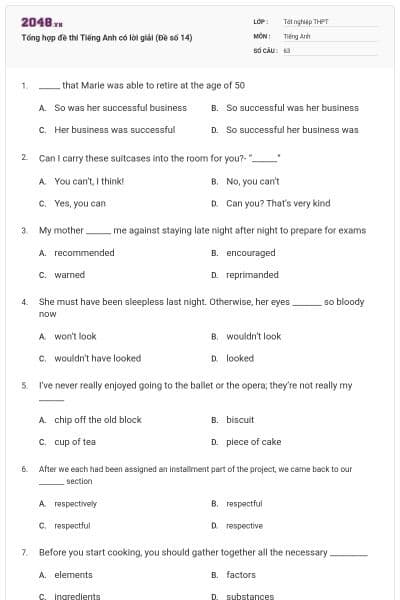
_____ that Marie was able to retire at the age of 50
So was her successful business
So successful was her business
Her business was successful
So successful her business was
Đáp án : B
Cấu trúc đảo ngữ với “so” : So + adj + be + S + that + clause = quá… đến mức mà
Can I carry these suitcases into the room for you?- “______”
You can’t, I think!
No, you can’t
Yes, you can
Can you? That’s very kind
Đáp án : D
“Can I+ V…+ for you?” là cấu trúc đề nghị làm gì cho người khác. Được đề nghị xách hộ đồ; người đáp hỏi lại với ý cảm ơn: Can you? That’s very kind. = Bạn xách được chứ? Thật là tốt bụng
My mother ______ me against staying late night after night to prepare for exams
recommended
encouraged
warned
reprimanded
Đáp án : C
Warn somebody + against + Ving = cảnh báo ai không làm gì
She must have been sleepless last night. Otherwise, her eyes _______ so bloody now
won’t look
wouldn’t look
wouldn’t have looked
looked
Đáp án : B
Must have done -> dự đoán một việc chắc chắn đã xảy ra trong quá khứ. Otherwise = nếu không thì. Để giả định một việc trái hiện tại: otherwise + S + would (not) + V (= nếu không thì bây giờ đã không…)
I’ve never really enjoyed going to the ballet or the opera; they’re not really my ______
chip off the old block
biscuit
cup of tea
piece of cake
Đáp án : C
N + be my cup of tea = cái gì đó là hợp sở thích của tôi
After we each had been assigned an installment part of the project, we came back to our _______ section
respectively
respectful
respectful
respective
Đáp án: D
Giải thích:
Kiến thức: Từ vựng - Từ loại
A. respectively (adv): tương ứng
B. irrespective (adj): không liên quan
C. respectful (adj): tôn trọng
D. respective (adj): tương ứng, riêng biệt
Vị trí cần điền là một tính từ đứng trước và bổ nghĩa cho danh từ “section”.
Dựa vào nghĩa, chọn D.
Dịch: Sau khi mỗi người được phân công một phần của dự án, chúng tôi quay lại phần việc của mình.
Before you start cooking, you should gather together all the necessary _________
elements
factors
ingredients
substances
Đáp án : C
Ingredient = thành phần (thực phẩm); element = thành phần cấu tạo; factor = yếu tố; substance = vật chất
The last person _____ will have to turn off the lights
left
leaving
have left
to leave
Đáp án : D
The first/last + N + to V = là người/vật đầu tiên/cuối cùng làm gì
This shirt is ______ that one
a bit less expensive
as much expensive as
not nearly as expensive as
much far expensive than
Đáp án : C
So sánh ngang bằng: S + be + as + adj + as N = cũng … như…
My friend bought ___________ from a shop on Tran Phu street
a brown nice leather belt
a nice brown leather belt
a leather brown nice belt
a nice leather brown beltĐáp án : B
Quy tắc sắp xếp các tính từ: OPSACOM: Opinion (nice) – Price – Shape/size – Age – Color (brown) – Original – Material (leather) => nice leather brown
Đáp án : B
Quy tắc sắp xếp các tính từ: OPSACOM: Opinion (nice) – Price – Shape/size – Age – Color (brown) – Original – Material (leather) => nice leather brown
The new manager found the situation so complicated that he couldn’t see the wood for the _________
leaf
fruit
wood
trees
Đáp án : D
Can’t see the wood for the trees = thấy cây mà chẳng thấy rừng; ý nói chỉ chú ý đến cái tiểu tiết, mà không nắm được tình hình chung
A: I think it is a good idea to have three or four generations living under one roof
B: _________ Family members can help each other a lot
It's not true
That's wrong
I couldn't agree any more
I don't agree
Đáp án: C
Giải thích:
Kiến thức: Tình huống giao tiếp
Dịch:
A: Tôi nghĩ rằng có ba hoặc bốn thế hệ sống chung dưới một mái nhà là một ý tưởng hay.
B: _________. Các thành viên trong gia đình có thể giúp đỡ lẫn nhau rất nhiều.
A. Điều đó không đúng
B. Điều đó sai
C. Tôi không thể đồng ý hơn nữa / Tôi hoàn toàn đồng ý
D. Tôi không đồng ý
Dựa vào ý của câu sau, chọn C.
Ann: How well you are playing, Peter!Peter: _________.
Say it again. I like to hear your words
Thank you too much
I think so. I'm proud of myself
Many thanks, that's a nice compliment
Đáp án : D
How + adv + S + V! -> câu cảm thán, thường chỉ ý khen ai đó làm việc gì thế nào. Đáp lại là lời cám ơn: . Many thanks, that's a nice compliment = Cám ơn nhiều, đó là một lời khen tốt
The teacher as well as his students____________ at the school meeting yet
arrived
hasn’t arrived
haven’t arrived
not arriving
Đáp án : B
Trong câu có: N1 + as well as + N2 đứng đầu thì N1 là chủ ngữ, động từ chia theo N1
Why wasn't your boyfriend at the party last night?He ______ the lecture at Shaw Hall. I know he very much wanted to hear the speaker
may have attended
was to attend
should have attended
can have attended
Đáp án : A
May have + past participle : có lẽ đã làm gì trong quá khứ, dự đoán không chắc chắn. Be to V = cần phải làm gì. Should have + past participle: đã nên làm gì trong quá khứ, mà đã không làm. Can have + past participle: đã có thể làm gì trong quá khứ, mà không làm
We’d better __________ if we want to get there in time
take up
turn down
speed up
put down
Đáp án : C
Speed up = nhanh lên
Nowadays, most students use _______ calculators in their studies and examinations
electrical
electricity
electric
electronic
Đáp án : D
Electronic (Adj) = thuộc về điện tử. Electric (Adj) = thuộc về điện, dùng điện
It is essential that Alice __________ about his responsibilities in the meeting tomorrow
be reminded
must remind
will be reminded
will remind
Đáp án : A
Giả định cách: It is + tính từ chỉ sự quan trọng (essential/important/necessary…) + (that) + S + (should) + V không chia
The use of computers aids in teaching, __________ the role of teachers is still very important
althoughB. yet
yet
so that
because
Đáp án : B
Although = mặc dù. Yet = nhưng. So that = để mà. Because = bởi vì
Mark the letter A, B, C, or D on your answer sheet to indicate the word(s) SIMILAR in meaning to the underlined word(s) in each of the following questions
Within a week on display at the exhibition, the painting was hailed as a masterpiece
a down- to – earth work of art
an excellent work of art
an expensive work of art
a large work of art
Đáp án : B
Masterpiece = kiệt tác
Mark the letter A, B, C, or D on your answer sheet to indicate the word(s) SIMILAR in meaning to the underlined word(s) in each of the following questions
Deer like figures made from willow shoots are the oldest evidence of human habitation in the Grand Canyon
proofB. clue
clue
dispute
exhibit
Đáp án : A
Evidence = proof = bằng chứng. clue = gợi ý, dấu vết
Mark the letter A, B, C, or D on your answer sheet to indicate the word(s) SIMILAR in meaning to the underlined word(s) in each of the following questions.
He drives me to the edge because he never stops talking
frightens me
moves me
irritates me
steers me
Đáp án : C
Drive somebody to the edge = làm ai khó chịu, tức điên. Irritate = làm ai bực mình
Mark the letter A, B, C, or D on your answer sheet to indicate the word(s) SIMILAR in meaning to the underlined word(s) in each of the following questions.
I think we can safely say now that we have got our money back, we are home and dry
have got home dry
have been successful
have not got wet
have got no water
Đáp án : B
Be home and dry = êm xuôi, xuôi chèo mát mái
Mark the letter A, B, C, or D on your answer sheet to indicate the word(s) SIMILAR in meaning to the underlined word(s) in each of the following questions
Roget's Thesaurus, a collection of English words and phrases, was originally arranged by the ideas they express rather than by alphabetical order
unless
instead of
restricted
as well as
Đáp án : B
Rather than = hơn là, thay vì
Mark the letter A, B, C, or D on your answer sheet to indicate the word whose underlined part differs from the other three in pronunciation in each of the following questions
resort
position
pleasure
desert
Đáp án : C
“s” trong “pleasure” phát âm là /ʒ/, trong các từ còn lại phát âm là /z/
Mark the letter A, B, C, or D on your answer sheet to indicate the word whose underlined part differs from the other three in pronunciation in each of the following questionsA. helped
helped
wicked
knocked
coughed
Đáp án : B
“ed” trong từ “wicked” là trường hợp đặc biệt, phát âm là /id/, trong các từ còn lại phát âm là /t/
Mark the letter A, B, C, or D on your answer sheet to show the underlined part that needs correction in each of the following questions.
The longest mountain range, the Mid-Atlantic Range, is not hardly visible because most of it lies under the ocean
mountain range
not hardly
most of
under
Ðáp án B
Hardly = gần như không (mang nghĩa phủ định); không dùng “not” cạnh “hardly”
Mark the letter A, B, C, or D on your answer sheet to show the underlined part that needs correction in each of the following questions.
Establishing in 1984 for students who wanted to study art and music subjects, LaGuardia was the first public school of its kind
Establishing
for students
was
of its kindÐáp án A
Chủ ngữ trong câu là LaGuardia – một truờng học; dộng từ dứng dầu câu “establish” (=thành
lập) phải là dộng từ do chủ ngữ này hành dộng. Ngôi truờng này duợc thành lập; việc thành lập là bị động; phải dùng quá khứ phân từ dứng dầu câu dể thể hiện ý bị động
Ðáp án A
Chủ ngữ trong câu là LaGuardia – một truờng học; dộng từ dứng dầu câu “establish” (=thành
lập) phải là dộng từ do chủ ngữ này hành dộng. Ngôi truờng này duợc thành lập; việc thành lập là bị động; phải dùng quá khứ phân từ dứng dầu câu dể thể hiện ý bị động
Mark the letter A, B, C, or D on your answer sheet to show the underlined part that needs correction in each of the following questions.
The abilities to work hard, follow directions, and thinking independently are some of the criteria for success in the workplace
to work
thinking
are
for success
Ðáp án B
Truớc “and” là to V thì sau “and” là V. Sửa B thành: think
Mark the letter A, B, C, or D on your answer sheet to show the underlined part that needs correction in each of the following questions.
The old woman cannot remember the place which she kept her savings
The old
remember
which
kept
Ðáp án C
Ðại từ quan hệ bổ nghia cho nơi chốn (the place) và không làm chủ ngữ cho mệnh đề quan hệ (“she” làm chủ ngữ cho mệnh đề quan hệ) là “where”
Mark the letter A, B, C, or D on your answer sheet to show the underlined part that needs correction in each of the following questions.
I think she will be suitable for the work because she has been working like a teacher for a long time.
will be
for
has been working
like
Ðáp án D
Work + as + a/an + nghề nghiệp = làm việc trong vai trò là một nghề gì
Read the following passage and mark the letter A, B, C or D on your answer sheet to indicate the correct answer to each of the question below.
We find that bright children are rarely held back by mixed-ability teaching. On the contrary, both their knowledge and experience are enriched. We feel that there are many disadvantages in streaming pupils. It does not take into account the fact that children develop at different rates. It can have a bad effect on both the bright and the not-so-bright child. After all, it can be quite discouraging to be at the bottom of the top grade!
Besides, it is rather unreal to grade people just according to their intellectual ability. This is only one aspect of their total personality. We are concerned to develop the abilities of all our pupils to the full, not just their academic ability. We also value personal qualities and social skills, and we find that mixed-ability teaching contributes to all these aspects of learning.
In our classroom, we work in various ways. The pupils often work in groups; this gives them the opportunity to learn to co-operate, to share, and to develop leadership skills. They also learn how to cope with the personal problems as well as learning how to think, to make decisions, to analyze and evaluate, to communicate effectively. The pupils learn from each other as well as from the teachers.
Sometimes the pupils work in pairs; sometimes the work on individual tasks and assignments, they can do this at their own speed. They also have some formal class teaching when this is appropriate. We encourage our pupils to use the library, and we teach them the skills they need in order to do this effectively. An advanced pupil can do advanced works; it does not matter what age the child is. We expect our pupils to do their best, not their least, and we give them every encouragement to attain this goal
In the passage, the author’s attitude towards “mixed-ability teaching” is ________
questioning
approving
objective
critical
Đáp án : B
Trong đoạn mở đầu, tác giả cho rằng những đứa trẻ tài giỏi không bị cản trở bởi khả năng dạy hỗn hợp của giáo viên; mà ngược lại còn có thêm kiến thức và kinh nghiệm học tập (rarely held back by mixed-ability teaching. On the contrary, both their knowledge and experience are enriched) -> tác giả đồng tình với khả năng dạy hỗn hợp (approving)
Read the following passage and mark the letter A, B, C or D on your answer sheet to indicate the correct answer to each of the question below.
We find that bright children are rarely held back by mixed-ability teaching. On the contrary, both their knowledge and experience are enriched. We feel that there are many disadvantages in streaming pupils. It does not take into account the fact that children develop at different rates. It can have a bad effect on both the bright and the not-so-bright child. After all, it can be quite discouraging to be at the bottom of the top grade!
Besides, it is rather unreal to grade people just according to their intellectual ability. This is only one aspect of their total personality. We are concerned to develop the abilities of all our pupils to the full, not just their academic ability. We also value personal qualities and social skills, and we find that mixed-ability teaching contributes to all these aspects of learning.
In our classroom, we work in various ways. The pupils often work in groups; this gives them the opportunity to learn to co-operate, to share, and to develop leadership skills. They also learn how to cope with the personal problems as well as learning how to think, to make decisions, to analyze and evaluate, to communicate effectively. The pupils learn from each other as well as from the teachers.
Sometimes the pupils work in pairs; sometimes the work on individual tasks and assignments, they can do this at their own speed. They also have some formal class teaching when this is appropriate. We encourage our pupils to use the library, and we teach them the skills they need in order to do this effectively. An advanced pupil can do advanced works; it does not matter what age the child is. We expect our pupils to do their best, not their least, and we give them every encouragement to attain this goal
The phrase “held back” in paragraph 1 means ______
prevented from advancing
forced to study in lower class
made to remain in the same classes
made to lag behind
Đáp án : A
Be held back = bị cản trở
Read the following passage and mark the letter A, B, C or D on your answer sheet to indicate the correct answer to each of the question below.
We find that bright children are rarely held back by mixed-ability teaching. On the contrary, both their knowledge and experience are enriched. We feel that there are many disadvantages in streaming pupils. It does not take into account the fact that children develop at different rates. It can have a bad effect on both the bright and the not-so-bright child. After all, it can be quite discouraging to be at the bottom of the top grade!
Besides, it is rather unreal to grade people just according to their intellectual ability. This is only one aspect of their total personality. We are concerned to develop the abilities of all our pupils to the full, not just their academic ability. We also value personal qualities and social skills, and we find that mixed-ability teaching contributes to all these aspects of learning.
In our classroom, we work in various ways. The pupils often work in groups; this gives them the opportunity to learn to co-operate, to share, and to develop leadership skills. They also learn how to cope with the personal problems as well as learning how to think, to make decisions, to analyze and evaluate, to communicate effectively. The pupils learn from each other as well as from the teachers.
Sometimes the pupils work in pairs; sometimes the work on individual tasks and assignments, they can do this at their own speed. They also have some formal class teaching when this is appropriate. We encourage our pupils to use the library, and we teach them the skills they need in order to do this effectively. An advanced pupil can do advanced works; it does not matter what age the child is. We expect our pupils to do their best, not their least, and we give them every encouragement to attain this goal
The author argues that a teacher’s chief concern should be the development of the pupils’ _________
learning ability and communicative skills
intellectual abilities
total personality
personal and social skills
Đáp án : C
Từ cuối dòng đầu đoạn 2: This is only one aspect of their total personality. We are concerned to develop the abilities of all our pupils to the full -> thay vì đánh giá học sinh qua khả năng học tập; cần phải chú ý phát triển mọi kĩ năng, nhân cách tổng thể
Read the following passage and mark the letter A, B, C or D on your answer sheet to indicate the correct answer to each of the question below.
We find that bright children are rarely held back by mixed-ability teaching. On the contrary, both their knowledge and experience are enriched. We feel that there are many disadvantages in streaming pupils. It does not take into account the fact that children develop at different rates. It can have a bad effect on both the bright and the not-so-bright child. After all, it can be quite discouraging to be at the bottom of the top grade!
Besides, it is rather unreal to grade people just according to their intellectual ability. This is only one aspect of their total personality. We are concerned to develop the abilities of all our pupils to the full, not just their academic ability. We also value personal qualities and social skills, and we find that mixed-ability teaching contributes to all these aspects of learning.
In our classroom, we work in various ways. The pupils often work in groups; this gives them the opportunity to learn to co-operate, to share, and to develop leadership skills. They also learn how to cope with the personal problems as well as learning how to think, to make decisions, to analyze and evaluate, to communicate effectively. The pupils learn from each other as well as from the teachers.
Sometimes the pupils work in pairs; sometimes the work on individual tasks and assignments, they can do this at their own speed. They also have some formal class teaching when this is appropriate. We encourage our pupils to use the library, and we teach them the skills they need in order to do this effectively. An advanced pupil can do advanced works; it does not matter what age the child is. We expect our pupils to do their best, not their least, and we give them every encouragement to attain this goal
Which of the following is NOT mentioned in the passage?
Group work provides the pupils with the opportunity to learn to be capable organizers
Pupils also learn how to participate in teaching activities
Group work gives pupils the opportunity to learn to work together with others
Pupils also learn to develop their reasoning ability
Đáp án : B
Từ dòng đầu đoạn 3: The pupils often work in groups; this gives them the opportunity to learn to co-operate, to share, and to develop leadership skills. They also learn how to cope with the personal problems as well as learning how to think, to make decisions, to analyze and evaluate, to communicate effectively -> chỉ có đáp án B là không được nhắc tới
Read the following passage and mark the letter A, B, C or D on your answer sheet to indicate the correct answer to each of the question below.
We find that bright children are rarely held back by mixed-ability teaching. On the contrary, both their knowledge and experience are enriched. We feel that there are many disadvantages in streaming pupils. It does not take into account the fact that children develop at different rates. It can have a bad effect on both the bright and the not-so-bright child. After all, it can be quite discouraging to be at the bottom of the top grade!
Besides, it is rather unreal to grade people just according to their intellectual ability. This is only one aspect of their total personality. We are concerned to develop the abilities of all our pupils to the full, not just their academic ability. We also value personal qualities and social skills, and we find that mixed-ability teaching contributes to all these aspects of learning.
In our classroom, we work in various ways. The pupils often work in groups; this gives them the opportunity to learn to co-operate, to share, and to develop leadership skills. They also learn how to cope with the personal problems as well as learning how to think, to make decisions, to analyze and evaluate, to communicate effectively. The pupils learn from each other as well as from the teachers.
Sometimes the pupils work in pairs; sometimes the work on individual tasks and assignments, they can do this at their own speed. They also have some formal class teaching when this is appropriate. We encourage our pupils to use the library, and we teach them the skills they need in order to do this effectively. An advanced pupil can do advanced works; it does not matter what age the child is. We expect our pupils to do their best, not their least, and we give them every encouragement to attain this goal
The author’s purpose of writing this passage is to _________
recommend pair work and group work classroom activities
offer advice on the proper use of the school library
argue for teaching bright and not-so-bright pupils in the same class
emphasize the importance of appropriate formal classroom teaching
Đáp án : C
Từ đoạn đầu, dòng 2: there are many disadvantages in streaming pupils… It can have a bad effect on both the bright and the not-so-bright child -> tác giả cho rằng đưa học sinh vào cùng các trình độ có hại cho những trẻ thông minh và trẻ kém thông minh -> đoạn văn ám chỉ nên tách 2 trình độ học sinh riêng biệt
Read the following passage and mark the letter A, B, C or D on your answer sheet to indicate the correct answer to each of the question below.
We find that bright children are rarely held back by mixed-ability teaching. On the contrary, both their knowledge and experience are enriched. We feel that there are many disadvantages in streaming pupils. It does not take into account the fact that children develop at different rates. It can have a bad effect on both the bright and the not-so-bright child. After all, it can be quite discouraging to be at the bottom of the top grade!
Besides, it is rather unreal to grade people just according to their intellectual ability. This is only one aspect of their total personality. We are concerned to develop the abilities of all our pupils to the full, not just their academic ability. We also value personal qualities and social skills, and we find that mixed-ability teaching contributes to all these aspects of learning.
In our classroom, we work in various ways. The pupils often work in groups; this gives them the opportunity to learn to co-operate, to share, and to develop leadership skills. They also learn how to cope with the personal problems as well as learning how to think, to make decisions, to analyze and evaluate, to communicate effectively. The pupils learn from each other as well as from the teachers.
Sometimes the pupils work in pairs; sometimes the work on individual tasks and assignments, they can do this at their own speed. They also have some formal class teaching when this is appropriate. We encourage our pupils to use the library, and we teach them the skills they need in order to do this effectively. An advanced pupil can do advanced works; it does not matter what age the child is. We expect our pupils to do their best, not their least, and we give them every encouragement to attain this goal
According to the passage, which of the following is NOT true?
Development of pupils as individuals is not the aim of group work
Pupils cannot develop in the best way if they are streamed into classes of different intellectual abilities
It’s not good for a bright child to find out that he performs worst in a mixed-ability class
There is no fixed method in teaching pupils to develop themselves to the full
Đáp án : B
Ngay từ 2 câu đầu: We find that bright children are rarely held back by mixed-ability teaching. On the contrary, both their knowledge and experience are enriched -> với những trình độ hỗn hợp; những học sinh giỏi vẫn phát triển tốt về mặt tích lũy kiến thức và kinh nghiệm
Read the following passage and mark the letter A, B, C or D on your answer sheet to indicate the correct answer to each of the question below.
We find that bright children are rarely held back by mixed-ability teaching. On the contrary, both their knowledge and experience are enriched. We feel that there are many disadvantages in streaming pupils. It does not take into account the fact that children develop at different rates. It can have a bad effect on both the bright and the not-so-bright child. After all, it can be quite discouraging to be at the bottom of the top grade!
Besides, it is rather unreal to grade people just according to their intellectual ability. This is only one aspect of their total personality. We are concerned to develop the abilities of all our pupils to the full, not just their academic ability. We also value personal qualities and social skills, and we find that mixed-ability teaching contributes to all these aspects of learning.
In our classroom, we work in various ways. The pupils often work in groups; this gives them the opportunity to learn to co-operate, to share, and to develop leadership skills. They also learn how to cope with the personal problems as well as learning how to think, to make decisions, to analyze and evaluate, to communicate effectively. The pupils learn from each other as well as from the teachers.
Sometimes the pupils work in pairs; sometimes the work on individual tasks and assignments, they can do this at their own speed. They also have some formal class teaching when this is appropriate. We encourage our pupils to use the library, and we teach them the skills they need in order to do this effectively. An advanced pupil can do advanced works; it does not matter what age the child is. We expect our pupils to do their best, not their least, and we give them every encouragement to attain this goal
According to the passage, which of the following is an advantage of mixed-ability teaching?
Formal class teaching is the important way to give pupils essential skills such as those to be used in the library
Pupils as individuals always have the opportunities to work on their own
A pupil can be at the bottom of a class
Pupils can be hindered from an all-round development
Đáp án : B
Trong đoạn cuối: sometimes the work on individual tasks and assignments, they can do this at their own speed …An advanced pupil can do advanced works -> các học sinh có thể làm việc độc lập; phát huy ở tốc độ riêng của mình – một điểm tích cực
Read the following passage and mark the letter A, B, C or D on your answer sheet to indicate the correct answer to each of the question below.
We find that bright children are rarely held back by mixed-ability teaching. On the contrary, both their knowledge and experience are enriched. We feel that there are many disadvantages in streaming pupils. It does not take into account the fact that children develop at different rates. It can have a bad effect on both the bright and the not-so-bright child. After all, it can be quite discouraging to be at the bottom of the top grade!
Besides, it is rather unreal to grade people just according to their intellectual ability. This is only one aspect of their total personality. We are concerned to develop the abilities of all our pupils to the full, not just their academic ability. We also value personal qualities and social skills, and we find that mixed-ability teaching contributes to all these aspects of learning.
In our classroom, we work in various ways. The pupils often work in groups; this gives them the opportunity to learn to co-operate, to share, and to develop leadership skills. They also learn how to cope with the personal problems as well as learning how to think, to make decisions, to analyze and evaluate, to communicate effectively. The pupils learn from each other as well as from the teachers.
Sometimes the pupils work in pairs; sometimes the work on individual tasks and assignments, they can do this at their own speed. They also have some formal class teaching when this is appropriate. We encourage our pupils to use the library, and we teach them the skills they need in order to do this effectively. An advanced pupil can do advanced works; it does not matter what age the child is. We expect our pupils to do their best, not their least, and we give them every encouragement to attain this goal
Which of the following statements can best summarize the main idea of the passage?
The aim of education is to find out how to teach the bright and not-so-bright pupils
Various ways of teaching should be encouraged in class
Children, in general, develop at different rates
Bright children do benefit from mixed-ability teaching
Đáp án : B
Bài văn đề cập tới việc phát triển các kĩ năng của học sinh thông qua rất nhiều phương pháp khá nhau; làm việc nhóm, làm việc cá nhân, học từ giáo viên, tự học “we work in various ways” -> khuyến khích học sinh học bằng nhiều cách
Read the following passage and mark the letter A, B, C or D on your answer sheet to indicate the correct answer to each of the question below.
We find that bright children are rarely held back by mixed-ability teaching. On the contrary, both their knowledge and experience are enriched. We feel that there are many disadvantages in streaming pupils. It does not take into account the fact that children develop at different rates. It can have a bad effect on both the bright and the not-so-bright child. After all, it can be quite discouraging to be at the bottom of the top grade!
Besides, it is rather unreal to grade people just according to their intellectual ability. This is only one aspect of their total personality. We are concerned to develop the abilities of all our pupils to the full, not just their academic ability. We also value personal qualities and social skills, and we find that mixed-ability teaching contributes to all these aspects of learning.
In our classroom, we work in various ways. The pupils often work in groups; this gives them the opportunity to learn to co-operate, to share, and to develop leadership skills. They also learn how to cope with the personal problems as well as learning how to think, to make decisions, to analyze and evaluate, to communicate effectively. The pupils learn from each other as well as from the teachers.
Sometimes the pupils work in pairs; sometimes the work on individual tasks and assignments, they can do this at their own speed. They also have some formal class teaching when this is appropriate. We encourage our pupils to use the library, and we teach them the skills they need in order to do this effectively. An advanced pupil can do advanced works; it does not matter what age the child is. We expect our pupils to do their best, not their least, and we give them every encouragement to attain this goal
According to the passage, “streaming pupils” ______
is the act of putting pupils into class according to their academic abilities
aims at enriching both their knowledge and experience
is quite discouraging
will help the pupils learn best
Đáp án : A
Stream (v) có thể mang nghĩa: đưa học sinh vào các lớp theo trình độ của mình
Read the following passage and mark the letter A, B, C or D on your answer sheet to indicate the correct answer to each of the question below.
We find that bright children are rarely held back by mixed-ability teaching. On the contrary, both their knowledge and experience are enriched. We feel that there are many disadvantages in streaming pupils. It does not take into account the fact that children develop at different rates. It can have a bad effect on both the bright and the not-so-bright child. After all, it can be quite discouraging to be at the bottom of the top grade!
Besides, it is rather unreal to grade people just according to their intellectual ability. This is only one aspect of their total personality. We are concerned to develop the abilities of all our pupils to the full, not just their academic ability. We also value personal qualities and social skills, and we find that mixed-ability teaching contributes to all these aspects of learning.
In our classroom, we work in various ways. The pupils often work in groups; this gives them the opportunity to learn to co-operate, to share, and to develop leadership skills. They also learn how to cope with the personal problems as well as learning how to think, to make decisions, to analyze and evaluate, to communicate effectively. The pupils learn from each other as well as from the teachers.
Sometimes the pupils work in pairs; sometimes the work on individual tasks and assignments, they can do this at their own speed. They also have some formal class teaching when this is appropriate. We encourage our pupils to use the library, and we teach them the skills they need in order to do this effectively. An advanced pupil can do advanced works; it does not matter what age the child is. We expect our pupils to do their best, not their least, and we give them every encouragement to attain this goal
According to the author, mixed-ability teaching is more preferable because _______
children can learn to work with each other to solve personal problems
it doesn’t have disadvantages as in streaming pupils
formal class teaching is appropriate
its aim at developing the children’s total personality
Đáp án : D
Từ dòng 2 đoạn 2: . We are concerned to develop the abilities of all our pupils to the full, not just their academic ability -> hướng tới phát triển toàn diện cho học sinh
Read the following passage and mark the letter A, B, C or D on your answer sheet to indicate the correct answer to each of the following questions
Throughout history people have always communicated with one another, not only by speech but also by movements of the hands and body. It is, however, only (42) ______ the last few years that these aspects of communication have been studied at all widely. This type of communication is known as body language or non-verbal communication.
People sometimes wonder (43) ______ you can learn how body language works. It is of course possible to read books on the subject but you also need to (44) ______ time observing people’s movements. A railway station is a particular good place for such observation, as here people can be seen openly expressing eagerness, sorrow, delight, impatience and many other human emotions by (45) _____ of movement.
If you turn down the sound on your television set and try to understand (46) _____ is happening simply by watching the picture you will learn even more about communication (47) _____ words. By turning the sound back up every five (48) ______ or so, it is possible to check how accurate your (49) ______ is.
Having studied the art of body language you will have a definite (50) ______ at a boring party. You will be able to sit on your own for the whole evening and thoroughly enjoy yourself by both watching (51) ______ interpreting the body language of all the other people there.Question 42
with
during
for
on
Đáp án : B
For the last/past + khoảng thời gian = trong vòng bao lâu qua
Read the following passage and mark the letter A, B, C or D on your answer sheet to indicate the correct answer to each of the following questions
Throughout history people have always communicated with one another, not only by speech but also by movements of the hands and body. It is, however, only (42) ______ the last few years that these aspects of communication have been studied at all widely. This type of communication is known as body language or non-verbal communication.
People sometimes wonder (43) ______ you can learn how body language works. It is of course possible to read books on the subject but you also need to (44) ______ time observing people’s movements. A railway station is a particular good place for such observation, as here people can be seen openly expressing eagerness, sorrow, delight, impatience and many other human emotions by (45) _____ of movement.
If you turn down the sound on your television set and try to understand (46) _____ is happening simply by watching the picture you will learn even more about communication (47) _____ words. By turning the sound back up every five (48) ______ or so, it is possible to check how accurate your (49) ______ is.
Having studied the art of body language you will have a definite (50) ______ at a boring party. You will be able to sit on your own for the whole evening and thoroughly enjoy yourself by both watching (51) ______ interpreting the body language of all the other people there.Question 43
that
how
what
whether
Đáp án : D
Wonder whether + mệnh đề = thắc mắc, tự hỏi liệu rằng…
Read the following passage and mark the letter A, B, C or D on your answer sheet to indicate the correct answer to each of the following questions
Throughout history people have always communicated with one another, not only by speech but also by movements of the hands and body. It is, however, only (42) ______ the last few years that these aspects of communication have been studied at all widely. This type of communication is known as body language or non-verbal communication.
People sometimes wonder (43) ______ you can learn how body language works. It is of course possible to read books on the subject but you also need to (44) ______ time observing people’s movements. A railway station is a particular good place for such observation, as here people can be seen openly expressing eagerness, sorrow, delight, impatience and many other human emotions by (45) _____ of movement.
If you turn down the sound on your television set and try to understand (46) _____ is happening simply by watching the picture you will learn even more about communication (47) _____ words. By turning the sound back up every five (48) ______ or so, it is possible to check how accurate your (49) ______ is.
Having studied the art of body language you will have a definite (50) ______ at a boring party. You will be able to sit on your own for the whole evening and thoroughly enjoy yourself by both watching (51) ______ interpreting the body language of all the other people there.Question 44
kill
spend
give
lose
Đáp án : B
Spend time + Ving = dành thời gian làm gì
Read the following passage and mark the letter A, B, C or D on your answer sheet to indicate the correct answer to each of the following questions
Throughout history people have always communicated with one another, not only by speech but also by movements of the hands and body. It is, however, only (42) ______ the last few years that these aspects of communication have been studied at all widely. This type of communication is known as body language or non-verbal communication.
People sometimes wonder (43) ______ you can learn how body language works. It is of course possible to read books on the subject but you also need to (44) ______ time observing people’s movements. A railway station is a particular good place for such observation, as here people can be seen openly expressing eagerness, sorrow, delight, impatience and many other human emotions by (45) _____ of movement.
If you turn down the sound on your television set and try to understand (46) _____ is happening simply by watching the picture you will learn even more about communication (47) _____ words. By turning the sound back up every five (48) ______ or so, it is possible to check how accurate your (49) ______ is.
Having studied the art of body language you will have a definite (50) ______ at a boring party. You will be able to sit on your own for the whole evening and thoroughly enjoy yourself by both watching (51) ______ interpreting the body language of all the other people there.Question 45
means
gestures
health
postures
Đáp án : A
By means of N = bằng phương tiện gì
Read the following passage and mark the letter A, B, C or D on your answer sheet to indicate the correct answer to each of the following questions
Throughout history people have always communicated with one another, not only by speech but also by movements of the hands and body. It is, however, only (42) ______ the last few years that these aspects of communication have been studied at all widely. This type of communication is known as body language or non-verbal communication.
People sometimes wonder (43) ______ you can learn how body language works. It is of course possible to read books on the subject but you also need to (44) ______ time observing people’s movements. A railway station is a particular good place for such observation, as here people can be seen openly expressing eagerness, sorrow, delight, impatience and many other human emotions by (45) _____ of movement.
If you turn down the sound on your television set and try to understand (46) _____ is happening simply by watching the picture you will learn even more about communication (47) _____ words. By turning the sound back up every five (48) ______ or so, it is possible to check how accurate your (49) ______ is.
Having studied the art of body language you will have a definite (50) ______ at a boring party. You will be able to sit on your own for the whole evening and thoroughly enjoy yourself by both watching (51) ______ interpreting the body language of all the other people there.Question 46
who
which
what
that
Đáp án : C
Mệnh đề quan hệ có thể đứng sau động từ; mang vai trò một túc từ. Understand what is happening = hiểu cái gì đang xảy ra
Read the following passage and mark the letter A, B, C or D on your answer sheet to indicate the correct answer to each of the following questions
Throughout history people have always communicated with one another, not only by speech but also by movements of the hands and body. It is, however, only (42) ______ the last few years that these aspects of communication have been studied at all widely. This type of communication is known as body language or non-verbal communication.
People sometimes wonder (43) ______ you can learn how body language works. It is of course possible to read books on the subject but you also need to (44) ______ time observing people’s movements. A railway station is a particular good place for such observation, as here people can be seen openly expressing eagerness, sorrow, delight, impatience and many other human emotions by (45) _____ of movement.
If you turn down the sound on your television set and try to understand (46) _____ is happening simply by watching the picture you will learn even more about communication (47) _____ words. By turning the sound back up every five (48) ______ or so, it is possible to check how accurate your (49) ______ is.
Having studied the art of body language you will have a definite (50) ______ at a boring party. You will be able to sit on your own for the whole evening and thoroughly enjoy yourself by both watching (51) ______ interpreting the body language of all the other people there.Question 47
and
including
without
with
Đáp án : C
Without N = mà không có cái gì
Read the following passage and mark the letter A, B, C or D on your answer sheet to indicate the correct answer to each of the following questions
Throughout history people have always communicated with one another, not only by speech but also by movements of the hands and body. It is, however, only (42) ______ the last few years that these aspects of communication have been studied at all widely. This type of communication is known as body language or non-verbal communication.
People sometimes wonder (43) ______ you can learn how body language works. It is of course possible to read books on the subject but you also need to (44) ______ time observing people’s movements. A railway station is a particular good place for such observation, as here people can be seen openly expressing eagerness, sorrow, delight, impatience and many other human emotions by (45) _____ of movement.
If you turn down the sound on your television set and try to understand (46) _____ is happening simply by watching the picture you will learn even more about communication (47) _____ words. By turning the sound back up every five (48) ______ or so, it is possible to check how accurate your (49) ______ is.
Having studied the art of body language you will have a definite (50) ______ at a boring party. You will be able to sit on your own for the whole evening and thoroughly enjoy yourself by both watching (51) ______ interpreting the body language of all the other people there.Question 48
years
minutes
hours
months
Đáp án : A
Every five years = cứ 5 năm một lần ( tự kiểm trả khả năng hiểu của mình cứ 5 năm một lần)
Read the following passage and mark the letter A, B, C or D on your answer sheet to indicate the correct answer to each of the following questions
Throughout history people have always communicated with one another, not only by speech but also by movements of the hands and body. It is, however, only (42) ______ the last few years that these aspects of communication have been studied at all widely. This type of communication is known as body language or non-verbal communication.
People sometimes wonder (43) ______ you can learn how body language works. It is of course possible to read books on the subject but you also need to (44) ______ time observing people’s movements. A railway station is a particular good place for such observation, as here people can be seen openly expressing eagerness, sorrow, delight, impatience and many other human emotions by (45) _____ of movement.
If you turn down the sound on your television set and try to understand (46) _____ is happening simply by watching the picture you will learn even more about communication (47) _____ words. By turning the sound back up every five (48) ______ or so, it is possible to check how accurate your (49) ______ is.
Having studied the art of body language you will have a definite (50) ______ at a boring party. You will be able to sit on your own for the whole evening and thoroughly enjoy yourself by both watching (51) ______ interpreting the body language of all the other people there.Question 49
expression
understanding
meaning
movement
Đáp án : B
Understanding (noun) = sự hiểu biết
Read the following passage and mark the letter A, B, C or D on your answer sheet to indicate the correct answer to each of the following questions
Throughout history people have always communicated with one another, not only by speech but also by movements of the hands and body. It is, however, only (42) ______ the last few years that these aspects of communication have been studied at all widely. This type of communication is known as body language or non-verbal communication.
People sometimes wonder (43) ______ you can learn how body language works. It is of course possible to read books on the subject but you also need to (44) ______ time observing people’s movements. A railway station is a particular good place for such observation, as here people can be seen openly expressing eagerness, sorrow, delight, impatience and many other human emotions by (45) _____ of movement.
If you turn down the sound on your television set and try to understand (46) _____ is happening simply by watching the picture you will learn even more about communication (47) _____ words. By turning the sound back up every five (48) ______ or so, it is possible to check how accurate your (49) ______ is.
Having studied the art of body language you will have a definite (50) ______ at a boring party. You will be able to sit on your own for the whole evening and thoroughly enjoy yourself by both watching (51) ______ interpreting the body language of all the other people there.Question 50
benefit
favour
disadvantage
advantage
Đáp án : D
Have an advantage at N/Ving = có lợi thế về cái gì
Read the following passage and mark the letter A, B, C or D on your answer sheet to indicate the correct answer to each of the following questions
Throughout history people have always communicated with one another, not only by speech but also by movements of the hands and body. It is, however, only (42) ______ the last few years that these aspects of communication have been studied at all widely. This type of communication is known as body language or non-verbal communication.
People sometimes wonder (43) ______ you can learn how body language works. It is of course possible to read books on the subject but you also need to (44) ______ time observing people’s movements. A railway station is a particular good place for such observation, as here people can be seen openly expressing eagerness, sorrow, delight, impatience and many other human emotions by (45) _____ of movement.
If you turn down the sound on your television set and try to understand (46) _____ is happening simply by watching the picture you will learn even more about communication (47) _____ words. By turning the sound back up every five (48) ______ or so, it is possible to check how accurate your (49) ______ is.
Having studied the art of body language you will have a definite (50) ______ at a boring party. You will be able to sit on your own for the whole evening and thoroughly enjoy yourself by both watching (51) ______ interpreting the body language of all the other people there.Question 51
with
and
but
or
Đáp án : B
Both… and… = vừa … vừa
Read the following passage and mark the letter A, B, C, or D on your answer sheet to indicate the correct answer to each of the following questions.
Long before they can actually speak, babies pay special attention to the speech they hear around them. Within the first month of their lives, babies' responses to the sound of the human voice will be different from their responses to other sorts of auditory stimuli. They will stop crying when they hear a person talking, but not if they hear a bell or the sound of a rattle. At first, the sounds that an infant notices might be only those words that receive the heaviest emphasis and that often occur at the ends of utterances. By the time they are six or seven weeks old, babies can detect the difference between syllables pronounced with rising and falling inflections. Very soon, these differences in adult stress and intonation can influence babies' emotional states and behavior. Long before they develop actual language comprehension, babies can sense when an adult is playful or angry, attempting to initiate or terminate new behavior, and so on, merely on the basis of cues such as the rate, volume, and melody of adult speech.
Adults make it as easy as they can for babies to pick up a language by exaggerating such cues. One researcher observed babies and their mothers in six diverse cultures and found that, in all six languages, the mothers used simplified syntax, short utterances and nonsense sounds, and transformed certain sounds into baby talk. Other investigators have noted that when mothers talk to babies who are only a few months old, they exaggerate the pitch, loudness, and intensity of their words. They also exaggerate their facial expressions, hold vowels longer, and emphasize certain words.
More significant for language development than their response to general intonation is observation that tiny babies can make relatively fine distinctions between speech sounds. In other words, babies enter the world with the ability to make precisely those perceptual discriminations that are necessary if they are to acquire aural language.
Babies obviously derive pleasure from sound input, too: even as young as nine months they will listen to songs or stories, although the words themselves are beyond their understanding. For babies, language is a sensory-motor delight rather than the route to prosaic meaning that it often is for adults
Which of the following can be inferred about the findings described in paragraph 2?
Babies ignore facial expressions in comprehending aural language
Mothers from different cultures speak to their babies in similar ways
Babies who are exposed to more than one language can speak earlier than babies exposed to a single language
The mothers observed by the researchers were consciously teaching their babies to speak
Đáp án : B
Từ dòng 3 đoạn 2: in all six languages, the mothers used simplified syntax, short utterances and nonsense sounds, and transformed certain sounds into baby talk -> các cách giống nhau để nói chuyện với con
Read the following passage and mark the letter A, B, C, or D on your answer sheet to indicate the correct answer to each of the following questions.
Long before they can actually speak, babies pay special attention to the speech they hear around them. Within the first month of their lives, babies' responses to the sound of the human voice will be different from their responses to other sorts of auditory stimuli. They will stop crying when they hear a person talking, but not if they hear a bell or the sound of a rattle. At first, the sounds that an infant notices might be only those words that receive the heaviest emphasis and that often occur at the ends of utterances. By the time they are six or seven weeks old, babies can detect the difference between syllables pronounced with rising and falling inflections. Very soon, these differences in adult stress and intonation can influence babies' emotional states and behavior. Long before they develop actual language comprehension, babies can sense when an adult is playful or angry, attempting to initiate or terminate new behavior, and so on, merely on the basis of cues such as the rate, volume, and melody of adult speech.
Adults make it as easy as they can for babies to pick up a language by exaggerating such cues. One researcher observed babies and their mothers in six diverse cultures and found that, in all six languages, the mothers used simplified syntax, short utterances and nonsense sounds, and transformed certain sounds into baby talk. Other investigators have noted that when mothers talk to babies who are only a few months old, they exaggerate the pitch, loudness, and intensity of their words. They also exaggerate their facial expressions, hold vowels longer, and emphasize certain words.
More significant for language development than their response to general intonation is observation that tiny babies can make relatively fine distinctions between speech sounds. In other words, babies enter the world with the ability to make precisely those perceptual discriminations that are necessary if they are to acquire aural language.
Babies obviously derive pleasure from sound input, too: even as young as nine months they will listen to songs or stories, although the words themselves are beyond their understanding. For babies, language is a sensory-motor delight rather than the route to prosaic meaning that it often is for adults
According to the author, why do babies listen to songs and stories, even though they cannot understand them?
They can remember them easily
They focus on the meaning of their parents' word
They enjoy the sound
They understand the rhythm
Đáp án : C
Đầu đoạn cuối: Babies obviously derive pleasure from sound input, too: even as young as nine months they will listen to songs or stories, although the words themselves are beyond their understanding -> vẫn thích dù không hiểu
Read the following passage and mark the letter A, B, C, or D on your answer sheet to indicate the correct answer to each of the following questions.
Long before they can actually speak, babies pay special attention to the speech they hear around them. Within the first month of their lives, babies' responses to the sound of the human voice will be different from their responses to other sorts of auditory stimuli. They will stop crying when they hear a person talking, but not if they hear a bell or the sound of a rattle. At first, the sounds that an infant notices might be only those words that receive the heaviest emphasis and that often occur at the ends of utterances. By the time they are six or seven weeks old, babies can detect the difference between syllables pronounced with rising and falling inflections. Very soon, these differences in adult stress and intonation can influence babies' emotional states and behavior. Long before they develop actual language comprehension, babies can sense when an adult is playful or angry, attempting to initiate or terminate new behavior, and so on, merely on the basis of cues such as the rate, volume, and melody of adult speech.
Adults make it as easy as they can for babies to pick up a language by exaggerating such cues. One researcher observed babies and their mothers in six diverse cultures and found that, in all six languages, the mothers used simplified syntax, short utterances and nonsense sounds, and transformed certain sounds into baby talk. Other investigators have noted that when mothers talk to babies who are only a few months old, they exaggerate the pitch, loudness, and intensity of their words. They also exaggerate their facial expressions, hold vowels longer, and emphasize certain words.
More significant for language development than their response to general intonation is observation that tiny babies can make relatively fine distinctions between speech sounds. In other words, babies enter the world with the ability to make precisely those perceptual discriminations that are necessary if they are to acquire aural language.
Babies obviously derive pleasure from sound input, too: even as young as nine months they will listen to songs or stories, although the words themselves are beyond their understanding. For babies, language is a sensory-motor delight rather than the route to prosaic meaning that it often is for adults
According to the author, why do babies listen to songs and stories, even though they cannot understand them?
They can remember them easily
They focus on the meaning of their parents' word
They enjoy the sound
They understand the rhythm.
Đáp án : B
Từ dòng 5 đoạn 2: they exaggerate the pitch, loudness, and intensity of their words. They also exaggerate their facial expressions, hold vowels longer, and emphasize certain words. -> không phải các từ đều nhấn mạnh như nhau mà là nhấn mạnh một số từ nhất định
Read the following passage and mark the letter A, B, C, or D on your answer sheet to indicate the correct answer to each of the following questions.
Long before they can actually speak, babies pay special attention to the speech they hear around them. Within the first month of their lives, babies' responses to the sound of the human voice will be different from their responses to other sorts of auditory stimuli. They will stop crying when they hear a person talking, but not if they hear a bell or the sound of a rattle. At first, the sounds that an infant notices might be only those words that receive the heaviest emphasis and that often occur at the ends of utterances. By the time they are six or seven weeks old, babies can detect the difference between syllables pronounced with rising and falling inflections. Very soon, these differences in adult stress and intonation can influence babies' emotional states and behavior. Long before they develop actual language comprehension, babies can sense when an adult is playful or angry, attempting to initiate or terminate new behavior, and so on, merely on the basis of cues such as the rate, volume, and melody of adult speech.
Adults make it as easy as they can for babies to pick up a language by exaggerating such cues. One researcher observed babies and their mothers in six diverse cultures and found that, in all six languages, the mothers used simplified syntax, short utterances and nonsense sounds, and transformed certain sounds into baby talk. Other investigators have noted that when mothers talk to babies who are only a few months old, they exaggerate the pitch, loudness, and intensity of their words. They also exaggerate their facial expressions, hold vowels longer, and emphasize certain words.
More significant for language development than their response to general intonation is observation that tiny babies can make relatively fine distinctions between speech sounds. In other words, babies enter the world with the ability to make precisely those perceptual discriminations that are necessary if they are to acquire aural language.
Babies obviously derive pleasure from sound input, too: even as young as nine months they will listen to songs or stories, although the words themselves are beyond their understanding. For babies, language is a sensory-motor delight rather than the route to prosaic meaning that it often is for adults
The word diverse is closest in meaning to ______________
different
surrounding
stimulating
divided
Đáp án : A
Diverse = đa dạng, phong phú
Read the following passage and mark the letter A, B, C, or D on your answer sheet to indicate the correct answer to each of the following questions.
Long before they can actually speak, babies pay special attention to the speech they hear around them. Within the first month of their lives, babies' responses to the sound of the human voice will be different from their responses to other sorts of auditory stimuli. They will stop crying when they hear a person talking, but not if they hear a bell or the sound of a rattle. At first, the sounds that an infant notices might be only those words that receive the heaviest emphasis and that often occur at the ends of utterances. By the time they are six or seven weeks old, babies can detect the difference between syllables pronounced with rising and falling inflections. Very soon, these differences in adult stress and intonation can influence babies' emotional states and behavior. Long before they develop actual language comprehension, babies can sense when an adult is playful or angry, attempting to initiate or terminate new behavior, and so on, merely on the basis of cues such as the rate, volume, and melody of adult speech.
Adults make it as easy as they can for babies to pick up a language by exaggerating such cues. One researcher observed babies and their mothers in six diverse cultures and found that, in all six languages, the mothers used simplified syntax, short utterances and nonsense sounds, and transformed certain sounds into baby talk. Other investigators have noted that when mothers talk to babies who are only a few months old, they exaggerate the pitch, loudness, and intensity of their words. They also exaggerate their facial expressions, hold vowels longer, and emphasize certain words.
More significant for language development than their response to general intonation is observation that tiny babies can make relatively fine distinctions between speech sounds. In other words, babies enter the world with the ability to make precisely those perceptual discriminations that are necessary if they are to acquire aural language.
Babies obviously derive pleasure from sound input, too: even as young as nine months they will listen to songs or stories, although the words themselves are beyond their understanding. For babies, language is a sensory-motor delight rather than the route to prosaic meaning that it often is for adults
Why does the author mention "a bell and a rattle"?
To contrast the reactions of babies to human and nonhuman sounds
To give examples of typical toys that babies do not like
To explain how babies distinguish between different nonhuman sounds
To give examples of sounds that will cause a baby to cry
Đáp án : A
Từ dòng 3 đoạn đầu: They will stop crying when they hear a person talking, but not if they hear a bell or the sound of a rattle -> những đứa trẻ ngừng khóc nếu nghe thấy người nói chuyện; nhưng không nín khóc khi nghe một tiếng chuông hay tiếng lách cách -> phản ứng khác nhau với âm thanh của người và vật
Read the following passage and mark the letter A, B, C, or D on your answer sheet to indicate the correct answer to each of the following questions.
Long before they can actually speak, babies pay special attention to the speech they hear around them. Within the first month of their lives, babies' responses to the sound of the human voice will be different from their responses to other sorts of auditory stimuli. They will stop crying when they hear a person talking, but not if they hear a bell or the sound of a rattle. At first, the sounds that an infant notices might be only those words that receive the heaviest emphasis and that often occur at the ends of utterances. By the time they are six or seven weeks old, babies can detect the difference between syllables pronounced with rising and falling inflections. Very soon, these differences in adult stress and intonation can influence babies' emotional states and behavior. Long before they develop actual language comprehension, babies can sense when an adult is playful or angry, attempting to initiate or terminate new behavior, and so on, merely on the basis of cues such as the rate, volume, and melody of adult speech.
Adults make it as easy as they can for babies to pick up a language by exaggerating such cues. One researcher observed babies and their mothers in six diverse cultures and found that, in all six languages, the mothers used simplified syntax, short utterances and nonsense sounds, and transformed certain sounds into baby talk. Other investigators have noted that when mothers talk to babies who are only a few months old, they exaggerate the pitch, loudness, and intensity of their words. They also exaggerate their facial expressions, hold vowels longer, and emphasize certain words.
More significant for language development than their response to general intonation is observation that tiny babies can make relatively fine distinctions between speech sounds. In other words, babies enter the world with the ability to make precisely those perceptual discriminations that are necessary if they are to acquire aural language.
Babies obviously derive pleasure from sound input, too: even as young as nine months they will listen to songs or stories, although the words themselves are beyond their understanding. For babies, language is a sensory-motor delight rather than the route to prosaic meaning that it often is for adults
What does the passage mainly discuss?
The differences between a baby's and an adult's ability to comprehend language
How babies perceive and respond to the human voice in their earliest stages of language development
The response of babies to sounds other than the human voice
How babies differentiate between the sound of the human voice and other sounds
Đáp án : B
Đoạn văn nói về sự phản ứng với tiếng nói của trẻ em từ lúc sơ sinh, chưa có khả năng hiểu
Read the following passage and mark the letter A, B, C, or D on your answer sheet to indicate the correct answer to each of the following questions.
Long before they can actually speak, babies pay special attention to the speech they hear around them. Within the first month of their lives, babies' responses to the sound of the human voice will be different from their responses to other sorts of auditory stimuli. They will stop crying when they hear a person talking, but not if they hear a bell or the sound of a rattle. At first, the sounds that an infant notices might be only those words that receive the heaviest emphasis and that often occur at the ends of utterances. By the time they are six or seven weeks old, babies can detect the difference between syllables pronounced with rising and falling inflections. Very soon, these differences in adult stress and intonation can influence babies' emotional states and behavior. Long before they develop actual language comprehension, babies can sense when an adult is playful or angry, attempting to initiate or terminate new behavior, and so on, merely on the basis of cues such as the rate, volume, and melody of adult speech.
Adults make it as easy as they can for babies to pick up a language by exaggerating such cues. One researcher observed babies and their mothers in six diverse cultures and found that, in all six languages, the mothers used simplified syntax, short utterances and nonsense sounds, and transformed certain sounds into baby talk. Other investigators have noted that when mothers talk to babies who are only a few months old, they exaggerate the pitch, loudness, and intensity of their words. They also exaggerate their facial expressions, hold vowels longer, and emphasize certain words.
More significant for language development than their response to general intonation is observation that tiny babies can make relatively fine distinctions between speech sounds. In other words, babies enter the world with the ability to make precisely those perceptual discriminations that are necessary if they are to acquire aural language.
Babies obviously derive pleasure from sound input, too: even as young as nine months they will listen to songs or stories, although the words themselves are beyond their understanding. For babies, language is a sensory-motor delight rather than the route to prosaic meaning that it often is for adults
The word "emphasize" is closest in meaning to ______________
stress
leave out
explain
repeat
Đáp án : A
Emphasize = nhấn mạnh = stress
Read the following passage and mark the letter A, B, C, or D on your answer sheet to indicate the correct answer to each of the following questions.
Long before they can actually speak, babies pay special attention to the speech they hear around them. Within the first month of their lives, babies' responses to the sound of the human voice will be different from their responses to other sorts of auditory stimuli. They will stop crying when they hear a person talking, but not if they hear a bell or the sound of a rattle. At first, the sounds that an infant notices might be only those words that receive the heaviest emphasis and that often occur at the ends of utterances. By the time they are six or seven weeks old, babies can detect the difference between syllables pronounced with rising and falling inflections. Very soon, these differences in adult stress and intonation can influence babies' emotional states and behavior. Long before they develop actual language comprehension, babies can sense when an adult is playful or angry, attempting to initiate or terminate new behavior, and so on, merely on the basis of cues such as the rate, volume, and melody of adult speech.
Adults make it as easy as they can for babies to pick up a language by exaggerating such cues. One researcher observed babies and their mothers in six diverse cultures and found that, in all six languages, the mothers used simplified syntax, short utterances and nonsense sounds, and transformed certain sounds into baby talk. Other investigators have noted that when mothers talk to babies who are only a few months old, they exaggerate the pitch, loudness, and intensity of their words. They also exaggerate their facial expressions, hold vowels longer, and emphasize certain words.
More significant for language development than their response to general intonation is observation that tiny babies can make relatively fine distinctions between speech sounds. In other words, babies enter the world with the ability to make precisely those perceptual discriminations that are necessary if they are to acquire aural language.
Babies obviously derive pleasure from sound input, too: even as young as nine months they will listen to songs or stories, although the words themselves are beyond their understanding. For babies, language is a sensory-motor delight rather than the route to prosaic meaning that it often is for adults
What point does the author make to illustrate that babies are born with the ability to acquire language?
Babies exaggerate their own sounds and expressions
Babies begin to understand words in songs
Babies notice even minor differences between speech sounds
Babies are more sensitive to sounds than are adults
Đáp án : C
Dòng 2 đoạn 3: … tiny babies can make relatively fine distinctions between speech sounds, babies enter the world with the ability to make precisely those perceptual discriminations that are necessary if they are to acquire aural language
Read the following passage and mark the letter A, B, C, or D on your answer sheet to indicate the correct answer to each of the following questions.
Long before they can actually speak, babies pay special attention to the speech they hear around them. Within the first month of their lives, babies' responses to the sound of the human voice will be different from their responses to other sorts of auditory stimuli. They will stop crying when they hear a person talking, but not if they hear a bell or the sound of a rattle. At first, the sounds that an infant notices might be only those words that receive the heaviest emphasis and that often occur at the ends of utterances. By the time they are six or seven weeks old, babies can detect the difference between syllables pronounced with rising and falling inflections. Very soon, these differences in adult stress and intonation can influence babies' emotional states and behavior. Long before they develop actual language comprehension, babies can sense when an adult is playful or angry, attempting to initiate or terminate new behavior, and so on, merely on the basis of cues such as the rate, volume, and melody of adult speech.
Adults make it as easy as they can for babies to pick up a language by exaggerating such cues. One researcher observed babies and their mothers in six diverse cultures and found that, in all six languages, the mothers used simplified syntax, short utterances and nonsense sounds, and transformed certain sounds into baby talk. Other investigators have noted that when mothers talk to babies who are only a few months old, they exaggerate the pitch, loudness, and intensity of their words. They also exaggerate their facial expressions, hold vowels longer, and emphasize certain words.
More significant for language development than their response to general intonation is observation that tiny babies can make relatively fine distinctions between speech sounds. In other words, babies enter the world with the ability to make precisely those perceptual discriminations that are necessary if they are to acquire aural language.
Babies obviously derive pleasure from sound input, too: even as young as nine months they will listen to songs or stories, although the words themselves are beyond their understanding. For babies, language is a sensory-motor delight rather than the route to prosaic meaning that it often is for adults
The word "noted" is closest in meaning to______________
requested
observed
theorized
disagreed
Đáp án : B
Note = chú ý, nhận ra. Observe = quan sát
Mark the letter A, B, C, or D on your answer sheet to indicate the word that differs from the rest in the position of the main stress in each of the following questions
humidity
humidity
endangered
incredible
Đáp án : B
Trọng âm của từ này rơi vào âm tiết thứ 1, các từ còn lại rơi vào âm tiết thứ 2
Mark the letter A, B, C, or D on your answer sheet to indicate the word that differs from the rest in the position of the main stress in each of the following questions
economics
achievement
dependent
technology
Đáp án : A
Trọng âm của từ này rơi vào âm tiết thứ 3, các từ còn lại rơi vào âm tiết thứ 2
Mark the letter A, B, C, or D on your answer sheet to indicate the word that differs from the rest in the position of the main stress in each of the following questions
understand
expedition
electronic
insurance
Đáp án : D
Trọng âm của từ này rơi vào âm tiết thứ 2, các từ còn lại rơi vào âm tiết thứ 3