Tổng hợp đề thi Tiếng Anh có lời giải (Đề số 13)
64 câu hỏi
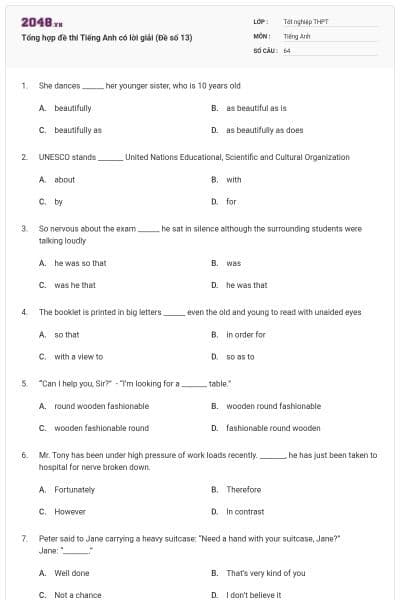
She dances ______ her younger sister, who is 10 years old
beautifully
as beautiful as is
beautifully as
as beautifully as does
Đáp án D
Ở đây sử dụng động từ thường dances nên ta cần 1 trạng từ là beautifully. Hơn nữa, ở đây sử dụng so sánh
bằng: S + be + as + adj + as + O
UNESCO stands _______ United Nations Educational, Scientific and Cultural Organization
about
with
by
for
Đáp án D
Sử dụng cấu trúc : To Stand for : viết tắt cho cái gì
So nervous about the exam ______ he sat in silence although the surrounding students were talking loudly
he was so that
was
was he that
he was that
Đáp án C
Sử dụng cấu trúc: So…that…: quá (rất) để làm gì, để chỉ nguyên nhân kết quả. Tuy nhiên, ở đây, so nervous
được đảo lên đầu câu nên ta cũng cần đảo động từ was lên. (đảo ngữ)
The booklet is printed in big letters ______ even the old and young to read with unaided eyes
so that
in order for
with a view to
so as to
Đáp án B
Sử dụng cấu trúc chỉ mục đích : in order for sb to do st (để ai làm gì)
“Can I help you, Sir?” - “I’m looking for a _______ table.”
round wooden fashionable
wooden round fashionable
wooden fashionable round
fashionable round wooden
Đáp án D
Đối với trường hợp có nhiều tính từ, ta sắp xếp theo trình tự:
OpSACOMP: Opinion (Quan điểm) – Size (Kích cỡ) – Age (độ tuổi) – Color (Màu sắc) – Origin (Nguồn
gốc, xuất sứ) – Material (Chất liệu) – Purpose (Mục đích)
Theo đó: Fashionable – Opinion; Round – Size; Wooden – Material
Mr. Tony has been under high pressure of work loads recently. _______, he has just been taken to hospital for nerve broken down.
Fortunately
Therefore
However
In contrast
Đáp án B
Dựa theo nghĩa ta chọn đáp án Therefore (Vì vậy). Dịch cả câu ta được: Gần đây Tony chịu nhiều áp lực
công việc. Vì vậy, anh ấy đã được đưa tới bệnh viện để tránh bị gục.
Fortunately: May mắn; However: Tuy nhiên; In contrast: đói lập
Peter said to Jane carrying a heavy suitcase: “Need a hand with your suitcase, Jane?”
Jane: “_______.”
Well done
That’s very kind of you
Not a chance
I don’t believe it
Đáp án B
Đây là cách đáp lại lịch sự khi người khác đề nghị giúp đỡ (Need a hand with your suitcase, Jane ?) -> ta đáp
lại : That’s very kind of you (Bạn thật tốt bụng)
You should ______ think about what technical school to apply for; or else, you will waste your time and money in a few years later
strongly
extremely
hardly
highly
Đáp án D
To think highly about st: cân nhắc kĩ lưỡng về vấn đề gì
Strongly: mạnh mẽ; extremely: cực kì; hardly: hiếm khi
You should practice your eyes by looking at other surrounding things every thirty minutes; _______, they will get strenuous
if so
if
therefore
otherwise
Đáp án D
- Dựa theo nghĩa ta chọn đáp án đúng: Otherwise (nếu không thì). Ở đây hai vế chỉ sự đối lập
- Thêm vào đó, ở đây ta thấy cần điền từ nằm giữa hai dấu “;” và “,” thì chỉ có otherwise được phù hợp trong
trường hợp này.
- If - nếu; therefore – vì vậy; if so: nếu vậy
A lot of skills and knowledge fields ________
be prepared and practiced
have to be prepared and practiced
have to prepare and practice
are had to prepare and practice
Đáp án B
- Skills and knowledge fields là hai danh từ làm chủ ngữ những được thực hiẹn bởi người khác nên ta cần
dùng thể bị động
- Đáp án A: động từ “be” chưa được chia; đáp án C dùng sai thể chủ động; đáp án D sai ngữ pháp
_______ as her handwriting was, the teacher was able to make it out and she got a full mark for it
Badly
As badly
As bad
Bad
Đáp án D
Sử dụng cấu trúc adj + as + S + be để chỉ sự nhấn mạnh
The grape is the ______, juicy fruit of a woody vine
which is smooth
skin smooth
skin
smooth-skinned
Đáp án D
Đứng sau the và đứng trước cũng như bổ nghĩa cho danh từ fruit ta cần tính từ, vì vậy cần sử dụng
“skinned”.
He really deserved the award because he performed ______ what was expected of him
much more as
the most that
much better than
much better which
Đáp án C
Sử dụng so sánh hơn với tính từ good -> better cấu trúc: be + adj (dạng so sánh hơn) + than
“Do I have to take that French course?” - “No, you _______.”
haven’t
mustn’t
needn’t
don’t have
Đáp án: C
Giải thích:
Để trả lời cho câu hỏi này, có thể dùng “needn’t” hoặc “don’t” mang nét nghĩa “không cần”.
Loại A vì câu hỏi dùng trợ động từ “do”, nên phủ định dùng “don’t”
Loại B vì câu hỏi dùng “have to”
Loại D vì thừa “have”
Chọn C.
Dịch: “Tôi có phải học khóa học tiếng Pháp đó không?” - “Không, anh không.”
Hurry up! They’ve only got _______ seats left
a lot of
a little
a few
plenty of
Đáp án C
Ở đây seats (chỗ ngồi) là danh từ đếm được số nhiều nên ta loại đáp án B (a little chỉ dùng cho danh từ
không đếm được). Hơn nữa, dựa vào nghĩa của câu mang tính thúc giục: H ur ry up! (Mau l ên) -> ta chọn C (a few -
một ít)
A lot of = plenty of: rất nhiều
Penicillin is perhaps the drug which ______ more life than any other in the history of medicine
is saving
save
has saved
have been saved
Đáp án C
Trong câu nói về Penicilin- drug (thuốc) là danh từ số ít đếm được nên ta loại B và D. Hơn nữa, ở đây sử
dụ
ng hiện tại hoàn thành nói về việc vẫn còn tiếp tục diễn ra, chưa kết thúc:
Penicilin có lẽ là loại thuốc cứu được nhiều mạng sống hơn cả trong lịch sử các loại thuốc (và việc này sẽ
còn tiếp diễn, chưa dừng lại)
A has just turned up at the meeting and said to the group-leader: “I’m sorry. I was stuck in a traffic jam.”
The group-leader: “______.”
Never mind. Thanks
Don’t apologize. It’s all my fault
My pleasure
It’s Ok. We’ve just started
Đáp án D
Dựa theo nghĩa ta chọn được lời đáp đúng và phù hợp. Ở đây cần đáp lại một lời xin lỗi: Xin lỗi. Tôi bị kẹt
xe.
A: Đừng để tâm. Cám ơn.
B: Đừng xin lỗi, đó hoàn toàn là lỗi của tôi
C: Niềm vinh hạnh cho tôi
D. Không sao. Chúng tôi ch vừa bắt đầu thôi
He agreed to accept the position _______ a share of the company’s profits
with the purpose that he would give
on the understanding that he would be given
with the aim that he would be received
in the agreement that he would be giving
Đáp án B
Sử dụng cấu trúc: On the understanding : hiểu rằng, vì biết rằng. Kèm theo thể bị động (be given - được
tặng). Dịch cả câu ta được: Anh ta chấp nhận vị trí đó bởi hiểu rằng mình sẽ được chia một phần lợi nhuận.
A,C: with the purpose/ aim: với mục đích
The teachers are, at the moment, trying their best ______ all the necessary that their students may need for their critical examination while, sadly, some do not seem to appreciate that
to prepare
prepared
preparing
prepare
Đáp án A
To try + to V: cố gắng làm gì
Try their best to prepare: cố gắng hết sức để chuẩn bị
Choose one of the given options which is incorrect
In this organization, all members are equal. No members will use force against together
In this organization
all members
will use
together
Đáp án D -> each other
Against each other: chống đối lại nhau
Choose one of the given options which is incorrect
The local people propose that national parks should be made and enlarged, hunting are strictly controlled, and fund be raised more to finance environmental activities
national parks
are
The
be raised
Đáp án B -> be
Chú ý ở đây trước dấu phẩy là Should, sau should ta dùng động từ nguyên thể, ở đây chỉ các hành động liên
tiếp nhau nên vẫn áp dụng với Should
Choose one of the given options which is incorrect
Working for this organization will give a chance to help improve international healthy care
Working
to help
healthy
will give
Đáp án C -> health
Health care: cụm từ chỉ chăm sóc sức khỏe
Choose one of the given options which is incorrect
The more regularly you practice, the best appetite you get
The more regularly
practice
the best
get
Đáp án C -> The more
Sử dụng cấu trúc so sánh hơn đặc biệt: The more…the more (càng…càng…)
Choose one of the given options which is incorrect
Mr. Thang said that students in the rest grades would sit for the end-of-second term exam in index of each class next week.
each
would sit for
said that
in index
Đáp án B
Would sit for -> were going to sit for: chỉ một hành động đã được lên kế hoạch từ trước
Mark the letter A, B, C or D on your answer sheet to indicate the word(s) that is CLOSEST in meaning to the underlined part in each of the following questions.
Who will replace you to monitor the class on the days you are on duty next week?
support
undermine
vandalize
manage
Đáp án D
To monitor = manage: điều khiển, giám sát
To support: cổ vũ; undermine: làm suy yếu; vandalize: có chủ ý làm hỏng
Mark the letter A, B, C or D on your answer sheet to indicate the word(s) that is CLOSEST in meaning to the underlined part in each of the following questions.
We, the young, should take actions to raise people’s awareness of being concerned with sewage processing measures from now on
indifferent to
carefree with
interested in
nervous about
Đáp án C
Be concerned with = be interested in: quan tâm tới vấn đề gì
Mark the letter A, B, C or D on your answer sheet to indicate the word(s) that is CLOSEST in meaning to the underlined part in each of the following questions.
You shouldn’t look down on our rivals because they have got a lot of progress this football season
opponents
aliens
goalies
allies
Đáp án A
Rivals = opponents: đối thủ
Mark the letter A, B, C or D on your answer sheet to indicate the word(s) that is OPPOSITE in meaning to the underlined part in each of the following questions
Under ideal conditions, the entire life cycle of some insects, for example fleas, living on pets, may only take 3 weeks, so in no time at all, pets and homes can be infested
very fast
immeasurably
unaccountably
very slowly
Đáp án D
In no time at all: hầu như k tốn chút thời gian nào >< very slowly: rất chậm
Mark the letter A, B, C or D on your answer sheet to indicate the word(s) that is OPPOSITE in meaning to the underlined part in each of the following questions
Most of the female football players will be jobless when the Games are over
employed
busy
unemployed
highly-paid
Đáp án A
Jobless: không có việc làm >< employed: được nhận làm việc
Choose the letter A, B, c, or D on your answer sheet to indicate the word whose underlined letter(s) is pronounced differently from the rest
processed
infested
balanced
reached
Đáp án B
Đuôi ed sau t ta phát âm là /id/, sau các từ còn lại là /t/
Choose the letter A, B, c, or D on your answer sheet to indicate the word whose underlined letter(s) is pronounced differently from the rest
advocate
manage
rival
canal
Đáp án C
A trong rival phát âm là /ə/, trong các từ còn lại phát âm là /æ/
Choose the letter A, B, c, or D on your answer sheet to indicate the word differs from the
rest in the position of the main stress in each of the following questions
occur
manage
absorb
display
Đáp án B
trọng âm ở đây rơi vào âm thứ nhất, trong các từ còn lại rơi vào âm thứ 2
Choose the letter A, B, c, or D on your answer sheet to indicate the word differs from the
rest in the position of the main stress in each of the following questions
develop
chocolate
arrangement
procession
Đáp án B
trọng âm ở đây rơi vào âm thứ nhất, trong các từ còn lại rơi vào âm thứ 2
Choose the letter A, B, c, or D on your answer sheet to indicate the word differs from the
rest in the position of the main stress in each of the following questions
atmosphere
deduction
energy
quality
Đáp án B
trọng âm ở đây rơi vào âm thứ 2, trong các từ còn lại rơi vào âm thứ nhất
Read the passage bellow and then choose a suitable word A, B, C or D to fill in each blank.
The Earth's Energy Budget
The way the Earth interacts ___ (35)___ the sun's energy can be displayed in a diagram called the Earth’s energy budget. It displays the sun's energy that reaches us and how much of that energy absorbed and reflected is by the earth and___(36)___ atmosphere. Solar energy reaches earth as electromagnetic radiation. Once the energy reaches earth, some of it is absorbed by the atmosphere, ___(37)___ clouds.
Some of it makes it to the earth's surface, and is ___(38)___ by land and oceans. The ___(39)___ of energy absorbed affects temperature. The energy ___(40)___ is not absorbed by the earth or its atmosphere is reflected. back out to space in the same wavelengths in which it came to earth. On ___(41)___, the amount of energy coming in is equal to the amount of energy going out. Therefore, we say the earth's energy budget is balanced. ___(42)___ more energy was coming in than was going out, the earth's temperature would increase. On the other hand, if too much energy is reflected, and not absorbed, we'll see a ___(43)___ in the earth's temperatures. Of all of the sun's energy that hits the Earth, about 70% is absorbed by ___(44)___ land, ocean, atmosphere and clouds and about 30% is reflected back into space.Question 35
to
with
about
for
Đáp án B
Sử dụng cấu trúc: to interact with: liện hệ với
Read the passage bellow and then choose a suitable word A, B, C or D to fill in each blank.
The Earth's Energy Budget
The way the Earth interacts ___ (35)___ the sun's energy can be displayed in a diagram called the Earth’s energy budget. It displays the sun's energy that reaches us and how much of that energy absorbed and reflected is by the earth and___(36)___ atmosphere. Solar energy reaches earth as electromagnetic radiation. Once the energy reaches earth, some of it is absorbed by the atmosphere, ___(37)___ clouds.
Some of it makes it to the earth's surface, and is ___(38)___ by land and oceans. The ___(39)___ of energy absorbed affects temperature. The energy ___(40)___ is not absorbed by the earth or its atmosphere is reflected. back out to space in the same wavelengths in which it came to earth. On ___(41)___, the amount of energy coming in is equal to the amount of energy going out. Therefore, we say the earth's energy budget is balanced. ___(42)___ more energy was coming in than was going out, the earth's temperature would increase. On the other hand, if too much energy is reflected, and not absorbed, we'll see a ___(43)___ in the earth's temperatures. Of all of the sun's energy that hits the Earth, about 70% is absorbed by ___(44)___ land, ocean, atmosphere and clouds and about 30% is reflected back into space.Question 36
them
it
its
their
Đáp án C
Its ở đây thay thế ngay cho danh từ trước nó là Earth ( trái đất)
Read the passage bellow and then choose a suitable word A, B, C or D to fill in each blank.
The Earth's Energy Budget
The way the Earth interacts ___ (35)___ the sun's energy can be displayed in a diagram called the Earth’s energy budget. It displays the sun's energy that reaches us and how much of that energy absorbed and reflected is by the earth and___(36)___ atmosphere. Solar energy reaches earth as electromagnetic radiation. Once the energy reaches earth, some of it is absorbed by the atmosphere, ___(37)___ clouds.
Some of it makes it to the earth's surface, and is ___(38)___ by land and oceans. The ___(39)___ of energy absorbed affects temperature. The energy ___(40)___ is not absorbed by the earth or its atmosphere is reflected. back out to space in the same wavelengths in which it came to earth. On ___(41)___, the amount of energy coming in is equal to the amount of energy going out. Therefore, we say the earth's energy budget is balanced. ___(42)___ more energy was coming in than was going out, the earth's temperature would increase. On the other hand, if too much energy is reflected, and not absorbed, we'll see a ___(43)___ in the earth's temperatures. Of all of the sun's energy that hits the Earth, about 70% is absorbed by ___(44)___ land, ocean, atmosphere and clouds and about 30% is reflected back into space.Question 37
include
included
to include
including
Đáp án D
Sử dụng V-ing để rút ngắn lại câu. phần đầy đủ sẽ làWhich includes
Read the passage bellow and then choose a suitable word A, B, C or D to fill in each blank.
The Earth's Energy Budget
The way the Earth interacts ___ (35)___ the sun's energy can be displayed in a diagram called the Earth’s energy budget. It displays the sun's energy that reaches us and how much of that energy absorbed and reflected is by the earth and___(36)___ atmosphere. Solar energy reaches earth as electromagnetic radiation. Once the energy reaches earth, some of it is absorbed by the atmosphere, ___(37)___ clouds.
Some of it makes it to the earth's surface, and is ___(38)___ by land and oceans. The ___(39)___ of energy absorbed affects temperature. The energy ___(40)___ is not absorbed by the earth or its atmosphere is reflected. back out to space in the same wavelengths in which it came to earth. On ___(41)___, the amount of energy coming in is equal to the amount of energy going out. Therefore, we say the earth's energy budget is balanced. ___(42)___ more energy was coming in than was going out, the earth's temperature would increase. On the other hand, if too much energy is reflected, and not absorbed, we'll see a ___(43)___ in the earth's temperatures. Of all of the sun's energy that hits the Earth, about 70% is absorbed by ___(44)___ land, ocean, atmosphere and clouds and about 30% is reflected back into space.Question 38
injected
accessed
soaked
absorbed
Đáp án D
To be absorbed: được hấp thụ
Read the passage bellow and then choose a suitable word A, B, C or D to fill in each blank.
The Earth's Energy Budget
The way the Earth interacts ___ (35)___ the sun's energy can be displayed in a diagram called the Earth’s energy budget. It displays the sun's energy that reaches us and how much of that energy absorbed and reflected is by the earth and___(36)___ atmosphere. Solar energy reaches earth as electromagnetic radiation. Once the energy reaches earth, some of it is absorbed by the atmosphere, ___(37)___ clouds.
Some of it makes it to the earth's surface, and is ___(38)___ by land and oceans. The ___(39)___ of energy absorbed affects temperature. The energy ___(40)___ is not absorbed by the earth or its atmosphere is reflected. back out to space in the same wavelengths in which it came to earth. On ___(41)___, the amount of energy coming in is equal to the amount of energy going out. Therefore, we say the earth's energy budget is balanced. ___(42)___ more energy was coming in than was going out, the earth's temperature would increase. On the other hand, if too much energy is reflected, and not absorbed, we'll see a ___(43)___ in the earth's temperatures. Of all of the sun's energy that hits the Earth, about 70% is absorbed by ___(44)___ land, ocean, atmosphere and clouds and about 30% is reflected back into space.Question 39
amount
number
plenty
quality
Đáp án A
The amount of energy: lượng năng lượng (energy không đếm được)
Read the passage bellow and then choose a suitable word A, B, C or D to fill in each blank.
The Earth's Energy Budget
The way the Earth interacts ___ (35)___ the sun's energy can be displayed in a diagram called the Earth’s energy budget. It displays the sun's energy that reaches us and how much of that energy absorbed and reflected is by the earth and___(36)___ atmosphere. Solar energy reaches earth as electromagnetic radiation. Once the energy reaches earth, some of it is absorbed by the atmosphere, ___(37)___ clouds.
Some of it makes it to the earth's surface, and is ___(38)___ by land and oceans. The ___(39)___ of energy absorbed affects temperature. The energy ___(40)___ is not absorbed by the earth or its atmosphere is reflected. back out to space in the same wavelengths in which it came to earth. On ___(41)___, the amount of energy coming in is equal to the amount of energy going out. Therefore, we say the earth's energy budget is balanced. ___(42)___ more energy was coming in than was going out, the earth's temperature would increase. On the other hand, if too much energy is reflected, and not absorbed, we'll see a ___(43)___ in the earth's temperatures. Of all of the sun's energy that hits the Earth, about 70% is absorbed by ___(44)___ land, ocean, atmosphere and clouds and about 30% is reflected back into space.Question 40
whose
that
who
where
Đáp án B
Để thay thế cho The energy ta dùng that
Whose thay thế cho danh từ, chỉ sự sở hữu; Who thay thế cho danh từ chỉ người; where thay thế cho nơi chốn
Read the passage bellow and then choose a suitable word A, B, C or D to fill in each blank.
The Earth's Energy Budget
The way the Earth interacts ___ (35)___ the sun's energy can be displayed in a diagram called the Earth’s energy budget. It displays the sun's energy that reaches us and how much of that energy absorbed and reflected is by the earth and___(36)___ atmosphere. Solar energy reaches earth as electromagnetic radiation. Once the energy reaches earth, some of it is absorbed by the atmosphere, ___(37)___ clouds.
Some of it makes it to the earth's surface, and is ___(38)___ by land and oceans. The ___(39)___ of energy absorbed affects temperature. The energy ___(40)___ is not absorbed by the earth or its atmosphere is reflected. back out to space in the same wavelengths in which it came to earth. On ___(41)___, the amount of energy coming in is equal to the amount of energy going out. Therefore, we say the earth's energy budget is balanced. ___(42)___ more energy was coming in than was going out, the earth's temperature would increase. On the other hand, if too much energy is reflected, and not absorbed, we'll see a ___(43)___ in the earth's temperatures. Of all of the sun's energy that hits the Earth, about 70% is absorbed by ___(44)___ land, ocean, atmosphere and clouds and about 30% is reflected back into space.Question 41
average
case
condition
account
Đáp án A
Sử dụng cụm: On average: trung bình
Read the passage bellow and then choose a suitable word A, B, C or D to fill in each blank.
The Earth's Energy Budget
The way the Earth interacts ___ (35)___ the sun's energy can be displayed in a diagram called the Earth’s energy budget. It displays the sun's energy that reaches us and how much of that energy absorbed and reflected is by the earth and___(36)___ atmosphere. Solar energy reaches earth as electromagnetic radiation. Once the energy reaches earth, some of it is absorbed by the atmosphere, ___(37)___ clouds.
Some of it makes it to the earth's surface, and is ___(38)___ by land and oceans. The ___(39)___ of energy absorbed affects temperature. The energy ___(40)___ is not absorbed by the earth or its atmosphere is reflected. back out to space in the same wavelengths in which it came to earth. On ___(41)___, the amount of energy coming in is equal to the amount of energy going out. Therefore, we say the earth's energy budget is balanced. ___(42)___ more energy was coming in than was going out, the earth's temperature would increase. On the other hand, if too much energy is reflected, and not absorbed, we'll see a ___(43)___ in the earth's temperatures. Of all of the sun's energy that hits the Earth, about 70% is absorbed by ___(44)___ land, ocean, atmosphere and clouds and about 30% is reflected back into space.Question 42
In case of
Although
If
Unless
Đáp án C
Ở đây sử dụng câu điều kiện loại 2: If + S + V(ed), S + would/could + V
In case of: trong trường hợp; although: mặc dù; Unless = If not
Read the passage bellow and then choose a suitable word A, B, C or D to fill in each blank.
The Earth's Energy Budget
The way the Earth interacts ___ (35)___ the sun's energy can be displayed in a diagram called the Earth’s energy budget. It displays the sun's energy that reaches us and how much of that energy absorbed and reflected is by the earth and___(36)___ atmosphere. Solar energy reaches earth as electromagnetic radiation. Once the energy reaches earth, some of it is absorbed by the atmosphere, ___(37)___ clouds.
Some of it makes it to the earth's surface, and is ___(38)___ by land and oceans. The ___(39)___ of energy absorbed affects temperature. The energy ___(40)___ is not absorbed by the earth or its atmosphere is reflected. back out to space in the same wavelengths in which it came to earth. On ___(41)___, the amount of energy coming in is equal to the amount of energy going out. Therefore, we say the earth's energy budget is balanced. ___(42)___ more energy was coming in than was going out, the earth's temperature would increase. On the other hand, if too much energy is reflected, and not absorbed, we'll see a ___(43)___ in the earth's temperatures. Of all of the sun's energy that hits the Earth, about 70% is absorbed by ___(44)___ land, ocean, atmosphere and clouds and about 30% is reflected back into space.Question 43
rise
deduction
decrease
fluctuation
Đáp án C
A decrease in: sự giảm
Dịch cả câu ta được: Mặt khác, nếu có quá nhiều năng lượng được đưa ra mà không có sự hấp thụ, nhiệt độ trái đất sẽ
giảm xuống.
Read the passage bellow and then choose a suitable word A, B, C or D to fill in each blank.
The Earth's Energy Budget
The way the Earth interacts ___ (35)___ the sun's energy can be displayed in a diagram called the Earth’s energy budget. It displays the sun's energy that reaches us and how much of that energy absorbed and reflected is by the earth and___(36)___ atmosphere. Solar energy reaches earth as electromagnetic radiation. Once the energy reaches earth, some of it is absorbed by the atmosphere, ___(37)___ clouds.
Some of it makes it to the earth's surface, and is ___(38)___ by land and oceans. The ___(39)___ of energy absorbed affects temperature. The energy ___(40)___ is not absorbed by the earth or its atmosphere is reflected. back out to space in the same wavelengths in which it came to earth. On ___(41)___, the amount of energy coming in is equal to the amount of energy going out. Therefore, we say the earth's energy budget is balanced. ___(42)___ more energy was coming in than was going out, the earth's temperature would increase. On the other hand, if too much energy is reflected, and not absorbed, we'll see a ___(43)___ in the earth's temperatures. Of all of the sun's energy that hits the Earth, about 70% is absorbed by ___(44)___ land, ocean, atmosphere and clouds and about 30% is reflected back into space.Question 44
Ø
the
a
an
Đáp án B
Land: đất đai, sử dụng mạo từ The đứng trước
Read the following passage and then choose the best answer A, B, C or D.
Glass is a remarkable substance made from simplest raw materials. It can be colored or colorless, monochrome or polychrome, transparent, translucent or opaque. It is lightweight impermeable to liquids, readily cleaned and reused, durable yet fragile, and often very beautiful. Glass can be decorated in multiple ways and its optical properties are exceptional. In all its myriad forms-as table ware, containers, in architecture and design-glass represents a major achievement in the history of technological developments.
Since the Bronze Age about 3,000 B.C, glass has been used for making various kinds of objects. It was first made from a mixture of silica, line and an alkali such as soda or potash, and these remained the basic ingredients of glass until the development of lead glass in the seventeenth century. When heated, the mixture becomes soft, and malleable and can be formed by various techniques into a vast array of shapes and sizes. The homogeneous mass is thus formed by melting then cooling to create glass, but in contrast to most materials formed in this way (metals, for instance), glass lacks the crystalline structure normally associated with solids, and instead retains the random molecular structure of a liquid. In effect, as molten glass cools, it progressively stiffens until rigid, but does so without setting up a network of interlocking crystals customarily associated with that process. This is why glass shatters so easily when dealt a blow, why glass deteriorates over time, especially when exposed to moisture, and why glassware must be slowly reheated and uniformly cooled after manufacture to release internal stresses induced by uneven cooling.
Another unusual feature of glass is the manner in which its viscosity changes as it turns from a cold substance into a hot, ductile liquid. Unlike metals that flow or “freeze” at specific temperatures, glass progressively softens as the temperature rises, going through varying stages of malleability until it flows like a thick syrup. Each stage of malleability allows the glass to be manipulated into various forms, by different techniques, and if suddenly cooled the object retains the stage achieved at that point. Glass is thus amenable to a greater number of heat-forming techniques than most other materials
Why does the author list the characteristics of glass in paragraph 1?
To show the versatility of glass
To demonstrate how glass evolved
to explain the purpose of each component of glass
To explain glassmaking
Đáp án A
Nhìn vào câu đầu tiên của bài ta thấy tác giả khẳng định rằng : “Thủy tinh là vật chất đặc biệt được làm từ
những nguyên liệu đơn giản nhất.” Vì vậy, trong các câu sau trong đoạn, tác giả đưa ra các tính chất của thủy tinh để
khẳng định và củng cố cho câu nói. -> A: Để cho thấy các tính chất, sự đa dụngcủa thủy tinh
Read the following passage and then choose the best answer A, B, C or D.
Glass is a remarkable substance made from simplest raw materials. It can be colored or colorless, monochrome or polychrome, transparent, translucent or opaque. It is lightweight impermeable to liquids, readily cleaned and reused, durable yet fragile, and often very beautiful. Glass can be decorated in multiple ways and its optical properties are exceptional. In all its myriad forms-as table ware, containers, in architecture and design-glass represents a major achievement in the history of technological developments.
Since the Bronze Age about 3,000 B.C, glass has been used for making various kinds of objects. It was first made from a mixture of silica, line and an alkali such as soda or potash, and these remained the basic ingredients of glass until the development of lead glass in the seventeenth century. When heated, the mixture becomes soft, and malleable and can be formed by various techniques into a vast array of shapes and sizes. The homogeneous mass is thus formed by melting then cooling to create glass, but in contrast to most materials formed in this way (metals, for instance), glass lacks the crystalline structure normally associated with solids, and instead retains the random molecular structure of a liquid. In effect, as molten glass cools, it progressively stiffens until rigid, but does so without setting up a network of interlocking crystals customarily associated with that process. This is why glass shatters so easily when dealt a blow, why glass deteriorates over time, especially when exposed to moisture, and why glassware must be slowly reheated and uniformly cooled after manufacture to release internal stresses induced by uneven cooling.
Another unusual feature of glass is the manner in which its viscosity changes as it turns from a cold substance into a hot, ductile liquid. Unlike metals that flow or “freeze” at specific temperatures, glass progressively softens as the temperature rises, going through varying stages of malleability until it flows like a thick syrup. Each stage of malleability allows the glass to be manipulated into various forms, by different techniques, and if suddenly cooled the object retains the stage achieved at that point. Glass is thus amenable to a greater number of heat-forming techniques than most other materials
The word “durable” in paragraph 1 is closest in meaning to
delicate
plain
lasting
heavy
Đáp án C
Durable = lasting: lâu bền
Read the following passage and then choose the best answer A, B, C or D.
Glass is a remarkable substance made from simplest raw materials. It can be colored or colorless, monochrome or polychrome, transparent, translucent or opaque. It is lightweight impermeable to liquids, readily cleaned and reused, durable yet fragile, and often very beautiful. Glass can be decorated in multiple ways and its optical properties are exceptional. In all its myriad forms-as table ware, containers, in architecture and design-glass represents a major achievement in the history of technological developments.
Since the Bronze Age about 3,000 B.C, glass has been used for making various kinds of objects. It was first made from a mixture of silica, line and an alkali such as soda or potash, and these remained the basic ingredients of glass until the development of lead glass in the seventeenth century. When heated, the mixture becomes soft, and malleable and can be formed by various techniques into a vast array of shapes and sizes. The homogeneous mass is thus formed by melting then cooling to create glass, but in contrast to most materials formed in this way (metals, for instance), glass lacks the crystalline structure normally associated with solids, and instead retains the random molecular structure of a liquid. In effect, as molten glass cools, it progressively stiffens until rigid, but does so without setting up a network of interlocking crystals customarily associated with that process. This is why glass shatters so easily when dealt a blow, why glass deteriorates over time, especially when exposed to moisture, and why glassware must be slowly reheated and uniformly cooled after manufacture to release internal stresses induced by uneven cooling.
Another unusual feature of glass is the manner in which its viscosity changes as it turns from a cold substance into a hot, ductile liquid. Unlike metals that flow or “freeze” at specific temperatures, glass progressively softens as the temperature rises, going through varying stages of malleability until it flows like a thick syrup. Each stage of malleability allows the glass to be manipulated into various forms, by different techniques, and if suddenly cooled the object retains the stage achieved at that point. Glass is thus amenable to a greater number of heat-forming techniques than most other materials
What does the author imply about the raw materials used to make glass?
They are transparent
They were the same for centuries
They are very heavy
They are liquid
Đáp án B
Nói về các nguyên liệu làm nên thủy tinh, đáp án của câu hỏi nằm ở dòng thứ 2 và 3 của đoạn số 2. Câu nói
đã nêu rõ nguồn gốc ban đầu thủy tinh được làm qua từ “made from a mixture of (được làm từ hỗn hợp)” và
“remained the basic ingredients of glass … in the seventeenth century (duy trì những nguyên liệu cơ bản của thủy
tinh..cho tới tận thế kỉ thứ 17)
Read the following passage and then choose the best answer A, B, C or D.
Glass is a remarkable substance made from simplest raw materials. It can be colored or colorless, monochrome or polychrome, transparent, translucent or opaque. It is lightweight impermeable to liquids, readily cleaned and reused, durable yet fragile, and often very beautiful. Glass can be decorated in multiple ways and its optical properties are exceptional. In all its myriad forms-as table ware, containers, in architecture and design-glass represents a major achievement in the history of technological developments.
Since the Bronze Age about 3,000 B.C, glass has been used for making various kinds of objects. It was first made from a mixture of silica, line and an alkali such as soda or potash, and these remained the basic ingredients of glass until the development of lead glass in the seventeenth century. When heated, the mixture becomes soft, and malleable and can be formed by various techniques into a vast array of shapes and sizes. The homogeneous mass is thus formed by melting then cooling to create glass, but in contrast to most materials formed in this way (metals, for instance), glass lacks the crystalline structure normally associated with solids, and instead retains the random molecular structure of a liquid. In effect, as molten glass cools, it progressively stiffens until rigid, but does so without setting up a network of interlocking crystals customarily associated with that process. This is why glass shatters so easily when dealt a blow, why glass deteriorates over time, especially when exposed to moisture, and why glassware must be slowly reheated and uniformly cooled after manufacture to release internal stresses induced by uneven cooling.
Another unusual feature of glass is the manner in which its viscosity changes as it turns from a cold substance into a hot, ductile liquid. Unlike metals that flow or “freeze” at specific temperatures, glass progressively softens as the temperature rises, going through varying stages of malleability until it flows like a thick syrup. Each stage of malleability allows the glass to be manipulated into various forms, by different techniques, and if suddenly cooled the object retains the stage achieved at that point. Glass is thus amenable to a greater number of heat-forming techniques than most other materials
According the passage, how is glass that has cooled and become rigid different from most other rigid substances?
It has varying physical properties
It has an interlocking crystal network
It has unusually low melting temperature
It has a random molecular structure
Đáp án D
Dòng thứ 6 của đoạn 2 đã chỉ ra rất rõ đáp án cho câu hỏi này: “but in contrast to most materials formed in
this way (metals, for instance), glass lacks the crystalline structure normally associated with solids, and instead
retains the random molecular structure of a liquid (còn giữ lại một kết cấu phân tử ngẫu nhiên của thể lỏng.
Read the following passage and then choose the best answer A, B, C or D.
Glass is a remarkable substance made from simplest raw materials. It can be colored or colorless, monochrome or polychrome, transparent, translucent or opaque. It is lightweight impermeable to liquids, readily cleaned and reused, durable yet fragile, and often very beautiful. Glass can be decorated in multiple ways and its optical properties are exceptional. In all its myriad forms-as table ware, containers, in architecture and design-glass represents a major achievement in the history of technological developments.
Since the Bronze Age about 3,000 B.C, glass has been used for making various kinds of objects. It was first made from a mixture of silica, line and an alkali such as soda or potash, and these remained the basic ingredients of glass until the development of lead glass in the seventeenth century. When heated, the mixture becomes soft, and malleable and can be formed by various techniques into a vast array of shapes and sizes. The homogeneous mass is thus formed by melting then cooling to create glass, but in contrast to most materials formed in this way (metals, for instance), glass lacks the crystalline structure normally associated with solids, and instead retains the random molecular structure of a liquid. In effect, as molten glass cools, it progressively stiffens until rigid, but does so without setting up a network of interlocking crystals customarily associated with that process. This is why glass shatters so easily when dealt a blow, why glass deteriorates over time, especially when exposed to moisture, and why glassware must be slowly reheated and uniformly cooled after manufacture to release internal stresses induced by uneven cooling.
Another unusual feature of glass is the manner in which its viscosity changes as it turns from a cold substance into a hot, ductile liquid. Unlike metals that flow or “freeze” at specific temperatures, glass progressively softens as the temperature rises, going through varying stages of malleability until it flows like a thick syrup. Each stage of malleability allows the glass to be manipulated into various forms, by different techniques, and if suddenly cooled the object retains the stage achieved at that point. Glass is thus amenable to a greater number of heat-forming techniques than most other materials
The word “customarily” in paragraph 2 could be best replaced by”……………”
certainly
naturally
usually
necessarily
Đáp án C
Customarily = usually: theo lẽ thường, thông thường
Read the following passage and then choose the best answer A, B, C or D.
Glass is a remarkable substance made from simplest raw materials. It can be colored or colorless, monochrome or polychrome, transparent, translucent or opaque. It is lightweight impermeable to liquids, readily cleaned and reused, durable yet fragile, and often very beautiful. Glass can be decorated in multiple ways and its optical properties are exceptional. In all its myriad forms-as table ware, containers, in architecture and design-glass represents a major achievement in the history of technological developments.
Since the Bronze Age about 3,000 B.C, glass has been used for making various kinds of objects. It was first made from a mixture of silica, line and an alkali such as soda or potash, and these remained the basic ingredients of glass until the development of lead glass in the seventeenth century. When heated, the mixture becomes soft, and malleable and can be formed by various techniques into a vast array of shapes and sizes. The homogeneous mass is thus formed by melting then cooling to create glass, but in contrast to most materials formed in this way (metals, for instance), glass lacks the crystalline structure normally associated with solids, and instead retains the random molecular structure of a liquid. In effect, as molten glass cools, it progressively stiffens until rigid, but does so without setting up a network of interlocking crystals customarily associated with that process. This is why glass shatters so easily when dealt a blow, why glass deteriorates over time, especially when exposed to moisture, and why glassware must be slowly reheated and uniformly cooled after manufacture to release internal stresses induced by uneven cooling.
Another unusual feature of glass is the manner in which its viscosity changes as it turns from a cold substance into a hot, ductile liquid. Unlike metals that flow or “freeze” at specific temperatures, glass progressively softens as the temperature rises, going through varying stages of malleability until it flows like a thick syrup. Each stage of malleability allows the glass to be manipulated into various forms, by different techniques, and if suddenly cooled the object retains the stage achieved at that point. Glass is thus amenable to a greater number of heat-forming techniques than most other materials
The words “exposed to” in paragraph 2 most likely mean………..
deprived of
hardened by
chilled with
subjected to
Đáp án D
To expose to = to subject to: tiếp xúc với
Read the following passage and then choose the best answer A, B, C or D.
Glass is a remarkable substance made from simplest raw materials. It can be colored or colorless, monochrome or polychrome, transparent, translucent or opaque. It is lightweight impermeable to liquids, readily cleaned and reused, durable yet fragile, and often very beautiful. Glass can be decorated in multiple ways and its optical properties are exceptional. In all its myriad forms-as table ware, containers, in architecture and design-glass represents a major achievement in the history of technological developments.
Since the Bronze Age about 3,000 B.C, glass has been used for making various kinds of objects. It was first made from a mixture of silica, line and an alkali such as soda or potash, and these remained the basic ingredients of glass until the development of lead glass in the seventeenth century. When heated, the mixture becomes soft, and malleable and can be formed by various techniques into a vast array of shapes and sizes. The homogeneous mass is thus formed by melting then cooling to create glass, but in contrast to most materials formed in this way (metals, for instance), glass lacks the crystalline structure normally associated with solids, and instead retains the random molecular structure of a liquid. In effect, as molten glass cools, it progressively stiffens until rigid, but does so without setting up a network of interlocking crystals customarily associated with that process. This is why glass shatters so easily when dealt a blow, why glass deteriorates over time, especially when exposed to moisture, and why glassware must be slowly reheated and uniformly cooled after manufacture to release internal stresses induced by uneven cooling.
Another unusual feature of glass is the manner in which its viscosity changes as it turns from a cold substance into a hot, ductile liquid. Unlike metals that flow or “freeze” at specific temperatures, glass progressively softens as the temperature rises, going through varying stages of malleability until it flows like a thick syrup. Each stage of malleability allows the glass to be manipulated into various forms, by different techniques, and if suddenly cooled the object retains the stage achieved at that point. Glass is thus amenable to a greater number of heat-forming techniques than most other materials.
The word “induced” in paragraph 2 is closest in meaning to…………….
missed
joined
lost
caused
Đáp án D
To induce = to cause: gây ra
Read the following passage and then choose the best answer A, B, C or D.
Glass is a remarkable substance made from simplest raw materials. It can be colored or colorless, monochrome or polychrome, transparent, translucent or opaque. It is lightweight impermeable to liquids, readily cleaned and reused, durable yet fragile, and often very beautiful. Glass can be decorated in multiple ways and its optical properties are exceptional. In all its myriad forms-as table ware, containers, in architecture and design-glass represents a major achievement in the history of technological developments.
Since the Bronze Age about 3,000 B.C, glass has been used for making various kinds of objects. It was first made from a mixture of silica, line and an alkali such as soda or potash, and these remained the basic ingredients of glass until the development of lead glass in the seventeenth century. When heated, the mixture becomes soft, and malleable and can be formed by various techniques into a vast array of shapes and sizes. The homogeneous mass is thus formed by melting then cooling to create glass, but in contrast to most materials formed in this way (metals, for instance), glass lacks the crystalline structure normally associated with solids, and instead retains the random molecular structure of a liquid. In effect, as molten glass cools, it progressively stiffens until rigid, but does so without setting up a network of interlocking crystals customarily associated with that process. This is why glass shatters so easily when dealt a blow, why glass deteriorates over time, especially when exposed to moisture, and why glassware must be slowly reheated and uniformly cooled after manufacture to release internal stresses induced by uneven cooling.
Another unusual feature of glass is the manner in which its viscosity changes as it turns from a cold substance into a hot, ductile liquid. Unlike metals that flow or “freeze” at specific temperatures, glass progressively softens as the temperature rises, going through varying stages of malleability until it flows like a thick syrup. Each stage of malleability allows the glass to be manipulated into various forms, by different techniques, and if suddenly cooled the object retains the stage achieved at that point. Glass is thus amenable to a greater number of heat-forming techniques than most other materials.
What must be done to release the internal stresses that build up in glass products during manufacture?
The glass must be cooled quickly
The glass must be reheated and evenly cooled
The glass must be kept moist until cooled
The glass must be shaped to its desired form immediately
Đáp án B
Đáp án nằm ở câu cuối cùng của đoạn số 2: “and why glassware must be slowly reheated and uniformly
cooled after manufacture to release internal stresses (để giải phóng áp lực bên trong) induced by uneven cooling.”
Read the following passage and then choose the best answer A, B, C or D.
Glass is a remarkable substance made from simplest raw materials. It can be colored or colorless, monochrome or polychrome, transparent, translucent or opaque. It is lightweight impermeable to liquids, readily cleaned and reused, durable yet fragile, and often very beautiful. Glass can be decorated in multiple ways and its optical properties are exceptional. In all its myriad forms-as table ware, containers, in architecture and design-glass represents a major achievement in the history of technological developments.
Since the Bronze Age about 3,000 B.C, glass has been used for making various kinds of objects. It was first made from a mixture of silica, line and an alkali such as soda or potash, and these remained the basic ingredients of glass until the development of lead glass in the seventeenth century. When heated, the mixture becomes soft, and malleable and can be formed by various techniques into a vast array of shapes and sizes. The homogeneous mass is thus formed by melting then cooling to create glass, but in contrast to most materials formed in this way (metals, for instance), glass lacks the crystalline structure normally associated with solids, and instead retains the random molecular structure of a liquid. In effect, as molten glass cools, it progressively stiffens until rigid, but does so without setting up a network of interlocking crystals customarily associated with that process. This is why glass shatters so easily when dealt a blow, why glass deteriorates over time, especially when exposed to moisture, and why glassware must be slowly reheated and uniformly cooled after manufacture to release internal stresses induced by uneven cooling.
Another unusual feature of glass is the manner in which its viscosity changes as it turns from a cold substance into a hot, ductile liquid. Unlike metals that flow or “freeze” at specific temperatures, glass progressively softens as the temperature rises, going through varying stages of malleability until it flows like a thick syrup. Each stage of malleability allows the glass to be manipulated into various forms, by different techniques, and if suddenly cooled the object retains the stage achieved at that point. Glass is thus amenable to a greater number of heat-forming techniques than most other materials.
The word “it” in paragraph 3 refers to…………….
feature
manner
viscosity
glass
Đáp án D
Đối với dạng bài tìm từ thay thế này, thông thường ta nhìn vào danh từ đầu câu, hoặc câu trước đó. Ở đây là
câu đầu tiên của đoạn 3, ta có thể thấy danh từ được nhắc đến ở đây là glass -> chọn được đáp án D
Read the following passage and then choose the best answer A, B, C or D.
Glass is a remarkable substance made from simplest raw materials. It can be colored or colorless, monochrome or polychrome, transparent, translucent or opaque. It is lightweight impermeable to liquids, readily cleaned and reused, durable yet fragile, and often very beautiful. Glass can be decorated in multiple ways and its optical properties are exceptional. In all its myriad forms-as table ware, containers, in architecture and design-glass represents a major achievement in the history of technological developments.
Since the Bronze Age about 3,000 B.C, glass has been used for making various kinds of objects. It was first made from a mixture of silica, line and an alkali such as soda or potash, and these remained the basic ingredients of glass until the development of lead glass in the seventeenth century. When heated, the mixture becomes soft, and malleable and can be formed by various techniques into a vast array of shapes and sizes. The homogeneous mass is thus formed by melting then cooling to create glass, but in contrast to most materials formed in this way (metals, for instance), glass lacks the crystalline structure normally associated with solids, and instead retains the random molecular structure of a liquid. In effect, as molten glass cools, it progressively stiffens until rigid, but does so without setting up a network of interlocking crystals customarily associated with that process. This is why glass shatters so easily when dealt a blow, why glass deteriorates over time, especially when exposed to moisture, and why glassware must be slowly reheated and uniformly cooled after manufacture to release internal stresses induced by uneven cooling.
Another unusual feature of glass is the manner in which its viscosity changes as it turns from a cold substance into a hot, ductile liquid. Unlike metals that flow or “freeze” at specific temperatures, glass progressively softens as the temperature rises, going through varying stages of malleability until it flows like a thick syrup. Each stage of malleability allows the glass to be manipulated into various forms, by different techniques, and if suddenly cooled the object retains the stage achieved at that point. Glass is thus amenable to a greater number of heat-forming techniques than most other materials.
According to the passage, why can glass be more easily shaped into specific forms than can metals?
It has better optical properties
It retains heat while its viscosity changesv
It gradually becomes softer as its temperature rises
It resists breaking when heated
Đáp án C
Nhìn vào dòng số 2 và 3 của đoạn cuối cùng ta có thể thấy rõ được đáp án: “Unlike metals that flow or
“freeze” at specific temperatures, glass progressively softens as the temperature rises (thủy tinh mềm dần khi
nhiệt độ tăng)”
Read the following passage and then choose the best answer A, B, C or D.
Comets are bodies that move around in space. They are something likes stars or small planets that move around the sun. Comets are surrounded by gases and the sun makes those gases look very bright. Dust can get caught in the gas around the comet and make the comet look like it has a tails.
Halley's Comet is the most famous comet, but we can't see it very often. In fact, it can only be seen from the Earth when it moves close the sun. This means that this beautiful comet only comes into our sky every 77 years or so. The last time Halley's Comet was invisible from the Earth was in 1991. Did you see it?
Halley's Comet was named after the English astronomer Edmond Halley. An astronomer studies the star and planets in the solar system. Edmond Halley was born in London, England, in 1656. He studies astronomy at Oxford University. In 1676, he left the university to study the astronomy of the Southern Hemisphere. He wrote a brook about the arrangement of the stars in the sky and the movement of the planets. He made the first accurate map of the stars we see in the sky. He also observed the moon and studied how the Moon affects the ocean tides. He helped find a way to measure distances in space. This measurement was used by other scientists to learn about the size of our solar system and the distances of many star and planets from the Earth.
Halley especially liked to study comets. He read about comets and observed them in the sky. He learned about the way they moved around the Sun — each comet follows a different path around the Sun and travels at its own speed. The path and speed of a body as it moves in space is called its orbit. Halley calculated the orbits of comets that he read about or saw himself. He found the orbits for twenty-four comets.
Halley also noticed that the paths of a comet seen in 1531 and of a comet seen in 1607 were identical to the path of a comet he had observed in 1682. He concluded that these three comets were, in fact, the same comet. Halley predicted that the comet would come again in 1758, and it did! This comet was named “Halley’s Comet” and can be seen from Earth. The first reports of this comet in history were made in 240 B.C. by Chinese astronomers, so we know that it has been orbiting the Sun to more than 2,000 years. Halley’s Comet is not the only comet in our sky, but it is the only one that appears regularly and can be predicted. It is also one of the brightest comets, and people can see it without a telescope.
Like comets, the Earth also travels around the Sun. Sometimes the orbit of t Earth passes through the path of Hailey’s Comet. Like comets, the Earth also travels around the Sun. Sometimes the orbit of the Earth passes through the path of Hailey’s Comet. When this When this happens, dust left behind from the comet falls to Earth. The dust burns and makes brilliant lights like falling stars in the sky. You can see this happen every year in May and October. Astronomers predict that Hailey’s Comet will enter our sky again in 2061. Who do you think will see it?
Comets move around ______.
every 77 years
in the Southern Hemisphere
the Sun
the Earth
Đáp án C
2 câu đầu tiên của đoạn số 1 cho ta thấy đán án: “Comets are bodies that move around in space. They are
something likes stars or small planets that move around the sun” (Sau chổi là thực thể chuyển động quanh vũ trụ.
Chúng giống như những ngôi sao hay những hành tinh nhỏ quay xung quanh mặt trời)
Read the following passage and then choose the best answer A, B, C or D.
Comets are bodies that move around in space. They are something likes stars or small planets that move around the sun. Comets are surrounded by gases and the sun makes those gases look very bright. Dust can get caught in the gas around the comet and make the comet look like it has a tails.
Halley's Comet is the most famous comet, but we can't see it very often. In fact, it can only be seen from the Earth when it moves close the sun. This means that this beautiful comet only comes into our sky every 77 years or so. The last time Halley's Comet was invisible from the Earth was in 1991. Did you see it?
Halley's Comet was named after the English astronomer Edmond Halley. An astronomer studies the star and planets in the solar system. Edmond Halley was born in London, England, in 1656. He studies astronomy at Oxford University. In 1676, he left the university to study the astronomy of the Southern Hemisphere. He wrote a brook about the arrangement of the stars in the sky and the movement of the planets. He made the first accurate map of the stars we see in the sky. He also observed the moon and studied how the Moon affects the ocean tides. He helped find a way to measure distances in space. This measurement was used by other scientists to learn about the size of our solar system and the distances of many star and planets from the Earth.
Halley especially liked to study comets. He read about comets and observed them in the sky. He learned about the way they moved around the Sun — each comet follows a different path around the Sun and travels at its own speed. The path and speed of a body as it moves in space is called its orbit. Halley calculated the orbits of comets that he read about or saw himself. He found the orbits for twenty-four comets.
Halley also noticed that the paths of a comet seen in 1531 and of a comet seen in 1607 were identical to the path of a comet he had observed in 1682. He concluded that these three comets were, in fact, the same comet. Halley predicted that the comet would come again in 1758, and it did! This comet was named “Halley’s Comet” and can be seen from Earth. The first reports of this comet in history were made in 240 B.C. by Chinese astronomers, so we know that it has been orbiting the Sun to more than 2,000 years. Halley’s Comet is not the only comet in our sky, but it is the only one that appears regularly and can be predicted. It is also one of the brightest comets, and people can see it without a telescope.
Like comets, the Earth also travels around the Sun. Sometimes the orbit of t Earth passes through the path of Hailey’s Comet. Like comets, the Earth also travels around the Sun. Sometimes the orbit of the Earth passes through the path of Hailey’s Comet. When this When this happens, dust left behind from the comet falls to Earth. The dust burns and makes brilliant lights like falling stars in the sky. You can see this happen every year in May and October. Astronomers predict that Hailey’s Comet will enter our sky again in 2061. Who do you think will see it?
Comets may look like they have a tail because ______
gases surround the comet
dust can get caught in the gas around the comet
the Sun is very bright
they appear like bright white stars in the sky
Đáp án B
Đáp án nằm ở câu cuối cùng của đoạn 1, dòng 3: Dust (Bụi) can get caught in the gas around the comet and
make the comet look like it has a tail (đuôi): Bụi có thể kẹt trong khí ga quanh sao chổi và khiến nó giống như có
một cái đuôi.
Read the following passage and then choose the best answer A, B, C or D.
Comets are bodies that move around in space. They are something likes stars or small planets that move around the sun. Comets are surrounded by gases and the sun makes those gases look very bright. Dust can get caught in the gas around the comet and make the comet look like it has a tails.
Halley's Comet is the most famous comet, but we can't see it very often. In fact, it can only be seen from the Earth when it moves close the sun. This means that this beautiful comet only comes into our sky every 77 years or so. The last time Halley's Comet was invisible from the Earth was in 1991. Did you see it?
Halley's Comet was named after the English astronomer Edmond Halley. An astronomer studies the star and planets in the solar system. Edmond Halley was born in London, England, in 1656. He studies astronomy at Oxford University. In 1676, he left the university to study the astronomy of the Southern Hemisphere. He wrote a brook about the arrangement of the stars in the sky and the movement of the planets. He made the first accurate map of the stars we see in the sky. He also observed the moon and studied how the Moon affects the ocean tides. He helped find a way to measure distances in space. This measurement was used by other scientists to learn about the size of our solar system and the distances of many star and planets from the Earth.
Halley especially liked to study comets. He read about comets and observed them in the sky. He learned about the way they moved around the Sun — each comet follows a different path around the Sun and travels at its own speed. The path and speed of a body as it moves in space is called its orbit. Halley calculated the orbits of comets that he read about or saw himself. He found the orbits for twenty-four comets.
Halley also noticed that the paths of a comet seen in 1531 and of a comet seen in 1607 were identical to the path of a comet he had observed in 1682. He concluded that these three comets were, in fact, the same comet. Halley predicted that the comet would come again in 1758, and it did! This comet was named “Halley’s Comet” and can be seen from Earth. The first reports of this comet in history were made in 240 B.C. by Chinese astronomers, so we know that it has been orbiting the Sun to more than 2,000 years. Halley’s Comet is not the only comet in our sky, but it is the only one that appears regularly and can be predicted. It is also one of the brightest comets, and people can see it without a telescope.
Like comets, the Earth also travels around the Sun. Sometimes the orbit of t Earth passes through the path of Hailey’s Comet. Like comets, the Earth also travels around the Sun. Sometimes the orbit of the Earth passes through the path of Hailey’s Comet. When this When this happens, dust left behind from the comet falls to Earth. The dust burns and makes brilliant lights like falling stars in the sky. You can see this happen every year in May and October. Astronomers predict that Hailey’s Comet will enter our sky again in 2061. Who do you think will see it?
Edmond Hailey calculated the orbits for _______
1607
1682
77 comets
24 comets
Đáp án D
Đáp án nằm ở hai câu cuối đoạn số 4: Halley calculated the orbits of comets that he read about or saw
himself. He found the orbits for twenty-four comets
Read the following passage and then choose the best answer A, B, C or D.
Comets are bodies that move around in space. They are something likes stars or small planets that move around the sun. Comets are surrounded by gases and the sun makes those gases look very bright. Dust can get caught in the gas around the comet and make the comet look like it has a tails.
Halley's Comet is the most famous comet, but we can't see it very often. In fact, it can only be seen from the Earth when it moves close the sun. This means that this beautiful comet only comes into our sky every 77 years or so. The last time Halley's Comet was invisible from the Earth was in 1991. Did you see it?
Halley's Comet was named after the English astronomer Edmond Halley. An astronomer studies the star and planets in the solar system. Edmond Halley was born in London, England, in 1656. He studies astronomy at Oxford University. In 1676, he left the university to study the astronomy of the Southern Hemisphere. He wrote a brook about the arrangement of the stars in the sky and the movement of the planets. He made the first accurate map of the stars we see in the sky. He also observed the moon and studied how the Moon affects the ocean tides. He helped find a way to measure distances in space. This measurement was used by other scientists to learn about the size of our solar system and the distances of many star and planets from the Earth.
Halley especially liked to study comets. He read about comets and observed them in the sky. He learned about the way they moved around the Sun — each comet follows a different path around the Sun and travels at its own speed. The path and speed of a body as it moves in space is called its orbit. Halley calculated the orbits of comets that he read about or saw himself. He found the orbits for twenty-four comets.
Halley also noticed that the paths of a comet seen in 1531 and of a comet seen in 1607 were identical to the path of a comet he had observed in 1682. He concluded that these three comets were, in fact, the same comet. Halley predicted that the comet would come again in 1758, and it did! This comet was named “Halley’s Comet” and can be seen from Earth. The first reports of this comet in history were made in 240 B.C. by Chinese astronomers, so we know that it has been orbiting the Sun to more than 2,000 years. Halley’s Comet is not the only comet in our sky, but it is the only one that appears regularly and can be predicted. It is also one of the brightest comets, and people can see it without a telescope.
Like comets, the Earth also travels around the Sun. Sometimes the orbit of t Earth passes through the path of Hailey’s Comet. Like comets, the Earth also travels around the Sun. Sometimes the orbit of the Earth passes through the path of Hailey’s Comet. When this When this happens, dust left behind from the comet falls to Earth. The dust burns and makes brilliant lights like falling stars in the sky. You can see this happen every year in May and October. Astronomers predict that Hailey’s Comet will enter our sky again in 2061. Who do you think will see it?
In 240 B.C._____
there were no comets in the sky
Chinese astronomers first observed Halley’s comet
Halley was born in London, England
Halley’s Comet did not appear in the sky
Đáp án B
Đáp án nằm ở dòng số 4,5 đoạn 5: . The first reports of this comet in history were made in 240 B.C. by
Chinese astronomers (Báo cáo đầu tiên trong lịch sử về sao chổi được làm vào năm 240 trước công nguyên bởi
những nhà du hành vũ trụ Trung Quốc)
Read the following passage and then choose the best answer A, B, C or D.
Comets are bodies that move around in space. They are something likes stars or small planets that move around the sun. Comets are surrounded by gases and the sun makes those gases look very bright. Dust can get caught in the gas around the comet and make the comet look like it has a tails.
Halley's Comet is the most famous comet, but we can't see it very often. In fact, it can only be seen from the Earth when it moves close the sun. This means that this beautiful comet only comes into our sky every 77 years or so. The last time Halley's Comet was invisible from the Earth was in 1991. Did you see it?
Halley's Comet was named after the English astronomer Edmond Halley. An astronomer studies the star and planets in the solar system. Edmond Halley was born in London, England, in 1656. He studies astronomy at Oxford University. In 1676, he left the university to study the astronomy of the Southern Hemisphere. He wrote a brook about the arrangement of the stars in the sky and the movement of the planets. He made the first accurate map of the stars we see in the sky. He also observed the moon and studied how the Moon affects the ocean tides. He helped find a way to measure distances in space. This measurement was used by other scientists to learn about the size of our solar system and the distances of many star and planets from the Earth.
Halley especially liked to study comets. He read about comets and observed them in the sky. He learned about the way they moved around the Sun — each comet follows a different path around the Sun and travels at its own speed. The path and speed of a body as it moves in space is called its orbit. Halley calculated the orbits of comets that he read about or saw himself. He found the orbits for twenty-four comets.
Halley also noticed that the paths of a comet seen in 1531 and of a comet seen in 1607 were identical to the path of a comet he had observed in 1682. He concluded that these three comets were, in fact, the same comet. Halley predicted that the comet would come again in 1758, and it did! This comet was named “Halley’s Comet” and can be seen from Earth. The first reports of this comet in history were made in 240 B.C. by Chinese astronomers, so we know that it has been orbiting the Sun to more than 2,000 years. Halley’s Comet is not the only comet in our sky, but it is the only one that appears regularly and can be predicted. It is also one of the brightest comets, and people can see it without a telescope.
Like comets, the Earth also travels around the Sun. Sometimes the orbit of t Earth passes through the path of Hailey’s Comet. Like comets, the Earth also travels around the Sun. Sometimes the orbit of the Earth passes through the path of Hailey’s Comet. When this When this happens, dust left behind from the comet falls to Earth. The dust burns and makes brilliant lights like falling stars in the sky. You can see this happen every year in May and October. Astronomers predict that Hailey’s Comet will enter our sky again in 2061. Who do you think will see it?
Which of the following is NOT true?
Halley’s Comet can be seen from Earth with naked eyes
Halley’s prediction of the comet’s re-appearance in 1758 was right
He observed the comet of 1682 and named it “Helley’s Comet.”
The comets of 1531, 1607 and 1682 were, in fact, the same comet
Đáp án C
Qua đoạn số 5 ta thấy năm 1682 Halley đã quan sát thấy sao chổi (a comet he had observed in 1682), tuy
nhiên ông chỉ đặt tên là “Halley’s Comet” vào năm 1758 qua câu “Halley predicted that the comet would come again
in 1758, and it did! This comet was named “Halley’s Comet” and can be seen from Earth”
Read the following passage and then choose the best answer A, B, C or D.
Comets are bodies that move around in space. They are something likes stars or small planets that move around the sun. Comets are surrounded by gases and the sun makes those gases look very bright. Dust can get caught in the gas around the comet and make the comet look like it has a tails.
Halley's Comet is the most famous comet, but we can't see it very often. In fact, it can only be seen from the Earth when it moves close the sun. This means that this beautiful comet only comes into our sky every 77 years or so. The last time Halley's Comet was invisible from the Earth was in 1991. Did you see it?
Halley's Comet was named after the English astronomer Edmond Halley. An astronomer studies the star and planets in the solar system. Edmond Halley was born in London, England, in 1656. He studies astronomy at Oxford University. In 1676, he left the university to study the astronomy of the Southern Hemisphere. He wrote a brook about the arrangement of the stars in the sky and the movement of the planets. He made the first accurate map of the stars we see in the sky. He also observed the moon and studied how the Moon affects the ocean tides. He helped find a way to measure distances in space. This measurement was used by other scientists to learn about the size of our solar system and the distances of many star and planets from the Earth.
Halley especially liked to study comets. He read about comets and observed them in the sky. He learned about the way they moved around the Sun — each comet follows a different path around the Sun and travels at its own speed. The path and speed of a body as it moves in space is called its orbit. Halley calculated the orbits of comets that he read about or saw himself. He found the orbits for twenty-four comets.
Halley also noticed that the paths of a comet seen in 1531 and of a comet seen in 1607 were identical to the path of a comet he had observed in 1682. He concluded that these three comets were, in fact, the same comet. Halley predicted that the comet would come again in 1758, and it did! This comet was named “Halley’s Comet” and can be seen from Earth. The first reports of this comet in history were made in 240 B.C. by Chinese astronomers, so we know that it has been orbiting the Sun to more than 2,000 years. Halley’s Comet is not the only comet in our sky, but it is the only one that appears regularly and can be predicted. It is also one of the brightest comets, and people can see it without a telescope.
Like comets, the Earth also travels around the Sun. Sometimes the orbit of t Earth passes through the path of Hailey’s Comet. Like comets, the Earth also travels around the Sun. Sometimes the orbit of the Earth passes through the path of Hailey’s Comet. When this When this happens, dust left behind from the comet falls to Earth. The dust burns and makes brilliant lights like falling stars in the sky. You can see this happen every year in May and October. Astronomers predict that Hailey’s Comet will enter our sky again in 2061. Who do you think will see it?
Edmond Hailey made the first accurate map of ______
the stars
England
the Earth’s orbits
the Southern Hemisphere
Đáp án A
Đáp án nằm ở dòng số 5 của đoạn số 3: He made the first accurate map of the stars we see in the sky. (Ông
làm chiếc bản đồ đầu tiên về các ngôi sao mà chúng ta thấy trên bầu trời)
Read the following passage and then choose the best answer A, B, C or D.
Comets are bodies that move around in space. They are something likes stars or small planets that move around the sun. Comets are surrounded by gases and the sun makes those gases look very bright. Dust can get caught in the gas around the comet and make the comet look like it has a tails.
Halley's Comet is the most famous comet, but we can't see it very often. In fact, it can only be seen from the Earth when it moves close the sun. This means that this beautiful comet only comes into our sky every 77 years or so. The last time Halley's Comet was invisible from the Earth was in 1991. Did you see it?
Halley's Comet was named after the English astronomer Edmond Halley. An astronomer studies the star and planets in the solar system. Edmond Halley was born in London, England, in 1656. He studies astronomy at Oxford University. In 1676, he left the university to study the astronomy of the Southern Hemisphere. He wrote a brook about the arrangement of the stars in the sky and the movement of the planets. He made the first accurate map of the stars we see in the sky. He also observed the moon and studied how the Moon affects the ocean tides. He helped find a way to measure distances in space. This measurement was used by other scientists to learn about the size of our solar system and the distances of many star and planets from the Earth.
Halley especially liked to study comets. He read about comets and observed them in the sky. He learned about the way they moved around the Sun — each comet follows a different path around the Sun and travels at its own speed. The path and speed of a body as it moves in space is called its orbit. Halley calculated the orbits of comets that he read about or saw himself. He found the orbits for twenty-four comets.
Halley also noticed that the paths of a comet seen in 1531 and of a comet seen in 1607 were identical to the path of a comet he had observed in 1682. He concluded that these three comets were, in fact, the same comet. Halley predicted that the comet would come again in 1758, and it did! This comet was named “Halley’s Comet” and can be seen from Earth. The first reports of this comet in history were made in 240 B.C. by Chinese astronomers, so we know that it has been orbiting the Sun to more than 2,000 years. Halley’s Comet is not the only comet in our sky, but it is the only one that appears regularly and can be predicted. It is also one of the brightest comets, and people can see it without a telescope.
Like comets, the Earth also travels around the Sun. Sometimes the orbit of t Earth passes through the path of Hailey’s Comet. Like comets, the Earth also travels around the Sun. Sometimes the orbit of the Earth passes through the path of Hailey’s Comet. When this When this happens, dust left behind from the comet falls to Earth. The dust burns and makes brilliant lights like falling stars in the sky. You can see this happen every year in May and October. Astronomers predict that Hailey’s Comet will enter our sky again in 2061. Who do you think will see it?
The Earth also travels _______
around Hailey’s comet
every 77 years
around the Sun
around the Moon
Đáp án C
Đáp án ở câu đầu tiên của đoạn 1: Like comets, the Earth also travels around the Sun. (giống như sao chổi,
Trái Đất cũng quay xung quanh mặt trời)
Read the following passage and then choose the best answer A, B, C or D.
Comets are bodies that move around in space. They are something likes stars or small planets that move around the sun. Comets are surrounded by gases and the sun makes those gases look very bright. Dust can get caught in the gas around the comet and make the comet look like it has a tails.
Halley's Comet is the most famous comet, but we can't see it very often. In fact, it can only be seen from the Earth when it moves close the sun. This means that this beautiful comet only comes into our sky every 77 years or so. The last time Halley's Comet was invisible from the Earth was in 1991. Did you see it?
Halley's Comet was named after the English astronomer Edmond Halley. An astronomer studies the star and planets in the solar system. Edmond Halley was born in London, England, in 1656. He studies astronomy at Oxford University. In 1676, he left the university to study the astronomy of the Southern Hemisphere. He wrote a brook about the arrangement of the stars in the sky and the movement of the planets. He made the first accurate map of the stars we see in the sky. He also observed the moon and studied how the Moon affects the ocean tides. He helped find a way to measure distances in space. This measurement was used by other scientists to learn about the size of our solar system and the distances of many star and planets from the Earth.
Halley especially liked to study comets. He read about comets and observed them in the sky. He learned about the way they moved around the Sun — each comet follows a different path around the Sun and travels at its own speed. The path and speed of a body as it moves in space is called its orbit. Halley calculated the orbits of comets that he read about or saw himself. He found the orbits for twenty-four comets.
Halley also noticed that the paths of a comet seen in 1531 and of a comet seen in 1607 were identical to the path of a comet he had observed in 1682. He concluded that these three comets were, in fact, the same comet. Halley predicted that the comet would come again in 1758, and it did! This comet was named “Halley’s Comet” and can be seen from Earth. The first reports of this comet in history were made in 240 B.C. by Chinese astronomers, so we know that it has been orbiting the Sun to more than 2,000 years. Halley’s Comet is not the only comet in our sky, but it is the only one that appears regularly and can be predicted. It is also one of the brightest comets, and people can see it without a telescope.
Like comets, the Earth also travels around the Sun. Sometimes the orbit of t Earth passes through the path of Hailey’s Comet. Like comets, the Earth also travels around the Sun. Sometimes the orbit of the Earth passes through the path of Hailey’s Comet. When this When this happens, dust left behind from the comet falls to Earth. The dust burns and makes brilliant lights like falling stars in the sky. You can see this happen every year in May and October. Astronomers predict that Hailey’s Comet will enter our sky again in 2061. Who do you think will see it?
One of Hailey’s contributions to astronomy was _____
giving a name to one of the most famous comets
drawing a map of the Southern Hemisphere
finding a way to measure distances in space
founding the astronomy department at Oxford University
Đáp án C
Đoạn 3 nói về tiểu sử và những đóng góp của Halley với ngành thiên văn học, theo đó đáp án xuất hiện ở
dòng số 6 câu “He helped find a way to measure distances in space.”(Ông đã tìm ra một cách để tính toán khoảng
cách trong vũ trụ)
Read the following passage and then choose the best answer A, B, C or D.
Comets are bodies that move around in space. They are something likes stars or small planets that move around the sun. Comets are surrounded by gases and the sun makes those gases look very bright. Dust can get caught in the gas around the comet and make the comet look like it has a tails.
Halley's Comet is the most famous comet, but we can't see it very often. In fact, it can only be seen from the Earth when it moves close the sun. This means that this beautiful comet only comes into our sky every 77 years or so. The last time Halley's Comet was invisible from the Earth was in 1991. Did you see it?
Halley's Comet was named after the English astronomer Edmond Halley. An astronomer studies the star and planets in the solar system. Edmond Halley was born in London, England, in 1656. He studies astronomy at Oxford University. In 1676, he left the university to study the astronomy of the Southern Hemisphere. He wrote a brook about the arrangement of the stars in the sky and the movement of the planets. He made the first accurate map of the stars we see in the sky. He also observed the moon and studied how the Moon affects the ocean tides. He helped find a way to measure distances in space. This measurement was used by other scientists to learn about the size of our solar system and the distances of many star and planets from the Earth.
Halley especially liked to study comets. He read about comets and observed them in the sky. He learned about the way they moved around the Sun — each comet follows a different path around the Sun and travels at its own speed. The path and speed of a body as it moves in space is called its orbit. Halley calculated the orbits of comets that he read about or saw himself. He found the orbits for twenty-four comets.
Halley also noticed that the paths of a comet seen in 1531 and of a comet seen in 1607 were identical to the path of a comet he had observed in 1682. He concluded that these three comets were, in fact, the same comet. Halley predicted that the comet would come again in 1758, and it did! This comet was named “Halley’s Comet” and can be seen from Earth. The first reports of this comet in history were made in 240 B.C. by Chinese astronomers, so we know that it has been orbiting the Sun to more than 2,000 years. Halley’s Comet is not the only comet in our sky, but it is the only one that appears regularly and can be predicted. It is also one of the brightest comets, and people can see it without a telescope.
Like comets, the Earth also travels around the Sun. Sometimes the orbit of t Earth passes through the path of Hailey’s Comet. Like comets, the Earth also travels around the Sun. Sometimes the orbit of the Earth passes through the path of Hailey’s Comet. When this When this happens, dust left behind from the comet falls to Earth. The dust burns and makes brilliant lights like falling stars in the sky. You can see this happen every year in May and October. Astronomers predict that Hailey’s Comet will enter our sky again in 2061. Who do you think will see it?
When the paths of the Earth and Hailey Comet cross each other
astronomers starts making predictions about its appearance
dust from the tail of the comet burn's brightly and looks like ling stars in the night sky
Hailey’s Comet appears in May and October
stars begins to fall from the sky
Đáp án B
Ở đây là cần tìm mối liên hệ giữa the Earth (trái đất) và the comet (sao chổi). Đáp án được tìm thấy trong
đoạn cuối cùng ở các câu: Sometimes the orbit of the Earth passes through the path of Hailey’s Comet. When this
When this happens, dust left behind from the comet falls to Earth. The dust burns and makes brilliant lights like
falling stars in the sky. (Bụi cháy và tạo nên những ánh sáng như những ngôi sao đang rơi từ trên bầu trời)
Read the following passage and then choose the best answer A, B, C or D.
Comets are bodies that move around in space. They are something likes stars or small planets that move around the sun. Comets are surrounded by gases and the sun makes those gases look very bright. Dust can get caught in the gas around the comet and make the comet look like it has a tails.
Halley's Comet is the most famous comet, but we can't see it very often. In fact, it can only be seen from the Earth when it moves close the sun. This means that this beautiful comet only comes into our sky every 77 years or so. The last time Halley's Comet was invisible from the Earth was in 1991. Did you see it?
Halley's Comet was named after the English astronomer Edmond Halley. An astronomer studies the star and planets in the solar system. Edmond Halley was born in London, England, in 1656. He studies astronomy at Oxford University. In 1676, he left the university to study the astronomy of the Southern Hemisphere. He wrote a brook about the arrangement of the stars in the sky and the movement of the planets. He made the first accurate map of the stars we see in the sky. He also observed the moon and studied how the Moon affects the ocean tides. He helped find a way to measure distances in space. This measurement was used by other scientists to learn about the size of our solar system and the distances of many star and planets from the Earth.
Halley especially liked to study comets. He read about comets and observed them in the sky. He learned about the way they moved around the Sun — each comet follows a different path around the Sun and travels at its own speed. The path and speed of a body as it moves in space is called its orbit. Halley calculated the orbits of comets that he read about or saw himself. He found the orbits for twenty-four comets.
Halley also noticed that the paths of a comet seen in 1531 and of a comet seen in 1607 were identical to the path of a comet he had observed in 1682. He concluded that these three comets were, in fact, the same comet. Halley predicted that the comet would come again in 1758, and it did! This comet was named “Halley’s Comet” and can be seen from Earth. The first reports of this comet in history were made in 240 B.C. by Chinese astronomers, so we know that it has been orbiting the Sun to more than 2,000 years. Halley’s Comet is not the only comet in our sky, but it is the only one that appears regularly and can be predicted. It is also one of the brightest comets, and people can see it without a telescope.
Like comets, the Earth also travels around the Sun. Sometimes the orbit of t Earth passes through the path of Hailey’s Comet. Like comets, the Earth also travels around the Sun. Sometimes the orbit of the Earth passes through the path of Hailey’s Comet. When this When this happens, dust left behind from the comet falls to Earth. The dust burns and makes brilliant lights like falling stars in the sky. You can see this happen every year in May and October. Astronomers predict that Hailey’s Comet will enter our sky again in 2061. Who do you think will see it?
Which of the following is NOT TRUE of Hailey’s Comet?
It won’t appear again until 2061
Chinese astronomers named it “Hailey’s Comet.”
It is predictable
It is bright
Đáp án B
Đoạn số 5 có nhắc đến việc sao chổi được đặt tên là “Halley’s Comet” vào năm 1758 (Halley predicted that
the comet would come again in 1758, and it did! This comet was named “Halley’s Comet”“, tuy nhiên không phải do
các nhà du hành vũ trụ Trung Quốc đặt tên