Tổng hợp đề thi Tiếng Anh có lời giải (Đề số 12)
64 câu hỏi
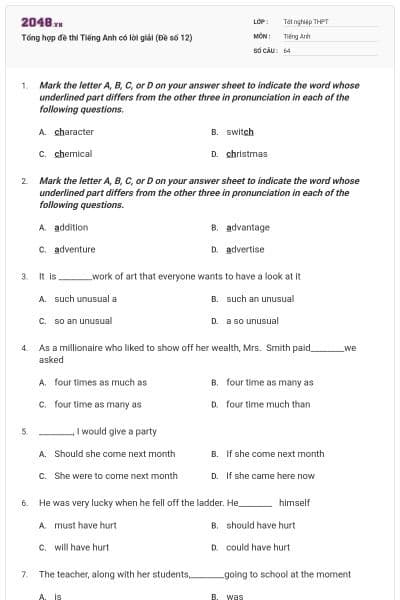
Mark the letter A, B, C, or D on your answer sheet to indicate the word whose underlined part differs from the other three in pronunciation in each of the following questions.
character
switch
chemical
christmas
Đáp án : B
“ch” trong “switch” phát âm là /t∫ /, trong các từ còn lại phát âm là /k/
Mark the letter A, B, C, or D on your answer sheet to indicate the word whose underlined part differs from the other three in pronunciation in each of the following questions.
addition
advantage
adventure
advertise
Đáp án : D
“a” trong “advertise” phát âm là /ӕ/, trong các từ còn lại phát âm là /ə/
It is ________work of art that everyone wants to have a look at it
such unusual a
such an unusual
so an unusual
a so unusual
Đáp án : B
So + adj + (a/an) + N (s) + that … = Such + (a/an) + adj + N + that …= thật là một… đến mức…
As a millionaire who liked to show off her wealth, Mrs. Smith paid________we asked
four times as much as
four time as many as
four time as many as
four time much than
Đáp án : A
So sánh gấp bao nhiêu lần: (với 3 lần trở lên) số lần + times + as + adj + as. Đồng thời “money” là danh từ không đếm được, nên ta dùng “much” để chỉ “nhiều”
________, I would give a party
Should she come next month
If she come next month
She were to come next month
If she came here now
Đáp án : D
Câu điều kiện loại 2, giả định điều không có thật trong hiện tại: If + S + past verb, S + would + V
He was very lucky when he fell off the ladder. He________ himself
must have hurt
should have hurt
will have hurt
could have hurt
Đáp án : D
Việc ngã khỏi thang đã xảy ra trong quá khứ. Could have + past participle là để chỉ việc đã có thể xảy ra trong quá khứ, nhưng đã không xảy ra
The teacher, along with her students,________going to school at the moment
is
was
were
are
Đáp án : A
Khi chủ ngữ có dạng: N1, along with N2 thì động từ chia theo N1 (the teacher) -> động từ số ít. Đồng thời , at the moment = now = bây giờ -> chia động từ ở hiện tại
Her mother,________has been working for thirty years, is retiring next month.
whose
whom
that
who
Đáp án : D
Đại từ quan hệ “who” bổ nghĩa cho danh từ chỉ người xác định “the teacher”, đứng sau dấu phẩy
The man________at the blackboard is our teacher
standing
to stand
stood
stands
Đáp án : A
Ving đứng sau danh từ là hình thức rút gọn mệnh đề quan hệ nghĩa chủ động. Không thể dùng động từ có chia thì (stands, stood) nó không phải động từ chính của câu, động từ chính của câu là “is”
In a formal interview, it is essential to maintain good eye________with the interviewers
contact
touch
link
connection
Đáp án : A
Eye contact = giao tiếp bằng mắt
We are going to________
have our house be redecorated
have our house redecorated
have our house to be redecorated
get our house being redecorated
Đáp án : B
Have/get + something + past participle = thu xếp cho đồ của mình được ai đó làm gì giúp
I suggest the room________before Christmas
be decorated
were decorated
should decorate
is decorated
Đáp án : A
Suggest + (that) + S + (should) + V (nguyên thể bỏ “to”) = gợi ý ai làm gì. Be decorated = được trang trí
Your parents must be proud of your result at school________
I am glad you like it
Sorry to hear that
Thanks. It's certainly encouraging
Of course
Đáp án : C
Người nói: bố mẹ cậu hẳn rất tự hào về kết quả học của cậu -> hàm ý khen ->Người đáp cám ơn và cho rằng lời nói đó rất có tính khích lệ
The theory of relativity________by Einstein, who was a famous physicist
is developed
developed
develops
was developed
Đáp án : D
Thuyết tương đối đã được phát triển bởi Anhxtanh -> câu bị động chỉ việc đã xảy ra trong quá khứ -> D
Without my parents' support, ________my overseas study
had not completed
would not have completed
will not complete
did not complete
Đáp án : B
Without trong câu điều kiện loại 3, giả định điều không có thật trong quá khứ: Without + N/Ving, S + would have + past participle = nếu không có … thì đã…
She isn’t________well with the new manager
going on
keeping on
taking on
getting on
Đáp án : D
Get on well with somebody = hòa hợp với ai
The last student________was John
to be interviewed
who is interviewed
whom was interviewed
for interviewed
Đáp án : A
The first/last + (N) + to V = đối tượng đầu tiên/cuối cùng làm điều gì
You should look up the meaning of the new in the dictionary________misuse it
so as to
to
so as not to
so that
Đáp án : C
Look up something = tra từ. misuse = dùng nhầm. So as to V = để làm gì. So as not to V = để không làm gì
________is to give strangers your address
What must never you do
That must never you do
That you must never do
What you must never do
Đáp án : D
What you must never do = điều mà bạn không bao giờ được phép làm; sau what có thể là một mệnh đề quan hệ
Maria: “I’m taking my end-of-term examination tomorrow.” Sarah: “________.”
Good day
Good luck
Good time
Good chance
Đáp án : B
Maria nói cô ấy sắp thi cuối kì; Sarah chúc may mắn
They asked me a lot of questions,________I couldn’t answer
most of which
of which most
most of that
of that most
Đáp án : A
Đại từ quan hệ có thể đứng sau dấu phẩy; và có thể gắn với most of là which
Mark the letter A, B, C, or D on your answer sheet to indicate the word whose stress differs from the other three in pronunciation in each of the following questions
kindergarten
Contaminate
curriculum
conventional
Đáp án : A
Trọng âm của từ này rơi vào âm tiết thứ nhất; các từ còn lại rơi vào âm tiết thứ hai
Mark the letter A, B, C, or D on your answer sheet to indicate the word whose stress differs from the other three in pronunciation in each of the following questions
attend
visit
apply
appear
Đáp án : B
Trọng âm của từ này rơi vào âm tiết thứ nhất; các từ còn lại rơi vào âm tiết thứ hai
Mark the letter A, B, C, or D on your answer sheet to indicate the word whose stress differs from the other three in pronunciation in each of the following questions
attendance
security
obedient
candidate
Đáp án : D
Trọng âm của từ này rơi vào âm tiết thứ nhất; các từ còn lại rơi vào âm tiết thứ hai
Mark the letter A, B, C, or D on your answer sheet to indicate the word(s) CLOSEST in meaning to the underlined word(s) in each of the following questions
I received housing benefit when I was unemployed
out of work
out of practice
out of fashion
out of order
Đáp án : A
Unemployed = thất nghiệp = out of work; out of fashion = lỗi thời; out of order = hỏng hóc
Mark the letter A, B, C, or D on your answer sheet to indicate the word(s) CLOSEST in meaning to the underlined word(s) in each of the following questions
Before the interview, you have to send a letter of application and your résumé to the company
recommendation
photograph
reference
curriculum
Đáp án : D
Résumé = curriculum vitae = bản sơ yếu lí lịch
Mark the letter A, B, C, or D on your answer sheet to indicate the word(s) CLOSEST in meaning to the underlined word(s) in each of the following questions
GCSEs are not compulsory, but they are the most common qualifications taken by 14-16- year-old students
fulfilled
required
specialized
applied
Đáp án : B
Compulsory = bắt buộc = required
Mark the letter A, B, C, or D on your answer sheet to indicate the word(s) OPPOSITE in meaning to the underlined word(s) in each of the following questions
That is a well-behaved boy whose behavior has nothing to complain about
behaving nice
behaving cleverly
good behavior
behaving improperly
Đáp án : D
Well- behaved = ngoan ngoãn; ứng xử tốt
Mark the letter A, B, C, or D on your answer sheet to indicate the word(s) OPPOSITE in meaning to the underlined word(s) in each of the following questions
Punctuality is imperative in your new job
Being late
Being cheerful
Being courteous
Being efficient
Đáp án : A
Punctuality = tính đúng giờ
Mark the letter A, B, C, or D on your answer sheet to indicate the underlined part that needs correction in each of the following questions
The assumption that smoking has bad effects on our health have been proved
that
effects on
have been
proved
Đáp án : D
Chủ ngữ cho mệnh đề này là smoking = việc hút thuốc ~ chủ ngữ số ít; động từ phải chia ở số ít; Sửa D thành has been proved
Mark the letter A, B, C, or D on your answer sheet to indicate the underlined part that needs correction in each of the following questions
I like the fresh air and green trees of the village which I spent my vacation last year
the fresh air
green trees
which
my vacation
Đáp án : C
Đại từ quan hê bổ nghĩa cho danh từ chỉ địa điểm village là where
Mark the letter A, B, C, or D on your answer sheet to indicate the underlined part that needs correction in each of the following questions
The General Certificate of Secondary Education (GCSE) is the name of a set of English qualifications, generally taking by secondary school students at the age of 15-16 in England
the name
a set of
taking
at the age
Đáp án : C
Đằng sau C là giới từ by ~ dấu hiệu của bị động ; những bằng cấp này được thi lấy bởi các học sinh trung học; sửa C thành taken
Mark the letter A, B, C, or D on your answer sheet to indicate the underlined part that needs correction in each of the following questions
Full-time jobs for men are declining, while more women are finding part- and full-time work. The result is declining social status for men so they lose their role as the sole financial provider
while
is
so
as
Đáp án : C
Sửa so thành because; kết quả là sự suy giảm địa vị xã hội ở nam giới … họ đã mất đi vai trò là nguồn kinh tế chủ đạo; hai mệnh đề mang ý kết quả - nguyên nhân; nên dùng because mới phù hợp
Mark the letter A, B, C, or D on your answer sheet to indicate the underlined part that needs correction in each of the following questions
I told him I'd prefer to walk , but he insisted to give me a lift
prefer
to walk
to give
a lift
Đáp án : C
Insist on Ving = nài nỉ; khăng khăng làm gì
Read the following passage and mark the letter A, B, C, or D on your answer sheet to indicate the correct word or phrase that best fits each of the numbered blanks from 35 to 44
You will make the interview process easier for the employer if you prepare relevant information about yourself. Think about how you want to present your (35)______, experiences, education, work style, skills, and goals. Be prepared to supplement all your answers with examples that support the statements you make. It is also a good idea to review your resume with a critical eye and (36)______areas that an employer might see as limitations or want further information. Think about how you can answer difficult' questions (37)______and positively, while keeping each answer brief.
An interview gives the employer a (38)______to get to know you. While you do want to market yourself to the employer, answer each question with an honest (39)______.
Never say anything negative about past experiences, employers, or courses and professors. Always think of something positive about an experience and talk about that. You should also be (40)______. If you are genuinely interested (41) the job, let the interviewer know that.
One of the best ways to show you are keen on a job is to demonstrate that you have researched the organization prior to the interview. You can also (42)______interest by asking questions about the job, the organization, and its services and products. The best way to impress an employer is to ask questions that build upon your interview discussion. This shows you are interested and (43)______close attention to the interviewer. It is a good idea to prepare a few questions in advance, but an insightful comment based on your conversation can make an even stronger statement. At the (44)______of an interview, it is appropriate for you to ask when you may expect to hear; from the employer.Question 35
pressures
strengths
practices
promotions
Đáp án : B
Present = thể hiện; trình bày; strength = điểm mạnh; pressure = áp lực
Read the following passage and mark the letter A, B, C, or D on your answer sheet to indicate the correct word or phrase that best fits each of the numbered blanks from 35 to 44
You will make the interview process easier for the employer if you prepare relevant information about yourself. Think about how you want to present your (35)______, experiences, education, work style, skills, and goals. Be prepared to supplement all your answers with examples that support the statements you make. It is also a good idea to review your resume with a critical eye and (36)______areas that an employer might see as limitations or want further information. Think about how you can answer difficult' questions (37)______and positively, while keeping each answer brief.
An interview gives the employer a (38)______to get to know you. While you do want to market yourself to the employer, answer each question with an honest (39)______.
Never say anything negative about past experiences, employers, or courses and professors. Always think of something positive about an experience and talk about that. You should also be (40)______. If you are genuinely interested (41) the job, let the interviewer know that.
One of the best ways to show you are keen on a job is to demonstrate that you have researched the organization prior to the interview. You can also (42)______interest by asking questions about the job, the organization, and its services and products. The best way to impress an employer is to ask questions that build upon your interview discussion. This shows you are interested and (43)______close attention to the interviewer. It is a good idea to prepare a few questions in advance, but an insightful comment based on your conversation can make an even stronger statement. At the (44)______of an interview, it is appropriate for you to ask when you may expect to hear; from the employer.Question 36
hide
limit
express
identify
Đáp án : D
Identify = phát hiện ra; nhận ra . Hide = ẩn giấu; trốn . Limit = giới hạn . Express = thể hiện
Read the following passage and mark the letter A, B, C, or D on your answer sheet to indicate the correct word or phrase that best fits each of the numbered blanks from 35 to 44
You will make the interview process easier for the employer if you prepare relevant information about yourself. Think about how you want to present your (35)______, experiences, education, work style, skills, and goals. Be prepared to supplement all your answers with examples that support the statements you make. It is also a good idea to review your resume with a critical eye and (36)______areas that an employer might see as limitations or want further information. Think about how you can answer difficult' questions (37)______and positively, while keeping each answer brief.
An interview gives the employer a (38)______to get to know you. While you do want to market yourself to the employer, answer each question with an honest (39)______.
Never say anything negative about past experiences, employers, or courses and professors. Always think of something positive about an experience and talk about that. You should also be (40)______. If you are genuinely interested (41) the job, let the interviewer know that.
One of the best ways to show you are keen on a job is to demonstrate that you have researched the organization prior to the interview. You can also (42)______interest by asking questions about the job, the organization, and its services and products. The best way to impress an employer is to ask questions that build upon your interview discussion. This shows you are interested and (43)______close attention to the interviewer. It is a good idea to prepare a few questions in advance, but an insightful comment based on your conversation can make an even stronger statement. At the (44)______of an interview, it is appropriate for you to ask when you may expect to hear; from the employer.Question 37
accurately
rightly
hardly
sharply
Đáp án : A
Accurately = một cách chính xác
Read the following passage and mark the letter A, B, C, or D on your answer sheet to indicate the correct word or phrase that best fits each of the numbered blanks from 35 to 44
You will make the interview process easier for the employer if you prepare relevant information about yourself. Think about how you want to present your (35)______, experiences, education, work style, skills, and goals. Be prepared to supplement all your answers with examples that support the statements you make. It is also a good idea to review your resume with a critical eye and (36)______areas that an employer might see as limitations or want further information. Think about how you can answer difficult' questions (37)______and positively, while keeping each answer brief.
An interview gives the employer a (38)______to get to know you. While you do want to market yourself to the employer, answer each question with an honest (39)______.
Never say anything negative about past experiences, employers, or courses and professors. Always think of something positive about an experience and talk about that. You should also be (40)______. If you are genuinely interested (41) the job, let the interviewer know that.
One of the best ways to show you are keen on a job is to demonstrate that you have researched the organization prior to the interview. You can also (42)______interest by asking questions about the job, the organization, and its services and products. The best way to impress an employer is to ask questions that build upon your interview discussion. This shows you are interested and (43)______close attention to the interviewer. It is a good idea to prepare a few questions in advance, but an insightful comment based on your conversation can make an even stronger statement. At the (44)______of an interview, it is appropriate for you to ask when you may expect to hear; from the employer.Question 38
change
practice
way
chance
Đáp án : A
A chance to V = cơ hội để làm gì. Change = sự thay đổi. practice = sự thực hành. Way = cách thức; phương pháp
Read the following passage and mark the letter A, B, C, or D on your answer sheet to indicate the correct word or phrase that best fits each of the numbered blanks from 35 to 44
You will make the interview process easier for the employer if you prepare relevant information about yourself. Think about how you want to present your (35)______, experiences, education, work style, skills, and goals. Be prepared to supplement all your answers with examples that support the statements you make. It is also a good idea to review your resume with a critical eye and (36)______areas that an employer might see as limitations or want further information. Think about how you can answer difficult' questions (37)______and positively, while keeping each answer brief.
An interview gives the employer a (38)______to get to know you. While you do want to market yourself to the employer, answer each question with an honest (39)______.
Never say anything negative about past experiences, employers, or courses and professors. Always think of something positive about an experience and talk about that. You should also be (40)______. If you are genuinely interested (41) the job, let the interviewer know that.
One of the best ways to show you are keen on a job is to demonstrate that you have researched the organization prior to the interview. You can also (42)______interest by asking questions about the job, the organization, and its services and products. The best way to impress an employer is to ask questions that build upon your interview discussion. This shows you are interested and (43)______close attention to the interviewer. It is a good idea to prepare a few questions in advance, but an insightful comment based on your conversation can make an even stronger statement. At the (44)______of an interview, it is appropriate for you to ask when you may expect to hear; from the employer.Question 39
ability
response
expression
respect
Đáp án : B
Response = câu trả lời. ability = khả năng làm gì. Expression = sự thể hiện; biểu lộ. respect = sự tôn trọng
Read the following passage and mark the letter A, B, C, or D on your answer sheet to indicate the correct word or phrase that best fits each of the numbered blanks from 35 to 44
You will make the interview process easier for the employer if you prepare relevant information about yourself. Think about how you want to present your (35)______, experiences, education, work style, skills, and goals. Be prepared to supplement all your answers with examples that support the statements you make. It is also a good idea to review your resume with a critical eye and (36)______areas that an employer might see as limitations or want further information. Think about how you can answer difficult' questions (37)______and positively, while keeping each answer brief.
An interview gives the employer a (38)______to get to know you. While you do want to market yourself to the employer, answer each question with an honest (39)______.
Never say anything negative about past experiences, employers, or courses and professors. Always think of something positive about an experience and talk about that. You should also be (40)______. If you are genuinely interested (41) the job, let the interviewer know that.
One of the best ways to show you are keen on a job is to demonstrate that you have researched the organization prior to the interview. You can also (42)______interest by asking questions about the job, the organization, and its services and products. The best way to impress an employer is to ask questions that build upon your interview discussion. This shows you are interested and (43)______close attention to the interviewer. It is a good idea to prepare a few questions in advance, but an insightful comment based on your conversation can make an even stronger statement. At the (44)______of an interview, it is appropriate for you to ask when you may expect to hear; from the employer.Question 40
enthusiast
enthusiasm
enthusiastic
enthusiastically
Đáp án : C
Enthusiastic (adj) = nhiệt tình. Be + adj
Read the following passage and mark the letter A, B, C, or D on your answer sheet to indicate the correct word or phrase that best fits each of the numbered blanks from 35 to 44
You will make the interview process easier for the employer if you prepare relevant information about yourself. Think about how you want to present your (35)______, experiences, education, work style, skills, and goals. Be prepared to supplement all your answers with examples that support the statements you make. It is also a good idea to review your resume with a critical eye and (36)______areas that an employer might see as limitations or want further information. Think about how you can answer difficult' questions (37)______and positively, while keeping each answer brief.
An interview gives the employer a (38)______to get to know you. While you do want to market yourself to the employer, answer each question with an honest (39)______.
Never say anything negative about past experiences, employers, or courses and professors. Always think of something positive about an experience and talk about that. You should also be (40)______. If you are genuinely interested (41) the job, let the interviewer know that.
One of the best ways to show you are keen on a job is to demonstrate that you have researched the organization prior to the interview. You can also (42)______interest by asking questions about the job, the organization, and its services and products. The best way to impress an employer is to ask questions that build upon your interview discussion. This shows you are interested and (43)______close attention to the interviewer. It is a good idea to prepare a few questions in advance, but an insightful comment based on your conversation can make an even stronger statement. At the (44)______of an interview, it is appropriate for you to ask when you may expect to hear; from the employer.Question 41
for
on
with
in
Đáp án : D
Be interested in = quan tâm; hứng thú vói cái gì
Read the following passage and mark the letter A, B, C, or D on your answer sheet to indicate the correct word or phrase that best fits each of the numbered blanks from 35 to 44
You will make the interview process easier for the employer if you prepare relevant information about yourself. Think about how you want to present your (35)______, experiences, education, work style, skills, and goals. Be prepared to supplement all your answers with examples that support the statements you make. It is also a good idea to review your resume with a critical eye and (36)______areas that an employer might see as limitations or want further information. Think about how you can answer difficult' questions (37)______and positively, while keeping each answer brief.
An interview gives the employer a (38)______to get to know you. While you do want to market yourself to the employer, answer each question with an honest (39)______.
Never say anything negative about past experiences, employers, or courses and professors. Always think of something positive about an experience and talk about that. You should also be (40)______. If you are genuinely interested (41) the job, let the interviewer know that.
One of the best ways to show you are keen on a job is to demonstrate that you have researched the organization prior to the interview. You can also (42)______interest by asking questions about the job, the organization, and its services and products. The best way to impress an employer is to ask questions that build upon your interview discussion. This shows you are interested and (43)______close attention to the interviewer. It is a good idea to prepare a few questions in advance, but an insightful comment based on your conversation can make an even stronger statement. At the (44)______of an interview, it is appropriate for you to ask when you may expect to hear; from the employer.Question 42
appear
show
conceal
cover
Đáp án : B
Show = thể hiện cái gì. Appear = xuất hiện, có vẻ. conceal = giấu kín. Cover = bao phủ
Read the following passage and mark the letter A, B, C, or D on your answer sheet to indicate the correct word or phrase that best fits each of the numbered blanks from 35 to 44
You will make the interview process easier for the employer if you prepare relevant information about yourself. Think about how you want to present your (35)______, experiences, education, work style, skills, and goals. Be prepared to supplement all your answers with examples that support the statements you make. It is also a good idea to review your resume with a critical eye and (36)______areas that an employer might see as limitations or want further information. Think about how you can answer difficult' questions (37)______and positively, while keeping each answer brief.
An interview gives the employer a (38)______to get to know you. While you do want to market yourself to the employer, answer each question with an honest (39)______.
Never say anything negative about past experiences, employers, or courses and professors. Always think of something positive about an experience and talk about that. You should also be (40)______. If you are genuinely interested (41) the job, let the interviewer know that.
One of the best ways to show you are keen on a job is to demonstrate that you have researched the organization prior to the interview. You can also (42)______interest by asking questions about the job, the organization, and its services and products. The best way to impress an employer is to ask questions that build upon your interview discussion. This shows you are interested and (43)______close attention to the interviewer. It is a good idea to prepare a few questions in advance, but an insightful comment based on your conversation can make an even stronger statement. At the (44)______of an interview, it is appropriate for you to ask when you may expect to hear; from the employer.Question 43
spend
pay
choose
make
Đáp án : B
Pay attention to something = chú ý tới cái gì
Read the following passage and mark the letter A, B, C, or D on your answer sheet to indicate the correct word or phrase that best fits each of the numbered blanks from 35 to 44
You will make the interview process easier for the employer if you prepare relevant information about yourself. Think about how you want to present your (35)______, experiences, education, work style, skills, and goals. Be prepared to supplement all your answers with examples that support the statements you make. It is also a good idea to review your resume with a critical eye and (36)______areas that an employer might see as limitations or want further information. Think about how you can answer difficult' questions (37)______and positively, while keeping each answer brief.
An interview gives the employer a (38)______to get to know you. While you do want to market yourself to the employer, answer each question with an honest (39)______.
Never say anything negative about past experiences, employers, or courses and professors. Always think of something positive about an experience and talk about that. You should also be (40)______. If you are genuinely interested (41) the job, let the interviewer know that.
One of the best ways to show you are keen on a job is to demonstrate that you have researched the organization prior to the interview. You can also (42)______interest by asking questions about the job, the organization, and its services and products. The best way to impress an employer is to ask questions that build upon your interview discussion. This shows you are interested and (43)______close attention to the interviewer. It is a good idea to prepare a few questions in advance, but an insightful comment based on your conversation can make an even stronger statement. At the (44)______of an interview, it is appropriate for you to ask when you may expect to hear; from the employer.Question 44
end
close
finish
final
Đáp án : A
At the end of N = vào lúc cuối của cái gì. Close (v) = đóng, khép. Finish = hoàn thành. Final (Adj) = cuối cùng
Read the following passage and mark the letter A, B, C, or D on your answer sheet to indicate the correct answer to each of the questions from 45 to 54.
A survey is a study, generally in the form of an interview or a questionnaire, which provides information concerning how people think and act. In the United States, the best-known surveys are the Gallup poll and the Harris poll. As anyone who watches the news during campaigns presidential knows, these polls have become an important part of political life in the United States.
North Americans are familiar with the many “person on the street” interviews on local television news shows. While such interviews can be highly entertaining, they are not necessarily an accurate indication of public opinion. First, they reflect the opinions of only those people who appear at a certain location. Thus, such samples can be biased in favor of commuters, middle-class shoppers, or factory workers, depending on which area the news people select. Second, television interviews tend to attract outgoing people who are willing to appear on the air, while they frighten away others who may feel intimidated by a camera. A survey must be based on a precise, representative sampling if it is to genuinely reflect a broad range of the population.
In preparing to conduct a survey, sociologists must exercise great care in the wording of questions. An effective survey question must be simple and clear enough for people to understand it. It must also be specific enough so that there are no problems in interpreting the results. Even questions that are less structured must be carefully phrased in order to elicit the type of information desired. Surveys can be indispensable sources of information, but only if the sampling is done properly and the questions are worded accurately.
There are two main forms of surveys: the interview and the questionnaire. Each of these forms of survey research has its advantages. An interviewer can obtain a high response rate because people find it more difficult to turn down a personal request for an interview than to throw away a written questionnaire. In addition, an interviewer can go beyond written questions and probe for a subject’s underlying feelings and reasons. However, questionnaires have the advantage of being cheaper and more consistent
What does the passage mainly discuss?
The principles of conducting surveys
The importance of polls in American political life
The history of surveys in North America
Problems associated with interpreting surveys
Đáp án : A
Đoạn văn nói về việc tiến hành điều tra theo cách phỏng vấn, hoặc bảng hỏi, với những thuận lợi, khó khăn, và yêu cầu của từng loại -> nguyên tắc tiến hành khảo sát
Read the following passage and mark the letter A, B, C, or D on your answer sheet to indicate the correct answer to each of the questions from 45 to 54.
A survey is a study, generally in the form of an interview or a questionnaire, which provides information concerning how people think and act. In the United States, the best-known surveys are the Gallup poll and the Harris poll. As anyone who watches the news during campaigns presidential knows, these polls have become an important part of political life in the United States.
North Americans are familiar with the many “person on the street” interviews on local television news shows. While such interviews can be highly entertaining, they are not necessarily an accurate indication of public opinion. First, they reflect the opinions of only those people who appear at a certain location. Thus, such samples can be biased in favor of commuters, middle-class shoppers, or factory workers, depending on which area the news people select. Second, television interviews tend to attract outgoing people who are willing to appear on the air, while they frighten away others who may feel intimidated by a camera. A survey must be based on a precise, representative sampling if it is to genuinely reflect a broad range of the population.
In preparing to conduct a survey, sociologists must exercise great care in the wording of questions. An effective survey question must be simple and clear enough for people to understand it. It must also be specific enough so that there are no problems in interpreting the results. Even questions that are less structured must be carefully phrased in order to elicit the type of information desired. Surveys can be indispensable sources of information, but only if the sampling is done properly and the questions are worded accurately.
There are two main forms of surveys: the interview and the questionnaire. Each of these forms of survey research has its advantages. An interviewer can obtain a high response rate because people find it more difficult to turn down a personal request for an interview than to throw away a written questionnaire. In addition, an interviewer can go beyond written questions and probe for a subject’s underlying feelings and reasons. However, questionnaires have the advantage of being cheaper and more consistent
The word "they" in line 7 refers to
interviews
news shows
North Americans
opinions
Đáp án : A
They là để chỉ danh từ số nhiều ở vế trước. Ở câu trước chỉ có một danh từ nhiều là “interviews”
Read the following passage and mark the letter A, B, C, or D on your answer sheet to indicate the correct answer to each of the questions from 45 to 54.
A survey is a study, generally in the form of an interview or a questionnaire, which provides information concerning how people think and act. In the United States, the best-known surveys are the Gallup poll and the Harris poll. As anyone who watches the news during campaigns presidential knows, these polls have become an important part of political life in the United States.
North Americans are familiar with the many “person on the street” interviews on local television news shows. While such interviews can be highly entertaining, they are not necessarily an accurate indication of public opinion. First, they reflect the opinions of only those people who appear at a certain location. Thus, such samples can be biased in favor of commuters, middle-class shoppers, or factory workers, depending on which area the news people select. Second, television interviews tend to attract outgoing people who are willing to appear on the air, while they frighten away others who may feel intimidated by a camera. A survey must be based on a precise, representative sampling if it is to genuinely reflect a broad range of the population.
In preparing to conduct a survey, sociologists must exercise great care in the wording of questions. An effective survey question must be simple and clear enough for people to understand it. It must also be specific enough so that there are no problems in interpreting the results. Even questions that are less structured must be carefully phrased in order to elicit the type of information desired. Surveys can be indispensable sources of information, but only if the sampling is done properly and the questions are worded accurately.
There are two main forms of surveys: the interview and the questionnaire. Each of these forms of survey research has its advantages. An interviewer can obtain a high response rate because people find it more difficult to turn down a personal request for an interview than to throw away a written questionnaire. In addition, an interviewer can go beyond written questions and probe for a subject’s underlying feelings and reasons. However, questionnaires have the advantage of being cheaper and more consistent
According to the passage, the main disadvantage of person-on-the-street interviews is that they
reflect political opinions
are used only on television
are not carefully worded
are not based on a representative sampling
Đáp án : D
Từ dòng 2 đoạn 2: While such interviews can be highly entertaining, they are not necessarily an accurate indication of public opinion-> hình thức phỏng vấn này không thực sự thể hiện chính xác quan điểm của cả cộng đồng (chỉ thể hiện quan điểm của một số loại người nhất định, cởi mở trước truyền hình và ở một số nơi nhất định)
Read the following passage and mark the letter A, B, C, or D on your answer sheet to indicate the correct answer to each of the questions from 45 to 54.
A survey is a study, generally in the form of an interview or a questionnaire, which provides information concerning how people think and act. In the United States, the best-known surveys are the Gallup poll and the Harris poll. As anyone who watches the news during campaigns presidential knows, these polls have become an important part of political life in the United States.
North Americans are familiar with the many “person on the street” interviews on local television news shows. While such interviews can be highly entertaining, they are not necessarily an accurate indication of public opinion. First, they reflect the opinions of only those people who appear at a certain location. Thus, such samples can be biased in favor of commuters, middle-class shoppers, or factory workers, depending on which area the news people select. Second, television interviews tend to attract outgoing people who are willing to appear on the air, while they frighten away others who may feel intimidated by a camera. A survey must be based on a precise, representative sampling if it is to genuinely reflect a broad range of the population.
In preparing to conduct a survey, sociologists must exercise great care in the wording of questions. An effective survey question must be simple and clear enough for people to understand it. It must also be specific enough so that there are no problems in interpreting the results. Even questions that are less structured must be carefully phrased in order to elicit the type of information desired. Surveys can be indispensable sources of information, but only if the sampling is done properly and the questions are worded accurately.
There are two main forms of surveys: the interview and the questionnaire. Each of these forms of survey research has its advantages. An interviewer can obtain a high response rate because people find it more difficult to turn down a personal request for an interview than to throw away a written questionnaire. In addition, an interviewer can go beyond written questions and probe for a subject’s underlying feelings and reasons. However, questionnaires have the advantage of being cheaper and more consistent
The word "precise" in line 10 is closest in meaning to
rational
accurate
required
planned
Đáp án : B
Precise= chính xác ≈ accurate
Read the following passage and mark the letter A, B, C, or D on your answer sheet to indicate the correct answer to each of the questions from 45 to 54.
A survey is a study, generally in the form of an interview or a questionnaire, which provides information concerning how people think and act. In the United States, the best-known surveys are the Gallup poll and the Harris poll. As anyone who watches the news during campaigns presidential knows, these polls have become an important part of political life in the United States.
North Americans are familiar with the many “person on the street” interviews on local television news shows. While such interviews can be highly entertaining, they are not necessarily an accurate indication of public opinion. First, they reflect the opinions of only those people who appear at a certain location. Thus, such samples can be biased in favor of commuters, middle-class shoppers, or factory workers, depending on which area the news people select. Second, television interviews tend to attract outgoing people who are willing to appear on the air, while they frighten away others who may feel intimidated by a camera. A survey must be based on a precise, representative sampling if it is to genuinely reflect a broad range of the population.
In preparing to conduct a survey, sociologists must exercise great care in the wording of questions. An effective survey question must be simple and clear enough for people to understand it. It must also be specific enough so that there are no problems in interpreting the results. Even questions that are less structured must be carefully phrased in order to elicit the type of information desired. Surveys can be indispensable sources of information, but only if the sampling is done properly and the questions are worded accurately.
There are two main forms of surveys: the interview and the questionnaire. Each of these forms of survey research has its advantages. An interviewer can obtain a high response rate because people find it more difficult to turn down a personal request for an interview than to throw away a written questionnaire. In addition, an interviewer can go beyond written questions and probe for a subject’s underlying feelings and reasons. However, questionnaires have the advantage of being cheaper and more consistent
According to paragraph 3, which of the following is most important for an effective survey?
An interviewer's ability to measure respondents' feelings
Carefully worded questions
A sociologist who is able to interpret the results
A high number of respondents
Đáp án : B
Từ dòng đầu đoạn 3: sociologists must exercise great care in the wording of questions. An effective survey question must be simple and clear enough -> phải đặt câu từ cẩn thận để cho câu hỏi phỏng vấn có hiệu quả
Read the following passage and mark the letter A, B, C, or D on your answer sheet to indicate the correct answer to each of the questions from 45 to 54.
A survey is a study, generally in the form of an interview or a questionnaire, which provides information concerning how people think and act. In the United States, the best-known surveys are the Gallup poll and the Harris poll. As anyone who watches the news during campaigns presidential knows, these polls have become an important part of political life in the United States.
North Americans are familiar with the many “person on the street” interviews on local television news shows. While such interviews can be highly entertaining, they are not necessarily an accurate indication of public opinion. First, they reflect the opinions of only those people who appear at a certain location. Thus, such samples can be biased in favor of commuters, middle-class shoppers, or factory workers, depending on which area the news people select. Second, television interviews tend to attract outgoing people who are willing to appear on the air, while they frighten away others who may feel intimidated by a camera. A survey must be based on a precise, representative sampling if it is to genuinely reflect a broad range of the population.
In preparing to conduct a survey, sociologists must exercise great care in the wording of questions. An effective survey question must be simple and clear enough for people to understand it. It must also be specific enough so that there are no problems in interpreting the results. Even questions that are less structured must be carefully phrased in order to elicit the type of information desired. Surveys can be indispensable sources of information, but only if the sampling is done properly and the questions are worded accurately.
There are two main forms of surveys: the interview and the questionnaire. Each of these forms of survey research has its advantages. An interviewer can obtain a high response rate because people find it more difficult to turn down a personal request for an interview than to throw away a written questionnaire. In addition, an interviewer can go beyond written questions and probe for a subject’s underlying feelings and reasons. However, questionnaires have the advantage of being cheaper and more consistent
The word "exercise" in line 12 is closest in meaning to
consider
design
utilize
defend
Đáp án : C
Exercise = luyện tập; hoặc tiến hành, sử dụng ≈ utilize
Read the following passage and mark the letter A, B, C, or D on your answer sheet to indicate the correct answer to each of the questions from 45 to 54.
A survey is a study, generally in the form of an interview or a questionnaire, which provides information concerning how people think and act. In the United States, the best-known surveys are the Gallup poll and the Harris poll. As anyone who watches the news during campaigns presidential knows, these polls have become an important part of political life in the United States.
North Americans are familiar with the many “person on the street” interviews on local television news shows. While such interviews can be highly entertaining, they are not necessarily an accurate indication of public opinion. First, they reflect the opinions of only those people who appear at a certain location. Thus, such samples can be biased in favor of commuters, middle-class shoppers, or factory workers, depending on which area the news people select. Second, television interviews tend to attract outgoing people who are willing to appear on the air, while they frighten away others who may feel intimidated by a camera. A survey must be based on a precise, representative sampling if it is to genuinely reflect a broad range of the population.
In preparing to conduct a survey, sociologists must exercise great care in the wording of questions. An effective survey question must be simple and clear enough for people to understand it. It must also be specific enough so that there are no problems in interpreting the results. Even questions that are less structured must be carefully phrased in order to elicit the type of information desired. Surveys can be indispensable sources of information, but only if the sampling is done properly and the questions are worded accurately.
There are two main forms of surveys: the interview and the questionnaire. Each of these forms of survey research has its advantages. An interviewer can obtain a high response rate because people find it more difficult to turn down a personal request for an interview than to throw away a written questionnaire. In addition, an interviewer can go beyond written questions and probe for a subject’s underlying feelings and reasons. However, questionnaires have the advantage of being cheaper and more consistent
The word "elicit" in line 15 is closest in meaning to
rule out
bring out
predict
compose
Đáp án : B
Elicit = làm cho rõ. Bring out something = làm nổi bật cái gì; sản xuất ra cái gì
Read the following passage and mark the letter A, B, C, or D on your answer sheet to indicate the correct answer to each of the questions from 45 to 54.
A survey is a study, generally in the form of an interview or a questionnaire, which provides information concerning how people think and act. In the United States, the best-known surveys are the Gallup poll and the Harris poll. As anyone who watches the news during campaigns presidential knows, these polls have become an important part of political life in the United States.
North Americans are familiar with the many “person on the street” interviews on local television news shows. While such interviews can be highly entertaining, they are not necessarily an accurate indication of public opinion. First, they reflect the opinions of only those people who appear at a certain location. Thus, such samples can be biased in favor of commuters, middle-class shoppers, or factory workers, depending on which area the news people select. Second, television interviews tend to attract outgoing people who are willing to appear on the air, while they frighten away others who may feel intimidated by a camera. A survey must be based on a precise, representative sampling if it is to genuinely reflect a broad range of the population.
In preparing to conduct a survey, sociologists must exercise great care in the wording of questions. An effective survey question must be simple and clear enough for people to understand it. It must also be specific enough so that there are no problems in interpreting the results. Even questions that are less structured must be carefully phrased in order to elicit the type of information desired. Surveys can be indispensable sources of information, but only if the sampling is done properly and the questions are worded accurately.
There are two main forms of surveys: the interview and the questionnaire. Each of these forms of survey research has its advantages. An interviewer can obtain a high response rate because people find it more difficult to turn down a personal request for an interview than to throw away a written questionnaire. In addition, an interviewer can go beyond written questions and probe for a subject’s underlying feelings and reasons. However, questionnaires have the advantage of being cheaper and more consistent
It can be inferred from the passage that one reason that sociologists may become frustrated with questionnaires is that
respondents are too eager to supplement questions with their own opinions
respondents often do not complete and return questionnaires
questionnaires are expensive and difficult to distribute
questionnaires are often difficult to read
Đáp án : B
Từ dòng 2 đoạn cuối: An interviewer can obtain a high response rate because people find it more difficult to turn down a personal request for an interview than to throw away a written questionnaire ->phỏng vấn thì có tỉ lệ người trả lời cao hơn; cũng có nghĩa là tỉ lệ người trả lời bảng hỏi thấp hơn
Read the following passage and mark the letter A, B, C, or D on your answer sheet to indicate the correct answer to each of the questions from 45 to 54.
A survey is a study, generally in the form of an interview or a questionnaire, which provides information concerning how people think and act. In the United States, the best-known surveys are the Gallup poll and the Harris poll. As anyone who watches the news during campaigns presidential knows, these polls have become an important part of political life in the United States.
North Americans are familiar with the many “person on the street” interviews on local television news shows. While such interviews can be highly entertaining, they are not necessarily an accurate indication of public opinion. First, they reflect the opinions of only those people who appear at a certain location. Thus, such samples can be biased in favor of commuters, middle-class shoppers, or factory workers, depending on which area the news people select. Second, television interviews tend to attract outgoing people who are willing to appear on the air, while they frighten away others who may feel intimidated by a camera. A survey must be based on a precise, representative sampling if it is to genuinely reflect a broad range of the population.
In preparing to conduct a survey, sociologists must exercise great care in the wording of questions. An effective survey question must be simple and clear enough for people to understand it. It must also be specific enough so that there are no problems in interpreting the results. Even questions that are less structured must be carefully phrased in order to elicit the type of information desired. Surveys can be indispensable sources of information, but only if the sampling is done properly and the questions are worded accurately.
There are two main forms of surveys: the interview and the questionnaire. Each of these forms of survey research has its advantages. An interviewer can obtain a high response rate because people find it more difficult to turn down a personal request for an interview than to throw away a written questionnaire. In addition, an interviewer can go beyond written questions and probe for a subject’s underlying feelings and reasons. However, questionnaires have the advantage of being cheaper and more consistent
According to the passage, one advantage of live interviews over questionnaires is that live interviews
minimize the influence of the researcher
are easier to interpret
can produce more information
cost less
Đáp án : C
Từ dòng 4 đoạn cuối: an interviewer can go beyond written questions and probe for a subject’s underlying feelings and reasons.-> một cuộc phỏng vấn có thể đi xa hơn khỏi những câu hỏi định sẵn và khám phá những cảm xúc và lí do sâu bên trong đối tượng -> nhiều thông tin hơn
Read the following passage and mark the letter A, B, C, or D on your answer sheet to indicate the correct answer to each of the questions from 45 to 54.
A survey is a study, generally in the form of an interview or a questionnaire, which provides information concerning how people think and act. In the United States, the best-known surveys are the Gallup poll and the Harris poll. As anyone who watches the news during campaigns presidential knows, these polls have become an important part of political life in the United States.
North Americans are familiar with the many “person on the street” interviews on local television news shows. While such interviews can be highly entertaining, they are not necessarily an accurate indication of public opinion. First, they reflect the opinions of only those people who appear at a certain location. Thus, such samples can be biased in favor of commuters, middle-class shoppers, or factory workers, depending on which area the news people select. Second, television interviews tend to attract outgoing people who are willing to appear on the air, while they frighten away others who may feel intimidated by a camera. A survey must be based on a precise, representative sampling if it is to genuinely reflect a broad range of the population.
In preparing to conduct a survey, sociologists must exercise great care in the wording of questions. An effective survey question must be simple and clear enough for people to understand it. It must also be specific enough so that there are no problems in interpreting the results. Even questions that are less structured must be carefully phrased in order to elicit the type of information desired. Surveys can be indispensable sources of information, but only if the sampling is done properly and the questions are worded accurately.
There are two main forms of surveys: the interview and the questionnaire. Each of these forms of survey research has its advantages. An interviewer can obtain a high response rate because people find it more difficult to turn down a personal request for an interview than to throw away a written questionnaire. In addition, an interviewer can go beyond written questions and probe for a subject’s underlying feelings and reasons. However, questionnaires have the advantage of being cheaper and more consistent
Which of the following terms is defined in the passage?
Representative sampling
Response rate
Public opinion
Survey
Đáp án : D
“survey” được định nghĩa ngay từ dòng đầu: A survey is a study, generally in the form of an interview or a questionnaire, which provides information concerning how people think and act
Read the following passage and mark the letter A, B, C, or D on your answer sheet to indicate the correct answer to each of the questions from 55 to 64.
Although most universities in the United States are on a semester system, which offers classes in the fall and spring, some schools observe a quarter system comprised of fall, winter, spring, and summer quarters. The academic year, September to June, is divided into three quarters of eleven weeks each beginning in September, January, and March: the summer quarter, June to August, is composed of shorter sessions of vary length.
There are several advantages and disadvantages to the quarter system. On the plus side, students who wish to complete their degrees in less than the customary four years may take advantage of the opportunity to study year round by enrolling in all four quarters. In addition, although most students begin their programs in the fall quarter, they may enter at the beginning of any other quarters. Finally, since the physical facilities are kept in operation year round, the resources are used effectively to serve the greatest number of students. But there are several disadvantages as well. Many faculty complain that eleven-week term is simply not enough for them to cover the material required by most college coursed. Students also find it difficult to complete the assignments in such a short period of time.
In order to combine the advantages of the quarter system with those of the semester system some colleges and universities have instituted a three-term trimester system. In fourteen weeks, faculty and students have more time to cover material and finish course requirements, but the additional term provides options for admission during the year and accelerates the degree programs for those students who wish to graduate early
Which of the following would be the best title for this passage?
The Semester System
The Academic Year
Universities in the United States
The Quarter System
Đáp án : D
Bài văn nói về hệ thống đào tạo theo quý ở Mỹ, từ thông tin khái quát, mặt lợi và hại, đến cách kết hợp hệ thống theo quý với theo kì
Read the following passage and mark the letter A, B, C, or D on your answer sheet to indicate the correct answer to each of the questions from 55 to 64.
Although most universities in the United States are on a semester system, which offers classes in the fall and spring, some schools observe a quarter system comprised of fall, winter, spring, and summer quarters. The academic year, September to June, is divided into three quarters of eleven weeks each beginning in September, January, and March: the summer quarter, June to August, is composed of shorter sessions of vary length.
There are several advantages and disadvantages to the quarter system. On the plus side, students who wish to complete their degrees in less than the customary four years may take advantage of the opportunity to study year round by enrolling in all four quarters. In addition, although most students begin their programs in the fall quarter, they may enter at the beginning of any other quarters. Finally, since the physical facilities are kept in operation year round, the resources are used effectively to serve the greatest number of students. But there are several disadvantages as well. Many faculty complain that eleven-week term is simply not enough for them to cover the material required by most college coursed. Students also find it difficult to complete the assignments in such a short period of time.
In order to combine the advantages of the quarter system with those of the semester system some colleges and universities have instituted a three-term trimester system. In fourteen weeks, faculty and students have more time to cover material and finish course requirements, but the additional term provides options for admission during the year and accelerates the degree programs for those students who wish to graduate early
A semester system
has two major sessions a year
Isn’t very popular in the United States
gives students the opportunity to study year round
has eleven-week sessions
Đáp án : A
Từ dòng đầu tiên: on a semester system, which offers classes in the fall and spring -> một hệ thống đào tạo theo kì gồm hai kì: kì mùa thu và xuân
Read the following passage and mark the letter A, B, C, or D on your answer sheet to indicate the correct answer to each of the questions from 55 to 64.
Although most universities in the United States are on a semester system, which offers classes in the fall and spring, some schools observe a quarter system comprised of fall, winter, spring, and summer quarters. The academic year, September to June, is divided into three quarters of eleven weeks each beginning in September, January, and March: the summer quarter, June to August, is composed of shorter sessions of vary length.
There are several advantages and disadvantages to the quarter system. On the plus side, students who wish to complete their degrees in less than the customary four years may take advantage of the opportunity to study year round by enrolling in all four quarters. In addition, although most students begin their programs in the fall quarter, they may enter at the beginning of any other quarters. Finally, since the physical facilities are kept in operation year round, the resources are used effectively to serve the greatest number of students. But there are several disadvantages as well. Many faculty complain that eleven-week term is simply not enough for them to cover the material required by most college coursed. Students also find it difficult to complete the assignments in such a short period of time.
In order to combine the advantages of the quarter system with those of the semester system some colleges and universities have instituted a three-term trimester system. In fourteen weeks, faculty and students have more time to cover material and finish course requirements, but the additional term provides options for admission during the year and accelerates the degree programs for those students who wish to graduate early
How many terms are there in a quarter system?
Three regular terms and one summer term
One regular term and four summer terms
Two regular terms and two summer terms
Four regular terms and one summer term
Đáp án : A
Từ dòng 3 đoạn đầu: The academic year, September to June, is divided into three quarters of eleven weeks each beginning in September, January, and March: the summer quarter, June to August, is composed of shorter sessions of vary length
Read the following passage and mark the letter A, B, C, or D on your answer sheet to indicate the correct answer to each of the questions from 55 to 64.
Although most universities in the United States are on a semester system, which offers classes in the fall and spring, some schools observe a quarter system comprised of fall, winter, spring, and summer quarters. The academic year, September to June, is divided into three quarters of eleven weeks each beginning in September, January, and March: the summer quarter, June to August, is composed of shorter sessions of vary length.
There are several advantages and disadvantages to the quarter system. On the plus side, students who wish to complete their degrees in less than the customary four years may take advantage of the opportunity to study year round by enrolling in all four quarters. In addition, although most students begin their programs in the fall quarter, they may enter at the beginning of any other quarters. Finally, since the physical facilities are kept in operation year round, the resources are used effectively to serve the greatest number of students. But there are several disadvantages as well. Many faculty complain that eleven-week term is simply not enough for them to cover the material required by most college coursed. Students also find it difficult to complete the assignments in such a short period of time.
In order to combine the advantages of the quarter system with those of the semester system some colleges and universities have instituted a three-term trimester system. In fourteen weeks, faculty and students have more time to cover material and finish course requirements, but the additional term provides options for admission during the year and accelerates the degree programs for those students who wish to graduate early
When is the academic year?
September to August
September to June
June to August
August to June
Đáp án : B
Dòng 3 đoạn đầu: The academic year, September to June, is divided into three quarters of eleven weeks
Read the following passage and mark the letter A, B, C, or D on your answer sheet to indicate the correct answer to each of the questions from 55 to 64.
Although most universities in the United States are on a semester system, which offers classes in the fall and spring, some schools observe a quarter system comprised of fall, winter, spring, and summer quarters. The academic year, September to June, is divided into three quarters of eleven weeks each beginning in September, January, and March: the summer quarter, June to August, is composed of shorter sessions of vary length.
There are several advantages and disadvantages to the quarter system. On the plus side, students who wish to complete their degrees in less than the customary four years may take advantage of the opportunity to study year round by enrolling in all four quarters. In addition, although most students begin their programs in the fall quarter, they may enter at the beginning of any other quarters. Finally, since the physical facilities are kept in operation year round, the resources are used effectively to serve the greatest number of students. But there are several disadvantages as well. Many faculty complain that eleven-week term is simply not enough for them to cover the material required by most college coursed. Students also find it difficult to complete the assignments in such a short period of time.
In order to combine the advantages of the quarter system with those of the semester system some colleges and universities have instituted a three-term trimester system. In fourteen weeks, faculty and students have more time to cover material and finish course requirements, but the additional term provides options for admission during the year and accelerates the degree programs for those students who wish to graduate early
The word “ customary” in paragraph 2 could best be replaced by
agreeable
limited
traditional
length
Đáp án : C
Customary = thường lệ, theo lệ thường ≈ traditional = theo truyền thống
Read the following passage and mark the letter A, B, C, or D on your answer sheet to indicate the correct answer to each of the questions from 55 to 64.
Although most universities in the United States are on a semester system, which offers classes in the fall and spring, some schools observe a quarter system comprised of fall, winter, spring, and summer quarters. The academic year, September to June, is divided into three quarters of eleven weeks each beginning in September, January, and March: the summer quarter, June to August, is composed of shorter sessions of vary length.
There are several advantages and disadvantages to the quarter system. On the plus side, students who wish to complete their degrees in less than the customary four years may take advantage of the opportunity to study year round by enrolling in all four quarters. In addition, although most students begin their programs in the fall quarter, they may enter at the beginning of any other quarters. Finally, since the physical facilities are kept in operation year round, the resources are used effectively to serve the greatest number of students. But there are several disadvantages as well. Many faculty complain that eleven-week term is simply not enough for them to cover the material required by most college coursed. Students also find it difficult to complete the assignments in such a short period of time.
In order to combine the advantages of the quarter system with those of the semester system some colleges and universities have instituted a three-term trimester system. In fourteen weeks, faculty and students have more time to cover material and finish course requirements, but the additional term provides options for admission during the year and accelerates the degree programs for those students who wish to graduate early
When may students begin studying in a school that uses a quarter system?
Summer semester only
at the beginning of the academic year
at the beginning of any quarter
September
Đáp án : C
Từ dòng 3 đoạn 2: In addition, although most students begin their programs in the fall quarter, they may enter at the beginning of any other quarters
Read the following passage and mark the letter A, B, C, or D on your answer sheet to indicate the correct answer to each of the questions from 55 to 64.
Although most universities in the United States are on a semester system, which offers classes in the fall and spring, some schools observe a quarter system comprised of fall, winter, spring, and summer quarters. The academic year, September to June, is divided into three quarters of eleven weeks each beginning in September, January, and March: the summer quarter, June to August, is composed of shorter sessions of vary length.
There are several advantages and disadvantages to the quarter system. On the plus side, students who wish to complete their degrees in less than the customary four years may take advantage of the opportunity to study year round by enrolling in all four quarters. In addition, although most students begin their programs in the fall quarter, they may enter at the beginning of any other quarters. Finally, since the physical facilities are kept in operation year round, the resources are used effectively to serve the greatest number of students. But there are several disadvantages as well. Many faculty complain that eleven-week term is simply not enough for them to cover the material required by most college coursed. Students also find it difficult to complete the assignments in such a short period of time.
In order to combine the advantages of the quarter system with those of the semester system some colleges and universities have instituted a three-term trimester system. In fourteen weeks, faculty and students have more time to cover material and finish course requirements, but the additional term provides options for admission during the year and accelerates the degree programs for those students who wish to graduate early
The word “them” in paragraph 2 refers to
material
courses
faculty
weeks
Đáp án : C
“them” là để chỉ danh từ đếm được số nhiều ở vế câu phía trước. Vế câu trước đó chỉ có “many faculties”
Read the following passage and mark the letter A, B, C, or D on your answer sheet to indicate the correct answer to each of the questions from 55 to 64.
Although most universities in the United States are on a semester system, which offers classes in the fall and spring, some schools observe a quarter system comprised of fall, winter, spring, and summer quarters. The academic year, September to June, is divided into three quarters of eleven weeks each beginning in September, January, and March: the summer quarter, June to August, is composed of shorter sessions of vary length.
There are several advantages and disadvantages to the quarter system. On the plus side, students who wish to complete their degrees in less than the customary four years may take advantage of the opportunity to study year round by enrolling in all four quarters. In addition, although most students begin their programs in the fall quarter, they may enter at the beginning of any other quarters. Finally, since the physical facilities are kept in operation year round, the resources are used effectively to serve the greatest number of students. But there are several disadvantages as well. Many faculty complain that eleven-week term is simply not enough for them to cover the material required by most college coursed. Students also find it difficult to complete the assignments in such a short period of time.
In order to combine the advantages of the quarter system with those of the semester system some colleges and universities have instituted a three-term trimester system. In fourteen weeks, faculty and students have more time to cover material and finish course requirements, but the additional term provides options for admission during the year and accelerates the degree programs for those students who wish to graduate early
The word “instituted” in paragraph 3 is closest in meaning to
recommended
attempted
established
considered
Đáp án : C
Institute = thành lập, thiết lập ≈ establish
Read the following passage and mark the letter A, B, C, or D on your answer sheet to indicate the correct answer to each of the questions from 55 to 64.
Although most universities in the United States are on a semester system, which offers classes in the fall and spring, some schools observe a quarter system comprised of fall, winter, spring, and summer quarters. The academic year, September to June, is divided into three quarters of eleven weeks each beginning in September, January, and March: the summer quarter, June to August, is composed of shorter sessions of vary length.
There are several advantages and disadvantages to the quarter system. On the plus side, students who wish to complete their degrees in less than the customary four years may take advantage of the opportunity to study year round by enrolling in all four quarters. In addition, although most students begin their programs in the fall quarter, they may enter at the beginning of any other quarters. Finally, since the physical facilities are kept in operation year round, the resources are used effectively to serve the greatest number of students. But there are several disadvantages as well. Many faculty complain that eleven-week term is simply not enough for them to cover the material required by most college coursed. Students also find it difficult to complete the assignments in such a short period of time.
In order to combine the advantages of the quarter system with those of the semester system some colleges and universities have instituted a three-term trimester system. In fourteen weeks, faculty and students have more time to cover material and finish course requirements, but the additional term provides options for admission during the year and accelerates the degree programs for those students who wish to graduate early
Which of the following characteristics does NOT apply to trimesters?
they provide more options for admission
They allow students to graduate early
they last eleven weeks
They are long enough to cover the course material
Đáp án : C
Từ dòng 2 đoạn cuối: colleges and universities have instituted a three-term trimester system. In fourteen weeks, faculty and students have more time to cover material and finish course requirements -> một hệ thống đào tạo 3 kì chỉ kéo dài 14 tuần, chứ không phải 17 tuần
Read the following passage and mark the letter A, B, C, or D on your answer sheet to indicate the correct answer to each of the questions from 55 to 64.
Although most universities in the United States are on a semester system, which offers classes in the fall and spring, some schools observe a quarter system comprised of fall, winter, spring, and summer quarters. The academic year, September to June, is divided into three quarters of eleven weeks each beginning in September, January, and March: the summer quarter, June to August, is composed of shorter sessions of vary length.
There are several advantages and disadvantages to the quarter system. On the plus side, students who wish to complete their degrees in less than the customary four years may take advantage of the opportunity to study year round by enrolling in all four quarters. In addition, although most students begin their programs in the fall quarter, they may enter at the beginning of any other quarters. Finally, since the physical facilities are kept in operation year round, the resources are used effectively to serve the greatest number of students. But there are several disadvantages as well. Many faculty complain that eleven-week term is simply not enough for them to cover the material required by most college coursed. Students also find it difficult to complete the assignments in such a short period of time.
In order to combine the advantages of the quarter system with those of the semester system some colleges and universities have instituted a three-term trimester system. In fourteen weeks, faculty and students have more time to cover material and finish course requirements, but the additional term provides options for admission during the year and accelerates the degree programs for those students who wish to graduate early
Where would this passage most probably be found?
In a American newspaper
In a dictionary published in the United States
In a general guide to colleges and universities in the United States
In a college catalog for a university in the United States
Đáp án : C
Bài văn nói về hệ thống đào tạo theo quý, đồng thời có bổ sung so sánh với các hệ thống đào tạo khác -> dễ bắt gặp trong sách hướng dẫn, giới thiệu về khung đào tạo ở Mỹ