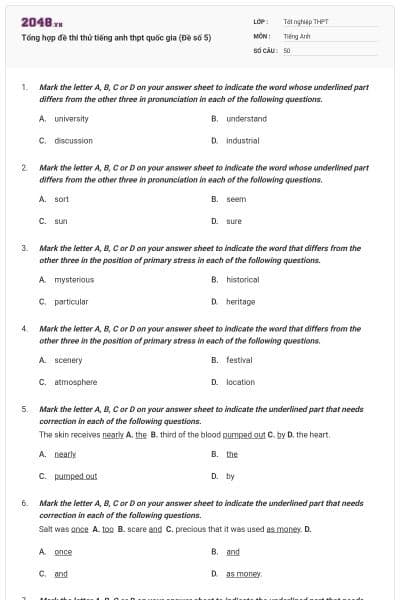
Tổng hợp đề thi thử tiếng anh thpt quốc gia (Đề số 5)
50 câu hỏi
Mark the letter A, B, C or D on your answer sheet to indicate the word whose underlined part differs from the other three in pronunciation in each of the following questions.
university
understand
discussion
industrial
Đáp án A
Mark the letter A, B, C or D on your answer sheet to indicate the word whose underlined part differs from the other three in pronunciation in each of the following questions.
sort
seem
sun
sure
Đáp án D
Mark the letter A, B, C or D on your answer sheet to indicate the word that differs from the other three in the position of primary stress in each of the following questions.
mysterious
historical
particular
heritage
Đáp án D
/mɪstɪəriəs/,/hɪstɒrɪkl/, /pətɪkjələ®/ /herɪtɪdʒ/
Mark the letter A, B, C or D on your answer sheet to indicate the word that differs from the other three in the position of primary stress in each of the following questions.
scenery
festival
atmosphere
location
Đáp án D
Đáp án D trọng âm rơi vào âm tiết thứ 2, còn lại rơi vào âm tiết thứ nhất.
Chú ý:
- Trọng âm thường rơi trước vần –tion.
- Hầu hết danh từ có 3,4 âm tiết thì trọng âm thường ở âm tiết đầu.
Mark the letter A, B, C or D on your answer sheet to indicate the underlined part that needs correction in each of the following questions.
The skin receives nearly A. the B. third of the blood pumped out C. by D. the heart.
nearly
the
pumped out
by
Đáp án B
the --> a (a third:1/3), the third + N: …..thứ 3
Mark the letter A, B, C or D on your answer sheet to indicate the underlined part that needs correction in each of the following questions.
Salt was once A. too B. scare and C. precious that it was used as money. D.
once
and
and
as money.
Đáp án B
too--> so ( so…that: quá….đến nỗi mà)
Mark the letter A, B, C or D on your answer sheet to indicate the underlined part that needs correction in each of the following questions.
There being A. no evidence B. against himself C. , Slade was released. D.
There being
no evidence
himself
was released.
Đáp án C
himself --> him: chủ ngữ là there nên không sử dụng tân ngữ là đại từ phản thân, chỉ sử dụng tân ngữ là đại từ phản thân khi chủ ngữ và tân ngữ chỉ cùng một đối tượng

Học thông minh hơn mỗi ngày
Xem toàn bộ 50 câu hỏi và nhiều hơn nữa với tài khoản miễn phí
Mark the letter A, B, C or D on your answer sheet to indicate the correct answer to each of the following questions.
Are there any household chores for _________ men are better _________ than women?
whose/suited
which/suit
that/suit
which/suited
Đáp án D
Mark the letter A, B, C or D on your answer sheet to indicate the correct answer to each of the following questions.
Too many factories dispose _________ their waste by pumping it into rivers and the sea.
out
of
away
off
Đáp án B
Mark the letter A, B, C or D on your answer sheet to indicate the correct answer to each of the following questions.
Why did Berth ask you _________ a bicycle?
that if you had
do you have
that you had
if you had
Đáp án D
Trong câu gián tiếp dùng if hoặc whether cho câu hỏi dạng yes/no question
Mark the letter A, B, C or D on your answer sheet to indicate the correct answer to each of the following questions.
She wondered if they _________ her jeweler and rather hoped that they had.
find
have found
had found
would find
Đáp án C
từ dẫn wondered ở thì quá khứ nên câu theo sau phải có hiện tượng lùi thì
Mark the letter A, B, C or D on your answer sheet to indicate the correct answer to each of the following questions.
I cannot bear the noise of my brother’s radio; it _________ me from my work.
distracts
perturbs
interrupts
disturbs
Đáp án A
distract sb from st: làm ai xao nhãng việc gì
perturb sb: làm cho ai lo sợ
interrupt Sb with st: làm gián đoạn ai đó bằng điều gì (trong khi người đó đang nói)
disturb Sb: làm gián đoạn ai đó bằng điều gì (trong khi người đó đang làm việc gì đó)
Mark the letter A, B, C or D on your answer sheet to indicate the correct answer to each of the following questions.
-“Is swimming under water very difficult?”
-“No, it’s just a matter _________ able to control your breathing.”
to be
of being
that you are
being
Đáp án B
a matter of st: vấn đề về
Mark the letter A, B, C or D on your answer sheet to indicate the correct answer to each of the following questions.
I am going to the dentist’s tomorrow. I hope I don’t need to _________
have anything done
have nothing done
be done anything
get him do anything
Đáp án A
câu phủ định dùng anything, không dùng câu B là nothing nữa
have ST done = Get SB to do ST
Mark the letter A, B, C or D on your answer sheet to indicate the correct answer to each of the following questions.
A young girl came on to the stage with a bouquet _________ to the conductor.
Presented
and presented
for presenting
to present
Đáp án D
to Verb: chỉ mục đích
Mark the letter A, B, C or D on your answer sheet to indicate the correct answer to each of the following questions.
_________ I love you, I can’t let you do whatever you like.
Whatever
Whether
Despite
Much as
Đáp án D
Mark the letter A, B, C or D on your answer sheet to indicate the correct answer to each of the following questions.
He _________ alone a month ago, and _________ of since.
set off/hasn’t been heard
setted off/hasn’t heard
set on/hasn’t heard
setted on/hadn’t been heard
Đáp án A
Loại B và D vì set-set-set. Set off: khởi hành
Set on/upon SB: tấn công ai đó đột ngột
Mark the letter A, B, C or D on your answer sheet to indicate the correct answer to each of the following questions.
His _________ of the school regulations really can’t be ignored any longer.
carelessness
inattention
unfamiliarity
disregard
Đáp án B
Mark the letter A, B, C or D on your answer sheet to indicate the correct answer to each of the following questions.
Beaches were _________ as police searched for canisters of toxic waste from the damaged ship.
sealed off
cut off
washed up
kept out
Đáp án A
seal sth/sb off: ngăn chặn ai/cái gì
be sealed off: bị vây chắn/phong tỏa
các bãi biển đã bị phong tỏa vì cảnh sát (đang) tìm kiếm những can chứa rác động hại từ một con tàu bị phá hủy
Mark the letter A, B, C or D on your answer sheet to indicate the correct answer to each of the following questions.
The fall of the dictatorship of Miguel Primode Riverra _____ the establishment of the
Second Spanish Republic.'
brought around
set down
set up
brought about
Đáp án D
Bring about = lead to: (v) dẫn đến, gây ra
Mark the letter A, B, C or D on your answer sheet to indicate the correct answer to each of the following questions.
You have to _____ your revision tonight. Or it’s too late.'
get over
give out
give away
get through
Đáp án D
Get through: làm xong, hoàn thành công việc
Mark the letter A, B, C, or D on your answer sheet to indicate the most suitable response to complete each of the following exchanges.
Peter: “___________________________”
Tim: “What happened?”
What did you do today?
I had a bad day.
How was your day?
Have a nice day.
Đáp án B
Dịch nghĩa: Tôi đã có một ngày tồi tệ. Chuyện gì đã xảy ra thế
Mark the letter A, B, C, or D on your answer sheet to indicate the most suitable response to complete each of the following exchanges.
“Don’t fail to look after yourself, Mary!” – “___________________________”
Of course, you’re an adult.
Oh, I knew about that.
Thanks, me too.
Thanks, I will.
Đáp án D
Đừng quên tự chăm sóc bản thân nhé. Cảm ơn, mình sẽ làm như vậy
Mark the letter A, B, C, or D to indicate the phrase that is CLOSEST in meaning to the underlined ones.
When you cross the street, be careful and be on the alert for the bus.
Look for
watch out for
search for
watch for
Đáp án B
Be on the alert for = watch out for: trông chừng
Mark the letter A, B, C, or D to indicate the phrase that is CLOSEST in meaning to the underlined ones.
He was asked to account for his presence at the scene of crime
complain
exchange
explain
arrange
Đáp án C
Account for = explain: giải thích
Mark the letter A, B, C, or D to indicate the phrase that is OPPOSITE in meaning to the underlined ones.
Because Jack defaulted on his loan, the bank took him to court
failed to pay
paid in full
had a bad personality
was paid much money
Đáp án B
default ≠ paid in full: không thể trả nợ ≠ trả đầy đủ nợ
Mark the letter A, B, C, or D to indicate the phrase that is OPPOSITE in meaning to the underlined ones.
His career in the illicit drug trade ended with the police raid this morning.
elicited
irregular
secret
legal
Đáp án D
illicit: bất hợp pháp ≠ legal: hợp pháp
Mark the letter A, B, C, or D on your answer sheet to indicate sentence that is similar in meaning to
the given one
"If I were you, I would take the job," said my room-mate.
My room-mate was thinking about taking the job.
My room-mate advised me to take the job.
My room-mate introduced the idea of taking the job to me.
My room-mate insisted on taking the job for me.
Đáp án B
Có “if I were…, dùng câu tường thuật chỉ lời khuyên: advised SB + to do ST
Mark the letter A, B, C, or D on your answer sheet to indicate sentence that is similar in meaning to
the given one
"It's too stuffy in this room, isn't it?" said the guest.
The guest suggested that the room should be aired.
The guest remarked that the room should be aired.
The guest said that the room was too crowded.
The guest said that there was too much stuff in the room.
Đáp án A
-> A: câu đã cho “trong phòng này thì quá ngột ngạt có phải không?, vị khách nói. – câu trực tiếp là 1 câu hỏi đuôi, thực chất đây là 1 cách nói “indirect –gián tiếp” để thể hiện gợi ý/yêu cầu, chứ không phải là 1 câu hỏi đơn thuần, vì thế khi chuyển sang câu gián tiếp ta dùng “suggest that + mệnh đề - khuyên/gợi ý rằng”
Dịch là: vị khách gợi ý rằng căn phòng nên được thông khí.
Mark the letter A, B, C, or D on your answer sheet to indicate sentence that is similar in meaning to
the given one
"Cigarette?" he asked. "No, thanks." I said.
He asked for a cigarette, and I immediately refused.
He mentioned a cigarette, so I thanked him.
He offered me a cigarette, but I promptly declined.
He asked if I was smoking, and I denied at once.
Đáp án C
-> C: câu đã cho “mời anh hút thuốc?, anh ta nói _” không, cảm ơn”, tôi nói.
A: anh ta hỏi xin một điếu thuốc và ngay lập tức tôi từ chối;
B: anh ta đề cập đến 1 điếu thuốc vì thế tôi cảm ơn anh ta;
C: anh ta mời tôi một điếu thuốc, nhưng tôi từ chối ngay;
D: anh ta hỏi xem tôi có đang hút thuốc không và tôi nói không/ phủ nhận ngay lập tức.
Mark the letter A, B, C, or D on your answer sheet to indicate sentence that best combines each pair of sentences in the following questions
She tried very hard to pass the driving test. She could hardly pass it.
Although she didn’t try hard to pass the driving test, she could pass it.
Despite being able to pass the driving test, she didn’t pass it.
No matter how hard she tried, she could hardly pass the driving test.
She tried very hard, so she passed the driving test satisfactorily.
Đáp án C
Giải thích: Cấu trúc could + hardly + V (khó khăn để làm gì)
Dịch nghĩa: Cô ấy đã cố gắng rất nhiều để có thể đậu kỳ thi lái xe. Cô ấy khó có thể thi đậu được.
C: Dù có cố gắng thế nào đi nữa, cô ấy cũng khó có thể đậu kỳ thi lái xe.
A: Mặc dù cô ấy không cố gắng nhiều để đậu kỳ thi lái xe, cô ấy vẫn thi đậu.
B: Mặc dù có thể đậu được kỳ thi lái xe, cô ấy đã không đậu.
D: Cô ấy đã cố gắng nhiều vì vậy cô ấy đã đậu kỳ thi lái xe một cách hài lòng.
Mark the letter A, B, C, or D on your answer sheet to indicate sentence that best combines each pair of sentences in the following questions
We didn’t want to spend a lot of money. We stayed in a cheap hotel.
Rather than spending a lot of money, we stayed in a cheap hotel.
In spite of spending a lot of money, we stayed in a cheap hotel.
We stayed in a cheap hotel, but we had to spend a lot of money.
We didn’t stay in a cheap hotel as we had a lot of money to spend.
Đáp án A
Giải thích: rather than st = instead of th (Thay vì)
Dịch nghĩa: Chúng tôi không muốn tiêu nhiều tiền. Chúng tôi ở trong một khách sạn rẻ tiền.
A: Thay vì tiêu nhiều tiền, chúng tôi ở trong một khách sạn rẻ tiền.
B: Mặc dù tiêu nhiều tiền, chúng tôi ở trong một khách sạn rẻ tiền.
C: Chúng tôi ở trong một khách sạn rẻ tiền nhưng chúng tôi phải tiêu nhiều tiền.
D: Chúng tôi đã không ở trong một khách sạn rẻ tiền vì chúng tôi có rất nhiều tiền tiêu.
Read the following passage and mark the letter A, B, C or D on you answer sheet to indicate the correct word or phrase that best fits each of the numbered blanks from 31 to 35. Fill in the appropriate word in question 33
How men first learnt to (33) ........ words is unknown; in other words, the origin of language is a mystery. All we really know is that men, unlike animals, (34) ............ invented certain sounds to express thoughts and feelings, actions and things so that they could communicate with each other; and that later they agreed (35) ........... certain signs, called letters, which could be combined to represent those sounds, and which could be written down. These sounds, (36) .......... spoken or written in letters, are called words. Great writers are those who not only have great thoughts but also express these thoughts in words that apeal powerfully to our minds and emotions. This charming and telling use of words is what we call literary (37) ........... Above all, the real poet is a master of words.
invent
create
make
discover
Đáp án A
Invent: khi nói tới vật gì đó mà do con người tạo r A. Ví dụ: Điện thoại, ô tô, xe máy vv…
Discover khi nói tới gì đó mà nó đã tồn tại ngoài ý muốn của con người, tìm ra cái gì đó nó bị ẩn đi mà con người chưa biết.
Ví dụ: một hành tinh, hòn đảo, một
Make= Tạo ra sản phẩm nhờ vào việc lắp ghép các bộ phận, phần, vật liệu đã có.
Create tạo ra cái gì mang tính sáng tạo như tư tưởng, tác phẩm
Read the following passage and mark the letter A, B, C or D on you answer sheet to indicate the correct word or phrase that best fits each of the numbered blanks from 31 to 35. Fill in the appropriate word in question 34
How men first learnt to (33) ........ words is unknown; in other words, the origin of language is a mystery. All we really know is that men, unlike animals, (34) ............ invented certain sounds to express thoughts and feelings, actions and things so that they could communicate with each other; and that later they agreed (35) ........... certain signs, called letters, which could be combined to represent those sounds, and which could be written down. These sounds, (36) .......... spoken or written in letters, are called words. Great writers are those who not only have great thoughts but also express these thoughts in words that apeal powerfully to our minds and emotions. This charming and telling use of words is what we call literary (37) ........... Above all, the real poet is a master of words.
somehow
however
somewhat
whatever
Đáp án A
Somehow: bằng cách nào đó
Somewhat: ở một mức độ nào đó
Read the following passage and mark the letter A, B, C or D on you answer sheet to indicate the correct word or phrase that best fits each of the numbered blanks from 31 to 35. Fill in the appropriate word in question 35
How men first learnt to (33) ........ words is unknown; in other words, the origin of language is a mystery. All we really know is that men, unlike animals, (34) ............ invented certain sounds to express thoughts and feelings, actions and things so that they could communicate with each other; and that later they agreed (35) ........... certain signs, called letters, which could be combined to represent those sounds, and which could be written down. These sounds, (36) .......... spoken or written in letters, are called words. Great writers are those who not only have great thoughts but also express these thoughts in words that apeal powerfully to our minds and emotions. This charming and telling use of words is what we call literary (37) ........... Above all, the real poet is a master of words.
at
upon
with
to
Đáp án B
Agree with sb on/upon st: thống nhất với ai về việc gì
Read the following passage and mark the letter A, B, C or D on you answer sheet to indicate the correct word or phrase that best fits each of the numbered blanks from 31 to 35. Fill in the appropriate word in question 36
How men first learnt to (33) ........ words is unknown; in other words, the origin of language is a mystery. All we really know is that men, unlike animals, (34) ............ invented certain sounds to express thoughts and feelings, actions and things so that they could communicate with each other; and that later they agreed (35) ........... certain signs, called letters, which could be combined to represent those sounds, and which could be written down. These sounds, (36) .......... spoken or written in letters, are called words. Great writers are those who not only have great thoughts but also express these thoughts in words that apeal powerfully to our minds and emotions. This charming and telling use of words is what we call literary (37) ........... Above all, the real poet is a master of words.
if
however
whether
though
Đáp án C
whether…or: hoặc là…hoặc là
Read the following passage and mark the letter A, B, C or D on you answer sheet to indicate the correct word or phrase that best fits each of the numbered blanks from 31 to 35. Fill in the appropriate word in question 37
How men first learnt to (33) ........ words is unknown; in other words, the origin of language is a mystery. All we really know is that men, unlike animals, (34) ............ invented certain sounds to express thoughts and feelings, actions and things so that they could communicate with each other; and that later they agreed (35) ........... certain signs, called letters, which could be combined to represent those sounds, and which could be written down. These sounds, (36) .......... spoken or written in letters, are called words. Great writers are those who not only have great thoughts but also express these thoughts in words that apeal powerfully to our minds and emotions. This charming and telling use of words is what we call literary (37) ........... Above all, the real poet is a master of words.
prose
work
form
style
Đáp án D
literacy style: phong cách văn chương
prose: văn xuôi
work: tác phẩm
form: hình thức
Read the following passage on transport, and mark the letter A, B, C, or D on your answer sheet to indicate the correct answer to each of the questions from 38 to 42.
(1) The protozoans, minute, aquatic creatures each of which consists of a single cell of protoplasm, constitute a classification of the most primitive forms of animal life. They are fantastically diverse, but three major groups may be identified on the basis of their motility. The Mastigophora have one or more long tails, which they use to project themselves forward. The Ciliata, which use the same basic means for locomotion as the Mastigophora, have a larger number of short tails. The Sarcodina, which include amoebae, float or row themselves about on their crusted bodies.
(2) In addition to their form of movement, several other features discriminate among the three groups of protozoans. For example, at least two nuclei per cell have been identified in the Ciliata, usually a large nucleus that regulates growth but decomposes during reproduction, and a smaller one that contains the genetic code necessary to generate the large nucleus.
(3) Protozoans are considered animals because, unlike pigmented plants to which some protozoans are otherwise almost identical, they do not live on simple organic compounds. Their cell demonstrates all of the major characteristics of the cells of higher animals.
(4) Many species of protozoans collect into colonies, physically connected to each other and responding uniformly to outside stimulae. Current research into this phenomenon, along with investigations carried out with advanced microscopes may necessitate a redefinition of what constitutes protozoans, even calling into question the basic premise that they have only one cell. Nevertheless, with the current data available, almost 40,000 species of protozoans have been identified. No doubt, as the technology improves our methods of observation, better models of classification will be proposed.
With what topic is the passage primarily concerned?
Colonies of protozoans
Mastigophora
Motility in protozoans
Characteristics of protozoans
Đáp án D
A. Colonies of protozoans: các loại sinh vật đơn bào
B. Mastigophora: Nhóm Mastigophora
C. Motility in protozoans: tính chất của sinh vật đơn bào
D. Characteristics of protozoans: đặc điểm của sinh vật đơn bào
Read the following passage on transport, and mark the letter A, B, C, or D on your answer sheet to indicate the correct answer to each of the questions from 38 to 42.
(1) The protozoans, minute, aquatic creatures each of which consists of a single cell of protoplasm, constitute a classification of the most primitive forms of animal life. They are fantastically diverse, but three major groups may be identified on the basis of their motility. The Mastigophora have one or more long tails, which they use to project themselves forward. The Ciliata, which use the same basic means for locomotion as the Mastigophora, have a larger number of short tails. The Sarcodina, which include amoebae, float or row themselves about on their crusted bodies.
(2) In addition to their form of movement, several other features discriminate among the three groups of protozoans. For example, at least two nuclei per cell have been identified in the Ciliata, usually a large nucleus that regulates growth but decomposes during reproduction, and a smaller one that contains the genetic code necessary to generate the large nucleus.
(3) Protozoans are considered animals because, unlike pigmented plants to which some protozoans are otherwise almost identical, they do not live on simple organic compounds. Their cell demonstrates all of the major characteristics of the cells of higher animals.
(4) Many species of protozoans collect into colonies, physically connected to each other and responding uniformly to outside stimulae. Current research into this phenomenon, along with investigations carried out with advanced microscopes may necessitate a redefinition of what constitutes protozoans, even calling into question the basic premise that they have only one cell. Nevertheless, with the current data available, almost 40,000 species of protozoans have been identified. No doubt, as the technology improves our methods of observation, better models of classification will be proposed.
The word “minute” in paragraph 1 could best be replaced by
Very common
Very fast
Very old
Very small
Đáp án D
Minute -> very small: rất bé
Very common: rất phổ biến
Very fast: rất nhanh
Very old: rất già
Read the following passage on transport, and mark the letter A, B, C, or D on your answer sheet to indicate the correct answer to each of the questions from 38 to 42.
(1) The protozoans, minute, aquatic creatures each of which consists of a single cell of protoplasm, constitute a classification of the most primitive forms of animal life. They are fantastically diverse, but three major groups may be identified on the basis of their motility. The Mastigophora have one or more long tails, which they use to project themselves forward. The Ciliata, which use the same basic means for locomotion as the Mastigophora, have a larger number of short tails. The Sarcodina, which include amoebae, float or row themselves about on their crusted bodies.
(2) In addition to their form of movement, several other features discriminate among the three groups of protozoans. For example, at least two nuclei per cell have been identified in the Ciliata, usually a large nucleus that regulates growth but decomposes during reproduction, and a smaller one that contains the genetic code necessary to generate the large nucleus.
(3) Protozoans are considered animals because, unlike pigmented plants to which some protozoans are otherwise almost identical, they do not live on simple organic compounds. Their cell demonstrates all of the major characteristics of the cells of higher animals.
(4) Many species of protozoans collect into colonies, physically connected to each other and responding uniformly to outside stimulae. Current research into this phenomenon, along with investigations carried out with advanced microscopes may necessitate a redefinition of what constitutes protozoans, even calling into question the basic premise that they have only one cell. Nevertheless, with the current data available, almost 40,000 species of protozoans have been identified. No doubt, as the technology improves our methods of observation, better models of classification will be proposed.
Where do protozoans probably live?
Water
Sand
Grass
Wood
Đáp án A
(1) The protozoans, minute, aquatic creatures each of which consists
Aquatic: sống ở nước
Read the following passage on transport, and mark the letter A, B, C, or D on your answer sheet to indicate the correct answer to each of the questions from 38 to 42.
(1) The protozoans, minute, aquatic creatures each of which consists of a single cell of protoplasm, constitute a classification of the most primitive forms of animal life. They are fantastically diverse, but three major groups may be identified on the basis of their motility. The Mastigophora have one or more long tails, which they use to project themselves forward. The Ciliata, which use the same basic means for locomotion as the Mastigophora, have a larger number of short tails. The Sarcodina, which include amoebae, float or row themselves about on their crusted bodies.
(2) In addition to their form of movement, several other features discriminate among the three groups of protozoans. For example, at least two nuclei per cell have been identified in the Ciliata, usually a large nucleus that regulates growth but decomposes during reproduction, and a smaller one that contains the genetic code necessary to generate the large nucleus.
(3) Protozoans are considered animals because, unlike pigmented plants to which some protozoans are otherwise almost identical, they do not live on simple organic compounds. Their cell demonstrates all of the major characteristics of the cells of higher animals.
(4) Many species of protozoans collect into colonies, physically connected to each other and responding uniformly to outside stimulae. Current research into this phenomenon, along with investigations carried out with advanced microscopes may necessitate a redefinition of what constitutes protozoans, even calling into question the basic premise that they have only one cell. Nevertheless, with the current data available, almost 40,000 species of protozoans have been identified. No doubt, as the technology improves our methods of observation, better models of classification will be proposed.
What is protoplasm?
A class of protozoan
The substance that forms the cell of a protozoan
A primitive animal similar to a protozoan
An animal that developed from a protozoan
Đáp án B
(1) The protozoans, minute, aquatic creatures each of which consists of a single cell of protoplasm
Read the following passage on transport, and mark the letter A, B, C, or D on your answer sheet to indicate the correct answer to each of the questions from 38 to 42.
(1) The protozoans, minute, aquatic creatures each of which consists of a single cell of protoplasm, constitute a classification of the most primitive forms of animal life. They are fantastically diverse, but three major groups may be identified on the basis of their motility. The Mastigophora have one or more long tails, which they use to project themselves forward. The Ciliata, which use the same basic means for locomotion as the Mastigophora, have a larger number of short tails. The Sarcodina, which include amoebae, float or row themselves about on their crusted bodies.
(2) In addition to their form of movement, several other features discriminate among the three groups of protozoans. For example, at least two nuclei per cell have been identified in the Ciliata, usually a large nucleus that regulates growth but decomposes during reproduction, and a smaller one that contains the genetic code necessary to generate the large nucleus.
(3) Protozoans are considered animals because, unlike pigmented plants to which some protozoans are otherwise almost identical, they do not live on simple organic compounds. Their cell demonstrates all of the major characteristics of the cells of higher animals.
(4) Many species of protozoans collect into colonies, physically connected to each other and responding uniformly to outside stimulae. Current research into this phenomenon, along with investigations carried out with advanced microscopes may necessitate a redefinition of what constitutes protozoans, even calling into question the basic premise that they have only one cell. Nevertheless, with the current data available, almost 40,000 species of protozoans have been identified. No doubt, as the technology improves our methods of observation, better models of classification will be proposed.
The word “uniformly” in paragraph 4 is closest in meaning to
in the same way
once in a while
all of a sudden
in the long run
Đáp án A
Uniformly <=> in the same way: theo cùng một cách
once in a while: thỉnh thoảng
all of a sudden: một cách bất ngờ
in the long run: sau cùng, rốt cuộc là
Read the following passage on transport, and mark the letter A, B, C, or D on your answer sheet to indicate the correct answer to each of the questions from 43 to 50.
1) It was the first photograph that I had ever seen, and it fascinated me. I can remember holding it at every angle in order to catch the flickering light from the oil lamp on the dresser. The man in the photograph was unsmiling, but his eyes were kind. I had never met him, but I felt that I knew him. One evening when I was looking at the photograph, as I always did before I went to sleep, I noticed a shadow across the man’s thin face. I moved the photograph so that the shadow lay perfectly around his hollow cheecks. How different he looked!
(2) That night I could not sleep, thinking about the letter that I would write. First, I would tell him that I was eleven years old, and that if he had a little girl my age, she could write to me instead of him. I knew that he was a very busy man. Then I would explain to him the real purpose of my letter. I would tell him how wonderful he looked with the shadow that I had seen across his photograph, and I would most carefully suggest that he grow whiskers.
(3) Four months later when I met him at the train station near my home in Westfield, New York, he was wearing a full beard. He was so much taller than I had imagined from my tiny photograph.
(4) “Ladies and gentlemen,” he said, “I have no speech to make and no time to make it in. I appear before you that I may see you and that you may see me.” Then he picked me right up and kissed me on both cheeks. The whiskers scratched. “Do you think I look better, my little friend?” he asked me.
(5) My name is Grace Bedell, and the man in the photograph was Abraham Lincoln.
What is the author’s main purpose in the passage?
To explain how Grace Bedell took a photograph of Abraham Lincoln
To explain why Abraham Lincoln wore a beard
To explain why the first photographs were significant in American life
To explain why Westfield is an important city
Đáp án A
fascinated = interested: gây hứng thú
frighten: làm sợ hãi
confuse: làm bối rối
disgust: làm chán ghét
Read the following passage on transport, and mark the letter A, B, C, or D on your answer sheet to indicate the correct answer to each of the questions from 43 to 50.
1) It was the first photograph that I had ever seen, and it fascinated me. I can remember holding it at every angle in order to catch the flickering light from the oil lamp on the dresser. The man in the photograph was unsmiling, but his eyes were kind. I had never met him, but I felt that I knew him. One evening when I was looking at the photograph, as I always did before I went to sleep, I noticed a shadow across the man’s thin face. I moved the photograph so that the shadow lay perfectly around his hollow cheecks. How different he looked!
(2) That night I could not sleep, thinking about the letter that I would write. First, I would tell him that I was eleven years old, and that if he had a little girl my age, she could write to me instead of him. I knew that he was a very busy man. Then I would explain to him the real purpose of my letter. I would tell him how wonderful he looked with the shadow that I had seen across his photograph, and I would most carefully suggest that he grow whiskers.
(3) Four months later when I met him at the train station near my home in Westfield, New York, he was wearing a full beard. He was so much taller than I had imagined from my tiny photograph.
(4) “Ladies and gentlemen,” he said, “I have no speech to make and no time to make it in. I appear before you that I may see you and that you may see me.” Then he picked me right up and kissed me on both cheeks. The whiskers scratched. “Do you think I look better, my little friend?” he asked me.
(5) My name is Grace Bedell, and the man in the photograph was Abraham Lincoln.
The word “fascinated” in paragraph 1 could best be replaced by
Interested
frightened
confused
disgusted
Đáp án D
Dòng 2 + 3 đoạn 1 “The man in the photograph was unsmiling, but his eyes were kind”
Read the following passage on transport, and mark the letter A, B, C, or D on your answer sheet to indicate the correct answer to each of the questions from 43 to 50.
1) It was the first photograph that I had ever seen, and it fascinated me. I can remember holding it at every angle in order to catch the flickering light from the oil lamp on the dresser. The man in the photograph was unsmiling, but his eyes were kind. I had never met him, but I felt that I knew him. One evening when I was looking at the photograph, as I always did before I went to sleep, I noticed a shadow across the man’s thin face. I moved the photograph so that the shadow lay perfectly around his hollow cheecks. How different he looked!
(2) That night I could not sleep, thinking about the letter that I would write. First, I would tell him that I was eleven years old, and that if he had a little girl my age, she could write to me instead of him. I knew that he was a very busy man. Then I would explain to him the real purpose of my letter. I would tell him how wonderful he looked with the shadow that I had seen across his photograph, and I would most carefully suggest that he grow whiskers.
(3) Four months later when I met him at the train station near my home in Westfield, New York, he was wearing a full beard. He was so much taller than I had imagined from my tiny photograph.
(4) “Ladies and gentlemen,” he said, “I have no speech to make and no time to make it in. I appear before you that I may see you and that you may see me.” Then he picked me right up and kissed me on both cheeks. The whiskers scratched. “Do you think I look better, my little friend?” he asked me.
(5) My name is Grace Bedell, and the man in the photograph was Abraham Lincoln.
The man in the photograph
was smiling
had a beard
had a round, fat face
looked kind
Đáp án B
Dòng 3 + 4 đoạn 1: “One evening when I was looking at the photograph, as I always did before I went to sleep”
Read the following passage on transport, and mark the letter A, B, C, or D on your answer sheet to indicate the correct answer to each of the questions from 43 to 50.
1) It was the first photograph that I had ever seen, and it fascinated me. I can remember holding it at every angle in order to catch the flickering light from the oil lamp on the dresser. The man in the photograph was unsmiling, but his eyes were kind. I had never met him, but I felt that I knew him. One evening when I was looking at the photograph, as I always did before I went to sleep, I noticed a shadow across the man’s thin face. I moved the photograph so that the shadow lay perfectly around his hollow cheecks. How different he looked!
(2) That night I could not sleep, thinking about the letter that I would write. First, I would tell him that I was eleven years old, and that if he had a little girl my age, she could write to me instead of him. I knew that he was a very busy man. Then I would explain to him the real purpose of my letter. I would tell him how wonderful he looked with the shadow that I had seen across his photograph, and I would most carefully suggest that he grow whiskers.
(3) Four months later when I met him at the train station near my home in Westfield, New York, he was wearing a full beard. He was so much taller than I had imagined from my tiny photograph.
(4) “Ladies and gentlemen,” he said, “I have no speech to make and no time to make it in. I appear before you that I may see you and that you may see me.” Then he picked me right up and kissed me on both cheeks. The whiskers scratched. “Do you think I look better, my little friend?” he asked me.
(5) My name is Grace Bedell, and the man in the photograph was Abraham Lincoln.
What did Grace Bedell do every night before she went to sleep?
She wrote letters.
She looked at the photograph.
She made shadow figures on the wall.
She read stories.
Đáp án B
Dòng 1 đoạn 2: “That night I could not sleep, thinking about the letter that I would write”
Sick: ốm
Exited: hào hứng
Lonely: cô đơn
Sad: buồn
Read the following passage on transport, and mark the letter A, B, C, or D on your answer sheet to indicate the correct answer to each of the questions from 43 to 50.
1) It was the first photograph that I had ever seen, and it fascinated me. I can remember holding it at every angle in order to catch the flickering light from the oil lamp on the dresser. The man in the photograph was unsmiling, but his eyes were kind. I had never met him, but I felt that I knew him. One evening when I was looking at the photograph, as I always did before I went to sleep, I noticed a shadow across the man’s thin face. I moved the photograph so that the shadow lay perfectly around his hollow cheecks. How different he looked!
(2) That night I could not sleep, thinking about the letter that I would write. First, I would tell him that I was eleven years old, and that if he had a little girl my age, she could write to me instead of him. I knew that he was a very busy man. Then I would explain to him the real purpose of my letter. I would tell him how wonderful he looked with the shadow that I had seen across his photograph, and I would most carefully suggest that he grow whiskers.
(3) Four months later when I met him at the train station near my home in Westfield, New York, he was wearing a full beard. He was so much taller than I had imagined from my tiny photograph.
(4) “Ladies and gentlemen,” he said, “I have no speech to make and no time to make it in. I appear before you that I may see you and that you may see me.” Then he picked me right up and kissed me on both cheeks. The whiskers scratched. “Do you think I look better, my little friend?” he asked me.
(5) My name is Grace Bedell, and the man in the photograph was Abraham Lincoln.
The little girl could not sleep because she was
Sick
excited
lonely
sad
Đáp án B
“I have no speech to make and no time to make it in.” tôi không có bài diễn thuyết nào để thực hiện cả và cũng không có thời gian để diễn thuyết
Time: thời gian
Speech: bài diễn thuyết
Photograph: chụp ảnh
Station: sân ga
Read the following passage on transport, and mark the letter A, B, C, or D on your answer sheet to indicate the correct answer to each of the questions from 43 to 50.
1) It was the first photograph that I had ever seen, and it fascinated me. I can remember holding it at every angle in order to catch the flickering light from the oil lamp on the dresser. The man in the photograph was unsmiling, but his eyes were kind. I had never met him, but I felt that I knew him. One evening when I was looking at the photograph, as I always did before I went to sleep, I noticed a shadow across the man’s thin face. I moved the photograph so that the shadow lay perfectly around his hollow cheecks. How different he looked!
(2) That night I could not sleep, thinking about the letter that I would write. First, I would tell him that I was eleven years old, and that if he had a little girl my age, she could write to me instead of him. I knew that he was a very busy man. Then I would explain to him the real purpose of my letter. I would tell him how wonderful he looked with the shadow that I had seen across his photograph, and I would most carefully suggest that he grow whiskers.
(3) Four months later when I met him at the train station near my home in Westfield, New York, he was wearing a full beard. He was so much taller than I had imagined from my tiny photograph.
(4) “Ladies and gentlemen,” he said, “I have no speech to make and no time to make it in. I appear before you that I may see you and that you may see me.” Then he picked me right up and kissed me on both cheeks. The whiskers scratched. “Do you think I look better, my little friend?” he asked me.
(5) My name is Grace Bedell, and the man in the photograph was Abraham Lincoln.
The word “it” in paragraph 4 refers to
Time
Speech
Photograph
Station
Đáp án B
““Ladies and gentlemen,” he said, “I have no speech to make and no time to make it in. I appear before you that I may see you and that you may see me” =>Có rất nhiều người đợi Lincoln ở ga tàu Lincoln đến, nên khi đến Lincoln chào mọi người “thưa các quý ông quý bà,…tôi xuất hiện trước mặt các bạn để tôi có thể thấy mọi người và mọi người có thể thấy tôi”
Read the following passage on transport, and mark the letter A, B, C, or D on your answer sheet to indicate the correct answer to each of the questions from 43 to 50.
1) It was the first photograph that I had ever seen, and it fascinated me. I can remember holding it at every angle in order to catch the flickering light from the oil lamp on the dresser. The man in the photograph was unsmiling, but his eyes were kind. I had never met him, but I felt that I knew him. One evening when I was looking at the photograph, as I always did before I went to sleep, I noticed a shadow across the man’s thin face. I moved the photograph so that the shadow lay perfectly around his hollow cheecks. How different he looked!
(2) That night I could not sleep, thinking about the letter that I would write. First, I would tell him that I was eleven years old, and that if he had a little girl my age, she could write to me instead of him. I knew that he was a very busy man. Then I would explain to him the real purpose of my letter. I would tell him how wonderful he looked with the shadow that I had seen across his photograph, and I would most carefully suggest that he grow whiskers.
(3) Four months later when I met him at the train station near my home in Westfield, New York, he was wearing a full beard. He was so much taller than I had imagined from my tiny photograph.
(4) “Ladies and gentlemen,” he said, “I have no speech to make and no time to make it in. I appear before you that I may see you and that you may see me.” Then he picked me right up and kissed me on both cheeks. The whiskers scratched. “Do you think I look better, my little friend?” he asked me.
(5) My name is Grace Bedell, and the man in the photograph was Abraham Lincoln.
From this passage, it may be inferred that
Grace Bedell was the only one at the train station when Lincoln stopped at Westfield
There were many people waiting for Lincoln to arrive on the train
Lincoln made a long speech at the station in Westfield
Lincoln was offended by the letter
Đáp án C
C. Tác giả muốn gây sự thu hút và tò mò từ phía người đọc
Read the following passage on transport, and mark the letter A, B, C, or D on your answer sheet to indicate the correct answer to each of the questions from 43 to 50.
1) It was the first photograph that I had ever seen, and it fascinated me. I can remember holding it at every angle in order to catch the flickering light from the oil lamp on the dresser. The man in the photograph was unsmiling, but his eyes were kind. I had never met him, but I felt that I knew him. One evening when I was looking at the photograph, as I always did before I went to sleep, I noticed a shadow across the man’s thin face. I moved the photograph so that the shadow lay perfectly around his hollow cheecks. How different he looked!
(2) That night I could not sleep, thinking about the letter that I would write. First, I would tell him that I was eleven years old, and that if he had a little girl my age, she could write to me instead of him. I knew that he was a very busy man. Then I would explain to him the real purpose of my letter. I would tell him how wonderful he looked with the shadow that I had seen across his photograph, and I would most carefully suggest that he grow whiskers.
(3) Four months later when I met him at the train station near my home in Westfield, New York, he was wearing a full beard. He was so much taller than I had imagined from my tiny photograph.
(4) “Ladies and gentlemen,” he said, “I have no speech to make and no time to make it in. I appear before you that I may see you and that you may see me.” Then he picked me right up and kissed me on both cheeks. The whiskers scratched. “Do you think I look better, my little friend?” he asked me.
(5) My name is Grace Bedell, and the man in the photograph was Abraham Lincoln.
Why did the author wait until the last line to reveal the identity of the man in the photograph?
The author did not know it.
The author wanted to make the reader fell foolish.
The author wanted to build the interest and curiosity of the reader.
The author was just a little girl.
Đáp án C
Các đáp án A, B, D còn lại chỉ là ví dụ nhỏ trong câu không phải là mục đích chính của bài viết. Mục đích chính là giải thích tại sao các bức ảnh đầu tiên lại quan trong trong đời sống người Mỹ
Bạn có thích hoạt động này không?
Ý kiến của bạn sẽ giúp chúng tôi đề xuất nội dung phù hợp hơn.
Gợi ý cho bạn
![[Năm 2022] Đề thi thử môn Vật lí THPT Quốc gia có lời giải - Đề số 21](/_next/image?url=https%3A%2F%2Fvideo.vietjack.com%2Fupload%2Fimages%2Fvj-image%2Fimage-3izficdefgfoel0s9j8s-1786772791.jpg&w=3840&q=75)
![[Năm 2022] Đề thi thử môn Vật lí THPT Quốc gia có lời giải - Đề số 20](/_next/image?url=https%3A%2F%2Fvideo.vietjack.com%2Fupload%2Fimages%2Fvj-image%2Fimage-emy0gtcksawvorajezvv-1786772460.jpg&w=3840&q=75)
Tài liệu phổ biến Tốt nghiệp THPT
Tài liệu phổ biến Tiếng Anh