Tổng hợp đề thi thử Tiếng Anh có lời giải (Đề số 2)
80 câu hỏi
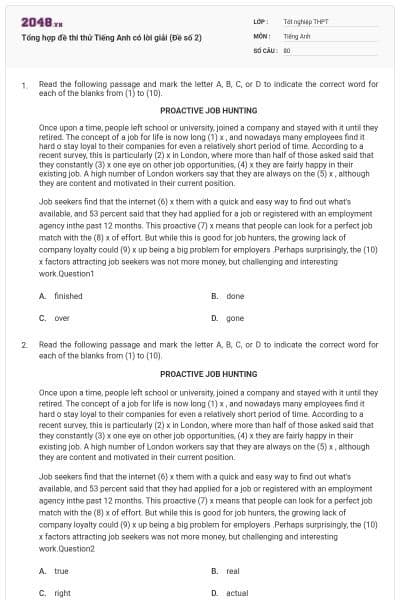
Read the following passage and mark the letter A, B, C, or D to indicate the correct word for each of the blanks from (1) to (10).
PROACTIVE JOB HUNTING
Once upon a time, people left school or university, joined a company and stayed with it until they retired. The concept of a job for life is now long (1) x , and nowadays many employees find it hard o stay loyal to their companies for even a relatively short period of time. According to a recent survey, this is particularly (2) x in London, where more than half of those asked said that they constantly (3) x one eye on other job opportunities, (4) x they are fairly happy in their existing job. A high number of London workers say that they are always on the (5) x , although they are content and motivated in their current position.
Job seekers find that the internet (6) x them with a quick and easy way to find out what's available, and 53 percent said that they had applied for a job or registered with an employment agency inthe past 12 months. This proactive (7) x means that people can look for a perfect job match with the (8) x of effort. But while this is good for job hunters, the growing lack of company loyalty could (9) x up being a big problem for employers .Perhaps surprisingly, the (10) x factors attracting job seekers was not more money, but challenging and interesting work.Question1
finished
done
over
gone
Đáp án là D. long gone: được sử dụng một thời gian dài trước đây
Read the following passage and mark the letter A, B, C, or D to indicate the correct word for each of the blanks from (1) to (10).
PROACTIVE JOB HUNTING
Once upon a time, people left school or university, joined a company and stayed with it until they retired. The concept of a job for life is now long (1) x , and nowadays many employees find it hard o stay loyal to their companies for even a relatively short period of time. According to a recent survey, this is particularly (2) x in London, where more than half of those asked said that they constantly (3) x one eye on other job opportunities, (4) x they are fairly happy in their existing job. A high number of London workers say that they are always on the (5) x , although they are content and motivated in their current position.
Job seekers find that the internet (6) x them with a quick and easy way to find out what's available, and 53 percent said that they had applied for a job or registered with an employment agency inthe past 12 months. This proactive (7) x means that people can look for a perfect job match with the (8) x of effort. But while this is good for job hunters, the growing lack of company loyalty could (9) x up being a big problem for employers .Perhaps surprisingly, the (10) x factors attracting job seekers was not more money, but challenging and interesting work.Question2
true
real
right
actual
Đáp án là A. true: thật. (đề cập đến lời nói, sự thật nào đó.)
Các từ khác không chọn được: real : thật ( khi nói 1 vật gì đó là thật , không phải giả ); right: đúng; actual: thực tế
Read the following passage and mark the letter A, B, C, or D to indicate the correct word for each of the blanks from (1) to (10).
PROACTIVE JOB HUNTING
Once upon a time, people left school or university, joined a company and stayed with it until they retired. The concept of a job for life is now long (1) x , and nowadays many employees find it hard o stay loyal to their companies for even a relatively short period of time. According to a recent survey, this is particularly (2) x in London, where more than half of those asked said that they constantly (3) x one eye on other job opportunities, (4) x they are fairly happy in their existing job. A high number of London workers say that they are always on the (5) x , although they are content and motivated in their current position.
Job seekers find that the internet (6) x them with a quick and easy way to find out what's available, and 53 percent said that they had applied for a job or registered with an employment agency inthe past 12 months. This proactive (7) x means that people can look for a perfect job match with the (8) x of effort. But while this is good for job hunters, the growing lack of company loyalty could (9) x up being a big problem for employers .Perhaps surprisingly, the (10) x factors attracting job seekers was not more money, but challenging and interesting work.Question 3
put
keep
hold
place
Đáp án là B. keep an eye on: để mắt vào, theo dõi
Read the following passage and mark the letter A, B, C, or D to indicate the correct word for each of the blanks from (1) to (10).
PROACTIVE JOB HUNTING
Once upon a time, people left school or university, joined a company and stayed with it until they retired. The concept of a job for life is now long (1) x , and nowadays many employees find it hard o stay loyal to their companies for even a relatively short period of time. According to a recent survey, this is particularly (2) x in London, where more than half of those asked said that they constantly (3) x one eye on other job opportunities, (4) x they are fairly happy in their existing job. A high number of London workers say that they are always on the (5) x , although they are content and motivated in their current position.
Job seekers find that the internet (6) x them with a quick and easy way to find out what's available, and 53 percent said that they had applied for a job or registered with an employment agency inthe past 12 months. This proactive (7) x means that people can look for a perfect job match with the (8) x of effort. But while this is good for job hunters, the growing lack of company loyalty could (9) x up being a big problem for employers .Perhaps surprisingly, the (10) x factors attracting job seekers was not more money, but challenging and interesting work.Question 4
just as
even if
as well
so that
Đáp án là B. even if = whether or not: mang tính giả dụ
Read the following passage and mark the letter A, B, C, or D to indicate the correct word for each of the blanks from (1) to (10).
PROACTIVE JOB HUNTING
Once upon a time, people left school or university, joined a company and stayed with it until they retired. The concept of a job for life is now long (1) x , and nowadays many employees find it hard o stay loyal to their companies for even a relatively short period of time. According to a recent survey, this is particularly (2) x in London, where more than half of those asked said that they constantly (3) x one eye on other job opportunities, (4) x they are fairly happy in their existing job. A high number of London workers say that they are always on the (5) x , although they are content and motivated in their current position.
Job seekers find that the internet (6) x them with a quick and easy way to find out what's available, and 53 percent said that they had applied for a job or registered with an employment agency inthe past 12 months. This proactive (7) x means that people can look for a perfect job match with the (8) x of effort. But while this is good for job hunters, the growing lack of company loyalty could (9) x up being a big problem for employers .Perhaps surprisingly, the (10) x factors attracting job seekers was not more money, but challenging and interesting work.Question 5
search
pursuit
lookout
watch
Đáp án là C. be on the look-out: coi chừng.
Read the following passage and mark the letter A, B, C, or D to indicate the correct word for each of the blanks from (1) to (10).
PROACTIVE JOB HUNTING
Once upon a time, people left school or university, joined a company and stayed with it until they retired. The concept of a job for life is now long (1) x , and nowadays many employees find it hard o stay loyal to their companies for even a relatively short period of time. According to a recent survey, this is particularly (2) x in London, where more than half of those asked said that they constantly (3) x one eye on other job opportunities, (4) x they are fairly happy in their existing job. A high number of London workers say that they are always on the (5) x , although they are content and motivated in their current position.
Job seekers find that the internet (6) x them with a quick and easy way to find out what's available, and 53 percent said that they had applied for a job or registered with an employment agency inthe past 12 months. This proactive (7) x means that people can look for a perfect job match with the (8) x of effort. But while this is good for job hunters, the growing lack of company loyalty could (9) x up being a big problem for employers .Perhaps surprisingly, the (10) x factors attracting job seekers was not more money, but challenging and interesting work.Question 6
delivers
serves
fulfils
provides
Đáp án là D. provide someone with something: cung cấp cho ai cái gì
Read the following passage and mark the letter A, B, C, or D to indicate the correct word for each of the blanks from (1) to (10).
PROACTIVE JOB HUNTING
Once upon a time, people left school or university, joined a company and stayed with it until they retired. The concept of a job for life is now long (1) x , and nowadays many employees find it hard o stay loyal to their companies for even a relatively short period of time. According to a recent survey, this is particularly (2) x in London, where more than half of those asked said that they constantly (3) x one eye on other job opportunities, (4) x they are fairly happy in their existing job. A high number of London workers say that they are always on the (5) x , although they are content and motivated in their current position.
Job seekers find that the internet (6) x them with a quick and easy way to find out what's available, and 53 percent said that they had applied for a job or registered with an employment agency inthe past 12 months. This proactive (7) x means that people can look for a perfect job match with the (8) x of effort. But while this is good for job hunters, the growing lack of company loyalty could (9) x up being a big problem for employers .Perhaps surprisingly, the (10) x factors attracting job seekers was not more money, but challenging and interesting work.Question 7
manner
custom
approach
style
Đáp án là C. approach: sự tiếp cận
Nghĩa các từ còn lại: manner: cách thức; custom: phong tục; style: phong cách
Read the following passage and mark the letter A, B, C, or D to indicate the correct word for each of the blanks from (1) to (10).
PROACTIVE JOB HUNTING
Once upon a time, people left school or university, joined a company and stayed with it until they retired. The concept of a job for life is now long (1) x , and nowadays many employees find it hard o stay loyal to their companies for even a relatively short period of time. According to a recent survey, this is particularly (2) x in London, where more than half of those asked said that they constantly (3) x one eye on other job opportunities, (4) x they are fairly happy in their existing job. A high number of London workers say that they are always on the (5) x , although they are content and motivated in their current position.
Job seekers find that the internet (6) x them with a quick and easy way to find out what's available, and 53 percent said that they had applied for a job or registered with an employment agency inthe past 12 months. This proactive (7) x means that people can look for a perfect job match with the (8) x of effort. But while this is good for job hunters, the growing lack of company loyalty could (9) x up being a big problem for employers .Perhaps surprisingly, the (10) x factors attracting job seekers was not more money, but challenging and interesting work.Question 8
minimum
lowest
smallest
least
Đáp án là A. minimum: sự tối thiểu
Nghĩa các từ còn lại: lowest: thấp nhất; smallest: nhỏ nhất; least: ít nhất
Read the following passage and mark the letter A, B, C, or D to indicate the correct word for each of the blanks from (1) to (10).
PROACTIVE JOB HUNTING
Once upon a time, people left school or university, joined a company and stayed with it until they retired. The concept of a job for life is now long (1) x , and nowadays many employees find it hard o stay loyal to their companies for even a relatively short period of time. According to a recent survey, this is particularly (2) x in London, where more than half of those asked said that they constantly (3) x one eye on other job opportunities, (4) x they are fairly happy in their existing job. A high number of London workers say that they are always on the (5) x , although they are content and motivated in their current position.
Job seekers find that the internet (6) x them with a quick and easy way to find out what's available, and 53 percent said that they had applied for a job or registered with an employment agency inthe past 12 months. This proactive (7) x means that people can look for a perfect job match with the (8) x of effort. But while this is good for job hunters, the growing lack of company loyalty could (9) x up being a big problem for employers .Perhaps surprisingly, the (10) x factors attracting job seekers was not more money, but challenging and interesting work.Question 9
run
come
end
lead
Đáp án là C. end up: (cuối cùng) trở thành
Read the following passage and mark the letter A, B, C, or D to indicate the correct word for each of the blanks from (1) to (10).
PROACTIVE JOB HUNTING
Once upon a time, people left school or university, joined a company and stayed with it until they retired. The concept of a job for life is now long (1) x , and nowadays many employees find it hard o stay loyal to their companies for even a relatively short period of time. According to a recent survey, this is particularly (2) x in London, where more than half of those asked said that they constantly (3) x one eye on other job opportunities, (4) x they are fairly happy in their existing job. A high number of London workers say that they are always on the (5) x , although they are content and motivated in their current position.
Job seekers find that the internet (6) x them with a quick and easy way to find out what's available, and 53 percent said that they had applied for a job or registered with an employment agency inthe past 12 months. This proactive (7) x means that people can look for a perfect job match with the (8) x of effort. But while this is good for job hunters, the growing lack of company loyalty could (9) x up being a big problem for employers .Perhaps surprisingly, the (10) x factors attracting job seekers was not more money, but challenging and interesting work.Question 10
biggest
highest
widest
largest
Đáp án là A. the biggest factors: những yếu tố lớn nhất
Choose the word whose stressed syllable is different from the others in each group
occupation
individual
competitive
documentary
Đáp án là C. Từ competitive nhấn âm tiết thứ hai, các từ còn lại nhấn âm tiết thứ ba.
Choose the word whose stressed syllable is different from the others in each group
innovate
incentive
inevitable
insecticide
Đáp án là A. Từ innovate nhấn âm tiết thứ nhất, các từ còn lại nhấn âm tiết thứ hai.
Choose the word whose stressed syllable is different from the others in each group:
mysteriously
originally
necessarily
elaborately
Đáp án là C. Từ necessarily nhấm âm tiết thứ nhất, các từ còn lại nhấn âm tiết thứ hai
Choose the word whose stressed syllable is different from the others in each group
submarine
technological
biodiversity
picturesque
Đáp án là C. Từ biodiversity nhấm âm tiết thứ tư, các từ còn lại nhấn âm tiết thứ ba
Choose the word whose stressed syllable is different from the others in each group
accomplish
establish
abolish
mechanism
Đáp án là D. Từ mechanism nhấm âm tiết thứ nhất, các từ còn lại nhấn âm tiết thứ hai.
Mark the letter A, B, C, or D to indicate the correct answer to each of the following questions.
Jim's X flu again. That's the third time this year
led up to
put up with
come up with
gone down with
Đáp án là D. go down with : bị ốm. Nghĩa các nhóm từ khác: come up with: đưa ra, phát hiện ra, khám phá; put up with: khoan dung, tha thứ, chịu đựng; lead up to: chuẩn bị cho ( một cái gì )
Mark the letter A, B, C, or D to indicate the correct answer to each of the following questions.
With his excellent qualifications and a good command of English, James is above X the other applicants
head and hands
head and hair
head and ears
head and shoulders
Đáp án là D. Thành ngữ: to be /stand head and shoulders above somebody: tốt hơn ai, thông minh hơn ai rất nhiều; hơn hẳn một cái đầu
17. Đáp án là C. otherwise: nếu không thì ... ( dùng trong câu điều kiện )
Các từ còn lại: nevertheless: tuy nhiên; consequently: do đó, vì vậy; however: tuy nhiên
nevertheless
consequently
otherwise
however
Đáp án là C. otherwise: nếu không thì ... ( dùng trong câu điều kiện )
Các từ còn lại: nevertheless: tuy nhiên; consequently: do đó, vì vậy; however: tuy nhiên
Mark the letter A, B, C, or D to indicate the correct answer to each of the following questions.
He came to inspect the house X buying it
with a view to
in case of
in the event of
with reference to
Đáp án là A. with a view to doing something: với ý định làm cái gì, với hy vọng làm cái gì
Mark the letter A, B, C, or D to indicate the correct answer to each of the following questions.
Nam : " x " - Susan: " Never mind."
Thank you for helping me finish my work
Sorry for steeping on your toes
Congratulations! How great!
Would you like to go to the cinema?
Câu này hỏi về kỹ năng giao tiếp. “ Never mind” thường dùng để đáp lại lời xin lỗi của ai đó => đáp án là B.
Mark the letter A, B, C, or D to indicate the correct answer to each of the following questions.
X , he felt so unhappy and lonely
Rich as he was
Rich as was he
In spite of his being wealth
Despite his wealthy
Đáp án: A
Giải thích:
Adj + as + S + be: Dù…/ … như vậy
In spite of / Despite + N/V-ing: mặc dù, mặc cho
wealth (n): sự giàu có
wealthy (adj): giàu có
C và D sai ngữ pháp (sai từ loại)
Đáp án A đúng nghĩa và ngữ pháp.
Dịch: Mặc dù giàu có, ông vẫn cảm thấy bất hạnh và cô đơn.
Mark the letter A, B, C, or D to indicate the correct answer to each of the following questions.
"If only I hadn't lent him all my money!" -" x "
Well, you did, so it's no use crying over spilt milk.
All right. You will be OK
I'm afraid you will have to do it
Sorry, I have no idea.
Câu này hỏi về kỹ năng giao tiếp. If only I hadn't lent him all my money!- Ước gì tớ đã không cho anh ta mượn tất cả số tiền tớ có.
Đáp án là A. A - it’s no use crying over spilt milk. : có khóc cũng vô ích
Mark the letter A, B, C, or D to indicate the correct answer to each of the following questions.
The x dressed woman in the advertisement has a pose smile on her face.
stylistic
stylish
stylishly
stylistically
Đáp án là C. Cụm “stylishly dressed”: ăn mặc hợp thời trang
Mark the letter A, B, C, or D to indicate the correct answer to each of the following questions.
They have considered all the fifty applications, x seems suitable for the position
none of them
none of whom
none of these
none of which
Đáp án: D
Giải thích:
Kiến thức: Mệnh đề quan hệ
“applications” là danh từ chỉ vật, dùng “which” cho mệnh đề quan hệ. Chọn D.
Dịch: Họ đã xem xét tất cả 50 đơn xin việc nhưng không có đơn nào phù hợp với vị trí này.
Mark the letter A, B, C, or D to indicate the correct answer to each of the following questions.
He was x speaker!
so good a
how a good
what a good
so a good
Đáp án là A. Cấu trúc nhấn mạnh: S + V + so + adj + a + singular count noun
Mark the letter A, B, C, or D to indicate the correct answer to each of the following questions
By the end of last March, I x English for five years
had been studied
will have studied
will have been studying
had been studying
Dùng phương pháp loại trừ, B và C loại vì Đáp án là D. “the end of last March” - mốc thời gian trong quá khứ.
A cũng loại, câu này không chia bị động được.
Đáp án là D. Ta dùng quá khứ hoàn thành tiếp diễn diễn tả hành động đã bắt đầu trước đó và vẫn đang tiếp diễn tại một thời điểm trong quá khứ
Mark the letter A, B, C, or D to indicate the correct answer to each of the following questions
It was announced that neither the passengers nor the driver x in the crash
was injured
injured
were injured
had injured
Đáp án: A
Giải thích:
Kiến thức: Sự hòa hợp giữa chủ ngữ và động từ
Neither + A + nor + B + động từ chia theo chủ ngữ B (gần hơn)
Trong câu: "neither the passengers nor the driver" → Chủ ngữ gần động từ là "the driver" → số ít
Xét nghĩa câu, cần dùng dạng bị động.
Bị động ở thì quá khứ đơn: was/were + V3
Chọn A.
Dịch: Người ta thông báo rằng cả hành khách lẫn tài xế đều không bị thương trong vụ tai nạn.
Mark the letter A, B, C, or D to indicate the correct answer to each of the following questions
A cool drink x him after his long hot journey.
relieved
relaxed
refreshed
recovered
Đáp án là C. refresh someone: làm khỏe người
Nghĩa các từ còn lại: relieve: an ủi;làm yên lòng; relax: thư giãn; recover: hồi phục
Mark the letter A, B, C, or D to indicate the correct answer to each of the following questions.
Employers often require that candidates have not only a degree x
but two-year experience as well
also two years of experience
but also two years experience
but also two years experience as well
Đáp án là A. Cấu trúc “ không những ... mà còn…” : not only…but…as well
Mark the letter A, B, C, or D to indicate the correct answer to each of the following questions.
Arthur assured me that he was going to come, but he hasn't x yet
turned on
turned in
turned up
turned round
Đáp án là C. turn up: đến, xuất hiện.
Các từ còn lại: turn on: bật ; turn in: gập lại, thu lại; turn round: quay vòng
Mark the letter A, B, C, or D to indicate the correct answer to each of the following questions.
You x to your teacher like that. It was very rude
mustn't have talked
shouldn't have talked
shouldn't talk
mustn't talk
Đáp án là B. should ( not ) have done: đáng lẽ nên ( không nên ) làm gì ... ( trong quá khứ )
Các từ còn lại: mustn’t have done: chắc chắn không xảy ra ( trong quá khứ, có cơ sở ); shouldn’t done: không nên ... ( hiện tại ); mustn't done: không được phép .( hiện tại )
Mark the letter A, B, C, or D to indicate the correct answer to each of the following questions.
It is imperative that this letter x immediately
is sent
be sent
has been sent
was sent
Đáp án: B
Kiến thức: Bàng thái cách
Với các tính từ chỉ sự quan trọng, cấp thiết, ta dùng bàng thái cách:
It + be + adj (imperative/important/vital/necessary…) + that + S + (should) V
Động từ V không chia với mọi thì và chủ ngữ.
Bị động: V → be VpII
Dịch: Điều bắt buộc là lá thư này phải được gửi đi ngay lập tức.
Mark the letter A, B, C, or D to indicate the correct answer to each of the following questions.
Sport today has become X and is no longer enjoyable.
more too competitive
far too competitive
too much competitive
much competitive
Đáp án là B. Far là trạng từ chỉ mức độ được dùng với so sánh hơn hay với too/so + cấp nguyên
Mark the letter A, B, C, or D to indicate the correct answer to each of the following questions.
Jane: " What a lovely house you have!" - Tom : " x "
I'm glad you like it.
I spent much money on it.
Many people say so.
Thanks. Hopefully you will drop in.
Câu này hỏi về kỹ năng giao tiếp. What a lovely house you have!" - Bạn có ngôi nhà thật đẹp!
Đáp án là D. Cảm ơn. Hy vọng bạn sẽ ghé thăm . Cấu trúc: Drop in at one’s house: ghé thăm nhà ai
Mark the letter A, B, C, or D to indicate the correct answer to each of the following questions.
The teacher asked a difficult question, but finally Ted x a good answer
came out at
came out of
came up with
came up to
Đáp án là C. com up with = đưa ra
Nghĩa các cụm còn lại: come up to: làm thỏa mãn mong đợi; come out: đi ra; lộ ra; đình công; được xuất bản ( không theo giới từ “of” hay “at” )
Mark the letter A, B, C, or D to indicate the correct answer to each of the following questions.
"Do you have a minute, Dr Keith?" - " x "
Sure. What's the problem?
Well. I'm not sure when
Good, I hope so
Sorry, I haven't got it here.
Câu này hỏi về kỹ năng giao tiếp. “Do you have a minute?” - Câu hỏi ai đó có rảnh không?
Đáp án phù hợp nhất là A. Sure. What’s the problem? - Chắc chắn rồi. Có chuyện gì thế?
Mark the letter A, B, C, or D to indicate the correct answer to each of the following questions.
He was x to explain why he hadn't finished the work
at random
at a loss
at least
at first
Đáp án là B. at a loss: bối rối.
Nghĩa các từ còn lại: at random: ngẫu nhiên; at least: ít nhất; at first: đầu tiên
Mark the letter A, B, C, or D to indicate the correct answer to each of the following questions.
"All right. Keep your receipt. If something comes up, you can show it to us, and we'll give you a refund."- “ x ”
OK. I won't use it
Thanks. I'll put it in a safe place
You're welcome. See you later
Thanks you. I'll keep it for you
Câu này hỏi về kỹ năng giao tiếp. All right. Keep your rece ipt. If something comes up, you can show it to us, and we'll give you a refund. - Được rồi. Giữ biên lai nhé. Nếu có vấn đề gì xảy ra, bạn có thể đưa chúng tôi xem, và chúng tôi sẽ hoàn lại tiền cho bạn.
Đáp án là B. Thanks. I'll put it in a safe place. Cám ơn. Tôi sẽ cất nó đi
Mark the letter A, B, C, or D to indicate the correct answer to each of the following questions.
x to the national park before, Sue was amazed to see the geyser
Being not
Not having been
Not being
Having not been
Đối với động từ không có chia thì (tức là chỉ chia dạng: to inf, Ving, bare inf), not sẽ đứng trước. => A và D loại
Có “before” => hành động đã xảy ra ta chia hoàn thành thể => Đáp án là B
Mark the letter A, B, C, or D to indicate the correct answer to each of the following questions.
Winter's almost here and it's time x against the flu
to protect yourselves
you protect
you protect yourselves
you protected
It's time có 2 công thức, it's time + S + V2/ed, và It's time + (for someone) + to Vo.. Ở đây dùng công thức 2 vì nó còn có thêm yourselves để làm rõ nghĩa
Đáp án C
Mark the letter A, B, C, or D on your answer sheet to indicate the word or phrase that is OPPOSITE in meaning to the underlined part in each of the following questions from 41-43
Names of people in the book were changed to preserve anonymity
cover
presume
conserve
reveal
preserve : giữ; cả cụm ; preserve anonymity: nặc danh => Đáp án là D. reveal: tiết lộ.
Nghĩa các từ còn lại: cover: bao phủ; conserve: bảo tồn; presume : phỏng đoán
Mark the letter A, B, C, or D on your answer sheet to indicate the word or phrase that is OPPOSITE in meaning to the underlined part in each of the following questions from 41-43.
Their classmates are writing letters of of acceptance.
confirmation
agree
admissionD. refusal
refusal
Đáp án là D. acceptance : sự chấp nhận >< refusal: sự từ chối
Nghĩa các từ còn lại: confirmation: sự xác nhận; admission: sự thừa nhận; agree: đồng tình
Mark the letter A, B, C, or D on your answer sheet to indicate the word or phrase which best replaces the underlined part
It takes me 15 minutes to get ready.
to go
to prepare
to get up
to wake up
Đáp án là B. get ready =prepare: chuân bị sẵn sàng
Mark the letter A, B, C, or D on your answer sheet to indicate the word or phrase which best replaces the underlined part
When the laser strikes the chemicals, it releases a form of oxygen that kills cancer cells.
contains
vaporizes
gives out
omits
Đáp án là C. release = give out: đưa ra, phóng thích
Nghĩa các từ còn lại: contain: bao gồm; vaporize:bốc hơi; omit: bỏ sót
Mark the letter A, B, C, or D on your answer sheet to indicate the word or phrase which best replaces the underlined part
Kate was overwhelmed with tension before she entered the final contest
nervousness
high degree
strength
eagerness
Đáp án là A. tension = nervousness: sự căng thẳng
Nghĩa các từ còn lại: high degree: mức độ cao; strength: sức mạnh; eagerness: sự háo hức
Read the following passage and mark the letter A, B, C, or D to indicate the correct answer to each of the following questions from (46)to (55)
Animals have an intuitive awareness of quantities. They know without analysis the difference between a number of objects and a smaller number. In his book " The natural History of Selboure " (1786 ) , the naturalist Gilbert White tells how he surreptitiously removed one egg a day from a plover's nest , and how the mother laid another egg each day to make up for the missing one . He noted that other species of birds ignore the absence of a single egg but abandon their nests if more than one egg has been removed. It has also been noted by naturalists that a certain type of wasp always provides five - never four, never six - caterpillars for each of their eggs so that their young have something to eat when the eggs hatch . Research has also shown that both mice and pigeons can be taught to distinguish between odd and even numbers of food pieces.
These and similar accounts have led some people to infer that creatures other than humans can actually count. They also point to dogs that have been taught to respond to numerical questions with the correct number of barks, or to horses that seem to solve arithmetic problems by stomping their hooves the proper number of times.
Animals respond to quantities only when they are connected to survival as a species - as in the case of the eggs - or survival as individuals - as in the case of food. There is no transfer to other situations or from concrete reality to the abstract notion of numbers. Animals can "count" only when the objects are present and only when the numbers involved are small - not more than seven or eight. In lab experiments, animals trained to "count" one kind of object were unable to count any other type. The objects, not the numbers, are what interest them. Animals’ admittedly remarkable achievements simply do not amount to evidence of counting, nor do they reveal more than innate instincts, refined by the genes of successive generations, or the results of clever, careful conditioning by trainers.
Why does the author refer to Gilbert White's book in line 2?
To indicate that more research is needed in this field.
To contradict the idea that animals can count
To show how attitudes have changed since1786
To provide evidence that some birds are aware of quantities.
Đáp án là D. Có thể dựa vào đoạn giải thích sau đó để chọn đáp án này: other species of birds ignore the absence of a single egg but abandon their nests if more than one egg has been removed
Read the following passage and mark the letter A, B, C, or D to indicate the correct answer to each of the following questions from (46)to (55)
Animals have an intuitive awareness of quantities. They know without analysis the difference between a number of objects and a smaller number. In his book " The natural History of Selboure " (1786 ) , the naturalist Gilbert White tells how he surreptitiously removed one egg a day from a plover's nest , and how the mother laid another egg each day to make up for the missing one . He noted that other species of birds ignore the absence of a single egg but abandon their nests if more than one egg has been removed. It has also been noted by naturalists that a certain type of wasp always provides five - never four, never six - caterpillars for each of their eggs so that their young have something to eat when the eggs hatch . Research has also shown that both mice and pigeons can be taught to distinguish between odd and even numbers of food pieces.
These and similar accounts have led some people to infer that creatures other than humans can actually count. They also point to dogs that have been taught to respond to numerical questions with the correct number of barks, or to horses that seem to solve arithmetic problems by stomping their hooves the proper number of times.
Animals respond to quantities only when they are connected to survival as a species - as in the case of the eggs - or survival as individuals - as in the case of food. There is no transfer to other situations or from concrete reality to the abstract notion of numbers. Animals can "count" only when the objects are present and only when the numbers involved are small - not more than seven or eight. In lab experiments, animals trained to "count" one kind of object were unable to count any other type. The objects, not the numbers, are what interest them. Animals’ admittedly remarkable achievements simply do not amount to evidence of counting, nor do they reveal more than innate instincts, refined by the genes of successive generations, or the results of clever, careful conditioning by trainers.
The word "surreptitiously " is closest in meaning to
occasionally
stubbornly
secretly
quickly
Đáp án là C. surreptitiously = secretly: lén lút
Các từ còn lại: occasionally:thỉnh thoảng; stubbornly= bướng bỉnh; quickly: nhanh
Read the following passage and mark the letter A, B, C, or D to indicate the correct answer to each of the following questions from (46)to (55)
Animals have an intuitive awareness of quantities. They know without analysis the difference between a number of objects and a smaller number. In his book " The natural History of Selboure " (1786 ) , the naturalist Gilbert White tells how he surreptitiously removed one egg a day from a plover's nest , and how the mother laid another egg each day to make up for the missing one . He noted that other species of birds ignore the absence of a single egg but abandon their nests if more than one egg has been removed. It has also been noted by naturalists that a certain type of wasp always provides five - never four, never six - caterpillars for each of their eggs so that their young have something to eat when the eggs hatch . Research has also shown that both mice and pigeons can be taught to distinguish between odd and even numbers of food pieces.
These and similar accounts have led some people to infer that creatures other than humans can actually count. They also point to dogs that have been taught to respond to numerical questions with the correct number of barks, or to horses that seem to solve arithmetic problems by stomping their hooves the proper number of times.
Animals respond to quantities only when they are connected to survival as a species - as in the case of the eggs - or survival as individuals - as in the case of food. There is no transfer to other situations or from concrete reality to the abstract notion of numbers. Animals can "count" only when the objects are present and only when the numbers involved are small - not more than seven or eight. In lab experiments, animals trained to "count" one kind of object were unable to count any other type. The objects, not the numbers, are what interest them. Animals’ admittedly remarkable achievements simply do not amount to evidence of counting, nor do they reveal more than innate instincts, refined by the genes of successive generations, or the results of clever, careful conditioning by trainers.
According to information in the passage, which of the following is LEAST likely to occur as a result of animals' intuitive awareness of quantities?
When asked by its trainer how old it is, a monkey holds up five fingers
A lion follows one antelope instead of the herd of antelopes because it is easier to hunt a single prey
A pigeon is more attracted by a box containing two pieces of food than by a box containing one piece
When one of its four kittens crawls away, a mother cat misses it and searches for the kitten
Đáp án là A. When asked by its trainer how old it is, a monkey holds up five fingers. Khi được hỏi về tuổi bởi huấn luyện viên , một con khỉ giơ năm ngón tay. => Con khỉ này nhận thức được về số lượng
Read the following passage and mark the letter A, B, C, or D to indicate the correct answer to each of the following questions from (46)to (55)
Animals have an intuitive awareness of quantities. They know without analysis the difference between a number of objects and a smaller number. In his book " The natural History of Selboure " (1786 ) , the naturalist Gilbert White tells how he surreptitiously removed one egg a day from a plover's nest , and how the mother laid another egg each day to make up for the missing one . He noted that other species of birds ignore the absence of a single egg but abandon their nests if more than one egg has been removed. It has also been noted by naturalists that a certain type of wasp always provides five - never four, never six - caterpillars for each of their eggs so that their young have something to eat when the eggs hatch . Research has also shown that both mice and pigeons can be taught to distinguish between odd and even numbers of food pieces.
These and similar accounts have led some people to infer that creatures other than humans can actually count. They also point to dogs that have been taught to respond to numerical questions with the correct number of barks, or to horses that seem to solve arithmetic problems by stomping their hooves the proper number of times.
Animals respond to quantities only when they are connected to survival as a species - as in the case of the eggs - or survival as individuals - as in the case of food. There is no transfer to other situations or from concrete reality to the abstract notion of numbers. Animals can "count" only when the objects are present and only when the numbers involved are small - not more than seven or eight. In lab experiments, animals trained to "count" one kind of object were unable to count any other type. The objects, not the numbers, are what interest them. Animals’ admittedly remarkable achievements simply do not amount to evidence of counting, nor do they reveal more than innate instincts, refined by the genes of successive generations, or the results of clever, careful conditioning by trainers.
The word “they” refer to
numbers
genes
animals
achievements
Đáp án là D. they = achievements: thành tựu
Câu: Animals’ admittedly remarkable achievements simply do not amount to evidence of counting, nor do they reveal more than innate instincts
Nghĩa các từ còn lại: numbers: các con số; genes: các gen; animals: các động vật
Read the following passage and mark the letter A, B, C, or D to indicate the correct answer to each of the following questions from (46)to (55)
Animals have an intuitive awareness of quantities. They know without analysis the difference between a number of objects and a smaller number. In his book " The natural History of Selboure " (1786 ) , the naturalist Gilbert White tells how he surreptitiously removed one egg a day from a plover's nest , and how the mother laid another egg each day to make up for the missing one . He noted that other species of birds ignore the absence of a single egg but abandon their nests if more than one egg has been removed. It has also been noted by naturalists that a certain type of wasp always provides five - never four, never six - caterpillars for each of their eggs so that their young have something to eat when the eggs hatch . Research has also shown that both mice and pigeons can be taught to distinguish between odd and even numbers of food pieces.
These and similar accounts have led some people to infer that creatures other than humans can actually count. They also point to dogs that have been taught to respond to numerical questions with the correct number of barks, or to horses that seem to solve arithmetic problems by stomping their hooves the proper number of times.
Animals respond to quantities only when they are connected to survival as a species - as in the case of the eggs - or survival as individuals - as in the case of food. There is no transfer to other situations or from concrete reality to the abstract notion of numbers. Animals can "count" only when the objects are present and only when the numbers involved are small - not more than seven or eight. In lab experiments, animals trained to "count" one kind of object were unable to count any other type. The objects, not the numbers, are what interest them. Animals’ admittedly remarkable achievements simply do not amount to evidence of counting, nor do they reveal more than innate instincts, refined by the genes of successive generations, or the results of clever, careful conditioning by trainers.
How would the author probably characterize the people who are mentioned in the first line of the secondparagraph?
As foolish
As clever
As demanding
As mistaken
These and similar accounts have led some people to infer that creatures other than humans can actually count. (Những điều này và các bản kê khai tương tự đã khiến một số người suy ra rằng những sinh vật khác hơn con người thực sự có thể đếm.) => Đây như sự lầm tưởng. Đáp án là D. As mistake
Read the following passage and mark the letter A, B, C, or D to indicate the correct answer to each of the following questions from (46)to (55)
Animals have an intuitive awareness of quantities. They know without analysis the difference between a number of objects and a smaller number. In his book " The natural History of Selboure " (1786 ) , the naturalist Gilbert White tells how he surreptitiously removed one egg a day from a plover's nest , and how the mother laid another egg each day to make up for the missing one . He noted that other species of birds ignore the absence of a single egg but abandon their nests if more than one egg has been removed. It has also been noted by naturalists that a certain type of wasp always provides five - never four, never six - caterpillars for each of their eggs so that their young have something to eat when the eggs hatch . Research has also shown that both mice and pigeons can be taught to distinguish between odd and even numbers of food pieces.
These and similar accounts have led some people to infer that creatures other than humans can actually count. They also point to dogs that have been taught to respond to numerical questions with the correct number of barks, or to horses that seem to solve arithmetic problems by stomping their hooves the proper number of times.
Animals respond to quantities only when they are connected to survival as a species - as in the case of the eggs - or survival as individuals - as in the case of food. There is no transfer to other situations or from concrete reality to the abstract notion of numbers. Animals can "count" only when the objects are present and only when the numbers involved are small - not more than seven or eight. In lab experiments, animals trained to "count" one kind of object were unable to count any other type. The objects, not the numbers, are what interest them. Animals’ admittedly remarkable achievements simply do not amount to evidence of counting, nor do they reveal more than innate instincts, refined by the genes of successive generations, or the results of clever, careful conditioning by trainers.
The author mentions that all of the following are aware of quantities in some ways EXCEPT
caterpillars
mice
plovers
wasps
Đáp án là A.
B được đề cập: Research has also shown that both mice and pigeons can be taught to distinguish between odd and even numbers of food pieces.
C được đề cập: the naturalist Gilbert White tells how he surreptitiously removed one egg a day from a plover's nest
D được đề cập: It has also been noted by naturalists that a certain type of wasp always provides five - never four,
Read the following passage and mark the letter A, B, C, or D to indicate the correct answer to each of the following questions from (46)to (55)
Animals have an intuitive awareness of quantities. They know without analysis the difference between a number of objects and a smaller number. In his book " The natural History of Selboure " (1786 ) , the naturalist Gilbert White tells how he surreptitiously removed one egg a day from a plover's nest , and how the mother laid another egg each day to make up for the missing one . He noted that other species of birds ignore the absence of a single egg but abandon their nests if more than one egg has been removed. It has also been noted by naturalists that a certain type of wasp always provides five - never four, never six - caterpillars for each of their eggs so that their young have something to eat when the eggs hatch . Research has also shown that both mice and pigeons can be taught to distinguish between odd and even numbers of food pieces.
These and similar accounts have led some people to infer that creatures other than humans can actually count. They also point to dogs that have been taught to respond to numerical questions with the correct number of barks, or to horses that seem to solve arithmetic problems by stomping their hooves the proper number of times.
Animals respond to quantities only when they are connected to survival as a species - as in the case of the eggs - or survival as individuals - as in the case of food. There is no transfer to other situations or from concrete reality to the abstract notion of numbers. Animals can "count" only when the objects are present and only when the numbers involved are small - not more than seven or eight. In lab experiments, animals trained to "count" one kind of object were unable to count any other type. The objects, not the numbers, are what interest them. Animals’ admittedly remarkable achievements simply do not amount to evidence of counting, nor do they reveal more than innate instincts, refined by the genes of successive generations, or the results of clever, careful conditioning by trainers.
What is the main idea of this passage?
Animals cannot "count" more than one kind of object
Although animals may be aware of quantities, they cannot actually count
Of all animals, dogs and horses can count best.
Careful training is required to teach animals to perform tricks involving numbers
Đáp án là B. Mặc dù động vật ý thức được số lượng, nhưng chúng thực sự không thể đếm.
Dựa vào câu đầu tiên trong bài: Animals have an intuitive awareness of quantities. .. và đoạn cuối : In lab experiments, animals trained to "count" one kind of object were unable to count any other type
Read the following passage and mark the letter A, B, C, or D to indicate the correct answer to each of the following questions from (46)to (55)
Animals have an intuitive awareness of quantities. They know without analysis the difference between a number of objects and a smaller number. In his book " The natural History of Selboure " (1786 ) , the naturalist Gilbert White tells how he surreptitiously removed one egg a day from a plover's nest , and how the mother laid another egg each day to make up for the missing one . He noted that other species of birds ignore the absence of a single egg but abandon their nests if more than one egg has been removed. It has also been noted by naturalists that a certain type of wasp always provides five - never four, never six - caterpillars for each of their eggs so that their young have something to eat when the eggs hatch . Research has also shown that both mice and pigeons can be taught to distinguish between odd and even numbers of food pieces.
These and similar accounts have led some people to infer that creatures other than humans can actually count. They also point to dogs that have been taught to respond to numerical questions with the correct number of barks, or to horses that seem to solve arithmetic problems by stomping their hooves the proper number of times.
Animals respond to quantities only when they are connected to survival as a species - as in the case of the eggs - or survival as individuals - as in the case of food. There is no transfer to other situations or from concrete reality to the abstract notion of numbers. Animals can "count" only when the objects are present and only when the numbers involved are small - not more than seven or eight. In lab experiments, animals trained to "count" one kind of object were unable to count any other type. The objects, not the numbers, are what interest them. Animals’ admittedly remarkable achievements simply do not amount to evidence of counting, nor do they reveal more than innate instincts, refined by the genes of successive generations, or the results of clever, careful conditioning by trainers.
The word "odd" refers to which of the following?
numbers such as 2, 4, 6 and so on
unusual numbers
lucky numbers
numbers such as 1, 3, 5 and so on
Odd: ( số ) lẻ => đáp án là D
Read the following passage and mark the letter A, B, C, or D to indicate the correct answer to each of the following questions from (46)to (55)
Animals have an intuitive awareness of quantities. They know without analysis the difference between a number of objects and a smaller number. In his book " The natural History of Selboure " (1786 ) , the naturalist Gilbert White tells how he surreptitiously removed one egg a day from a plover's nest , and how the mother laid another egg each day to make up for the missing one . He noted that other species of birds ignore the absence of a single egg but abandon their nests if more than one egg has been removed. It has also been noted by naturalists that a certain type of wasp always provides five - never four, never six - caterpillars for each of their eggs so that their young have something to eat when the eggs hatch . Research has also shown that both mice and pigeons can be taught to distinguish between odd and even numbers of food pieces.
These and similar accounts have led some people to infer that creatures other than humans can actually count. They also point to dogs that have been taught to respond to numerical questions with the correct number of barks, or to horses that seem to solve arithmetic problems by stomping their hooves the proper number of times.
Animals respond to quantities only when they are connected to survival as a species - as in the case of the eggs - or survival as individuals - as in the case of food. There is no transfer to other situations or from concrete reality to the abstract notion of numbers. Animals can "count" only when the objects are present and only when the numbers involved are small - not more than seven or eight. In lab experiments, animals trained to "count" one kind of object were unable to count any other type. The objects, not the numbers, are what interest them. Animals’ admittedly remarkable achievements simply do not amount to evidence of counting, nor do they reveal more than innate instincts, refined by the genes of successive generations, or the results of clever, careful conditioning by trainers.
Where in the passage does the author mention research that supports his own view of animals' inability to count?
"Research has shown that food pieces."
"In lab experiments other type”
"These and similar accounts count ."
"In his book the missing one."
Đáp án là B. In lab experiments, animals trained to "count" one kind of object were unable to count any other type.Trong các thí nghiệm trong phòng thí nghiệm, động vật, con mà được đào tạo để "đếm" một loại đối tượng, không thể đếm bất kỳ loại hình khác
Read the following passage and mark the letter A, B, C, or D to indicate the correct answer to each of the following questions from (46)to (55)
Animals have an intuitive awareness of quantities. They know without analysis the difference between a number of objects and a smaller number. In his book " The natural History of Selboure " (1786 ) , the naturalist Gilbert White tells how he surreptitiously removed one egg a day from a plover's nest , and how the mother laid another egg each day to make up for the missing one . He noted that other species of birds ignore the absence of a single egg but abandon their nests if more than one egg has been removed. It has also been noted by naturalists that a certain type of wasp always provides five - never four, never six - caterpillars for each of their eggs so that their young have something to eat when the eggs hatch . Research has also shown that both mice and pigeons can be taught to distinguish between odd and even numbers of food pieces.
These and similar accounts have led some people to infer that creatures other than humans can actually count. They also point to dogs that have been taught to respond to numerical questions with the correct number of barks, or to horses that seem to solve arithmetic problems by stomping their hooves the proper number of times.
Animals respond to quantities only when they are connected to survival as a species - as in the case of the eggs - or survival as individuals - as in the case of food. There is no transfer to other situations or from concrete reality to the abstract notion of numbers. Animals can "count" only when the objects are present and only when the numbers involved are small - not more than seven or eight. In lab experiments, animals trained to "count" one kind of object were unable to count any other type. The objects, not the numbers, are what interest them. Animals’ admittedly remarkable achievements simply do not amount to evidence of counting, nor do they reveal more than innate instincts, refined by the genes of successive generations, or the results of clever, careful conditioning by trainers.
The word "accounts" is closest in meaning to
invoices
deceptions
reports
reasons
Đáp án là C. accounts = reports: các bản thông báo, kê khai Các từ còn lại: invoice: hóa đơn; deception: sự gian trá; reason: lý do
Mark the letter A, B, C or D on your answer sheet to indicate the sentence that is closest in meaning to each of the following questions.
"You don't appreciate me," she said
She told him not to appreciate her
She said that he didn't take her for granted
She complained that he took her for granted
She suggested that he shouldn't appreciate her
Đáp án là C. "take sb for granted" gần nghĩa với "not appreciate sb": không đề cao ai
Mark the letter A, B, C or D on your answer sheet to indicate the sentence that is closest in meaning to each of the following questions.
Alfred said to John, "I didn't use your cassette player! Someone else did, not me. "
Alfred refused to use John's cassette player, saying that someone else had
Alfred denied having used John's cassette player, saying that someone else had
Alfred said John that he hadn't used his cassette player, saying that someone else had
Alfred told to John that he hadn't used his cassette player, saying that someone else had.
Đáp án: B
Giải thích:
A. refuse to V: từ chối làm gì → sai nghĩa
B. deny V-ing/having VpII: phủ nhận đã làm gì → đúng
C. sai nghĩa. Đây không phải là 1 câu tường thuật lại 1 câu kể.
D. sai nghĩa. Đây không phải là 1 câu tường thuật lại 1 câu kể.
tell (sb) that + S + V
Dịch: Alfred nói với John: "Tôi không sử dụng máy cassette của anh! Người khác đã sử dụng chứ không phải tôi."
= Alfred phủ nhận đã sử dụng máy cassette của John, nói rằng ai đó khác đã làm.
Mark the letter A, B, C or D on your answer sheet to indicate the sentence that is closest in meaning to each of the following questions.
There is a rumour that the chairman is planning to retire early
Retiring early is what the chairman has planned
The chairman is rumoured that he is planning to retire early.
People rumored that the chairman planned to retire early
It is rumoured that the chairman is planning to retire early
Đáp án là D. Cấu trúc câu bị động 2 mệnh đề: It +be + V-ed + that clause
Mark the letter A, B, C or D on your answer sheet to indicate the sentence that is closest in meaning to each of the following questions
"I will pay back the money, Linda," said Helen
Helen offered to pay Linda the money back.
Helen suggested paying back the money to Linda
Helen promised to pay back Linda's money
Helen apologized to Linda for borrowing her money
Đáp án là C. promise + to V: hứa sẽ làm gì
Mark the letter A, B, C or D on your answer sheet to indicate the sentence that is closest in meaning to each of the following questions
Tom said to himself, " Why haven't I thought of this before?"
Tom wondered why he didn't think of that before
Tom wondered why he hadn't thought of that before
Tom asked himself why he hadn't thought of this before
Tom asked himself why he didn't think of this before
Biến đổi câu hỏi từ trực tiếp sang gián tiếp: giữ nguyên từ để hỏi, sau đó biến đổi các thành phần còn lại về câu trần thuật: I => he ( theo chủ ngữ ); haven’t bought => hadn’t bought; this => that. => Đáp án là B : wonder: phân vân, cân nhắc.
Mark the letter A, B, C or D on your answer sheet to indicate the sentence that is closest in meaning to each of the following questions
I didn't know you were coming, so I didn't wait for you
Had I known you were coming, I would have waited for you
If I knew you were coming, I would wait for you
Were I to know you were coming I would wait for you
If I had known you were coming, I would wait for you
Đáp án là A. Câu thực tế chia ở quá khứ => câu điều kiện loại III: If + S + had(not) + PII, S + would(not) + have + PII.
Đảo ngữ câu điều kiện loại III: Had + S (+ not) + PII, S + would(not) + have + PII
Mark the letter A, B, C or D on your answer sheet to indicate the sentence that is closest in meaning to each of the following questions
Impressed as we were by the new cinema, we found it rather expensive
We were very impressed by the new cinema, but we found it rather expensive
The new cinema was more expensive than we expected
The new cinema impressed us because it was rather expensive
We were not impressed by the new cinema at all because it looked rather expensive
Câu đã cho là câu có hai mệnh đề chỉ sự tương phản nhượng bộ với cấu trúc: Adj as + S + V, S+ V. Đáp án là A. Dùng “but” nối hai mệnh đề chỉ sự tương phản
Mark the letter A, B, C or D on your answer sheet to indicate the sentence that is closest in meaning to each of the following questions
“Would you like another cup of tea?", the landlady said to the guest
The landlady offered the guest another cup of tea
The landlady invited the guest another cup of tea
The landlady had asked whether the guest wanted another cup of tea
The landlady had asked if the guest would like another cup of tea
“Would you like + N...?” - câu đề nghị gợi ý. Khi biến đổi sang gián tiếp, ta có thể dùng động từ “offer”. Đáp án là A. offer someone something: phục vụ ai cái gì.
Mark the letter A, B, C or D on your answer sheet to indicate the sentence that is closest in meaning to each of the following questions
Adele tries hard but she doesn't make much progress
Adele tries hard so that she can make much progress
Adele tries hard ; she doesn't make much progress, though
However hard does she try, Adele doesn't make much progress
Though Adele tries hard but she doesn't make much progress
Câu đã cho: Adele tries hard but she doesn't make much progress. - Adele rất cố gắng nhưng cô không tiến bộ nhiều.
Đáp án là B. THOUGH trong trường hợp này là một adverb dùng khi nói một sự kiện ngạc nhiên sau khi đã nói một điều (nghĩa như however: tuy nhiên)
Mark the letter A, B, C or D on your answer sheet to indicate the sentence that is closest in meaning to each of the following questions
When I picked up my book I found that the cover had been torn
Picked up, I saw that the cover of the book was torn
Picking up my book, the cover had been torn
The cover had been torn when my book picked up
On picking up the book, I saw that the cover had been torn
Đáp án là D. On + V-ing = When + S + V: Khi
Mark the letter A, B, C, or D on your answer sheet to indicate the part which needs correcting
(A) Well though he (B) makes at school, he hardly seems to be (C) satisfied (D) with the results.
Well though
makes
satisfied
with
Đáp án là B. makes => does
Mark the letter A, B, C, or D on your answer sheet to indicate the part which needs correcting
(A) Being the only child in the family, Mary (B) always tries (C) to help her mother (D) about household chores.
Being
always tries
help
about
Đáp án là D. about => with
Mark the letter A, B, C, or D on your answer sheet to indicate the part which needs correcting
Foreign students who (A) are doing a decision (B) about which school (C) to attend may not know exactly where (D) the choices are located
are doing
about which
to attend
the choices
Đáp án là A. are doing => are making
Mark the letter A, B, C, or D on your answer sheet to indicate the part which needs correcting
New York City, (A), which is one of the largest cities in the world , (B) is larger any (C) other city in (D) the United States.
which
larger
other city
the United States
Đáp án là B. larger => larger than
Mark the letter A, B, C, or D on your answer sheet to indicate the part which needs correcting
It was (A) disappointed that (B) most of (C), the guests left the party earlier (D) than I expected
disappointed
most of
the guests
than I expected
Đáp án: B
Giải thích:
Tính từ đuôi –ing: diễn tả tính chất, đặc điểm của người/vật
Tính từ đuôi –ed: diễn tả cảm xúc
Sửa: disappointed → disappointing
Dịch: Thật thất vọng khi hầu hết khách mời rời khỏi bữa tiệc sớm hơn tôi dự kiến.
Read the following passage and mark the letter A, B, C, or D to indicate the correct answer to each of the following questions from (71) to (80)
The Moon has been worshipped by primitive peoples and has inspired humans to create everything from lunar calendars to love sonnets, but what do we really know about it? The most accepted theory about the origin of the Moon is that it was formed of the debris from a massive collision with the young Earth about 4.6 billion years ago. A huge body, perhaps the size of Mars, struck the Earth, throwing out an immense amount of debris that coalesced and cooled in orbit around the Earth.
The development of Earth is inextricably linked to the moon; the Moon's gravitational influence upon the Earth is the primary cause of ocean tides. In fact, the Moon has more than twice the effect upon the tides than does the Sun. The Moon makes one rotation and completes a revolution around the Earth every 27 days, 7 hours, and 43 minutes. This synchronous rotation is caused by an uneven distribution of mass in the Moon (essentially, it is heavier on one side than the other) and has allowed the Earth's gravity to keep one side of the Moon permanently facing Earth. It is an average distance from Earth of 384,403 km.
The Moon has no atmosphere; without an atmosphere, the Moon has nothing to protect it from meteorite impacts, and thus the surface of the Moon is covered with impact craters, both large and small. The Moon also has no active tectonic or volcanic activity, so the erosive effects of atmospheric weathering, tectonic shifts, and volcanic upheavals that tend to erase and reform the Earth's surface features are not at work on the Moon. In fact, even tiny surface features such as the footprint left by an astronaut in the lunar soil are likely to last for millions of years, unless obliterated by a chance meteorite strike. The surface gravity of the Moon is about one-sixth that of the Earth's. Therefore, a man weighing 82 kilograms on Earth would only weigh 14 kilograms on the Moon.
The geographical features of the Earth most like that of the Moon are, in fact, places such as the Hawaiian volcanic craters and the huge meteor crater in Arizona. The climate of the Moon is very unlike either Hawaii or Arizona, however; in fact the temperature on the Moon ranges between 123 degrees C. to - 233 degrees C.
The word "massive" is closest in meaning to
unavoidable
impressive
huge
dense
Đáp án là C. massive = huge: to lớn
Nghĩa các từ khác: unavoidable: không thể tránh được; impressive: ấn tượng ; dense: dày đặc
Read the following passage and mark the letter A, B, C, or D to indicate the correct answer to each of the following questions from (71) to (80)
The Moon has been worshipped by primitive peoples and has inspired humans to create everything from lunar calendars to love sonnets, but what do we really know about it? The most accepted theory about the origin of the Moon is that it was formed of the debris from a massive collision with the young Earth about 4.6 billion years ago. A huge body, perhaps the size of Mars, struck the Earth, throwing out an immense amount of debris that coalesced and cooled in orbit around the Earth.
The development of Earth is inextricably linked to the moon; the Moon's gravitational influence upon the Earth is the primary cause of ocean tides. In fact, the Moon has more than twice the effect upon the tides than does the Sun. The Moon makes one rotation and completes a revolution around the Earth every 27 days, 7 hours, and 43 minutes. This synchronous rotation is caused by an uneven distribution of mass in the Moon (essentially, it is heavier on one side than the other) and has allowed the Earth's gravity to keep one side of the Moon permanently facing Earth. It is an average distance from Earth of 384,403 km.
The Moon has no atmosphere; without an atmosphere, the Moon has nothing to protect it from meteorite impacts, and thus the surface of the Moon is covered with impact craters, both large and small. The Moon also has no active tectonic or volcanic activity, so the erosive effects of atmospheric weathering, tectonic shifts, and volcanic upheavals that tend to erase and reform the Earth's surface features are not at work on the Moon. In fact, even tiny surface features such as the footprint left by an astronaut in the lunar soil are likely to last for millions of years, unless obliterated by a chance meteorite strike. The surface gravity of the Moon is about one-sixth that of the Earth's. Therefore, a man weighing 82 kilograms on Earth would only weigh 14 kilograms on the Moon.
The geographical features of the Earth most like that of the Moon are, in fact, places such as the Hawaiian volcanic craters and the huge meteor crater in Arizona. The climate of the Moon is very unlike either Hawaii or Arizona, however; in fact the temperature on the Moon ranges between 123 degrees C. to - 233 degrees C.
The word "debris" is closest in meaning to
satellites
rubbish
moons
earth
Đáp án là B. debris = rubbish: đồ thừa, đồ bỏ đi
Các từ còn lại: satellite: vệ tinh; moon: mặt trăng; earth: trái đất
Read the following passage and mark the letter A, B, C, or D to indicate the correct answer to each of the following questions from (71) to (80)
The Moon has been worshipped by primitive peoples and has inspired humans to create everything from lunar calendars to love sonnets, but what do we really know about it? The most accepted theory about the origin of the Moon is that it was formed of the debris from a massive collision with the young Earth about 4.6 billion years ago. A huge body, perhaps the size of Mars, struck the Earth, throwing out an immense amount of debris that coalesced and cooled in orbit around the Earth.
The development of Earth is inextricably linked to the moon; the Moon's gravitational influence upon the Earth is the primary cause of ocean tides. In fact, the Moon has more than twice the effect upon the tides than does the Sun. The Moon makes one rotation and completes a revolution around the Earth every 27 days, 7 hours, and 43 minutes. This synchronous rotation is caused by an uneven distribution of mass in the Moon (essentially, it is heavier on one side than the other) and has allowed the Earth's gravity to keep one side of the Moon permanently facing Earth. It is an average distance from Earth of 384,403 km.
The Moon has no atmosphere; without an atmosphere, the Moon has nothing to protect it from meteorite impacts, and thus the surface of the Moon is covered with impact craters, both large and small. The Moon also has no active tectonic or volcanic activity, so the erosive effects of atmospheric weathering, tectonic shifts, and volcanic upheavals that tend to erase and reform the Earth's surface features are not at work on the Moon. In fact, even tiny surface features such as the footprint left by an astronaut in the lunar soil are likely to last for millions of years, unless obliterated by a chance meteorite strike. The surface gravity of the Moon is about one-sixth that of the Earth's. Therefore, a man weighing 82 kilograms on Earth would only weigh 14 kilograms on the Moon.
The geographical features of the Earth most like that of the Moon are, in fact, places such as the Hawaiian volcanic craters and the huge meteor crater in Arizona. The climate of the Moon is very unlike either Hawaii or Arizona, however; in fact the temperature on the Moon ranges between 123 degrees C. to - 233 degrees C.
What is the passage primarily about?
what we know about the Moon and its differences to Earth
the origin of the Moon
the Moon's effect upon the Earth
a comparison of the Moon and the Earth
Đáp án là A. Đọc bài ta có thể thấy, đoạn đầu nói về nguồn gốc, ý nghĩa của mặt trăng. Các đoạn sau nói về sự khác biệt của nó so với trái đất.
Read the following passage and mark the letter A, B, C, or D to indicate the correct answer to each of the following questions from (71) to (80)
The Moon has been worshipped by primitive peoples and has inspired humans to create everything from lunar calendars to love sonnets, but what do we really know about it? The most accepted theory about the origin of the Moon is that it was formed of the debris from a massive collision with the young Earth about 4.6 billion years ago. A huge body, perhaps the size of Mars, struck the Earth, throwing out an immense amount of debris that coalesced and cooled in orbit around the Earth.
The development of Earth is inextricably linked to the moon; the Moon's gravitational influence upon the Earth is the primary cause of ocean tides. In fact, the Moon has more than twice the effect upon the tides than does the Sun. The Moon makes one rotation and completes a revolution around the Earth every 27 days, 7 hours, and 43 minutes. This synchronous rotation is caused by an uneven distribution of mass in the Moon (essentially, it is heavier on one side than the other) and has allowed the Earth's gravity to keep one side of the Moon permanently facing Earth. It is an average distance from Earth of 384,403 km.
The Moon has no atmosphere; without an atmosphere, the Moon has nothing to protect it from meteorite impacts, and thus the surface of the Moon is covered with impact craters, both large and small. The Moon also has no active tectonic or volcanic activity, so the erosive effects of atmospheric weathering, tectonic shifts, and volcanic upheavals that tend to erase and reform the Earth's surface features are not at work on the Moon. In fact, even tiny surface features such as the footprint left by an astronaut in the lunar soil are likely to last for millions of years, unless obliterated by a chance meteorite strike. The surface gravity of the Moon is about one-sixth that of the Earth's. Therefore, a man weighing 82 kilograms on Earth would only weigh 14 kilograms on the Moon.
The geographical features of the Earth most like that of the Moon are, in fact, places such as the Hawaiian volcanic craters and the huge meteor crater in Arizona. The climate of the Moon is very unlike either Hawaii or Arizona, however; in fact the temperature on the Moon ranges between 123 degrees C. to - 233 degrees C.
Why does the author mention "impact craters"?
to show the result of the Moon not having an atmosphere
to show the result of the Moon not having active tectonic or volcanic activity
to explain the corrosive effects of atmospheric weathering
to explain why the Moon has no plant life because of meteorites
Đáp án là A. Ý trong bài: The Moon has no atmosphere; without an atmosphere, the Moon has nothing to protect it from meteorite impacts, and thus the surface of the Moon is covered with impact craters, both large and small.
Read the following passage and mark the letter A, B, C, or D to indicate the correct answer to each of the following questions from (71) to (80)
The Moon has been worshipped by primitive peoples and has inspired humans to create everything from lunar calendars to love sonnets, but what do we really know about it? The most accepted theory about the origin of the Moon is that it was formed of the debris from a massive collision with the young Earth about 4.6 billion years ago. A huge body, perhaps the size of Mars, struck the Earth, throwing out an immense amount of debris that coalesced and cooled in orbit around the Earth.
The development of Earth is inextricably linked to the moon; the Moon's gravitational influence upon the Earth is the primary cause of ocean tides. In fact, the Moon has more than twice the effect upon the tides than does the Sun. The Moon makes one rotation and completes a revolution around the Earth every 27 days, 7 hours, and 43 minutes. This synchronous rotation is caused by an uneven distribution of mass in the Moon (essentially, it is heavier on one side than the other) and has allowed the Earth's gravity to keep one side of the Moon permanently facing Earth. It is an average distance from Earth of 384,403 km.
The Moon has no atmosphere; without an atmosphere, the Moon has nothing to protect it from meteorite impacts, and thus the surface of the Moon is covered with impact craters, both large and small. The Moon also has no active tectonic or volcanic activity, so the erosive effects of atmospheric weathering, tectonic shifts, and volcanic upheavals that tend to erase and reform the Earth's surface features are not at work on the Moon. In fact, even tiny surface features such as the footprint left by an astronaut in the lunar soil are likely to last for millions of years, unless obliterated by a chance meteorite strike. The surface gravity of the Moon is about one-sixth that of the Earth's. Therefore, a man weighing 82 kilograms on Earth would only weigh 14 kilograms on the Moon.
The geographical features of the Earth most like that of the Moon are, in fact, places such as the Hawaiian volcanic craters and the huge meteor crater in Arizona. The climate of the Moon is very unlike either Hawaii or Arizona, however; in fact the temperature on the Moon ranges between 123 degrees C. to - 233 degrees C.
Which of the following can be inferred from the passage?
if the Moon had no gravitational influence, the Earth would not have tides
if the Moon had no gravitational influence, the Earth would not have tide
Mars could have been formed in a similar way to the Moon
the Moon is not able to support human life
Đáp án là D. Con người không thể sống trên mặt Trăng được, vì lý do có thể dễ nhận thấy là nhiệt độ, “in fact the temperature on the Moon ranges between 123 degrees C. to -233 degrees C.
Read the following passage and mark the letter A, B, C, or D to indicate the correct answer to each of the following questions from (71) to (80)
The Moon has been worshipped by primitive peoples and has inspired humans to create everything from lunar calendars to love sonnets, but what do we really know about it? The most accepted theory about the origin of the Moon is that it was formed of the debris from a massive collision with the young Earth about 4.6 billion years ago. A huge body, perhaps the size of Mars, struck the Earth, throwing out an immense amount of debris that coalesced and cooled in orbit around the Earth.
The development of Earth is inextricably linked to the moon; the Moon's gravitational influence upon the Earth is the primary cause of ocean tides. In fact, the Moon has more than twice the effect upon the tides than does the Sun. The Moon makes one rotation and completes a revolution around the Earth every 27 days, 7 hours, and 43 minutes. This synchronous rotation is caused by an uneven distribution of mass in the Moon (essentially, it is heavier on one side than the other) and has allowed the Earth's gravity to keep one side of the Moon permanently facing Earth. It is an average distance from Earth of 384,403 km.
The Moon has no atmosphere; without an atmosphere, the Moon has nothing to protect it from meteorite impacts, and thus the surface of the Moon is covered with impact craters, both large and small. The Moon also has no active tectonic or volcanic activity, so the erosive effects of atmospheric weathering, tectonic shifts, and volcanic upheavals that tend to erase and reform the Earth's surface features are not at work on the Moon. In fact, even tiny surface features such as the footprint left by an astronaut in the lunar soil are likely to last for millions of years, unless obliterated by a chance meteorite strike. The surface gravity of the Moon is about one-sixth that of the Earth's. Therefore, a man weighing 82 kilograms on Earth would only weigh 14 kilograms on the Moon.
The geographical features of the Earth most like that of the Moon are, in fact, places such as the Hawaiian volcanic craters and the huge meteor crater in Arizona. The climate of the Moon is very unlike either Hawaii or Arizona, however; in fact the temperature on the Moon ranges between 123 degrees C. to - 233 degrees C.
All of the following are true about the Moon EXCEPT
it has a wide range of temperatures
it is heavier on one side than the other
it is unable to protect itself from meteorite attacks
it has less effect upon the tides than the Sun
Đáp án là D.
A được đề cập: in fact the temperature on the Moon ranges between 123 degrees C. to -233 degrees C.
B được đề cập: ... essentially, it is heavier on one side than the other....
C được đề cập: the Moon has nothing to protect it from meteorite impacts
Read the following passage and mark the letter A, B, C, or D to indicate the correct answer to each of the following questions from (71) to (80)
The Moon has been worshipped by primitive peoples and has inspired humans to create everything from lunar calendars to love sonnets, but what do we really know about it? The most accepted theory about the origin of the Moon is that it was formed of the debris from a massive collision with the young Earth about 4.6 billion years ago. A huge body, perhaps the size of Mars, struck the Earth, throwing out an immense amount of debris that coalesced and cooled in orbit around the Earth.
The development of Earth is inextricably linked to the moon; the Moon's gravitational influence upon the Earth is the primary cause of ocean tides. In fact, the Moon has more than twice the effect upon the tides than does the Sun. The Moon makes one rotation and completes a revolution around the Earth every 27 days, 7 hours, and 43 minutes. This synchronous rotation is caused by an uneven distribution of mass in the Moon (essentially, it is heavier on one side than the other) and has allowed the Earth's gravity to keep one side of the Moon permanently facing Earth. It is an average distance from Earth of 384,403 km.
The Moon has no atmosphere; without an atmosphere, the Moon has nothing to protect it from meteorite impacts, and thus the surface of the Moon is covered with impact craters, both large and small. The Moon also has no active tectonic or volcanic activity, so the erosive effects of atmospheric weathering, tectonic shifts, and volcanic upheavals that tend to erase and reform the Earth's surface features are not at work on the Moon. In fact, even tiny surface features such as the footprint left by an astronaut in the lunar soil are likely to last for millions of years, unless obliterated by a chance meteorite strike. The surface gravity of the Moon is about one-sixth that of the Earth's. Therefore, a man weighing 82 kilograms on Earth would only weigh 14 kilograms on the Moon.
The geographical features of the Earth most like that of the Moon are, in fact, places such as the Hawaiian volcanic craters and the huge meteor crater in Arizona. The climate of the Moon is very unlike either Hawaii or Arizona, however; in fact the temperature on the Moon ranges between 123 degrees C. to - 233 degrees C.
The word "erase" is closest in meaning to
impact
obliterate
eruptD. change
change
Đáp án là B. erase = obliterate: xóa bỏ, lãng quên
Nghĩa các từ còn lại: impact: ảnh hưởng; erupt: phun trào; change: thay đổi
Read the following passage and mark the letter A, B, C, or D to indicate the correct answer to each of the following questions from (71) to (80)
The Moon has been worshipped by primitive peoples and has inspired humans to create everything from lunar calendars to love sonnets, but what do we really know about it? The most accepted theory about the origin of the Moon is that it was formed of the debris from a massive collision with the young Earth about 4.6 billion years ago. A huge body, perhaps the size of Mars, struck the Earth, throwing out an immense amount of debris that coalesced and cooled in orbit around the Earth.
The development of Earth is inextricably linked to the moon; the Moon's gravitational influence upon the Earth is the primary cause of ocean tides. In fact, the Moon has more than twice the effect upon the tides than does the Sun. The Moon makes one rotation and completes a revolution around the Earth every 27 days, 7 hours, and 43 minutes. This synchronous rotation is caused by an uneven distribution of mass in the Moon (essentially, it is heavier on one side than the other) and has allowed the Earth's gravity to keep one side of the Moon permanently facing Earth. It is an average distance from Earth of 384,403 km.
The Moon has no atmosphere; without an atmosphere, the Moon has nothing to protect it from meteorite impacts, and thus the surface of the Moon is covered with impact craters, both large and small. The Moon also has no active tectonic or volcanic activity, so the erosive effects of atmospheric weathering, tectonic shifts, and volcanic upheavals that tend to erase and reform the Earth's surface features are not at work on the Moon. In fact, even tiny surface features such as the footprint left by an astronaut in the lunar soil are likely to last for millions of years, unless obliterated by a chance meteorite strike. The surface gravity of the Moon is about one-sixth that of the Earth's. Therefore, a man weighing 82 kilograms on Earth would only weigh 14 kilograms on the Moon.
The geographical features of the Earth most like that of the Moon are, in fact, places such as the Hawaiian volcanic craters and the huge meteor crater in Arizona. The climate of the Moon is very unlike either Hawaii or Arizona, however; in fact the temperature on the Moon ranges between 123 degrees C. to - 233 degrees C.
According to the passage, the Moon is
protected by a dense atmosphere
the primary cause of Earth's ocean tides
older than the Earth
composed of a few active volcanoes
Đáp án là B. Ý trong bài: the Moon's gravitational influence upon the Earth is the primary cause of ocean tides
Read the following passage and mark the letter A, B, C, or D to indicate the correct answer to each of the following questions from (71) to (80)
The Moon has been worshipped by primitive peoples and has inspired humans to create everything from lunar calendars to love sonnets, but what do we really know about it? The most accepted theory about the origin of the Moon is that it was formed of the debris from a massive collision with the young Earth about 4.6 billion years ago. A huge body, perhaps the size of Mars, struck the Earth, throwing out an immense amount of debris that coalesced and cooled in orbit around the Earth.
The development of Earth is inextricably linked to the moon; the Moon's gravitational influence upon the Earth is the primary cause of ocean tides. In fact, the Moon has more than twice the effect upon the tides than does the Sun. The Moon makes one rotation and completes a revolution around the Earth every 27 days, 7 hours, and 43 minutes. This synchronous rotation is caused by an uneven distribution of mass in the Moon (essentially, it is heavier on one side than the other) and has allowed the Earth's gravity to keep one side of the Moon permanently facing Earth. It is an average distance from Earth of 384,403 km.
The Moon has no atmosphere; without an atmosphere, the Moon has nothing to protect it from meteorite impacts, and thus the surface of the Moon is covered with impact craters, both large and small. The Moon also has no active tectonic or volcanic activity, so the erosive effects of atmospheric weathering, tectonic shifts, and volcanic upheavals that tend to erase and reform the Earth's surface features are not at work on the Moon. In fact, even tiny surface features such as the footprint left by an astronaut in the lunar soil are likely to last for millions of years, unless obliterated by a chance meteorite strike. The surface gravity of the Moon is about one-sixth that of the Earth's. Therefore, a man weighing 82 kilograms on Earth would only weigh 14 kilograms on the Moon.
The geographical features of the Earth most like that of the Moon are, in fact, places such as the Hawaiian volcanic craters and the huge meteor crater in Arizona. The climate of the Moon is very unlike either Hawaii or Arizona, however; in fact the temperature on the Moon ranges between 123 degrees C. to - 233 degrees C.
A person on the Moon would weigh less than on the Earth because
of the composition of lunar soil
the Moon has no atmosphere
the Moon has no active tectonic or volcanic activity
the surface gravity of the Moon is less
Đáp án là D. Ý trong bài: The surface gravity of the Moon is about one-sixth that of the Earth's. Therefore, a man weighing 82 kilograms on Earth would only weigh 14 kilograms on the Moon.
Read the following passage and mark the letter A, B, C, or D to indicate the correct answer to each of the following questions from (71) to (80)
The Moon has been worshipped by primitive peoples and has inspired humans to create everything from lunar calendars to love sonnets, but what do we really know about it? The most accepted theory about the origin of the Moon is that it was formed of the debris from a massive collision with the young Earth about 4.6 billion years ago. A huge body, perhaps the size of Mars, struck the Earth, throwing out an immense amount of debris that coalesced and cooled in orbit around the Earth.
The development of Earth is inextricably linked to the moon; the Moon's gravitational influence upon the Earth is the primary cause of ocean tides. In fact, the Moon has more than twice the effect upon the tides than does the Sun. The Moon makes one rotation and completes a revolution around the Earth every 27 days, 7 hours, and 43 minutes. This synchronous rotation is caused by an uneven distribution of mass in the Moon (essentially, it is heavier on one side than the other) and has allowed the Earth's gravity to keep one side of the Moon permanently facing Earth. It is an average distance from Earth of 384,403 km.
The Moon has no atmosphere; without an atmosphere, the Moon has nothing to protect it from meteorite impacts, and thus the surface of the Moon is covered with impact craters, both large and small. The Moon also has no active tectonic or volcanic activity, so the erosive effects of atmospheric weathering, tectonic shifts, and volcanic upheavals that tend to erase and reform the Earth's surface features are not at work on the Moon. In fact, even tiny surface features such as the footprint left by an astronaut in the lunar soil are likely to last for millions of years, unless obliterated by a chance meteorite strike. The surface gravity of the Moon is about one-sixth that of the Earth's. Therefore, a man weighing 82 kilograms on Earth would only weigh 14 kilograms on the Moon.
The geographical features of the Earth most like that of the Moon are, in fact, places such as the Hawaiian volcanic craters and the huge meteor crater in Arizona. The climate of the Moon is very unlike either Hawaii or Arizona, however; in fact the temperature on the Moon ranges between 123 degrees C. to - 233 degrees C.
The word "uneven" is closest in meaning to
Equally distributed
Heavier
Orderly
Not uniform
Đáp án là D. uneven = Not uniform: không đồng đều, thống nhất
Nghĩa các từ còn lại: Equally distributed : phân bố đồng đều; Heavier : nặng hơn; Orderly: có trật tự