Tổng hợp đề thi thử THPT quốc gia môn tiếng anh có lời giải chi tiết (Đề số 8)
50 câu hỏi
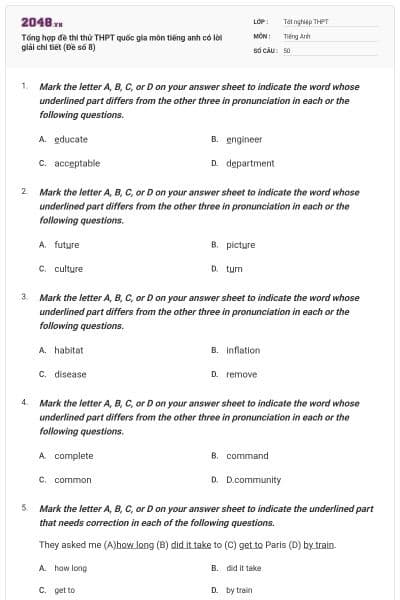
Mark the letter A, B, C, or D on your answer sheet to indicate the word whose underlined part differs from the other three in pronunciation in each or the following questions.
educate
engineer
acceptable
department
Đáp án D
Phần gạch chân đáp án D được phát âm là /i/, các đáp án còn lại được phát âm là /e/.
A. educate /ˈedʒ.u.keɪt/ (n): giáo dục.
B. engineer /ˌen.dʒɪˈnɪər/ (n): kĩ sư.
C. acceptable /əkˈsep.tə.bəl/ (adj): có thể chấp nhận được.
D. department /dɪˈpɑːrt.mənt/ (n): căn hộ.
Mark the letter A, B, C, or D on your answer sheet to indicate the word whose underlined part differs from the other three in pronunciation in each or the following questions.
future
picture
culture
turn
Đáp án D
Phần gạch chân đáp án D được phát âm là /ɚ/, các đáp án còn lại được phát âm là /ɝː/.
A. future /ˈfjuː.tʃɚ/ (n): tương lai.
B. picture /ˈpɪk.tʃɚ/(n): bức họa, hình ảnh.
C. culture /ˈkʌl.tʃɚ/ (n): văn hóa.
D. turn /tɝːn/ (n+v): vòng quay, rẽ hướng,…
Mark the letter A, B, C, or D on your answer sheet to indicate the word whose underlined part differs from the other three in pronunciation in each or the following questions.
habitat
inflation
disease
remove
Đáp án A
Trọng âm rơi vào âm tiết thứ nhất, các đáp án còn lại rơi vào âm tiết thứ 2.
A. habitat /ˈhæ.bɪ.tæt/ (n): môi trường sống, nơi ở.
B. inflation /ɪnˈfleɪ.ʃən/ (n): sự thổi phồng, sự lạm phát.
C. disease /dɪˈziːz/ (n): bệnh tật.
D. remove /rɪˈmuːv/ (v): dời đi, tháo ra, loại bỏ,…
Mark the letter A, B, C, or D on your answer sheet to indicate the word whose underlined part differs from the other three in pronunciation in each or the following questions.
complete
command
common
D.community
Đáp án C
Trọng âm rơi vào âm tiết thứ nhất, các đáp án còn lại rơi vào âm tiết thứ 2.
A. complete /kəmˈpliːt/ (v): hoàn thành.
B. command /kəˈmænd/ (n+v): mệnh lệnh, ra lệnh.
C. common /ˈkɒ.mən/ (adj); chung, phổ biến.
D.community /kəˈmjuː.nə.ti/ (n): cộng đồng.
Mark the letter A, B, C, or D on your answer sheet to indicate the underlined part that needs correction in each of the following questions.
They asked me (A)how long (B) did it take to (C) get to Paris (D) by train.
how long
did it take
get to
by train
Đáp án B
Sửa did it take => it took.
Câu hỏi dạng wh.question trong câu gián tiếp phải ở dạng khẳng định.
Dịch: Họ hỏi tôi mất bao lâu để đi tàu tới Paris
Mark the letter A, B, C, or D on your answer sheet to indicate the underlined part that needs correction in each of the following questions.
(A) After driving for twenty miles., he (B) suddenly realized that he (C) has been driving (D) in the wrong direction.
After driving
suddenly realized
has been drivin
in the wrong direction
Đáp án: C
Giải thích:
Sự việc đã xảy ra trong quá khứ (realized) nên ta không thể chia Hiện tại hoàn thành tiếp diễn (have/has been V-ing), mà phải chia về Quá khứ hoàn thành tiếp diễn (had been V-ing).
Phân biệt 2 thì:
+ Thì Hiện tại hoàn thành tiếp diễn: Diễn tả hành động xảy ra trong quá khứ, tiếp tục tới hiện tại và để lại dấu hiệu ở hiện tại, có xu hướng tiếp diễn tới tương lai và nhấn mạnh tới quá trình của hành động.
+ Thì Quá khứ hoàn thành tiếp diễn: Diễn tả hành động đang xảy ra trước 1 hành động khác trong quá khứ, nhấn mạnh tới quá trình.
Sửa has been driving → had been driving
Dịch: Sau khi lái xe được 20 dặm, anh ấy chợt nhận ra rằng anh ấy đã đi nhầm đường.
Mark the letter A, B, C, or D on your answer sheet to indicate the underlined part that needs correction in each of the following questions.
(A)Because the Red Cross (B) accepts blood from most donors, the nurses will not let you (C) give blood if you have just (D) had a cold
Because
accepts
give
had
Đáp án A
Sửa Because => Although/Though.
Cấu trúc: Although/Though S V O, S V O (Mặc dù…, nhưng…).
Nghĩa ở 2 mệnh đề này đối lập nhau nên ta cần sử dụng Liên từ chỉ sự đối lập.
Dịch: Mặc dù Hội chữ thập đỏ chấp nhận máu từ hầu hết những người tới hiến, nhưng các y tá sẽ không để bạn cho máu nếu bạn vừa bị cảm lạnh
Mark the letter A, B, C, or D on your answer sheet to indicate the correct answer to each of the following questions.
In Vietnam, application forms for the National Entrance Examinations must be ______ before the deadline, often in April.
issued
signed
filed
submitted
Đáp án D
A. issue (v): phát hành, in ra.
B. sign (v): kí tên, ra hiệu.
C. file (v): sắp xếp (giấy má, thư từ…), đệ trình (văn kiện,…).
D. submit (v): nộp.
Dịch: Ở Việt Nam, đơn đăng kí tham dự vào kì thi Trung học phổ thông quốc gia phải được nộp trước hạn, thường là vào tháng 4.
He walked______ I could not catch up with him.
fast
so fast that
as fast as
faster than
Đáp án B
Cấu trúc: S V + so adv (adj- trong trường hợp V là tobe) + that S V O: quá như thế nào đến nỗi mà.
Dịch: Anh ấy đi nhanh đến nỗi mà tôi không thể theo kịp.
It is high time we______ something to protect our environment
do
to do
did
have done
Đáp án C
Cấu trúc: It tobe (high) time + S V-ed: Đã đến lúc ai đó phải làm gì.
Dịch: Đã đến lúc chúng ta phải làm gì đó để cứu lấy môi trường.
The more______ you are, the easier it is for you to make friends.
reserved
funny
sociable
social
Đáp án C
A. reserved (adj): kín kẽ, rụt rè.
B. funny (adj): hài hước.
C. sociable (adj): cởi mở, hoàn đồng, chan hòa.
D. social (adj): thuộc về xã hội- tính từ này không dùng để nói về tính cách con người.
Dịch: Bạn càng cởi mở thì bạn càng dễ kết bạn.
I can______ with most things but I cannot stand noisy children.
put up
put on
put aside
put off
Đáp án A
(to) put up with = (to) tolerate: chịu đựng.
Các đáp án còn lại:
B. put on: mặc quần áo, tăng cân, lừa dối.
C. put aside: để dành.
D. put off: trì hoãn
Dịch: Tôi có thể chịu đựng được nhiều thứ nhưng tôi không thể chịu đựng đươc lũ trẻ ồn ào.
Neither the students nor their lecturer______ English in the classroom.
use
are using
uses
have used
Đáp án C
Chủ điểm ngữ pháp liên quan tới Hài hòa giữa chủ ngữ và động từ.
Ta có: Neither S1 nor S2 + V- chia theo S2 (Không…cũng không…)
Dịch: Cả sinh viên và giảng viên đều không sử dụng Tiếng Anh trong lớp học.
______ she can buy everything she likes.
So rich is she that
So rich she is that
Such rich is she that
All are right
Đáp án A
Đảo ngữ dạng câu …so…that… (Qúa như thế nào tới nỗi mà): So adj/adv + aux+ S + that S V O.
Các đáp án còn lại sai ngữ pháp.
Dịch: Cô ấy giàu tới nỗi mà cô ấy có thể mua được mọi thứ cô ấy thích
This is the second time______.
you are losing your door key.
you've lost your door key.
you were losing your door key.
your door key was lost by you.
Đáp án B
Dùng thì Hiện tại hoàn thành (have/has PII) để chỉ hành động đã xảy ra trong quá khứ, tiếp tục ở hiện tại và có thể tiếp diễn tới tương lai.
Dịch: Đây là lần thứ 2 cậu làm mất chìa khóa cửa.
The man______is very friendly.
that lives next door
who live next door
which lives next door
who lives the next door
Đáp án A
Đại từ quan hệ (ĐTQH) who thay thế cho danh từ chỉ người, đóng chức năng làm chủ ngữ.
ĐTQH which thay thế cho danh từ chỉ vật, đóng chức năng làm chủ ngữ hoặc tân ngữ.
ĐTQH that có thể thay thế cho who, whom, which trong Mệnh đề quan hệ xác định.
Các đáp án còn lại:
Đáp án B chia sai động từ, the man- 1 người đàn ông là số ít => lives.
Đáp án C dùng sai MĐQH.
Đáp án D thừa mạo từ the, ta có: (to) live next door: sống gần nhà, sống sát vách.
Dịch: Người đàn ông sống bên cạnh rất là thân thiện.
Universities send letters of______to successful candidates by post.
accept
acceptable
acceptably
acceptance
Đáp án D
Letters of acceptance: thư chấp thuận, giấy báo trúng tuyển.
Dịch: Trường đại học gửi giấy báo trúng tuyển tới các sĩ tử (ứng viên) thành công qua đường bưu điện
If you do not learn seriously, ______to understand the subject well
you will never be able
will you never be able
never you will be able
will never you be able
Đáp án A
Cấu trúc câu điều kiện loại 1: If S V(s/es), S will V.
Dùng để chỉ giả định có thể xảy ra ở hiện tại hoặc tương lai.
Trạng từ never (không bao giờ) đứng sau trợ động từ và trước tobe.
Dịch: Nếu cậu không học hành tử tế, cậu sẽ không bao giờ hiểu được bài.
His research has not been able to be ______because of a financial difficulty.
set up
put off
turned on
carried out
Đáp án D
A. set up = establish (v): thành lập.
B. put off = postpone, delay: trì hõa.
C. turn on: mở, bật (các thiết bị điện).
D. carry out: tiến hành, thực hiện.
Dịch: Nghiên cứu của ông ta đã không có khả năng tiến hành do tình hình tài chính khó khăn.
- Tim: “Let's go to Fuji for our summer holiday!”.
- Tom:“______”.
How about you?
What's the matter
Not at all
OK. It sounds good
Đáp án D
- Tim: “Hãy tới Fuji vào dịp nghỉ hè nào!”.
-Tom: “Được. Nghe hay đấy”
Chú ý: Cấu trúc câu gợi ý, rủ rê: Let’s V-inf.
Các đáp án còn lại không phù hợp.
A. Thế còn cậu thì sao?
B. Có vấn đề gì vậy?
C. Không có chi.
- Lora.: “Sorry, the manager is not here”.
-Jane:“______”.
Can I take a message then
Can I speak to the manager, please?
Would you like to leave a message
Can I leave a message then
Đáp án D
-Lora: “Xin lỗi, người quản lí không có ở đây”.
-Jane: “Tôi có thể để lại lời nhắn được không?”
Các đáp án còn lại không phù hợp:
A. Bạn có nhắn lại gì không?
B. Tôi có thể nói chuyện với người quản lí được không, làm ơn?
C. Bạn có muốn để lại lời nhắn không?
Mark the letter A, B, C, or D on your answer sheet to indicate the word(s) CLOSEST in meaning to the underlined word(s) in each of the following questions.
He's really delighted with his success
pleased
angry
entertained
annoyed
Đáp án A
Tobe delighted = A. tobe pleased: vui mừng, hài lòng.
Các đáp án còn lại:
B. angry (adj): tức giận.
C. entertain (v): vui chơi, tiêu khiển.
D. annoyed (adj): bực mình, phiền hà >< Tobe delighted.
Dịch: Anh ấy thực sự hài lòng với thành công của mình.
Mark the letter A, B, C, or D on your answer sheet to indicate the word(s) CLOSEST in meaning to the underlined word(s) in each of the following questions.
Try to eliminate fatty foods from your diet.
limit
move
add
get rid of
Đáp án D
(to) elimimate = D. (to) get rid of: loại bỏ.
Các đáp án còn lại:
A. limit (n+v): giới hạn.
B. move (v): di chuyển.
C. add (v): thêm vào.
Dịch: Cố gắng loại bỏ những thực phẩm chứa nhiều chất béo ra khỏi chế độ ăn hằng ngày của bạn.
Mark the letter A, B C, or D on your answer sheet to indicate the word(s) OPPOSITE in meaning to the underlined word(s) in each of the following questions.
Those clothes are inappropriate for this morning.
improper
attractive
suitable
available
Đáp án C
inappropriate (adj): không thích hợp >< C. suitable (adj): phù hợp, thích hợp.
Các đáp án còn lại:
A. improper (adj) = inappropriate (adj): không thích hợp.
B. attractive (adj): thu hút, quyến rũ.
D. available (adj): có sẵn.
Dịch: Bộ quần áo này không thích hợp cho buổi sáng.
Mark the letter A, B C, or D on your answer sheet to indicate the word(s) OPPOSITE in meaning to the underlined word(s) in each of the following questions.
She is a very. generous woman. She has given most of her wealth to a charity organization.
mean
amicable
kind
hospitable
Đáp án A
Generous (adj): hào phóng >< mean (adj): keo kiệt.
Các đáp án còn lại:
B. amicable (adj): thân mật, thân tình.
C. kind (adj): tốt bụng.
D. hospitable (adj): hiếu khách.
Dịch: Bà ấy là một người phụ nữ hào hiệp. Bà đã trao cả gia tài của mình cho một tổ chức từ thiện.
Mark the letter A, B, C, or D on your answer sheet to indicate the sentence that Is closest in meaning to each of the following questions.
People say that he gets a high salary.
It is said that he gets a high salary.
It is said for him to get high salary.
He is said that he gets a high salary.
That he gets a high salary is said.
Đáp án A
Câu gián tiếp: People say that S V O = It is said that S V O.
Dịch: Mọi người nói rằng anh ấy nhận lương rất cao
Mark the letter A, B, C, or D on your answer sheet to indicate the sentence that Is closest in meaning to each of the following questions.
It’s high time you started revising for the coming exam
I think you should start revising for the coming exam right now
Revising for the coming exam takes your time
It’s time to come to the exam after revising
The time is high because you started revising for the coming exam
Đáp án A
Đã đến lúc cậu nên bắt đầu ôn tập lại cho bài kiểm tra sắp tới.
= A.Tớ nghĩ là cậu nên bắt đầu ôn tập lại cho bài kiểm tra sắp tới.
Chú ý: It tobe (high) time + S V-ed: Đã đến lúc ai đó nên làm gì.
Các đáp án còn lại sai nghĩa:
B. Ôn tập lại cho bài kiểm tra sắp tới làm mất thời gian của cậu.
C. Đã đến lúc sắp có bài kiểm tra sau khi ôn tập lại.
D. Thời gian này là cao điểm bởi vì cậu đã bắt đầu ôn tập lại cho bài kiểm tra sắp tới.
Mark the letter A, B, C, or D on your answer sheet to indicate the sentence that Is closest in meaning to each of the following questions.
This film is interesting but the film we saw last week was more interesting.
The film we saw last week was as interesting as this one
The film we saw last week was less interesting than this one
The film we saw last week was more interesting as this one
The film we saw last week was more interesting than this one
Đáp án: D
Giải thích:
Công thức so sánh hơn: S + to be + adj-er/more adj + than N/pronoun.
Công thức so sánh bằng: S + to be + as adj as + N/pronoun.
Dịch: Bộ phim này thú vị nhưng bộ phim chúng ta xem tuần trước thú vị hơn.
= D. Bộ phim chúng ta xem tuần trước thú vị hơn bộ phim này.
A. sai ở “more interesting as”
B. Bộ phim chúng ta đã xem tuần trước cũng thú vị như bộ phim này. → sai về nghĩa
C. Bộ phim chúng ta đã xem tuần trước kém thú vị hơn bộ phim này. → sai về nghĩa
Mark the letter A, B, C, or D on your answer sheet to indicate the sentence that best combines each pair of sentences in the following questions.
The weather was very hot. They continued playing football.
Although the hot weather, they continued playing football
In spite of the hot weather, they continued playing football
In spite of the weather was hot, they continued playing football
Despite the weather was hot, they continued playing football
Đáp án B
Thời tiết rất nóng. Họ tiếp tục chơi bóng.
= B. Mặc dù thời tiết rất nóng, nhưng họ vẫn tiếp tục chơi bóng.
Cấu trúc câu tương phải, đối lập: Although/Though + S V O, S V O. (Mặc dù…, nhưng…).
In spite of/Despite + N/V-ing, S V O.
Các đáp án còn lại sai cấu trúc ngữ pháp.
Mark the letter A, B, C, or D on your answer sheet to indicate the sentence that best combines each pair of sentences in the following questions.
She helped us a lot with our project. We couldn't continue without her.
Provided her contribution wouldn't come, we couldn't have continued with the project.
Unless we had her contribution, we couldn't have continued with the project
If she hadn't contributed positively, we couldn't have continued with the project
But for her contribution, we could have continued with the project
Đáp án C
Cô ấy đã giúp đỡ chúng tôi rất nhiều về dự án. Chúng tôi đã không thể tiếp tục nếu không có cô ấy.
= C. Nếu cô ấy không đóng góp tích cực, thì chúng tôi đã không thể tiếp tục cùng với dự án.
Câu điều kiện loại 3: If S had PII, S would have PII.
Chỉ một giả định không có thật trong quá khứ.
Các đáp án còn lại:
A, B- sai cấu trúc câu điều kiện.
D- sai nghĩa: Nếu không có sự đóng góp của cô ấy, thì chúng tôi đã tiếp tục được cùng với dự án.
Read the following passage and mark the letter A, B, C, or D on your answer sheet to in the correct word or phrase that best fits each of the numbered blanks from 31 to 35.
Singapore has a highly developed market-based economy, (31) ______historically revolves around extended trade. Along with Hong Kong, South Korea and Taiwan, Singapore is one (32) ______The Four Asian Tigers. The economy depends heavily on exports , refining, imported goods, especially in manufacturing. Manufacturing constituted 26 (33) ______of Singapore's GDP in 2005. The manufacturing industry is well-diversified into electronics, petroleum refining, chemicals, (34) ______engineering and biomedical sciences manufacturing. In 2006. Singapore produced about 10 percent of the world’s foundry water output. Singapore is the busiest port in the world in terms of tonnage shipped. Singapore is the world's fourth largest foreign exchange trading centre after London, New York City (35) ______Tokyo.
Điền ô số 31
who
whom
why
which
Đáp án D
Đại từ quan hệ (ĐTQH) which thay thế cho cả mệnh đề đứng trước dấu phẩy.
Các đáp án còn lại:
A. ĐTQH who thay thế cho danh từ chỉ người, đóng chức năng làm chủ ngữ.
B. ĐTQH whom thay thế cho danh từ chỉ người, đóng chức năng làm tân ngữ.
C. ĐTQH why chỉ lí do, nguyên nhân.
Dịch: Singapore là nước có nền kinh tế thị trường phát triển mạnh, điều đó tập trung vào thương mại mở rộng nhìn trên phương diện lịch sử
Read the following passage and mark the letter A, B, C, or D on your answer sheet to in the correct word or phrase that best fits each of the numbered blanks from 31 to 35.
Singapore has a highly developed market-based economy, (31) ______historically revolves around extended trade. Along with Hong Kong, South Korea and Taiwan, Singapore is one (32) ______The Four Asian Tigers. The economy depends heavily on exports , refining, imported goods, especially in manufacturing. Manufacturing constituted 26 (33) ______of Singapore's GDP in 2005. The manufacturing industry is well-diversified into electronics, petroleum refining, chemicals, (34) ______engineering and biomedical sciences manufacturing. In 2006. Singapore produced about 10 percent of the world’s foundry water output. Singapore is the busiest port in the world in terms of tonnage shipped. Singapore is the world's fourth largest foreign exchange trading centre after London, New York City (35) ______Tokyo.
Điền ô số 32
of
in
for
at
Đáp án A
…is one of…: …là 1 trong…
Dịch: Cùng với Hồng Kông, Hàn Quốc và Đài Loan, Singapore là 1 trong 4 con hổ Châu Á.
Read the following passage and mark the letter A, B, C, or D on your answer sheet to in the correct word or phrase that best fits each of the numbered blanks from 31 to 35.
Singapore has a highly developed market-based economy, (31) ______historically revolves around extended trade. Along with Hong Kong, South Korea and Taiwan, Singapore is one (32) ______The Four Asian Tigers. The economy depends heavily on exports , refining, imported goods, especially in manufacturing. Manufacturing constituted 26 (33) ______of Singapore's GDP in 2005. The manufacturing industry is well-diversified into electronics, petroleum refining, chemicals, (34) ______engineering and biomedical sciences manufacturing. In 2006. Singapore produced about 10 percent of the world’s foundry water output. Singapore is the busiest port in the world in terms of tonnage shipped. Singapore is the world's fourth largest foreign exchange trading centre after London, New York City (35) ______Tokyo.
Điền ô số 33
percentage
persuasion
perception
percent
Đáp án D
Percent nghĩa là phần trăm, được kí hiệu là “%” .
Các đáp án còn lại:
A. percentage (n): tỷ lệ phần trăm, một phần.
B. persuasion (n): sự thuyết phục.
C. perception (n): sự nhận thức, sự am hiểu.
Dịch: Sản xuất chiếm 26% GPD của Singapore vào năm 2005
Read the following passage and mark the letter A, B, C, or D on your answer sheet to in the correct word or phrase that best fits each of the numbered blanks from 31 to 35.
Singapore has a highly developed market-based economy, (31) ______historically revolves around extended trade. Along with Hong Kong, South Korea and Taiwan, Singapore is one (32) ______The Four Asian Tigers. The economy depends heavily on exports , refining, imported goods, especially in manufacturing. Manufacturing constituted 26 (33) ______of Singapore's GDP in 2005. The manufacturing industry is well-diversified into electronics, petroleum refining, chemicals, (34) ______engineering and biomedical sciences manufacturing. In 2006. Singapore produced about 10 percent of the world’s foundry water output. Singapore is the busiest port in the world in terms of tonnage shipped. Singapore is the world's fourth largest foreign exchange trading centre after London, New York City (35) ______Tokyo.
Điền ô số 34
machine
mechanical
mechanically
mechanic
Đáp án B
Cụm danh từ: mechanical engineering: kĩ thuật cơ khí.
A. machine (n): máy móc.
C. mechanically (adj): bằng cơ học, máy móc.
D. mechanic (n): thợ máy, công nhân cơ khí.
Dịch: Ngành công nghiệp chế tạo được đa dạng hóa thành điện tử, lọc dầu, hóa chất, kĩ thuật cơ khí và khoa học y sinh.
Read the following passage and mark the letter A, B, C, or D on your answer sheet to in the correct word or phrase that best fits each of the numbered blanks from 31 to 35.
Singapore has a highly developed market-based economy, (31) ______historically revolves around extended trade. Along with Hong Kong, South Korea and Taiwan, Singapore is one (32) ______The Four Asian Tigers. The economy depends heavily on exports , refining, imported goods, especially in manufacturing. Manufacturing constituted 26 (33) ______of Singapore's GDP in 2005. The manufacturing industry is well-diversified into electronics, petroleum refining, chemicals, (34) ______engineering and biomedical sciences manufacturing. In 2006. Singapore produced about 10 percent of the world’s foundry water output. Singapore is the busiest port in the world in terms of tonnage shipped. Singapore is the world's fourth largest foreign exchange trading centre after London, New York City (35) ______Tokyo.
Điền ô số 35
and
but
or
so
Đáp án A
A. and: và.
B. but: nhưng.
C. or: hoặc.
D. so: nên.
Dịch: Singapore là trung tâm giao dịch ngoại hối lớn thứ tư trên thế giới, đứng sau London, New York và Tokyo.
Read the following passage and mark the letter A, B, C, or D on your answer sheet to indicate the correct answer to each ofthe questions from 36 to 42.
American movies create myths about college life in the United States. These stories are entertaining, but they are not true. You have to look beyond Hollywood movies to understand what college is really like.
Thanks to the movies, many people believe that college students party and socialize more than they study. Movies almost never show students working hard in class or in the library. Instead, movies show them eating, talking, hanging out, or dancing to loud music at wild parties. While it is true that American students have the freedom to participate in activities, they also have academic responsibilities. In order to succeed, they have to attend classes and study hard.
Another movie myth is that athletics is the only important extracurricular activity. In fact, there is a wide variety of nonacademic activities on campus such as special clubs, service organizations, art, and theater programs. This variety allows students to choose what interests them. Even more important, after graduation, students' résumés look better to employers if they list a few extracurricular activities.
Most students in the movies can easily afford higher education. If only this were true! While it is true that some American college students are wealthy, most are from families with moderate incomes. Up to 80% of them get some type of financial aid. Students from middle and lower-income families often work part-time throughout their college years. There is one thing that many college students have in common, but it is not something you will see in the movies. They have parents who think higher education is a priority, a necessary and important part of their children's lives.
Movies about college life usually have characters that are extreme in some way: super athletic, super intelligent, super wealthy, super glamorous, etc. Movies use these stereotypes, along with other myths of romance and adventure because audiences like going to movies that include these elements. Of course, real college students are not like movie characters at all.
So the next time you want a taste of the college experience, do not go to the movies. Look at some college websites or brochures instead. Take a walk around your local college campus. Visit a few classes. True, you may not be able to see the same people or exciting action you will see in the movies, but you can be sure that there are plenty of academic adventures going on all around you.
The story about college life in Amerian movies are not ______.
true
interesting
boring
exciting
Đáp án A
Câu chuyện vể cuộc sống sinh viên trong những bộ phim Mĩ không______.
A. đúng sự thật
B. thú vị
C. nhàm chán
D. hứng thú.
Dẫn chứng ở 2 câu đầu-đoạn 1: “American movies create myths about college life in the United States. These stories are entertaining, but they are not true” – (Phim Mĩ đã tạo ra những câu chuyện hoang đường về cuộc sống đại học ở Mĩ. Những câu chuyện đó có tính giải trí và chúng đều không đúng sự thật).
Read the following passage and mark the letter A, B, C, or D on your answer sheet to indicate the correct answer to each ofthe questions from 36 to 42.
American movies create myths about college life in the United States. These stories are entertaining, but they are not true. You have to look beyond Hollywood movies to understand what college is really like.
Thanks to the movies, many people believe that college students party and socialize more than they study. Movies almost never show students working hard in class or in the library. Instead, movies show them eating, talking, hanging out, or dancing to loud music at wild parties. While it is true that American students have the freedom to participate in activities, they also have academic responsibilities. In order to succeed, they have to attend classes and study hard.
Another movie myth is that athletics is the only important extracurricular activity. In fact, there is a wide variety of nonacademic activities on campus such as special clubs, service organizations, art, and theater programs. This variety allows students to choose what interests them. Even more important, after graduation, students' résumés look better to employers if they list a few extracurricular activities.
Most students in the movies can easily afford higher education. If only this were true! While it is true that some American college students are wealthy, most are from families with moderate incomes. Up to 80% of them get some type of financial aid. Students from middle and lower-income families often work part-time throughout their college years. There is one thing that many college students have in common, but it is not something you will see in the movies. They have parents who think higher education is a priority, a necessary and important part of their children's lives.
Movies about college life usually have characters that are extreme in some way: super athletic, super intelligent, super wealthy, super glamorous, etc. Movies use these stereotypes, along with other myths of romance and adventure because audiences like going to movies that include these elements. Of course, real college students are not like movie characters at all.
So the next time you want a taste of the college experience, do not go to the movies. Look at some college websites or brochures instead. Take a walk around your local college campus. Visit a few classes. True, you may not be able to see the same people or exciting action you will see in the movies, but you can be sure that there are plenty of academic adventures going on all around you.
The phrase “academic responsibilities” in the second paragraph is closest in meaning to ______.
learning duties
training skills
caring professions
teaching methods
Đáp án A
Cụm từ “academic responsibilities” ở đoạn 2 đồng nghĩa với ______.
A. trách nhiệm học tập.
B. kĩ năng đào tạo.
C. nghề nghiệp chăm sóc.
D. kĩ năng giảng dạy.
Cụm danh từ: academic responsibilities: trách nhiệm học tập = A. learning duties.
Read the following passage and mark the letter A, B, C, or D on your answer sheet to indicate the correct answer to each ofthe questions from 36 to 42.
American movies create myths about college life in the United States. These stories are entertaining, but they are not true. You have to look beyond Hollywood movies to understand what college is really like.
Thanks to the movies, many people believe that college students party and socialize more than they study. Movies almost never show students working hard in class or in the library. Instead, movies show them eating, talking, hanging out, or dancing to loud music at wild parties. While it is true that American students have the freedom to participate in activities, they also have academic responsibilities. In order to succeed, they have to attend classes and study hard.
Another movie myth is that athletics is the only important extracurricular activity. In fact, there is a wide variety of nonacademic activities on campus such as special clubs, service organizations, art, and theater programs. This variety allows students to choose what interests them. Even more important, after graduation, students' résumés look better to employers if they list a few extracurricular activities.
Most students in the movies can easily afford higher education. If only this were true! While it is true that some American college students are wealthy, most are from families with moderate incomes. Up to 80% of them get some type of financial aid. Students from middle and lower-income families often work part-time throughout their college years. There is one thing that many college students have in common, but it is not something you will see in the movies. They have parents who think higher education is a priority, a necessary and important part of their children's lives.
Movies about college life usually have characters that are extreme in some way: super athletic, super intelligent, super wealthy, super glamorous, etc. Movies use these stereotypes, along with other myths of romance and adventure because audiences like going to movies that include these elements. Of course, real college students are not like movie characters at all.
So the next time you want a taste of the college experience, do not go to the movies. Look at some college websites or brochures instead. Take a walk around your local college campus. Visit a few classes. True, you may not be able to see the same people or exciting action you will see in the movies, but you can be sure that there are plenty of academic adventures going on all around you.
Which of the following is NOT true?
Learning is only part of students’ college life.
There is a wide choice of extracurricular activities for college students.
Extracurricular activities are of no importance to employers.
Not all extracurricular activities are students' academic responsibilities.
Đáp án C
Câu nào sau đây không đúng?
A. Học tập chỉ là 1 phần của cuộc sống sinh viên đại học.
B. Có nhiều sự lựa chọn về hoạt động ngoại khóa dành cho sinh viên đại học.
C. Hoạt động ngoại khóa không quan trọng đối với những người đi làm.
D. Không phải tất cả hoạt động ngoại khóa đều là trách nhiệm học tập của sinh viên.
Dẫn chứng ở câu cuối đoạn 3: “Even more important, after graduation, students' résumés look better to employers if they list a few extracurricular activities” – (Thậm chí quan trọng hơn, sau khi tốt nghiệp, những bản hồ sơ xin việc trông sẽ có thiện cảm hơn đối với những nhà tuyển dụng nếu chúng liệt kê ra được một vài hoạt động ngoại khóa)
=> C sai.
Read the following passage and mark the letter A, B, C, or D on your answer sheet to indicate the correct answer to each ofthe questions from 36 to 42.
American movies create myths about college life in the United States. These stories are entertaining, but they are not true. You have to look beyond Hollywood movies to understand what college is really like.
Thanks to the movies, many people believe that college students party and socialize more than they study. Movies almost never show students working hard in class or in the library. Instead, movies show them eating, talking, hanging out, or dancing to loud music at wild parties. While it is true that American students have the freedom to participate in activities, they also have academic responsibilities. In order to succeed, they have to attend classes and study hard.
Another movie myth is that athletics is the only important extracurricular activity. In fact, there is a wide variety of nonacademic activities on campus such as special clubs, service organizations, art, and theater programs. This variety allows students to choose what interests them. Even more important, after graduation, students' résumés look better to employers if they list a few extracurricular activities.
Most students in the movies can easily afford higher education. If only this were true! While it is true that some American college students are wealthy, most are from families with moderate incomes. Up to 80% of them get some type of financial aid. Students from middle and lower-income families often work part-time throughout their college years. There is one thing that many college students have in common, but it is not something you will see in the movies. They have parents who think higher education is a priority, a necessary and important part of their children's lives.
Movies about college life usually have characters that are extreme in some way: super athletic, super intelligent, super wealthy, super glamorous, etc. Movies use these stereotypes, along with other myths of romance and adventure because audiences like going to movies that include these elements. Of course, real college students are not like movie characters at all.
So the next time you want a taste of the college experience, do not go to the movies. Look at some college websites or brochures instead. Take a walk around your local college campus. Visit a few classes. True, you may not be able to see the same people or exciting action you will see in the movies, but you can be sure that there are plenty of academic adventures going on all around you.
The word “they” in the third paragraph refers to ______.
employers
activities
colleges
résumés
Đáp án D
Từ “they” ở đoạn 3 ám chỉ tới ______.
A. những nhà tuyển dụng
B. những hoạt động.
C. những trường đại học
D. bản lý lịch xin việc
Tạm dịch: “Even more important, after graduation, students' résumés look better to employers if they list a few extracurricular activities” – (Thậm chí quan trọng hơn, sau khi tốt nghiệp, những bản hồ sơ xin việc trông sẽ có thiện cảm hơn đối với những nhà tuyển dụng nếu chúng liệt kê ra được một và hoạt động ngoại khóa).
Read the following passage and mark the letter A, B, C, or D on your answer sheet to indicate the correct answer to each ofthe questions from 36 to 42.
American movies create myths about college life in the United States. These stories are entertaining, but they are not true. You have to look beyond Hollywood movies to understand what college is really like.
Thanks to the movies, many people believe that college students party and socialize more than they study. Movies almost never show students working hard in class or in the library. Instead, movies show them eating, talking, hanging out, or dancing to loud music at wild parties. While it is true that American students have the freedom to participate in activities, they also have academic responsibilities. In order to succeed, they have to attend classes and study hard.
Another movie myth is that athletics is the only important extracurricular activity. In fact, there is a wide variety of nonacademic activities on campus such as special clubs, service organizations, art, and theater programs. This variety allows students to choose what interests them. Even more important, after graduation, students' résumés look better to employers if they list a few extracurricular activities.
Most students in the movies can easily afford higher education. If only this were true! While it is true that some American college students are wealthy, most are from families with moderate incomes. Up to 80% of them get some type of financial aid. Students from middle and lower-income families often work part-time throughout their college years. There is one thing that many college students have in common, but it is not something you will see in the movies. They have parents who think higher education is a priority, a necessary and important part of their children's lives.
Movies about college life usually have characters that are extreme in some way: super athletic, super intelligent, super wealthy, super glamorous, etc. Movies use these stereotypes, along with other myths of romance and adventure because audiences like going to movies that include these elements. Of course, real college students are not like movie characters at all.
So the next time you want a taste of the college experience, do not go to the movies. Look at some college websites or brochures instead. Take a walk around your local college campus. Visit a few classes. True, you may not be able to see the same people or exciting action you will see in the movies, but you can be sure that there are plenty of academic adventures going on all around you.
The word “moderate” in the fourth paragraph is closest in meaning to ______.
not high
unlimited
not steady
sensible
Đáp án A
Câu hỏi từ vựng:
moderate (adj): vừa phải, trung bình = A. not high: không cao.
Các đáp án còn lại:
B. unlimited (adj): không giới hạn.
C. not steady: không ổn định.
D. sensible (adj): có óc phán đoán.
Tạm dịch: “While it is true that some American college students are wealthy, most are from families with moderate incomes”- (Trong khi đúng rằng có một số sinh viên Mĩ là giàu có, nhưng phần đông là xuất thân từ những gia đình có thu nhập trung bình).
Read the following passage and mark the letter A, B, C, or D on your answer sheet to indicate the correct answer to each ofthe questions from 36 to 42.
American movies create myths about college life in the United States. These stories are entertaining, but they are not true. You have to look beyond Hollywood movies to understand what college is really like.
Thanks to the movies, many people believe that college students party and socialize more than they study. Movies almost never show students working hard in class or in the library. Instead, movies show them eating, talking, hanging out, or dancing to loud music at wild parties. While it is true that American students have the freedom to participate in activities, they also have academic responsibilities. In order to succeed, they have to attend classes and study hard.
Another movie myth is that athletics is the only important extracurricular activity. In fact, there is a wide variety of nonacademic activities on campus such as special clubs, service organizations, art, and theater programs. This variety allows students to choose what interests them. Even more important, after graduation, students' résumés look better to employers if they list a few extracurricular activities.
Most students in the movies can easily afford higher education. If only this were true! While it is true that some American college students are wealthy, most are from families with moderate incomes. Up to 80% of them get some type of financial aid. Students from middle and lower-income families often work part-time throughout their college years. There is one thing that many college students have in common, but it is not something you will see in the movies. They have parents who think higher education is a priority, a necessary and important part of their children's lives.
Movies about college life usually have characters that are extreme in some way: super athletic, super intelligent, super wealthy, super glamorous, etc. Movies use these stereotypes, along with other myths of romance and adventure because audiences like going to movies that include these elements. Of course, real college students are not like movie characters at all.
So the next time you want a taste of the college experience, do not go to the movies. Look at some college websites or brochures instead. Take a walk around your local college campus. Visit a few classes. True, you may not be able to see the same people or exciting action you will see in the movies, but you can be sure that there are plenty of academic adventures going on all around you.
Many American students have to work part-time throughout their college years because ______.
they are not allowed to work full-time
they want to gain experience.
their parents force them to.
they can earn money for their expenses.
Đáp án D
Nhiều sinh viên Mĩ phải làm việc bán thời gian trong suốt những năm đại học bởi vì ______.
A. Họ không được cho phép đi làm toàn thời gian.
B. Họ muốn có kinh nghiệm.
C. Bố mẹ thúc ép họ.
D. Họ có thể kiếm tiềm cho những kinh phí.
Dẫn chứng ở đoạn 4: “While it is true that some American college students are wealthy, most are from families with moderate incomes. Up to 80% of them get some type of financial aid. Students from middle and lower-income families often work part-time throughout their college years” – (Trong khi đúng rằng có một số sinh viên Mĩ là giàu có, nhưng phần đông là xuất thân từ những gia đình có thu nhập trung bình. Có tới 80% trong số họ nhận trợ cấp tài chính. Những sinh viên xuất thân từ những gia đình có thu nhập thấp hoặc trung bình thường làm việc bán thời gian trong suốt những năm học đại học của họ).
=> Những sinh viên đại học đi làm bán thời gian vì họ muốn có thêm tiền để trang trải những chi phí cuộc sống.
Read the following passage and mark the letter A, B, C, or D on your answer sheet to indicate the correct answer to each ofthe questions from 36 to 42.
American movies create myths about college life in the United States. These stories are entertaining, but they are not true. You have to look beyond Hollywood movies to understand what college is really like.
Thanks to the movies, many people believe that college students party and socialize more than they study. Movies almost never show students working hard in class or in the library. Instead, movies show them eating, talking, hanging out, or dancing to loud music at wild parties. While it is true that American students have the freedom to participate in activities, they also have academic responsibilities. In order to succeed, they have to attend classes and study hard.
Another movie myth is that athletics is the only important extracurricular activity. In fact, there is a wide variety of nonacademic activities on campus such as special clubs, service organizations, art, and theater programs. This variety allows students to choose what interests them. Even more important, after graduation, students' résumés look better to employers if they list a few extracurricular activities.
Most students in the movies can easily afford higher education. If only this were true! While it is true that some American college students are wealthy, most are from families with moderate incomes. Up to 80% of them get some type of financial aid. Students from middle and lower-income families often work part-time throughout their college years. There is one thing that many college students have in common, but it is not something you will see in the movies. They have parents who think higher education is a priority, a necessary and important part of their children's lives.
Movies about college life usually have characters that are extreme in some way: super athletic, super intelligent, super wealthy, super glamorous, etc. Movies use these stereotypes, along with other myths of romance and adventure because audiences like going to movies that include these elements. Of course, real college students are not like movie characters at all.
So the next time you want a taste of the college experience, do not go to the movies. Look at some college websites or brochures instead. Take a walk around your local college campus. Visit a few classes. True, you may not be able to see the same people or exciting action you will see in the movies, but you can be sure that there are plenty of academic adventures going on all around you.
Which of the following could best serve as the title of the passage?
Going to College: The Only Way to Succeed in Life
Hollywood Movies: The Best About College Life
Extracurricular Activities and Job Opportunities
American College Life and the Movies
Đáp án D
Câu nào sau đây có thể là tiêu đề phù hợp nhất cho đoạn văn?
A. Học đại học: Con đường duy nhất để thành công trong cuộc sống.
B. Những bộ phim Hollywood: Những điều chân thật nhất về cuộc sống đại học.
C. Hoạt động ngoại khóa và những cơ hội nghề nghiệp.
D. Cuộc sống đại học ở Mĩ và những bộ phim.
Đoạn văn mở đầu là đoạn khái quát nội dung của bài: “American movies create myths about college life in the United States. These stories are entertaining, but they are not true. You have to look beyond Hollywood movies to understand what college is really like” – (Phim Mĩ đã tạo ra những câu chuyện hoang đường về cuộc sống đại học ở Mĩ. Những câu chuyện đó có tính giải trí và chúng đều không đúng sự thật. Bạn phải nhìn xa hơn ngoài những bộ phim Hollywood để hiểu được đại học thực chất là như thế nào).
Một số ý trong bài bài như:
+ “Thanks to the movies, many people believe that college students party and socialize more than they study. Movies almost never show students working hard in class or in the library. Instead, movies show them eating, talking, hanging out, or dancing to loud music at wild parties” -(Nhờ vào những bộ phim, nhiều người tin rằng sinh viên đại học tiệc tùng và xã giao nhiều hơn là học hành. Những bộ phim hầu như không bao giờ cho thấy những học sinh học tập chăm chỉ trên lớp hoặc trong thư viện. Thay vào đó, chúng cho thấy họ ăn uống, nói chuyện, đi chơi hoặc nhảy nhót dưới âm thanh xập xình trong những bữa tiệu hoang dại).
+ “Another movie myth is that athletics is the only important extracurricular activity. In fact, there is a wide variety of nonacademic activities on campus such as special clubs, service organizations, art, and theater programs” – (Một câu chuyện hoang đường khác trên phim đó là thể thao là một hoạt động ngoại động ngoại khóa quan trọng duy nhất. Trên thực tế, còn có nhiều những hoạt động ngoại khóa khác trên trường như tham gia vào các clb, các tổ chức dịch vụ, các chương trình nghệ thuật và sân khấu).
+ “Most students in the movies can easily afford higher education. If only this were true! While it is true that some American college students are wealthy, most are from families with moderate incomes” (Phần lớn sinh viên trong phim có thể dễ dành chi trả được chương trình giáo dục cao cấp. Giá như điều đó là đúng! Trong khi đúng rằng có một số sinh viên Mĩ là giàu có, nhưng phần đông là xuất thân từ những gia đình có thu nhập trung bình).
=> Bài văn chỉ ra những mâu thuẫn đối lập giữa cuộc sống sinh viên đại học trong phim và ngoài thực tế.
=> Tiêu đề D là phù hợp nhất.
Read the following passage and mark the letter A, B, C, or D on your answer sheet to indicate the correct answer to each of the questions from 43 to 50.
The need for a surgical operation, especially an emergency operation, almost always comes as a severe shock to the patient and his family. Despite modern advances, most people still have an irrational fear of hospitals and anaesthetics. Patients do riot often believe they really need surgery- cutting into a part of the body as opposed to treatment with drugs.
In the early year of the 20th century, there was little specialization in surgery. A good surgeon was capable of performing almost every operation that had been advised up to that time. Today the situation is different. Operations are now being carried out that were not even dreamed of fifty years ago. The heart can be safely opened and its valves repaired. Cloyed blood vessels can be clean out, and broken ones mended and replaced. A lung, the whole stomach, or even part of the brain can be removed and still permit the patient to live a comfortable and satisfactory life. However, not every surgeon wants to, or is qualified to carry out every type of modern operation.
The scope of surgery has increase remarkable in the past decades. Its safety has increased, too. Deaths from most operations are about 20% of what they were in 1910 and surgery has been extended in many directions, for example, to certain types of birth defects in new born babies, and at the other end of the scale, to life-saving operation for the octogenarian .The hospital stay after surgery has been shortened to as little as a week for most major operations. Most patients are out of bed on the day after an operation and may be back at work in two or three weeks.
One of the most revolutionary areas of modern surgery is that of organ transplants. Until a few decades ago, no person, except an identical twins, was able to accept into his body the tissues of another person without reacting against them and eventually killing them. Recently, however, it has been discovered that with the use of X-rays and special drugs, it is possible to graft tissues from one person to another which will survive for periods of a year or more. Kidneys have been successfully transplanted between non-identical twins. Heart and lung transplants have also been reasonably successful.
“Spare parts” surgery, the simple routine replacement of all worn-out organs by new ones, is still a dream of the future but surgery is ready for such miracles. In the meantime, you can be happy if the doctors say to you: “Yes, l think it is possible to operate on you for this condition”.
Most people are afraid of being operated on______.
in spite of improvements in modem surgery
because they think modern drugs are dangerous
because they do not believe they need anesthetics
unless it is an emergency operation
Đáp án A
Nhiều người sợ phẫu thuật______.
A. mặc dù có những tiến bộ trong phẫu thuật hiện đại.
B. bởi vì họ nghĩ rằng thuốc hiện đại gây nguy hiểm.
C. bởi vì họ không tin rằng họ cần gây tê.
D. trừ khi đó là phẫu thuật khẩn cấp.
Dẫn chứng ở 2 câu đầu tiên: “The need for a surgical operation, especially an emergency operation, almost always comes as a severe shock to the patient and his family. Despite modern advances, most people still have an irrational fear of hospitals and anaesthetics”- (Cần thiết phải phẫu thuật, đặc biệt là phẫu thuật cấp cứu, hầu như luôn là cú sốc lớn đối với bệnh nhân và gia đình họ. Mặc dù có sự tiến bộ hiện đại, nhiều người vẫn còn một nỗi sợ vô lí đối với bệnh viện và việc gây tê).
Read the following passage and mark the letter A, B, C, or D on your answer sheet to indicate the correct answer to each of the questions from 43 to 50.
The need for a surgical operation, especially an emergency operation, almost always comes as a severe shock to the patient and his family. Despite modern advances, most people still have an irrational fear of hospitals and anaesthetics. Patients do riot often believe they really need surgery- cutting into a part of the body as opposed to treatment with drugs.
In the early year of the 20th century, there was little specialization in surgery. A good surgeon was capable of performing almost every operation that had been advised up to that time. Today the situation is different. Operations are now being carried out that were not even dreamed of fifty years ago. The heart can be safely opened and its valves repaired. Cloyed blood vessels can be clean out, and broken ones mended and replaced. A lung, the whole stomach, or even part of the brain can be removed and still permit the patient to live a comfortable and satisfactory life. However, not every surgeon wants to, or is qualified to carry out every type of modern operation.
The scope of surgery has increase remarkable in the past decades. Its safety has increased, too. Deaths from most operations are about 20% of what they were in 1910 and surgery has been extended in many directions, for example, to certain types of birth defects in new born babies, and at the other end of the scale, to life-saving operation for the octogenarian .The hospital stay after surgery has been shortened to as little as a week for most major operations. Most patients are out of bed on the day after an operation and may be back at work in two or three weeks.
One of the most revolutionary areas of modern surgery is that of organ transplants. Until a few decades ago, no person, except an identical twins, was able to accept into his body the tissues of another person without reacting against them and eventually killing them. Recently, however, it has been discovered that with the use of X-rays and special drugs, it is possible to graft tissues from one person to another which will survive for periods of a year or more. Kidneys have been successfully transplanted between non-identical twins. Heart and lung transplants have also been reasonably successful.
“Spare parts” surgery, the simple routine replacement of all worn-out organs by new ones, is still a dream of the future but surgery is ready for such miracles. In the meantime, you can be happy if the doctors say to you: “Yes, l think it is possible to operate on you for this condition”.
Surgeons in the early 20th century compared with modern ones ______.
had less to learn about surgery.
needed more knowledge.
were more trusted by their patients.
could perform every operation known today.
Đáp án A
Bác sĩ phẫu thuật trong đầu thế kỉ 20 khi so với hiện nay______.
A. có ít thứ để học hơn về phẫu thuật.
B. cần thêm kiến thức.
C. được nhiều bệnh nhân của họ tin tưởng hơn.
D. có thể thực hiện được mọi ca phẫu thuật được biết tới trong ngày nay.
Dẫn chứng ở câu đầu đoạn 2: “In the early year of the 20th century, there was little specialization in surgery”- (Vào những năm đầu của thế kỉ 20, có rất ít chuyên ngành về phẫu thuật).
Read the following passage and mark the letter A, B, C, or D on your answer sheet to indicate the correct answer to each of the questions from 43 to 50.
The need for a surgical operation, especially an emergency operation, almost always comes as a severe shock to the patient and his family. Despite modern advances, most people still have an irrational fear of hospitals and anaesthetics. Patients do riot often believe they really need surgery- cutting into a part of the body as opposed to treatment with drugs.
In the early year of the 20th century, there was little specialization in surgery. A good surgeon was capable of performing almost every operation that had been advised up to that time. Today the situation is different. Operations are now being carried out that were not even dreamed of fifty years ago. The heart can be safely opened and its valves repaired. Cloyed blood vessels can be clean out, and broken ones mended and replaced. A lung, the whole stomach, or even part of the brain can be removed and still permit the patient to live a comfortable and satisfactory life. However, not every surgeon wants to, or is qualified to carry out every type of modern operation.
The scope of surgery has increase remarkable in the past decades. Its safety has increased, too. Deaths from most operations are about 20% of what they were in 1910 and surgery has been extended in many directions, for example, to certain types of birth defects in new born babies, and at the other end of the scale, to life-saving operation for the octogenarian .The hospital stay after surgery has been shortened to as little as a week for most major operations. Most patients are out of bed on the day after an operation and may be back at work in two or three weeks.
One of the most revolutionary areas of modern surgery is that of organ transplants. Until a few decades ago, no person, except an identical twins, was able to accept into his body the tissues of another person without reacting against them and eventually killing them. Recently, however, it has been discovered that with the use of X-rays and special drugs, it is possible to graft tissues from one person to another which will survive for periods of a year or more. Kidneys have been successfully transplanted between non-identical twins. Heart and lung transplants have also been reasonably successful.
“Spare parts” surgery, the simple routine replacement of all worn-out organs by new ones, is still a dream of the future but surgery is ready for such miracles. In the meantime, you can be happy if the doctors say to you: “Yes, l think it is possible to operate on you for this condition”.
A patient can still live a comfortable life even after the removal of______.
his brain.
a major organ such as the stomach or one lung.
his lungs.
part of the stomach or the whole liver.
Đáp án B
Một bệnh nhân có thể vẫn sống được 1 cuộc sống thoải mái sau khi loại bỏ đi______.
A. bộ não.
B. một cơ quan lớn như dạ dày hoặc một lá phổi.
C. 2 lá phổi.
D. một phần dạ dày hoặc cả lá gan.
Dẫn chứng ở cuối đoạn 2: “A lung, the whole stomach, or even part of the brain can be removed and still permit the patient to live a comfortable and satisfactory life”- (Một lá phổi, toàn bộ dạ dày và thậm chí là một phần của bộ não có thể loại bỏ đi và vẫn cho phép bệnh nhân sống thoải mải).
Read the following passage and mark the letter A, B, C, or D on your answer sheet to indicate the correct answer to each of the questions from 43 to 50.
The need for a surgical operation, especially an emergency operation, almost always comes as a severe shock to the patient and his family. Despite modern advances, most people still have an irrational fear of hospitals and anaesthetics. Patients do riot often believe they really need surgery- cutting into a part of the body as opposed to treatment with drugs.
In the early year of the 20th century, there was little specialization in surgery. A good surgeon was capable of performing almost every operation that had been advised up to that time. Today the situation is different. Operations are now being carried out that were not even dreamed of fifty years ago. The heart can be safely opened and its valves repaired. Cloyed blood vessels can be clean out, and broken ones mended and replaced. A lung, the whole stomach, or even part of the brain can be removed and still permit the patient to live a comfortable and satisfactory life. However, not every surgeon wants to, or is qualified to carry out every type of modern operation.
The scope of surgery has increase remarkable in the past decades. Its safety has increased, too. Deaths from most operations are about 20% of what they were in 1910 and surgery has been extended in many directions, for example, to certain types of birth defects in new born babies, and at the other end of the scale, to life-saving operation for the octogenarian .The hospital stay after surgery has been shortened to as little as a week for most major operations. Most patients are out of bed on the day after an operation and may be back at work in two or three weeks.
One of the most revolutionary areas of modern surgery is that of organ transplants. Until a few decades ago, no person, except an identical twins, was able to accept into his body the tissues of another person without reacting against them and eventually killing them. Recently, however, it has been discovered that with the use of X-rays and special drugs, it is possible to graft tissues from one person to another which will survive for periods of a year or more. Kidneys have been successfully transplanted between non-identical twins. Heart and lung transplants have also been reasonably successful.
“Spare parts” surgery, the simple routine replacement of all worn-out organs by new ones, is still a dream of the future but surgery is ready for such miracles. In the meantime, you can be happy if the doctors say to you: “Yes, l think it is possible to operate on you for this condition”.
The word “clogged” is most likely to correspond to______.
clean
blocked
covered
unwashed
Đáp án B
Câu hỏi từ vựng.
Clogged: bị tắc, bị kẹt = B. blocked: bị gây cản trở.
Các đáp án còn lại:
A. clean (adj): sạch sẽ.
C. covered: bị bao phủ.
D. unwashed: không được gội rửa.
Tạm dịch: “Cloyed blood vessels can be clean out, and broken ones mended and replaced”- (Các mạch máu bị tắc nghẽn có thể được loại bỏ, và những mạch máu bị vỡ có thể được sửa chữa và thay thế).
Read the following passage and mark the letter A, B, C, or D on your answer sheet to indicate the correct answer to each of the questions from 43 to 50.
The need for a surgical operation, especially an emergency operation, almost always comes as a severe shock to the patient and his family. Despite modern advances, most people still have an irrational fear of hospitals and anaesthetics. Patients do riot often believe they really need surgery- cutting into a part of the body as opposed to treatment with drugs.
In the early year of the 20th century, there was little specialization in surgery. A good surgeon was capable of performing almost every operation that had been advised up to that time. Today the situation is different. Operations are now being carried out that were not even dreamed of fifty years ago. The heart can be safely opened and its valves repaired. Cloyed blood vessels can be clean out, and broken ones mended and replaced. A lung, the whole stomach, or even part of the brain can be removed and still permit the patient to live a comfortable and satisfactory life. However, not every surgeon wants to, or is qualified to carry out every type of modern operation.
The scope of surgery has increase remarkable in the past decades. Its safety has increased, too. Deaths from most operations are about 20% of what they were in 1910 and surgery has been extended in many directions, for example, to certain types of birth defects in new born babies, and at the other end of the scale, to life-saving operation for the octogenarian .The hospital stay after surgery has been shortened to as little as a week for most major operations. Most patients are out of bed on the day after an operation and may be back at work in two or three weeks.
One of the most revolutionary areas of modern surgery is that of organ transplants. Until a few decades ago, no person, except an identical twins, was able to accept into his body the tissues of another person without reacting against them and eventually killing them. Recently, however, it has been discovered that with the use of X-rays and special drugs, it is possible to graft tissues from one person to another which will survive for periods of a year or more. Kidneys have been successfully transplanted between non-identical twins. Heart and lung transplants have also been reasonably successful.
“Spare parts” surgery, the simple routine replacement of all worn-out organs by new ones, is still a dream of the future but surgery is ready for such miracles. In the meantime, you can be happy if the doctors say to you: “Yes, l think it is possible to operate on you for this condition”.
Today, compared with 1910______.
20% fewer of all operation patients die
20% of all operation patients recover.
operation deaths have increased by 20%
five times fewer patients die after being operated on.
Đáp án A
Ngày nay, khi được so sánh với những năm 1910 thì______.
A. tổng số bệnh nhân phẫu thuật tử vong ít hơn 20%.
B. 20% trong tổng số bệnh nhân phẫu thuật là hồi phục.
C. những ca phẫu thuật tử vong tăng 20%.
D. số bệnh nhân tử vong hậu phẫu ít hơn 5 lần.
Dẫn chứng ở câu 3- đoạn 2: “Deaths from most operations are about 20% of what they were in 1910 […]” – (Những ca tử vong từ phẫu thuật là vào khoảng 20% so với vào năm 1910 […]).
Read the following passage and mark the letter A, B, C, or D on your answer sheet to indicate the correct answer to each of the questions from 43 to 50.
The need for a surgical operation, especially an emergency operation, almost always comes as a severe shock to the patient and his family. Despite modern advances, most people still have an irrational fear of hospitals and anaesthetics. Patients do riot often believe they really need surgery- cutting into a part of the body as opposed to treatment with drugs.
In the early year of the 20th century, there was little specialization in surgery. A good surgeon was capable of performing almost every operation that had been advised up to that time. Today the situation is different. Operations are now being carried out that were not even dreamed of fifty years ago. The heart can be safely opened and its valves repaired. Cloyed blood vessels can be clean out, and broken ones mended and replaced. A lung, the whole stomach, or even part of the brain can be removed and still permit the patient to live a comfortable and satisfactory life. However, not every surgeon wants to, or is qualified to carry out every type of modern operation.
The scope of surgery has increase remarkable in the past decades. Its safety has increased, too. Deaths from most operations are about 20% of what they were in 1910 and surgery has been extended in many directions, for example, to certain types of birth defects in new born babies, and at the other end of the scale, to life-saving operation for the octogenarian .The hospital stay after surgery has been shortened to as little as a week for most major operations. Most patients are out of bed on the day after an operation and may be back at work in two or three weeks.
One of the most revolutionary areas of modern surgery is that of organ transplants. Until a few decades ago, no person, except an identical twins, was able to accept into his body the tissues of another person without reacting against them and eventually killing them. Recently, however, it has been discovered that with the use of X-rays and special drugs, it is possible to graft tissues from one person to another which will survive for periods of a year or more. Kidneys have been successfully transplanted between non-identical twins. Heart and lung transplants have also been reasonably successful.
“Spare parts” surgery, the simple routine replacement of all worn-out organs by new ones, is still a dream of the future but surgery is ready for such miracles. In the meantime, you can be happy if the doctors say to you: “Yes, l think it is possible to operate on you for this condition”.
What is the similar meaning to the word “octogenarian”?
eighteen-year-old
person in his eighties.
person having eighth operation
eye specialist
Đáp án B
Câu hỏi từ vựng.
Octogenarian (n): người thọ 80 tuổi = B. person in his eighties.
Các đáp án còn lại:
A. 80 tuổi.
C. người có ca phẫu thuật lần thứ 80.
D. chuyên gia về mắt.
Read the following passage and mark the letter A, B, C, or D on your answer sheet to indicate the correct answer to each of the questions from 43 to 50.
The need for a surgical operation, especially an emergency operation, almost always comes as a severe shock to the patient and his family. Despite modern advances, most people still have an irrational fear of hospitals and anaesthetics. Patients do riot often believe they really need surgery- cutting into a part of the body as opposed to treatment with drugs.
In the early year of the 20th century, there was little specialization in surgery. A good surgeon was capable of performing almost every operation that had been advised up to that time. Today the situation is different. Operations are now being carried out that were not even dreamed of fifty years ago. The heart can be safely opened and its valves repaired. Cloyed blood vessels can be clean out, and broken ones mended and replaced. A lung, the whole stomach, or even part of the brain can be removed and still permit the patient to live a comfortable and satisfactory life. However, not every surgeon wants to, or is qualified to carry out every type of modern operation.
The scope of surgery has increase remarkable in the past decades. Its safety has increased, too. Deaths from most operations are about 20% of what they were in 1910 and surgery has been extended in many directions, for example, to certain types of birth defects in new born babies, and at the other end of the scale, to life-saving operation for the octogenarian .The hospital stay after surgery has been shortened to as little as a week for most major operations. Most patients are out of bed on the day after an operation and may be back at work in two or three weeks.
One of the most revolutionary areas of modern surgery is that of organ transplants. Until a few decades ago, no person, except an identical twins, was able to accept into his body the tissues of another person without reacting against them and eventually killing them. Recently, however, it has been discovered that with the use of X-rays and special drugs, it is possible to graft tissues from one person to another which will survive for periods of a year or more. Kidneys have been successfully transplanted between non-identical twins. Heart and lung transplants have also been reasonably successful.
“Spare parts” surgery, the simple routine replacement of all worn-out organs by new ones, is still a dream of the future but surgery is ready for such miracles. In the meantime, you can be happy if the doctors say to you: “Yes, l think it is possible to operate on you for this condition”.
The main difficulty with organ transplants is______.
it is difficult to find organs of the same size
only identical twins can give permission for their organs to be exchanged
the body's tendency to reject alien tissues
the patient is not allowed to use drugs after them
Đáp án C
Khó khăn chính của cấy ghép nội tạng là______.
A. khó tìm được nội tạng có cùng kích cỡ
B. chỉ những cặp sinh đôi giống hệt nhau mới được cho phép trao đổi nội tạng.
C. cơ thể có xu hướng đào thải các mô lạ.
D. bệnh nhân không được cho phép sử dụng thuốc sau đó.
Dẫn chứng ở câu thứ 2- đoạn 4: “Until a few decades ago, no person, except an identical twins, was able to accept into his body the tissues of another person without reacting against them and eventually killing them” – (Cho tới một vài thập kỉ trước, không một ai, ngoại trừ các cặp song sinh có khả năng chấp nhận vào cơ thể các mô của nhau mà không gây phản ứng ngược và cuối cùng là giết chết chúng) => Khó khăn ở đây chính là khi đưa vào cơ thể các mô của người lạ, chúng có thể gây phản ứng ngược và giết chết người bệnh.
Read the following passage and mark the letter A, B, C, or D on your answer sheet to indicate the correct answer to each of the questions from 43 to 50.
The need for a surgical operation, especially an emergency operation, almost always comes as a severe shock to the patient and his family. Despite modern advances, most people still have an irrational fear of hospitals and anaesthetics. Patients do riot often believe they really need surgery- cutting into a part of the body as opposed to treatment with drugs.
In the early year of the 20th century, there was little specialization in surgery. A good surgeon was capable of performing almost every operation that had been advised up to that time. Today the situation is different. Operations are now being carried out that were not even dreamed of fifty years ago. The heart can be safely opened and its valves repaired. Cloyed blood vessels can be clean out, and broken ones mended and replaced. A lung, the whole stomach, or even part of the brain can be removed and still permit the patient to live a comfortable and satisfactory life. However, not every surgeon wants to, or is qualified to carry out every type of modern operation.
The scope of surgery has increase remarkable in the past decades. Its safety has increased, too. Deaths from most operations are about 20% of what they were in 1910 and surgery has been extended in many directions, for example, to certain types of birth defects in new born babies, and at the other end of the scale, to life-saving operation for the octogenarian .The hospital stay after surgery has been shortened to as little as a week for most major operations. Most patients are out of bed on the day after an operation and may be back at work in two or three weeks.
One of the most revolutionary areas of modern surgery is that of organ transplants. Until a few decades ago, no person, except an identical twins, was able to accept into his body the tissues of another person without reacting against them and eventually killing them. Recently, however, it has been discovered that with the use of X-rays and special drugs, it is possible to graft tissues from one person to another which will survive for periods of a year or more. Kidneys have been successfully transplanted between non-identical twins. Heart and lung transplants have also been reasonably successful.
“Spare parts” surgery, the simple routine replacement of all worn-out organs by new ones, is still a dream of the future but surgery is ready for such miracles. In the meantime, you can be happy if the doctors say to you: “Yes, l think it is possible to operate on you for this condition”.
You can be happy if your surgeon can operate because it means______.
he thinks your condition may be curable
he is a good doctor.
he knows you will survive
you are getting better already
Đáp án A
Bạn có thể hạnh phục nếu bác sĩ phẫu thuật của mình có thể tiến hành phẫu thuật bởi vì điều đó cõ nghĩa là ______.
A. ông ấy nghĩ rằng tình trạng bệnh của bạn có thể cứu chữa được.
B. ông ấy là 1 bác sĩ tốt.
C. ông ấy biết rằng bạn sẽ sống sót.
D. bạn đang trở nên khỏe lên.
Dẫn chứng ở đoạn cuối cùng: ““Spare parts” surgery, the simple routine replacement of all worn-out organs by new ones, is still a dream of the future but surgery is ready for such miracles. In the meantime, you can be happy if the doctors say to you: “Yes, l think it is possible to operate on you for this condition” – (Phẫu thuật “phụ tùng”, sự thay thế đơn thuần các cơ quan bị suy giảm chức năng bằng một cơ quan mới, vẫn là một giấc mơ của tương lai nhưng phẫu thuật thì đã sẵn sàng cho những phép màu như vậy. Trong thời gian chờ đợi, bạn có thể hạnh phúc nếu bác sĩ nói rằng: “Vâng, tôi nghĩ là có thể phẫu thuật bạn cho tình trạng này”).