Tổng hợp đề thi thử THPT quốc gia môn tiếng anh có lời giải chi tiết (Đề số 7)
50 câu hỏi
Read the following passage and mark the letter A, B, C, or D on your answer sheet to indicate the correct answer to each of the questions.
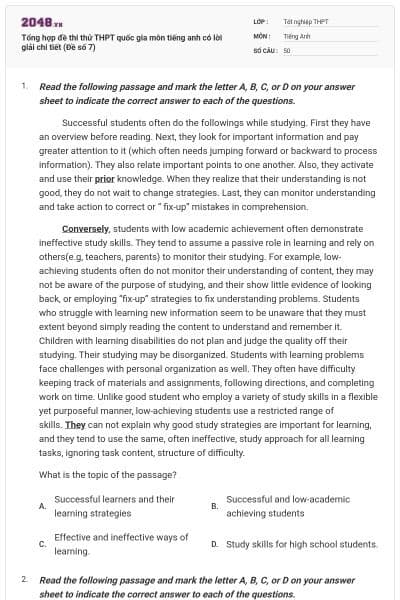
Successful students often do the followings while studying. First they have an overview before reading. Next, they look for important information and pay greater attention to it (which often needs jumping forward or backward to process information). They also relate important points to one another. Also, they activate and use their prior knowledge. When they realize that their understanding is not good, they do not wait to change strategies. Last, they can monitor understanding and take action to correct or “ fix-up” mistakes in comprehension.
Conversely, students with low academic achievement often demonstrate ineffective study skills. They tend to assume a passive role in learning and rely on others(e.g, teachers, parents) to monitor their studying. For example, low-achieving students often do not monitor their understanding of content, they may not be aware of the purpose of studying, and their show little evidence of looking back, or employing “fix-up” strategies to fix understanding problems. Students who struggle with learning new information seem to be unaware that they must extent beyond simply reading the content to understand and remember it. Children with learning disabilities do not plan and judge the quality off their studying. Their studying may be disorganized. Students with learning problems face challenges with personal organization as well. They often have difficulty keeping track of materials and assignments, following directions, and completing work on time. Unlike good student who employ a variety of study skills in a flexible yet purposeful manner, low-achieving students use a restricted range of skills. They can not explain why good study strategies are important for learning, and they tend to use the same, often ineffective, study approach for all learning tasks, ignoring task content, structure of difficulty.
What is the topic of the passage?
Successful learners and their learning strategies
Successful and low-academic achieving students
Effective and ineffective ways of learning.
Study skills for high school students.
Đáp án C
Đâu là chủ đề của đoạn văn?
A. Những học sinh thành công và chiến thuật của học tập của họ.
B. Những học sinh thành công và những học sinh có kết quả học tập thấp.
C. Những phương pháp học tập hiệu quả và không hiệu quả.
D. Những kĩ năng học tập dành cho học sinh trung học.
Dạng câu hỏi tìm ý chính luôn ưu tiên làm cuối cùng.
Đoạn văn mượn 2 đối tượng “good students” (những học sinh giỏi) và “low-achieving students” (những học sinh kém) để chỉ ra những phương pháp học tập hiệu quả và không hiệu quả.
Một số dẫn chứng như:
+ “Successful students often do the followings while studying. First they have an overview before reading. Next, they look for important information and pay greater attention to it (which often needs jumping forward or backward to process information)”- (Những học sinh thành công thường làm theo những điều dưới đây khi học. Đầu tiên, họ có một cái nhìn tổng quát trước khi đọc. Tiếp theo, họ tìm kiếm những thông tin quang trọng và dành nhiều sự chú ý hơn cho nó (cái thường cần được xem qua xem lại để xử lí thông tin)).
+ “Conversely, students with low academic achievement often demonstrate ineffective study skills. They tend to assume a passive role in learning and rely on others(e.g, teachers, parents) to monitor their studying. For example, low-achieving students often do not monitor their understanding of content, they may not be aware of the purpose of studying, and their show little evidence of looking back, or employing “fix-up” strategies to fix understanding problems” – (Ngược lại, những học sinh có kết quả học tập thấp thường xuyên cho thấy được những kĩ năng học tập kém hiệu quả. Họ có khuynh hướng đóng vai trò thụ động trong việc học và dựa dẫm vào người khác (ví dụ như bố mẹ, giáo viên) để giám sát việc học của mình. Ví dụ, những học sinh kém thường không chú tâm tới sự tiếp thu của mình trong nội dung, họ có lẽ không nhận thức được mục đích của việc học, và họ không thể hiện dấu hiệu của việc xem lại bài, hoặc dùng chiến lược “sửa chữa” để khắc phục các vấn đề về mặt tiếp thu).
Read the following passage and mark the letter A, B, C, or D on your answer sheet to indicate the correct answer to each of the questions.
Successful students often do the followings while studying. First they have an overview before reading. Next, they look for important information and pay greater attention to it (which often needs jumping forward or backward to process information). They also relate important points to one another. Also, they activate and use their prior knowledge. When they realize that their understanding is not good, they do not wait to change strategies. Last, they can monitor understanding and take action to correct or “ fix-up” mistakes in comprehension.
Conversely, students with low academic achievement often demonstrate ineffective study skills. They tend to assume a passive role in learning and rely on others(e.g, teachers, parents) to monitor their studying. For example, low-achieving students often do not monitor their understanding of content, they may not be aware of the purpose of studying, and their show little evidence of looking back, or employing “fix-up” strategies to fix understanding problems. Students who struggle with learning new information seem to be unaware that they must extent beyond simply reading the content to understand and remember it. Children with learning disabilities do not plan and judge the quality off their studying. Their studying may be disorganized. Students with learning problems face challenges with personal organization as well. They often have difficulty keeping track of materials and assignments, following directions, and completing work on time. Unlike good student who employ a variety of study skills in a flexible yet purposeful manner, low-achieving students use a restricted range of skills. They can not explain why good study strategies are important for learning, and they tend to use the same, often ineffective, study approach for all learning tasks, ignoring task content, structure of difficulty.
The word “prior” is CLOSET meaning to________.
forward
earlier
important
good
Đáp án B
Câu hỏi từ vựng.
Từ “prior” gần nghĩa với ________.
A. forward (adj+adv): phía trước.
B. earlier (adj): sớm hơn.
C. important (adj): quan trọng.
D. good (adj): tốt.
Prior (adj+adv): sớm hơn, trước đó = B. earlier (adj): sớm hơn.
Tạm dịch: “They also relate important points to one another. Also, they activate and use their prior knowledge” – (Họ cũng đồng thời liên hệ các phần quan trọng với nhau. Ngoài ra, họ còn vận dụng tới cả các phần kiến trước đó).
Read the following passage and mark the letter A, B, C, or D on your answer sheet to indicate the correct answer to each of the questions.
Successful students often do the followings while studying. First they have an overview before reading. Next, they look for important information and pay greater attention to it (which often needs jumping forward or backward to process information). They also relate important points to one another. Also, they activate and use their prior knowledge. When they realize that their understanding is not good, they do not wait to change strategies. Last, they can monitor understanding and take action to correct or “ fix-up” mistakes in comprehension.
Conversely, students with low academic achievement often demonstrate ineffective study skills. They tend to assume a passive role in learning and rely on others(e.g, teachers, parents) to monitor their studying. For example, low-achieving students often do not monitor their understanding of content, they may not be aware of the purpose of studying, and their show little evidence of looking back, or employing “fix-up” strategies to fix understanding problems. Students who struggle with learning new information seem to be unaware that they must extent beyond simply reading the content to understand and remember it. Children with learning disabilities do not plan and judge the quality off their studying. Their studying may be disorganized. Students with learning problems face challenges with personal organization as well. They often have difficulty keeping track of materials and assignments, following directions, and completing work on time. Unlike good student who employ a variety of study skills in a flexible yet purposeful manner, low-achieving students use a restricted range of skills. They can not explain why good study strategies are important for learning, and they tend to use the same, often ineffective, study approach for all learning tasks, ignoring task content, structure of difficulty.
The word “Conversely” is OPPOSITE meaning to________.
Actually
Alternatively
Consequently
Similarity
Đáp án D
Câu hỏi từ vựng.
Từ “Conversely” TRÁI NGHĨA với ________.
A. Actually (adv): Thực sự.
B. Alternatively (adv): Ngoài ra.
C. Consequently (adv): Do đó.
D. Similarity (n): Sự giống nhau, nét tương đồng.
Conversely (adv): Ngược lại, Mặt trái >< D. Similarity (n): Sự giống nhau, nét tương đồng.
Tạm dịch: “Conversely, students with low academic achievement often demonstrate ineffective study skills” – (Ngược lại, những học sinh có kết quả học tập thấp thường xuyên cho thấy được những kĩ năng học kém hiệu quả).
Read the following passage and mark the letter A, B, C, or D on your answer sheet to indicate the correct answer to each of the questions.
Successful students often do the followings while studying. First they have an overview before reading. Next, they look for important information and pay greater attention to it (which often needs jumping forward or backward to process information). They also relate important points to one another. Also, they activate and use their prior knowledge. When they realize that their understanding is not good, they do not wait to change strategies. Last, they can monitor understanding and take action to correct or “ fix-up” mistakes in comprehension.
Conversely, students with low academic achievement often demonstrate ineffective study skills. They tend to assume a passive role in learning and rely on others(e.g, teachers, parents) to monitor their studying. For example, low-achieving students often do not monitor their understanding of content, they may not be aware of the purpose of studying, and their show little evidence of looking back, or employing “fix-up” strategies to fix understanding problems. Students who struggle with learning new information seem to be unaware that they must extent beyond simply reading the content to understand and remember it. Children with learning disabilities do not plan and judge the quality off their studying. Their studying may be disorganized. Students with learning problems face challenges with personal organization as well. They often have difficulty keeping track of materials and assignments, following directions, and completing work on time. Unlike good student who employ a variety of study skills in a flexible yet purposeful manner, low-achieving students use a restricted range of skills. They can not explain why good study strategies are important for learning, and they tend to use the same, often ineffective, study approach for all learning tasks, ignoring task content, structure of difficulty.
According to the passage, what can be learnt about passive students?
They are slow in their studying
They depend on other people to organize their learning
They monitor their understanding
The know the purpose of studying
Đáp án B
Theo như đoạn văn, có thể biết được điều gì về những học sinh thụ động?
A. Họ chậm trong việc học.
B. Họ phụ thuộc vào người khác trong chuyện sắp xếp việc học.
C. Họ theo sát sự hiểu biết của bản thân.
D. Họ biết mục đích của việc học.
Dẫn chứng ở đầu đoạn 2: “Conversely, students with low academic achievement often demonstrate ineffective study skills. They tend to assume a passive role in learning and rely on others(e.g, teachers, parents) to monitor their studying” – (Ngược lại, những học sinh có kết quả học tập thấp thường xuyên cho thấy được những kĩ năng học kém hiệu quả. Họ có khuynh hướng đóng vai trò thụ động trong việc học và dựa dẫm vào người khác (ví dụ như bố mẹ, giáo viên) để giám sát việc học của mình).
Read the following passage and mark the letter A, B, C, or D on your answer sheet to indicate the correct answer to each of the questions.
Successful students often do the followings while studying. First they have an overview before reading. Next, they look for important information and pay greater attention to it (which often needs jumping forward or backward to process information). They also relate important points to one another. Also, they activate and use their prior knowledge. When they realize that their understanding is not good, they do not wait to change strategies. Last, they can monitor understanding and take action to correct or “ fix-up” mistakes in comprehension.
Conversely, students with low academic achievement often demonstrate ineffective study skills. They tend to assume a passive role in learning and rely on others(e.g, teachers, parents) to monitor their studying. For example, low-achieving students often do not monitor their understanding of content, they may not be aware of the purpose of studying, and their show little evidence of looking back, or employing “fix-up” strategies to fix understanding problems. Students who struggle with learning new information seem to be unaware that they must extent beyond simply reading the content to understand and remember it. Children with learning disabilities do not plan and judge the quality off their studying. Their studying may be disorganized. Students with learning problems face challenges with personal organization as well. They often have difficulty keeping track of materials and assignments, following directions, and completing work on time. Unlike good student who employ a variety of study skills in a flexible yet purposeful manner, low-achieving students use a restricted range of skills. They can not explain why good study strategies are important for learning, and they tend to use the same, often ineffective, study approach for all learning tasks, ignoring task content, structure of difficulty.
Which of the followings is NOT an evidence of monitoring studying?
Looking at their backs
Monitoring their understanding of content
Being aware of the purpose of studying
Fixing up mistakes in the understanding
Đáp án A
Điều nào sau đây là KHÔNG PHẢI là dấu hiệu của việc theo sát chuyện học hành?
A. Nhìn ra sau lưng.
B. Theo sát sự nhận biết nội dung.
C. Nhận thức được mục đích của việc học.
D. Khắc phục sai lầm trong hiểu biết.
Dẫn chứng ở câu thứ 3- đoạn 2: “For example, low-achieving students often do not monitor their understanding of content (B), they may not be aware of the purpose of studying (C), and their show little evidence of looking back, or employing “fix-up” strategies to fix understanding problems (D)” – (Ví dụ, những học sinh kém thường không theo sát sự nhận biết của mình trong nội dung, họ có lẽ không nhận thức được mục đích của việc học, và họ không thể hiện dấu hiệu của việc nhìn lại, hoặc dùng chiến lược “sửa chữa” để khắc phục các vấn đề về mặt hiểu biết).
Read the following passage and mark the letter A, B, C, or D on your answer sheet to indicate the correct answer to each of the questions.
Successful students often do the followings while studying. First they have an overview before reading. Next, they look for important information and pay greater attention to it (which often needs jumping forward or backward to process information). They also relate important points to one another. Also, they activate and use their prior knowledge. When they realize that their understanding is not good, they do not wait to change strategies. Last, they can monitor understanding and take action to correct or “ fix-up” mistakes in comprehension.
Conversely, students with low academic achievement often demonstrate ineffective study skills. They tend to assume a passive role in learning and rely on others(e.g, teachers, parents) to monitor their studying. For example, low-achieving students often do not monitor their understanding of content, they may not be aware of the purpose of studying, and their show little evidence of looking back, or employing “fix-up” strategies to fix understanding problems. Students who struggle with learning new information seem to be unaware that they must extent beyond simply reading the content to understand and remember it. Children with learning disabilities do not plan and judge the quality off their studying. Their studying may be disorganized. Students with learning problems face challenges with personal organization as well. They often have difficulty keeping track of materials and assignments, following directions, and completing work on time. Unlike good student who employ a variety of study skills in a flexible yet purposeful manner, low-achieving students use a restricted range of skills. They can not explain why good study strategies are important for learning, and they tend to use the same, often ineffective, study approach for all learning tasks, ignoring task content, structure of difficulty.
According to the passage, to learn new information, low-achieving students do NOT________.
read it.
just understand it.
simply remember it.
relate it to what they have known.
Đáp án D
Theo đoạn văn, để tiếp thu được thông tin mới, những học sinh có thành tích học tập thấp KHÔNG________.
A. đọc nó
B. chỉ hiểu nó
C. nhớ đơn thuần
D. liên hệ nó với những gì họ đã biết.
Dẫn chứng ở câu 4- đoạn 2: “Students who struggle with learning new information seem to be unaware that they must extent beyond simply reading the content (A) to understand (B) and remember it (C)”- (Những học sinh đang gặp khó khăn trong việc tiếp thu thông tin mới có vẻ như không nhận thức được rằng họ phải mở rộng xa hơn việc chỉ đơn thuần đọc nội dung để hiểu và nhớ được nó).
Read the following passage and mark the letter A, B, C, or D on your answer sheet to indicate the correct answer to each of the questions.
Successful students often do the followings while studying. First they have an overview before reading. Next, they look for important information and pay greater attention to it (which often needs jumping forward or backward to process information). They also relate important points to one another. Also, they activate and use their prior knowledge. When they realize that their understanding is not good, they do not wait to change strategies. Last, they can monitor understanding and take action to correct or “ fix-up” mistakes in comprehension.
Conversely, students with low academic achievement often demonstrate ineffective study skills. They tend to assume a passive role in learning and rely on others(e.g, teachers, parents) to monitor their studying. For example, low-achieving students often do not monitor their understanding of content, they may not be aware of the purpose of studying, and their show little evidence of looking back, or employing “fix-up” strategies to fix understanding problems. Students who struggle with learning new information seem to be unaware that they must extent beyond simply reading the content to understand and remember it. Children with learning disabilities do not plan and judge the quality off their studying. Their studying may be disorganized. Students with learning problems face challenges with personal organization as well. They often have difficulty keeping track of materials and assignments, following directions, and completing work on time. Unlike good student who employ a variety of study skills in a flexible yet purposeful manner, low-achieving students use a restricted range of skills. They can not explain why good study strategies are important for learning, and they tend to use the same, often ineffective, study approach for all learning tasks, ignoring task content, structure of difficulty.
In compared with low-achieving students, successful students use________.
inflexible study ways
various study skills
restricted strategies
aimless studying techniques
Đáp án B
So với những học sinh kém, những học sinh thành công sử dụng________.
A. những phương pháp học tập linh hoạt.
B. những kĩ năng học tập đa dạng.
C. những chiến thuật nghiêm khắc.
D. những kĩ thuật học học tập vô nghĩa.
Dẫn chứng ở đoạn cuối đoạn 2: “Unlike good student who employ a variety of study skills in a flexible yet purposeful manner […]”- (Không như những học sinh giỏi- người mà vận dụng đa dạng các kĩ năng khác nhau một cách linh hoạt nhưng có chủ đích […]).
Read the following passage and mark the letter A, B, C, or D on your answer sheet to indicate the correct answer to each of the questions.
Successful students often do the followings while studying. First they have an overview before reading. Next, they look for important information and pay greater attention to it (which often needs jumping forward or backward to process information). They also relate important points to one another. Also, they activate and use their prior knowledge. When they realize that their understanding is not good, they do not wait to change strategies. Last, they can monitor understanding and take action to correct or “ fix-up” mistakes in comprehension.
Conversely, students with low academic achievement often demonstrate ineffective study skills. They tend to assume a passive role in learning and rely on others(e.g, teachers, parents) to monitor their studying. For example, low-achieving students often do not monitor their understanding of content, they may not be aware of the purpose of studying, and their show little evidence of looking back, or employing “fix-up” strategies to fix understanding problems. Students who struggle with learning new information seem to be unaware that they must extent beyond simply reading the content to understand and remember it. Children with learning disabilities do not plan and judge the quality off their studying. Their studying may be disorganized. Students with learning problems face challenges with personal organization as well. They often have difficulty keeping track of materials and assignments, following directions, and completing work on time. Unlike good student who employ a variety of study skills in a flexible yet purposeful manner, low-achieving students use a restricted range of skills. They can not explain why good study strategies are important for learning, and they tend to use the same, often ineffective, study approach for all learning tasks, ignoring task content, structure of difficulty.
The underlined pronoun “they”refers to________.
study strategies
low-achieving students.
study skills.
good students.
Đáp án B
Đại từ được gạch chân “they” ám chỉ tới ________.
A. những chiến thuật học tập.
B. những học sinh kém.
C. những kĩ năng học tập.
D. những học sinh giỏi.
Do “They”đứng đầu làm chủ ngữ nên ta đọc lên câu phía trước.
Tạm dịch: “Unlike good student who employ a variety of study skills in a flexible yet purposeful manner, low-achieving students use a restricted range of skills. They can not explain why good study strategies are important for learning, and they tend to use the same, often ineffective, study approach for all learning tasks, ignoring task content, structure of difficulty” – (Không như những học sinh giỏi- người mà vận dụng đa dạng các kĩ năng khác nhau một cách linh hoạt nhưng có chủ đích, những học sinh kém thì lại sử dụng các kĩ năng có giới hạn. Họ không thể lí giải được tại sao những chiến thuật học tốt lại quan trọng đối với việc học, và họ có khuynh hướng làm theo, thường là không hiệu quả, các chiến thuật đó cho tất cả phần bài tập mà bỏ qua phần nội dung, bản chất của những khó khăn).
Mark the letter A, B, C, or D on your answer sheet to indicate the sentence that best combines each pair of sentences in the following questions.
I didn’t want to disturb the meeting. I left without saying goodbye.
Rather than disturb the meeting, I left without saying goodbye.
I disturbed the meeting because I said goodbye.
I would rather disturb the meeting than leaving without saying goodbye.
The meeting was disturbed as I left saying goodbye.
Đáp án A
Tôi không muốn cắt ngang cuộc họp. Tôi rời đi mà không nói lời tam biệt.
= A. Thay vì làm cắt ngang cuộc họp, tôi rời đi mà không nói lời tam biệt.
Chú ý: Rather than = Instead of: Thay vì…
Các đáp án còn lại không đúng nghĩa:
B. Tôi đã cắt ngang cuộc họp bởi vì tôi nói lời tạm biệt.
C. Tôi thà rằng cắt ngang cuộc họp còn hơn rời đi mà không nói lời tam biệt.
D. Cuộc họp bị cắt ngang bởi tôi để lại lời tạm biệt
Mark the letter A, B, C, or D on your answer sheet to indicate the sentence that best combines each pair of sentences in the following questions.
The director guided us through the museum. He gave us a specific explanation.
While the director was guiding us through the museum, he gave us a specific explanation
The director guided us through the museum and was giving us a specific explanation
Guiding us through the museum, a specific explanation was given to us by the director
The director guided us through the museum while a specific explanation was given to us
Đáp án A
Ngưới hướng dẫn viên chỉ dẫn chúng tôi qua viện bảo tàng. Anh ấy đã đưa cho chúng tôi một lời giải thích cụ thể.
= A. Trong khi người hướng dẫn viên chỉ dẫn chúng tôi qua viện bảo tàng, anh ấy đã đưa cho chúng tôi một lời giải thích cụ thể.
Mark the letter A, B, C or D on your answer sheet to indicate the word(s) OPPOSITE in meaning to the underlined word(s) in each of the following questions.
He seems to ignore whatever we say to him, which is rather annoying.
to take no notice of
to pay attention to
to make a fuss about
to make sure of
Đáp án B
(to) ingnore: thờ ơ >< B. to pay attention to: chú ý tới.
Các đáp án còn lại:
A. to take no notice of: không chú ý tới = (to) ingnore.
C. to make a fuss about: làm ầm ĩ về.
D. to make sure of: chắc chắn về.
Dịch: Anh ấy có vẻ thờ ơ với bất cứ điều gì chúng tôi nói với anh ấy, điều đó khá bực mình.
Mark the letter A, B, C or D on your answer sheet to indicate the word(s) OPPOSITE in meaning to the underlined word(s) in each of the following questions.
The competition was aimed to stimulate the learning spirit among students.
improve
announce
represent
discourage
Đáp án D
(to) stimulate: khuyến khích, cổ động >< D. discourage (v): làm nhụt chí, làm nản lòng.
Các đáp án còn lại:
A. improve (v): cải thiện, tiến bộ.
B. announce (v): thông báo.
C. represent (v): trình bày, đại diện, tượng trưng.
Dịch: Cuộc thi này nhằm khuyến khích tinh thần học tập giữa các em học sinh
Mark the letter A, B, C or D in your answer sheet to indicate the underlined part that needs correction in each of the following questions.
(A) Not knowing the language and (B) had no friends in the area, she found (C) it difficult to (D) get by.
Not knowing
had
it difficult
get by
Đáp án B
Sửa had => having.
Cấu trúc song hành với V-ing.
Dịch: Bất đồng ngôn ngữ và không có bạn bè ở cùng khu, cô ấy nhận ra thật khó khăn để vượt qua.
Mark the letter A, B, C or D in your answer sheet to indicate the underlined part that needs correction in each of the following questions.
On (A) asked about the strike, (B) the Minister (C) declined (D) to comment.
asked
the
declined
to comment
Đáp án A
Sửa asked => being asked.
Sau giới từ động từ chia V-ing (on + V-ing).
Dịch: Về việc được hỏi về cuộc đình công, bộ trưởng từ chối đưa ra lời bàn luận.
Mark the letter A, B, C or D in your answer sheet to indicate the underlined part that needs correction in each of the following questions.
Richart (A) said the play (B) was very (C) entertaining and he recommended (D) to see it
said
was
entertaining
to see
Đáp án D
Sửa to see => seeing.
(to) recommend V-ing = (to) recommend sbd to V: đề cử, giới thiệu, đề nghị, khuyên bảo.
Dịch: Richart nói rằng vở kịch này rất giải trí và anh ấy khuyên nên xem nó
Read the following passage and mark A, B, C, or D to indicate the correct answer to each of the blanks.
Volunteering is generally considered an (16) ______ activity and is intended to promote goodness or improve human quality of life. In return, it produces a feeling of self-worth and respect, rather than money. To volunteer simply means to be motivated and give your time or energy to work forwards an undertaking or cause you are interested in. Volunteering (17)______ individuals the chance to explore avenues that would not usually be open to them. This experience enables an exchange of culture and social contact between volunteers and those who benefit. When children volunteer, they often find themselves in a position where responsibility is required. They gain (18)______ when they know they’ve made a real contribution to a project. Research shows those who volunteer just one hour a week are 50 percent less likely to abuse drugs or alcohol, smoke cigarettes or engage in destructive behaviour. (19)______ my humble opinion, voluntary work needs to be integrated into the school curriculum.We need to motivate young people and make sure we create a culture or social activism where we insist that people help their community to empower others, (20)______ themselves.
Điền ô số 16
uncommon
uncertain
unpopular
unselfish
Đáp án D
A. uncommon (adj): không phổ biến.
B. uncertain (adj): không chắc chắn, không rõ ràng.
C. unpopular (adj): không phổ biến.
D. unselfish (adj): không vị kỉ, không nghĩ tới lợi ích bản thân.
Dịch: Tình nguyện được coi là hoạt động không nhắm tới mục đích cá nhân và hướng tới tinh thần hào hiệp hoặc cải thiện, nâng cao chất lượng đời sống con người.
Read the following passage and mark A, B, C, or D to indicate the correct answer to each of the blanks.
Volunteering is generally considered an (16) ______ activity and is intended to promote goodness or improve human quality of life. In return, it produces a feeling of self-worth and respect, rather than money. To volunteer simply means to be motivated and give your time or energy to work forwards an undertaking or cause you are interested in. Volunteering (17)______ individuals the chance to explore avenues that would not usually be open to them. This experience enables an exchange of culture and social contact between volunteers and those who benefit. When children volunteer, they often find themselves in a position where responsibility is required. They gain (18)______ when they know they’ve made a real contribution to a project. Research shows those who volunteer just one hour a week are 50 percent less likely to abuse drugs or alcohol, smoke cigarettes or engage in destructive behaviour. (19)______ my humble opinion, voluntary work needs to be integrated into the school curriculum.We need to motivate young people and make sure we create a culture or social activism where we insist that people help their community to empower others, (20)______ themselves.
Điền ô số 17
gives
shows
helps
makes
Đáp án A
(to) give sbd smt: đưa cho ai cái gì.
Dịch: Công việc tình nguyện đưa cho mỗi cá nhân cơ hội để khám phá ra những con đường đã từng không rộng mở dành cho họ
Read the following passage and mark A, B, C, or D to indicate the correct answer to each of the blanks.
Volunteering is generally considered an (16) ______ activity and is intended to promote goodness or improve human quality of life. In return, it produces a feeling of self-worth and respect, rather than money. To volunteer simply means to be motivated and give your time or energy to work forwards an undertaking or cause you are interested in. Volunteering (17)______ individuals the chance to explore avenues that would not usually be open to them. This experience enables an exchange of culture and social contact between volunteers and those who benefit. When children volunteer, they often find themselves in a position where responsibility is required. They gain (18)______ when they know they’ve made a real contribution to a project. Research shows those who volunteer just one hour a week are 50 percent less likely to abuse drugs or alcohol, smoke cigarettes or engage in destructive behaviour. (19)______ my humble opinion, voluntary work needs to be integrated into the school curriculum.We need to motivate young people and make sure we create a culture or social activism where we insist that people help their community to empower others, (20)______ themselves.
Điền ô số 18
self-reliance
self-esteem
self confidence
self-discipline
Đáp án C
A. self-reliance (n): sự tự lực.
B. self-esteem (n): lòng tự trọng.
C. self-confidence (n): sự tự tin.
D. self-discipline (n): tinh thần tự kỉ luật.
Dịch: Các em nhận được sự tự tin khi biết rằng mình đã có những đóng góp thực sự cho dự án.
Read the following passage and mark A, B, C, or D to indicate the correct answer to each of the blanks.
Volunteering is generally considered an (16) ______ activity and is intended to promote goodness or improve human quality of life. In return, it produces a feeling of self-worth and respect, rather than money. To volunteer simply means to be motivated and give your time or energy to work forwards an undertaking or cause you are interested in. Volunteering (17)______ individuals the chance to explore avenues that would not usually be open to them. This experience enables an exchange of culture and social contact between volunteers and those who benefit. When children volunteer, they often find themselves in a position where responsibility is required. They gain (18)______ when they know they’ve made a real contribution to a project. Research shows those who volunteer just one hour a week are 50 percent less likely to abuse drugs or alcohol, smoke cigarettes or engage in destructive behaviour. (19)______ my humble opinion, voluntary work needs to be integrated into the school curriculum.We need to motivate young people and make sure we create a culture or social activism where we insist that people help their community to empower others, (20)______ themselves.
Điên ô số 19
On
By
For
In
Đáp án D
In my opinion: Theo quan điểm của tôi.
Dịch: Theo quam điểm nhỏ của tôi, công việc tình nguyện cần được lồng ghép vào chương trình học trên nhà trường
Read the following passage and mark A, B, C, or D to indicate the correct answer to each of the blanks.
Volunteering is generally considered an (16) ______ activity and is intended to promote goodness or improve human quality of life. In return, it produces a feeling of self-worth and respect, rather than money. To volunteer simply means to be motivated and give your time or energy to work forwards an undertaking or cause you are interested in. Volunteering (17)______ individuals the chance to explore avenues that would not usually be open to them. This experience enables an exchange of culture and social contact between volunteers and those who benefit. When children volunteer, they often find themselves in a position where responsibility is required. They gain (18)______ when they know they’ve made a real contribution to a project. Research shows those who volunteer just one hour a week are 50 percent less likely to abuse drugs or alcohol, smoke cigarettes or engage in destructive behaviour. (19)______ my humble opinion, voluntary work needs to be integrated into the school curriculum.We need to motivate young people and make sure we create a culture or social activism where we insist that people help their community to empower others, (20)______ themselves.
Điền ô số 20
as much as
as well as
as long as
as good as
Đáp án B
A. as much as: nhiều như là.
B. as well as: cũng như là.
C. as long as: miễn là.
D. as good as: tốt như là.
Dịch: Chúng ta cần thúc đẩy người trẻ và đảm bảo rằng chúng ta tạo ra được sự lan tỏa tích cực về mặt văn hóa và xã hội, nơi chúng ta nhấn mạnh rằng mọi người cần chung tay giúp đỡ cộng đồng trao quyền hành động cho những người khác, cũng như là cho chính bản thân chúng ta.
Mark the letter A, B, C or D on your answer sheet to indicate the sentence that is closest in meaning to each of the following questions.
Having spent all his money, Daniel couldn’t afford a new watch
As Daniel had bought a new watch, he spent all his money
Danile didn’t buy a new watch although he had a lot of money
Because he had spent all the money, Daniel couldn’t afford a new watch
Daniel couldn’t get a new watch because he didn’t have much money
Đáp án C
Sau khi tiêu hết số tiền của mình, Daniel không có đủ điền kiện để mua 1 chiếc đồng hồ mới.
= Bởi vì anh ấy đã tiêu hết số tiền của mình, Daniel không có đủ điền kiện để mua 1 chiếc đồng hồ mới.
Chú ý: Phân từ hoàn thành có dạng Having PII đứng đầu trong câu có 2 mệnh đề đồng chủ ngữ, diễn tả hành động đã hoàn thành trước 1 hành dộng khác.
Các đáp án còn lại có nghĩa không phù hợp:
A. Bởi vì Daniel đã mua 1 chiếc đồng hồ mới, anh ấy đã sử dụng hết số tiền của mình.
B. Daniel không thể mua 1 chiếc đồng hồ mới mặc dù anh ấy có rất nhiều tiền.
D. Daniel không thể có 1 chiếc đồng hồ mới bởi vì anh ấy không có nhiều tiền
Mark the letter A, B, C or D on your answer sheet to indicate the sentence that is closest in meaning to each of the following questions.
Loyalty and trust are two importance qualities good friends must have.
Good friends must have the two importance qualities of loyalty and trust
Good friends must be loyal and trusty because of their qualities
Good friends are important because they must have qualities of loyalty and trust
The two good qualities of loyalty and trust make friends important
Đáp án A
Lòng trung thành và sự tin tưởng là 2 phẩm chất quan trọng mà bạn bè tốt phải có.
= A. Bạn bè tốt phải có 2 phẩm chất quan trọng của lòng trung thành và sự tin tưởng.
Các đáp án còn lại có nghĩa không phù hợp:
B. Bạn bè tốt phải trung thành và đáng tin cậy vì phẩm chất của họ.
C. Bạn bè tốt là quan trọng bởi họ phải có những phẩm chất của lòng trung thành và sự tin tưởng.
D. 2 phẩm chất tốt của lòng trung thành và sự tin tưởng làm cho bạn bè trở nên quan trọng
Mark the letter A, B, C or D on your answer sheet to indicate the sentence that is closest in meaning to each of the following questions.
“Why don’t we wear sunglasses” our granpa would say when we went out on bright sunny days
Our granpa would warn us against wearing sunglasses on bright sunny days
Our granpa never reminded us of going out with sunglasses on bright sunny days
Our granpa asked us why we did not wear sunglasses when going out on bright sunny days
Our granpa used to suggest wearing sunglasses when we were out on bright sunny days
Đáp án D
“Tại sao chúng ta không đeo kính râm nhỉ?” –ông chúng tôi sẽ nói mỗi khi chúng tôi ra ngoài vào những ngày đầy nắng.
= D. Ông chúng tôi từng đề xuất đeo kính râm khi chúng tôi ra ngoài vào những ngày đầy nắng.
“Why don’t we V?” mang hàm ý đề xuất, đưa ra lời gợi ý = (to) suggest V-ing.
Các đáp án còn lại có nghĩa không phù hợp:
A. Ông chúng tôi sẽ dặn chúng tôi đề phòng việc đeo kính râm vào những ngày đầy nắng.
Chú ý: (to) warn sbd against/about sbd/smt: dặn ai đề phòng ai/cái gì B. Ông chúng tôi đã không bao giờ khuyên chúng tôi ra ngoài với kính râm vào những ngày đầy nắng.
Chú ý: (to) remind sbd of N/V-ing: nhắc nhở ai nhớ/biết về cái gì.
C. Ông chúng tôi đã hỏi chúng tôi tại sao không đeo kính râm khi ra ngoài vào những ngày đầy nắng.
Mark the letter A, B, C or D on your answer sheet to indicate the word whose underlined part differs from the other three in pronunciation in each of the following questions.
promote
psychology
campaign
participant
Đáp án B
Phần gạch chân đáp án B là âm câm, các đáp án còn lại được phát âm là /p/.
A. promote /prəˈməʊt/ (v): thúc đẩy, xúc tiến, thăng chức.
B. psychology /saɪˈkɒ.lə.dʒi/ (n): tâm lí, tâm lí học.
C. campaign /kæmˈpeɪn/ (n): chiến dịch.
D. participant /pɑːˈtɪ.sɪ.pənt/ (n): người tham gia
Mark the letter A, B, C or D on your answer sheet to indicate the word whose underlined part differs from the other three in pronunciation in each of the following questions.
rhythm
exhibition
vehicle
childhood
Đáp án D
Phần gạch chân đáp án D là được phát âm là /h/, các đáp án còn lại là âm câm.
A. rhythm /ˈrɪ.ðəm/ (n): nhịp điệu.
B. exhibition /ˌek.sɪˈbɪʃ.ən/ (n): cuộc triểm lãm, sự phô bày.
C. vehicle /ˈvɪə.kəl/ (n): xe cộ.
D. childhood /ˈtʃaɪld.hʊd/ (n): tuổi thơ, thời thơ ấu.
Mark the letter A, B, C or D on your answer sheet to indicate the word whose underlined part differs from the other three in pronunciation in each of the following questions.
celebrate
co-operate
passionate
participate
Đáp án C
Phần gạch chân đáp án C được phát âm là / ət/, các đáp án còn lại được phát âm là /eit/
A. celebrate /ˈse.lə.breɪt/ (v): cử hành, tán dương, ca tụng.
B. co-operate /kəʊˈɒ.pər.eɪt/ (v): hợp tác, chung sức.
C. passionate /ˈpæ.ʃən.ət/ /(adj): nồng nàn, say đắm, thiết tha.
D. participate /pɑːˈtɪ.sɪ.peɪt/ (v): tham gia.
Mark the letter A, B, C or D on your answer sheet to indicate the word whose underlined part differs from the other three in pronunciation in each of the following questions.
solution
suspicion
volunteer
suggestion
Đáp án A
Phần gạch chân đáp án A được phát âm là /u:/, các đáp án còn lại được phát âm là /ə/.
A. solution /səˈluː.ʃən/ (n): giải pháp.
B. suspicion /səˈspɪ.ʃən/ (n): sự nghi ngờ.
C. volunteer /ˌvɒ.lənˈtɪər/ (n+v): tình nguyện.
D. suggestion /səˈdʒes.tʃən/ (n): sự đề xuất, lời gợi ý.
Mark the letter A, B, C or D on your answer sheet to indicate the correct answer to each of the following question.
Time-management skills are not difficult ______.
developing
develop
to develop
develop
Đáp án B
Thì Qúa khứ tiếp diễn (was/were V-ing) dùng để diễn tả một hành động, sự việc đang xảy ra tại một thời điểm xác định trong quá khứ.
Dịch: Tôi nhìn thấy cậu ở công viên vào ngày hôm qua. Cậu đang ngồi trên bãi cỏ và đọc sách.
Learning to live ______ sounds easy, but in reality, it isn’t.
independently
dependent
independent
independence
Đáp án D
(to) get tired of V-ing: mệt mỏi vì làm gì.br> Câu mang nghĩ bị động nên ta chọn đáp án D.br> Lí giải vì sao không chọn đáp án C: do đây là dạng phân từ hoàn thành (having PII) dùng để chỉ 1 hành động đã hoàn tất, nhưng hành động trong câu (be recognized) chưa hoàn tất, nó vẫn sẽ có thể tiếp tục xảy ra.br> Dịch: Những người nổi tiếng mệt mỏi vì bị nhận ra ở mọi nơi mà họ tới
I saw you in the park yesterday. You ______ on the grass and reading a book.
had sat
were sitting
sat
are sitting
Đáp án A
Phân từ hoành thành (Having PII) có chức năng làm trạng ngữ được rút gọn để diễn tả 1 hành động đã hoàn thành trước 1 hành động khác xảy ra trong quá khứ, chú ý là 2 hành động đó phải luôn có cùng 1 chủ ngữ.
Dịch: Sau khi đọc xong bức thư, cô ấy đã khóc rất nhiều vì những gì anh ấy đã viết cho cô.
Celebrities get tired of ______ everywhere they go.
recognizing
having recognized
having been recognized
being recognized
Đáp án C
Giản lược chủ ngữ thể bị động, câu đầy đủ là When letters of credit are used in international trade, they are very convenient.
Dịch: Khi được sử dụng trong thương mại quốc tế, thư tín dụng rất thuận tiện
______ the letter, she cried a lot because of what he wrote to her.
Having read
To read
Read
Being read
Đáp án A
Sau tobe ta cần 1 tính từ:
A. sympathetic (adj): có lòng thông cảm, đồng cảm.
B. sympathize (v): thông cảm, đồng cảm.
C. sympathy (n): sự thông cảm, sự đồng cảm.
D. sympathetically (adv): mang tính thông cảm, đồng cảm.
Dịch: Để duy trì được tình bạn lâu dài, bạn nên có lòng cảm thông và quan tâm tới cảm xúc của bạn bè.
When ______ in international trade, letters of credit are very convenient.
using
are used
used
they used
Đáp án D
constancy (n): lòng kiên trì, tính bền bỉ.
Các đáp án còn lại không hợp nghĩa:
A. unselfishness (n): tính không vị kỉ, không ích kỉ.
B. sympathy (n): sự thông cảm, lòng đồng cảm.
C. loyalty (n): sự trung thành.
Dịch: Nếu bạn muốn có kết quả tốt ở mọi công việc, bạn nên có đức tính kiên trì.
To maintain a long-life friendship, you should be ______ and care about your friend’s feeling.
sympathetic
sympathize
sympathy
sympathetically
Đáp án B
(to) raise money: gây quỹ.
Dịch: Gây quỹ cho trẻ em khuyến tật và trẻ em thiệt thòi luôn luôn là một hành động hào hiệp.
If you want to get a good result in every work, you should have ______.
unselfishness
sympathy
loyalty
constancy
Đáp án C
(to) leave smt at home: để quên cái gì đó ở nhà.
Dịch: Tôi xin lỗi tôi đã không mang theo một đồng tiền nào. Tôi đã để quên ví ở nhà.
____ money for handicapped and disadvantaged children is always a good cause.
Borrowing
Raising
Earning
Making
Đáp án A
Tobe in flood of tears: rất buồn.
Dịch: Đứa trẻ nghèo khổ đã rất buồn khi chiếc xe đạp của nó bị mất
I’m sorry I haven’t got any money. I’ve ______ my wallet at home.
let
missed
left
forgot
Đáp án C
Tobe adj to V: như thế nào để làm gì.
Dịch: Kĩ năng quản lí thời gian là không khó để phát triển.
The poor child was in floods of ______ because his bicycle had been stolen.
tears
sorrow
sadness
upset
Đáp án A
Vị trí này ta cần 1 trạng từ để bổ nghĩa cho động từ “live”.
A. independently (adv): mang tính độc lập, không lệ thuộc.
B. dependent (adj): lệ thuộc, dựa vào.
C. independent (adj): độc lập, không phục thuộc.
D. independence (n): sự độc lập, nền độc lập.
Dịch: Học cách sống độc lập nghe có vẻ dễ dàng, nhưng trong thực tế thì không phải vậy.
______ of the committee, I’d like to thank you for your generous donation.
Instead
On behalf
According
In spite
Đáp án B
On behalf of + N: Thay mặt cho.
Các đáp án còn lại:
A. Instead of = Rather than: thay vì.
C. According to N: Theo như….
D. In spite of N/V-ing: Mặc dù…
Dịch: Thay mặt cho ủy ban, tôi rất cảm ơn sự đóng góp hào phóng của các vị.
Mark the letter A, B, C or D on your answer sheet to indicate the word(s) CLOSEST in meaning to the underlined word(s) in each of the following questions.
Special education is intended to both handicapped and gifted children to reach their learning potentials.
untalented
disabled
disadvantaged
unskilled
Đáp án B
handicapped (adj) tật nguyền, khuyết tật = B. disabled (adj): tàn tật.
Các đáp án còn lại:
A. untalented (adj): không có tài năng.
C. disadvantaged (adj): thiệt thòi.
D. unskilled (adj): không có kĩ thuật.
Dịch: Chương trình giáo dục đặc biệt dành cho trẻ khuyến tật và cả trẻ có năng khiếu nhằm giúp các em đạt được tiềm năng học năng học tập của mình.
Mark the letter A, B, C or D on your answer sheet to indicate the word(s) CLOSEST in meaning to the underlined word(s) in each of the following questions.
New books are displayed in a prominent position on tables at the front of the store.
noticeable
memorable
incredible
enjoyable
Đáp án A
Prominent (adj): nổi bật, xuất chúng, lỗi lạc = A. noticeable (adj): đáng chú ý, dễ nhận thấy.
Các đáp án còn lại:
B. memorable (adj): đáng nhớ.
C. incredible (adj): không thể tin nổi.
D. enjoyable (adj): thú vị, thích thú.
Dịch: Những cuốn sách mới được bày ở vị trí nổi bật trên bàn ở phía trước của hàng.
Read the following passage and mark the letter A, B, C, or D on your answer sheet to indicate the correct answer to each of the questions.
People commonly complain that they never have enough time to accomplish tasks. The hours and minutes seem to slip away before many planned chores get done. According to time management experts, the main reason for this is that most people fail to set priorities about what to do first. They get tied down by trivial, time consuming matters and never complete the important ones.
One simple solution often used by those at the top is to keep lists of tasks to be accomplished daily. These lists order jobs from most essential to least essential and are checked regularly through the day to assess progress. Not only is this an effective way to manage time, but also it serves to give individuals a much deserved sense of satisfaction over their achievements. People who do not keep lists often face the end of the word day with uncertainly over the significance of their accomplishments, which over time can contribute to serious problem in mental and physical health.
Which of the following is the best title for the passage?
Accomplishing trivial matters
Common complaints about work
Learning to manage time
Achieving job satisfaction
Đáp án C
Đâu là tiêu đề thích hợp cho đoạn văn?
A. Hoàn thành các công việc nhỏ.
B. Những phàn nàn phổ biến về công việc.
C. Học cách quản lí thời gian.
D. Đạt được sự hài lòng trong công việc.
Dạng câu hỏi tìm ý chính luôn ưu tiên làm cuối cùng.
Một số dẫn chứng trong bài:
+ “People commonly complain that they never have enough time to accomplish tasks. The hours and minutes seem to slip away before many planned chores get done. According to time management experts, the main reason for this is that most people fail to set priorities about what to do first” – (Mọi người thường phàn nàn rằng họ không bao giờ có để thời gian để hoàn thành các công việc. Thời gian cứ trôi đi trước khi nhiều kế hoạch được hoành thành. Theo như những chuyên gia về quản lí thời gian, lí do chính cho điều đó chính là hầu hết họ không ưu tiên các việc nào nên làm trước).
+ “One simple solution often used by those at the top is to keep lists of tasks to be accomplished daily. These lists order jobs from most essential to least essential and are checked regularly through the day to assess progress.” – (Một giải pháp đơn giản thường được họ sử dụng nhiều nhất đó là lên danh sách các công việc cần được hoàn thành vào mỗi ngày. Những danh sách đó sắp xếp các công việc theo thứ tự từ cần thiết nhất đến ít cần thiết và được kiểm tra thường xuyên trong ngày để đáng giá tiến độ).
Read the following passage and mark the letter A, B, C, or D on your answer sheet to indicate the correct answer to each of the questions.
People commonly complain that they never have enough time to accomplish tasks. The hours and minutes seem to slip away before many planned chores get done. According to time management experts, the main reason for this is that most people fail to set priorities about what to do first. They get tied down by trivial, time consuming matters and never complete the important ones.
One simple solution often used by those at the top is to keep lists of tasks to be accomplished daily. These lists order jobs from most essential to least essential and are checked regularly through the day to assess progress. Not only is this an effective way to manage time, but also it serves to give individuals a much deserved sense of satisfaction over their achievements. People who do not keep lists often face the end of the word day with uncertainly over the significance of their accomplishments, which over time can contribute to serious problem in mental and physical health.
According to the passage, what does “slip away” mean?
pick up
break down
fall behind
pass quickly
Đáp án D
Câu hỏi từ vựng.
Theo như đoạn văn, từ “slip away” có nghĩa là?
A. pick up: học lỏm, nhặt nhiệm, đưa đón.
B. break down: hỏng hóc (máy móc),…
C. fall behind: tụt hậu, chậm tiến độ.
D. pass quickly: di chuyển qua nhanh, trôi qua.
(to) slip away: trượt, trôi, tuột qua = D. pass quickly: di chuyển qua nhanh, trôi qua.
Tạm dịch: “The hours and minutes seem to slip away before many planned chores get done” – (Thời gian cứ thế trôi đi trước khi những kế hoạch cần được hoành thành).
Read the following passage and mark the letter A, B, C, or D on your answer sheet to indicate the correct answer to each of the questions.
People commonly complain that they never have enough time to accomplish tasks. The hours and minutes seem to slip away before many planned chores get done. According to time management experts, the main reason for this is that most people fail to set priorities about what to do first. They get tied down by trivial, time consuming matters and never complete the important ones.
One simple solution often used by those at the top is to keep lists of tasks to be accomplished daily. These lists order jobs from most essential to least essential and are checked regularly through the day to assess progress. Not only is this an effective way to manage time, but also it serves to give individuals a much deserved sense of satisfaction over their achievements. People who do not keep lists often face the end of the word day with uncertainly over the significance of their accomplishments, which over time can contribute to serious problem in mental and physical health.
According to the passage, why do many people never seem to have enough time to accomplish things
They fail to deal with trivial matters
They get tied down by one difficult problem
They do not prioritize tasks
They do not seek the advice of time management experts
Đáp án C
Theo như đoạn văn, tại sao nhiều người không bao giờ có vẻ như có đủ thời gian để hoàn thành mọi việc?
A. Họ không giải quyết được các vấn đề nhỏ.
B. Họ bị rằng buộc bởi một vấn đề khó khăn.
C. Họ không ưu tiên các công việc nào cả.
D. Họ không tìm kiếm lời khuyên từ các chuyên gia quản lí thời gian.
Dẫn chứng ở đoạn 1: “People commonly complain that they never have enough time to accomplish tasks. The hours and minutes seem to slip away before many planned chores get done. According to time management experts, the main reason for this is that most people fail to set priorities about what to do first” – (Mọi người thường phàn nàn rằng họ không bao giờ có để thời gian để hoàn thành các công việc. Thời gian cứ trôi đi trước khi nhiều kế hoạch được hoành thành. Theo như những chuyên gia về quản lí thời gian, lí do chính cho điều đó chính là hầu hết họ không ưu tiên các việc nào nên làm trước).
Read the following passage and mark the letter A, B, C, or D on your answer sheet to indicate the correct answer to each of the questions.
People commonly complain that they never have enough time to accomplish tasks. The hours and minutes seem to slip away before many planned chores get done. According to time management experts, the main reason for this is that most people fail to set priorities about what to do first. They get tied down by trivial, time consuming matters and never complete the important ones.
One simple solution often used by those at the top is to keep lists of tasks to be accomplished daily. These lists order jobs from most essential to least essential and are checked regularly through the day to assess progress. Not only is this an effective way to manage time, but also it serves to give individuals a much deserved sense of satisfaction over their achievements. People who do not keep lists often face the end of the word day with uncertainly over the significance of their accomplishments, which over time can contribute to serious problem in mental and physical health.
In paragraph 2, the word “those” refers to ______.
priorities
trivial matters
daily lists
people
Đáp án D
Từ “those” ở đoạn 2 ám chỉ tới ______.
A. những sự ưu tiên.
B. những vấn đề nhỏ.
C. danh sách các công việc thường ngày.
D. mọi người.
Tạm dịch: “They get tied down by trivial, time consuming matters and never complete the important ones. One simple solution often used by those at the top is to keep lists of tasks to be accomplished daily” – (Họ bị rằng buộc bởi những vấn đề nhỏ và mất thời gian, và không bao giờ hoàn thành được những công việc quan trọng. Một giải pháp đơn giản thường được họ sử dụng nhiều nhất đó là lên danh sách các công việc cần được hoàn thành vào mỗi ngày).
Read the following passage and mark the letter A, B, C, or D on your answer sheet to indicate the correct answer to each of the questions.
People commonly complain that they never have enough time to accomplish tasks. The hours and minutes seem to slip away before many planned chores get done. According to time management experts, the main reason for this is that most people fail to set priorities about what to do first. They get tied down by trivial, time consuming matters and never complete the important ones.
One simple solution often used by those at the top is to keep lists of tasks to be accomplished daily. These lists order jobs from most essential to least essential and are checked regularly through the day to assess progress. Not only is this an effective way to manage time, but also it serves to give individuals a much deserved sense of satisfaction over their achievements. People who do not keep lists often face the end of the word day with uncertainly over the significance of their accomplishments, which over time can contribute to serious problem in mental and physical health.
The passage states that one solution to time management problem is to _____.
accomplish time – consuming matters first
consult a time management
spend only a short time on each task
keep daily lists of priorities and check them regularly
Đáp án D
Đoạn văn chỉ ra một biện pháp để quản lí thời gian đó là ______.
A. hoàn thành những vấn đề tốn thời gian trước.
B. đi tham khảo ý kiến chuyên gia quản lí thời gian.
C. chỉ sử dụng một thời gian ngắn cho mỗi nhiệm vụ.
D. lên danh sách các công việc ưu tiên hằng ngày và kiểm tra thường xuyên.
Dẫn chứng ở 2 câu đầu đoạn 2: “One simple solution often used by those at the top is to keep lists of tasks to be accomplished daily. These lists order jobs from most essential to least essential and are checked regularly through the day to assess progress” – (Một giải pháp đơn giản thường được họ sử dụng nhiều nhất đó là lên danh sách các công việc cần được hoàn thành vào mỗi ngày. Những danh sách đó sắp xếp các công việc theo thứ tự từ cần thiết nhất đến ít cần thiết và được kiểm tra thường xuyên trong ngày để đáng giá được tiến trình).
Read the following passage and mark the letter A, B, C, or D on your answer sheet to indicate the correct answer to each of the questions.
People commonly complain that they never have enough time to accomplish tasks. The hours and minutes seem to slip away before many planned chores get done. According to time management experts, the main reason for this is that most people fail to set priorities about what to do first. They get tied down by trivial, time consuming matters and never complete the important ones.
One simple solution often used by those at the top is to keep lists of tasks to be accomplished daily. These lists order jobs from most essential to least essential and are checked regularly through the day to assess progress. Not only is this an effective way to manage time, but also it serves to give individuals a much deserved sense of satisfaction over their achievements. People who do not keep lists often face the end of the word day with uncertainly over the significance of their accomplishments, which over time can contribute to serious problem in mental and physical health.
In the paragraph 2, the word “accomplishments” can be best replaced by ____.
decisions
priorities
assessments
achievements
Đáp án D
Câu hỏi từ vựng.
Tù “accomplishments” ở đoạn 2 có thể được thay thế bởi ______.
A. decisions (n): những quyến định.
B. priorities (n): những sự ưu tiên.
C. assessments (n): những sự đánh giá.
D. achievements (n): những sự đạt được, những thành tích, thành tựu.
Accomplishments (n): sự hoàn thành = D. achievements (n).
Tạm dịch: “People who do not keep lists often face the end of the word day with uncertainly over the significance of their accomplishments, which over time can contribute to serious problem in mental and physical health”- (Những người không đặt ra những danh sách ưu tiên sẽ thường xuyên phải đối mặt với những ngày cuối cùng không chắc chắn về tầm quan trọng của việc hoàn thành các công việc, điều đó theo thời gian có thể ảnh hưởng nghiêm trọng tới các vấn đề sức khỏe về mặt tinh thần và thể lực).
Read the following passage and mark the letter A, B, C, or D on your answer sheet to indicate the correct answer to each of the questions.
People commonly complain that they never have enough time to accomplish tasks. The hours and minutes seem to slip away before many planned chores get done. According to time management experts, the main reason for this is that most people fail to set priorities about what to do first. They get tied down by trivial, time consuming matters and never complete the important ones.
One simple solution often used by those at the top is to keep lists of tasks to be accomplished daily. These lists order jobs from most essential to least essential and are checked regularly through the day to assess progress. Not only is this an effective way to manage time, but also it serves to give individuals a much deserved sense of satisfaction over their achievements. People who do not keep lists often face the end of the word day with uncertainly over the significance of their accomplishments, which over time can contribute to serious problem in mental and physical health.
In the paragraph following the passage most probably discusses ______.
another solution to time management problems
mental and physical health problems
different types of lists
ways to achieve a sense of fulfillment
Đáp án A
Đoạn văn tiếp theo có thể được bàn luận tới là ______.
A. giải pháp khác về các vấn đề quản lí thời gian.
B. những vấn đề về sức khỏe thể chất và tinh thần.
C. các loại danh sách khác nhau.
D. các cách để hoàn thành công việc.
Cả bài văn là nêu ra thực trạng về vấn đề quản lí thời gian và một biện pháp cơ bản để quản lí thời gian. Đoạn tiếp theo có thể sẽ nói về những cách khác để quản lí được thời gian hiệu quả.
Mark the letter A, B, C or D on your answer sheet to indicate the most suitable response to complete each of the following exchanges.
– “Happy anniversary”
- “___________”
You’re welcome
Thanks
Many happy returns
My pleasure
Đáp án B
-“Chúc mừng kỉ niệm”.
- “Cảm ơn nhé”
Đáp lại lời chúc tụng là lời cảm ơn để thể hiện phép lịch sự.
Các đáp án còn lại không phù hợp:
A. Không có chi (Dùng để đáp lại lịch sự lời cảm ơn).
C. Nhiều niềm vui nhé.
D. Đó là niềm hân hạnh của tôi (Dùng để đáp lại lịch sự lời cảm ơn).
Mark the letter A, B, C or D on your answer sheet to indicate the most suitable response to complete each of the following exchanges.
– “Why don’t we send them some textbooks, newspapers and picture books?”
- “___________”
No, they’re available
Great idea! What meaningful gifts!
It’s my pleasure
We’re sorry to hear this.
Đáp án B
-“Tại sao chúng ta không gửi họ một số cuốn sách giáo khoa, báo chí và tranh ảnh”.
-“Ý tưởng hay đấy, đó đúng là những món quà ý nghĩa”
Các đáp án còn lại không phù hợp:
A. Không, chúng có sẵn rồi.
C. Đó là niềm hân hạnh của tôi.
D. Chúng tôi rất tiếc khi nghe điều đó.