Tổng hợp đề thi thử THPT quốc gia môn tiếng anh có lời giải chi tiết (Đề số 6)
50 câu hỏi
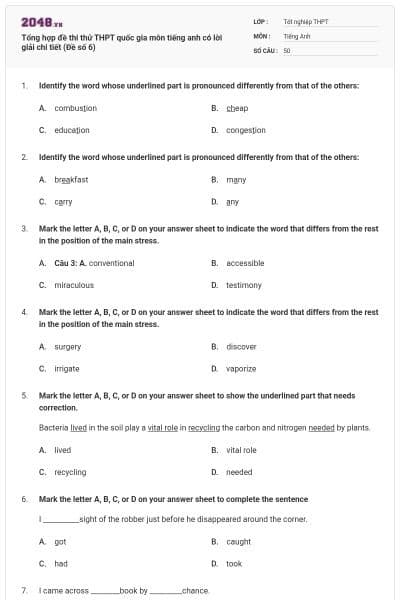
Identify the word whose underlined part is pronounced differently from that of the others:
combustion
cheap
education
congestion
Đáp án C
Phần gạch chân câu C được phát âm là /ʃ/, các đáp án còn lại là /tʃ/
A.combustion /kəmˈbʌs.tʃən/ (n): sự cháy.
B. cheap /tʃiːp/ (adj): rẻ.
C. education /ˌedʒ.uˈkeɪ.ʃən/ (n): giáo dục.
D. congestion /kənˈdʒes.tʃən/ (n): sự tắc nghẽn
Identify the word whose underlined part is pronounced differently from that of the others:
breakfast
many
carry
any
Đáp án C
Phần gạch chân đáp án C được phát âm là /æ/, các đáp án còn lại là /e/.
A.breakfast /ˈbrek.fəst/ (n): bữa sáng.
B. many /ˈmen.i/ (pro): nhiều ( dùng với danh từ đếm được).
C. carry /ˈkæ.ri/ (v): mang theo.
D. any /ˈen.i/ (pro): bất cứ ( dùng trong câu phủ định và câu hỏi)
Mark the letter A, B, C, or D on your answer sheet to indicate the word that differs from the rest in the position of the main stress.
Câu 3: A. conventional
accessible
miraculous
testimony
Đáp án D
trọng âm rơi vào âm tiết thứ nhất, các đáp án còn lại rơi và âm tiết thứ 2
A. conventional /kənˈven.ʃən.əl/ (adj): theo tục lệ, thông thường.
B. accessible /əkˈse.sə.bəl/ (adj): có thể tiếp cận được.
C. miraculous /mɪˈræ.kjə.ləs/ (adj): huyền diệu, phi thường
D. testimony /ˈtes.tɪ.mə.ni/ (n): bản chứng nhận, chứng cứ
Mark the letter A, B, C, or D on your answer sheet to indicate the word that differs from the rest in the position of the main stress.
surgery
discover
irrigate
vaporize
Đáp án B
trọng âm rơi vào âm tiết thứ 2, các đáp án còn lại rơi âm tiết thứ nhất.
A. surgery /ˈsɜːdʒə.ri/ (n): phẫu thuật.
B. discover /dɪˈskʌv.ər/ (v): khám phá.
C. irrigate /ˈɪr.ɪ.ɡeɪt/ (v): tưới ( đất, ruộng)
D. vaporize /ˈveɪ.pər.aɪz/ (v): bốc hơi ( nước)
Mark the letter A, B, C, or D on your answer sheet to show the underlined part that needs correction.
Bacteria lived in the soil play a vital role in recycling the carbon and nitrogen needed by plants.
lived
vital role
recycling
needed
Đáp án A
Sửa “ lived” => living/ which lives
Do ta thấy có 2 động từ “ live” và “ play” nên ngầm hiểu rằng bản chất câu này có 2 mệnh đề được gộp thành 1 do sử dụng tới Mệnh đề quan hệ/ Mệnh đề quan hệ rút gọn dạng chủ động (động từ chia V-ing).
Dịch: Vi khuẩn sống trong đất đóng 1 vai trò quan trọng trong việc tái hấp thu khí cac-bon và ni-tơ cần thiết cho cây.
Mark the letter A, B, C, or D on your answer sheet to complete the sentence
I __________sight of the robber just before he disappeared around the corner.
got
caught
had
took
Đáp án B
(to) catch sight of N/ V-ing: trông thấy
Dịch: Tôi trông thấy tên cướp trước khi hắn biến mất vào lối rẽ.
I came across ________book by _________chance.
Ø/Ø
Ø/ a
a/ the
the/ Ø
Đáp án D
Cụm “ by chance” : tình cờ, ngẫn nhiên. Do đó loại B, C
“ book” là số ít đếm được nên không thể đứng một mình=> ta chọn D
Dịch: Tôi tình cờ thấy 1 cuốn sách.
Many lives were saved _________the introduction of antibiotics.
into
with
in
at
Đáp án: B
Giải thích:
Kiến thức: Giới từ
"With the introduction of..." có nghĩa là "với sự ra đời của...", thường được dùng để chỉ điều gì đó xảy ra nhờ vào một sự đổi mới hoặc phát minh.
Trong trường hợp này, sự ra đời của kháng sinh (antibiotics) đã cứu nhiều mạng sống, nên ta dùng "with".
Dịch: Nhiều mạng sống đã được cứu nhờ sự ra đời của kháng sinh.
The doctor gave him an injection to _________the pain.
die
death
dead
deaden
Đáp án D
Đáp án D. deaden (v): làm dịu
Do vị trí này cần 1 động từ nên ta loại B, C. Đáp án A là động từ nhưng nghĩa không hợp nghĩa.
A. die (v): chết.
B. death (n): cái chết .
C. dead (adj): chết.
Dịch: Bác sĩ tiêm cho anh ta để làm giảm cơn đau
Your handwriting tells a lot about your_______
characteristic
characterless
character
characterize
Đáp án C
Đáp án C. character (n): tính cách, cá tính
Do vị trí này cần 1 danh từ nên ta loại B, D. Đáp án A là danh từ nhưng không hợp nghĩa.
A. characteristic (n): đặc điểm.
B. characterless (adj): tầm thường, không có bản sắc.
D. characterize (v): mô tả
Dịch: Chữ viết tay nói lên nhiều điều về tính cách của bạn.
We looked everywhere but the intruder was nowhere__________.
to see
seen
to be seen
having seen
Đáp án: C
Giải thích:
Kiến thức: Thành ngữ
nowhere to be found/seen = nowhere in sight: không thể nhìn thấy, tìm thấy
Dịch: Chúng tôi đã tìm khắp nơi nhưng không thấy kẻ đột nhập đâu cả.
System for purification of water is called__________.
a system water purification
a purification water system
a water purification system
a purified water system
Đáp án C
Đáp án C. Danh từ ghép: a water purification system: hệ thống lọc nước sạch
Linda insisted that the newly- born baby ___________after her husband’s father.
must be named
could be named
be named
ought to be named
Đáp án C
Chủ điểm ngữ pháp liên quan tới Câu giả định: S insist + that + S + V-inf
Ngoài “insist” ra, còn có: advise, ask, command, decree, demand, order, recommend request, require, propose, suggest, urge, etc
Dịch: Linda cứ khăng khăng rằng đứa bé phải được đặt tên theo ông nội
We were lucky to be able to finish the project ahead _______schedule
of
for
before
by
Đáp án: A
Giải thích:
Kiến thức: Giới từ
ahead of somebody/something: sớm hơn/trước ai/cái gì
Dịch: Chúng tôi may mắn khi có thể hoàn thành dự án trước thời hạn.
She _______till the early hours listening to pop music.
kept me up
took me up
help me up
caught me up
Đáp án A
Đáp án A. keep sbd up (v): làm ai thức khuya.
Các đáp án còn lại:
B. take sbd up: giúp đỡ, dìu dắt ai.
C. hold sbd/smt up: đưa ai/cái gì ra làm ví dụ.
D. catch sbd up: đuổi kịp ai.
Dịch: Cô ấy đã khiến tôi thức đến tận sáng để nghe nhạc pop
“Is there any news about the ex- president?”
“Well, he is reported __________the country last night”.
that he left
to be leaving
to have left
to leave
Đáp án C
Chủ điểm ngữ pháp liên quan tới Câu bị động ( Passive Voice) với động từ tường thuật (ở trong câu này động từ tường thuật là “ report” )
Chủ động: S1+ reported + that + S2 V O => Bị động: S2 + tobe reported+ to have PII by S1
Ngoài động từ “report” còn có: think, consider, know, believe, say, suppose, suspect, rumour, declare.
Dịch: “ Có tin gì mới về cựu tổng thống không?”
“ À, ông ấy được đưa tin là đã rời khỏi đất nước vào tối qua”.
There were many large rooms with _________walls in the castle.
decorating beautiful
beautifully decorating
beautifully decorated
beautiful decorated
Đáp án C
Giải thích: Ta thấy “ walls” là danh từ nên vị trí còn trống sẽ là 1 tính từ, ta có cách thành lập tính từ ghép trong Tiếng Anh là: adv + Ved ( eg: well bahaved, well prepared, etc).
Dịch: Lâu đài này có rất nhiều phòng lớn cùng với những bức tường được trang trí rất đẹp.
I don’t know what we are going to ……………if I lose this job.
get by
give away
live on
grow on
Đáp án C
Đáp án. C. live on: sống dựa vào.
Các đáp án còn lại không hợp nghĩa:
A. get by: xoay xở.
B. give away: trao, phát.
D. grow on: lớn lên, trở nên.
Dịch: Tôi không biết chúng tôi sẽ sống dựa và cái gì nếu tôi mất việc
From the hotel there’s a good _________of the mountain.
view
vision
picture
sight
Đáp án A
Đáp án A. view (n): tầm nhìn, quang cảnh.
Các đáp án còn lại:
B. vision (n): cảnh mộng, ảo mộng, tầm mắt.
C. picture (n): bức tranh.
D. sight (n): thị lực, khả năng nhìn.
Dịch: Từ khách sạn này có một tầm nhìn rất đẹp ra phía ngọn núi
My father is fond of sport. He goes to the Sport Clubs to watch________every Saturday.
racing horse
race horse
horsing race
horse races
Đáp án D
Đáp án D. horse races (n): trận đua ngựa.
Dịch: Bố tôi rất mê thể thao. Ông tới các câu lạc bộ thể thao để xem các trận đua ngựa vào thứ 7 hằng tuần.
Mark the letter A, B, C, or D on your answer sheet to complete the sentence.
John: “Do you think that we should use public transportation to protect our environment?”
Mary: “____________”
Well, that’s very surprising
Yes, it’s an absurd idea
Of course not. You bet!
There’s no doubt about it.
Đáp án D
- John: “ Cậu có nghĩ là chúng ta nên sử dụng phương tiện công cộng để bảo vệ môi trường không?”
- Mary: “ ”
A. Chà, thật là bất ngờ.
B. Vâng, đúng là 1 ý tưởng ngớ ngẩn.
C. Tất nhiên là không. Cậu chắc chắn chứ!
D. Tớ hoàn toàn đồng ý.
Chỉ có đáp án D là phù hợp: There’s no doubt about it = I totally agree
Mark the letter A, B, C, or D on your answer sheet to complete the sentence.
Linda: "Could you turn down the radio, please?"
Henry: “________________."
I feel sorry
I am, of course
Yes, with pleasure
Yes, I can
Đáp án C
-Lida: “ Cậu có thể tắt radio đi được không”.
-Henry: “__________."
A. Tớ rất tiếc.
B. Ừ đương nhiên.
C. Được thôi, tớ sẵn lòng.
D. Ừ, tớ có thể.
Đáp án C là phù hợp nhất, thể hiện được đúng tính lịch sự trong giao tiếp.
Mark the letter A, B, C, or D on your answer sheet to indicate the word CLOSEST in meaning to the underlined word in the sentence.
The high mountain climate is cold and inhospitable.
uninviting
rainy
dull
stormy
Đáp án A
Đáp án A. inhospitable (adj): không mến khách = uninviting (adj): gây khó chịu, không hấp dẫn.
Các đáp án còn lại:
B. rainy (adj): có mưa
C. dull (adj): ảm đạm, buồn tẻ
D. stormy (adj): có bão.
Mark the letter A, B, C, or D on your answer sheet to indicate the word CLOSEST in meaning to the underlined word in the sentence.
The train departed the railway station at 8 o’clock.
arrived
stopped
waited
left
Đáp án A
Đáp án A. depart (v) = arrive (v): khởi hành, lên đường.
Các đáp án còn lại:
B. stop (v): dừng lại.
C. wait (v): chờ đợi.
D. leave (v): rời đi, bỏ lại.
Mark the letter A, B, C, or D on your answer sheet to indicate the word OPPOSITE in meaning to the underlined word in the sentence.
The guests at the party last night refused to eat the raw fish
fresh
cooked
rotten
well- done
Đáp án B
Đáp án B. raw (adj): tươi sống >< cooked (adj): được nấu chín.
Các đáp án còn lại:
A. fresh (adj): tươi, trong sạch.
C. rotten (adj): mục nát, thối rữa.
D. well-done (adj): tốt.
Dịch: Khách mời ở bữa tiệc tối qua từ chối ăn món cá sống.
Mark the letter A, B, C, or D on your answer sheet to indicate the word OPPOSITE in meaning to the underlined word in the sentence.
She decided to remain celibate and devote her life to helping the homeless and orphans
divorced
single
separated
married
Đáp án D
Đáp án D. celebate (adj) = single: độc thân >< married (adj): đã lập gia đình.
Các đáp án còn lại:
A. divorced (adj): li hôn.
C. separated (adj): chia tay.
Dịch: Cô ấy quyết định tiếp tục sống độc thân và cống hiến cuộc đời mình cho việc giúp đỡ những người vô gia cư và trẻ mồ côi
Mark the letter A, B, C, or D on your answer sheet to indicate the sentence that is closest meaning to the given sentence.
The train came suddenly to a stop and some passengers were injured
Coming suddenly a stop, some passengers were injured
Coming suddenly a stop, the train made some passengers injured
Suddenly stopping running, some passengers were injured
Suddenly stopped, some passengers injured themselves
Đáp án B
Chủ điểm ngữ pháp liên quan đến Hiện tại phân từ dùng để miêu tả 2 hành động xảy ra nối tiếp nhau và cùng có chung một chủ ngữ.
Eg: She closed all the windows and the door carefully, then she went to bed
=> Closing all the windows and the door carefully, she went to bed (Đóng hết các cửa sổ và cửa chính cẩn thận, cô ấy đi ngủ)
Như vậy ngoài đáp án B, các đáp án còn lại sai ngữ pháp do 2 mệnh đề không thống nhất về chủ ngữ.
Dịch: Đột nhiên dừng lại, đoàn tàu khiến một vài hành khách bị thương
Mark the letter A, B, C, or D on your answer sheet to indicate the sentence that is closest meaning to the given sentence.
Dr Smith is now the fifth wealthiest man in this city.
Dr Smith is the wealthiest one in this city
Only four people in this city are wealthier than Dr Smith
Dr Smith is wealthier than five people in this city
No one in this city has more wealth than Dr Smith
Đáp án: B
Giải thích:
Dịch: Tiến sĩ Smith hiện là người giàu thứ năm ở thành phố này.
A. Tiến sĩ Smith là người giàu nhất ở thành phố này.
B. Chỉ có bốn người ở thành phố này giàu hơn Tiến sĩ Smith.
C. Tiến sĩ Smith giàu hơn năm người ở thành phố này.
D. Không ai ở thành phố này giàu hơn Tiến sĩ Smith.
Đáp án B phù hợp nhất về nghĩa.
Mark the letter A, B, C, or D on your answer sheet to indicate the sentence that is closest meaning to the given sentence.
It was only when I left home that I realized how much my father meant to me.
Not until I had left home did I realize how much my father meant to me
Not until I had left home that I realized how much my father meant to me
Not until had I left home that I realized how much my father meant to me
Not until after I left home did I realize how much my father meant to me
Đáp án A
Chỉ khi xa nhà tôi mới nhận ra rằng cha tôi đã có ý nghĩa đối với tôi như thế nào.
= Cho tới khi xa nhà thì tôi mới nhận ra rằng cha tôi đã có ý nghĩa đối với tôi như thế nào.
Chủ điểm ngữ pháp liên quan tới Đảo ngữ với “ Not only”:
Not until + S V O + Inversion (đảo ngữ): Không….cho tới khi…
Các đáp án còn lại sai ngữ pháp.
Mark the letter A, B, C, or D on your answer sheet to indicate the sentence that is closest meaning to the given sentence.
It’s possible that he didn’t hear what I said
She may not hear what I said
She might not hear what I said
She might have heard what I said
She may not have heard what I said
Đáp án D
Đáp án D. may have PII :chỉ 1 dự đoán ở quá khứ ( không có cơ sở)
Các đáp án khác:
A. may V: dự đoán ở hiện tại hoặc tương lại ( khả năng cao)
B. might V: dự đoán ở hiện tại hoặc tương lai ( khả năng thấp)
C. might have PII: dự đoán ở quá khứ ( không có cơ sở).
Cấu trúc ngữ pháp “may have PII” và “might have PII” có cùng cách sử dụng nhưng đáp án
C sai do thiếu “not” nên câu bị ngược nghĩa hoàn toàn so với câu tiêu đề.
Dịch: Có thể cô ấy đã không nghe những điều mà tôi nói.
= Cô ấy có lẽ đã không nghe những điều mà tôi nói.
Mark the letter a, B, C, or D on your answer sheet to indicate the sentence that is closest meaning to each of the following questions or indicate the correct answer to each of them from 1 to 8
Tsunami is a Japanese word which means harbor wave and is used as the scientific term for seismic sea wave generated by an undersea earthquake or possibly an undersea landslide or volcanic eruption. When the ocean floor is tilted or offset during an earthquake, a set of waves is created similar to the concentric waves generated by an object dropped into the wave. Most tsunamis originate along the Ring of Fire, a zone of volcanoes and seismic activity, 32.500 km long that encircles the Pacific Ocean. Since 1819, about 40 tsunami have struck the Hawaiian Islands.
A tsunami can have wave lengths, or widths, of 100 to 200 km, and may travel hundreds of kilometres across the deep ocean, reaching speeds of about 725 to 800 kilometres an hour. Upon entering shallow coastal waters, the wave, which may have been only about half a metre high out at sea, suddenly grows rapidly. When the wave reaches the shore, it may be 15 metres high or more. Tsunamis have tremendous energy because of the great volume of water affected. They are capable of obliterating coastal settlements.
Tsunami should not be confused with storm surges, which are domes of water that rise underneath hurricanes or cyclones and cause extensive coastal flooding when the storms reach land. Storm surges are particularly devastating if they occur at high tide. A cyclone and accompanying storm surge killed an estimated 500,000 people in Bangladesh in 1970. The tsunami which truck south and southeast Asia in late 2004 killed over 200 thousand people.
What does the word concentric mean?
Wavy
Having many centres
Having a common centre
A ring
Đáp án C
Từ “ concentric” có nghĩa là:
A. gợn sóng
B. có nhiều trung tâm
C. có 1 tâm chung
D. cái đai.
Concentric (adj): đồng tâm = Having a common centre
Mark the letter a, B, C, or D on your answer sheet to indicate the sentence that is closest meaning to each of the following questions or indicate the correct answer to each of them from 1 to 8
Tsunami is a Japanese word which means harbor wave and is used as the scientific term for seismic sea wave generated by an undersea earthquake or possibly an undersea landslide or volcanic eruption. When the ocean floor is tilted or offset during an earthquake, a set of waves is created similar to the concentric waves generated by an object dropped into the wave. Most tsunamis originate along the Ring of Fire, a zone of volcanoes and seismic activity, 32.500 km long that encircles the Pacific Ocean. Since 1819, about 40 tsunami have struck the Hawaiian Islands.
A tsunami can have wave lengths, or widths, of 100 to 200 km, and may travel hundreds of kilometres across the deep ocean, reaching speeds of about 725 to 800 kilometres an hour. Upon entering shallow coastal waters, the wave, which may have been only about half a metre high out at sea, suddenly grows rapidly. When the wave reaches the shore, it may be 15 metres high or more. Tsunamis have tremendous energy because of the great volume of water affected. They are capable of obliterating coastal settlements.
Tsunami should not be confused with storm surges, which are domes of water that rise underneath hurricanes or cyclones and cause extensive coastal flooding when the storms reach land. Storm surges are particularly devastating if they occur at high tide. A cyclone and accompanying storm surge killed an estimated 500,000 people in Bangladesh in 1970. The tsunami which truck south and southeast Asia in late 2004 killed over 200 thousand people.
What will happen when an object is dropped into the water?
Volcanic eruption may be a consequence
Some concentric waves will be generated
There will be seismic activity
Earthquake may happen
Đáp án B
Điều gì sẽ xảy ra nếu có 1 vật thể rơi vào trong nước:
A. Hậu quả có thể là 1 vụ phụ trào núi lửa.
B. Một số vòng sóng đồng tâm sẽ được tạo ra.
C. Hoạt động địa chấn sẽ xảy ra.
D. Động đất có thể xảy ra
Dẫn chứng ở câu thứ 2 đoạn 1: “a set of waves is created similar to the concentric waves generated by an object dropped into the wave” – ( một loạt các con sóng được tạo ra tương tự như các vòng sóng đồng tâm được hình thành khi ta thả 1 vật thể xuống nước ).
Mark the letter a, B, C, or D on your answer sheet to indicate the sentence that is closest meaning to each of the following questions or indicate the correct answer to each of them from 1 to 8
Tsunami is a Japanese word which means harbor wave and is used as the scientific term for seismic sea wave generated by an undersea earthquake or possibly an undersea landslide or volcanic eruption. When the ocean floor is tilted or offset during an earthquake, a set of waves is created similar to the concentric waves generated by an object dropped into the wave. Most tsunamis originate along the Ring of Fire, a zone of volcanoes and seismic activity, 32.500 km long that encircles the Pacific Ocean. Since 1819, about 40 tsunami have struck the Hawaiian Islands.
A tsunami can have wave lengths, or widths, of 100 to 200 km, and may travel hundreds of kilometres across the deep ocean, reaching speeds of about 725 to 800 kilometres an hour. Upon entering shallow coastal waters, the wave, which may have been only about half a metre high out at sea, suddenly grows rapidly. When the wave reaches the shore, it may be 15 metres high or more. Tsunamis have tremendous energy because of the great volume of water affected. They are capable of obliterating coastal settlements.
Tsunami should not be confused with storm surges, which are domes of water that rise underneath hurricanes or cyclones and cause extensive coastal flooding when the storms reach land. Storm surges are particularly devastating if they occur at high tide. A cyclone and accompanying storm surge killed an estimated 500,000 people in Bangladesh in 1970. The tsunami which truck south and southeast Asia in late 2004 killed over 200 thousand people.
What is the zone of volcanoes and seismic activity in the world called?
The concentric wave
the tsunami
The Pacific Ocean
The Ring of Fire
Đáp án D
Khu vực có núi nửa và địa chấn hoạt động được gọi là gì?
A. Con sóng đồng tâm.
B. Sóng thần.
C. Thái Bình Dương.
D. Vành đai Lửa.
Dẫn chứng ở câu thứ 3 đoạn 1: “Most tsunamis originate along the Ring of Fire, a zone of volcanoes and seismic activity” – ( Phần lớn sóng thần bắt nguồn dọc theo Vành đai Lửa - khu vực hoạt động của núi lủa và địa chấn).
Mark the letter a, B, C, or D on your answer sheet to indicate the sentence that is closest meaning to each of the following questions or indicate the correct answer to each of them from 1 to 8
Tsunami is a Japanese word which means harbor wave and is used as the scientific term for seismic sea wave generated by an undersea earthquake or possibly an undersea landslide or volcanic eruption. When the ocean floor is tilted or offset during an earthquake, a set of waves is created similar to the concentric waves generated by an object dropped into the wave. Most tsunamis originate along the Ring of Fire, a zone of volcanoes and seismic activity, 32.500 km long that encircles the Pacific Ocean. Since 1819, about 40 tsunami have struck the Hawaiian Islands.
A tsunami can have wave lengths, or widths, of 100 to 200 km, and may travel hundreds of kilometres across the deep ocean, reaching speeds of about 725 to 800 kilometres an hour. Upon entering shallow coastal waters, the wave, which may have been only about half a metre high out at sea, suddenly grows rapidly. When the wave reaches the shore, it may be 15 metres high or more. Tsunamis have tremendous energy because of the great volume of water affected. They are capable of obliterating coastal settlements.
Tsunami should not be confused with storm surges, which are domes of water that rise underneath hurricanes or cyclones and cause extensive coastal flooding when the storms reach land. Storm surges are particularly devastating if they occur at high tide. A cyclone and accompanying storm surge killed an estimated 500,000 people in Bangladesh in 1970. The tsunami which truck south and southeast Asia in late 2004 killed over 200 thousand people.
What is the greatest speed of tsunami traveling across the deep ocean?
200 kilometres an hour
700 kilometres an hour
800 kilometres an hour
150,000 kilometres an hour
Đáp án C
Tốc độ lớn nhất của sóng thần chạy trong lòng đại dương là bao nhiêu?
A. 200 km/h
B. 700 km/h
C. 800 km/h
D. 150.000 km/h
Dẫn chứng ở câu đầu đoạn 2: “…and may travel hundreds of kilometres across the deep ocean, reaching speeds of about 725 to 800 kilometres an hour” – ( Sóng thần có thể chạy hàng trăm km dưới lòng đại dương, tốc độ đạt tới từ 725-800 km/h)
Mark the letter a, B, C, or D on your answer sheet to indicate the sentence that is closest meaning to each of the following questions or indicate the correct answer to each of them from 1 to 8
Tsunami is a Japanese word which means harbor wave and is used as the scientific term for seismic sea wave generated by an undersea earthquake or possibly an undersea landslide or volcanic eruption. When the ocean floor is tilted or offset during an earthquake, a set of waves is created similar to the concentric waves generated by an object dropped into the wave. Most tsunamis originate along the Ring of Fire, a zone of volcanoes and seismic activity, 32.500 km long that encircles the Pacific Ocean. Since 1819, about 40 tsunami have struck the Hawaiian Islands.
A tsunami can have wave lengths, or widths, of 100 to 200 km, and may travel hundreds of kilometres across the deep ocean, reaching speeds of about 725 to 800 kilometres an hour. Upon entering shallow coastal waters, the wave, which may have been only about half a metre high out at sea, suddenly grows rapidly. When the wave reaches the shore, it may be 15 metres high or more. Tsunamis have tremendous energy because of the great volume of water affected. They are capable of obliterating coastal settlements.
Tsunami should not be confused with storm surges, which are domes of water that rise underneath hurricanes or cyclones and cause extensive coastal flooding when the storms reach land. Storm surges are particularly devastating if they occur at high tide. A cyclone and accompanying storm surge killed an estimated 500,000 people in Bangladesh in 1970. The tsunami which truck south and southeast Asia in late 2004 killed over 200 thousand people.
How high is the wave of the tsunami when it reaches the shore?
100 metres
200 metres
half a metre
fifteen metres
Đáp án D
Độ cao của sóng thần khi chúng tới bờ?
A. 100 mét
B. 200 mét
C 0,5 mét
D. 15 mét
Dẫn chứng ở câu thứ 3 đoạn 2: “When the wave reaches the shore, it may be 15 metres high or more” – ( Khi tới bờ, con sóng có thể cao tới 15 mét hoặc hơn ).
Mark the letter a, B, C, or D on your answer sheet to indicate the sentence that is closest meaning to each of the following questions or indicate the correct answer to each of them from 1 to 8
Tsunami is a Japanese word which means harbor wave and is used as the scientific term for seismic sea wave generated by an undersea earthquake or possibly an undersea landslide or volcanic eruption. When the ocean floor is tilted or offset during an earthquake, a set of waves is created similar to the concentric waves generated by an object dropped into the wave. Most tsunamis originate along the Ring of Fire, a zone of volcanoes and seismic activity, 32.500 km long that encircles the Pacific Ocean. Since 1819, about 40 tsunami have struck the Hawaiian Islands.
A tsunami can have wave lengths, or widths, of 100 to 200 km, and may travel hundreds of kilometres across the deep ocean, reaching speeds of about 725 to 800 kilometres an hour. Upon entering shallow coastal waters, the wave, which may have been only about half a metre high out at sea, suddenly grows rapidly. When the wave reaches the shore, it may be 15 metres high or more. Tsunamis have tremendous energy because of the great volume of water affected. They are capable of obliterating coastal settlements.
Tsunami should not be confused with storm surges, which are domes of water that rise underneath hurricanes or cyclones and cause extensive coastal flooding when the storms reach land. Storm surges are particularly devastating if they occur at high tide. A cyclone and accompanying storm surge killed an estimated 500,000 people in Bangladesh in 1970. The tsunami which truck south and southeast Asia in late 2004 killed over 200 thousand people.
How are tsunami capable of obliterating coastal settlements?
They have tremendous energy due to the great volume of water affected.
They are a metre high or more.
They travel hundreds of kilometers
They can strike the shore fifteen metres high.
Đáp án A
Sóng thần có khả năng hủy diệt các khu dân cư ven bờ như thế nào?
A. Chúng có năng lượng khủng khiếp do khối lượng nước khủng lồ bị tác động mạnh.
B. Chúng cao 1 mét hoặc hơn.
C. Chúng đi hàng trăm cây số.
D. Chúng có thể đánh mạnh vào bờ với độ cao 15 mét.
Dẫn chứng ở 2 câu cuối đoạn 2: “Tsunamis have tremendous energy because of the great volume of water affected. They are capable of obliterating coastal settlements.” – (Sóng thần có năng lượng khủng khiếp do khối lượng nước khủng lồ bị tác động mạnh. Chúng có khả năng xóa sổ hoàn toàn các khu dân cư ven bờ).
Mark the letter a, B, C, or D on your answer sheet to indicate the sentence that is closest meaning to each of the following questions or indicate the correct answer to each of them from 1 to 8
Tsunami is a Japanese word which means harbor wave and is used as the scientific term for seismic sea wave generated by an undersea earthquake or possibly an undersea landslide or volcanic eruption. When the ocean floor is tilted or offset during an earthquake, a set of waves is created similar to the concentric waves generated by an object dropped into the wave. Most tsunamis originate along the Ring of Fire, a zone of volcanoes and seismic activity, 32.500 km long that encircles the Pacific Ocean. Since 1819, about 40 tsunami have struck the Hawaiian Islands.
A tsunami can have wave lengths, or widths, of 100 to 200 km, and may travel hundreds of kilometres across the deep ocean, reaching speeds of about 725 to 800 kilometres an hour. Upon entering shallow coastal waters, the wave, which may have been only about half a metre high out at sea, suddenly grows rapidly. When the wave reaches the shore, it may be 15 metres high or more. Tsunamis have tremendous energy because of the great volume of water affected. They are capable of obliterating coastal settlements.
Tsunami should not be confused with storm surges, which are domes of water that rise underneath hurricanes or cyclones and cause extensive coastal flooding when the storms reach land. Storm surges are particularly devastating if they occur at high tide. A cyclone and accompanying storm surge killed an estimated 500,000 people in Bangladesh in 1970. The tsunami which truck south and southeast Asia in late 2004 killed over 200 thousand people.
What killed an estimated 500,000 people in Bangladesh?
a tsunami
A cyclone and accompanying storm surge
A high tide
flooding
Đáp án B
Cái gì làm 500.000 người Bangladesh thiệt mạng?
A. sóng thần.
B. Một cơn lốc xoáy và cơn bão đi kèm.
C. thủy triều cao.
D. ngập lụt.
Dẫn chứng ở câu gần cuối: “A cyclone and accompanying storm surge killed an estimated 500,000 people in Bangladesh in 1970” – (Một cơn lốc xoáy và cơn bão đi kèm đã làm thiệt mạng khoảng 500.000 người dân Bangladesh vào năm 1970).
Mark the letter a, B, C, or D on your answer sheet to indicate the sentence that is closest meaning to each of the following questions or indicate the correct answer to each of them from 1 to 8
Tsunami is a Japanese word which means harbor wave and is used as the scientific term for seismic sea wave generated by an undersea earthquake or possibly an undersea landslide or volcanic eruption. When the ocean floor is tilted or offset during an earthquake, a set of waves is created similar to the concentric waves generated by an object dropped into the wave. Most tsunamis originate along the Ring of Fire, a zone of volcanoes and seismic activity, 32.500 km long that encircles the Pacific Ocean. Since 1819, about 40 tsunami have struck the Hawaiian Islands.
A tsunami can have wave lengths, or widths, of 100 to 200 km, and may travel hundreds of kilometres across the deep ocean, reaching speeds of about 725 to 800 kilometres an hour. Upon entering shallow coastal waters, the wave, which may have been only about half a metre high out at sea, suddenly grows rapidly. When the wave reaches the shore, it may be 15 metres high or more. Tsunamis have tremendous energy because of the great volume of water affected. They are capable of obliterating coastal settlements.
Tsunami should not be confused with storm surges, which are domes of water that rise underneath hurricanes or cyclones and cause extensive coastal flooding when the storms reach land. Storm surges are particularly devastating if they occur at high tide. A cyclone and accompanying storm surge killed an estimated 500,000 people in Bangladesh in 1970. The tsunami which truck south and southeast Asia in late 2004 killed over 200 thousand people.
Which of the following is NOT true?
Tsunami only occurs in Asia.
A cyclone along with storm surge happened in Asia in 1970
Storm surges are domes of water rising underneath hurricanes or cyclones
Storm surges causes extensive coastal flooding
Đáp án A
Câu nào sau đây không đúng:
A. Sóng thần chỉ xảy ra ở Châu Á.
B. Một cơn lốc xoáy cùng với cơn bão đã xảy ra ở châu Á vào năm 1970.
C. Bão dâng là những vòm nước dâng cao bên dưới các cơn bão hoặc lốc xoáy.
D. Sóng dâng gây ra ngập lụt ven biển trên diện rộng.
Dẫn chứng: “Most tsunamis originate along the Ring of Fire, a zone of volcanoes and seismic activity, 32.500 km long that encircles the Pacific Ocean” – ( Phần lớn sóng thần bắt nguồn dọc theo Vành đai Lửa - khu vực hoạt động của núi lủa và địa chấn, trải dài 32.500 km bao quanh Thái Bình Dương ) => sóng thần xảy ra quanh khu vực Thái Bình Dương chứ không chỉ 1 mình Châu Á. Các thông tin còn lại có thể được tìm thấy trong bài.
Mark the letter a, B, C, or D on your answer sheet to choose the best option for each numbered gap to complete the following passage from 1 to 5.
Many thousands of children have …. (1).….in their homes. As a result, some children died. The most common accidents are with fire and hot water. Small children often .….(2)…... pots of boiling water on the stove. The pots fall over and the hot water falls on the children and burns them. Some children like to play with fire. They enjoy striking matches or throwing things on a fire to make it burn brightly. If a fire gets too big, it gets out of control. Then the house…...(3)…….. fire. It is very dangerous to play with matches. When a child strikes a match, the flame soon burns near his fingers. Then he….(4)…….. the match on the floor. Many houses catch fire in this way.
Some kinds of clothing burn very…….(5)…….. Many children have been badly burned because they have stood too near a fire and their clothing has suddenly caught fire.
Điền ô số 1
died
fallen
accidents
fainted
Đáp án C
accidents: tai nạn.
Vị trí này ta cần 1 danh từ để câu mang thì Hiện tại đơn, diễn tả 1 sự thật .
Các đáp án còn lại:
A. died (v): chết
B. fallen (v): ngã
D. fainted (v): ngất xỉu.
Dịch: Hàng ngàn trẻ em gặp tai nạn trong chính ngôi nhà của chúng
Mark the letter a, B, C, or D on your answer sheet to choose the best option for each numbered gap to complete the following passage from 1 to 5.
Many thousands of children have …. (1).….in their homes. As a result, some children died. The most common accidents are with fire and hot water. Small children often .….(2)…... pots of boiling water on the stove. The pots fall over and the hot water falls on the children and burns them. Some children like to play with fire. They enjoy striking matches or throwing things on a fire to make it burn brightly. If a fire gets too big, it gets out of control. Then the house…...(3)…….. fire. It is very dangerous to play with matches. When a child strikes a match, the flame soon burns near his fingers. Then he….(4)…….. the match on the floor. Many houses catch fire in this way.
Some kinds of clothing burn very…….(5)…….. Many children have been badly burned because they have stood too near a fire and their clothing has suddenly caught fire.
Điền ô số 2
reach
touch
hold
approach
Đáp án B
touch (v): chạm.
Các đáp án còn lại:
A. reach (v): đạt tới, đến.
C. hold (v): giữ.
D. approach (v): đến gần.
Dịch: Một vài trẻ thường xuyên chạm tay và ấm nước đang sôi trên bếp lò
Mark the letter a, B, C, or D on your answer sheet to choose the best option for each numbered gap to complete the following passage from 1 to 5.
Many thousands of children have …. (1).….in their homes. As a result, some children died. The most common accidents are with fire and hot water. Small children often .….(2)…... pots of boiling water on the stove. The pots fall over and the hot water falls on the children and burns them. Some children like to play with fire. They enjoy striking matches or throwing things on a fire to make it burn brightly. If a fire gets too big, it gets out of control. Then the house…...(3)…….. fire. It is very dangerous to play with matches. When a child strikes a match, the flame soon burns near his fingers. Then he….(4)…….. the match on the floor. Many houses catch fire in this way.
Some kinds of clothing burn very…….(5)…….. Many children have been badly burned because they have stood too near a fire and their clothing has suddenly caught fire.
Điền ô số 3
catches
burns
singes
makes
Đáp án A
catch fire (v): bén lửa.
Các đáp án còn lại:
B. burn (v): đốt.
C. singe (v): cháy xém
D. make (v): làm, tạo ra.
Dịch: Và sau đó ngôi nhà bén lửa
Mark the letter a, B, C, or D on your answer sheet to choose the best option for each numbered gap to complete the following passage from 1 to 5.
Many thousands of children have …. (1).….in their homes. As a result, some children died. The most common accidents are with fire and hot water. Small children often .….(2)…... pots of boiling water on the stove. The pots fall over and the hot water falls on the children and burns them. Some children like to play with fire. They enjoy striking matches or throwing things on a fire to make it burn brightly. If a fire gets too big, it gets out of control. Then the house…...(3)…….. fire. It is very dangerous to play with matches. When a child strikes a match, the flame soon burns near his fingers. Then he….(4)…….. the match on the floor. Many houses catch fire in this way.
Some kinds of clothing burn very…….(5)…….. Many children have been badly burned because they have stood too near a fire and their clothing has suddenly caught fire.
Điền ô số 4
throws
disposed
puts
drops
Đáp án D
drop (v): làm rơi.
Các đáp án còn lại:
A. throw (v): ném đi
B. dispose (v): vứt, tống khứ.
C. put (v): đặt, để.
Dịch: Sau đó nó đánh rơi que diêm xuống sàn
Mark the letter a, B, C, or D on your answer sheet to choose the best option for each numbered gap to complete the following passage from 1 to 5.
Many thousands of children have …. (1).….in their homes. As a result, some children died. The most common accidents are with fire and hot water. Small children often .….(2)…... pots of boiling water on the stove. The pots fall over and the hot water falls on the children and burns them. Some children like to play with fire. They enjoy striking matches or throwing things on a fire to make it burn brightly. If a fire gets too big, it gets out of control. Then the house…...(3)…….. fire. It is very dangerous to play with matches. When a child strikes a match, the flame soon burns near his fingers. Then he….(4)…….. the match on the floor. Many houses catch fire in this way.
Some kinds of clothing burn very…….(5)…….. Many children have been badly burned because they have stood too near a fire and their clothing has suddenly caught fire.
Điền ô số 5
easily
quickly
violently
both A & B
Đáp án D
Cả B và C đề đúng ( easily và quickly)
Dịch: Một và loại quần áo rất dễ cháy / cháy rất nhanh
Mark the letter a, B, C, or D on your answer sheet to indicate the sentence that is closest meaning to each of the following questions or indicate the correct answer to each of them from 1 to 7
It is estimated that over 99 percent of all species that ever existed have become extinct. What causes extinction? When a species is no longer adapted to a changed environment, it may perish. The exact causes of a species’ death vary from situation to situation. Rapid ecological change may render an environment hostile to a species. For example, temperatures may change and a species may not be able to adapt. Food resources may be affected by environmental changes, which will then cause problems for a species requiring these resources. Other species may become better adapted to an environment, resulting in competition and, ultimately, in the death of a species.
The fossil record reveals that extinction has occurred throughout the history of Earth. Recent analyses have also revealed that on some occasions many species become extinct at the same time- a mass extinction. One of the best- known examples of mass extinction occurred 65 million years ago with the demise of dinosaurs and many other forms of life. Perhaps the largest mass extinction was the one that occurred 225 million years ago, when appropriately 95 percent of all species died. Mass extinction can be caused by a relatively rapid change in the environment and can be worsened by the close interrelationship of many species. If, for example, something were to happen to destroy much of the plankton in the oceans, then the oxygen content of Earth would drop, affection even organisms not living in the ocean. Such a change would probably lead to a mass extinction.
One interesting, and controversial, finding is that extinctions during the past 250 million years have tended to be more intense every 26 million years. This periodic extinction might be due to intersection of the Earth’s orbit with a cloud of comets, but this theory is purely speculative. Some researchers have also speculated that extinction may often be random. That is, certain species may be eliminated and others may survive for no particular reason. A species’ survival may have nothing to do with its ability to adapt. If so, some of evolutionary history may reflect a sequence of essentially random events.
The underlined word “ultimately” is closest in meaning to
eventually
unfortunately
dramatically
exceptionally
Đáp án A
Đáp án A. ultimately = eventually: cuối cùng, rốt cục thì.
Các đáp án còn lại:
B. không may mắn.
C. đột ngột.
D. cá biệt, khác thường.
Mark the letter a, B, C, or D on your answer sheet to indicate the sentence that is closest meaning to each of the following questions or indicate the correct answer to each of them from 1 to 7
It is estimated that over 99 percent of all species that ever existed have become extinct. What causes extinction? When a species is no longer adapted to a changed environment, it may perish. The exact causes of a species’ death vary from situation to situation. Rapid ecological change may render an environment hostile to a species. For example, temperatures may change and a species may not be able to adapt. Food resources may be affected by environmental changes, which will then cause problems for a species requiring these resources. Other species may become better adapted to an environment, resulting in competition and, ultimately, in the death of a species.
The fossil record reveals that extinction has occurred throughout the history of Earth. Recent analyses have also revealed that on some occasions many species become extinct at the same time- a mass extinction. One of the best- known examples of mass extinction occurred 65 million years ago with the demise of dinosaurs and many other forms of life. Perhaps the largest mass extinction was the one that occurred 225 million years ago, when appropriately 95 percent of all species died. Mass extinction can be caused by a relatively rapid change in the environment and can be worsened by the close interrelationship of many species. If, for example, something were to happen to destroy much of the plankton in the oceans, then the oxygen content of Earth would drop, affection even organisms not living in the ocean. Such a change would probably lead to a mass extinction.
One interesting, and controversial, finding is that extinctions during the past 250 million years have tended to be more intense every 26 million years. This periodic extinction might be due to intersection of the Earth’s orbit with a cloud of comets, but this theory is purely speculative. Some researchers have also speculated that extinction may often be random. That is, certain species may be eliminated and others may survive for no particular reason. A species’ survival may have nothing to do with its ability to adapt. If so, some of evolutionary history may reflect a sequence of essentially random events.
What does the author say in paragraph 1 regarding most species in Earth’s history?
They are no longer in existence
They have caused rapid change in the environment
They have remained basically unchanged from their original forms
They have been able to adapt to ecological changes.
Đáp án A
Tác giả nói gì trong đoạn 1 liên quan tới phần lớn các loài trong lịch sử Trái Đất?
A. Chúng không còn tồn tại.
B. Chúng gây ra ra sự thay đổi nhanh chóng trong môi trường.
C. Chúng tồn tại không thay đổi nhiều so với ban đầu.
D. Chúng đã có thể thích nghi với sự thay đổi sinh thái.
Dẫn chứng ở câu đầu tiên: “It is estimated that over 99 percent of all species that ever existed have become extinct” – ( Xấp xỉ hơn 99% tất cả các loài từng tồn tại là đã tuyệt chủng ).
Mark the letter a, B, C, or D on your answer sheet to indicate the sentence that is closest meaning to each of the following questions or indicate the correct answer to each of them from 1 to 7
It is estimated that over 99 percent of all species that ever existed have become extinct. What causes extinction? When a species is no longer adapted to a changed environment, it may perish. The exact causes of a species’ death vary from situation to situation. Rapid ecological change may render an environment hostile to a species. For example, temperatures may change and a species may not be able to adapt. Food resources may be affected by environmental changes, which will then cause problems for a species requiring these resources. Other species may become better adapted to an environment, resulting in competition and, ultimately, in the death of a species.
The fossil record reveals that extinction has occurred throughout the history of Earth. Recent analyses have also revealed that on some occasions many species become extinct at the same time- a mass extinction. One of the best- known examples of mass extinction occurred 65 million years ago with the demise of dinosaurs and many other forms of life. Perhaps the largest mass extinction was the one that occurred 225 million years ago, when appropriately 95 percent of all species died. Mass extinction can be caused by a relatively rapid change in the environment and can be worsened by the close interrelationship of many species. If, for example, something were to happen to destroy much of the plankton in the oceans, then the oxygen content of Earth would drop, affection even organisms not living in the ocean. Such a change would probably lead to a mass extinction.
One interesting, and controversial, finding is that extinctions during the past 250 million years have tended to be more intense every 26 million years. This periodic extinction might be due to intersection of the Earth’s orbit with a cloud of comets, but this theory is purely speculative. Some researchers have also speculated that extinction may often be random. That is, certain species may be eliminated and others may survive for no particular reason. A species’ survival may have nothing to do with its ability to adapt. If so, some of evolutionary history may reflect a sequence of essentially random events.
Which of the following is NOT mentioned in paragraph 1 as resulting from repid ecological change?
Introduction of new species
Competition among species
Availability of food resources
Temperature changes
Đáp án A
Câu nào dưới đây không được đề cập trong đoạn 1 như là hệ quả từ sự biến đổi nhanh chóng của hệ sinh thái?
A. Loài mới xuất hiện.
B. Cạnh tranh giữa các loài.
C. Nguồn thức ăn có sẵn bị ảnh hưởng.
D. Thay đổi nhiệt độ.
Dẫn chứng ở câu 4+5 đoạn 1: “Rapid ecological change may render an environment hostile to a species. For example, temperatures may change and a species may not be able to adapt. Food resources may be affected by environmental changes” – ( Hệ sinh thái biến đổi làm cho môi trường trở thành thù địch đối với các loài. Ví dụ như nhiệt độ thay đổi làm nhiều loài không thể thích ứng kịp. Nguồn thức ăn cũng bị ảnh hưởng bởi sự biến đổi môi trường) => Từ đó ta loại ra đáp án A không được đề cập tới.
Mark the letter a, B, C, or D on your answer sheet to indicate the sentence that is closest meaning to each of the following questions or indicate the correct answer to each of them from 1 to 7
It is estimated that over 99 percent of all species that ever existed have become extinct. What causes extinction? When a species is no longer adapted to a changed environment, it may perish. The exact causes of a species’ death vary from situation to situation. Rapid ecological change may render an environment hostile to a species. For example, temperatures may change and a species may not be able to adapt. Food resources may be affected by environmental changes, which will then cause problems for a species requiring these resources. Other species may become better adapted to an environment, resulting in competition and, ultimately, in the death of a species.
The fossil record reveals that extinction has occurred throughout the history of Earth. Recent analyses have also revealed that on some occasions many species become extinct at the same time- a mass extinction. One of the best- known examples of mass extinction occurred 65 million years ago with the demise of dinosaurs and many other forms of life. Perhaps the largest mass extinction was the one that occurred 225 million years ago, when appropriately 95 percent of all species died. Mass extinction can be caused by a relatively rapid change in the environment and can be worsened by the close interrelationship of many species. If, for example, something were to happen to destroy much of the plankton in the oceans, then the oxygen content of Earth would drop, affection even organisms not living in the ocean. Such a change would probably lead to a mass extinction.
One interesting, and controversial, finding is that extinctions during the past 250 million years have tended to be more intense every 26 million years. This periodic extinction might be due to intersection of the Earth’s orbit with a cloud of comets, but this theory is purely speculative. Some researchers have also speculated that extinction may often be random. That is, certain species may be eliminated and others may survive for no particular reason. A species’ survival may have nothing to do with its ability to adapt. If so, some of evolutionary history may reflect a sequence of essentially random events.
The underlined word “demise” is closest in meaning to
help
change
death
recovery
Đáp án C
Đáp án C. demise (n) = death: cái chết.
Các đáp án còn lại:
A. help (n+v): giúp đỡ.
B. change (n+v): thay đổi.
D. recovery (n): sự khôi phục, sự phục hồi
Mark the letter a, B, C, or D on your answer sheet to indicate the sentence that is closest meaning to each of the following questions or indicate the correct answer to each of them from 1 to 7
It is estimated that over 99 percent of all species that ever existed have become extinct. What causes extinction? When a species is no longer adapted to a changed environment, it may perish. The exact causes of a species’ death vary from situation to situation. Rapid ecological change may render an environment hostile to a species. For example, temperatures may change and a species may not be able to adapt. Food resources may be affected by environmental changes, which will then cause problems for a species requiring these resources. Other species may become better adapted to an environment, resulting in competition and, ultimately, in the death of a species.
The fossil record reveals that extinction has occurred throughout the history of Earth. Recent analyses have also revealed that on some occasions many species become extinct at the same time- a mass extinction. One of the best- known examples of mass extinction occurred 65 million years ago with the demise of dinosaurs and many other forms of life. Perhaps the largest mass extinction was the one that occurred 225 million years ago, when appropriately 95 percent of all species died. Mass extinction can be caused by a relatively rapid change in the environment and can be worsened by the close interrelationship of many species. If, for example, something were to happen to destroy much of the plankton in the oceans, then the oxygen content of Earth would drop, affection even organisms not living in the ocean. Such a change would probably lead to a mass extinction.
One interesting, and controversial, finding is that extinctions during the past 250 million years have tended to be more intense every 26 million years. This periodic extinction might be due to intersection of the Earth’s orbit with a cloud of comets, but this theory is purely speculative. Some researchers have also speculated that extinction may often be random. That is, certain species may be eliminated and others may survive for no particular reason. A species’ survival may have nothing to do with its ability to adapt. If so, some of evolutionary history may reflect a sequence of essentially random events.
Why is “plankton” mentioned in the second paragraph?
To demonstrate the interdependence of different species
To illustrate a comparison between organisms that live on the land and those that live in the ocean
To emphasize the importance of food resources in preventing mass extinction
To point out that certain species could never become extinct
Đáp án A
Tại sao sinh vật phù du được đề cập tới ở đoạn 2?
A. Để chứng minh sự phụ thuộc giữa các loài khác nhau.
B. Để minh họa cho sự so sánh giữa các sinh vật sống trên mặt đất và những sinh vật sống trong đại dương.
C. Để nhấn mạnh tầm quan trọng của nguồn thức ăn trong việc ngăn chặn sự tuyệt chủng hàng loạt.
D. Để chỉ ra rằng một số loài nhất định sẽ không bao giờ bị tuyệt chủng.
Dẫn chứng ở câu thứ 5+6 ở đoạn 2: “ Mass extinction can be caused by a relatively rapid change in the environment and can be worsened by the close interrelationship of many species. If, for example, something were to happen to destroy much of the plankton in the oceans, then the oxygen content of Earth would drop, affection even organisms not living in the ocean” – ( Sự tuyệt chủng hàng loạt bị gây ra bởi sự biến đổi môi trường nhanh chóng và có thể tồi tệ hơn là do mối tương quan mật thiết giữa các loài. Ví dụ như có điều gì đó xảy ra làm hủy diệt số lượng lớn các loài sinh vật phù dù trong đại dương, thì lượng ô-xi trên trái đất cũng từ đó mà giảm theo làm ảnh hưởng không chỉ tới các loài sinh vật đại dương).
Mark the letter a, B, C, or D on your answer sheet to indicate the sentence that is closest meaning to each of the following questions or indicate the correct answer to each of them from 1 to 7
It is estimated that over 99 percent of all species that ever existed have become extinct. What causes extinction? When a species is no longer adapted to a changed environment, it may perish. The exact causes of a species’ death vary from situation to situation. Rapid ecological change may render an environment hostile to a species. For example, temperatures may change and a species may not be able to adapt. Food resources may be affected by environmental changes, which will then cause problems for a species requiring these resources. Other species may become better adapted to an environment, resulting in competition and, ultimately, in the death of a species.
The fossil record reveals that extinction has occurred throughout the history of Earth. Recent analyses have also revealed that on some occasions many species become extinct at the same time- a mass extinction. One of the best- known examples of mass extinction occurred 65 million years ago with the demise of dinosaurs and many other forms of life. Perhaps the largest mass extinction was the one that occurred 225 million years ago, when appropriately 95 percent of all species died. Mass extinction can be caused by a relatively rapid change in the environment and can be worsened by the close interrelationship of many species. If, for example, something were to happen to destroy much of the plankton in the oceans, then the oxygen content of Earth would drop, affection even organisms not living in the ocean. Such a change would probably lead to a mass extinction.
One interesting, and controversial, finding is that extinctions during the past 250 million years have tended to be more intense every 26 million years. This periodic extinction might be due to intersection of the Earth’s orbit with a cloud of comets, but this theory is purely speculative. Some researchers have also speculated that extinction may often be random. That is, certain species may be eliminated and others may survive for no particular reason. A species’ survival may have nothing to do with its ability to adapt. If so, some of evolutionary history may reflect a sequence of essentially random events.
According to paragraph 2, evidence from fossil suggests that
extinction of species has occurred from time to time throughout Earth’s history
dinosaurs became extinct much earlier than scientists originally believed
extinctions on Earth have generally been massive
there has been only one mass extinction in Earth’s history
Đáp án A
Theo đoạn 2, bằng chứng từ hóa thạch chỉ ra rằng:
A. Sự tuyệt chủng của các loài đã xảy ra liên tục trong suốt tiến trình lịch sử Trái Đất.
B. Khủng long đã tuyệt chủng sớm hơn nhiều so với các nhà khoa học tin rằng.
C. Sự tuyệt chủng trên trái đất nhìn chung là mang tính hàng loạt.
D. Chỉ có duy nhất 1 lần sự tuyệt chủng hàng loạt diễn ra trong lịch sử Trái Đất.
Dẫn chứng ở câu đầu tiên đoạn 2: “The fossil record reveals that extinction has occurred throughout the history of Earth”- ( Ghi nhận về hóa thạch tiết lộ rằng sự tuyệt chủng đã xảy ra trong suốt tiến trình lịch sử Trái Đất)
Mark the letter a, B, C, or D on your answer sheet to indicate the sentence that is closest meaning to each of the following questions or indicate the correct answer to each of them from 1 to 7
It is estimated that over 99 percent of all species that ever existed have become extinct. What causes extinction? When a species is no longer adapted to a changed environment, it may perish. The exact causes of a species’ death vary from situation to situation. Rapid ecological change may render an environment hostile to a species. For example, temperatures may change and a species may not be able to adapt. Food resources may be affected by environmental changes, which will then cause problems for a species requiring these resources. Other species may become better adapted to an environment, resulting in competition and, ultimately, in the death of a species.
The fossil record reveals that extinction has occurred throughout the history of Earth. Recent analyses have also revealed that on some occasions many species become extinct at the same time- a mass extinction. One of the best- known examples of mass extinction occurred 65 million years ago with the demise of dinosaurs and many other forms of life. Perhaps the largest mass extinction was the one that occurred 225 million years ago, when appropriately 95 percent of all species died. Mass extinction can be caused by a relatively rapid change in the environment and can be worsened by the close interrelationship of many species. If, for example, something were to happen to destroy much of the plankton in the oceans, then the oxygen content of Earth would drop, affection even organisms not living in the ocean. Such a change would probably lead to a mass extinction.
One interesting, and controversial, finding is that extinctions during the past 250 million years have tended to be more intense every 26 million years. This periodic extinction might be due to intersection of the Earth’s orbit with a cloud of comets, but this theory is purely speculative. Some researchers have also speculated that extinction may often be random. That is, certain species may be eliminated and others may survive for no particular reason. A species’ survival may have nothing to do with its ability to adapt. If so, some of evolutionary history may reflect a sequence of essentially random events.
According to the passage, it is believed that the largest extinction of a species occurred
250 million years ago
225 million years ago
65 million years ago
26 million years ago
Đáp án D
Theo đoạn văn, người ta tin rằng sự tuyệt chủng lớn nhất của một loài xảy ra vào:
A. 250 triệu năm trước
B. 225 triệu năm trước
C. 65 triệu năm trước
D. 26 triệu năm trước.
Dẫn chứng ở câu thứ 4 đoạn 2: “Perhaps the largest mass extinction was the one that occurred 225 million years ago” – ( Sự tuyệt chủng lớn nhất của 1 loài có lẽ đã xảy ra vào 225 triệu năm trước).