Tổng hợp đề thi thử THPT quốc gia môn tiếng anh có lời giải chi tiết (Đề số 27)
50 câu hỏi
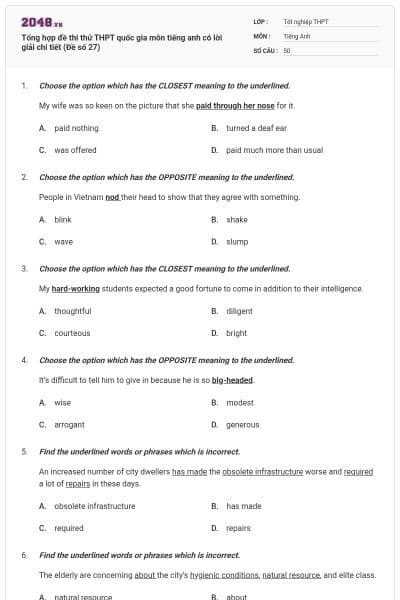
Choose the option which has the CLOSEST meaning to the underlined.
My wife was so keen on the picture that she paid through her nose for it.
paid nothing
turned a deaf ear
was offered
paid much more than usual
Đáp án D
Paid through her nose = paid much more than usual: trả nhiều tiền hơn mức bình thường
Câu này dịch như sau: vợ tôi thích bức tranh này đến nỗi cô ấy trả rất nhiều tiền để có nó.
Choose the option which has the OPPOSITE meaning to the underlined.
People in Vietnam nod their head to show that they agree with something.
blink
shake
wave
slump
Đáp án B
Nod: gật đầu ≠ shake: lắc đầ
Choose the option which has the CLOSEST meaning to the underlined.
My hard-working students expected a good fortune to come in addition to their intelligence.
thoughtful
diligent
courteous
bright
Đáp án B
Hard-working = diligent: chăm chỉ
Choose the option which has the OPPOSITE meaning to the underlined.
It’s difficult to tell him to give in because he is so big-headed.
wise
modest
arrogant
generous
Đáp án B
Big-headed: tự phụ, kiêu căng ≠ modest: khiêm tốn
Find the underlined words or phrases which is incorrect.
An increased number of city dwellers has made the obsolete infrastructure worse and required a lot of repairs in these days.
obsolete infrastructure
has made
required
repairs
Đáp án B
Has made => have made vì chủ ngữ A number of + danh từ là chủ ngữ số nhiều
Find the underlined words or phrases which is incorrect.
The elderly are concerning about the city’s hygienic conditions, natural resource, and elite class.
natural resource
about
hygienic conditions
elite
Đáp án A
Natural resource => natural resources vì nguồn tài nguyên thiên nhiên là danh từ số nhiều.
Find the underlined words or phrases which is incorrect.
In conclusion, plenty of money should, to sum up, be invested to repair the kilometer-long tube in near future.
plenty of
near future
kilometer-long
to sum up
Đáp án D
To sum up => bỏ đi vì trong câu đã có In conclusion.( = to sup up: tóm lại)
Rewriting the sentences in another way so that they have the same meaning as the given above.
It is not until the sun is shining brightly that the little girl woke up.
No sooner is the sun shining brightly than the little girl woke up.
Not until the little girl woke up is the sun shining brightly.
Not until the sun is shining brightly did the little girl wake up.
As soon as the little girl woke up, the sun hasn’t shone brightly yet.
Đáp án C
Mãi đến khi mặt trời nắng chói chang bé con mới thức dậy.
It is not until S+ V that S+ quá khứ đơn = Not until + V+ S that S+V
Rewriting the sentences in another way so that they have the same meaning as the given above.
"What language do you find the most difficult to learn of all?" Nhung asked Ha.
Nhung asked Ha what language Ha found the most difficult to learn of all.
Nhung wanted to know what language they founded the most difficult to learn of all.
Nhung asked Ha what language did you find the most difficult to learn of all.
Nhung asked Ha what language you found the most difficult to learn of all
Đáp án A
Nhung hỏi Hà ngôn ngữ nào bạn thấy khó học nhất.
Câu tường thuật nên đổi ngôi lùi thì và không đảo ngữ.
Rewriting the sentences in another way so that they have the same meaning as the given above.
They reported that the teachers expected more.
The teachers were reported to have been expected of more.
The teachers were expected more.
The teachers were reported to have expected more.
The teachers were reported to expect more.
Đáp án D
Họ báo cáo rằng các giáo viên đã mong đợi nhiều hơn. => Câu bị động
S+ be +Ved + to Vo
Choose the word whose stress pattern is different from the others.
designed
factor
recent
distant
Đáp án A
Câu A trọng âm 2 còn lại trọng âm 1.
Choose the word whose underlined letter(s) is/ are pronounced differently from the others.
performed
impaired
designed
produced
Đáp án D
Câu D phát âm là /t/ còn lại phát âm là /d
Choose the word whose stress pattern is different from the others.
injection
diminish
successful
benefit
Đáp án D
Câu D trọng âm 1 còn lại trọng âm 2
Choose the word whose underlined letter(s) is/ are pronounced differently from the others
destroys
cells
affects
stipends
Đáp án C
Câu C phát âm là /s/ còn lại phát âm là /z/
Complete the sentences with the given options.
John proposed_________Mary on a fine day at the crowded beach in their hometown.
that they married
getting married
to have married
to marry
Đáp án D
Propose + to Vo : đề nghị
John đã cầu hôn Marry vào một ngày đẹp trời tại bãi biển đông đúc ở quê nhà của họ.
He said he hadn’t finished his letter yet_________.
by now
until then
until now
so far
Đáp án B
By now: trước thời điểm bây giờ
Until then: mãi sau đó
Until now: cho đến bây giờ
So far: gần đây
Anh ấy nói rằng anh ấy vẫn chưa viết xong bức thư mãi đến sau đó.
The judge gave _________
him the special prize with good comments
him to the special prize with good comments
the special prize with good comments him
him for the special prize with good comments
Đáp án A
Ban giám khảo trao cho anh ấy giải thưởng với những lời bình luận tốt đẹp.
Her mother’s dream _________a family doctor will be fulfilled in six years.
by
with
of
at
Đáp án C
Dream of: mơ về ( việc gì đó)
Ước mơ của mẹ cô ấy trở thành một bác sĩ chữa bệnh tại nhà sẽ thành hiện thực trong 6 năm nữa.
They_________their service up to now.
didn’t do
haven’t done
don’t do
aren’t doing
Đáp án B
Trong câu có up to now ( cho đến tận bậy giờ) nên dùng thì hiện tại hoàn thành.
Body language is a potent form of _________communication.
verbal
oral
non-verbal
tongue
Đáp án C
Verbal: bằng lời nói
Oral: bằng miệng
Non-verbal: phi ngôn, không dùng lời nói
Tongue: lưỡi
Ngôn ngữ cơ thể là một dạng của giao tiếp phi ngôn.
_________eighty percent of the students in our school are eager to work with foreign teachers, aren’t they?
Most
Most of
Almost
Mostly
Đáp án C
Most + danh từ : hầu hết, đa số
Most of + the/ tính từ sở hữu + danh từ: hầu hết, đa số
Almost(adv): gần như
Mostly( adv): nhìn chung, chủ yếu
Gần 80% học sinh trường chúng ta rất thích thú khi làm việc với giáo viên nước ngoài, đúng không?
_________we work with her, we get confused because of her fast speaking pace.
So that
Although
Whenever
Lest
Đáp án C
So that: Để mà
Although: mặc dù
Whenever: bất cứ khi nào
Lest : e rằng
Bất cứ khi nào làm việc với cô ấy chúng tôi rất hoang mang vì cô ấy nói rất nhanh.
The local people insisted that the road_________50 cm more so that, in case of flood, they still can travel on it.
should be raised
should raise
could be raised
could rise
Đáp án A
Dân địa phương yêu cầu rằng con đường nên được nâng lên cao hơn 50 cm để mà vào mùa lũ họ vẫn đi lại được.
John asked me_________in English.
what that word means
what did this word mean
what does this word mean
what that word meant
Đáp án D
Câu tường thuật đổi ngôi lùi thì nhưng không đảo ngữ.
According to Do Tan Long, an official of the Steering Center of Urban Flood Control Program in Ho Chi Minh City, the rain could be "the most extreme downpour" since _________ beginning of the rainy season.
the
an
ø
a
Đáp án A
Cụm từ the biginning of the : đầu của gì đó
Since the beginning of the rainy season: kể từ đầu mùa mưa
Hoa is asking Hai, who is sitting at a corner of the room, seeming too shy.
- Hoa: Why aren’t you taking part in our activities?
- Hai: Yes. I can. Certainly."
Could you please show me how to get to the nearest post office?
Shall I take your hat off?
Can I help you?
Can you help me with these decorations
Đáp án D
Hoa đang hỏi Hải, người đang ngồi ở góc phòng, có vể rất ngại ngùng.
- Hoa: - Sao bạn không tham gia hoạt động cùng bọn mình nhỉ? Bạn giúp mình trang trí được
không?
- Hải: ‘ À vâng. Chắc chắn rồi.’
Children who are isolated and lonely seem to have poor language and _________
communication
communicate
communicative
communicator
Đáp án A
Hai từ nối với nhau bằng liên từ and nên có cùng từ loại ( danh từ).
Những đứa trẻ bị cô lập và cô đơn thường có vốn từ và khả năng giao tiếp kém.
_________the bad weather, their plan still go ahead.
In terms of
Regarded as
In spite of
Because of
Đáp án C
In terms of: với nội dung
Regarded as: được xem như là
In spite of: mặc dù
Because of: bởi vì
Mặc dù thời tiết xấu, kế hoạch của họ vẫn tiến hành.
What do we call that _________animal? - We call it an elephant.
long nose
long-nosed
nose long
nose length
Đáp án B
Cách thành lập tinhs từ: tính từ - dang từ + -ed
Long - nosed: mũi dài
Long is looking at Linh’s mark 10 in her paper and said to her.
Long: - _________
- Linh: - Thank you. That’s a nice compliment."
What a mark 10!
You are so skilful!
If only I had such a good mark
No matter how good the mark is!
Đáp án C
Long đang nhìn vào bài làm điểm 10 của Linh và nói:
- Long: - Giá mà mình cũng được điểm cao thế‖
- Linh: - Cảm ơn. Thật là một lời khen dễ thương.
Read the following passage and choose A, B, C, or D to indicate the correct answer to each of the questions.
Tyler Perry
Perry had a rough childhood. He was physically and sexually abused growing up, got kicked out of high school, and tried to commit suicide (31) _________once as a preteen and again at 22. At 23 he move to Atlanta and took (32) _________ odd jobs as he started working on his stage career.
In 1992 he wrote, produced, and starred in his first theater (33) _________, I Know I’ve Been Changed, somewhat informed by his difficult upbringing. Perry put all his savings into the show and it failed miserably; the run lasted just one weekend and only 30 people came to watch. He kept up with the production, working more odd jobs and often slept in his car to get by. Six years later, Perry finally (34) _________ through when, on its seventh run, the show became a success. He’s since gone on to have an extremely successful career (15) _________ a director, writer, and actor. In fact, Perry was named Forbes’ highest paid man in the field.
Điền ô số 31
twice
two
second
double
Đáp án A
Twice :hai lần
Perry had a rough childhood. He was physically and sexually abused growing up, got kicked out of high school, and tried to commit suicide (31) ________ once as a preteen and again at 22.
=> Perry có thời thơ ấu khó khăn. Ông ấy bị chế giễu về phát triền thể hình và giới tính, bị đuổi học và cố gắng tự tử 2 lần, 1 lần trước tuổi 13 và một lần lúc 22 tuổi.
Read the following passage and choose A, B, C, or D to indicate the correct answer to each of the questions.
Tyler Perry
Perry had a rough childhood. He was physically and sexually abused growing up, got kicked out of high school, and tried to commit suicide (31) _________once as a preteen and again at 22. At 23 he move to Atlanta and took (32) _________ odd jobs as he started working on his stage career.
In 1992 he wrote, produced, and starred in his first theater (33) _________, I Know I’ve Been Changed, somewhat informed by his difficult upbringing. Perry put all his savings into the show and it failed miserably; the run lasted just one weekend and only 30 people came to watch. He kept up with the production, working more odd jobs and often slept in his car to get by. Six years later, Perry finally (34) _________ through when, on its seventh run, the show became a success. He’s since gone on to have an extremely successful career (15) _________ a director, writer, and actor. In fact, Perry was named Forbes’ highest paid man in the field.
Điền ô số 32
up
off
in
to
Đáp án A
Take up: bắt đầu( công việc/ sở thích)
At 23 he moved to Atlanta and took (32)_______ odd jobs as he started working on his stage career.=> Năm 23 tuổi ông ấy bắt đầu những công việc lạ khi bắt đầu giai đoạn sự nghiệp của mình.
Read the following passage and choose A, B, C, or D to indicate the correct answer to each of the questions.
Tyler Perry
Perry had a rough childhood. He was physically and sexually abused growing up, got kicked out of high school, and tried to commit suicide (31) _________once as a preteen and again at 22. At 23 he move to Atlanta and took (32) _________ odd jobs as he started working on his stage career.
In 1992 he wrote, produced, and starred in his first theater (33) _________, I Know I’ve Been Changed, somewhat informed by his difficult upbringing. Perry put all his savings into the show and it failed miserably; the run lasted just one weekend and only 30 people came to watch. He kept up with the production, working more odd jobs and often slept in his car to get by. Six years later, Perry finally (34) _________ through when, on its seventh run, the show became a success. He’s since gone on to have an extremely successful career (15) _________ a director, writer, and actor. In fact, Perry was named Forbes’ highest paid man in the field.
Điền ô số 33
producer
productivity
production
productive
Đáp án C
Producer: nhà sản xuất
Productivity: năng suất
Production: việc sản xuất
Productive: năng suất cao
In 1992 he wrote, produced, and starred in his first theater (33)________, => Năm 1992 ôn ấy viết, sản xuất và nổi tiếng với tác phẩm sản xuất phim đầu tiên.
Read the following passage and choose A, B, C, or D to indicate the correct answer to each of the questions.
Tyler Perry
Perry had a rough childhood. He was physically and sexually abused growing up, got kicked out of high school, and tried to commit suicide (31) _________once as a preteen and again at 22. At 23 he move to Atlanta and took (32) _________ odd jobs as he started working on his stage career.
In 1992 he wrote, produced, and starred in his first theater (33) _________, I Know I’ve Been Changed, somewhat informed by his difficult upbringing. Perry put all his savings into the show and it failed miserably; the run lasted just one weekend and only 30 people came to watch. He kept up with the production, working more odd jobs and often slept in his car to get by. Six years later, Perry finally (34) _________ through when, on its seventh run, the show became a success. He’s since gone on to have an extremely successful career (15) _________ a director, writer, and actor. In fact, Perry was named Forbes’ highest paid man in the field.
Điền ô số 34
went
broken
got
put
Đáp án B
Go through: đi xuyên qua
Break through: đột phá
Go through: hiểu rõ
Put through: tiếp tục (hoàn thành công việc)
Six years later, Perry finally (34)_______ through when, on its seventh run, the show became a success. => 6 năm sau đó, Perry cuối cùng đã có bước đột phá khi trong lần sản xuất thứ 7, màn trình diễn đã thành công
Read the following passage and choose A, B, C, or D to indicate the correct answer to each of the questions.
Tyler Perry
Perry had a rough childhood. He was physically and sexually abused growing up, got kicked out of high school, and tried to commit suicide (31) _________once as a preteen and again at 22. At 23 he move to Atlanta and took (32) _________ odd jobs as he started working on his stage career.
In 1992 he wrote, produced, and starred in his first theater (33) _________, I Know I’ve Been Changed, somewhat informed by his difficult upbringing. Perry put all his savings into the show and it failed miserably; the run lasted just one weekend and only 30 people came to watch. He kept up with the production, working more odd jobs and often slept in his car to get by. Six years later, Perry finally (34) _________ through when, on its seventh run, the show became a success. He’s since gone on to have an extremely successful career (15) _________ a director, writer, and actor. In fact, Perry was named Forbes’ highest paid man in the field.
Điền ô số 35
same
as
like
as soon
Đáp án B
Same: giống như
As: như là
Like: giống
As soon as: ngay khi
He’s since gone on to have an extremely successful career (35)________ a director, writer, and actor. => Kể từ đó sự nghiệp của ông thành công như là 1 đạo diễn, nhà văn và diễn viên.
Read the text and answer the questions given by choosing one numbered options.
A number of factors related to the voice reveal the personality of the speaker.
The first is the broad area of communication, which includes imparting information by use of language, communicating with a group or an individual and specialized communication through performance. A person conveys thoughts and ideas through choice of words, by a tone of voice that is pleasant or unpleasant, gentle or harsh, by the rhythm that is inherent within the language itself, and by speech rhythms that are flowing and regular or uneven and hesitant, and finally, by the pitch and melody of the utterance. When speaking before a group, a person’s tone may indicate uncertainty or fright, confidence or calm. At interpersonal levels, the tone may reflect ideas and feelings over and above the words chosen, or may believe them. Here, the participant’s tone can consciously or unconsciously reflect intuitive sympathy or antipathy, lack of concern or interest, fatigue, anxiety, enthusiasm or excitement, all of which are usually discernible by the acute listener. Public performance is a manner of communication that is highly specialized with its own techniques for obtaining effects by voice and /or gesture. The motivation derived from the text, and in the case of singing, the music, in combination with the performer’s skills, personality, and ability to create empathy will determine the success of artistic, political, or pedagogic communication.
Second, the voice gives psychological clues to a person’s self-image, perception of others, and emotional health. Self-image can be indicated by a tone of voice that is confident, pretentious, shy, aggressive, outgoing, or exuberant, to name only a few personality traits. Also the sound may give a clue to the facade or mask of that person, for example, a shy person hiding behind an overconfident front.
How a speaker perceives the listener’s receptiveness, interest, or sympathy in any given conversation can drastically alter the tone of presentation, by encouraging or discouraging the speaker. Emotional health is evidenced in the voice by free and melodic sounds of the happy, by constricted and harsh sound of the angry, and by dull and lethargic qualities of the depressed
The word "Here" in line 9 refers to ___________.
interpersonal interaction
the tone
ideas and feelings
words chosen
Đáp án A
Here = interpersonal interactions: sự tương tác giữa người với người
Read the text and answer the questions given by choosing one numbered options.
A number of factors related to the voice reveal the personality of the speaker.
The first is the broad area of communication, which includes imparting information by use of language, communicating with a group or an individual and specialized communication through performance. A person conveys thoughts and ideas through choice of words, by a tone of voice that is pleasant or unpleasant, gentle or harsh, by the rhythm that is inherent within the language itself, and by speech rhythms that are flowing and regular or uneven and hesitant, and finally, by the pitch and melody of the utterance. When speaking before a group, a person’s tone may indicate uncertainty or fright, confidence or calm. At interpersonal levels, the tone may reflect ideas and feelings over and above the words chosen, or may believe them. Here, the participant’s tone can consciously or unconsciously reflect intuitive sympathy or antipathy, lack of concern or interest, fatigue, anxiety, enthusiasm or excitement, all of which are usually discernible by the acute listener. Public performance is a manner of communication that is highly specialized with its own techniques for obtaining effects by voice and /or gesture. The motivation derived from the text, and in the case of singing, the music, in combination with the performer’s skills, personality, and ability to create empathy will determine the success of artistic, political, or pedagogic communication.
Second, the voice gives psychological clues to a person’s self-image, perception of others, and emotional health. Self-image can be indicated by a tone of voice that is confident, pretentious, shy, aggressive, outgoing, or exuberant, to name only a few personality traits. Also the sound may give a clue to the facade or mask of that person, for example, a shy person hiding behind an overconfident front.
How a speaker perceives the listener’s receptiveness, interest, or sympathy in any given conversation can drastically alter the tone of presentation, by encouraging or discouraging the speaker. Emotional health is evidenced in the voice by free and melodic sounds of the happy, by constricted and harsh sound of the angry, and by dull and lethargic qualities of the depressed.
What does the passage mainly discuss?
The production of speech
The function of the voice in performance
Communication styles
The connection between voice and personality
Đáp án D
Bài đọc thảo luận về nội dung gì? => Mối quan hệ giữa giọng nói và tính cách.
Read the text and answer the questions given by choosing one numbered options.
A number of factors related to the voice reveal the personality of the speaker.
The first is the broad area of communication, which includes imparting information by use of language, communicating with a group or an individual and specialized communication through performance. A person conveys thoughts and ideas through choice of words, by a tone of voice that is pleasant or unpleasant, gentle or harsh, by the rhythm that is inherent within the language itself, and by speech rhythms that are flowing and regular or uneven and hesitant, and finally, by the pitch and melody of the utterance. When speaking before a group, a person’s tone may indicate uncertainty or fright, confidence or calm. At interpersonal levels, the tone may reflect ideas and feelings over and above the words chosen, or may believe them. Here, the participant’s tone can consciously or unconsciously reflect intuitive sympathy or antipathy, lack of concern or interest, fatigue, anxiety, enthusiasm or excitement, all of which are usually discernible by the acute listener. Public performance is a manner of communication that is highly specialized with its own techniques for obtaining effects by voice and /or gesture. The motivation derived from the text, and in the case of singing, the music, in combination with the performer’s skills, personality, and ability to create empathy will determine the success of artistic, political, or pedagogic communication.
Second, the voice gives psychological clues to a person’s self-image, perception of others, and emotional health. Self-image can be indicated by a tone of voice that is confident, pretentious, shy, aggressive, outgoing, or exuberant, to name only a few personality traits. Also the sound may give a clue to the facade or mask of that person, for example, a shy person hiding behind an overconfident front.
How a speaker perceives the listener’s receptiveness, interest, or sympathy in any given conversation can drastically alter the tone of presentation, by encouraging or discouraging the speaker. Emotional health is evidenced in the voice by free and melodic sounds of the happy, by constricted and harsh sound of the angry, and by dull and lethargic qualities of the depressed.
The word "evidenced" in line 22 is closest in meaning to ___________.
questioned
repeated
indicated
exaggerated
Đáp án C
Evidenced = indicated: rõ ràng, hiển nhiên, dễ thấy rằng
Read the text and answer the questions given by choosing one numbered options.
A number of factors related to the voice reveal the personality of the speaker.
The first is the broad area of communication, which includes imparting information by use of language, communicating with a group or an individual and specialized communication through performance. A person conveys thoughts and ideas through choice of words, by a tone of voice that is pleasant or unpleasant, gentle or harsh, by the rhythm that is inherent within the language itself, and by speech rhythms that are flowing and regular or uneven and hesitant, and finally, by the pitch and melody of the utterance. When speaking before a group, a person’s tone may indicate uncertainty or fright, confidence or calm. At interpersonal levels, the tone may reflect ideas and feelings over and above the words chosen, or may believe them. Here, the participant’s tone can consciously or unconsciously reflect intuitive sympathy or antipathy, lack of concern or interest, fatigue, anxiety, enthusiasm or excitement, all of which are usually discernible by the acute listener. Public performance is a manner of communication that is highly specialized with its own techniques for obtaining effects by voice and /or gesture. The motivation derived from the text, and in the case of singing, the music, in combination with the performer’s skills, personality, and ability to create empathy will determine the success of artistic, political, or pedagogic communication.
Second, the voice gives psychological clues to a person’s self-image, perception of others, and emotional health. Self-image can be indicated by a tone of voice that is confident, pretentious, shy, aggressive, outgoing, or exuberant, to name only a few personality traits. Also the sound may give a clue to the facade or mask of that person, for example, a shy person hiding behind an overconfident front.
How a speaker perceives the listener’s receptiveness, interest, or sympathy in any given conversation can drastically alter the tone of presentation, by encouraging or discouraging the speaker. Emotional health is evidenced in the voice by free and melodic sounds of the happy, by constricted and harsh sound of the angry, and by dull and lethargic qualities of the depressed.
Why does the author mention "artistic, political, or pedagogic communication" in line 14-15?
To introduce the idea of self-image
As examples of public performance
As examples of basic styles of communication
To contrast them to singing
Đáp án C
Tại sao tác giả đề cập đến - giao tiếp về nghệ thuật, chính trị hay giáo dục‖ => Như là những ví dụ về các phong cách giao tiếp cơ bản.
Dẫn chứng: The motivation derived from the text, and in the case of singing, the music, in combination with the performer’s skills, personality, and ability to create empathy will determine the success of artistic, political, or pedagogic communication.
Read the text and answer the questions given by choosing one numbered options.
A number of factors related to the voice reveal the personality of the speaker.
The first is the broad area of communication, which includes imparting information by use of language, communicating with a group or an individual and specialized communication through performance. A person conveys thoughts and ideas through choice of words, by a tone of voice that is pleasant or unpleasant, gentle or harsh, by the rhythm that is inherent within the language itself, and by speech rhythms that are flowing and regular or uneven and hesitant, and finally, by the pitch and melody of the utterance. When speaking before a group, a person’s tone may indicate uncertainty or fright, confidence or calm. At interpersonal levels, the tone may reflect ideas and feelings over and above the words chosen, or may believe them. Here, the participant’s tone can consciously or unconsciously reflect intuitive sympathy or antipathy, lack of concern or interest, fatigue, anxiety, enthusiasm or excitement, all of which are usually discernible by the acute listener. Public performance is a manner of communication that is highly specialized with its own techniques for obtaining effects by voice and /or gesture. The motivation derived from the text, and in the case of singing, the music, in combination with the performer’s skills, personality, and ability to create empathy will determine the success of artistic, political, or pedagogic communication.
Second, the voice gives psychological clues to a person’s self-image, perception of others, and emotional health. Self-image can be indicated by a tone of voice that is confident, pretentious, shy, aggressive, outgoing, or exuberant, to name only a few personality traits. Also the sound may give a clue to the facade or mask of that person, for example, a shy person hiding behind an overconfident front.
How a speaker perceives the listener’s receptiveness, interest, or sympathy in any given conversation can drastically alter the tone of presentation, by encouraging or discouraging the speaker. Emotional health is evidenced in the voice by free and melodic sounds of the happy, by constricted and harsh sound of the angry, and by dull and lethargic qualities of the depressed.
The word "derived" in line 13 is closest in meaning to___________.
prepared
registered
discussed
obtained
Đáp án D
Derived = obtained: đạt được
Read the text and answer the questions given by choosing one numbered options.
A number of factors related to the voice reveal the personality of the speaker.
The first is the broad area of communication, which includes imparting information by use of language, communicating with a group or an individual and specialized communication through performance. A person conveys thoughts and ideas through choice of words, by a tone of voice that is pleasant or unpleasant, gentle or harsh, by the rhythm that is inherent within the language itself, and by speech rhythms that are flowing and regular or uneven and hesitant, and finally, by the pitch and melody of the utterance. When speaking before a group, a person’s tone may indicate uncertainty or fright, confidence or calm. At interpersonal levels, the tone may reflect ideas and feelings over and above the words chosen, or may believe them. Here, the participant’s tone can consciously or unconsciously reflect intuitive sympathy or antipathy, lack of concern or interest, fatigue, anxiety, enthusiasm or excitement, all of which are usually discernible by the acute listener. Public performance is a manner of communication that is highly specialized with its own techniques for obtaining effects by voice and /or gesture. The motivation derived from the text, and in the case of singing, the music, in combination with the performer’s skills, personality, and ability to create empathy will determine the success of artistic, political, or pedagogic communication.
Second, the voice gives psychological clues to a person’s self-image, perception of others, and emotional health. Self-image can be indicated by a tone of voice that is confident, pretentious, shy, aggressive, outgoing, or exuberant, to name only a few personality traits. Also the sound may give a clue to the facade or mask of that person, for example, a shy person hiding behind an overconfident front.
How a speaker perceives the listener’s receptiveness, interest, or sympathy in any given conversation can drastically alter the tone of presentation, by encouraging or discouraging the speaker. Emotional health is evidenced in the voice by free and melodic sounds of the happy, by constricted and harsh sound of the angry, and by dull and lethargic qualities of the depressed.
According to the passage, an overconfident front may hide ___________.
hostility
shyness
friendliness
strength
Đáp án B
Theo bài đọc một người quá tự tin có thể ẩn giấu => sự thẹn thùng
Dẫn chứng: Also the sound may give a clue to the facade or mask of that person, for example, a shy person hiding behind an overconfident front.
Read the text and answer the questions given by choosing one numbered options.
A number of factors related to the voice reveal the personality of the speaker.
The first is the broad area of communication, which includes imparting information by use of language, communicating with a group or an individual and specialized communication through performance. A person conveys thoughts and ideas through choice of words, by a tone of voice that is pleasant or unpleasant, gentle or harsh, by the rhythm that is inherent within the language itself, and by speech rhythms that are flowing and regular or uneven and hesitant, and finally, by the pitch and melody of the utterance. When speaking before a group, a person’s tone may indicate uncertainty or fright, confidence or calm. At interpersonal levels, the tone may reflect ideas and feelings over and above the words chosen, or may believe them. Here, the participant’s tone can consciously or unconsciously reflect intuitive sympathy or antipathy, lack of concern or interest, fatigue, anxiety, enthusiasm or excitement, all of which are usually discernible by the acute listener. Public performance is a manner of communication that is highly specialized with its own techniques for obtaining effects by voice and /or gesture. The motivation derived from the text, and in the case of singing, the music, in combination with the performer’s skills, personality, and ability to create empathy will determine the success of artistic, political, or pedagogic communication.
Second, the voice gives psychological clues to a person’s self-image, perception of others, and emotional health. Self-image can be indicated by a tone of voice that is confident, pretentious, shy, aggressive, outgoing, or exuberant, to name only a few personality traits. Also the sound may give a clue to the facade or mask of that person, for example, a shy person hiding behind an overconfident front.
How a speaker perceives the listener’s receptiveness, interest, or sympathy in any given conversation can drastically alter the tone of presentation, by encouraging or discouraging the speaker. Emotional health is evidenced in the voice by free and melodic sounds of the happy, by constricted and harsh sound of the angry, and by dull and lethargic qualities of the depressed.
What does the author mean by staring that, "At interpersonal levels, tone may reflect ideas and feelings over and above the words chosen" in lines 8- 9?
A high tone of voice reflects an emotional communication
Feelings are expressed with different words than ideas are
The tone of voice can carry information beyond the meaning of words
Feelings are more difficult to express than ideas
Đáp án C
Tác giả ngụ ý gì khi nói răng - Ở mức độ tương tác giữa người với người, giọng nói có thể phản ánh ý kiến và cảm xúc vượt xa từ ngữ được chọn‖ ở dòng 8-9?
Giọng nói truyền tải thông tin nhiều hơn bản thân nghĩa của những từ đó.
Read the text and answer the questions given by choosing one numbered options.
A number of factors related to the voice reveal the personality of the speaker.
The first is the broad area of communication, which includes imparting information by use of language, communicating with a group or an individual and specialized communication through performance. A person conveys thoughts and ideas through choice of words, by a tone of voice that is pleasant or unpleasant, gentle or harsh, by the rhythm that is inherent within the language itself, and by speech rhythms that are flowing and regular or uneven and hesitant, and finally, by the pitch and melody of the utterance. When speaking before a group, a person’s tone may indicate uncertainty or fright, confidence or calm. At interpersonal levels, the tone may reflect ideas and feelings over and above the words chosen, or may believe them. Here, the participant’s tone can consciously or unconsciously reflect intuitive sympathy or antipathy, lack of concern or interest, fatigue, anxiety, enthusiasm or excitement, all of which are usually discernible by the acute listener. Public performance is a manner of communication that is highly specialized with its own techniques for obtaining effects by voice and /or gesture. The motivation derived from the text, and in the case of singing, the music, in combination with the performer’s skills, personality, and ability to create empathy will determine the success of artistic, political, or pedagogic communication.
Second, the voice gives psychological clues to a person’s self-image, perception of others, and emotional health. Self-image can be indicated by a tone of voice that is confident, pretentious, shy, aggressive, outgoing, or exuberant, to name only a few personality traits. Also the sound may give a clue to the facade or mask of that person, for example, a shy person hiding behind an overconfident front.
How a speaker perceives the listener’s receptiveness, interest, or sympathy in any given conversation can drastically alter the tone of presentation, by encouraging or discouraging the speaker. Emotional health is evidenced in the voice by free and melodic sounds of the happy, by constricted and harsh sound of the angry, and by dull and lethargic qualities of the depressed.
According to the passage, what does a constricted and harsh voice indicate?
Lethargy
Depression
Boredom
Anger
Đáp án D
Theo bài đọc, một giọng nói cọc cằn và thô cho thấy điều gì? => Sự tức giận
Dẫn chứng: by constricted and harsh sound of the angry
Read the text and answer the questions given by choosing one numbered options.
A number of factors related to the voice reveal the personality of the speaker.
The first is the broad area of communication, which includes imparting information by use of language, communicating with a group or an individual and specialized communication through performance. A person conveys thoughts and ideas through choice of words, by a tone of voice that is pleasant or unpleasant, gentle or harsh, by the rhythm that is inherent within the language itself, and by speech rhythms that are flowing and regular or uneven and hesitant, and finally, by the pitch and melody of the utterance. When speaking before a group, a person’s tone may indicate uncertainty or fright, confidence or calm. At interpersonal levels, the tone may reflect ideas and feelings over and above the words chosen, or may believe them. Here, the participant’s tone can consciously or unconsciously reflect intuitive sympathy or antipathy, lack of concern or interest, fatigue, anxiety, enthusiasm or excitement, all of which are usually discernible by the acute listener. Public performance is a manner of communication that is highly specialized with its own techniques for obtaining effects by voice and /or gesture. The motivation derived from the text, and in the case of singing, the music, in combination with the performer’s skills, personality, and ability to create empathy will determine the success of artistic, political, or pedagogic communication.
Second, the voice gives psychological clues to a person’s self-image, perception of others, and emotional health. Self-image can be indicated by a tone of voice that is confident, pretentious, shy, aggressive, outgoing, or exuberant, to name only a few personality traits. Also the sound may give a clue to the facade or mask of that person, for example, a shy person hiding behind an overconfident front.
How a speaker perceives the listener’s receptiveness, interest, or sympathy in any given conversation can drastically alter the tone of presentation, by encouraging or discouraging the speaker. Emotional health is evidenced in the voice by free and melodic sounds of the happy, by constricted and harsh sound of the angry, and by dull and lethargic qualities of the depressed.
According to the passage, an exuberant tone of voice may be an indication of a person’s ______
general physical health
personality
ability to communicate
vocal quality
Đáp án B
Theo bài đọc, giọng nói đa dạng có thể cho thấy cái gì của một người => tính các
Read the text and answer the questions given by choosing one numbered options.
A number of factors related to the voice reveal the personality of the speaker.
The first is the broad area of communication, which includes imparting information by use of language, communicating with a group or an individual and specialized communication through performance. A person conveys thoughts and ideas through choice of words, by a tone of voice that is pleasant or unpleasant, gentle or harsh, by the rhythm that is inherent within the language itself, and by speech rhythms that are flowing and regular or uneven and hesitant, and finally, by the pitch and melody of the utterance. When speaking before a group, a person’s tone may indicate uncertainty or fright, confidence or calm. At interpersonal levels, the tone may reflect ideas and feelings over and above the words chosen, or may believe them. Here, the participant’s tone can consciously or unconsciously reflect intuitive sympathy or antipathy, lack of concern or interest, fatigue, anxiety, enthusiasm or excitement, all of which are usually discernible by the acute listener. Public performance is a manner of communication that is highly specialized with its own techniques for obtaining effects by voice and /or gesture. The motivation derived from the text, and in the case of singing, the music, in combination with the performer’s skills, personality, and ability to create empathy will determine the success of artistic, political, or pedagogic communication.
Second, the voice gives psychological clues to a person’s self-image, perception of others, and emotional health. Self-image can be indicated by a tone of voice that is confident, pretentious, shy, aggressive, outgoing, or exuberant, to name only a few personality traits. Also the sound may give a clue to the facade or mask of that person, for example, a shy person hiding behind an overconfident front.
How a speaker perceives the listener’s receptiveness, interest, or sympathy in any given conversation can drastically alter the tone of presentation, by encouraging or discouraging the speaker. Emotional health is evidenced in the voice by free and melodic sounds of the happy, by constricted and harsh sound of the angry, and by dull and lethargic qualities of the depressed.
The word "drastically" in line 21 is closest in meaning to ___________.
severely
easily
exactly
frequently
Đáp án A
Drastically = severely: khắc nghiệt, khốc liệt
Read the text and answer the questions given by choosing one numbered options.
If you want to give someone the nod in Bulgaria, you have to nod your head to say ‘no’ and shake it to say "yes" – the exact opposite of what we do! In Belgium, pointing with your index finger or snapping your fingers at someone is very rude.
In France, you shouldn’t rest your feet on tables or chairs. Speaking to someone with your hands in your pockets will only make matters worse. In the Middle East, you should never show the soles of your feet or shoes to others as it will be seen as a grave insult. When eating, only use your right hand because they use their left hands when going to the bathroom.
In Bangladesh, the ‘thumbs-up’ is a rude sign. In Myanmar, people greet each other by clapping, and in India, whistling in public is considered rude.
In Japan, you should not blow your nose in public, but you can burp at the end of a meal to show that you have enjoyed it. The ‘OK’ sign (thumb and index finger forming a circle) means "everything is good" in the West, but in China it means nothing or zero. In Japan, it means money, and in the Middle East, it is a rude gesture.
In the Middle East, people do not use their left hands for eating because they use their left hands ___________.
to put in their pockets
when going to the bathroom
when preparing the meal
to clean their tables and chairs
Đáp án B
Ở Trung Đông người ta không dùng tay trái khi ăn vì tay trái được dùng để => khi họ đi vệ sinh
Dẫn chứng: In the Middle East, you should never show the soles of your feet or shoes to others as it will be seen as a grave insult. When eating, only use your right hand because they use their left hands when going to the bathroom.
Read the text and answer the questions given by choosing one numbered options.
If you want to give someone the nod in Bulgaria, you have to nod your head to say ‘no’ and shake it to say "yes" – the exact opposite of what we do! In Belgium, pointing with your index finger or snapping your fingers at someone is very rude.
In France, you shouldn’t rest your feet on tables or chairs. Speaking to someone with your hands in your pockets will only make matters worse. In the Middle East, you should never show the soles of your feet or shoes to others as it will be seen as a grave insult. When eating, only use your right hand because they use their left hands when going to the bathroom.
In Bangladesh, the ‘thumbs-up’ is a rude sign. In Myanmar, people greet each other by clapping, and in India, whistling in public is considered rude.
In Japan, you should not blow your nose in public, but you can burp at the end of a meal to show that you have enjoyed it. The ‘OK’ sign (thumb and index finger forming a circle) means "everything is good" in the West, but in China it means nothing or zero. In Japan, it means money, and in the Middle East, it is a rude gesture.
It is mentioned in the passage that many gestures ___________.
are not used to communicate our feeling
can be used to greet each other in public
are used in greeting among men and women
may mean different things in different countries
Đáp án D
Được đề cập trong bài đọc rằng nhiều cử chỉ điệu bộ => có ý nghĩa khác nhau ở những quốc gia khác nhau.
Dẫn chứng: The ‘OK’ sign (thumb and index finger forming a circle) means "everything is good‖ :in the West, but in China it means nothing or zero. In Japan, it means money, and in the Middle East, it is a rude gesture.
Read the text and answer the questions given by choosing one numbered options.
If you want to give someone the nod in Bulgaria, you have to nod your head to say ‘no’ and shake it to say "yes" – the exact opposite of what we do! In Belgium, pointing with your index finger or snapping your fingers at someone is very rude.
In France, you shouldn’t rest your feet on tables or chairs. Speaking to someone with your hands in your pockets will only make matters worse. In the Middle East, you should never show the soles of your feet or shoes to others as it will be seen as a grave insult. When eating, only use your right hand because they use their left hands when going to the bathroom.
In Bangladesh, the ‘thumbs-up’ is a rude sign. In Myanmar, people greet each other by clapping, and in India, whistling in public is considered rude.
In Japan, you should not blow your nose in public, but you can burp at the end of a meal to show that you have enjoyed it. The ‘OK’ sign (thumb and index finger forming a circle) means "everything is good" in the West, but in China it means nothing or zero. In Japan, it means money, and in the Middle East, it is a rude gesture.
Which of the following is NOT true according to the passage?
In Belgium, snapping your fingers at someone is very rude
In France, people shouldn’t rest their feet on tables
In Myanmar, people greet each other by clapping
In China, the ‘OK’ sign means money
Đáp án D
Câu nào sau đây không đúng theo như bài đọc? => Ở Trung Quốc - ‘OK’ có nghĩa là tiền.
Dẫn chứng: but in China it means nothing or zero.
Read the text and answer the questions given by choosing one numbered options.
If you want to give someone the nod in Bulgaria, you have to nod your head to say ‘no’ and shake it to say "yes" – the exact opposite of what we do! In Belgium, pointing with your index finger or snapping your fingers at someone is very rude.
In France, you shouldn’t rest your feet on tables or chairs. Speaking to someone with your hands in your pockets will only make matters worse. In the Middle East, you should never show the soles of your feet or shoes to others as it will be seen as a grave insult. When eating, only use your right hand because they use their left hands when going to the bathroom.
In Bangladesh, the ‘thumbs-up’ is a rude sign. In Myanmar, people greet each other by clapping, and in India, whistling in public is considered rude.
In Japan, you should not blow your nose in public, but you can burp at the end of a meal to show that you have enjoyed it. The ‘OK’ sign (thumb and index finger forming a circle) means "everything is good" in the West, but in China it means nothing or zero. In Japan, it means money, and in the Middle East, it is a rude gesture.
The word "others" in paragraph 3 refers to ___________.
other people
other shoes
other soles
other feet
Đáp án A
Others = other people: những người khác
Read the text and answer the questions given by choosing one numbered options.
If you want to give someone the nod in Bulgaria, you have to nod your head to say ‘no’ and shake it to say "yes" – the exact opposite of what we do! In Belgium, pointing with your index finger or snapping your fingers at someone is very rude.
In France, you shouldn’t rest your feet on tables or chairs. Speaking to someone with your hands in your pockets will only make matters worse. In the Middle East, you should never show the soles of your feet or shoes to others as it will be seen as a grave insult. When eating, only use your right hand because they use their left hands when going to the bathroom.
In Bangladesh, the ‘thumbs-up’ is a rude sign. In Myanmar, people greet each other by clapping, and in India, whistling in public is considered rude.
In Japan, you should not blow your nose in public, but you can burp at the end of a meal to show that you have enjoyed it. The ‘OK’ sign (thumb and index finger forming a circle) means "everything is good" in the West, but in China it means nothing or zero. In Japan, it means money, and in the Middle East, it is a rude gesture.
People nod their head to say no in ___________.
Belgium
France
Japan
Bulgaria
Đáp án D
Người ta gật đầu để nói ‘không’ ở đất nước nào? => Bungary.
Dẫn chứng: If you want to give someone the nod in Bulgaria, you have to nod your head to say - ‘no’