Tổng hợp đề thi thử THPT quốc gia môn tiếng anh có lời giải chi tiết (Đề số 23)
50 câu hỏi
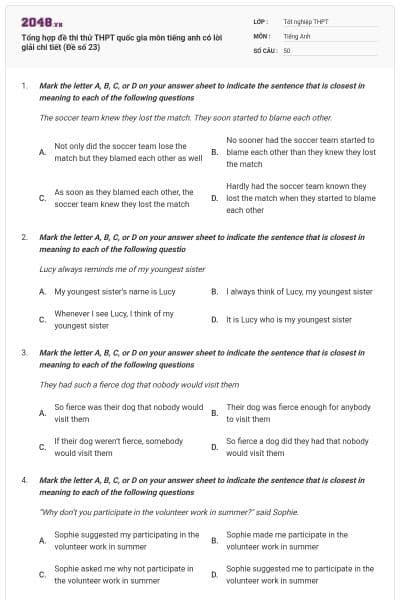
Mark the letter A, B, C, or D on your answer sheet to indicate the sentence that is closest in meaning to each of the following questions
The soccer team knew they lost the match. They soon started to blame each other.
Not only did the soccer team lose the match but they blamed each other as well
No sooner had the soccer team started to blame each other than they knew they lost the match
As soon as they blamed each other, the soccer team knew they lost the match
Hardly had the soccer team known they lost the match when they started to blame each other
Đáp án D
Đội bóng biết họ thua trận đấu. Họ bắt đầu đổ lỗi cho nhau.
Cấu trúc: Hardly had +S+ Ved/V3 when S+ Ved/V2: ngay sau khi…thì
Mark the letter A, B, C, or D on your answer sheet to indicate the sentence that is closest in meaning to each of the following questio
Lucy always reminds me of my youngest sister
My youngest sister’s name is Lucy
I always think of Lucy, my youngest sister
Whenever I see Lucy, I think of my youngest sister
It is Lucy who is my youngest sister
Đáp án C
Lucy luôn gợi cho tôi nhớ về em gái nhỏ. = Bất cứ lúc nào nhìn thấy Lucy tôi cũng nghĩ ngay đến em gái nhỏ của mình.
Mark the letter A, B, C, or D on your answer sheet to indicate the sentence that is closest in meaning to each of the following questions
They had such a fierce dog that nobody would visit them
So fierce was their dog that nobody would visit them
Their dog was fierce enough for anybody to visit them
If their dog weren’t fierce, somebody would visit them
So fierce a dog did they had that nobody would visit them
Đáp án A
Họ có chú chó hung dữ đến nỗi mà không ai dám đến nhà họ chơi.
Cấu trúc: S+ V+ such + cụm dnah từ that S+ V = So + adj + be + S+ that S+ V: quá…đến nỗi mà
Mark the letter A, B, C, or D on your answer sheet to indicate the sentence that is closest in meaning to each of the following questions
“Why don’t you participate in the volunteer work in summer?" said Sophie.
Sophie suggested my participating in the volunteer work in summer
Sophie made me participate in the volunteer work in summer
Sophie asked me why not participate in the volunteer work in summer
Sophie suggested me to participate in the volunteer work in summer
Đáp án A
Sophie nói: “ Tại sao bạn không tham gia vào công tác tình nguyện mùa hè này nhỉ?” = Sophie đề nghị tôi tham gia vào công tác tình nguyện mùa hè này.
Mark the letter A, B, C, or D on your answer sheet to indicate the sentence that is closest in meaning to each of the following questions
They are my two sisters. They aren’t teachers like me.
They are my two sisters, that are teachers like me
They are my two sisters, neither of whom are teachers like me
They are my two sisters, both of those are teachers like m
Unlike me, neither of my two sisters aren’t teachers
Đáp án B
Họ là hai chị gái của tôi. Họ không làm giáo viên giống như tôi.= Họ là hai người chị gái của tôi, không ai trong số họ làm giáo viên giống như tôi.
Mark the letter A, B, C, or D on your answer sheet to indicate the word or phrase that is closest in meaning to the underlined part in each of the following questions
The students are advised to concentrate on their studying
remember
pay attention to
be interested in
resemble
Đáp án B
Concentrate on = pay attention to: chú ý đến, tập trung vào ( việc gì đó)
Mark the letter A, B, C, or D on your answer sheet to indicate the word or phrase that is closest in meaning to the underlined part in each of the following questions
In most countries, compulsory military service does not apply to women.
mandatory
superior
beneficial
constructive
Đáp án A
Compulsory = mandatory: bắt buộc
Mark the letter A, B, C, or D on your answer sheet to indicate the correct answer to each of the following questions.
Many people will be out of _________ if the factory is closed.
career
job
profession
work
Đáp án D
Cụm từ out of work: thất nghiệp
Nhiều người sẽ bị thất nghiệp nếu nhà máy này đóng cửa.
Neither Tom nor his brothers_________ willing to help their mother with the housework.
is
was
are
has been
Đáp án: C
Giải thích:
Neither A nor B + V: động từ chia theo chủ ngữ B.
Ở đây “his brothers” (các anh em trai của cậu ấy) là chủ ngữ số nhiều, chọn đáp án C.
Dịch: Cả Tom hay các anh em trai của cậu ấy đều không sẵn lòng giúp mẹ làm việc nhà.
Do you know the person _________ next to you in the evening class?
whose sitting
whom sits
sitting
who sit
Đáp án C
Bạn có biết người ngồi bên cạnh trong lớp học thêm buổi tối không?
Mệnh đề quan hệ đầy đủ “ Do you know the person who sits next to you in the evening class?”
Þ Mệnh đề quan hệ ở dạng chủ động nên rút gọn về dạng Ving
I can’t _________ of a word he is saying.
make sense
grasp
comprehend
understand
Đáp án A
Cụm từ make sense of = understand: hiểu, biết
Tôi không hiểu một từ nào mà anh ấy nói.
Tony Blair is believed _________ for Liverpool last week.
having left
to have left
to leave
leaving
Đáp án B
Sau câu bị động dùng To Vo nếu hai vế cùng thì, trong câu động từ bị động ở thì hiện tại is
believed mà vế sau ở quá khứ ( last week) nên sau bị động ta dùng To have Ved/ V3
_________ is increasing, which results from economic crisis.
Employment
Unemployed
Unemployment
Employ
Đáp án C
Đóng vai trò chủ ngữ trong câu nên phải dùng từ loại danh từ
Employment: việc tuyển dụng
Unemployment: sự thất nghiệp
Nạn thẤt nghiệp đang tăng, điều này dẫn đến khủng hoảng kinh tế.
Tom: “_________” Mike: “I won’t say no!”
How are things with you, Mike?
What about playing badminton this afternoon?
Mike, do you know where the scissors are?
What’s your favourite, tea or coffee?
Đáp án B
Mike: “ Tôi sẽ không nói không!”
A. Mọi việc sao rồi, Mike?
B. Chiều nay chơi cầu lông nhé?
C. Mike, bạn biết cái kéo ở đâu không?
D. Sở thích của bạn là gì,trà hay cà phê?
In the US the first stage of compulsory education _________ as elementary education.
to be generally known
s generally known
generally known
is generally knowing
Đáp án B
Ở nước Mỹ giai đoạn đầu tiên của giáo dục bắt buộc được biết đến như là giáo dục tiểu học.
Câu bị động nên dùng “ be+ Ved/ V3”
It is vital to create a good impression _________ your interviewer.
on
with
at
for
Đáp án A
Impression on: ấn tượng với ai, về cái gì
Rất quan trọng để tạo ấn tượng với người phỏng vấn.
Geometry is the branch of mathematics _________ the properties of time, curves, shapes, and surfaces.
it is concerned with
that concerned with
concerned with
its concerned are
Đáp án: C
Giải thích:
Cụm từ “to be concerned with sth” có nghĩa là “liên quan đến điều gì
Chú ý: trong câu này chỉ dùng hình thức tính từ quá khứ phân từ “concerned with” như là một dạng giản lược mệnh đề quan hệ, thay vì nói đầy đủ:
“Geometry is a branch of mathemetics that/which is concerned with the properties of lines, curves, shapes, and surfaces.”
Phương án A dùng sai đại từ quan hệ, không dùng “it”, mà dùng “which”.
Phương án B không đúng vì thừa “that”.
Phương án D không đúng vì không đúng cấu trúc mệnh đề quan hệ.
Dịch: Hình học là một nhánh của toán học liên quan đến tính chất của đường thẳng, đường cong, hình khối và bề mặt.
We should make full use _________ the Internet as it is an endless source of information.
of
in
with
from
Đáp án A
of
Cindy: "Your hairstyle is terrific, Mary!" - Mary: - " ______________”
Never mention it.
Thanks, Cindy. I had it done yesterday
Thanks, but I'm afraid.
Yes, all right.
Đáp án B
Cindy:” Tóc bạn đẹp quá, Mary!”
A. Đừng bận tâm đến nó.
B. Cảm ơn Cindy. Tôi cắt hôm qua đó.
C. Cảm ơn, nhưng tôi e rằng.
D. Ừ, đúng rồi.
He didn’t know_________ or stay until the end of the festival.
whether to go
if that he should go
to go
if to go
Đáp án A
Anh ấy không biết liệu đi hay ở lại cho đến khi lễ hội kết thúc.
Whether + to Vo or Vo: liệu có…hay không
If_________ the Xmas tree would look more impressive.
done carefully
being done carefully
it were careful done
it were to be carefully done
Đáp án D
Câu điều kiện loại 2: If S+ Ved/ V2, S + would Vo
Vì done là động từ thường nên dùng trạng từ để bổ nghĩa => loại câu C
Read the following andmark the letter A, B, C, or D on your answer sheet to indicate the correct answer to each of the questions from 22 to 29.
Harvard University, today recognized as part of the top echelon of the world's universities, came from very inauspicious and humble beginning.
This oldest of American universities was founded in 1636, just sixteen years after the Pilgrims landed at Plymouth. Included in the Puritan emigrants to the Massachusetts colony during this period were more than 100 graduates of England's prestigious Oxford and Cambridge universities, and these universities graduates in the New Word were determined that their sons would have the same educational opportunities that they themselves had had. Because of this support in the colony for an institution of higher learning, the General
Court of Massachusetts appropriated 400 pounds for a college in October of 1636 and early the following year decided on a parcel of land for the school; this land was in an area called Newetowne, which was later renamed Cambridge after its English cousin and is the site of the present-day university.
When a young minister named John Harvard, who came from the neighboring town of Charlestowne, died from tuberculosis in 1638, he willed half of his estate of 1,700 pounds to the fledgling college. In spite of the fact that only half of the bequest was actually paid, the General Court named the college after the minister in appreciation for what he had done. The amount of the bequest may not have been large, particularly by today's standard, but it was more than the General Court had found it necessary to appropriate in order to open the college.
Henry Dunster was appointed the first president of Harvard in 1640, and it should be noted that in addition to serving as president, he was also the entire faculty, with an entering freshmen class of four students. Although the staff did expand somewhat, for the first century of its existence the entire teaching staff consisted of the president and three or four tutors.
The main idea of this passage is that ______________ .
Harvard University developed under the auspices of the General Court of Massachusetts
What is today a great university started out small
John Harvard was key to the development of a great university
Harvard is one of the world's most prestigious universities
Đáp án B
Nội dung chính của bài đọc này? => Harvard là một trong những trường đại học danh giá nhất thế giới.
Dẫn chứng: Harvard University, today recognized as part of the top echelon of the world's universities, came from very inauspicious and humble beginning.
Read the following andmark the letter A, B, C, or D on your answer sheet to indicate the correct answer to each of the questions from 22 to 29.
Harvard University, today recognized as part of the top echelon of the world's universities, came from very inauspicious and humble beginning.
This oldest of American universities was founded in 1636, just sixteen years after the Pilgrims landed at Plymouth. Included in the Puritan emigrants to the Massachusetts colony during this period were more than 100 graduates of England's prestigious Oxford and Cambridge universities, and these universities graduates in the New Word were determined that their sons would have the same educational opportunities that they themselves had had. Because of this support in the colony for an institution of higher learning, the General
Court of Massachusetts appropriated 400 pounds for a college in October of 1636 and early the following year decided on a parcel of land for the school; this land was in an area called Newetowne, which was later renamed Cambridge after its English cousin and is the site of the present-day university.
When a young minister named John Harvard, who came from the neighboring town of Charlestowne, died from tuberculosis in 1638, he willed half of his estate of 1,700 pounds to the fledgling college. In spite of the fact that only half of the bequest was actually paid, the General Court named the college after the minister in appreciation for what he had done. The amount of the bequest may not have been large, particularly by today's standard, but it was more than the General Court had found it necessary to appropriate in order to open the college.
Henry Dunster was appointed the first president of Harvard in 1640, and it should be noted that in addition to serving as president, he was also the entire faculty, with an entering freshmen class of four students. Although the staff did expand somewhat, for the first century of its existence the entire teaching staff consisted of the president and three or four tutors.
The passage indicates that Harvard is ______________.
one of the oldest universities in the world
the oldest university in the world
one of the oldest universities in America
the oldest university in America
Đáp án D
Bài đọc chỉ ra rằng Harvard là => trường đại học lâu năm nhất ở Mỹ
Dẫn chứng: This oldest of American universities was founded in 1636, just sixteen years after the Pilgrims landed at Plymouth.
Read the following andmark the letter A, B, C, or D on your answer sheet to indicate the correct answer to each of the questions from 22 to 29.
Harvard University, today recognized as part of the top echelon of the world's universities, came from very inauspicious and humble beginning.
This oldest of American universities was founded in 1636, just sixteen years after the Pilgrims landed at Plymouth. Included in the Puritan emigrants to the Massachusetts colony during this period were more than 100 graduates of England's prestigious Oxford and Cambridge universities, and these universities graduates in the New Word were determined that their sons would have the same educational opportunities that they themselves had had. Because of this support in the colony for an institution of higher learning, the General
Court of Massachusetts appropriated 400 pounds for a college in October of 1636 and early the following year decided on a parcel of land for the school; this land was in an area called Newetowne, which was later renamed Cambridge after its English cousin and is the site of the present-day university.
When a young minister named John Harvard, who came from the neighboring town of Charlestowne, died from tuberculosis in 1638, he willed half of his estate of 1,700 pounds to the fledgling college. In spite of the fact that only half of the bequest was actually paid, the General Court named the college after the minister in appreciation for what he had done. The amount of the bequest may not have been large, particularly by today's standard, but it was more than the General Court had found it necessary to appropriate in order to open the college.
Henry Dunster was appointed the first president of Harvard in 1640, and it should be noted that in addition to serving as president, he was also the entire faculty, with an entering freshmen class of four students. Although the staff did expand somewhat, for the first century of its existence the entire teaching staff consisted of the president and three or four tutors.
It can be inferred from the passage that the Puritans who traveled to the Massachusetts colony were ______________.
rather rich
Rather well educated
rather supportive of the English government
rather undemocratic
Đáp án B
Có thể suy ra từ bài đọc rằng người Puritans đã đi đến lục địa Massachusetts thì => có học thức tốt
Dẫn chứng: Included in the Puritan emigrants to the Massachusetts colony during this period were more than 100 graduates of England's prestigious Oxford and Cambridge universities, and these universities graduates in the New Word were determined that their sons would have the same educational opportunities that they themselves had had.
Read the following andmark the letter A, B, C, or D on your answer sheet to indicate the correct answer to each of the questions from 22 to 29.
Harvard University, today recognized as part of the top echelon of the world's universities, came from very inauspicious and humble beginning.
This oldest of American universities was founded in 1636, just sixteen years after the Pilgrims landed at Plymouth. Included in the Puritan emigrants to the Massachusetts colony during this period were more than 100 graduates of England's prestigious Oxford and Cambridge universities, and these universities graduates in the New Word were determined that their sons would have the same educational opportunities that they themselves had had. Because of this support in the colony for an institution of higher learning, the General
Court of Massachusetts appropriated 400 pounds for a college in October of 1636 and early the following year decided on a parcel of land for the school; this land was in an area called Newetowne, which was later renamed Cambridge after its English cousin and is the site of the present-day university.
When a young minister named John Harvard, who came from the neighboring town of Charlestowne, died from tuberculosis in 1638, he willed half of his estate of 1,700 pounds to the fledgling college. In spite of the fact that only half of the bequest was actually paid, the General Court named the college after the minister in appreciation for what he had done. The amount of the bequest may not have been large, particularly by today's standard, but it was more than the General Court had found it necessary to appropriate in order to open the college.
Henry Dunster was appointed the first president of Harvard in 1640, and it should be noted that in addition to serving as president, he was also the entire faculty, with an entering freshmen class of four students. Although the staff did expand somewhat, for the first century of its existence the entire teaching staff consisted of the president and three or four tutors.
The pronoun "they" in the second paragraph refers to ______________.
son
university graduates
Oxford and Cambridge universities
educational opportunities
Đáp án B
Đại từ they ở đoạn văn số 2 nhằm chỉ => những cử nhân đại học
Included in the Puritan emigrants to the Massachusetts colony during this period were more than 100 graduates of England's prestigious Oxford and Cambridge universities, and these universities graduates in the New Word were determined that their sons would have the same educational opportunities that they themselves had had.
Þ Bao gồm những người nhập cư Puritans đến Massachusetts trong giai đoạn này hơn 100 cử nhân của trường đại học Oxford và Cambridge danh tiếng, và những vị cử nhân này trong thế giới mới quyết tâm rằng con trai của họ cũng phải có cơ hội giáo dục như họ đã từng.
Read the following andmark the letter A, B, C, or D on your answer sheet to indicate the correct answer to each of the questions from 22 to 29.
Harvard University, today recognized as part of the top echelon of the world's universities, came from very inauspicious and humble beginning.
This oldest of American universities was founded in 1636, just sixteen years after the Pilgrims landed at Plymouth. Included in the Puritan emigrants to the Massachusetts colony during this period were more than 100 graduates of England's prestigious Oxford and Cambridge universities, and these universities graduates in the New Word were determined that their sons would have the same educational opportunities that they themselves had had. Because of this support in the colony for an institution of higher learning, the General
Court of Massachusetts appropriated 400 pounds for a college in October of 1636 and early the following year decided on a parcel of land for the school; this land was in an area called Newetowne, which was later renamed Cambridge after its English cousin and is the site of the present-day university.
When a young minister named John Harvard, who came from the neighboring town of Charlestowne, died from tuberculosis in 1638, he willed half of his estate of 1,700 pounds to the fledgling college. In spite of the fact that only half of the bequest was actually paid, the General Court named the college after the minister in appreciation for what he had done. The amount of the bequest may not have been large, particularly by today's standard, but it was more than the General Court had found it necessary to appropriate in order to open the college.
Henry Dunster was appointed the first president of Harvard in 1640, and it should be noted that in addition to serving as president, he was also the entire faculty, with an entering freshmen class of four students. Although the staff did expand somewhat, for the first century of its existence the entire teaching staff consisted of the president and three or four tutors
The "pounds" in the second paragraph are probably ______________.
units of money
college students
types of books
school campuses
Đáp án A
Pounds = units of money: đơn vị tiền tệ
Read the following andmark the letter A, B, C, or D on your answer sheet to indicate the correct answer to each of the questions from 22 to 29.
Harvard University, today recognized as part of the top echelon of the world's universities, came from very inauspicious and humble beginning.
This oldest of American universities was founded in 1636, just sixteen years after the Pilgrims landed at Plymouth. Included in the Puritan emigrants to the Massachusetts colony during this period were more than 100 graduates of England's prestigious Oxford and Cambridge universities, and these universities graduates in the New Word were determined that their sons would have the same educational opportunities that they themselves had had. Because of this support in the colony for an institution of higher learning, the General
Court of Massachusetts appropriated 400 pounds for a college in October of 1636 and early the following year decided on a parcel of land for the school; this land was in an area called Newetowne, which was later renamed Cambridge after its English cousin and is the site of the present-day university.
When a young minister named John Harvard, who came from the neighboring town of Charlestowne, died from tuberculosis in 1638, he willed half of his estate of 1,700 pounds to the fledgling college. In spite of the fact that only half of the bequest was actually paid, the General Court named the college after the minister in appreciation for what he had done. The amount of the bequest may not have been large, particularly by today's standard, but it was more than the General Court had found it necessary to appropriate in order to open the college.
Henry Dunster was appointed the first president of Harvard in 1640, and it should be noted that in addition to serving as president, he was also the entire faculty, with an entering freshmen class of four students. Although the staff did expand somewhat, for the first century of its existence the entire teaching staff consisted of the president and three or four tutors.
Which of the following is NOT mentioned about John Harvard?
What he died of
Where he came from
Where he was buried
How much he bequeathed to Harvard
Đáp án C
Thông tin nào sau đây không được đề cập về John Harvard? => Nơi ông được an táng
Dẫn chứng: When a young minister named John Harvard, who came from the neighboring town of Charlestowne, died from tuberculosis in 1638, he willed half of his estate of 1,700 pounds to the fledgling college. In spite of the fact that only half of the bequest was actually paid, the General Court named the college after the minister in appreciation for what he had done.
Read the following andmark the letter A, B, C, or D on your answer sheet to indicate the correct answer to each of the questions from 22 to 29.
Harvard University, today recognized as part of the top echelon of the world's universities, came from very inauspicious and humble beginning.
This oldest of American universities was founded in 1636, just sixteen years after the Pilgrims landed at Plymouth. Included in the Puritan emigrants to the Massachusetts colony during this period were more than 100 graduates of England's prestigious Oxford and Cambridge universities, and these universities graduates in the New Word were determined that their sons would have the same educational opportunities that they themselves had had. Because of this support in the colony for an institution of higher learning, the General
Court of Massachusetts appropriated 400 pounds for a college in October of 1636 and early the following year decided on a parcel of land for the school; this land was in an area called Newetowne, which was later renamed Cambridge after its English cousin and is the site of the present-day university.
When a young minister named John Harvard, who came from the neighboring town of Charlestowne, died from tuberculosis in 1638, he willed half of his estate of 1,700 pounds to the fledgling college. In spite of the fact that only half of the bequest was actually paid, the General Court named the college after the minister in appreciation for what he had done. The amount of the bequest may not have been large, particularly by today's standard, but it was more than the General Court had found it necessary to appropriate in order to open the college.
Henry Dunster was appointed the first president of Harvard in 1640, and it should be noted that in addition to serving as president, he was also the entire faculty, with an entering freshmen class of four students. Although the staff did expand somewhat, for the first century of its existence the entire teaching staff consisted of the president and three or four tutors.
The passage implies that ______________.
Someone else really served as president of Harvard before Henry Dunster
Henry Dunster was an ineffective president
Henry Dunster spent much of his time as president managing the Harvard faculty
The position of president of Harvard was not merely an administrative position in the early ears
Đáp án D
Bài đọc ngụ ý rằng => vị trí của hiệu trưởng trường Harvard không chỉ là vị trí của một người
quản lý.
Dẫn chứng: Henry Dunster was appointed the first president of Harvard in 1640, and it should be noted that in addition to serving as president, he was also the entire faculty, with an entering freshmen class of four students
Read the following andmark the letter A, B, C, or D on your answer sheet to indicate the correct answer to each of the questions from 22 to 29.
Harvard University, today recognized as part of the top echelon of the world's universities, came from very inauspicious and humble beginning.
This oldest of American universities was founded in 1636, just sixteen years after the Pilgrims landed at Plymouth. Included in the Puritan emigrants to the Massachusetts colony during this period were more than 100 graduates of England's prestigious Oxford and Cambridge universities, and these universities graduates in the New Word were determined that their sons would have the same educational opportunities that they themselves had had. Because of this support in the colony for an institution of higher learning, the General
Court of Massachusetts appropriated 400 pounds for a college in October of 1636 and early the following year decided on a parcel of land for the school; this land was in an area called Newetowne, which was later renamed Cambridge after its English cousin and is the site of the present-day university.
When a young minister named John Harvard, who came from the neighboring town of Charlestowne, died from tuberculosis in 1638, he willed half of his estate of 1,700 pounds to the fledgling college. In spite of the fact that only half of the bequest was actually paid, the General Court named the college after the minister in appreciation for what he had done. The amount of the bequest may not have been large, particularly by today's standard, but it was more than the General Court had found it necessary to appropriate in order to open the college.
Henry Dunster was appointed the first president of Harvard in 1640, and it should be noted that in addition to serving as president, he was also the entire faculty, with an entering freshmen class of four students. Although the staff did expand somewhat, for the first century of its existence the entire teaching staff consisted of the president and three or four tutors.
The word "somewhat" in the last paragraph could best be replaced by ______________.
to and pro
Back and forth
side by side
more or less
Đáp án D
Somewhat = more or less: kha khá ( một con số không ít cũng không nhiều)
Mark the letter A, B, C, or D on your answer sheet to indicate the word that differs from the rest in the position of the main stress in each of the following questions.
engineering
economics
recommend
curriculum
Đáp án D
Câu D trọng âm 2 còn lại trọng âm 3.
Mark the letter A, B, C, or D on your answer sheet to indicate the word that differs from the rest in the position of the main stress in each of the following questions.
economy
certificate
graduate
semester
Đáp án C
Câu C trọng âm 1 còn lại trọng âm 2.
Mark the letter A, B, C, or D on your answer sheet to show the underlined part that needs correction in each of the following questions.
My mother told me to watch the milk and don’t let it boil over.
told
watch
don’t let
over
Đáp án C
Don’t let => not to let vì hai động từ nối với nhau bằng liên từ and phải dùng dạng cùng thì.
Mark the letter A, B, C, or D on your answer sheet to show the underlined part that needs correction in each of the following questions.
Fertilizer, which is added to the soil to replace or increase plant nutrients, include animal and green manure, fish and bone meal and compost.
which is
increase
include
compost
Đáp án C
Inclide => includes vì chủ ngữ fertilizer số ít nên động từ phải thêm “s”
Mark the letter A, B, C, or D on your answer sheet to show the underlined part that needs correction in each of the following questions.
Foreign students who are doing a decision about which school to attend may not know exactly where the choices are located.
are doing
about which
to attend
the choices
Đáp án A
Are doing => are making vì cụm từ đưa ra quyết định là make a decision
Mark the letter A, B, C, or D on your answer sheet to indicate the word or phrase that is OPPOSITE in meaning to the underlined part in each of the following questions.
A chronic lack of sleep may make us irritable and reduces our motivation to work
calm
miserable
responsive
uncomfortable
Đáp án A
Irritable: nóng tình, dễ cáu giận ≠ calm: bình tĩnh
Mark the letter A, B, C, or D on your answer sheet to indicate the word or phrase that is OPPOSITE in meaning to the underlined part in each of the following questions.
I must have a watch since punctuality is imperative in my new job.
Being courteous
Being cheerful
Being efficient
Being late
Đáp án D
Punctuality: sự đùng giờ ≠ being late: trễ giờ
Read the following andmark the letter A, B, C, or D on your answer sheet to indicate the correct answer to each of the questions from 37 to 43.
In early civilization, citizens were educated informally, usually within the family unit. Education meant simply learning to live. As civilization became more complex, however, education became more formal, structured, and comprehensive. Initial efforts of the ancient Chinese and Greek societies concentrated solely on the education of males. The post-Babylonian Jews and Plato were exceptions to this pattern. Plato was apparently the first significant advocate of the equality of the sexes. Women, in his ideal state, would have the same rights and duties and the same educational opportunities as men. This aspect of Platonic philosophy, however, had little or no effect on education for many centuries, and the concept of a liberal education for men only, which had been espoused by Aristotle, prevailed.
In ancient Rome, the availability of an education was radually extended to women, but they were taught separately from men. The early Christians and medieval Europeans continued this trend, and single-sex schools for the privileged through classes prevailed through the Reformation period. Gradually, however, education for women, in a separate but equal basis to that provided for men, was becoming a clear responsibility of society. Martin Luther appealed for civil support of schools for all children. Al the Council of Trent in the 16th century, the Roman Catholic Church encouraged the establishment of free primary schools for children of all classes. The concept of universal primary education, regardless of sex, had been born, but it was still in the realm of the single-sex school.
In the late 19th and early 20th centuries, co-education became a more widely applied principle of educational philosophy. In Britain, Germany, and the Soviet Union the education of boys and girls in the same classes became an accepted practice. Since World War II, Japan and the Scandinavian countries have also adopted relatively universal co-educational systems. The greatest negative reaction to co-education has been felt in the teaching systems of the Latin countries, where the sexes have usually been separated at both primary and secondary levels, according to local conditions.
A number of studies have indicated that girls seem to perform better overall and in science in particular. In single-sex classes, during the adolescent years, pressure to conform to stereotypical female gender roles may disadvantage girls in traditionally male subjects, making them reluctant to volunteer for experimental work while taking part in lessons. In Britain, academic league tables point to high standards achieved in girls’ schools. Some educationalists, therefore, suggest segregation of the sexes as a good thing, particularly in certain areas, and a number of schools are experimenting with the idea.
Ancient education generally focused its efforts on __________.
young people only
on male learners
both sexes
female learners
Đáp án B
Nền giáo dục thời xa xưa nhìn chung tập trung vào những nỗ lực => học viên nam
Dẫn chứng: Initial efforts of the ancient Chinese and Greek societies concentrated solely on the education of males.
Read the following andmark the letter A, B, C, or D on your answer sheet to indicate the correct answer to each of the questions from 37 to 43.
In early civilization, citizens were educated informally, usually within the family unit. Education meant simply learning to live. As civilization became more complex, however, education became more formal, structured, and comprehensive. Initial efforts of the ancient Chinese and Greek societies concentrated solely on the education of males. The post-Babylonian Jews and Plato were exceptions to this pattern. Plato was apparently the first significant advocate of the equality of the sexes. Women, in his ideal state, would have the same rights and duties and the same educational opportunities as men. This aspect of Platonic philosophy, however, had little or no effect on education for many centuries, and the concept of a liberal education for men only, which had been espoused by Aristotle, prevailed.
In ancient Rome, the availability of an education was radually extended to women, but they were taught separately from men. The early Christians and medieval Europeans continued this trend, and single-sex schools for the privileged through classes prevailed through the Reformation period. Gradually, however, education for women, in a separate but equal basis to that provided for men, was becoming a clear responsibility of society. Martin Luther appealed for civil support of schools for all children. Al the Council of Trent in the 16th century, the Roman Catholic Church encouraged the establishment of free primary schools for children of all classes. The concept of universal primary education, regardless of sex, had been born, but it was still in the realm of the single-sex school.
In the late 19th and early 20th centuries, co-education became a more widely applied principle of educational philosophy. In Britain, Germany, and the Soviet Union the education of boys and girls in the same classes became an accepted practice. Since World War II, Japan and the Scandinavian countries have also adopted relatively universal co-educational systems. The greatest negative reaction to co-education has been felt in the teaching systems of the Latin countries, where the sexes have usually been separated at both primary and secondary levels, according to local conditions.
A number of studies have indicated that girls seem to perform better overall and in science in particular. In single-sex classes, during the adolescent years, pressure to conform to stereotypical female gender roles may disadvantage girls in traditionally male subjects, making them reluctant to volunteer for experimental work while taking part in lessons. In Britain, academic league tables point to high standards achieved in girls’ schools. Some educationalists, therefore, suggest segregation of the sexes as a good thing, particularly in certain areas, and a number of schools are experimenting with the idea.
Education in early times was mostly aimed at __________.
teaching skills
learning new lifestyles
learning to live
imparting survival skills
Đáp án C
Giáo dục trong thời gian đầu có mục đích chủ yếu là => học cách để sinh tồn
Dẫn chứng: Education meant simply learning to live.
Read the following andmark the letter A, B, C, or D on your answer sheet to indicate the correct answer to each of the questions from 37 to 43.
In early civilization, citizens were educated informally, usually within the family unit. Education meant simply learning to live. As civilization became more complex, however, education became more formal, structured, and comprehensive. Initial efforts of the ancient Chinese and Greek societies concentrated solely on the education of males. The post-Babylonian Jews and Plato were exceptions to this pattern. Plato was apparently the first significant advocate of the equality of the sexes. Women, in his ideal state, would have the same rights and duties and the same educational opportunities as men. This aspect of Platonic philosophy, however, had little or no effect on education for many centuries, and the concept of a liberal education for men only, which had been espoused by Aristotle, prevailed.
In ancient Rome, the availability of an education was radually extended to women, but they were taught separately from men. The early Christians and medieval Europeans continued this trend, and single-sex schools for the privileged through classes prevailed through the Reformation period. Gradually, however, education for women, in a separate but equal basis to that provided for men, was becoming a clear responsibility of society. Martin Luther appealed for civil support of schools for all children. Al the Council of Trent in the 16th century, the Roman Catholic Church encouraged the establishment of free primary schools for children of all classes. The concept of universal primary education, regardless of sex, had been born, but it was still in the realm of the single-sex school.
In the late 19th and early 20th centuries, co-education became a more widely applied principle of educational philosophy. In Britain, Germany, and the Soviet Union the education of boys and girls in the same classes became an accepted practice. Since World War II, Japan and the Scandinavian countries have also adopted relatively universal co-educational systems. The greatest negative reaction to co-education has been felt in the teaching systems of the Latin countries, where the sexes have usually been separated at both primary and secondary levels, according to local conditions.
A number of studies have indicated that girls seem to perform better overall and in science in particular. In single-sex classes, during the adolescent years, pressure to conform to stereotypical female gender roles may disadvantage girls in traditionally male subjects, making them reluctant to volunteer for experimental work while taking part in lessons. In Britain, academic league tables point to high standards achieved in girls’ schools. Some educationalists, therefore, suggest segregation of the sexes as a good thing, particularly in certain areas, and a number of schools are experimenting with the idea.
The first to support the equality of the sexes was __________.
the Chinese
the Jews
Plato
the Greek
Đáp án C
Người đầu tiên ủng hộ bình đẳng giới là? => Plato
Dẫn chứng: Plato was apparently the first significant advocate of the equality of the sexes.
Read the following andmark the letter A, B, C, or D on your answer sheet to indicate the correct answer to each of the questions from 37 to 43.
In early civilization, citizens were educated informally, usually within the family unit. Education meant simply learning to live. As civilization became more complex, however, education became more formal, structured, and comprehensive. Initial efforts of the ancient Chinese and Greek societies concentrated solely on the education of males. The post-Babylonian Jews and Plato were exceptions to this pattern. Plato was apparently the first significant advocate of the equality of the sexes. Women, in his ideal state, would have the same rights and duties and the same educational opportunities as men. This aspect of Platonic philosophy, however, had little or no effect on education for many centuries, and the concept of a liberal education for men only, which had been espoused by Aristotle, prevailed.
In ancient Rome, the availability of an education was radually extended to women, but they were taught separately from men. The early Christians and medieval Europeans continued this trend, and single-sex schools for the privileged through classes prevailed through the Reformation period. Gradually, however, education for women, in a separate but equal basis to that provided for men, was becoming a clear responsibility of society. Martin Luther appealed for civil support of schools for all children. Al the Council of Trent in the 16th century, the Roman Catholic Church encouraged the establishment of free primary schools for children of all classes. The concept of universal primary education, regardless of sex, had been born, but it was still in the realm of the single-sex school.
In the late 19th and early 20th centuries, co-education became a more widely applied principle of educational philosophy. In Britain, Germany, and the Soviet Union the education of boys and girls in the same classes became an accepted practice. Since World War II, Japan and the Scandinavian countries have also adopted relatively universal co-educational systems. The greatest negative reaction to co-education has been felt in the teaching systems of the Latin countries, where the sexes have usually been separated at both primary and secondary levels, according to local conditions.
A number of studies have indicated that girls seem to perform better overall and in science in particular. In single-sex classes, during the adolescent years, pressure to conform to stereotypical female gender roles may disadvantage girls in traditionally male subjects, making them reluctant to volunteer for experimental work while taking part in lessons. In Britain, academic league tables point to high standards achieved in girls’ schools. Some educationalists, therefore, suggest segregation of the sexes as a good thing, particularly in certain areas, and a number of schools are experimenting with the idea.
The word “informally” in this context mostly refers to an education occurring __________.
in a department
in classrooms
ability
outside the school
Đáp án D
Informally trong ngữ cảnh bài đọc hầu như ám chỉ nền giáo dục xảy ra => bên ngoài trường học.
Dẫn chứng: In early civilization, citizens were educated informally, usually within the family unit
Read the following andmark the letter A, B, C, or D on your answer sheet to indicate the correct answer to each of the questions from 37 to 43.
In early civilization, citizens were educated informally, usually within the family unit. Education meant simply learning to live. As civilization became more complex, however, education became more formal, structured, and comprehensive. Initial efforts of the ancient Chinese and Greek societies concentrated solely on the education of males. The post-Babylonian Jews and Plato were exceptions to this pattern. Plato was apparently the first significant advocate of the equality of the sexes. Women, in his ideal state, would have the same rights and duties and the same educational opportunities as men. This aspect of Platonic philosophy, however, had little or no effect on education for many centuries, and the concept of a liberal education for men only, which had been espoused by Aristotle, prevailed.
In ancient Rome, the availability of an education was radually extended to women, but they were taught separately from men. The early Christians and medieval Europeans continued this trend, and single-sex schools for the privileged through classes prevailed through the Reformation period. Gradually, however, education for women, in a separate but equal basis to that provided for men, was becoming a clear responsibility of society. Martin Luther appealed for civil support of schools for all children. Al the Council of Trent in the 16th century, the Roman Catholic Church encouraged the establishment of free primary schools for children of all classes. The concept of universal primary education, regardless of sex, had been born, but it was still in the realm of the single-sex school.
In the late 19th and early 20th centuries, co-education became a more widely applied principle of educational philosophy. In Britain, Germany, and the Soviet Union the education of boys and girls in the same classes became an accepted practice. Since World War II, Japan and the Scandinavian countries have also adopted relatively universal co-educational systems. The greatest negative reaction to co-education has been felt in the teaching systems of the Latin countries, where the sexes have usually been separated at both primary and secondary levels, according to local conditions.
A number of studies have indicated that girls seem to perform better overall and in science in particular. In single-sex classes, during the adolescent years, pressure to conform to stereotypical female gender roles may disadvantage girls in traditionally male subjects, making them reluctant to volunteer for experimental work while taking part in lessons. In Britain, academic league tables point to high standards achieved in girls’ schools. Some educationalists, therefore, suggest segregation of the sexes as a good thing, particularly in certain areas, and a number of schools are experimenting with the idea.
When education first reached women, they were __________.
separated from men
locked up in a place with men
deprived of opportunities
isolated from a normal life
Đáp án A
Khi giáo dục được tiếp cận đến nữ giới, họ => tách biệt với nam
Dẫn chứng: In ancient Rome, the availability of an education was gradually extended to women, but they were taught separately from men.
Read the following andmark the letter A, B, C, or D on your answer sheet to indicate the correct answer to each of the questions from 37 to 43.
In early civilization, citizens were educated informally, usually within the family unit. Education meant simply learning to live. As civilization became more complex, however, education became more formal, structured, and comprehensive. Initial efforts of the ancient Chinese and Greek societies concentrated solely on the education of males. The post-Babylonian Jews and Plato were exceptions to this pattern. Plato was apparently the first significant advocate of the equality of the sexes. Women, in his ideal state, would have the same rights and duties and the same educational opportunities as men. This aspect of Platonic philosophy, however, had little or no effect on education for many centuries, and the concept of a liberal education for men only, which had been espoused by Aristotle, prevailed.
In ancient Rome, the availability of an education was radually extended to women, but they were taught separately from men. The early Christians and medieval Europeans continued this trend, and single-sex schools for the privileged through classes prevailed through the Reformation period. Gradually, however, education for women, in a separate but equal basis to that provided for men, was becoming a clear responsibility of society. Martin Luther appealed for civil support of schools for all children. Al the Council of Trent in the 16th century, the Roman Catholic Church encouraged the establishment of free primary schools for children of all classes. The concept of universal primary education, regardless of sex, had been born, but it was still in the realm of the single-sex school.
In the late 19th and early 20th centuries, co-education became a more widely applied principle of educational philosophy. In Britain, Germany, and the Soviet Union the education of boys and girls in the same classes became an accepted practice. Since World War II, Japan and the Scandinavian countries have also adopted relatively universal co-educational systems. The greatest negative reaction to co-education has been felt in the teaching systems of the Latin countries, where the sexes have usually been separated at both primary and secondary levels, according to local conditions.
A number of studies have indicated that girls seem to perform better overall and in science in particular. In single-sex classes, during the adolescent years, pressure to conform to stereotypical female gender roles may disadvantage girls in traditionally male subjects, making them reluctant to volunteer for experimental work while taking part in lessons. In Britain, academic league tables point to high standards achieved in girls’ schools. Some educationalists, therefore, suggest segregation of the sexes as a good thing, particularly in certain areas, and a number of schools are experimenting with the idea.
When the concept of universal primary education was introduced, education __________.
was intended for all the sexes
was intended for all the sexes
was given free to all
focused on imparting skills
Đáp án A
Khi nội dung cơ bản của nền giáo dục đại học được đưa vào, nền giáo dục => Dành cho mọi giới tính.
Dẫn chứng: The concept of universal primary education, regardless of sex, had been born, but it was still in the realm of the single-sex school
Read the following andmark the letter A, B, C, or D on your answer sheet to indicate the correct answer to each of the questions from 37 to 43.
In early civilization, citizens were educated informally, usually within the family unit. Education meant simply learning to live. As civilization became more complex, however, education became more formal, structured, and comprehensive. Initial efforts of the ancient Chinese and Greek societies concentrated solely on the education of males. The post-Babylonian Jews and Plato were exceptions to this pattern. Plato was apparently the first significant advocate of the equality of the sexes. Women, in his ideal state, would have the same rights and duties and the same educational opportunities as men. This aspect of Platonic philosophy, however, had little or no effect on education for many centuries, and the concept of a liberal education for men only, which had been espoused by Aristotle, prevailed.
In ancient Rome, the availability of an education was radually extended to women, but they were taught separately from men. The early Christians and medieval Europeans continued this trend, and single-sex schools for the privileged through classes prevailed through the Reformation period. Gradually, however, education for women, in a separate but equal basis to that provided for men, was becoming a clear responsibility of society. Martin Luther appealed for civil support of schools for all children. Al the Council of Trent in the 16th century, the Roman Catholic Church encouraged the establishment of free primary schools for children of all classes. The concept of universal primary education, regardless of sex, had been born, but it was still in the realm of the single-sex school.
In the late 19th and early 20th centuries, co-education became a more widely applied principle of educational philosophy. In Britain, Germany, and the Soviet Union the education of boys and girls in the same classes became an accepted practice. Since World War II, Japan and the Scandinavian countries have also adopted relatively universal co-educational systems. The greatest negative reaction to co-education has been felt in the teaching systems of the Latin countries, where the sexes have usually been separated at both primary and secondary levels, according to local conditions.
A number of studies have indicated that girls seem to perform better overall and in science in particular. In single-sex classes, during the adolescent years, pressure to conform to stereotypical female gender roles may disadvantage girls in traditionally male subjects, making them reluctant to volunteer for experimental work while taking part in lessons. In Britain, academic league tables point to high standards achieved in girls’ schools. Some educationalists, therefore, suggest segregation of the sexes as a good thing, particularly in certain areas, and a number of schools are experimenting with the idea.
Co-education was negatively responded to in __________.
conservative countries
Japan
South American countries
the Scandinavian countries
Đáp án C
Đồng giáo dục bị phản hồi tiêu cực ở => những quốc gia Nam Mỹ
Dẫn chứng: The greatest negative reaction to co-education has been felt in the teaching systems of the Latin countries, where the sexes have usually been separated at both primary and secondary levels, according to local conditions
Mark the letter A, B, C, or D on your answer sheet to indicate the word whose underlined part differs from the other three in pronunciation in each of the following questions.
interview
minute
question
suitable
Đáp án C
Câu C phát âm là /tʃ/ còn lại phát âm là /t/
Mark the letter A, B, C, or D on your answer sheet to indicate the word whose underlined part differs from the other three in pronunciation in each of the following questions.
expand
vacancy
applicant
category
Đáp án B
Câu B phát âm là /eɪ/ còn lại phát âm là /æ/
Read the following passage and mark the letter A, B, C, or D on your answer sheet to indicate the correct word for each of the blanks from 46 to 50.
Here are tips that help succeed in your job interview:
Always arrive early. If you do not know (46) ____________ the organization is located, call for exact directions (47) ____________ advance. Leave some extra time for any traffic, parking, or unexpected events. If you are running late, call right away and let someone know. The best time to arrive is approximately 5 - 10 minutes early. Give yourself the time to read your resume one more time, to catch your breath, and to be ready for the interview. Once you are at the office, treat everyone you encounter with respect. Be (48) ____________ to everyone as soon as you walk in the door.
Wear a professional business suit. This point should be emphasized enough. First (49) ____________ are extremely important in the interview process. Women should (50)____________ wearing too much jewelry or make up. Men should avoid flashy suits or wearing too much perfume. It is also important that you feel comfortable. While a suit is the standard interview attire in a business environment, if you think it is an informal environment, call before and ask. Regardless, you can never be overdressed if you are wearing a tailored suit.
Điền ô số 46
when
why
where
that
Đáp án C
If you do not know (46) _________ the organization is located, => nếu bạn không biết cơ sở đó được đặt ở đâu. => chọn where
Read the following passage and mark the letter A, B, C, or D on your answer sheet to indicate the correct word for each of the blanks from 46 to 50.
Here are tips that help succeed in your job interview:
Always arrive early. If you do not know (46) ____________ the organization is located, call for exact directions (47) ____________ advance. Leave some extra time for any traffic, parking, or unexpected events. If you are running late, call right away and let someone know. The best time to arrive is approximately 5 - 10 minutes early. Give yourself the time to read your resume one more time, to catch your breath, and to be ready for the interview. Once you are at the office, treat everyone you encounter with respect. Be (48) ____________ to everyone as soon as you walk in the door.
Wear a professional business suit. This point should be emphasized enough. First (49) ____________ are extremely important in the interview process. Women should (50)____________ wearing too much jewelry or make up. Men should avoid flashy suits or wearing too much perfume. It is also important that you feel comfortable. While a suit is the standard interview attire in a business environment, if you think it is an informal environment, call before and ask. Regardless, you can never be overdressed if you are wearing a tailored suit.
Điền ô số 47
with
in
on
for
Đáp án B
Cụm từ: in advance = before: trước đó
Read the following passage and mark the letter A, B, C, or D on your answer sheet to indicate the correct word for each of the blanks from 46 to 50.
Here are tips that help succeed in your job interview:
Always arrive early. If you do not know (46) ____________ the organization is located, call for exact directions (47) ____________ advance. Leave some extra time for any traffic, parking, or unexpected events. If you are running late, call right away and let someone know. The best time to arrive is approximately 5 - 10 minutes early. Give yourself the time to read your resume one more time, to catch your breath, and to be ready for the interview. Once you are at the office, treat everyone you encounter with respect. Be (48) ____________ to everyone as soon as you walk in the door.
Wear a professional business suit. This point should be emphasized enough. First (49) ____________ are extremely important in the interview process. Women should (50)____________ wearing too much jewelry or make up. Men should avoid flashy suits or wearing too much perfume. It is also important that you feel comfortable. While a suit is the standard interview attire in a business environment, if you think it is an informal environment, call before and ask. Regardless, you can never be overdressed if you are wearing a tailored suit.
Điền ô số 48
happy
pleasant
disappointed
excited
Đáp án B
Happy: vui mừng ( hạnh phúc)
Pleasant: dễ thương, vui vẻ
Disappointed: thất vọng
Excited: hào hứng
Be (48) _____________ to everyone as soon as you walk in the door. => Hãy tỏ ra vui vẻ và thân thiện với mọi người ngay khi bạn vừa bước vào.
Read the following passage and mark the letter A, B, C, or D on your answer sheet to indicate the correct word for each of the blanks from 46 to 50.
Here are tips that help succeed in your job interview:
Always arrive early. If you do not know (46) ____________ the organization is located, call for exact directions (47) ____________ advance. Leave some extra time for any traffic, parking, or unexpected events. If you are running late, call right away and let someone know. The best time to arrive is approximately 5 - 10 minutes early. Give yourself the time to read your resume one more time, to catch your breath, and to be ready for the interview. Once you are at the office, treat everyone you encounter with respect. Be (48) ____________ to everyone as soon as you walk in the door.
Wear a professional business suit. This point should be emphasized enough. First (49) ____________ are extremely important in the interview process. Women should (50)____________ wearing too much jewelry or make up. Men should avoid flashy suits or wearing too much perfume. It is also important that you feel comfortable. While a suit is the standard interview attire in a business environment, if you think it is an informal environment, call before and ask. Regardless, you can never be overdressed if you are wearing a tailored suit.
Điền ô số 49
attendances
attentions
impressions
pressures
Đáp án C
Attendances: sự tham gia
Attentions: sự chú ý
Impressions: ấn tượng
Pressures: áp lực
First (49) ____________ are extremely important in the interview process. => ấn tượng đầu tiên rất quan trọng trong quá trình phỏng vấn.
Read the following passage and mark the letter A, B, C, or D on your answer sheet to indicate the correct word for each of the blanks from 46 to 50.
Here are tips that help succeed in your job interview:
Always arrive early. If you do not know (46) ____________ the organization is located, call for exact directions (47) ____________ advance. Leave some extra time for any traffic, parking, or unexpected events. If you are running late, call right away and let someone know. The best time to arrive is approximately 5 - 10 minutes early. Give yourself the time to read your resume one more time, to catch your breath, and to be ready for the interview. Once you are at the office, treat everyone you encounter with respect. Be (48) ____________ to everyone as soon as you walk in the door.
Wear a professional business suit. This point should be emphasized enough. First (49) ____________ are extremely important in the interview process. Women should (50)____________ wearing too much jewelry or make up. Men should avoid flashy suits or wearing too much perfume. It is also important that you feel comfortable. While a suit is the standard interview attire in a business environment, if you think it is an informal environment, call before and ask. Regardless, you can never be overdressed if you are wearing a tailored suit.
Điền ô số 50
avoid
suggest
enjoy
mind
Đáp án A
Avoid: tránh Suggest: đề nghị
Enjoy: thích thú Mind: phiền, ngại
Women should (50)_________ wearing too much jewelry or make up. => Phụ nữ nên tránh
mang quá nhiều nữ trang hoặc trang điểm quá đậm.