Tổng hợp đề thi thử THPT quốc gia môn tiếng anh có lời giải chi tiết (Đề số 21)
50 câu hỏi
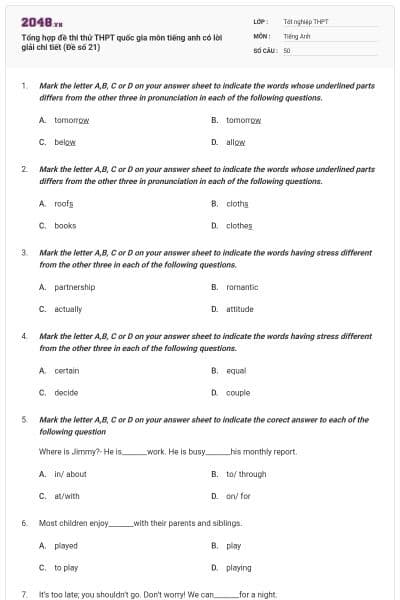
Mark the letter A,B, C or D on your answer sheet to indicate the words whose underlined parts differs from the other three in pronunciation in each of the following questions.
tomorrow
tomorrow
below
allow
Đáp án D
Câu D phát âm là /au/ còn lại phát âm là /ou/
Mark the letter A,B, C or D on your answer sheet to indicate the words whose underlined parts differs from the other three in pronunciation in each of the following questions.
roofs
cloths
books
clothes
Đáp án D
Câu D phát âm là /z/ còn lại phát âm là /s/
Mark the letter A,B, C or D on your answer sheet to indicate the words having stress different from the other three in each of the following questions.
partnership
romantic
actually
attitude
Đáp án B
Câu B trọng âm 2 còn lại trọng âm 1.
Mark the letter A,B, C or D on your answer sheet to indicate the words having stress different from the other three in each of the following questions.
certain
equal
decide
couple
Đáp án C
Câu C trọng âm 2 còn lại trọng âm 1.
Mark the letter A,B, C or D on your answer sheet to indicate the corect answer to each of the following question
Where is Jimmy?- He is_______work. He is busy_______his monthly report.
in/ about
to/ through
at/with
on/ for
Đáp án C
Be at work: đang làm việc
Busy with: bận rộn với công việc gì đó
Most children enjoy_______with their parents and siblings.
played
play
to play
playing
Đáp án D
Enjoy + Ving: thích làm ( gì đó)
It’s too late; you shouldn’t go. Don’t worry! We can_______for a night.
put you up
put you through
put you away
put you aside
Đáp án A
Put someone up: cho (ai đó) ngủ lại một đêm
Put someone through: cho qua, xuyên qua
Put …away: cất đi
Put…aside: để sang một bên
Câu này dịch như sau: Trễ quá rồi, bây giờ bạn không nên đi. Đừng lo. Chúng tôi có thể cho bạn ngủ nhờ lại một đêm.
_______nonverbal language is_______important aspect of interpersonal communication.
- / an
The / -
A/ the
The/ a
Đáp án A
Nonverbal language: ngôn ngữ phi ngôn => không đếm được => không dùng mạo từ
An important aspect: 1 khía cạnh/ lĩnh vực quan trọng , aspect là danh từ đếm được nhưng chưa xác định nên dùng mạo từ “an”
Tim asked Sarah_______English so far.
how long was she learning
how long she has been learning
she had been learning how long
how long she had been learning
Đáp án D
Tường thuật câu hỏi đổi ngôi lùi thì ( hiện tại hoàn thành => quá khứ hoàn thành) và không đảo ngữ.
John often says he_______boxing because it _______a cruel sport.
had not liked/ was
not liked/ had been
does not like/ is
did not like/ were
Đáp án C
Vì động từ tường thuật (says) ở thì hiện tại đơn nên câu không lùi thì, các động từ đều dùng thì hiện tại đơn.
I do not think there is a real_______between men and women at home as well as in our society.
attitude
equality
value
measurement
Đáp án B
Attitude: thái độ
Equality: sự bình đẳng
Value: giá trị
Measurement: phương pháp
Câu này dịch như sau: Tôi không nghĩ có sự bình đẳng thật sự giữa nam và nữ ở nhà cũng như trong xã hội.
Most of us would agree that physical_______does not play a major part in how we react to the people we meet.
attractiveness
attract
attractively
attractive
Đáp án A
Sau tính từ (physical: thuộc về vật lý/ cơ thể) là danh từ ( attractiveness: sự hấp dẫn lôi cuốn)
You should _______ more attention to what your teacher explanis.
make
get
set
pay
Đáp án: D
Giải thích:
Cụm: pay attention (to somebody/something): chú ý (tới ai/cái gì)
Dịch: Bạn nên chú ý nhiều hơn đến những gì giáo viên giải thích.
I_______there once a long time ago and_______back since.
have gone/ was
went/ have not been
go/ am not
was going/ has not been
Đáp án B
Mệnh đề đầu có a long time ago => quá khứ đơn
Mệnh đề sau có since => hiện tại hoàn thành.
The more_______and positive you look, the better you will feel.
confident
confide
confident
confidence
Đáp án A
Sau and là tính từ ( positive: lạc quan) nên trước and cũng là tính từ ( confident: tự tin)
It’s hard work looking _______ three children all day.
after
to
up
through
Đáp án A
Look after: chăm sóc
Look up: tra ( từ điển/ danh bạ)
Look through: xem qua
Câu này dịch như sau: Thật là một công việc khó khăn khi phải chăm sóc 3 đứa trẻ cả ngày.
Mark the letter A, B, C or D on your answer sheet to indicate the word(s) CLOSEST in meaning to the underlined word(s) in each of the following questions.
School uniform is compulsory in most of Vietnmaese schools.
depended
paid
required
divided
Đáp án C
Compulsory = required: được yêu cầu/ bắt buộc
Mark the letter A, B, C or D on your answer sheet to indicate the word(s) CLOSEST in meaning to the underlined word(s) in each of the following questions.
Bill, come and give me a hand with cooking.
attemp
prepare
be busy
help
Đáp án D
Give a hand = help: giúp đỡ
Mark the letter A, B, C or D on your answer sheet to indicate the word(s) OPPOSITE in meaning to the underlined word(s) in each of the following questions.
We should keep these proposals secret from the chairman for the time being.
revealed
frequented
lively
accessible
Đáp án A
Secret: giữ bí mật ≠ revealed: tiết lộ
Mark the letter A, B, C or D on your answer sheet to indicate the word(s) OPPOSITE in meaning to the underlined word(s) in each of the following questions.
I didn’t think his comments were very appropriate at the time.
unsuitable
right
exact
correct
Đáp án B
Appropriate: phù hợp ≠ unsuitable: không phù hợp
Mark the letter A,B, C or D on your answer sheet to indicate the most suitable response to complete each of the following exchanges
“ I like your coat, Helen.” -“_______.”
Really, I’m not.
Do you?
I think so
I’m sorry.
Đáp án B
-“ Tôi thích cái áo khoát bằng lông thú của bạn lắm, Helen à.”
- “ Thật sao?”
Mark the letter A,B, C or D on your answer sheet to indicate the most suitable response to complete each of the following exchanges
“ What an attractive hair style you have got, Mary!” -“_______”
You are telling a lie
I don’t like your saying
Thank you very much. I’m afraid
Thank you for your compliment
Đáp án D
-“ Bạn có kiểu tóc đẹp quá Mary!
-“ Cảm ơn lời khen của bạn nhé!”
Mark the letter A,B, C or D on your answer sheet to indicate the sentence that is closest in meaning to each of the following questions.
Had the announcement been made earlier, more people wouls have attended the lecture.
The lecture was held so late thet a few people attended it
More people came late to the lecture because of the late announcement
The late announcement helped make the lecture well- attended
Few people came to the lecture because the announcement was not made earlier
Đáp án D
Nếu thông báo được truyền đi sớm hơn, sẽ có nhiều người hơn tham gia vào buổi diễn thuyết. = Rất ít người đến buổi diễn thuyết vì thông báo không được truyền đi sớm hơn.
Mark the letter A,B, C or D on your answer sheet to indicate the sentence that is closest in meaning to each of the following questions.
She raised her hand high so that she could attract the teacher’s attention.
Because her teacher attracted her, she raised her hand again.
Though she raised her hand high, she couldn’t attract her teacher’s attention.
To attract her teacher’s attention, she raised her hand high.
She had such a high raising of hand that she failed to attract her teacher’s attention.
Đáp án C
Cô ấy giơ tay lên cao để thu hút sự chú ý của giáo viên = Để thu hút sự chú ý của giáo viên cô ấy giơ tay lên cao.
Mark the letter A,B, C or D on your answer sheet to indicate the sentence that is closest in meaning to each of the following questions.
Anyone who misses more than fifty percent of the classes deserves to fail.
Those who are absent more than half the time shouls fail
Fifty percent of classes have failed the exams
More than fifty percent is too much for one class
People who fail must make up fifty percent of the classwork
Đáp án A
Bất cứ ai nghỉ hơn 50% số buổi học sẽ bị trượt = Những người nghỉ hơn 50% thời gian sẽ trượt.
Make the letter A, B, C or D on your answer sheet to indicate the sentence that best combines each pair of sentence in the following questions.
The old man is workign in this factory. I borrowed his bicycle yesterday.
The old man is workign in this factory which I borrowed his bycicle yesterday
The old man whom I borrowed his bicycle yesterday is working in this factory
The old man whose bicycle I borrowed yesterday is working in this factory
The old man whom is working in this factory I borrowed his bicycle yesterday
Đáp án C
Ông cụ này làm việc trong nhà máy. Tôi đã mượn xe đạp của ông vào hôm qua.
Þ Dùng đại từ quan hệ whose để nối 2 câu lại với nhau.
Make the letter A, B, C or D on your answer sheet to indicate the sentence that best combines each pair of sentence in the following questions.
Mary doesn’t like sports. Her brother doesn’t, either.
Neither Mary or her brother likes sports
either Mary or her brotehr loikes sports
Neither Mary nor her brother likes sports
both Mary and her brother like sports
Đáp án C
Mary không thích thể thao. Anh trai cô ấy cũng không. = Không Mary cũng không phải anh trai cô ấy thích thể thao.
Neither…nor…: Không …cũng không…
Mark the letter A, B, C or D on your answer sheet to indicate the underlined part that needs correction in each of the following questions.
Body language is quiet and secret, but most powerful language of all.
Body language
secret
most
of all
Đáp án: C
Giải thích:
So sánh nhất phải có mạo từ “the”.
Sửa: most → the most
Dịch: Ngôn ngữ cơ thể là ngôn ngữ trầm lặng và bí mật, nhưng mạnh mẽ nhất trong tất cả.
Mark the letter A, B, C or D on your answer sheet to indicate the underlined part that needs correction in each of the following questions.
Stayed strong, family members have to be engaged in each other’s lives.
Stayed
strong
have
be engaged
Đáp án A
Stayed => to stay vì khi chỉ mục đích để làm gì ta dùng to Vo
Câu này dịch như sau: Để có mối quan hệ chặt chẽ, các thành viên trong gia đình phải quan tâm đời sống của nhau
Mark the letter A, B, C or D on your answer sheet to indicate the underlined part that needs correction in each of the following questions.
Once you can overcome your difficulty, the problem may well become a source of strengthen to your marriage and your faith.
Once
overcome
may well become
strengthen
Đáp án: D
Giải thích:
Kiến thức: Từ loại
Sau giới từ “of” cần một danh từ.
strengthen (v): làm cho mạnh mẽ, kiên cố, tăng cường
strength (n): sức mạnh
Sửa: strengthen → strength
Dịch: Một khi bạn có thể vượt qua khó khăn, vấn đề đó có thể trở thành nguồn sức mạnh cho cuộc hôn nhân và đức tin của bạn.
Read the following passage and mark the letter A, B, C or D on your answer sheet to indicate the correct word or phrase thet best fits each of the numbered blanks from 31 to 35.
In the western customs (31) _______ hands is the customary form of greeting, but in China a nod of the head or (32) _______ bow is sufficient. Hugging and kissing when greeting are uncommon. Business cards are often (33) _______ and yours should be printed in your own language and in Chinese. Also, it is more respectful to present your card or a gift or any other article using (34) _______ hands. The Chinese are (35) _______ applauders. You may be greeted with group clapping, even by small children.
Điền ô số 31
taking
shaking
grasping
hugging
Đáp án B
Shaking hands: bắt tay
In the western customs shaking hands is customary form of greeting: Theo phong tục phương Tây bắt tay là hình thức chào hỏi phổ biến.
Read the following passage and mark the letter A, B, C or D on your answer sheet to indicate the correct word or phrase thet best fits each of the numbered blanks from 31 to 35.
In the western customs (31) _______ hands is the customary form of greeting, but in China a nod of the head or (32) _______ bow is sufficient. Hugging and kissing when greeting are uncommon. Business cards are often (33) _______ and yours should be printed in your own language and in Chinese. Also, it is more respectful to present your card or a gift or any other article using (34) _______ hands. The Chinese are (35) _______ applauders. You may be greeted with group clapping, even by small children
Điền ô số 32
small
bit
slight
heavy
Đáp án C
Slight bow: cái ôm nhẹ
But in China a nod of head or slight bow is sufficient: nhưng ở Trung Quốc một cái gật đầu hay cái ôm nhẹ là đủ.
Read the following passage and mark the letter A, B, C or D on your answer sheet to indicate the correct word or phrase thet best fits each of the numbered blanks from 31 to 35.
In the western customs (31) _______ hands is the customary form of greeting, but in China a nod of the head or (32) _______ bow is sufficient. Hugging and kissing when greeting are uncommon. Business cards are often (33) _______ and yours should be printed in your own language and in Chinese. Also, it is more respectful to present your card or a gift or any other article using (34) _______ hands. The Chinese are (35) _______ applauders. You may be greeted with group clapping, even by small children.
Điền ô sô 33
exchanged
changed
transferred
converted
Đáp án D
Transfer: chuyển đi, gửi đi
Change: thay đổi
Covert: chuyển đổi( từ dạng này sang dạng khác)
Exchange: trao đổi
Business cards are often exchanged and yours should be printed in your own language and in
Chinese: Danh thiếp thường được trao đổi và danh thiếp của bạn nên được in bằng cả ngôn ngữ của bạn và tiếng Trung Quốc.
Read the following passage and mark the letter A, B, C or D on your answer sheet to indicate the correct word or phrase thet best fits each of the numbered blanks from 31 to 35.
In the western customs (31) _______ hands is the customary form of greeting, but in China a nod of the head or (32) _______ bow is sufficient. Hugging and kissing when greeting are uncommon. Business cards are often (33) _______ and yours should be printed in your own language and in Chinese. Also, it is more respectful to present your card or a gift or any other article using (34) _______ hands. The Chinese are (35) _______ applauders. You may be greeted with group clapping, even by small children.
Điền ô số 34
pair
couple
double
both
Đáp án C
Both hands: cả hai tay
Also, it is more respectful to present your card of a gift or any other article using both hands: Tương tự, sẽ trân trọng hơn khi đưa quà hay bất cứ cái gì bằng cả hai tay.
Read the following passage and mark the letter A, B, C or D on your answer sheet to indicate the correct word or phrase thet best fits each of the numbered blanks from 31 to 35.
In the western customs (31) _______ hands is the customary form of greeting, but in China a nod of the head or (32) _______ bow is sufficient. Hugging and kissing when greeting are uncommon. Business cards are often (33) _______ and yours should be printed in your own language and in Chinese. Also, it is more respectful to present your card or a gift or any other article using (34) _______ hands. The Chinese are (35) _______ applauders. You may be greeted with group clapping, even by small children.
Điền ô số 35
enthusiast
enthusiastic
enthusiasm
enthusiastically
Đáp án A
Trước danh từ (applauders: người vỗ tay) dùng tính từ ( enthusiastic: phấn khởi, hào hứng)
Read the following passage and mark the letter A, B, C or D on your answer sheet to indicate the correct answer to each of the following question from 36 to 43.
A number of factors related to the voice reveal the personality of the speaker.
The first is the broad area of communication, which includes imparting information by use of language, communicating with a group or an individual and specialized communication through performance. A person conveys thoughts and ideas through choice of words, by a tone of voice that is pleasant or unpleasant, gentle or harsh, by the rhythm that is inherent within the language itself, and by speech rhythms that are flowing and regular or uneven and hesitant, and finally, by the pitch and melody of the utterance. When speaking before a group, a person's tone may indicate uncertainty or fright, confidence or calm. At interpersonal levels, the tone may reflect ideas and feelings over and above the words chosen, or may belie them.
Here the participant’s tone can consciously or unconsciously reflect intuitive sympathy or antipathy, lack of concern or interest, fatigue, anxiety, enthusiasm or excitement, all of which are .usually discernible by the acute listener. Public performance is a manner of communication that is highly specialized with its own techniques for obtaining effects by voice and /or gesture. The motivation derived from the text, and in the case of singing, the music, in combination with the performer's skills, personality, and ability to create empathy will determine the success of artistic, political, or pedagogic communication.
Second, the voice gives psychological clues to a person's self-image, perception of others, and emotional health. Self-image can be indicated by a tone of voice that is confident, pretentious, shy, aggressive, outgoing, or exuberant, to name only a few personality traits. Also the sound may give a clue to the facade or mask of that person, for example, a shy person hiding behind an overconfident front. How a speaker perceives the listener's receptiveness, interest, or sympathy in any given conversation can drastically alter the tone of presentation, by encouraging or discouraging the speaker. Emotional health is evidenced in the voice by free and melodic sounds of the happy, by constricted and harsh sound of the angry, and by dull and lethargic qualities of the depressed.
What does the passage mainly discuss?
The function of the voice in performance
Communication styles
The connection between voice and personality
The production of speech
Đáp án A
Bài đọc chủ yếu thảo luận về vấn đề gì? => Mối quan hệ giữa giọng nói và tính cách/
Read the following passage and mark the letter A, B, C or D on your answer sheet to indicate the correct answer to each of the following question from 36 to 43.
A number of factors related to the voice reveal the personality of the speaker.
The first is the broad area of communication, which includes imparting information by use of language, communicating with a group or an individual and specialized communication through performance. A person conveys thoughts and ideas through choice of words, by a tone of voice that is pleasant or unpleasant, gentle or harsh, by the rhythm that is inherent within the language itself, and by speech rhythms that are flowing and regular or uneven and hesitant, and finally, by the pitch and melody of the utterance. When speaking before a group, a person's tone may indicate uncertainty or fright, confidence or calm. At interpersonal levels, the tone may reflect ideas and feelings over and above the words chosen, or may belie them.
Here the participant’s tone can consciously or unconsciously reflect intuitive sympathy or antipathy, lack of concern or interest, fatigue, anxiety, enthusiasm or excitement, all of which are .usually discernible by the acute listener. Public performance is a manner of communication that is highly specialized with its own techniques for obtaining effects by voice and /or gesture. The motivation derived from the text, and in the case of singing, the music, in combination with the performer's skills, personality, and ability to create empathy will determine the success of artistic, political, or pedagogic communication.
Second, the voice gives psychological clues to a person's self-image, perception of others, and emotional health. Self-image can be indicated by a tone of voice that is confident, pretentious, shy, aggressive, outgoing, or exuberant, to name only a few personality traits. Also the sound may give a clue to the facade or mask of that person, for example, a shy person hiding behind an overconfident front. How a speaker perceives the listener's receptiveness, interest, or sympathy in any given conversation can drastically alter the tone of presentation, by encouraging or discouraging the speaker. Emotional health is evidenced in the voice by free and melodic sounds of the happy, by constricted and harsh sound of the angry, and by dull and lethargic qualities of the depressed.
What does the author mean by staring that, "At interpersonal levels, tone may reflect ideas and feelings over and above the words chosen" ?
Feelings are expressed with different words than ideas are
The tone of voice can carry information beyond the meaning of words
A high tone of voice reflects an emotional communication
Feelings are more difficult to express than ideas
Đáp án A
Tác giả ngụ ý gì khi nói rằng “ Ở mức độ tương tác giữa người và người, giọng nói có thể phản ánh những ý kiến và cảm xúc hơn cả những cái mà ngôn ngữ vốn có”
Þ Giọng nói có thể truyền đạt thông tin nhiều hơn cả ý nghĩa vốn có của từ.
Read the following passage and mark the letter A, B, C or D on your answer sheet to indicate the correct answer to each of the following question from 36 to 43.
A number of factors related to the voice reveal the personality of the speaker.
The first is the broad area of communication, which includes imparting information by use of language, communicating with a group or an individual and specialized communication through performance. A person conveys thoughts and ideas through choice of words, by a tone of voice that is pleasant or unpleasant, gentle or harsh, by the rhythm that is inherent within the language itself, and by speech rhythms that are flowing and regular or uneven and hesitant, and finally, by the pitch and melody of the utterance. When speaking before a group, a person's tone may indicate uncertainty or fright, confidence or calm. At interpersonal levels, the tone may reflect ideas and feelings over and above the words chosen, or may belie them.
Here the participant’s tone can consciously or unconsciously reflect intuitive sympathy or antipathy, lack of concern or interest, fatigue, anxiety, enthusiasm or excitement, all of which are .usually discernible by the acute listener. Public performance is a manner of communication that is highly specialized with its own techniques for obtaining effects by voice and /or gesture. The motivation derived from the text, and in the case of singing, the music, in combination with the performer's skills, personality, and ability to create empathy will determine the success of artistic, political, or pedagogic communication.
Second, the voice gives psychological clues to a person's self-image, perception of others, and emotional health. Self-image can be indicated by a tone of voice that is confident, pretentious, shy, aggressive, outgoing, or exuberant, to name only a few personality traits. Also the sound may give a clue to the facade or mask of that person, for example, a shy person hiding behind an overconfident front. How a speaker perceives the listener's receptiveness, interest, or sympathy in any given conversation can drastically alter the tone of presentation, by encouraging or discouraging the speaker. Emotional health is evidenced in the voice by free and melodic sounds of the happy, by constricted and harsh sound of the angry, and by dull and lethargic qualities of the depressed.
The word "Here" in line 9 refers to……………
At interpersonal levels
the tone
ideas and feelings
words chosen
Đáp án A
Here = At interpersonal level
Read the following passage and mark the letter A, B, C or D on your answer sheet to indicate the correct answer to each of the following question from 36 to 43.
A number of factors related to the voice reveal the personality of the speaker.
The first is the broad area of communication, which includes imparting information by use of language, communicating with a group or an individual and specialized communication through performance. A person conveys thoughts and ideas through choice of words, by a tone of voice that is pleasant or unpleasant, gentle or harsh, by the rhythm that is inherent within the language itself, and by speech rhythms that are flowing and regular or uneven and hesitant, and finally, by the pitch and melody of the utterance. When speaking before a group, a person's tone may indicate uncertainty or fright, confidence or calm. At interpersonal levels, the tone may reflect ideas and feelings over and above the words chosen, or may belie them.
Here the participant’s tone can consciously or unconsciously reflect intuitive sympathy or antipathy, lack of concern or interest, fatigue, anxiety, enthusiasm or excitement, all of which are .usually discernible by the acute listener. Public performance is a manner of communication that is highly specialized with its own techniques for obtaining effects by voice and /or gesture. The motivation derived from the text, and in the case of singing, the music, in combination with the performer's skills, personality, and ability to create empathy will determine the success of artistic, political, or pedagogic communication.
Second, the voice gives psychological clues to a person's self-image, perception of others, and emotional health. Self-image can be indicated by a tone of voice that is confident, pretentious, shy, aggressive, outgoing, or exuberant, to name only a few personality traits. Also the sound may give a clue to the facade or mask of that person, for example, a shy person hiding behind an overconfident front. How a speaker perceives the listener's receptiveness, interest, or sympathy in any given conversation can drastically alter the tone of presentation, by encouraging or discouraging the speaker. Emotional health is evidenced in the voice by free and melodic sounds of the happy, by constricted and harsh sound of the angry, and by dull and lethargic qualities of the depressed.
Why does the author mention "artistic, political, or pedagogic communication" ?
As examples of public performance
As examples of basic styles of communication
To contrast them to singing
To introduce the idea of self-image
Đáp án A
Tại sao tác giả đề cập đến giao tiếp về nghệ thuật, chính trị và giáo dục? => Để nêu lên những ví dụ về các loại hình giao tiếp cơ bản.
Read the following passage and mark the letter A, B, C or D on your answer sheet to indicate the correct answer to each of the following question from 36 to 43.
A number of factors related to the voice reveal the personality of the speaker.
The first is the broad area of communication, which includes imparting information by use of language, communicating with a group or an individual and specialized communication through performance. A person conveys thoughts and ideas through choice of words, by a tone of voice that is pleasant or unpleasant, gentle or harsh, by the rhythm that is inherent within the language itself, and by speech rhythms that are flowing and regular or uneven and hesitant, and finally, by the pitch and melody of the utterance. When speaking before a group, a person's tone may indicate uncertainty or fright, confidence or calm. At interpersonal levels, the tone may reflect ideas and feelings over and above the words chosen, or may belie them.
Here the participant’s tone can consciously or unconsciously reflect intuitive sympathy or antipathy, lack of concern or interest, fatigue, anxiety, enthusiasm or excitement, all of which are .usually discernible by the acute listener. Public performance is a manner of communication that is highly specialized with its own techniques for obtaining effects by voice and /or gesture. The motivation derived from the text, and in the case of singing, the music, in combination with the performer's skills, personality, and ability to create empathy will determine the success of artistic, political, or pedagogic communication.
Second, the voice gives psychological clues to a person's self-image, perception of others, and emotional health. Self-image can be indicated by a tone of voice that is confident, pretentious, shy, aggressive, outgoing, or exuberant, to name only a few personality traits. Also the sound may give a clue to the facade or mask of that person, for example, a shy person hiding behind an overconfident front. How a speaker perceives the listener's receptiveness, interest, or sympathy in any given conversation can drastically alter the tone of presentation, by encouraging or discouraging the speaker. Emotional health is evidenced in the voice by free and melodic sounds of the happy, by constricted and harsh sound of the angry, and by dull and lethargic qualities of the depressed.
According to the passage, an exuberant tone of voice may be an indication of a person's___________
general physical health
personality
registered
obtained
Đáp án D
Theo bài đọc, sự đa dạng của các tông giọng thể hiện cái gì của người nói => tính cách
Dẫn chứng: Self-image can be indicated by a tone of voice that is confident, pretentious, shy, aggressive, outgoing, or exuberant, to name pnly a few personality traits.
Read the following passage and mark the letter A, B, C or D on your answer sheet to indicate the correct answer to each of the following question from 36 to 43.
A number of factors related to the voice reveal the personality of the speaker.
The first is the broad area of communication, which includes imparting information by use of language, communicating with a group or an individual and specialized communication through performance. A person conveys thoughts and ideas through choice of words, by a tone of voice that is pleasant or unpleasant, gentle or harsh, by the rhythm that is inherent within the language itself, and by speech rhythms that are flowing and regular or uneven and hesitant, and finally, by the pitch and melody of the utterance. When speaking before a group, a person's tone may indicate uncertainty or fright, confidence or calm. At interpersonal levels, the tone may reflect ideas and feelings over and above the words chosen, or may belie them.
Here the participant’s tone can consciously or unconsciously reflect intuitive sympathy or antipathy, lack of concern or interest, fatigue, anxiety, enthusiasm or excitement, all of which are .usually discernible by the acute listener. Public performance is a manner of communication that is highly specialized with its own techniques for obtaining effects by voice and /or gesture. The motivation derived from the text, and in the case of singing, the music, in combination with the performer's skills, personality, and ability to create empathy will determine the success of artistic, political, or pedagogic communication.
Second, the voice gives psychological clues to a person's self-image, perception of others, and emotional health. Self-image can be indicated by a tone of voice that is confident, pretentious, shy, aggressive, outgoing, or exuberant, to name only a few personality traits. Also the sound may give a clue to the facade or mask of that person, for example, a shy person hiding behind an overconfident front. How a speaker perceives the listener's receptiveness, interest, or sympathy in any given conversation can drastically alter the tone of presentation, by encouraging or discouraging the speaker. Emotional health is evidenced in the voice by free and melodic sounds of the happy, by constricted and harsh sound of the angry, and by dull and lethargic qualities of the depressed.
According to the passage, an overconfident front may hide___________.
hostility
shyness
friendliness
strength
Đáp án B
Theo bài đọc, một vẻ ngoài quá tự tin có thể ẩn giấu => Sự thẹn thùng, mắc cỡ
Dẫn chứng: For example, a shy person hiding behind an overconfident front.
Read the following passage and mark the letter A, B, C or D on your answer sheet to indicate the correct answer to each of the following question from 36 to 43.
A number of factors related to the voice reveal the personality of the speaker.
The first is the broad area of communication, which includes imparting information by use of language, communicating with a group or an individual and specialized communication through performance. A person conveys thoughts and ideas through choice of words, by a tone of voice that is pleasant or unpleasant, gentle or harsh, by the rhythm that is inherent within the language itself, and by speech rhythms that are flowing and regular or uneven and hesitant, and finally, by the pitch and melody of the utterance. When speaking before a group, a person's tone may indicate uncertainty or fright, confidence or calm. At interpersonal levels, the tone may reflect ideas and feelings over and above the words chosen, or may belie them.
Here the participant’s tone can consciously or unconsciously reflect intuitive sympathy or antipathy, lack of concern or interest, fatigue, anxiety, enthusiasm or excitement, all of which are .usually discernible by the acute listener. Public performance is a manner of communication that is highly specialized with its own techniques for obtaining effects by voice and /or gesture. The motivation derived from the text, and in the case of singing, the music, in combination with the performer's skills, personality, and ability to create empathy will determine the success of artistic, political, or pedagogic communication.
Second, the voice gives psychological clues to a person's self-image, perception of others, and emotional health. Self-image can be indicated by a tone of voice that is confident, pretentious, shy, aggressive, outgoing, or exuberant, to name only a few personality traits. Also the sound may give a clue to the facade or mask of that person, for example, a shy person hiding behind an overconfident front. How a speaker perceives the listener's receptiveness, interest, or sympathy in any given conversation can drastically alter the tone of presentation, by encouraging or discouraging the speaker. Emotional health is evidenced in the voice by free and melodic sounds of the happy, by constricted and harsh sound of the angry, and by dull and lethargic qualities of the depressed.
The word "drastically" in line 21 is closest in meaning to___________.
frequently
exactly
severely
easily
Đáp án D
Drastically = severely: dữ dội, khốc liệt
Read the following passage and mark the letter A, B, C or D on your answer sheet to indicate the correct answer to each of the following question from 36 to 43.
A number of factors related to the voice reveal the personality of the speaker.
The first is the broad area of communication, which includes imparting information by use of language, communicating with a group or an individual and specialized communication through performance. A person conveys thoughts and ideas through choice of words, by a tone of voice that is pleasant or unpleasant, gentle or harsh, by the rhythm that is inherent within the language itself, and by speech rhythms that are flowing and regular or uneven and hesitant, and finally, by the pitch and melody of the utterance. When speaking before a group, a person's tone may indicate uncertainty or fright, confidence or calm. At interpersonal levels, the tone may reflect ideas and feelings over and above the words chosen, or may belie them.
Here the participant’s tone can consciously or unconsciously reflect intuitive sympathy or antipathy, lack of concern or interest, fatigue, anxiety, enthusiasm or excitement, all of which are .usually discernible by the acute listener. Public performance is a manner of communication that is highly specialized with its own techniques for obtaining effects by voice and /or gesture. The motivation derived from the text, and in the case of singing, the music, in combination with the performer's skills, personality, and ability to create empathy will determine the success of artistic, political, or pedagogic communication.
Second, the voice gives psychological clues to a person's self-image, perception of others, and emotional health. Self-image can be indicated by a tone of voice that is confident, pretentious, shy, aggressive, outgoing, or exuberant, to name only a few personality traits. Also the sound may give a clue to the facade or mask of that person, for example, a shy person hiding behind an overconfident front. How a speaker perceives the listener's receptiveness, interest, or sympathy in any given conversation can drastically alter the tone of presentation, by encouraging or discouraging the speaker. Emotional health is evidenced in the voice by free and melodic sounds of the happy, by constricted and harsh sound of the angry, and by dull and lethargic qualities of the depressed.
According to the passage, what does a constricted and harsh voice indicate?
Lethargy
Depression
Boredom
Anger
Đáp án B
Theo bài đọc, một giọng nói thô và dữ thể hiện cái gì => sự tức giận
Dẫn chứng: emotional health is evidenced in the voice by free and melodic sounds of the happy, by constricted and harsh sound of the angry, and by dull and lethargic qualities of the depressed.
Read the following passage and mark the letter A, B, C or D on your answer sheet to indicate the correct answer to each of the following question from 44 to 50.
The rules of etiquette in American restaurants depend upon a number of factors the physical location of the restaurant, e.g., rural or urban; the type of restaurant, e.g., informal or formal; and certain standards that are more universal. In other words, some standards 5 of etiquette vary significantly while other standards apply almost anywhere. Learning the proper etiquette in a particular type of restaurant in a particular area may sometimes require instruction, but more commonly it simply requires sensitivity and experience. For example, while it is acceptable to read a magazine in a coffee shop, it is 10 inappropriate to do the same in a more luxurious setting. And, if you are eating in a very rustic setting it may be fine to tuck your napkin into your shirt, but if you are in a sophisticated urban restaurant this behavior would demonstrate a lack of manners. It is safe to say, however, that in virtually every restaurant it is unacceptable 15 to indiscriminately throw your food on the floor. The conclusion we can most likely draw from the above is that while the types and locations of restaurants determine etiquette appropriate to them, some rules apply to all restaurants.
What topic is this passage primarily concerned?
instruction in proper etiquette
rules of etiquette
variable and universal standards of etiquette
the importance of good manners
Đáp án C
Bài đọc chủ yếu đề cập về nội dung gì? => những tiêu chí đa dạng và phổ biến về sự lịch thiệp.
Read the following passage and mark the letter A, B, C or D on your answer sheet to indicate the correct answer to each of the following question from 44 to 50.
The rules of etiquette in American restaurants depend upon a number of factors the physical location of the restaurant, e.g., rural or urban; the type of restaurant, e.g., informal or formal; and certain standards that are more universal. In other words, some standards 5 of etiquette vary significantly while other standards apply almost anywhere. Learning the proper etiquette in a particular type of restaurant in a particular area may sometimes require instruction, but more commonly it simply requires sensitivity and experience. For example, while it is acceptable to read a magazine in a coffee shop, it is 10 inappropriate to do the same in a more luxurious setting. And, if you are eating in a very rustic setting it may be fine to tuck your napkin into your shirt, but if you are in a sophisticated urban restaurant this behavior would demonstrate a lack of manners. It is safe to say, however, that in virtually every restaurant it is unacceptable 15 to indiscriminately throw your food on the floor. The conclusion we can most likely draw from the above is that while the types and locations of restaurants determine etiquette appropriate to them, some rules apply to all restaurants.
According to the passage,which of the following is a universal rule of etiquette?
reading a magazine at a coffee shop
not throwing food on the floor
eating in rustic settings
tucking a napkin in your shirt
Đáp án B
Theo bài đọc, cái nào là cách ứng xử lịch thiệp chung? => không vứt thức ăn lên sàn nhà.
Read the following passage and mark the letter A, B, C or D on your answer sheet to indicate the correct answer to each of the following question from 44 to 50.
The rules of etiquette in American restaurants depend upon a number of factors the physical location of the restaurant, e.g., rural or urban; the type of restaurant, e.g., informal or formal; and certain standards that are more universal. In other words, some standards 5 of etiquette vary significantly while other standards apply almost anywhere. Learning the proper etiquette in a particular type of restaurant in a particular area may sometimes require instruction, but more commonly it simply requires sensitivity and experience. For example, while it is acceptable to read a magazine in a coffee shop, it is 10 inappropriate to do the same in a more luxurious setting. And, if you are eating in a very rustic setting it may be fine to tuck your napkin into your shirt, but if you are in a sophisticated urban restaurant this behavior would demonstrate a lack of manners. It is safe to say, however, that in virtually every restaurant it is unacceptable 15 to indiscriminately throw your food on the floor. The conclusion we can most likely draw from the above is that while the types and locations of restaurants determine etiquette appropriate to them, some rules apply to all restaurants.
According to the passage, requires sensitivity and experience?
reading a magazine at a coffee shop
not throwing food on the floor
eating in rustic settings
tucking a napkin in your shirt
Đáp án C
Theo bài đọc, cái gì yêu cầu sự tinh tế và kinh nghiệm => học về phép ứng xứ lịch thiệp phù hợp.
Read the following passage and mark the letter A, B, C or D on your answer sheet to indicate the correct answer to each of the following question from 44 to 50.
The rules of etiquette in American restaurants depend upon a number of factors the physical location of the restaurant, e.g., rural or urban; the type of restaurant, e.g., informal or formal; and certain standards that are more universal. In other words, some standards 5 of etiquette vary significantly while other standards apply almost anywhere. Learning the proper etiquette in a particular type of restaurant in a particular area may sometimes require instruction, but more commonly it simply requires sensitivity and experience. For example, while it is acceptable to read a magazine in a coffee shop, it is 10 inappropriate to do the same in a more luxurious setting. And, if you are eating in a very rustic setting it may be fine to tuck your napkin into your shirt, but if you are in a sophisticated urban restaurant this behavior would demonstrate a lack of manners. It is safe to say, however, that in virtually every restaurant it is unacceptable 15 to indiscriminately throw your food on the floor. The conclusion we can most likely draw from the above is that while the types and locations of restaurants determine etiquette appropriate to them, some rules apply to all restaurants.
Which of the following words is most similar to the meaning of “rustic” ?
urban
unsophisticated
agricultural
ancient
Đáp án B
Rustic = unsophisticated: đơn giản, không phức tạp, mộc mạc
Read the following passage and mark the letter A, B, C or D on your answer sheet to indicate the correct answer to each of the following question from 44 to 50.
The rules of etiquette in American restaurants depend upon a number of factors the physical location of the restaurant, e.g., rural or urban; the type of restaurant, e.g., informal or formal; and certain standards that are more universal. In other words, some standards 5 of etiquette vary significantly while other standards apply almost anywhere. Learning the proper etiquette in a particular type of restaurant in a particular area may sometimes require instruction, but more commonly it simply requires sensitivity and experience. For example, while it is acceptable to read a magazine in a coffee shop, it is 10 inappropriate to do the same in a more luxurious setting. And, if you are eating in a very rustic setting it may be fine to tuck your napkin into your shirt, but if you are in a sophisticated urban restaurant this behavior would demonstrate a lack of manners. It is safe to say, however, that in virtually every restaurant it is unacceptable 15 to indiscriminately throw your food on the floor. The conclusion we can most likely draw from the above is that while the types and locations of restaurants determine etiquette appropriate to them, some rules apply to all restaurants.
Which of the following is closest in meaning to the word “tuck” in line 11?
set
put
fold
hold
Đáp án B
Tuck = put: đặt, để
Read the following passage and mark the letter A, B, C or D on your answer sheet to indicate the correct answer to each of the following question from 44 to 50.
The rules of etiquette in American restaurants depend upon a number of factors the physical location of the restaurant, e.g., rural or urban; the type of restaurant, e.g., informal or formal; and certain standards that are more universal. In other words, some standards 5 of etiquette vary significantly while other standards apply almost anywhere. Learning the proper etiquette in a particular type of restaurant in a particular area may sometimes require instruction, but more commonly it simply requires sensitivity and experience. For example, while it is acceptable to read a magazine in a coffee shop, it is 10 inappropriate to do the same in a more luxurious setting. And, if you are eating in a very rustic setting it may be fine to tuck your napkin into your shirt, but if you are in a sophisticated urban restaurant this behavior would demonstrate a lack of manners. It is safe to say, however, that in virtually every restaurant it is unacceptable 15 to indiscriminately throw your food on the floor. The conclusion we can most likely draw from the above is that while the types and locations of restaurants determine etiquette appropriate to them, some rules apply to all restaurants.
The word “sophisticated” in line 12 could best be replaced by?
famous
cultured
expensive
exclusive
Đáp án B
Sophisticated = cultured: tinh vi, phức tạp
Read the following passage and mark the letter A, B, C or D on your answer sheet to indicate the correct answer to each of the following question from 44 to 50.
The rules of etiquette in American restaurants depend upon a number of factors the physical location of the restaurant, e.g., rural or urban; the type of restaurant, e.g., informal or formal; and certain standards that are more universal. In other words, some standards 5 of etiquette vary significantly while other standards apply almost anywhere. Learning the proper etiquette in a particular type of restaurant in a particular area may sometimes require instruction, but more commonly it simply requires sensitivity and experience. For example, while it is acceptable to read a magazine in a coffee shop, it is 10 inappropriate to do the same in a more luxurious setting. And, if you are eating in a very rustic setting it may be fine to tuck your napkin into your shirt, but if you are in a sophisticated urban restaurant this behavior would demonstrate a lack of manners. It is safe to say, however, that in virtually every restaurant it is unacceptable 15 to indiscriminately throw your food on the floor. The conclusion we can most likely draw from the above is that while the types and locations of restaurants determine etiquette appropriate to them, some rules apply to all restaurants.
What is the author’s main purpose in this passage?
to compare sophisticated and rustic restaurants
to assist people in learning sophisticatedmanners
to simplify rules of restaurant etiquette
to describe variations in restaurant manners
Đáp án D
Mục đích chính của tác giả trong bài đọc là => mô tả về các lối ứng xử đa dạng ở nhà hàng.