Tổng hợp đề thi thử THPT quốc gia môn tiếng anh có lời giải chi tiết (Đề số 20)
50 câu hỏi
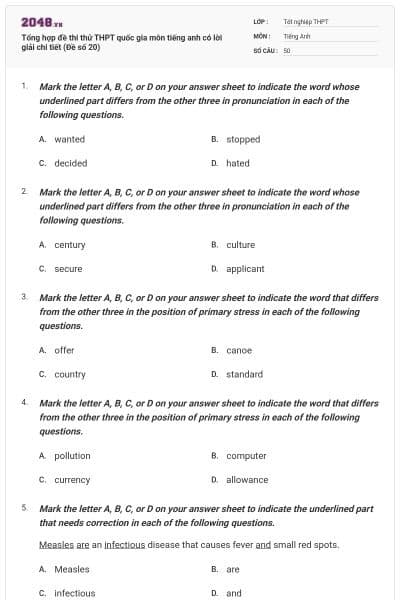
Mark the letter A, B, C, or D on your answer sheet to indicate the word whose underlined part differs from the other three in pronunciation in each of the following questions.
wanted
stopped
decided
hated
Đáp án B
Câu B phát âm là /t/ còn lại phát âm là /id/
Mark the letter A, B, C, or D on your answer sheet to indicate the word whose underlined part differs from the other three in pronunciation in each of the following questions.
century
culture
secure
applicant
Đáp án A
Câu A phát âm là /s/ còn lại phát âm là /k/
Mark the letter A, B, C, or D on your answer sheet to indicate the word that differs from the other three in the position of primary stress in each of the following questions.
offer
canoe
country
standard
Đáp án B
Câu B trọng âm 2 còn lại trọng âm 1
Mark the letter A, B, C, or D on your answer sheet to indicate the word that differs from the other three in the position of primary stress in each of the following questions.
pollution
computer
currency
allowance
Đáp án C
Câu C trọng âm 1 còn lại trọng âm 2.
Mark the letter A, B, C, or D on your answer sheet to indicate the underlined part that needs correction in each of the following questions.
Measles are an infectious disease that causes fever and small red spots.
Measles
are
infectious
and
Đáp án B
Are → is vì measles (bệnh sởi) là chủ ngữ số ít
Dịch nghĩa: Sởi là một bệnh truyền nhiễm gây sốt và xuất hiện các nốt đỏ nhỏ.
Mark the letter A, B, C, or D on your answer sheet to indicate the underlined part that needs correction in each of the following questions.
He passed the exams with high scores, that made his parents happy.
passed
with
that
happy
Đáp án: C
Giải thích:
Kiến thức: Đại từ quan hệ
Không dùng đại từ quan hệ “that” trong mệnh đề quan hệ có dấu phẩy.
Dùng “which” để thay cho nghĩa cả mệnh đề trước.
Sửa: that → which
Dịch: Anh đã vượt qua kỳ thi với số điểm cao, điều đó khiến bố mẹ anh rất vui.
Mark the letter A, B, C, or D on your answer sheet to indicate the underlined part that needs correction in each of the following questions.
For such a demanding job, you will need qualifications, soft skills and having full commitment.
such
will need
qualifications
having
Đáp án D
Having → have vì động từ nối với nhau bằng and nên phải song song về thì.
Mark the letter A, B, C, or D on your answer sheet to indicate the correct answer to each of the following questions.
I haven’t met him again since we ______ school ten years ago.
have left
leave
left
had left
Đáp án C
Cấu trúc: S + hiện tịa hoàn thành since S + quá khứ đơn
A recent survey has shown that ______ increasing number of men are willing to share the housework with their wives.
a
an
the
some
Đáp án B
A number of + danh từ số nhiều → động từ số nhiều (are). Vì sau mạo từ bắt đầu bằng 1 nguyên âm (increasing) nên ta dùng mạo từ an.
The more demanding the job is, ______ I like it.
more
most
the more
the most
Đáp án C
Cấu trúc so sánh kép: the so sánh hơn S+V, the so sánh hơn S+ V
John wanted to know ______ in my family.
there were how many people
how many people were there
were there how many people
how many people there were
Đáp án D
Tường thuật câu hỏi( wanted to know) nên lùi tì và không đảo ngữ.
Richard, my neighbor, _______ in World War II.
says to fight
says to have fought
is said to fight
is said to have fought
Đáp án D
Cấu trúc bị động đặc biệt.
Câu này dịch như sau: Richard, hàng xóm của tôi, được bảo rằngđã tham gia chiến
tranh thế giới thứ hai.
Việc được đồn ở hiện tại nên dùng is said, việc tham chiến ở quá khứ nên dùng to have Ved/ V3
Students are ______ less pressure as a result of changes in testing procedures.
under
above
upon
out of
Đáp án A
Under pressure: chịu áp lực
Tom is getting ever keener on doing research on ______.
biology
biological
biologist
biologically
Đáp án A
Sau giới từ (on) dùng danh từ biology( môn sinh học)
Many people and organizations have been making every possible effort in order to save ______ species.
endangered
dangerous
fearful
threatening
Đáp án A
Endangered species: động vật bị đe dọa.
A number of young teachers nowadays ______ themselves to teaching disadvantaged children.
offer
stick
give
devote
Đáp án D
Devote…to: cống hiến
Whistling or clapping hands to get someone’s attention is considered ______ and even rude in some circumstances.
suitable
unnecessary
appropriate
impolite
Đáp án: D
Giải thích:
Kiến thức: Từ vựng
A. suitable (adj): phù hợp
B. unnecessary (adj): không cần thiết
C. appropriate (adj): phù hợp
D. impolite (adj): bất lịch sự
Dựa vào nghĩa, chọn D.
Dịch: Việc huýt sáo hoặc vỗ tay để thu hút sự chú ý của ai đó được coi là bất lịch sự và thậm chí là khiếm nhã trong một số trường hợp.
- Sorry for being late. I was ______ in the traffic for more than an hour.
carried on
held up
put off
taken after
Đáp án B
Hold up: cản trở/ trì trệ
Tôi bị cản trở giao thông hơn 1 giờ đồng hồ.
She was tired and couldn’t keep ______ the group
up with
up against
on to
out of
Đáp án A
Keep up with: theo kịp/ đuổi kịp
Cô ấy mệt mỏi và không thể đuổi kịp nhóm của mình.
Mark the letter A, B, C, or D on your answer sheet to indicate the most suitable response to complete each of the following exchanges.
Two friends Diana and Anne are talking about Anne’s new blouse.
- Diana: - That blouse suits you perfectly, Anne.
- Anne: - _________.
Never mind
Don’t mention it
Thank you
You’re welcome.
Đáp án C
Diana: Ngôi nhà đó thật phù hợp với bạn Anne à.
Anne: Cảm ơn.
Mark the letter A, B, C, or D on your answer sheet to indicate the most suitable response to complete each of the following exchanges.
Mary is talking to a porter in the hotel lobby.
- Porter: - Shall I help you with your suitcase?
- Mary: - __________
Not a chance
That’s very kind of you
I can’t agree more
What a pity!
Đáp án B
Người khuân vác: Tôi giúp cô mang hành lý nhé.
Mary: Anh thật tốt bụng.
Mark the letter A, B, C, or D on your answer sheet to indicate the word(s) CLOSEST in meaning to the underlined word(s) in each of the following questions.
Mary is talking to a porter in the hotel lobby.
question
violate
disregard
follow
Đáp án D
Adhere to = follow: tuân thủ/ làm theo
Mark the letter A, B, C, or D on your answer sheet to indicate the word(s) CLOSEST in meaning to the underlined word(s) in each of the following questions.
A number of programs have been initiated to provide food and shelter for the underprivileged in the remote areas of the country.
rich citizens
active members
poor inhabitants
enthusiastic people
Đáp án C
The underprivileged = poor habitants: những người nghèo, không may mắn, xấu số
Mark the letter A, B, C, or D on your answer sheet to indicate the word(s) OPPOSITE in meaning to the underlined word(s) in each of the following questions.
Drivers are advised to get enough petrol because filling stations are few and far between on the highway.
easy to find
difficult to access
unlikely to happen
impossible to reach
Đáp án A
Few and far between: khan hiếm ≠ easy to find: dễ tìm
Mark the letter A, B, C, or D on your answer sheet to indicate the word(s) OPPOSITE in meaning to the underlined word(s) in each of the following questions.
We managed to get to school in time despite the heavy rain.
earlier than a particular moment
later than expected
early enough to do something
as long as expected
Đáp án B
In time: đúng giờ ≠ later than expected: trễ hơn dự định
Mark the letter A, B, C, or D on your answer sheet to indicate the sentence that is closest in meaning to each of the following questions.
I’m sure Luisa was very disappointed when she failed the exam.
Luisa must be very disappointed when she failed the exam.
Luisa must have been very disappointed when she failed the exam.
Luisa may be very disappointed when she failed the exam.
Luisa could have been very disappointed when she failed the exam.
Đáp án B
Tôi chắc rằng Luisa đã rất thất vọng khi cô ấy thi trượt.
Tình huống dự đoán trong quá khứ nên dùng must have Ved/ V3
Mark the letter A, B, C, or D on your answer sheet to indicate the sentence that is closest in meaning to each of the following questions.
- “You had better see a doctor if the sore throat does not clear up,” she said to me.
She reminded me of seeing a doctor if the sore throat did not clear up
She ordered me to see a doctor if the sore throat did not clear up
She insisted that I see a doctor unless the sore throat did not clear up
She suggested that I see a doctor if the sore throat did not clear up
Đáp án: D
Giải thích:
Dịch: “Tốt hơn là bạn nên đi khám bác sĩ nếu cơn đau họng không khỏi,” bà ấy nói với tôi.
A. Bà ấy nhắc tôi đi khám bác sĩ nếu cơn đau họng không khỏi.
B. Bà ấy ra lệnh cho tôi đi khám bác sĩ nếu cơn đau họng không khỏi.
C. Bà ấy khăng khăng bắt tôi đi khám bác sĩ trừ khi cơn đau họng không khỏi.
D. Bà ấy gợi ý tôi đi khám bác sĩ nếu cơn đau họng không khỏi.
Dựa vào nghĩa, chọn D. Các động từ “reminded”, “ordered”, “insisted” không thể hiện phù hợp sắc thái khuyên bảo.
Ta có cấu trúc bàng thái cách:
S + suggest/advise/command/order/request/recommend/… + S + (should) + V
(Động từ không chia với mọi thì và chủ ngữ)
Mark the letter A, B, C, or D on your answer sheet to indicate the sentence that is closest in meaning to each of the following questions.
Without her teacher’s advice, she would never have written such a good essay.
Her teacher advised him and she didn’t write a good essay
Her teacher didn’t advise her and she didn’t write a good essay
She wrote a good essay as her teacher gave her some advice
If her teacher didn’t advise her, she wouldn’t write such a good essay
Đáp án C
Không có lời khuyên của thầy cô ấy sẽ không bao giờ viết được bài văn hay như vậy
→ Cô ấy đã viết bài văn hay nhờ vào lời khuyên của thầy
Mark the letter A, B, C, or D on your answer sheet to indicate the sentence that best combines each pair of sentences in the following questions.
She tried very hard to pass the driving test. She could hardly pass it.
Although she didn’t try hard to pass the driving test, she could pass it
Despite being able to pass the driving test, she didn’t pass it
No matter how hard she tried, she could hardly pass the driving test
She tried very hard, so she passed the driving test satisfactorily
Đáp án C
Cô ấy cô gắng rất nhiều để vượt qua kỳ thi bằng lái xe, nhưng cô ấy không thể.
Mark the letter A, B, C, or D on your answer sheet to indicate the sentence that best combines each pair of sentences in the following questions.
We didn’t want to spend a lot of money. We stayed in a cheap hotel.
Rather than spending a lot of money, we stayed in a cheap hotel.
In spite of spending a lot of money, we stayed in a cheap hotel.
We stayed in a cheap hotel, but we had to spend a lot of money.
We didn’t stay in a cheap hotel as we had a lot of money to spend.
Đáp án A
Chúng tôi không muốn tiêu nhiều tiền vì vậy chúng tôi ở khách sạn rẻ tiền. → Thay vì tiêu nhiều tiền chúng tôi ở khách sạn rẻ tiền.
Read the following passage and mark the letter A, B, C, or D on your answer sheet to indicate the correct word or phrase that best fits each of the numbered blanks from 31 to 35.
WAYS TO IMPROVE YOUR MEMORY
A good memory is often seen as something that comes naturally, and a bad memory as something that cannot be changed, but actually (31)_________ is a lot that you can do to improve your memory. We all remember the things we are interested in and forget the ones that bore us. This no doubt explains the reason (32)_________ schoolboys remember football results effortlessly but struggle with dates from their history lessons! Take an active interest in what you want to remember, and focus on it (33)_________ . One way to ‗make’ yourself more interested is to ask questions — the more the better! Physical exercise is also important for your memory, because it increases your heart (34)_________ and sends more oxygen to your brain, and that makes your memory work better. Exercise also reduces stress, which is very bad for the memory. The old saying that ―eating fish makes you brainy‖ may be true after all. Scientists have discovered that the fats (35)_________ in fish like tuna, sardines and salmon — as well as in olive oil — help to improve the memory. Vitamin-rich fruits such as oranges, strawberries and red grapes are all good ‗brain food’, too.
Điền ô số 31
there
it
that
this
Đáp án A
There is a lot that you can do to improve your memory.→ có nhiều cách làm để cải thiện trí nhớ.
Read the following passage and mark the letter A, B, C, or D on your answer sheet to indicate the correct word or phrase that best fits each of the numbered blanks from 31 to 35.
WAYS TO IMPROVE YOUR MEMORY
A good memory is often seen as something that comes naturally, and a bad memory as something that cannot be changed, but actually (31)_________ is a lot that you can do to improve your memory. We all remember the things we are interested in and forget the ones that bore us. This no doubt explains the reason (32)_________ schoolboys remember football results effortlessly but struggle with dates from their history lessons! Take an active interest in what you want to remember, and focus on it (33)_________ . One way to ‗make’ yourself more interested is to ask questions — the more the better! Physical exercise is also important for your memory, because it increases your heart (34)_________ and sends more oxygen to your brain, and that makes your memory work better. Exercise also reduces stress, which is very bad for the memory. The old saying that ―eating fish makes you brainy‖ may be true after all. Scientists have discovered that the fats (35)_________ in fish like tuna, sardines and salmon — as well as in olive oil — help to improve the memory. Vitamin-rich fruits such as oranges, strawberries and red grapes are all good ‗brain food’, too.
Điền ô số 32
why
what
how
which
Đáp án A
The reason why
Read the following passage and mark the letter A, B, C, or D on your answer sheet to indicate the correct word or phrase that best fits each of the numbered blanks from 31 to 35.
WAYS TO IMPROVE YOUR MEMORY
A good memory is often seen as something that comes naturally, and a bad memory as something that cannot be changed, but actually (31)_________ is a lot that you can do to improve your memory. We all remember the things we are interested in and forget the ones that bore us. This no doubt explains the reason (32)_________ schoolboys remember football results effortlessly but struggle with dates from their history lessons! Take an active interest in what you want to remember, and focus on it (33)_________ . One way to ‗make’ yourself more interested is to ask questions — the more the better! Physical exercise is also important for your memory, because it increases your heart (34)_________ and sends more oxygen to your brain, and that makes your memory work better. Exercise also reduces stress, which is very bad for the memory. The old saying that ―eating fish makes you brainy‖ may be true after all. Scientists have discovered that the fats (35)_________ in fish like tuna, sardines and salmon — as well as in olive oil — help to improve the memory. Vitamin-rich fruits such as oranges, strawberries and red grapes are all good ‗brain food’, too.
Điền ô số 33
hardly
slightly
consciously
easily
Đáp án C
Take an active interest in what you want to remember, and focus on it (33)______.
→ Chủ động yêu thích cái mà bạn muốn nhớ và tập trung một cách có ý thức.
Read the following passage and mark the letter A, B, C, or D on your answer sheet to indicate the correct word or phrase that best fits each of the numbered blanks from 31 to 35.
WAYS TO IMPROVE YOUR MEMORY
A good memory is often seen as something that comes naturally, and a bad memory as something that cannot be changed, but actually (31)_________ is a lot that you can do to improve your memory. We all remember the things we are interested in and forget the ones that bore us. This no doubt explains the reason (32)_________ schoolboys remember football results effortlessly but struggle with dates from their history lessons! Take an active interest in what you want to remember, and focus on it (33)_________ . One way to ‗make’ yourself more interested is to ask questions — the more the better! Physical exercise is also important for your memory, because it increases your heart (34)_________ and sends more oxygen to your brain, and that makes your memory work better. Exercise also reduces stress, which is very bad for the memory. The old saying that ―eating fish makes you brainy‖ may be true after all. Scientists have discovered that the fats (35)_________ in fish like tuna, sardines and salmon — as well as in olive oil — help to improve the memory. Vitamin-rich fruits such as oranges, strawberries and red grapes are all good ‗brain food’, too.
Điền ô số 34
degree
level
rate
grade
Đáp án C
Heart rate: nhịp đập của tim
Read the following passage and mark the letter A, B, C, or D on your answer sheet to indicate the correct word or phrase that best fits each of the numbered blanks from 31 to 35.
WAYS TO IMPROVE YOUR MEMORY
A good memory is often seen as something that comes naturally, and a bad memory as something that cannot be changed, but actually (31)_________ is a lot that you can do to improve your memory. We all remember the things we are interested in and forget the ones that bore us. This no doubt explains the reason (32)_________ schoolboys remember football results effortlessly but struggle with dates from their history lessons! Take an active interest in what you want to remember, and focus on it (33)_________ . One way to ‗make’ yourself more interested is to ask questions — the more the better! Physical exercise is also important for your memory, because it increases your heart (34)_________ and sends more oxygen to your brain, and that makes your memory work better. Exercise also reduces stress, which is very bad for the memory. The old saying that ―eating fish makes you brainy‖ may be true after all. Scientists have discovered that the fats (35)_________ in fish like tuna, sardines and salmon — as well as in olive oil — help to improve the memory. Vitamin-rich fruits such as oranges, strawberries and red grapes are all good ‗brain food’, too.
Điền ô số 35
made
existed
founded
found
Đáp án D
found: được tìm thấy
Scientists have discovered that the fats (35)______ in fish like tuna, sardines and
salmon — as well as in olive oil — help to improve the memory.
→ Các nhà khoa học đã phát hiện ra rằng những chất béo được phát hiện trong cá như cá ngừ, cá mồi, cá hồi - tương tự như dầu oliu – giúp cải thiện trí nhớ.
Read the following passage and mark the letter A, B, C, or D on your answer sheet to indicate the correct answer to each of the questions from 36 to 42.
It used to be that people would drink coffee or tea in the morning to pick them up and get them going for the day. Then cola drinks hit the market. With lots of caffeine and sugar, these beverages soon became the pick-me-up of choice for many adults and teenagers. Now drink companies are putting out so-called "energy drinks." These beverages have the specific aim of giving tired consumers more energy.
One example of a popular energy drink is Red Bull. The company that puts out this beverage has stated in interviews that Red Bull is not a thirst quencher. Nor is it meant to be a fluid replacement drink for athletes. Instead, the beverage is meant to revitalize a tired consumer’s body and mind. In order to do this, the makers of Red Bull, and other energy drinks, typically add vitamins and certain chemicals to their beverages. The added chemicals are like chemicals that the body naturally produces for energy. The vitamins, chemicals, caffeine, and sugar found in these beverages all seem like a sure bet to give a person energy.
Health professionals are not so sure, though. For one thing, there is not enough evidence to show that all of the vitamins added to energy drinks actually raise a person’s energy level. Another problem is that there are so many things in the beverages. Nobody knows for sure how all of the ingredients in energy drinks work together.
Dr. Brent Bauer, one of the directors at the Mayo Clinic in the US, cautions people about believing all the claims energy drinks make. He says, - It is plausible if you put all these things together, you will get a good result.” However, Dr. Bauer adds the mix of ingredients could also have a negative impact on the body. - We just don’t know at this point,” he says.
The beverages mentioned in the first paragraph aim to give consumers ______.
caffeine
sugar
more energy
more choices
Đáp án C
Các loại nước uống được đề cập ở đoạn văn 1 nhằm mục đích cung cấp cho khách hàng → năng lượng
These beverages have the specific aim of giving tired consumers more energy.
Read the following passage and mark the letter A, B, C, or D on your answer sheet to indicate the correct answer to each of the questions from 36 to 42.
It used to be that people would drink coffee or tea in the morning to pick them up and get them going for the day. Then cola drinks hit the market. With lots of caffeine and sugar, these beverages soon became the pick-me-up of choice for many adults and teenagers. Now drink companies are putting out so-called "energy drinks." These beverages have the specific aim of giving tired consumers more energy.
One example of a popular energy drink is Red Bull. The company that puts out this beverage has stated in interviews that Red Bull is not a thirst quencher. Nor is it meant to be a fluid replacement drink for athletes. Instead, the beverage is meant to revitalize a tired consumer’s body and mind. In order to do this, the makers of Red Bull, and other energy drinks, typically add vitamins and certain chemicals to their beverages. The added chemicals are like chemicals that the body naturally produces for energy. The vitamins, chemicals, caffeine, and sugar found in these beverages all seem like a sure bet to give a person energy.
Health professionals are not so sure, though. For one thing, there is not enough evidence to show that all of the vitamins added to energy drinks actually raise a person’s energy level. Another problem is that there are so many things in the beverages. Nobody knows for sure how all of the ingredients in energy drinks work together.
Dr. Brent Bauer, one of the directors at the Mayo Clinic in the US, cautions people about believing all the claims energy drinks make. He says, - It is plausible if you put all these things together, you will get a good result.” However, Dr. Bauer adds the mix of ingredients could also have a negative impact on the body. - We just don’t know at this point,” he says.
The word “it” in the second paragraph refers to ______.
one example
the company
Red Bull
thirst quencher
Đáp án C
It = Red Bull
Read the following passage and mark the letter A, B, C, or D on your answer sheet to indicate the correct answer to each of the questions from 36 to 42.
It used to be that people would drink coffee or tea in the morning to pick them up and get them going for the day. Then cola drinks hit the market. With lots of caffeine and sugar, these beverages soon became the pick-me-up of choice for many adults and teenagers. Now drink companies are putting out so-called "energy drinks." These beverages have the specific aim of giving tired consumers more energy.
One example of a popular energy drink is Red Bull. The company that puts out this beverage has stated in interviews that Red Bull is not a thirst quencher. Nor is it meant to be a fluid replacement drink for athletes. Instead, the beverage is meant to revitalize a tired consumer’s body and mind. In order to do this, the makers of Red Bull, and other energy drinks, typically add vitamins and certain chemicals to their beverages. The added chemicals are like chemicals that the body naturally produces for energy. The vitamins, chemicals, caffeine, and sugar found in these beverages all seem like a sure bet to give a person energy.
Health professionals are not so sure, though. For one thing, there is not enough evidence to show that all of the vitamins added to energy drinks actually raise a person’s energy level. Another problem is that there are so many things in the beverages. Nobody knows for sure how all of the ingredients in energy drinks work together.
Dr. Brent Bauer, one of the directors at the Mayo Clinic in the US, cautions people about believing all the claims energy drinks make. He says, - It is plausible if you put all these things together, you will get a good result.” However, Dr. Bauer adds the mix of ingredients could also have a negative impact on the body. - We just don’t know at this point,” he says.
According to the passage, what makes it difficult for researchers to know if an energy drink gives people energy?
Natural chemicals in a person’s body
The average age of the consumer
The number of beverage makers
The mixture of various ingredients
Đáp án D
Theo bài đọc, điều gì gây khó khăn cho các nhà nghiên cứu để biết liệu nước uống tăng lực có cung cấp năng lượng không → sự pha trộn nhiều chất
Dr. Bauer adds the mix of ingredients could also have a negative impact on the body.
- We just don't know at this point
Read the following passage and mark the letter A, B, C, or D on your answer sheet to indicate the correct answer to each of the questions from 36 to 42.
It used to be that people would drink coffee or tea in the morning to pick them up and get them going for the day. Then cola drinks hit the market. With lots of caffeine and sugar, these beverages soon became the pick-me-up of choice for many adults and teenagers. Now drink companies are putting out so-called "energy drinks." These beverages have the specific aim of giving tired consumers more energy.
One example of a popular energy drink is Red Bull. The company that puts out this beverage has stated in interviews that Red Bull is not a thirst quencher. Nor is it meant to be a fluid replacement drink for athletes. Instead, the beverage is meant to revitalize a tired consumer’s body and mind. In order to do this, the makers of Red Bull, and other energy drinks, typically add vitamins and certain chemicals to their beverages. The added chemicals are like chemicals that the body naturally produces for energy. The vitamins, chemicals, caffeine, and sugar found in these beverages all seem like a sure bet to give a person energy.
Health professionals are not so sure, though. For one thing, there is not enough evidence to show that all of the vitamins added to energy drinks actually raise a person’s energy level. Another problem is that there are so many things in the beverages. Nobody knows for sure how all of the ingredients in energy drinks work together.
Dr. Brent Bauer, one of the directors at the Mayo Clinic in the US, cautions people about believing all the claims energy drinks make. He says, - It is plausible if you put all these things together, you will get a good result.” However, Dr. Bauer adds the mix of ingredients could also have a negative impact on the body. - We just don’t know at this point,” he says.
The word -plausible‖ in the passage is closest in meaning to _______.
impossible
reasonable
typical
unlikely
Đáp án B
Plausible = reasonable: đúng, hợp lý
Read the following passage and mark the letter A, B, C, or D on your answer sheet to indicate the correct answer to each of the questions from 36 to 42.
It used to be that people would drink coffee or tea in the morning to pick them up and get them going for the day. Then cola drinks hit the market. With lots of caffeine and sugar, these beverages soon became the pick-me-up of choice for many adults and teenagers. Now drink companies are putting out so-called "energy drinks." These beverages have the specific aim of giving tired consumers more energy.
One example of a popular energy drink is Red Bull. The company that puts out this beverage has stated in interviews that Red Bull is not a thirst quencher. Nor is it meant to be a fluid replacement drink for athletes. Instead, the beverage is meant to revitalize a tired consumer’s body and mind. In order to do this, the makers of Red Bull, and other energy drinks, typically add vitamins and certain chemicals to their beverages. The added chemicals are like chemicals that the body naturally produces for energy. The vitamins, chemicals, caffeine, and sugar found in these beverages all seem like a sure bet to give a person energy.
Health professionals are not so sure, though. For one thing, there is not enough evidence to show that all of the vitamins added to energy drinks actually raise a person’s energy level. Another problem is that there are so many things in the beverages. Nobody knows for sure how all of the ingredients in energy drinks work together.
Dr. Brent Bauer, one of the directors at the Mayo Clinic in the US, cautions people about believing all the claims energy drinks make. He says, - It is plausible if you put all these things together, you will get a good result.” However, Dr. Bauer adds the mix of ingredients could also have a negative impact on the body. - We just don’t know at this point,” he says.
What has Dr. Bauer probably researched?
Countries where Red Bull is popular
Energy drinks for teenage athletes
Habits of healthy and unhealthy adults
Vitamins and chemicals in the body
Đáp án D
Cái mà Tiến sĩ Bauer có lẽ đã nghiên cứu → Vitamins và các chất trong cơ thể.
Read the following passage and mark the letter A, B, C, or D on your answer sheet to indicate the correct answer to each of the questions from 36 to 42.
It used to be that people would drink coffee or tea in the morning to pick them up and get them going for the day. Then cola drinks hit the market. With lots of caffeine and sugar, these beverages soon became the pick-me-up of choice for many adults and teenagers. Now drink companies are putting out so-called "energy drinks." These beverages have the specific aim of giving tired consumers more energy.
One example of a popular energy drink is Red Bull. The company that puts out this beverage has stated in interviews that Red Bull is not a thirst quencher. Nor is it meant to be a fluid replacement drink for athletes. Instead, the beverage is meant to revitalize a tired consumer’s body and mind. In order to do this, the makers of Red Bull, and other energy drinks, typically add vitamins and certain chemicals to their beverages. The added chemicals are like chemicals that the body naturally produces for energy. The vitamins, chemicals, caffeine, and sugar found in these beverages all seem like a sure bet to give a person energy.
Health professionals are not so sure, though. For one thing, there is not enough evidence to show that all of the vitamins added to energy drinks actually raise a person’s energy level. Another problem is that there are so many things in the beverages. Nobody knows for sure how all of the ingredients in energy drinks work together.
Dr. Brent Bauer, one of the directors at the Mayo Clinic in the US, cautions people about believing all the claims energy drinks make. He says, - It is plausible if you put all these things together, you will get a good result.” However, Dr. Bauer adds the mix of ingredients could also have a negative impact on the body. - We just don’t know at this point,” he says.
Which of the following is NOT true according to the passage?
Bauer does not seem to believe the claims of energy drink makers.
Colas have been on the market longer than energy drinks.
It has been scientifically proved that energy drinks work.
The makers of Red Bull say that it can revitalize a person.
Đáp án B
Câu nào sau đây không đúng theo như bài đọc → Colas có mặt trên thị trường lâu hơn nước tăng lực.
Read the following passage and mark the letter A, B, C, or D on your answer sheet to indicate the correct answer to each of the questions from 36 to 42.
It used to be that people would drink coffee or tea in the morning to pick them up and get them going for the day. Then cola drinks hit the market. With lots of caffeine and sugar, these beverages soon became the pick-me-up of choice for many adults and teenagers. Now drink companies are putting out so-called "energy drinks." These beverages have the specific aim of giving tired consumers more energy.
One example of a popular energy drink is Red Bull. The company that puts out this beverage has stated in interviews that Red Bull is not a thirst quencher. Nor is it meant to be a fluid replacement drink for athletes. Instead, the beverage is meant to revitalize a tired consumer’s body and mind. In order to do this, the makers of Red Bull, and other energy drinks, typically add vitamins and certain chemicals to their beverages. The added chemicals are like chemicals that the body naturally produces for energy. The vitamins, chemicals, caffeine, and sugar found in these beverages all seem like a sure bet to give a person energy.
Health professionals are not so sure, though. For one thing, there is not enough evidence to show that all of the vitamins added to energy drinks actually raise a person’s energy level. Another problem is that there are so many things in the beverages. Nobody knows for sure how all of the ingredients in energy drinks work together.
Dr. Brent Bauer, one of the directors at the Mayo Clinic in the US, cautions people about believing all the claims energy drinks make. He says, - It is plausible if you put all these things together, you will get a good result.” However, Dr. Bauer adds the mix of ingredients could also have a negative impact on the body. - We just don’t know at this point,” he says.
What is the main idea of this passage?
Caffeine is bad for people to drink
It is uncertain whether energy drinks are healthy
Red Bull is the best energy drink
Teenagers should not choose energy drinks
Đáp án B
Tiêu đề cho bài đọc → Vẫn chưa chắc chắn rằng nước tăng lực tốt cho sức khỏe.
Read the following passage and mark the letter A, B, C, or D on your answer sheet to indicate the correct answer to each of the questions from 43 to 50.
What is “extreme” weather? Why are people talking about it these days? “Extreme” weather is an unusual weather event such as rainfall, a drought or a heat wave in the wrong place or at the wrong time. In theory, they are very rare. But these days, our TV screens are constantly showing such extreme weather events. Take just three news stories from 2010: 28 centimetres of rain fell on Rio de Janeiro in 24 hours, Nashville, USA, had 33 centimetres of rain in two days and there was record rainfall in Pakistan.
The effects of this kind of rainfall are dramatic and lethal. In Rio de Janeiro, landslides followed, burying hundreds of people. In Pakistan, the floods affected 20 million people. Meanwhile, other parts of the world suffer devastating droughts. Australia, Russia and East Africa have been hit in the last ten years. And then there are unexpected heat waves, such as in 2003 in Europe. That summer, 35,000 deaths were said to be heat-related.
So, what is happening to our weather? Are these extreme events part of a natural cycle? Or are they caused by human activity and its effects on the Earth’s climate? Peter Miller says it’s probably a mixture of both of these things. On the one hand, the most important influences on weather events are natural cycles in the climate. Two of the most famous weather cycles, El Niño and La Niña, originate in the Pacific Ocean. The heat from the warm ocean rises high into the atmosphere and affects weather all around the world. On the other hand, the temperature of the Earth’s oceans is slowly but steadily going up. And this is a result of human activity. We are producing greenhouse gases that trap heat in the Earth’s atmosphere. This heat warms up the atmosphere, land and oceans. Warmer oceans produce more water vapour – think of heating a pan of water in your kitchen. Turn up the heat, it produces steam more quickly. Satellite data tells us that the water vapour in the atmosphere has gone up by four percent in 25 years. This warm, wet air turns into the rain, storms, hurricanes and typhoons that we are increasingly experiencing. Climate scientist, Michael Oppenheimer, says that we need to face the reality of climate change. And we also need to act now to save lives and money in the future.
It is stated in the passage that extreme weather is ______.
becoming more common
not a natural occurrence
difficult for scientists to understand
killing more people than ever before
Đáp án A
Bài đọc thể hiện rằng thời tiết khắc nghiệt thì → ngày càng phổ biến
Read the following passage and mark the letter A, B, C, or D on your answer sheet to indicate the correct answer to each of the questions from 43 to 50.
What is “extreme” weather? Why are people talking about it these days? “Extreme” weather is an unusual weather event such as rainfall, a drought or a heat wave in the wrong place or at the wrong time. In theory, they are very rare. But these days, our TV screens are constantly showing such extreme weather events. Take just three news stories from 2010: 28 centimetres of rain fell on Rio de Janeiro in 24 hours, Nashville, USA, had 33 centimetres of rain in two days and there was record rainfall in Pakistan.
The effects of this kind of rainfall are dramatic and lethal. In Rio de Janeiro, landslides followed, burying hundreds of people. In Pakistan, the floods affected 20 million people. Meanwhile, other parts of the world suffer devastating droughts. Australia, Russia and East Africa have been hit in the last ten years. And then there are unexpected heat waves, such as in 2003 in Europe. That summer, 35,000 deaths were said to be heat-related.
So, what is happening to our weather? Are these extreme events part of a natural cycle? Or are they caused by human activity and its effects on the Earth’s climate? Peter Miller says it’s probably a mixture of both of these things. On the one hand, the most important influences on weather events are natural cycles in the climate. Two of the most famous weather cycles, El Niño and La Niña, originate in the Pacific Ocean. The heat from the warm ocean rises high into the atmosphere and affects weather all around the world. On the other hand, the temperature of the Earth’s oceans is slowly but steadily going up. And this is a result of human activity. We are producing greenhouse gases that trap heat in the Earth’s atmosphere. This heat warms up the atmosphere, land and oceans. Warmer oceans produce more water vapour – think of heating a pan of water in your kitchen. Turn up the heat, it produces steam more quickly. Satellite data tells us that the water vapour in the atmosphere has gone up by four percent in 25 years. This warm, wet air turns into the rain, storms, hurricanes and typhoons that we are increasingly experiencing. Climate scientist, Michael Oppenheimer, says that we need to face the reality of climate change. And we also need to act now to save lives and money in the future.
The word -lethal‖ in the second paragraph probably means ______.
far-reaching
long-lasting
happening soon
causing deaths
Đáp án D
Lethal = causing deaths: gây chết người
Read the following passage and mark the letter A, B, C, or D on your answer sheet to indicate the correct answer to each of the questions from 43 to 50.
What is “extreme” weather? Why are people talking about it these days? “Extreme” weather is an unusual weather event such as rainfall, a drought or a heat wave in the wrong place or at the wrong time. In theory, they are very rare. But these days, our TV screens are constantly showing such extreme weather events. Take just three news stories from 2010: 28 centimetres of rain fell on Rio de Janeiro in 24 hours, Nashville, USA, had 33 centimetres of rain in two days and there was record rainfall in Pakistan.
The effects of this kind of rainfall are dramatic and lethal. In Rio de Janeiro, landslides followed, burying hundreds of people. In Pakistan, the floods affected 20 million people. Meanwhile, other parts of the world suffer devastating droughts. Australia, Russia and East Africa have been hit in the last ten years. And then there are unexpected heat waves, such as in 2003 in Europe. That summer, 35,000 deaths were said to be heat-related.
So, what is happening to our weather? Are these extreme events part of a natural cycle? Or are they caused by human activity and its effects on the Earth’s climate? Peter Miller says it’s probably a mixture of both of these things. On the one hand, the most important influences on weather events are natural cycles in the climate. Two of the most famous weather cycles, El Niño and La Niña, originate in the Pacific Ocean. The heat from the warm ocean rises high into the atmosphere and affects weather all around the world. On the other hand, the temperature of the Earth’s oceans is slowly but steadily going up. And this is a result of human activity. We are producing greenhouse gases that trap heat in the Earth’s atmosphere. This heat warms up the atmosphere, land and oceans. Warmer oceans produce more water vapour – think of heating a pan of water in your kitchen. Turn up the heat, it produces steam more quickly. Satellite data tells us that the water vapour in the atmosphere has gone up by four percent in 25 years. This warm, wet air turns into the rain, storms, hurricanes and typhoons that we are increasingly experiencing. Climate scientist, Michael Oppenheimer, says that we need to face the reality of climate change. And we also need to act now to save lives and money in the future.
What caused thousands of deaths in 2003?
a period of hot weather
floods after a bad summer
a long spell of heavy rain
large-scale landslides
Đáp án A
Cái gì gây ra hàng nghìn các chết năm 2003 → thời kỳ hạn hán thời tiết nóng kéo dài
Read the following passage and mark the letter A, B, C, or D on your answer sheet to indicate the correct answer to each of the questions from 43 to 50.
What is “extreme” weather? Why are people talking about it these days? “Extreme” weather is an unusual weather event such as rainfall, a drought or a heat wave in the wrong place or at the wrong time. In theory, they are very rare. But these days, our TV screens are constantly showing such extreme weather events. Take just three news stories from 2010: 28 centimetres of rain fell on Rio de Janeiro in 24 hours, Nashville, USA, had 33 centimetres of rain in two days and there was record rainfall in Pakistan.
The effects of this kind of rainfall are dramatic and lethal. In Rio de Janeiro, landslides followed, burying hundreds of people. In Pakistan, the floods affected 20 million people. Meanwhile, other parts of the world suffer devastating droughts. Australia, Russia and East Africa have been hit in the last ten years. And then there are unexpected heat waves, such as in 2003 in Europe. That summer, 35,000 deaths were said to be heat-related.
So, what is happening to our weather? Are these extreme events part of a natural cycle? Or are they caused by human activity and its effects on the Earth’s climate? Peter Miller says it’s probably a mixture of both of these things. On the one hand, the most important influences on weather events are natural cycles in the climate. Two of the most famous weather cycles, El Niño and La Niña, originate in the Pacific Ocean. The heat from the warm ocean rises high into the atmosphere and affects weather all around the world. On the other hand, the temperature of the Earth’s oceans is slowly but steadily going up. And this is a result of human activity. We are producing greenhouse gases that trap heat in the Earth’s atmosphere. This heat warms up the atmosphere, land and oceans. Warmer oceans produce more water vapour – think of heating a pan of water in your kitchen. Turn up the heat, it produces steam more quickly. Satellite data tells us that the water vapour in the atmosphere has gone up by four percent in 25 years. This warm, wet air turns into the rain, storms, hurricanes and typhoons that we are increasingly experiencing. Climate scientist, Michael Oppenheimer, says that we need to face the reality of climate change. And we also need to act now to save lives and money in the future.
According to the passage, extreme weather is a problem because ______.
we can never predict it
it only affects crowded places
it’s often very destructive
its causes are completely unknown
Đáp án C
Theo bài đọc thời tiết khắc nghiệt là vấn đề bởi vì → nó có tính hủy diệt cao
Read the following passage and mark the letter A, B, C, or D on your answer sheet to indicate the correct answer to each of the questions from 43 to 50.
What is “extreme” weather? Why are people talking about it these days? “Extreme” weather is an unusual weather event such as rainfall, a drought or a heat wave in the wrong place or at the wrong time. In theory, they are very rare. But these days, our TV screens are constantly showing such extreme weather events. Take just three news stories from 2010: 28 centimetres of rain fell on Rio de Janeiro in 24 hours, Nashville, USA, had 33 centimetres of rain in two days and there was record rainfall in Pakistan.
The effects of this kind of rainfall are dramatic and lethal. In Rio de Janeiro, landslides followed, burying hundreds of people. In Pakistan, the floods affected 20 million people. Meanwhile, other parts of the world suffer devastating droughts. Australia, Russia and East Africa have been hit in the last ten years. And then there are unexpected heat waves, such as in 2003 in Europe. That summer, 35,000 deaths were said to be heat-related.
So, what is happening to our weather? Are these extreme events part of a natural cycle? Or are they caused by human activity and its effects on the Earth’s climate? Peter Miller says it’s probably a mixture of both of these things. On the one hand, the most important influences on weather events are natural cycles in the climate. Two of the most famous weather cycles, El Niño and La Niña, originate in the Pacific Ocean. The heat from the warm ocean rises high into the atmosphere and affects weather all around the world. On the other hand, the temperature of the Earth’s oceans is slowly but steadily going up. And this is a result of human activity. We are producing greenhouse gases that trap heat in the Earth’s atmosphere. This heat warms up the atmosphere, land and oceans. Warmer oceans produce more water vapour – think of heating a pan of water in your kitchen. Turn up the heat, it produces steam more quickly. Satellite data tells us that the water vapour in the atmosphere has gone up by four percent in 25 years. This warm, wet air turns into the rain, storms, hurricanes and typhoons that we are increasingly experiencing. Climate scientist, Michael Oppenheimer, says that we need to face the reality of climate change. And we also need to act now to save lives and money in the future.
The word -that in the third paragraph refers to ______.
Earth’s oceans
human activity
greenhouse gases
Earth’s atmosphere
Đáp án C
That = greenhouse gases : khí gây hiệu ứng nhà kính
Read the following passage and mark the letter A, B, C, or D on your answer sheet to indicate the correct answer to each of the questions from 43 to 50.
What is “extreme” weather? Why are people talking about it these days? “Extreme” weather is an unusual weather event such as rainfall, a drought or a heat wave in the wrong place or at the wrong time. In theory, they are very rare. But these days, our TV screens are constantly showing such extreme weather events. Take just three news stories from 2010: 28 centimetres of rain fell on Rio de Janeiro in 24 hours, Nashville, USA, had 33 centimetres of rain in two days and there was record rainfall in Pakistan.
The effects of this kind of rainfall are dramatic and lethal. In Rio de Janeiro, landslides followed, burying hundreds of people. In Pakistan, the floods affected 20 million people. Meanwhile, other parts of the world suffer devastating droughts. Australia, Russia and East Africa have been hit in the last ten years. And then there are unexpected heat waves, such as in 2003 in Europe. That summer, 35,000 deaths were said to be heat-related.
So, what is happening to our weather? Are these extreme events part of a natural cycle? Or are they caused by human activity and its effects on the Earth’s climate? Peter Miller says it’s probably a mixture of both of these things. On the one hand, the most important influences on weather events are natural cycles in the climate. Two of the most famous weather cycles, El Niño and La Niña, originate in the Pacific Ocean. The heat from the warm ocean rises high into the atmosphere and affects weather all around the world. On the other hand, the temperature of the Earth’s oceans is slowly but steadily going up. And this is a result of human activity. We are producing greenhouse gases that trap heat in the Earth’s atmosphere. This heat warms up the atmosphere, land and oceans. Warmer oceans produce more water vapour – think of heating a pan of water in your kitchen. Turn up the heat, it produces steam more quickly. Satellite data tells us that the water vapour in the atmosphere has gone up by four percent in 25 years. This warm, wet air turns into the rain, storms, hurricanes and typhoons that we are increasingly experiencing. Climate scientist, Michael Oppenheimer, says that we need to face the reality of climate change. And we also need to act now to save lives and money in the future.
Extreme weather can be caused by ______.
satellites above the Earth
water vapour in the atmosphere
very hot summers
water pans in your kitchen
Đáp án B
Thời tiết khắc nghiệt có thể gây ra bởi → hơi nước trong không khí
Read the following passage and mark the letter A, B, C, or D on your answer sheet to indicate the correct answer to each of the questions from 43 to 50.
What is “extreme” weather? Why are people talking about it these days? “Extreme” weather is an unusual weather event such as rainfall, a drought or a heat wave in the wrong place or at the wrong time. In theory, they are very rare. But these days, our TV screens are constantly showing such extreme weather events. Take just three news stories from 2010: 28 centimetres of rain fell on Rio de Janeiro in 24 hours, Nashville, USA, had 33 centimetres of rain in two days and there was record rainfall in Pakistan.
The effects of this kind of rainfall are dramatic and lethal. In Rio de Janeiro, landslides followed, burying hundreds of people. In Pakistan, the floods affected 20 million people. Meanwhile, other parts of the world suffer devastating droughts. Australia, Russia and East Africa have been hit in the last ten years. And then there are unexpected heat waves, such as in 2003 in Europe. That summer, 35,000 deaths were said to be heat-related.
So, what is happening to our weather? Are these extreme events part of a natural cycle? Or are they caused by human activity and its effects on the Earth’s climate? Peter Miller says it’s probably a mixture of both of these things. On the one hand, the most important influences on weather events are natural cycles in the climate. Two of the most famous weather cycles, El Niño and La Niña, originate in the Pacific Ocean. The heat from the warm ocean rises high into the atmosphere and affects weather all around the world. On the other hand, the temperature of the Earth’s oceans is slowly but steadily going up. And this is a result of human activity. We are producing greenhouse gases that trap heat in the Earth’s atmosphere. This heat warms up the atmosphere, land and oceans. Warmer oceans produce more water vapour – think of heating a pan of water in your kitchen. Turn up the heat, it produces steam more quickly. Satellite data tells us that the water vapour in the atmosphere has gone up by four percent in 25 years. This warm, wet air turns into the rain, storms, hurricanes and typhoons that we are increasingly experiencing. Climate scientist, Michael Oppenheimer, says that we need to face the reality of climate change. And we also need to act now to save lives and money in the future.
Satellites are used to ______.
change the direction of severe storms
trap greenhouse gases in the atmosphere
measure changes in atmospheric water vapour
prevent climate from changing quickly Question
Đáp án C
Vệ tinh nhân tạo được sử dụng để → đo sự thay đổi của hơi nước trong không khí.
Read the following passage and mark the letter A, B, C, or D on your answer sheet to indicate the correct answer to each of the questions from 43 to 50.
What is “extreme” weather? Why are people talking about it these days? “Extreme” weather is an unusual weather event such as rainfall, a drought or a heat wave in the wrong place or at the wrong time. In theory, they are very rare. But these days, our TV screens are constantly showing such extreme weather events. Take just three news stories from 2010: 28 centimetres of rain fell on Rio de Janeiro in 24 hours, Nashville, USA, had 33 centimetres of rain in two days and there was record rainfall in Pakistan.
The effects of this kind of rainfall are dramatic and lethal. In Rio de Janeiro, landslides followed, burying hundreds of people. In Pakistan, the floods affected 20 million people. Meanwhile, other parts of the world suffer devastating droughts. Australia, Russia and East Africa have been hit in the last ten years. And then there are unexpected heat waves, such as in 2003 in Europe. That summer, 35,000 deaths were said to be heat-related.
So, what is happening to our weather? Are these extreme events part of a natural cycle? Or are they caused by human activity and its effects on the Earth’s climate? Peter Miller says it’s probably a mixture of both of these things. On the one hand, the most important influences on weather events are natural cycles in the climate. Two of the most famous weather cycles, El Niño and La Niña, originate in the Pacific Ocean. The heat from the warm ocean rises high into the atmosphere and affects weather all around the world. On the other hand, the temperature of the Earth’s oceans is slowly but steadily going up. And this is a result of human activity. We are producing greenhouse gases that trap heat in the Earth’s atmosphere. This heat warms up the atmosphere, land and oceans. Warmer oceans produce more water vapour – think of heating a pan of water in your kitchen. Turn up the heat, it produces steam more quickly. Satellite data tells us that the water vapour in the atmosphere has gone up by four percent in 25 years. This warm, wet air turns into the rain, storms, hurricanes and typhoons that we are increasingly experiencing. Climate scientist, Michael Oppenheimer, says that we need to face the reality of climate change. And we also need to act now to save lives and money in the future.
Which statement is NOT supported by the information in the passage?
Extreme weather is substantially influenced by human activity
Unusual weather events are part of natural cycles
We can limit the bad effects of extreme weather
Such extreme weather is hardly the consequence of human activity
Đáp án D
Câu nào mà bài đọc không ủng hộ? → Thời tiết khắc nghiệt hiếm khi là hậu quả của hoạt động con người