Tổng hợp đề thi thử THPT quốc gia môn tiếng anh có lời giải chi tiết (Đề số 19)
50 câu hỏi
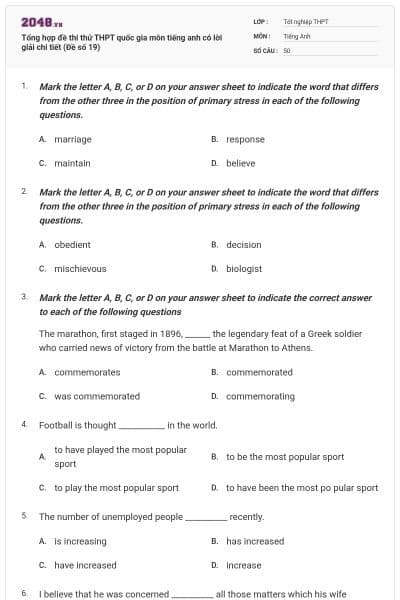
Mark the letter A, B, C, or D on your answer sheet to indicate the word that differs from the other three in the position of primary stress in each of the following questions.
marriage
response
maintain
believe
Đáp án A
Câu A trọng âm 1 còn lại trọng âm 2.
Mark the letter A, B, C, or D on your answer sheet to indicate the word that differs from the other three in the position of primary stress in each of the following questions.
obedient
decision
mischievous
biologist
Đáp án C
Câu C trọng âm 1 còn lại trọng âm 2.
Mark the letter A, B, C, or D on your answer sheet to indicate the correct answer to each of the following questions
The marathon, first staged in 1896, ______ the legendary feat of a Greek soldier who carried news of victory from the battle at Marathon to Athens.
commemorates
commemorated
was commemorated
commemorating
Đáp án A
Dùng thì hiện tại đơn vì để nói về sự kiện thể thao xảy ra hằng năm.
Câu này dịch như sau: Cuộc thi chạy marathon, lần đầu tiên diễn ra vào năm 1896, tưởng niệm chiến thắng huyền thoại của một binh sĩ Hi Lạp người đã đưa tin chiến thắng từ trận chiến tại Marathon đến Athens.
Football is thought ___________ in the world.
to have played the most popular sport
to be the most popular sport
to play the most popular sport
to have been the most po pular sport
Đáp án B
Bóng đá được xem là môn thể thao phổ biến nhất thế giới.
Hiện tại bóng đá vẫn là môn thể thao phổ biến nên 2 mệnh đề dùng hiện đơn → sau cấu trúc bị động là “ to Vo”
The number of unemployed people __________ recently.
is increasing
has increased
have increased
increase
Đáp án B
Trong câu có recently nên dùng hiện tại hoàn thành, chủ ngữ the number of số ít → dùng has Ved/ V3
I believe that he was concerned __________ all those matters which his wife mentioned.
upon
over
above
with
Đáp án D
Concern with: có liên quan đến
I ________ very well with my roommate now. We never have arguments.
carry on
go on
put on
get on
Đáp án D
Get on well with: hòa đồng tốt với
Can you tell me who is responsible _____________ checking passports are?
to
in
for
about
Đáp án C
Be responsible for: chịu trách nhiệm về ( việc gì)
When my father was young, he ______ get up early to do the gardening.
used to
was used to
got used to
use to
Đáp án A
Used to Vo: đã từng dùng để diển tả thói quen đã từng có trong quá khứ hiện tại không còn nữa.
The preparation_________ by the time the guest_________
have finished- arrived
had been finished- arrived
had finished-were arriving
have been finished- were arrived
Đáp án B
Sự chuẩn bị đã được hoàn thành trước khi khách đến.
Cấu trúc: S+ quá khứ hoàn thành by the time S+ quá khứ
Mệnh đề trước mang nghĩa bị động nên chọn đáp án B.
If she had known how awful this job was going to be, she__________it.
wouldn't have accepted
would have accepted
would accept
wouldn't accept
Đáp án A
Câu điều kiện loại 3: If S+ quá khứ hoàn thành, S+ quá khứ đơn
Câu này dịch nghĩa như sau: Nếu cô ấy biết công việc này tệ như thế, cô ấy sẽ không nhận nó.
Jack asked his sister ______.
where would she go the following day
where you will go tomorrow
where you have gone tomorrow
where she would go the following day
Đáp án D
Tường thuật câu hỏi thì tương lai đơn ,đổi ngôi lùi thì nhưng không đảo ngữ
The mother told her son _______ so impolitely
didn't behave
to behave
not behave
not to behave
Đáp án D
Cấu trúc: S+ ask + O+ (not) to Vo
Eugenie Clark has a wide _______ about cultures of many countries in the world
known
knowing
knowledge
know
Đáp án: C
Giải thích:
Vị trí chỗ trống là một danh từ vì theo sau tính từ “wide”.
- knowledge (n): sự hiểu biết, kiến thức
- know (v): biết
Dịch: Eugenie Clark có kiến thức sâu rộng về văn hóa của nhiều nước trên thế giới.
Mark the letter A, B, C, or D on your answer sheet to indicate the word or phrase CLOSEST in meaning to the underlined part in the following questions
Whenever problems come up, we discuss them frankly and find solutions quickly.
arrive
encounter
happen
clean
Đáp án C
Come up = happen: xảy ra
Mark the letter A, B, C, or D on your answer sheet to indicate the word or phrase CLOSEST in meaning to the underlined part in the following questions
It was obvious to everyone that the child had been badly treated
significant
unclear
evident
frank
Đáp án C
Obvious = evident: hiển nhiên, rõ ràng
Mark the letter A, B, C, or D on your answer sheet to indicate the most suitable response to complete each of the following exchanges.
- Anne: “Make yourself at home”.
- John: “ _______”
That’s very kind of you. Thank you
Thanks! The same to you!
Not at all. Don’t mention it
Yes, can I help you?
Đáp án A
Anne: Cứ tự nhiên như ở nhà nhé.
John: Bạn thật tốt! Cảm ơn nhé.
Mark the letter A, B, C, or D on your answer sheet to indicate the most suitable response to complete each of the following exchanges.
Kate: “Thank you for the lovely present. ” – Peter: “ ____________ ”
I’m pleased you like it
Not at al
Go ahead
come on
Đáp án A
Kate: Cảm ơn món quà dễ thương nhé!
Peter: Tôi rất vui vì bạn thích nó.
Mark the letter A, B, C, or D on your answer sheet to indicate the word whose underlined part differs from the other three in pronunciation in each of the following questions.
carpet
school
facial
contact
Đáp án C
Câu C phát âm là /ʃ/ còn lại phát âm là /k/
Mark the letter A, B, C, or D on your answer sheet to indicate the word whose underlined part differs from the other three in pronunciation in each of the following questions.
takes
develops
volumes
laughs
Đáp án C
Câu C phát âm là /z/ còn lại là /s/
Mark the letter A, B, C, or D on your answer sheet to indicate the underlined part that needs correction in each of the following questions.
The basic elements of public-opinion research are interviewers, questionnaires, tabulating equipment, and to sample population.
basic elements
are
tabulating
and to sample
Đáp án D
To sample → sampling vì hai động từ nối với nhau bằng liên từ and phải cùng dạng để đảm bảo sự hài hòa
Mark the letter A, B, C, or D on your answer sheet to indicate the underlined part that needs correction in each of the following questions.
She asked why did Mathew look so embarrassed when he saw Carole.
why
did Mathew look
so embarrassed
saw
Đáp án B
Did Mathew look → Mathew looked vì tường thuật câu hỏi không đảo ngữ
Mark the letter A, B, C, or D on your answer sheet to indicate the underlined part that needs correction in each of the following questions.
Higher education is very importance to national economies and it is also a source of trained and educated personnel for the whole country
importance
economies
educated
the whole country
Đáp án A
Importance → important vì sau động từ “be” dùng tính từ
Read the following passage and mark the letter A, B, C or D on your answer to indicate the correct word or phrase that best fits each of the numbered blanks.
Keeping your distance
Personal space is a term that refers (24) __________ the distance we like to keep between ourselves and other people. When (25) __________ we do not know well gets too close we usually begin to feel uncomfortable. If a business colleague comes closer than 1.2 meters, the most common response is to move (26) _________. Some interesting (27) __________have been done in libraries. If strangers come too close, many people get up and leave the building; others use different methods such as turning their back on the intruder. Living in cities has made people develop new skills for dealing with situations where they are very close to strangers. Most people on crowded trains try not to look at strangers; they avoid skin contact, and apologize if hands touch by mistake. People use newspapers (28) __________a barrier between themselves and other people, and if they do not have one, they stare into the distance, making sure they are not looking into anyone’s eyes.
Điền ô số 24
from
about
to
for
Đáp án C
Refer to: ám chỉ/ ngụ ý( cái gì)
Read the following passage and mark the letter A, B, C or D on your answer to indicate the correct word or phrase that best fits each of the numbered blanks.
Keeping your distance
Personal space is a term that refers (24) __________ the distance we like to keep between ourselves and other people. When (25) __________ we do not know well gets too close we usually begin to feel uncomfortable. If a business colleague comes closer than 1.2 meters, the most common response is to move (26) _________. Some interesting (27) __________have been done in libraries. If strangers come too close, many people get up and leave the building; others use different methods such as turning their back on the intruder. Living in cities has made people develop new skills for dealing with situations where they are very close to strangers. Most people on crowded trains try not to look at strangers; they avoid skin contact, and apologize if hands touch by mistake. People use newspapers (28) __________a barrier between themselves and other people, and if they do not have one, they stare into the distance, making sure they are not looking into anyone’s eyes.
Điền ô số 25
people
anyone
someone
nobody
Đáp án C
When (25) …………. we do not know well gets too close we usually begin to feel uncomfortable.
Khi ai đó mà chúng ta không quen biết đến quá gần chúng thường bắt đầu cảm thấy không thoải mái.
Động từ chính” gets” chứng tỏ chủ ngữ số ít → loại people
Theo ngữ nghĩa “ ai đó” → loại nobody( không ai cả)
Anyone ( bất cứ ai) dùng trong câu phủ định hoặc nghi vấn → loại.
Read the following passage and mark the letter A, B, C or D on your answer to indicate the correct word or phrase that best fits each of the numbered blanks.
Keeping your distance
Personal space is a term that refers (24) __________ the distance we like to keep between ourselves and other people. When (25) __________ we do not know well gets too close we usually begin to feel uncomfortable. If a business colleague comes closer than 1.2 meters, the most common response is to move (26) _________. Some interesting (27) __________have been done in libraries. If strangers come too close, many people get up and leave the building; others use different methods such as turning their back on the intruder. Living in cities has made people develop new skills for dealing with situations where they are very close to strangers. Most people on crowded trains try not to look at strangers; they avoid skin contact, and apologize if hands touch by mistake. People use newspapers (28) __________a barrier between themselves and other people, and if they do not have one, they stare into the distance, making sure they are not looking into anyone’s eyes.
Điền ô số 26
up
away
on
in
Đáp án B
Move away: bước đi chỗ khác
If a business colleague comes closer than 1.2 meters, the most common response is to move (26) ……… . → Nếu một đồng nghiệp có quan hệ làm ăn thông thường đến gần hơn 1,2 mét, phản ứng thông thường nhất là bỏ đi.
Read the following passage and mark the letter A, B, C or D on your answer to indicate the correct word or phrase that best fits each of the numbered blanks.
Keeping your distance
Personal space is a term that refers (24) __________ the distance we like to keep between ourselves and other people. When (25) __________ we do not know well gets too close we usually begin to feel uncomfortable. If a business colleague comes closer than 1.2 meters, the most common response is to move (26) _________. Some interesting (27) __________have been done in libraries. If strangers come too close, many people get up and leave the building; others use different methods such as turning their back on the intruder. Living in cities has made people develop new skills for dealing with situations where they are very close to strangers. Most people on crowded trains try not to look at strangers; they avoid skin contact, and apologize if hands touch by mistake. People use newspapers (28) __________a barrier between themselves and other people, and if they do not have one, they stare into the distance, making sure they are not looking into anyone’s eyes.
Điền ô số 27
survey
questionnaires
research
studies
Đáp án D
Studies: nghiên cứu
Some interesting (27) ……….. have been done in libraries. → Một số nghiên cứu thú vị cũng đã được thực hiện trong thư viện.
Read the following passage and mark the letter A, B, C or D on your answer to indicate the correct word or phrase that best fits each of the numbered blanks.
Keeping your distance
Personal space is a term that refers (24) __________ the distance we like to keep between ourselves and other people. When (25) __________ we do not know well gets too close we usually begin to feel uncomfortable. If a business colleague comes closer than 1.2 meters, the most common response is to move (26) _________. Some interesting (27) __________have been done in libraries. If strangers come too close, many people get up and leave the building; others use different methods such as turning their back on the intruder. Living in cities has made people develop new skills for dealing with situations where they are very close to strangers. Most people on crowded trains try not to look at strangers; they avoid skin contact, and apologize if hands touch by mistake. People use newspapers (28) __________a barrier between themselves and other people, and if they do not have one, they stare into the distance, making sure they are not looking into anyone’s eyes.
Điền ô số 28
like
alike
as
such as
Đáp án C
As: như là
People use newspapers (28) …….. a barrier between themselves and other people → Mọi người thường sư dụng báo như 1 rào chắn giữa họ và người khác.
Mark the letter A, B, C, or D on your answer sheet to indicate the word that is OPPOSITE in meaning to the underlined part in the following questions
She decided to remain celibate and devote her life to helping the homeless and orphans.
divorced
separated
single
married
Đáp án D
Celibate: độc thân ≠ married: đã kết hôn
Mark the letter A, B, C, or D on your answer sheet to indicate the word that is OPPOSITE in meaning to the underlined part in the following questions.
In Western culture, it is polite to maintain eye contact during conversation.
irresponsible
discourteous
insecure
informal
Đáp án B
Polite : lịch sự ≠ discourteous: mất lịch sự
Mark the letter A, B, C, or D on your answer sheet to indicate the sentence that best combines each pair of sentences in the following questions.
He was able to finish his book. It was because his wife helped him.
If only he had been able to finish his book.
If it weren’t for his wife’s help, he couldn’t have finished his book.
Without his wife’s help, he couldn’t have finished his book.
But for his wife’s help, he couldn’t finish his book.
Đáp án C
Anh ấy có thể tìm được quyển sách vì vợ anh ấy giúp anh ấy.
→ Câu điều kiện loại 3: Nếu không có sự giúp đỡ của vợ, anh ấy không thể tìm được quyển sách.
Mark the letter A, B, C, or D on your answer sheet to indicate the sentence that best combines each pair of sentences in the following questions.
The basketball team knew they lost the match. They soon started to blame each other.
Hardly had the basketball team known they lost the match when they started to blame each other
Not only did the basketball team lose the match but they blamed each other as well
No sooner had the basketball team started to blame each other than they knew they lost the match
As soon as they blamed each other, the basketball team knew they lost the match
Đáp án A
Đội bóng rổ thua trận đấu. Họ bắt đầu đổ lỗi cho nhau.
→ Cấu trúc Hardly had S+ Ved when S+ quá khứ đơn: Ngay khi đội bóng rổ biết rằng họ thua trận đấu họ bắt đầu đổ lỗi cho nhau.
Mark the letter A, B, C, or D on your answer sheet to indicate the sentence that is closest in meaning to each of the following questions.
They believe a single gunman carried out the attack.
The attack’s is believed to have carried out a single gunman
A single gunman is believed to have carried out the attack
It is believed to be carried out the attack by a single gunman
It is believed that the attack has been carried out by a single gunman
Đáp án B
Họ tin rằng người đàn ông mang theo súng đã tiến hành cuộc tấn công.
→ Câu bị động: Người đàn ông một mình mang theo súng được tin rằng đã gây ra cuộc tấn công.
Mark the letter A, B, C, or D on your answer sheet to indicate the sentence that is closest in meaning to each of the following questions.
"I'm sorry. I didn’t do the homework." said the boy.
The boy admitted not doing the homework.
The boy said that he was sorry and he wouldn’t do the homework
The boy denied not doing the homework
The boy refused to do the homework
Đáp án A
Thằng bé nói: Em xin lỗi. Em đã không làm bài tập về nhà.
→ Cấu trúc: S admit Ving → Thằng bé thừa nhận đã không làm bài tập về nhà.
Mark the letter A, B, C, or D on your answer sheet to indicate the sentence that is closest in meaning to each of the following questions.
You can stay in the flat for free as long as you pay the bills.
Whether you pay the bills or stay in the flat, it is free
Without the bills paid, you can stay in the free flat
Unless the flat is free of bills, you cannot stay in it
Provided you pay the bills, you can stay in the flat for free
Đáp án D
Ông có thể ở trong ngôi nhà này thoải mái nếu ông trả tất cả hóa đơn.
= Nếu ông trả hết những hóa đơn này, ông có thể ở trong ngôi nhà này thoải mái.
Read the following passage and mark the letter A, B, C or D on your answer sheet to indicate the correct answer to each of the questions below.
FAMILY LIFE IN THE UNITED STATES
Family life in the United States is changing. Fifty or sixty years ago, the wife was called a “housewife”. She cleaned, cooked, and cared for the children. The husband earned the money for the family. He was usually out working all day. He came home tired in the evening, so he did not do much housework. And he did not see the children very much, except on weekends.
These days, however, more and more women work outside the home. They cannot stay with the children all day. They, too, come home tired in the evening. They do not want to spend the evening cooking dinner and cleaning up. They do not have time to clean the house and do the laundry. So who is going to do the housework now? Who is going to take care of the children?
Many families solve the problem of housework by sharing it. In these families, the husband and wife agree to do different jobs around the house, or they take turns doing each job. For example, the husband always cooks dinner and the wife always does the laundry. Or the wife cooks dinner on some nights and the husband cooks dinner on other nights.
Then there is the question of the children. In the past, many families got help with child care from grandparents. Now families usually do not live near their relatives. The grandparents are often too far away to help in a regular way. More often, parents have to pay for child care help. The help may be a babysitter or a day-care center. The problem with t his kind of help is the high cost. It is possible only for couples with jobs that pay well.
Parents may get another kind of help form the companies they work for. Many companies now let people with children work part-time. That way, parents can spend mo re time with their children. Some husbands may even stop working for a while to stay with the children. For these men there is a new word: they are called “househusbands”. In the USA more and more men are becoming househusbands every year.
These changes in the home mean changes in the family. Fathers can learn to understand their children better, and the children can get to know their fathers better. Husbands and wives may also find changes in their marriage. They, too, may have a better understanding of each other.
Sixty years ago, most women ____________
went out to work
had no children
did not do much housework
were housewives
Đáp án D
Cách đây 60 năm, hầu hết phụ nữ → là nội trợ
Fifty or sixty years ago, the wife was called a “housewife”
Read the following passage and mark the letter A, B, C or D on your answer sheet to indicate the correct answer to each of the questions below.
FAMILY LIFE IN THE UNITED STATES
Family life in the United States is changing. Fifty or sixty years ago, the wife was called a “housewife”. She cleaned, cooked, and cared for the children. The husband earned the money for the family. He was usually out working all day. He came home tired in the evening, so he did not do much housework. And he did not see the children very much, except on weekends.
These days, however, more and more women work outside the home. They cannot stay with the children all day. They, too, come home tired in the evening. They do not want to spend the evening cooking dinner and cleaning up. They do not have time to clean the house and do the laundry. So who is going to do the housework now? Who is going to take care of the children?
Many families solve the problem of housework by sharing it. In these families, the husband and wife agree to do different jobs around the house, or they take turns doing each job. For example, the husband always cooks dinner and the wife always does the laundry. Or the wife cooks dinner on some nights and the husband cooks dinner on other nights.
Then there is the question of the children. In the past, many families got help with child care from grandparents. Now families usually do not live near their relatives. The grandparents are often too far away to help in a regular way. More often, parents have to pay for child care help. The help may be a babysitter or a day-care center. The problem with t his kind of help is the high cost. It is possible only for couples with jobs that pay well.
Parents may get another kind of help form the companies they work for. Many companies now let people with children work part-time. That way, parents can spend mo re time with their children. Some husbands may even stop working for a while to stay with the children. For these men there is a new word: they are called “househusbands”. In the USA more and more men are becoming househusbands every year.
These changes in the home mean changes in the family. Fathers can learn to understand their children better, and the children can get to know their fathers better. Husbands and wives may also find changes in their marriage. They, too, may have a better understanding of each other.
Nowadays, there are __________.
more women going out to work than before
more and more women staying with the children all day
more work outside the home than before
more housewives than before
Đáp án A
Ngày nay, có → nhiều phụ nữ đi làm hơn trước đây.
These days, however, more and more women work outside the home.
Read the following passage and mark the letter A, B, C or D on your answer sheet to indicate the correct answer to each of the questions below.
FAMILY LIFE IN THE UNITED STATES
Family life in the United States is changing. Fifty or sixty years ago, the wife was called a “housewife”. She cleaned, cooked, and cared for the children. The husband earned the money for the family. He was usually out working all day. He came home tired in the evening, so he did not do much housework. And he did not see the children very much, except on weekends.
These days, however, more and more women work outside the home. They cannot stay with the children all day. They, too, come home tired in the evening. They do not want to spend the evening cooking dinner and cleaning up. They do not have time to clean the house and do the laundry. So who is going to do the housework now? Who is going to take care of the children?
Many families solve the problem of housework by sharing it. In these families, the husband and wife agree to do different jobs around the house, or they take turns doing each job. For example, the husband always cooks dinner and the wife always does the laundry. Or the wife cooks dinner on some nights and the husband cooks dinner on other nights.
Then there is the question of the children. In the past, many families got help with child care from grandparents. Now families usually do not live near their relatives. The grandparents are often too far away to help in a regular way. More often, parents have to pay for child care help. The help may be a babysitter or a day-care center. The problem with t his kind of help is the high cost. It is possible only for couples with jobs that pay well.
Parents may get another kind of help form the companies they work for. Many companies now let people with children work part-time. That way, parents can spend mo re time with their children. Some husbands may even stop working for a while to stay with the children. For these men there is a new word: they are called “househusbands”. In the USA more and more men are becoming househusbands every year.
These changes in the home mean changes in the family. Fathers can learn to understand their children better, and the children can get to know their fathers better. Husbands and wives may also find changes in their marriage. They, too, may have a better understanding of each other.
The word “laundry” in paragraph 2 is closest in meaning to ___________
tidying up
cooking and washing up
washing and ironing
shopping
Đáp án C
Laundry = washing and ironing: công việc giặt ủi
Read the following passage and mark the letter A, B, C or D on your answer sheet to indicate the correct answer to each of the questions below.
FAMILY LIFE IN THE UNITED STATES
Family life in the United States is changing. Fifty or sixty years ago, the wife was called a “housewife”. She cleaned, cooked, and cared for the children. The husband earned the money for the family. He was usually out working all day. He came home tired in the evening, so he did not do much housework. And he did not see the children very much, except on weekends.
These days, however, more and more women work outside the home. They cannot stay with the children all day. They, too, come home tired in the evening. They do not want to spend the evening cooking dinner and cleaning up. They do not have time to clean the house and do the laundry. So who is going to do the housework now? Who is going to take care of the children?
Many families solve the problem of housework by sharing it. In these families, the husband and wife agree to do different jobs around the house, or they take turns doing each job. For example, the husband always cooks dinner and the wife always does the laundry. Or the wife cooks dinner on some nights and the husband cooks dinner on other nights.
Then there is the question of the children. In the past, many families got help with child care from grandparents. Now families usually do not live near their relatives. The grandparents are often too far away to help in a regular way. More often, parents have to pay for child care help. The help may be a babysitter or a day-care center. The problem with t his kind of help is the high cost. It is possible only for couples with jobs that pay well.
Parents may get another kind of help form the companies they work for. Many companies now let people with children work part-time. That way, parents can spend mo re time with their children. Some husbands may even stop working for a while to stay with the children. For these men there is a new word: they are called “househusbands”. In the USA more and more men are becoming househusbands every year.
These changes in the home mean changes in the family. Fathers can learn to understand their children better, and the children can get to know their fathers better. Husbands and wives may also find changes in their marriage. They, too, may have a better understanding of each other.
It can be inferred from paragraph 4 that__________.
couples with low-paid jobs can’t afford the cost of a babysitter or a day-care center
grandparents can help care the children in a regular way
all couples with jobs can pay for help from a babysitter or a day-care center
in the past, grandparents did not help the couples with child care
Đáp án A
Có thể suy ra từ đoạn 4 rằng → các cặp vợ chồng có thu nhập thấp không thể có đủ tiền thuê người giữ trẻ hoặc gởi con đến nhà trẻ.
The problem with this kind of help is the high cost. It is possible only for couples with jobs that pay well.
Read the following passage and mark the letter A, B, C or D on your answer sheet to indicate the correct answer to each of the questions below.
FAMILY LIFE IN THE UNITED STATES
Family life in the United States is changing. Fifty or sixty years ago, the wife was called a “housewife”. She cleaned, cooked, and cared for the children. The husband earned the money for the family. He was usually out working all day. He came home tired in the evening, so he did not do much housework. And he did not see the children very much, except on weekends.
These days, however, more and more women work outside the home. They cannot stay with the children all day. They, too, come home tired in the evening. They do not want to spend the evening cooking dinner and cleaning up. They do not have time to clean the house and do the laundry. So who is going to do the housework now? Who is going to take care of the children?
Many families solve the problem of housework by sharing it. In these families, the husband and wife agree to do different jobs around the house, or they take turns doing each job. For example, the husband always cooks dinner and the wife always does the laundry. Or the wife cooks dinner on some nights and the husband cooks dinner on other nights.
Then there is the question of the children. In the past, many families got help with child care from grandparents. Now families usually do not live near their relatives. The grandparents are often too far away to help in a regular way. More often, parents have to pay for child care help. The help may be a babysitter or a day-care center. The problem with t his kind of help is the high cost. It is possible only for couples with jobs that pay well.
Parents may get another kind of help form the companies they work for. Many companies now let people with children work part-time. That way, parents can spend mo re time with their children. Some husbands may even stop working for a while to stay with the children. For these men there is a new word: they are called “househusbands”. In the USA more and more men are becoming househusbands every year.
These changes in the home mean changes in the family. Fathers can learn to understand their children better, and the children can get to know their fathers better. Husbands and wives may also find changes in their marriage. They, too, may have a better understanding of each other.
The word “they” in paragraph 5 refers to _______________
husbands who stop working to stay with the children
fathers who spend more time with their children
parents who work part-time
children who spend more time with fathers than mothers
Đáp án A
They = husbands who stop working to stay with the children: những người chồng nghỉ làm để ở nhà với con.
Read the following passage and mark the letter A, B, C or D on your answer sheet to indicate the correct answer to each of the questions below.
FAMILY LIFE IN THE UNITED STATES
Family life in the United States is changing. Fifty or sixty years ago, the wife was called a “housewife”. She cleaned, cooked, and cared for the children. The husband earned the money for the family. He was usually out working all day. He came home tired in the evening, so he did not do much housework. And he did not see the children very much, except on weekends.
These days, however, more and more women work outside the home. They cannot stay with the children all day. They, too, come home tired in the evening. They do not want to spend the evening cooking dinner and cleaning up. They do not have time to clean the house and do the laundry. So who is going to do the housework now? Who is going to take care of the children?
Many families solve the problem of housework by sharing it. In these families, the husband and wife agree to do different jobs around the house, or they take turns doing each job. For example, the husband always cooks dinner and the wife always does the laundry. Or the wife cooks dinner on some nights and the husband cooks dinner on other nights.
Then there is the question of the children. In the past, many families got help with child care from grandparents. Now families usually do not live near their relatives. The grandparents are often too far away to help in a regular way. More often, parents have to pay for child care help. The help may be a babysitter or a day-care center. The problem with t his kind of help is the high cost. It is possible only for couples with jobs that pay well.
Parents may get another kind of help form the companies they work for. Many companies now let people with children work part-time. That way, parents can spend mo re time with their children. Some husbands may even stop working for a while to stay with the children. For these men there is a new word: they are called “househusbands”. In the USA more and more men are becoming househusbands every year.
These changes in the home mean changes in the family. Fathers can learn to understand their children better, and the children can get to know their fathers better. Husbands and wives may also find changes in their marriage. They, too, may have a better understanding of each other.
The changes in the American home mentioned in this passage may _________
help families
not happen
cause problems for a marriage
not change the children at all
Đáp án A
Những thay đổi trong gia đình Mỹ được đề cập trong bài đọc có thể → giúp đỡ các gia đình.
Read the following passage and mark the letter A, B, C or D on your answer sheet to indicate the correct answer to each of the questions below.
FAMILY LIFE IN THE UNITED STATES
Family life in the United States is changing. Fifty or sixty years ago, the wife was called a “housewife”. She cleaned, cooked, and cared for the children. The husband earned the money for the family. He was usually out working all day. He came home tired in the evening, so he did not do much housework. And he did not see the children very much, except on weekends.
These days, however, more and more women work outside the home. They cannot stay with the children all day. They, too, come home tired in the evening. They do not want to spend the evening cooking dinner and cleaning up. They do not have time to clean the house and do the laundry. So who is going to do the housework now? Who is going to take care of the children?
Many families solve the problem of housework by sharing it. In these families, the husband and wife agree to do different jobs around the house, or they take turns doing each job. For example, the husband always cooks dinner and the wife always does the laundry. Or the wife cooks dinner on some nights and the husband cooks dinner on other nights.
Then there is the question of the children. In the past, many families got help with child care from grandparents. Now families usually do not live near their relatives. The grandparents are often too far away to help in a regular way. More often, parents have to pay for child care help. The help may be a babysitter or a day-care center. The problem with t his kind of help is the high cost. It is possible only for couples with jobs that pay well.
Parents may get another kind of help form the companies they work for. Many companies now let people with children work part-time. That way, parents can spend mo re time with their children. Some husbands may even stop working for a while to stay with the children. For these men there is a new word: they are called “househusbands”. In the USA more and more men are becoming househusbands every year.
These changes in the home mean changes in the family. Fathers can learn to understand their children better, and the children can get to know their fathers better. Husbands and wives may also find changes in their marriage. They, too, may have a better understanding of each other.
This article is about ________
American men as househusbands
housewives in America
how more American women are working
how family life in America is changing
Đáp án D
Bài đọc này nói về → Đời sống gia đình ở Mỹ thay đổi như thế nào.
Read the following passage and mark the letter A, B, C or D on your answer sheet to indicate the correct answer to each of the questions below.
Because writing has become so important in our culture, we sometimes think of it as more real than speech. A little thought, however, will show w hy speech is primary and writing secondary to language. Human beings have been writing (as far as we can tell from surviving evidence) for at least 5000 years; but they have been talking for much longer, doubtless ever since there have been human beings.
When writing did develop, it was derived from and represented speech, although imperfectly. Even today there are spoken languages that have no written form. Furthermore, we all learn to talk well before we learn to write; any human child who is not severely handicapped physically or mentally will learn to talk: a normal human being cannot be prevented from doing so. On the other hand, it takes a special effort to learn to write. In the past many intelligent and useful members of society did not acquire the skill, and even today many who speak languages with writing systems never learn to read or write, while some who learn the rudiments of those skills do so only imperfectly.
To affirm the primacy of speech over writing is not, however, to disparage the latter. One advantage writing has over speech is that it is more permanent and makes possible the records that any civilization must have. Thus, if speaking makes us human, writing makes us civilized.
We sometimes think of writing as more real than speech because ______.
writing is secondary to language
human beings have been writing for at least 5000 years
it has become very important in our culture
people have been writing since there have been human beings
Đáp án C
Chúng ta thường nghĩ viết thật hơn nói bởi vì → nó rất quan trọng trong nền văn hóa của chúng ta.
Because writing has become so important in our culture, we sometimes think of it as more real than speech.
Read the following passage and mark the letter A, B, C or D on your answer sheet to indicate the correct answer to each of the questions below.
Because writing has become so important in our culture, we sometimes think of it as more real than speech. A little thought, however, will show w hy speech is primary and writing secondary to language. Human beings have been writing (as far as we can tell from surviving evidence) for at least 5000 years; but they have been talking for much longer, doubtless ever since there have been human beings.
When writing did develop, it was derived from and represented speech, although imperfectly. Even today there are spoken languages that have no written form. Furthermore, we all learn to talk well before we learn to write; any human child who is not severely handicapped physically or mentally will learn to talk: a normal human being cannot be prevented from doing so. On the other hand, it takes a special effort to learn to write. In the past many intelligent and useful members of society did not acquire the skill, and even today many who speak languages with writing systems never learn to read or write, while some who learn the rudiments of those skills do so only imperfectly.
To affirm the primacy of speech over writing is not, however, to disparage the latter. One advantage writing has over speech is that it is more permanent and makes possible the records that any civilization must have. Thus, if speaking makes us human, writing makes us civilized.
The author of the passage argues that ______.
speech is more basic to language than writing
writing has become too important in today’s society
everyone who learns to speak must learn to write
all languages should have a written form
Đáp án A
Tác giả trong bài đọc tranh luận rằng → Nói là ngôn ngữ cơ bản hơn viết
Furthermore, we all learn to talk well before we learn to write; any human child who is not severely handicapped physically or mentally will learn to talk: a normal human being cannot be prevented from doing so.
Read the following passage and mark the letter A, B, C or D on your answer sheet to indicate the correct answer to each of the questions below.
Because writing has become so important in our culture, we sometimes think of it as more real than speech. A little thought, however, will show w hy speech is primary and writing secondary to language. Human beings have been writing (as far as we can tell from surviving evidence) for at least 5000 years; but they have been talking for much longer, doubtless ever since there have been human beings.
When writing did develop, it was derived from and represented speech, although imperfectly. Even today there are spoken languages that have no written form. Furthermore, we all learn to talk well before we learn to write; any human child who is not severely handicapped physically or mentally will learn to talk: a normal human being cannot be prevented from doing so. On the other hand, it takes a special effort to learn to write. In the past many intelligent and useful members of society did not acquire the skill, and even today many who speak languages with writing systems never learn to read or write, while some who learn the rudiments of those skills do so only imperfectly.
To affirm the primacy of speech over writing is not, however, to disparage the latter. One advantage writing has over speech is that it is more permanent and makes possible the records that any civilization must have. Thus, if speaking makes us human, writing makes us civilized.
According to the passage, writing ______.
is represented perfectly by speech
represents speech, but not perfectly
developed from imperfect speech
is imperfect, but less so than speech
Đáp án B
Theo bài đọc, kỹ năng viết thì → thể hiện lời nói nhưng không hoàn hảo. Even today many who speak languages wit h writing systems never learn to read or write, while some who learn the rudiments of those skills do so only imperfectly
Read the following passage and mark the letter A, B, C or D on your answer sheet to indicate the correct answer to each of the questions below.
Because writing has become so important in our culture, we sometimes think of it as more real than speech. A little thought, however, will show w hy speech is primary and writing secondary to language. Human beings have been writing (as far as we can tell from surviving evidence) for at least 5000 years; but they have been talking for much longer, doubtless ever since there have been human beings.
When writing did develop, it was derived from and represented speech, although imperfectly. Even today there are spoken languages that have no written form. Furthermore, we all learn to talk well before we learn to write; any human child who is not severely handicapped physically or mentally will learn to talk: a normal human being cannot be prevented from doing so. On the other hand, it takes a special effort to learn to write. In the past many intelligent and useful members of society did not acquire the skill, and even today many who speak languages with writing systems never learn to read or write, while some who learn the rudiments of those skills do so only imperfectly.
To affirm the primacy of speech over writing is not, however, to disparage the latter. One advantage writing has over speech is that it is more permanent and makes possible the records that any civilization must have. Thus, if speaking makes us human, writing makes us civilized.
Normal human beings ______.
learn to talk after learning to write
learn t o write before learning to talk
learn to write and to talk at the same time
learn to talk before learning to write
Đáp án D
Người bình thường → Học nói trước khi học viết
we all learn to talk well before we learn to write
Read the following passage and mark the letter A, B, C or D on your answer sheet to indicate the correct answer to each of the questions below.
Because writing has become so important in our culture, we sometimes think of it as more real than speech. A little thought, however, will show w hy speech is primary and writing secondary to language. Human beings have been writing (as far as we can tell from surviving evidence) for at least 5000 years; but they have been talking for much longer, doubtless ever since there have been human beings.
When writing did develop, it was derived from and represented speech, although imperfectly. Even today there are spoken languages that have no written form. Furthermore, we all learn to talk well before we learn to write; any human child who is not severely handicapped physically or mentally will learn to talk: a normal human being cannot be prevented from doing so. On the other hand, it takes a special effort to learn to write. In the past many intelligent and useful members of society did not acquire the skill, and even today many who speak languages with writing systems never learn to read or write, while some who learn the rudiments of those skills do so only imperfectly.
To affirm the primacy of speech over writing is not, however, to disparage the latter. One advantage writing has over speech is that it is more permanent and makes possible the records that any civilization must have. Thus, if speaking makes us human, writing makes us civilized.
Learning to write is ______.
easy
too difficult
not easy
very easy
Đáp án C
Học viết thì → không dễ
On the other hand, it takes a special effort to learn to write.
Read the following passage and mark the letter A, B, C or D on your answer sheet to indicate the correct answer to each of the questions below.
Because writing has become so important in our culture, we sometimes think of it as more real than speech. A little thought, however, will show w hy speech is primary and writing secondary to language. Human beings have been writing (as far as we can tell from surviving evidence) for at least 5000 years; but they have been talking for much longer, doubtless ever since there have been human beings.
When writing did develop, it was derived from and represented speech, although imperfectly. Even today there are spoken languages that have no written form. Furthermore, we all learn to talk well before we learn to write; any human child who is not severely handicapped physically or mentally will learn to talk: a normal human being cannot be prevented from doing so. On the other hand, it takes a special effort to learn to write. In the past many intelligent and useful members of society did not acquire the skill, and even today many who speak languages with writing systems never learn to read or write, while some who learn the rudiments of those skills do so only imperfectly.
To affirm the primacy of speech over writing is not, however, to disparage the latter. One advantage writing has over speech is that it is more permanent and makes possible the records that any civilization must have. Thus, if speaking makes us human, writing makes us civilized.
In order to show that learning to write requires effort, the author gives the example of _________.
people who learn the rudiments of speech
severely handicapped children
intelligent people who couldn’t write
people who speak many languages
Đáp án C
Để thể hiên rằng học viết cần phải nỗ lực, tác giả đưa ra ví dụ về → những người thông minh không thể viết
In the past many intelligent and useful members of society did not acquire the skill.
Read the following passage and mark the letter A, B, C or D on your answer sheet to indicate the correct answer to each of the questions below.
Because writing has become so important in our culture, we sometimes think of it as more real than speech. A little thought, however, will show w hy speech is primary and writing secondary to language. Human beings have been writing (as far as we can tell from surviving evidence) for at least 5000 years; but they have been talking for much longer, doubtless ever since there have been human beings.
When writing did develop, it was derived from and represented speech, although imperfectly. Even today there are spoken languages that have no written form. Furthermore, we all learn to talk well before we learn to write; any human child who is not severely handicapped physically or mentally will learn to talk: a normal human being cannot be prevented from doing so. On the other hand, it takes a special effort to learn to write. In the past many intelligent and useful members of society did not acquire the skill, and even today many who speak languages with writing systems never learn to read or write, while some who learn the rudiments of those skills do so only imperfectly.
To affirm the primacy of speech over writing is not, however, to disparage the latter. One advantage writing has over speech is that it is more permanent and makes possible the records that any civilization must have. Thus, if speaking makes us human, writing makes us civilized.
In the author’s judgment, ______.
writing has more advantages than speech
writing is more real than speech
speech conveys ideas less accurately than writing does
speech is essential but writing has important benefits
Đáp án D
Kết luận của tác giả → Nói rất cần thiết nhưng kỹ năng viết cũng có những lợi ích quan trọng.
Read the following passage and mark the letter A, B, C or D on your answer sheet to indicate the correct answer to each of the questions below.
Because writing has become so important in our culture, we sometimes think of it as more real than speech. A little thought, however, will show w hy speech is primary and writing secondary to language. Human beings have been writing (as far as we can tell from surviving evidence) for at least 5000 years; but they have been talking for much longer, doubtless ever since there have been human beings.
When writing did develop, it was derived from and represented speech, although imperfectly. Even today there are spoken languages that have no written form. Furthermore, we all learn to talk well before we learn to write; any human child who is not severely handicapped physically or mentally will learn to talk: a normal human being cannot be prevented from doing so. On the other hand, it takes a special effort to learn to write. In the past many intelligent and useful members of society did not acquire the skill, and even today many who speak languages with writing systems never learn to read or write, while some who learn the rudiments of those skills do so only imperfectly.
To affirm the primacy of speech over writing is not, however, to disparage the latter. One advantage writing has over speech is that it is more permanent and makes possible the records that any civilization must have. Thus, if speaking makes us human, writing makes us civilized.
The word “advantage” in the last paragraph most closely means ______.
“rudiments”
“skill”
“domination”
“benefit”
Đáp án D
Advantage = benefit: lợi ích, thuận lợi.