Tổng hợp đề thi thử THPT quốc gia môn tiếng anh có lời giải chi tiết (Đề số 13)
50 câu hỏi
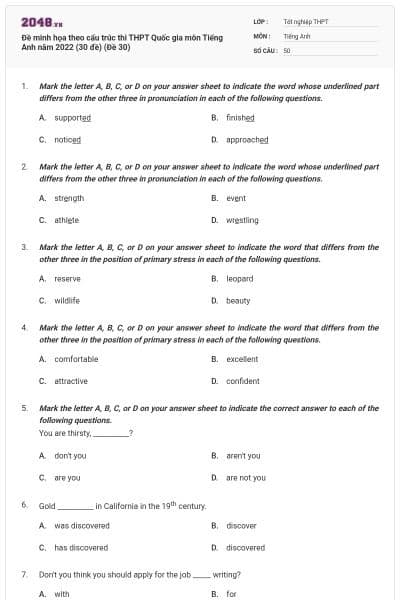
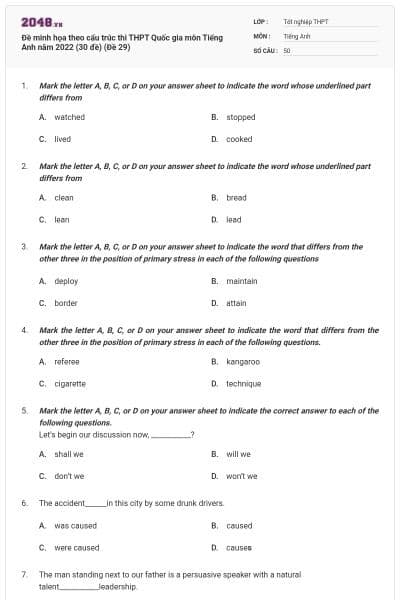
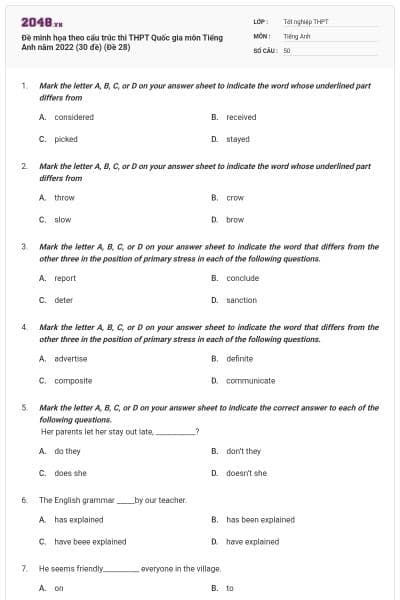
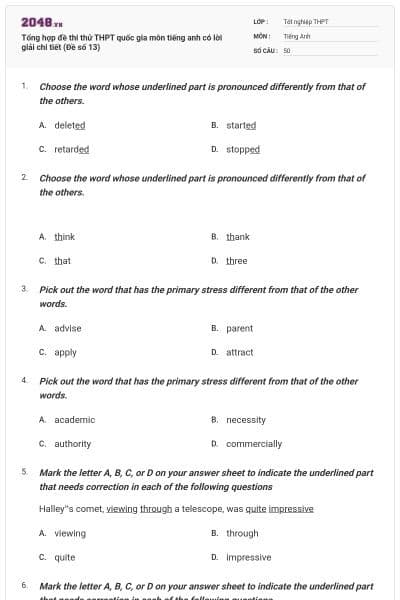
Choose the word whose underlined part is pronounced differently from that of the others.
deleted
started
retarded
stopped
Đáp án D
Kiến thức: Phát âm “-ed”
Giải thích:
Có 3 cách phát âm ed trong tiếng anh
Đuôi /ed/ được phát âm là /id/ khi động từ có phát âm kết thúc là /t/ hay /d/
Đuôi /ed/ được phát âm là /t/ khi động từ có phát âm kết thúc là /s/,/f/,/p/,/ʃ/,/tʃ/,/k/
Đuôi /ed/ được phát âm là /d/ với các trường hợp còn lại.
Phần gạch chân câu D được phát âm là /t/ còn lại là /id/
Choose the word whose underlined part is pronounced differently from that of the others.
think
thank
that
three
Đáp án C
Kiến thức: Phát âm “-th”
Giải thích:
think /θiŋk/ thank /θæŋk/
that /ðæt/ three /θri:/
Phần gạch chân câu C được phát âm là /ð/ còn lại là /θ/
Pick out the word that has the primary stress different from that of the other words.
advise
parent
apply
attract
Đáp án B
Kiến thức: Trọng âm của từ có 2 âm tiết
Giải thích:
advise /əd'vaiz/ parent /'peərənt/
apply /ə'plai/ attract /ə'trækt/
Câu B trọng âm rơi vào âm tiết thứ nhất, còn lại là thứ 2
Pick out the word that has the primary stress different from that of the other words.
academic
necessity
authority
commercially
Đáp án A
Kiến thức: Trọng âm của từ có từ 3 âm tiết trở lên
Giải thích:
academic /,ækə'demik/
authority /ɔ:'θɒrəti/
necessity /ni'sesəti/
commercially /kə'mɜ:∫əli/
Câu A trọng âm rơi vào âm tiết thứ 3, còn lại là thứ 2
Mark the letter A, B, C, or D on your answer sheet to indicate the underlined part that needs correction in each of the following questions
Halley‟s comet, viewing through a telescope, was quite impressive
viewing
through
quite
impressive
Đáp án A
Kiến thức: Mệnh đề quan hệ, sửa lỗi sai
Giải thích:
viewing => viewed/which was viewed
Ở đây ta phải dùng mệnh đề quan hệ để thay thế cho “comet” ở phía trước. Trong câu này vì trước đó có dấu phảy nên ta bắt buộc dùng “which” chứ không dùng “that” (ngoài ra ta có thể dùng mệnh đề quan hệ rút gọn bằng cách dùng dạng quá khứ phân từ “viewed”)
Tạm dịch: Sao chổi Halley, được nhìn xuyên qua kính thiên văn, khá ấn tượng.
Mark the letter A, B, C, or D on your answer sheet to indicate the underlined part that needs correction in each of the following questions
There are a car and two vans in front of my house.
are
a car
two vans
in front of
Đáp án A
Kiến thức: Cách dùng đặc biệt của “There is” và “There are”
Giải thích:
are => is
Nếu danh từ trong chuỗi liệt kê bắt đầu là danh từ số ít hoặc danh từ không đếm được, chúng ta dùng “There is”. Nếu danh từ trong chuỗi liệt kê bắt đầu là danh từ số nhiều, chúng ta dùng “There are”.
Trong câu này, danh từ bắt đầu là “a car” (số ít) nên ta phải dùng There is
Tạm dịch: Có một chiếc xe hơi và hai chiếc xe tải trước nhà tôi.
Mark the letter A, B, C, or D on your answer sheet to indicate the underlined part that needs correction in each of the following questions.
All her children have graduated from university, that is the reason for her to be proud
All her
from
that
for her
Đáp án C
Kiến thức: Mệnh đề quan hệ
Giải thích:
that => which
Mệnh đề quan hệ “that” không đứng đằng sau dấu phảy, vì thế dùng “that” là sai. Ta dùng mệnh đề quan hệ
“which” để thay thế cho cả 1 vế câu ở phía trước.
Tạm dịch: Tất cả các con của cô đã tốt nghiệp đại học, đó là lý do để cô tự hào.
Choose the most suitable words or phrases to fill in the blanks.
The more you practise your English, _______.
Faster you learn
the faster will you learn.
You will learn faster
the faster you will learn
Đáp án D
Kiến thức: Cấu trúc so sánh hơn càng…càng…
Giải thích:
Cấu trúc so sánh hơn càng…càng…: The + dạng so sánh hơn của tính/trạng từ + mệnh đề, the + dạng so sánh hơn của tính/trạng từ + mệnh đề. Đáp án C không đúng vì đã đảo “will” lên trước chủ ngữ.
Tạm dịch: Bạn càng luyện tập tiếng Anh, bạn sẽ càng học nhanh hơn.
Mrs. Brown was the first owner _______ dog won 3 prizes in the same show.
whose
her
who
whom
Đáp án A
Kiến thức: Mệnh đề quan hệ
Giải thích:
Ở đây ta dùng mệnh đề quan hệ “whose” thể hiện sự sở hữu, whose + danh từ
Tạm dịch: Bà Brown là chủ nhân đầu tiên có con chó giành được 3 giải trong cùng chương trình.
If she _______ a car, she would go out in the evening.
have
has
has had
had
Đáp án D
Kiến thức: Câu điều kiện
Giải thích:
Đây là câu điều kiện loại 2, diễn tả một hành động không có thật ở hiện tại. Cấu trúc câu điều kiện loại 2: If + mệnh đề quá khứ đơn, S + could/would…+ V +…
Tạm dịch: Nếu cô ấy có xe, cô ấy sẽ đi ra ngoài vào buổi tối.
You are old enough. I think it is high time you applied _______ a job.
in
of
for
upon
Đáp án C
Kiến thức: Phrasal verb
Giải thích:
To apply for sth: ứng cử, nộp đơn cho cái gì
Tạm dịch: Bạn đủ lớn rồi. Đã đến lúc bạn nộp đơn xin việc rồi.
Because of the_______ of hospital employees at the hospital, the head of administration began advertising job openings in the newspaper.
short
shorter
shorten
shortage
Đáp án D
Kiến thức: Từ vựng, từ loại
Giải thích:
short (a): ngắn, thiếu
shorten (v): làm ngắn lại
shorter (so sánh hơn của short) (a): ngắn hơn
shortage (n): sự thiếu hụt
Ở đây ta cần một danh từ, vì phía trước có mạo từ “the” và phía sau có giới từ “of”
Tạm dịch: Do tình trạng thiếu nhân viên tại bệnh viện, người đứng đầu chính quyền đã bắt đầu quảng cáo việc làm trong tờ báo.
Friendship is a two-sided_______ , it lives by give-and-take.
affair
event
aspect
feature
Đáp án A
Kiến thức: Từ vựng
Giải thích:
affair (n): thứ, sự việc
aspect (n): khía cạnh
event (n): sự kiện
feature (n): yếu tố
Tạm dịch: Tình bạn là một thứ hai mặt, nó dựa trên cho và nhận.
“Do you _______ your new roommate, or do you two argue?”
keep in touch with
get along with
on good term with
get used to
Đáp án B
Kiến thức: Phrasal verb
Giải thích:
keep in touch with: giữ liên lạc với
get along with: thân thiện, ăn ý với = get on well with
on good terms with: thân thiện, quan hệ tốt với (trong đề bài cụm đã cho không được viết chính xác)
get used to: quen với
Tạm dịch: “Bạn có quan hệ tốt với bạn cùng phòng mới không, hay là 2 đứa lại cãi nhau rồi?”
The majority of Asian students reject the American _______ that marriage is a partnership of equals.
attitude
thought
view
look
Đáp án C
Kiến thức: Từ vựng
Giải thích:
attitude (n): thái độ
view (n): cách nhìn, quan điểm
thought (n): suy nghĩ, cách nghĩ
look (n): dáng vẻ, cái nhìn
Tạm dịch: Phần lớn sinh viên châu Á từ chối quan điểm của người Mỹ rằng hôn nhân là một sự hợp tác công bằng.
Bob has a bad lung cancer and his doctor has advised him to _______ smoking.
put up
give up
take up
turn up
Đáp án B
Kiến thức: Phrasal verb
Giải thích:
put up: để lên, kéo lên, xây dựng
take up: bắt đầu (một cái gì mới)
give up: từ bỏ, bỏ cuộc
turn up = arrive: đến, xuất hiện
Tạm dịch: Bob bị bệnh ung thư phổi nặng và bác sĩ đã khuyên anh ta bỏ thuốc lá.
According to FAO, Vietnam is _______ second largest coffee producer in the world after Brazil.
a
0
an
the
Đáp án D
Kiến thức: Mạo từ, so sánh nhất
Giải thích:
Khi so sánh nhất, ta dùng “the” + dạng so sánh nhất của tính/trạng từ. Trong câu, “the second largest”: lớn nhất thứ hai
Tạm dịch: Theo FAO, Việt Nam là nước sản xuất cà phê lớn thứ hai trên thế giới sau Brazil.
When she came home from school yesterday, her mother _______ in the kitchen.
cooked
was cooking
is cooking
cooks
Đáp án B
Kiến thức: Thì trong tiếng anh
Giải thích:
Ta dùng thì quá khứ đơn và thì quá khứ tiếp diễn để diễn tả một hành động đang xảy ra trong quá khứ thì có một hành động khác xen vào.
Tạm dịch: Hôm qua khi cô ấy đi học về, mẹ cô đang nấu ăn trong bếp.
We were made _______ hard when we were at school.
to study
study
studying
studied
Đáp án A
Kiến thức: Từ vựng, cụm từ
Giải thích:
To be made to do sth: bị bắt, bị ép làm gì (Cần phân biệt với cấu trúc make sb/sth do sth: khiến, bắt ai/cái gì làm gì)
Tạm dịch: Chúng tôi bị bắt học chăm chỉ khi còn ở trường.
Mark the letter A, B, C, or D on your answer sheet to indicate the most suitable response to complete each of the following exchanges.
– Kate: “How lovely your cats are.” – David: “ ___________ .”
Really? They are.
Thank you, it is nice of you to say so.
Can you say that again.
I love them, too.
Đáp án B
Kiến thức: Văn hoá giao tiếp
Giải thích:
Tạm dịch:
- Kate: "Con mèo của bạn đáng yêu quá."
- David: "____."
A. Thật sao? Đúng vậy.
B. Cảm ơn bạn, thật tuyệt vời khi bạn nói vậy.
C. Bạn có thể nói điều đó một lần nữa. ( = Tôi đồng ý với bạn.)
D. Tôi cũng yêu chúng.
Mark the letter A, B, C, or D on your answer sheet to indicate the most suitable response to complete each of the following exchanges.
– Geogre: “In my opinion, action films are exciting.” – Frankie: “________ .”
There‟s no doubt about it.
Yes, congratulations
You shouldn‟t have said that.
What an opinion!
Đáp án A
Kiến thức: Văn hoá giao tiếp
Giải thích:
Tạm dịch:
- George: "Theo tôi, phim hành động rất thú vị."
- Frankie: "____."
A. Không có nghi ngờ gì về điều đó.
C. Bạn không nên nói như vậy.
B. Có, xin chúc mừng.
D. Thật là một ý kiến hay!
Mark the letter A, B, C or D on your answer sheet to indicate the word or phrase that is closest in meaning to the underlined part in each of the following questions.
“Edwards seems like a dog with two tails this morning.” – “Haven‟t you hear the news? His wife gave birth a baby boy early this morning.”
extremely happy
exhausted
extremely disappointed
very proud
Đáp án A
Kiến thức: Từ vựng, từ đồng nghĩa
Giải thích:
like a dog with two tails (idiom): rất vui vẻ, hạnh phúc
extremely happy: thực sự vui vẻ
extremely disappointed: thực sự thất vọng
exhausted: kiệt sức
very proud: rất tự hào
=> like a dog with two tails = extremely happy
Tạm dịch: "Edwards có vẻ rất hạnh phúc sáng nay." - "Bạn không nghe tin gì sao? Vợ anh ấy đã sinh một bé trai sáng sớm hôm nay.”
Mark the letter A, B, C or D on your answer sheet to indicate the word or phrase that is closest in meaning to the underlined part in each of the following questions.
The whole village was wiped out in the bombing raids.
cleaned well
removed quickly
changed completely
destroyed completely
Đáp án D
Kiến thức: Từ vựng, từ đồng nghĩa
Giải thích:
wipe out: tàn phá, càn quét
clean well: dọn sạch
change completely: thay đổi hoàn toàn
removed quickly: loại bỏ nhanh chóng
destroy completely: phá huỷ hoàn toàn
=> wipe out = destroy completely
Tạm dịch: Toàn bộ ngôi làng đã bị tàn phá trong vụ đánh bom.
Mark the letter A, B, C, or D on your answer sheet to indicate the word OPPOSITE in meaning to the underlined word(s) in each of the following questions.
The president expressed his deep sorrow over the bombing deaths.
regret
happiness
sadness
passion
Đáp án B
Kiến thức: Từ vựng, từ trái nghĩa
Giải thích:
sorrow (n): sự buồn rầu, sự buồn phiền
regret (n,v): hối tiếc, hối hận
sadness (n): sự buồn bã
happiness (n): sự vui vẻ, hạnh phúc
passion (n): sự say mê, sự say đắm
=> sorrow >< happiness
Tạm dịch: Tổng thống bày tỏ sự đau buồn sâu sắc của mình đối với những người thiệt mạng do ném bom.
Mark the letter A, B, C, or D on your answer sheet to indicate the word OPPOSITE in meaning to the underlined word(s) in each of the following questions.
Ann has always made good in everything she has done.
succeeded
achieved
failed
won
Đáp án C
Kiến thức: Từ vựng, từ trái nghĩa
Giải thích:
make good (v): hoàn thành tốt, thành công
succeed (v): thành công fail (v): thất bại
achieve (v): đạt được
win (v): chiến thắng
=> make good >< fail
Tạm dịch: Ann đã luôn luôn làm tốt trong tất cả mọi thứ cô ấy đã làm.
Mark the letter A, B, C, or D on your answer sheet to indicate the sentence that is closest in meaning.
“It was nice of you to give me the present. Thank you.” Mary said to Helen.
Mary thanked Helen for the present
Mary asked Helen for the present
Mary was happy to give Helen the present
Mary was sorry to receive the present for Helen
Đáp án A
Kiến thức: Phrasal verb, viết lại câu
Giải thích:
Tạm dịch: "Thật vui khi bạn tặng cho tôi món quà. Cảm ơn bạn. "Mary nói với Helen.
A. Mary cảm ơn Helen vì món quà.
C. Mary rất vui vì tặng món quà cho Helen
B. Mary hỏi xin Helen món quà.
D. Mary xin lỗi vì đã nhận món quà cho Helen.
Cấu trúc To thank sb for sth/doing sth: cám ơn ai vì cái gì/làm gì
Mark the letter A, B, C, or D on your answer sheet to indicate the sentence that is closest in meaning.
We last went to that cinema 2 months ago.
We have been to the cinema for 2 months
We haven‟t been to the cinema for 2 months
We didn‟t want to go to the cinema anymore
We didn‟t go to the cinema for 2 months
Đáp án B
Kiến thức: Thì trong tiếng anh, viết lại câu
Giải thích:
Tạm dịch: Chúng tôi đến rạp chiếu phim lần cuối vào 2 tháng trước.
A. Chúng tôi đã đến rạp chiếu phim trong vòng 2 tháng.
B. Chúng tôi đã không đến rạp chiếu phim trong 2 tháng.
C. Chúng tôi không muốn đi xem phim nữa.
D. Chúng tôi đã không đi xem phim trong 2 tháng. (thì quá khứ đơn, diễn tả hành động đã xảy ra và kết thúc.)
Mark the letter A, B, C, or D on your answer sheet to indicate the sentence that is closest in meaning.
In spite of his poverty, he led a devoted life to the revolutionary cause.
He could not devote his life to the revolutionary cause because of his poverty.
Although he was poor, he led a devoted life to the revolutionary cause.
If he had not been so poor, he could have devoted his life to the revolutionary cause.
He led a devoted life to the revolutionary cause, but he was so poor.
Đáp án B
Kiến thức: Viết lại câu
Giải thích:
Tạm dịch: Mặc dù nghèo đói, ông đã cống hiến cuộc đời cho sự nghiệp cách mạng.
A. Ông không thể cống hiến cuộc đời mình cho sự nghiệp cách mạng vì nghèo đói.
B. Mặc dù ông nghèo, ông đã cống hiến cuộc đời cho sự nghiệp cách mạng.
C. Nếu ông không quá nghèo, ông đã có thể cống hiến cuộc đời mình cho sự nghiệp cách mạng.
D. Ông đã cống hiến cuộc đời cho sự nghiệp cách mạng, nhưng ông rất nghèo
Although + mệnh đề = In spite of + danh từ/cụm danh từ: tuy, mặc dù
Mark the letter A, B, C, or D on your answer sheet to indicate the sentence that best combines each pair of sentences in the following questions.
The song says about the love of two young students. She is studying the song.
The song which she is singing it says about the love of two young students.
The song she is singing says about the love of two young students.
The song says about the love of two young students which she is singing.
The song says about the love of two young students that she is singing.
Đáp án B
Kiến thức: Viết lại câu
Giải thích:
Câu gốc: Bài hát nói về tình yêu của hai sinh viên trẻ. Cô ấy đang học bài hát.
A. Thừa đại từ “it”
B. Trong câu này dù khuyết mệnh đề quan hệ nhưng vẫn đảm bảo được ngữ pháp.
C. Vị trí của mệnh đề quan hệ và phần bổ sung nghĩa không chính xác
D. Vị trí của mệnh đề quan hệ và phần bổ sung nghĩa không chính xác
Tạm dịch: Bài hát mà cô ấy hát nói về tình yêu của hai sinh viên trẻ.
Mark the letter A, B, C, or D on your answer sheet to indicate the sentence that best combines each pair of sentences in the following questions.
He didn‟t hurry. Therefore, he missed the plane.
If he hurried, he wouldn‟t miss the plane.
Had he hurried, he might catch the plane.
Had he hurried, he could have caught the plane.
He didn‟t miss the plane because he hurried..
Đáp án C
Kiến thức: Câu điều kiện, viết lại câu
Giải thích:
Tạm dịch: Anh ấy không nhanh. Vì thế, anh ấy bị lỡ chuyến bay. (Anh ấy đã bị lỡ chuyến bay vì không kịp)
A. Nếu anh ấy nhanh, anh ấy sẽ không lỡ chuyến bay. (Anh ấy hiện tại bị lỡ chuyến bay)
B. Nếu anh ấy nhanh, anh ấy sẽ có thể bắt được chuyến bay. (Hiện tại anh ấy có thể bắt kịp chuyến bay nếu anh ấy đã nhanh hơn.)
C. Nếu anh ấy nhanh, anh ấy hẳn đã có thể bắt được chuyến bay. (Anh ấy đã bị lỡ chuyến bay)
D. Anh ấy không bị lỡ chuyến bay vì anh ấy nhanh.
Read the following passage and mark the letter A, B, C, or D on your answer sheet to indicate the correct word or phrase for each of the blanks.
Why do people often get uptight and worried before meeting someone for the first time? It is often said that (31)______a good first impression is very important, and according to recent studies, it appears that there is something to it. In his book, Blink, author Malcolm Gladwell says that we form an opinion of someone in the first 2 seconds after meeting them. In other words, if Gladwell is right, most of us pass (32)______on people we meet almost immediately. It makes (33)______that we create a better first impression when we‟re friendly. A warm smile can really make a difference.
And then if we have interests (34)______common, the other person may feel they want to get t know us. However, when we meet someone from abroad who (35)______a foreign language, there‟s no need we have to keep our distance from them. If we decided to take the trouble to communicate, we might make a new friend.
Điền ô số 31
doing
making
passing
having
Đáp án B
Kiến thức: Đọc hiểu, cụm từ
Giải thích:
To make an impression: tạo ấn tượng
Read the following passage and mark the letter A, B, C, or D on your answer sheet to indicate the correct word or phrase for each of the blanks.
Why do people often get uptight and worried before meeting someone for the first time? It is often said that (31)______a good first impression is very important, and according to recent studies, it appears that there is something to it. In his book, Blink, author Malcolm Gladwell says that we form an opinion of someone in the first 2 seconds after meeting them. In other words, if Gladwell is right, most of us pass (32)______on people we meet almost immediately. It makes (33)______that we create a better first impression when we‟re friendly. A warm smile can really make a difference.
And then if we have interests (34)______common, the other person may feel they want to get t know us. However, when we meet someone from abroad who (35)______a foreign language, there‟s no need we have to keep our distance from them. If we decided to take the trouble to communicate, we might make a new friend.
Điền ô số 32
prejudice
judgement
impression
doubt
Đáp án B
Kiến thức: Đọc hiểu, từ vựng
Giải thích:
prejudice (n): thiên kiến; thành kiến
impression (n): ấn tượng
judgement (n): đánh giá
doubt (n): nghi ngờ
Read the following passage and mark the letter A, B, C, or D on your answer sheet to indicate the correct word or phrase for each of the blanks.
Why do people often get uptight and worried before meeting someone for the first time? It is often said that (31)______a good first impression is very important, and according to recent studies, it appears that there is something to it. In his book, Blink, author Malcolm Gladwell says that we form an opinion of someone in the first 2 seconds after meeting them. In other words, if Gladwell is right, most of us pass (32)______on people we meet almost immediately. It makes (33)______that we create a better first impression when we‟re friendly. A warm smile can really make a difference.
And then if we have interests (34)______common, the other person may feel they want to get t know us. However, when we meet someone from abroad who (35)______a foreign language, there‟s no need we have to keep our distance from them. If we decided to take the trouble to communicate, we might make a new friend.
Điền ô số 33
logic
sense
interest
friends
Đáp án B
Kiến thức: Đọc hiểu, cụm từ
Giải thích:
To make sense: có lý, có ý nghĩa, hợp lý
Read the following passage and mark the letter A, B, C, or D on your answer sheet to indicate the correct word or phrase for each of the blanks.
Why do people often get uptight and worried before meeting someone for the first time? It is often said that (31)______a good first impression is very important, and according to recent studies, it appears that there is something to it. In his book, Blink, author Malcolm Gladwell says that we form an opinion of someone in the first 2 seconds after meeting them. In other words, if Gladwell is right, most of us pass (32)______on people we meet almost immediately. It makes (33)______that we create a better first impression when we‟re friendly. A warm smile can really make a difference.
And then if we have interests (34)______common, the other person may feel they want to get t know us. However, when we meet someone from abroad who (35)______a foreign language, there‟s no need we have to keep our distance from them. If we decided to take the trouble to communicate, we might make a new friend.
Điền ô số 34
in
by
with
to
Đáp án A
Kiến thức: Đọc hiểu, cụm từ
Giải thích:
…in common: chung, (sở thích) giống nhau
Read the following passage and mark the letter A, B, C, or D on your answer sheet to indicate the correct word or phrase for each of the blanks.
Why do people often get uptight and worried before meeting someone for the first time? It is often said that (31)______a good first impression is very important, and according to recent studies, it appears that there is something to it. In his book, Blink, author Malcolm Gladwell says that we form an opinion of someone in the first 2 seconds after meeting them. In other words, if Gladwell is right, most of us pass (32)______on people we meet almost immediately. It makes (33)______that we create a better first impression when we‟re friendly. A warm smile can really make a difference.
And then if we have interests (34)______common, the other person may feel they want to get t know us. However, when we meet someone from abroad who (35)______a foreign language, there‟s no need we have to keep our distance from them. If we decided to take the trouble to communicate, we might make a new friend.
Điền ô số 35
speaks
asks
says
talks
Đáp án A
Kiến thức: Đọc hiểu, từ vựng
Giải thích:
speak (v): nói
say (v): nói
ask (v): hỏi, yêu cầu
talk (v): nói chuyện
Nói một ngôn ngữ, ta dùng “speak”
Read the following passage and mark the letter A, B, C or D on your answer sheet to indicate the correct answer to each of the questions.
In the 1960s, The Beatles were probably the most famous pop group in the whole world. Since then, there have been a great many groups that have achieved enormous fame, so it is perhaps difficult now to imagine how sensational The Beatles were at that time. They were four boys from the north of England and none of them had any training in music. They started by performing and recording songs by black Americans and they had some success with these songs. Then they started writing their own songs and that was when they became really popular. The Beatles changed pop music. They were the first pop group to achieve great success from songs they had written themselves. After that it became common for groups and singers to write their own songs. The Beatles did not have a long career. Their first hit record was in 1963 and they split up in 1970. They stopped doing live performances in 1966 because it had become too dangerous for them – their fans were so excited that they surrounded them and tried to take their clothes as souvenirs! However, today some of their songs remain as famous as they were when they first came out. Throughout the world many people can sing part of a Beatles song if you ask them.
The passage is mainly about
How the Beatles became more successful than other groups
Why the Beatles split up after 7 years
The Beatles‟ fame and success
Many people‟s ability to sing a Beatles song
Đáp án C
Kiến thức: Đọc hiểu
Giải thích:
Đoạn văn chủ yếu là về
A. Cách The Beatles thành công hơn các nhóm khác
B. Tại sao The Beatles chia tay sau 7 năm
C. Sự nổi tiếng và thành công của The Beatles
D. Nhiều người có khả năng hát một bài hát của The Beatles
Read the following passage and mark the letter A, B, C or D on your answer sheet to indicate the correct answer to each of the questions.
In the 1960s, The Beatles were probably the most famous pop group in the whole world. Since then, there have been a great many groups that have achieved enormous fame, so it is perhaps difficult now to imagine how sensational The Beatles were at that time. They were four boys from the north of England and none of them had any training in music. They started by performing and recording songs by black Americans and they had some success with these songs. Then they started writing their own songs and that was when they became really popular. The Beatles changed pop music. They were the first pop group to achieve great success from songs they had written themselves. After that it became common for groups and singers to write their own songs. The Beatles did not have a long career. Their first hit record was in 1963 and they split up in 1970. They stopped doing live performances in 1966 because it had become too dangerous for them – their fans were so excited that they surrounded them and tried to take their clothes as souvenirs! However, today some of their songs remain as famous as they were when they first came out. Throughout the world many people can sing part of a Beatles song if you ask them.
The four boys of the Beatles
Came from the same family
Came from a town in the north of England
Were at the same age
Received good training in music
Đáp án B
Kiến thức: Đọc hiểu
Giải thích:
Bốn chàng trai của The Beatles
A. Xuất thân từ cùng một gia đình
C. Ở cùng độ tuổi
B. Đến từ một thị trấn ở phía Bắc nước Anh
D. Nhận được sự huấn luyện về âm nhạc
Thông tin: They were four boys from the north of England and none of them had any training in music.
Read the following passage and mark the letter A, B, C or D on your answer sheet to indicate the correct answer to each of the questions.
In the 1960s, The Beatles were probably the most famous pop group in the whole world. Since then, there have been a great many groups that have achieved enormous fame, so it is perhaps difficult now to imagine how sensational The Beatles were at that time. They were four boys from the north of England and none of them had any training in music. They started by performing and recording songs by black Americans and they had some success with these songs. Then they started writing their own songs and that was when they became really popular. The Beatles changed pop music. They were the first pop group to achieve great success from songs they had written themselves. After that it became common for groups and singers to write their own songs. The Beatles did not have a long career. Their first hit record was in 1963 and they split up in 1970. They stopped doing live performances in 1966 because it had become too dangerous for them – their fans were so excited that they surrounded them and tried to take their clothes as souvenirs! However, today some of their songs remain as famous as they were when they first came out. Throughout the world many people can sing part of a Beatles song if you ask them.
The word “sensational” is closest in meaning to
Notorious
Bad
Shocking
Popular
Đáp án D
Kiến thức: Đọc hiểu
Giải thích:
Từ "sensational" có ý nghĩa gần nhất với
A. Khét tiếng C. Sốc
B. Xấu D. Phổ biến
"sensational" ~ popular: gây ấn tượng lớn, phổ biến
Since then, there have been a great many groups that have achieved enormous fame, so it is perhaps difficult now to imagine how sensational The Beatles were at that time.
Kể từ đó, đã có rất nhiều nhóm nhạc đã đạt được danh vọng rất lớn, vì vậy có lẽ bây giờ khó tưởng tượng Beatles gây ấn tượng lớn thế nào vào thời điểm đó.
Read the following passage and mark the letter A, B, C or D on your answer sheet to indicate the correct answer to each of the questions.
In the 1960s, The Beatles were probably the most famous pop group in the whole world. Since then, there have been a great many groups that have achieved enormous fame, so it is perhaps difficult now to imagine how sensational The Beatles were at that time. They were four boys from the north of England and none of them had any training in music. They started by performing and recording songs by black Americans and they had some success with these songs. Then they started writing their own songs and that was when they became really popular. The Beatles changed pop music. They were the first pop group to achieve great success from songs they had written themselves. After that it became common for groups and singers to write their own songs. The Beatles did not have a long career. Their first hit record was in 1963 and they split up in 1970. They stopped doing live performances in 1966 because it had become too dangerous for them – their fans were so excited that they surrounded them and tried to take their clothes as souvenirs! However, today some of their songs remain as famous as they were when they first came out. Throughout the world many people can sing part of a Beatles song if you ask them.
The first songs of the Beatles were
Written by themselves
Broadcast on the radio
Paid a lot of money
Written by black Americans
Đáp án D
Kiến thức: Đọc hiểu
Giải thích:
Những bài hát đầu tiên của Beatles
A. là tự viết
C. được trả rất nhiều tiền
B. được phát sóng trên đài
D. được viết bởi người Mỹ da đen
Thông tin: They started by performing and recording songs by black Americans and they had some success with these songs.
Read the following passage and mark the letter A, B, C or D on your answer sheet to indicate the correct answer to each of the questions.
In the 1960s, The Beatles were probably the most famous pop group in the whole world. Since then, there have been a great many groups that have achieved enormous fame, so it is perhaps difficult now to imagine how sensational The Beatles were at that time. They were four boys from the north of England and none of them had any training in music. They started by performing and recording songs by black Americans and they had some success with these songs. Then they started writing their own songs and that was when they became really popular. The Beatles changed pop music. They were the first pop group to achieve great success from songs they had written themselves. After that it became common for groups and singers to write their own songs. The Beatles did not have a long career. Their first hit record was in 1963 and they split up in 1970. They stopped doing live performances in 1966 because it had become too dangerous for them – their fans were so excited that they surrounded them and tried to take their clothes as souvenirs! However, today some of their songs remain as famous as they were when they first came out. Throughout the world many people can sing part of a Beatles song if you ask them.
What is not true about the Beatles?
The members had no training in music
They had a long stable career
They became famous when they wrote their own songs
They were afraid of being hurt by fans
Đáp án B
Kiến thức: Đọc hiểu
Giải thích:
Điều gì không đúng về The Beatles?
A. Các thành viên không được đào tạo về âm nhạc
B. Họ đã có một sự nghiệp ổn định lâu dài.
C. Họ trở nên nổi tiếng khi họ viết những bài hát của mình.
D. Họ sợ bị làm tổn thương bởi người hâm mộ.
Thông tin: The Beatles did not have a long career. Their first hit record was in 1963 and they split up in 1970.
Read the following passage and mark the letter A, B, C or D on your answer sheet to indicate the correct answer to each of the questions.
In the 1960s, The Beatles were probably the most famous pop group in the whole world. Since then, there have been a great many groups that have achieved enormous fame, so it is perhaps difficult now to imagine how sensational The Beatles were at that time. They were four boys from the north of England and none of them had any training in music. They started by performing and recording songs by black Americans and they had some success with these songs. Then they started writing their own songs and that was when they became really popular. The Beatles changed pop music. They were the first pop group to achieve great success from songs they had written themselves. After that it became common for groups and singers to write their own songs. The Beatles did not have a long career. Their first hit record was in 1963 and they split up in 1970. They stopped doing live performances in 1966 because it had become too dangerous for them – their fans were so excited that they surrounded them and tried to take their clothes as souvenirs! However, today some of their songs remain as famous as they were when they first came out. Throughout the world many people can sing part of a Beatles song if you ask them.
The Beatles stopped their live performances because
They had earned enough money
They did not want to work with each other
They spent more time writing their own songs
They were afraid of being hurt by fans.
Đáp án D
Kiến thức: Đọc hiểu
Giải thích:
The Beatles ngừng biểu diễn trực tiếp bởi vì
A. Họ đã kiếm được đủ tiền
C. Họ dành nhiều thời gian viết ca khúc.
B. Họ không muốn làm việc với nhau.
D. Họ sợ bị người hâm mộ làm tổn thương.
Thông tin: They stopped doing live performances in 1966 because it had become too dangerous for them – their fans were so excited that they surrounded them and tried to take their clothes as souvenirs!
Read the following passage and mark the letter A, B, C or D on your answer sheet to indicate the correct answer to each of the questions.
In the 1960s, The Beatles were probably the most famous pop group in the whole world. Since then, there have been a great many groups that have achieved enormous fame, so it is perhaps difficult now to imagine how sensational The Beatles were at that time. They were four boys from the north of England and none of them had any training in music. They started by performing and recording songs by black Americans and they had some success with these songs. Then they started writing their own songs and that was when they became really popular. The Beatles changed pop music. They were the first pop group to achieve great success from songs they had written themselves. After that it became common for groups and singers to write their own songs. The Beatles did not have a long career. Their first hit record was in 1963 and they split up in 1970. They stopped doing live performances in 1966 because it had become too dangerous for them – their fans were so excited that they surrounded them and tried to take their clothes as souvenirs! However, today some of their songs remain as famous as they were when they first came out. Throughout the world many people can sing part of a Beatles song if you ask them.
The word “they” is closest in meaning to
The Beatles
the fans
the songs
the performances
Đáp án B
Kiến thức: Đọc hiểu
Giải thích:
Từ "they" có nghĩa gần nhất là
A. The Beatles
C. các bài hát
B. người hâm mộ
D. các buổi trình diễn
“they” đề cập đến “fans” (người hâm mộ)
They stopped doing live performances in 1966 because it had become too dangerous for them – their fans were so excited that they surrounded them and tried to take their clothes as souvenirs!
Họ dừng biểu diễn trực tiếp vào năm 1966 bởi vì nó trở nên quá nguy hiểm đối với họ - người hâm mộ của họ kích động đến nỗi vây quanh họ và cố gắng lấy quần áo của họ làm quà lưu niệm!
Read the following passage and mark the letter A, B, C or D on your answer sheet to indicate the correct answer to each of the questions.
In the 1960s, The Beatles were probably the most famous pop group in the whole world. Since then, there have been a great many groups that have achieved enormous fame, so it is perhaps difficult now to imagine how sensational The Beatles were at that time. They were four boys from the north of England and none of them had any training in music. They started by performing and recording songs by black Americans and they had some success with these songs. Then they started writing their own songs and that was when they became really popular. The Beatles changed pop music. They were the first pop group to achieve great success from songs they had written themselves. After that it became common for groups and singers to write their own songs. The Beatles did not have a long career. Their first hit record was in 1963 and they split up in 1970. They stopped doing live performances in 1966 because it had become too dangerous for them – their fans were so excited that they surrounded them and tried to take their clothes as souvenirs! However, today some of their songs remain as famous as they were when they first came out. Throughout the world many people can sing part of a Beatles song if you ask them.
What word might describes the attitudes of the writer?
admiration
criticism
neutral
sarcasm
Đáp án A
Kiến thức: Đọc hiểu
Giải thích:
Từ nào có thể mô tả thái độ của người viết?
A. ngưỡng mộ C. trung lập
B. chỉ trích D. mỉa mai
Read the following passage and mark the letter A, B, C or D on your answer sheet to indicate the correct answer to each of the questions.
Early humans saw a variety of natural colours around them, from the browns and greens of the soil and plants to the deep blues and red of the sky. They painted their bodies with colours from nature to signal aggression toward an enemy, or to make themselves attractive to a mate.
A girl and a rainbow of crushed ice flavors at Chowpatty Beach, India. Over the centuries, the sources of colours such as blue, purple, and red were high valued and they were often worth as much as gold. In the 19th century, a young chemistry student manufactured the first synthetic dye, and suddenly the world became a much more colorful place. In the 20th century, scientists discovered the psychological effects of colours, and people found ways to use this discovery to influence our feelings and behaviors.
RED
Red, colour of blood, symbolises fire, love and anger. In Eastern cultures, people believe it brings luck, wealth and success. In humans, the color red can send different messages. Some people redden, for example, when they are angry or embarrassed. Researchers have discovered that in sports the team that is wearing red is more likely to win. Why? Because red seems to be the color that signals dominance, giving those dressed in red an advantage in sporting events. In many animal species (including humans), contact with this bold color causes the heart rate to increase. However, one of red’s lighter shades, pink, can have the opposite effect on people. Man in prisons are less agressive when the walls are a specific shade of pink.
YELLOW
Yellow, the colour that comes to mind when we think of sunshine, is found throughout nature and the man-made world as a colour that commands attention; indeed, it is one of the easiest colours to see. This highly visible shade is found on everything from school buses to traffic signs and pens that we use to highlight important information in a text. The colour is also used to caution people; football players, for example, are shown a yellow card as a reminder to behave. It can be used as a stimulant as well: in a number of studies, yellow has been found to help children focus on their work and do better at school.
BLUE
Blue, the colour of the sky and sea, is associated in many cultures with water, religious objects, and protection against evil. Its darker shades represent calm, stability and power. Dark blue, for example, is the colour of the business suit or police uniform; it tells others, ‘I am in control,’ or ‘I am trustworthy.’ Blue is also associated with sadness. It’s common in English, for example, when you are feeling sad or depressed, to talk about ‘feeling blue,’ while in Iran, blue is the colour of mourning, worn when a person dies. Like pink, blue has a calming effect on people. Rooms painted blue help people to relax or sleep. Sleeping pills are often coloured blue to suggest exactly this idea. This colour also seems to reduce feelings of hunger. Blue food is rarely seen in nature, and when it is, such food is usually no longer healthy to consume. It’s just one more example of the power that colour can hold over us.
According to the pasage, the colour red______.
is believed to embarrass people
gives an advantage to team members who wear it.
symbolises bad luck
makes people less aggressive.
Đáp án B
Kiến thức: Đọc hiểu
Giải thích:
Theo đoạn văn, màu đỏ
A. được tin rằng làm cho người ta xấu hổ
B. mang lại lợi thế cho các thành viên trong nhóm mặc nó
C. tượng trưng cho sự không may mắn
D. làm cho người ta ít hăng hái
Thông tin: Researchers have discovered that in sports the team that is wearing red is more likely to win. Why? Because red seems to be the color that signals dominance, giving those dressed in red an advantage in sporting events.
Read the following passage and mark the letter A, B, C or D on your answer sheet to indicate the correct answer to each of the questions.
Early humans saw a variety of natural colours around them, from the browns and greens of the soil and plants to the deep blues and red of the sky. They painted their bodies with colours from nature to signal aggression toward an enemy, or to make themselves attractive to a mate.
A girl and a rainbow of crushed ice flavors at Chowpatty Beach, India. Over the centuries, the sources of colours such as blue, purple, and red were high valued and they were often worth as much as gold. In the 19th century, a young chemistry student manufactured the first synthetic dye, and suddenly the world became a much more colorful place. In the 20th century, scientists discovered the psychological effects of colours, and people found ways to use this discovery to influence our feelings and behaviors.
RED
Red, colour of blood, symbolises fire, love and anger. In Eastern cultures, people believe it brings luck, wealth and success. In humans, the color red can send different messages. Some people redden, for example, when they are angry or embarrassed. Researchers have discovered that in sports the team that is wearing red is more likely to win. Why? Because red seems to be the color that signals dominance, giving those dressed in red an advantage in sporting events. In many animal species (including humans), contact with this bold color causes the heart rate to increase. However, one of red’s lighter shades, pink, can have the opposite effect on people. Man in prisons are less agressive when the walls are a specific shade of pink.
YELLOW
Yellow, the colour that comes to mind when we think of sunshine, is found throughout nature and the man-made world as a colour that commands attention; indeed, it is one of the easiest colours to see. This highly visible shade is found on everything from school buses to traffic signs and pens that we use to highlight important information in a text. The colour is also used to caution people; football players, for example, are shown a yellow card as a reminder to behave. It can be used as a stimulant as well: in a number of studies, yellow has been found to help children focus on their work and do better at school.
BLUE
Blue, the colour of the sky and sea, is associated in many cultures with water, religious objects, and protection against evil. Its darker shades represent calm, stability and power. Dark blue, for example, is the colour of the business suit or police uniform; it tells others, ‘I am in control,’ or ‘I am trustworthy.’ Blue is also associated with sadness. It’s common in English, for example, when you are feeling sad or depressed, to talk about ‘feeling blue,’ while in Iran, blue is the colour of mourning, worn when a person dies. Like pink, blue has a calming effect on people. Rooms painted blue help people to relax or sleep. Sleeping pills are often coloured blue to suggest exactly this idea. This colour also seems to reduce feelings of hunger. Blue food is rarely seen in nature, and when it is, such food is usually no longer healthy to consume. It’s just one more example of the power that colour can hold over us.
Yellow is used to highlight information in a text because
it is an important colour.
it can be used to caution people.
it is a highly visible colour.
people prefer this colour to other colours.
Đáp án B
Kiến thức: Đọc hiểu
Giải thích:
Màu vàng được sử dụng để làm nổi bật thông tin trong một văn bản vì
A. nó là một màu sắc quan trọng.
C. nó là một màu dễ nhận thấy.
B. nó có thể được dùng để cảnh báo mọi người.
D. người ta thích màu này hơn màu khác.
Thông tin: This highly visible shade is found on everything from school buses to traffic signs and pens that we use to highlight important information in a text. The colour is also used to caution people
Read the following passage and mark the letter A, B, C or D on your answer sheet to indicate the correct answer to each of the questions.
Early humans saw a variety of natural colours around them, from the browns and greens of the soil and plants to the deep blues and red of the sky. They painted their bodies with colours from nature to signal aggression toward an enemy, or to make themselves attractive to a mate.
A girl and a rainbow of crushed ice flavors at Chowpatty Beach, India. Over the centuries, the sources of colours such as blue, purple, and red were high valued and they were often worth as much as gold. In the 19th century, a young chemistry student manufactured the first synthetic dye, and suddenly the world became a much more colorful place. In the 20th century, scientists discovered the psychological effects of colours, and people found ways to use this discovery to influence our feelings and behaviors.
RED
Red, colour of blood, symbolises fire, love and anger. In Eastern cultures, people believe it brings luck, wealth and success. In humans, the color red can send different messages. Some people redden, for example, when they are angry or embarrassed. Researchers have discovered that in sports the team that is wearing red is more likely to win. Why? Because red seems to be the color that signals dominance, giving those dressed in red an advantage in sporting events. In many animal species (including humans), contact with this bold color causes the heart rate to increase. However, one of red’s lighter shades, pink, can have the opposite effect on people. Man in prisons are less agressive when the walls are a specific shade of pink.
YELLOW
Yellow, the colour that comes to mind when we think of sunshine, is found throughout nature and the man-made world as a colour that commands attention; indeed, it is one of the easiest colours to see. This highly visible shade is found on everything from school buses to traffic signs and pens that we use to highlight important information in a text. The colour is also used to caution people; football players, for example, are shown a yellow card as a reminder to behave. It can be used as a stimulant as well: in a number of studies, yellow has been found to help children focus on their work and do better at school.
BLUE
Blue, the colour of the sky and sea, is associated in many cultures with water, religious objects, and protection against evil. Its darker shades represent calm, stability and power. Dark blue, for example, is the colour of the business suit or police uniform; it tells others, ‘I am in control,’ or ‘I am trustworthy.’ Blue is also associated with sadness. It’s common in English, for example, when you are feeling sad or depressed, to talk about ‘feeling blue,’ while in Iran, blue is the colour of mourning, worn when a person dies. Like pink, blue has a calming effect on people. Rooms painted blue help people to relax or sleep. Sleeping pills are often coloured blue to suggest exactly this idea. This colour also seems to reduce feelings of hunger. Blue food is rarely seen in nature, and when it is, such food is usually no longer healthy to consume. It’s just one more example of the power that colour can hold over us.
What is this text mainly about?
How views of colour have changed
The sources of colour
How colour influences people
How colour has a calming effect
Đáp án A
Kiến thức: Đọc hiểu
Giải thích:
Văn bản này chủ yếu là về điều gì?
A. Quan điểm về màu sắc đã thay đổi như thế nào
B. Các nguồn màu sắc
C. Màu sắc ảnh hưởng thế nào đến người
D. Màu sắc có tác dụng làm dịu
Read the following passage and mark the letter A, B, C or D on your answer sheet to indicate the correct answer to each of the questions.
Early humans saw a variety of natural colours around them, from the browns and greens of the soil and plants to the deep blues and red of the sky. They painted their bodies with colours from nature to signal aggression toward an enemy, or to make themselves attractive to a mate.
A girl and a rainbow of crushed ice flavors at Chowpatty Beach, India. Over the centuries, the sources of colours such as blue, purple, and red were high valued and they were often worth as much as gold. In the 19th century, a young chemistry student manufactured the first synthetic dye, and suddenly the world became a much more colorful place. In the 20th century, scientists discovered the psychological effects of colours, and people found ways to use this discovery to influence our feelings and behaviors.
RED
Red, colour of blood, symbolises fire, love and anger. In Eastern cultures, people believe it brings luck, wealth and success. In humans, the color red can send different messages. Some people redden, for example, when they are angry or embarrassed. Researchers have discovered that in sports the team that is wearing red is more likely to win. Why? Because red seems to be the color that signals dominance, giving those dressed in red an advantage in sporting events. In many animal species (including humans), contact with this bold color causes the heart rate to increase. However, one of red’s lighter shades, pink, can have the opposite effect on people. Man in prisons are less agressive when the walls are a specific shade of pink.
YELLOW
Yellow, the colour that comes to mind when we think of sunshine, is found throughout nature and the man-made world as a colour that commands attention; indeed, it is one of the easiest colours to see. This highly visible shade is found on everything from school buses to traffic signs and pens that we use to highlight important information in a text. The colour is also used to caution people; football players, for example, are shown a yellow card as a reminder to behave. It can be used as a stimulant as well: in a number of studies, yellow has been found to help children focus on their work and do better at school.
BLUE
Blue, the colour of the sky and sea, is associated in many cultures with water, religious objects, and protection against evil. Its darker shades represent calm, stability and power. Dark blue, for example, is the colour of the business suit or police uniform; it tells others, ‘I am in control,’ or ‘I am trustworthy.’ Blue is also associated with sadness. It’s common in English, for example, when you are feeling sad or depressed, to talk about ‘feeling blue,’ while in Iran, blue is the colour of mourning, worn when a person dies. Like pink, blue has a calming effect on people. Rooms painted blue help people to relax or sleep. Sleeping pills are often coloured blue to suggest exactly this idea. This colour also seems to reduce feelings of hunger. Blue food is rarely seen in nature, and when it is, such food is usually no longer healthy to consume. It’s just one more example of the power that colour can hold over us.
The word “they” refers to
early humans
colours
plants
deep blues
Đáp án A
Kiến thức: Đọc hiểu
Giải thích:
Từ "they" dùng để chỉ
A. người tiền sử B. màu sắc
C. thực vật D. xanh đậm
“they” dùng để chỉ “early humans”
Early humans saw a variety of natural colours around them, from the browns and greens of the soil and plants to the deep blues and red of the sky. They painted their bodies with colours from nature to signal aggression toward an enemy, or to make themselves attractive to a mate.
Người tiền sử nhìn thấy nhiều màu sắc tự nhiên xung quanh họ, từ màu nâu, màu xanh lá cây của đất và của cây cối đến màu xanh thẫm và màu đỏ của bầu trời. Họ vẽ thân thể của mình với màu sắc từ tự nhiên để đánh dấu sự xâm lược đối với kẻ thù, hoặc để làm cho mình hấp dẫn với một người bạn đời.
Read the following passage and mark the letter A, B, C or D on your answer sheet to indicate the correct answer to each of the questions.
Early humans saw a variety of natural colours around them, from the browns and greens of the soil and plants to the deep blues and red of the sky. They painted their bodies with colours from nature to signal aggression toward an enemy, or to make themselves attractive to a mate.
A girl and a rainbow of crushed ice flavors at Chowpatty Beach, India. Over the centuries, the sources of colours such as blue, purple, and red were high valued and they were often worth as much as gold. In the 19th century, a young chemistry student manufactured the first synthetic dye, and suddenly the world became a much more colorful place. In the 20th century, scientists discovered the psychological effects of colours, and people found ways to use this discovery to influence our feelings and behaviors.
RED
Red, colour of blood, symbolises fire, love and anger. In Eastern cultures, people believe it brings luck, wealth and success. In humans, the color red can send different messages. Some people redden, for example, when they are angry or embarrassed. Researchers have discovered that in sports the team that is wearing red is more likely to win. Why? Because red seems to be the color that signals dominance, giving those dressed in red an advantage in sporting events. In many animal species (including humans), contact with this bold color causes the heart rate to increase. However, one of red’s lighter shades, pink, can have the opposite effect on people. Man in prisons are less agressive when the walls are a specific shade of pink.
YELLOW
Yellow, the colour that comes to mind when we think of sunshine, is found throughout nature and the man-made world as a colour that commands attention; indeed, it is one of the easiest colours to see. This highly visible shade is found on everything from school buses to traffic signs and pens that we use to highlight important information in a text. The colour is also used to caution people; football players, for example, are shown a yellow card as a reminder to behave. It can be used as a stimulant as well: in a number of studies, yellow has been found to help children focus on their work and do better at school.
BLUE
Blue, the colour of the sky and sea, is associated in many cultures with water, religious objects, and protection against evil. Its darker shades represent calm, stability and power. Dark blue, for example, is the colour of the business suit or police uniform; it tells others, ‘I am in control,’ or ‘I am trustworthy.’ Blue is also associated with sadness. It’s common in English, for example, when you are feeling sad or depressed, to talk about ‘feeling blue,’ while in Iran, blue is the colour of mourning, worn when a person dies. Like pink, blue has a calming effect on people. Rooms painted blue help people to relax or sleep. Sleeping pills are often coloured blue to suggest exactly this idea. This colour also seems to reduce feelings of hunger. Blue food is rarely seen in nature, and when it is, such food is usually no longer healthy to consume. It’s just one more example of the power that colour can hold over us.
What are English speakers refering to when they talk about “feeling blue”?
being in control
being upset when someone dies
being calm
being sad
Đáp án D
Kiến thức: Đọc hiểu
Giải thích:
Người Anh đề cập gì khi nói đến "cảm thấy xanh"?
A. kiểm soát
B. buồn bã khi ai đó chết
C. bình tĩnh
D. buồn
“feeling blue” = sad: buồn bã
Read the following passage and mark the letter A, B, C or D on your answer sheet to indicate the correct answer to each of the questions.
Early humans saw a variety of natural colours around them, from the browns and greens of the soil and plants to the deep blues and red of the sky. They painted their bodies with colours from nature to signal aggression toward an enemy, or to make themselves attractive to a mate.
A girl and a rainbow of crushed ice flavors at Chowpatty Beach, India. Over the centuries, the sources of colours such as blue, purple, and red were high valued and they were often worth as much as gold. In the 19th century, a young chemistry student manufactured the first synthetic dye, and suddenly the world became a much more colorful place. In the 20th century, scientists discovered the psychological effects of colours, and people found ways to use this discovery to influence our feelings and behaviors.
RED
Red, colour of blood, symbolises fire, love and anger. In Eastern cultures, people believe it brings luck, wealth and success. In humans, the color red can send different messages. Some people redden, for example, when they are angry or embarrassed. Researchers have discovered that in sports the team that is wearing red is more likely to win. Why? Because red seems to be the color that signals dominance, giving those dressed in red an advantage in sporting events. In many animal species (including humans), contact with this bold color causes the heart rate to increase. However, one of red’s lighter shades, pink, can have the opposite effect on people. Man in prisons are less agressive when the walls are a specific shade of pink.
YELLOW
Yellow, the colour that comes to mind when we think of sunshine, is found throughout nature and the man-made world as a colour that commands attention; indeed, it is one of the easiest colours to see. This highly visible shade is found on everything from school buses to traffic signs and pens that we use to highlight important information in a text. The colour is also used to caution people; football players, for example, are shown a yellow card as a reminder to behave. It can be used as a stimulant as well: in a number of studies, yellow has been found to help children focus on their work and do better at school.
BLUE
Blue, the colour of the sky and sea, is associated in many cultures with water, religious objects, and protection against evil. Its darker shades represent calm, stability and power. Dark blue, for example, is the colour of the business suit or police uniform; it tells others, ‘I am in control,’ or ‘I am trustworthy.’ Blue is also associated with sadness. It’s common in English, for example, when you are feeling sad or depressed, to talk about ‘feeling blue,’ while in Iran, blue is the colour of mourning, worn when a person dies. Like pink, blue has a calming effect on people. Rooms painted blue help people to relax or sleep. Sleeping pills are often coloured blue to suggest exactly this idea. This colour also seems to reduce feelings of hunger. Blue food is rarely seen in nature, and when it is, such food is usually no longer healthy to consume. It’s just one more example of the power that colour can hold over us.
The first man-made colors were produced
only recently
in the 20th century
in the 19th century
centuries ago
Đáp án C
Kiến thức: Đọc hiểu
Giải thích:
Những màu nhân tạo đầu tiên được sản xuất
A. gần đây
B. trong thế kỷ 20
C. trong thế kỷ 19
D. nhiều thế kỷ trước
Thông tin: In the 19th century, a young chemistry student manufactured the first synthetic dye, and suddenly the world became a much more colorful place.
Read the following passage and mark the letter A, B, C or D on your answer sheet to indicate the correct answer to each of the questions.
Early humans saw a variety of natural colours around them, from the browns and greens of the soil and plants to the deep blues and red of the sky. They painted their bodies with colours from nature to signal aggression toward an enemy, or to make themselves attractive to a mate.
A girl and a rainbow of crushed ice flavors at Chowpatty Beach, India. Over the centuries, the sources of colours such as blue, purple, and red were high valued and they were often worth as much as gold. In the 19th century, a young chemistry student manufactured the first synthetic dye, and suddenly the world became a much more colorful place. In the 20th century, scientists discovered the psychological effects of colours, and people found ways to use this discovery to influence our feelings and behaviors.
RED
Red, colour of blood, symbolises fire, love and anger. In Eastern cultures, people believe it brings luck, wealth and success. In humans, the color red can send different messages. Some people redden, for example, when they are angry or embarrassed. Researchers have discovered that in sports the team that is wearing red is more likely to win. Why? Because red seems to be the color that signals dominance, giving those dressed in red an advantage in sporting events. In many animal species (including humans), contact with this bold color causes the heart rate to increase. However, one of red’s lighter shades, pink, can have the opposite effect on people. Man in prisons are less agressive when the walls are a specific shade of pink.
YELLOW
Yellow, the colour that comes to mind when we think of sunshine, is found throughout nature and the man-made world as a colour that commands attention; indeed, it is one of the easiest colours to see. This highly visible shade is found on everything from school buses to traffic signs and pens that we use to highlight important information in a text. The colour is also used to caution people; football players, for example, are shown a yellow card as a reminder to behave. It can be used as a stimulant as well: in a number of studies, yellow has been found to help children focus on their work and do better at school.
BLUE
Blue, the colour of the sky and sea, is associated in many cultures with water, religious objects, and protection against evil. Its darker shades represent calm, stability and power. Dark blue, for example, is the colour of the business suit or police uniform; it tells others, ‘I am in control,’ or ‘I am trustworthy.’ Blue is also associated with sadness. It’s common in English, for example, when you are feeling sad or depressed, to talk about ‘feeling blue,’ while in Iran, blue is the colour of mourning, worn when a person dies. Like pink, blue has a calming effect on people. Rooms painted blue help people to relax or sleep. Sleeping pills are often coloured blue to suggest exactly this idea. This colour also seems to reduce feelings of hunger. Blue food is rarely seen in nature, and when it is, such food is usually no longer healthy to consume. It’s just one more example of the power that colour can hold over us.
The phrase “this idea” refers to _____________.
food
stopping hunger
painting rooms
relaxation
Đáp án D
Kiến thức: Đọc hiểu
Giải thích:
Cụm từ "ý tưởng này" dùng để chỉ
A. thức ăn
C. sơn phòng
B. ngừng cơn đói
D. sự thư giãn
Rooms painted blue help people to relax or sleep. Sleeping pills are often coloured blue to suggest exactly this idea.
Các phòng sơn màu xanh giúp mọi người thư giãn hoặc ngủ. Thuốc ngủ thường có màu xanh dương để gợi ý chính xác ý tưởng này.