Tổng hợp đề thi thử THPT quốc gia môn tiếng anh có lời giải chi tiết (Đề số 11)
50 câu hỏi
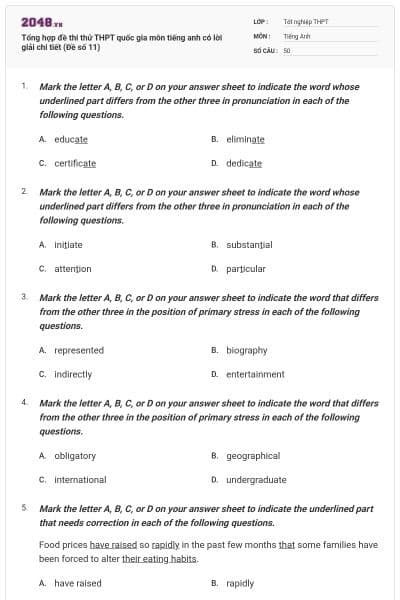
Mark the letter A, B, C, or D on your answer sheet to indicate the word whose underlined part differs from the other three in pronunciation in each of the following questions.
educate
eliminate
certificate
dedicate
Đáp án C
Kiến thức: Phát âm “-ate”
Giải thích:
educate /ˈedʒukeit/ eliminate /i'limineit/
certificate /sə'tifikət/ dedicate /'dedikeit/
Phần gạch chân câu C được phát âm là /ət/ còn lại là /eit/
Mark the letter A, B, C, or D on your answer sheet to indicate the word whose underlined part differs from the other three in pronunciation in each of the following questions.
initiate
substantial
attention
particular
Đáp án D
Kiến thức: Phát âm “-t”
Giải thích:
initiate /ɪˈnɪʃieɪt/ substantial /səb'stæn∫l/
attention /ə'ten∫n/ particular /pə'tikjʊlə[r]/
Phần gạch chân câu D được phát âm là /t/ còn lại là /∫/
Mark the letter A, B, C, or D on your answer sheet to indicate the word that differs from the other three in the position of primary stress in each of the following questions.
represented
biography
indirectly
entertainment
Đáp án B
Kiến thức: Trọng âm của từ có 3 âm tiết trở lên
Giải thích:
represented /ˌreprɪˈzentɪd/ biography /bai'ɒgrəfi/
indirectly /,indi'rektli/ entertainment /,entə'tainmənt/
Câu B trọng âm rơi vào âm tiết thứ 2, còn lại là thứ 3
Mark the letter A, B, C, or D on your answer sheet to indicate the word that differs from the other three in the position of primary stress in each of the following questions.
obligatory
geographical
international
undergraduate
Đáp án A
Kiến thức: Trọng âm của từ có 3 âm tiết trở lên
Giải thích:
obligatory /ə'bligətri/ geographical /dʒiə'græfikl/
international /,intə'næ∫nəl/ undergraduate /,ʌndə'grædʒʊət/
Câu A trọng âm rơi vào âm tiết thứ 2, còn lại là thứ 3
Mark the letter A, B, C, or D on your answer sheet to indicate the underlined part that needs correction in each of the following questions.
Food prices have raised so rapidly in the past few months that some families have been forced to alter their eating habits.
have raised
rapidly
that
their eating habits
Đáp án A
Kiến thức: Nội động từ, ngoại động từ
Giải thích:
have raised => have risen
Phân biệt rise và raise:
- rise là một nội động từ, phía sau không có tân ngữ
- raise là một ngoại động từ, phía sau cần có tân ngữ
Tạm dịch: Giá thực phẩm đã tăng nhanh chóng trong vài tháng qua đến mức mà một số gia đình đã buộc phải thay đổi thói quen ăn uống của họ.
Mark the letter A, B, C, or D on your answer sheet to indicate the underlined part that needs correction in each of the following questions.
Having finished his term paper before the deadline, it was delivered to the professor before the class.
Having finished
before the
it was delivered
professor before
Đáp án C
Kiến thức: Dạng chủ động, bị động
Giải thích:
it was delivered => he delivered it
Chủ ngữ trong câu này phải là người thực hiện hành động “finish” ở vế trước, vì thế chủ ngữ không thể là “it” được. Phải chuyển sang thể chủ động
Tạm dịch: Sau khi hoàn thành bài thi học kỳ của mình trước thời hạn, cậu ấy giao cho giáo sư trước lớp.
Mark the letter A, B, C, or D on your answer sheet to indicate the underlined part that needs correction in each of the following questions.
Since vitamins are contained in a wide variety of foods, people seldom lack of most of them.
are
in a
variety of
lack of
Đáp án D
Kiến thức: Từ vựng, từ loại
Giải thích:
lack of => lack
"lack" vừa là danh từ vừa là động từ.
Trong câu này ta cần 1 động từ chính và được bổ nghĩa bởi trạng từ 'seldom': lack something (v) (không có giới từ đi kèm)
lack (n) thường đi kèm với giới từ 'of': lack of something ≈ shortage of something (n)
Tạm dịch: Vì vitamins được chứa trong nhiều loại thức ăn nên mọi người hiếm khi thiếu chúng.
Mark the letter A, B, C, or D on your answer sheet to indicate the correct answer to each of the following questions.
We should participate in the movements ______ the natural environment.
organizing to conserve
organized to conserve
organized conserving
which organize to conserve
Đáp án B
Kiến thức: Quá khứ phân từ
Giải thích:
Ta dùng quá khứ phân từ tạo mệnh đề quan hệ rút gọn với dạng bị động (dạng chủ động ta dùng hiện tại phân từ). Trong câu này, “organized” được hiểu là which are organized. => A, D loại
Ta dùng giới từ to: để, chỉ mục đích
Tạm dịch: Chúng ta nên tham gia vào các phong trào được tổ chức để bảo vệ môi trường tự nhiên.
______ number of boys were swimming in the lake, but I didn’t know ______ exact number of them
A/the
The/an
The/the
A/an
Đáp án A
Kiến thức: Hoà hợp giữa chủ ngữ và động từ
Giải thích:
“A number of + N” động từ phía sau được chia như với danh từ số nhiều
“The number of + N” động từ phía sau được chia như với danh từ số ít
Vế sau ta dùng "the" khi danh từ chỉ đối tượng được cả người nói lẫn người nghe biết rõ
Tạm dịch: Một số chàng trai đang bơi trong hồ, nhưng tôi không biết chính xác số người họ.
John forgot ______ his ticket so he was not allowed ______ the club.
brought/enter
bring/entering
bringing/to enter
to bring/to enter
Đáp án D
Kiến thức: Phase, từ vựng
Giải thích:
Có 2 cấu trúc với “forget”
- forget doing sth: quên đã làm gì
- forget to do sth: quên làm gì
Trong câu này ta dùng forget to do sth
To be allowed to do sth: được phép làm gì
Tạm dịch: John quên mang theo vé vì vậy anh ấy không được vào quán bar.
Snow and rain ______ of nature.
are phenomena
is phenomena
is phenomenon
are phenomenon
Đáp án A
Kiến thức: Từ vựng
Giải thích:
phenomenon (n): hiện tượng
Số nhiều của “phenomenon” là phenomena
Trong câu này ta phải dùng danh từ số nhiều, và to be là “are”
Tạm dịch: Tuyết và mưa là hiện tượng của tự nhiên.
Her outgoing character contrasts ______ with that of her sister.
thoroughly
fully
sharply
coolly
Đáp án A
Kiến thức: Từ vựng
Giải thích:
thoroughly (adv): [một cách] hoàn toàn, hết sức fully (adv): [một cách] đầy đủ
sharply (adv): [một cách] rõ nét, sắc nét coolly (adv): mát mẻ, điềm tĩnh
Tạm dịch: Tính cách dễ gần của cô ấy hoàn toàn đối lập với chị gái.
It turned out that we ______ rushed to the airport as the plane was delayed by several hours.
hadn’t
should have
mustn’t
needn’t have
Đáp án D
Kiến thức: Modal verb
Giải thích:
had not done sth: đã không làm gì (thì quá khứ hoàn thành)
should have done sth: nên đã làm gì (nhưng thực tế đã không làm)
must not do sth: không được làm gì
need not have done sth: không cần đã làm gì (nhưng thực tế là đã làm)
Tạm dịch: Hóa ra chúng ta không cần phải vội vã đến sân bay vì máy bay đã bị trì hoãn vài giờ.
When I was a child, I loved to splash through the ______ after rain.
pools
puddles
ponds
rivers
Đáp án B
Kiến thức: Từ vựng
Giải thích:
pool (n): vực sông, bể bơi puddle (n): vũng nước (nước mưa ở mặt đường…)
pond (n): cái ao river (n): sông
Tạm dịch: Khi còn nhỏ, tôi thích lướt qua các vũng nước sau khi mưa.
Learning Spanish isn’t so difficult once you ______.
get away with it
get off it
get down to it
get on it
Đáp án C
Kiến thức: Phrasal verb
Giải thích:
To get away with: không bị bắt, bị trừng phạt vì đã làm sai điều gì đó.
To get off: xuống (tàu, xe…)
To get down to: bắt đầu nghiêm túc làm vịêc gì.
To get on: bước lên
Tạm dịch: Học tiếng Tây Ban Nha không quá khó một khi bạn nghiêm túc với nó.
Staying in a hotel costs ______ renting a room in a dormitory for a week.
twice as much as
as much as twice
twice more than
twice as
Đáp án A
Kiến thức: Câu so sánh
Giải thích:
Cấu trúc so sánh gấp nhiều lần: số nhân (twice, three times…) + as +… + as
Tạm dịch: Ở trong khách sạn tốn kém gấp đôi so với thuê một căn phòng trong ký t c xá trong một tuần.
Please don’t ______ a word of this to anyone else, it’s highly confidential.
speak
pass
mutter
breathe
Đáp án D
Kiến thức: Từ vựng
Giải thích:
speak (v): nói, nói chuyện
pass (v): qua, đi qua
mutter (v): nói thì thầm
breathe (v): thở; to breathe/ say a word: Nói/ tiết lộ cho ai đó biết về điều gì đó
Tạm dịch: Đừng tiết lộ cho ai về điều này, nó rất bí mật.
In spite of his abilities, Peter has been ______ overlooked for promotion.
repeat
repeatedly
repetitiveness
repetitive
Đáp án B
Kiến thức: Từ vựng, từ loại
Giải thích:
repeat (v): lặp lại repeatedly (adv): một cách lặp lại
repetitiveness (n): tính chất lặp đi lặp lại repetitive (a): có đặc trưng lặp đi lặp lại
Ở đây ta cần một trạng từ để bổ sung nghĩa cho động từ “overlook” ở phía sau.
Tạm dịch: Dù cho có khả năng, Peter đã bị bỏ qua nhiều lần thăng chức.
I wish you ______ me a new one instead of having it ______ as you did.
had given/repaired
gave/to repair
would give/to repair
had given/to be repaired
Đáp án A
Kiến thức: Cấu trúc với wish, have sth done
Giải thích:
Trong câu là ước cho một việc trong quá khứ, cấu trúc wish cho quá khứ: wish + S + quá khứ hoàn thành
Cấu trúc have sth done: có cái gì được làm (bởi ai đó, bản thân mình không làm)
Tạm dịch: Tôi ước rằng bạn đã cho tôi một cái mới thay vì sửa chữa nó như bạn đã làm.
Mark the letter A, B, C, or D on your answer sheet to indicate the most suitable response to complete each of the following exchanges.
Jim invited Helen to visit his gardens:
- Helen: "I love your gardens. The plants are well taken care of!"
- Jim : “Thanks. Yes, I suppose I've always ____.”
had green fingers
let nature take its course
made it down on my luck
drawn the short straw
Đáp án B
Kiến thức: ăn hoá giao tiếp, idioms
Giải thích:
Tạm dịch: Jim mời Helen đi thăm vườn của mình:
- Helen: "Tôi yêu khu vườn của bạn. Cây cối được chăm sóc cẩn thận!"
- Jim: "Cảm ơn. âng, tôi cho rằng tôi đã luôn luôn ____. "
have green fingers: giỏi làm vườn
let nature take its course : để cái gì diễn ra, tiến hành tự nhiên
down on one's luck: gặp vận rủi, gặp cơn đen
draw the short straw: được chọn làm công việc mà chả ai muốn cả
Mark the letter A, B, C, or D on your answer sheet to indicate the most suitable response to complete each of the following exchanges.
Mrs. Skate’s in a fashion store. Choose the most suitable response to fill in the blank in the following exchange:
- Mrs. Skate: “How can this dress can be so expensive?”
- The shop assistant: “________.”
Yes, it’s the most expensive
You’re paying for the brand
What an expensive dress
That’s a good idea
Đáp án B
Kiến thức: ăn hoá giao tiếp
Giải thích:
Tạm dịch: Bà Skate đang ở trong một cửa hàng thời trang. Chọn câu trả lời phù hợp nhất để điền vào chỗ trống trong trao đổi sau:
- Bà Skate: "Sao chiếc váy này có thể đắt đến thế?"
- Trợ lý cửa hàng: "________".
A. âng, nó đắt nhất C. Thật là một chiếc váy đắt tiền
B. Bà đang trả tiền cho thương hiệu. D. Đó là một ý tưởng hay
Mark the letter A, B, C, or D on your answer sheet to indicate the word(s) CLOSEST in meaning to the underlined word(s) in each of the following questions.
Adding a garage will enhance the value of the house
stabilize
alter
increase
diminish
Đáp án C
Kiến thức: Từ vựng, từ đồng nghĩa
Giải thích:
enhance (v): làm tăng, nâng cao
stabilize (v): làm ổn định
alter (v): thay đổi, đổi
increase (v): tăng lên
diminish (v): làm giảm, hạ bớt
=> enhance = increase
Tạm dịch: Thêm một nhà để xe sẽ làm tăng giá trị ngôi nhà.
Mark the letter A, B, C, or D on your answer sheet to indicate the word(s) CLOSEST in meaning to the underlined word(s) in each of the following questions.
You never really know where you are with her as she just blows hot and cold.
keeps going
keeps taking things
keeps changing her mood
keeps testing
Đáp án C
Kiến thức: Từ vựng, từ đồng nghĩa
Giải thích:
blow hot and cold: hay thay đổi ý kiến, dao động.
keep going: luôn đi keep taking things: luôn lấy các thứ
keep changing her mood: luôn thay đổi tâm trạng keep testing: luôn kiểm tra
=> blow hot and cold = keep changing her mood
Tạm dịch: Bạn không bao giờ thực sự biết mình đang ở đâu với cô ấy vì cô ấy hay thay đổi ý kiến.
Mark the letter A, B, C, or D on your answer sheet to indicate the word(s) OPPOSITE in meaning to the underlined word(s) in each of the following questions.
Are you looking for a temporary or a permanent job?
fierce
stable
fleeting
loose
Đáp án C
Kiến thức: Từ vựng, từ trái nghĩa
Giải thích:
permanent (a): dài hạn
fierce (a): hung dữ; dữ tợn
stable (a): ổn định, bền vững
fleeting (a): lướt nhanh, thoáng qua
loose (a): lỏng lẻo, không sát
=> permanent >< fleeting
Tạm dịch: Bạn đang tìm kiếm một công việc tạm thời hoặc lâu dài?
Mark the letter A, B, C, or D on your answer sheet to indicate the word(s) OPPOSITE in meaning to the underlined word(s) in each of the following questions.
Constant correction of speaking ‘errors’ by a teacher is often counter-productive, as student may become afraid to speak at all.
desolate
fruitless
barren
effective
Đáp án D
Kiến thức: Từ vựng, từ trái nghĩa
Giải thích:
counter-productive (a): phản tác dụng
desolate (a): hoang vắng, tiêu điều
fruitless (a): không có kết quả, thất bại
barren (a): không đem lại kết quả; vô bổ
effective (a): có hiệu quả
=> counter-productive >< effective
Tạm dịch: Sự thay đổi liên tục của việc nói "lỗi" của một giáo viên thường phản tác dụng, vì học sinh có thể trở nên sợ nói.
Mark the letter A, B, C, or D on your answer sheet to indicate the sentence that is closest in meaning to each of the following questions.
Jack has won a jackpot prize. 10% of it was donated to flooded areas.
Jack has won a jackpot prize, 10% which half was donated to flooded areas
Jack has won a jackpot prize, 10% of which was donated to flooded areas
Jack has won a jackpot prize, 10% of that was donated to flooded areas
Jack has won a jackpot prize, which was donated to flooded areas
Đáp án B
Kiến thức: Mệnh đề quan hệ
Giải thích:
Khi mệnh đề thứ hai có sở hữu dùng danh từ chỉ người thì ta dùng từ "whose", còn chỉ vật thì ta dùng "of which”
Tạm dịch: Jack đã giành được một giải thưởng jackpot, 10% trong đó đã được tặng cho các khu vực bị ngập lụt.
Mark the letter A, B, C, or D on your answer sheet to indicate the sentence that is closest in meaning to each of the following questions.
Had she read the reference books, she would have been able to finish the test.
If she had read the reference books, she could finish the test
Because she read the reference books, she was able to finish the test
Although she didn't read the reference books, she was able to finish the test
Not having read the reference books, she couldn't finish the test
Đáp án D
Kiến thức: Viết lại câu
Giải thích:
Tạm dịch: Nếu cô đã đọc cuốn sách tham khảo, cô đã có thể hoàn thành bài kiểm tra. (trong quá khứ đã không thể qua bài kiểm tra)
A. Nếu cô đã đọc cuốn sách tham khảo, cô có thể hoàn thành bài kiểm tra. (hiện tại không thể qua)
B. Bởi vì cô đã đọc cuốn sách tham khảo, cô đã có thể hoàn thành bài kiểm tra.
C. Mặc dù không đọc cuốn sách tham khảo, nhưng cô đã có thể hoàn thành bài kiểm tra.
D. Không đọc cuốn sách tham khảo, cô không thể hoàn thành bài kiểm tra.
Mark the letter A, B, C, or D on your answer sheet to indicate the sentence that is closest in meaning to each of the following questions.
My advice is that you get straight to the point in the next report.
If I were you, I would go straight to the bush in the next report.
If I were you, I would have the next report got started.
If I were you, I would not beat around the bush in the next report.
If I were you, I would not point out the next report.
Đáp án C
Kiến thức: Viết lại câu, phrase
Giải thích:
get straight to the point: đi thẳng đến vấn đề
beat about the bush: lòng vòng, lảng tránh, không đi vào vấn đề
Tạm dịch: Nếu tôi là bạn, tôi sẽ không đi lòng vòng ở bản báo cáo tiếp theo.
Mark the letter A, B, C, or D on your answer sheet to indicate the sentence that best combines each pair of sentences in the following questions.
I whispered as I didn't want anybody to hear our conversation
Since nobody wanted to hear our conversation, I whispered
So as not to hear our conversation, I whispered
Because I whispered, anybody heard our conversation
I lowered my voice in order that our conversation couldn't be heard
Đáp án D
Kiến thức: Viết lại câu
Giải thích:
Tạm dịch: Tôi thì thầm vì tôi không muốn ai nghe câu chuyện của chúng tôi.
A. Vì không ai muốn nghe cuộc nói chuyện của chúng tôi, tôi thì thầm.
B. Để không nghe cuộc nói chuyện của chúng tôi, tôi thì thầm.
C. Bởi vì tôi thì thầm, ai cũng nghe thấy cuộc nói chuyện của chúng tôi.
D. Tôi hạ thấp giọng để cuộc trò chuyện của chúng tôi không thể được nghe thấy.
Mark the letter A, B, C, or D on your answer sheet to indicate the sentence that best combines each pair of sentences in the following questions.
Tim graduated with a good degree. He joined the ranks of the unemployed.
Tim joined the ranks of the unemployed because he graduated with a good degree
If Tim graduated with a good degree, he would join the ranks of the unemployed
Though Tim graduated with a good degree, he joined the ranks of the unemployed
That Tim graduated with a good degree helped him join the ranks of the unemployed
Đáp án C
Kiến thức: Viết lại câu
Giải thích:
Tạm dịch: Tim tốt nghiệp với tấm bằng giỏi. Anh gia nhập hàng ngũ những người thất nghiệp.
A. Tim gia nhập hàng ngũ những người thất nghiệp vì anh tốt nghiệp với tấm bằng giỏi.
B. Nếu Tim tốt nghiệp với một tấm bằng giỏi, anh sẽ gia nhập hàng ngũ những người thất nghiệp.
C. Mặc dù Tim đã tốt nghiệp với tấm bằng giỏi, anh gia nhập hàng ngũ những người thất nghiệp.
D. Việc Tim tốt nghiệp với tấm bằng giỏi đã gi p anh gia nhập hàng ngũ những người thất nghiệp.
Read the following passage and mark the letter A, B, C, or D on your answer sheet to indicate the correct word or phrase that best fits each of the numbered blanks from 31 to 35.
LETTER TO THE EDITOR
The Prime Minister's comments yesterday on education spending miss the point, as the secondary education system also needs a major overhaul. Firstly, the system only views the weakest learners as having special needs. The brightest and most conscientious students are not encouraged to develop to their full (31)_____. Secondly, there's too much testing and not enough learning. My fifteen-year-old daughter, for example, has just spent the last month or so (32)_____ for exams. These aren't even real, important exams, as her GCSEs will be next year. They're just mock exams. Is the work she's been doing really going to make her more knowledgeable about her subjects, or will she forget it all tomorrow? I suspect the (33)_____.
Thirdly, the standard (34)_____ doesn't give students any tuition in developing practical work-related, living and social skills, or in skills necessary for higher education. How many students entering university have the first idea what the difference is between plagiarising someone else's work and (35)_____ good use of someone else's ideas? Shouldn't they have been taught this at school? How many of them are really able to go about self-study skill that's essential at university because there are no teachers to tell you what to do - in an efficient way? Indeed, hoe many students graduate from university totally unable to spell even simple English words correctly? The system is letting our children down.
Điền ô số 31
plan
fame
potential
achievement
Đáp án C
Kiến thức: Từ vựng, đọc hiểu
Giải thích:
plan (n): kế hoạch fame (n): danh tiếng, tiếng tăm
potential (n, a): tiềm lực; tiềm năng achievement (n): sự đạt được, thành tựu
Read the following passage and mark the letter A, B, C, or D on your answer sheet to indicate the correct word or phrase that best fits each of the numbered blanks from 31 to 35.
LETTER TO THE EDITOR
The Prime Minister's comments yesterday on education spending miss the point, as the secondary education system also needs a major overhaul. Firstly, the system only views the weakest learners as having special needs. The brightest and most conscientious students are not encouraged to develop to their full (31)_____. Secondly, there's too much testing and not enough learning. My fifteen-year-old daughter, for example, has just spent the last month or so (32)_____ for exams. These aren't even real, important exams, as her GCSEs will be next year. They're just mock exams. Is the work she's been doing really going to make her more knowledgeable about her subjects, or will she forget it all tomorrow? I suspect the (33)_____.
Thirdly, the standard (34)_____ doesn't give students any tuition in developing practical work-related, living and social skills, or in skills necessary for higher education. How many students entering university have the first idea what the difference is between plagiarising someone else's work and (35)_____ good use of someone else's ideas? Shouldn't they have been taught this at school? How many of them are really able to go about self-study skill that's essential at university because there are no teachers to tell you what to do - in an efficient way? Indeed, hoe many students graduate from university totally unable to spell even simple English words correctly? The system is letting our children down.
Điền ô số 32
reading
lecturing
cheating
cramming
Đáp án D
Kiến thức: Từ vựng, đọc hiểu
Giải thích:
read (v): đọc
lecture (v): giảng dạy
cheat (v): lừa, gian lận
cram (v): nhồi, nhét
Read the following passage and mark the letter A, B, C, or D on your answer sheet to indicate the correct word or phrase that best fits each of the numbered blanks from 31 to 35.
LETTER TO THE EDITOR
The Prime Minister's comments yesterday on education spending miss the point, as the secondary education system also needs a major overhaul. Firstly, the system only views the weakest learners as having special needs. The brightest and most conscientious students are not encouraged to develop to their full (31)_____. Secondly, there's too much testing and not enough learning. My fifteen-year-old daughter, for example, has just spent the last month or so (32)_____ for exams. These aren't even real, important exams, as her GCSEs will be next year. They're just mock exams. Is the work she's been doing really going to make her more knowledgeable about her subjects, or will she forget it all tomorrow? I suspect the (33)_____.
Thirdly, the standard (34)_____ doesn't give students any tuition in developing practical work-related, living and social skills, or in skills necessary for higher education. How many students entering university have the first idea what the difference is between plagiarising someone else's work and (35)_____ good use of someone else's ideas? Shouldn't they have been taught this at school? How many of them are really able to go about self-study skill that's essential at university because there are no teachers to tell you what to do - in an efficient way? Indeed, hoe many students graduate from university totally unable to spell even simple English words correctly? The system is letting our children down
Điền ô số 33
latter
frontier
later
latest
Đáp án A
Kiến thức: Từ vựng, đọc hiểu
Giải thích:
the latter: cái sau
frontier (n): biên giới
later (so sánh hơn): muộn hơn
latest: gần đây
Read the following passage and mark the letter A, B, C, or D on your answer sheet to indicate the correct word or phrase that best fits each of the numbered blanks from 31 to 35.
LETTER TO THE EDITOR
The Prime Minister's comments yesterday on education spending miss the point, as the secondary education system also needs a major overhaul. Firstly, the system only views the weakest learners as having special needs. The brightest and most conscientious students are not encouraged to develop to their full (31)_____. Secondly, there's too much testing and not enough learning. My fifteen-year-old daughter, for example, has just spent the last month or so (32)_____ for exams. These aren't even real, important exams, as her GCSEs will be next year. They're just mock exams. Is the work she's been doing really going to make her more knowledgeable about her subjects, or will she forget it all tomorrow? I suspect the (33)_____.
Thirdly, the standard (34)_____ doesn't give students any tuition in developing practical work-related, living and social skills, or in skills necessary for higher education. How many students entering university have the first idea what the difference is between plagiarising someone else's work and (35)_____ good use of someone else's ideas? Shouldn't they have been taught this at school? How many of them are really able to go about self-study skill that's essential at university because there are no teachers to tell you what to do - in an efficient way? Indeed, hoe many students graduate from university totally unable to spell even simple English words correctly? The system is letting our children down.
Điền ô số 34
timetable
curriculum
lecture
seminar
Đáp án B
Kiến thức: Từ vựng, đọc hiểu
Giải thích:
timetable (n): thời khoá biểu curriculum (n): chương trình giảng dạy
lecture (n): bài thuyết trình; bài lên lớp
seminar (n): cuộc thảo luận chuyên đề
Read the following passage and mark the letter A, B, C, or D on your answer sheet to indicate the correct word or phrase that best fits each of the numbered blanks from 31 to 35.
LETTER TO THE EDITOR
The Prime Minister's comments yesterday on education spending miss the point, as the secondary education system also needs a major overhaul. Firstly, the system only views the weakest learners as having special needs. The brightest and most conscientious students are not encouraged to develop to their full (31)_____. Secondly, there's too much testing and not enough learning. My fifteen-year-old daughter, for example, has just spent the last month or so (32)_____ for exams. These aren't even real, important exams, as her GCSEs will be next year. They're just mock exams. Is the work she's been doing really going to make her more knowledgeable about her subjects, or will she forget it all tomorrow? I suspect the (33)_____.
Thirdly, the standard (34)_____ doesn't give students any tuition in developing practical work-related, living and social skills, or in skills necessary for higher education. How many students entering university have the first idea what the difference is between plagiarising someone else's work and (35)_____ good use of someone else's ideas? Shouldn't they have been taught this at school? How many of them are really able to go about self-study skill that's essential at university because there are no teachers to tell you what to do - in an efficient way? Indeed, hoe many students graduate from university totally unable to spell even simple English words correctly? The system is letting our children down.
Điền ô số 35
having
taking
making
creating
Đáp án C
Kiến thức: Phrasal verb, đọc hiểu
Giải thích:
To make use of sth: tận dụng, sử dụng cái gì
Read the following passage and mark the letter A, B, C, or D on your answer sheet to indicate the correct answer to each of the questions from 36 to 42.
Lead poisoning in children is a major health concern. Both low and high doses of paint can have serious effects. Children exposed to high doses of lead often suffer permanent nerve damage, mental retardation, blindness, and even death. Low doses of lead can lead to mild mental retardation, short attention spans, distractibility, poor academic performance, and behavioral problems.
This is not a new concern. As early as 1904, lead poisoning in children was linked to lead-based paint. Microscopic lead particles from paint are absorbed into the bloodstream when children ingest flakes of chipped paint,plaster,or paint dust from sanding. Lead can also enter the body through household dust, nailbiting, thumb sucking, or chewing on toys and other objects painted with lead-based paint. Although American paint companies today must comply with strict regulations regarding the amount of lead used in their paint, this source of lead poisoning is still the most common and most dangerous. Children living in older, dilapidated houses are particularly at risk.
What is the main topic of the passage?
problems with household paint
major health concern for children
lead poisoning in children
lead paint in order homes
Đáp án C
Kiến thức: Đọc hiểu
Giải thích:
Chủ đề chính của đoạn văn là gì?
A. các vấn đề với sơn trong gia đình
B. mối quan tâm sức khỏe nghiêm trọng đối với trẻ em
C. ngộ độc chì ở trẻ em
D. sơn có chì trong nhà
Thông tin: Lead poisoning in children is a major health concern.
Read the following passage and mark the letter A, B, C, or D on your answer sheet to indicate the correct answer to each of the questions from 36 to 42.
Lead poisoning in children is a major health concern. Both low and high doses of paint can have serious effects. Children exposed to high doses of lead often suffer permanent nerve damage, mental retardation, blindness, and even death. Low doses of lead can lead to mild mental retardation, short attention spans, distractibility, poor academic performance, and behavioral problems.
This is not a new concern. As early as 1904, lead poisoning in children was linked to lead-based paint. Microscopic lead particles from paint are absorbed into the bloodstream when children ingest flakes of chipped paint,plaster,or paint dust from sanding. Lead can also enter the body through household dust, nailbiting, thumb sucking, or chewing on toys and other objects painted with lead-based paint. Although American paint companies today must comply with strict regulations regarding the amount of lead used in their paint, this source of lead poisoning is still the most common and most dangerous. Children living in older, dilapidated houses are particularly at risk.
The phrase "exposed to" in line 2 could best be replaced by which of the following?
in contact with
familiar with
displaying
conducting
Đáp án A
Kiến thức: Đọc hiểu
Giải thích:
Cụm từ "exposed to" ở dòng 2 có thể được thay thế bằng?
A. tiếp xúc với B. quen với
C. hiển thị D. tiến hành
"exposed to" = in contact with: tiếp xúc với
Children exposed to high doses of lead often suffer permanent nerve damage, mental retardation, blindness, and even death.
Trẻ tiếp xúc với chì ở liều lượng cao thường bị tổn thương lâu dài về thần kinh, thiểu năng trí tuệ, mù mắt, thậm chí mất mạng.
Read the following passage and mark the letter A, B, C, or D on your answer sheet to indicate the correct answer to each of the questions from 36 to 42.
Lead poisoning in children is a major health concern. Both low and high doses of paint can have serious effects. Children exposed to high doses of lead often suffer permanent nerve damage, mental retardation, blindness, and even death. Low doses of lead can lead to mild mental retardation, short attention spans, distractibility, poor academic performance, and behavioral problems.
This is not a new concern. As early as 1904, lead poisoning in children was linked to lead-based paint. Microscopic lead particles from paint are absorbed into the bloodstream when children ingest flakes of chipped paint,plaster,or paint dust from sanding. Lead can also enter the body through household dust, nailbiting, thumb sucking, or chewing on toys and other objects painted with lead-based paint. Although American paint companies today must comply with strict regulations regarding the amount of lead used in their paint, this source of lead poisoning is still the most common and most dangerous. Children living in older, dilapidated houses are particularly at risk.
Which of the following does the passage infer?
Paint companies can no longer use lead in their paint.
Paint companies must limit the amount of lead used in their paint.
Paint companies aren't required to limit the amount of lead used in their paint.
Paint companies have always followed restrictions regarding the amount of lead used in their paint.
Đáp án B
Kiến thức: Đọc hiểu
Giải thích:
Câu nào suy ra từ đoạn văn?
A. Các công ty sơn không còn có thể sử dụng chì trong sơn.
B. Các công ty sơn phải hạn chế lượng chì trong sơn.
C. Các công ty sơn không bắt buộc phải hạn chế lượng chì trong sơn.
D. Các công ty sơn luôn tuân thủ các hạn chế về lượng chì trong sơn.
Thông tin: Although American paint companies today must comply with strict regulations regarding the amount of lead used in their paint, this source of lead poisoning is still the most common and most dangerous.
Read the following passage and mark the letter A, B, C, or D on your answer sheet to indicate the correct answer to each of the questions from 36 to 42.
Lead poisoning in children is a major health concern. Both low and high doses of paint can have serious effects. Children exposed to high doses of lead often suffer permanent nerve damage, mental retardation, blindness, and even death. Low doses of lead can lead to mild mental retardation, short attention spans, distractibility, poor academic performance, and behavioral problems.
This is not a new concern. As early as 1904, lead poisoning in children was linked to lead-based paint. Microscopic lead particles from paint are absorbed into the bloodstream when children ingest flakes of chipped paint,plaster,or paint dust from sanding. Lead can also enter the body through household dust, nailbiting, thumb sucking, or chewing on toys and other objects painted with lead-based paint. Although American paint companies today must comply with strict regulations regarding the amount of lead used in their paint, this source of lead poisoning is still the most common and most dangerous. Children living in older, dilapidated houses are particularly at risk.
The word "ingest" could best be replaced by which of the following?
inhale
invest
inject
eat
Đáp án D
Kiến thức: Đọc hiểu
Giải thích:
Từ "ingest" có thể được thay thế bằng từ nào?
A. hít vào B. đầu tư
C. tiêm D. ăn
"ingest" = eat: ăn vào, nuốt vào
Microscopic lead particles from paint are absorbed into the bloodstream when children ingest flakes of chipped paint,plaster,or paint dust from sanding.
Hạt chì li ti trong sơn sẽ thấm vào máu khi trẻ nuốt phải những mảnh sơn, vữa bị tróc hoặc bụi sơn trong cát.
Read the following passage and mark the letter A, B, C, or D on your answer sheet to indicate the correct answer to each of the questions from 36 to 42.
Lead poisoning in children is a major health concern. Both low and high doses of paint can have serious effects. Children exposed to high doses of lead often suffer permanent nerve damage, mental retardation, blindness, and even death. Low doses of lead can lead to mild mental retardation, short attention spans, distractibility, poor academic performance, and behavioral problems.
This is not a new concern. As early as 1904, lead poisoning in children was linked to lead-based paint. Microscopic lead particles from paint are absorbed into the bloodstream when children ingest flakes of chipped paint,plaster,or paint dust from sanding. Lead can also enter the body through household dust, nailbiting, thumb sucking, or chewing on toys and other objects painted with lead-based paint. Although American paint companies today must comply with strict regulations regarding the amount of lead used in their paint, this source of lead poisoning is still the most common and most dangerous. Children living in older, dilapidated houses are particularly at risk.
The word "dilapidated" is closest in meaning to which of the following?
unpainted
decorated
broken down
poorly painted
Đáp án C
Kiến thức: Đọc hiểu
Giải thích:
Từ "dilapidated" có ý nghĩa gần nhất với từ nào sau đây?
A. không được sơn
B. trang trí
C. hỏng hóc
D. được sơn một cách rất tệ
"dilapidated" = broken down: đổ nát, hỏng hóc
Children living in older, dilapidated houses are particularly at risk.
Đặc biệt là trẻ sống trong những ngôi nhà cũ đổ nát thì càng dễ bị nhiễm chì hơn nữa.
Read the following passage and mark the letter A, B, C, or D on your answer sheet to indicate the correct answer to each of the questions from 36 to 42.
Lead poisoning in children is a major health concern. Both low and high doses of paint can have serious effects. Children exposed to high doses of lead often suffer permanent nerve damage, mental retardation, blindness, and even death. Low doses of lead can lead to mild mental retardation, short attention spans, distractibility, poor academic performance, and behavioral problems.
This is not a new concern. As early as 1904, lead poisoning in children was linked to lead-based paint. Microscopic lead particles from paint are absorbed into the bloodstream when children ingest flakes of chipped paint,plaster,or paint dust from sanding. Lead can also enter the body through household dust, nailbiting, thumb sucking, or chewing on toys and other objects painted with lead-based paint. Although American paint companies today must comply with strict regulations regarding the amount of lead used in their paint, this source of lead poisoning is still the most common and most dangerous. Children living in older, dilapidated houses are particularly at risk.
According to the passage, what is the most common source of lead poisoning in children?
household dust
lead-based paint
painted toys
dilapidated houses
Đáp án B
Kiến thức: Đọc hiểu
Giải thích:
Theo đoạn văn, nguồn gây ngộ độc chì ở trẻ em là gì?
A. bụi trong gia đình
B. sơn có chì
C. đồ chơi được sơn
D. nhà đổ nát
Thông tin: Lead can also enter the body through household dust, nailbiting, thumb sucking, or chewing on toys and other objects painted with lead-based paint.
Read the following passage and mark the letter A, B, C, or D on your answer sheet to indicate the correct answer to each of the questions from 36 to 42.
Lead poisoning in children is a major health concern. Both low and high doses of paint can have serious effects. Children exposed to high doses of lead often suffer permanent nerve damage, mental retardation, blindness, and even death. Low doses of lead can lead to mild mental retardation, short attention spans, distractibility, poor academic performance, and behavioral problems.
This is not a new concern. As early as 1904, lead poisoning in children was linked to lead-based paint. Microscopic lead particles from paint are absorbed into the bloodstream when children ingest flakes of chipped paint,plaster,or paint dust from sanding. Lead can also enter the body through household dust, nailbiting, thumb sucking, or chewing on toys and other objects painted with lead-based paint. Although American paint companies today must comply with strict regulations regarding the amount of lead used in their paint, this source of lead poisoning is still the most common and most dangerous. Children living in older, dilapidated houses are particularly at risk.
What does the author imply in the final sentence of the passage?
Old homes were painted with lead – based paint
Lead-based paint chips off more easily than newer paints
Poor people did not comply with the regulations
Old homes need to be rebuilt in order to be safe for children
Đáp án A
Kiến thức: Đọc hiểu
Giải thích:
Tác giả có ý gì trong câu cuối cùng của đoạn văn?
A. Nhà cũ được sơn bằng sơn có chì.
B. Các loại sơn có chì dễ bị mẻ hơn các loại sơn mới hơn.
C. Người nghèo không tuân thủ các quy định
D. Những ngôi nhà cũ cần được xây dựng lại để an toàn cho trẻ em.
Read the following passage and mark the letter A, B, C, or D on your answer sheet to indicate the correct answer to each of the questions from 43 to 50.
China - Missing Women
1. In China the growing difference between the genders is giving signals of alarm to Government authorities. According to the latest census figures, 119 boys are born for every 100 girls. This striking difference is expected to shoot up by the year 2020 with almost 40 million unsettled bachelors. This distribution of the social ecology would create havoc in the future. The social leaders are trying to pressurize the masses into producing more females. The Government has embarked on policies extending innumerable incentives to the families bearing girls. Monetary support, free education, guaranteed employment is being gifted to parents who gift the country with a girl child. The Government is trying to persuade people to suppress their personal preferences and regulate their community behavior according to the new blueprint to stimulate the girl ratio. [A■] Sometimes the Government tries to woo them and sometimes it uses stem policies to force them into it
2. Consequent to the population explosion, the Government introduced, in the 80’s, one child policy in China. Any additional pregnancy had to be terminated. This was aimed to put a check on the teeming millions. The policy had no relation to extermination of girl child in the womb. But the policymakers had no idea about its long term impact. People, with a patriarchic mindset, came up with their preference for a single male child. The idea of a happy family became ‘parents with a single male child’.
3. The Chinese culture has always promoted sons over daughters because the society has been dominated by males. In villages, where hard work is needed to sustain the agriculture, a boy is always preferable due to his superior physical strength compared to that of a girl. [B■] In such circumstances, looking forward to a male baby seems justified. If people have to limit their families, it is obvious they would prefer a boy over a girl child. This problem has been accentuated by the use of ultrasound scanning which helps determine the sex of the fetus. This technology has played a crucial role in creating gender imbalance.
4. Sociologists consider this imbalance as the aftermath of Government’s poorly thought and short-sighted policy. The Government's intentions notwithstanding, China came to develop a markedly lopsided sex ratio. Nobel Laureate Hayek feels that when Government tries to dominate the social system by making people forcibly inculcate a certain habit, such a condition is bound to happen. People try to find ways which not only fulfill their preferences but also satisfy the law makers. The Government damaged the dynamics of a healthy society and was now bearing the brunt of its past deeds.
5. Hayek argues that by no means should a centralized bureaucracy be allowed to design preferences for hundreds of thousands of people, without even consulting them. In such a system, with the passage of time, unforeseen consequences spring up. Government can bind people to its chosen course for a time but the impositions cannot limit their options for long. [C■] The quarter century that has passed since commencement of the effort to redesign the Chinese family is leaving behind its own trail.
6. The Government needs to be careful now. It has to invent new remedies to address this problem. It needs to redesign the social fabric so that programs like ‘Care for Girls’ get support of the masses, who seem to have little faith in the system. They view the new program for the girl child in the same resigned manner as the program that was forced on them in the past. Some women social workers are of the view that the fall of sex ratio has been an advantage for the women of China, as their social value has increased. [D■] The Government policy has in a way helped uplift the status of females. The real fear now is that China will soon be faced with hordes of bachelors at war with their brethren over finding their brides. The “surplus sons” of China need to stop interfering with the social system.
The word "havoc" in paragraph 1 is closest in meaning to
ordinary problem
great destruction
serious dispute
an infectious disease
Đáp án B
Kiến thức: Đọc hiểu
Giải thích:
Từ "havoc" trong đoạn 1 gần nhất có nghĩa là
A. vấn đề bất thường
B. hủy hoại lớn và rắc rối
C. tranh chấp nghiêm trọng
D. một bệnh truyền nhiễm
"havoc" = great destruction and trouble: tàn phá, huỷ hoại nghiêm trọng
This distribution of the social ecology would create havoc in the future.
Sự phân bố này của hệ sinh thái xã hội sẽ tạo ra sự tàn phá trong tương lai.
Read the following passage and mark the letter A, B, C, or D on your answer sheet to indicate the correct answer to each of the questions from 43 to 50.
China - Missing Women
1. In China the growing difference between the genders is giving signals of alarm to Government authorities. According to the latest census figures, 119 boys are born for every 100 girls. This striking difference is expected to shoot up by the year 2020 with almost 40 million unsettled bachelors. This distribution of the social ecology would create havoc in the future. The social leaders are trying to pressurize the masses into producing more females. The Government has embarked on policies extending innumerable incentives to the families bearing girls. Monetary support, free education, guaranteed employment is being gifted to parents who gift the country with a girl child. The Government is trying to persuade people to suppress their personal preferences and regulate their community behavior according to the new blueprint to stimulate the girl ratio. [A■] Sometimes the Government tries to woo them and sometimes it uses stem policies to force them into it
2. Consequent to the population explosion, the Government introduced, in the 80’s, one child policy in China. Any additional pregnancy had to be terminated. This was aimed to put a check on the teeming millions. The policy had no relation to extermination of girl child in the womb. But the policymakers had no idea about its long term impact. People, with a patriarchic mindset, came up with their preference for a single male child. The idea of a happy family became ‘parents with a single male child’.
3. The Chinese culture has always promoted sons over daughters because the society has been dominated by males. In villages, where hard work is needed to sustain the agriculture, a boy is always preferable due to his superior physical strength compared to that of a girl. [B■] In such circumstances, looking forward to a male baby seems justified. If people have to limit their families, it is obvious they would prefer a boy over a girl child. This problem has been accentuated by the use of ultrasound scanning which helps determine the sex of the fetus. This technology has played a crucial role in creating gender imbalance.
4. Sociologists consider this imbalance as the aftermath of Government’s poorly thought and short-sighted policy. The Government's intentions notwithstanding, China came to develop a markedly lopsided sex ratio. Nobel Laureate Hayek feels that when Government tries to dominate the social system by making people forcibly inculcate a certain habit, such a condition is bound to happen. People try to find ways which not only fulfill their preferences but also satisfy the law makers. The Government damaged the dynamics of a healthy society and was now bearing the brunt of its past deeds.
5. Hayek argues that by no means should a centralized bureaucracy be allowed to design preferences for hundreds of thousands of people, without even consulting them. In such a system, with the passage of time, unforeseen consequences spring up. Government can bind people to its chosen course for a time but the impositions cannot limit their options for long. [C■] The quarter century that has passed since commencement of the effort to redesign the Chinese family is leaving behind its own trail.
6. The Government needs to be careful now. It has to invent new remedies to address this problem. It needs to redesign the social fabric so that programs like ‘Care for Girls’ get support of the masses, who seem to have little faith in the system. They view the new program for the girl child in the same resigned manner as the program that was forced on them in the past. Some women social workers are of the view that the fall of sex ratio has been an advantage for the women of China, as their social value has increased. [D■] The Government policy has in a way helped uplift the status of females. The real fear now is that China will soon be faced with hordes of bachelors at war with their brethren over finding their brides. The “surplus sons” of China need to stop interfering with the social system.
What is the main thrust of paragraph 1?
Government is providing incentives to girls.
Government is trying to decipher implications of the census records.
Government is devising polices to undermine the position of boys in the society.
Government is extending incentives to encourage parents with single girls
Đáp án D
Kiến thức: Đọc hiểu
Giải thích:
Nọi dung chính của đoạn 1 là gì?
A. Chính phủ đang tạo ra các ưu đãi cho trẻ em gái.
B. Chính phủ đang cố gắng để giải mã các hàm ý của các hồ sơ điều tra dân số.
C. Chính phủ đang xây dựng các chính sách để làm suy yếu vị trí của con trai trong xã hội.
D. Chính phủ đang mở rộng ưu đãi để khuyến khích cha mẹ có con gái.
Thông tin: The Government has embarked on policies extending innumerable incentives to the families bearing girls. Monetary support, free education, guaranteed employment is being gifted to parents who gift the country with a girl child
Read the following passage and mark the letter A, B, C, or D on your answer sheet to indicate the correct answer to each of the questions from 43 to 50.
China - Missing Women
1. In China the growing difference between the genders is giving signals of alarm to Government authorities. According to the latest census figures, 119 boys are born for every 100 girls. This striking difference is expected to shoot up by the year 2020 with almost 40 million unsettled bachelors. This distribution of the social ecology would create havoc in the future. The social leaders are trying to pressurize the masses into producing more females. The Government has embarked on policies extending innumerable incentives to the families bearing girls. Monetary support, free education, guaranteed employment is being gifted to parents who gift the country with a girl child. The Government is trying to persuade people to suppress their personal preferences and regulate their community behavior according to the new blueprint to stimulate the girl ratio. [A■] Sometimes the Government tries to woo them and sometimes it uses stem policies to force them into it
2. Consequent to the population explosion, the Government introduced, in the 80’s, one child policy in China. Any additional pregnancy had to be terminated. This was aimed to put a check on the teeming millions. The policy had no relation to extermination of girl child in the womb. But the policymakers had no idea about its long term impact. People, with a patriarchic mindset, came up with their preference for a single male child. The idea of a happy family became ‘parents with a single male child’.
3. The Chinese culture has always promoted sons over daughters because the society has been dominated by males. In villages, where hard work is needed to sustain the agriculture, a boy is always preferable due to his superior physical strength compared to that of a girl. [B■] In such circumstances, looking forward to a male baby seems justified. If people have to limit their families, it is obvious they would prefer a boy over a girl child. This problem has been accentuated by the use of ultrasound scanning which helps determine the sex of the fetus. This technology has played a crucial role in creating gender imbalance.
4. Sociologists consider this imbalance as the aftermath of Government’s poorly thought and short-sighted policy. The Government's intentions notwithstanding, China came to develop a markedly lopsided sex ratio. Nobel Laureate Hayek feels that when Government tries to dominate the social system by making people forcibly inculcate a certain habit, such a condition is bound to happen. People try to find ways which not only fulfill their preferences but also satisfy the law makers. The Government damaged the dynamics of a healthy society and was now bearing the brunt of its past deeds.
5. Hayek argues that by no means should a centralized bureaucracy be allowed to design preferences for hundreds of thousands of people, without even consulting them. In such a system, with the passage of time, unforeseen consequences spring up. Government can bind people to its chosen course for a time but the impositions cannot limit their options for long. [C■] The quarter century that has passed since commencement of the effort to redesign the Chinese family is leaving behind its own trail.
6. The Government needs to be careful now. It has to invent new remedies to address this problem. It needs to redesign the social fabric so that programs like ‘Care for Girls’ get support of the masses, who seem to have little faith in the system. They view the new program for the girl child in the same resigned manner as the program that was forced on them in the past. Some women social workers are of the view that the fall of sex ratio has been an advantage for the women of China, as their social value has increased. [D■] The Government policy has in a way helped uplift the status of females. The real fear now is that China will soon be faced with hordes of bachelors at war with their brethren over finding their brides. The “surplus sons” of China need to stop interfering with the social system.
What is the "blueprint" as discussed in paragraph 1?
It is a list of rules for the Chinese people to follow to maintain population control
It is a rough plan for regulating community behavior
It is the Government’s plan containing details of regulations and incentives to improve the girl child ratio
It is a printed guide for conduct rules governing sex ratio
Đáp án C
Kiến thức: Đọc hiểu
Giải thích:
"Kế hoạch chi tiết" như đã thảo luận trong đoạn 1 là gì?
A. Đó là một danh sách các quy tắc để người dân Trung Quốc làm theo để duy trì kiểm soát dân số.
B. Đó là một kế hoạch sơ bộ để điều chỉnh hành vi của cộng đồng.
C. Chính sách của Chính phủ bao gồm chi tiết về các quy định và khuyến khích để cải thiện tỷ lệ trẻ em gái.
D. Đó là hướng dẫn được in ra để thực hiện các quy tắc về tỷ lệ giới tính.
Read the following passage and mark the letter A, B, C, or D on your answer sheet to indicate the correct answer to each of the questions from 43 to 50.
China - Missing Women
1. In China the growing difference between the genders is giving signals of alarm to Government authorities. According to the latest census figures, 119 boys are born for every 100 girls. This striking difference is expected to shoot up by the year 2020 with almost 40 million unsettled bachelors. This distribution of the social ecology would create havoc in the future. The social leaders are trying to pressurize the masses into producing more females. The Government has embarked on policies extending innumerable incentives to the families bearing girls. Monetary support, free education, guaranteed employment is being gifted to parents who gift the country with a girl child. The Government is trying to persuade people to suppress their personal preferences and regulate their community behavior according to the new blueprint to stimulate the girl ratio. [A■] Sometimes the Government tries to woo them and sometimes it uses stem policies to force them into it
2. Consequent to the population explosion, the Government introduced, in the 80’s, one child policy in China. Any additional pregnancy had to be terminated. This was aimed to put a check on the teeming millions. The policy had no relation to extermination of girl child in the womb. But the policymakers had no idea about its long term impact. People, with a patriarchic mindset, came up with their preference for a single male child. The idea of a happy family became ‘parents with a single male child’.
3. The Chinese culture has always promoted sons over daughters because the society has been dominated by males. In villages, where hard work is needed to sustain the agriculture, a boy is always preferable due to his superior physical strength compared to that of a girl. [B■] In such circumstances, looking forward to a male baby seems justified. If people have to limit their families, it is obvious they would prefer a boy over a girl child. This problem has been accentuated by the use of ultrasound scanning which helps determine the sex of the fetus. This technology has played a crucial role in creating gender imbalance.
4. Sociologists consider this imbalance as the aftermath of Government’s poorly thought and short-sighted policy. The Government's intentions notwithstanding, China came to develop a markedly lopsided sex ratio. Nobel Laureate Hayek feels that when Government tries to dominate the social system by making people forcibly inculcate a certain habit, such a condition is bound to happen. People try to find ways which not only fulfill their preferences but also satisfy the law makers. The Government damaged the dynamics of a healthy society and was now bearing the brunt of its past deeds.
5. Hayek argues that by no means should a centralized bureaucracy be allowed to design preferences for hundreds of thousands of people, without even consulting them. In such a system, with the passage of time, unforeseen consequences spring up. Government can bind people to its chosen course for a time but the impositions cannot limit their options for long. [C■] The quarter century that has passed since commencement of the effort to redesign the Chinese family is leaving behind its own trail.
6. The Government needs to be careful now. It has to invent new remedies to address this problem. It needs to redesign the social fabric so that programs like ‘Care for Girls’ get support of the masses, who seem to have little faith in the system. They view the new program for the girl child in the same resigned manner as the program that was forced on them in the past. Some women social workers are of the view that the fall of sex ratio has been an advantage for the women of China, as their social value has increased. [D■] The Government policy has in a way helped uplift the status of females. The real fear now is that China will soon be faced with hordes of bachelors at war with their brethren over finding their brides. The “surplus sons” of China need to stop interfering with the social system.
The word “teeming” in paragraph 2 is closest in meaning to
overflowing
female population
couples
general population
Đáp án A
Kiến thức: Đọc hiểu
Giải thích:
Từ "teeming" trong đoạn 2 gần nhất có nghĩa là
A. đầy tràn B. dân số nữ
C. cặp vợ chồng D. dân số nói chung
"teeming" = overflowing: đông đ c, nhiều, tràn đầy
Read the following passage and mark the letter A, B, C, or D on your answer sheet to indicate the correct answer to each of the questions from 43 to 50.
China - Missing Women
1. In China the growing difference between the genders is giving signals of alarm to Government authorities. According to the latest census figures, 119 boys are born for every 100 girls. This striking difference is expected to shoot up by the year 2020 with almost 40 million unsettled bachelors. This distribution of the social ecology would create havoc in the future. The social leaders are trying to pressurize the masses into producing more females. The Government has embarked on policies extending innumerable incentives to the families bearing girls. Monetary support, free education, guaranteed employment is being gifted to parents who gift the country with a girl child. The Government is trying to persuade people to suppress their personal preferences and regulate their community behavior according to the new blueprint to stimulate the girl ratio. [A■] Sometimes the Government tries to woo them and sometimes it uses stem policies to force them into it
2. Consequent to the population explosion, the Government introduced, in the 80’s, one child policy in China. Any additional pregnancy had to be terminated. This was aimed to put a check on the teeming millions. The policy had no relation to extermination of girl child in the womb. But the policymakers had no idea about its long term impact. People, with a patriarchic mindset, came up with their preference for a single male child. The idea of a happy family became ‘parents with a single male child’.
3. The Chinese culture has always promoted sons over daughters because the society has been dominated by males. In villages, where hard work is needed to sustain the agriculture, a boy is always preferable due to his superior physical strength compared to that of a girl. [B■] In such circumstances, looking forward to a male baby seems justified. If people have to limit their families, it is obvious they would prefer a boy over a girl child. This problem has been accentuated by the use of ultrasound scanning which helps determine the sex of the fetus. This technology has played a crucial role in creating gender imbalance.
4. Sociologists consider this imbalance as the aftermath of Government’s poorly thought and short-sighted policy. The Government's intentions notwithstanding, China came to develop a markedly lopsided sex ratio. Nobel Laureate Hayek feels that when Government tries to dominate the social system by making people forcibly inculcate a certain habit, such a condition is bound to happen. People try to find ways which not only fulfill their preferences but also satisfy the law makers. The Government damaged the dynamics of a healthy society and was now bearing the brunt of its past deeds.
5. Hayek argues that by no means should a centralized bureaucracy be allowed to design preferences for hundreds of thousands of people, without even consulting them. In such a system, with the passage of time, unforeseen consequences spring up. Government can bind people to its chosen course for a time but the impositions cannot limit their options for long. [C■] The quarter century that has passed since commencement of the effort to redesign the Chinese family is leaving behind its own trail.
6. The Government needs to be careful now. It has to invent new remedies to address this problem. It needs to redesign the social fabric so that programs like ‘Care for Girls’ get support of the masses, who seem to have little faith in the system. They view the new program for the girl child in the same resigned manner as the program that was forced on them in the past. Some women social workers are of the view that the fall of sex ratio has been an advantage for the women of China, as their social value has increased. [D■] The Government policy has in a way helped uplift the status of females. The real fear now is that China will soon be faced with hordes of bachelors at war with their brethren over finding their brides. The “surplus sons” of China need to stop interfering with the social system.
What was the vision behind the government's policy discussed in paragraph 2?
The vision about China with women at top positions in the government
The vision for China to control its burgeoning population in near future
The vision about a female dominated society
The vision that Chinese young men and women would find life partners among themselves
Đáp án B
Kiến thức: Đọc hiểu
Giải thích:
Tầm nhìn phía sau chính sách của chính phủ được thảo luận trong đoạn 2 là?
A. Tầm nhìn về Trung Quốc với phụ nữ ở các vị trí hàng đầu trong chính phủ
B. Tầm nhìn cho Trung Quốc để kiểm soát dân số đang phát triển trong tương lai gần
C. Tầm nhìn về một xã hội phụ nữ thống trị
D. Tầm nhìn mà các thanh thiếu niên nam nữ Trung Quốc sẽ tìm được bạn đời
Thông tin: Consequent to the population explosion, the Government introduced, in the 80‟s, one child policy in China. Any additional pregnancy had to be terminated.
Read the following passage and mark the letter A, B, C, or D on your answer sheet to indicate the correct answer to each of the questions from 43 to 50.
China - Missing Women
1. In China the growing difference between the genders is giving signals of alarm to Government authorities. According to the latest census figures, 119 boys are born for every 100 girls. This striking difference is expected to shoot up by the year 2020 with almost 40 million unsettled bachelors. This distribution of the social ecology would create havoc in the future. The social leaders are trying to pressurize the masses into producing more females. The Government has embarked on policies extending innumerable incentives to the families bearing girls. Monetary support, free education, guaranteed employment is being gifted to parents who gift the country with a girl child. The Government is trying to persuade people to suppress their personal preferences and regulate their community behavior according to the new blueprint to stimulate the girl ratio. [A■] Sometimes the Government tries to woo them and sometimes it uses stem policies to force them into it
2. Consequent to the population explosion, the Government introduced, in the 80’s, one child policy in China. Any additional pregnancy had to be terminated. This was aimed to put a check on the teeming millions. The policy had no relation to extermination of girl child in the womb. But the policymakers had no idea about its long term impact. People, with a patriarchic mindset, came up with their preference for a single male child. The idea of a happy family became ‘parents with a single male child’.
3. The Chinese culture has always promoted sons over daughters because the society has been dominated by males. In villages, where hard work is needed to sustain the agriculture, a boy is always preferable due to his superior physical strength compared to that of a girl. [B■] In such circumstances, looking forward to a male baby seems justified. If people have to limit their families, it is obvious they would prefer a boy over a girl child. This problem has been accentuated by the use of ultrasound scanning which helps determine the sex of the fetus. This technology has played a crucial role in creating gender imbalance.
4. Sociologists consider this imbalance as the aftermath of Government’s poorly thought and short-sighted policy. The Government's intentions notwithstanding, China came to develop a markedly lopsided sex ratio. Nobel Laureate Hayek feels that when Government tries to dominate the social system by making people forcibly inculcate a certain habit, such a condition is bound to happen. People try to find ways which not only fulfill their preferences but also satisfy the law makers. The Government damaged the dynamics of a healthy society and was now bearing the brunt of its past deeds.
5. Hayek argues that by no means should a centralized bureaucracy be allowed to design preferences for hundreds of thousands of people, without even consulting them. In such a system, with the passage of time, unforeseen consequences spring up. Government can bind people to its chosen course for a time but the impositions cannot limit their options for long. [C■] The quarter century that has passed since commencement of the effort to redesign the Chinese family is leaving behind its own trail.
6. The Government needs to be careful now. It has to invent new remedies to address this problem. It needs to redesign the social fabric so that programs like ‘Care for Girls’ get support of the masses, who seem to have little faith in the system. They view the new program for the girl child in the same resigned manner as the program that was forced on them in the past. Some women social workers are of the view that the fall of sex ratio has been an advantage for the women of China, as their social value has increased. [D■] The Government policy has in a way helped uplift the status of females. The real fear now is that China will soon be faced with hordes of bachelors at war with their brethren over finding their brides. The “surplus sons” of China need to stop interfering with the social system.
The word "inculcate" as used in paragraph 4 means
calculate the pros and cons
forting somebody to do one's bidding
get into the habit of
impressing upon the mind by persistent urging
Đáp án C
Kiến thức: Đọc hiểu
Giải thích:
Từ “inculcate” được sử dụng trong đoạn 4 có nghĩa là
A. tính toán các ưu và nhược điểm
B. khiến ai tuân theo lệnh của ai đó
C. bắt đầu một thói quen về
D. gây ấn tượng bằng sự thúc giục liên tục
Nobel Laureate Hayek feels that when Government tries to dominate the social system by making people forcibly inculcate a certain habit, such a condition is bound to happen.
Nobel Laureate Hayek cảm thấy rằng khi Chính phủ cố gắng thống trị hệ thống xã hội bằng cách buộc người ta
phải khắc sâu vào não một thói quen nhất định, chuyện như vậy chắc chắn sẽ xảy ra.
Read the following passage and mark the letter A, B, C, or D on your answer sheet to indicate the correct answer to each of the questions from 43 to 50.
China - Missing Women
1. In China the growing difference between the genders is giving signals of alarm to Government authorities. According to the latest census figures, 119 boys are born for every 100 girls. This striking difference is expected to shoot up by the year 2020 with almost 40 million unsettled bachelors. This distribution of the social ecology would create havoc in the future. The social leaders are trying to pressurize the masses into producing more females. The Government has embarked on policies extending innumerable incentives to the families bearing girls. Monetary support, free education, guaranteed employment is being gifted to parents who gift the country with a girl child. The Government is trying to persuade people to suppress their personal preferences and regulate their community behavior according to the new blueprint to stimulate the girl ratio. [A■] Sometimes the Government tries to woo them and sometimes it uses stem policies to force them into it
2. Consequent to the population explosion, the Government introduced, in the 80’s, one child policy in China. Any additional pregnancy had to be terminated. This was aimed to put a check on the teeming millions. The policy had no relation to extermination of girl child in the womb. But the policymakers had no idea about its long term impact. People, with a patriarchic mindset, came up with their preference for a single male child. The idea of a happy family became ‘parents with a single male child’.
3. The Chinese culture has always promoted sons over daughters because the society has been dominated by males. In villages, where hard work is needed to sustain the agriculture, a boy is always preferable due to his superior physical strength compared to that of a girl. [B■] In such circumstances, looking forward to a male baby seems justified. If people have to limit their families, it is obvious they would prefer a boy over a girl child. This problem has been accentuated by the use of ultrasound scanning which helps determine the sex of the fetus. This technology has played a crucial role in creating gender imbalance.
4. Sociologists consider this imbalance as the aftermath of Government’s poorly thought and short-sighted policy. The Government's intentions notwithstanding, China came to develop a markedly lopsided sex ratio. Nobel Laureate Hayek feels that when Government tries to dominate the social system by making people forcibly inculcate a certain habit, such a condition is bound to happen. People try to find ways which not only fulfill their preferences but also satisfy the law makers. The Government damaged the dynamics of a healthy society and was now bearing the brunt of its past deeds.
5. Hayek argues that by no means should a centralized bureaucracy be allowed to design preferences for hundreds of thousands of people, without even consulting them. In such a system, with the passage of time, unforeseen consequences spring up. Government can bind people to its chosen course for a time but the impositions cannot limit their options for long. [C■] The quarter century that has passed since commencement of the effort to redesign the Chinese family is leaving behind its own trail.
6. The Government needs to be careful now. It has to invent new remedies to address this problem. It needs to redesign the social fabric so that programs like ‘Care for Girls’ get support of the masses, who seem to have little faith in the system. They view the new program for the girl child in the same resigned manner as the program that was forced on them in the past. Some women social workers are of the view that the fall of sex ratio has been an advantage for the women of China, as their social value has increased. [D■] The Government policy has in a way helped uplift the status of females. The real fear now is that China will soon be faced with hordes of bachelors at war with their brethren over finding their brides. The “surplus sons” of China need to stop interfering with the social system.
How has "One Child Policy" supposedly improved the value of females? (Refer paragraph 6)
Due to scarcity of girl child, there is a perceived sense of "value"
Government has worked hard to promote the policy
Low female ratio has helped the cause of health of the girl child
Females are able to get good education as family expenditure is limited
Đáp án A
Kiến thức: Đọc hiểu
Giải thích:
"Chính sách một đứa trẻ" được cho là có thể cải thiện được giá trị của phụ nữ như thế nào? (Tham khảo đoạn 6)
A. Do sự khan hiếm của phụ nữ trẻ, có nhận thức về "giá trị".
B. Chính phủ đã làm việc tích cực để th c đẩy chính sách.
C. Tỷ lệ nữ giới thấp giúp sức khoẻ của bé gái.
D. Phụ nữ có thể nhận được nền giáo dục tốt vì chi tiêu gia đình bị hạn chế.
Read the following passage and mark the letter A, B, C, or D on your answer sheet to indicate the correct answer to each of the questions from 43 to 50.
China - Missing Women
1. In China the growing difference between the genders is giving signals of alarm to Government authorities. According to the latest census figures, 119 boys are born for every 100 girls. This striking difference is expected to shoot up by the year 2020 with almost 40 million unsettled bachelors. This distribution of the social ecology would create havoc in the future. The social leaders are trying to pressurize the masses into producing more females. The Government has embarked on policies extending innumerable incentives to the families bearing girls. Monetary support, free education, guaranteed employment is being gifted to parents who gift the country with a girl child. The Government is trying to persuade people to suppress their personal preferences and regulate their community behavior according to the new blueprint to stimulate the girl ratio. [A■] Sometimes the Government tries to woo them and sometimes it uses stem policies to force them into it
2. Consequent to the population explosion, the Government introduced, in the 80’s, one child policy in China. Any additional pregnancy had to be terminated. This was aimed to put a check on the teeming millions. The policy had no relation to extermination of girl child in the womb. But the policymakers had no idea about its long term impact. People, with a patriarchic mindset, came up with their preference for a single male child. The idea of a happy family became ‘parents with a single male child’.
3. The Chinese culture has always promoted sons over daughters because the society has been dominated by males. In villages, where hard work is needed to sustain the agriculture, a boy is always preferable due to his superior physical strength compared to that of a girl. [B■] In such circumstances, looking forward to a male baby seems justified. If people have to limit their families, it is obvious they would prefer a boy over a girl child. This problem has been accentuated by the use of ultrasound scanning which helps determine the sex of the fetus. This technology has played a crucial role in creating gender imbalance.
4. Sociologists consider this imbalance as the aftermath of Government’s poorly thought and short-sighted policy. The Government's intentions notwithstanding, China came to develop a markedly lopsided sex ratio. Nobel Laureate Hayek feels that when Government tries to dominate the social system by making people forcibly inculcate a certain habit, such a condition is bound to happen. People try to find ways which not only fulfill their preferences but also satisfy the law makers. The Government damaged the dynamics of a healthy society and was now bearing the brunt of its past deeds.
5. Hayek argues that by no means should a centralized bureaucracy be allowed to design preferences for hundreds of thousands of people, without even consulting them. In such a system, with the passage of time, unforeseen consequences spring up. Government can bind people to its chosen course for a time but the impositions cannot limit their options for long. [C■] The quarter century that has passed since commencement of the effort to redesign the Chinese family is leaving behind its own trail.
6. The Government needs to be careful now. It has to invent new remedies to address this problem. It needs to redesign the social fabric so that programs like ‘Care for Girls’ get support of the masses, who seem to have little faith in the system. They view the new program for the girl child in the same resigned manner as the program that was forced on them in the past. Some women social workers are of the view that the fall of sex ratio has been an advantage for the women of China, as their social value has increased. [D■] The Government policy has in a way helped uplift the status of females. The real fear now is that China will soon be faced with hordes of bachelors at war with their brethren over finding their brides. The “surplus sons” of China need to stop interfering with the social system.
Look at the four squares [■] that indicate where the following sentence can be added to the passage:
“Another reason is that daughters have to leave their parents after marriage to enrich their husband's family.”
Where would the sentence best fit?
[A■]
[B■]
[C■]
[D■]
Đáp án B
Kiến thức: Đọc hiểu
Giải thích:
Nhìn vào bốn ô vuông [■] cho biết câu sau có thể được thêm vào ở đâu trong đoạn văn:
"Một lý do khác là con gái phải rời cha mẹ sau khi kết hôn làm giàu gia đình chồng họ."
Câu nào phù hợp nhất?
Đoạn văn này đang nói về lý do con trai được ưa thích hơn con gái, cho nên điền vào chỗ trống B là phù hợp.