Tổng hợp đề thi thử môn Tiếng Anh có lời giải chi tiết (Đề số 7)
50 câu hỏi
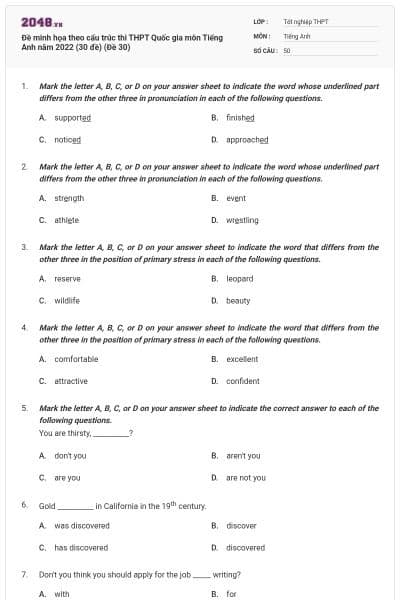
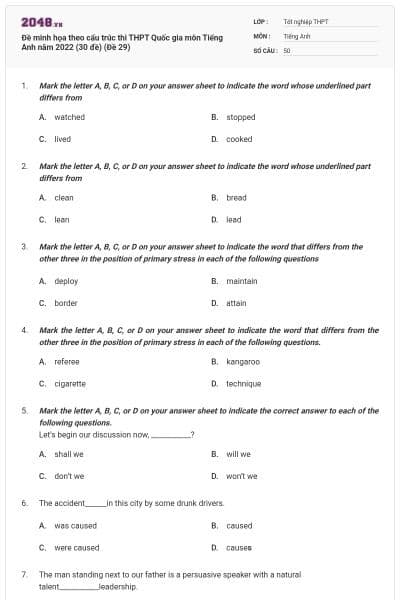
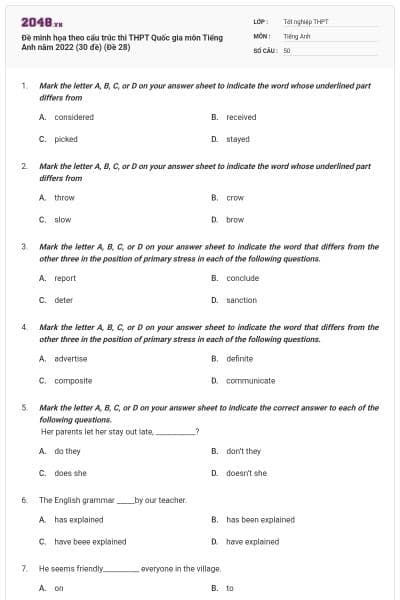
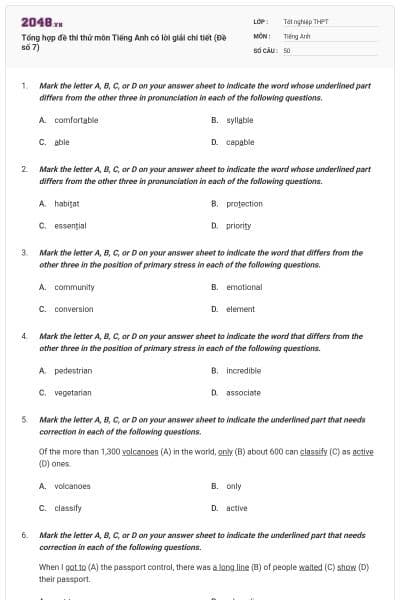
Mark the letter A, B, C, or D on your answer sheet to indicate the word whose underlined part differs from the other three in pronunciation in each of the following questions.
comfortable
syllable
able
capable
Đáp án C
Vì ‘a’ phát âm là /ei/, các từ còn lại phát âm là /ə/
able: /ˈeɪ.bəl/, comfortable: /ˈkʌm.fə.tə.bəl/, syllable: /ˈsɪl.ə.bl̩/, capable: /ˈkeɪ.pə.bəl/
Mark the letter A, B, C, or D on your answer sheet to indicate the word whose underlined part differs from the other three in pronunciation in each of the following questions.
habitat
protection
essential
priority
Đáp án C
Vì ‘t’ phát âm là /ʃ/, các từ còn lại phát âm là /t/
essential: /ɪˈsen.ʃəl/, habitat: /ˈhæb.ɪ.tæt/, protection: /prəˈtek.ʃən/, priority: /praɪˈɒr.ə.ti/
Mark the letter A, B, C, or D on your answer sheet to indicate the word that differs from the other three in the position of primary stress in each of the following questions.
community
emotional
conversion
element
Đáp án D
Từ element trọng âm rơi vào âm tiết thứ nhất, các từ còn lại trọng âm rơi vào âm tiết thứ 2
Element: /ˈel.ɪ.mənt/, community: /kəˈmjuː.nə.ti/, emotional : /ɪˈməʊ.ʃən.əl/, conversion: /ɪˈməʊ.ʃən.əl/
Mark the letter A, B, C, or D on your answer sheet to indicate the word that differs from the other three in the position of primary stress in each of the following questions.
pedestrian
incredible
vegetarian
associate
Đáp án C
Từ vegetarian trọng âm rơi vào âm tiết thứ 3, các từ còn lại trọng âm rơi vào âm tiết thứ 2
Vegetarian: /ˌvedʒ.ɪˈteə.ri.ən/, pedestrian: /pəˈdes.tri.ən/, incredible: /ɪnˈkred.ə.bəl/, associate: /əˈsəʊ.si.eɪt/
Mark the letter A, B, C, or D on your answer sheet to indicate the underlined part that needs correction in each of the following questions.
Of the more than 1,300 volcanoes (A) in the world, only (B) about 600 can classify (C) as active (D) ones.
volcanoes
only
classify
active
Đáp án C
classify -> be classified:
Phải dùng dạng bị động vì chủ ngữ ở đây là about 600 volcanoes
Tạm dịch: Trong số hơn 1300 ngọn núi lửa trên thế giới, chỉ có khoảng 600 ngọn núi được xem là còn hoạt động
Mark the letter A, B, C, or D on your answer sheet to indicate the underlined part that needs correction in each of the following questions.
When I got to (A) the passport control, there was a long line (B) of people waited (C) show (D) their passport.
got to
a long line
waited
show
Đáp án C
waited -> waiting: theo cách rút gọn mệnh đề quan hệ đổi thành V_ing vì câu mang nghĩa chủ động
Tạm dịch: Khi tôi đến khu vực kiểm tra hộ chiếu, có một hàng dài người đang chờ đẻ trình chiếu hộ chiếu của họ
Mark the letter A, B, C, or D on your answer sheet to indicate the underlined part that needs correction in each of the following questions.
Finished (A) her household chores (B), Mary decided to do (C) some shopping (D).
finished
household chores
to do
shopping
Đáp án A
Finished -> having finished
-> Nếu 2 hành động ở 2 mệnh đề xảy ra đồng thời thường được chia cùng thì với nhau, ta lược bỏ chủ ngữ ở mệnh đề trạng ngữ rồi sau đó chia động từ trong mệnh đề đó ở dạng V_ing (chủ động)
-> Nếu 2 động từ ở 2 mệnh đề xảy ra theo thứ tự trước sau, ta lược bỏ chủ từ của mệnh đề có hành động xảy ra trước rồi sau đó chia động từ trong mệnh đề đó ở dạng Having + PP
Trong câu này hành động hoàn thành công việc nhà xảy ra và hoàn thành trước hành động quyết định đi mua sắm nên động từ cần chia ở dạng having + PP
Tạm dịch: Sau khi hoàn thành công việc nhà, Mary quyết định đi mua sắm
Mark the letter A, B, C, or D on your answer sheet to indicate the correct answer to each of the following questions.
No one knows exactly _____.
how did speech begin
how speech began
how the beginning of speech
of how beginning speech
Đáp án B
Câu tường thuật của dạng Wh_question có dạng Wh_question+ mệnh đề, sẽ không có hiện tượng đảo ngữ như trong câu hỏi bình thường
Tạm dịch: Không ai biết chính xác bài phát biểu bắt đầu như thế nào
Mark the letter A, B, C, or D on your answer sheet to indicate the correct answer to each of the following questions.
The marathon, first staged in 1896, _____ the legendary feat of a Greek soldier who carried news of victory from the battle at Marathon to Athens.
commemorating
was commemorated
commemorated
commemorates
Đáp án D
commemorate: (v) kỷ niệm, tưởng nhớ
Trong câu thiếu động từ chính nên cần chia động từ theo chủ ngữ là the marathon
Tạm dịch: Cuộc chạy marathon được diễn ra lần đầu tiên vào năm 1896 tưởng nhớ chiến tích thần kỳ của người lính Hy Lạp người đã đem tin chiến thắng từ trận đấu ở Marathon về Athens
Mark the letter A, B, C, or D on your answer sheet to indicate the correct answer to each of the following questions.
Neither my dad nor my mom _____ of the idea.
convinced
have convinced
was convinced
were convinced
Đáp án C
Khi dùng “neither … nor” thì động từ chia theo chủ ngữ gần nó nhất
Tạm dịch: Không phải cha tôi cũng không phải mẹ tôi đã bị thuyết phục bởi ý đó
Mark the letter A, B, C, or D on your answer sheet to indicate the correct answer to each of the following questions.
Jacobson is often referred to _____ at the factory.
be the best engineer
as the best engineer
by the president to be the best engineer
as being the best engineer
Đáp án B
Tobe referred to as the best engineer: được xem, được nhắc đến là người kỹ sư giỏi nhất
Mark the letter A, B, C, or D on your answer sheet to indicate the correct answer to each of the following questions.
He was brave, _____ soldier fought so bravely in that battle.
no others
no another
no other
no the others
Đáp án C
“no other solider”: không có người lính nào khác
Mark the letter A, B, C, or D on your answer sheet to indicate the correct answer to each of the following questions.
I took a course in shorthand and typing with a(n) _____ to applying for a secretarial job.
purpose
intention
view
project
Đáp án C
Cấu trúc: with a view to doing st: với dự kiến, ý định làm gì
Mark the letter A, B, C, or D on your answer sheet to indicate the correct answer to each of the following questions.
Our teacher tends to _____ certain subjects which she finds difficult to talk about.
boil down
string along
skate over
track down
Đáp án C
To skate over: tìm cách nói gián tiếp
Boil down: tóm tắt lại
String someone along: đánh lừa ai
Track down: theo dấu, tìm vị trí
Tạm dịch: cô giáo của chúng tôi có xu hướng nói gián tiếp chủ đề nào đó mà cô cảm thấy khó để nói
Mark the letter A, B, C, or D on your answer sheet to indicate the correct answer to each of the following questions.
Monica was so angry about the noise her neighbors were making that she refused to _____ it anymore.
get away with
run away with
put up with
cut down on
Đáp án C
To put up with st: chịu đựng cái gì, tha thứ cho việc gì
Get away with: trốn tránh hình phạt, thoái thác công việc
Run away with: áp đảo, lấn át
Cut down on: cắt giảm cái gì đó
Tạm dịch: Monica rất bực với tiếng ồn hàng xóm cô ấy gây ra đến nỗi mà cô ấy từ chối chịu đựng thêm nữa
Mark the letter A, B, C, or D on your answer sheet to indicate the correct answer to each of the following questions.
I _____ hope there won’t be a repetition of these unfortunate events.
bitterly
sincerely
unfailingly
completely
Đáp án B
Sincerely: (adv) một cách thân thiện , chân thành
Bitterly (adv): một cách cay đắng, chua chát
Unfailingly (adv): luôn luôn, lúc nào cũng
Completely (adv): hoàn toàn
Tạm dịch: Tôi chân thành mong rằng sẽ không có lần nào nữa cho những điều không may như này nữa
Mark the letter A, B, C, or D on your answer sheet to indicate the correct answer to each of the following questions.
There was _____ evidence to bring charges against the man.
ineffective
inadvisable
interior
insufficient
Đáp án D
Insufficient: (adj) không đủ, thiếu
Ineffective (adj): không hiệu quả
Inadvisable (adj): không thích hợp, không khôn ngoan
Interior (adj): ở trong, nội bộ
Tạm dịch: không đủ chứng cứ để buộc tội người đàn ông đó
Mark the letter A, B, C, or D on your answer sheet to indicate the correct answer to each of the following questions.
If Michael _____ with his piano playing, he could eventually reach concert standard.
perseveres
maintains
survives
sustains
Đáp án A
To persevere with st: kiên nhẫn, kiên gan, bền chí
Maintain: duy trì
Survive: sống sót
Sustain: kéo dài
Tạm dịch: Nếu Michael kiên trì chơi đàn, anh ấy cuối cùng có thể đạt đến độ chuẩn nghệ thuật nào đó
Mark the letter A, B, C, or D on your answer sheet to indicate the correct answer to each of the following questions.
After you have finished the _, restart the computer to get it acquainted to the new program.
installation
install
installment
installing
Đáp án A
Sau mạo từ the ta dùng danh từ
Installation (n): sự cài đặt, thiết lập
Install (v): thiết lập
Installment (n): tiền trả góp
Tạm dịch: Sau khi bạn hoàn thành việc cài đặt (cho máy tính), hãy khởi động lại máy tính để nó quen với chương trình mới
Mark the letter A, B, C, or D on your answer sheet to indicate the most suitable response to complete each of the following exchanges.
– Jones: “It seems to me that the summer is nice here.”
– Tam: “_____. It’s really lovely.”
You’re exactly right
You’re dead wrong
I couldn’t agree less
You could be right
Đáp án A
Jones: “Dường như đối với tôi mùa hè ở đây rất đẹp.”
Tam: “Bạn nhận xét đúng rồi đấy. Thời tiết thật sự rất tuyệt. “
Mark the letter A, B, C, or D on your answer sheet to indicate the most suitable response to complete each of the following exchanges.
– Anna: “In my opinion, children always watch too much TV.”
– Tom: “_____.”
Completely
Of course
Totally
Absolutely
Đáp án D
Absolutely: được sử dụng trong trường hợp này với mục đích tán thành quan điểm của ai đó.
Ann: “Theo ý tôi, trẻ con luôn xem quá nhiều TV”
Tom: “Đúng vậy đấy”
Mark the letter A, B, C, or D on your answer sheet to indicate the word(s) CLOSEST in meaning to the underlined word(s) in each of the following questions.
The pilot miraculously serviced the crash unscathed.
unsurprised
unhurt
unhappy
undeterred
Đáp án B
Unscathed: (adj) không bị tổn thương ≈ unhurt: (adj) không bị thương, không bị đau
Unsurprised (adj): không ngạc nhiên
Unhappy (adj): không hạnh phúc
Undeterred (adj): không bị ngăn cản
Tạm dịch: Một cách kỳ diệu phi công đã sống sót mà không bị thương sau vụ va chạm
Mark the letter A, B, C, or D on your answer sheet to indicate the word(s) CLOSEST in meaning to the underlined word(s) in each of the following questions.
Ponce de Leon searched in vain for a means of rejuvenating the aged.
making weary again
making wealthy again
making young again
making merry again
Đáp án C
Rejuvenate: (v) làm trẻ lại
Rejuvenating = making young again: làm trẻ lại
- making weary again: làm mệt mỏi nữa
- making wealthy again: làm giàu thêm nữa
- making merry again: làm cho vui vẻ lại
Tạm dịch: Ponce de Leon đã nghiên cứu một cách vô ích trong việc tìm cách làm trẻ lại
Mark the letter A, B, C, or D on your answer sheet to indicate the word(s) OPPOSITE in meaning to the underlined word(s) in each of the following questions.
Friendship changed to antipathy when the settlers took the Indian’s land.
fright
hatred
amity
hostility
Đáp án C
Antipathy: (n) sự ác cảm, sự thù địch ≠ amity: (n) quan hệ hữu nghị, tình bạn
Fright (n): sự hoảng sợ
Hatred (n): sự căm ghét
Hostility (n): sự thù địch
Tạm dịch: tình bạn đã biến thành sự thù địch khi những người khai hoang chiếm đất của người Ấn Độ
Mark the letter A, B, C, or D on your answer sheet to indicate the word(s) OPPOSITE in meaning to the underlined word(s) in each of the following questions.
During the five-decade history the Asian Games have been advancing in all aspects.
holding back
holding to
holding by
holding at
Đáp án A
Advance + in: (v) tiến lên, tiến bộ >< hold back: (v) ngăn lại, giữ lại
Tạm dịch: Trong suốt lịch sử 5 thập kỷ đại hội thể thao châu Á đã tiến bộ ở tất cá các mặt
Mark the letter A, B, C, or D on your answer sheet to indicate the sentence that is closest in meaning to each of the following questions.
I will only work extra hours if I get paid at a higher rate.
I will not work extra hours even if I get paid at a higher rate.
Unless I get paid at a higher rate, I won’t work extra hours.
Working extra hours means I won’t get paid at a higher rate.
I get paid at a higher rate because I will work extra hours.
Đáp án B
Câu gốc: tôi sẽ chỉ làm thêm giờ nếu tôi được trả ở mức lương cao hơn
A. Tôi sẽ không làm thêm giờ thậm chí nếu có được trả ở mức lương cao hơn -> không sát nghĩa với câu gốc
B. Nếu tôi không nhận được mức lương cao hơn, tôi sẽ không làm thêm giờ -> sát nghĩa với câu gốc. Ở đây sử dụng cấu trúc tương đương: Unless = if…not
C. Làm việc thêm giờ nghĩa là tôi sẽ không được trả ở mức lương cao hơn -> không sát nghĩa với câu gốc
D. Tôi được trả ở mức lương cao bở vì tôi sẽ làm thêm giờ không sát nghĩa với câu gốc
Mark the letter A, B, C, or D on your answer sheet to indicate the sentence that is closest in meaning to each of the following questions.
Mr. Kha remembered to take everything except his front door key.
The only thing which Mr. Kha forgot was his front door key.
Mr. Kha remembered to take everything including his front door key.
The only thing that Mr. Kha remembered was his front door key.
Except his front door key, Mr. Kha forgot everything.
Đáp án A
Câu gốc: Ông Kha nhớ để cầm theo mọi thứ ngoại trừ chìa khoá cửa trước
A. Thứ duy nhất mà ông Kha quên là chiếc chìa khoá cửa trước -> sát nghĩa với câu gốc
B. Ông Kha đã nhớ để cầm theo mọi thứ bao gồm cả chiếc chìa khoá cửa trước -> không sát nghĩa với câu gốc
C. Thứ duy nhất ông Kha nhớ là chiếc chìa khoá cửa trước -> không sát nghĩa với câu gốc
D. Ngoại trừ chiếc chìa khoá cửa trước, ông Kha quên mọi thứ -> không sát nghĩa với câu gốc
Mark the letter A, B, C, or D on your answer sheet to indicate the sentence that is closest in meaning to each of the following questions.
Mrs. Gibson expressed her thanks for all the help she’d received.
Mrs. Gibson stated that she was happy for all the help she’d received.
Mrs. Gibson expressed she was surprised at all the help she’d received.
Mrs. Gibson reported she was amused at all the help she’d received.
Mrs. Gibson said that she was grateful for all the help she’d received.
Đáp án D
Câu gốc: Bà Gibson bày tỏ lòng cảm ơn vì những giúp đỡ bà nhận được
A. Bà Gigson nói rằng bà hạnh phúc vì những giúp đỡ bà đã nhận được
B. Bà Gibson bày tỏ rằng bà ngạc nhiên với những giúp đỡ bà nhận được
C. Bà Gibson báo cáo rằng bà thích thú với những giúp đỡ bà nhận được
D. Bà Gibson nói rằng bà biết ơn với những giúp đỡ bà nhận được -> sát nghĩa với câu gốc
Mark the letter A, B, C, or D on your answer sheet to indicate the sentence that best combines each pair of sentences in the following questions.
They finished one project. They started working on the next.
Had they finished one project, they would have started working on the next.
Only if they had finished one project did they start working on the next.
Hardly had they finished one project when they started working on the next.
Not until did they start working on the next project then they finished one.
Đáp án C
Câu gốc: Họ đã hoàn thành một dự án. Họ đã bắt đầu làm dự án kế tiếp
A. Nếu họ đã hoàn thành một dự án, họ sẽ bắt đầu làm dự án kế tiếp
B. Chỉ khi họ đã hoàn thành một dự án, họ mới bắt đầu làm dự án kế tiếp
C. Ngay khi họ hoàn thành một dự án họ sẽ bắt đầu làm dự án kế tiếp -> cách kết hợp tốt nhất cho 2 câu gốc
D. Mãi cho đến lúc họ bắt đầu làm dự án tiếp theo thì họ mới honaf thành một dự án.
Mark the letter A, B, C, or D on your answer sheet to indicate the sentence that best combines each pair of sentences in the following questions.
The proposal seemed like a good idea. The manager refused it
The manager refused the proposal though it seemed like a good idea.
Since the proposal seemed like a good idea, the manager refused it.
The manager didn’t like to proposal because it didn’t seem a good idea.
The proposal didn’t seem like a good idea, so the manager didn’t accept it.
Đáp án A
Câu gốc: Đề xuất đó dường như là một ý hay. Người quản lý từ chối lời đề xuất đó
A. Người quản lý từ chối đề xuất đó dù dường như đó một ý hay
B. Bởi vì đề xuất đó dường như là một ý hay, người quản lý từ chối đề xuất đó
C. Người quản lý không thích đề xuất vì dường như nó không phải là một ý hay
D. Đề xuất dường như không hay, vì vậy người quản lý không chấp nhận nó
Read the following passage and mark the letter A, B, C, or D on your answer sheet to indicate the correct word or phrase that best fits each of the numbered blanks from 31 to 35.
Reference books are not designed to be read from the first page to the last but rather to be consulted to answer the questions and provide both general and specific pieces of information.
One of the most (31) _____ -used reference books is a dictionary, which provides information about words. It lists meanings and spellings, tells how a word is pronounced, gives (32) _____ of how it is used, may reveal its origins and also lists synonyms and antonyms. To help you find the words faster, there are guide words at the top of each page showing the first and last words on that page - and of course it (33) _____ to know the alphabet!
There may be numerous special sections at the back with facts about famous people and places, lists of dates and scientific names, etc. There is usually a section at the front (34) _____ how to use the dictionary, which includes the special abbreviations or signs.
An atlas is also a reference book and it contains charts, tables and geographical facts, as well as maps. Political maps locate countries and cities, physical maps show the formation of the land with its mountains and valleys, and economic maps show industries and agriculture. To find a specific place, you need to look in the (35) _____ at the back of the atlas and the exact position on the map. There are numerous map symbols that you need to know in order to be able to read a map-almost like a special language-and these are explained at the front of the atlas.
Điền ô số 31
greatly
mainly
widely
largely
Đáp án C
Widely: (adv) rộng rãi
Cấu trúc: tobe widely + used: được sử dụng rộng khắp
Read the following passage and mark the letter A, B, C, or D on your answer sheet to indicate the correct word or phrase that best fits each of the numbered blanks from 31 to 35.
Reference books are not designed to be read from the first page to the last but rather to be consulted to answer the questions and provide both general and specific pieces of information.
One of the most (31) _____ -used reference books is a dictionary, which provides information about words. It lists meanings and spellings, tells how a word is pronounced, gives (32) _____ of how it is used, may reveal its origins and also lists synonyms and antonyms. To help you find the words faster, there are guide words at the top of each page showing the first and last words on that page - and of course it (33) _____ to know the alphabet!
There may be numerous special sections at the back with facts about famous people and places, lists of dates and scientific names, etc. There is usually a section at the front (34) _____ how to use the dictionary, which includes the special abbreviations or signs.
An atlas is also a reference book and it contains charts, tables and geographical facts, as well as maps. Political maps locate countries and cities, physical maps show the formation of the land with its mountains and valleys, and economic maps show industries and agriculture. To find a specific place, you need to look in the (35) _____ at the back of the atlas and the exact position on the map. There are numerous map symbols that you need to know in order to be able to read a map-almost like a special language-and these are explained at the front of the atlas.
Điền ô số 32
evidence
roof
examples
cases
Đáp án C
gives examples of how it is used: đưa ra những ví dụ về cách dùng của từ đó
Read the following passage and mark the letter A, B, C, or D on your answer sheet to indicate the correct word or phrase that best fits each of the numbered blanks from 31 to 35.
Reference books are not designed to be read from the first page to the last but rather to be consulted to answer the questions and provide both general and specific pieces of information.
One of the most (31) _____ -used reference books is a dictionary, which provides information about words. It lists meanings and spellings, tells how a word is pronounced, gives (32) _____ of how it is used, may reveal its origins and also lists synonyms and antonyms. To help you find the words faster, there are guide words at the top of each page showing the first and last words on that page - and of course it (33) _____ to know the alphabet!
There may be numerous special sections at the back with facts about famous people and places, lists of dates and scientific names, etc. There is usually a section at the front (34) _____ how to use the dictionary, which includes the special abbreviations or signs.
An atlas is also a reference book and it contains charts, tables and geographical facts, as well as maps. Political maps locate countries and cities, physical maps show the formation of the land with its mountains and valleys, and economic maps show industries and agriculture. To find a specific place, you need to look in the (35) _____ at the back of the atlas and the exact position on the map. There are numerous map symbols that you need to know in order to be able to read a map-almost like a special language-and these are explained at the front of the atlas.
Điền ô số 33
assists
pays
helps
works
Đáp án C
Cấu trúc: help sb (to) do sth: giúp ai làm gì
Và: help (to) do st:
Read the following passage and mark the letter A, B, C, or D on your answer sheet to indicate the correct word or phrase that best fits each of the numbered blanks from 31 to 35.
Reference books are not designed to be read from the first page to the last but rather to be consulted to answer the questions and provide both general and specific pieces of information.
One of the most (31) _____ -used reference books is a dictionary, which provides information about words. It lists meanings and spellings, tells how a word is pronounced, gives (32) _____ of how it is used, may reveal its origins and also lists synonyms and antonyms. To help you find the words faster, there are guide words at the top of each page showing the first and last words on that page - and of course it (33) _____ to know the alphabet!
There may be numerous special sections at the back with facts about famous people and places, lists of dates and scientific names, etc. There is usually a section at the front (34) _____ how to use the dictionary, which includes the special abbreviations or signs.
An atlas is also a reference book and it contains charts, tables and geographical facts, as well as maps. Political maps locate countries and cities, physical maps show the formation of the land with its mountains and valleys, and economic maps show industries and agriculture. To find a specific place, you need to look in the (35) _____ at the back of the atlas and the exact position on the map. There are numerous map symbols that you need to know in order to be able to read a map-almost like a special language-and these are explained at the front of the atlas.
Điền ô số 34
explaining
interpreting
suggesting
presenting
Đáp án A
To explain: (v) giải thích
Cấu trúc:
- explain st (to sb): giải thích cái gì cho ai
- explain why/ how …
Read the following passage and mark the letter A, B, C, or D on your answer sheet to indicate the correct word or phrase that best fits each of the numbered blanks from 31 to 35.
Reference books are not designed to be read from the first page to the last but rather to be consulted to answer the questions and provide both general and specific pieces of information.
One of the most (31) _____ -used reference books is a dictionary, which provides information about words. It lists meanings and spellings, tells how a word is pronounced, gives (32) _____ of how it is used, may reveal its origins and also lists synonyms and antonyms. To help you find the words faster, there are guide words at the top of each page showing the first and last words on that page - and of course it (33) _____ to know the alphabet!
There may be numerous special sections at the back with facts about famous people and places, lists of dates and scientific names, etc. There is usually a section at the front (34) _____ how to use the dictionary, which includes the special abbreviations or signs.
An atlas is also a reference book and it contains charts, tables and geographical facts, as well as maps. Political maps locate countries and cities, physical maps show the formation of the land with its mountains and valleys, and economic maps show industries and agriculture. To find a specific place, you need to look in the (35) _____ at the back of the atlas and the exact position on the map. There are numerous map symbols that you need to know in order to be able to read a map-almost like a special language-and these are explained at the front of the atlas.
Điền ô số 35
foreword
preface
complement
index
Đáp án D
Index: bảng mục lục (cho danh sách)
Foreword: lời nói đầu
Preface: lời nói đầu
Complement: phần bổ sung
Read the following passage and mark the letter A, B, C, or D on your answer sheet to indicate the correct answer to each of the questions from 36 to 42.
(1) The initial contact between American Indians and European settlers usually involved trade, whereby Indians acquired tools and firearms and the Europeans obtained furs. These initial events usually pitted Indian tribes against each other as they competed for the European trade and for the lands containing fur-producing animals. When the furs had been depleted, the Europeans began a campaign to obtain the lands the Indians occupied. The Indians often formed confederations and alliances to fight back the Europeans; however, the Indians’ involvement in the white people’s wars usually disrupted these confederations. Indians resisted the attempts by the whites to displace them. They fought defensive wars such as the Black Hawk War in 1832. Indian uprisings also occurred, like the Sioux uprising in the 1860s.
(2) Despite the resistance of the Indians, the Europeans were destined to win the conflict. After Indian resistance was crushed, the whites legitimized the taking of Indian lands by proposing treaties, frequently offering gifts to Indian chiefs to get them sign the treaties. Once an Indian group had signed a treaty, the whites proceeded to remove them from their land. Often the Indians were forced west of the Mississippi into Indian Territory-land the whites considered uninhabitable. If only a few Indians remained after the conquest, they were often absorbed by local tribes or forced onto reservations.
(3) No aspect of American history is more poignant than the accounts of the forced removal of Indians across the continent. As white settlers migrated farther west, Indians were forced to sign new treaties giving up the lands earlier treaties had promised them. Some Indian tribes, realizing the futility of resistance, accepted their fate and moved westward without force. The Winnebagos, who offered little resistance, were shifted from place to place between 1829 and 1866. About half of them perished during their perpetual sojourn. Other tribes, however, bitterly resisted. The Seminoles signed a treaty in 1832 but violently resisted removal. Hostilities broke out in 1835 and continued for seven years. The United States government lost nearly 1,500 men and spent over $50 million in its attempts to crush Seminole resistance. Most of Seminoles were eventually forced to Indian Territory. However, several hundred remained in the Florida Everglades, where their descendants live today.
What does the passage mainly discuss?
Violation of treaties by white settlers.
Conflict between American Indians and Europeans settlers.
The diverse cultures of American Indian tribes.
Trade between American Indians and European settlers.
Đáp án B
Đoạn văn nói về sự xung đột giữa người Mỹ da đỏ và người di cư Châu Âu.
Read the following passage and mark the letter A, B, C, or D on your answer sheet to indicate the correct answer to each of the questions from 36 to 42.
(1) The initial contact between American Indians and European settlers usually involved trade, whereby Indians acquired tools and firearms and the Europeans obtained furs. These initial events usually pitted Indian tribes against each other as they competed for the European trade and for the lands containing fur-producing animals. When the furs had been depleted, the Europeans began a campaign to obtain the lands the Indians occupied. The Indians often formed confederations and alliances to fight back the Europeans; however, the Indians’ involvement in the white people’s wars usually disrupted these confederations. Indians resisted the attempts by the whites to displace them. They fought defensive wars such as the Black Hawk War in 1832. Indian uprisings also occurred, like the Sioux uprising in the 1860s.
(2) Despite the resistance of the Indians, the Europeans were destined to win the conflict. After Indian resistance was crushed, the whites legitimized the taking of Indian lands by proposing treaties, frequently offering gifts to Indian chiefs to get them sign the treaties. Once an Indian group had signed a treaty, the whites proceeded to remove them from their land. Often the Indians were forced west of the Mississippi into Indian Territory-land the whites considered uninhabitable. If only a few Indians remained after the conquest, they were often absorbed by local tribes or forced onto reservations.
(3) No aspect of American history is more poignant than the accounts of the forced removal of Indians across the continent. As white settlers migrated farther west, Indians were forced to sign new treaties giving up the lands earlier treaties had promised them. Some Indian tribes, realizing the futility of resistance, accepted their fate and moved westward without force. The Winnebagos, who offered little resistance, were shifted from place to place between 1829 and 1866. About half of them perished during their perpetual sojourn. Other tribes, however, bitterly resisted. The Seminoles signed a treaty in 1832 but violently resisted removal. Hostilities broke out in 1835 and continued for seven years. The United States government lost nearly 1,500 men and spent over $50 million in its attempts to crush Seminole resistance. Most of Seminoles were eventually forced to Indian Territory. However, several hundred remained in the Florida Everglades, where their descendants live today.
The word “legitimized” in paragraph 2 is closet in meaning to _____.
encouraged
wrote to support
justified
coordinated
Đáp án C
To legitimize: (v) hợp pháp hóa = justify: (v) chứng minh là đúng, hợp pháp hóa
To encourage (v): khuyến khích
Wrote to support: được viết để ủng hộ
To coordinate (v): phối hợp
Read the following passage and mark the letter A, B, C, or D on your answer sheet to indicate the correct answer to each of the questions from 36 to 42.
(1) The initial contact between American Indians and European settlers usually involved trade, whereby Indians acquired tools and firearms and the Europeans obtained furs. These initial events usually pitted Indian tribes against each other as they competed for the European trade and for the lands containing fur-producing animals. When the furs had been depleted, the Europeans began a campaign to obtain the lands the Indians occupied. The Indians often formed confederations and alliances to fight back the Europeans; however, the Indians’ involvement in the white people’s wars usually disrupted these confederations. Indians resisted the attempts by the whites to displace them. They fought defensive wars such as the Black Hawk War in 1832. Indian uprisings also occurred, like the Sioux uprising in the 1860s.
(2) Despite the resistance of the Indians, the Europeans were destined to win the conflict. After Indian resistance was crushed, the whites legitimized the taking of Indian lands by proposing treaties, frequently offering gifts to Indian chiefs to get them sign the treaties. Once an Indian group had signed a treaty, the whites proceeded to remove them from their land. Often the Indians were forced west of the Mississippi into Indian Territory-land the whites considered uninhabitable. If only a few Indians remained after the conquest, they were often absorbed by local tribes or forced onto reservations.
(3) No aspect of American history is more poignant than the accounts of the forced removal of Indians across the continent. As white settlers migrated farther west, Indians were forced to sign new treaties giving up the lands earlier treaties had promised them. Some Indian tribes, realizing the futility of resistance, accepted their fate and moved westward without force. The Winnebagos, who offered little resistance, were shifted from place to place between 1829 and 1866. About half of them perished during their perpetual sojourn. Other tribes, however, bitterly resisted. The Seminoles signed a treaty in 1832 but violently resisted removal. Hostilities broke out in 1835 and continued for seven years. The United States government lost nearly 1,500 men and spent over $50 million in its attempts to crush Seminole resistance. Most of Seminoles were eventually forced to Indian Territory. However, several hundred remained in the Florida Everglades, where their descendants live today.
It can be concluded from the line 8-10 that _____.
Both Indians and European wanted to end the conflict by signing treaties
Indian chiefs were easily bribed by economic offerings
Europeans showed great speaking skill in their treaty proposals
Europeans had greater military, political, and economic power than Indians
Đáp án D
Thông tin ở đoạn 2: “Despite the resistance of the Indians, the Europeans were destined to win the conflict. After Indian resistance was crushed, the whites legitimized the taking of Indian lands by proposing treaties, frequently offering gifts to Indian chiefs to get them sign the treaties.”
Read the following passage and mark the letter A, B, C, or D on your answer sheet to indicate the correct answer to each of the questions from 36 to 42.
(1) The initial contact between American Indians and European settlers usually involved trade, whereby Indians acquired tools and firearms and the Europeans obtained furs. These initial events usually pitted Indian tribes against each other as they competed for the European trade and for the lands containing fur-producing animals. When the furs had been depleted, the Europeans began a campaign to obtain the lands the Indians occupied. The Indians often formed confederations and alliances to fight back the Europeans; however, the Indians’ involvement in the white people’s wars usually disrupted these confederations. Indians resisted the attempts by the whites to displace them. They fought defensive wars such as the Black Hawk War in 1832. Indian uprisings also occurred, like the Sioux uprising in the 1860s.
(2) Despite the resistance of the Indians, the Europeans were destined to win the conflict. After Indian resistance was crushed, the whites legitimized the taking of Indian lands by proposing treaties, frequently offering gifts to Indian chiefs to get them sign the treaties. Once an Indian group had signed a treaty, the whites proceeded to remove them from their land. Often the Indians were forced west of the Mississippi into Indian Territory-land the whites considered uninhabitable. If only a few Indians remained after the conquest, they were often absorbed by local tribes or forced onto reservations.
(3) No aspect of American history is more poignant than the accounts of the forced removal of Indians across the continent. As white settlers migrated farther west, Indians were forced to sign new treaties giving up the lands earlier treaties had promised them. Some Indian tribes, realizing the futility of resistance, accepted their fate and moved westward without force. The Winnebagos, who offered little resistance, were shifted from place to place between 1829 and 1866. About half of them perished during their perpetual sojourn. Other tribes, however, bitterly resisted. The Seminoles signed a treaty in 1832 but violently resisted removal. Hostilities broke out in 1835 and continued for seven years. The United States government lost nearly 1,500 men and spent over $50 million in its attempts to crush Seminole resistance. Most of Seminoles were eventually forced to Indian Territory. However, several hundred remained in the Florida Everglades, where their descendants live today.
The author makes the point that Indian Territory was _____.
where a few Indians remained
in the western part of Mississippi.
where several battles between Indians and whites took place.
considered undesirable by European settlers.
Đáp án D
Thông tin ở đoạn 2: “…Indian Territory-land the whites considered uninhabitable.” – vùng lãnh thổ người Da đỏ mà người da trắng (châu Âu) xem là không ở được.
Chú ý: undesirable: (a) không mong muốn, không ưa, không them muốn
Read the following passage and mark the letter A, B, C, or D on your answer sheet to indicate the correct answer to each of the questions from 36 to 42.
(1) The initial contact between American Indians and European settlers usually involved trade, whereby Indians acquired tools and firearms and the Europeans obtained furs. These initial events usually pitted Indian tribes against each other as they competed for the European trade and for the lands containing fur-producing animals. When the furs had been depleted, the Europeans began a campaign to obtain the lands the Indians occupied. The Indians often formed confederations and alliances to fight back the Europeans; however, the Indians’ involvement in the white people’s wars usually disrupted these confederations. Indians resisted the attempts by the whites to displace them. They fought defensive wars such as the Black Hawk War in 1832. Indian uprisings also occurred, like the Sioux uprising in the 1860s.
(2) Despite the resistance of the Indians, the Europeans were destined to win the conflict. After Indian resistance was crushed, the whites legitimized the taking of Indian lands by proposing treaties, frequently offering gifts to Indian chiefs to get them sign the treaties. Once an Indian group had signed a treaty, the whites proceeded to remove them from their land. Often the Indians were forced west of the Mississippi into Indian Territory-land the whites considered uninhabitable. If only a few Indians remained after the conquest, they were often absorbed by local tribes or forced onto reservations.
(3) No aspect of American history is more poignant than the accounts of the forced removal of Indians across the continent. As white settlers migrated farther west, Indians were forced to sign new treaties giving up the lands earlier treaties had promised them. Some Indian tribes, realizing the futility of resistance, accepted their fate and moved westward without force. The Winnebagos, who offered little resistance, were shifted from place to place between 1829 and 1866. About half of them perished during their perpetual sojourn. Other tribes, however, bitterly resisted. The Seminoles signed a treaty in 1832 but violently resisted removal. Hostilities broke out in 1835 and continued for seven years. The United States government lost nearly 1,500 men and spent over $50 million in its attempts to crush Seminole resistance. Most of Seminoles were eventually forced to Indian Territory. However, several hundred remained in the Florida Everglades, where their descendants live today.
According to the passage, which of the following did NOT happen?
Treaties allowed Indians to live where they wanted.
Indians tribes formed alliances with other tribes.
Indians were forced to live on reservations.
Indians rebelled against European settlers.
Đáp án A
Thông tin ở đoạn 2: “…the whites proceeded to remove them from their land.” – người da trắng tiếp tục loại bỏ họ ra khỏi vùng đất của mình… => người Da Đỏ không được sống nơi mà họ muốn sau khi kí hiệp ước.
Read the following passage and mark the letter A, B, C, or D on your answer sheet to indicate the correct answer to each of the questions from 36 to 42.
(1) The initial contact between American Indians and European settlers usually involved trade, whereby Indians acquired tools and firearms and the Europeans obtained furs. These initial events usually pitted Indian tribes against each other as they competed for the European trade and for the lands containing fur-producing animals. When the furs had been depleted, the Europeans began a campaign to obtain the lands the Indians occupied. The Indians often formed confederations and alliances to fight back the Europeans; however, the Indians’ involvement in the white people’s wars usually disrupted these confederations. Indians resisted the attempts by the whites to displace them. They fought defensive wars such as the Black Hawk War in 1832. Indian uprisings also occurred, like the Sioux uprising in the 1860s.
(2) Despite the resistance of the Indians, the Europeans were destined to win the conflict. After Indian resistance was crushed, the whites legitimized the taking of Indian lands by proposing treaties, frequently offering gifts to Indian chiefs to get them sign the treaties. Once an Indian group had signed a treaty, the whites proceeded to remove them from their land. Often the Indians were forced west of the Mississippi into Indian Territory-land the whites considered uninhabitable. If only a few Indians remained after the conquest, they were often absorbed by local tribes or forced onto reservations.
(3) No aspect of American history is more poignant than the accounts of the forced removal of Indians across the continent. As white settlers migrated farther west, Indians were forced to sign new treaties giving up the lands earlier treaties had promised them. Some Indian tribes, realizing the futility of resistance, accepted their fate and moved westward without force. The Winnebagos, who offered little resistance, were shifted from place to place between 1829 and 1866. About half of them perished during their perpetual sojourn. Other tribes, however, bitterly resisted. The Seminoles signed a treaty in 1832 but violently resisted removal. Hostilities broke out in 1835 and continued for seven years. The United States government lost nearly 1,500 men and spent over $50 million in its attempts to crush Seminole resistance. Most of Seminoles were eventually forced to Indian Territory. However, several hundred remained in the Florida Everglades, where their descendants live today.
In line 14-16, the author implies that _____.
Indian treaties and removal were minor events in American history.
new treaties promised Indians more land than had the earlier treaties
many accounts of Indian removal are not true
Indian removal was a shameful tragedy of American history
Đáp án D
Thông tin nằm ở đoạn 3: “No aspect of American history is more poignant than the accounts of the forced removal of Indians across the continent.” – Không khía cạnh nào của lịch sử Mỹ đau xót hơn những bản miêu tả về việc bị ép phải chuyển đi của người Da Đỏ qua các lục địa.
Read the following passage and mark the letter A, B, C, or D on your answer sheet to indicate the correct answer to each of the questions from 36 to 42.
(1) The initial contact between American Indians and European settlers usually involved trade, whereby Indians acquired tools and firearms and the Europeans obtained furs. These initial events usually pitted Indian tribes against each other as they competed for the European trade and for the lands containing fur-producing animals. When the furs had been depleted, the Europeans began a campaign to obtain the lands the Indians occupied. The Indians often formed confederations and alliances to fight back the Europeans; however, the Indians’ involvement in the white people’s wars usually disrupted these confederations. Indians resisted the attempts by the whites to displace them. They fought defensive wars such as the Black Hawk War in 1832. Indian uprisings also occurred, like the Sioux uprising in the 1860s.
(2) Despite the resistance of the Indians, the Europeans were destined to win the conflict. After Indian resistance was crushed, the whites legitimized the taking of Indian lands by proposing treaties, frequently offering gifts to Indian chiefs to get them sign the treaties. Once an Indian group had signed a treaty, the whites proceeded to remove them from their land. Often the Indians were forced west of the Mississippi into Indian Territory-land the whites considered uninhabitable. If only a few Indians remained after the conquest, they were often absorbed by local tribes or forced onto reservations.
(3) No aspect of American history is more poignant than the accounts of the forced removal of Indians across the continent. As white settlers migrated farther west, Indians were forced to sign new treaties giving up the lands earlier treaties had promised them. Some Indian tribes, realizing the futility of resistance, accepted their fate and moved westward without force. The Winnebagos, who offered little resistance, were shifted from place to place between 1829 and 1866. About half of them perished during their perpetual sojourn. Other tribes, however, bitterly resisted. The Seminoles signed a treaty in 1832 but violently resisted removal. Hostilities broke out in 1835 and continued for seven years. The United States government lost nearly 1,500 men and spent over $50 million in its attempts to crush Seminole resistance. Most of Seminoles were eventually forced to Indian Territory. However, several hundred remained in the Florida Everglades, where their descendants live today.
The word “futility” could be best replaced by _____.
uselessness
expense
importance
advantage
Đáp án A
Futility: (n) sự vô ích, không hiệu quả = uselessness: (n) sự vô ích
Expense (n): chi phí
Importance (n): sự quan trọng
Advantage (n): lợi ích
Read the following passage on transport, and mark the letter A, B, C, or D on your answer sheet to indicate the correct answer to each of the questions from 43 to 50.
No educational medium better as means of spatial communication than the atlas. Atlases deal with such invaluable information as population distribution and density. One of the best, Pennycooke's World Atlas, has been widely accepted as a standard owing to the quality of its maps and photographs, which not only show various settlements but also portray them in a variety of scales. In fact, the very first map in the atlas is a cleverly designed population cartogram that projects the size of each country if geographical size were proportional to population. Following the proportional layout, a sequence of smaller maps shows the world’s population density, each country’s birth and death rates, population increase or decrease, industrialization, urbanization, gross national product in terms of per capita income, the quality of medical care, literacy, and language. To give readers a perspective on how their own country fits in with the global view, additional projections depict the world's patterns in nutrition, calorie and protein consumption, health care, number of physicians per unit of population, and life expectancy by region. Population density maps on a subcontinental scale, as well as political maps. Convey the diverse demographic phenomena of the world in a broad array of scales.
What is the main topic of the passage?
The educational benefits of atlases.
Physical maps in an atlas.
The ideal in the making of atlases.
Partial maps and their uses.
Đáp án A
Ngay ở đầu đoạn văn, những lợi ích giáo dục của atlas đã được đề cập: “No educational medium better as means of spatial communication than the atlas.” – Không một phương tiện giáo dục nào tốt hơn phương tiện truyền thông về không gian như atlas.
Read the following passage on transport, and mark the letter A, B, C, or D on your answer sheet to indicate the correct answer to each of the questions from 43 to 50.
No educational medium better as means of spatial communication than the atlas. Atlases deal with such invaluable information as population distribution and density. One of the best, Pennycooke's World Atlas, has been widely accepted as a standard owing to the quality of its maps and photographs, which not only show various settlements but also portray them in a variety of scales. In fact, the very first map in the atlas is a cleverly designed population cartogram that projects the size of each country if geographical size were proportional to population. Following the proportional layout, a sequence of smaller maps shows the world’s population density, each country’s birth and death rates, population increase or decrease, industrialization, urbanization, gross national product in terms of per capita income, the quality of medical care, literacy, and language. To give readers a perspective on how their own country fits in with the global view, additional projections depict the world's patterns in nutrition, calorie and protein consumption, health care, number of physicians per unit of population, and life expectancy by region. Population density maps on a subcontinental scale, as well as political maps. Convey the diverse demographic phenomena of the world in a broad array of scales.
According to the passage, the first map in Pennycooke's World Atlas shows______.
the population policy in each country
the hypothetical sizes of each country
geographical proportions of each country
national boundaries relative to population
Đáp án D
Thông tin nằm ở câu 4 của đoạn: “In fact, the very first map in the atlas is a cleverly designed population cartogram that projects the size of each country if geographical size were proportional to population.”
Read the following passage on transport, and mark the letter A, B, C, or D on your answer sheet to indicate the correct answer to each of the questions from 43 to 50.
No educational medium better as means of spatial communication than the atlas. Atlases deal with such invaluable information as population distribution and density. One of the best, Pennycooke's World Atlas, has been widely accepted as a standard owing to the quality of its maps and photographs, which not only show various settlements but also portray them in a variety of scales. In fact, the very first map in the atlas is a cleverly designed population cartogram that projects the size of each country if geographical size were proportional to population. Following the proportional layout, a sequence of smaller maps shows the world’s population density, each country’s birth and death rates, population increase or decrease, industrialization, urbanization, gross national product in terms of per capita income, the quality of medical care, literacy, and language. To give readers a perspective on how their own country fits in with the global view, additional projections depict the world's patterns in nutrition, calorie and protein consumption, health care, number of physicians per unit of population, and life expectancy by region. Population density maps on a subcontinental scale, as well as political maps. Convey the diverse demographic phenomena of the world in a broad array of scales.
In the passage, the word “invaluable” is closet in meaning to ______.
incremental
invalid
priceless
shapeless
Đáp án C
Invaluable = priceless: (a) vô giá, rất giá trị, không định giá được
Incremental: (a) thuộc tiền lãi, tiền lời
Invalid: (a) không có hiệu lực; tàn tật, tàn phế
Shapeless: (a) không có hình thù
Read the following passage on transport, and mark the letter A, B, C, or D on your answer sheet to indicate the correct answer to each of the questions from 43 to 50.
No educational medium better as means of spatial communication than the atlas. Atlases deal with such invaluable information as population distribution and density. One of the best, Pennycooke's World Atlas, has been widely accepted as a standard owing to the quality of its maps and photographs, which not only show various settlements but also portray them in a variety of scales. In fact, the very first map in the atlas is a cleverly designed population cartogram that projects the size of each country if geographical size were proportional to population. Following the proportional layout, a sequence of smaller maps shows the world’s population density, each country’s birth and death rates, population increase or decrease, industrialization, urbanization, gross national product in terms of per capita income, the quality of medical care, literacy, and language. To give readers a perspective on how their own country fits in with the global view, additional projections depict the world's patterns in nutrition, calorie and protein consumption, health care, number of physicians per unit of population, and life expectancy by region. Population density maps on a subcontinental scale, as well as political maps. Convey the diverse demographic phenomena of the world in a broad array of scales.
Which of the following is NOT mentioned in the passage?
calorie consumption
currency exchange rates
a level of educations
population decline
Đáp án B
Các lựa chọn A, C, D đều nằm trong đoạn văn: “Following the proportional layout, a sequence of smaller maps shows the world’s population density, each country’s birth and death rates, population increase or decrease (D), industrialization, urbanization, gross national product in terms of per capita income, the quality of medical care, literacy, and language (C). To give readers a perspective on how their own country fits in with the global view, additional projections depict the world's patterns in nutrition, calorie and protein consumption (A)…”
Read the following passage on transport, and mark the letter A, B, C, or D on your answer sheet to indicate the correct answer to each of the questions from 43 to 50.
No educational medium better as means of spatial communication than the atlas. Atlases deal with such invaluable information as population distribution and density. One of the best, Pennycooke's World Atlas, has been widely accepted as a standard owing to the quality of its maps and photographs, which not only show various settlements but also portray them in a variety of scales. In fact, the very first map in the atlas is a cleverly designed population cartogram that projects the size of each country if geographical size were proportional to population. Following the proportional layout, a sequence of smaller maps shows the world’s population density, each country’s birth and death rates, population increase or decrease, industrialization, urbanization, gross national product in terms of per capita income, the quality of medical care, literacy, and language. To give readers a perspective on how their own country fits in with the global view, additional projections depict the world's patterns in nutrition, calorie and protein consumption, health care, number of physicians per unit of population, and life expectancy by region. Population density maps on a subcontinental scale, as well as political maps. Convey the diverse demographic phenomena of the world in a broad array of scales.
The word “layout” in the passage refers to _____.
the cartogram
the geographical size
population
each country
Đáp án A
Thông tin nằm ở câu: “In fact, the very first map in the atlas is a cleverly designed population cartogram that projects the size of each country if geographical size were proportional to population. Following the proportional layout, a sequence of smaller maps…”
Read the following passage on transport, and mark the letter A, B, C, or D on your answer sheet to indicate the correct answer to each of the questions from 43 to 50.
No educational medium better as means of spatial communication than the atlas. Atlases deal with such invaluable information as population distribution and density. One of the best, Pennycooke's World Atlas, has been widely accepted as a standard owing to the quality of its maps and photographs, which not only show various settlements but also portray them in a variety of scales. In fact, the very first map in the atlas is a cleverly designed population cartogram that projects the size of each country if geographical size were proportional to population. Following the proportional layout, a sequence of smaller maps shows the world’s population density, each country’s birth and death rates, population increase or decrease, industrialization, urbanization, gross national product in terms of per capita income, the quality of medical care, literacy, and language. To give readers a perspective on how their own country fits in with the global view, additional projections depict the world's patterns in nutrition, calorie and protein consumption, health care, number of physicians per unit of population, and life expectancy by region. Population density maps on a subcontinental scale, as well as political maps. Convey the diverse demographic phenomena of the world in a broad array of scales.
It can be inferred from the passage that maps can be used to _____.
pinpoint ethnic strife in each country
identify a shortage of qualified labor
give readers a new perspective on their own country
show readers photographs in a new form
Đáp án C
Thông tin nằm ở câu: “Following the proportional layout, a sequence of smaller maps shows the world’s population density, each country’s birth and death rates, population increase or decrease, industrialization, urbanization, gross national product in terms of per capita income, the quality of medical care, literacy, and language. To give readers a perspective on how their own country fits in with the global view, additional projections depict the world's patterns in nutrition, calorie and protein consumption, health care, number of physicians per unit of population, and life expectancy by region.”
Read the following passage on transport, and mark the letter A, B, C, or D on your answer sheet to indicate the correct answer to each of the questions from 43 to 50.
No educational medium better as means of spatial communication than the atlas. Atlases deal with such invaluable information as population distribution and density. One of the best, Pennycooke's World Atlas, has been widely accepted as a standard owing to the quality of its maps and photographs, which not only show various settlements but also portray them in a variety of scales. In fact, the very first map in the atlas is a cleverly designed population cartogram that projects the size of each country if geographical size were proportional to population. Following the proportional layout, a sequence of smaller maps shows the world’s population density, each country’s birth and death rates, population increase or decrease, industrialization, urbanization, gross national product in terms of per capita income, the quality of medical care, literacy, and language. To give readers a perspective on how their own country fits in with the global view, additional projections depict the world's patterns in nutrition, calorie and protein consumption, health care, number of physicians per unit of population, and life expectancy by region. Population density maps on a subcontinental scale, as well as political maps. Convey the diverse demographic phenomena of the world in a broad array of scales.
The author of the passage implies that _____.
atlases provide a bird's eye view of countries
maps use a variety of scales in each projection
maps of countries differ in size
atlases can be versatile instrument
Đáp án D
Dựa vào nội dung đoạn văn có thể rút ra được ẩn ý của tác giả. Theo tác giả thì tập bản đồ có thể là dụng cụ đa năng. Dựa vào tập bản đồ chúng ta có thể biết về sự tăng giảm dân số, về công nghiệp hóa, hiện đại hóa, biết về đất nước của mình, sự tiêu thụ calo, về dịch vụ chăm sóc sức khỏe hay tỷ lệ người biết đọc biết viết…
Read the following passage on transport, and mark the letter A, B, C, or D on your answer sheet to indicate the correct answer to each of the questions from 43 to 50.
No educational medium better as means of spatial communication than the atlas. Atlases deal with such invaluable information as population distribution and density. One of the best, Pennycooke's World Atlas, has been widely accepted as a standard owing to the quality of its maps and photographs, which not only show various settlements but also portray them in a variety of scales. In fact, the very first map in the atlas is a cleverly designed population cartogram that projects the size of each country if geographical size were proportional to population. Following the proportional layout, a sequence of smaller maps shows the world’s population density, each country’s birth and death rates, population increase or decrease, industrialization, urbanization, gross national product in terms of per capita income, the quality of medical care, literacy, and language. To give readers a perspective on how their own country fits in with the global view, additional projections depict the world's patterns in nutrition, calorie and protein consumption, health care, number of physicians per unit of population, and life expectancy by region. Population density maps on a subcontinental scale, as well as political maps. Convey the diverse demographic phenomena of the world in a broad array of scales.
The word “convey” in the passage is closest meaning to _____.
devise
conjure up
demonstrate
indicate
Đáp án C
Covey: (v) truyền đạt, bày tỏ, biểu lộ = demonstrate: (v) chứng minh, giải thích, bày tỏ, biểu lộ
- devise: (v) nghĩ ra, đề ra, đặt kế hoạch
- conjure up: (v) gợi lên cái gì, gọi hồn
- indicate: (v) chỉ, cho biết, ra dấu