Tổng hợp đề thi thử môn Tiếng Anh có lời giải chi tiết (Đề số 4)
50 câu hỏi
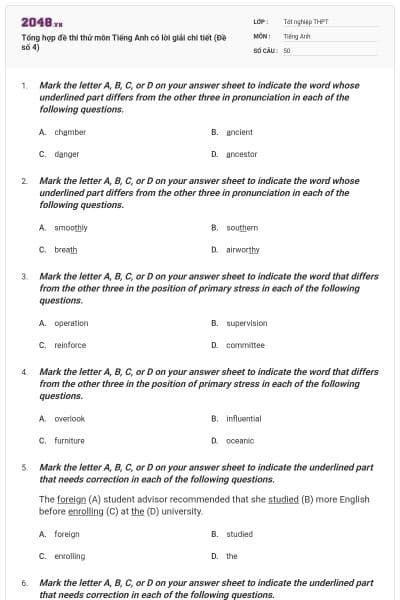
Mark the letter A, B, C, or D on your answer sheet to indicate the word whose underlined part differs from the other three in pronunciation in each of the following questions.
chamber
ancient
danger
ancestor
Đáp án D
/a/ trong ancestor được phát âm là /æ/, các âm /a/ trong các từ còn lại phát âm là /eɪ/
ancestor/ˈænsestə(r)/, chamber /ˈtʃeɪmbə(r)/, ancient/ˈeɪnʃənt/, danger/ˈdeɪndʒə(r)/
Mark the letter A, B, C, or D on your answer sheet to indicate the word whose underlined part differs from the other three in pronunciation in each of the following questions.
smoothly
southern
breath
airworthy
Đáp án C
/th/ trong breath được phát âm là /θ/, các âm /th/ trong các từ còn lại phát âm là /θ/
breath /breθ/, smoothly /ˈsmuːðli/, southern /ˈsʌðən/, airworthy /ˈeəwɜːði/
Mark the letter A, B, C, or D on your answer sheet to indicate the word that differs from the other three in the position of primary stress in each of the following questions.
operation
supervision
reinforce
committee
Đáp án D
Từ committee trọng âm rơi vào âm tiết thứ 2, các từ còn lại trọng âm rơi vào âm tiết thứ 3
committee/kəˈmɪti/, cooperation /ˌɒpəˈreɪʃn/, supervision /ˌsuːpəˈvɪʒn/, reinforce /ˌriːɪnˈfɔːs/
Mark the letter A, B, C, or D on your answer sheet to indicate the word that differs from the other three in the position of primary stress in each of the following questions.
overlook
influential
furniture
oceanic
Đáp án C
Từ furniture trọng âm rơi vào âm tiết thứ 1 , các từ còn lại trọng âm rơi vào âm tiết thứ 3
furniture /ˈfɜːnɪtʃə(r)/, overlook /ˌəʊvəˈlʊk/, influential /ˌɪnfluˈenʃl/, oceanic /ˌəʊʃiˈænɪk/
Mark the letter A, B, C, or D on your answer sheet to indicate the underlined part that needs correction in each of the following questions.
The foreign (A) student advisor recommended that she studied (B) more English before enrolling (C) at the (D) university.
foreign
studied
enrolling
the
Đáp án B
studied -> study
Cấu trúc giả định: S + recommend/advise/suggest…+ S + V (bare infinitive)
Tạm dịch: Cố vấn cho sinh viên nước ngoài đã khuyên rằng cô ấy nên học thêm tiếng Anh trước khi bước vào trường đại học
Mark the letter A, B, C, or D on your answer sheet to indicate the underlined part that needs correction in each of the following questions.
Tourists (A) are not permitted entering (B) the park after (C) twenty-four hundred hours for security (D).
tourists
entering
after
for security
Đáp án B
entering -> to enter
Động từ ở dạng to infinitive sau cấu trúc bị động tobe + permitted
Tạm dịch: Các du khách không được phép vào công viên sau 12h đêm vì lý do an ninh
Mark the letter A, B, C, or D on your answer sheet to indicate the underlined part that needs correction in each of the following questions.
In (A) a hot, sunny climate, man acclimatizes by eating (B) less, drinking more liquids (C), wearing lighter clothing, and experience (D) a darkening of the skin.
in
by eating
more liquids
experience
Đáp án D
experience -> experiencing
Cấu trúc song song với liên từ nối “and”: eating, drinking, wearing, experiencing
Tạm dịch: Với khí hậu nắng nóng, con người thích nghi bằng cách ăn ít đi, uống nhiều chất lỏng hơn, mặc áo mỏng hơn và trải qua quá trình tự làm da đen hơn.
Mark the letter A, B, C, or D on your answer sheet to indicate the correct answer to each of the following questions.
I had to pay the fine, _____.
didn’t I
hadn’t I
wouldn’t I
don’t I
Đáp án A
Động từ trong mệnh đề chính là “had to pay” được sử dụng như động từ thường nên câu hỏi đuôi mượn trợ động từ did và ở dạng phủ định didn’t
Mark the letter A, B, C, or D on your answer sheet to indicate the correct answer to each of the following questions.
What a dangerous thing to do! You _____ have been killed.
may
can
must
might
Đáp án D
Cấu trúc suy đoán trong quá khứ: might + have + PP dùng để suy đoán một điều gì đó có thể xảy ra với khả năng khoảng 80-90%. Câu này mang nghĩa bị động nên có thêm been sau have
Tạm dịch: Làm điều đó thật là nguy hiểm! Bạn đã có thể bị giết đấy!
Mark the letter A, B, C, or D on your answer sheet to indicate the correct answer to each of the following questions.
Ludwig van Beethoven is considered one of the greatest composers _____.
to live
when living
who ever lived
while he was still living
Đáp án C
Đại từ quan hệ who đứng sau danh từ chỉ người, đóng vai trò là chủ ngữ trong mệnh đề qua hệ sau danh từ đó và bổ sung ý nghĩa cho danh từ đấy
Tạm dịch: Ludwig van Beethoven được xem là một trong những nhà soạn nhạc vĩ đại nhất trong số các nhà soạn nhạc cùng thời
Mark the letter A, B, C, or D on your answer sheet to indicate the correct answer to each of the following questions.
Scarcely _____ when the fight broke out.
he arrived
he had arrived
did he arrive
had he arrived
Đáp án D
Scarcely đứng đầu câu nên mệnh đề ngay sau scarcely sẽ có hiện tượng đảo ngữ là mượn trợ động từ, ta dùng thì quá khứ hoàn thành vì nó được sự dụng để diễn tả hành động xảy ra và hoàn thành trước một hành động khác trong quá khứ
Tạm dịch: Anh ta vừa mới đến thì trận đánh diễn ra
Mark the letter A, B, C, or D on your answer sheet to indicate the correct answer to each of the following questions.
Up _____ and the people cheered.
went the balloon
did the balloon go
had the balloon go
has the balloon gone
Đáp án A
Giới từ đứng đầu câu thì mệnh đề ngay sau giới từ đó sẽ có hiện tượng đảo ngữ đó là đưa động từ chính lên trước chủ ngữ. Chú ý không dùng trợ động từ trong trường hợp đảo ngữ này
Tạm dịch: Bóng bay lên và mọi người ăn mừng
Mark the letter A, B, C, or D on your answer sheet to indicate the correct answer to each of the following questions.
I’d love to try and make that cake. Have you got a(n) _____ for it?
receipt
prescription
ingredient
recipe
Đáp án D
Recipe (n): công thức (nấu ăn)
Receipt (n): hóa đơn
Prescription (n): đơn thuốc
Ingredient (n): thành phần (để nấu ăn)
Tạm dịch: Tôi thích thử và làm chiếc bánh đó. Bạn có công thức làm không?
Mark the letter A, B, C, or D on your answer sheet to indicate the correct answer to each of the following questions.
At first he didn’t agree, but in the end we managed to bring him _____ to our point of view.
up
over
round
back
Đáp án C
Cấu trúc: to bring SB round: thuyết phục ai đó để có cùng quan điểm với bạn
Tạm dịch: Lúc đầu anh ấy không đồng ý nhưng cuối cùng chúng tôi đã xoay sở để thuyết phục anh ấy theo quan điểm của chúng tôi
Mark the letter A, B, C, or D on your answer sheet to indicate the correct answer to each of the following questions.
You’ve got to be _____ certain before you decide.
deadly
deathly
dead
dearly
Đáp án C
Collocation: dead certain: hoàn toàn chắc chắn
Tạm dịch: Bạn cần phải hoàn toàn chắc chắn trước khi bạn quyết định
Mark the letter A, B, C, or D on your answer sheet to indicate the correct answer to each of the following questions.
His business is growing so fast that he must take _____ more workers.
up
over
on
out
Đáp án C
To take on: thuê mướn
To take up: tiếp nhận, đảm nhiệm
To take over: tiếp quản, tiếp thu
To take out: rút ra
Tạm dịch: Việc kinh doanh của anh ấy đang phát triển nhanh chóng đến nỗi anh ấy cần thuê thêm công nhân.
Mark the letter A, B, C, or D on your answer sheet to indicate the correct answer to each of the following questions.
The forecast has revealed that the world’s reserves of fossil fuel will have _____ by 2015
taken over
caught up
used off
run out
Đáp án D
To run out: cạn kiệt
To run up: nâng lên
To run over: chạy thử
To run on: tiếp tục
Tạm dịch: Dự báo rằng dự trữ dầu của thế giới sẽ cạn kiệt vào trước năm 2015
Mark the letter A, B, C, or D on your answer sheet to indicate the correct answer to each of the following questions.
She had to hand in her notice _____ advance when she decided to leave the job
with
from
in
to
Đáp án C
Cụm từ « in advance » : trước
Tạm dịch : cô ấy cần phải nộp thông báo trước khi cô ấy quyết định thôi việc
Mark the letter A, B, C, or D on your answer sheet to indicate the correct answer to each of the following questions.
If you have anything important to do, do it straight away. Don’t put it _____ .
on
off
over
up
Đáp án B
To put off: trì hoãn
To put on: mặc vào
To put over: nói quan điểm của bạn cho người khác
To put up: dựng lên
Tạm dịch: Nếu bạn có điều gì quan trọng phải làm, hãy làm ngay lập tức.
Đừng trì hoãn
Mark the letter A, B, C, or D on your answer sheet to indicate the most suitable response to complete each of the following exchanges
– Sorry, do I know you? _____?
Fine, thanks. And you
How do you do
We’ve met before, haven’t we
Are your luggages these ones
Đáp án C
Theo nghĩa của câu thì đáp án C phù hợp nhất: Xin lỗi tôi có biết bạn không? Chúng ta đã từng gặp nhau rồi, phải không?.
Phương án A là “Mình khỏe, cảm ơn nhé. Thế còn bạn thì sao”, phương án B là “ Rất hân hạnh được làm quen”, phương án D sai ngữ pháp vì từ luggage (hành lý) là danh từ không đếm được nên không thể chia ở dạng số nhiều.
Mark the letter A, B, C, or D on your answer sheet to indicate the most suitable response to complete each of the following exchanges.
– _____?
– No, that’s Helen’s.
Is this your luggage
Are these your luggages
Is your luggage red
Are your luggages these ones
Đáp án A
Câu trả lời nghĩa là : « Không, nó là của Helen”, nên ta loại phương án C vì không phù hợp về nghĩa: “hành lý của bạn màu đỏ à”, ngoài ra loại phương án B, D vì sai ngữ pháp ở từ luggage (hành lý), đây là danh từ không đếm được. Đáp án là A hợp ngữ cảnh của câu
Tạm dịch: Đây là hành lý của bạn à?/Không, nó là của Helen
Mark the letter A, B, C, or D on your answer sheet to indicate the word(s) CLOSEST in meaning to the underlined word(s) in each of the following questions.
Because the jury had reached a deadlock, the judge called for a retrial.
reduction
disagreement
impasse
verdict
Đáp án C
Deadlock (n) ≈ impasse (n): sự đình trệ, bế tắc, ngõ cụt
Reduction (n): sự giảm sút, disagreement (n): sự không đồng ý, verdict (n): Tạm dịch: Vì bồi thẩm đoàn gặp bế tắc trong quyết định nên quan tòa kêu gọi xử lại.
Mark the letter A, B, C, or D on your answer sheet to indicate the word(s) CLOSEST in meaning to the underlined word(s) in each of the following questions.
His tenacious personality made him top salesperson in the company.
explosive
charming
tenable
persistent
Đáp án D
Tenacious (adj) ≈ persistent (adj): kiên định, kiên trì (adj)
Explosive (adj): , charming (adj): quyến rũ, tenable (adj):
Tạm dịch: Tính cách kiên định của anh ấy đã giúp anh ấy trở thành nhân viên bán hàng giỏi nhất của công ty.
Mark the letter A, B, C, or D on your answer sheet to indicate the word(s) OPPOSITE in meaning to the underlined word(s) in each of the following questions.
In remote communities, it’s important to replenish stocks before the winter sets in.
remake
empty
refill
repeat
Đáp án B
Replenish: bổ sung thêm ≠ empty: làm trống
Remake: làm lại, refill: làm đầy lại, repeat: lặp lại
Tạm dịch: Ở các vùng sâu vùng xa, bổ sung thêm dự trữ là việc quan trọng trước khi mùa đông đến
Mark the letter A, B, C, or D on your answer sheet to indicate the word(s) OPPOSITE in meaning to the underlined word(s) in each of the following questions.
There has been no discernible improvement in the noise levels since lorries were banned.
clear
obvious
thin
insignificant
Đáp án D
Discernible (adj) : có thể thấy rõ ≠ insignificant (adj) : không đáng kể
Clear (adj): rõ ràng, obvious (adj): rõ ràng, thin (adj): gầy
Tạm dịch: Không có cải thiện rõ nét nào về mức độ tiếng ồn kể từ khi xe tải bị cấm
Mark the letter A, B, C, or D on your answer sheet to indicate the sentence that is closest in meaning to each of the following questions.
Were it not for the money, this job wouldn’t be worthwhile
This job is not rewarding at all.
This job offers a poor salary.
Although the salary is poor, the job is worthwhile.
The only thing that makes this job worthwhile is the money.
Đáp án D
“Nếu không phải vì tiền, công việc này không đáng làm chút nào”
Đáp án D là sát nghĩa với câu gốc nhất: “Điều duy nhất khiến công việc này đáng để làm đó là tiền.” Các phương án khác nghĩa không giống với câu gốc.
Phương án A: “công việc này không đáng làm chút nào”, phương án B: “Công việc này trả lương thấp”, phương án C: “mặc dù lương bèo bọt nhưng việc này đáng làm”.
Mark the letter A, B, C, or D on your answer sheet to indicate the sentence that is closest in meaning to each of the following questions.
At no time did the two sides look likely to reach an agreement
The two sides had no time to reach an agreement.
The two sides never looked likely to reach an agreement
If the two sides had had time, they would have reached an agreement
The two sides never look like each other
Đáp án B
“Hai bên trông có vẻ không thể nào đạt được thỏa thuận”
Đáp án B là sát nghĩa với câu gốc nhất: “Hai bên có vẻ không thể đạt được thỏa thuận”. Các phương án khác nghĩa không giống với câu gốc.
Phương án A: “Hai bên không có thời gian để đạt được thỏa thuận”, phương án C: “Nếu hai bên đã có thời gian, họ sẽ đạt được thỏa thuận”, phương án D: “hai bên trông không giống nhau”
Mark the letter A, B, C, or D on your answer sheet to indicate the sentence that is closest in meaning to each of the following questions.
No matter how hard Fred tried to start the car, he didn’t succeed.
Fred tried very hard to start the car, and succeeded.
However hard Fred tried, he couldn’t start the car.
It’s hard for Fred to start the car because he never succeeded.
Fred tried hard to start the car, and with success.
Đáp án B
“Dù Fred có cố gắng khởi động xe như thế nào, anh ấy vẫn không thể làm được”
Đáp án B là sát nghĩa với câu gốc nhất: “Dù cho Fred cố gắng thế nào, anh ấy vẫn không thể khởi động xe”. Các phương án khác nghĩa không giống với câu gốc.
Phương án A: “Fred đã cố gắng rất nhiều để khởi động xe và anh ấy là thành công”, phương án C: “Rất khó cho Fre để khởi động xe vì anh ấy chưa bao giờ làm được”, phương án D sai cấu trúc ngữ pháp ở “and with success” vì không song song với mệnh đề đằng trước.
Mark the letter A, B, C, or D on your answer sheet to indicate the sentence that best combines each pair of sentences in the following questions.
The new restaurant looks good. However, it seems to have few customers
In order to get more business, the new restaurant should improve its appearance.
The new restaurant would have more customers if it looked better.
If it had a few more customers, the new restaurant would look better.
In spite of its appearance, the new restaurant does not appear to attract much business.
Đáp án D
“Nhà hàng mới trông có vẻ ổn. Mặc dù dường như chỉ có vài khách”
Đáp án D là sát nghĩa với câu gốc nhất: “Dù là có vẻ ngoài trông ổn nhưng nhà hàng mới dường như không thu hút được nhiều khách. Các phương án khác nghĩa không giống với câu gốc. Phương án A: “Để có thêm nhiều khách, nhà hàng mới nên cải thiện bề ngoài của nó”, phương án B: “nhà hàng mới sẽ có thêm nhiều khách nếu nó trông tốt hơn”, phương án C: “nếu có thêm một vài khách, nhà hàng mới trông sẽ tốt hơn”.
Mark the letter A, B, C, or D on your answer sheet to indicate the sentence that best combines each pair of sentences in the following questions.
No one but the experts was able to realize that the painting was an imitation. It greatly resembled the original.
It was obvious that only a person with great talent could fake a painting so successfully.
It was almost impossible for amateurs to realize that the painting was not authentic, though the experts could judge it quite easily.
The painting looked so much like the authentic one that only the experts could tell it wasn’t genuine.
It was hard for ordinary people to judge between the fake painting and the real one.
Đáp án C
“Không ai ngoại trừ các chuyên gia có thể nhận ra rằng bức tranh là đồ giả. Nó trông cực kỳ giống với bản gốc”
Đáp án C là sát nghĩa với câu gốc nhất “Bức tranh trông rất giống với bản gốc, chỉ có các chuyên gia có thể biết đó không phải là bản gốc”. Các phương án khác nghĩa không giống với câu gốc. Phương án A: “Rõ ràng rằng chỉ có một người với tài nghệ xuất sắc mới có thể làm giả bức tranh một cách hoàn hảo đến vậy, phương án B: “Các nhà nghiệp dư gần như không thể nhận ra rằng bức tranh không phải bản thật, mặc dù các chuyên gia thì lại có thể nhận ra một cách dễ dàng, phương án D: “Rất khó cho người bình thường có thể phân biệt giữa bức tranh thật và bức tranh giả”.
Read the following passage and mark the letter A, B, C, or D on your answer sheet to indicate the correct word or phrase that best fits each of the numbered blanks from 31 to 35.
There has been an outbreak of avian influenza, better known as bird flu in Asia recently. The first (1) _____ died two weeks ago in Vietnam and there have been the cases reported since in Thailand, and there are some suspected cases in Cambodia as well as.
Wild birds are affected by a large number of flu viruses, just as the humans and other animals are, but they are normally exclusive to birds. If the viruses manage to mutate, they can to jump the species barrier and infect human beings. The first case (2) _____ someone died was in Hong Kong in 1997.
There are the several different forms of bird flu, ranging from mild to very (3) _____ infections, which spreading rapidly and kill many of the birds they infect. It is spread by wild birds-ducks, in particular – which carry the virus, but aren't killed by it. They can spread the virus to farm birds through (4) _____ contact or by the contaminating water supplies.
World Health Organization officials have attributed the spread of bird flu to human contact with the droppings of infected birds and (5) _____ sanitation. There was no evidence at first that the virus spread from person to person, though there has been a case of this happening being investigated by scientists.
Điền ô số 1
victim
casualty
sufferer
infector
Đáp án A
Victim (n): nạn nhân, casualty (n): tai nạn, sufferer (n): người bị thiệt hại, infector (n): tác nhân gây nhiễm
Đáp án A phù hợp với nghĩa của câu
Tạm dịch : Nạn nhân đầu tiên đã chết cách đây 2 tuần ở Việt Nam
Read the following passage and mark the letter A, B, C, or D on your answer sheet to indicate the correct word or phrase that best fits each of the numbered blanks from 31 to 35.
There has been an outbreak of avian influenza, better known as bird flu in Asia recently. The first (1) _____ died two weeks ago in Vietnam and there have been the cases reported since in Thailand, and there are some suspected cases in Cambodia as well as.
Wild birds are affected by a large number of flu viruses, just as the humans and other animals are, but they are normally exclusive to birds. If the viruses manage to mutate, they can to jump the species barrier and infect human beings. The first case (2) _____ someone died was in Hong Kong in 1997.
There are the several different forms of bird flu, ranging from mild to very (3) _____ infections, which spreading rapidly and kill many of the birds they infect. It is spread by wild birds-ducks, in particular – which carry the virus, but aren't killed by it. They can spread the virus to farm birds through (4) _____ contact or by the contaminating water supplies.
World Health Organization officials have attributed the spread of bird flu to human contact with the droppings of infected birds and (5) _____ sanitation. There was no evidence at first that the virus spread from person to person, though there has been a case of this happening being investigated by scientists.
Điền ô số 2
where
when
which
why
Đáp án A
Vế sau có “in Hong Kong” chỉ địa điểm nên đại từ quan hệ được dùng là where (nơi mà)
Tạm dịch: Trường hợp đầu tiên nơi mà ai đó đã tử vong là ở Hồng Kông vào năm 1997.
Read the following passage and mark the letter A, B, C, or D on your answer sheet to indicate the correct word or phrase that best fits each of the numbered blanks from 31 to 35.
There has been an outbreak of avian influenza, better known as bird flu in Asia recently. The first (1) _____ died two weeks ago in Vietnam and there have been the cases reported since in Thailand, and there are some suspected cases in Cambodia as well as.
Wild birds are affected by a large number of flu viruses, just as the humans and other animals are, but they are normally exclusive to birds. If the viruses manage to mutate, they can to jump the species barrier and infect human beings. The first case (2) _____ someone died was in Hong Kong in 1997.
There are the several different forms of bird flu, ranging from mild to very (3) _____ infections, which spreading rapidly and kill many of the birds they infect. It is spread by wild birds-ducks, in particular – which carry the virus, but aren't killed by it. They can spread the virus to farm birds through (4) _____ contact or by the contaminating water supplies.
World Health Organization officials have attributed the spread of bird flu to human contact with the droppings of infected birds and (5) _____ sanitation. There was no evidence at first that the virus spread from person to person, though there has been a case of this happening being investigated by scientists.
Điền ô số 3
strict
severe
serious
heavy
Đáp án C
Đáp án C – serious (nghiệm trọng) phù hợp với nghĩa của câu: “Có rất nhiều loại bệnh cúm khác nhau, từ những loại lây nhiễm nhẹ cho đến những loại lây nhiễm nghiêm trọng”.
Các phương án khác là strict (nghiêm khắc), severe (khốc liệt), heavy (nặng, thường dùng để nói về khối lượng).
Read the following passage and mark the letter A, B, C, or D on your answer sheet to indicate the correct word or phrase that best fits each of the numbered blanks from 31 to 35.
There has been an outbreak of avian influenza, better known as bird flu in Asia recently. The first (1) _____ died two weeks ago in Vietnam and there have been the cases reported since in Thailand, and there are some suspected cases in Cambodia as well as.
Wild birds are affected by a large number of flu viruses, just as the humans and other animals are, but they are normally exclusive to birds. If the viruses manage to mutate, they can to jump the species barrier and infect human beings. The first case (2) _____ someone died was in Hong Kong in 1997.
There are the several different forms of bird flu, ranging from mild to very (3) _____ infections, which spreading rapidly and kill many of the birds they infect. It is spread by wild birds-ducks, in particular – which carry the virus, but aren't killed by it. They can spread the virus to farm birds through (4) _____ contact or by the contaminating water supplies.
World Health Organization officials have attributed the spread of bird flu to human contact with the droppings of infected birds and (5) _____ sanitation. There was no evidence at first that the virus spread from person to person, though there has been a case of this happening being investigated by scientists.
Điền ô số 4
direct
straight
immediate
square
Đáp án A
Đáp án A phù hợp với nghĩa của câu : (direct contact: tiếp xúc trực tiếp): "Chúng có thể lây lan virus đến các loài gia cầm trhoong qua tiếp xúc trực tiếp hoặc qua nguồn nước bị nhiễm virus". Các phương án khác là straight (thẳng), immediate (ngay lập tức), square (thẳng thắn)
Read the following passage and mark the letter A, B, C, or D on your answer sheet to indicate the correct word or phrase that best fits each of the numbered blanks from 31 to 35.
There has been an outbreak of avian influenza, better known as bird flu in Asia recently. The first (1) _____ died two weeks ago in Vietnam and there have been the cases reported since in Thailand, and there are some suspected cases in Cambodia as well as.
Wild birds are affected by a large number of flu viruses, just as the humans and other animals are, but they are normally exclusive to birds. If the viruses manage to mutate, they can to jump the species barrier and infect human beings. The first case (2) _____ someone died was in Hong Kong in 1997.
There are the several different forms of bird flu, ranging from mild to very (3) _____ infections, which spreading rapidly and kill many of the birds they infect. It is spread by wild birds-ducks, in particular – which carry the virus, but aren't killed by it. They can spread the virus to farm birds through (4) _____ contact or by the contaminating water supplies.
World Health Organization officials have attributed the spread of bird flu to human contact with the droppings of infected birds and (5) _____ sanitation. There was no evidence at first that the virus spread from person to person, though there has been a case of this happening being investigated by scientists.
Điền ô số 5
awful
bad
terrible
poor
Đáp án D
Collocation: poor sanitation: vệ sinh kém
Tạm dịch: “Tổ chức Y Tế Thế Giới cho rằng việc lây lan của bệnh cúm là do tiếp xúc của con người với các chất thải của các con chim bị bệnh và do vệ sinh kém
Read the following passage and mark the letter A, B, C, or D on your answer sheet to indicate the correct answer to each of the questions from 16 to 42.
Very few people in the modern world obtain their food supply by hunting and gathering in the natural environment surrounding their homes. This method of harvesting from nature’s provision is the oldest subsistence strategy, and has been practiced for at least the last two million years. It was, indeed, the only way to obtain food until rudimentary farming and the domestication of wild animals were introduced about 10,000 years ago.
Because hunter-gatherers have fared poorly in comparison with their agricultural cousins, their numbers have dwindled, and they have been forced to live in marginal environments, such as deserts and arctic wastelands. In higher latitudes, the shorter growing season has restricted the availability of plant life. Such conditions have caused a greater independence on hunting, and along the coasts and waterways, on fishing. The abundance of vegetation in the lower latitudes of the tropics, on the other hand, has provided a greater opportunity for gathering a variety of plants. In short, the environmental differences have restricted the diet and have limited possibilities for the development of subsistence societies. Contemporary hunter-gatherers may help us understand our prehistoric ancestors. We know from observation of modern hunter-gatherers in both Africa and Alaska that society based on hunting and gathering must be very mobile. While the entire community camps in a central location, a smaller party harvests the food within a reasonable distance from the camp. When the food in the area is exhausted, the community moves on to exploit another site. We also notice seasonal migration on patterns evolving for most hunter-gatherers, along with a strict division of labor between sexes. These patterns of behavior may be similar to those practiced by mankind during the Paleolithic Period.
With which of the following topics is the passage primarily concerned?
The Paleolithic period
Subsistence farming
Hunter-gatherers
Marginal environment
Đáp án C
Đoạn văn chủ yếu nói về người sinh sống bằng nghề đi săn và hái lượm.
Ta đọc các câu đầu của đoạn văn tóm tắt ý chính của đoạn: “Very few people in the modern world obtain their food supply by hunting and gathering in the natural environment surrounding their homes”: Rất ít người trong thế giới hiện đại tìm nguồn thức ăn bằng cách đi săn bắn và hái lượm thức ăn từ môi trường tự nhiên xung quanh nhà, hay “Because hunter-gatherers have fared poorly in comparison with their agricultural cousins, their numbers have dwindled: Vì những người săn bắt hái lượm kiếm sống kém hơn so với những người làm nông nên số lượng những người săn bắt hái lượm ngày càng thu hẹp lại.
Các ý A, B, D chỉ là những ví dụ và phần nhỏ được nhắc đến trong bài: the Paleolithic period (thời kỳ đồ đá), subsistence farming (nông nghiệp mưu sinh), marginal environment (môi trường không thuận lợi cho việc trồng trọt)
Read the following passage and mark the letter A, B, C, or D on your answer sheet to indicate the correct answer to each of the questions from 16 to 42.
Very few people in the modern world obtain their food supply by hunting and gathering in the natural environment surrounding their homes. This method of harvesting from nature’s provision is the oldest subsistence strategy, and has been practiced for at least the last two million years. It was, indeed, the only way to obtain food until rudimentary farming and the domestication of wild animals were introduced about 10,000 years ago.
Because hunter-gatherers have fared poorly in comparison with their agricultural cousins, their numbers have dwindled, and they have been forced to live in marginal environments, such as deserts and arctic wastelands. In higher latitudes, the shorter growing season has restricted the availability of plant life. Such conditions have caused a greater independence on hunting, and along the coasts and waterways, on fishing. The abundance of vegetation in the lower latitudes of the tropics, on the other hand, has provided a greater opportunity for gathering a variety of plants. In short, the environmental differences have restricted the diet and have limited possibilities for the development of subsistence societies. Contemporary hunter-gatherers may help us understand our prehistoric ancestors. We know from observation of modern hunter-gatherers in both Africa and Alaska that society based on hunting and gathering must be very mobile. While the entire community camps in a central location, a smaller party harvests the food within a reasonable distance from the camp. When the food in the area is exhausted, the community moves on to exploit another site. We also notice seasonal migration on patterns evolving for most hunter-gatherers, along with a strict division of labor between sexes. These patterns of behavior may be similar to those practiced by mankind during the Paleolithic Period.
Which is the oldest subsistence strategy?
Migrating
Domesticating animals
Farming
Hunting and gathering
Đáp án D
Phương pháp sinh tồn lâu đời nhất là gì? Các em scan chữ (tìm chữ) subsistence strategy trong đoạn văn và thấy xuất hiện ở dòng 3, đoạn 1: “Very few people in the modern world obtain their food supply by hunting and gathering in the natural environment surrounding their homes. This method of harvesting from nature’s provision is the oldest subsistence strategy”: Rất ít người trong thế giới hiện đại tìm nguồn thức ăn bằng cách đi săn bắn và hái lượm thức ăn từ môi trường tự nhiên xung quanh nhà. Phương pháp kiếm ăn từ nguồn cung của thiên nhiên này là phương pháp sinh tồn lâu đời nhất. Vậy nên đáp án là “hunting and gathering”: săn bắt và hái lượm
Các phương án còn lại: migrating (di cư), domesticating animals (thuần hoá động vật), farming (trồng trọt)
Read the following passage and mark the letter A, B, C, or D on your answer sheet to indicate the correct answer to each of the questions from 16 to 42.
Very few people in the modern world obtain their food supply by hunting and gathering in the natural environment surrounding their homes. This method of harvesting from nature’s provision is the oldest subsistence strategy, and has been practiced for at least the last two million years. It was, indeed, the only way to obtain food until rudimentary farming and the domestication of wild animals were introduced about 10,000 years ago.
Because hunter-gatherers have fared poorly in comparison with their agricultural cousins, their numbers have dwindled, and they have been forced to live in marginal environments, such as deserts and arctic wastelands. In higher latitudes, the shorter growing season has restricted the availability of plant life. Such conditions have caused a greater independence on hunting, and along the coasts and waterways, on fishing. The abundance of vegetation in the lower latitudes of the tropics, on the other hand, has provided a greater opportunity for gathering a variety of plants. In short, the environmental differences have restricted the diet and have limited possibilities for the development of subsistence societies. Contemporary hunter-gatherers may help us understand our prehistoric ancestors. We know from observation of modern hunter-gatherers in both Africa and Alaska that society based on hunting and gathering must be very mobile. While the entire community camps in a central location, a smaller party harvests the food within a reasonable distance from the camp. When the food in the area is exhausted, the community moves on to exploit another site. We also notice seasonal migration on patterns evolving for most hunter-gatherers, along with a strict division of labor between sexes. These patterns of behavior may be similar to those practiced by mankind during the Paleolithic Period.
The word “rudimentary” is closet in meaning to _____.
rough
preliminary
ancient
backward
Đáp án B
Rudimentary ≈ preliminary: thô sơ, ban đầu
Các phương án khác: rough (lởm chởm, khắc nghiệt), ancient (cổ xưa, cũ), backward (lạc hậu)
Read the following passage and mark the letter A, B, C, or D on your answer sheet to indicate the correct answer to each of the questions from 16 to 42.
Very few people in the modern world obtain their food supply by hunting and gathering in the natural environment surrounding their homes. This method of harvesting from nature’s provision is the oldest subsistence strategy, and has been practiced for at least the last two million years. It was, indeed, the only way to obtain food until rudimentary farming and the domestication of wild animals were introduced about 10,000 years ago.
Because hunter-gatherers have fared poorly in comparison with their agricultural cousins, their numbers have dwindled, and they have been forced to live in marginal environments, such as deserts and arctic wastelands. In higher latitudes, the shorter growing season has restricted the availability of plant life. Such conditions have caused a greater independence on hunting, and along the coasts and waterways, on fishing. The abundance of vegetation in the lower latitudes of the tropics, on the other hand, has provided a greater opportunity for gathering a variety of plants. In short, the environmental differences have restricted the diet and have limited possibilities for the development of subsistence societies. Contemporary hunter-gatherers may help us understand our prehistoric ancestors. We know from observation of modern hunter-gatherers in both Africa and Alaska that society based on hunting and gathering must be very mobile. While the entire community camps in a central location, a smaller party harvests the food within a reasonable distance from the camp. When the food in the area is exhausted, the community moves on to exploit another site. We also notice seasonal migration on patterns evolving for most hunter-gatherers, along with a strict division of labor between sexes. These patterns of behavior may be similar to those practiced by mankind during the Paleolithic Period.
When was hunting and gathering introduced?
1,000,000 years ago
2,000,000 years ago
10,000 years ago
2,000 years ago
Đáp án B
Nghề săn bắt và hái lượm ra đời khi nào? Đáp án tìm thấy ở dòng 2 + 3 đoạn 1: “This method of harvesting from nature’s provision is the oldest subsistence strategy, and has been practiced for at least the last two million years: Phương thức thu hoạch từ nguồn cung tự nhiên là cách thức sinh tồn lâu đời nhất và đã kéo dài ít nhất là 2 triệu năm.
Read the following passage and mark the letter A, B, C, or D on your answer sheet to indicate the correct answer to each of the questions from 16 to 42.
Very few people in the modern world obtain their food supply by hunting and gathering in the natural environment surrounding their homes. This method of harvesting from nature’s provision is the oldest subsistence strategy, and has been practiced for at least the last two million years. It was, indeed, the only way to obtain food until rudimentary farming and the domestication of wild animals were introduced about 10,000 years ago.
Because hunter-gatherers have fared poorly in comparison with their agricultural cousins, their numbers have dwindled, and they have been forced to live in marginal environments, such as deserts and arctic wastelands. In higher latitudes, the shorter growing season has restricted the availability of plant life. Such conditions have caused a greater independence on hunting, and along the coasts and waterways, on fishing. The abundance of vegetation in the lower latitudes of the tropics, on the other hand, has provided a greater opportunity for gathering a variety of plants. In short, the environmental differences have restricted the diet and have limited possibilities for the development of subsistence societies. Contemporary hunter-gatherers may help us understand our prehistoric ancestors. We know from observation of modern hunter-gatherers in both Africa and Alaska that society based on hunting and gathering must be very mobile. While the entire community camps in a central location, a smaller party harvests the food within a reasonable distance from the camp. When the food in the area is exhausted, the community moves on to exploit another site. We also notice seasonal migration on patterns evolving for most hunter-gatherers, along with a strict division of labor between sexes. These patterns of behavior may be similar to those practiced by mankind during the Paleolithic Period.
What conditions exist in the lower latitude?
Greater dependence on hunting.
More coats and waterways for fishing.
A shorter growing season.
A large variety of plant life.
Đáp án D
Chúng ta scan chữ lower latitude trong đoạn văn để tìm ra đáp án. Đáp án nằm ở dòng 5 +6 đoạn 2: “The abundance of vegetation in the lower latitudes of the tropics, on the other hand, has provided a greater opportunity for gathering a variety of plants”: Trái lại sự phong phú rau trái ở các vĩ tuyến thấp hơn ở miền nhiệt đoái đã tạo nhiều cơ hội cho việc hái lượm nhiều loại rau quả khác nhau. Đáp án A nghìa là “sự đa dạng về các loài rau quả”
Read the following passage and mark the letter A, B, C, or D on your answer sheet to indicate the correct answer to each of the questions from 16 to 42.
Very few people in the modern world obtain their food supply by hunting and gathering in the natural environment surrounding their homes. This method of harvesting from nature’s provision is the oldest subsistence strategy, and has been practiced for at least the last two million years. It was, indeed, the only way to obtain food until rudimentary farming and the domestication of wild animals were introduced about 10,000 years ago.
Because hunter-gatherers have fared poorly in comparison with their agricultural cousins, their numbers have dwindled, and they have been forced to live in marginal environments, such as deserts and arctic wastelands. In higher latitudes, the shorter growing season has restricted the availability of plant life. Such conditions have caused a greater independence on hunting, and along the coasts and waterways, on fishing. The abundance of vegetation in the lower latitudes of the tropics, on the other hand, has provided a greater opportunity for gathering a variety of plants. In short, the environmental differences have restricted the diet and have limited possibilities for the development of subsistence societies. Contemporary hunter-gatherers may help us understand our prehistoric ancestors. We know from observation of modern hunter-gatherers in both Africa and Alaska that society based on hunting and gathering must be very mobile. While the entire community camps in a central location, a smaller party harvests the food within a reasonable distance from the camp. When the food in the area is exhausted, the community moves on to exploit another site. We also notice seasonal migration on patterns evolving for most hunter-gatherers, along with a strict division of labor between sexes. These patterns of behavior may be similar to those practiced by mankind during the Paleolithic Period.
The word “mobile” in the passage can be replaced by _____.
transportable
carried
movable
portable
Đáp án C
Mobile ≈ movable: di động, có thể di chuyển
“We know from observation of modern hunter-gatherers in both Africa and Alaska that society based on hunting and gathering must be very mobile”: Từ việc quan sát những người săn bắt hái lượm thời nay ở châu Phi và Alaska chúng ta biết rằng xã hội tồn tại dựa trên săn bắt và hái lượm thường rất hay di chuyển.
Các phương án khác: transportable (có thể vận chuyển được), carried (được mang theo), portable (có thể mang theo)
Read the following passage and mark the letter A, B, C, or D on your answer sheet to indicate the correct answer to each of the questions from 16 to 42.
Very few people in the modern world obtain their food supply by hunting and gathering in the natural environment surrounding their homes. This method of harvesting from nature’s provision is the oldest subsistence strategy, and has been practiced for at least the last two million years. It was, indeed, the only way to obtain food until rudimentary farming and the domestication of wild animals were introduced about 10,000 years ago.
Because hunter-gatherers have fared poorly in comparison with their agricultural cousins, their numbers have dwindled, and they have been forced to live in marginal environments, such as deserts and arctic wastelands. In higher latitudes, the shorter growing season has restricted the availability of plant life. Such conditions have caused a greater independence on hunting, and along the coasts and waterways, on fishing. The abundance of vegetation in the lower latitudes of the tropics, on the other hand, has provided a greater opportunity for gathering a variety of plants. In short, the environmental differences have restricted the diet and have limited possibilities for the development of subsistence societies. Contemporary hunter-gatherers may help us understand our prehistoric ancestors. We know from observation of modern hunter-gatherers in both Africa and Alaska that society based on hunting and gathering must be very mobile. While the entire community camps in a central location, a smaller party harvests the food within a reasonable distance from the camp. When the food in the area is exhausted, the community moves on to exploit another site. We also notice seasonal migration on patterns evolving for most hunter-gatherers, along with a strict division of labor between sexes. These patterns of behavior may be similar to those practiced by mankind during the Paleolithic Period.
Which of the following is not mentioned in the above passage?
More and more people in the modern time live on the food they gather in the natural environment around their homes.
The more vegetable in the lower latitude in the tropics there is, the greater opportunity for gathering plants there are.
Because of the shorter growing season in higher latitude, the availability of plants is limited.
The environmental differences result in restricted diet.
Đáp án A
Đáp án A không được để cập đến trong bài “More and more people in the modern time live on the food they gather in the natural environment around their homes.” Ngày càng nhiều người ở thời hiện đại sống dựa vào thức ăn họ thu thập được từ môi trường tự nhiên xung quanh nhà. Trong khi trong bài đề cập đến ý ngược lại, ý nằm ở dòng 1 +2 đoạn 1: ““Very few people in the modern world obtain their food supply by hunting and gathering in the natural environment surrounding their homes”. Rất ít người trong thế giới hiện đại tìm nguồn thức ăn bằng cách đi săn bắn và hái lượm thức ăn từ môi trường tự nhiên xung quanh nhà
Các phương án khác được tìm thấy trong bài như sau:
Phương án B: dòng 5 +6 đoạn 2: “The abundance of vegetation in the lower latitudes of the tropics, on the other hand, has provided a greater opportunity for gathering a variety of plants”
Phương án C: dòng 3 đoạn 2: “In higher latitudes, the shorter growing season has restricted the availability of plant life”
Phương án D: dòng 6 đoạn 2: “In short, the environmental differences have restricted the diet”
Read the following passage on transport, and mark the letter A, B, C, or D on your answer sheet to indicate the correct answer to each of the questions from 43 to 50.
Quite different from storm surges are the giant sea waves called tsunamis, which derive their name from the Japanese expression for “high water in a harbor.” These waves are also referred to by the general public as tidal waves, although they have relatively little to do with tides. Scientists often referred to them as seismic sea waves, far more appropriate in that they do result from undersea seismic activity.
Tsunamis are caused when the sea bottom suddenly moves, during an underwater earthquake or volcano for example, and the water above the moving earth is suddenly displaced. This sudden shift of water sets off a series of waves. These waves can travel great distances at speeds close to 700 kilometers per hour. In the open ocean, tsunamis have little noticeable amplitude, often no more than one or two meters. It is when they hit the shallow waters near the coast that they increase in height, possibly up to 40 meters.
Tsunamis often occur in the Pacific because the Pacific is an area of heavy seismic activity. Two areas of the Pacific well accustomed to the threat of tsunamis are Japan and Hawaii. Because the seismic activity that causes tsunamis in Japan often occurs on the ocean bottom quite close to the islands, the tsunamis that hit Japan often come with little warning and can, therefore, prove disastrous. Most of the tsunamis that hit the Hawaiian Islands, however, originate thousands of miles away near the coast of Alaska, so these tsunamis have a much greater distance to travel and the inhabitants of Hawaii generally have time for warning of their imminent arrival.
Tsunamis are certainly not limited to Japan and Hawaii. In 1755, Europe experienced a calamitous tsunami, when movement along the fault lines near the Azores caused a massive tsunami to sweep onto the Portuguese coast and flood the heavily populated area around Lisbon. The greatest tsunami on record occurred on the other side of the world in 1883 when the Krakatoa volcano underwent a massive explosion, sending waves more than 30 meters high onto nearby Indonesian islands; the tsunami from this volcano actually traveled around the world and was witnessed as far away as the English Channel.
The paragraph preceding this passage most probably discusses _____.
tides
underwater earthquakes
storm surges
tidal waves
Đáp án C
Với dạng câu này ta đọc câu đầu của đoạn văn vì câu này sẽ là câu dẫn với đoạn văn trước đó: “Quite different from storm surges are the giant sea waves called tsunamis, which derive their name from the Japanese expression for “high water in a harbor.”Khác với những cơn song dâng cao do bão gây ra đó là những đợt sóng biển lớn được gọi là tsunamis, từ này được xuất phát từ cụm từ tiếng Nhật “nước dâng cao ở một cảng” Vậy đáp án là storm surges vì câu này so sánh với storm surge trong đoạn văn trước đoạn văn này
Read the following passage on transport, and mark the letter A, B, C, or D on your answer sheet to indicate the correct answer to each of the questions from 43 to 50.
Quite different from storm surges are the giant sea waves called tsunamis, which derive their name from the Japanese expression for “high water in a harbor.” These waves are also referred to by the general public as tidal waves, although they have relatively little to do with tides. Scientists often referred to them as seismic sea waves, far more appropriate in that they do result from undersea seismic activity.
Tsunamis are caused when the sea bottom suddenly moves, during an underwater earthquake or volcano for example, and the water above the moving earth is suddenly displaced. This sudden shift of water sets off a series of waves. These waves can travel great distances at speeds close to 700 kilometers per hour. In the open ocean, tsunamis have little noticeable amplitude, often no more than one or two meters. It is when they hit the shallow waters near the coast that they increase in height, possibly up to 40 meters.
Tsunamis often occur in the Pacific because the Pacific is an area of heavy seismic activity. Two areas of the Pacific well accustomed to the threat of tsunamis are Japan and Hawaii. Because the seismic activity that causes tsunamis in Japan often occurs on the ocean bottom quite close to the islands, the tsunamis that hit Japan often come with little warning and can, therefore, prove disastrous. Most of the tsunamis that hit the Hawaiian Islands, however, originate thousands of miles away near the coast of Alaska, so these tsunamis have a much greater distance to travel and the inhabitants of Hawaii generally have time for warning of their imminent arrival.
Tsunamis are certainly not limited to Japan and Hawaii. In 1755, Europe experienced a calamitous tsunami, when movement along the fault lines near the Azores caused a massive tsunami to sweep onto the Portuguese coast and flood the heavily populated area around Lisbon. The greatest tsunami on record occurred on the other side of the world in 1883 when the Krakatoa volcano underwent a massive explosion, sending waves more than 30 meters high onto nearby Indonesian islands; the tsunami from this volcano actually traveled around the world and was witnessed as far away as the English Channel.
According to the passage, all of the following are true about tidal waves except that _____.
they are the same as tsunamis
they refer to the same phenomenon as seismic sea waves
they are caused by sudden changes in high and low tides
this terminology is not used by the scientific community
Đáp án C
Chúng ta scan từ tidal waves để tìm ra đáp án là C. they are caused by sudden changes in high and low tides (chúng được gây ra bởi sự thay đổi đột ngột của thuỷ triều lên và xuống. Ở dòng 2 +3 đoạn 1 có nhắc tới “These waves are also referred to by the general public as tidal waves, although they have relatively little to do with tides” Người dân xem những con sóng này như là những con sóng thuỷ triều mặc dù chúng gần như không liên quan đến thuỷ triều.
Phương án A được tìm thấy ở dòng 1 +2 + 3 đoạn 1: “Quite different from storm surges are the giant sea waves called tsunamis, which derive their name from the Japanese expression for “high water in a harbor.” These waves are also referred to by the general public as tidal waves” Những con sóng này cũng chính là tsunamis
Phương án B và D được tìm thấy ở dòng 3 đoan 1: “Scientists often referred to them as seismic sea waves, far more appropriate in that they do result from undersea seismic activity” Các nhà khoa học thường đề cập đến chúng như là các cơn sóng biển địa chấn, thuật ngữ này phù hợp hơn vì chúng được gây nên bởi hoạt động địa chấn dưới biển.
Read the following passage on transport, and mark the letter A, B, C, or D on your answer sheet to indicate the correct answer to each of the questions from 43 to 50.
Quite different from storm surges are the giant sea waves called tsunamis, which derive their name from the Japanese expression for “high water in a harbor.” These waves are also referred to by the general public as tidal waves, although they have relatively little to do with tides. Scientists often referred to them as seismic sea waves, far more appropriate in that they do result from undersea seismic activity.
Tsunamis are caused when the sea bottom suddenly moves, during an underwater earthquake or volcano for example, and the water above the moving earth is suddenly displaced. This sudden shift of water sets off a series of waves. These waves can travel great distances at speeds close to 700 kilometers per hour. In the open ocean, tsunamis have little noticeable amplitude, often no more than one or two meters. It is when they hit the shallow waters near the coast that they increase in height, possibly up to 40 meters.
Tsunamis often occur in the Pacific because the Pacific is an area of heavy seismic activity. Two areas of the Pacific well accustomed to the threat of tsunamis are Japan and Hawaii. Because the seismic activity that causes tsunamis in Japan often occurs on the ocean bottom quite close to the islands, the tsunamis that hit Japan often come with little warning and can, therefore, prove disastrous. Most of the tsunamis that hit the Hawaiian Islands, however, originate thousands of miles away near the coast of Alaska, so these tsunamis have a much greater distance to travel and the inhabitants of Hawaii generally have time for warning of their imminent arrival.
Tsunamis are certainly not limited to Japan and Hawaii. In 1755, Europe experienced a calamitous tsunami, when movement along the fault lines near the Azores caused a massive tsunami to sweep onto the Portuguese coast and flood the heavily populated area around Lisbon. The greatest tsunami on record occurred on the other side of the world in 1883 when the Krakatoa volcano underwent a massive explosion, sending waves more than 30 meters high onto nearby Indonesian islands; the tsunami from this volcano actually traveled around the world and was witnessed as far away as the English Channel.
The word “displaced” in line 6 is closet in meaning to _____.
located
moved
filtered
not pleased
Đáp án B
Displace ≈ move: dịch chuyển
Các phương án khác là: located: nằm ở, filtered: lọc, not pleased: không thoải mái
Read the following passage on transport, and mark the letter A, B, C, or D on your answer sheet to indicate the correct answer to each of the questions from 43 to 50.
Quite different from storm surges are the giant sea waves called tsunamis, which derive their name from the Japanese expression for “high water in a harbor.” These waves are also referred to by the general public as tidal waves, although they have relatively little to do with tides. Scientists often referred to them as seismic sea waves, far more appropriate in that they do result from undersea seismic activity.
Tsunamis are caused when the sea bottom suddenly moves, during an underwater earthquake or volcano for example, and the water above the moving earth is suddenly displaced. This sudden shift of water sets off a series of waves. These waves can travel great distances at speeds close to 700 kilometers per hour. In the open ocean, tsunamis have little noticeable amplitude, often no more than one or two meters. It is when they hit the shallow waters near the coast that they increase in height, possibly up to 40 meters.
Tsunamis often occur in the Pacific because the Pacific is an area of heavy seismic activity. Two areas of the Pacific well accustomed to the threat of tsunamis are Japan and Hawaii. Because the seismic activity that causes tsunamis in Japan often occurs on the ocean bottom quite close to the islands, the tsunamis that hit Japan often come with little warning and can, therefore, prove disastrous. Most of the tsunamis that hit the Hawaiian Islands, however, originate thousands of miles away near the coast of Alaska, so these tsunamis have a much greater distance to travel and the inhabitants of Hawaii generally have time for warning of their imminent arrival.
Tsunamis are certainly not limited to Japan and Hawaii. In 1755, Europe experienced a calamitous tsunami, when movement along the fault lines near the Azores caused a massive tsunami to sweep onto the Portuguese coast and flood the heavily populated area around Lisbon. The greatest tsunami on record occurred on the other side of the world in 1883 when the Krakatoa volcano underwent a massive explosion, sending waves more than 30 meters high onto nearby Indonesian islands; the tsunami from this volcano actually traveled around the world and was witnessed as far away as the English Channel.
It can be inferred from the passage that tsunamis _____.
are often identified by ships on the ocean
are far more dangerous on the coast than in the open ocean
causes serve damage in the middle if the ocean
generally reach heights greater than 40 meters
Đáp án B
Đáp án nằm ở dòng 4 +5 đoạn 2: “In the open ocean, tsunamis have little noticeable amplitude, often no more than one or two meters. It is when they hit the shallow waters near the coast that they increase in height, possibly up to 40 meters.” Ở ngoài đại dương, sóng thần không có ảnh hưởng gì đáng chú ý, thường không cao quá 1 hay 2m. Chỉ khi sóng đánh vào dòng nước nông gần bờ biển dâng cao có thể lên đến 40m. Nên suy ra là sóng thần nguy hiểm hơn rất nhiều ở bờ biển so với ở ngoài đại dương.
Read the following passage on transport, and mark the letter A, B, C, or D on your answer sheet to indicate the correct answer to each of the questions from 43 to 50.
Quite different from storm surges are the giant sea waves called tsunamis, which derive their name from the Japanese expression for “high water in a harbor.” These waves are also referred to by the general public as tidal waves, although they have relatively little to do with tides. Scientists often referred to them as seismic sea waves, far more appropriate in that they do result from undersea seismic activity.
Tsunamis are caused when the sea bottom suddenly moves, during an underwater earthquake or volcano for example, and the water above the moving earth is suddenly displaced. This sudden shift of water sets off a series of waves. These waves can travel great distances at speeds close to 700 kilometers per hour. In the open ocean, tsunamis have little noticeable amplitude, often no more than one or two meters. It is when they hit the shallow waters near the coast that they increase in height, possibly up to 40 meters.
Tsunamis often occur in the Pacific because the Pacific is an area of heavy seismic activity. Two areas of the Pacific well accustomed to the threat of tsunamis are Japan and Hawaii. Because the seismic activity that causes tsunamis in Japan often occurs on the ocean bottom quite close to the islands, the tsunamis that hit Japan often come with little warning and can, therefore, prove disastrous. Most of the tsunamis that hit the Hawaiian Islands, however, originate thousands of miles away near the coast of Alaska, so these tsunamis have a much greater distance to travel and the inhabitants of Hawaii generally have time for warning of their imminent arrival.
Tsunamis are certainly not limited to Japan and Hawaii. In 1755, Europe experienced a calamitous tsunami, when movement along the fault lines near the Azores caused a massive tsunami to sweep onto the Portuguese coast and flood the heavily populated area around Lisbon. The greatest tsunami on record occurred on the other side of the world in 1883 when the Krakatoa volcano underwent a massive explosion, sending waves more than 30 meters high onto nearby Indonesian islands; the tsunami from this volcano actually traveled around the world and was witnessed as far away as the English Channel.
In line 9, water that is “shallow” is NOT _____.
coastal
tidalB. tidal
clear
deep
Đáp án D
Shallow = not deep: nông, không sâu
Các phương án khác là: coastal: thuộc về bờ biển, tidal: thuỷ triều, clear: rõ ràng
Read the following passage on transport, and mark the letter A, B, C, or D on your answer sheet to indicate the correct answer to each of the questions from 43 to 50.
Quite different from storm surges are the giant sea waves called tsunamis, which derive their name from the Japanese expression for “high water in a harbor.” These waves are also referred to by the general public as tidal waves, although they have relatively little to do with tides. Scientists often referred to them as seismic sea waves, far more appropriate in that they do result from undersea seismic activity.
Tsunamis are caused when the sea bottom suddenly moves, during an underwater earthquake or volcano for example, and the water above the moving earth is suddenly displaced. This sudden shift of water sets off a series of waves. These waves can travel great distances at speeds close to 700 kilometers per hour. In the open ocean, tsunamis have little noticeable amplitude, often no more than one or two meters. It is when they hit the shallow waters near the coast that they increase in height, possibly up to 40 meters.
Tsunamis often occur in the Pacific because the Pacific is an area of heavy seismic activity. Two areas of the Pacific well accustomed to the threat of tsunamis are Japan and Hawaii. Because the seismic activity that causes tsunamis in Japan often occurs on the ocean bottom quite close to the islands, the tsunamis that hit Japan often come with little warning and can, therefore, prove disastrous. Most of the tsunamis that hit the Hawaiian Islands, however, originate thousands of miles away near the coast of Alaska, so these tsunamis have a much greater distance to travel and the inhabitants of Hawaii generally have time for warning of their imminent arrival.
Tsunamis are certainly not limited to Japan and Hawaii. In 1755, Europe experienced a calamitous tsunami, when movement along the fault lines near the Azores caused a massive tsunami to sweep onto the Portuguese coast and flood the heavily populated area around Lisbon. The greatest tsunami on record occurred on the other side of the world in 1883 when the Krakatoa volcano underwent a massive explosion, sending waves more than 30 meters high onto nearby Indonesian islands; the tsunami from this volcano actually traveled around the world and was witnessed as far away as the English Channel.
A main difference between tsunamis in Japan and in Hawaii is that tsunamis in Japan are more likely to _____.
arrive without warning
originate in Alaska
be less of a problem
come from greater distances
Đáp án A
Đáp án ở dòng 3 + 4 đoạn 3: “the tsunamis that hit Japan often come with little warning and can, therefore, prove disastrous” Sóng thần đánh vào Nhật Bản thường đến mà không có cảnh báo trước và do đó có thể gây ra thảm hoạ.
Trong khi đó sóng thần ở Hawaii: “Most of the tsunamis that hit the Hawaiian Islands, however, originate thousands of miles away near the coast of Alaska, so these tsunamis have a much greater distance to travel and the inhabitants of Hawaii generally have time for warning of their imminent arrival” Tuy nhiên hầu hết các sóng thần đánh vào Hawaii bắt nguồn từ ngoài biển cách xa ngàn dặm so với bờ biển Alaska, vì vậy những cơn sóng thần này cần phải đi qua một chặng đường dài mới đánh vào đất liền và người dân ở Hawaii nhìn chung có thời gian cảnh báo về cơn sóng thần sắp đến.
Read the following passage on transport, and mark the letter A, B, C, or D on your answer sheet to indicate the correct answer to each of the questions from 43 to 50.
Quite different from storm surges are the giant sea waves called tsunamis, which derive their name from the Japanese expression for “high water in a harbor.” These waves are also referred to by the general public as tidal waves, although they have relatively little to do with tides. Scientists often referred to them as seismic sea waves, far more appropriate in that they do result from undersea seismic activity.
Tsunamis are caused when the sea bottom suddenly moves, during an underwater earthquake or volcano for example, and the water above the moving earth is suddenly displaced. This sudden shift of water sets off a series of waves. These waves can travel great distances at speeds close to 700 kilometers per hour. In the open ocean, tsunamis have little noticeable amplitude, often no more than one or two meters. It is when they hit the shallow waters near the coast that they increase in height, possibly up to 40 meters.
Tsunamis often occur in the Pacific because the Pacific is an area of heavy seismic activity. Two areas of the Pacific well accustomed to the threat of tsunamis are Japan and Hawaii. Because the seismic activity that causes tsunamis in Japan often occurs on the ocean bottom quite close to the islands, the tsunamis that hit Japan often come with little warning and can, therefore, prove disastrous. Most of the tsunamis that hit the Hawaiian Islands, however, originate thousands of miles away near the coast of Alaska, so these tsunamis have a much greater distance to travel and the inhabitants of Hawaii generally have time for warning of their imminent arrival.
Tsunamis are certainly not limited to Japan and Hawaii. In 1755, Europe experienced a calamitous tsunami, when movement along the fault lines near the Azores caused a massive tsunami to sweep onto the Portuguese coast and flood the heavily populated area around Lisbon. The greatest tsunami on record occurred on the other side of the world in 1883 when the Krakatoa volcano underwent a massive explosion, sending waves more than 30 meters high onto nearby Indonesian islands; the tsunami from this volcano actually traveled around the world and was witnessed as far away as the English Channel.
The possessive “their” in line 15 refers to _____.
these tsunamis
thousands of miles
the inhabitants of Hawaii
the Hawaii Islands
Đáp án A
Their ở đây là đề cập đến các cơn sóng thần. “Most of the tsunamis that hit the Hawaiian Islands, however, originate thousands of miles away near the coast of Alaska, so these tsunamis have a much greater distance to travel and the inhabitants of Hawaii generally have time for warning of their imminent arrival” Tuy nhiên hầu hết các sóng thần đánh vào Hawaii bắt nguồn từ ngoài biển cách xa ngàn dặm so với bờ biển Alaska, vì vậy những cơn sóng thần này cần phải đi qua một chặng đường dài mới đánh vào đất liền và người dân ở Hawaii nhìn chung có thời gian cảnh báo về cơn sóng thần sắp đến.
Read the following passage on transport, and mark the letter A, B, C, or D on your answer sheet to indicate the correct answer to each of the questions from 43 to 50.
Quite different from storm surges are the giant sea waves called tsunamis, which derive their name from the Japanese expression for “high water in a harbor.” These waves are also referred to by the general public as tidal waves, although they have relatively little to do with tides. Scientists often referred to them as seismic sea waves, far more appropriate in that they do result from undersea seismic activity.
Tsunamis are caused when the sea bottom suddenly moves, during an underwater earthquake or volcano for example, and the water above the moving earth is suddenly displaced. This sudden shift of water sets off a series of waves. These waves can travel great distances at speeds close to 700 kilometers per hour. In the open ocean, tsunamis have little noticeable amplitude, often no more than one or two meters. It is when they hit the shallow waters near the coast that they increase in height, possibly up to 40 meters.
Tsunamis often occur in the Pacific because the Pacific is an area of heavy seismic activity. Two areas of the Pacific well accustomed to the threat of tsunamis are Japan and Hawaii. Because the seismic activity that causes tsunamis in Japan often occurs on the ocean bottom quite close to the islands, the tsunamis that hit Japan often come with little warning and can, therefore, prove disastrous. Most of the tsunamis that hit the Hawaiian Islands, however, originate thousands of miles away near the coast of Alaska, so these tsunamis have a much greater distance to travel and the inhabitants of Hawaii generally have time for warning of their imminent arrival.
Tsunamis are certainly not limited to Japan and Hawaii. In 1755, Europe experienced a calamitous tsunami, when movement along the fault lines near the Azores caused a massive tsunami to sweep onto the Portuguese coast and flood the heavily populated area around Lisbon. The greatest tsunami on record occurred on the other side of the world in 1883 when the Krakatoa volcano underwent a massive explosion, sending waves more than 30 meters high onto nearby Indonesian islands; the tsunami from this volcano actually traveled around the world and was witnessed as far away as the English Channel.
The passage suggests that the tsunamis resulting from the Krakatoa volcano _____.
resulted in little damage
caused volcanic explosions in the English Channel
actually traveled around the world
was unobserved outside of the Indonesian islands
Đáp án C
Đáp án ở dòng 5 đoạn 4: “the tsunami from this volcano actually traveled around the world”