Tổng hợp đề thi thử mới nhất môn tiếng anh cực hay có lời giải (P3)
64 câu hỏi
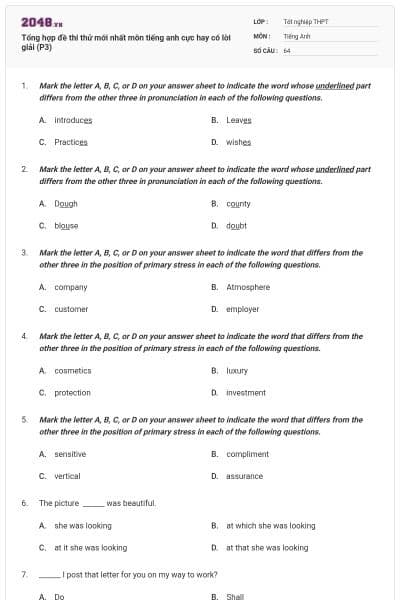
Mark the letter A, B, C, or D on your answer sheet to indicate the word whose underlined part differs from the other three in pronunciation in each of the following questions.
introduces
Leaves
Practices
wishes
B
B đọc là /s/ những đáp án khác đọc là /ɪz/
Mark the letter A, B, C, or D on your answer sheet to indicate the word whose underlined part differs from the other three in pronunciation in each of the following questions.
Dough
county
blouse
doubt
A
A đọc là /əʊ/ những đáp án khác đọc là /aʊ
Mark the letter A, B, C, or D on your answer sheet to indicate the word that differs from the other three in the position of primary stress in each of the following questions.
company
Atmosphere
customer
employer
D
D trọng âm rơi vào âm 2, những đáp án khác rơi vào âm 1
Mark the letter A, B, C, or D on your answer sheet to indicate the word that differs from the other three in the position of primary stress in each of the following questions.
cosmetics
luxury
protection
investment
B
B trọng âm rơi vào âm 1, những đáp án khác rơi vào âm 2
Mark the letter A, B, C, or D on your answer sheet to indicate the word that differs from the other three in the position of primary stress in each of the following questions.
sensitive
compliment
vertical
assurance
D
D trọng âm rơi vào âm 2, những đáp án khác rơi vào âm 1
The picture ______ was beautiful.
she was looking
at which she was looking
at it she was looking
at that she was looking
B
B “at which she was looking at” vì đây là mệnh đề phụ tính ngữ được sử dụng để bổ nghĩa cho “the picture” – trong văn cảnh là một nơi đang hút ánh nhìn nên ta đảo trạng từ “at” lên trước “which” = “where”
______ I post that letter for you on my way to work?
Do
Shall
Would
Will
Đáp án: B
Giải thích:
“Shall I + Vo....?” sẽ thể hiện yêu cầu làm điều gì một cách lịch sự.
Dịch: Tôi gửi lá thư đó cho bạn trên đường đi làm nhé?
______ all our careful plans, a lot of things went wrong.
Although
Because
Because of
In spite of
D
D “In spite of” nghĩa là mặc dù, phù hợp với ngữ nghĩa của câu, ngoài ra cụm này đi với cụm danh từ nên thỏa mãn cả ngữ pháp của câu
By the end of next month, we ______ our English course.
have completed
will be completed
will have completed
completed
C
C “will have completed” vì ở đây mốc thời gian cụ thể trong tương lai, ta dùng tương lai tiếp diễn để diễn tả hành động đã và đang xảy ra, có thể kết thúc trong tương lai
If I had studied harder, I ______ better in the last exam.
wouldn’t have done
would have done
had done
would do
B
B “would have done” vì ở đây ta có cấu trúc câu điều kiện loại 3 (thức giả định không có thật trong quá khứ), vế có “IF” ta dùng QKHT, vế sau ta dùng “would have + PII”
They wanted ______ if anything happened.
to be told
to tell
Telling
being told
A
A “to be told” vì “want” + toV nên ta loại được C và D, ngoài ra theo ngữ nghĩa thì động từ phải chia bị động nên ta chọn A
Everyone can join our club, ______ age and sex.
instead of
in case of
in place of
regardless of
D
D “regardless of” nghĩa là bất kể phù hợp với ngữ nghĩa của câu
There was nothing special about him, ______ from his flowery tie.
but
except
Apart
other
C
C “apart” vì “apart” luôn đi với “from” = except for, other than
Since I moved house, I haven’t had much ______ with those friends.
connection
contact
link
meeting
B
B “contact” vì đây là một kết hợp từ (collocations) – “have contacts with sb” là giữ liên lạc với ai
My uncle was ______ ill last summer; however, he is now making a slow but steady recovery
seriously
deeply
greatly
critically
A
A “seriously” nghĩa là một cách nghiêm trọng thường mang sắc thái tiêu cực nên phù hợp với ngữ nghĩa của câu
The twins look so much alike that almost no one can ______.
take them apart
tell them away
tell them apart
take them away
C
C “tell them apart” đây là một cụm động từ nghĩa là phân biệt được ai.
We bought some ______.
German lovely old glasse
German old lovely glasses
lovely old German glasses
old lovely German glasses
C
C “lovely old German glasses” vì ta có thứ tự tính từ trước danh từ là Opinion Size Age Colour Origin Material. Ba tính từ trong đề bài mang ý nghĩa của ba từ đăc trưng nên phải sắp xếp theo C
David is a captain of the school basketball team ______ his father.
similar to
just like
such as
as well as
Đáp án: B
Giải thích:
A. similar to: tương tự như (để so sánh nhưng cần “to be”: S + be + similar to + N)
B. just like: y như, giống như
C. such as: như là (dùng để nêu ví dụ)
D. as well as: và
Dịch: David là đội trưởng đội bóng rổ của trường giống như bố anh ấy.
Forget it! It is no use crying over spilt ______.
water
juice
milk
lemonade
C
C “milk” đây là câu thành ngữ nghĩa là “Đừng quá nuối tiếc việc gì đã lỡ xảy ra”
______ the issue was debated, the more people became involved.
The more longer
The longer
The longest
The long
B
B “the longer” đây là cấu trúc so sánh kép, “long” là tính từ một âm tiết nên ta thêm “er” vào sau
To sail single-handed across the ocean takes both skill and ______.
determine
determining
determined
determination
D
D “determination” nghĩa là sự quyết tâm, là danh từ duy nhất trong các đáp án
George wouldn't have met Mary ______ to his brother’s graduation party.
hadn't he gone
had he not gone
if he has not gone
if he should not have gone
B
B “had he not gone” ở đây là đảo ngữ với câu điều kiện loại 3, thay vì dùng “IF” ta đảo trợ động từ “Had” lên trước chủ ngữ
John: “I’ve got to go, Jenny. So long!"- Jenny: “So long, John! ______!”
Don’t hurry
Calm down
Be careful
Take care
D
D “take care” đây là lời chúc bảo trọng khi tạm biệt một ai đó phải đi xa
“What a nice hairstyle you have!” - “____.”
Never mind
Hope so
Thank you
No way
C
C “thank you” vì đây là lời đáp hợp lý nhất khi nhận được một lời khen
Mark the letter A, B, C, or D on your answer sheet to indicate the word(s) CLOSEST in meaning to the underlined word(s) in each of the following questions.
He was one of the most outstanding performers at the live show last night
easy-looking
important
well- known
impressive
D
D “impressive” = “outstanding” nghĩa là nổi trội, ấn tượng
Mark the letter A, B, C, or D on your answer sheet to indicate the word(s) CLOSEST in meaning to the underlined word(s) in each of the following questions.
American children customarily go trick or treating on Halloween.
inevitably
readily
happily
traditionally
Đáp án: D
Giải thích:
Kiến thức: Từ vựng – Từ đồng nghĩa
customarily (adv): theo thông lệ
Xét các đáp án:
A. inevitably (adv): tất yếu, không tránh được
B. readily (adv): sẵn sàng
C. happily (adv): vui vẻ
D. traditionally (adv): theo truyền thống
→ customarily = traditionally
Dịch: Trẻ em Mỹ thường đi xin kẹo vào dịp Halloween.
They are going to suffer a lot of criticism for increasing bus fare.
get into
stand in with
come in for
put across
Đáp án: C
Giải thích:
Kiến thức: Từ vựng – Từ đồng nghĩa
undergo (v): trải qua, gánh chịu
Xét các đáp án:
A. get into something: tới đâu, chiến thắng bầu cử, tham gia vào, bắt đầu thích thú với cái gì
B. stand in with: không có cụm này
Ta có: stand in (for somebody): thay thế ai
C. come in for something: hứng chịu cái gì
D. put across something (to somebody): làm ai hiểu điều gì
=> undergo = come in for
Dịch: Họ sẽ phải hứng chịu rất nhiều chỉ trích vì đã tăng giá vé xe buýt quá nhiều.
Mark the letter A, B, C, or D on your answer sheet to indicate the word(s) OPPOSITE in meaning to the underlined word(s) in each of the following questions.
For most male spiders courtship is a perilous procedure, for they may be eaten by females
complicated
dangerous
Safe
peculiar
C
C “safe”: an toàn >< “perilous”: nguy hiểm
Mark the letter A, B, C, or D on your answer sheet to indicate the word(s) OPPOSITE in meaning to the underlined word(s) in each of the following questions.
He didn’t bat an eye when he realized he failed the exam again.
wanted to see
was shocked
was happy
wanted to cry
Đáp án: B
Giải thích:
Kiến thức: Thành ngữ - Cụm từ trái nghĩa
didn’t bat an eye: không bất ngờ, điềm nhiên
Xét các đáp án:
A. wanted to see: muốn xem
B. was shocked: ngạc nhiên
C. was happy: vui vẻ
D. wanted to cry: muốn khóc
→ didn’t bat an eye >< was shocked
Dịch: Anh ấy không hề ngạc nhiên khi nhận ra mình lại trượt kỳ thi.
Mark the letter A, B, C, or D on your answer sheet to indicate the underlined part that needs correction in each of the following questions.
Air pollution, together (A) with littering, (B) are causing (C) many problems (D)
with
are
many
problems
B
B “are” => “is” vì chủ ngữ chính là “air pollution”- danh từ không đếm được
Mark the letter A, B, C, or D on your answer sheet to indicate the underlined part that needs correction in each of the following questions.
Manufacturers (A) may use food additives (B) for preserving, to color, or (C) to flavor, or to (D) fortify foods.
may use
for preserving
to flavor
fortify foods
B
B “for preserving” => “to preserve” để hòa hợp chủ vị trong câu
Mark the letter A, B, C, or D on your answer sheet to indicate the underlined part that needs correction in each of the following questions.
It is (A) high time John (B) understands (C) how to behave properly (D) towards the old men
high time
understands
how to
towards
B
B “understands” => “understood” vì cấu trúc It’s high time + V quá khứ
Mark the letter A, B, C, or D on your answer sheet to indicate the underlined part that needs correction in each of the following questions.
She (A) asked why (B) did Mathew look so (C) embarrassing when he (D) saw Carole.
asked why
did Mathew look
embarrassing
saw
B
B “did Mathew look” => “Mathew looked” vì why ở đây không phải câu hỏi mà là mệnh đề phụ
Mark the letter A, B, C, or D on your answer sheet to indicate the underlined part that needs correction in each of the following questions.
So extensive (A) the lakes are that they (B) are viewed as the (C) largest bodies (D) of fresh water in the world
the lakes are
are viewed as
largest
of fresh water
A
A “the lakes are” => “are the lakes” vì đây là cấu trúc đảo ngữ với tính từ
Read the following passage and mark the letter A, B, C, or D on your answer sheet to indicate the correct word or phrase that best fits each of the numbered blanks from 35 to 44.
Reference books are not designed to be read from the first page to the last but rather to be consulted to answer the questions and provide both general and specific pieces of information.
One of the most (35) ______ used reference books is a dictionary, which provides information about words. It lists meanings and spellings, (36) ______ how a word is pronounced, gives (37) ______ of how it is used, may reveal its origins and also lists synonyms and (38) ______. To help you find the words faster, there are guide words at the top of each page showing the first and last words on that page and of course it (39) ______ to know the alphabet!
There may be numerous special sections at the back with (40) ______ about famous people and places, lists of dates and scientific names, etc. There is usually a section at the front (41) ______ how to use the dictionary, which includes the special abbreviations or signs.
An atlas is also a reference book and (42) ______ charts, tables and geographical facts, as well as maps. Political maps locate countries and cities, physical maps show the formation of the land with its mountains and valleys, and economic maps show industries and agriculture. To find a specific place, you need to look in the (43) ______ at the back of the atlas and the exact position on the map. There are numerous map (44) ______ that you need to know in order to be able to read a map-almost like a special language-and these are explained at the front of the atlas.
Điền vào ô 35
Greatly
Mainly
widely
largely
C
C “widely” vì từ này hợp nghĩa và ngữ pháp nhất, hay đi với “used” hay “known”
Read the following passage and mark the letter A, B, C, or D on your answer sheet to indicate the correct word or phrase that best fits each of the numbered blanks from 35 to 44.
Reference books are not designed to be read from the first page to the last but rather to be consulted to answer the questions and provide both general and specific pieces of information.
One of the most (35) ______ used reference books is a dictionary, which provides information about words. It lists meanings and spellings, (36) ______ how a word is pronounced, gives (37) ______ of how it is used, may reveal its origins and also lists synonyms and (38) ______. To help you find the words faster, there are guide words at the top of each page showing the first and last words on that page and of course it (39) ______ to know the alphabet!
There may be numerous special sections at the back with (40) ______ about famous people and places, lists of dates and scientific names, etc. There is usually a section at the front (41) ______ how to use the dictionary, which includes the special abbreviations or signs.
An atlas is also a reference book and (42) ______ charts, tables and geographical facts, as well as maps. Political maps locate countries and cities, physical maps show the formation of the land with its mountains and valleys, and economic maps show industries and agriculture. To find a specific place, you need to look in the (43) ______ at the back of the atlas and the exact position on the map. There are numerous map (44) ______ that you need to know in order to be able to read a map-almost like a special language-and these are explained at the front of the atlas.
Điền vào ô 37
evidence
roof
Examples
cases
C
C “examples” vì “give example of” là cho ví dụ, loại “evidence” và “roof” vì không hợp nghĩa, “cases thì không đi với cấu trúc trên
Read the following passage and mark the letter A, B, C, or D on your answer sheet to indicate the correct word or phrase that best fits each of the numbered blanks from 35 to 44.
Reference books are not designed to be read from the first page to the last but rather to be consulted to answer the questions and provide both general and specific pieces of information.
One of the most (35) ______ used reference books is a dictionary, which provides information about words. It lists meanings and spellings, (36) ______ how a word is pronounced, gives (37) ______ of how it is used, may reveal its origins and also lists synonyms and (38) ______. To help you find the words faster, there are guide words at the top of each page showing the first and last words on that page and of course it (39) ______ to know the alphabet!
There may be numerous special sections at the back with (40) ______ about famous people and places, lists of dates and scientific names, etc. There is usually a section at the front (41) ______ how to use the dictionary, which includes the special abbreviations or signs.
An atlas is also a reference book and (42) ______ charts, tables and geographical facts, as well as maps. Political maps locate countries and cities, physical maps show the formation of the land with its mountains and valleys, and economic maps show industries and agriculture. To find a specific place, you need to look in the (43) ______ at the back of the atlas and the exact position on the map. There are numerous map (44) ______ that you need to know in order to be able to read a map-almost like a special language-and these are explained at the front of the atlas.
Điền vào ô 36
speaks
tells
says
gives
B
B “tells” nghĩa là “cho biết”, loại trừ “gives” là cho không hợp nghĩa, “says” + sth không đi với mệnh đề, “speaks” rất hiếm khi đi với tân ngữ
Read the following passage and mark the letter A, B, C, or D on your answer sheet to indicate the correct word or phrase that best fits each of the numbered blanks from 35 to 44.
Reference books are not designed to be read from the first page to the last but rather to be consulted to answer the questions and provide both general and specific pieces of information.
One of the most (35) ______ used reference books is a dictionary, which provides information about words. It lists meanings and spellings, (36) ______ how a word is pronounced, gives (37) ______ of how it is used, may reveal its origins and also lists synonyms and (38) ______. To help you find the words faster, there are guide words at the top of each page showing the first and last words on that page and of course it (39) ______ to know the alphabet!
There may be numerous special sections at the back with (40) ______ about famous people and places, lists of dates and scientific names, etc. There is usually a section at the front (41) ______ how to use the dictionary, which includes the special abbreviations or signs.
An atlas is also a reference book and (42) ______ charts, tables and geographical facts, as well as maps. Political maps locate countries and cities, physical maps show the formation of the land with its mountains and valleys, and economic maps show industries and agriculture. To find a specific place, you need to look in the (43) ______ at the back of the atlas and the exact position on the map. There are numerous map (44) ______ that you need to know in order to be able to read a map-almost like a special language-and these are explained at the front of the atlas.
Điền vào ô 38
antonyms
Closest
opposite
controversies
A
A “antonyms” nghĩa là từ trái nghĩa, hợp với ngữ cảnh khi ở vế trên tác giả nhắc tới “synonyms”: từ đồng nghĩa
Read the following passage and mark the letter A, B, C, or D on your answer sheet to indicate the correct word or phrase that best fits each of the numbered blanks from 35 to 44.
Reference books are not designed to be read from the first page to the last but rather to be consulted to answer the questions and provide both general and specific pieces of information.
One of the most (35) ______ used reference books is a dictionary, which provides information about words. It lists meanings and spellings, (36) ______ how a word is pronounced, gives (37) ______ of how it is used, may reveal its origins and also lists synonyms and (38) ______. To help you find the words faster, there are guide words at the top of each page showing the first and last words on that page and of course it (39) ______ to know the alphabet!
There may be numerous special sections at the back with (40) ______ about famous people and places, lists of dates and scientific names, etc. There is usually a section at the front (41) ______ how to use the dictionary, which includes the special abbreviations or signs.
An atlas is also a reference book and (42) ______ charts, tables and geographical facts, as well as maps. Political maps locate countries and cities, physical maps show the formation of the land with its mountains and valleys, and economic maps show industries and agriculture. To find a specific place, you need to look in the (43) ______ at the back of the atlas and the exact position on the map. There are numerous map (44) ______ that you need to know in order to be able to read a map-almost like a special language-and these are explained at the front of the atlas.
Điền vào ô 39
assists
Pays
helps
works
C
C “helps” + to V chỉ mục đích và không cần tân ngữ
Read the following passage and mark the letter A, B, C, or D on your answer sheet to indicate the correct word or phrase that best fits each of the numbered blanks from 35 to 44.
Reference books are not designed to be read from the first page to the last but rather to be consulted to answer the questions and provide both general and specific pieces of information.
One of the most (35) ______ used reference books is a dictionary, which provides information about words. It lists meanings and spellings, (36) ______ how a word is pronounced, gives (37) ______ of how it is used, may reveal its origins and also lists synonyms and (38) ______. To help you find the words faster, there are guide words at the top of each page showing the first and last words on that page and of course it (39) ______ to know the alphabet!
There may be numerous special sections at the back with (40) ______ about famous people and places, lists of dates and scientific names, etc. There is usually a section at the front (41) ______ how to use the dictionary, which includes the special abbreviations or signs.
An atlas is also a reference book and (42) ______ charts, tables and geographical facts, as well as maps. Political maps locate countries and cities, physical maps show the formation of the land with its mountains and valleys, and economic maps show industries and agriculture. To find a specific place, you need to look in the (43) ______ at the back of the atlas and the exact position on the map. There are numerous map (44) ______ that you need to know in order to be able to read a map-almost like a special language-and these are explained at the front of the atlas.
Điền vào ô 40
events
stories
facts
materials
C
C “facts” nghĩa là “những sự thực, loại được “events” và “materials” vì sai nghĩa, còn “stories” nghĩa quá tiếng Việt và không dùng với “places”
Read the following passage and mark the letter A, B, C, or D on your answer sheet to indicate the correct word or phrase that best fits each of the numbered blanks from 35 to 44.
Reference books are not designed to be read from the first page to the last but rather to be consulted to answer the questions and provide both general and specific pieces of information.
One of the most (35) ______ used reference books is a dictionary, which provides information about words. It lists meanings and spellings, (36) ______ how a word is pronounced, gives (37) ______ of how it is used, may reveal its origins and also lists synonyms and (38) ______. To help you find the words faster, there are guide words at the top of each page showing the first and last words on that page and of course it (39) ______ to know the alphabet!
There may be numerous special sections at the back with (40) ______ about famous people and places, lists of dates and scientific names, etc. There is usually a section at the front (41) ______ how to use the dictionary, which includes the special abbreviations or signs.
An atlas is also a reference book and (42) ______ charts, tables and geographical facts, as well as maps. Political maps locate countries and cities, physical maps show the formation of the land with its mountains and valleys, and economic maps show industries and agriculture. To find a specific place, you need to look in the (43) ______ at the back of the atlas and the exact position on the map. There are numerous map (44) ______ that you need to know in order to be able to read a map-almost like a special language-and these are explained at the front of the atlas.
Điền vào ô 41
explaining
interpreting
suggesting
presenting
A
A “explaining” nghĩa là “giải thích” + to V, những đáp án khác sai ngữ pháp
Read the following passage and mark the letter A, B, C, or D on your answer sheet to indicate the correct word or phrase that best fits each of the numbered blanks from 35 to 44.
Reference books are not designed to be read from the first page to the last but rather to be consulted to answer the questions and provide both general and specific pieces of information.
One of the most (35) ______ used reference books is a dictionary, which provides information about words. It lists meanings and spellings, (36) ______ how a word is pronounced, gives (37) ______ of how it is used, may reveal its origins and also lists synonyms and (38) ______. To help you find the words faster, there are guide words at the top of each page showing the first and last words on that page and of course it (39) ______ to know the alphabet!
There may be numerous special sections at the back with (40) ______ about famous people and places, lists of dates and scientific names, etc. There is usually a section at the front (41) ______ how to use the dictionary, which includes the special abbreviations or signs.
An atlas is also a reference book and (42) ______ charts, tables and geographical facts, as well as maps. Political maps locate countries and cities, physical maps show the formation of the land with its mountains and valleys, and economic maps show industries and agriculture. To find a specific place, you need to look in the (43) ______ at the back of the atlas and the exact position on the map. There are numerous map (44) ______ that you need to know in order to be able to read a map-almost like a special language-and these are explained at the front of the atlas.
Điền vào ô 42
composes
Includes
Consists
contains
Đáp án : D
D “contains” nghĩa là bao gồm vì nó không cần trạng từ theo sau, “consist of” hay “compose of”, “include” không hợp nghĩa
Read the following passage and mark the letter A, B, C, or D on your answer sheet to indicate the correct word or phrase that best fits each of the numbered blanks from 35 to 44.
Reference books are not designed to be read from the first page to the last but rather to be consulted to answer the questions and provide both general and specific pieces of information.
One of the most (35) ______ used reference books is a dictionary, which provides information about words. It lists meanings and spellings, (36) ______ how a word is pronounced, gives (37) ______ of how it is used, may reveal its origins and also lists synonyms and (38) ______. To help you find the words faster, there are guide words at the top of each page showing the first and last words on that page and of course it (39) ______ to know the alphabet!
There may be numerous special sections at the back with (40) ______ about famous people and places, lists of dates and scientific names, etc. There is usually a section at the front (41) ______ how to use the dictionary, which includes the special abbreviations or signs.
An atlas is also a reference book and (42) ______ charts, tables and geographical facts, as well as maps. Political maps locate countries and cities, physical maps show the formation of the land with its mountains and valleys, and economic maps show industries and agriculture. To find a specific place, you need to look in the (43) ______ at the back of the atlas and the exact position on the map. There are numerous map (44) ______ that you need to know in order to be able to read a map-almost like a special language-and these are explained at the front of the atlas.
Điền vào ô 43
foreword
Preface
complement
index
Đáp án : D
D “index” nghĩa là chỉ số, thông số cụ thể vì câu sau tác giả có đề cập tới “exact positon”
Read the following passage and mark the letter A, B, C, or D on your answer sheet to indicate the correct word or phrase that best fits each of the numbered blanks from 35 to 44.
Reference books are not designed to be read from the first page to the last but rather to be consulted to answer the questions and provide both general and specific pieces of information.
One of the most (35) ______ used reference books is a dictionary, which provides information about words. It lists meanings and spellings, (36) ______ how a word is pronounced, gives (37) ______ of how it is used, may reveal its origins and also lists synonyms and (38) ______. To help you find the words faster, there are guide words at the top of each page showing the first and last words on that page and of course it (39) ______ to know the alphabet!
There may be numerous special sections at the back with (40) ______ about famous people and places, lists of dates and scientific names, etc. There is usually a section at the front (41) ______ how to use the dictionary, which includes the special abbreviations or signs.
An atlas is also a reference book and (42) ______ charts, tables and geographical facts, as well as maps. Political maps locate countries and cities, physical maps show the formation of the land with its mountains and valleys, and economic maps show industries and agriculture. To find a specific place, you need to look in the (43) ______ at the back of the atlas and the exact position on the map. There are numerous map (44) ______ that you need to know in order to be able to read a map-almost like a special language-and these are explained at the front of the atlas.
Điền vào ô 44
marks
signs
signals
symbols
Đáp án : D
D “symbols” nghĩa là biểu tượng, nghĩa những từ còn lại quá chung chung
Read the following passage and mark the letter A, B, C, or D on your answer sheet to indicate the correct answer to each of the questions from 44 to 55.
Panel painting, common in thirteenth- and fourteenth-century Europe, involved a painstaking, laborious process. Wooden planks were joined, covered with gesso to prepare the surface for painting, and then polished smooth with special tools. On this perfect surface, the artist would sketch a composition with chalk, refine it with inks, and then begin the deliberate process of applying thin layers of egg tempera paint (egg yolk in which pigments are suspended) with small brushes. The successive layering of these meticulously applied paints produced the final translucent colors.
Backgrounds of gold were made by carefully applying sheets of gold leaf, and then embellishing of decorating the gold leaf by punching it with a metal rod on which a pattern had been embossed. Every step in the process was slow and deliberate. The quick-drying tempera demanded that the artist know exactly where each stroke be placed before the brush met the panel, and it required the use of fine brushes. It was, therefore, an ideal technique for emphasizing the hard linear edges and pure, fine areas of color that were so much a part of the overall aesthetic of the time. The notion that an artist could or would dash off an idea in a fit of spontaneous inspiration was completely alien to these deliberately produced works.
Furthermore, making these paintings was so time-consuming that it demanded assistance. All such work was done by collective enterprise in the workshops. The painter or master who is credited with having created the painting may have designed the work and overseen its production, but it is highly unlikely that the artist’s hand applied every stroke of the brush. More likely, numerous assistants, who had been trained to imitate the artist’s style, applied the paint. The carpenter’s shop probably provided the frame and perhaps supplied the panel, and yet another shop supplied the gold. Thus, not only many hands, but also many shops were involved in the final product.
In spite of problems with their condition, restoration, and preservation, many panel paintings have survived, and today many of them are housed in museum collections.
What aspect of panel paintings does the passage mainly discuss?
Different styles
Famous examples
Production
Restoration
Đáp án : C
C “production” nghĩa là phương thức sản xuất, vì cả bài từng đoạn nói về cách làm từng phần của loại tranh này
Read the following passage and mark the letter A, B, C, or D on your answer sheet to indicate the correct answer to each of the questions from 44 to 55.
Panel painting, common in thirteenth- and fourteenth-century Europe, involved a painstaking, laborious process. Wooden planks were joined, covered with gesso to prepare the surface for painting, and then polished smooth with special tools. On this perfect surface, the artist would sketch a composition with chalk, refine it with inks, and then begin the deliberate process of applying thin layers of egg tempera paint (egg yolk in which pigments are suspended) with small brushes. The successive layering of these meticulously applied paints produced the final translucent colors.
Backgrounds of gold were made by carefully applying sheets of gold leaf, and then embellishing of decorating the gold leaf by punching it with a metal rod on which a pattern had been embossed. Every step in the process was slow and deliberate. The quick-drying tempera demanded that the artist know exactly where each stroke be placed before the brush met the panel, and it required the use of fine brushes. It was, therefore, an ideal technique for emphasizing the hard linear edges and pure, fine areas of color that were so much a part of the overall aesthetic of the time. The notion that an artist could or would dash off an idea in a fit of spontaneous inspiration was completely alien to these deliberately produced works.
Furthermore, making these paintings was so time-consuming that it demanded assistance. All such work was done by collective enterprise in the workshops. The painter or master who is credited with having created the painting may have designed the work and overseen its production, but it is highly unlikely that the artist’s hand applied every stroke of the brush. More likely, numerous assistants, who had been trained to imitate the artist’s style, applied the paint. The carpenter’s shop probably provided the frame and perhaps supplied the panel, and yet another shop supplied the gold. Thus, not only many hands, but also many shops were involved in the final product.
In spite of problems with their condition, restoration, and preservation, many panel paintings have survived, and today many of them are housed in museum collections.
According to the passage, what was the first step in making a panel painting?
Mixing the paint
Making ink drawings
Preparing the panel
Buying the gold leaf
Đáp án : C
C “preparing the panel” ở ngay câu thứ hai nhà văn đã đề cập tới bược chuẩn bị “Wooden planks were joined, covered with gesso to prepare the surface for painting, and then polished smooth with special tools”
Read the following passage and mark the letter A, B, C, or D on your answer sheet to indicate the correct answer to each of the questions from 44 to 55.
Panel painting, common in thirteenth- and fourteenth-century Europe, involved a painstaking, laborious process. Wooden planks were joined, covered with gesso to prepare the surface for painting, and then polished smooth with special tools. On this perfect surface, the artist would sketch a composition with chalk, refine it with inks, and then begin the deliberate process of applying thin layers of egg tempera paint (egg yolk in which pigments are suspended) with small brushes. The successive layering of these meticulously applied paints produced the final translucent colors.
Backgrounds of gold were made by carefully applying sheets of gold leaf, and then embellishing of decorating the gold leaf by punching it with a metal rod on which a pattern had been embossed. Every step in the process was slow and deliberate. The quick-drying tempera demanded that the artist know exactly where each stroke be placed before the brush met the panel, and it required the use of fine brushes. It was, therefore, an ideal technique for emphasizing the hard linear edges and pure, fine areas of color that were so much a part of the overall aesthetic of the time. The notion that an artist could or would dash off an idea in a fit of spontaneous inspiration was completely alien to these deliberately produced works.
Furthermore, making these paintings was so time-consuming that it demanded assistance. All such work was done by collective enterprise in the workshops. The painter or master who is credited with having created the painting may have designed the work and overseen its production, but it is highly unlikely that the artist’s hand applied every stroke of the brush. More likely, numerous assistants, who had been trained to imitate the artist’s style, applied the paint. The carpenter’s shop probably provided the frame and perhaps supplied the panel, and yet another shop supplied the gold. Thus, not only many hands, but also many shops were involved in the final product.
In spite of problems with their condition, restoration, and preservation, many panel paintings have survived, and today many of them are housed in museum collections.
The word “it” refers to ______.
composition
Artist
Chalk
surface
Đáp án : A
A “composition” vì ta dựa vào câu “refine it with ink” nghĩa là lọc nó với mực, thì chắc chắn nó không thể thay thế cho “the artist” hoặc là “chalk”
Read the following passage and mark the letter A, B, C, or D on your answer sheet to indicate the correct answer to each of the questions from 44 to 55.
Panel painting, common in thirteenth- and fourteenth-century Europe, involved a painstaking, laborious process. Wooden planks were joined, covered with gesso to prepare the surface for painting, and then polished smooth with special tools. On this perfect surface, the artist would sketch a composition with chalk, refine it with inks, and then begin the deliberate process of applying thin layers of egg tempera paint (egg yolk in which pigments are suspended) with small brushes. The successive layering of these meticulously applied paints produced the final translucent colors.
Backgrounds of gold were made by carefully applying sheets of gold leaf, and then embellishing of decorating the gold leaf by punching it with a metal rod on which a pattern had been embossed. Every step in the process was slow and deliberate. The quick-drying tempera demanded that the artist know exactly where each stroke be placed before the brush met the panel, and it required the use of fine brushes. It was, therefore, an ideal technique for emphasizing the hard linear edges and pure, fine areas of color that were so much a part of the overall aesthetic of the time. The notion that an artist could or would dash off an idea in a fit of spontaneous inspiration was completely alien to these deliberately produced works.
Furthermore, making these paintings was so time-consuming that it demanded assistance. All such work was done by collective enterprise in the workshops. The painter or master who is credited with having created the painting may have designed the work and overseen its production, but it is highly unlikely that the artist’s hand applied every stroke of the brush. More likely, numerous assistants, who had been trained to imitate the artist’s style, applied the paint. The carpenter’s shop probably provided the frame and perhaps supplied the panel, and yet another shop supplied the gold. Thus, not only many hands, but also many shops were involved in the final product.
In spite of problems with their condition, restoration, and preservation, many panel paintings have survived, and today many of them are housed in museum collections.
The word “deliberate” is closest in meaning to ______.
careful
Decisive
Unusual
natural
Đáp án : A
A “careful” = “deliberate” nghĩa là cần thận, tỉ mỉ
Read the following passage and mark the letter A, B, C, or D on your answer sheet to indicate the correct answer to each of the questions from 44 to 55.
Panel painting, common in thirteenth- and fourteenth-century Europe, involved a painstaking, laborious process. Wooden planks were joined, covered with gesso to prepare the surface for painting, and then polished smooth with special tools. On this perfect surface, the artist would sketch a composition with chalk, refine it with inks, and then begin the deliberate process of applying thin layers of egg tempera paint (egg yolk in which pigments are suspended) with small brushes. The successive layering of these meticulously applied paints produced the final translucent colors.
Backgrounds of gold were made by carefully applying sheets of gold leaf, and then embellishing of decorating the gold leaf by punching it with a metal rod on which a pattern had been embossed. Every step in the process was slow and deliberate. The quick-drying tempera demanded that the artist know exactly where each stroke be placed before the brush met the panel, and it required the use of fine brushes. It was, therefore, an ideal technique for emphasizing the hard linear edges and pure, fine areas of color that were so much a part of the overall aesthetic of the time. The notion that an artist could or would dash off an idea in a fit of spontaneous inspiration was completely alien to these deliberately produced works.
Furthermore, making these paintings was so time-consuming that it demanded assistance. All such work was done by collective enterprise in the workshops. The painter or master who is credited with having created the painting may have designed the work and overseen its production, but it is highly unlikely that the artist’s hand applied every stroke of the brush. More likely, numerous assistants, who had been trained to imitate the artist’s style, applied the paint. The carpenter’s shop probably provided the frame and perhaps supplied the panel, and yet another shop supplied the gold. Thus, not only many hands, but also many shops were involved in the final product.
In spite of problems with their condition, restoration, and preservation, many panel paintings have survived, and today many of them are housed in museum collections.
Which of the following processes produced the translucent colors found on panel paintings?
Applying many layers of paint
Joining wooden planks to form large sheets
Polishing the gesso
Covering the background with gold leaf
Đáp án : A
A “applying many layers of paint” được đề cập ở câu “On this perfect surface, the artist would sketch a composition with chalk, refine it with inks, and then begin the deliberate process of applying thin layers of egg tempera paint (egg yolk in which pigments are suspended) with small brushes. The successive layering of these meticulously applied paints produced the final translucent colors.”
Read the following passage and mark the letter A, B, C, or D on your answer sheet to indicate the correct answer to each of the questions from 44 to 55.
Panel painting, common in thirteenth- and fourteenth-century Europe, involved a painstaking, laborious process. Wooden planks were joined, covered with gesso to prepare the surface for painting, and then polished smooth with special tools. On this perfect surface, the artist would sketch a composition with chalk, refine it with inks, and then begin the deliberate process of applying thin layers of egg tempera paint (egg yolk in which pigments are suspended) with small brushes. The successive layering of these meticulously applied paints produced the final translucent colors.
Backgrounds of gold were made by carefully applying sheets of gold leaf, and then embellishing of decorating the gold leaf by punching it with a metal rod on which a pattern had been embossed. Every step in the process was slow and deliberate. The quick-drying tempera demanded that the artist know exactly where each stroke be placed before the brush met the panel, and it required the use of fine brushes. It was, therefore, an ideal technique for emphasizing the hard linear edges and pure, fine areas of color that were so much a part of the overall aesthetic of the time. The notion that an artist could or would dash off an idea in a fit of spontaneous inspiration was completely alien to these deliberately produced works.
Furthermore, making these paintings was so time-consuming that it demanded assistance. All such work was done by collective enterprise in the workshops. The painter or master who is credited with having created the painting may have designed the work and overseen its production, but it is highly unlikely that the artist’s hand applied every stroke of the brush. More likely, numerous assistants, who had been trained to imitate the artist’s style, applied the paint. The carpenter’s shop probably provided the frame and perhaps supplied the panel, and yet another shop supplied the gold. Thus, not only many hands, but also many shops were involved in the final product.
In spite of problems with their condition, restoration, and preservation, many panel paintings have survived, and today many of them are housed in museum collections.
What characteristic of tempera paint is mentioned in the passage?
It has to be applied directly to wood
It is difficult to make
It dries quickly
It dissolves easily
Đáp án : C
C “it dries quickly” được đề cập ở câu “The quick-drying tempera demanded that the artist know exactly where each stroke be placed before the brush met the panel, and it required the use of fine brushes.”
Read the following passage and mark the letter A, B, C, or D on your answer sheet to indicate the correct answer to each of the questions from 44 to 55.
Panel painting, common in thirteenth- and fourteenth-century Europe, involved a painstaking, laborious process. Wooden planks were joined, covered with gesso to prepare the surface for painting, and then polished smooth with special tools. On this perfect surface, the artist would sketch a composition with chalk, refine it with inks, and then begin the deliberate process of applying thin layers of egg tempera paint (egg yolk in which pigments are suspended) with small brushes. The successive layering of these meticulously applied paints produced the final translucent colors.
Backgrounds of gold were made by carefully applying sheets of gold leaf, and then embellishing of decorating the gold leaf by punching it with a metal rod on which a pattern had been embossed. Every step in the process was slow and deliberate. The quick-drying tempera demanded that the artist know exactly where each stroke be placed before the brush met the panel, and it required the use of fine brushes. It was, therefore, an ideal technique for emphasizing the hard linear edges and pure, fine areas of color that were so much a part of the overall aesthetic of the time. The notion that an artist could or would dash off an idea in a fit of spontaneous inspiration was completely alien to these deliberately produced works.
Furthermore, making these paintings was so time-consuming that it demanded assistance. All such work was done by collective enterprise in the workshops. The painter or master who is credited with having created the painting may have designed the work and overseen its production, but it is highly unlikely that the artist’s hand applied every stroke of the brush. More likely, numerous assistants, who had been trained to imitate the artist’s style, applied the paint. The carpenter’s shop probably provided the frame and perhaps supplied the panel, and yet another shop supplied the gold. Thus, not only many hands, but also many shops were involved in the final product.
In spite of problems with their condition, restoration, and preservation, many panel paintings have survived, and today many of them are housed in museum collections.
The word “demanded” is closest in meaning to ______.
ordered
required
reported
questioned
Đáp án : B
B “required” = “demanded” nghĩa là yêu cầu, đòi hỏi
Read the following passage and mark the letter A, B, C, or D on your answer sheet to indicate the correct answer to each of the questions from 44 to 55.
Panel painting, common in thirteenth- and fourteenth-century Europe, involved a painstaking, laborious process. Wooden planks were joined, covered with gesso to prepare the surface for painting, and then polished smooth with special tools. On this perfect surface, the artist would sketch a composition with chalk, refine it with inks, and then begin the deliberate process of applying thin layers of egg tempera paint (egg yolk in which pigments are suspended) with small brushes. The successive layering of these meticulously applied paints produced the final translucent colors.
Backgrounds of gold were made by carefully applying sheets of gold leaf, and then embellishing of decorating the gold leaf by punching it with a metal rod on which a pattern had been embossed. Every step in the process was slow and deliberate. The quick-drying tempera demanded that the artist know exactly where each stroke be placed before the brush met the panel, and it required the use of fine brushes. It was, therefore, an ideal technique for emphasizing the hard linear edges and pure, fine areas of color that were so much a part of the overall aesthetic of the time. The notion that an artist could or would dash off an idea in a fit of spontaneous inspiration was completely alien to these deliberately produced works.
Furthermore, making these paintings was so time-consuming that it demanded assistance. All such work was done by collective enterprise in the workshops. The painter or master who is credited with having created the painting may have designed the work and overseen its production, but it is highly unlikely that the artist’s hand applied every stroke of the brush. More likely, numerous assistants, who had been trained to imitate the artist’s style, applied the paint. The carpenter’s shop probably provided the frame and perhaps supplied the panel, and yet another shop supplied the gold. Thus, not only many hands, but also many shops were involved in the final product.
In spite of problems with their condition, restoration, and preservation, many panel paintings have survived, and today many of them are housed in museum collections.
The “collective enterprise” mentioned includes all of the following EXCEPT ______.
supplying the gold leaf
applying the paint
selling the painting
building the panels
Đáp án : C
C “selling the painting” vì ở những đoạn trước, tất cả những đáp án khác đều đã được đề cập trừ C
Read the following passage and mark the letter A, B, C, or D on your answer sheet to indicate the correct answer to each of the questions from 44 to 55.
Panel painting, common in thirteenth- and fourteenth-century Europe, involved a painstaking, laborious process. Wooden planks were joined, covered with gesso to prepare the surface for painting, and then polished smooth with special tools. On this perfect surface, the artist would sketch a composition with chalk, refine it with inks, and then begin the deliberate process of applying thin layers of egg tempera paint (egg yolk in which pigments are suspended) with small brushes. The successive layering of these meticulously applied paints produced the final translucent colors.
Backgrounds of gold were made by carefully applying sheets of gold leaf, and then embellishing of decorating the gold leaf by punching it with a metal rod on which a pattern had been embossed. Every step in the process was slow and deliberate. The quick-drying tempera demanded that the artist know exactly where each stroke be placed before the brush met the panel, and it required the use of fine brushes. It was, therefore, an ideal technique for emphasizing the hard linear edges and pure, fine areas of color that were so much a part of the overall aesthetic of the time. The notion that an artist could or would dash off an idea in a fit of spontaneous inspiration was completely alien to these deliberately produced works.
Furthermore, making these paintings was so time-consuming that it demanded assistance. All such work was done by collective enterprise in the workshops. The painter or master who is credited with having created the painting may have designed the work and overseen its production, but it is highly unlikely that the artist’s hand applied every stroke of the brush. More likely, numerous assistants, who had been trained to imitate the artist’s style, applied the paint. The carpenter’s shop probably provided the frame and perhaps supplied the panel, and yet another shop supplied the gold. Thus, not only many hands, but also many shops were involved in the final product.
In spite of problems with their condition, restoration, and preservation, many panel paintings have survived, and today many of them are housed in museum collections.
The word “imitate” is closest in meaning to ______.
copy
believe in
promote
illustrate
Đáp án : A
A “copy” = “imitate” nghĩa là làm giả, bắt chước
Read the following passage and mark the letter A, B, C, or D on your answer sheet to indicate the correct answer to each of the questions from 44 to 55.
Panel painting, common in thirteenth- and fourteenth-century Europe, involved a painstaking, laborious process. Wooden planks were joined, covered with gesso to prepare the surface for painting, and then polished smooth with special tools. On this perfect surface, the artist would sketch a composition with chalk, refine it with inks, and then begin the deliberate process of applying thin layers of egg tempera paint (egg yolk in which pigments are suspended) with small brushes. The successive layering of these meticulously applied paints produced the final translucent colors.
Backgrounds of gold were made by carefully applying sheets of gold leaf, and then embellishing of decorating the gold leaf by punching it with a metal rod on which a pattern had been embossed. Every step in the process was slow and deliberate. The quick-drying tempera demanded that the artist know exactly where each stroke be placed before the brush met the panel, and it required the use of fine brushes. It was, therefore, an ideal technique for emphasizing the hard linear edges and pure, fine areas of color that were so much a part of the overall aesthetic of the time. The notion that an artist could or would dash off an idea in a fit of spontaneous inspiration was completely alien to these deliberately produced works.
Furthermore, making these paintings was so time-consuming that it demanded assistance. All such work was done by collective enterprise in the workshops. The painter or master who is credited with having created the painting may have designed the work and overseen its production, but it is highly unlikely that the artist’s hand applied every stroke of the brush. More likely, numerous assistants, who had been trained to imitate the artist’s style, applied the paint. The carpenter’s shop probably provided the frame and perhaps supplied the panel, and yet another shop supplied the gold. Thus, not only many hands, but also many shops were involved in the final product.
In spite of problems with their condition, restoration, and preservation, many panel paintings have survived, and today many of them are housed in museum collections.
The author mentions all of the following as problems with the survival of panel paintings EXCEPT ______.
condition
restoration
preservation
theft
Đáp án : D
D “theft” vì đáp án này không được đề cập
Read the following passage and mark the letter A, B, C, or D on your answer sheet to indicate the correct answer to each of the questions from 55 to 64.
Although they are an inexpensive supplier of vitamins, minerals, and high-quality protein, eggs also contain a high level of blood cholesterol, one of the major causes of heart diseases. One egg yolk, in fact, contains a little more than two-thirds of the suggested daily cholesterol limit. This knowledge has caused egg sales to plummet in recent years, which in turn has brought about the development of several alternatives to eating regular eggs. One alternative is to eat substitute eggs. These egg substitutes are not really eggs, but they look somewhat like eggs when they are cooked. They have the advantage of having low cholesterol rates, and they can be scrambled or used in baking. One disadvantage, however, is that they are not good for frying, poaching, or boiling. A second alternative to regular eggs is a new type of egg, sometimes called 'designer' eggs. These eggs are produced by hens that are fed low-fat diets consisting of ingredients such as canola oil, flax, and rice bran. In spite of their diets, however, these hens produce eggs that contain the same amount of cholesterol as regular eggs. Yet, the producers of these eggs claim that eating their eggs will not raise the blood cholesterol in humans.
Egg producers claim that their product has been portrayed unfairly. They cite scientific studies to back up their claim. And, in fact, studies on the relationship between eggs and human cholesterol levels have brought mixed results. It may be that it is not the type of egg that is the main determinant of cholesterol but the person who is eating the eggs. Some people may be more sensitive to cholesterol derived from food than other people. In fact, there is evidence that certain dietary fats stimulate the body's production of blood cholesterol. Consequently, while it still makes sense to limit one's intake of eggs, even designer eggs, it seems that doing this without regulating dietary fat will probably not help reduce the blood cholesterol level.
What is the main purpose of the passage?
To introduce the idea that dietary fat increases the blood cholesterol leve
To inform people about the relationship between eggs and cholesterol
To persuade people that eggs are unhealthy and should not be eaten
To convince people to eat 'designer' eggs and egg substitutes
Đáp án : B
B “To inform people about the relationship between eggs and cholesterol.” Vì cả đoạn văn chỉ xoay quanh mối quan hệ của trứng và cholesterol chứ tác giả không đưa ra nhận định hay ý kiến riêng nào của mìn
Read the following passage and mark the letter A, B, C, or D on your answer sheet to indicate the correct answer to each of the questions from 55 to 64.
Although they are an inexpensive supplier of vitamins, minerals, and high-quality protein, eggs also contain a high level of blood cholesterol, one of the major causes of heart diseases. One egg yolk, in fact, contains a little more than two-thirds of the suggested daily cholesterol limit. This knowledge has caused egg sales to plummet in recent years, which in turn has brought about the development of several alternatives to eating regular eggs. One alternative is to eat substitute eggs. These egg substitutes are not really eggs, but they look somewhat like eggs when they are cooked. They have the advantage of having low cholesterol rates, and they can be scrambled or used in baking. One disadvantage, however, is that they are not good for frying, poaching, or boiling. A second alternative to regular eggs is a new type of egg, sometimes called 'designer' eggs. These eggs are produced by hens that are fed low-fat diets consisting of ingredients such as canola oil, flax, and rice bran. In spite of their diets, however, these hens produce eggs that contain the same amount of cholesterol as regular eggs. Yet, the producers of these eggs claim that eating their eggs will not raise the blood cholesterol in humans.
Egg producers claim that their product has been portrayed unfairly. They cite scientific studies to back up their claim. And, in fact, studies on the relationship between eggs and human cholesterol levels have brought mixed results. It may be that it is not the type of egg that is the main determinant of cholesterol but the person who is eating the eggs. Some people may be more sensitive to cholesterol derived from food than other people. In fact, there is evidence that certain dietary fats stimulate the body's production of blood cholesterol. Consequently, while it still makes sense to limit one's intake of eggs, even designer eggs, it seems that doing this without regulating dietary fat will probably not help reduce the blood cholesterol level.
According to the passage, which of the following is a cause of heart diseases
minerals
cholesterol
canola oil
vitamins
Đáp án : B
B “cholesterol” đề cập ở câu đầu “ ….eggs also contain a high level of blood cholesterol, one of the major causes of heart diseases.“
Read the following passage and mark the letter A, B, C, or D on your answer sheet to indicate the correct answer to each of the questions from 55 to 64.
Although they are an inexpensive supplier of vitamins, minerals, and high-quality protein, eggs also contain a high level of blood cholesterol, one of the major causes of heart diseases. One egg yolk, in fact, contains a little more than two-thirds of the suggested daily cholesterol limit. This knowledge has caused egg sales to plummet in recent years, which in turn has brought about the development of several alternatives to eating regular eggs. One alternative is to eat substitute eggs. These egg substitutes are not really eggs, but they look somewhat like eggs when they are cooked. They have the advantage of having low cholesterol rates, and they can be scrambled or used in baking. One disadvantage, however, is that they are not good for frying, poaching, or boiling. A second alternative to regular eggs is a new type of egg, sometimes called 'designer' eggs. These eggs are produced by hens that are fed low-fat diets consisting of ingredients such as canola oil, flax, and rice bran. In spite of their diets, however, these hens produce eggs that contain the same amount of cholesterol as regular eggs. Yet, the producers of these eggs claim that eating their eggs will not raise the blood cholesterol in humans.
Egg producers claim that their product has been portrayed unfairly. They cite scientific studies to back up their claim. And, in fact, studies on the relationship between eggs and human cholesterol levels have brought mixed results. It may be that it is not the type of egg that is the main determinant of cholesterol but the person who is eating the eggs. Some people may be more sensitive to cholesterol derived from food than other people. In fact, there is evidence that certain dietary fats stimulate the body's production of blood cholesterol. Consequently, while it still makes sense to limit one's intake of eggs, even designer eggs, it seems that doing this without regulating dietary fat will probably not help reduce the blood cholesterol level.
Which of the following could best replace the word 'somewhat'?
in fact
a little
indefinitely
a lot
Đáp án : B
B “a little” = “somewhat” diễn tả một xíu, một chút
Read the following passage and mark the letter A, B, C, or D on your answer sheet to indicate the correct answer to each of the questions from 55 to 64.
Although they are an inexpensive supplier of vitamins, minerals, and high-quality protein, eggs also contain a high level of blood cholesterol, one of the major causes of heart diseases. One egg yolk, in fact, contains a little more than two-thirds of the suggested daily cholesterol limit. This knowledge has caused egg sales to plummet in recent years, which in turn has brought about the development of several alternatives to eating regular eggs. One alternative is to eat substitute eggs. These egg substitutes are not really eggs, but they look somewhat like eggs when they are cooked. They have the advantage of having low cholesterol rates, and they can be scrambled or used in baking. One disadvantage, however, is that they are not good for frying, poaching, or boiling. A second alternative to regular eggs is a new type of egg, sometimes called 'designer' eggs. These eggs are produced by hens that are fed low-fat diets consisting of ingredients such as canola oil, flax, and rice bran. In spite of their diets, however, these hens produce eggs that contain the same amount of cholesterol as regular eggs. Yet, the producers of these eggs claim that eating their eggs will not raise the blood cholesterol in humans.
Egg producers claim that their product has been portrayed unfairly. They cite scientific studies to back up their claim. And, in fact, studies on the relationship between eggs and human cholesterol levels have brought mixed results. It may be that it is not the type of egg that is the main determinant of cholesterol but the person who is eating the eggs. Some people may be more sensitive to cholesterol derived from food than other people. In fact, there is evidence that certain dietary fats stimulate the body's production of blood cholesterol. Consequently, while it still makes sense to limit one's intake of eggs, even designer eggs, it seems that doing this without regulating dietary fat will probably not help reduce the blood cholesterol level.
What has been the cause for changes in the sale of eggs?
increasing price
decreased production
dietary changes in hens
concerns about cholesterol
Đáp án : D
D “concerns about cholesterol”dựa vào câu số 2 và 3 của đoạn văn “One egg yolk, in fact, contains a little more than two-thirds of the suggested daily cholesterol limit. This knowledge has caused egg sales to plummet in recent years, which in turn has brought about the development of several alternatives to eating regular eggs.”
Read the following passage and mark the letter A, B, C, or D on your answer sheet to indicate the correct answer to each of the questions from 55 to 64.
Although they are an inexpensive supplier of vitamins, minerals, and high-quality protein, eggs also contain a high level of blood cholesterol, one of the major causes of heart diseases. One egg yolk, in fact, contains a little more than two-thirds of the suggested daily cholesterol limit. This knowledge has caused egg sales to plummet in recent years, which in turn has brought about the development of several alternatives to eating regular eggs. One alternative is to eat substitute eggs. These egg substitutes are not really eggs, but they look somewhat like eggs when they are cooked. They have the advantage of having low cholesterol rates, and they can be scrambled or used in baking. One disadvantage, however, is that they are not good for frying, poaching, or boiling. A second alternative to regular eggs is a new type of egg, sometimes called 'designer' eggs. These eggs are produced by hens that are fed low-fat diets consisting of ingredients such as canola oil, flax, and rice bran. In spite of their diets, however, these hens produce eggs that contain the same amount of cholesterol as regular eggs. Yet, the producers of these eggs claim that eating their eggs will not raise the blood cholesterol in humans.
Egg producers claim that their product has been portrayed unfairly. They cite scientific studies to back up their claim. And, in fact, studies on the relationship between eggs and human cholesterol levels have brought mixed results. It may be that it is not the type of egg that is the main determinant of cholesterol but the person who is eating the eggs. Some people may be more sensitive to cholesterol derived from food than other people. In fact, there is evidence that certain dietary fats stimulate the body's production of blood cholesterol. Consequently, while it still makes sense to limit one's intake of eggs, even designer eggs, it seems that doing this without regulating dietary fat will probably not help reduce the blood cholesterol level.
According to the passage, one yolk contains approximately what fraction of the suggested daily limit for human consumption of cholesterol?
3/4
1/3
1/2
2/3
Đáp án : D
D “2/3” dựa vào câu số 2 của đoạn văn “One egg yolk, in fact, contains a little more than two-thirds of the suggested daily cholesterol limit.”
Read the following passage and mark the letter A, B, C, or D on your answer sheet to indicate the correct answer to each of the questions from 55 to 64.
Although they are an inexpensive supplier of vitamins, minerals, and high-quality protein, eggs also contain a high level of blood cholesterol, one of the major causes of heart diseases. One egg yolk, in fact, contains a little more than two-thirds of the suggested daily cholesterol limit. This knowledge has caused egg sales to plummet in recent years, which in turn has brought about the development of several alternatives to eating regular eggs. One alternative is to eat substitute eggs. These egg substitutes are not really eggs, but they look somewhat like eggs when they are cooked. They have the advantage of having low cholesterol rates, and they can be scrambled or used in baking. One disadvantage, however, is that they are not good for frying, poaching, or boiling. A second alternative to regular eggs is a new type of egg, sometimes called 'designer' eggs. These eggs are produced by hens that are fed low-fat diets consisting of ingredients such as canola oil, flax, and rice bran. In spite of their diets, however, these hens produce eggs that contain the same amount of cholesterol as regular eggs. Yet, the producers of these eggs claim that eating their eggs will not raise the blood cholesterol in humans.
Egg producers claim that their product has been portrayed unfairly. They cite scientific studies to back up their claim. And, in fact, studies on the relationship between eggs and human cholesterol levels have brought mixed results. It may be that it is not the type of egg that is the main determinant of cholesterol but the person who is eating the eggs. Some people may be more sensitive to cholesterol derived from food than other people. In fact, there is evidence that certain dietary fats stimulate the body's production of blood cholesterol. Consequently, while it still makes sense to limit one's intake of eggs, even designer eggs, it seems that doing this without regulating dietary fat will probably not help reduce the blood cholesterol level.
The word 'portrayed' could be best replaced by which of the following?
described
destroyed
tested
studied
Đáp án : A
A “described” = “portrayed” nghĩa là được miêu tả
Read the following passage and mark the letter A, B, C, or D on your answer sheet to indicate the correct answer to each of the questions from 55 to 64.
Although they are an inexpensive supplier of vitamins, minerals, and high-quality protein, eggs also contain a high level of blood cholesterol, one of the major causes of heart diseases. One egg yolk, in fact, contains a little more than two-thirds of the suggested daily cholesterol limit. This knowledge has caused egg sales to plummet in recent years, which in turn has brought about the development of several alternatives to eating regular eggs. One alternative is to eat substitute eggs. These egg substitutes are not really eggs, but they look somewhat like eggs when they are cooked. They have the advantage of having low cholesterol rates, and they can be scrambled or used in baking. One disadvantage, however, is that they are not good for frying, poaching, or boiling. A second alternative to regular eggs is a new type of egg, sometimes called 'designer' eggs. These eggs are produced by hens that are fed low-fat diets consisting of ingredients such as canola oil, flax, and rice bran. In spite of their diets, however, these hens produce eggs that contain the same amount of cholesterol as regular eggs. Yet, the producers of these eggs claim that eating their eggs will not raise the blood cholesterol in humans.
Egg producers claim that their product has been portrayed unfairly. They cite scientific studies to back up their claim. And, in fact, studies on the relationship between eggs and human cholesterol levels have brought mixed results. It may be that it is not the type of egg that is the main determinant of cholesterol but the person who is eating the eggs. Some people may be more sensitive to cholesterol derived from food than other people. In fact, there is evidence that certain dietary fats stimulate the body's production of blood cholesterol. Consequently, while it still makes sense to limit one's intake of eggs, even designer eggs, it seems that doing this without regulating dietary fat will probably not help reduce the blood cholesterol level.
What is the meaning of 'back up'?
reverse
advance
block
support
Đáp án : D
D “support” = “back up” nghĩa là chống lưng, hỗ trợ
Read the following passage and mark the letter A, B, C, or D on your answer sheet to indicate the correct answer to each of the questions from 55 to 64.
Although they are an inexpensive supplier of vitamins, minerals, and high-quality protein, eggs also contain a high level of blood cholesterol, one of the major causes of heart diseases. One egg yolk, in fact, contains a little more than two-thirds of the suggested daily cholesterol limit. This knowledge has caused egg sales to plummet in recent years, which in turn has brought about the development of several alternatives to eating regular eggs. One alternative is to eat substitute eggs. These egg substitutes are not really eggs, but they look somewhat like eggs when they are cooked. They have the advantage of having low cholesterol rates, and they can be scrambled or used in baking. One disadvantage, however, is that they are not good for frying, poaching, or boiling. A second alternative to regular eggs is a new type of egg, sometimes called 'designer' eggs. These eggs are produced by hens that are fed low-fat diets consisting of ingredients such as canola oil, flax, and rice bran. In spite of their diets, however, these hens produce eggs that contain the same amount of cholesterol as regular eggs. Yet, the producers of these eggs claim that eating their eggs will not raise the blood cholesterol in humans.
Egg producers claim that their product has been portrayed unfairly. They cite scientific studies to back up their claim. And, in fact, studies on the relationship between eggs and human cholesterol levels have brought mixed results. It may be that it is not the type of egg that is the main determinant of cholesterol but the person who is eating the eggs. Some people may be more sensitive to cholesterol derived from food than other people. In fact, there is evidence that certain dietary fats stimulate the body's production of blood cholesterol. Consequently, while it still makes sense to limit one's intake of eggs, even designer eggs, it seems that doing this without regulating dietary fat will probably not help reduce the blood cholesterol level.
What is meant by the phrase 'mixed results'?
The results are blended
The results are inconclusive
The results are a composite of things
The results are mingled together
Đáp án : B
B “the results are inconclusive” vì bản thân “mixed result” nghĩa là kết quả hỗn hợp, lẫn => không có kết luận cụ thể
Read the following passage and mark the letter A, B, C, or D on your answer sheet to indicate the correct answer to each of the questions from 55 to 64.
Although they are an inexpensive supplier of vitamins, minerals, and high-quality protein, eggs also contain a high level of blood cholesterol, one of the major causes of heart diseases. One egg yolk, in fact, contains a little more than two-thirds of the suggested daily cholesterol limit. This knowledge has caused egg sales to plummet in recent years, which in turn has brought about the development of several alternatives to eating regular eggs. One alternative is to eat substitute eggs. These egg substitutes are not really eggs, but they look somewhat like eggs when they are cooked. They have the advantage of having low cholesterol rates, and they can be scrambled or used in baking. One disadvantage, however, is that they are not good for frying, poaching, or boiling. A second alternative to regular eggs is a new type of egg, sometimes called 'designer' eggs. These eggs are produced by hens that are fed low-fat diets consisting of ingredients such as canola oil, flax, and rice bran. In spite of their diets, however, these hens produce eggs that contain the same amount of cholesterol as regular eggs. Yet, the producers of these eggs claim that eating their eggs will not raise the blood cholesterol in humans.
Egg producers claim that their product has been portrayed unfairly. They cite scientific studies to back up their claim. And, in fact, studies on the relationship between eggs and human cholesterol levels have brought mixed results. It may be that it is not the type of egg that is the main determinant of cholesterol but the person who is eating the eggs. Some people may be more sensitive to cholesterol derived from food than other people. In fact, there is evidence that certain dietary fats stimulate the body's production of blood cholesterol. Consequently, while it still makes sense to limit one's intake of eggs, even designer eggs, it seems that doing this without regulating dietary fat will probably not help reduce the blood cholesterol level.
According to the passage, egg substitutes cannot be used to make any of following types of eggs EXCEPT?
boiled
Poached
scrambled
fried
Đáp án C
C “scramped” vì nó đươc đề cập ở câu “They have the advantage of having low cholesterol rates, and they can be scrambled or used in baking.”
Read the following passage and mark the letter A, B, C, or D on your answer sheet to indicate the correct answer to each of the questions from 55 to 64.
Although they are an inexpensive supplier of vitamins, minerals, and high-quality protein, eggs also contain a high level of blood cholesterol, one of the major causes of heart diseases. One egg yolk, in fact, contains a little more than two-thirds of the suggested daily cholesterol limit. This knowledge has caused egg sales to plummet in recent years, which in turn has brought about the development of several alternatives to eating regular eggs. One alternative is to eat substitute eggs. These egg substitutes are not really eggs, but they look somewhat like eggs when they are cooked. They have the advantage of having low cholesterol rates, and they can be scrambled or used in baking. One disadvantage, however, is that they are not good for frying, poaching, or boiling. A second alternative to regular eggs is a new type of egg, sometimes called 'designer' eggs. These eggs are produced by hens that are fed low-fat diets consisting of ingredients such as canola oil, flax, and rice bran. In spite of their diets, however, these hens produce eggs that contain the same amount of cholesterol as regular eggs. Yet, the producers of these eggs claim that eating their eggs will not raise the blood cholesterol in humans.
Egg producers claim that their product has been portrayed unfairly. They cite scientific studies to back up their claim. And, in fact, studies on the relationship between eggs and human cholesterol levels have brought mixed results. It may be that it is not the type of egg that is the main determinant of cholesterol but the person who is eating the eggs. Some people may be more sensitive to cholesterol derived from food than other people. In fact, there is evidence that certain dietary fats stimulate the body's production of blood cholesterol. Consequently, while it still makes sense to limit one's intake of eggs, even designer eggs, it seems that doing this without regulating dietary fat will probably not help reduce the blood cholesterol level.
According to the author, which of the following may reduce blood cholesterol?
decreasing egg intake and fat intake
increasing egg intake and fat intake
reducing egg intake but not fat intake
increasing egg intake but not fat intake
Đáp án : A
A “decreasing egg intake and fat intake” vì nó cả hai được đề cập ở câu “In fact, there is evidence that certain dietary fats stimulate the body's production of blood cholesterol.”