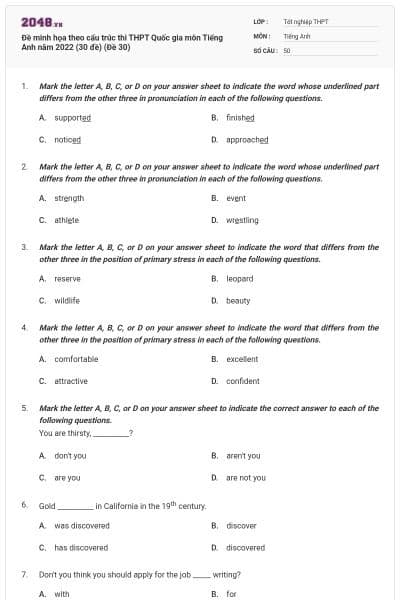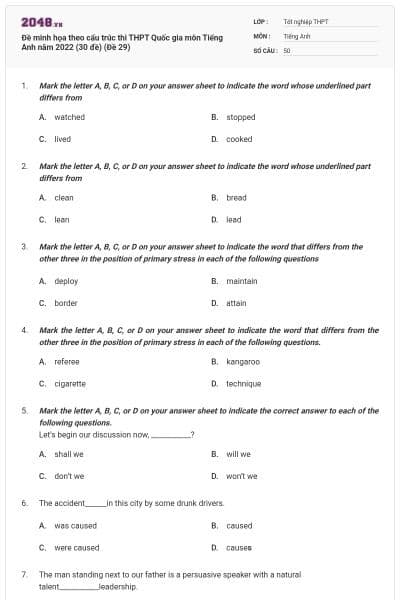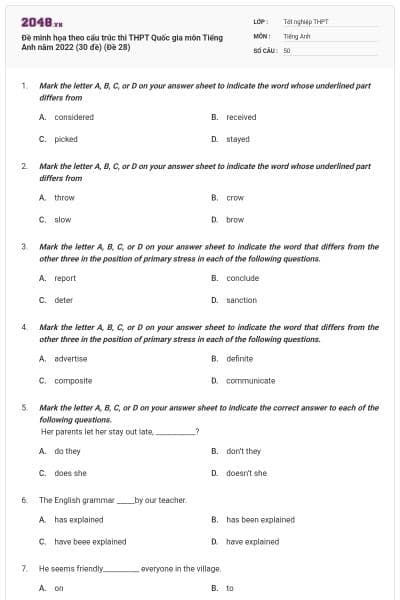
Tổng hợp đề thi thử mới nhất môn tiếng anh cực hay có lời giải (P15)
64 câu hỏi
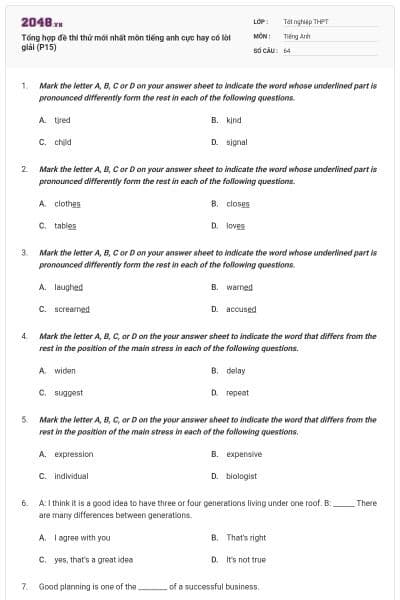
Mark the letter A, B, C or D on your answer sheet to indicate the word whose underlined part is pronounced differently form the rest in each of the following questions.
tired
kind
child
signal
Chọn D
Đáp án D có phần gạch chân đọc là /i/, các từ còn lại đọc là /ai/
Mark the letter A, B, C or D on your answer sheet to indicate the word whose underlined part is pronounced differently form the rest in each of the following questions.
clothes
closes
tables
loves
Chọn B
Đáp án B có phần gạch chân phát âm là /iz/ còn lại đọc là /z/
Mark the letter A, B, C or D on your answer sheet to indicate the word whose underlined part is pronounced differently form the rest in each of the following questions.
laughed
warned
screamed
accused
Chọn A
Đáp án A đọc phần gạch chân là /t/ còn lại là /d/
Mark the letter A, B, C, or D on the your answer sheet to indicate the word that differs from the rest in the position of the main stress in each of the following questions.
widen
delay
suggest
repeat
Chọn A
Đáp án A trọng âm chính rơi vào âm thứ 1, các từ còn lại rơi vào âm tiết thứ 2
Mark the letter A, B, C, or D on the your answer sheet to indicate the word that differs from the rest in the position of the main stress in each of the following questions.
expression
expensive
individual
biologist
Chọn C
Đáp án C
A: I think it is a good idea to have three or four generations living under one roof. B: ______ There are many differences between generations.
I agree with you
That’s right
yes, that’s a great idea
It’s not true
Đáp án: D
Giải thích:
Kiến thức: Tình huống giao tiếp
Dịch:
A: Tôi nghĩ rằng sẽ là một ý tưởng hay nếu có ba hoặc bốn thế hệ sống chung dưới một mái nhà.
B: ______. Có nhiều sự khác biệt giữa các thế hệ.
A. Tôi đồng ý với bạn
B. Đúng vậy
C. Đúng, đó là một ý tưởng tuyệt vời
D. Không đúng
Dựa vào nghĩa câu sau, chọn D.
Good planning is one of the ________ of a successful business.
character
characters
characteristic
characteristics
Chọn D
Dịch câu: lập kế hoạch giỏi thì là 1 trong những đặc trưng của kinh doanh thành công Characteristic (n): đặc trưng, đặc điểm . Ở đây là “một trong những đặc trưng” nên ta dùng số nhiều Character (n) tính cách, nhân vật => không chọn do không phù hợp về nghĩa.
We need ________ information about historical places in Hanoi.
farer
further
father
farthest
Chọn B
Need further information: cần thêm thông tin
Prices are ______ than I expected
little cheaper
more cheap
more cheaper
much cheaper
Chọn D
Không chọn B và C do “cheap’ là tính từ ngắn nên chuyển sang so sánh hơn không cần thêm “more” Người ta thường thêm “much”,”far”, “a little”,… để nhấn mạnh trong so sánh hơn => chọn D Không chọn A do người ta thường dùng “a little” thay vì “little” để nhấn mạnh.
Men and women should be given the same job opportunities; __________ they should be paid equal salaries for the same work.
although
furthermore
therefore
however
Chọn B
Furthermore: thêm nữa ( dùng để bổ sung thêm thông tin cho vế trước )
Remember to invite other people to share the meal _______ you before you start eating it.
with
of
to
about
Chọn A
Share st with sb : chia sẻ cái gì với ai
The Vietnamese government has done a lot to ____ hunger and poverty.
increase
force
eliminate
improve
Đáp án: C
Giải thích:
Kiến thức: Từ vựng
A. increase (v): làm tăng, tăng
B. force (v): bắt buộc, yêu cầu
C. eliminate (v): loại bỏ
D. improve (v): cải thiện
Dựa vào nghĩa câu, chọn C.
Dịch: Chính phủ Việt Nam đã làm rất nhiều việc để xóa đói giảm nghèo.
The TV program I watched last night was so __________ that I turned it off.
boring
excited
bored
exciting
Chọn A
Dịch câu: chương trình TV tôi xem tối qua chán quá đến nỗi mà tôi phải tắt đi. Không chọn B hay C theo nghĩa dịch Ở đây ta dùng “boring” để chỉ tính chất ( chủ động ), “bored” chỉ dùng để chỉ trạng thái, cảm xúc ( mang tính bị động).
Money is used __________ buying and selling goods.
to
for
with
as
Chọn B
(be) used for Ving: được sử dụng cho mục đích gì đó.
Children should _________ not to talk with strangers.
teach
are taught
be teaching
be taught
Chọn D
Dich câu: trẻ con nên được dạy không nói chuyện với người lạ. Câu mang nghĩa phủ định mà bị động của “should” là “should be Ved”
Men and women should be given the same job opportunities; __________ they should be paid equal salaries for the same work.
although
furthermore
therefore
however
Chọn B
Furthermore: thêm nữa ( dùng để bổ sung thêm thông tin cho vế trước )
If you work for the WWF, you can ……………. research on rare plants and animals.
carry away
carry on
carry out
carry off
Chọn C
Dịch câu: nếu bạn làm việc cho WWF, bạn có thể tiến hành nghiên cứu những động thực vật quý hiếm. Carry out : tiến hành
I hate people who …………….the end of a film that you haven’t seen.
breaks off
fills in
gives away
turns up
Chọn C
Dịch câu: tôi ghét những ai mà hé lộ hết ra kết phim mà tôi chưa xem Give away: để lộ ra.
Stop putting words into my ………….! I never said opera was boring, I just said I preferred musicals, that’s all.
mouth
brain
heart
Hair
Chọn A
put word into one’s mouth- mớm lời
You should always do your best to get along ………….other people.
to
into
with
about
Chọn C
Dịch câu: bạn không cần lúc nào cũng phải cố hòa thuận với mọi người
The electric failed while she ……..dinner.
is cooking
was cooking
has cooked
has been cooked
Chọn B
Dùng thì quá khứ tiếp diễn để diễn tả 1 hành động đang xảy ra ở quá khứ thì có hành động khác xem vào. Hành động đang xảy ra ta chia thì quá khứ tiếp diễn, hành động xem vào ta chia thì quá khứ đơn.
Nam has bought a (an)…………… car
expensive red American sport
expensive sport red American
sport expensive red American
American red sport expensive
Chọn A
Thứ tự của tính từ:
· Miêu tả chung
· Kích cỡ
· Tuổi tác
· Hình dạng
· Màu sắc
· Xuất xứ
· Chất liệu
· Mục đích Ở đây cần chú ý cả cụm “ sport car” là ô tô thể thao.
_____Mary studied hard, she would have passed the exam
If
Should
Were
Had
Đáp án: D
Giải thích:
Kiến thức: Câu điều kiện
Dựa vào mệnh đề kết quả ở dạng “would have VpII”, xác định đây là câu điều kiện loại 3 diễn tả điều kiện và kết quả trái với quá khứ.
Cấu trúc:
If + S + had VpII, S + would have VpII
Đảo ngữ:
Had + S + VpII, S + would have VpII
Chọn D.
Dịch: Nếu Mary học hành chăm chỉ, cô ấy đã có thể vượt qua kỳ thi.
Their hotel, ________ staff are very helpful, is an example to all other hotels
that
who
which
whose
Chọn D
Không chọn A B hay C được do ta đang cần 1 đại từ quan hệ mang tính sở hữu đứng trước “staff”
A thief is going to get a nasty surprise today!
an astonishing
a disappointing
a boring
an unpleasant
Chọn D
Nasty = unpleasant (a) khó chịu, chả mấy vui vẻ
Instead of saying that an epidemic had happened suddenly, We generally say that it has
Stopped
burned out
broken out
burned up
Chọn C
Happen suddenly = break out: đột ngột bùng ra, bùng nổ
The campers heard a strange rustling in the trees.
stealing
movement
pillaging
fight
Chọn B
Rustling = movement: sự xào xạc, sự dao động
She had a cozy little apartment in Boston.
uncomfortable
warm
lazy
dirty
Chọn A
Cozy = comfortable (a): ấm cúng, thoải mái, dễ chịu >< uncomfortable
A temporary office was in place within hours and the injured were being helped
soak
permanent
complicated
guess
Chọn B
Temporary(a): tạm thời >< permanent (a) vĩnh cửu, mãi mãi
Going to school is the legal right of children.
elicited
irregular
Secret
illicit
Chọn D
Legal(a) hợp pháp >< illicit (a) trái phép, không hợp pháp.
Mark the letter A, B, C or D on your sheet to indicate the underlined part that needs correction in each of the following questions.
Linh (A) is used to (B) get up (C) late (D) at weekends.
is
get
late
at
Chọn B
=> getting Be used to Ving/N : quen làm cái gì/ quen với cái gì.
Mark the letter A, B, C or D on your sheet to indicate the underlined part that needs correction in each of the following questions.
Joyce thanked (A) us inviting (B) them to dinner and (C) said that they wanted to (D) have us over for dinner next week.
us inviting
them to dinner
said
have us over
Chọn A
=> us for inviting Thank sb for Ving/N: cảm ơn ai đó đã làm gì/cảm ơn ai đó vì cái gì
Mark the letter A, B, C or D on your sheet to indicate the underlined part that needs correction in each of the following questions.
Hadn't he (B) resigned, we would have (C) been forced (D) to sack him.
Hadn't he
resigned
been forced
to sack
Chọn A
=> had he not resigned
Đảo ngữ của câu điều kiện loại 3:
Had + S1 + (not) +Ved, S2 + would/might/could… + have + Ved.
Mark the letter A, B, C or D on your sheet to indicate the underlined part that needs correction in each of the following questions.
Because (A) much species of plants and animals(B) in Hawaii are threaten (C) with extinction within a short period of time, scientists (D) are trying desperately to rescue them.
much
in Hawaii
with
are trying desperately
Chọn A
=> many Cả cụm danh từ “species of plants and animals” là danh từ số nhiều đếm được nên ta dùng “many” thay vì dùng “much”.
Mark the letter A, B, C or D on your sheet to indicate the underlined part that needs correction in each of the following questions.
No (A) sooner had the couple(B) arrived (C) than the priest (D) had started the ceremony.
sooner
arrived
than
had started
Chọn D
=> started Cấu trúc: No sooner …than…: ngay khi… thì… Dịch câu: ngay khi cặp đôi đến thì vị linh mục bắt đầu nghi lễ Động từ “start” chỉ đơn thuần là hành động diễn ra trong quá khứ, xảy ra sau hành động “arrived” nên ta chia ở thì quá khứ đơn.
Read the following passage and mark the letter A, B, C or D on your sheet to indicate the correct word or phrase that best fits each of the numbered blanks from 36 to 46
I was with Overseas Volunteers (OV) for a year after leaving university, and I was sent to an isolated village in Chad, about 500 kilometres from the capital N’Djamena. Coming from a (36)______country, I got quite a shock, as conditions were much harder than I had ( 37) ______. But after a few days I soon got used to (38) ______there. The people were very friendly and helpful, and I soon began to appreciate how beautiful the countryside was.
One of my job was to supply the village with water. The well was a long walk (39) _____, and the women used to spend a long time every day ( 40)_______heavy pots backwards and forwards. So I contacted the organization and arranged to (41 ) _____some pipes delivered. We built a simple pipeline and a pump, and it worked first time. It wasn’t perfect there were a few (42) _____but it made a great difference to the villagers, (43 )______had never had running water before. And not (44 ) ____did we have running water, but in the evenings it was hot, because the pipe had been (45) ____ in the sun all day.
All in all, I think my time with OV was a good experience. I would recommend it to anyone who was planning to work for a charity
Điền vào ô 36
rich
well-paid
comfortable
luxurious
Chọn A
Rich country: quốc gia giàu có
Read the following passage and mark the letter A, B, C or D on your sheet to indicate the correct word or phrase that best fits each of the numbered blanks from 36 to 46
I was with Overseas Volunteers (OV) for a year after leaving university, and I was sent to an isolated village in Chad, about 500 kilometres from the capital N’Djamena. Coming from a (36)______country, I got quite a shock, as conditions were much harder than I had ( 37) ______. But after a few days I soon got used to (38) ______there. The people were very friendly and helpful, and I soon began to appreciate how beautiful the countryside was.
One of my job was to supply the village with water. The well was a long walk (39) _____, and the women used to spend a long time every day ( 40)_______heavy pots backwards and forwards. So I contacted the organization and arranged to (41 ) _____some pipes delivered. We built a simple pipeline and a pump, and it worked first time. It wasn’t perfect there were a few (42) _____but it made a great difference to the villagers, (43 )______had never had running water before. And not (44 ) ____did we have running water, but in the evenings it was hot, because the pipe had been (45) ____ in the sun all day.
All in all, I think my time with OV was a good experience. I would recommend it to anyone who was planning to work for a charity
Điền vào ô 37
felt
planned
found
expected
Chọn D
“I got quite a shock as conditions were much harder than I had expected”: tôi khá là sốc vì điều kiện ở đây khó khăn hơn nhiều so với tôi nghĩ.
Read the following passage and mark the letter A, B, C or D on your sheet to indicate the correct word or phrase that best fits each of the numbered blanks from 36 to 46
I was with Overseas Volunteers (OV) for a year after leaving university, and I was sent to an isolated village in Chad, about 500 kilometres from the capital N’Djamena. Coming from a (36)______country, I got quite a shock, as conditions were much harder than I had ( 37) ______. But after a few days I soon got used to (38) ______there. The people were very friendly and helpful, and I soon began to appreciate how beautiful the countryside was.
One of my job was to supply the village with water. The well was a long walk (39) _____, and the women used to spend a long time every day ( 40)_______heavy pots backwards and forwards. So I contacted the organization and arranged to (41 ) _____some pipes delivered. We built a simple pipeline and a pump, and it worked first time. It wasn’t perfect there were a few (42) _____but it made a great difference to the villagers, (43 )______had never had running water before. And not (44 ) ____did we have running water, but in the evenings it was hot, because the pipe had been (45) ____ in the sun all day.
All in all, I think my time with OV was a good experience. I would recommend it to anyone who was planning to work for a charity
Điền vào ô 38
live
lived
living
lives
Chọn C
Get/be used to Ving/N : quen với việc gì/ quen với cái gì.
Read the following passage and mark the letter A, B, C or D on your sheet to indicate the correct word or phrase that best fits each of the numbered blanks from 36 to 46
I was with Overseas Volunteers (OV) for a year after leaving university, and I was sent to an isolated village in Chad, about 500 kilometres from the capital N’Djamena. Coming from a (36)______country, I got quite a shock, as conditions were much harder than I had ( 37) ______. But after a few days I soon got used to (38) ______there. The people were very friendly and helpful, and I soon began to appreciate how beautiful the countryside was.
One of my job was to supply the village with water. The well was a long walk (39) _____, and the women used to spend a long time every day ( 40)_______heavy pots backwards and forwards. So I contacted the organization and arranged to (41 ) _____some pipes delivered. We built a simple pipeline and a pump, and it worked first time. It wasn’t perfect there were a few (42) _____but it made a great difference to the villagers, (43 )______had never had running water before. And not (44 ) ____did we have running water, but in the evenings it was hot, because the pipe had been (45) ____ in the sun all day.
All in all, I think my time with OV was a good experience. I would recommend it to anyone who was planning to work for a charity
Điền vào ô 39
away
B from
away from
far
Chọn A
“The well was a long walk away”: giếng nước thì cách khoảng 1 đoạn đi bộ dài.
Read the following passage and mark the letter A, B, C or D on your sheet to indicate the correct word or phrase that best fits each of the numbered blanks from 36 to 46
I was with Overseas Volunteers (OV) for a year after leaving university, and I was sent to an isolated village in Chad, about 500 kilometres from the capital N’Djamena. Coming from a (36)______country, I got quite a shock, as conditions were much harder than I had ( 37) ______. But after a few days I soon got used to (38) ______there. The people were very friendly and helpful, and I soon began to appreciate how beautiful the countryside was.
One of my job was to supply the village with water. The well was a long walk (39) _____, and the women used to spend a long time every day ( 40)_______heavy pots backwards and forwards. So I contacted the organization and arranged to (41 ) _____some pipes delivered. We built a simple pipeline and a pump, and it worked first time. It wasn’t perfect there were a few (42) _____but it made a great difference to the villagers, (43 )______had never had running water before. And not (44 ) ____did we have running water, but in the evenings it was hot, because the pipe had been (45) ____ in the sun all day.
All in all, I think my time with OV was a good experience. I would recommend it to anyone who was planning to work for a charity
Điền vào ô 40
A fetching
wearing
carrying
holding
Chọn C
Carry(v) : mang, vác
Read the following passage and mark the letter A, B, C or D on your sheet to indicate the correct word or phrase that best fits each of the numbered blanks from 36 to 46
I was with Overseas Volunteers (OV) for a year after leaving university, and I was sent to an isolated village in Chad, about 500 kilometres from the capital N’Djamena. Coming from a (36)______country, I got quite a shock, as conditions were much harder than I had ( 37) ______. But after a few days I soon got used to (38) ______there. The people were very friendly and helpful, and I soon began to appreciate how beautiful the countryside was.
One of my job was to supply the village with water. The well was a long walk (39) _____, and the women used to spend a long time every day ( 40)_______heavy pots backwards and forwards. So I contacted the organization and arranged to (41 ) _____some pipes delivered. We built a simple pipeline and a pump, and it worked first time. It wasn’t perfect there were a few (42) _____but it made a great difference to the villagers, (43 )______had never had running water before. And not (44 ) ____did we have running water, but in the evenings it was hot, because the pipe had been (45) ____ in the sun all day.
All in all, I think my time with OV was a good experience. I would recommend it to anyone who was planning to work for a charity
Điền vào ô 41
A make
let
have
allow
Chọn C
Ta có cấu trúc: have sb V: nhờ ai đó làm gì (câu chủ động)
ð Have st Ved (bị động)
Read the following passage and mark the letter A, B, C or D on your sheet to indicate the correct word or phrase that best fits each of the numbered blanks from 36 to 46
I was with Overseas Volunteers (OV) for a year after leaving university, and I was sent to an isolated village in Chad, about 500 kilometres from the capital N’Djamena. Coming from a (36)______country, I got quite a shock, as conditions were much harder than I had ( 37) ______. But after a few days I soon got used to (38) ______there. The people were very friendly and helpful, and I soon began to appreciate how beautiful the countryside was.
One of my job was to supply the village with water. The well was a long walk (39) _____, and the women used to spend a long time every day ( 40)_______heavy pots backwards and forwards. So I contacted the organization and arranged to (41 ) _____some pipes delivered. We built a simple pipeline and a pump, and it worked first time. It wasn’t perfect there were a few (42) _____but it made a great difference to the villagers, (43 )______had never had running water before. And not (44 ) ____did we have running water, but in the evenings it was hot, because the pipe had been (45) ____ in the sun all day.
All in all, I think my time with OV was a good experience. I would recommend it to anyone who was planning to work for a charity
Điền vào ô 42
breaks
leaks
splits
punctures
Chọn B
Leak(n) sự rò rỉ
Read the following passage and mark the letter A, B, C or D on your sheet to indicate the correct word or phrase that best fits each of the numbered blanks from 36 to 46
I was with Overseas Volunteers (OV) for a year after leaving university, and I was sent to an isolated village in Chad, about 500 kilometres from the capital N’Djamena. Coming from a (36)______country, I got quite a shock, as conditions were much harder than I had ( 37) ______. But after a few days I soon got used to (38) ______there. The people were very friendly and helpful, and I soon began to appreciate how beautiful the countryside was.
One of my job was to supply the village with water. The well was a long walk (39) _____, and the women used to spend a long time every day ( 40)_______heavy pots backwards and forwards. So I contacted the organization and arranged to (41 ) _____some pipes delivered. We built a simple pipeline and a pump, and it worked first time. It wasn’t perfect there were a few (42) _____but it made a great difference to the villagers, (43 )______had never had running water before. And not (44 ) ____did we have running water, but in the evenings it was hot, because the pipe had been (45) ____ in the sun all day.
All in all, I think my time with OV was a good experience. I would recommend it to anyone who was planning to work for a charity
Điền vào ô 43
A which
that
they
who
Chọn D
Ta dùng đại từ quan hê “who” thay thế chủ ngữ và nối hai mệnh đề với nhau.
Read the following passage and mark the letter A, B, C or D on your sheet to indicate the correct word or phrase that best fits each of the numbered blanks from 36 to 46
I was with Overseas Volunteers (OV) for a year after leaving university, and I was sent to an isolated village in Chad, about 500 kilometres from the capital N’Djamena. Coming from a (36)______country, I got quite a shock, as conditions were much harder than I had ( 37) ______. But after a few days I soon got used to (38) ______there. The people were very friendly and helpful, and I soon began to appreciate how beautiful the countryside was.
One of my job was to supply the village with water. The well was a long walk (39) _____, and the women used to spend a long time every day ( 40)_______heavy pots backwards and forwards. So I contacted the organization and arranged to (41 ) _____some pipes delivered. We built a simple pipeline and a pump, and it worked first time. It wasn’t perfect there were a few (42) _____but it made a great difference to the villagers, (43 )______had never had running water before. And not (44 ) ____did we have running water, but in the evenings it was hot, because the pipe had been (45) ____ in the sun all day.
All in all, I think my time with OV was a good experience. I would recommend it to anyone who was planning to work for a charity
Điền vào ô 44
hardly
scarcely
C only
also
Chọn C
Ta có cấu trúc; …not only…but also…: không chỉ… mà còn …
Read the following passage and mark the letter A, B, C or D on your sheet to indicate the correct word or phrase that best fits each of the numbered blanks from 36 to 46
I was with Overseas Volunteers (OV) for a year after leaving university, and I was sent to an isolated village in Chad, about 500 kilometres from the capital N’Djamena. Coming from a (36)______country, I got quite a shock, as conditions were much harder than I had ( 37) ______. But after a few days I soon got used to (38) ______there. The people were very friendly and helpful, and I soon began to appreciate how beautiful the countryside was.
One of my job was to supply the village with water. The well was a long walk (39) _____, and the women used to spend a long time every day ( 40)_______heavy pots backwards and forwards. So I contacted the organization and arranged to (41 ) _____some pipes delivered. We built a simple pipeline and a pump, and it worked first time. It wasn’t perfect there were a few (42) _____but it made a great difference to the villagers, (43 )______had never had running water before. And not (44 ) ____did we have running water, but in the evenings it was hot, because the pipe had been (45) ____ in the sun all day.
All in all, I think my time with OV was a good experience. I would recommend it to anyone who was planning to work for a charity
Điền vào ô 45
lied
lay
laying
lying
Chọn D
Lie(v) nằm Lie – lay(quá khứ) – lain (phân từ hai) – lying (Ving)
Read the following passage and mark the letter A, B, C, or D on your answer sheet to indicate the correct answer to each of the questions from 46 to 55
Tsunami is a Japanese word which means harbour wave and is used as the scientific term for seismic sea wave generated by an undersea earthquake or possibly an undersea landslide or volcanic eruption. When the ocean floor is tilted or offset during an earthquake, a set of waves is created similar to the concentric waves generated by an object dropped into the water. Most tsunami originate along Ring of Fire, a zone of volcanoes and seismic activities, 32,500 km long that encircles the Pacific Ocean. Since 1819, about 40 tsunamis have struck the Hawaiian Islands.
A tsunami can have wave lengths, or widths, of 100 to 200 km, and may travel hundreds of kilometers across the deep ocean, reaching speech of about 725 to 800 kilometres an hour. Upon entering shallow coastal waters, the wave, which may have been only about half a metre high out at sea, suddenly grow s rapidly. When the wave reaches the shore, it may be 15m high or more. Tsunamis have tremendous energy because of the great volume of wave effected. They are capable of obliterating coastal settlements.
Tsunamis should not be confused with storm surges, which are domes of water that rise underneath hurricanes or cyclone and accompanying storm surge killed an estimated 500,000 people in Bangladesh in 1970. The tsunami which struck south and southeast Asia in late 2004 killed over 200 thousand people.
Scientifically, tsunami is the term for_____
seismic sea wave
undersea earthquake
undersea landslide
volcanic eruption
Chọn A
Thông tin ở câu đầu tiên của bài “Tsunami is a Japanese word which means harbour wave and is used as the scientific term for seismic sea wave generated by an undersea earthquake or possibly an undersea landslide or volcanic eruption.” Ta thấy cụm “seismic sea wave” xuất hiện.
Read the following passage and mark the letter A, B, C, or D on your answer sheet to indicate the correct answer to each of the questions from 46 to 55
Tsunami is a Japanese word which means harbour wave and is used as the scientific term for seismic sea wave generated by an undersea earthquake or possibly an undersea landslide or volcanic eruption. When the ocean floor is tilted or offset during an earthquake, a set of waves is created similar to the concentric waves generated by an object dropped into the water. Most tsunami originate along Ring of Fire, a zone of volcanoes and seismic activities, 32,500 km long that encircles the Pacific Ocean. Since 1819, about 40 tsunamis have struck the Hawaiian Islands.
A tsunami can have wave lengths, or widths, of 100 to 200 km, and may travel hundreds of kilometers across the deep ocean, reaching speech of about 725 to 800 kilometres an hour. Upon entering shallow coastal waters, the wave, which may have been only about half a metre high out at sea, suddenly grow s rapidly. When the wave reaches the shore, it may be 15m high or more. Tsunamis have tremendous energy because of the great volume of wave effected. They are capable of obliterating coastal settlements.
Tsunamis should not be confused with storm surges, which are domes of water that rise underneath hurricanes or cyclone and accompanying storm surge killed an estimated 500,000 people in Bangladesh in 1970. The tsunami which struck south and southeast Asia in late 2004 killed over 200 thousand people.
What does the word concentric mean ?
Wavy
Having many centres
Having a common centre
A ring
Chọn C
Concentric = having a common center: đồng tâm
Read the following passage and mark the letter A, B, C, or D on your answer sheet to indicate the correct answer to each of the questions from 46 to 55
Tsunami is a Japanese word which means harbour wave and is used as the scientific term for seismic sea wave generated by an undersea earthquake or possibly an undersea landslide or volcanic eruption. When the ocean floor is tilted or offset during an earthquake, a set of waves is created similar to the concentric waves generated by an object dropped into the water. Most tsunami originate along Ring of Fire, a zone of volcanoes and seismic activities, 32,500 km long that encircles the Pacific Ocean. Since 1819, about 40 tsunamis have struck the Hawaiian Islands.
A tsunami can have wave lengths, or widths, of 100 to 200 km, and may travel hundreds of kilometers across the deep ocean, reaching speech of about 725 to 800 kilometres an hour. Upon entering shallow coastal waters, the wave, which may have been only about half a metre high out at sea, suddenly grow s rapidly. When the wave reaches the shore, it may be 15m high or more. Tsunamis have tremendous energy because of the great volume of wave effected. They are capable of obliterating coastal settlements.
Tsunamis should not be confused with storm surges, which are domes of water that rise underneath hurricanes or cyclone and accompanying storm surge killed an estimated 500,000 people in Bangladesh in 1970. The tsunami which struck south and southeast Asia in late 2004 killed over 200 thousand people.
Which of the following may be a reason for a tsunami ?
An inactive volcano
A landslide on the seashore
An undersea earthquake
A storm
Chọn B
Thông tin ở câu đầu tiên của bài “Tsunami is a Japanese word which means harbour wave and is used as the scientific term for seismic sea wave generated by an undersea earthquake or possibly an undersea landslide or volcanic eruption.” Chú ý một nguyên nhân có thể gây ra “an undersea landslide”. Vậy chọn B
Read the following passage and mark the letter A, B, C, or D on your answer sheet to indicate the correct answer to each of the questions from 46 to 55
Tsunami is a Japanese word which means harbour wave and is used as the scientific term for seismic sea wave generated by an undersea earthquake or possibly an undersea landslide or volcanic eruption. When the ocean floor is tilted or offset during an earthquake, a set of waves is created similar to the concentric waves generated by an object dropped into the water. Most tsunami originate along Ring of Fire, a zone of volcanoes and seismic activities, 32,500 km long that encircles the Pacific Ocean. Since 1819, about 40 tsunamis have struck the Hawaiian Islands.
A tsunami can have wave lengths, or widths, of 100 to 200 km, and may travel hundreds of kilometers across the deep ocean, reaching speech of about 725 to 800 kilometres an hour. Upon entering shallow coastal waters, the wave, which may have been only about half a metre high out at sea, suddenly grow s rapidly. When the wave reaches the shore, it may be 15m high or more. Tsunamis have tremendous energy because of the great volume of wave effected. They are capable of obliterating coastal settlements.
Tsunamis should not be confused with storm surges, which are domes of water that rise underneath hurricanes or cyclone and accompanying storm surge killed an estimated 500,000 people in Bangladesh in 1970. The tsunami which struck south and southeast Asia in late 2004 killed over 200 thousand people.
What will happen when an object is dropped into the water ?
volcanic eruption may be a consequence
Some concentric waves will be generated
there will be seismic activity
Earthquake may happen
Chọn B
Ta thấy thông tin “the concentric waves generated by an object dropped into the water”. Từ đó, có thể nhận ra rằng: một vài sóng đồng tâm sẽ đươc tạo ra nếu một vật bị rơi vào trong nước.
Read the following passage and mark the letter A, B, C, or D on your answer sheet to indicate the correct answer to each of the questions from 46 to 55
Tsunami is a Japanese word which means harbour wave and is used as the scientific term for seismic sea wave generated by an undersea earthquake or possibly an undersea landslide or volcanic eruption. When the ocean floor is tilted or offset during an earthquake, a set of waves is created similar to the concentric waves generated by an object dropped into the water. Most tsunami originate along Ring of Fire, a zone of volcanoes and seismic activities, 32,500 km long that encircles the Pacific Ocean. Since 1819, about 40 tsunamis have struck the Hawaiian Islands.
A tsunami can have wave lengths, or widths, of 100 to 200 km, and may travel hundreds of kilometers across the deep ocean, reaching speech of about 725 to 800 kilometres an hour. Upon entering shallow coastal waters, the wave, which may have been only about half a metre high out at sea, suddenly grow s rapidly. When the wave reaches the shore, it may be 15m high or more. Tsunamis have tremendous energy because of the great volume of wave effected. They are capable of obliterating coastal settlements.
Tsunamis should not be confused with storm surges, which are domes of water that rise underneath hurricanes or cyclone and accompanying storm surge killed an estimated 500,000 people in Bangladesh in 1970. The tsunami which struck south and southeast Asia in late 2004 killed over 200 thousand people.
What is the zone of volcanoes and seismic activity in the world called ?
The concentric wave
The tsunami
The Pacific Ocean
The Ring of Fire
Chọn D
“Most tsunami originate along Ring of Fire” hầu hết sóng thần bắt nguồn ở Vành Đai Lửa.
Read the following passage and mark the letter A, B, C, or D on your answer sheet to indicate the correct answer to each of the questions from 46 to 55
Tsunami is a Japanese word which means harbour wave and is used as the scientific term for seismic sea wave generated by an undersea earthquake or possibly an undersea landslide or volcanic eruption. When the ocean floor is tilted or offset during an earthquake, a set of waves is created similar to the concentric waves generated by an object dropped into the water. Most tsunami originate along Ring of Fire, a zone of volcanoes and seismic activities, 32,500 km long that encircles the Pacific Ocean. Since 1819, about 40 tsunamis have struck the Hawaiian Islands.
A tsunami can have wave lengths, or widths, of 100 to 200 km, and may travel hundreds of kilometers across the deep ocean, reaching speech of about 725 to 800 kilometres an hour. Upon entering shallow coastal waters, the wave, which may have been only about half a metre high out at sea, suddenly grow s rapidly. When the wave reaches the shore, it may be 15m high or more. Tsunamis have tremendous energy because of the great volume of wave effected. They are capable of obliterating coastal settlements.
Tsunamis should not be confused with storm surges, which are domes of water that rise underneath hurricanes or cyclone and accompanying storm surge killed an estimated 500,000 people in Bangladesh in 1970. The tsunami which struck south and southeast Asia in late 2004 killed over 200 thousand people.
That is the greatest speed of tsunamis traveling across the deep ocean ?
200 kilometres an hour
700 kilometres an hour
800 kilometres an hour
150,000 kilometres an hour
Chọn C
“reaching speech of about 725 to 800 kilometres an hour.” Vậy tốc độ lớn nhất nó có thể đạt được là “800 kilometres an hour”.
Read the following passage and mark the letter A, B, C, or D on your answer sheet to indicate the correct answer to each of the questions from 46 to 55
Tsunami is a Japanese word which means harbour wave and is used as the scientific term for seismic sea wave generated by an undersea earthquake or possibly an undersea landslide or volcanic eruption. When the ocean floor is tilted or offset during an earthquake, a set of waves is created similar to the concentric waves generated by an object dropped into the water. Most tsunami originate along Ring of Fire, a zone of volcanoes and seismic activities, 32,500 km long that encircles the Pacific Ocean. Since 1819, about 40 tsunamis have struck the Hawaiian Islands.
A tsunami can have wave lengths, or widths, of 100 to 200 km, and may travel hundreds of kilometers across the deep ocean, reaching speech of about 725 to 800 kilometres an hour. Upon entering shallow coastal waters, the wave, which may have been only about half a metre high out at sea, suddenly grow s rapidly. When the wave reaches the shore, it may be 15m high or more. Tsunamis have tremendous energy because of the great volume of wave effected. They are capable of obliterating coastal settlements.
Tsunamis should not be confused with storm surges, which are domes of water that rise underneath hurricanes or cyclone and accompanying storm surge killed an estimated 500,000 people in Bangladesh in 1970. The tsunami which struck south and southeast Asia in late 2004 killed over 200 thousand people.
How high is the wave of the tsunami when it reaches the shore ?
100 metres
200 metres
Half a metre
Fifteen metres
Chọn D
Ta có thông tin: “When the wave reaches the shore, it may be 15m high or more.” ( khi sóng đánh lên đến bờ, nó có thể đạt tới 15 mét hoặc hơn thê).
Read the following passage and mark the letter A, B, C, or D on your answer sheet to indicate the correct answer to each of the questions from 46 to 55
Tsunami is a Japanese word which means harbour wave and is used as the scientific term for seismic sea wave generated by an undersea earthquake or possibly an undersea landslide or volcanic eruption. When the ocean floor is tilted or offset during an earthquake, a set of waves is created similar to the concentric waves generated by an object dropped into the water. Most tsunami originate along Ring of Fire, a zone of volcanoes and seismic activities, 32,500 km long that encircles the Pacific Ocean. Since 1819, about 40 tsunamis have struck the Hawaiian Islands.
A tsunami can have wave lengths, or widths, of 100 to 200 km, and may travel hundreds of kilometers across the deep ocean, reaching speech of about 725 to 800 kilometres an hour. Upon entering shallow coastal waters, the wave, which may have been only about half a metre high out at sea, suddenly grow s rapidly. When the wave reaches the shore, it may be 15m high or more. Tsunamis have tremendous energy because of the great volume of wave effected. They are capable of obliterating coastal settlements.
Tsunamis should not be confused with storm surges, which are domes of water that rise underneath hurricanes or cyclone and accompanying storm surge killed an estimated 500,000 people in Bangladesh in 1970. The tsunami which struck south and southeast Asia in late 2004 killed over 200 thousand people.
How are tsunami capable of obliterating coastal settlements?
They have tremendous energy due to the great volume of water affected
They are a metre high or more
They travel hundreds of kilometers
They can strike the shore fifteen metres high
Chọn A
Thông tin: “Tsunamis have tremendous energy because of the great volume of wave effected. They are capable of obliterating coastal settlements”.
Read the following passage and mark the letter A, B, C, or D on your answer sheet to indicate the correct answer to each of the questions from 46 to 55
Tsunami is a Japanese word which means harbour wave and is used as the scientific term for seismic sea wave generated by an undersea earthquake or possibly an undersea landslide or volcanic eruption. When the ocean floor is tilted or offset during an earthquake, a set of waves is created similar to the concentric waves generated by an object dropped into the water. Most tsunami originate along Ring of Fire, a zone of volcanoes and seismic activities, 32,500 km long that encircles the Pacific Ocean. Since 1819, about 40 tsunamis have struck the Hawaiian Islands.
A tsunami can have wave lengths, or widths, of 100 to 200 km, and may travel hundreds of kilometers across the deep ocean, reaching speech of about 725 to 800 kilometres an hour. Upon entering shallow coastal waters, the wave, which may have been only about half a metre high out at sea, suddenly grow s rapidly. When the wave reaches the shore, it may be 15m high or more. Tsunamis have tremendous energy because of the great volume of wave effected. They are capable of obliterating coastal settlements.
Tsunamis should not be confused with storm surges, which are domes of water that rise underneath hurricanes or cyclone and accompanying storm surge killed an estimated 500,000 people in Bangladesh in 1970. The tsunami which struck south and southeast Asia in late 2004 killed over 200 thousand people.
What killed an estimated 500,000 people in Bangladesh?
A tsunami
A cyclone and accompanying storm surge
A high tide
Flooding
Chọn B
Ta thấy “Tsunamis should not be confused with storm surges, which are domes of water that rise underneath hurricanes or cyclone and accompanying storm surge killed an estimated 500,000 people in Bangladesh in 1970”. Vậy “cyclone and accompanying storm” đã giết chết 500,000 người ở Bangladesh vào năm 1970.
Read the following passage and mark the letter A, B, C, or D on your answer sheet to indicate the correct answer to each of the questions from 46 to 55
Tsunami is a Japanese word which means harbour wave and is used as the scientific term for seismic sea wave generated by an undersea earthquake or possibly an undersea landslide or volcanic eruption. When the ocean floor is tilted or offset during an earthquake, a set of waves is created similar to the concentric waves generated by an object dropped into the water. Most tsunami originate along Ring of Fire, a zone of volcanoes and seismic activities, 32,500 km long that encircles the Pacific Ocean. Since 1819, about 40 tsunamis have struck the Hawaiian Islands.
A tsunami can have wave lengths, or widths, of 100 to 200 km, and may travel hundreds of kilometers across the deep ocean, reaching speech of about 725 to 800 kilometres an hour. Upon entering shallow coastal waters, the wave, which may have been only about half a metre high out at sea, suddenly grow s rapidly. When the wave reaches the shore, it may be 15m high or more. Tsunamis have tremendous energy because of the great volume of wave effected. They are capable of obliterating coastal settlements.
Tsunamis should not be confused with storm surges, which are domes of water that rise underneath hurricanes or cyclone and accompanying storm surge killed an estimated 500,000 people in Bangladesh in 1970. The tsunami which struck south and southeast Asia in late 2004 killed over 200 thousand people.
Which of the following is NOT true ?
Tsunamis only occur in Asia
A cyclone along with storm surge happened in Asia in 1970
Storm surges are domes of water rising underneath hurricanes or cyclones
Storm surges cause extensive coastal flooding
Chọn A
Các đáp án B C và D đều xuất hiện trong bài đáp án A không chính xác do ta thấy sóng thần còn xuất hiện ở “Hawaiian Islands”, không phải chỉ xảy ra ở châu Á.
Read the following passage and mark the letter A, B, C, or D on your answer sheet to indicate the correct answer to each of the questions from 56 to 64
Millions of people are using cell phones today. In many places, it is actually considered unusual not to use one. In many countries, cell phones are very popular with young people. They find that the phones are more than a means of communication-having a mobile phone shows that they are cool and connected.
The explosion in mobile phone use around the world has made some health professionals worried. Some doctors are concerned that in the future many people may suffer heath problems from the use of mobile phones. In England, there has a serious debate about this issue. Mobile phone companies are worried about the negative publicity of such ideas. They say that there is no proof that mobile phones are bad for your health. On the other hand, medical studies have shown changes in the brain cells of some people who use mobile phones. Signs of change in the tissues of the brain and head can be detected with modern scanning equipment. In one case, a loss. He couldn’t remember even simple tasks. He would often forget the name of his own son. This man used to talk on his mobile phone for about six hours a day, every day of his working week, for a couple of years. His family doctor blamed his mobile phone use, but his employer’s doctor didn’t agree. What is it that makes mobile phone potentially harmful? The answer is radiation. High-tech machines can detect very small amounts of radiation from mobile phones. Mobile phone companies agree that there is some radiation, but they say the amount is too small to worry about. As the discussion about their safety continues, it appears that it’s best to use mobile phone less often. Use your regular phone if you want to talk for a long time. Use your mobile phone only when you really need it. Mobile phones can be very useful and convenient, especially in emergencies. In the future, mobile phone may have a warning label that says they are bad for your health. So for now, its wise not to use your mobile phone too often.
The most suitable title for the passage could be ______
“The reasons Why Mobile phones Are popular
“Technological Innovations and Their Price”
“The Way Mobile Phones Work”
“Mobile Phones: A Must of Our Time”
Chọn B
Bài đọc đề cập đến 2 mặt của một vấn đề. Tác giả đưa ra sự tiện lợi hữu ích của điện thoại di động đồng thời cũng nêu lên những tác hại có thể gây cho con người. Đề tựa phù hợp nhất cho bài đọc trên là: “Technological Innovations and Their Price” vì nó thể hiện được đúng nội dung của bài.
Read the following passage and mark the letter A, B, C, or D on your answer sheet to indicate the correct answer to each of the questions from 56 to 64
Millions of people are using cell phones today. In many places, it is actually considered unusual not to use one. In many countries, cell phones are very popular with young people. They find that the phones are more than a means of communication-having a mobile phone shows that they are cool and connected.
The explosion in mobile phone use around the world has made some health professionals worried. Some doctors are concerned that in the future many people may suffer heath problems from the use of mobile phones. In England, there has a serious debate about this issue. Mobile phone companies are worried about the negative publicity of such ideas. They say that there is no proof that mobile phones are bad for your health. On the other hand, medical studies have shown changes in the brain cells of some people who use mobile phones. Signs of change in the tissues of the brain and head can be detected with modern scanning equipment. In one case, a loss. He couldn’t remember even simple tasks. He would often forget the name of his own son. This man used to talk on his mobile phone for about six hours a day, every day of his working week, for a couple of years. His family doctor blamed his mobile phone use, but his employer’s doctor didn’t agree. What is it that makes mobile phone potentially harmful? The answer is radiation. High-tech machines can detect very small amounts of radiation from mobile phones. Mobile phone companies agree that there is some radiation, but they say the amount is too small to worry about. As the discussion about their safety continues, it appears that it’s best to use mobile phone less often. Use your regular phone if you want to talk for a long time. Use your mobile phone only when you really need it. Mobile phones can be very useful and convenient, especially in emergencies. In the future, mobile phone may have a warning label that says they are bad for your health. So for now, its wise not to use your mobile phone too often.
According to the passage, cell phones are especially popular with young people because
they are indispensable in everyday communications
they make them look more stylish
they keep the users alert all the time
They can not be replaced by regular phone
Chọn B
“They find that the phones are more than a means of communication - having a mobile phone shows that they are cool and connected.” Cool đồng nghĩa với fashionable hoặc stylish.
Read the following passage and mark the letter A, B, C, or D on your answer sheet to indicate the correct answer to each of the questions from 56 to 64
Millions of people are using cell phones today. In many places, it is actually considered unusual not to use one. In many countries, cell phones are very popular with young people. They find that the phones are more than a means of communication-having a mobile phone shows that they are cool and connected.
The explosion in mobile phone use around the world has made some health professionals worried. Some doctors are concerned that in the future many people may suffer heath problems from the use of mobile phones. In England, there has a serious debate about this issue. Mobile phone companies are worried about the negative publicity of such ideas. They say that there is no proof that mobile phones are bad for your health. On the other hand, medical studies have shown changes in the brain cells of some people who use mobile phones. Signs of change in the tissues of the brain and head can be detected with modern scanning equipment. In one case, a loss. He couldn’t remember even simple tasks. He would often forget the name of his own son. This man used to talk on his mobile phone for about six hours a day, every day of his working week, for a couple of years. His family doctor blamed his mobile phone use, but his employer’s doctor didn’t agree. What is it that makes mobile phone potentially harmful? The answer is radiation. High-tech machines can detect very small amounts of radiation from mobile phones. Mobile phone companies agree that there is some radiation, but they say the amount is too small to worry about. As the discussion about their safety continues, it appears that it’s best to use mobile phone less often. Use your regular phone if you want to talk for a long time. Use your mobile phone only when you really need it. Mobile phones can be very useful and convenient, especially in emergencies. In the future, mobile phone may have a warning label that says they are bad for your health. So for now, its wise not to use your mobile phone too often.
The changes possibly caused by the cell phones are mainly concerned with _____
the mobility of the mind and the body
the resident memory
the smallest units of the brain
the arteries of the brain
Chọn C
“On the other hand, medical studies have shown changes in the brain cells of some people who use mobile phones”. Brain cells = the smallest units of the brain: tế bào não
Read the following passage and mark the letter A, B, C, or D on your answer sheet to indicate the correct answer to each of the questions from 56 to 64
Millions of people are using cell phones today. In many places, it is actually considered unusual not to use one. In many countries, cell phones are very popular with young people. They find that the phones are more than a means of communication-having a mobile phone shows that they are cool and connected.
The explosion in mobile phone use around the world has made some health professionals worried. Some doctors are concerned that in the future many people may suffer heath problems from the use of mobile phones. In England, there has a serious debate about this issue. Mobile phone companies are worried about the negative publicity of such ideas. They say that there is no proof that mobile phones are bad for your health. On the other hand, medical studies have shown changes in the brain cells of some people who use mobile phones. Signs of change in the tissues of the brain and head can be detected with modern scanning equipment. In one case, a loss. He couldn’t remember even simple tasks. He would often forget the name of his own son. This man used to talk on his mobile phone for about six hours a day, every day of his working week, for a couple of years. His family doctor blamed his mobile phone use, but his employer’s doctor didn’t agree. What is it that makes mobile phone potentially harmful? The answer is radiation. High-tech machines can detect very small amounts of radiation from mobile phones. Mobile phone companies agree that there is some radiation, but they say the amount is too small to worry about. As the discussion about their safety continues, it appears that it’s best to use mobile phone less often. Use your regular phone if you want to talk for a long time. Use your mobile phone only when you really need it. Mobile phones can be very useful and convenient, especially in emergencies. In the future, mobile phone may have a warning label that says they are bad for your health. So for now, its wise not to use your mobile phone too often.
The word “means” in the passage most closely means ______
meanings
expression
method
transmission
Chọn C
a means of communication: phương tiện/ cách thức giao tiếp. Do đó means đồng nghĩa với method
Read the following passage and mark the letter A, B, C, or D on your answer sheet to indicate the correct answer to each of the questions from 56 to 64
Millions of people are using cell phones today. In many places, it is actually considered unusual not to use one. In many countries, cell phones are very popular with young people. They find that the phones are more than a means of communication-having a mobile phone shows that they are cool and connected.
The explosion in mobile phone use around the world has made some health professionals worried. Some doctors are concerned that in the future many people may suffer heath problems from the use of mobile phones. In England, there has a serious debate about this issue. Mobile phone companies are worried about the negative publicity of such ideas. They say that there is no proof that mobile phones are bad for your health. On the other hand, medical studies have shown changes in the brain cells of some people who use mobile phones. Signs of change in the tissues of the brain and head can be detected with modern scanning equipment. In one case, a loss. He couldn’t remember even simple tasks. He would often forget the name of his own son. This man used to talk on his mobile phone for about six hours a day, every day of his working week, for a couple of years. His family doctor blamed his mobile phone use, but his employer’s doctor didn’t agree. What is it that makes mobile phone potentially harmful? The answer is radiation. High-tech machines can detect very small amounts of radiation from mobile phones. Mobile phone companies agree that there is some radiation, but they say the amount is too small to worry about. As the discussion about their safety continues, it appears that it’s best to use mobile phone less often. Use your regular phone if you want to talk for a long time. Use your mobile phone only when you really need it. Mobile phones can be very useful and convenient, especially in emergencies. In the future, mobile phone may have a warning label that says they are bad for your health. So for now, its wise not to use your mobile phone too often.
The word “potentially” in the passage most closely means _______
obviously
possibly
certainly
privately
Chọn B
“What is it that makes mobile phones potentially harmful?” Xét trong ngữ cảnh của câu potentially có nghĩa là “có thể”, do đó từ có nghĩa gần nhất với nó là possibly
Read the following passage and mark the letter A, B, C, or D on your answer sheet to indicate the correct answer to each of the questions from 56 to 64
Millions of people are using cell phones today. In many places, it is actually considered unusual not to use one. In many countries, cell phones are very popular with young people. They find that the phones are more than a means of communication-having a mobile phone shows that they are cool and connected.
The explosion in mobile phone use around the world has made some health professionals worried. Some doctors are concerned that in the future many people may suffer heath problems from the use of mobile phones. In England, there has a serious debate about this issue. Mobile phone companies are worried about the negative publicity of such ideas. They say that there is no proof that mobile phones are bad for your health. On the other hand, medical studies have shown changes in the brain cells of some people who use mobile phones. Signs of change in the tissues of the brain and head can be detected with modern scanning equipment. In one case, a loss. He couldn’t remember even simple tasks. He would often forget the name of his own son. This man used to talk on his mobile phone for about six hours a day, every day of his working week, for a couple of years. His family doctor blamed his mobile phone use, but his employer’s doctor didn’t agree. What is it that makes mobile phone potentially harmful? The answer is radiation. High-tech machines can detect very small amounts of radiation from mobile phones. Mobile phone companies agree that there is some radiation, but they say the amount is too small to worry about. As the discussion about their safety continues, it appears that it’s best to use mobile phone less often. Use your regular phone if you want to talk for a long time. Use your mobile phone only when you really need it. Mobile phones can be very useful and convenient, especially in emergencies. In the future, mobile phone may have a warning label that says they are bad for your health. So for now, its wise not to use your mobile phone too often.
“Negative publicity: in the passage most closely means________
information on the lethal effects of cell phones
widespread opinion about bad effects of cell phones
the negative public use of cell phones
poor ideas about the effects of cell phones
Chọn B
“In England, there has been a serious debate about this issue. Mobile phone companies are worried about the negative publicity of such ideas.” Negative publicity có nghĩa là việc làm cho công chúng biết đến những mặt tiêu cực hoặc ảnh hưởng xấu của điều gì đó. Đáp án của câu trên là B (widespread opinion about bad effects of cellphones)
Read the following passage and mark the letter A, B, C, or D on your answer sheet to indicate the correct answer to each of the questions from 56 to 64
Millions of people are using cell phones today. In many places, it is actually considered unusual not to use one. In many countries, cell phones are very popular with young people. They find that the phones are more than a means of communication-having a mobile phone shows that they are cool and connected.
The explosion in mobile phone use around the world has made some health professionals worried. Some doctors are concerned that in the future many people may suffer heath problems from the use of mobile phones. In England, there has a serious debate about this issue. Mobile phone companies are worried about the negative publicity of such ideas. They say that there is no proof that mobile phones are bad for your health. On the other hand, medical studies have shown changes in the brain cells of some people who use mobile phones. Signs of change in the tissues of the brain and head can be detected with modern scanning equipment. In one case, a loss. He couldn’t remember even simple tasks. He would often forget the name of his own son. This man used to talk on his mobile phone for about six hours a day, every day of his working week, for a couple of years. His family doctor blamed his mobile phone use, but his employer’s doctor didn’t agree. What is it that makes mobile phone potentially harmful? The answer is radiation. High-tech machines can detect very small amounts of radiation from mobile phones. Mobile phone companies agree that there is some radiation, but they say the amount is too small to worry about. As the discussion about their safety continues, it appears that it’s best to use mobile phone less often. Use your regular phone if you want to talk for a long time. Use your mobile phone only when you really need it. Mobile phones can be very useful and convenient, especially in emergencies. In the future, mobile phone may have a warning label that says they are bad for your health. So for now, its wise not to use your mobile phone too often.
Doctors have tentatively concluded that cell phones may _____
damage their users’ emotions
cause some mental malfunction
change their users’ temperament
change their users’ social behavior
Chọn B
“In one case, a traveling salesman had to retire at young age because of serious memory loss. He couldn't remember even simple tasks. He would often forget the name of his own son. This man used to talk on his mobile phone for about six hours a day, every day of his working week, for a couple of years. His family doctor blamed his mobile phone use, but his employer's doctor didn't agree.” Như vậy việc dùng điện thoại di động có thể gây ảnh hưởng đến các chức năng về mặt thần kinh. Đáp án của câu là cause some mental malfunction
Read the following passage and mark the letter A, B, C, or D on your answer sheet to indicate the correct answer to each of the questions from 56 to 64
Millions of people are using cell phones today. In many places, it is actually considered unusual not to use one. In many countries, cell phones are very popular with young people. They find that the phones are more than a means of communication-having a mobile phone shows that they are cool and connected.
The explosion in mobile phone use around the world has made some health professionals worried. Some doctors are concerned that in the future many people may suffer heath problems from the use of mobile phones. In England, there has a serious debate about this issue. Mobile phone companies are worried about the negative publicity of such ideas. They say that there is no proof that mobile phones are bad for your health. On the other hand, medical studies have shown changes in the brain cells of some people who use mobile phones. Signs of change in the tissues of the brain and head can be detected with modern scanning equipment. In one case, a loss. He couldn’t remember even simple tasks. He would often forget the name of his own son. This man used to talk on his mobile phone for about six hours a day, every day of his working week, for a couple of years. His family doctor blamed his mobile phone use, but his employer’s doctor didn’t agree. What is it that makes mobile phone potentially harmful? The answer is radiation. High-tech machines can detect very small amounts of radiation from mobile phones. Mobile phone companies agree that there is some radiation, but they say the amount is too small to worry about. As the discussion about their safety continues, it appears that it’s best to use mobile phone less often. Use your regular phone if you want to talk for a long time. Use your mobile phone only when you really need it. Mobile phones can be very useful and convenient, especially in emergencies. In the future, mobile phone may have a warning label that says they are bad for your health. So for now, its wise not to use your mobile phone too often.
The man mentioned in the passage, who used his cell phone too often, ____
suffer serious loss of mental ability
abandoned his family
could no longer think lucidly
had a problem with memory
Chọn D
“In one case, a traveling salesman had to retire at young age because of serious memory loss. He couldn't remember even simple tasks.”
Read the following passage and mark the letter A, B, C, or D on your answer sheet to indicate the correct answer to each of the questions from 56 to 64
Millions of people are using cell phones today. In many places, it is actually considered unusual not to use one. In many countries, cell phones are very popular with young people. They find that the phones are more than a means of communication-having a mobile phone shows that they are cool and connected.
The explosion in mobile phone use around the world has made some health professionals worried. Some doctors are concerned that in the future many people may suffer heath problems from the use of mobile phones. In England, there has a serious debate about this issue. Mobile phone companies are worried about the negative publicity of such ideas. They say that there is no proof that mobile phones are bad for your health. On the other hand, medical studies have shown changes in the brain cells of some people who use mobile phones. Signs of change in the tissues of the brain and head can be detected with modern scanning equipment. In one case, a loss. He couldn’t remember even simple tasks. He would often forget the name of his own son. This man used to talk on his mobile phone for about six hours a day, every day of his working week, for a couple of years. His family doctor blamed his mobile phone use, but his employer’s doctor didn’t agree. What is it that makes mobile phone potentially harmful? The answer is radiation. High-tech machines can detect very small amounts of radiation from mobile phones. Mobile phone companies agree that there is some radiation, but they say the amount is too small to worry about. As the discussion about their safety continues, it appears that it’s best to use mobile phone less often. Use your regular phone if you want to talk for a long time. Use your mobile phone only when you really need it. Mobile phones can be very useful and convenient, especially in emergencies. In the future, mobile phone may have a warning label that says they are bad for your health. So for now, its wise not to use your mobile phone too often.
According to the writer, people should _____
only use mobile phones in urgent cases
only use mobile phones regularly
keep off mobile phones regularly
never use mobile phones in all cases
Chọn A
“Mobile phones can be very useful and convenient, especially in emergencies.”
emergencies = urgent cases: những trường hợp khẩn cấp