Tổng hợp đề thi thử mới nhất môn tiếng anh cực hay có lời giải (P13)
64 câu hỏi
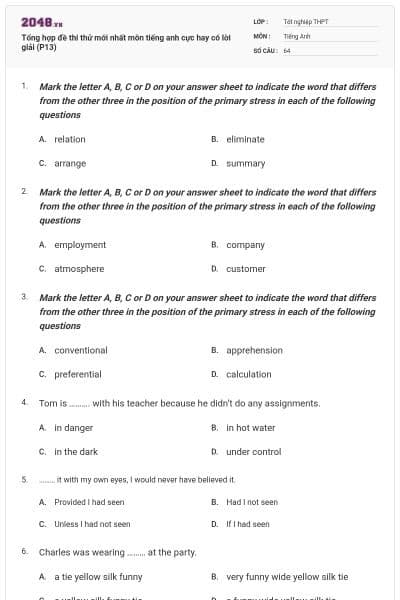
Mark the letter A, B, C or D on your answer sheet to indicate the word that differs from the other three in the position of the primary stress in each of the following questions
relation
eliminate
arrange
summary
Đáp án : D
Phần D trọng âm rơi vào âm tiết thứ nhất, còn lại là thứ 2
Mark the letter A, B, C or D on your answer sheet to indicate the word that differs from the other three in the position of the primary stress in each of the following questions
employment
company
atmosphere
customer
Đáp án : A
Phần A trọng âm rơi vào âm tiết thứ 2, còn lại là thứ nhất
Mark the letter A, B, C or D on your answer sheet to indicate the word that differs from the other three in the position of the primary stress in each of the following questions
conventional
apprehension
preferential
calculation
Đáp án : A
Phần A trọng âm rơi vào âm tiết thứ 2, còn lại là thứ 3
Tom is ………. with his teacher because he didn’t do any assignments.
in danger
in hot water
in the dark
under control
Đáp án : B
Cấu trúc “be in (get into) hot water”: gặp khó khăn, rắc rố
……… it with my own eyes, I would never have believed it.
Provided I had seen
Had I not seen
Unless I had not seen
If I had seen
Đáp án: B
Giải thích:
Kiến thức: Câu điều kiện loại 3
Xét các đáp án:
A. Đúng cấu trúc câu điều kiện loại 3 nhưng không phù hợp về nghĩa
B. Đảo ngữ với câu điều kiện loại 3
Had + S + (not) + VpII = If + S + had (not) VpII
Đúng nghĩa và cấu trúc
C. If + S + had not VpII = Unless + S + VpII
Thừa phủ định “not” vì “unless” đã mang nghĩa phủ định rồi
D. Đúng cấu trúc câu điều kiện loại 3 nhưng không phù hợp về nghĩa
Dịch: Nếu không tận mắt chứng kiến, tôi sẽ không bao giờ tin được.
Charles was wearing ……… at the party.
a tie yellow silk funny
very funny wide yellow silk tie
a yellow silk funny tie
a funny wide yellow silk tie
Đáp án : D
Vị trí đúng của tính từ:
Mạo từ (a,an,the) + Opinion (funny) + Size (wide) + Color (yellow) + Material (silk) + noun (tie)
Marie Curie was the first and only woman ……… two Nobel prizes.
that win
to be won
who win
to have won
Đáp án: D
Giải thích:
Cấu trúc the first / the only + to V diễn tả người đầu tiên hoặc duy nhất làm điều gì đó.
Ở đây, Marie Curie was the first and only woman → cần động từ nguyên mẫu hoàn thành (to have won) để diễn tả hành động đã xảy ra trong quá khứ.
Xét các đáp án:
A. that win → Sai vì "win" ở dạng nguyên mẫu không phù hợp với cấu trúc câu.
B. to be won → Sai vì "to be won" mang nghĩa bị động (được trao), trong khi Marie Curie là người giành giải.
C. who win → Sai vì "who win" cần chia động từ đúng với "woman" (số ít), nhưng "win" chưa chia.
D. to have won → Đúng vì đây là cấu trúc the first/only + to have V3/V-ed diễn tả hành động đã xảy ra trong quá khứ.
Dịch: Marie Curie là người phụ nữ đầu tiên và duy nhất giành hai giải Nobel.
The death of Tran Lap, the leader of a Vietnamese famous rock band called Buc Tuong, is a great………to his fans
loss
losing
lost
lose
Đáp án : A
Ở đây ta cần một danh từ, vì phía trước đã có tính từ great
“loss” (n): sự mất mát
I………an old friend of mine in the street this morning. We haven’t seen each other for ages.
came round
came over
ran into
ran out
Đáp án : C
“run into”: gặp tình cờ
Sorry, I’m late, but my car………on the way here, and I had to call the garage.
not working
out of order
broke down
was broke
Đáp án : C
“break down”: hỏng hóc
It was………furniture that I didn’t buy it.
a so expensive
such expensive
such an expensive
so expensive
Đáp án: B
Giải thích:
Giải thích:
Kiến thức: Cấu trúc "such ... that"
Công thức: Such + (a/an) + adj + danh từ + that + mệnh đề
Furniture là danh từ không đếm được, nên không dùng a/an.
Chọn B.
Dịch: Đó là đồ nội thất quá đắt đến nỗi tôi không mua nó.
We can decrease the amount of waste produced at home by………used paper, plastic and metal
reducing
retaining
remaining
recycling
Đáp án : D
“recycle”: tái chế, tái sử dụng
It was in 1989 ……… the Berlin Wall collapsed.
when
which
what
that
Đáp án : D
Cấu trúc nhấn mạnh “It is…that…”, bỏ thành phần này, nội dung câu không có gì thay đổi, nó chỉ giúp nhấn mạnh một số chỗ mà thôi
My phone is out of order, ………is a nuisance.
that
which
this
it
Đáp án : B
“which” là mệnh đề quan hệ, thay thế cho toàn bộ vế phía trước dấu phảy
Nam never comes to class on time and………
neither does Huy
so does Huy
neither doesn’t Huy
so doesn’t Huy
Đáp án : A
“neither” có nghĩa là cũng nhưng dùng trong câu bị động, khi dùng neither không có not (neither bản thân nó đã là phủ định rồi)
The robbers were………two years in jail.
put
sentenced
ordered
sent
Đáp án: B
Giải thích:
put (v): đặt
sentence (v): kết án
order (v): yêu cầu
send (v): gửi
Ta có: to be sentenced to jail/ … years in jail: bị kết án tù/ bao nhiêu năm trong tù
Dịch: Những tên cướp bị kết án hai năm tù.
Mai and Lan are friends. Lan asks Mai about Mai’s plan. Select the most suitable response to fill in the blank. Lan: “Are you going to see the live show by Son Tung today?” Mai: “………”.
Yes, I enjoyed it very much
Maybe I’ll be out
I think so
Yes, I’m going to stay in
Đáp án : B
- Cậu có định đi xem live show của Sơn Tùng không?
- Có thể tớ sẽ ra ngoài
………Michelle tried hard, she didn’t manage to win the competition.
No matter how
Even though
In spite of
Nevertheless
Đáp án : B
Even though/Although/Though (mặc dù) +một mệnh đề
The phone………suddenly while Jane was doing the gardening.
had rung
is ringing
rang
was ringing
Đáp án : C
Diễn tả một hành động đang xảy ra trong quá khứ thì một hành động khác chen vào, hành động đó được chia ở thì quá khứ đơn
Lan :“She seems………for the job”.
Hoa: “Yes. Everybody thinks she’s perfectly suited for it.”
ready-made
home-made
tailor-made
self-made
Đáp án : C
“tailor-made” (adj): rất thích hợp
………, Mr. Jean takes pleasure in doing charity and other social work.
Retiring
Having retired
He has retired
Although retired
Đáp án : B
Đây là một loại gerund – động danh từ, tức là lấy động từ làm chủ ngữ, đơn giản bằng cách thêm –ing. Ở đây mang ý nghĩa trong quá khứ nên dùng thêm have ở phía trước động từ chính
I asked her………she understood what I was saying.
if not
if
if only
even if
Đáp án : B
“if” ở đây không có nghĩa là nếu, mà nó đồng nghĩa với whether (liệu, không biết liệu có…)
Mark the letter A, B, C, or D on your answer sheet to indicate the word or phrase that is CLOSEST in meaning to the underlined part in each of the following questions
The twentieth century saw a rapid rise in life expectancy due to improvement in public health, nutrition and medicine.
expectation
anticipation
span
prospect
Đáp án: C
Giải thích:
A. expectation (n): kỳ vọng
B. anticipation (n): dự đoán
C. span (n): nhịp, quãng (khoảng thời gian mà cái gì đó kéo dài từ lúc bắt đầu đến khi kết thúc)
D. prospect (n): triển vọng
Ta có: life expectancy = life span: vòng đời, tuổi thọ
Dịch: Thế kỷ 20 chứng kiến sự gia tăng nhanh chóng về tuổi thọ nhờ sự cải thiện về y tế công cộng, dinh dưỡng và y tế.
Mark the letter A, B, C, or D on your answer sheet to indicate the word or phrase that is CLOSEST in meaning to the underlined part in each of the following questions
The tiny irrigation channels were everywhere and along some of them the water was running.
cleaning with water
supplying water
flushing out with water
washing out with water
Đáp án : B
“irrigation” = “supplying water”: sự tưới tiêu, cung cấp nước
Mark the letter A, B, C, or D on your answer sheet to indicate the word or phrase that is CLOSEST in meaning to the underlined part in each of the following questions
Thanks to the invention of microscope, biologists can now gain insights into the nature of the human cell
in-depth studies
spectacular sightings
far-sighted views
deep understanding
Đáp án : D
“insights” = “deep understanding”: sự thấu hiểu, sự hiểu biết sâu sắc
Mark the letter A, B, C or D on your answer sheet to indicate the word or phrase that is OPPOSITE in meaning to the underlined part in each of the following questions
He had never experienced such discourtesy towards the president as it occurred at the annual meeting in May.
rudeness
encouragement
politeness
measurement
Đáp án : C
“discourtesy” : sự bất lịch sự, sự khiếm nhã
Trái nghĩa là politeness: sự lễ phép, sự lịch sự
Mark the letter A, B, C or D on your answer sheet to indicate the word or phrase that is OPPOSITE in meaning to the underlined part in each of the following questions
About 95 percent of all animals are invertebrates which can live anywhere, but most, like the starfish and crabs, live in the ocean
without ribs
with ribs
without backbones
with backbones
Đáp án : D
“invertebrates”: động vật không xương sống, không có xương sống
Trái nghĩa là with backbones: có xương sống
Mark the letter A, B,C or D on your answer sheet to indicate the underlined part that needs correction in each of the following questions
So extensive (A) the lakes are that they (B) are viewed as the (C) largest bodies (D) of fresh water in the world.
the lakes are
are viewed as
largest
of fresh water
Đáp án : A
“the lakes are” -> “are the lakes”
Đây là cấu trúc đảo ngữ với so: So + adj + to be + S+…+that+…
Mark the letter A, B,C or D on your answer sheet to indicate the underlined part that needs correction in each of the following questions
A (A) basic knowledge of social studies, such as (B) history and geography, (C) are considered a basic part of the education of every (D) child.
basic
history
are
child
Đáp án : C
“are” -> “is”
Chủ ngữ trong câu là A basic knowledge – số ít nên động từ to be phù hợp nhất là is
Mark the letter A, B,C or D on your answer sheet to indicate the underlined part that needs correction in each of the following questions
(A) Regardless of your teaching method, the (B) objective of any conversation class (C) should be for the students to practise (D) speaking words.
Regardless of
objective of any
should be
speaking words
Đáp án : D
“speaking words” -> “spoken words”
“spoken words”: các từ thuộc ngôn ngữ nói, chứ ở đây không sử dụng “speaking words”: nói, phát âm từ. Mục tiêu của các cuộc đối thoại là giúp học sinh luyện tập được ngôn ngữ nói
Mark the letter A, B,C or D on your answer sheet to indicate the underlined part that needs correction in each of the following questions
Have you considered (A) to move to another city (B) to find a new job that uses the (C) same skills but offers a (D) better salary?
to move
to find
same
better
Đáp án: A
Giải thích:
Cấu trúc: to consider doing st: cân nhắc, suy nghĩ về việc làm gì
Sửa: to move → moving
Dịch: Bạn đã cân nhắc việc chuyển đến một thành phố khác để tìm một công việc mới sử dụng các kỹ năng tương tự nhưng mang lại mức lương tốt hơn chưa?
Mark the letter A, B,C or D on your answer sheet to indicate the underlined part that needs correction in each of the following questions
Scientists (A) say that the Earth is unique because no (B) other planet has conditions which (C) enables the existence of (D) intelligent life
say
other planet
enables
intelligent life
Đáp án : C
“enables” -> “enable”
Danh từ đi với động từ này là conditions – số nhiều, nên động từ được chia là enable
Read the following passage and mark the letter A, B, C, or D on your answer sheet to indicate the correct word for each of the blanks from 33 to 42.
What is meant by the term economic resources? In general, these are all the natural, man-made, and human resources that go into the (33) of goods and services. Economic resources can be broken down into (34) general categories: property resource – land and capital, and human resources – labor and entrepreneurial skills.
What do economists mean (35) land? Much more than the non-economist, land refers to all the natural resources (36) are usable in the production process: arable land, forests, mineral and oil deposits, and (37) _ on. What about capital? Capital goods are all the man-made aids to producing, storing, transporting, and distributing goods and (38). Capital goods differ from consumer goods in that (39) satisfy wants directly, while the former do so indirectly by facilitating the production of consumer goods. It should be noted that capital as defined here does not (40) to money. Money, as such, produces nothing.
The term labor refers to the physical and mental talents of humans used to produce goods and services (with the exception of a certain set of human talents, entrepreneurial skills, which will be considered separately because of their special significance). Thus the services of a factory worker or an office worker, a ballet (41) or an astronaut all fall (42) the general heading of labor.
Điền vào ô 33
production
plant
using
doing
Đáp án : A
“production”: sự sản xuất
Dùng từ này vì phía sau có “goods”: hàng hoá và “services”: dịch vụ
Read the following passage and mark the letter A, B, C, or D on your answer sheet to indicate the correct word for each of the blanks from 33 to 42.
What is meant by the term economic resources? In general, these are all the natural, man-made, and human resources that go into the (33) of goods and services. Economic resources can be broken down into (34) general categories: property resource – land and capital, and human resources – labor and entrepreneurial skills.
What do economists mean (35) land? Much more than the non-economist, land refers to all the natural resources (36) are usable in the production process: arable land, forests, mineral and oil deposits, and (37) _ on. What about capital? Capital goods are all the man-made aids to producing, storing, transporting, and distributing goods and (38). Capital goods differ from consumer goods in that (39) satisfy wants directly, while the former do so indirectly by facilitating the production of consumer goods. It should be noted that capital as defined here does not (40) to money. Money, as such, produces nothing.
The term labor refers to the physical and mental talents of humans used to produce goods and services (with the exception of a certain set of human talents, entrepreneurial skills, which will be considered separately because of their special significance). Thus the services of a factory worker or an office worker, a ballet (41) or an astronaut all fall (42) the general heading of labor.
Điền vào ô 34
many
six
two
some
Đáp án : C
Nguồn lực kinh tế có thể được chia thành 2 loại: property resource (trong đó có land and capital, and human resources) và labor and entrepreneurial skills.
Read the following passage and mark the letter A, B, C, or D on your answer sheet to indicate the correct word for each of the blanks from 33 to 42.
What is meant by the term economic resources? In general, these are all the natural, man-made, and human resources that go into the (33) of goods and services. Economic resources can be broken down into (34) general categories: property resource – land and capital, and human resources – labor and entrepreneurial skills.
What do economists mean (35) land? Much more than the non-economist, land refers to all the natural resources (36) are usable in the production process: arable land, forests, mineral and oil deposits, and (37) _ on. What about capital? Capital goods are all the man-made aids to producing, storing, transporting, and distributing goods and (38). Capital goods differ from consumer goods in that (39) satisfy wants directly, while the former do so indirectly by facilitating the production of consumer goods. It should be noted that capital as defined here does not (40) to money. Money, as such, produces nothing.
The term labor refers to the physical and mental talents of humans used to produce goods and services (with the exception of a certain set of human talents, entrepreneurial skills, which will be considered separately because of their special significance). Thus the services of a factory worker or an office worker, a ballet (41) or an astronaut all fall (42) the general heading of labor.
Điền vào ô 35
by
using
calling
with
Đáp án : A
“mean by…”: có nghĩa là gì..
Trong câu đầu tiên của bài đã nhận thấy một ví dụ điển hình đã được sử dụng: What is meant by the term economic resources?
Read the following passage and mark the letter A, B, C, or D on your answer sheet to indicate the correct word for each of the blanks from 33 to 42.
What is meant by the term economic resources? In general, these are all the natural, man-made, and human resources that go into the (33) of goods and services. Economic resources can be broken down into (34) general categories: property resource – land and capital, and human resources – labor and entrepreneurial skills.
What do economists mean (35) land? Much more than the non-economist, land refers to all the natural resources (36) are usable in the production process: arable land, forests, mineral and oil deposits, and (37) _ on. What about capital? Capital goods are all the man-made aids to producing, storing, transporting, and distributing goods and (38). Capital goods differ from consumer goods in that (39) satisfy wants directly, while the former do so indirectly by facilitating the production of consumer goods. It should be noted that capital as defined here does not (40) to money. Money, as such, produces nothing.
The term labor refers to the physical and mental talents of humans used to produce goods and services (with the exception of a certain set of human talents, entrepreneurial skills, which will be considered separately because of their special significance). Thus the services of a factory worker or an office worker, a ballet (41) or an astronaut all fall (42) the general heading of labor.
Điền vào ô 36
these
they
what
that
Đáp án : D
“that” là mệnh đề quan hệ, được thay thế cho all the natural resources ở phía trước
Read the following passage and mark the letter A, B, C, or D on your answer sheet to indicate the correct word for each of the blanks from 33 to 42.
What is meant by the term economic resources? In general, these are all the natural, man-made, and human resources that go into the (33) of goods and services. Economic resources can be broken down into (34) general categories: property resource – land and capital, and human resources – labor and entrepreneurial skills.
What do economists mean (35) land? Much more than the non-economist, land refers to all the natural resources (36) are usable in the production process: arable land, forests, mineral and oil deposits, and (37) _ on. What about capital? Capital goods are all the man-made aids to producing, storing, transporting, and distributing goods and (38). Capital goods differ from consumer goods in that (39) satisfy wants directly, while the former do so indirectly by facilitating the production of consumer goods. It should be noted that capital as defined here does not (40) to money. Money, as such, produces nothing.
The term labor refers to the physical and mental talents of humans used to produce goods and services (with the exception of a certain set of human talents, entrepreneurial skills, which will be considered separately because of their special significance). Thus the services of a factory worker or an office worker, a ballet (41) or an astronaut all fall (42) the general heading of labor.
Điền vào ô 37
so
come
such
go
Đáp án : A
Cụm so on = etc.: vân vân (dùng khi liệt kê mà còn rất nhiều cái không thể liệt kê hết)
Read the following passage and mark the letter A, B, C, or D on your answer sheet to indicate the correct word for each of the blanks from 33 to 42.
What is meant by the term economic resources? In general, these are all the natural, man-made, and human resources that go into the (33) of goods and services. Economic resources can be broken down into (34) general categories: property resource – land and capital, and human resources – labor and entrepreneurial skills.
What do economists mean (35) land? Much more than the non-economist, land refers to all the natural resources (36) are usable in the production process: arable land, forests, mineral and oil deposits, and (37) _ on. What about capital? Capital goods are all the man-made aids to producing, storing, transporting, and distributing goods and (38). Capital goods differ from consumer goods in that (39) satisfy wants directly, while the former do so indirectly by facilitating the production of consumer goods. It should be noted that capital as defined here does not (40) to money. Money, as such, produces nothing.
The term labor refers to the physical and mental talents of humans used to produce goods and services (with the exception of a certain set of human talents, entrepreneurial skills, which will be considered separately because of their special significance). Thus the services of a factory worker or an office worker, a ballet (41) or an astronaut all fall (42) the general heading of labor.
Điền vào ô 38
money
machines
crops
services
Đáp án : D
Ở đoạn đầu tiên của bài ta đã bắt gặp 2 cụm goods and services (hàng hoá và dịch vụ) đi kèm với nhau, vì thế ở đây cũng tương tự, ta sử dụng từ services
Read the following passage and mark the letter A, B, C, or D on your answer sheet to indicate the correct word for each of the blanks from 33 to 42.
What is meant by the term economic resources? In general, these are all the natural, man-made, and human resources that go into the (33) of goods and services. Economic resources can be broken down into (34) general categories: property resource – land and capital, and human resources – labor and entrepreneurial skills.
What do economists mean (35) land? Much more than the non-economist, land refers to all the natural resources (36) are usable in the production process: arable land, forests, mineral and oil deposits, and (37) _ on. What about capital? Capital goods are all the man-made aids to producing, storing, transporting, and distributing goods and (38). Capital goods differ from consumer goods in that (39) satisfy wants directly, while the former do so indirectly by facilitating the production of consumer goods. It should be noted that capital as defined here does not (40) to money. Money, as such, produces nothing.
The term labor refers to the physical and mental talents of humans used to produce goods and services (with the exception of a certain set of human talents, entrepreneurial skills, which will be considered separately because of their special significance). Thus the services of a factory worker or an office worker, a ballet (41) or an astronaut all fall (42) the general heading of labor.
Điền vào ô 39
later
lately
the latter
the latest
Đáp án : C
Vế phía sau xuất hiện the former: cái trước đó
Vì thế ở đây ta phải sử dụng the latter: cái phía sau, cái sau đó
Read the following passage and mark the letter A, B, C, or D on your answer sheet to indicate the correct word for each of the blanks from 33 to 42.
What is meant by the term economic resources? In general, these are all the natural, man-made, and human resources that go into the (33) of goods and services. Economic resources can be broken down into (34) general categories: property resource – land and capital, and human resources – labor and entrepreneurial skills.
What do economists mean (35) land? Much more than the non-economist, land refers to all the natural resources (36) are usable in the production process: arable land, forests, mineral and oil deposits, and (37) _ on. What about capital? Capital goods are all the man-made aids to producing, storing, transporting, and distributing goods and (38). Capital goods differ from consumer goods in that (39) satisfy wants directly, while the former do so indirectly by facilitating the production of consumer goods. It should be noted that capital as defined here does not (40) to money. Money, as such, produces nothing.
The term labor refers to the physical and mental talents of humans used to produce goods and services (with the exception of a certain set of human talents, entrepreneurial skills, which will be considered separately because of their special significance). Thus the services of a factory worker or an office worker, a ballet (41) or an astronaut all fall (42) the general heading of labor.
Điền vào ô 40
come
go
speak
refer
Đáp án : D
Cụm “refer to st”: đề cập đến cái gì, ám chỉ, nói đến cái gì
Read the following passage and mark the letter A, B, C, or D on your answer sheet to indicate the correct word for each of the blanks from 33 to 42.
What is meant by the term economic resources? In general, these are all the natural, man-made, and human resources that go into the (33) of goods and services. Economic resources can be broken down into (34) general categories: property resource – land and capital, and human resources – labor and entrepreneurial skills.
What do economists mean (35) land? Much more than the non-economist, land refers to all the natural resources (36) are usable in the production process: arable land, forests, mineral and oil deposits, and (37) _ on. What about capital? Capital goods are all the man-made aids to producing, storing, transporting, and distributing goods and (38). Capital goods differ from consumer goods in that (39) satisfy wants directly, while the former do so indirectly by facilitating the production of consumer goods. It should be noted that capital as defined here does not (40) to money. Money, as such, produces nothing.
The term labor refers to the physical and mental talents of humans used to produce goods and services (with the exception of a certain set of human talents, entrepreneurial skills, which will be considered separately because of their special significance). Thus the services of a factory worker or an office worker, a ballet (41) or an astronaut all fall (42) the general heading of labor.
Điền vào ô 41
performance
director
writer
dancer
Đáp án : D
“ballet dancer”: người nhảy, múa ba lê
Read the following passage and mark the letter A, B, C, or D on your answer sheet to indicate the correct word for each of the blanks from 33 to 42.
What is meant by the term economic resources? In general, these are all the natural, man-made, and human resources that go into the (33) of goods and services. Economic resources can be broken down into (34) general categories: property resource – land and capital, and human resources – labor and entrepreneurial skills.
What do economists mean (35) land? Much more than the non-economist, land refers to all the natural resources (36) are usable in the production process: arable land, forests, mineral and oil deposits, and (37) _ on. What about capital? Capital goods are all the man-made aids to producing, storing, transporting, and distributing goods and (38). Capital goods differ from consumer goods in that (39) satisfy wants directly, while the former do so indirectly by facilitating the production of consumer goods. It should be noted that capital as defined here does not (40) to money. Money, as such, produces nothing.
The term labor refers to the physical and mental talents of humans used to produce goods and services (with the exception of a certain set of human talents, entrepreneurial skills, which will be considered separately because of their special significance). Thus the services of a factory worker or an office worker, a ballet (41) or an astronaut all fall (42) the general heading of labor.
Điền vào ô 42
into
from
under
to
Đáp án : C
Cấu trúc “fall under st”: được xếp vào, được liệt kê vào cái gì
Read the following passage and mark the letter A, B, C, or D on your answer sheet to indicate the correct answer to each of the following questions
The principle of use and disuse states that those parts of organisms' bodies that are used grown larger. Those parts that are not tend to wither away. It is an observed fact that when you exercise particular muscles, they grow. Those that are never used dimish. By examining a man's body, we can tell which muscles he uses and which he doesn't. We may even be able to guess his profession or his reaction. Enthusiasts of the "body- building" cult make use of the principle of use and disuse to "build" their bodies, almost like a piece of sculpture, into whatever unnatural shape is demanded by fashion in this peculiar minority culture. Muscles are not the only parts of the body that respond to use in this kind of way. Walk barefoot and you acquire harder skin on your soles. It is easy to tell a farmer from a bank teller by looking at their hands alone. The farmer's hands are horny, hardened by long exposure to rough work. The teller's hands are relatively soft.
The principle of use and disuse enables animals to become better at the job of surviving in their world, progressively better during their lifetime as a result of living in that world. Humans, through direct exposure to sunlight, or lack of it, develop a skin color which equips them better to survive in the particular local conditions.
Too much sunlight is dangerous. Enthusiastic sunbathers with very fair skins are susceptible to skin cancer. Too little sunlight, on the other hand, leads to vitamin-D deficiency and rickets. The brown pigment melanin which is synthesized under the influence of sunlight, makes a screen to protect the underlying tissues from the harmful effects of further sunlight. If a suntanned person moves to a less sunny climate, the melanin disappears, and the body is able to benefit from what little sun there is. This can be represented as an instance of the principle of use and disuse: skin goes brown when it is "used", and fades to white when it is not.
What does the passage mainly discuss?
How the principles of use and disuse change people's concepts of themselves.
The way in which people change themselves to conform to fashion
The changes that occur according to the principle of use and disuse
The effects of the sun on the principle of use and disuse
Đáp án : C
Bài viết chủ yếu nói về nguyên tắc sử dụng và không sử dụng và những thay đổi cũng như những ứng dụng của nó.
- Đoạn 1 là giới thiệu chung nhất về nguyên tắc này với câu mở đầu: The principle of use and disuse states that those parts of organisms' bodies that are used grown larger.
- Đoạn 2 là nguyên tắc được ứng dụng ở người và động vật
- Đoạn cuối là sự thay đổi dựa theo liều lượng sử dụng (too much, too little…)
Read the following passage and mark the letter A, B, C, or D on your answer sheet to indicate the correct answer to each of the following questions
The principle of use and disuse states that those parts of organisms' bodies that are used grown larger. Those parts that are not tend to wither away. It is an observed fact that when you exercise particular muscles, they grow. Those that are never used dimish. By examining a man's body, we can tell which muscles he uses and which he doesn't. We may even be able to guess his profession or his reaction. Enthusiasts of the "body- building" cult make use of the principle of use and disuse to "build" their bodies, almost like a piece of sculpture, into whatever unnatural shape is demanded by fashion in this peculiar minority culture. Muscles are not the only parts of the body that respond to use in this kind of way. Walk barefoot and you acquire harder skin on your soles. It is easy to tell a farmer from a bank teller by looking at their hands alone. The farmer's hands are horny, hardened by long exposure to rough work. The teller's hands are relatively soft.
The principle of use and disuse enables animals to become better at the job of surviving in their world, progressively better during their lifetime as a result of living in that world. Humans, through direct exposure to sunlight, or lack of it, develop a skin color which equips them better to survive in the particular local conditions.
Too much sunlight is dangerous. Enthusiastic sunbathers with very fair skins are susceptible to skin cancer. Too little sunlight, on the other hand, leads to vitamin-D deficiency and rickets. The brown pigment melanin which is synthesized under the influence of sunlight, makes a screen to protect the underlying tissues from the harmful effects of further sunlight. If a suntanned person moves to a less sunny climate, the melanin disappears, and the body is able to benefit from what little sun there is. This can be represented as an instance of the principle of use and disuse: skin goes brown when it is "used", and fades to white when it is not.
The phrase "wither away" in line 2 is closest in meaning to……….
split
rot
perish
shrink
Đáp án : D
“wither away” = “shrink”: làm tàn đi, héo đi, nhỏ đi
Read the following passage and mark the letter A, B, C, or D on your answer sheet to indicate the correct answer to each of the following questions
The principle of use and disuse states that those parts of organisms' bodies that are used grown larger. Those parts that are not tend to wither away. It is an observed fact that when you exercise particular muscles, they grow. Those that are never used dimish. By examining a man's body, we can tell which muscles he uses and which he doesn't. We may even be able to guess his profession or his reaction. Enthusiasts of the "body- building" cult make use of the principle of use and disuse to "build" their bodies, almost like a piece of sculpture, into whatever unnatural shape is demanded by fashion in this peculiar minority culture. Muscles are not the only parts of the body that respond to use in this kind of way. Walk barefoot and you acquire harder skin on your soles. It is easy to tell a farmer from a bank teller by looking at their hands alone. The farmer's hands are horny, hardened by long exposure to rough work. The teller's hands are relatively soft.
The principle of use and disuse enables animals to become better at the job of surviving in their world, progressively better during their lifetime as a result of living in that world. Humans, through direct exposure to sunlight, or lack of it, develop a skin color which equips them better to survive in the particular local conditions.
Too much sunlight is dangerous. Enthusiastic sunbathers with very fair skins are susceptible to skin cancer. Too little sunlight, on the other hand, leads to vitamin-D deficiency and rickets. The brown pigment melanin which is synthesized under the influence of sunlight, makes a screen to protect the underlying tissues from the harmful effects of further sunlight. If a suntanned person moves to a less sunny climate, the melanin disappears, and the body is able to benefit from what little sun there is. This can be represented as an instance of the principle of use and disuse: skin goes brown when it is "used", and fades to white when it is not.
The word "Those" in line 3 refers to……….
organisms
bodies
parts
muscles
Đáp án : D
“those” được thay thế cho muscles trong câu phía trước: It is an observed fact that when you exercise particular muscles, they grow.
Read the following passage and mark the letter A, B, C, or D on your answer sheet to indicate the correct answer to each of the following questions
The principle of use and disuse states that those parts of organisms' bodies that are used grown larger. Those parts that are not tend to wither away. It is an observed fact that when you exercise particular muscles, they grow. Those that are never used dimish. By examining a man's body, we can tell which muscles he uses and which he doesn't. We may even be able to guess his profession or his reaction. Enthusiasts of the "body- building" cult make use of the principle of use and disuse to "build" their bodies, almost like a piece of sculpture, into whatever unnatural shape is demanded by fashion in this peculiar minority culture. Muscles are not the only parts of the body that respond to use in this kind of way. Walk barefoot and you acquire harder skin on your soles. It is easy to tell a farmer from a bank teller by looking at their hands alone. The farmer's hands are horny, hardened by long exposure to rough work. The teller's hands are relatively soft.
The principle of use and disuse enables animals to become better at the job of surviving in their world, progressively better during their lifetime as a result of living in that world. Humans, through direct exposure to sunlight, or lack of it, develop a skin color which equips them better to survive in the particular local conditions.
Too much sunlight is dangerous. Enthusiastic sunbathers with very fair skins are susceptible to skin cancer. Too little sunlight, on the other hand, leads to vitamin-D deficiency and rickets. The brown pigment melanin which is synthesized under the influence of sunlight, makes a screen to protect the underlying tissues from the harmful effects of further sunlight. If a suntanned person moves to a less sunny climate, the melanin disappears, and the body is able to benefit from what little sun there is. This can be represented as an instance of the principle of use and disuse: skin goes brown when it is "used", and fades to white when it is not.
According to the passage, men who body build……….
change their appearance
appear like sculptures
belong to strange cults
are very fashionable
Đáp án : B
Thông tin ở câu thứ 5 của đoạn 1: “Enthusiasts of the "body- building" cult make use of the principle of use and disuse to "build" their bodies, almost like a piece of sculpture…” (=appear like sculptures)
Read the following passage and mark the letter A, B, C, or D on your answer sheet to indicate the correct answer to each of the following questions
The principle of use and disuse states that those parts of organisms' bodies that are used grown larger. Those parts that are not tend to wither away. It is an observed fact that when you exercise particular muscles, they grow. Those that are never used dimish. By examining a man's body, we can tell which muscles he uses and which he doesn't. We may even be able to guess his profession or his reaction. Enthusiasts of the "body- building" cult make use of the principle of use and disuse to "build" their bodies, almost like a piece of sculpture, into whatever unnatural shape is demanded by fashion in this peculiar minority culture. Muscles are not the only parts of the body that respond to use in this kind of way. Walk barefoot and you acquire harder skin on your soles. It is easy to tell a farmer from a bank teller by looking at their hands alone. The farmer's hands are horny, hardened by long exposure to rough work. The teller's hands are relatively soft.
The principle of use and disuse enables animals to become better at the job of surviving in their world, progressively better during their lifetime as a result of living in that world. Humans, through direct exposure to sunlight, or lack of it, develop a skin color which equips them better to survive in the particular local conditions.
Too much sunlight is dangerous. Enthusiastic sunbathers with very fair skins are susceptible to skin cancer. Too little sunlight, on the other hand, leads to vitamin-D deficiency and rickets. The brown pigment melanin which is synthesized under the influence of sunlight, makes a screen to protect the underlying tissues from the harmful effects of further sunlight. If a suntanned person moves to a less sunny climate, the melanin disappears, and the body is able to benefit from what little sun there is. This can be represented as an instance of the principle of use and disuse: skin goes brown when it is "used", and fades to white when it is not.
From the passage, it can be inferred that author views body building ………
with enthusiasm
as an artistic form
with scientific interest
of doubtful benefit
Đáp án : D
Thông tin ở câu thứ 5 của đoạn 1: “Enthusiasts of the "body- building" cult make use of the principle of use and disuse to "build" their bodies, almost like a piece of sculpture, into whatever unnatural shape is demanded by fashion in this peculiar minority culture.” Body-building có thể khiến cơ thể thành hình dạng không tự nhiên (unnatural shape), do đó body- building mang lại những lợi ích đáng nghi ngờ (of doubtful benefit)
Read the following passage and mark the letter A, B, C, or D on your answer sheet to indicate the correct answer to each of the following questions
The principle of use and disuse states that those parts of organisms' bodies that are used grown larger. Those parts that are not tend to wither away. It is an observed fact that when you exercise particular muscles, they grow. Those that are never used dimish. By examining a man's body, we can tell which muscles he uses and which he doesn't. We may even be able to guess his profession or his reaction. Enthusiasts of the "body- building" cult make use of the principle of use and disuse to "build" their bodies, almost like a piece of sculpture, into whatever unnatural shape is demanded by fashion in this peculiar minority culture. Muscles are not the only parts of the body that respond to use in this kind of way. Walk barefoot and you acquire harder skin on your soles. It is easy to tell a farmer from a bank teller by looking at their hands alone. The farmer's hands are horny, hardened by long exposure to rough work. The teller's hands are relatively soft.
The principle of use and disuse enables animals to become better at the job of surviving in their world, progressively better during their lifetime as a result of living in that world. Humans, through direct exposure to sunlight, or lack of it, develop a skin color which equips them better to survive in the particular local conditions.
Too much sunlight is dangerous. Enthusiastic sunbathers with very fair skins are susceptible to skin cancer. Too little sunlight, on the other hand, leads to vitamin-D deficiency and rickets. The brown pigment melanin which is synthesized under the influence of sunlight, makes a screen to protect the underlying tissues from the harmful effects of further sunlight. If a suntanned person moves to a less sunny climate, the melanin disappears, and the body is able to benefit from what little sun there is. This can be represented as an instance of the principle of use and disuse: skin goes brown when it is "used", and fades to white when it is not.
The word "horny" in line 9 is closest in meaning to ………
firm
strong
tough
dense
Đáp án : C
“horny” = “tough”: cứng cáp, cứng rắn
Read the following passage and mark the letter A, B, C, or D on your answer sheet to indicate the correct answer to each of the following questions
The principle of use and disuse states that those parts of organisms' bodies that are used grown larger. Those parts that are not tend to wither away. It is an observed fact that when you exercise particular muscles, they grow. Those that are never used dimish. By examining a man's body, we can tell which muscles he uses and which he doesn't. We may even be able to guess his profession or his reaction. Enthusiasts of the "body- building" cult make use of the principle of use and disuse to "build" their bodies, almost like a piece of sculpture, into whatever unnatural shape is demanded by fashion in this peculiar minority culture. Muscles are not the only parts of the body that respond to use in this kind of way. Walk barefoot and you acquire harder skin on your soles. It is easy to tell a farmer from a bank teller by looking at their hands alone. The farmer's hands are horny, hardened by long exposure to rough work. The teller's hands are relatively soft.
The principle of use and disuse enables animals to become better at the job of surviving in their world, progressively better during their lifetime as a result of living in that world. Humans, through direct exposure to sunlight, or lack of it, develop a skin color which equips them better to survive in the particular local conditions.
Too much sunlight is dangerous. Enthusiastic sunbathers with very fair skins are susceptible to skin cancer. Too little sunlight, on the other hand, leads to vitamin-D deficiency and rickets. The brown pigment melanin which is synthesized under the influence of sunlight, makes a screen to protect the underlying tissues from the harmful effects of further sunlight. If a suntanned person moves to a less sunny climate, the melanin disappears, and the body is able to benefit from what little sun there is. This can be represented as an instance of the principle of use and disuse: skin goes brown when it is "used", and fades to white when it is not.
It can be inferred from the passage that the principle of use and disuse enables organisms to ………
change their existence
automatically benefit
survive in any condition
improve their lifetime
Đáp án : C
Thông tin ở câu đầu tiên của đoạn 2: “The principle of use and disuse enables animals to become better at the job of surviving in their world, progressively better during their lifetime as a result of living in that world.” Nguyên tắc sử dụng và không sử dụng giúp động vật hoàn thiện tốt hơn trong việc tồn tại, thích nghi trong thế giới với nhiều hoàn cảnh trên thế giới (survive in any condition)
Read the following passage and mark the letter A, B, C, or D on your answer sheet to indicate the correct answer to each of the following questions
The principle of use and disuse states that those parts of organisms' bodies that are used grown larger. Those parts that are not tend to wither away. It is an observed fact that when you exercise particular muscles, they grow. Those that are never used dimish. By examining a man's body, we can tell which muscles he uses and which he doesn't. We may even be able to guess his profession or his reaction. Enthusiasts of the "body- building" cult make use of the principle of use and disuse to "build" their bodies, almost like a piece of sculpture, into whatever unnatural shape is demanded by fashion in this peculiar minority culture. Muscles are not the only parts of the body that respond to use in this kind of way. Walk barefoot and you acquire harder skin on your soles. It is easy to tell a farmer from a bank teller by looking at their hands alone. The farmer's hands are horny, hardened by long exposure to rough work. The teller's hands are relatively soft.
The principle of use and disuse enables animals to become better at the job of surviving in their world, progressively better during their lifetime as a result of living in that world. Humans, through direct exposure to sunlight, or lack of it, develop a skin color which equips them better to survive in the particular local conditions.
Too much sunlight is dangerous. Enthusiastic sunbathers with very fair skins are susceptible to skin cancer. Too little sunlight, on the other hand, leads to vitamin-D deficiency and rickets. The brown pigment melanin which is synthesized under the influence of sunlight, makes a screen to protect the underlying tissues from the harmful effects of further sunlight. If a suntanned person moves to a less sunny climate, the melanin disappears, and the body is able to benefit from what little sun there is. This can be represented as an instance of the principle of use and disuse: skin goes brown when it is "used", and fades to white when it is not.
The author suggests that melanin ………
is necessary for the production of vitamin-D
is beneficial in sunless climates
helps protect fair-skinned people
is a synthetic product
Đáp án : C
Thông tin ở đoạn 3: “Enthusiastic sunbathers with very fair skins are susceptible to skin cancer. Too little sunlight, on the other hand, leads to vitamin-D deficiency and rickets.” Những người có làn da sáng dễ bị ung thư da. Quá ít ánh sáng mặt trời, dẫn đến thiếu hụt vitamin D và còi xương. Từ đó có thể suy ra rằng, vitamin D giúp góp phần bảo vệ những người da sáng màu (helps protect fair-skinned people)
Read the following passage and mark the letter A, B, C, or D on your answer sheet to indicate the correct answer to each of the following questions
The principle of use and disuse states that those parts of organisms' bodies that are used grown larger. Those parts that are not tend to wither away. It is an observed fact that when you exercise particular muscles, they grow. Those that are never used dimish. By examining a man's body, we can tell which muscles he uses and which he doesn't. We may even be able to guess his profession or his reaction. Enthusiasts of the "body- building" cult make use of the principle of use and disuse to "build" their bodies, almost like a piece of sculpture, into whatever unnatural shape is demanded by fashion in this peculiar minority culture. Muscles are not the only parts of the body that respond to use in this kind of way. Walk barefoot and you acquire harder skin on your soles. It is easy to tell a farmer from a bank teller by looking at their hands alone. The farmer's hands are horny, hardened by long exposure to rough work. The teller's hands are relatively soft.
The principle of use and disuse enables animals to become better at the job of surviving in their world, progressively better during their lifetime as a result of living in that world. Humans, through direct exposure to sunlight, or lack of it, develop a skin color which equips them better to survive in the particular local conditions.
Too much sunlight is dangerous. Enthusiastic sunbathers with very fair skins are susceptible to skin cancer. Too little sunlight, on the other hand, leads to vitamin-D deficiency and rickets. The brown pigment melanin which is synthesized under the influence of sunlight, makes a screen to protect the underlying tissues from the harmful effects of further sunlight. If a suntanned person moves to a less sunny climate, the melanin disappears, and the body is able to benefit from what little sun there is. This can be represented as an instance of the principle of use and disuse: skin goes brown when it is "used", and fades to white when it is not.
In the second paragraph, the author mentions sun tanning as an example of ………
humans improving their local condition
humans surviving in adverse conditions
humans using the principle of use and disuse
humans running the risk of skin cancer
Đáp án : C
Câu đầu tiên có đề cập đến nguyên tắc sử dụng và không sử dụng đối với động vật và con người, câu đầu tiên đã đề cập The principle of use and disuse…
Vì thế sun tanning (a skin color) là một ví dụ của ứng dụng con người qua nguyên tắc sử dụng và không sử dụng (humans using the principle of use and disuse)
Read the following passage and mark the letter A, B, C, or D on your answer sheet to indicate the correct answer to each of the following questions
The principle of use and disuse states that those parts of organisms' bodies that are used grown larger. Those parts that are not tend to wither away. It is an observed fact that when you exercise particular muscles, they grow. Those that are never used dimish. By examining a man's body, we can tell which muscles he uses and which he doesn't. We may even be able to guess his profession or his reaction. Enthusiasts of the "body- building" cult make use of the principle of use and disuse to "build" their bodies, almost like a piece of sculpture, into whatever unnatural shape is demanded by fashion in this peculiar minority culture. Muscles are not the only parts of the body that respond to use in this kind of way. Walk barefoot and you acquire harder skin on your soles. It is easy to tell a farmer from a bank teller by looking at their hands alone. The farmer's hands are horny, hardened by long exposure to rough work. The teller's hands are relatively soft.
The principle of use and disuse enables animals to become better at the job of surviving in their world, progressively better during their lifetime as a result of living in that world. Humans, through direct exposure to sunlight, or lack of it, develop a skin color which equips them better to survive in the particular local conditions.
Too much sunlight is dangerous. Enthusiastic sunbathers with very fair skins are susceptible to skin cancer. Too little sunlight, on the other hand, leads to vitamin-D deficiency and rickets. The brown pigment melanin which is synthesized under the influence of sunlight, makes a screen to protect the underlying tissues from the harmful effects of further sunlight. If a suntanned person moves to a less sunny climate, the melanin disappears, and the body is able to benefit from what little sun there is. This can be represented as an instance of the principle of use and disuse: skin goes brown when it is "used", and fades to white when it is not.
The word "susceptible" could be best replaced by……….
vulnerable
condemned
allergic
suggestible
Đáp án : A
"susceptible" = “vulnerable”: dễ mắc phải, dễ bị tấn công
Mark the letter A, B, C, or D on your answer sheet to indicate the word whose underlined part differs from the other three in pronunciation in each of the following questions
husband
distinct
reserve
raise
Đáp án : B
A./z/
B./s/
C./z/
D./s/
Mark the letter A, B, C, or D on your answer sheet to indicate the word whose underlined part differs from the other three in pronunciation in each of the following questions
exchange
chore
much
technology
Đáp án : D
A./tʃ/
B. /tʃ/
C. /tʃ/
D./k/
Read the following passage and mark the letter A, B, C or D on your answer sheet to indicate the correct answer to each of the questions
Basic to any understanding of Canada in the 20 years after the Second World War is the country's impressive population growth. For every three Canadians in 1945, there were over five in 1966. In September 1966, Canada's population passed the 20 million mark. Most of this surging growth came from natural increase. The depression of the 1930s and the war had held back marriages, and the catching-up process began after 1945. The baby boom continued through the decade of the1950s, producing a population increase of nearly fifteen percent in the five years from 1951 to 1956. This rate of increase had been exceeded only once before in Canada's history, in the decade before 1911 when the prairies were being settled. Undoubtedly, the good economic conditions of the 1950s supported a growth in the population, but the expansion also derived from a trend toward earlier marriages and an increase in the average size of families. In 1957 the Canadian birth rate stood at 28 per thousand, one of the highest in the world.
After the peak year of 1957, the birth rate in Canada began to decline. It continued falling until in 1966 it stood at the lowest level in 25 years. Partly this decline reflected the low level of births during the depression and the war, but it was also caused by changes in Canadian society. Young people were staying at school longer; more women were working; young married couples were buying automobiles or houses before starting families; rising living standards were cutting down the size of families.
It appeared that Canada was once more falling in step with the trend toward smaller families that had occurred all through the Western world since the time of the Industrial Revolution. Although the growth in Canada's population had slowed down by 1966 (the increase in the first half of the 1960's was only nine percent), another large population wave was coming over the horizon. It would be composed of the children who were born during the period of the high birth rate prior to 1957.
The phrase "prior to" in the last paragraph is closest in meaning to……….
behind
since
during
before
Đáp án : D
"prior to" = “before”: trước, (xảy ra trước một thời gian, một hành động, một mốc sự kiện nào đó)
Read the following passage and mark the letter A, B, C or D on your answer sheet to indicate the correct answer to each of the questions
Basic to any understanding of Canada in the 20 years after the Second World War is the country's impressive population growth. For every three Canadians in 1945, there were over five in 1966. In September 1966, Canada's population passed the 20 million mark. Most of this surging growth came from natural increase. The depression of the 1930s and the war had held back marriages, and the catching-up process began after 1945. The baby boom continued through the decade of the1950s, producing a population increase of nearly fifteen percent in the five years from 1951 to 1956. This rate of increase had been exceeded only once before in Canada's history, in the decade before 1911 when the prairies were being settled. Undoubtedly, the good economic conditions of the 1950s supported a growth in the population, but the expansion also derived from a trend toward earlier marriages and an increase in the average size of families. In 1957 the Canadian birth rate stood at 28 per thousand, one of the highest in the world.
After the peak year of 1957, the birth rate in Canada began to decline. It continued falling until in 1966 it stood at the lowest level in 25 years. Partly this decline reflected the low level of births during the depression and the war, but it was also caused by changes in Canadian society. Young people were staying at school longer; more women were working; young married couples were buying automobiles or houses before starting families; rising living standards were cutting down the size of families.
It appeared that Canada was once more falling in step with the trend toward smaller families that had occurred all through the Western world since the time of the Industrial Revolution. Although the growth in Canada's population had slowed down by 1966 (the increase in the first half of the 1960's was only nine percent), another large population wave was coming over the horizon. It would be composed of the children who were born during the period of the high birth rate prior to 1957.
When was the birth rate in Canada at its lowest postwar level?
1951
1956
1966
1957
Đáp án : C
Thông tin ở câu thứ 2 của đoạn 2: “It continued falling until in 1966 it stood at the lowest level in 25 years.” (Nó tiếp tục giảm vào năm 1966 và giữ tại mức thấp nhất trong vòng 25 năm)
Read the following passage and mark the letter A, B, C or D on your answer sheet to indicate the correct answer to each of the questions
Basic to any understanding of Canada in the 20 years after the Second World War is the country's impressive population growth. For every three Canadians in 1945, there were over five in 1966. In September 1966, Canada's population passed the 20 million mark. Most of this surging growth came from natural increase. The depression of the 1930s and the war had held back marriages, and the catching-up process began after 1945. The baby boom continued through the decade of the1950s, producing a population increase of nearly fifteen percent in the five years from 1951 to 1956. This rate of increase had been exceeded only once before in Canada's history, in the decade before 1911 when the prairies were being settled. Undoubtedly, the good economic conditions of the 1950s supported a growth in the population, but the expansion also derived from a trend toward earlier marriages and an increase in the average size of families. In 1957 the Canadian birth rate stood at 28 per thousand, one of the highest in the world.
After the peak year of 1957, the birth rate in Canada began to decline. It continued falling until in 1966 it stood at the lowest level in 25 years. Partly this decline reflected the low level of births during the depression and the war, but it was also caused by changes in Canadian society. Young people were staying at school longer; more women were working; young married couples were buying automobiles or houses before starting families; rising living standards were cutting down the size of families.
It appeared that Canada was once more falling in step with the trend toward smaller families that had occurred all through the Western world since the time of the Industrial Revolution. Although the growth in Canada's population had slowed down by 1966 (the increase in the first half of the 1960's was only nine percent), another large population wave was coming over the horizon. It would be composed of the children who were born during the period of the high birth rate prior to 1957.
It can be inferred from the passage that before the Industrial Revolution………
economic conditions were bad
the population grew steadily
population statistics were unreliable
families were large
Đáp án : D
Thông tin ở câu đầu tiên của đoạn 3: “It appeared that Canada was once more falling in step with the trend toward smaller families that had occurred all through the Western world since the time of the Industrial Revolution.” (Canada đã từng có xu hướng hình thành những gia đình nhỏ hơn kể từ thời gian có Cải cách Công nghiệp)
Vì vậy có thể suy luận rằng, trước Cải cách Công nghiệp, các gia đình lớn hơn.
Read the following passage and mark the letter A, B, C or D on your answer sheet to indicate the correct answer to each of the questions
Basic to any understanding of Canada in the 20 years after the Second World War is the country's impressive population growth. For every three Canadians in 1945, there were over five in 1966. In September 1966, Canada's population passed the 20 million mark. Most of this surging growth came from natural increase. The depression of the 1930s and the war had held back marriages, and the catching-up process began after 1945. The baby boom continued through the decade of the1950s, producing a population increase of nearly fifteen percent in the five years from 1951 to 1956. This rate of increase had been exceeded only once before in Canada's history, in the decade before 1911 when the prairies were being settled. Undoubtedly, the good economic conditions of the 1950s supported a growth in the population, but the expansion also derived from a trend toward earlier marriages and an increase in the average size of families. In 1957 the Canadian birth rate stood at 28 per thousand, one of the highest in the world.
After the peak year of 1957, the birth rate in Canada began to decline. It continued falling until in 1966 it stood at the lowest level in 25 years. Partly this decline reflected the low level of births during the depression and the war, but it was also caused by changes in Canadian society. Young people were staying at school longer; more women were working; young married couples were buying automobiles or houses before starting families; rising living standards were cutting down the size of families.
It appeared that Canada was once more falling in step with the trend toward smaller families that had occurred all through the Western world since the time of the Industrial Revolution. Although the growth in Canada's population had slowed down by 1966 (the increase in the first half of the 1960's was only nine percent), another large population wave was coming over the horizon. It would be composed of the children who were born during the period of the high birth rate prior to 1957.
According to the passage, when did Canada's baby boom begin?
In the decade after 1911
In 1966
After 1945
During the depression of the 1930s
Đáp án : C
Thông tin ở đoạn đầu tiên: “The depression of the 1930s and the war had held back marriages, and the catching-up process began after 1945. The baby boom continued through the decade of the1950s” (Suy thoái và chiến tranh vào những năm 1930 đã làm giảm số lượng các cuộc hôn nhân, và quá trình tăng lên bắt đầu từ sau năm 1945, bùng nổ trẻ em tiếp tục đến những thập kỉ của những năm 1950)
Vì thế, cuộc bùng nổ trẻ em được diễn ra từ sau 1945 và kéo dài đến những thập kỉ của những năm 1950
Read the following passage and mark the letter A, B, C or D on your answer sheet to indicate the correct answer to each of the questions
Basic to any understanding of Canada in the 20 years after the Second World War is the country's impressive population growth. For every three Canadians in 1945, there were over five in 1966. In September 1966, Canada's population passed the 20 million mark. Most of this surging growth came from natural increase. The depression of the 1930s and the war had held back marriages, and the catching-up process began after 1945. The baby boom continued through the decade of the1950s, producing a population increase of nearly fifteen percent in the five years from 1951 to 1956. This rate of increase had been exceeded only once before in Canada's history, in the decade before 1911 when the prairies were being settled. Undoubtedly, the good economic conditions of the 1950s supported a growth in the population, but the expansion also derived from a trend toward earlier marriages and an increase in the average size of families. In 1957 the Canadian birth rate stood at 28 per thousand, one of the highest in the world.
After the peak year of 1957, the birth rate in Canada began to decline. It continued falling until in 1966 it stood at the lowest level in 25 years. Partly this decline reflected the low level of births during the depression and the war, but it was also caused by changes in Canadian society. Young people were staying at school longer; more women were working; young married couples were buying automobiles or houses before starting families; rising living standards were cutting down the size of families.
It appeared that Canada was once more falling in step with the trend toward smaller families that had occurred all through the Western world since the time of the Industrial Revolution. Although the growth in Canada's population had slowed down by 1966 (the increase in the first half of the 1960's was only nine percent), another large population wave was coming over the horizon. It would be composed of the children who were born during the period of the high birth rate prior to 1957.
What does the passage mainly discuss?
Canada during the Second World War
Standards of living in Canada
Educational changes in Canadian society
Population trends in postwar Canada
Đáp án : D
Bài viết chủ yếu nói về dân số của Canada.
Đoạn đầu tiên: sự gia tăng dân số của Canada sau chiến tranh thế giới lần 2
Đoạn 2: dân số Canada giảm
Đoạn 3: dân số Canada sau cuộc Cải cách công nghiệp
Read the following passage and mark the letter A, B, C or D on your answer sheet to indicate the correct answer to each of the questions
Basic to any understanding of Canada in the 20 years after the Second World War is the country's impressive population growth. For every three Canadians in 1945, there were over five in 1966. In September 1966, Canada's population passed the 20 million mark. Most of this surging growth came from natural increase. The depression of the 1930s and the war had held back marriages, and the catching-up process began after 1945. The baby boom continued through the decade of the1950s, producing a population increase of nearly fifteen percent in the five years from 1951 to 1956. This rate of increase had been exceeded only once before in Canada's history, in the decade before 1911 when the prairies were being settled. Undoubtedly, the good economic conditions of the 1950s supported a growth in the population, but the expansion also derived from a trend toward earlier marriages and an increase in the average size of families. In 1957 the Canadian birth rate stood at 28 per thousand, one of the highest in the world.
After the peak year of 1957, the birth rate in Canada began to decline. It continued falling until in 1966 it stood at the lowest level in 25 years. Partly this decline reflected the low level of births during the depression and the war, but it was also caused by changes in Canadian society. Young people were staying at school longer; more women were working; young married couples were buying automobiles or houses before starting families; rising living standards were cutting down the size of families.
It appeared that Canada was once more falling in step with the trend toward smaller families that had occurred all through the Western world since the time of the Industrial Revolution. Although the growth in Canada's population had slowed down by 1966 (the increase in the first half of the 1960's was only nine percent), another large population wave was coming over the horizon. It would be composed of the children who were born during the period of the high birth rate prior to 1957.
The author suggests that in Canada during the1950s ………
the urban population decreased rapidly
fewer people married
the birth rate was very high
economic conditions were poor
Đáp án : C
Thông tin ở đoạn đầu tiên: The baby boom continued through the decade of the1950s, producing a population increase of nearly fifteen percent in the five years from 1951 to 1956.
Cuộc bùng nổ trẻ em diễn ra vào những năm 1950, dân số tăng lên gần 15% trong 5 năm => những năm 1950 dân số Canada rất đông
Read the following passage and mark the letter A, B, C or D on your answer sheet to indicate the correct answer to each of the questions
Basic to any understanding of Canada in the 20 years after the Second World War is the country's impressive population growth. For every three Canadians in 1945, there were over five in 1966. In September 1966, Canada's population passed the 20 million mark. Most of this surging growth came from natural increase. The depression of the 1930s and the war had held back marriages, and the catching-up process began after 1945. The baby boom continued through the decade of the1950s, producing a population increase of nearly fifteen percent in the five years from 1951 to 1956. This rate of increase had been exceeded only once before in Canada's history, in the decade before 1911 when the prairies were being settled. Undoubtedly, the good economic conditions of the 1950s supported a growth in the population, but the expansion also derived from a trend toward earlier marriages and an increase in the average size of families. In 1957 the Canadian birth rate stood at 28 per thousand, one of the highest in the world.
After the peak year of 1957, the birth rate in Canada began to decline. It continued falling until in 1966 it stood at the lowest level in 25 years. Partly this decline reflected the low level of births during the depression and the war, but it was also caused by changes in Canadian society. Young people were staying at school longer; more women were working; young married couples were buying automobiles or houses before starting families; rising living standards were cutting down the size of families.
It appeared that Canada was once more falling in step with the trend toward smaller families that had occurred all through the Western world since the time of the Industrial Revolution. Although the growth in Canada's population had slowed down by 1966 (the increase in the first half of the 1960's was only nine percent), another large population wave was coming over the horizon. It would be composed of the children who were born during the period of the high birth rate prior to 1957.
The word "surging" is closest in meaning to ………
accelerating
extra
new
surprising
Đáp án : A
"surging" = “accelerating”: bùng lên, tăng mạnh
Read the following passage and mark the letter A, B, C or D on your answer sheet to indicate the correct answer to each of the questions
Basic to any understanding of Canada in the 20 years after the Second World War is the country's impressive population growth. For every three Canadians in 1945, there were over five in 1966. In September 1966, Canada's population passed the 20 million mark. Most of this surging growth came from natural increase. The depression of the 1930s and the war had held back marriages, and the catching-up process began after 1945. The baby boom continued through the decade of the1950s, producing a population increase of nearly fifteen percent in the five years from 1951 to 1956. This rate of increase had been exceeded only once before in Canada's history, in the decade before 1911 when the prairies were being settled. Undoubtedly, the good economic conditions of the 1950s supported a growth in the population, but the expansion also derived from a trend toward earlier marriages and an increase in the average size of families. In 1957 the Canadian birth rate stood at 28 per thousand, one of the highest in the world.
After the peak year of 1957, the birth rate in Canada began to decline. It continued falling until in 1966 it stood at the lowest level in 25 years. Partly this decline reflected the low level of births during the depression and the war, but it was also caused by changes in Canadian society. Young people were staying at school longer; more women were working; young married couples were buying automobiles or houses before starting families; rising living standards were cutting down the size of families.
It appeared that Canada was once more falling in step with the trend toward smaller families that had occurred all through the Western world since the time of the Industrial Revolution. Although the growth in Canada's population had slowed down by 1966 (the increase in the first half of the 1960's was only nine percent), another large population wave was coming over the horizon. It would be composed of the children who were born during the period of the high birth rate prior to 1957.
The word "five" in the first paragraph refers to ………
decades
marriages
Canadians
years
Đáp án : C
"five" = “Canadians”
Đây là viết tắt vì vế phía trước có viết For every three Canadians in 1945, vì thế, five có thể hiểu ở đây là five Canadians
Read the following passage and mark the letter A, B, C or D on your answer sheet to indicate the correct answer to each of the questions
Basic to any understanding of Canada in the 20 years after the Second World War is the country's impressive population growth. For every three Canadians in 1945, there were over five in 1966. In September 1966, Canada's population passed the 20 million mark. Most of this surging growth came from natural increase. The depression of the 1930s and the war had held back marriages, and the catching-up process began after 1945. The baby boom continued through the decade of the1950s, producing a population increase of nearly fifteen percent in the five years from 1951 to 1956. This rate of increase had been exceeded only once before in Canada's history, in the decade before 1911 when the prairies were being settled. Undoubtedly, the good economic conditions of the 1950s supported a growth in the population, but the expansion also derived from a trend toward earlier marriages and an increase in the average size of families. In 1957 the Canadian birth rate stood at 28 per thousand, one of the highest in the world.
After the peak year of 1957, the birth rate in Canada began to decline. It continued falling until in 1966 it stood at the lowest level in 25 years. Partly this decline reflected the low level of births during the depression and the war, but it was also caused by changes in Canadian society. Young people were staying at school longer; more women were working; young married couples were buying automobiles or houses before starting families; rising living standards were cutting down the size of families.
It appeared that Canada was once more falling in step with the trend toward smaller families that had occurred all through the Western world since the time of the Industrial Revolution. Although the growth in Canada's population had slowed down by 1966 (the increase in the first half of the 1960's was only nine percent), another large population wave was coming over the horizon. It would be composed of the children who were born during the period of the high birth rate prior to 1957.
The word "trend" in the first paragraph is closest in meaning to ………
growth
directive
aim
tendency
Đáp án : D
"trend" = “tendency”: xu hướng, chiều hướng
Read the following passage and mark the letter A, B, C or D on your answer sheet to indicate the correct answer to each of the questions
Basic to any understanding of Canada in the 20 years after the Second World War is the country's impressive population growth. For every three Canadians in 1945, there were over five in 1966. In September 1966, Canada's population passed the 20 million mark. Most of this surging growth came from natural increase. The depression of the 1930s and the war had held back marriages, and the catching-up process began after 1945. The baby boom continued through the decade of the1950s, producing a population increase of nearly fifteen percent in the five years from 1951 to 1956. This rate of increase had been exceeded only once before in Canada's history, in the decade before 1911 when the prairies were being settled. Undoubtedly, the good economic conditions of the 1950s supported a growth in the population, but the expansion also derived from a trend toward earlier marriages and an increase in the average size of families. In 1957 the Canadian birth rate stood at 28 per thousand, one of the highest in the world.
After the peak year of 1957, the birth rate in Canada began to decline. It continued falling until in 1966 it stood at the lowest level in 25 years. Partly this decline reflected the low level of births during the depression and the war, but it was also caused by changes in Canadian society. Young people were staying at school longer; more women were working; young married couples were buying automobiles or houses before starting families; rising living standards were cutting down the size of families.
It appeared that Canada was once more falling in step with the trend toward smaller families that had occurred all through the Western world since the time of the Industrial Revolution. Although the growth in Canada's population had slowed down by 1966 (the increase in the first half of the 1960's was only nine percent), another large population wave was coming over the horizon. It would be composed of the children who were born during the period of the high birth rate prior to 1957.
The author mentions all of the following as causes of declines in population growth after 1957 EXCEPT……….
better standards of living
couples buying houses
people getting married earlier
people being better educated
Đáp án : C
Thông tin ở đoạn 2:
- rising living standards were cutting down the size of families. (better standards of living)
- young married couples were buying automobiles or houses before starting families (couples buying houses)
- Young people were staying at school longer (people being better educated)