Tổng hợp đề thi thử mới nhất môn tiếng anh cực hay có lời giải (P1)
64 câu hỏi
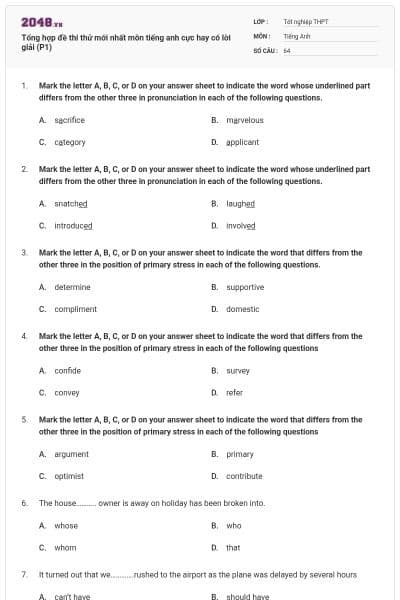
Mark the letter A, B, C, or D on your answer sheet to indicate the word whose underlined part differs from the other three in pronunciation in each of the following questions.
sacrifice
marvelous
category
applicant
B
A./ᴂ/
B./a:/
C. /ᴂ/
D. /ᴂ/
Mark the letter A, B, C, or D on your answer sheet to indicate the word whose underlined part differs from the other three in pronunciation in each of the following questions.
snatched
laughed
introduced
involved
D
A./t/
B./t/
C./t/
D./d/
Mark the letter A, B, C, or D on your answer sheet to indicate the word that differs from the other three in the position of primary stress in each of the following questions.
determine
supportive
compliment
domestic
C
Phần C trọng âm rơi vào âm tiết thứ nhất, còn lại là thứ 2
Mark the letter A, B, C, or D on your answer sheet to indicate the word that differs from the other three in the position of primary stress in each of the following questions
confide
survey
convey
refer
B
Phần B trọng âm rơi vào âm tiết thứ nhất, còn lại là thứ 2
Mark the letter A, B, C, or D on your answer sheet to indicate the word that differs from the other three in the position of primary stress in each of the following questions
argument
primary
optimist
contribute
D
Phần D trọng âm rơi vào âm tiết thứ 2, còn lại là thứ nhất
The house……….. owner is away on holiday has been broken into.
whose
who
whom
that
A
“whose” là mệnh đề quan hệ, thay thế cho một quan hệ sở hữu
“whose owner” trong câu được hiểu là the house’s owner
It turned out that we………….rushed to the airport as the plane was delayed by several hours
can’t have
should have
may have
needn’t have
D
“need”: cần, “needn’t”: không cần, đây là động từ khuyết thiếu
“need/needn’t +V”: cần/không cần làm gì
Nếu là chỉ một hành động trong quá khứ thì V được chuyển thành have + động từ phân từ II
It was only………….he told me his surname that I realized we had been to the same school
when
until
then
as soon as
A
“only when”: chỉ khi…
Không nên nhầm lẫn với until, vì cấu trúc với until là “It is/was not until…that…”
In the last thirty years, space exploration………….great contributions to weather forecasting
is making
has made
made
will have made
B
Trong câu có cụm trạng từ chỉ thời gian In the last thirty years, đây là một dấu hiệu cho thì hiện tại hoàn thành
We hope to have the law……………by December.
to pass
passing
passed
pass
C
Cấu trúc “have st done (by sb)”: có thứ gì đó được thực hiện (bởi ai đó) – chủ thể không thực hiện việc này mà có ai đó làm cho
What…………if you saw a pick pocket steal money from someone in the street?
did you do
do you do
will you do
would you do
D
Câu điều kiện loại 2: “If + mệnh đề quá khứ đơn, S + would/could… +V…”
The workers complained………..the manager………..the working conditions.
with / about
to / on
to / about
with / for
C
Cấu trúc “complain to sb about st”: phàn nàn với ai về cái gì
At first he opposed the marriage, but………….the end he gave his consent
on
by
At
in
D
“in the end”: cuối cùng
Tránh nhầm lẫn với “at the end”: phía cuối, vị trí cuối…
In his latest speech, the Secretary General…………..the importance of wildlife conservation
stressed
remained
excused
referred
A
“stress” (v): nhấn mạnh
Lasers can be used as…………
miraculous accurate scalpels
miraculously accurate scalpels
accurate miraculously scalpels
accurately miraculously scalpels
B
Vị trí của trạng từ, tính từ và danh từ trong câu như sau:
Trạng từ - Tính từ - Danh từ
All employers need workers who have a good sense of………
responsible
responsibly
responsibility
irresponsible
C
Ở đây ta cần một danh từ, vì phía trước có cụm a good sense of…
“responsibility” (n): tinh thần trách nhiệm, có trách nhiệm
The stamp machine is………………..I think it’s broken.
out of place
out of job
out of date
out of order
D
“out of order”: hỏng hóc (thường nói về vật dụng)
……………Shakespeare’s tragedies have been translated into many languages.
Most
Most of
Much of
Some
A
Most + N ( đi với danh từ không xác định ) = hầu hết
Most of + a/an/the/this/that/these/those/my/his... + N = hầu hết
(Chú ý: Ta dùng of sau Most khi có những từ chỉ định theo sau)
Much of là không đúng vì Shakespeare’s tragedies là danh từ đếm được số nhiều. Some thì không chính xác về nghĩa, hầu hết tác phẩm của Shakespeare chứ không chỉ là một vài
Neither the driver nor the passengers……………injured in the accident.
were
was
has been
had been
Đáp án: A
Giải thích:
Kiến thức: Sự hòa hợp giữa chủ ngữ và động từ
Neither A nor B: động từ chia theo chủ ngữ B
“passengers” số nhiều, loại B và C.
Câu đơn giản diễn tả hành động đã xảy ra trong quá khứ, dùng thì quá khứ đơn, chọn A.
Dịch: Có thông báo rằng cả hành khách và tài xế đều không bị thương trong vụ tai nạn.
The doctor recommended……………….three times a day.
that my sister takes these pills
that my sister taking these pills
that my sister take these pills
that my sister must take these pills
C
Cấu trúc “recommend that sb (should) do st”: khuyên/đề nghị ai đó làm gì
Third time lucky! After two……………attempts, Mark’s finally passed his driving test.
success
successful
successfully
unsuccessful
D
“unsuccessful” : không thành công
Sau 2 lần cố gắng không thành, Mark cuối cùng đã qua kì thi lái xe
……………………..than her boss rang back.
She had put down the telephone no sooner
She has no sooner put down the telephone
No sooner she had put down the telephone
No sooner had she put down the telephone
D
Cấu trúc đảo ngữ với No sooner: “No sooner + had + S + động từ phân từ II +…+ than+ mệnh đề quá khứ đơn”
Lora: “Your new blouse looks gorgeous, Helen!”
Helen: . “…………….”
Thanks, I bought it at Macy’s
It’s up to you
I’d rather not
You can say that again
A
- Chiếc sơ-mi mới của cậu thật tuyệt
- Cám ơn, tớ mua nó ở Macy’s đấy
A: “ Would you mind moving your bag from the seat?”
B : ………….
No, I wouldn’t
Oh, sorry
That’s a nice idea
Yes. I’m glad to
A
- Bạn có phiền di chuyển cặp khỏi ghế không?
- Không, tôi không phiền
Mark the letter A, B, C, or D on your answer sheet to indicate the word(s) CLOSEST in meaning to the underlined word(s) in each of the following questions.
All at one, the sky became dark and it started to rain.
Suddenly
At times
Occasionally
Immediately
A
“all at one” = “suddenly”: đột ngột, bất ngờ
Mark the letter A, B, C, or D on your answer sheet to indicate the word(s) CLOSEST in meaning to the underlined word(s) in each of the following questions.
Don’t buy the first thing you see: shop around a bit.
try to find the cheapest ones
wait until you know exactly you want
go to several different shops to compare prices
look at everything in the shop
C
“shop around” = “go to several different shops to compare prices”: đi các cửa hàng khác để so sánh giá cả, nhằm tìm được đồ ưng ý nhất/giá tốt nhất
Mark the letter A, B, C, or D on your answer sheet to indicate the word(s) CLOSEST in meaning to the underlined word(s) in each of the following questions
Nations that live in concord are nations that live together in peace.
war
Harmony
happiness
conformity
B
“concord” = “harmony”: hoà thuận, hoà hợp
Mark the letter A, B, C, or D on your answer sheet to indicate the underlined part that needs correction in each of the following questions.
When he was a little boy, Mark Twain would walk (A) along the piers, watch (B) the river boats, swimming (C) and fish in the (D) Mississippi, much like his famous character, Tom Sawyer
would walk
watch
swimming
the
Đáp án: C
Giải thích:
Trong câu có cấu trúc song song: would walk, watch, và swim (không phải swimming).
Để giữ sự đồng nhất về dạng động từ, swimming cần được đổi thành swim để phù hợp với các động từ trước đó.
Sửa: swimming → swim
Dịch: Khi còn nhỏ, Mark Twain thường đi dọc theo bến tàu, ngắm thuyền trên sông, bơi và câu cá ở sông Mississippi, rất giống với nhân vật nổi tiếng Tom Sawyer của ông.
Mark the letter A, B, C, or D on your answer sheet to indicate the underlined part that needs correction in each of the following questions.
Recently, the island of Hawaii (A) had been (B) the subject of intensive research (C) on the occurrence (D) of earthquakes.
the island of Hawaii
had been
intensive research
occurrence
Đáp án: B
“Recently” (gần đây) là trạng từ chỉ thời gian được sử dụng trong thì hiện tại hoàn thành, vì thế phải chia động từ ở thì hiện tại hoàn thành.
Sửa: had been → has been
Dịch: Gần đây, đảo Hawaii trở thành đối tượng nghiên cứu chuyên sâu về việc xảy ra động đất.
Mark the letter A, B, C, or D on your answer sheet to indicate the underlined part that needs correction in each of the following questions.
Only in a (A) situation like (B) this children learn (C) a lot about how to behave. (D)
a
the
children learn
to behave
C
“children learn” -> “do children learn”
Đây là cấu trúc đảo ngữ, nhằm nhấn mạnh sự vật, sự việc (Only in a situation like this)
Mark the letter A, B, C, or D on your answer sheet to indicate the underlined part that needs correction in each of the following questions.
They have so many (A) children that they can’t (B) afford sending (C) them all (D) to university
so many
can’t
sending
all
C
“sending” -> “to send”
Cấu trúc “afford to do st”: đủ khả năng, đủ điều kiện để làm việc gì
Mark the letter A, B, C, or D on your answer sheet to indicate the underlined part that needs correction in each of the following questions
Two out of (A) three people were struck (B) by (C) lightning survive (D)
out of
were struck
by
survive
B
“were stuck” -> “stuck”
“stuck” không phải động từ chính trong câu (động từ chính là survive), nó chỉ là bổ nghĩa cho danh từ, ở đây, stuck được hiểu là “who were stuck”
Mark the letter A, B, C, or D on your answer sheet to indicate the word(s) OPPOSITE in meaning to the underlined word(s) in each of the following questions
It’s very unlikely for a pessimist to succeed in life.
optimis
terrorist
Activist
hobbyist
A
“pessimist”: người bi quan
Trái nghĩa là “optimist”: người lạc quan
Mark the letter A, B, C, or D on your answer sheet to indicate the word(s) OPPOSITE in meaning to the underlined word(s) in each of the following questions
Their house is so beautiful. They also have a very spacious kitchen.
large
beautiful
open
cramped
D
“spacious”: rộng rãi, có nhiều không gian
Trái nghĩa là “cramped”: chật hẹp, tù túng
Read the following passage and mark the letter A, B, C or D to choose the word or phrase that best fits each of the numbered blank.
Education is more important today than ever before. It helps people acquire the skills they need for such everyday ----------(35) as reading a newspaper or managing their money. It also gives them specialized training they may need to ----------(36) for a job or career. For example, a person must meet certain educational requirements and obtain a ----------(37) or certificate before he can practice law or medicine. Many fields, such as computer operation ----------(38)police work, require satisfactory completion of special training courses.
Education is also important ----------(39) it helps people get more out of life. It increases their knowledge and understanding of the world. It helps them ----------(40)the skill that makes life more interesting and enjoyable, such as the skills ----------(41) to participate in a sport, paint a picture or play a musical instrument. Such education becomes ----------(42)important as people gain more and more leisure time.
Education also helps people adjust to change. This habit has become ----------(43) because social changes today take place with increasing speed and affect the lives of more and more people. Education can help a person understand these changes and provide him ----------(44)the skills for adjusting to them.
Điền vào ô 35
actions
activities
jobs
works
B
“everyday activities”: các hoạt động thường ngày
Chọn đáp án này vì phía sau có reading a newspaper or managing their money – đây là các hoạt động thường ngày trong cuộc sống
Read the following passage and mark the letter A, B, C or D to choose the word or phrase that best fits each of the numbered blank.
Education is more important today than ever before. It helps people acquire the skills they need for such everyday ----------(35) as reading a newspaper or managing their money. It also gives them specialized training they may need to ----------(36) for a job or career. For example, a person must meet certain educational requirements and obtain a ----------(37) or certificate before he can practice law or medicine. Many fields, such as computer operation ----------(38)police work, require satisfactory completion of special training courses.
Education is also important ----------(39) it helps people get more out of life. It increases their knowledge and understanding of the world. It helps them ----------(40)the skill that makes life more interesting and enjoyable, such as the skills ----------(41) to participate in a sport, paint a picture or play a musical instrument. Such education becomes ----------(42)important as people gain more and more leisure time.
Education also helps people adjust to change. This habit has become ----------(43) because social changes today take place with increasing speed and affect the lives of more and more people. Education can help a person understand these changes and provide him ----------(44)the skills for adjusting to them.
Điền vào ô 36
prepare
Work
do
make
A
Cụm “prepare for st/doing st”: chuẩn bị cho cái gì/làm cái gì
Read the following passage and mark the letter A, B, C or D to choose the word or phrase that best fits each of the numbered blank.
Education is more important today than ever before. It helps people acquire the skills they need for such everyday ----------(35) as reading a newspaper or managing their money. It also gives them specialized training they may need to ----------(36) for a job or career. For example, a person must meet certain educational requirements and obtain a ----------(37) or certificate before he can practice law or medicine. Many fields, such as computer operation ----------(38)police work, require satisfactory completion of special training courses.
Education is also important ----------(39) it helps people get more out of life. It increases their knowledge and understanding of the world. It helps them ----------(40)the skill that makes life more interesting and enjoyable, such as the skills ----------(41) to participate in a sport, paint a picture or play a musical instrument. Such education becomes ----------(42)important as people gain more and more leisure time.
Education also helps people adjust to change. This habit has become ----------(43) because social changes today take place with increasing speed and affect the lives of more and more people. Education can help a person understand these changes and provide him ----------(44)the skills for adjusting to them.
Điền vào ô 37
paper
diploma
test
card
B
“diploma”: bằng, bằng cấp
Chọn đáp án này vì phía sau có một danh từ có trường nghĩa tương đương (certificate: chứng chỉ, văn bằng)
Read the following passage and mark the letter A, B, C or D to choose the word or phrase that best fits each of the numbered blank.
Education is more important today than ever before. It helps people acquire the skills they need for such everyday ----------(35) as reading a newspaper or managing their money. It also gives them specialized training they may need to ----------(36) for a job or career. For example, a person must meet certain educational requirements and obtain a ----------(37) or certificate before he can practice law or medicine. Many fields, such as computer operation ----------(38)police work, require satisfactory completion of special training courses.
Education is also important ----------(39) it helps people get more out of life. It increases their knowledge and understanding of the world. It helps them ----------(40)the skill that makes life more interesting and enjoyable, such as the skills ----------(41) to participate in a sport, paint a picture or play a musical instrument. Such education becomes ----------(42)important as people gain more and more leisure time.
Education also helps people adjust to change. This habit has become ----------(43) because social changes today take place with increasing speed and affect the lives of more and more people. Education can help a person understand these changes and provide him ----------(44)the skills for adjusting to them.
Điền vào ô 38
or
But
because of
otherwise
A
“or”: hoặc
THể hiện sự lựa chọn/ khả năng giữa 2 sự việc
Read the following passage and mark the letter A, B, C or D to choose the word or phrase that best fits each of the numbered blank.
Education is more important today than ever before. It helps people acquire the skills they need for such everyday ----------(35) as reading a newspaper or managing their money. It also gives them specialized training they may need to ----------(36) for a job or career. For example, a person must meet certain educational requirements and obtain a ----------(37) or certificate before he can practice law or medicine. Many fields, such as computer operation ----------(38)police work, require satisfactory completion of special training courses.
Education is also important ----------(39) it helps people get more out of life. It increases their knowledge and understanding of the world. It helps them ----------(40)the skill that makes life more interesting and enjoyable, such as the skills ----------(41) to participate in a sport, paint a picture or play a musical instrument. Such education becomes ----------(42)important as people gain more and more leisure time.
Education also helps people adjust to change. This habit has become ----------(43) because social changes today take place with increasing speed and affect the lives of more and more people. Education can help a person understand these changes and provide him ----------(44)the skills for adjusting to them.
Điền vào ô 39
despite
although
therefore
because
D
“because”: bởi vì
Giáo dục cũng rất quan trọng bởi vì nó giúp con người đạt được nhiều hơn ngoài cuộc sống
Read the following passage and mark the letter A, B, C or D to choose the word or phrase that best fits each of the numbered blank.
Education is more important today than ever before. It helps people acquire the skills they need for such everyday ----------(35) as reading a newspaper or managing their money. It also gives them specialized training they may need to ----------(36) for a job or career. For example, a person must meet certain educational requirements and obtain a ----------(37) or certificate before he can practice law or medicine. Many fields, such as computer operation ----------(38)police work, require satisfactory completion of special training courses.
Education is also important ----------(39) it helps people get more out of life. It increases their knowledge and understanding of the world. It helps them ----------(40)the skill that makes life more interesting and enjoyable, such as the skills ----------(41) to participate in a sport, paint a picture or play a musical instrument. Such education becomes ----------(42)important as people gain more and more leisure time.
Education also helps people adjust to change. This habit has become ----------(43) because social changes today take place with increasing speed and affect the lives of more and more people. Education can help a person understand these changes and provide him ----------(44)the skills for adjusting to them.
Điền vào ô 40
ask
acquire
think
come
B
“acquire”: đạt được, thu được
Read the following passage and mark the letter A, B, C or D to choose the word or phrase that best fits each of the numbered blank.
Education is more important today than ever before. It helps people acquire the skills they need for such everyday ----------(35) as reading a newspaper or managing their money. It also gives them specialized training they may need to ----------(36) for a job or career. For example, a person must meet certain educational requirements and obtain a ----------(37) or certificate before he can practice law or medicine. Many fields, such as computer operation ----------(38)police work, require satisfactory completion of special training courses.
Education is also important ----------(39) it helps people get more out of life. It increases their knowledge and understanding of the world. It helps them ----------(40)the skill that makes life more interesting and enjoyable, such as the skills ----------(41) to participate in a sport, paint a picture or play a musical instrument. Such education becomes ----------(42)important as people gain more and more leisure time.
Education also helps people adjust to change. This habit has become ----------(43) because social changes today take place with increasing speed and affect the lives of more and more people. Education can help a person understand these changes and provide him ----------(44)the skills for adjusting to them.
Điền vào ô 41
ordered
needed
Capable
done
B
“needed to…”: cần thiết để, nên để…
Read the following passage and mark the letter A, B, C or D to choose the word or phrase that best fits each of the numbered blank.
Education is more important today than ever before. It helps people acquire the skills they need for such everyday ----------(35) as reading a newspaper or managing their money. It also gives them specialized training they may need to ----------(36) for a job or career. For example, a person must meet certain educational requirements and obtain a ----------(37) or certificate before he can practice law or medicine. Many fields, such as computer operation ----------(38)police work, require satisfactory completion of special training courses.
Education is also important ----------(39) it helps people get more out of life. It increases their knowledge and understanding of the world. It helps them ----------(40)the skill that makes life more interesting and enjoyable, such as the skills ----------(41) to participate in a sport, paint a picture or play a musical instrument. Such education becomes ----------(42)important as people gain more and more leisure time.
Education also helps people adjust to change. This habit has become ----------(43) because social changes today take place with increasing speed and affect the lives of more and more people. Education can help a person understand these changes and provide him ----------(44)the skills for adjusting to them.
Điền vào ô 42
increase
increasingly
increased
increasing
B
Ở đây ta cần một trạng từ để bổ sung ý nghĩa cho tính từ important
“increasingly”: một cách gia tăng
Read the following passage and mark the letter A, B, C or D to choose the word or phrase that best fits each of the numbered blank.
Education is more important today than ever before. It helps people acquire the skills they need for such everyday ----------(35) as reading a newspaper or managing their money. It also gives them specialized training they may need to ----------(36) for a job or career. For example, a person must meet certain educational requirements and obtain a ----------(37) or certificate before he can practice law or medicine. Many fields, such as computer operation ----------(38)police work, require satisfactory completion of special training courses.
Education is also important ----------(39) it helps people get more out of life. It increases their knowledge and understanding of the world. It helps them ----------(40)the skill that makes life more interesting and enjoyable, such as the skills ----------(41) to participate in a sport, paint a picture or play a musical instrument. Such education becomes ----------(42)important as people gain more and more leisure time.
Education also helps people adjust to change. This habit has become ----------(43) because social changes today take place with increasing speed and affect the lives of more and more people. Education can help a person understand these changes and provide him ----------(44)the skills for adjusting to them.
Điền vào ô 43
major
Necessary
main
optional
B
“necessary”: cần thiết
Thói quen này trở nên cần thiết vì xã hội thay đổi với tốc độ gia tăng nhanh chóng
Read the following passage and mark the letter A, B, C or D to choose the word or phrase that best fits each of the numbered blank.
Education is more important today than ever before. It helps people acquire the skills they need for such everyday ----------(35) as reading a newspaper or managing their money. It also gives them specialized training they may need to ----------(36) for a job or career. For example, a person must meet certain educational requirements and obtain a ----------(37) or certificate before he can practice law or medicine. Many fields, such as computer operation ----------(38)police work, require satisfactory completion of special training courses.
Education is also important ----------(39) it helps people get more out of life. It increases their knowledge and understanding of the world. It helps them ----------(40)the skill that makes life more interesting and enjoyable, such as the skills ----------(41) to participate in a sport, paint a picture or play a musical instrument. Such education becomes ----------(42)important as people gain more and more leisure time.
Education also helps people adjust to change. This habit has become ----------(43) because social changes today take place with increasing speed and affect the lives of more and more people. Education can help a person understand these changes and provide him ----------(44)the skills for adjusting to them.
Điền vào ô 44
to
for
in
with
D
Cấu trúc “provide sb with st”: cung cấp, cung ứng cho ai cái gì
Read the following passage and mark the letter A, B, C or D to indicate the correct answer.
The medieval artists didn’t know about perspective; they didn’t want to make their people look like real, individual people in a real, individual scene. They wanted to show the truth, the eternal quality of their religious stories. So these artists didn’t need to know about perspective.
In the European Renaissance period, artists wanted to show the importance of the individual person and his or her possessions and surroundings. A flat medieval style couldn’t show this level of reality and the artists needed a new technique. It was the Italian artist Brunelleschi who discovered the technique of perspective drawing. At first the artists of the Renaissance only had single-point perspective. Later they realized that they could have two-pointed perspective and still later multi-point perspective.
With two-point perspective they could turn an object (like a building) at an angle to the picture and draw two sides of it. The technique of perspective which seems so natural to us now is an invented technique, a part of the “grammar of painting”. Like all bits of grammar there are exceptions about perspective. For example, only vertical and horizontal surfaces seem to meet on eye level. Sloping roof tops don’t meet on eye level.
For 500 years, artists in Europe made use of perspective drawing in their pictures. Nevertheless, there are a range of priorities that artists give in displaying individual styles. Crivelli wanted to show depth in his picture and he used a simple single-point perspective. Cezanne always talked about space and volume. Van Gogh, like some of the other painters of the Impressionist period, was interested in Japanese prints. And Japanese artists until this century were always very strong designers of “flat” pictures. Picasso certainly made pictures which have volume and depth. However, he wanted to keep our eyes on the surface and to remind us that his paintings are paintings and not illusions.
It is technically easy to give an illusion of depth. However, a strong two dimensional design is just as important as a feeling of depth, and perhaps more important.
The passage mainly discusses
the difference between medieval and Renaissance art
how the technique of perspective influenced the modern art
the discovery of the technique of perspective
the contribution of Renaissance artists
B
Bài văn chủ yếu đề cập đến how the technique of perspective influenced the modern art
Ở đoạn số 1, đề cập đến các nhà hoạ sĩ thời trung cổ không biết đến phối cảnh, và cũng không cần biết.
Ở đoạn 2, họ phát hiện ra cần một phương cách mới để phản ánh thực tế “Later they realized that they could have two-pointed perspective and still later multi-point perspective.”
Đoạn 3,4,5 là cụ thể hơn về phối cảnh, sử dụng phối cảnh trong hội hoạ, ảnh hưởng của phối cảnh đến hội hoạ
Read the following passage and mark the letter A, B, C or D to indicate the correct answer.
The medieval artists didn’t know about perspective; they didn’t want to make their people look like real, individual people in a real, individual scene. They wanted to show the truth, the eternal quality of their religious stories. So these artists didn’t need to know about perspective.
In the European Renaissance period, artists wanted to show the importance of the individual person and his or her possessions and surroundings. A flat medieval style couldn’t show this level of reality and the artists needed a new technique. It was the Italian artist Brunelleschi who discovered the technique of perspective drawing. At first the artists of the Renaissance only had single-point perspective. Later they realized that they could have two-pointed perspective and still later multi-point perspective.
With two-point perspective they could turn an object (like a building) at an angle to the picture and draw two sides of it. The technique of perspective which seems so natural to us now is an invented technique, a part of the “grammar of painting”. Like all bits of grammar there are exceptions about perspective. For example, only vertical and horizontal surfaces seem to meet on eye level. Sloping roof tops don’t meet on eye level.
For 500 years, artists in Europe made use of perspective drawing in their pictures. Nevertheless, there are a range of priorities that artists give in displaying individual styles. Crivelli wanted to show depth in his picture and he used a simple single-point perspective. Cezanne always talked about space and volume. Van Gogh, like some of the other painters of the Impressionist period, was interested in Japanese prints. And Japanese artists until this century were always very strong designers of “flat” pictures. Picasso certainly made pictures which have volume and depth. However, he wanted to keep our eyes on the surface and to remind us that his paintings are paintings and not illusions.
It is technically easy to give an illusion of depth. However, a strong two dimensional design is just as important as a feeling of depth, and perhaps more important.
The word “eternal” in line 3 is closest in meaning to
timeless
infinite
frequent
rare
A
“eternal” = “timeless”: bất diệt, vĩnh hằng, vô tận
Read the following passage and mark the letter A, B, C or D to indicate the correct answer.
The medieval artists didn’t know about perspective; they didn’t want to make their people look like real, individual people in a real, individual scene. They wanted to show the truth, the eternal quality of their religious stories. So these artists didn’t need to know about perspective.
In the European Renaissance period, artists wanted to show the importance of the individual person and his or her possessions and surroundings. A flat medieval style couldn’t show this level of reality and the artists needed a new technique. It was the Italian artist Brunelleschi who discovered the technique of perspective drawing. At first the artists of the Renaissance only had single-point perspective. Later they realized that they could have two-pointed perspective and still later multi-point perspective.
With two-point perspective they could turn an object (like a building) at an angle to the picture and draw two sides of it. The technique of perspective which seems so natural to us now is an invented technique, a part of the “grammar of painting”. Like all bits of grammar there are exceptions about perspective. For example, only vertical and horizontal surfaces seem to meet on eye level. Sloping roof tops don’t meet on eye level.
For 500 years, artists in Europe made use of perspective drawing in their pictures. Nevertheless, there are a range of priorities that artists give in displaying individual styles. Crivelli wanted to show depth in his picture and he used a simple single-point perspective. Cezanne always talked about space and volume. Van Gogh, like some of the other painters of the Impressionist period, was interested in Japanese prints. And Japanese artists until this century were always very strong designers of “flat” pictures. Picasso certainly made pictures which have volume and depth. However, he wanted to keep our eyes on the surface and to remind us that his paintings are paintings and not illusions.
It is technically easy to give an illusion of depth. However, a strong two dimensional design is just as important as a feeling of depth, and perhaps more important.
According to the passage, which is the main concern for medieval artists?
the individual person and his/her possessions and surroundings
real people, real scenes
eternal truth of the earth
themes of religious stories
D
Thông tin ở câu gần cuối đoạn 1: “They wanted to show the truth, the eternal quality of their religious stories.” (Họ muốn biểu lộ sự thật, phẩm chất vĩnh hằng của những câu chuyện về tôn giáo họ) = themes of religious stories
Read the following passage and mark the letter A, B, C or D to indicate the correct answer.
The medieval artists didn’t know about perspective; they didn’t want to make their people look like real, individual people in a real, individual scene. They wanted to show the truth, the eternal quality of their religious stories. So these artists didn’t need to know about perspective.
In the European Renaissance period, artists wanted to show the importance of the individual person and his or her possessions and surroundings. A flat medieval style couldn’t show this level of reality and the artists needed a new technique. It was the Italian artist Brunelleschi who discovered the technique of perspective drawing. At first the artists of the Renaissance only had single-point perspective. Later they realized that they could have two-pointed perspective and still later multi-point perspective.
With two-point perspective they could turn an object (like a building) at an angle to the picture and draw two sides of it. The technique of perspective which seems so natural to us now is an invented technique, a part of the “grammar of painting”. Like all bits of grammar there are exceptions about perspective. For example, only vertical and horizontal surfaces seem to meet on eye level. Sloping roof tops don’t meet on eye level.
For 500 years, artists in Europe made use of perspective drawing in their pictures. Nevertheless, there are a range of priorities that artists give in displaying individual styles. Crivelli wanted to show depth in his picture and he used a simple single-point perspective. Cezanne always talked about space and volume. Van Gogh, like some of the other painters of the Impressionist period, was interested in Japanese prints. And Japanese artists until this century were always very strong designers of “flat” pictures. Picasso certainly made pictures which have volume and depth. However, he wanted to keep our eyes on the surface and to remind us that his paintings are paintings and not illusions.
It is technically easy to give an illusion of depth. However, a strong two dimensional design is just as important as a feeling of depth, and perhaps more important.
The discovery of perspective was the result of
Renaissance artists’ to prove that the medieval artists could show level of reality
the need to turn an object at an angle and draw more than one side of it
the subject being shifted from religious stories to individual person and surroundings
natural evolution of human senses
C
Thông tin ở câu đầu đoạn số 2: “artists wanted to show the importance of the individual person and his or her possessions and surroundings.” (thể hiện sự quan trọng của cá nhân, sự sở hữu và môi trường xung quanh) tức là the subject being shifted from religious stories to individual person and surroundings. (chủ đề được di chuyển từ câu chuyện tôn giáo đến từng cá nhân và môi trường xung quanh -> từng cá nhân và môi trường đóng vai trò quan trọng)
Read the following passage and mark the letter A, B, C or D to indicate the correct answer.
The medieval artists didn’t know about perspective; they didn’t want to make their people look like real, individual people in a real, individual scene. They wanted to show the truth, the eternal quality of their religious stories. So these artists didn’t need to know about perspective.
In the European Renaissance period, artists wanted to show the importance of the individual person and his or her possessions and surroundings. A flat medieval style couldn’t show this level of reality and the artists needed a new technique. It was the Italian artist Brunelleschi who discovered the technique of perspective drawing. At first the artists of the Renaissance only had single-point perspective. Later they realized that they could have two-pointed perspective and still later multi-point perspective.
With two-point perspective they could turn an object (like a building) at an angle to the picture and draw two sides of it. The technique of perspective which seems so natural to us now is an invented technique, a part of the “grammar of painting”. Like all bits of grammar there are exceptions about perspective. For example, only vertical and horizontal surfaces seem to meet on eye level. Sloping roof tops don’t meet on eye level.
For 500 years, artists in Europe made use of perspective drawing in their pictures. Nevertheless, there are a range of priorities that artists give in displaying individual styles. Crivelli wanted to show depth in his picture and he used a simple single-point perspective. Cezanne always talked about space and volume. Van Gogh, like some of the other painters of the Impressionist period, was interested in Japanese prints. And Japanese artists until this century were always very strong designers of “flat” pictures. Picasso certainly made pictures which have volume and depth. However, he wanted to keep our eyes on the surface and to remind us that his paintings are paintings and not illusions.
It is technically easy to give an illusion of depth. However, a strong two dimensional design is just as important as a feeling of depth, and perhaps more important.
The word “it” in line 13 refers to
the picture
perspective
angle
the object
D
“it” được thay thế cho “object” trong vế trước của câu đầu tiên đoạn 3: “With two-point perspective they could turn an object (like a building)…”
Read the following passage and mark the letter A, B, C or D to indicate the correct answer.
The medieval artists didn’t know about perspective; they didn’t want to make their people look like real, individual people in a real, individual scene. They wanted to show the truth, the eternal quality of their religious stories. So these artists didn’t need to know about perspective.
In the European Renaissance period, artists wanted to show the importance of the individual person and his or her possessions and surroundings. A flat medieval style couldn’t show this level of reality and the artists needed a new technique. It was the Italian artist Brunelleschi who discovered the technique of perspective drawing. At first the artists of the Renaissance only had single-point perspective. Later they realized that they could have two-pointed perspective and still later multi-point perspective.
With two-point perspective they could turn an object (like a building) at an angle to the picture and draw two sides of it. The technique of perspective which seems so natural to us now is an invented technique, a part of the “grammar of painting”. Like all bits of grammar there are exceptions about perspective. For example, only vertical and horizontal surfaces seem to meet on eye level. Sloping roof tops don’t meet on eye level.
For 500 years, artists in Europe made use of perspective drawing in their pictures. Nevertheless, there are a range of priorities that artists give in displaying individual styles. Crivelli wanted to show depth in his picture and he used a simple single-point perspective. Cezanne always talked about space and volume. Van Gogh, like some of the other painters of the Impressionist period, was interested in Japanese prints. And Japanese artists until this century were always very strong designers of “flat” pictures. Picasso certainly made pictures which have volume and depth. However, he wanted to keep our eyes on the surface and to remind us that his paintings are paintings and not illusions.
It is technically easy to give an illusion of depth. However, a strong two dimensional design is just as important as a feeling of depth, and perhaps more important.
The word “Grammar ” in line 14 is closest in meaning to
construction
grammatical rules
rules and regulations
tones and volume
C
“Grammar” = “rules and regulations”: cấu trúc, quy tắc
Read the following passage and mark the letter A, B, C or D to indicate the correct answer.
The medieval artists didn’t know about perspective; they didn’t want to make their people look like real, individual people in a real, individual scene. They wanted to show the truth, the eternal quality of their religious stories. So these artists didn’t need to know about perspective.
In the European Renaissance period, artists wanted to show the importance of the individual person and his or her possessions and surroundings. A flat medieval style couldn’t show this level of reality and the artists needed a new technique. It was the Italian artist Brunelleschi who discovered the technique of perspective drawing. At first the artists of the Renaissance only had single-point perspective. Later they realized that they could have two-pointed perspective and still later multi-point perspective.
With two-point perspective they could turn an object (like a building) at an angle to the picture and draw two sides of it. The technique of perspective which seems so natural to us now is an invented technique, a part of the “grammar of painting”. Like all bits of grammar there are exceptions about perspective. For example, only vertical and horizontal surfaces seem to meet on eye level. Sloping roof tops don’t meet on eye level.
For 500 years, artists in Europe made use of perspective drawing in their pictures. Nevertheless, there are a range of priorities that artists give in displaying individual styles. Crivelli wanted to show depth in his picture and he used a simple single-point perspective. Cezanne always talked about space and volume. Van Gogh, like some of the other painters of the Impressionist period, was interested in Japanese prints. And Japanese artists until this century were always very strong designers of “flat” pictures. Picasso certainly made pictures which have volume and depth. However, he wanted to keep our eyes on the surface and to remind us that his paintings are paintings and not illusions.
It is technically easy to give an illusion of depth. However, a strong two dimensional design is just as important as a feeling of depth, and perhaps more important.
The author’s purpose to give the example in line15-17 is to
explain how perspective work in painting
support two-pointed perspective
illustrate that there are exceptions about perspective
point out that the technique of perspective though seems so natural is an invented technique
C
Thông tin ở những câu cuối đoạn 3: “Like all bits of grammar there are exceptions about perspective. For example, only vertical and horizontal surfaces seem to meet on eye level. Sloping roof tops don’t meet on eye level.”
Tức là tác giả đã minh chứng về những trường hợp ngoại lệ của phối cảnh (illustrate that there are exceptions about perspective) thông qua các ví dụ
Read the following passage and mark the letter A, B, C or D to indicate the correct answer.
The medieval artists didn’t know about perspective; they didn’t want to make their people look like real, individual people in a real, individual scene. They wanted to show the truth, the eternal quality of their religious stories. So these artists didn’t need to know about perspective.
In the European Renaissance period, artists wanted to show the importance of the individual person and his or her possessions and surroundings. A flat medieval style couldn’t show this level of reality and the artists needed a new technique. It was the Italian artist Brunelleschi who discovered the technique of perspective drawing. At first the artists of the Renaissance only had single-point perspective. Later they realized that they could have two-pointed perspective and still later multi-point perspective.
With two-point perspective they could turn an object (like a building) at an angle to the picture and draw two sides of it. The technique of perspective which seems so natural to us now is an invented technique, a part of the “grammar of painting”. Like all bits of grammar there are exceptions about perspective. For example, only vertical and horizontal surfaces seem to meet on eye level. Sloping roof tops don’t meet on eye level.
For 500 years, artists in Europe made use of perspective drawing in their pictures. Nevertheless, there are a range of priorities that artists give in displaying individual styles. Crivelli wanted to show depth in his picture and he used a simple single-point perspective. Cezanne always talked about space and volume. Van Gogh, like some of the other painters of the Impressionist period, was interested in Japanese prints. And Japanese artists until this century were always very strong designers of “flat” pictures. Picasso certainly made pictures which have volume and depth. However, he wanted to keep our eyes on the surface and to remind us that his paintings are paintings and not illusions.
It is technically easy to give an illusion of depth. However, a strong two dimensional design is just as important as a feeling of depth, and perhaps more important.
The word “he” in line 25 refers to
Crivelli
Cezanne
Picasso
Van Gogh
C
“he” được thay thế cho Picasso trong câu phía trước: “Picasso certainly made pictures which have volume and depth.”
Read the following passage and mark the letter A, B, C or D to indicate the correct answer.
The medieval artists didn’t know about perspective; they didn’t want to make their people look like real, individual people in a real, individual scene. They wanted to show the truth, the eternal quality of their religious stories. So these artists didn’t need to know about perspective.
In the European Renaissance period, artists wanted to show the importance of the individual person and his or her possessions and surroundings. A flat medieval style couldn’t show this level of reality and the artists needed a new technique. It was the Italian artist Brunelleschi who discovered the technique of perspective drawing. At first the artists of the Renaissance only had single-point perspective. Later they realized that they could have two-pointed perspective and still later multi-point perspective.
With two-point perspective they could turn an object (like a building) at an angle to the picture and draw two sides of it. The technique of perspective which seems so natural to us now is an invented technique, a part of the “grammar of painting”. Like all bits of grammar there are exceptions about perspective. For example, only vertical and horizontal surfaces seem to meet on eye level. Sloping roof tops don’t meet on eye level.
For 500 years, artists in Europe made use of perspective drawing in their pictures. Nevertheless, there are a range of priorities that artists give in displaying individual styles. Crivelli wanted to show depth in his picture and he used a simple single-point perspective. Cezanne always talked about space and volume. Van Gogh, like some of the other painters of the Impressionist period, was interested in Japanese prints. And Japanese artists until this century were always very strong designers of “flat” pictures. Picasso certainly made pictures which have volume and depth. However, he wanted to keep our eyes on the surface and to remind us that his paintings are paintings and not illusions.
It is technically easy to give an illusion of depth. However, a strong two dimensional design is just as important as a feeling of depth, and perhaps more important.
The word ”Illusion” in line 27 is closest in meaning to
deception
photograph
decoration
illustration
A
”Illusion” = “deception”: ảo tưởng, lầm tưởng rằng, trò lừa dối khiến lầm tưởng
Read the following passage and mark the letter A, B, C or D to indicate the correct answer.
The medieval artists didn’t know about perspective; they didn’t want to make their people look like real, individual people in a real, individual scene. They wanted to show the truth, the eternal quality of their religious stories. So these artists didn’t need to know about perspective.
In the European Renaissance period, artists wanted to show the importance of the individual person and his or her possessions and surroundings. A flat medieval style couldn’t show this level of reality and the artists needed a new technique. It was the Italian artist Brunelleschi who discovered the technique of perspective drawing. At first the artists of the Renaissance only had single-point perspective. Later they realized that they could have two-pointed perspective and still later multi-point perspective.
With two-point perspective they could turn an object (like a building) at an angle to the picture and draw two sides of it. The technique of perspective which seems so natural to us now is an invented technique, a part of the “grammar of painting”. Like all bits of grammar there are exceptions about perspective. For example, only vertical and horizontal surfaces seem to meet on eye level. Sloping roof tops don’t meet on eye level.
For 500 years, artists in Europe made use of perspective drawing in their pictures. Nevertheless, there are a range of priorities that artists give in displaying individual styles. Crivelli wanted to show depth in his picture and he used a simple single-point perspective. Cezanne always talked about space and volume. Van Gogh, like some of the other painters of the Impressionist period, was interested in Japanese prints. And Japanese artists until this century were always very strong designers of “flat” pictures. Picasso certainly made pictures which have volume and depth. However, he wanted to keep our eyes on the surface and to remind us that his paintings are paintings and not illusions.
It is technically easy to give an illusion of depth. However, a strong two dimensional design is just as important as a feeling of depth, and perhaps more important.
It can be inferred from the passage that Renaissance artists
embraced the medieval style of eternal truth
needed to develop a new approach towards painting to show a new level of reality
were inspired by vertical and horizontal surfaces in inventing the technique of perspective
saw two dimensional design more important than a feeling of depth
B
Thông tin ở câu thứ 2 của đoạn 2: “A flat medieval style couldn’t show this level of reality and the artists needed a new technique.” (phong cách thời Trung cổ không thể biểu đạt hết cấp bậc của thực tế và các nhà hoạ sĩ cần một công thức/công nghệ mới) = needed to develop a new approach towards painting to show a new level of reality (cần phát triển một cách tiếp cận nghệ thuật mới để biểu đạt cấp độ thực tế)
Read the following passage and mark the letter A, B, C or D to indicate the correct answer.
The Nobel Peace Prize is awarded annually and the first woman to win this prize was Baroness Bertha Felicie Sophie von Suttner in 1905. In fact, her work inspired the creation of the Prize. The first American woman to win this prize was Jane Addams, in 1931. However, Addams is best known as the founder of Hull House.
Jane Addams was born in 1860, into a wealthy family. She was one of a small number of women in her generation to graduate from college. Her commitment to improving the lives of those around her led her to work for social reform and world peace. In the 1880s Jane Addams traveled to Europe. While she was in London, she visited a ‘settlement house’ called Toynbee Hall. Inspired by Toynbee Hall, Addams and her friend, Ellen Gates Starr, opened Hull House in a neighborhood of slums in Chicago in 1899. Hull House provided a day care center for children of working mothers, a community kitchen, and visiting nurses. Addams and her staff gave classes in English literacy, art, and other subjects. Hull House also became a meeting place for clubs and labor unions. Most of the people who worked with Addams in Hull House were well educated, middle-class women. Hull House gave them an opportunity to use their education and it provided a training ground for careers in social work.
Before World War I, Addams was probably the most beloved woman in America. In a newspaper poll that asked, “Who among our contemporaries are of the most value to the community?”, Jane Addams was rated second, after Thomas Edison. When she opposed America’s involvement in World War I, however, newspaper editors called her a traitor and a fool, but she never changed her mind. Jane Addams was a strong champion of several other causes. Until 1920, American women could not vote. Addams joined in the movement for women’s suffrage and was a vice president of the National American Woman Suffrage Association. She was a founding member of the National Association for the Advancement of Colored People (NAACP), and was president of the Women’s International League for Peace and Freedom. . Her reputation was gradually restored during the last years of her life. She died of cancer in 1935.
With which of the following subjects is the passage mainly concerned?
The first award of the Nobel Peace Prize to an American woman
A woman’s work for social reform and world peace
The early development of Social Work in America
Contributions of educated women to American society
B
Bài đọc chủ yếu nói về: A woman’s work for social reform and world peace.
Vì trong đoạn 2 đã viết: “Her commitment to improving the lives of those around her led her to work for social reform and world peace.”
Read the following passage and mark the letter A, B, C or D to indicate the correct answer.
The Nobel Peace Prize is awarded annually and the first woman to win this prize was Baroness Bertha Felicie Sophie von Suttner in 1905. In fact, her work inspired the creation of the Prize. The first American woman to win this prize was Jane Addams, in 1931. However, Addams is best known as the founder of Hull House.
Jane Addams was born in 1860, into a wealthy family. She was one of a small number of women in her generation to graduate from college. Her commitment to improving the lives of those around her led her to work for social reform and world peace. In the 1880s Jane Addams traveled to Europe. While she was in London, she visited a ‘settlement house’ called Toynbee Hall. Inspired by Toynbee Hall, Addams and her friend, Ellen Gates Starr, opened Hull House in a neighborhood of slums in Chicago in 1899. Hull House provided a day care center for children of working mothers, a community kitchen, and visiting nurses. Addams and her staff gave classes in English literacy, art, and other subjects. Hull House also became a meeting place for clubs and labor unions. Most of the people who worked with Addams in Hull House were well educated, middle-class women. Hull House gave them an opportunity to use their education and it provided a training ground for careers in social work.
Before World War I, Addams was probably the most beloved woman in America. In a newspaper poll that asked, “Who among our contemporaries are of the most value to the community?”, Jane Addams was rated second, after Thomas Edison. When she opposed America’s involvement in World War I, however, newspaper editors called her a traitor and a fool, but she never changed her mind. Jane Addams was a strong champion of several other causes. Until 1920, American women could not vote. Addams joined in the movement for women’s suffrage and was a vice president of the National American Woman Suffrage Association. She was a founding member of the National Association for the Advancement of Colored People (NAACP), and was president of the Women’s International League for Peace and Freedom. . Her reputation was gradually restored during the last years of her life. She died of cancer in 1935.
Which of the following can be inferred from the passage?
the work of Baroness Bertha Felicie Sophie von Suttner was an inspiration to Jane Addam
Jane Addams is most famous for her opening of Hull House
those who lived near Hull House had very poor literacy skills
Jane Addams considered herself as a citizen of the world rather than of one particular country
B
Thông tin ở câu cuối cùng đoạn 1: “However, Addams is best known as the founder of Hull House.” = Jane Addams is most famous for her opening of Hull House
Read the following passage and mark the letter A, B, C or D to indicate the correct answer.
The Nobel Peace Prize is awarded annually and the first woman to win this prize was Baroness Bertha Felicie Sophie von Suttner in 1905. In fact, her work inspired the creation of the Prize. The first American woman to win this prize was Jane Addams, in 1931. However, Addams is best known as the founder of Hull House.
Jane Addams was born in 1860, into a wealthy family. She was one of a small number of women in her generation to graduate from college. Her commitment to improving the lives of those around her led her to work for social reform and world peace. In the 1880s Jane Addams traveled to Europe. While she was in London, she visited a ‘settlement house’ called Toynbee Hall. Inspired by Toynbee Hall, Addams and her friend, Ellen Gates Starr, opened Hull House in a neighborhood of slums in Chicago in 1899. Hull House provided a day care center for children of working mothers, a community kitchen, and visiting nurses. Addams and her staff gave classes in English literacy, art, and other subjects. Hull House also became a meeting place for clubs and labor unions. Most of the people who worked with Addams in Hull House were well educated, middle-class women. Hull House gave them an opportunity to use their education and it provided a training ground for careers in social work.
Before World War I, Addams was probably the most beloved woman in America. In a newspaper poll that asked, “Who among our contemporaries are of the most value to the community?”, Jane Addams was rated second, after Thomas Edison. When she opposed America’s involvement in World War I, however, newspaper editors called her a traitor and a fool, but she never changed her mind. Jane Addams was a strong champion of several other causes. Until 1920, American women could not vote. Addams joined in the movement for women’s suffrage and was a vice president of the National American Woman Suffrage Association. She was a founding member of the National Association for the Advancement of Colored People (NAACP), and was president of the Women’s International League for Peace and Freedom. . Her reputation was gradually restored during the last years of her life. She died of cancer in 1935.
The word “commitment” in line 6 is closest in meaning to
involvement
obligation
dedication
enthusiasm
C
“commitment” = “dedication”: sự tận tuỵ, sự cống hiến
Read the following passage and mark the letter A, B, C or D to indicate the correct answer.
The Nobel Peace Prize is awarded annually and the first woman to win this prize was Baroness Bertha Felicie Sophie von Suttner in 1905. In fact, her work inspired the creation of the Prize. The first American woman to win this prize was Jane Addams, in 1931. However, Addams is best known as the founder of Hull House.
Jane Addams was born in 1860, into a wealthy family. She was one of a small number of women in her generation to graduate from college. Her commitment to improving the lives of those around her led her to work for social reform and world peace. In the 1880s Jane Addams traveled to Europe. While she was in London, she visited a ‘settlement house’ called Toynbee Hall. Inspired by Toynbee Hall, Addams and her friend, Ellen Gates Starr, opened Hull House in a neighborhood of slums in Chicago in 1899. Hull House provided a day care center for children of working mothers, a community kitchen, and visiting nurses. Addams and her staff gave classes in English literacy, art, and other subjects. Hull House also became a meeting place for clubs and labor unions. Most of the people who worked with Addams in Hull House were well educated, middle-class women. Hull House gave them an opportunity to use their education and it provided a training ground for careers in social work.
Before World War I, Addams was probably the most beloved woman in America. In a newspaper poll that asked, “Who among our contemporaries are of the most value to the community?”, Jane Addams was rated second, after Thomas Edison. When she opposed America’s involvement in World War I, however, newspaper editors called her a traitor and a fool, but she never changed her mind. Jane Addams was a strong champion of several other causes. Until 1920, American women could not vote. Addams joined in the movement for women’s suffrage and was a vice president of the National American Woman Suffrage Association. She was a founding member of the National Association for the Advancement of Colored People (NAACP), and was president of the Women’s International League for Peace and Freedom. . Her reputation was gradually restored during the last years of her life. She died of cancer in 1935.
Jane Addams was inspired to open Hull House because:
it gave educated women an opportunity to use their education and develop careers in social work
she traveled to Europe in the 1880s
she visited Toynbee Hall
she was invited by a ‘settlement house’ in Chicago
C
While she was in London, she visited a ‘settlement house’ called Toynbee Hall. Inspired by Toynbee Hall, Addams and her friend, Ellen Gates Starr, opened Hull House (Ở London, bà đã đến thăm Toynbee Hall. Lấy niềm cảm hứng từ đó, bà đã mở ra Hull House) = C. she visited Toynbee Hall
Read the following passage and mark the letter A, B, C or D to indicate the correct answer.
The Nobel Peace Prize is awarded annually and the first woman to win this prize was Baroness Bertha Felicie Sophie von Suttner in 1905. In fact, her work inspired the creation of the Prize. The first American woman to win this prize was Jane Addams, in 1931. However, Addams is best known as the founder of Hull House.
Jane Addams was born in 1860, into a wealthy family. She was one of a small number of women in her generation to graduate from college. Her commitment to improving the lives of those around her led her to work for social reform and world peace. In the 1880s Jane Addams traveled to Europe. While she was in London, she visited a ‘settlement house’ called Toynbee Hall. Inspired by Toynbee Hall, Addams and her friend, Ellen Gates Starr, opened Hull House in a neighborhood of slums in Chicago in 1899. Hull House provided a day care center for children of working mothers, a community kitchen, and visiting nurses. Addams and her staff gave classes in English literacy, art, and other subjects. Hull House also became a meeting place for clubs and labor unions. Most of the people who worked with Addams in Hull House were well educated, middle-class women. Hull House gave them an opportunity to use their education and it provided a training ground for careers in social work.
Before World War I, Addams was probably the most beloved woman in America. In a newspaper poll that asked, “Who among our contemporaries are of the most value to the community?”, Jane Addams was rated second, after Thomas Edison. When she opposed America’s involvement in World War I, however, newspaper editors called her a traitor and a fool, but she never changed her mind. Jane Addams was a strong champion of several other causes. Until 1920, American women could not vote. Addams joined in the movement for women’s suffrage and was a vice president of the National American Woman Suffrage Association. She was a founding member of the National Association for the Advancement of Colored People (NAACP), and was president of the Women’s International League for Peace and Freedom. . Her reputation was gradually restored during the last years of her life. She died of cancer in 1935.
The word “their” in line 16 refers to
children of working mothers
middle-class women
visiting nurses
labor union members
B
“their” được thay thế cho middle-class women trong : “Most of the people who worked with Addams in Hull House were well educated, middle-class women. Hull House gave them an opportunity to use their education..”
Read the following passage and mark the letter A, B, C or D to indicate the correct answer.
The Nobel Peace Prize is awarded annually and the first woman to win this prize was Baroness Bertha Felicie Sophie von Suttner in 1905. In fact, her work inspired the creation of the Prize. The first American woman to win this prize was Jane Addams, in 1931. However, Addams is best known as the founder of Hull House.
Jane Addams was born in 1860, into a wealthy family. She was one of a small number of women in her generation to graduate from college. Her commitment to improving the lives of those around her led her to work for social reform and world peace. In the 1880s Jane Addams traveled to Europe. While she was in London, she visited a ‘settlement house’ called Toynbee Hall. Inspired by Toynbee Hall, Addams and her friend, Ellen Gates Starr, opened Hull House in a neighborhood of slums in Chicago in 1899. Hull House provided a day care center for children of working mothers, a community kitchen, and visiting nurses. Addams and her staff gave classes in English literacy, art, and other subjects. Hull House also became a meeting place for clubs and labor unions. Most of the people who worked with Addams in Hull House were well educated, middle-class women. Hull House gave them an opportunity to use their education and it provided a training ground for careers in social work.
Before World War I, Addams was probably the most beloved woman in America. In a newspaper poll that asked, “Who among our contemporaries are of the most value to the community?”, Jane Addams was rated second, after Thomas Edison. When she opposed America’s involvement in World War I, however, newspaper editors called her a traitor and a fool, but she never changed her mind. Jane Addams was a strong champion of several other causes. Until 1920, American women could not vote. Addams joined in the movement for women’s suffrage and was a vice president of the National American Woman Suffrage Association. She was a founding member of the National Association for the Advancement of Colored People (NAACP), and was president of the Women’s International League for Peace and Freedom. . Her reputation was gradually restored during the last years of her life. She died of cancer in 1935.
The word “it” in line 16 refers to
opportunity
Hull House
meeting place
Toynbee Hall
A
“it” được thay thế cho opportunity trong vế trước: “. Hull House gave them an opportunity to use their education”
Read the following passage and mark the letter A, B, C or D to indicate the correct answer.
The Nobel Peace Prize is awarded annually and the first woman to win this prize was Baroness Bertha Felicie Sophie von Suttner in 1905. In fact, her work inspired the creation of the Prize. The first American woman to win this prize was Jane Addams, in 1931. However, Addams is best known as the founder of Hull House.
Jane Addams was born in 1860, into a wealthy family. She was one of a small number of women in her generation to graduate from college. Her commitment to improving the lives of those around her led her to work for social reform and world peace. In the 1880s Jane Addams traveled to Europe. While she was in London, she visited a ‘settlement house’ called Toynbee Hall. Inspired by Toynbee Hall, Addams and her friend, Ellen Gates Starr, opened Hull House in a neighborhood of slums in Chicago in 1899. Hull House provided a day care center for children of working mothers, a community kitchen, and visiting nurses. Addams and her staff gave classes in English literacy, art, and other subjects. Hull House also became a meeting place for clubs and labor unions. Most of the people who worked with Addams in Hull House were well educated, middle-class women. Hull House gave them an opportunity to use their education and it provided a training ground for careers in social work.
Before World War I, Addams was probably the most beloved woman in America. In a newspaper poll that asked, “Who among our contemporaries are of the most value to the community?”, Jane Addams was rated second, after Thomas Edison. When she opposed America’s involvement in World War I, however, newspaper editors called her a traitor and a fool, but she never changed her mind. Jane Addams was a strong champion of several other causes. Until 1920, American women could not vote. Addams joined in the movement for women’s suffrage and was a vice president of the National American Woman Suffrage Association. She was a founding member of the National Association for the Advancement of Colored People (NAACP), and was president of the Women’s International League for Peace and Freedom. . Her reputation was gradually restored during the last years of her life. She died of cancer in 1935.
The word “contemporaries” in line 19 is closest in meaning to
people of the same tim
famous people still alive
elected officials
people old enough to vote
A
“contemporaries” = “people of the same time”: người cùng thời, người đương thời
Read the following passage and mark the letter A, B, C or D to indicate the correct answer.
The Nobel Peace Prize is awarded annually and the first woman to win this prize was Baroness Bertha Felicie Sophie von Suttner in 1905. In fact, her work inspired the creation of the Prize. The first American woman to win this prize was Jane Addams, in 1931. However, Addams is best known as the founder of Hull House.
Jane Addams was born in 1860, into a wealthy family. She was one of a small number of women in her generation to graduate from college. Her commitment to improving the lives of those around her led her to work for social reform and world peace. In the 1880s Jane Addams traveled to Europe. While she was in London, she visited a ‘settlement house’ called Toynbee Hall. Inspired by Toynbee Hall, Addams and her friend, Ellen Gates Starr, opened Hull House in a neighborhood of slums in Chicago in 1899. Hull House provided a day care center for children of working mothers, a community kitchen, and visiting nurses. Addams and her staff gave classes in English literacy, art, and other subjects. Hull House also became a meeting place for clubs and labor unions. Most of the people who worked with Addams in Hull House were well educated, middle-class women. Hull House gave them an opportunity to use their education and it provided a training ground for careers in social work.
Before World War I, Addams was probably the most beloved woman in America. In a newspaper poll that asked, “Who among our contemporaries are of the most value to the community?”, Jane Addams was rated second, after Thomas Edison. When she opposed America’s involvement in World War I, however, newspaper editors called her a traitor and a fool, but she never changed her mind. Jane Addams was a strong champion of several other causes. Until 1920, American women could not vote. Addams joined in the movement for women’s suffrage and was a vice president of the National American Woman Suffrage Association. She was a founding member of the National Association for the Advancement of Colored People (NAACP), and was president of the Women’s International League for Peace and Freedom. . Her reputation was gradually restored during the last years of her life. She died of cancer in 1935.
According to the passage, Jane Addams’ reputation was damaged when she
allowed Hull House to become a meeting place for clubs and labor unions
joined in the movement for women’s suffrage
became a founding member of the NAACP
opposed America’s involvement in World War I
D
Thông tin: “Jane Addams was rated second, after Thomas Edison. When she opposed America’s involvement in World War I” Khi Jane Addams phản đối sự dính líu của Mỹ vào CTTG I, thì độ nổi tiếng của bà bị đứng thứ 2 sau Thomas Edison
Read the following passage and mark the letter A, B, C or D to indicate the correct answer.
The Nobel Peace Prize is awarded annually and the first woman to win this prize was Baroness Bertha Felicie Sophie von Suttner in 1905. In fact, her work inspired the creation of the Prize. The first American woman to win this prize was Jane Addams, in 1931. However, Addams is best known as the founder of Hull House.
Jane Addams was born in 1860, into a wealthy family. She was one of a small number of women in her generation to graduate from college. Her commitment to improving the lives of those around her led her to work for social reform and world peace. In the 1880s Jane Addams traveled to Europe. While she was in London, she visited a ‘settlement house’ called Toynbee Hall. Inspired by Toynbee Hall, Addams and her friend, Ellen Gates Starr, opened Hull House in a neighborhood of slums in Chicago in 1899. Hull House provided a day care center for children of working mothers, a community kitchen, and visiting nurses. Addams and her staff gave classes in English literacy, art, and other subjects. Hull House also became a meeting place for clubs and labor unions. Most of the people who worked with Addams in Hull House were well educated, middle-class women. Hull House gave them an opportunity to use their education and it provided a training ground for careers in social work.
Before World War I, Addams was probably the most beloved woman in America. In a newspaper poll that asked, “Who among our contemporaries are of the most value to the community?”, Jane Addams was rated second, after Thomas Edison. When she opposed America’s involvement in World War I, however, newspaper editors called her a traitor and a fool, but she never changed her mind. Jane Addams was a strong champion of several other causes. Until 1920, American women could not vote. Addams joined in the movement for women’s suffrage and was a vice president of the National American Woman Suffrage Association. She was a founding member of the National Association for the Advancement of Colored People (NAACP), and was president of the Women’s International League for Peace and Freedom. . Her reputation was gradually restored during the last years of her life. She died of cancer in 1935.
Where in the passage does the author mention the services provided by Hull House?
Lines 5-11
Lines 11-16
Lines 16-20
Lines 20-25
B
Line 11-16 nằm ở đoạn số 2: “Hull House provided a day care center for children of working mothers, a community kitchen, and visiting nurses. Addams and her staff gave classes in English literacy, art, and other subjects. Hull House also became a meeting place for clubs and labor unions. Most of the people who worked with Addams in Hull House were well educated, middle-class women. Hull House gave them an opportunity to use their education and it provided a training ground for careers in social work.”
Đây là những sự phục vụ mà Hull House cung cấp.
Read the following passage and mark the letter A, B, C or D to indicate the correct answer.
The Nobel Peace Prize is awarded annually and the first woman to win this prize was Baroness Bertha Felicie Sophie von Suttner in 1905. In fact, her work inspired the creation of the Prize. The first American woman to win this prize was Jane Addams, in 1931. However, Addams is best known as the founder of Hull House.
Jane Addams was born in 1860, into a wealthy family. She was one of a small number of women in her generation to graduate from college. Her commitment to improving the lives of those around her led her to work for social reform and world peace. In the 1880s Jane Addams traveled to Europe. While she was in London, she visited a ‘settlement house’ called Toynbee Hall. Inspired by Toynbee Hall, Addams and her friend, Ellen Gates Starr, opened Hull House in a neighborhood of slums in Chicago in 1899. Hull House provided a day care center for children of working mothers, a community kitchen, and visiting nurses. Addams and her staff gave classes in English literacy, art, and other subjects. Hull House also became a meeting place for clubs and labor unions. Most of the people who worked with Addams in Hull House were well educated, middle-class women. Hull House gave them an opportunity to use their education and it provided a training ground for careers in social work.
Before World War I, Addams was probably the most beloved woman in America. In a newspaper poll that asked, “Who among our contemporaries are of the most value to the community?”, Jane Addams was rated second, after Thomas Edison. When she opposed America’s involvement in World War I, however, newspaper editors called her a traitor and a fool, but she never changed her mind. Jane Addams was a strong champion of several other causes. Until 1920, American women could not vote. Addams joined in the movement for women’s suffrage and was a vice president of the National American Woman Suffrage Association. She was a founding member of the National Association for the Advancement of Colored People (NAACP), and was president of the Women’s International League for Peace and Freedom. . Her reputation was gradually restored during the last years of her life. She died of cancer in 1935.
The word “restored” in line 29 is closest in meaning to
brought back
improved
changed
bettered
A
“restored” = “brought back”: trả lại, hoàn lại (chỗ cũ)