Tổng hợp đề luyện thi Đại Học môn Tiếng Anh có lời giải(Đề số 4)
50 câu hỏi
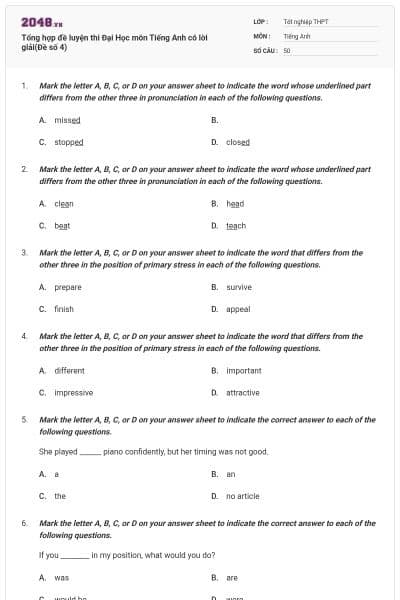
Mark the letter A, B, C, or D on your answer sheet to indicate the word whose underlined part differs from the other three in pronunciation in each of the following questions.
missed
stopped
closed
Chọn D.
Đáp án: D
A. missed /mɪst/
B. laughed /lɑːft/
C. stopped /stɒpt/
D. closed /kləʊzd/
Cụm “ed” trong các đáp án A, B, C có cách phát âm là /t/. Cụm “ed” trong đáp án D có cách phát âm là /d/. Vậy đáp án đúng là D.
Mark the letter A, B, C, or D on your answer sheet to indicate the word whose underlined part differs from the other three in pronunciation in each of the following questions.
clean
head
beat
teach
Chọn B.
Đáp án B.
A. clean /kliː n/
B. head /hed/
C. beat /biː t/
D. teach /tiː tʃ/
Cụm “ea” trong các đáp án A, C, D có cách phát âm là /i:/. Cụm “ea” trong đáp án B có cách phát âm là /e/. Vậy đáp án đúng là B.
Mark the letter A, B, C, or D on your answer sheet to indicate the word that differs from the other three in the position of primary stress in each of the following questions.
prepare
survive
finish
appeal
Chọn C.
Đáp án C.
A. prepare /prɪˈpeə(r)/
B. survive /səˈvaɪv/
C. finish /ˈfɪnɪʃ/
D. appeal /əˈpiː l/
Ta thấy các đáp án A, B, D đều có trọng âm vào âm tiết thứ hai. Còn C có trọng âm vào âm tiết thứ nhất.
Mark the letter A, B, C, or D on your answer sheet to indicate the word that differs from the other three in the position of primary stress in each of the following questions.
different
important
impressive
attractive
Chọn A.
Đáp án là A.
A. different /ˈdɪfrənt/
B. important /ɪmˈpɔːtnt/
C. impressive /ɪmˈpresɪv/
D. attractive /əˈtræktɪv/
Ta thấy các đáp án B, C, D đều có trọng âm vào âm tiết thứ hai. Còn A có trọng âm vào âm tiết thứ nhất.
Mark the letter A, B, C, or D on your answer sheet to indicate the correct answer to each of the following questions.
She played ______ piano confidently, but her timing was not good.
a
an
the
no article
Chọn C.
Đáp án C.
Dùng mạo từ the trước tên nhạc cụ khi đề cập đến các nhạc cụ đó nói chung hoặc khi chơi các nhạc cụ đó.
Dịch: Cô ấy đã chơi piano một cách rất tự tin, nhưng không đúng thời điểm
Mark the letter A, B, C, or D on your answer sheet to indicate the correct answer to each of the following questions.
If you ________ in my position, what would you do?
was
are
would be
were
Chọn D.
Đáp án D.
Câu điều kiện loại 2 diễn tả điều kiện không thể thực hiện được ở hiện tại hoặc tương lai.
Cấu trúc: If + S + V (Quá khứ), S + would/ could + V(nguyên thể).
Dịch: Nếu bạn ở địa vị của tôi thì bạn sẽ làm thế nào?
Mark the letter A, B, C, or D on your answer sheet to indicate the correct answer to each of the following questions.
Mary did not remember what I _____ her the day before.
would tell
had told
told
had been told
Chọn B.
Đáp án B.
Câu gián tiếp Wh- question phải lùi thì. Ta có “the day before” => trong câu trực tiếp là yesterday nên động từ khi chuyển sang gián tiếp lùi về quá khứ hoàn thành.
Dịch: Mary không nhớ những gì tôi đã nói với cô ấy ngày hôm trước.

Học thông minh hơn mỗi ngày
Xem toàn bộ 50 câu hỏi và nhiều hơn nữa với tài khoản miễn phí
Mark the letter A, B, C, or D on your answer sheet to indicate the correct answer to each of the following questions.
She neglected her study during the term,_____she couldn’t pass the exam.
although
because
so that
so
Chọn D.
Đáp án D
Vế trước chỉ nguyên nhân (sao lãng việc học), vế sau chỉ kết quả (không thể vượt qua kỳ thi, vì vậy cần 1 liên từ chỉ nguyên nhân kết quả. Trong 4 đáp án thì có D là đáp án đúng.
Dịch: Trong suốt khóa học cô ta sao lãng việc học, cho nên cô ta không thể vượt qua kỳ thi.
Mark the letter A, B, C, or D on your answer sheet to indicate the correct answer to each of the following questions.
Young people have become increasingly committed their time _____social activities.
of
in
to
at
Chọn C.
Đáp án C.
Ta có "commit to"…: cống hiến
Dịch: Những người trẻ ngày càng càng cống hiến thời gian của họ cho các hoạt động xã hội.
Mark the letter A, B, C, or D on your answer sheet to indicate the correct answer to each of the following questions.
The baby can't even sit up yet, ______ stand and walk!
but for
let alone
all but
rather than
Chọn B.
Đáp án B.
A. but for: nếu như không có (= if not).
B. let alone: chứ đừng nói tới, huống chi là.
C. all but: suýt nữa thì.
D. rather than: thay vì, còn hơn là (= instead of).
Dịch: Đứa bé thậm chí còn chưa biết ngồi, huống hồ là đứng và bước đi.
Mark the letter A, B, C, or D on your answer sheet to indicate the correct answer to each of the following questions.
____ one of the most beautiful forms of performance art, ballet is a combination of dance and mime performed to music.
To consider
Considered
Being considering
Considering
Chọn B.
Đáp án B.
Rút gọn cùng chủ ngữ với vế đầu dạng bị động nên ta đưa về dạng "considered".
Dịch: Được coi là một trong những hình thức nghệ thuật trình diễn đẹp nhất, múa ba lê là sự kết hợp giữa múa và kịch được biểu diễn theo âm nhạc.
Mark the letter A, B, C, or D on your answer sheet to indicate the correct answer to each of the following questions.
Could you please stop ________ so much noise?
make
making
to make
to making
Chọn B.
Đáp án B.
Ta có:
- stop + V-ing: ngừng một hành động đang làm
- stop + to V: ngừng làm việc này để làm việc khác
Dịch câu: Bạn có thể đừng làm ồn nữa không? ( Vì người đó đang làm ồn và mình muốn người đó ngừng làm ồn => dùng V-ing)
Mark the letter A, B, C, or D on your answer sheet to indicate the correct answer to each of the following questions.
Shakespeare asserts the right of women to _____ and independence.
equalization
equally
equalize
equality
Chọn D.
Đáp án D.
Ở đây ta cần một danh từ để tương đương với independence (độc lập).
Xét 4 đáp án thì B (adv) và C (v) bị loại.
Xét nghĩa hai đáp án A và D ta có: A. sự làm bằng nhau, sự làm ngang nhau (không hợp nghĩa);D. sự bình đẳng
Dịch: Shakespeare khẳng định quyền bình đẳng và độc lập của phụ nữ.
Mark the letter A, B, C, or D on your answer sheet to indicate the correct answer to each of the following questions.
________ me to phone them before I go out.
Remind
Remember
Mention
Make
Chọn A.
Đáp án A.
Ta có:
A. remind + O + to –V: nhắc nhở ai đó làm gì => đúng
B. remember + to-V: nhớ phải làm gì => sai do không đi kèm O
C. mention + V-ing: đề cập đến => sai
D. make + O + V(nguyên thể): khiến ai làm gì => sai
Mark the letter A, B, C, or D on your answer sheet to indicate the correct answer to each of the following questions.
He is doing very badly but he tries to ___________ appearance.
hold on
stick to
keep up
make out
Chọn C.
Đáp án C.
save/ keep up appearance (idm): giữ thể diện
Dịch: Anh ta đang làm việc rất tồi nhưng anh ta đang cố gắng giữ thể diện.
Mark the letter A, B, C, or D on your answer sheet to indicate the correct answer to each of the following questions.
Thanks to the invention of labor-saving ________, domestic chores are no longer a burden.
devices
things
equipment
furniture
Chọn A.
Đáp án A
Xét 4 đáp án ta có:
A. devices: thiết bị, vật sáng chế (vì mục đích gì)
B. things: vật dụng (nó chung)
C. equipment: thiết bị, dụng cụ (không kết hợp với labor-saving)
D: furniture: đồ nội thất
Xét về nghĩa thì đáp án đúng là A. labor-saving devices: thiết bị tiết kiệm sức lao động
Dịch: Nhờ vào sự phát minh thiết bị tiết kiệm sức lao động, công việc nhà không còn là một gánh nặng.
Mark the letter A, B, C, or D on your answer sheet to indicate the correct answer to each of the following questions.
The village was ________ visible through the dense fog.
only
barely
mostly
hard
Chọn B.
Đáp án B.
Ta có các đáp án:
A. only (adv): duy nhất
B. barely (adv): hầu như không
C. mostly (adv): phần lớn, chủ yếu là
D. hard (adv): chăm chỉ
Dịch: Ngôi làng hầu như không nhìn thấy rõ qua lớp sương mù dày đặc.
Mark the letter A, B, C, or D on your answer sheet to indicate the correct answer to each of the following questions.
I can’t go out this morning. I’m up to ____ in reports.
eye
ears
feet
fingers
Chọn B.
Đáp án B.
Ta có up to ears in sth = up to sb’s eyes in sth: bận rộn với cái gì
Dịch: Tôi không thể ra ngoài vào sáng nay. Tôi rất bận rộn với đống báo cáo.
Mark the letter A, B, C, or D on your answer sheet to indicate the word(s) CLOSEST in meaning to the underlined word(s) in each of the following questions.
It appalled me that they could simply ignore the problem.
appeared to
shocked
distracted
confused
Chọn B.
Đáp án B.
Ta có:
A. appeared to: xuất hiện
B. shocked: bị sốc = appalled: gây kinh hoàng
C. distracted: mất tập trung
D. confused: bối rố
Mark the letter A, B, C, or D on your answer sheet to indicate the word(s) CLOSEST in meaning to the underlined word(s) in each of the following questions.
The teacher testified to the boy’s honesty when he was accused of stealing from another student. (27 p275)
believed in
doubted
confirmed
ensured
Chọn C.
Đáp án C.
testify to: chứng tỏ, chứng nhận
A. believe in: tin vào
B. doubt: nghi ngờ
C. confirm: xác nhận
D. ensure: bảo đảm
Mark the letter A, B, C, or D on your answer sheet to indicate the word(s) OPPOSITE in meaning to the underlined word(s) in each of the following questions.
Any student who neglects his or her homework is unlikely to do well at school.
puts off
looks for
attends to
approves of
Chọn C.
Đáp án C.
Ta có: neglect (v): lơ là, chểnh mảng >< attend to (v): tập trung, chú ý
Các đáp án còn lại:
A. put off: trì hoãn
B. look for: tìm kiếm
D. approve of: đồng ý, tán thành
Mark the letter A, B, C, or D on your answer sheet to indicate the word(s) OPPOSITE in meaning to the underlined word(s) in each of the following questions.
As a newspaper reporter, she always wanted to get information at first hand.
indirectly
directly
easily
slowly
Chọn A.
Đáp án A.
Ta có: at first hand: trực tiếp
Xét 4 đáp án ta có:
A. indirectly: gián tiếp
B. directly: trực tiếp
C. easily: dễ dàng
D. slowly: chậm chạp
-> at first hand = directly
Dịch: Là một phóng viên báo chí, cô ấy luôn muốn nhận được thông tin trực tiếp.
Mark the letter A, B, C, or D on your answer sheet to indicate the option that best completes each of the following exchanges.
Two close friends Tom and Jane are talking about Jane’s upcoming birthday. Select the most suitable response to complete the exchange.
- Tom: “ Can I bring a friend to your birthday party?”
- Jane: “________________________.”
It’s my honour.
Let’s do it then.
The more the merrie
That’s right.
Đáp án: C
Giải thích:
Kiến thức: Tình huống giao tiếp
Dịch: Hai người bạn thân Tom và Jane đang nói về sinh nhật sắp tới của Jane.
- Tom: “Tớ có thể dẫn một người bạn đến dự tiệc sinh nhật của cậu không?”
- Jane: “________________________.”
A. Rất vinh dự cho tớ
B. Vậy thì làm thôi
C. Càng đông càng vui
D. Đúng rồi
Dựa vào nghĩa, chọn C.
Mark the letter A, B, C, or D on your answer sheet to indicate the option that best completes each of the following exchanges.
“I’m having some friends over for dinner this evening. Would you like to join us?” “________________________.”
Thanks, but I mustn’t.
Come on. It's your turn.
Can I take a rain check?
As a matter of fact, I do.
Chọn C.
Đáp án C.
Dịch: "Tôi sẽ có bữa tối với vài người bạn. Bạn có muốn tham gia cùng chúng tôi không?"
Ta có: to take a rain check (on sth): hẹn lần sau, hẹn dịp khác
Read the following passage and mark the letter A, B, C, or D on your answer sheet to indicate the correct word or phrase that best fits each of the numbered blanks from 25 to 29. Fill in the appropriate word in question 25
Speech is one of the most important ways of communicating. It consists of far more than just making noises. To talk and also to (25) ______ by other people, we have to speak a language, that is, we have to use combinations of (26) ______ that everyone agrees to stand for a particular object or idea. Communication would be impossible if everyone made up their own language.
Learning a language properly is very important. The (27) _______ vocabulary of English is not very large, and only about 2,000 words are needed to speak it quite well. But the more ideas you can (28) ______, the more precise you can be about their exact meanings.
Words are the main thing we use in communicating what we want to say. The way we say the words is also very important. Our tone of voice can express many emotions and (29) _____ whether we are pleased or angry, for instance.
be examined
be talked
be understood
be spoken
Chọn C.
Đáp án C.
Hình thức bị động: be + past participle.
To talk and to be understood by other people = để nói chuyện và để được người khác hiểu.
Ý trong bài: Để nói chuyện và cũng để được hiểu bởi người khác, chúng ta phải nói một ngôn ngữ, nghĩa là, chúng ta phải sử dụng sự kết hợp của âm thanh mà mọi người đồng ý đứng cho một đối tượng hay ý tưởng cụ thể.
Read the following passage and mark the letter A, B, C, or D on your answer sheet to indicate the correct word or phrase that best fits each of the numbered blanks from 25 to 29. Fill in the appropriate word in question 26
Speech is one of the most important ways of communicating. It consists of far more than just making noises. To talk and also to (25) ______ by other people, we have to speak a language, that is, we have to use combinations of (26) ______ that everyone agrees to stand for a particular object or idea. Communication would be impossible if everyone made up their own language.
Learning a language properly is very important. The (27) _______ vocabulary of English is not very large, and only about 2,000 words are needed to speak it quite well. But the more ideas you can (28) ______, the more precise you can be about their exact meanings.
Words are the main thing we use in communicating what we want to say. The way we say the words is also very important. Our tone of voice can express many emotions and (29) _____ whether we are pleased or angry, for instance.
sounds
languages
systems
talks
Chọn A.
Đáp án A.
Xét 4 đáp án:
A. sounds: âm thanh
B. languages: ngôn ngữ
C. systems: hệ thống
D. talks: các cuộc trò chuyện để “speak” (nói) thì cần có các âm thanh
Ý trong bài: Để nói chuyện và cũng để được hiểu bởi người khác, chúng ta phải nói một ngôn ngữ, nghĩa là, chúng ta phải sử dụng sự kết hợp của âm thanh mà mọi người đồng ý đứng cho một đối tượng hay ý tưởng cụ thể.
Read the following passage and mark the letter A, B, C, or D on your answer sheet to indicate the correct word or phrase that best fits each of the numbered blanks from 25 to 29. Fill in the appropriate word in question 27
Speech is one of the most important ways of communicating. It consists of far more than just making noises. To talk and also to (25) ______ by other people, we have to speak a language, that is, we have to use combinations of (26) ______ that everyone agrees to stand for a particular object or idea. Communication would be impossible if everyone made up their own language.
Learning a language properly is very important. The (27) _______ vocabulary of English is not very large, and only about 2,000 words are needed to speak it quite well. But the more ideas you can (28) ______, the more precise you can be about their exact meanings.
Words are the main thing we use in communicating what we want to say. The way we say the words is also very important. Our tone of voice can express many emotions and (29) _____ whether we are pleased or angry, for instance.
basical
basically
basic
basicity
Chọn C.
Đáp án C.
A. basical: không có từ này
B. basically (adv): về cơ bản
C. basic (adj): cơ bản, cơ sở
D. basicity (n): tính ba zơ
Ý trong bài: Vốn từ vựng cơ bản của tiếng Anh không quá lớn và chỉ cần khoảng 2.000 từ để nói nó khá tốt.
Read the following passage and mark the letter A, B, C, or D on your answer sheet to indicate the correct word or phrase that best fits each of the numbered blanks from 25 to 29. Fill in the appropriate word in question 28
Speech is one of the most important ways of communicating. It consists of far more than just making noises. To talk and also to (25) ______ by other people, we have to speak a language, that is, we have to use combinations of (26) ______ that everyone agrees to stand for a particular object or idea. Communication would be impossible if everyone made up their own language.
Learning a language properly is very important. The (27) _______ vocabulary of English is not very large, and only about 2,000 words are needed to speak it quite well. But the more ideas you can (28) ______, the more precise you can be about their exact meanings.
Words are the main thing we use in communicating what we want to say. The way we say the words is also very important. Our tone of voice can express many emotions and (29) _____ whether we are pleased or angry, for instance.
grow
need
pass
express
Chọn D.
Đáp án D.
Diễn đạt, thể hiện ý tưởng hay ý nghĩa (idea) => dùng express
Ý trong bài: Nhưng ý tưởng bạn càng thể hiện, bạn càng chính xác hơn về ý nghĩa chính xác của chúng. Từ ngữ là điều chính chúng ta sử dụng trong việc truyền đạt những gì chúng ta muốn nói.
Read the following passage and mark the letter A, B, C, or D on your answer sheet to indicate the correct word or phrase that best fits each of the numbered blanks from 25 to 29. Fill in the appropriate word in question 29
Speech is one of the most important ways of communicating. It consists of far more than just making noises. To talk and also to (25) ______ by other people, we have to speak a language, that is, we have to use combinations of (26) ______ that everyone agrees to stand for a particular object or idea. Communication would be impossible if everyone made up their own language.
Learning a language properly is very important. The (27) _______ vocabulary of English is not very large, and only about 2,000 words are needed to speak it quite well. But the more ideas you can (28) ______, the more precise you can be about their exact meanings.
Words are the main thing we use in communicating what we want to say. The way we say the words is also very important. Our tone of voice can express many emotions and (29) _____ whether we are pleased or angry, for instance.
ask
understand
know
show
Chọn D.
Đáp án D.
thể hiện cảm xúc => show emotions
Ý trong bài: Cách chúng ta nói các từ cũng rất quan trọng. Giọng nói của chúng tôi có thể thể hiện nhiều cảm xúc và cho thấy chúng tôi có hài lòng hay tức giận hay không.
Read the following passage and mark the letter A, B, C, or D on your answer sheet to indicate the correct answer to each of the questions from 30 to 34.
Marriage nowadays is a choice people make on their own, but this has not always been the case in society. Thousands of years ago, the average lifespan was shorter than it is today. A man usually lived until he was about 40 years old, while women died even sooner because of childbirth. There were many wars and illnesses, and people had to protect themselves by having more children while they were still young. The parents lived through their children.
Marriage was not so much a romantic love story but a business transaction, or deal. Most marriages were arranged between parents while their children were still very young. It was the custom that the fathers made the decision on whom their children were going to marry. The mothers had little say in it since they rarely made any decisions outside the household. The fathers would meet to arrange the wedding date and the money given for the bride on her wedding date. The more money and land a girl had, the more chances she had to marry well. Therefore, it was important that her father choose the bridegroom very well. Usually, it was someone who came from a good family or who was rich too. It was very unlikely that people married outside their social class. A few well-off and rich merchants got to marry poorer noblewomen and became King’s business advisors. In a way, poor peasants had an easier choice as it was less important whom they married.
The practice of arranged marriage is still common in some countries in the Middle East, such as India or Pakistan. Here, social classes are still strongly divided and very well-kept. Often, however, arranged marriages are a sign that people do not want to let go of the past, which gives them comfort and security in an ever- changing world.
(Adapted from Longman Essence Reading, Vol. 2)
What does the passage mainly discuss?
Marriage as a business transaction today
Mothers' roles in their children's marriage
Marriage practices in modern society
The practice of arranged marriage
Chọn D.
Đáp án D.
Dịch đề bài: Bài văn chủ yếu bàn về điều gì?
Ta thấy sau khi giới thiệu chung về hôn nhân tác giả nói đến chủ yếu về tình trạng hôn nhân sắp đặt.
A. Ngày nay, hôn nhân là một cuộc giao dịch kinh doanh
B. Vị trí của người mẹ trong hôn nhân của con cái
C. Thực tế hôn nhân trong xã hội hiện đại
D. Thực trạng của hôn nhân sắp xếp.
Read the following passage and mark the letter A, B, C, or D on your answer sheet to indicate the correct answer to each of the questions from 30 to 34.
Marriage nowadays is a choice people make on their own, but this has not always been the case in society. Thousands of years ago, the average lifespan was shorter than it is today. A man usually lived until he was about 40 years old, while women died even sooner because of childbirth. There were many wars and illnesses, and people had to protect themselves by having more children while they were still young. The parents lived through their children.
Marriage was not so much a romantic love story but a business transaction, or deal. Most marriages were arranged between parents while their children were still very young. It was the custom that the fathers made the decision on whom their children were going to marry. The mothers had little say in it since they rarely made any decisions outside the household. The fathers would meet to arrange the wedding date and the money given for the bride on her wedding date. The more money and land a girl had, the more chances she had to marry well. Therefore, it was important that her father choose the bridegroom very well. Usually, it was someone who came from a good family or who was rich too. It was very unlikely that people married outside their social class. A few well-off and rich merchants got to marry poorer noblewomen and became King’s business advisors. In a way, poor peasants had an easier choice as it was less important whom they married.
The practice of arranged marriage is still common in some countries in the Middle East, such as India or Pakistan. Here, social classes are still strongly divided and very well-kept. Often, however, arranged marriages are a sign that people do not want to let go of the past, which gives them comfort and security in an ever- changing world.
(Adapted from Longman Essence Reading, Vol. 2)
The author mentions all of the following in the passage EXCEPT ____.
People tended to marry outside their social class.
Men made almost all decisions inside the family.
Marriage used to be a deal between two families.
The wedding date was decided by the fathers.
Chọn A.
Đáp án A.
Tác giả đề cập đến tất cả những điều sau đây trong bài văn, trừ: mọi người có xu hướng kết hôn ngoài tầng lớp xã hội của mình; Đàn ông đưa ra hầu hết quyết định trong gia đình; hôn nhân đã từng là một cuộc giao dịch giữa hai gia đình; Ngày cưới được quyết định bởi các bậc làm cha.
Thông tin đươc tìm thấy ở: ". It was very unlikely that people married outside their social class. " => Rất khó có khả năng là người ta kết hôn bên ngoài tầng lớp xã hội của họ
Read the following passage and mark the letter A, B, C, or D on your answer sheet to indicate the correct answer to each of the questions from 30 to 34.
Marriage nowadays is a choice people make on their own, but this has not always been the case in society. Thousands of years ago, the average lifespan was shorter than it is today. A man usually lived until he was about 40 years old, while women died even sooner because of childbirth. There were many wars and illnesses, and people had to protect themselves by having more children while they were still young. The parents lived through their children.
Marriage was not so much a romantic love story but a business transaction, or deal. Most marriages were arranged between parents while their children were still very young. It was the custom that the fathers made the decision on whom their children were going to marry. The mothers had little say in it since they rarely made any decisions outside the household. The fathers would meet to arrange the wedding date and the money given for the bride on her wedding date. The more money and land a girl had, the more chances she had to marry well. Therefore, it was important that her father choose the bridegroom very well. Usually, it was someone who came from a good family or who was rich too. It was very unlikely that people married outside their social class. A few well-off and rich merchants got to marry poorer noblewomen and became King’s business advisors. In a way, poor peasants had an easier choice as it was less important whom they married.
The practice of arranged marriage is still common in some countries in the Middle East, such as India or Pakistan. Here, social classes are still strongly divided and very well-kept. Often, however, arranged marriages are a sign that people do not want to let go of the past, which gives them comfort and security in an ever- changing world.
(Adapted from Longman Essence Reading, Vol. 2)
The word "it" in paragraph I refers to ________.
marriage
a choice
society
the average lifespan
Chọn D.
Đáp án D.
Ta thấy chủ đề được nói đến trong câu là average life span, do đó it thay thế cho the average life span.
Thousands of years ago, the average lifespan was shorter than it is today => Hàng ngàn năm trước, tuổi thọ trung bình ngắn hơn (tuổi thọ trung bình) hiện nay.
Read the following passage and mark the letter A, B, C, or D on your answer sheet to indicate the correct answer to each of the questions from 30 to 34.
Marriage nowadays is a choice people make on their own, but this has not always been the case in society. Thousands of years ago, the average lifespan was shorter than it is today. A man usually lived until he was about 40 years old, while women died even sooner because of childbirth. There were many wars and illnesses, and people had to protect themselves by having more children while they were still young. The parents lived through their children.
Marriage was not so much a romantic love story but a business transaction, or deal. Most marriages were arranged between parents while their children were still very young. It was the custom that the fathers made the decision on whom their children were going to marry. The mothers had little say in it since they rarely made any decisions outside the household. The fathers would meet to arrange the wedding date and the money given for the bride on her wedding date. The more money and land a girl had, the more chances she had to marry well. Therefore, it was important that her father choose the bridegroom very well. Usually, it was someone who came from a good family or who was rich too. It was very unlikely that people married outside their social class. A few well-off and rich merchants got to marry poorer noblewomen and became King’s business advisors. In a way, poor peasants had an easier choice as it was less important whom they married.
The practice of arranged marriage is still common in some countries in the Middle East, such as India or Pakistan. Here, social classes are still strongly divided and very well-kept. Often, however, arranged marriages are a sign that people do not want to let go of the past, which gives them comfort and security in an ever- changing world.
(Adapted from Longman Essence Reading, Vol. 2)
According to paragraph 2, richer girls were more likely to_____.
become noblewomen
marry well
succeed in business
marry peasants
Chọn B.
Đáp án B
Thông tin được tìm thấy ở: " The more money and land a girl had, the more chances she had to marry well." => Một cô gái có càng nhiều tiền và đất đai, cô ta càng có nhiều cơ hội để kết hôn.
Read the following passage and mark the letter A, B, C, or D on your answer sheet to indicate the correct answer to each of the questions from 30 to 34.
Marriage nowadays is a choice people make on their own, but this has not always been the case in society. Thousands of years ago, the average lifespan was shorter than it is today. A man usually lived until he was about 40 years old, while women died even sooner because of childbirth. There were many wars and illnesses, and people had to protect themselves by having more children while they were still young. The parents lived through their children.
Marriage was not so much a romantic love story but a business transaction, or deal. Most marriages were arranged between parents while their children were still very young. It was the custom that the fathers made the decision on whom their children were going to marry. The mothers had little say in it since they rarely made any decisions outside the household. The fathers would meet to arrange the wedding date and the money given for the bride on her wedding date. The more money and land a girl had, the more chances she had to marry well. Therefore, it was important that her father choose the bridegroom very well. Usually, it was someone who came from a good family or who was rich too. It was very unlikely that people married outside their social class. A few well-off and rich merchants got to marry poorer noblewomen and became King’s business advisors. In a way, poor peasants had an easier choice as it was less important whom they married.
The practice of arranged marriage is still common in some countries in the Middle East, such as India or Pakistan. Here, social classes are still strongly divided and very well-kept. Often, however, arranged marriages are a sign that people do not want to let go of the past, which gives them comfort and security in an ever- changing world.
(Adapted from Longman Essence Reading, Vol. 2)
The phrase “let go of” in paragraph 3 mostly means _____.
give up
turn off
save up
give in
Chọn A.
Đáp án A.
Ta có: let go of= give up: buông bỏ, từ bỏ;
B. turn off: tắt
C. save up: tiết kiệm
D. give in: nhượng bộ, chịu thua
Ý trong bài: Often, however, arranged marriages are a sign that people do not want to let go of the past, which gives them comfort and security in an ever-changing world.
Read the following passage and mark the letter A, B, C, or D on your answer sheet to indicate the correct answer to each of the questions from 35 to 42.
New surveys suggest that the technological tools we use to make our lives easier are killing our leisure time. We are working longer hours, taking fewer and shorter vacations (and when we do go away, we take our cell phones, PDAs, and laptops along). And, we are more stressed than ever as increased use of e-mail, voice mail, cell phones, and the Internet is destroying any idea of privacy and leisure.
Since the Industrial Revolution, people have assumed that new labor-saving devices would free them from the burdens of the workplace and give them more time to grow intellectually, creatively, and socially - exploring the arts, keeping up with current events, spending more time with friends and family, and even just ‘goofing off’.
But here we are at the start of the 21st century, enjoying one of the greatest technological boom times in human history, and nothing could be further from the truth. The very tools that were supposed to liberate us have bound us to our work and study in ways that were inconceivable just a few years ago. It would seem that technology almost never does what we expect.
In ‘the old days’, the lines between work and leisure time were markedly clearer. People left their offices at a predictable time, were often completely disconnected from and out of touch with their jobs as they traveled to and from work, and were off-duty once they were home. That is no longer true. In today's highly competitive job market, employers demand increased productivity, expecting workers to put in longer hours and to keep in touch almost constantly via fax, cell phones, e-mail, or other communications devices. As a result, employees feel the need to check in on what is going on at the office, even on days off. They feel pressured to work after hours just to catch up on everything they have to do. Workers work harder and longer, change their work tasks more frequently, and have more and more reasons to worry about job security.
Bosses, colleagues, family members, lovers, and friends expect instant responses to voice mail and email messages. Even college students have become bound to their desks by an environment in which faculty, friends, and other members of the college community increasingly do their work online. Studies of time spent on instant messaging services would probably show staggering use.
This is not what technology was supposed to be doing for us. New technologies from genetic research to the Internet, offer all sorts of benefits and opportunities. But, when new tools make life more difficult and stressful rather than easier and more meaningful - and we are, as a society, barely conscious of it - then something has gone seriously awry, both with our expectations for technology and our understanding of how it should benefit us.
Which of the following could best serve as the title of the passage?
Changes at the Workplace
Benefits of Technology
Research on the Roles of Computers
Expectations and Plain Reality
Chọn D.
Đáp án D.
Dịch câu hỏi: Câu nào sau đây có thể phù hợp nhất để làm tiêu đề cho đoạn văn?
A. Sự thay đổi tại nơi làm việc.
B. Lợi ích của công nghệ
C. Nghiên cứu về vai trò của máy tính.
D. Những mong muốn và thực tại giản đơn.
Read the following passage and mark the letter A, B, C, or D on your answer sheet to indicate the correct answer to each of the questions from 35 to 42.
New surveys suggest that the technological tools we use to make our lives easier are killing our leisure time. We are working longer hours, taking fewer and shorter vacations (and when we do go away, we take our cell phones, PDAs, and laptops along). And, we are more stressed than ever as increased use of e-mail, voice mail, cell phones, and the Internet is destroying any idea of privacy and leisure.
Since the Industrial Revolution, people have assumed that new labor-saving devices would free them from the burdens of the workplace and give them more time to grow intellectually, creatively, and socially - exploring the arts, keeping up with current events, spending more time with friends and family, and even just ‘goofing off’.
But here we are at the start of the 21st century, enjoying one of the greatest technological boom times in human history, and nothing could be further from the truth. The very tools that were supposed to liberate us have bound us to our work and study in ways that were inconceivable just a few years ago. It would seem that technology almost never does what we expect.
In ‘the old days’, the lines between work and leisure time were markedly clearer. People left their offices at a predictable time, were often completely disconnected from and out of touch with their jobs as they traveled to and from work, and were off-duty once they were home. That is no longer true. In today's highly competitive job market, employers demand increased productivity, expecting workers to put in longer hours and to keep in touch almost constantly via fax, cell phones, e-mail, or other communications devices. As a result, employees feel the need to check in on what is going on at the office, even on days off. They feel pressured to work after hours just to catch up on everything they have to do. Workers work harder and longer, change their work tasks more frequently, and have more and more reasons to worry about job security.
Bosses, colleagues, family members, lovers, and friends expect instant responses to voice mail and email messages. Even college students have become bound to their desks by an environment in which faculty, friends, and other members of the college community increasingly do their work online. Studies of time spent on instant messaging services would probably show staggering use.
This is not what technology was supposed to be doing for us. New technologies from genetic research to the Internet, offer all sorts of benefits and opportunities. But, when new tools make life more difficult and stressful rather than easier and more meaningful - and we are, as a society, barely conscious of it - then something has gone seriously awry, both with our expectations for technology and our understanding of how it should benefit us.
Which of the following is NOT true about technological tools, according to new surveys?
They bring more leisure to our life.
They make our lives more stressful.
They are being increasingly used.
They are used even during vacations.
Chọn A.
Đáp án A.
Dịch câu hỏi: Theo những thăm dò mới đây, câu nào không đúng khi nói đến công cụ công nghệ?
A. Chúng mang lại nhiều thời gian rảng cho cuộc sống của chúng ta.
B. Chúng làm cho cuộc sống của chúng ta căng thẳng hơn.
C. Chúng ngày càng được tận dụng nhiều hơn.
D. Chúng được tận dụng ngay cả khi bạn đi nghỉ mát.
Thông tin: “We are working longer hours, taking fewer and shorter vacations (and when we do go away, we take our cell phones, PDAs, and laptops along). And, we are more stressed than ever....”
(Chúng ta đang làm việc nhiều giờ hơn, nghỉ ít hơn và ngắn hơn (và khi chúng ta đi xa, chúng ta mang theo điện thoại di động, thiết bị kỹ thuật số hỗ trợ cá nhân và máy tính xách tay của chúng ta). Và, chúng ta đang căng thẳng hơn bao giờ hết....)
Read the following passage and mark the letter A, B, C, or D on your answer sheet to indicate the correct answer to each of the questions from 35 to 42.
New surveys suggest that the technological tools we use to make our lives easier are killing our leisure time. We are working longer hours, taking fewer and shorter vacations (and when we do go away, we take our cell phones, PDAs, and laptops along). And, we are more stressed than ever as increased use of e-mail, voice mail, cell phones, and the Internet is destroying any idea of privacy and leisure.
Since the Industrial Revolution, people have assumed that new labor-saving devices would free them from the burdens of the workplace and give them more time to grow intellectually, creatively, and socially - exploring the arts, keeping up with current events, spending more time with friends and family, and even just ‘goofing off’.
But here we are at the start of the 21st century, enjoying one of the greatest technological boom times in human history, and nothing could be further from the truth. The very tools that were supposed to liberate us have bound us to our work and study in ways that were inconceivable just a few years ago. It would seem that technology almost never does what we expect.
In ‘the old days’, the lines between work and leisure time were markedly clearer. People left their offices at a predictable time, were often completely disconnected from and out of touch with their jobs as they traveled to and from work, and were off-duty once they were home. That is no longer true. In today's highly competitive job market, employers demand increased productivity, expecting workers to put in longer hours and to keep in touch almost constantly via fax, cell phones, e-mail, or other communications devices. As a result, employees feel the need to check in on what is going on at the office, even on days off. They feel pressured to work after hours just to catch up on everything they have to do. Workers work harder and longer, change their work tasks more frequently, and have more and more reasons to worry about job security.
Bosses, colleagues, family members, lovers, and friends expect instant responses to voice mail and email messages. Even college students have become bound to their desks by an environment in which faculty, friends, and other members of the college community increasingly do their work online. Studies of time spent on instant messaging services would probably show staggering use.
This is not what technology was supposed to be doing for us. New technologies from genetic research to the Internet, offer all sorts of benefits and opportunities. But, when new tools make life more difficult and stressful rather than easier and more meaningful - and we are, as a society, barely conscious of it - then something has gone seriously awry, both with our expectations for technology and our understanding of how it should benefit us.
According to the first three paragraphs, technological tools that were designed to make our lives easier ______.
have turned out to do us more harm than good
have not interfered with our privacy
have fully met our expectations
have brought us complete happiness
Chọn A.
Đáp án A.
Dịch câu hỏi: Theo 3 đoạn đầu, công cụ công nghệ được thiết kể để làm cho cuộc sống của chúng ra dễ dàng hơn _____________.
A. chứng minh cho chúng ta thấy hại nhiều hơn lợi
B. không can thiệp vào sự riêng tư của chúng ta
C. đáp ứng đầy đủ mong đợi của chúng ta
D. mang lại cho chúng ta hạnh phúc trọn vẹn
Thông tin: “The very tools that were supposed to liberate us have bound us to our work and study in ways that were inconceivable just a few years ago. It would seem that technology almost never does what we expect.”
(Chính những công cụ được cho là để giải phóng chúng ta đã ràng buộc chúng ta vào công việc và nghiên cứu theo những cách không thể tưởng tượng được chỉ vài năm trước. Dường như công nghệ gần như không bao giờ làm những gì chúng ta mong đợi.)
Read the following passage and mark the letter A, B, C, or D on your answer sheet to indicate the correct answer to each of the questions from 35 to 42.
New surveys suggest that the technological tools we use to make our lives easier are killing our leisure time. We are working longer hours, taking fewer and shorter vacations (and when we do go away, we take our cell phones, PDAs, and laptops along). And, we are more stressed than ever as increased use of e-mail, voice mail, cell phones, and the Internet is destroying any idea of privacy and leisure.
Since the Industrial Revolution, people have assumed that new labor-saving devices would free them from the burdens of the workplace and give them more time to grow intellectually, creatively, and socially - exploring the arts, keeping up with current events, spending more time with friends and family, and even just ‘goofing off’.
But here we are at the start of the 21st century, enjoying one of the greatest technological boom times in human history, and nothing could be further from the truth. The very tools that were supposed to liberate us have bound us to our work and study in ways that were inconceivable just a few years ago. It would seem that technology almost never does what we expect.
In ‘the old days’, the lines between work and leisure time were markedly clearer. People left their offices at a predictable time, were often completely disconnected from and out of touch with their jobs as they traveled to and from work, and were off-duty once they were home. That is no longer true. In today's highly competitive job market, employers demand increased productivity, expecting workers to put in longer hours and to keep in touch almost constantly via fax, cell phones, e-mail, or other communications devices. As a result, employees feel the need to check in on what is going on at the office, even on days off. They feel pressured to work after hours just to catch up on everything they have to do. Workers work harder and longer, change their work tasks more frequently, and have more and more reasons to worry about job security.
Bosses, colleagues, family members, lovers, and friends expect instant responses to voice mail and email messages. Even college students have become bound to their desks by an environment in which faculty, friends, and other members of the college community increasingly do their work online. Studies of time spent on instant messaging services would probably show staggering use.
This is not what technology was supposed to be doing for us. New technologies from genetic research to the Internet, offer all sorts of benefits and opportunities. But, when new tools make life more difficult and stressful rather than easier and more meaningful - and we are, as a society, barely conscious of it - then something has gone seriously awry, both with our expectations for technology and our understanding of how it should benefit us.
The word "inconceivable" in the passage is closest in meaning to __________.
predictable
foreseeable
unforgettable
unimaginable
Chọn D.
Đáp án D.
Dịch câu hỏi: Từ “inconceivable” trong đoạn văn gần nghĩa nhất với _____________.
A. predictable (adj): có thể đoán được
B. foreseeable (adj): có thể biết trước được
C. unforgettable (adj): không thể quên
D. unimaginable (adj): không tưởng tượng được
Thông tin: “The very tools that were supposed to liberate us have bound us to our work and study in ways that were inconceivable just a few years ago.” (Chính những công cụ được cho là để giải phóng chúng ta đã ràng buộc chúng ta vào công việc và nghiên cứu theo những cách không thể tưởng tượng được chỉ vài năm trước.)
Read the following passage and mark the letter A, B, C, or D on your answer sheet to indicate the correct answer to each of the questions from 35 to 42.
New surveys suggest that the technological tools we use to make our lives easier are killing our leisure time. We are working longer hours, taking fewer and shorter vacations (and when we do go away, we take our cell phones, PDAs, and laptops along). And, we are more stressed than ever as increased use of e-mail, voice mail, cell phones, and the Internet is destroying any idea of privacy and leisure.
Since the Industrial Revolution, people have assumed that new labor-saving devices would free them from the burdens of the workplace and give them more time to grow intellectually, creatively, and socially - exploring the arts, keeping up with current events, spending more time with friends and family, and even just ‘goofing off’.
But here we are at the start of the 21st century, enjoying one of the greatest technological boom times in human history, and nothing could be further from the truth. The very tools that were supposed to liberate us have bound us to our work and study in ways that were inconceivable just a few years ago. It would seem that technology almost never does what we expect.
In ‘the old days’, the lines between work and leisure time were markedly clearer. People left their offices at a predictable time, were often completely disconnected from and out of touch with their jobs as they traveled to and from work, and were off-duty once they were home. That is no longer true. In today's highly competitive job market, employers demand increased productivity, expecting workers to put in longer hours and to keep in touch almost constantly via fax, cell phones, e-mail, or other communications devices. As a result, employees feel the need to check in on what is going on at the office, even on days off. They feel pressured to work after hours just to catch up on everything they have to do. Workers work harder and longer, change their work tasks more frequently, and have more and more reasons to worry about job security.
Bosses, colleagues, family members, lovers, and friends expect instant responses to voice mail and email messages. Even college students have become bound to their desks by an environment in which faculty, friends, and other members of the college community increasingly do their work online. Studies of time spent on instant messaging services would probably show staggering use.
This is not what technology was supposed to be doing for us. New technologies from genetic research to the Internet, offer all sorts of benefits and opportunities. But, when new tools make life more difficult and stressful rather than easier and more meaningful - and we are, as a society, barely conscious of it - then something has gone seriously awry, both with our expectations for technology and our understanding of how it should benefit us.
It can be inferred from the fourth paragraph that __________.
employees have more freedom to decide what time they start and finish work
it is compulsory that employees go to the office, even on days off.
employers are more demanding and have efficient means to monitor employees
life is more relaxing with cell phones and other technological devices
Chọn C.
Đáp án C.
Dịch câu hỏi: Có thể rút ra từ đoạn văn số 4 rằng ______________.
A. Nhân viên tự do hơn trong việc quyết định thời gian bắt đầu và kết thúc công việc.
B. Bắt buộc nhân viên phải đến cơ quan, thậm chí và vào ngày nghỉ
C. Người sử dụng lao động khắt khe hơn và có nhiều phương tiện hiệu quả để giám sát nhân viên.
D. Cuộc sống thoải mái hơn khi có điện thoại di dộng và các thiết bị công nghệ khác.
Thông tin: “In today’s highly competitive job market, employers demand increased productivity, expecting workers to put in longer hours and to keep in touch almost constantly via fax, cell phones, e-mail, or other communications devices.”
(Trong thị trường việc làm cạnh tranh cao hiện nay, các nhà tuyển dụng yêu cầu tăng năng suất, hy vọng người lao động sẽ làm việc nhiều giờ hơn và giữ liên lạc gần như liên tục qua fax, điện thoại di động, e-mail hoặc các thiết bị liên lạc khác.)
Read the following passage and mark the letter A, B, C, or D on your answer sheet to indicate the correct answer to each of the questions from 35 to 42.
New surveys suggest that the technological tools we use to make our lives easier are killing our leisure time. We are working longer hours, taking fewer and shorter vacations (and when we do go away, we take our cell phones, PDAs, and laptops along). And, we are more stressed than ever as increased use of e-mail, voice mail, cell phones, and the Internet is destroying any idea of privacy and leisure.
Since the Industrial Revolution, people have assumed that new labor-saving devices would free them from the burdens of the workplace and give them more time to grow intellectually, creatively, and socially - exploring the arts, keeping up with current events, spending more time with friends and family, and even just ‘goofing off’.
But here we are at the start of the 21st century, enjoying one of the greatest technological boom times in human history, and nothing could be further from the truth. The very tools that were supposed to liberate us have bound us to our work and study in ways that were inconceivable just a few years ago. It would seem that technology almost never does what we expect.
In ‘the old days’, the lines between work and leisure time were markedly clearer. People left their offices at a predictable time, were often completely disconnected from and out of touch with their jobs as they traveled to and from work, and were off-duty once they were home. That is no longer true. In today's highly competitive job market, employers demand increased productivity, expecting workers to put in longer hours and to keep in touch almost constantly via fax, cell phones, e-mail, or other communications devices. As a result, employees feel the need to check in on what is going on at the office, even on days off. They feel pressured to work after hours just to catch up on everything they have to do. Workers work harder and longer, change their work tasks more frequently, and have more and more reasons to worry about job security.
Bosses, colleagues, family members, lovers, and friends expect instant responses to voice mail and email messages. Even college students have become bound to their desks by an environment in which faculty, friends, and other members of the college community increasingly do their work online. Studies of time spent on instant messaging services would probably show staggering use.
This is not what technology was supposed to be doing for us. New technologies from genetic research to the Internet, offer all sorts of benefits and opportunities. But, when new tools make life more difficult and stressful rather than easier and more meaningful - and we are, as a society, barely conscious of it - then something has gone seriously awry, both with our expectations for technology and our understanding of how it should benefit us.
The word "They" in the fourth paragraph refers to ________.
workers
employers
employees
tasks
Chọn C.
Đáp án C.
Dịch câu hỏi: Từ “They” trong đoạn 4 đề cập đến ______________.
A. Công nhân
B. Người tuyển dụng
C. Nhân viên
D. Nhiệm vụ
Thông tin: “As a result, employees feel the need to check in on what is going on at the office, even on days off. They feel pressured to work after hours just to catch up on everything they have to do.”
(Do đó, nhân viên cảm thấy cần phải kiểm tra những gì đang diễn ra tại văn phòng, ngay cả trong những ngày nghỉ. Họ cảm thấy áp lực phải làm việc sau nhiều giờ chỉ để bắt kịp mọi thứ họ phải làm.)
Read the following passage and mark the letter A, B, C, or D on your answer sheet to indicate the correct answer to each of the questions from 35 to 42.
New surveys suggest that the technological tools we use to make our lives easier are killing our leisure time. We are working longer hours, taking fewer and shorter vacations (and when we do go away, we take our cell phones, PDAs, and laptops along). And, we are more stressed than ever as increased use of e-mail, voice mail, cell phones, and the Internet is destroying any idea of privacy and leisure.
Since the Industrial Revolution, people have assumed that new labor-saving devices would free them from the burdens of the workplace and give them more time to grow intellectually, creatively, and socially - exploring the arts, keeping up with current events, spending more time with friends and family, and even just ‘goofing off’.
But here we are at the start of the 21st century, enjoying one of the greatest technological boom times in human history, and nothing could be further from the truth. The very tools that were supposed to liberate us have bound us to our work and study in ways that were inconceivable just a few years ago. It would seem that technology almost never does what we expect.
In ‘the old days’, the lines between work and leisure time were markedly clearer. People left their offices at a predictable time, were often completely disconnected from and out of touch with their jobs as they traveled to and from work, and were off-duty once they were home. That is no longer true. In today's highly competitive job market, employers demand increased productivity, expecting workers to put in longer hours and to keep in touch almost constantly via fax, cell phones, e-mail, or other communications devices. As a result, employees feel the need to check in on what is going on at the office, even on days off. They feel pressured to work after hours just to catch up on everything they have to do. Workers work harder and longer, change their work tasks more frequently, and have more and more reasons to worry about job security.
Bosses, colleagues, family members, lovers, and friends expect instant responses to voice mail and email messages. Even college students have become bound to their desks by an environment in which faculty, friends, and other members of the college community increasingly do their work online. Studies of time spent on instant messaging services would probably show staggering use.
This is not what technology was supposed to be doing for us. New technologies from genetic research to the Internet, offer all sorts of benefits and opportunities. But, when new tools make life more difficult and stressful rather than easier and more meaningful - and we are, as a society, barely conscious of it - then something has gone seriously awry, both with our expectations for technology and our understanding of how it should benefit us.
Which of the following could be the main idea of the fifth paragraph?
New technological applications are wise entertainment choices of our modern time.
The coming of new technological advances has spoiled family and social relationships.
New technological advances have added more stress to daily life.
New technological advances have reduced work performance.
Chọn C.
Đáp án C
Dịch câu hỏi: Câu nào sau đây có thể làm ý chính cho đoạn văn số 5?
A. Các ứng dụng công nghệ mới là những lựa chọn giải trí khôn ngoan trong thời hiện đại của chúng ta.
B. Việc ra đời của công nghệ tân tiến đã làm hỏng gia đình và các mối quan hệ xã hội.
C. Sự phát triển của công nghệ tân tiến đã tạo thêm áp lực cho cuộc sống hàng ngày.
D. Sự phát triển của công nghệ tân tiến đã làm giảm hiệu suất công việc.
Read the following passage and mark the letter A, B, C, or D on your answer sheet to indicate the correct answer to each of the questions from 35 to 42.
New surveys suggest that the technological tools we use to make our lives easier are killing our leisure time. We are working longer hours, taking fewer and shorter vacations (and when we do go away, we take our cell phones, PDAs, and laptops along). And, we are more stressed than ever as increased use of e-mail, voice mail, cell phones, and the Internet is destroying any idea of privacy and leisure.
Since the Industrial Revolution, people have assumed that new labor-saving devices would free them from the burdens of the workplace and give them more time to grow intellectually, creatively, and socially - exploring the arts, keeping up with current events, spending more time with friends and family, and even just ‘goofing off’.
But here we are at the start of the 21st century, enjoying one of the greatest technological boom times in human history, and nothing could be further from the truth. The very tools that were supposed to liberate us have bound us to our work and study in ways that were inconceivable just a few years ago. It would seem that technology almost never does what we expect.
In ‘the old days’, the lines between work and leisure time were markedly clearer. People left their offices at a predictable time, were often completely disconnected from and out of touch with their jobs as they traveled to and from work, and were off-duty once they were home. That is no longer true. In today's highly competitive job market, employers demand increased productivity, expecting workers to put in longer hours and to keep in touch almost constantly via fax, cell phones, e-mail, or other communications devices. As a result, employees feel the need to check in on what is going on at the office, even on days off. They feel pressured to work after hours just to catch up on everything they have to do. Workers work harder and longer, change their work tasks more frequently, and have more and more reasons to worry about job security.
Bosses, colleagues, family members, lovers, and friends expect instant responses to voice mail and email messages. Even college students have become bound to their desks by an environment in which faculty, friends, and other members of the college community increasingly do their work online. Studies of time spent on instant messaging services would probably show staggering use.
This is not what technology was supposed to be doing for us. New technologies from genetic research to the Internet, offer all sorts of benefits and opportunities. But, when new tools make life more difficult and stressful rather than easier and more meaningful - and we are, as a society, barely conscious of it - then something has gone seriously awry, both with our expectations for technology and our understanding of how it should benefit us.
This passage has probably been taken from ________.
a science journal
an advertisement
a political journal
a fashion magazine
Chọn A.
Đáp án A.
Dịch câu hỏi: Đoạn văn này có thể được rút ra từ _________
A. một tạp chí khoa học
B. một quảng cáo
C. một tạp chí chính trị
D. một tạp chí thời trang
Lướt qua đoạn văn ta có thể thấy đoạn văn nói về “technological tools” => có thể được rút trong 1 tạp chí khoa học
Mark the letter A, B, C, or D on your answer sheet to indicate the underlined part that needs correction in each of the following questions.
Although both of them (A) are trying (B) to get (C) the scholarship, she has the highest (D) grades.
of them
are trying
to get
highest
Chọn D.
Đáp án D.
So sánh hơn so sánh giữa 2 người/ vật. So sánh hơn nhất so sánh giữa 3 người/ vật trở lên.
Vì vậy: highest => higher
Dịch: Mặc dù cả 2 đều cố gắng đê lấy học bổng nhưng cô ấy lại có điểm cao hơn.
Mark the letter A, B, C, or D on your answer sheet to indicate the underlined part that needs correction in each of the following questions.
Grover Cleveland was the only (A) American president served (B) two nonconsecutive (C) terms (D).
the only
served
nonconsecutive
terms
Chọn B.
Đáp án B.
Mệnh đề rút gọn đứng sau “the only”.
Vì vậy: served => to serve.
Dich: Grover Cleveland là tổng thống Mỹ duy nhất phục vụ hai nhiệm kỳ không liên tiếp.
Mark the letter A, B, C, or D on your answer sheet to indicate the underlined part that needs correction in each of the following questions.
Chocolate is prepared by a complexity (A) process of cleaning, blending (B) and roasting cocoa beans, which (C) must be ground and mixed with (D) sugar.
complexity
blending
which
mixed with
Chọn A.
Đáp án A.
Ta có trật tự: mạo từ + tính từ + danh từ
Vì vậy: complexity => complex
Dịch: Sô cô la được chuẩn bị bởi một quá trình phức tạp: làm sạch, pha trộn và rang hạt ca cao, mà phải được nghiền và trộn với đường.
Mark the letter A, B, C, or D on your answer sheet to indicate the sentence that is closest in meaning to each of the following questions.
I had two job offers upon graduation, neither of which was appropriate for my qualifications.
The two jobs offered to me after my graduation didn’t suit my qualifications.
Both of the job offers I had prior to my graduation were appropriate for my qualifications.
I was offered two jobs soon after my graduation, both of them were suitable for my qualifications.
Though I wasn’t qualified enough, two jobs were offered to me upon graduation.
Chọn A.
Đáp án A.
Câu gốc: Tôi có hai đề nghị công việc sau khi tốt nghiệp, không cái nào trong đó phù hợp với chuyên môn của tôi.
= A. Hai việc làm được đề nghị cho tôi sai khi tôi tốt nghiệp đều không phù hợp với chuyên môn của tôi.
Các đáp án khác:
B. Cả hai đề nghị việc làm mà tôi nhận được trước khi tốt nghiệp đều phù hợp với chuyên môn của tôi.
C. Tôi được đề nghi hai việc làm ngay sau khi tốt nghiệp, cả hai đều phù hợp với chuyên môn của tôi.
D. Mặc dù chưa đủ trình độ chuyên môn nhưng hai công việc đã được đề nghị cho tôi trước khi tôi tốt nghiệp.
Mark the letter A, B, C, or D on your answer sheet to indicate the sentence that is closest in meaning to each of the following questions.
“Don’t forget to lock all the doors when you go out, John!”- said his mother.
John’s mother suggested him to lock all the doors when he went out.
John’s mother reminded him to lock all the doors when he went out.
John’s mother recommended him to lock all the doors when he went out.
John’s mother remembered him to lock all the doors when he went out.
Chọn B.
Đáp án B.
Câu gốc: "Đừng quên khóa tất cả các cánh cửa khi con đi ra ngoài, John!" Mẹ cậu ta nói. == hàm ý một lời nhắc nhở. Sang gián tiếp dùng: remind sb to do sth: nhắc nhở ai đó làm gì
= B. Mẹ của John đã nhắc cho anh ta khóa tất cả cửa ra vào khi anh ta ra ngoài.
Các lựa chọn khác không phù hợp.
A. Mẹ của John đề nghị anh ta khóa tất cả các cửa ra vào khi anh ta ra ngoài.
C. Mẹ của John John đề nghị anh ta khóa tất cả các cánh cửa khi anh ta ra ngoài.
D. Mẹ của John nhớ anh ta khóa tất cả các cánh cửa khi anh ta ra ngoài.
Mark the letter A, B, C, or D on your answer sheet to indicate the sentence that is closest in meaning to each of the following questions.
They couldn’t climb up the mountain because of the storm.
The storm made them possible to climb up the mountain.
The storm made it not capable of climbing up the mountain.
The storm discouraged them from climbing up the mountain.
Their climbing up the mountain was able due to the storm.
Đáp án: C
Giải thích:
Dịch: Họ không thể leo lên núi vì cơn bão.
because of + N/V-ing: bởi vì/do
Xét các đáp án:
A. Sai vì chỉ có cấu trúc: make it + adj: làm cho …
B. capable of doing something: có khả năng làm gì
Dùng với chủ ngữ có thể/không thể thực hiện một hành động nào đó. Chủ ngữ ở đây là “Their climbing up the mountain” (việc leo núi của họ) → loại
C. discourage somebody from doing something: ngăn cản ai làm gì
Cơn bão đã ngăn cản họ leo lên núi.
→ đúng nghĩa và cấu trúc
D. able/unable to V: có/không đủ khả năng làm gì
Dùng với chủ ngữ có thể/không thể thực hiện một hành động nào đó. Chủ ngữ ở đây là “Their climbing up the mountain” (việc leo núi của họ) → loại
Mark the letter A, B, C, or D on your answer sheet to indicate the sentence that best combines each pair of sentences in the following questions.
Most scientists know him well. However, very few ordinary people have heard of him.
He is the only scientist that is not known to the general public.
Not only scientists but also the general public know him as a big name.
Although he is well known to scientists, he is little known to the general public.
Many ordinary people know him better than most scientists do.
Chọn C.
Đáp án C.
Câu cho sẵn nghĩa là: "Hầu hết các nhà khoa học đều biết ông ấy. Tuy nhiên, có rất ít công chúng biết đến ông ấy."
A. Ông là nhà khoa học duy nhất không được công chúng biết đến.
B. Không chỉ các nhà khoa học mà cả công chúng đều biết anh ta là một tên tuổi lớn.
C. Mặc dù ông ấy nổi tiếng trong giới khoa học nhưng lại ít được công chúng biết đến.
D. Nhiều người bình thường biết anh ta tốt hơn hầu hết các nhà khoa học.
Các đáp án A, B, D đều sai nghĩa.
Đáp án C đúng vì đây là 2 mệnh đề mang ý nghĩa tương phản nên dùng "Although" để nối 2 mệnh đề là hợp lí.
Mark the letter A, B, C, or D on your answer sheet to indicate the sentence that best combines each pair of sentences in the following questions.
They drove fifteen miles off the main road. Also, they had nothing to eat for the day.
They drove fifteen miles off the main road until they had something to eat for the day.
They neither drove fifteen miles off the main road nor had anything to eat for the day.
Driving fifteen miles off the main road, they eventually had something to eat for the day.
Not only did they drive fifteen miles off the main road but they also had nothing to eat
Chọn D.
Đáp án D.
Câu cho sẵn có nghĩa: Họ đã lái xe cách đường chính 15 dặm. Họ cũng không có gì để ăn trong ngày hôm đó.
A: Họ lái xe cách đường chính 15 dặm cho tới khi họ tìm thấy thứ gì đó để ăn cho ngày hôm đó.
B: Họ không lái xe ra khỏi đường chính 15 dặm mà cũng chẳng có gì để ăn cho ngày hôm đó.
C: Lái xe ra khỏi đường chính 15 dặm, cuối cùng họ cũng kiếm được thứ gì đó để ăn cho ngày hôm đó.
D: Họ không chỉ lái xe ra khỏi đường chính 15 dặm mà họ cũng chẳng có gì để ăn cho ngày hôm đó.
Bạn có thích hoạt động này không?
Ý kiến của bạn sẽ giúp chúng tôi đề xuất nội dung phù hợp hơn.
Gợi ý cho bạn
![[Năm 2022] Đề thi thử môn Vật lí THPT Quốc gia có lời giải - Đề số 21](/_next/image?url=https%3A%2F%2Fvideo.vietjack.com%2Fupload%2Fimages%2Fvj-image%2Fimage-3izficdefgfoel0s9j8s-1786772791.jpg&w=3840&q=75)
![[Năm 2022] Đề thi thử môn Vật lí THPT Quốc gia có lời giải - Đề số 20](/_next/image?url=https%3A%2F%2Fvideo.vietjack.com%2Fupload%2Fimages%2Fvj-image%2Fimage-emy0gtcksawvorajezvv-1786772460.jpg&w=3840&q=75)
Tài liệu phổ biến Tốt nghiệp THPT
Tài liệu phổ biến Tiếng Anh