Tổng hợp đề luyện thi Đại Học môn Tiếng Anh có lời giải(Đề số 19)
50 câu hỏi
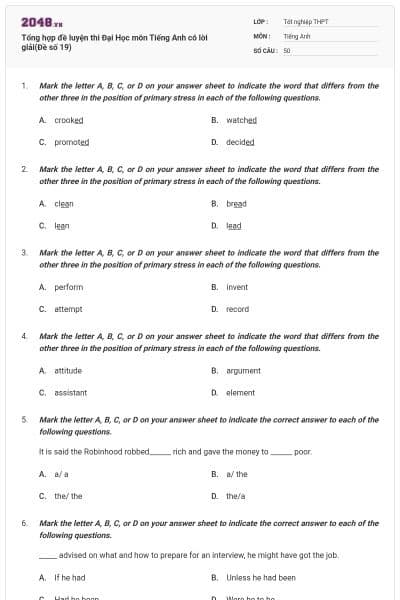
Mark the letter A, B, C, or D on your answer sheet to indicate the word that differs from the other three in the position of primary stress in each of the following questions.
crooked
watched
promoted
decided
Chọn B.
Đáp án B
A. crooked /ˈkrʊkɪd/
B. watched /wɒtʃt/
C. promoted /prəˈməʊtɪd/
D. decided /dɪˈsaɪdɪd/
Đuôi “ed” trong đáp án B phát âm là /t/. Các đáp án còn lại phát âm là /ɪd/.
Mark the letter A, B, C, or D on your answer sheet to indicate the word that differs from the other three in the position of primary stress in each of the following questions.
clean
bread
lean
lead
Chọn B.
Đáp án B.
A. clean /kliːn/
B. bread /bred/
C. lean /liːn/
D. lead /liːd/
Phần gạch chân “ea” trong đáp án B phát âm là /e/. Các đáp án còn lại phát âm là /i:/.
Mark the letter A, B, C, or D on your answer sheet to indicate the word that differs from the other three in the position of primary stress in each of the following questions.
perform
invent
attempt
record
Chọn D.
Đáp án D
A. perform /pəˈfɔːm/
B. invent /ɪnˈvɛnt/
C. attempt /əˈtɛm(p)t/
D. record/ˈrikɔːd/
Đáp án D có trọng âm rơi vào âm tiết thứ nhất. Các đáp án còn lại có trọng âm rơi vào âm tiết thứ 2
Mark the letter A, B, C, or D on your answer sheet to indicate the word that differs from the other three in the position of primary stress in each of the following questions.
attitude
argument
assistant
element
Chọn B.
Đáp án B
A. essential /ɪˈsenʃl/
B. different /ˈdɪfrənt/
C. important /ɪmˈpɔːtnt/
D. dependent /dɪˈpendənt/
Đáp án B có trọng âm rơi vào âm tiết thứ nhất. Các đáp án còn lại có trọng âm rơi vào âm tiết thứ 2
Mark the letter A, B, C, or D on your answer sheet to indicate the correct answer to each of the following questions.
It is said the Robinhood robbed______ rich and gave the money to ______ poor.
a/ a
a/ the
the/ the
the/a
Chọn C.
Đáp án C.
The + adj: chỉ một nhóm người hoặc một tầng lớp trong xã hôi. => the rich (người giàu), the poor (người nghèo)
Dịch: Người ta nói Robinhood đã cướp của người giàu và chia cho người nghèo.
Mark the letter A, B, C, or D on your answer sheet to indicate the correct answer to each of the following questions.
_____ advised on what and how to prepare for an interview, he might have got the job.
If he had
Unless he had been
Had he been
Were he to be
Chọn C.
Đáp án C
Dựa vào mệnh đề sau có dạng might + have + PII nên câu thuộc điều kiện loại 3.
Câu điều kiện 3: If S + had + PII, S + would/ might have PII
= Had + S + PII, would/ might have PII.
=> Đáp án D sai về ngữ pháp.
Dựa vào nghĩa của câu, ta nhận thấy hành động anh ta được khuyên phải ở dạng bị động => mệnh đề thích hợp để điền vào chỗ trống là C. Had he been.
Dịch: Nếu anh ta được khuyên về việc chuẩn bị cái gì và như thế nào cho buổi phỏng vấn, anh ta đã có thể nhận được việc.
Mark the letter A, B, C, or D on your answer sheet to indicate the correct answer to each of the following questions.
I’d rather you ______ to the English-speaking club with me this Sunday.
will come
came
come
to come
Chọn B.
Đáp án B.
Ta có cấu trúc: S1 would rather S2 + V(quá khứ): muốn cùng ai làm gì.
Dịch: Tôi muốn bạn đến câu lạc bộ nói tiếng Anh với tôi chủ nhật tuần này.
Mark the letter A, B, C, or D on your answer sheet to indicate the correct answer to each of the following questions.
_______ of all the staff, I would like to wish you a happy retirement.
Instead
In place
On behalf
On account
Chọn C.
Đáp án C.
Ta có:
A. instead of sb/ sth = B. in place of sb/ sth: thay thế cho
C. on behalf of sb/ on sb’s behalf: thay mặt cho, nhân danh.
D. on account of sb/sth: bởi vì.
Dịch: Thay mặt cho cho toàn bộ nhân viên, tôi chúc anh nghỉ hưu vui vẻ.
Mark the letter A, B, C, or D on your answer sheet to indicate the correct answer to each of the following questions.
Instead of staying around the house all day, you should be out there looking ______a job.
for
after
into
at
Chọn A.
Đáp án A
Ta có:
A. look for: tìm kiếm
B. look after: chăm sóc
C. look into: nhìn vào/ xem xét
D. look at: nhìn chằm chằm
Dịch: Thay vì ở nhà cả ngày, bạn nên ra khỏi đây tìm việc làm.
Mark the letter A, B, C, or D on your answer sheet to indicate the correct answer to each of the following questions.
The principal wanted to know the student ________________ the highest mark for the test in geography last month.
got
getting
who not
is getting
Chọn B.
Đáp án B.
Mệnh đề quan hệ giản lược dạng chủ động dùng V-ing.
Dịch: Hiệu trưởng muốn biết học sinh đạt điểm cao nhất cho bài kiểm tra địa lý vào tháng trước.
Mark the letter A, B, C, or D on your answer sheet to indicate the correct answer to each of the following questions.
___________one day by a passing car, the dog never walked proper again.
Having injured
Injuring
Injured
To be injured
Chọn C.
Đáp án C
Dịch: Đã có lần bị thương bởi một chiếc ô tô đi ngang qua, con chó không bao giờ đi lại bình
thường được nữa.
PII đứng đầu câu để thể hiện nghĩa bị động.
A., B. sai vì nghĩa chủ động
Mark the letter A, B, C, or D on your answer sheet to indicate the correct answer to each of the following questions.
Our father suggested ______ to Da Nang for this summer holiday.
to going
going
go
to go
Chọn B.
Đáp án B.
Ta có: suggest + V-ing: gợi ý làm gì
Dịch: Bố gợi ý đi Đà Nẵng trong kì nghỉ hè này.
Mark the letter A, B, C, or D on your answer sheet to indicate the correct answer to each of the following questions.
Don’t worry. He‘ll do the job as _______as possible.
economizing
economic
uneconomically
economically
Chọn B.
Đáp án D
A. economize (v): tiết kiệm; tiêu ít
B. economic (adj): thuộc về kinh tế
C. uneconomically (adv): không có tính kinh tế, không tiết kiệm; tốn kém
D. economically (adv): một cách kinh tế, tiết kiệm; ít tốn kém
Cần điền adv để bổ nghĩa cho do (V).
Dịch: Dừng lo. Anh ấy sẽ làm việc đó một cách kinh tế nhất có thể.
Mark the letter A, B, C, or D on your answer sheet to indicate the correct answer to each of the following questions.
The teacher always ______that the students make an outline before writing the complete essay.
reports
tells
says
recommends
Chọn D.
Đáp án D
Dịch: Giáo viên luôn khuyên rằng học sinh (nên) làm dàn ý trước khi viết bài luận hoàn chỉnh.
Mark the letter A, B, C, or D on your answer sheet to indicate the correct answer to each of the following questions.
______ to reason that Jason passed the exam with flying colors on account of his working hard during the term.
comes
gets
stands
lays
Đáp án: C
Giải thích:
Kiến thức: Thành ngữ
Ta có cụm cố định: It stands to reason (that) (said when something is obvious or clear from the facts): rõ ràng là, thực tế là
Ví dụ: If 20 percent of the earth’s population has 80 percent of its resources, then it stands to reason that 80 percent of the population has only 20 percent of the resources.
(Nếu 20 phần trăm dân số thế giới sở hữu 80 phần trăm tài nguyên thì cũng hợp lý khi nói rằng 80 phần trăm dân số chỉ sở hữu 20 phần trăm tài nguyên.)
Vì đây là cụm cố định nên ta không thể thay thế bằng phương án nào khác.
Dịch: Rõ ràng là Jason đã vượt qua kì thi một cách vô cùng thành công bởi sự chăm chỉ học tập của anh ấy suốt kì học.
Mark the letter A, B, C, or D on your answer sheet to indicate the correct answer to each of the following questions.
Nobody took any ________of the warning and they went swimming in the contaminated water.
sight
attention
information
notice
Chọn D.
Đáp án D.
A. sight (n): tầm nhìn
B. attention (n): sự chú ý
C. information (n): thông tin
D. notice (n): thông báo
Dịch: Không ai nhận được bất kỳ thông báo nào về cảnh báo và họ đã đi bơi trong vùng nước bị ô nhiễm.
Mark the letter A, B, C, or D on your answer sheet to indicate the correct answer to each of the following questions.
I have looked through the report, but I must admit, only ___________.
superficially
thoroughly
carefully
seriously
Chọn A.
Đáp án A
A. superficially (adv): một cách hời hợt/ qua loa; nông cạn
B. thoroughly (adv): môt cách kỹ lưỡng, sâu sắc
C. carefully (adv): một cách cẩn thận
D. seriously (adv): một cách nghiêm túc/ nghiêm trọng
Dịch: Tôi đã xem xét báo cáo, nhưng tôi phải thừa nhận là (tôi chỉ xem) một cách qua loa.
Mark the letter A, B, C, or D on your answer sheet to indicate the correct answer to each of the following questions.
Don’t give me the details of what the client said, just tell me his bottom _____.
line
link
rope
heart
Chọn A.
Đáp án A.
(the) bottom line: con số hoặc thông tin quan trọng nhất
Dịch: Đừng cho tôi biết chi tiết về những gì khách hàng nói, chỉ cần cho tôi biết điểm mấu chốt của anh ấy.
Mark the letter A, B, C, or D on your answer sheet to indicate the word(s) CLOSEST in meaning to the underlined word(s) in each of the following questions.
He was so happy that he kept grinning all the time.
shouting
crying
thrilling
smiling widely
Chọn D.
Đáp án D
Ta có: grin: cười thoải mái/ toe toét
Xét nghĩa các đáp án ta có:
A. shouting: la hét
B. crying: khóc
C. thrilling: rung rợn
D. smile widely: cười thoải mái
Dịch: Anh ta quá hạnh phúc tới mức liên tục cười toe toét liên tục.
Mark the letter A, B, C, or D on your answer sheet to indicate the word(s) CLOSEST in meaning to the underlined word(s) in each of the following questions.
The flight was called off because there was a severe storm
cancelled
postponed
scheduled
interrupted
Chọn A.
Đáp án A
A. cancelled: hủy bỏ
B. postponed: trì hoãn
C. scheduled: theo kế hoạch
D. interrupted: bị gián đoạn
Do nguyên nhân có 1 cơn bão mạnh nên động từ “call off” khi nói về chuyến bay mang nghĩa là hủy bỏ. Vậy từ đồng nghĩa phù hợp là “cancel”
Dich: Chuyến bay bị hủy vì có một cơn bão rất mạnh.
Mark the letter A, B, C, or D on your answer sheet to indicate the word(s) OPPOSITE in meaning to the underlined word(s) in each of the following questions.
It was not for his friend to abate that confidence.
free
augment
provoke
wane
Chọn B.
Đáp án B
A. free (v): giải phóng, thả tự do
B. augment (v): làm tăng lên, tăng cường >< abate (v): làm nản lòng, làm giảm đi
C. provoke (v): kích động, chọc giận
D. wane (v): yếu đi
Dịch: Đấy không phải là việc của bạn anh ấy để làm giảm sự tự tin của anh ấy.
Mark the letter A, B, C, or D on your answer sheet to indicate the word(s) OPPOSITE in meaning to the underlined word(s) in each of the following questions.
Laura loves to talk to anyone. Sometimes her chatter really gets on my nerves.
annoys me
disturbs me
pleases me
encourages me
Chọn C.
Đáp án C.
Dịch: Laura thích nói chuyện với mọi người. Thỉnh thoảng thì cái việc cô ấy nói luôn mồm làm tôi khó chịu.
A. annoy (v): làm khó chịu, quấy rầy.
B. disturb (v): làm phiền
C. please sb (v): làm ai đó vui vẻ, hài lòng.
D. encourage sb (v): khuyến khích, khích lệ ai đó.
Đáp án chính xác là C. pleases me >< gets on my nerve
Mark the letter A, B, C or D on your answer sheet to indicate the sentence that best completes each of the following exchanges.
Mary is saying goodbye to Paul after a party at Paul’s home.
Mary: “I had a really good time. Thanks for the lovely evening.”
Paul: “____________”
I’m glad you enjoyed it.
Yes, it’s really good.
Oh, that’s right.
No, it’s very kind of you.
Chọn A.
Đáp án A
Dịch câu nói của Mary có thể thấy cô ấy đang cám ơn bữa tối của Paul.
Vậy đáp lại lời cám ơn này đáp án phù hợp là A. I’m glad you enjoyed it (tôi rất mừng bạn thích nó)
Mark the letter A, B, C or D on your answer sheet to indicate the sentence that best completes each of the following exchanges.
“Would you mind if I open the window?”
“______________”
Yes, please open
Yes, I wouldn’t mind.
No, please do
No, don’t open it.
Đáp án: C
Giải thích:
Dịch: “Bạn có phiền nếu tôi mở cửa sổ không?”
“______________.”
A. Vâng, xin hãy mở
B. Vâng, tôi không phiền
C. Không, xin hãy mở
D. Không, đừng mở
Dựa vào nghĩa, chọn C.
Read the following passage and mark the letter A, B, C, or D on your answer sheet to indicate the correct word for each of the blanks from 25 to 29. Fill in the appropriate word in question 25
In recent years there have been many articles on air pollution in newspapers and magazines. Scientists all over the world have warned that our atmosphere is (25) ______ more and more contaminated, and that Man, through his carelessness, may run out of pure air to breathe.
Automobiles and industries mainly account (26) _______ air pollution in most cities. They pour into the air such gases as carbon monoxide, sulfur and nitrogen oxides, (27) _____ are very harmful to humans. (28) ____ still, these gases, a series of chemical changes, turn into toxic acids. They fall down in “acid rains”, raising the acidity in the air, soil and water to dangerous levels and affecting not only tress but also fish and other wildlife. Many industrial countries in Europe and North America have suffered bad effects (29) ______ those “rains”.
Surely, Man faces no more urgent problem than that of saving his own survival. Scientists, social organizations and governments shout sit down together to solve the air pollution problem.
got
become
becoming
changing
Chọn C.
Đáp án C
Ta có:
- become thường được dùng với dạng so sánh kép của tính từ
+ Với tính từ ngắn: S + become adj-er and adj-er
+ Với tính từ dài: S + become + more and more + adj
- Thì hiện tại tiếp diễn: S + is/am/are + V-ing + O
Read the following passage and mark the letter A, B, C, or D on your answer sheet to indicate the correct word for each of the blanks from 25 to 29. Fill in the appropriate word in question 26
In recent years there have been many articles on air pollution in newspapers and magazines. Scientists all over the world have warned that our atmosphere is (25) ______ more and more contaminated, and that Man, through his carelessness, may run out of pure air to breathe.
Automobiles and industries mainly account (26) _______ air pollution in most cities. They pour into the air such gases as carbon monoxide, sulfur and nitrogen oxides, (27) _____ are very harmful to humans. (28) ____ still, these gases, a series of chemical changes, turn into toxic acids. They fall down in “acid rains”, raising the acidity in the air, soil and water to dangerous levels and affecting not only tress but also fish and other wildlife. Many industrial countries in Europe and North America have suffered bad effects (29) ______ those “rains”.
Surely, Man faces no more urgent problem than that of saving his own survival. Scientists, social organizations and governments shout sit down together to solve the air pollution problem.
for
about
of
with
Chọn A.
Đáp án A
Ta có: account for sth: giải thích cho cái gì; là lời giải thích hay nguyên nhân của cái gì
Dịch: Automobiles and ... is most cities: ô tô và các ngành công nghiệp là nguyên nhân chính của sự ô nhiễm không khí ở hầu hết các thành phố.
Read the following passage and mark the letter A, B, C, or D on your answer sheet to indicate the correct word for each of the blanks from 25 to 29. Fill in the appropriate word in question 27
In recent years there have been many articles on air pollution in newspapers and magazines. Scientists all over the world have warned that our atmosphere is (25) ______ more and more contaminated, and that Man, through his carelessness, may run out of pure air to breathe.
Automobiles and industries mainly account (26) _______ air pollution in most cities. They pour into the air such gases as carbon monoxide, sulfur and nitrogen oxides, (27) _____ are very harmful to humans. (28) ____ still, these gases, a series of chemical changes, turn into toxic acids. They fall down in “acid rains”, raising the acidity in the air, soil and water to dangerous levels and affecting not only tress but also fish and other wildlife. Many industrial countries in Europe and North America have suffered bad effects (29) ______ those “rains”.
Surely, Man faces no more urgent problem than that of saving his own survival. Scientists, social organizations and governments shout sit down together to solve the air pollution problem.
that
which
they
and
Chọn B.
Đáp án B
Mệnh đề quan hệ không xác định:
- Mệnh đề quan hệ không xác định được dùng để bổ nghĩa cho 1 danh từ hoặc mệnh đề được đề cập đến ở trước trong câu. Nó bổ sung thêm thông tin thêm về người, về sự vật, một hiện tượng đang được nói đến. Mệnh đề quan hệ luôn đứng ngay sau danh từ, mệnh đề mà nó bổ nghĩa.
- Mệnh đề quan hệ không xác định không phải là thành phần cổt yếu của câu và có thể loại bỏ mà không ảnh hường gì đến câu.
- Khác với mệnh đề quan hệ xác định, mệnh đê quan hệ không xác định được phân cách bằng dấu phẩy và không thể bỏ đại từ quan hệ.
- Không dùng that trong mệnh đề quan hệ không xác định.
Read the following passage and mark the letter A, B, C, or D on your answer sheet to indicate the correct word for each of the blanks from 25 to 29. Fill in the appropriate word in question 28
In recent years there have been many articles on air pollution in newspapers and magazines. Scientists all over the world have warned that our atmosphere is (25) ______ more and more contaminated, and that Man, through his carelessness, may run out of pure air to breathe.
Automobiles and industries mainly account (26) _______ air pollution in most cities. They pour into the air such gases as carbon monoxide, sulfur and nitrogen oxides, (27) _____ are very harmful to humans. (28) ____ still, these gases, a series of chemical changes, turn into toxic acids. They fall down in “acid rains”, raising the acidity in the air, soil and water to dangerous levels and affecting not only tress but also fish and other wildlife. Many industrial countries in Europe and North America have suffered bad effects (29) ______ those “rains”.
Surely, Man faces no more urgent problem than that of saving his own survival. Scientists, social organizations and governments shout sit down together to solve the air pollution problem.
Badly
Worst
Worse
Most
Chọn C.
Đáp án C
Ta có: better / worse still: tốt hơn nữa / Tệ hơn nữa
Dịch: Worse still, ...turn in to toxic acids: Tệ hơn nữa, các khí này, với một loạt các thay đổi hóa học, biến thành axit độc hại.
Read the following passage and mark the letter A, B, C, or D on your answer sheet to indicate the correct word for each of the blanks from 25 to 29. Fill in the appropriate word in question 29
In recent years there have been many articles on air pollution in newspapers and magazines. Scientists all over the world have warned that our atmosphere is (25) ______ more and more contaminated, and that Man, through his carelessness, may run out of pure air to breathe.
Automobiles and industries mainly account (26) _______ air pollution in most cities. They pour into the air such gases as carbon monoxide, sulfur and nitrogen oxides, (27) _____ are very harmful to humans. (28) ____ still, these gases, a series of chemical changes, turn into toxic acids. They fall down in “acid rains”, raising the acidity in the air, soil and water to dangerous levels and affecting not only tress but also fish and other wildlife. Many industrial countries in Europe and North America have suffered bad effects (29) ______ those “rains”.
Surely, Man faces no more urgent problem than that of saving his own survival. Scientists, social organizations and governments shout sit down together to solve the air pollution problem.
with
from
about
for
Chọn B.
Đáp án B
Ta có: from : từ
Dịch: Many is industrial... from those “rains”: Nhiều nước công nghiệp ở châu Âu và Bắc Mỹ đã chịu ảnh hưởng xấu từ những “cơn mưa” này
Read the following passage and mark the letter A, B, C or D on your answer sheet to indicate the correct answer to each of the following questions from 30 to 34.
Successful students often do the followings while studying. First, they have an overview before reading. Next, they look for important information and pay greater attention to it (which often needs jumping forward or backward to process information). They also relate important points to one another. Also, they activate and use their prior knowledge. When they realize that their understanding is not good, they do not wait to change strategies. Last, they can monitor understanding and take action to correct or “fix up” mistakes in comprehension.
Conversely, students with low academic achievement often demonstrate ineffective study skills. They tend to assume a passive role, in learning and rely on others (e.g., teachers, parents) to monitor their studying, for example, low-achieving students often do not monitor their understanding of content; they may not be aware of the purpose of studying; and they show little evidence of looking back, or employing “fix-up” strategies to fix understanding problems. Students who struggle with learning new information seem to be unaware that they must extent effort beyond simply reading the content to understand and remember it. Children with learning disabilities do not plan and judge the quality of their studying. Their studying may be disorganized. Students with learning problems face challenges with personal organization as well. They often have difficulty keeping track of materials and assignments, following directions, and completing work on time. Unlike good studiers who employ a variety of study skills in a flexible yet purposeful manner, low-achieving students use a restricted range of study skills. They cannot explain why good study strategies are important for learning, and they tend to use the same, often ineffective study approach for all learning tasks, ignoring task content, structure or difficulty.
What is the topic of the passage?
Successful and low-academic achieving students
Successful learners and their learning strategies
Study skills for high school students
Effective and ineffective ways of learning
Chọn D.
Đáp án D
Dịch câu hỏi: Chủ đề của đoạn văn là gì?
A. Học sinh giỏi và học sinh kém
B. Những người học giỏi và các chiến lược học tập của họ
C. kỹ năng học tập dành cho học sinh trung học
D. Cách học hiệu quả và không hiệu quả
Read the following passage and mark the letter A, B, C or D on your answer sheet to indicate the correct answer to each of the following questions from 30 to 34.
Successful students often do the followings while studying. First, they have an overview before reading. Next, they look for important information and pay greater attention to it (which often needs jumping forward or backward to process information). They also relate important points to one another. Also, they activate and use their prior knowledge. When they realize that their understanding is not good, they do not wait to change strategies. Last, they can monitor understanding and take action to correct or “fix up” mistakes in comprehension.
Conversely, students with low academic achievement often demonstrate ineffective study skills. They tend to assume a passive role, in learning and rely on others (e.g., teachers, parents) to monitor their studying, for example, low-achieving students often do not monitor their understanding of content; they may not be aware of the purpose of studying; and they show little evidence of looking back, or employing “fix-up” strategies to fix understanding problems. Students who struggle with learning new information seem to be unaware that they must extent effort beyond simply reading the content to understand and remember it. Children with learning disabilities do not plan and judge the quality of their studying. Their studying may be disorganized. Students with learning problems face challenges with personal organization as well. They often have difficulty keeping track of materials and assignments, following directions, and completing work on time. Unlike good studiers who employ a variety of study skills in a flexible yet purposeful manner, low-achieving students use a restricted range of study skills. They cannot explain why good study strategies are important for learning, and they tend to use the same, often ineffective study approach for all learning tasks, ignoring task content, structure or difficulty.
The word “prior” in the first paragraph is closest in meaning to ________.
important
earlier
forward
good
Chọn B.
Đáp án B
Dịch câu hỏi: Từ “prior” ở đoạn đầu tiên có ý nghĩa gần nhất với _________.
A. important: quan trọng
B. earlier: trước đó
C. forward: chuyển tiếp
D. good: tốt
=> prior = earlier: trước đó
Read the following passage and mark the letter A, B, C or D on your answer sheet to indicate the correct answer to each of the following questions from 30 to 34.
Successful students often do the followings while studying. First, they have an overview before reading. Next, they look for important information and pay greater attention to it (which often needs jumping forward or backward to process information). They also relate important points to one another. Also, they activate and use their prior knowledge. When they realize that their understanding is not good, they do not wait to change strategies. Last, they can monitor understanding and take action to correct or “fix up” mistakes in comprehension.
Conversely, students with low academic achievement often demonstrate ineffective study skills. They tend to assume a passive role, in learning and rely on others (e.g., teachers, parents) to monitor their studying, for example, low-achieving students often do not monitor their understanding of content; they may not be aware of the purpose of studying; and they show little evidence of looking back, or employing “fix-up” strategies to fix understanding problems. Students who struggle with learning new information seem to be unaware that they must extent effort beyond simply reading the content to understand and remember it. Children with learning disabilities do not plan and judge the quality of their studying. Their studying may be disorganized. Students with learning problems face challenges with personal organization as well. They often have difficulty keeping track of materials and assignments, following directions, and completing work on time. Unlike good studiers who employ a variety of study skills in a flexible yet purposeful manner, low-achieving students use a restricted range of study skills. They cannot explain why good study strategies are important for learning, and they tend to use the same, often ineffective study approach for all learning tasks, ignoring task content, structure or difficulty.
According to the passage, what can be learnt about passive students?
They depend on other people to organize their learning
They are slow in their studying
They monitor their understanding
They know the purpose of studying
Chọn A.
Đáp án A
Dịch câu hỏi: Theo đoạn văn, điều gì có thể rút ra về những học sinh thụ động?
A. Họ phụ thuộc vào người khác để tổ chức học tập
B. Họ chậm trong việc học tập
C. Họ theo dõi hiểu biết của mình
D. Họ biết mục tiêu học tập
Thông tin: They tend to assume a passive role, in learning and rely on others (e.g., teachers, parents) to monitor their studying.
Read the following passage and mark the letter A, B, C or D on your answer sheet to indicate the correct answer to each of the following questions from 30 to 34.
Successful students often do the followings while studying. First, they have an overview before reading. Next, they look for important information and pay greater attention to it (which often needs jumping forward or backward to process information). They also relate important points to one another. Also, they activate and use their prior knowledge. When they realize that their understanding is not good, they do not wait to change strategies. Last, they can monitor understanding and take action to correct or “fix up” mistakes in comprehension.
Conversely, students with low academic achievement often demonstrate ineffective study skills. They tend to assume a passive role, in learning and rely on others (e.g., teachers, parents) to monitor their studying, for example, low-achieving students often do not monitor their understanding of content; they may not be aware of the purpose of studying; and they show little evidence of looking back, or employing “fix-up” strategies to fix understanding problems. Students who struggle with learning new information seem to be unaware that they must extent effort beyond simply reading the content to understand and remember it. Children with learning disabilities do not plan and judge the quality of their studying. Their studying may be disorganized. Students with learning problems face challenges with personal organization as well. They often have difficulty keeping track of materials and assignments, following directions, and completing work on time. Unlike good studiers who employ a variety of study skills in a flexible yet purposeful manner, low-achieving students use a restricted range of study skills. They cannot explain why good study strategies are important for learning, and they tend to use the same, often ineffective study approach for all learning tasks, ignoring task content, structure or difficulty.
According to the passage, to learn new information, low-achieving students do NOT _________.
just understand it
relate it to what they have known
simply remember it
read it
Chọn B.
Đáp án B
Dịch câu hỏi: Theo đoạn văn, để tìm hiểu thông tin mới, học sinh kém KHÔNG___________.
A. chỉ hiểu nó
B. liên hệ nó với những gì họ đã biết
C. chỉ đơn giản là nhớ nó
D. đọc nó
Thông tin: Students who struggle with learning new information seem to be unaware that they must
Read the following passage and mark the letter A, B, C or D on your answer sheet to indicate the correct answer to each of the following questions from 30 to 34.
Successful students often do the followings while studying. First, they have an overview before reading. Next, they look for important information and pay greater attention to it (which often needs jumping forward or backward to process information). They also relate important points to one another. Also, they activate and use their prior knowledge. When they realize that their understanding is not good, they do not wait to change strategies. Last, they can monitor understanding and take action to correct or “fix up” mistakes in comprehension.
Conversely, students with low academic achievement often demonstrate ineffective study skills. They tend to assume a passive role, in learning and rely on others (e.g., teachers, parents) to monitor their studying, for example, low-achieving students often do not monitor their understanding of content; they may not be aware of the purpose of studying; and they show little evidence of looking back, or employing “fix-up” strategies to fix understanding problems. Students who struggle with learning new information seem to be unaware that they must extent effort beyond simply reading the content to understand and remember it. Children with learning disabilities do not plan and judge the quality of their studying. Their studying may be disorganized. Students with learning problems face challenges with personal organization as well. They often have difficulty keeping track of materials and assignments, following directions, and completing work on time. Unlike good studiers who employ a variety of study skills in a flexible yet purposeful manner, low-achieving students use a restricted range of study skills. They cannot explain why good study strategies are important for learning, and they tend to use the same, often ineffective study approach for all learning tasks, ignoring task content, structure or difficulty.
The underlined pronoun “They” in the last sentence refers to __________.
study strategies
study skills
low-achieving students
good studiers
Chọn C.
Đáp án C.
Dịch câu hỏi: Đại từ được gạch dưới “They” trong câu cuối cùng đề cập đến ________.
A. các chiến lược học tập
B. kỹ năng học tập
C. học sinh kém
D. người học giỏi
“they” được thay cho “low-achieving students”
Read the following passage and mark the letter A, B, C, or D on your answer sheet to indicate the correct answer to each of the questions from 35 to 42.
Although noise, commonly defined as unwanted sound, is a widely recognized form of pollution, it is very difficult to measure because the discomfort experienced by different individuals is highly subjective and, therefore, variable. Exposure to lower levels of noise may be slightly irritating, whereas exposure to higher levels may actually cause hearing loss. Particularly in congested urban areas, the noise produced as a by-product of our advancing technology causes physical and psychological harm, and detracts from the quality of life for those who are exposed to it.
Unlike the eyes, which can be covered by the eyelids against strong light, the ear has no lid, and is, therefore, always open and vulnerable; noise penetrates without protection.
Noise causes effects that the hearer cannot control and to which the body never becomes accustomed. Loud noises instinctively signal danger to any organism with a hearing mechanism, including human beings. In response, heartbeat and respiration accelerate, blood vessels constrict, the skin pales, and muscles tense. In fact, there is a general increase in functioning brought about by the flow of adrenaline released in response to fear, and some of these responses persist even longer than the noise, occasionally as long as thirty minutes after the sound has ceased.
Because noise is unavoidable in a complex, industrial society, we are constantly responding in the same way that we would respond to danger. Recently, researchers have concluded that noise and our response may be much more than an annoyance. It may be a serious threat to physical and psychological health and well-being, causing damage not only to the ear and brain but also to the heart and stomach. We have long known that hearing loss is America’s number one nonfatal health problem, but now we are learning that some of us with heart disease and ulcers may be victims of noise as well. Fetuses exposed to noise tend to be overactive, they cry easily, and they are more sensitive to gastrointestinal problems after birth. In addition, the psychic effect of noise is very important. Nervousness, irritability, tension, and anxiety increase affecting the quality of rest during sleep, and the efficiency of activities during waking hours, as well as the way that we interact with each other.
Which of the following is the author’s main point?
Hearing loss is America’s number one nonfatal health problem.
Loud noises signal danger.
Noise may pose a serious threat to our physical and psychological health.
The ear is not like the eye.
Chọn C.
Đáp án C
Dịch câu hỏi: Câu nào sau đây là ý chính tác giải muốn gửi gắm?
A. Mất thính giác là vấn đề sức khỏe nhỏ ở Mỹ.
B. Tiếng ồn lớn báo hiệu sự nguy hiểm.
C. Tiếng ồn có thể gây ra một mối đe dọa nghiêm trọng đối với sức khoẻ thể chất và tâm lý của chúng ta.
D. Tai không giống như mắt.
=> Đáp án C đúng.
Read the following passage and mark the letter A, B, C, or D on your answer sheet to indicate the correct answer to each of the questions from 35 to 42.
Although noise, commonly defined as unwanted sound, is a widely recognized form of pollution, it is very difficult to measure because the discomfort experienced by different individuals is highly subjective and, therefore, variable. Exposure to lower levels of noise may be slightly irritating, whereas exposure to higher levels may actually cause hearing loss. Particularly in congested urban areas, the noise produced as a by-product of our advancing technology causes physical and psychological harm, and detracts from the quality of life for those who are exposed to it.
Unlike the eyes, which can be covered by the eyelids against strong light, the ear has no lid, and is, therefore, always open and vulnerable; noise penetrates without protection.
Noise causes effects that the hearer cannot control and to which the body never becomes accustomed. Loud noises instinctively signal danger to any organism with a hearing mechanism, including human beings. In response, heartbeat and respiration accelerate, blood vessels constrict, the skin pales, and muscles tense. In fact, there is a general increase in functioning brought about by the flow of adrenaline released in response to fear, and some of these responses persist even longer than the noise, occasionally as long as thirty minutes after the sound has ceased.
Because noise is unavoidable in a complex, industrial society, we are constantly responding in the same way that we would respond to danger. Recently, researchers have concluded that noise and our response may be much more than an annoyance. It may be a serious threat to physical and psychological health and well-being, causing damage not only to the ear and brain but also to the heart and stomach. We have long known that hearing loss is America’s number one nonfatal health problem, but now we are learning that some of us with heart disease and ulcers may be victims of noise as well. Fetuses exposed to noise tend to be overactive, they cry easily, and they are more sensitive to gastrointestinal problems after birth. In addition, the psychic effect of noise is very important. Nervousness, irritability, tension, and anxiety increase affecting the quality of rest during sleep, and the efficiency of activities during waking hours, as well as the way that we interact with each other.
According to the passage, what is noise?
A byproduct of technology
Physical and psychological harm
Congestion
Unwanted sound
Chọn D.
Đáp án D
Dịch câu hỏi: Theo như đoạn văn, tiếng ồn là gì?
A. Sản phẩm phụ của công nghệ
B. Tác hại tâm lý và thể chất
C. Sự đông đúc
D. Âm thanh không mong muốn
Dẫn chứng: Although noise, commonly defined as unwanted sound, is a widely recognized form of pollution
Read the following passage and mark the letter A, B, C, or D on your answer sheet to indicate the correct answer to each of the questions from 35 to 42.
Although noise, commonly defined as unwanted sound, is a widely recognized form of pollution, it is very difficult to measure because the discomfort experienced by different individuals is highly subjective and, therefore, variable. Exposure to lower levels of noise may be slightly irritating, whereas exposure to higher levels may actually cause hearing loss. Particularly in congested urban areas, the noise produced as a by-product of our advancing technology causes physical and psychological harm, and detracts from the quality of life for those who are exposed to it.
Unlike the eyes, which can be covered by the eyelids against strong light, the ear has no lid, and is, therefore, always open and vulnerable; noise penetrates without protection.
Noise causes effects that the hearer cannot control and to which the body never becomes accustomed. Loud noises instinctively signal danger to any organism with a hearing mechanism, including human beings. In response, heartbeat and respiration accelerate, blood vessels constrict, the skin pales, and muscles tense. In fact, there is a general increase in functioning brought about by the flow of adrenaline released in response to fear, and some of these responses persist even longer than the noise, occasionally as long as thirty minutes after the sound has ceased.
Because noise is unavoidable in a complex, industrial society, we are constantly responding in the same way that we would respond to danger. Recently, researchers have concluded that noise and our response may be much more than an annoyance. It may be a serious threat to physical and psychological health and well-being, causing damage not only to the ear and brain but also to the heart and stomach. We have long known that hearing loss is America’s number one nonfatal health problem, but now we are learning that some of us with heart disease and ulcers may be victims of noise as well. Fetuses exposed to noise tend to be overactive, they cry easily, and they are more sensitive to gastrointestinal problems after birth. In addition, the psychic effect of noise is very important. Nervousness, irritability, tension, and anxiety increase affecting the quality of rest during sleep, and the efficiency of activities during waking hours, as well as the way that we interact with each other.
Why is noise difficult to measure?
All people do not respond to it in the same way.
It causes hearing loss.
It is unwanted.
People become accustomed to it.
Chọn A.
Đáp án A
Dịch câu hỏi: Tại sao tiếng ồn khó đo lường?
A. Mọi người không phản ứng với nó theo một cách giống nhau.
B. Nó gây mất thính giác.
C. Nó không được mong muốn
D. Người ta trở nên quen thuộc với nó.
Dẫn chứng: “... it is very difficult to measure because the discomfort experienced by different individuals is highly subjective and, therefore, variable” (nó rất khó để đo lường bởi vì sự khó chịu của các cá nhân khác nhau là chủ quan và, vì vậy, nó rất đa dạng.)
Read the following passage and mark the letter A, B, C, or D on your answer sheet to indicate the correct answer to each of the questions from 35 to 42.
Although noise, commonly defined as unwanted sound, is a widely recognized form of pollution, it is very difficult to measure because the discomfort experienced by different individuals is highly subjective and, therefore, variable. Exposure to lower levels of noise may be slightly irritating, whereas exposure to higher levels may actually cause hearing loss. Particularly in congested urban areas, the noise produced as a by-product of our advancing technology causes physical and psychological harm, and detracts from the quality of life for those who are exposed to it.
Unlike the eyes, which can be covered by the eyelids against strong light, the ear has no lid, and is, therefore, always open and vulnerable; noise penetrates without protection.
Noise causes effects that the hearer cannot control and to which the body never becomes accustomed. Loud noises instinctively signal danger to any organism with a hearing mechanism, including human beings. In response, heartbeat and respiration accelerate, blood vessels constrict, the skin pales, and muscles tense. In fact, there is a general increase in functioning brought about by the flow of adrenaline released in response to fear, and some of these responses persist even longer than the noise, occasionally as long as thirty minutes after the sound has ceased.
Because noise is unavoidable in a complex, industrial society, we are constantly responding in the same way that we would respond to danger. Recently, researchers have concluded that noise and our response may be much more than an annoyance. It may be a serious threat to physical and psychological health and well-being, causing damage not only to the ear and brain but also to the heart and stomach. We have long known that hearing loss is America’s number one nonfatal health problem, but now we are learning that some of us with heart disease and ulcers may be victims of noise as well. Fetuses exposed to noise tend to be overactive, they cry easily, and they are more sensitive to gastrointestinal problems after birth. In addition, the psychic effect of noise is very important. Nervousness, irritability, tension, and anxiety increase affecting the quality of rest during sleep, and the efficiency of activities during waking hours, as well as the way that we interact with each other.
The word “congested” in paragraph 1 could best be replaced by ________.
hazardous
polluted
crowded
rushed
Chọn C.
Đáp án C
Dịch câu hỏi: Từ “congested” ở đoạn 1 gần nghĩa với ____________.
A. hazardous (adj): khó khăn
B. polluted (adj): ô nhiễm
C. crowded (adj): đông đúc = congested
D. rushed (adj): vội vàng
Read the following passage and mark the letter A, B, C, or D on your answer sheet to indicate the correct answer to each of the questions from 35 to 42.
Although noise, commonly defined as unwanted sound, is a widely recognized form of pollution, it is very difficult to measure because the discomfort experienced by different individuals is highly subjective and, therefore, variable. Exposure to lower levels of noise may be slightly irritating, whereas exposure to higher levels may actually cause hearing loss. Particularly in congested urban areas, the noise produced as a by-product of our advancing technology causes physical and psychological harm, and detracts from the quality of life for those who are exposed to it.
Unlike the eyes, which can be covered by the eyelids against strong light, the ear has no lid, and is, therefore, always open and vulnerable; noise penetrates without protection.
Noise causes effects that the hearer cannot control and to which the body never becomes accustomed. Loud noises instinctively signal danger to any organism with a hearing mechanism, including human beings. In response, heartbeat and respiration accelerate, blood vessels constrict, the skin pales, and muscles tense. In fact, there is a general increase in functioning brought about by the flow of adrenaline released in response to fear, and some of these responses persist even longer than the noise, occasionally as long as thirty minutes after the sound has ceased.
Because noise is unavoidable in a complex, industrial society, we are constantly responding in the same way that we would respond to danger. Recently, researchers have concluded that noise and our response may be much more than an annoyance. It may be a serious threat to physical and psychological health and well-being, causing damage not only to the ear and brain but also to the heart and stomach. We have long known that hearing loss is America’s number one nonfatal health problem, but now we are learning that some of us with heart disease and ulcers may be victims of noise as well. Fetuses exposed to noise tend to be overactive, they cry easily, and they are more sensitive to gastrointestinal problems after birth. In addition, the psychic effect of noise is very important. Nervousness, irritability, tension, and anxiety increase affecting the quality of rest during sleep, and the efficiency of activities during waking hours, as well as the way that we interact with each other.
The word “it” in the first paragraph refers to _________.
the quality of life
advancing technology
the noise
physical and psychological harm
Chọn C.
Đáp án C.
Dịch câu hỏi: Từ “it” ở đoạn 1 đề cập đến _________.
A. chất lượng cuộc sống
B. công nghệ tiên tiến
C. tiếng ồn
D. tác hại tâm lý và thể chất.
Dẫn chứng: Particularly in congested urban areas, the noise produced as a by-product of our advancing technology causes physical and psychological harm, and detracts from the quality of life for those who are exposed to it.
Read the following passage and mark the letter A, B, C, or D on your answer sheet to indicate the correct answer to each of the questions from 35 to 42.
Although noise, commonly defined as unwanted sound, is a widely recognized form of pollution, it is very difficult to measure because the discomfort experienced by different individuals is highly subjective and, therefore, variable. Exposure to lower levels of noise may be slightly irritating, whereas exposure to higher levels may actually cause hearing loss. Particularly in congested urban areas, the noise produced as a by-product of our advancing technology causes physical and psychological harm, and detracts from the quality of life for those who are exposed to it.
Unlike the eyes, which can be covered by the eyelids against strong light, the ear has no lid, and is, therefore, always open and vulnerable; noise penetrates without protection.
Noise causes effects that the hearer cannot control and to which the body never becomes accustomed. Loud noises instinctively signal danger to any organism with a hearing mechanism, including human beings. In response, heartbeat and respiration accelerate, blood vessels constrict, the skin pales, and muscles tense. In fact, there is a general increase in functioning brought about by the flow of adrenaline released in response to fear, and some of these responses persist even longer than the noise, occasionally as long as thirty minutes after the sound has ceased.
Because noise is unavoidable in a complex, industrial society, we are constantly responding in the same way that we would respond to danger. Recently, researchers have concluded that noise and our response may be much more than an annoyance. It may be a serious threat to physical and psychological health and well-being, causing damage not only to the ear and brain but also to the heart and stomach. We have long known that hearing loss is America’s number one nonfatal health problem, but now we are learning that some of us with heart disease and ulcers may be victims of noise as well. Fetuses exposed to noise tend to be overactive, they cry easily, and they are more sensitive to gastrointestinal problems after birth. In addition, the psychic effect of noise is very important. Nervousness, irritability, tension, and anxiety increase affecting the quality of rest during sleep, and the efficiency of activities during waking hours, as well as the way that we interact with each other.
According to the passage, people respond to loud noises in the same way that they respond to ________.
annoyance
danger
damage
disease
Chọn B.
Đáp án B
Dịch câu hỏi: Theo đoạn văn, con người phản ứng với tiếng ồn lớn giống phản ứng với _______.
A. sự khó chịu
B. nguy hiểm
C. tổn thất
D. căn bệnh
Dẫn chứng: Because noise is unavoidable in a complex, industrial society, we are constantly responding in the same way that we would respond to danger.
Read the following passage and mark the letter A, B, C, or D on your answer sheet to indicate the correct answer to each of the questions from 35 to 42.
Although noise, commonly defined as unwanted sound, is a widely recognized form of pollution, it is very difficult to measure because the discomfort experienced by different individuals is highly subjective and, therefore, variable. Exposure to lower levels of noise may be slightly irritating, whereas exposure to higher levels may actually cause hearing loss. Particularly in congested urban areas, the noise produced as a by-product of our advancing technology causes physical and psychological harm, and detracts from the quality of life for those who are exposed to it.
Unlike the eyes, which can be covered by the eyelids against strong light, the ear has no lid, and is, therefore, always open and vulnerable; noise penetrates without protection.
Noise causes effects that the hearer cannot control and to which the body never becomes accustomed. Loud noises instinctively signal danger to any organism with a hearing mechanism, including human beings. In response, heartbeat and respiration accelerate, blood vessels constrict, the skin pales, and muscles tense. In fact, there is a general increase in functioning brought about by the flow of adrenaline released in response to fear, and some of these responses persist even longer than the noise, occasionally as long as thirty minutes after the sound has ceased.
Because noise is unavoidable in a complex, industrial society, we are constantly responding in the same way that we would respond to danger. Recently, researchers have concluded that noise and our response may be much more than an annoyance. It may be a serious threat to physical and psychological health and well-being, causing damage not only to the ear and brain but also to the heart and stomach. We have long known that hearing loss is America’s number one nonfatal health problem, but now we are learning that some of us with heart disease and ulcers may be victims of noise as well. Fetuses exposed to noise tend to be overactive, they cry easily, and they are more sensitive to gastrointestinal problems after birth. In addition, the psychic effect of noise is very important. Nervousness, irritability, tension, and anxiety increase affecting the quality of rest during sleep, and the efficiency of activities during waking hours, as well as the way that we interact with each other.
The word “accelerate” in paragraph 3 is closest in meaning to ________.
cease
rise
swell
increase
Chọn D.
Đáp án D.
Dịch câu hỏi: Từ “accelerate” ở đoạn 3 gần nghĩa với ______.
A. cease (v): ngưng
B. rise (v): tăng lên
C. swell (v): sưng lên
D. increase (v): tăng
accelerate (v): tăng nhanh hơn ≈ increase
Read the following passage and mark the letter A, B, C, or D on your answer sheet to indicate the correct answer to each of the questions from 35 to 42.
Although noise, commonly defined as unwanted sound, is a widely recognized form of pollution, it is very difficult to measure because the discomfort experienced by different individuals is highly subjective and, therefore, variable. Exposure to lower levels of noise may be slightly irritating, whereas exposure to higher levels may actually cause hearing loss. Particularly in congested urban areas, the noise produced as a by-product of our advancing technology causes physical and psychological harm, and detracts from the quality of life for those who are exposed to it.
Unlike the eyes, which can be covered by the eyelids against strong light, the ear has no lid, and is, therefore, always open and vulnerable; noise penetrates without protection.
Noise causes effects that the hearer cannot control and to which the body never becomes accustomed. Loud noises instinctively signal danger to any organism with a hearing mechanism, including human beings. In response, heartbeat and respiration accelerate, blood vessels constrict, the skin pales, and muscles tense. In fact, there is a general increase in functioning brought about by the flow of adrenaline released in response to fear, and some of these responses persist even longer than the noise, occasionally as long as thirty minutes after the sound has ceased.
Because noise is unavoidable in a complex, industrial society, we are constantly responding in the same way that we would respond to danger. Recently, researchers have concluded that noise and our response may be much more than an annoyance. It may be a serious threat to physical and psychological health and well-being, causing damage not only to the ear and brain but also to the heart and stomach. We have long known that hearing loss is America’s number one nonfatal health problem, but now we are learning that some of us with heart disease and ulcers may be victims of noise as well. Fetuses exposed to noise tend to be overactive, they cry easily, and they are more sensitive to gastrointestinal problems after birth. In addition, the psychic effect of noise is very important. Nervousness, irritability, tension, and anxiety increase affecting the quality of rest during sleep, and the efficiency of activities during waking hours, as well as the way that we interact with each other.
It can be inferred from the passage that the eye __________.
responds to fear
enjoys greater protection than the ear
increases functions
is damaged by noise
Chọn B.
Đáp án B
Dịch câu hỏi: Có thể suy ra từ đoạn văn rằng mắt _________.
A. phản ứng với nỗi sợ
B. bảo vệ tốt hơn tai
C. tăng chức năng
D. bị tổn thương do tiếng ồn
Dẫn chứng: Unlike the eyes, which can be covered by the eyelids against strong light, the ear has no lid, and is, therefore, always open and vulnerable; noise penetrates without protection.
Mark the letter A, B, C, or D on your answer sheet to indicate the underlined part that needs correction in each of the following questions.
Unless (A) you get your kids doing (B) the housework, you will have to (C) do it all (D) by yourself.
Unless
doing
have to
it all
Chọn B.
Đáp án B. doing => to do.
Ta có cấu trúc S + get + sb + to V: nhờ, yêu cầu ai làm gì
Dịch: Nếu bạn muốn bọn trẻ làm việc nhà, bạn phải làm nó trước đã.
Mark the letter A, B, C, or D on your answer sheet to indicate the underlined part that needs correction in each of the following questions.
When (A) you lived in (B) Miami, did you (C) use to going (D) to the beach?
When
in
did you
going
Chọn D.
Đáp án D. going => go
Ta có cấu trúc: used to V: đã từng (chỉ thói quen với việc làm gì trong quá khứ).
Dịch: Khi bạn sống ở Miami, bạn có đi tới bãi biển không?
Mark the letter A, B, C, or D on your answer sheet to indicate the underlined part that needs correction in each of the following questions.
There is fewer (A) rainfall in the central (B) area than (C) in the north of (D) the country.
fewer
central
than
the north of
Chọn A.
Đáp án A. ferwer => less
Vì rainfall (lượng mưa) là danh từ lượng mưa nên không đếm được, do đó không thể dùng ferwer
Dịch: Lượng mưa ở vùng trung tâm thì ít hớn so với vùng phía bắc.
Mark the letter A, B, C or D on your answer sheet to indicate the sentence that is closest in meaning to each of the following questions.
It took me one day to prepare for the presentation.
I spent one day to prepare for the presentation.
I spent one day preparing for the presentation.
I spent one day prepare for the presentation.
I spent one day in order to prepare for the presentation.
Chọn B.
Đáp án B
Dịch câu hỏi: Tôi dành một ngày để chuẩn bị cho bài thuyết trình.
Khi viết lại với động từ spend ta có cấu trúc: spend + time + Ving: mất bao nhiêu thời gian làm gì
Mark the letter A, B, C or D on your answer sheet to indicate the sentence that is closest in meaning to each of the following questions.
“Shall I carry the bag for you, Linda?” said John.
John suggested to carry the bag for Linda.
John recommended to carry the bag for Linda.
John offered to carry the bag for Linda.
John asked to carry the bag for Linda.
Chọn C.
Đáp án C
Dịch câu hỏi: John nói “Tôi có thể mang túi cho bạn được không, Linda?”
Như vậy đây là một câu đề nghị nên động từ tương thuật thích hợp là offer (đề nghị)
Mark the letter A, B, C or D on your answer sheet to indicate the sentence that is closest in meaning to each of the following questions.
The fire took place just after she left her house.
Hardly had she left her house when the fire happened.
Hardly had she left her house than the fire happened.
Hardly after she had started leaving her house when the fire happened.
Hardly had she left her house when did the fire happen.
Chọn A.
Đáp án A
Vì câu viết lại có trạng từ hardly đứng đầu nên dựa vào công thức:
Hardly + Trợ động từ + Chủ ngữ + Động từ, S + V (hầu như không, vừa mới … thì)
Dịch: Đám cháy xảy ra ngay sau khi cô ấy rời khỏi nhà = Cô ấy chỉ vừa mới ra khỏi nhà khi đám cháy xảy ra.
Mark the letter A, B, C or D on your answer sheet to indicate the sentence that best combines each pair of sentences in the following questions.
Mary was sick. She didn’t leave the meeting until it ended.
Though sick, Mary didn’t leave the meeting until it ended.
When the meeting ended, Mary left because she was sick.
Mary didn’t leave the meeting until it ended despite she was sick.
In spite of the fact that Mary’s sickness, she didn’t leave the meeting until it ended.
Chọn A.
Đáp án A
Dịch câu hỏi: Mary bị ốm. Cô ấy không rời cuộc họp cho tới khi nó kết thúc.
=> 2 vế của câu có sự đối lập về nghĩa vậy liên từ nối thích hợp là “though”.
Dịch đáp án: Mặc dù bị ốm, Mary vẫn không rời cuộc họp cho đến khi nó kết thúc.
Mark the letter A, B, C or D on your answer sheet to indicate the sentence that best combines each pair of sentences in the following questions.
She tried very hard to pass the driving test. She could hardly pass it.
Although she didn’t try hard to pass the driving test, she could pass it.
Despite being able to pass the driving test, she didn’t pass it.
No matter how hard she tried, she could hardly pass the driving test.
She tried very hard, so she passed the driving test satisfactorily.
Chọn C.
Đáp án C
Dịch câu hỏi: Cô đã cố gắng rất nhiều để vượt qua bài kiểm tra lái xe. Cô ấy khó có thể vượt qua nó.
A. Mặc dù cô không cố gắng vượt qua kỳ thi lái xe, cô có thể vượt qua.
B. Mặc dù có thể vượt qua được bài kiểm tra lái xe, nhưng cô ấy đã không vượt qua.
C. Dù cô cố gắng như thế nào, cô ấy khó có thể vượt qua được bài kiểm tra lái xe.
D. Cô rất cố gắng, vì vậy cô đã vượt qua kiểm tra lái xe một cách thỏa đáng.