Tổng hợp bộ đề thi thử THPTQG môn Tiếng Anh các năm Đề 21
50 câu hỏi
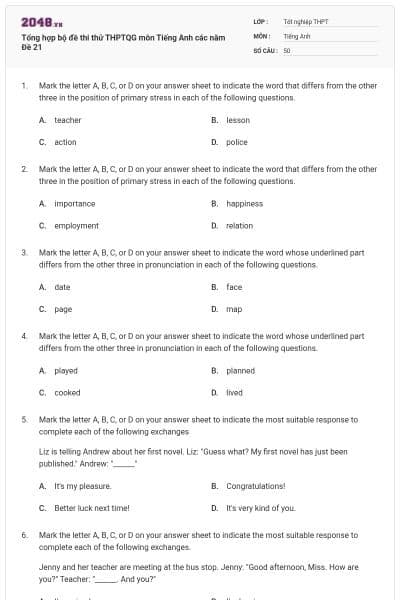
Mark the letter A, B, C, or D on your answer sheet to indicate the word that differs from the other three in the position of primary stress in each of the following questions.
teacher
lesson
action
police
D. police /pə'liːs/ có trọng âm ở vần thứ hai, còn 3 từ kia là ở vần thứ nhất. Nếu không hiểu kí hiệu phiên âm, xem http://bit.ly/phienamquocte. Rất quan trọng!
Mark the letter A, B, C, or D on your answer sheet to indicate the word that differs from the other three in the position of primary stress in each of the following questions.
importance
happiness
employment
relation
B. happiness có trọng âm ở vần thứ nhất, còn 3 từ kia là ở vần thứ hai.
Mark the letter A, B, C, or D on your answer sheet to indicate the word whose underlined part differs from the other three in pronunciation in each of the following questions.
date
face
page
map
Mark the letter A, B, C, or D on your answer sheet to indicate the word whose underlined part differs from the other three in pronunciation in each of the following questions.
played
planned
cooked
lived
C. ed trong cooked đọc là /t/: /kʊkt/ còn 3 âm kia thì ed đọc là /d/. Cách phân biệt
Mark the letter A, B, C, or D on your answer sheet to indicate the most suitable response to complete each of the following exchanges
Liz is telling Andrew about her first novel. Liz: "Guess what? My first novel has just been published." Andrew: "______"
It's my pleasure.
Congratulations!
Better luck next time!
It's very kind of you.
B. Andrew chúc mừng Liz có tiểu thuyết vừa được xuất bản.
Mark the letter A, B, C, or D on your answer sheet to indicate the most suitable response to complete each of the following exchanges.
Jenny and her teacher are meeting at the bus stop. Jenny: "Good afternoon, Miss. How are you?" Teacher: "______. And you?"
I'm going home
I'm leaving now
I'm thirty years old
Fine, thank you
D. Teacher đáp lại lời hỏi thăm "Cô có khỏe không?"
Mark the letter A, B, C, or D on your answer sheet to indicate the word(s) OPPOSITE in meaning to the underlined word(s) in each of the following questions.
As a sociable boy, Jack enjoys spending his free time going out with friends.
mischievous
outgoing
caring
shy
D. sociable (hòa đồng, thích giao thiệp) ≠ shy (nhút nhát)
Mark the letter A, B, C, or D on your answer sheet to indicate the word(s) OPPOSITE in meaning to the underlined word(s) in each of the following questions.
It's not a pleasant feeling to discover you've been taken for a ride by a close friend.
driven away
deceived deliberately
given a lift
treated with sincerity
D. take somebody for a ride (lừa lọc, chơi xỏ ai) ≠ treat with sincerity (đối xử chân thành)
Mark the letter A, B, C, or D on your answer sheet to indicate the word(s) CLOSEST in meaning to the underlined word(s) in each of the following questions.
Heavy rain makes driving on the road very difficult
hard
easy
interesting
simple
A. → Mưa lớn khiến việc lái xe trên đường rất khó khăn.
Mark the letter A, B, C, or D on your answer sheet to indicate the word(s) CLOSEST in meaning to the underlined word(s) in each of the following questions.
A series of programs have been broadcast to raise public awareness of healthy living.
experience
understanding
confidence
assistance
B. → ... để nâng cao nhận thức của công chúng về lối sống lành mạnh.
It is not always easy to make a good ______ at the last minute.
decide
decision
decisive
decisively
B. → ... đưa ra quyết định đúng đắn vào phút chót.3 từ kia không phải danh từ. Cho nên học từ nào phải biết từ loại của nó.
Mr Brown has kindly agreed to spare us some of his ______ time to answer our questions
valuable
worthy
costly
beneficial
A. → ... thời gian quí báu của anh ấy...
More and more investors are pouring ______ money into food and beverage start-ups.
an
the
Ø
a
C. money ở đây là tiền bạc nói chung. Xem http://bit.ly/_maotu
A survey was ______ to study the effects of smoking on young adults.
commented
filled
conducted
carried
C. → Một cuộc khảo sát được thực hiện...Học một từ phải học cả các từ ngữ kết hợp với nó.
The better the weather is, ______.
the most crowded the beaches get
the most the beaches get crowded
the more crowded the beaches get
the more the beaches get crowded
C. → Thời tiết càng đẹp thì bãi biển càng đông người.
The book ______ you gave me is very interesting.
when
which
who
where
B. The book là vật.
The ______ of the Internet has played an important part in the development of communication.
research
occurrence
invention
display
C. → Sự ra đời (sáng chế) của mạng Internet..
When the manager of our company retires, the deputy manager will ______ that position.
stand for
take over
catch on
hold on
Đáp án: B
Giải thích:
Kiến thức: Cụm động từ
A. stand for: đại diện cho, là viết tắt của
B. take over: chiếm lấy, đảm nhiệm thay, tiếp quản
C. catch on: trở nên phổ biến
D. hold on: chờ
Dựa vào nghĩa, chọn B.
Dịch: Khi giám đốc công ty chúng tôi nghỉ hưu, phó giám đốc sẽ tiếp quản vị trí đó.
I ______ my old school teacher last week.
visited
visit
am visiting
have visited
A. last week chỉ rõ một thời điểm đã qua.
Paul has just sold his ______ car and intends to buy a new one.
black old Japanese
Japanese old black
old black Japanese
old Japanese black
C. Vị trí các tính từ.
You ______ use your mobile phone during the test. It's against the rules.
mightn't
mustn't
oughtn't
needn't
Đáp án B
Mustn’t: không được phép
Dịch: Bạn không được phép sử dụng điện thoại trong suốt kì thi. Như thế là phạm luật
A university degree is considered to be a ______ for entry into most professions.
demand
requisite
claim
request
Đáp án: B
Giải thích:
Kiến thức: Từ vựng
A. demand (n): nhu cầu
B. requisite (n): điều kiện tiên quyết
C. claim (n): yêu cầu bồi thường, lời thỉnh cầu
D. request (n): yêu cầu
Dựa vào nghĩa câu, B phù hợp nhất.
Dịch: Bằng đại học được coi là điều kiện tiên quyết để bước vào hầu hết các ngành nghề.
Read the following passage and mark the letter A, B, C, or D on your answer sheet to indicate thecorrect word or phrase that best fits each of the numbered blanks from 23 to 27.
In the early twentieth century, an American woman named Emily Post wrote a book on etiquette. This book explained the proper behavior Americans should follow in many different social (23)______, from birthday parties to funerals. But in modern society, it is not simply to know the proper rules for behavior in your own country. It is necessary for people (24)______ work or travel abroad to understand the rules of etiquette in other cultures as well. Cultural (25)______ can be found in such simple processes as giving or receiving a gift. In Western cultures, a gift can be given to the receiver with relatively little ceremony. When a gift is offered, the receiver usually takes the gift and expresses his or her thanks. (26)______, in some Asian countries, the act of gift-giving may appear confusing to Westerners. In Chinese culture, both the giver and receiver understand that the receiver will typically refuse to take the gift several times before he or she finally accepts it. In addition, to (27)______ respect for the receiver, it is common in several Asian cultures to use both hands when offering a gift to another person.
Điền vào ô 23.
positions
conditions
situations
locations
C. → ... cách ứng xử đúng mà Người Mĩ nên tuân theo trong nhiều tình huống giao thiệp.
Read the following passage and mark the letter A, B, C, or D on your answer sheet to indicate thecorrect word or phrase that best fits each of the numbered blanks from 23 to 27.
In the early twentieth century, an American woman named Emily Post wrote a book on etiquette. This book explained the proper behavior Americans should follow in many different social (23)______, from birthday parties to funerals. But in modern society, it is not simply to know the proper rules for behavior in your own country. It is necessary for people (24)______ work or travel abroad to understand the rules of etiquette in other cultures as well. Cultural (25)______ can be found in such simple processes as giving or receiving a gift. In Western cultures, a gift can be given to the receiver with relatively little ceremony. When a gift is offered, the receiver usually takes the gift and expresses his or her thanks. (26)______, in some Asian countries, the act of gift-giving may appear confusing to Westerners. In Chinese culture, both the giver and receiver understand that the receiver will typically refuse to take the gift several times before he or she finally accepts it. In addition, to (27)______ respect for the receiver, it is common in several Asian cultures to use both hands when offering a gift to another person.
Điền vào ô 24.
who
which
where
whose
A. → ... những người làm việc hoặc du lịch nước ngoài...
Read the following passage and mark the letter A, B, C, or D on your answer sheet to indicate thecorrect word or phrase that best fits each of the numbered blanks from 23 to 27.
In the early twentieth century, an American woman named Emily Post wrote a book on etiquette. This book explained the proper behavior Americans should follow in many different social (23)______, from birthday parties to funerals. But in modern society, it is not simply to know the proper rules for behavior in your own country. It is necessary for people (24)______ work or travel abroad to understand the rules of etiquette in other cultures as well. Cultural (25)______ can be found in such simple processes as giving or receiving a gift. In Western cultures, a gift can be given to the receiver with relatively little ceremony. When a gift is offered, the receiver usually takes the gift and expresses his or her thanks. (26)______, in some Asian countries, the act of gift-giving may appear confusing to Westerners. In Chinese culture, both the giver and receiver understand that the receiver will typically refuse to take the gift several times before he or she finally accepts it. In addition, to (27)______ respect for the receiver, it is common in several Asian cultures to use both hands when offering a gift to another person.
Điền vào ô 25.
differences
different
differently
differ
A. → Những khác biệt về văn hóa...Chỉ có A là danh từ.
Read the following passage and mark the letter A, B, C, or D on your answer sheet to indicate thecorrect word or phrase that best fits each of the numbered blanks from 23 to 27.
In the early twentieth century, an American woman named Emily Post wrote a book on etiquette. This book explained the proper behavior Americans should follow in many different social (23)______, from birthday parties to funerals. But in modern society, it is not simply to know the proper rules for behavior in your own country. It is necessary for people (24)______ work or travel abroad to understand the rules of etiquette in other cultures as well. Cultural (25)______ can be found in such simple processes as giving or receiving a gift. In Western cultures, a gift can be given to the receiver with relatively little ceremony. When a gift is offered, the receiver usually takes the gift and expresses his or her thanks. (26)______, in some Asian countries, the act of gift-giving may appear confusing to Westerners. In Chinese culture, both the giver and receiver understand that the receiver will typically refuse to take the gift several times before he or she finally accepts it. In addition, to (27)______ respect for the receiver, it is common in several Asian cultures to use both hands when offering a gift to another person.
Điền vào ô 26.
Moreover
Therefore
However
Otherwise
C. → Khi được tặng quà, người ta thường nhận quà và cảm ơn. Tuy nhiên, ở một số nước Châu Á,...
Read the following passage and mark the letter A, B, C, or D on your answer sheet to indicate thecorrect word or phrase that best fits each of the numbered blanks from 23 to 27.
In the early twentieth century, an American woman named Emily Post wrote a book on etiquette. This book explained the proper behavior Americans should follow in many different social (23)______, from birthday parties to funerals. But in modern society, it is not simply to know the proper rules for behavior in your own country. It is necessary for people (24)______ work or travel abroad to understand the rules of etiquette in other cultures as well. Cultural (25)______ can be found in such simple processes as giving or receiving a gift. In Western cultures, a gift can be given to the receiver with relatively little ceremony. When a gift is offered, the receiver usually takes the gift and expresses his or her thanks. (26)______, in some Asian countries, the act of gift-giving may appear confusing to Westerners. In Chinese culture, both the giver and receiver understand that the receiver will typically refuse to take the gift several times before he or she finally accepts it. In addition, to (27)______ respect for the receiver, it is common in several Asian cultures to use both hands when offering a gift to another person.
Điền vào ô 27.
show
get
feel
take
A. → Ngoài ra, để thể hiện sự tôn trọng...
Read the following passage and mark the letter A, B, C, or D on your answer sheet to indicate the
correct answer to each of the questions from 28 to 34.
Different cultures follow their own special customs when a child's baby teeth fall out. In Korea, for example, they have the custom of throwing lost teeth up on the roof of a house. According to tradition, a magpie will come and take the tooth. Later, the magpie will return with a new tooth for the child.
In other Asian countries, such as Japan and Vietnam, children follow a similar tradition of throwing their lost teeth onto the roofs of houses. Birds aren't the only animals thought to take lost teeth. In Mexico and Spain, tradition says a mouse takes a lost tooth and leaves some money. However, in Mongolia, dogs are responsible for taking teeth away. Dogs are highly respected in Mongolian culture and are considered guardian angels of the people. Tradition says that the new tooth will grow good and strong if the baby tooth is fed to a guardian angel. Accordingly, parents in Mongolia will put their child's lost tooth in a piece of meat and feed it to a dog. The idea of giving lost teeth to an angel or fairy is also a tradition in the West. Many children in Western countries count on the Tooth Fairy to leave money or presents in exchange for a tooth. The exact origins of the Tooth Fairy are a mystery, although the story probably began in England or Ireland centuries ago. According to tradition, a child puts a lost tooth under his or her pillow before going to bed. In the wee hours, while the child is sleeping, the Tooth Fairy takes the tooth and leaves something else under the pillow. In France, the Tooth Fairy leaves a small gift. In the United States, however, the Tooth Fairy usually leaves money. These days, the rate is $1 to $5 per tooth, adding up to a lot of money from the Tooth Fairy!
What is the passage mainly about?
Traditions concerning children's lost teeth
Presents for young children's lost teeth
Animals eating children's lost teeth
Customs concerning children's new teeth
A. Đoạn văn đầu tiên
Read the following passage and mark the letter A, B, C, or D on your answer sheet to indicate the correct answer to each of the questions from 28 to 34.
Different cultures follow their own special customs when a child's baby teeth fall out.
In Korea, for example, they have the custom of throwing lost teeth up on the roof of a house. According to tradition, a magpie will come and take the tooth. Later, the magpie will return with a new tooth for the child. In other Asian countries, such as Japan and Vietnam, children follow a similar tradition of throwing their lost teeth onto the roofs of houses. Birds aren't the only animals thought to take lost teeth. In Mexico and Spain, tradition says a mouse takes a lost tooth and leaves some money. However, in Mongolia, dogs are responsible for taking teeth away. Dogs are highly respected in Mongolian culture and are considered guardian angels of the people. Tradition says that the new tooth will grow good and strong if the baby tooth is fed to a guardian angel. Accordingly, parents in Mongolia will put their child's lost tooth in a piece of meat and feed it to a dog. The idea of giving lost teeth to an angel or fairy is also a tradition in the West. Many children in Western countries count on the Tooth Fairy to leave money or presents in exchange for a tooth. The exact origins of the Tooth Fairy are a mystery, although the story probably began in England or Ireland centuries ago. According to tradition, a child puts a lost tooth under his or her pillow before going to bed. In the wee hours, while the child is sleeping, the Tooth Fairy takes the tooth and leaves something else under the pillow. In France, the Tooth Fairy leaves a small gift. In the United States, however, the Tooth Fairy usually leaves money. These days, the rate is $1 to $5 per tooth, adding up to a lot of money from the Tooth Fairy!
The word "their" in paragraph 1 refers to ______.
houses'
roofs'
children's
countries'
Đáp án C.
Read the following passage and mark the letter A, B, C, or D on your answer sheet to indicate the correct answer to each of the questions from 28 to 34.
Different cultures follow their own special customs when a child's baby teeth fall out.
In Korea, for example, they have the custom of throwing lost teeth up on the roof of a house. According to tradition, a magpie will come and take the tooth. Later, the magpie will return with a new tooth for the child. In other Asian countries, such as Japan and Vietnam, children follow a similar tradition of throwing their lost teeth onto the roofs of houses. Birds aren't the only animals thought to take lost teeth. In Mexico and Spain, tradition says a mouse takes a lost tooth and leaves some money. However, in Mongolia, dogs are responsible for taking teeth away. Dogs are highly respected in Mongolian culture and are considered guardian angels of the people. Tradition says that the new tooth will grow good and strong if the baby tooth is fed to a guardian angel. Accordingly, parents in Mongolia will put their child's lost tooth in a piece of meat and feed it to a dog. The idea of giving lost teeth to an angel or fairy is also a tradition in the West. Many children in Western countries count on the Tooth Fairy to leave money or presents in exchange for a tooth. The exact origins of the Tooth Fairy are a mystery, although the story probably began in England or Ireland centuries ago. According to tradition, a child puts a lost tooth under his or her pillow before going to bed. In the wee hours, while the child is sleeping, the Tooth Fairy takes the tooth and leaves something else under the pillow. In France, the Tooth Fairy leaves a small gift. In the United States, however, the Tooth Fairy usually leaves money. These days, the rate is $1 to $5 per tooth, adding up to a lot of money from the Tooth Fairy!
According to the passage, where is a child's lost tooth thought to be taken away by a mouse?
In Mexico and Spain
In Mongolia
In Japan and Vietnam
In Korea
A. Đoạn 2, câu 2
Read the following passage and mark the letter A, B, C, or D on your answer sheet to indicate the correct answer to each of the questions from 28 to 34.
Different cultures follow their own special customs when a child's baby teeth fall out.
In Korea, for example, they have the custom of throwing lost teeth up on the roof of a house. According to tradition, a magpie will come and take the tooth. Later, the magpie will return with a new tooth for the child. In other Asian countries, such as Japan and Vietnam, children follow a similar tradition of throwing their lost teeth onto the roofs of houses. Birds aren't the only animals thought to take lost teeth. In Mexico and Spain, tradition says a mouse takes a lost tooth and leaves some money. However, in Mongolia, dogs are responsible for taking teeth away. Dogs are highly respected in Mongolian culture and are considered guardian angels of the people. Tradition says that the new tooth will grow good and strong if the baby tooth is fed to a guardian angel. Accordingly, parents in Mongolia will put their child's lost tooth in a piece of meat and feed it to a dog. The idea of giving lost teeth to an angel or fairy is also a tradition in the West. Many children in Western countries count on the Tooth Fairy to leave money or presents in exchange for a tooth. The exact origins of the Tooth Fairy are a mystery, although the story probably began in England or Ireland centuries ago. According to tradition, a child puts a lost tooth under his or her pillow before going to bed. In the wee hours, while the child is sleeping, the Tooth Fairy takes the tooth and leaves something else under the pillow. In France, the Tooth Fairy leaves a small gift. In the United States, however, the Tooth Fairy usually leaves money. These days, the rate is $1 to $5 per tooth, adding up to a lot of money from the Tooth Fairy!
According to paragraph 2, parents in Mongolia feed their child's lost tooth to a dog because ______.
they know that dogs are very responsible animals
they believe that this will make their child's new tooth good and strong
they think dogs like eating children's teeth
they hope that their child will get some gifts for his or her tooth
B. Đoạn 2, câu 4-6
Read the following passage and mark the letter A, B, C, or D on your answer sheet to indicate the correct answer to each of the questions from 28 to 34.
Different cultures follow their own special customs when a child's baby teeth fall out.
In Korea, for example, they have the custom of throwing lost teeth up on the roof of a house. According to tradition, a magpie will come and take the tooth. Later, the magpie will return with a new tooth for the child. In other Asian countries, such as Japan and Vietnam, children follow a similar tradition of throwing their lost teeth onto the roofs of houses. Birds aren't the only animals thought to take lost teeth. In Mexico and Spain, tradition says a mouse takes a lost tooth and leaves some money. However, in Mongolia, dogs are responsible for taking teeth away. Dogs are highly respected in Mongolian culture and are considered guardian angels of the people. Tradition says that the new tooth will grow good and strong if the baby tooth is fed to a guardian angel. Accordingly, parents in Mongolia will put their child's lost tooth in a piece of meat and feed it to a dog. The idea of giving lost teeth to an angel or fairy is also a tradition in the West. Many children in Western countries count on the Tooth Fairy to leave money or presents in exchange for a tooth. The exact origins of the Tooth Fairy are a mystery, although the story probably began in England or Ireland centuries ago. According to tradition, a child puts a lost tooth under his or her pillow before going to bed. In the wee hours, while the child is sleeping, the Tooth Fairy takes the tooth and leaves something else under the pillow. In France, the Tooth Fairy leaves a small gift. In the United States, however, the Tooth Fairy usually leaves money. These days, the rate is $1 to $5 per tooth, adding up to a lot of money from the Tooth Fairy!
The word "origins" in paragraph 3 is closest in meaning to ______.
countries
families
beginnings
stories
C. → Nguồn gốc chính xác của...
Read the following passage and mark the letter A, B, C, or D on your answer sheet to indicate the correct answer to each of the questions from 28 to 34.
Different cultures follow their own special customs when a child's baby teeth fall out.
In Korea, for example, they have the custom of throwing lost teeth up on the roof of a house. According to tradition, a magpie will come and take the tooth. Later, the magpie will return with a new tooth for the child. In other Asian countries, such as Japan and Vietnam, children follow a similar tradition of throwing their lost teeth onto the roofs of houses. Birds aren't the only animals thought to take lost teeth. In Mexico and Spain, tradition says a mouse takes a lost tooth and leaves some money. However, in Mongolia, dogs are responsible for taking teeth away. Dogs are highly respected in Mongolian culture and are considered guardian angels of the people. Tradition says that the new tooth will grow good and strong if the baby tooth is fed to a guardian angel. Accordingly, parents in Mongolia will put their child's lost tooth in a piece of meat and feed it to a dog. The idea of giving lost teeth to an angel or fairy is also a tradition in the West. Many children in Western countries count on the Tooth Fairy to leave money or presents in exchange for a tooth. The exact origins of the Tooth Fairy are a mystery, although the story probably began in England or Ireland centuries ago. According to tradition, a child puts a lost tooth under his or her pillow before going to bed. In the wee hours, while the child is sleeping, the Tooth Fairy takes the tooth and leaves something else under the pillow. In France, the Tooth Fairy leaves a small gift. In the United States, however, the Tooth Fairy usually leaves money. These days, the rate is $1 to $5 per tooth, adding up to a lot of money from the Tooth Fairy!
According to the passage, which of the following is NOT true about the tradition of tooth giving in the West?
Children give money to the Tooth Fairy.
Children put their lost teeth under their pillows.
Children hope to get money or gifts from the Tooth Fairy.
Lost teeth are traditionally given to an angel or fairy.
A. Trong đoạn cuối, B có nói đến trong câu 4, C trong câu 2, D trong câu 1. Chỉ có A là không thấy nhắc đến.
Read the following passage and mark the letter A, B, C, or D on your answer sheet to indicate the correct answer to each of the questions from 28 to 34.
Different cultures follow their own special customs when a child's baby teeth fall out.
In Korea, for example, they have the custom of throwing lost teeth up on the roof of a house. According to tradition, a magpie will come and take the tooth. Later, the magpie will return with a new tooth for the child. In other Asian countries, such as Japan and Vietnam, children follow a similar tradition of throwing their lost teeth onto the roofs of houses. Birds aren't the only animals thought to take lost teeth. In Mexico and Spain, tradition says a mouse takes a lost tooth and leaves some money. However, in Mongolia, dogs are responsible for taking teeth away. Dogs are highly respected in Mongolian culture and are considered guardian angels of the people. Tradition says that the new tooth will grow good and strong if the baby tooth is fed to a guardian angel. Accordingly, parents in Mongolia will put their child's lost tooth in a piece of meat and feed it to a dog. The idea of giving lost teeth to an angel or fairy is also a tradition in the West. Many children in Western countries count on the Tooth Fairy to leave money or presents in exchange for a tooth. The exact origins of the Tooth Fairy are a mystery, although the story probably began in England or Ireland centuries ago. According to tradition, a child puts a lost tooth under his or her pillow before going to bed. In the wee hours, while the child is sleeping, the Tooth Fairy takes the tooth and leaves something else under the pillow. In France, the Tooth Fairy leaves a small gift. In the United States, however, the Tooth Fairy usually leaves money. These days, the rate is $1 to $5 per tooth, adding up to a lot of money from the Tooth Fairy!
The phrase "the wee hours" in paragraph 3 probably refers to the period of time ______.
early in the evening
soon after midnight
late in the morning
long before bedtime
B. → Qua nửa đêm, trong lúc đứa trẻ đang ngủ, ...
Read the following passage and mark the letter A, B, C, or D on your answer sheet to indicate the correct answer to each of the questions from 35 to 42.
Earth is richly supplied with different types of living organisms which co-exist in their environments, forming complex, interrelated communities. Living organisms depend on one another for nutrients, shelter, and other benefits. The extinction of one species can set off a chain reaction that affects many other species, particularly if the loss occurs near the bottom of the food chain. For example, the extinction of a particular insect or plant might seem inconsequential. However, there may be fish or small animals that depend on that resource for foodstuffs. The loss can threaten the survival of these creatures and larger predators that prey upon them. Extinction can have a ripple effect that spreads throughout nature. In addition to its biological consequences, extinction poses a moral dilemma for humans, the only species capable of saving the others. The presence of humans on the planet has affected all other life forms, particularly plants and animals. Human lifestyles have proven to be incompatible with the survival of some other species. Purposeful efforts have been made to eliminate animals that prey on people, livestock, crops, or pose any threat to human livelihoods. Some wild animals have been decimated by human desire for meat, hides, fur, or other body parts with commercial value. Likewise, demand for land, water, and other natural resources has left many wild plants and animals with little to no suitable habitat. Humans have also affected nature by introducing non-native species to local areas and producing pollutants having a negative impact on the environment. The combination of these human-related effects and natural obstacles such as disease or low birthrates has proven to be too much for some species to overcome. They have no chance of survival without human help. As a result, societies have difficult choices to make about the amount of effort and money they are willing to spend to save imperiled species. Will people accept limits on their property rights, recreational activities, and means of livelihood to save a plant or an animal? Should saving such popular species as whales and dolphins take priority over saving obscure, annoying, or fearful species? Is it the responsibility of humans to save every kind of life form from disappearing, or is extinction an inevitable part of nature, in which the strong survive and the weak perish? These are some difficult questions that people face as they ponder the fate of other species living on this planet.
What does the passage mainly discuss?
The importance of living organisms
Causes of animal extinction
Humans and endangered species
Measures to protect endangered species
A. Đoạn 1, nhất là câu cuối. (Đáp án của Bộ là C nhưng có lẽ là nhầm lẫn, vì trong bài chẳng đề cập gì đến "Endangered Species" cả.)
Read the following passage and mark the letter A, B, C, or D on your answer sheet to indicate the correct answer to each of the questions from 35 to 42.
Earth is richly supplied with different types of living organisms which co-exist in their environments, forming complex, interrelated communities. Living organisms depend on one another for nutrients, shelter, and other benefits. The extinction of one species can set off a chain reaction that affects many other species, particularly if the loss occurs near the bottom of the food chain. For example, the extinction of a particular insect or plant might seem inconsequential. However, there may be fish or small animals that depend on that resource for foodstuffs. The loss can threaten the survival of these creatures and larger predators that prey upon them. Extinction can have a ripple effect that spreads throughout nature. In addition to its biological consequences, extinction poses a moral dilemma for humans, the only species capable of saving the others. The presence of humans on the planet has affected all other life forms, particularly plants and animals. Human lifestyles have proven to be incompatible with the survival of some other species. Purposeful efforts have been made to eliminate animals that prey on people, livestock, crops, or pose any threat to human livelihoods. Some wild animals have been decimated by human desire for meat, hides, fur, or other body parts with commercial value. Likewise, demand for land, water, and other natural resources has left many wild plants and animals with little to no suitable habitat. Humans have also affected nature by introducing non-native species to local areas and producing pollutants having a negative impact on the environment. The combination of these human-related effects and natural obstacles such as disease or low birthrates has proven to be too much for some species to overcome. They have no chance of survival without human help. As a result, societies have difficult choices to make about the amount of effort and money they are willing to spend to save imperiled species. Will people accept limits on their property rights, recreational activities, and means of livelihood to save a plant or an animal? Should saving such popular species as whales and dolphins take priority over saving obscure, annoying, or fearful species? Is it the responsibility of humans to save every kind of life form from disappearing, or is extinction an inevitable part of nature, in which the strong survive and the weak perish? These are some difficult questions that people face as they ponder the fate of other species living on this planet.
The word "inconsequential" in paragraph 1 is closest in meaning to ______.
unimportant
unavoidable
unexpected
unrecognizable
A. → ... sự tuyệt chủng một loài côn trùng hoặc thực vật nhìn bề ngoài có vẻ không quan trọng.
Read the following passage and mark the letter A, B, C, or D on your answer sheet to indicate the correct answer to each of the questions from 35 to 42.
Earth is richly supplied with different types of living organisms which co-exist in their environments, forming complex, interrelated communities. Living organisms depend on one another for nutrients, shelter, and other benefits. The extinction of one species can set off a chain reaction that affects many other species, particularly if the loss occurs near the bottom of the food chain. For example, the extinction of a particular insect or plant might seem inconsequential. However, there may be fish or small animals that depend on that resource for foodstuffs. The loss can threaten the survival of these creatures and larger predators that prey upon them. Extinction can have a ripple effect that spreads throughout nature. In addition to its biological consequences, extinction poses a moral dilemma for humans, the only species capable of saving the others. The presence of humans on the planet has affected all other life forms, particularly plants and animals. Human lifestyles have proven to be incompatible with the survival of some other species. Purposeful efforts have been made to eliminate animals that prey on people, livestock, crops, or pose any threat to human livelihoods. Some wild animals have been decimated by human desire for meat, hides, fur, or other body parts with commercial value. Likewise, demand for land, water, and other natural resources has left many wild plants and animals with little to no suitable habitat. Humans have also affected nature by introducing non-native species to local areas and producing pollutants having a negative impact on the environment. The combination of these human-related effects and natural obstacles such as disease or low birthrates has proven to be too much for some species to overcome. They have no chance of survival without human help. As a result, societies have difficult choices to make about the amount of effort and money they are willing to spend to save imperiled species. Will people accept limits on their property rights, recreational activities, and means of livelihood to save a plant or an animal? Should saving such popular species as whales and dolphins take priority over saving obscure, annoying, or fearful species? Is it the responsibility of humans to save every kind of life form from disappearing, or is extinction an inevitable part of nature, in which the strong survive and the weak perish? These are some difficult questions that people face as they ponder the fate of other species living on this planet.
Which of the following can result from the loss of one species in a food chain?
There might be a lack of food resources for some other species.
Animals will shift to another food chain in the community.
Larger predators will look for other types of prey.
The connections among the creatures in the food chain become closer.
A. Đoạn 1, câu 3-6
Read the following passage and mark the letter A, B, C, or D on your answer sheet to indicate the correct answer to each of the questions from 35 to 42.
Earth is richly supplied with different types of living organisms which co-exist in their environments, forming complex, interrelated communities. Living organisms depend on one another for nutrients, shelter, and other benefits. The extinction of one species can set off a chain reaction that affects many other species, particularly if the loss occurs near the bottom of the food chain. For example, the extinction of a particular insect or plant might seem inconsequential. However, there may be fish or small animals that depend on that resource for foodstuffs. The loss can threaten the survival of these creatures and larger predators that prey upon them. Extinction can have a ripple effect that spreads throughout nature. In addition to its biological consequences, extinction poses a moral dilemma for humans, the only species capable of saving the others. The presence of humans on the planet has affected all other life forms, particularly plants and animals. Human lifestyles have proven to be incompatible with the survival of some other species. Purposeful efforts have been made to eliminate animals that prey on people, livestock, crops, or pose any threat to human livelihoods. Some wild animals have been decimated by human desire for meat, hides, fur, or other body parts with commercial value. Likewise, demand for land, water, and other natural resources has left many wild plants and animals with little to no suitable habitat. Humans have also affected nature by introducing non-native species to local areas and producing pollutants having a negative impact on the environment. The combination of these human-related effects and natural obstacles such as disease or low birthrates has proven to be too much for some species to overcome. They have no chance of survival without human help. As a result, societies have difficult choices to make about the amount of effort and money they are willing to spend to save imperiled species. Will people accept limits on their property rights, recreational activities, and means of livelihood to save a plant or an animal? Should saving such popular species as whales and dolphins take priority over saving obscure, annoying, or fearful species? Is it the responsibility of humans to save every kind of life form from disappearing, or is extinction an inevitable part of nature, in which the strong survive and the weak perish? These are some difficult questions that people face as they ponder the fate of other species living on this planet.
The word "They" in paragraph 2 refers to ______.
natural obstacles
low birthrates
some species
human-related effects
Đáp án C.
Read the following passage and mark the letter A, B, C, or D on your answer sheet to indicate the correct answer to each of the questions from 35 to 42.
Earth is richly supplied with different types of living organisms which co-exist in their environments, forming complex, interrelated communities. Living organisms depend on one another for nutrients, shelter, and other benefits. The extinction of one species can set off a chain reaction that affects many other species, particularly if the loss occurs near the bottom of the food chain. For example, the extinction of a particular insect or plant might seem inconsequential. However, there may be fish or small animals that depend on that resource for foodstuffs. The loss can threaten the survival of these creatures and larger predators that prey upon them. Extinction can have a ripple effect that spreads throughout nature. In addition to its biological consequences, extinction poses a moral dilemma for humans, the only species capable of saving the others. The presence of humans on the planet has affected all other life forms, particularly plants and animals. Human lifestyles have proven to be incompatible with the survival of some other species. Purposeful efforts have been made to eliminate animals that prey on people, livestock, crops, or pose any threat to human livelihoods. Some wild animals have been decimated by human desire for meat, hides, fur, or other body parts with commercial value. Likewise, demand for land, water, and other natural resources has left many wild plants and animals with little to no suitable habitat. Humans have also affected nature by introducing non-native species to local areas and producing pollutants having a negative impact on the environment. The combination of these human-related effects and natural obstacles such as disease or low birthrates has proven to be too much for some species to overcome. They have no chance of survival without human help. As a result, societies have difficult choices to make about the amount of effort and money they are willing to spend to save imperiled species. Will people accept limits on their property rights, recreational activities, and means of livelihood to save a plant or an animal? Should saving such popular species as whales and dolphins take priority over saving obscure, annoying, or fearful species? Is it the responsibility of humans to save every kind of life form from disappearing, or is extinction an inevitable part of nature, in which the strong survive and the weak perish? These are some difficult questions that people face as they ponder the fate of other species living on this planet.
In paragraph 2, non-native species are mentioned as ______.
an achievement of human beings
a harmful factor to the environment
a kind of useful plants
a kind of harmless animals
B. Đoạn 2, câu 7
Read the following passage and mark the letter A, B, C, or D on your answer sheet to indicate the correct answer to each of the questions from 35 to 42.
Earth is richly supplied with different types of living organisms which co-exist in their environments, forming complex, interrelated communities. Living organisms depend on one another for nutrients, shelter, and other benefits. The extinction of one species can set off a chain reaction that affects many other species, particularly if the loss occurs near the bottom of the food chain. For example, the extinction of a particular insect or plant might seem inconsequential. However, there may be fish or small animals that depend on that resource for foodstuffs. The loss can threaten the survival of these creatures and larger predators that prey upon them. Extinction can have a ripple effect that spreads throughout nature. In addition to its biological consequences, extinction poses a moral dilemma for humans, the only species capable of saving the others. The presence of humans on the planet has affected all other life forms, particularly plants and animals. Human lifestyles have proven to be incompatible with the survival of some other species. Purposeful efforts have been made to eliminate animals that prey on people, livestock, crops, or pose any threat to human livelihoods. Some wild animals have been decimated by human desire for meat, hides, fur, or other body parts with commercial value. Likewise, demand for land, water, and other natural resources has left many wild plants and animals with little to no suitable habitat. Humans have also affected nature by introducing non-native species to local areas and producing pollutants having a negative impact on the environment. The combination of these human-related effects and natural obstacles such as disease or low birthrates has proven to be too much for some species to overcome. They have no chance of survival without human help. As a result, societies have difficult choices to make about the amount of effort and money they are willing to spend to save imperiled species. Will people accept limits on their property rights, recreational activities, and means of livelihood to save a plant or an animal? Should saving such popular species as whales and dolphins take priority over saving obscure, annoying, or fearful species? Is it the responsibility of humans to save every kind of life form from disappearing, or is extinction an inevitable part of nature, in which the strong survive and the weak perish? These are some difficult questions that people face as they ponder the fate of other species living on this planet.
The word "perish" in paragraph 3 is closest in meaning to ______
disappear
complete
remain
develop
A. → ... kẻ mạnh thì tồn tại còn kẻ yếu thì bị diệt vong.
Read the following passage and mark the letter A, B, C, or D on your answer sheet to indicate the correct answer to each of the questions from 35 to 42.
Earth is richly supplied with different types of living organisms which co-exist in their environments, forming complex, interrelated communities. Living organisms depend on one another for nutrients, shelter, and other benefits. The extinction of one species can set off a chain reaction that affects many other species, particularly if the loss occurs near the bottom of the food chain. For example, the extinction of a particular insect or plant might seem inconsequential. However, there may be fish or small animals that depend on that resource for foodstuffs. The loss can threaten the survival of these creatures and larger predators that prey upon them. Extinction can have a ripple effect that spreads throughout nature. In addition to its biological consequences, extinction poses a moral dilemma for humans, the only species capable of saving the others. The presence of humans on the planet has affected all other life forms, particularly plants and animals. Human lifestyles have proven to be incompatible with the survival of some other species. Purposeful efforts have been made to eliminate animals that prey on people, livestock, crops, or pose any threat to human livelihoods. Some wild animals have been decimated by human desire for meat, hides, fur, or other body parts with commercial value. Likewise, demand for land, water, and other natural resources has left many wild plants and animals with little to no suitable habitat. Humans have also affected nature by introducing non-native species to local areas and producing pollutants having a negative impact on the environment. The combination of these human-related effects and natural obstacles such as disease or low birthrates has proven to be too much for some species to overcome. They have no chance of survival without human help. As a result, societies have difficult choices to make about the amount of effort and money they are willing to spend to save imperiled species. Will people accept limits on their property rights, recreational activities, and means of livelihood to save a plant or an animal? Should saving such popular species as whales and dolphins take priority over saving obscure, annoying, or fearful species? Is it the responsibility of humans to save every kind of life form from disappearing, or is extinction an inevitable part of nature, in which the strong survive and the weak perish? These are some difficult questions that people face as they ponder the fate of other species living on this planet.
According to the passage, which of the following statements is NOT true?
Some animals and plants cannot survive without human help.
No other species can threaten the survival of humans on Earth.
The existence of humans is at the expense of some other species.
Humans have difficult choices to make about saving endangered species.
Đáp án B.
A đúng do câu cuối của đoạn 2;
C đúng do câu 2-3, đoạn 2;
D đúng do câu đầu, đoạn 3.
Vả lại, B không đúng vì trái ngược với câu 4, đoạn 2.
Read the following passage and mark the letter A, B, C, or D on your answer sheet to indicate the correct answer to each of the questions from 35 to 42.
Earth is richly supplied with different types of living organisms which co-exist in their environments, forming complex, interrelated communities. Living organisms depend on one another for nutrients, shelter, and other benefits. The extinction of one species can set off a chain reaction that affects many other species, particularly if the loss occurs near the bottom of the food chain. For example, the extinction of a particular insect or plant might seem inconsequential. However, there may be fish or small animals that depend on that resource for foodstuffs. The loss can threaten the survival of these creatures and larger predators that prey upon them. Extinction can have a ripple effect that spreads throughout nature. In addition to its biological consequences, extinction poses a moral dilemma for humans, the only species capable of saving the others. The presence of humans on the planet has affected all other life forms, particularly plants and animals. Human lifestyles have proven to be incompatible with the survival of some other species. Purposeful efforts have been made to eliminate animals that prey on people, livestock, crops, or pose any threat to human livelihoods. Some wild animals have been decimated by human desire for meat, hides, fur, or other body parts with commercial value. Likewise, demand for land, water, and other natural resources has left many wild plants and animals with little to no suitable habitat. Humans have also affected nature by introducing non-native species to local areas and producing pollutants having a negative impact on the environment. The combination of these human-related effects and natural obstacles such as disease or low birthrates has proven to be too much for some species to overcome. They have no chance of survival without human help. As a result, societies have difficult choices to make about the amount of effort and money they are willing to spend to save imperiled species. Will people accept limits on their property rights, recreational activities, and means of livelihood to save a plant or an animal? Should saving such popular species as whales and dolphins take priority over saving obscure, annoying, or fearful species? Is it the responsibility of humans to save every kind of life form from disappearing, or is extinction an inevitable part of nature, in which the strong survive and the weak perish? These are some difficult questions that people face as they ponder the fate of other species living on this planet.
Which of the following can be inferred from the passage?
Animal and plant species which pose threats to humans will die out soon.
Humans will make changes in their lifestyles to save other species.
The dilemma humans face between maintaining their lives and saving other species remains.
Saving popular animal and plant species should be given a high priority.
C. Đoạn 3
Mark the letter A, B, C, or D on your answer sheet to indicate the sentence that is closest in meaning to each of the following questions.
I haven't met my grandparents for five years.
I often met my grandparents five years ago.
I last met my grandparents five years ago.
I have met my grandparents for five years.
I didn't meet my grandparents five years ago.
B.Đề → Tôi chưa gặp ông bà mình đã 5 năm.B → Lần cuối tôi gặp ông bà mình là 5 năm trước.
Mark the letter A, B, C, or D on your answer sheet to indicate the sentence that is closest in meaning to each of the following questions.
We survived that accident because we were wearing our seat belts.
But for our seat belts, we would have survived that accident.
Had we not been wearing our seat belts, we wouldn't have survived that accident.
Without our seat belts, we could have survived that accident.
If we weren't wearing our seat belts, we couldn't have survived that accident.
B.Đề → Chúng tôi không toi là vì có cài dây an toàn.B → Nếu lúc đó không cài dây an toàn thì chúng tôi toi rồi.
Mark the letter A, B, C, or D on your answer sheet to indicate the sentence that is closest in meaning to each of the following questions.
"No, I won't go to work at the weekend," said Sally
Sally refused to go to work at the weekend.
Sally promised to go to work at the weekend.
Sally apologized for not going to work at the weekend.
Sally regretted not going to work at the weekend.
A.Đề → "Không, tôi không đi làm vào cuối tuần đâu." Sally nói.A → Sally từ chối đi làm vào cuối tuần.
Mark the letter A, B, C, or D on your answer sheet to indicate the underlined part that needs correction in each of the following questions.
Animals like frogs have waterproof skin that prevents it from drying out quickly in the air, sun, or wind
have
that
it
wind
C. Đúng phải là them để hợp với frogs đã nói ở trước.
Mark the letter A, B, C, or D on your answer sheet to indicate the underlined part that needs correction in each of the following questions.
My brother usually ask me for help when he has difficulty with his homework.
ask
when
has
homework.
A. Đúng phải là asks.
Mark the letter A, B, C, or D on your answer sheet to indicate the underlined part that needs correction in each of the following questions.
Many people object to use physical punishment in dealing with discipline problems at school.
to use
punishment
dealing with
at school
A. Đúng phải là to using. to ở đây là giới từ của động từ to object: to object to doing something = phản đối việc làm gì đó.
Mark the letter A, B, C, or D on your answer sheet to indicate the sentence that best combines each pair of sentences in the following questions.
Some kinds of fish live in fresh water. Others live in sea water.
Some kinds of fish live in fresh water, for others live in sea water.
Some kinds of fish live in fresh water, and others live in sea water.
Some kinds of fish live in fresh water, or others live in sea water.
Some kinds of fish live in fresh water, so others live in sea water.
B. and nối hai mệnh đề độc lập về ý nghĩa.
Mark the letter A, B, C, or D on your answer sheet to indicate the sentence that best combines each pair of sentences in the following questions.
My mother is very busy with her work at the office. She still takes good care of us.
In spite of being very busy with her work at the office, my mother takes good care of us.
Because my mother is very busy with her work at the office, she takes good care of us.
My mother is so busy with her work at the office that she cannot take good care of us.
My mother is too busy with her work at the office to take good care of us.
A. in spite of = bất chấp, bất luận (dùng với cụm).