Tổng hợp bộ đề thi thử THPTQG môn Tiếng Anh các năm Đề 11
50 câu hỏi
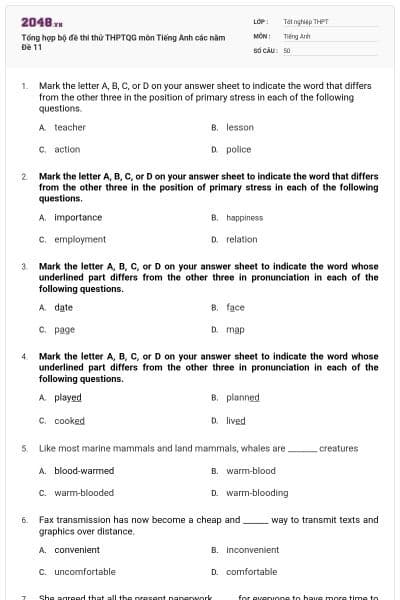
Mark the letter A, B, C, or D on your answer sheet to indicate the word that differs from the other three in the position of primary stress in each of the following questions.
teacher
lesson
action
police
Đáp án D
Kiến thức về trọng âm với từ hai âm tiết
A. teacher /‘ti:t∫ə(r)/: từ này trọng âm rơi vào âm tiết thứ nhất. Vì theo quy tắc trọng âm không bao giờ rơi vào âm /ə/ và trọng âm ưu tiên rơi vào nguyên âm dài.
B. lesson /'lesn/: Từ này trọng âm rơi vào âm tiết thứ nhất. Vì theo quy tắc nếu các âm mà ngắn hết thì trọng âm rơi vào âm tiết đầu.
C. action / 'æk∫n/ : Từ này trọng âm rơi vào âm tiết thứ nhất. Vì theo quy tắc có đuôi -ion thì trọng âm rơi vào trước âm đó.
D. police /pə'li:s/ : Từ này trọng âm rơi vào âm tiết thứ hai. Vì theo quy tắc trọng âm không bao giờ rơi vào âm /ə/ và trọng âm ưu tiên rơi vào nguyên âm dài.
=> Phần D trọng âm ớ âm tiết thứ 2, các từ còn lại trọng âm rơi vào âm tiết thứ nhất
Mark the letter A, B, C, or D on your answer sheet to indicate the word that differs from the other three in the position of primary stress in each of the following questions.
importance
happiness
employment
relation
Đáp án B
Kiến thức trọng âm với từ 3 âm tiết và hậu tố
A. importance /ɪm’pɔ:tns/: Từ này trọng âm rơi vào âm tiết thứ hai. Vì theo quy tắc trọng âm ưu tiên rơi vao nguyên âm dài.
B. happiness /'hæpinəs/: Từ này trọng âm rơi vào âm tiết thứ nhất. Vì theo quy tắc nếu các âm mà ngắn hết thì trọng âm rơi vào âm tiết đầu.
C. employment /ɪm’pɔɪmənt/ : Từ này trọng âm rơi vào âm tiết thứ hai. Vì theo quy tắc trọng âm không rơi vào đuôi -ment và ưu tiên rơi vào nguyên âm dài.
D. relation /rɪ'leɪ∫n/: Từ này trọng âm rơi vào âm tiết thứ hai. Vì theo quy tắc có đuôi -ion thì trọng âm rơi vào trước âm đó.
=> Phần B trọng âm rơi vào âm tiết thứ nhất, các từ còn lại trọng âm ở âm tiết thứ hai.
Mark the letter A, B, C, or D on your answer sheet to indicate the word whose underlined part differs from the other three in pronunciation in each of the following questions.
date
face
page
map
Đáp án D
Kiến thức cách phát âm của nguyên âm
Phần gạch chân của phần D phát âm là /æ/, của các từ còn lại phát âm là /ei/.
A. date /deɪt/ B. face /feɪs/ C. page /peɪdʒ/ D. map /mæp/
Mark the letter A, B, C, or D on your answer sheet to indicate the word whose underlined part differs from the other three in pronunciation in each of the following questions.
played
planned
cooked
lived
Đáp án C
Cách phát âm của đuôi -ed
Phần gạch chân của phần C phát âm là /t/, của các từ còn lại là /d/.
Like most marine mammals and land mammals, whales are _______ creatures
blood-warmed
warm-blood
warm-blooded
warm-blooding
Đáp án C
Kiến thức về từ vựng
warm-blooded (adj): máu nóng
Tạm dịch: Giống như hầu hết các loài động vật có vú trên cạn và dưới nước, cá voi là loài sinh vật máu nóng.
Fax transmission has now become a cheap and ______ way to transmit texts and graphics over distance.
convenient
inconvenient
uncomfortable
comfortable
Đáp án A
Kiến thức về từ vựng
A. convenient /kən’vi:njənt/ (a): thuận tiện
B. inconvenient /inkən'vi:njənt/ (a): bất tiện
C. uncomfortable /ʌn'kʌmfətəbl/ (a]) không thoải mái
D. comfortable /kʌmfətəbl/ (a): thoải mái
Tạm dịch: Chuyển fax giờ đã trở thành một cách truyền văn bản và hình ảnh rẻ và tiện lợi.
She agreed that all the present paperwork _____ for everyone to have more time to socialize.
stopping
be stopped
to stop
stopped
Đáp án B
Kiến thức về thức giả định và bị động
Cấu trúc:
Agree + that + S + V(bare)
Chủ từ ở đây là vật (paperwork) nên động từ phải được chia ở dạng bị động
ChỈ có đáp án B ở dạng bị động là phù hợp.
Tạm dịch: Cô ấy đồng ý rằng tất cả các giấy tờ hiện tại sẽ bị dừng lại để mọi người có thêm thời gian để giao tiếp bàn bạc.
In today's paper, it _______ that there will be a new government soon.
writes
tells
states
records
Đáp án C
Kiến thức về từ vựng
A. write (v): viết B. tell (v): bảo
C. state (v): tuyên bố D. record (v): ghi âm
Tạm dịch: Trong bài báo hôm nay, có tuyên bố rằng sẽ sớm có một Chính phủ mới.
The local press has been pouring _______ on the mayor for dissolving the council.
scorn
blame
disapproval
hatred
Đáp án A
Kiến thức về cụm từ cố định
Giải thích:
A. scorn (n): sự khinh bỉ, sự khinh miệt B. blame (n, v): sự đổ lỗi, đổ lỗi
C. disapproval (n): sự không tán thành D. hatred (n): lòng căm ghét
Cum từ cố định “pour scorn on somebody”: dè bỉu/ chê bai ai đó
Tạm dịch: Truyền thông địa phương dè hỉu ngài Thị trưởng vì giải tán hội đồng thành phố.
The Wildlife Fund helps to _______ endangered species.
reduce
produce
increase
preserve
Đáp án D
Kiến thức về từ vựng
A. reduce: cắt giảm B. produce: sản xuất
C. increase: tăng D. preserve: bảo tồn
Tạm dịch: Quỹ Bảo Tồn Động vật hoang dã giúp bảo tồn động vật đang bị đe dọa tuyệt chủng.
A curriculum that ignores ethnic tensions, racial antagonisms, cultural _____ and religiousdifferences is not relevant.
contacts
barriers
diversity
levels
Đáp án C
Kiến thức về từ vựng
A. contact: liên lạc, liên hệ B. barrier: rào cản
C. diversity: sự đa dạng D. level: mức, cấp
Tạm dịch: Một chương trình giảng dạy mà bỏ qua sự căng thẳng dân tộc, sự đối kháng chủng tộc, sự đa dạng văn hoá và sự khác biệt tôn giáo là không thích đáng.
The speaker fails to get his message _______to his audience.
around
in
across
out
Đáp án A
Kiến thức về cụm động từ
Cấu trúc: get (sth) across (to Sb) (phrV): (làm cho) được hiểu rõ, làm cho ai hiểu rõ về vấn đề gì.
Đáp án còn lại:
A. get around (phrV): đi vòng qua; tránh, lách
B. get in (phrV): vào, len vào
D. get out (phrV): đi ra, ra ngoài
Tạm dịch: Người diễn thuyết thất bại trong việc truyền tải thông điệp đến người nghe.
You are under no obligation ______ to accept this offer.
whatsoever
eventually
apart
indeed
Đáp án A
Kiến thức về từ vựng
Giải thích: whatsoever = whatever: bất cứ cái gì, mọi cái
Cấu trúc: tobe under no obligation: không có nghĩa vụ/ không bắt buộc
Đáp án còn lại:
B. eventually (adv) cuối cùng
C. apart (prep) tách biệt
D. indeed (adv) quả thực, thành thực
Tạm dịch: Bạn không có nghĩa vụ nào phải chấp nhận đề nghị này.
There's a lot more to Willie than one would think: still waters run _______.
deep
deeply
deepness
depth
Đáp án A
Kiến thức về thành ngữ
Still waters run deep (idm): Những người kín đáo mới là những người sâu sắc; tẩm ngẩm tầm ngầm mà đấm chết voi.
Đáp án còn lại: Không đúng cấu trúc thành ngữ.
Tạm dịch: Có rất nhiều điều về Willie hơn người ta nghĩ: tẩm ngẩm tầm ngầm mà đấm chết voi.
Many people and organizations have been making every possible effort in order to save _______ species.
endangered
dangerous
fearful
threatening
Đáp án A
Kiến thức về cấu trúc ngữ pháp
+ make effort to do st = try/attempt to do st: cố gắng, nỗ lực làm gì
+ (in order to = so as to = to) + V(bare) = so that/in order that + clause: để mà
Endangered species: những loài có nguy cơ bi tuyệt chủng
Tạm dịch: Nhiều cá nhân và tổ chức đã nỗ lực không ngừng để cứu những loài bị đe dọa tuyệt chủng.
Air pollution is getting _______ serious in big cities in the world.
more and more
the more and the more
the most and the most
most and most
Đáp án A
Kiến thức về so sánh
Cấu trúc so sánh lũy tiến: more and more + long adj/ adv: ngày càng...
Tạm dịch: Ô nhiễm không khí đang trở nên ngày càng nghiêm trọng ở các thành phố lớn trên thế giới.
Mark the letter A, B, C, or D on your answer sheet to indicate the word(s) CLOSEST in meaning to the underlined word (s) in each of the following questions.
The factory is fined for discharging dangerous chemicals into the river.
releasing
increasing
decreasing
keeping
Đáp án A
Từ đồng nghĩa
Tạm dịch: Nhà máy bị phạt vì thải hóa chất nguy hiểm xuống sông.
=> discharge /dɪs't∫ɑ:dʒ/ (v): thải
A. release (v): phóng thích, thải B. increase (v): tăng
C. decrease (v): giảm D. keep (v): giữ
=> Đáp án A (release = discharge)
Mark the letter A, B, C, or D on your answer sheet to indicate the word(s) CLOSEST in meaning to the underlined word (s) in each of the following questions.
A series of programs have been broadcast to raise public awareness of healthy living.
experience
understanding
confidence
assistance
Đáp án B
Từ đồng nghĩa
Tạm dịch: Một chuỗi chương trình truyền hình đã được phát sóng để nâng cao nhận thức của người dân về việc sống lành mạnh.
=> Understanding = Awareness: sự hiểu biết, nhận thức
Các đáp án còn lại:
A. experience (n): kinh nghiệm
C. confidence (n): sự tự tin
D. assistance = help (n): sự giúp đỡ
Mark the letter A, B, C, or D on your answer sheet to indicate the word(s) OPPOSITE in meaning to the underlined word(s) in each of the following questions.
This speedy and secure service of transferring money can be useful.
slow
rapid
careful
hurried
Đáp án A
Từ trái nghĩa
Tạm dịch: Dịch vụ chuyển tiền nhanh chóng và an toàn này có thể hữu ích.
=> speedy (adj): nhanh chóng >< slow (adj): chậm chạp
Các đáp án còn lai:
B. rapid (adj): nhanh C. careful (adj): cẩn thận D. hurried (adj): vội vã
Mark the letter A, B, C, or D on your answer sheet to indicate the word(s) OPPOSITE in meaning to the underlined word(s) in each of the following questions.
Our well-trained staff are always courteous to customers.
helpful
friendly
help
polite
Đáp án C
Từ trái nghĩa
Tạm dịch: Đội ngũ nhân viên được đào tạo của chúng tôi luôn lịch sự với khách hàng.
=> courteous (adj): nhã nhặn, lịch sự >< rude (adj): thô lỗ
Các đáp án còn lại:
A. helpful (adj): tốt bụng, hay giúp đỡ
B. friendly (adj): thân thiện
D. polite (adj): lịch sự
Mark the letter A, B, C, or D on your answer sheet to indicate the sentence that best completes each of the following exchanges.
-The shop assistant: “This is my last portable CD player. I'll let you have it for fifty dollars”.
- Stevenson: “ _____?”.
Could you give me your last CD?
Can you tell me your favourite type of music?
Could you give me a discount?
Could you possibly give me fifty dollars?
Đáp án C
Tình huống giao tiếp
- Nhân viên cửa hàng: “Đây là chiếc CD cuối cùng. Tôi sẽ bán cho bạn với giá 50 đô".
- Stevenson: “___________?”.
A. Bạn có thể đưa tôi chiếc CD cuối cùng được không?
B. Bạn có thể cho tôi biết thể loại nhạc mà bạn yêu thích là gì được không?
C. Bạn có thể giảm giá cho tôi được không?
D. Bạn có thể đưa tôi 50 đô được không?
Chỉ có đáp án C là hợp lí, thể hiện cuộc đối đáp giữa người mua và người bán.
Mark the letter A, B, C, or D on your answer sheet to indicate the sentence that best completes each of the following exchanges.
-Customer: "Can I try this jumper on?".
-Salesgirl: “_____?”.
Yes, it costs one hundred and fifty dollars.
No, the shop is closed in half an hour.
Sorry, only cash is accepted here.
Sure, the changing rooms are over there.
Đáp án D
Tình huống giao tiếp
- Khách hàng: “Tôi có thể thử chiếc áo len này được không?”.
- Nhân viên: “ _________?".
A. Vâng, nó có giá 150 đôla.
B. Không, cửa hàng đóng cửa 30 phút.
C. Xin lỗi, cửa hàng chỉ chấp nhận thanh toán bằng tiền mặt.
D. Chắc chắn rồi, phòng thay đồ ở phía kia.
Chỉ có đáp án D là hợp lí.
Read the following passage and mark the letter A, B, C, or D on your answer sheet to indicate the correct word or phrase that best fits each of the numbered blanks from 23 to 27.
Nowadays people are more aware that wildlife all over the world is in (23) _______. Many species of animals are threatened, and could easily become (24) _____ if we do not make an effort to protect them. In some cases, animals are hunted for their fur or for other valuable parts of their bodies. Some birds, such as parrots, are caught (25) _____ and sold as pets. For many animals and birds the problem is that their habitat - the place where they live - is disappearing. More land is used for farms, for houses or industry, and there are fewer open spaces than there once were. Farmers use powerful chemicals to help them to grow better crops, but these chemicals pollute the environment and (26) _____ wildlife. The most successful animals on earth - human beings - will soon be the only ones (27) _____ unless we can solve this problem.
Điền vào ô 23.
threat
problem
danger
vanishing
Đáp án C
CHỦ ĐỀ NATURE IN DANGER
Kiến thức về cụm từ cố định
to be in danger: đang gặp nguy hiểm
Các từ còn lại:
A. threat (n): mối đe doạ
B. problem (n): vấn đề, rắc rối
D. vanishing (n): sự biến mất
Read the following passage and mark the letter A, B, C, or D on your answer sheet to indicate the correct word or phrase that best fits each of the numbered blanks from 23 to 27.
Nowadays people are more aware that wildlife all over the world is in (23) _______. Many species of animals are threatened, and could easily become (24) _____ if we do not make an effort to protect them. In some cases, animals are hunted for their fur or for other valuable parts of their bodies. Some birds, such as parrots, are caught (25) _____ and sold as pets. For many animals and birds the problem is that their habitat - the place where they live - is disappearing. More land is used for farms, for houses or industry, and there are fewer open spaces than there once were. Farmers use powerful chemicals to help them to grow better crops, but these chemicals pollute the environment and (26) _____ wildlife. The most successful animals on earth - human beings - will soon be the only ones (27) _____ unless we can solve this problem.
Điền vào ô 24.
disappeared
vanished
extinct
empty
Đáp án C
Kiến thức về từ vựng
A. disappear (v): biến mất B. vanished (a): đã biến mất, không còn nữa
C. extinct (a): tuyệt chủng D. empty (a): trống rỗng
Tạm dịch:
“Many species of animals are threatened, and could easily become (24) _____ if we do not make an effort to protect them." (Nếu chúng ta không làm gì đó để bảo vệ chúng, nhiều loài đang ở bờ vực nguy hiểm sẽ dễ dàng bị tuyệt chủng.)
Read the following passage and mark the letter A, B, C, or D on your answer sheet to indicate the correct word or phrase that best fits each of the numbered blanks from 23 to 27.
Nowadays people are more aware that wildlife all over the world is in (23) _______. Many species of animals are threatened, and could easily become (24) _____ if we do not make an effort to protect them. In some cases, animals are hunted for their fur or for other valuable parts of their bodies. Some birds, such as parrots, are caught (25) _____ and sold as pets. For many animals and birds the problem is that their habitat - the place where they live - is disappearing. More land is used for farms, for houses or industry, and there are fewer open spaces than there once were. Farmers use powerful chemicals to help them to grow better crops, but these chemicals pollute the environment and (26) _____ wildlife. The most successful animals on earth - human beings - will soon be the only ones (27) _____ unless we can solve this problem.
Điền vào ô 25.
life
alive
lively
live
Đáp án B
Kiến thức về từ loại
A. life (n): cuộc sống B. alive (ai): còn sống
C. lively (a): sinh động D. live (v/n): sống/ trực tiếp
Tạm dịch:
“Some birds, such as parrots. are caught (25) ______ and sold as pets.” (Một số loài chim, như là vẹt bị bắt sống và bị bán làm thú cưng.)
Read the following passage and mark the letter A, B, C, or D on your answer sheet to indicate the correct word or phrase that best fits each of the numbered blanks from 23 to 27.
Nowadays people are more aware that wildlife all over the world is in (23) _______. Many species of animals are threatened, and could easily become (24) _____ if we do not make an effort to protect them. In some cases, animals are hunted for their fur or for other valuable parts of their bodies. Some birds, such as parrots, are caught (25) _____ and sold as pets. For many animals and birds the problem is that their habitat - the place where they live - is disappearing. More land is used for farms, for houses or industry, and there are fewer open spaces than there once were. Farmers use powerful chemicals to help them to grow better crops, but these chemicals pollute the environment and (26) _____ wildlife. The most successful animals on earth - human beings - will soon be the only ones (27) _____ unless we can solve this problem.
Điền vào ô 26.
spoil
wound
wrong
harm
Đáp án D
Kiến thức về từ vựng
A. spoil (v): làm hỏng, làm hư B. wound (v): làm bị thương
C. wrong (a): sai, nhầm D. harm (v): làm hại, gây tai hại
Tạm dịch:
“Farmers use powerful chemicals to help them to grow better crops, but these chemicals pollute the environment and (26) _____ wildlife.” (Nông dân sử dụng hóa chất để làm cây trồng phát triển hơn, nhưng những chất đó lại gây ô nhiễm môi trường và làm hại động vật hoang đã.)
Read the following passage and mark the letter A, B, C, or D on your answer sheet to indicate the correct word or phrase that best fits each of the numbered blanks from 23 to 27.
Nowadays people are more aware that wildlife all over the world is in (23) _______. Many species of animals are threatened, and could easily become (24) _____ if we do not make an effort to protect them. In some cases, animals are hunted for their fur or for other valuable parts of their bodies. Some birds, such as parrots, are caught (25) _____ and sold as pets. For many animals and birds the problem is that their habitat - the place where they live - is disappearing. More land is used for farms, for houses or industry, and there are fewer open spaces than there once were. Farmers use powerful chemicals to help them to grow better crops, but these chemicals pollute the environment and (26) _____ wildlife. The most successful animals on earth - human beings - will soon be the only ones (27) _____ unless we can solve this problem.
Điền vào ô 27.
left
alone
staying
survive
Đáp án A
Kiến thức về từ vựng
A. left (quá khứ phân từ): còn sót lại, còn lại B. alone (a): một mình
C. staying (hiện tại phân từ): ở lại, ở D. survive (v): sống sót
Tạm dịch:
“ The most successful animals on earth - human beings - will soon he the only ones (27) ______ unless we can solve this problem.”(Con người - loài động vật thành công nhất trên Trái Đất sẽ trở thành loài duy nhất sót lại trừ khi chúng ta có thể giải quyết vấn đề này.)
Read the following passage and mark the letter A, B, C, or D on your answer sheet to indicate the correct answer to each of the questions from 28 to 35.
The blue whale is the largest animal ever known to have existed. During the 20th century, the species was almost exterminated due to commercial whaling. The species has slowly recovered following the global whaling ban but it remains endangered and faces a number of serious threats including ship strikes and the impact of climate change.
Blue whales are simply enormous with most ranging in length from 24-30 m. The largest ever recorded was a gargantuan 33.5 m long. Females are up to 10 m longer than males. And they can weigh up to 200 tonnes. Just to put that in perspective: an adult male African elephant weighs 6 tonnes. The blue whale's heart is the size of a small car and its beat can be detected two miles away. But that's nothing compared to their calls. Blue whales are the loudest animals on earth and their calls are louder than a jet engine: reaching 188 decibels, while a jet's engine hit 'just' 140 decibels. Apart from their gigantic size, blue whales can be identified by their relatively small dorsal fin, a fairly rounded rostrum (anterior part of the skull), and approximately 90 ventral grooves, which reach the navel. They also have row of 300-400 baleen plates on each side of the mouth, which are black in color and range in length from 50 cm in front to 100 cm in back.
Blue whales mostly travel alone or in groups of 2-3. Larger groups of up to 60 whales have been reported and are probably associated with feeding grounds. However, the blue whale has the most powerful voice in the animal kingdom and its low-frequency sounds can travel in deep water over hundreds, or even thousands, of miles. Under these circumstances, animals which may appear to us to be traveling alone may actually be in constant contact with one another.
At birth, a blue whale calf is the largest baby on earth: approximately 8m long and weighing about 4 tonnes. They grow at a rate of 90 kg per day and wean after 7-8 months, once they have reached about 15 m in length, and are able to follow the normal migration pattern alone. They reach sexual maturity at 5-10 years. This growth rate is astonishing and is probably the fastest in the animal kingdom. From conception to weaning, it represents a several billion-fold increase in tissue in just over a year and a half. Like other baleen whales, the blue whale has no teeth so it is hard to tell its age but scientists believe they live until at least 50.
Like other large whales, blue whales are threatened by chemical and sound pollution, habitat loss, overfishing of krill, ship strikes and becoming entangled in fishing gear. Climate change could also have a major impact on its food supply, since global warming and associated ocean acidification may impact krill populations. In addition, frontal zones - critical whale habitats - are projected to move further south due to climate change. Frontal zones are boundaries between different water masses, where water can rise from the depths, bringing with it large amounts of nutrients that stimulate the growth of phytoplankton and support substantial populations of prey species for whales. Blue whales would have to migrate further (perhaps 200-500 km more) to reach and feed at these food-rich areas where they build up reserves to sustain themselves for the rest of the year. These longer migration paths could increase the energy costs of migration and reduce the duration of the main feeding season. As frontal zones move southward, they also move closer together, reducing the overall area of foraging habitat available.
What is the purpose of the author in the passage?
To provide basic information about the blue whale and its major threats.
To prove that the blue whale is the biggest mammal on the Earth.
To give evidence of how the blue whale changes the habit and feeding grounds.
To raise people's awareness of the extinction of the blue whale
Đáp án A
CHỦ ĐỀ ENDANGERED SPECIES
Mục đích của tác giả trong đoạn văn là gì?
A. Nhằm cung cấp những thông tin cơ bản về cá voi xanh và những mối đe doạ chính của chúng.
B. Để chứng minh rằng cá voi xanh là loài động vật có vú lớn nhất trên Trái Đất.
C. Để cung cấp bằng chứng về việc cá voi xanh thay đổi thói quen và khu vực kiếm ăn như thế nào.
D. Nhằm nâng cao nhận thức của mọi người về sự tuyệt chủng của cá voi xanh.
Căn cứ vào thông tin đoạn 1:
The blue whale is the largest animal ever known to have existed. During the 20th century, the species was almost exterminated due to commercial whaling. The species has slowly recovered following the global whaling ban but it remains endangered and faces a number of serious threats including ship strikes and the impact of climate change. (Cá voi xanh là loài động vật lớn nhất từng được biết đến. Trong thế kỉ 20, loài này đã gần như bị tuyệt chủng do nạn săn bắt cá voi phục vụ thương mại. Loài này đã dần hồi phục sau lệnh cấm đánh bắt cá voi toàn cầu nhưng nó vẫn đang gặp nguy hiểm và đối mặt với một số mối đe doạ nghiêm trọng bao gồm các cuộc tấn công tàu và tác động của biến đổi khí hậu.)
Bên cạnh do, các đoạn còn lại cung cấp thêm các thông tin cơ bản về loài cá voi như đặc điểm bên ngoài (đoạn 2), tập quán sinh sống (đoạn 3), sinh con (đoạn 4) và các mối đe doạ đến cá voi (đoạn cuối)
Read the following passage and mark the letter A, B, C, or D on your answer sheet to indicate the correct answer to each of the questions from 28 to 35.
The blue whale is the largest animal ever known to have existed. During the 20th century, the species was almost exterminated due to commercial whaling. The species has slowly recovered following the global whaling ban but it remains endangered and faces a number of serious threats including ship strikes and the impact of climate change.
Blue whales are simply enormous with most ranging in length from 24-30 m. The largest ever recorded was a gargantuan 33.5 m long. Females are up to 10 m longer than males. And they can weigh up to 200 tonnes. Just to put that in perspective: an adult male African elephant weighs 6 tonnes. The blue whale's heart is the size of a small car and its beat can be detected two miles away. But that's nothing compared to their calls. Blue whales are the loudest animals on earth and their calls are louder than a jet engine: reaching 188 decibels, while a jet's engine hit 'just' 140 decibels. Apart from their gigantic size, blue whales can be identified by their relatively small dorsal fin, a fairly rounded rostrum (anterior part of the skull), and approximately 90 ventral grooves, which reach the navel. They also have row of 300-400 baleen plates on each side of the mouth, which are black in color and range in length from 50 cm in front to 100 cm in back.
Blue whales mostly travel alone or in groups of 2-3. Larger groups of up to 60 whales have been reported and are probably associated with feeding grounds. However, the blue whale has the most powerful voice in the animal kingdom and its low-frequency sounds can travel in deep water over hundreds, or even thousands, of miles. Under these circumstances, animals which may appear to us to be traveling alone may actually be in constant contact with one another.
At birth, a blue whale calf is the largest baby on earth: approximately 8m long and weighing about 4 tonnes. They grow at a rate of 90 kg per day and wean after 7-8 months, once they have reached about 15 m in length, and are able to follow the normal migration pattern alone. They reach sexual maturity at 5-10 years. This growth rate is astonishing and is probably the fastest in the animal kingdom. From conception to weaning, it represents a several billion-fold increase in tissue in just over a year and a half. Like other baleen whales, the blue whale has no teeth so it is hard to tell its age but scientists believe they live until at least 50.
Like other large whales, blue whales are threatened by chemical and sound pollution, habitat loss, overfishing of krill, ship strikes and becoming entangled in fishing gear. Climate change could also have a major impact on its food supply, since global warming and associated ocean acidification may impact krill populations. In addition, frontal zones - critical whale habitats - are projected to move further south due to climate change. Frontal zones are boundaries between different water masses, where water can rise from the depths, bringing with it large amounts of nutrients that stimulate the growth of phytoplankton and support substantial populations of prey species for whales. Blue whales would have to migrate further (perhaps 200-500 km more) to reach and feed at these food-rich areas where they build up reserves to sustain themselves for the rest of the year. These longer migration paths could increase the energy costs of migration and reduce the duration of the main feeding season. As frontal zones move southward, they also move closer together, reducing the overall area of foraging habitat available.
Which of the following is NOT correct about the blue whale's physical description?
It is very easy to discover the appearance of a blue whale via its heart beat
Male blue whales are the longest in their species.
The calls of the blue whale are louder than those of any animals on the Earth.
A small dorsal fin is also the identity of the blue whale.
Đáp án B
Câu nào trong các cân sau là không đúng về đặc điểm vật lý (mô tả hình dáng) của cá voi xanh?
A. Rất dễ phát hiện sự có mặt của cá voi xanh thông qua nhịp tim của nó.
B. Cá voi xanh đực là con dài nhất trong loài.
C. Tiếng kêu của cá voi xanh lớn hơn tiếng kêu của bất kì loài nào trên Trái Đất.
D. Một cái vây nhỏ ở lưng cũng là đặc điểm nhận dạng của cá voi xanh.
Căn cứ vào thông tin đoạn 2:
Blue whales are simply enormous with most ranging in length from 24-30 m. The largest ever recorded was a gargantuan 33.5 m long. Females are up to 10 m longer than males. (Cá voi xanh là loài rất to lớn với chiều dài từ 24 - 30 mét. Con lớn nhất từng được ghi nhận là 1 con cá khổng lồ dài 33,5 mét. Con cái dài hơn 10 mét so với con đực)
Read the following passage and mark the letter A, B, C, or D on your answer sheet to indicate the correct answer to each of the questions from 28 to 35.
The blue whale is the largest animal ever known to have existed. During the 20th century, the species was almost exterminated due to commercial whaling. The species has slowly recovered following the global whaling ban but it remains endangered and faces a number of serious threats including ship strikes and the impact of climate change.
Blue whales are simply enormous with most ranging in length from 24-30 m. The largest ever recorded was a gargantuan 33.5 m long. Females are up to 10 m longer than males. And they can weigh up to 200 tonnes. Just to put that in perspective: an adult male African elephant weighs 6 tonnes. The blue whale's heart is the size of a small car and its beat can be detected two miles away. But that's nothing compared to their calls. Blue whales are the loudest animals on earth and their calls are louder than a jet engine: reaching 188 decibels, while a jet's engine hit 'just' 140 decibels. Apart from their gigantic size, blue whales can be identified by their relatively small dorsal fin, a fairly rounded rostrum (anterior part of the skull), and approximately 90 ventral grooves, which reach the navel. They also have row of 300-400 baleen plates on each side of the mouth, which are black in color and range in length from 50 cm in front to 100 cm in back.
Blue whales mostly travel alone or in groups of 2-3. Larger groups of up to 60 whales have been reported and are probably associated with feeding grounds. However, the blue whale has the most powerful voice in the animal kingdom and its low-frequency sounds can travel in deep water over hundreds, or even thousands, of miles. Under these circumstances, animals which may appear to us to be traveling alone may actually be in constant contact with one another.
At birth, a blue whale calf is the largest baby on earth: approximately 8m long and weighing about 4 tonnes. They grow at a rate of 90 kg per day and wean after 7-8 months, once they have reached about 15 m in length, and are able to follow the normal migration pattern alone. They reach sexual maturity at 5-10 years. This growth rate is astonishing and is probably the fastest in the animal kingdom. From conception to weaning, it represents a several billion-fold increase in tissue in just over a year and a half. Like other baleen whales, the blue whale has no teeth so it is hard to tell its age but scientists believe they live until at least 50.
Like other large whales, blue whales are threatened by chemical and sound pollution, habitat loss, overfishing of krill, ship strikes and becoming entangled in fishing gear. Climate change could also have a major impact on its food supply, since global warming and associated ocean acidification may impact krill populations. In addition, frontal zones - critical whale habitats - are projected to move further south due to climate change. Frontal zones are boundaries between different water masses, where water can rise from the depths, bringing with it large amounts of nutrients that stimulate the growth of phytoplankton and support substantial populations of prey species for whales. Blue whales would have to migrate further (perhaps 200-500 km more) to reach and feed at these food-rich areas where they build up reserves to sustain themselves for the rest of the year. These longer migration paths could increase the energy costs of migration and reduce the duration of the main feeding season. As frontal zones move southward, they also move closer together, reducing the overall area of foraging habitat available.
According to the passage, why isn't a blue whale lonely when it travels alone?
Because most of other blue whales also travel alone.
Because it can contact with others through their powerful voice.
Because it shares the same feeding grounds with others.
Because other blue whales will appear when it reaches the destination.
Đáp án B
Theo đoạn văn, tại sao một con cá voi xanh lại không đơn độc khi di chuyển một mình?
A. Bởi vì hầu hết các con cá voi xanh khác cũng di chuyển 1 mình.
B. Bởi vì nó có thể liên lạc với những con cá voi xanh khác thông qua tiếng kêu rất lớn của chúng.
C. Bởi vì chúng cùng chia sẻ khu vực kiếm ăn với những con cá voi xanh khác.
D. Bởi vì những con cá voi xanh khác sẽ xuất hiện khi chúng đến được đích đến.
Căn cứ thông tin đoạn 3:
Blue whales mostly travel alone or in groups of 2-3. Larger groups of up to 60 whales have been reported and are probably associated with feeding grounds. However. the blue whale has the most powerful voice in the animal kingdom and its low-frequency sounds can travel in deep water over hundreds, or even thousands. Of miles. Under these circumstances, animals which may appear to us to be traveling alone may actually be in constant contact with one another.
(Cá voi xanh chủ yếu di chuyển một mình hoặc theo nhóm từ 2 - 3 con. Những nhóm lớn hơn đến 50 con cũng đã từng được báo cáo và có thể có liên quan đến khu vực kiếm ăn. Tuy nhiên, cá voi xanh là loài có tiếng kêu to nhất trong vương quốc các loài động vật và âm thanh tần số thấp của nó có thể di chuyển sâu trong nước qua hàng tram hay thậm chí hàng ngàn dặm. Trong những hoàn cảnh này, những loài động vật mà chúng ta tưởng đang đi một mình lại thật sự có thể liên lạc thường xuyên với nhau.)
Read the following passage and mark the letter A, B, C, or D on your answer sheet to indicate the correct answer to each of the questions from 28 to 35.
The blue whale is the largest animal ever known to have existed. During the 20th century, the species was almost exterminated due to commercial whaling. The species has slowly recovered following the global whaling ban but it remains endangered and faces a number of serious threats including ship strikes and the impact of climate change.
Blue whales are simply enormous with most ranging in length from 24-30 m. The largest ever recorded was a gargantuan 33.5 m long. Females are up to 10 m longer than males. And they can weigh up to 200 tonnes. Just to put that in perspective: an adult male African elephant weighs 6 tonnes. The blue whale's heart is the size of a small car and its beat can be detected two miles away. But that's nothing compared to their calls. Blue whales are the loudest animals on earth and their calls are louder than a jet engine: reaching 188 decibels, while a jet's engine hit 'just' 140 decibels. Apart from their gigantic size, blue whales can be identified by their relatively small dorsal fin, a fairly rounded rostrum (anterior part of the skull), and approximately 90 ventral grooves, which reach the navel. They also have row of 300-400 baleen plates on each side of the mouth, which are black in color and range in length from 50 cm in front to 100 cm in back.
Blue whales mostly travel alone or in groups of 2-3. Larger groups of up to 60 whales have been reported and are probably associated with feeding grounds. However, the blue whale has the most powerful voice in the animal kingdom and its low-frequency sounds can travel in deep water over hundreds, or even thousands, of miles. Under these circumstances, animals which may appear to us to be traveling alone may actually be in constant contact with one another.
At birth, a blue whale calf is the largest baby on earth: approximately 8m long and weighing about 4 tonnes. They grow at a rate of 90 kg per day and wean after 7-8 months, once they have reached about 15 m in length, and are able to follow the normal migration pattern alone. They reach sexual maturity at 5-10 years. This growth rate is astonishing and is probably the fastest in the animal kingdom. From conception to weaning, it represents a several billion-fold increase in tissue in just over a year and a half. Like other baleen whales, the blue whale has no teeth so it is hard to tell its age but scientists believe they live until at least 50.
Like other large whales, blue whales are threatened by chemical and sound pollution, habitat loss, overfishing of krill, ship strikes and becoming entangled in fishing gear. Climate change could also have a major impact on its food supply, since global warming and associated ocean acidification may impact krill populations. In addition, frontal zones - critical whale habitats - are projected to move further south due to climate change. Frontal zones are boundaries between different water masses, where water can rise from the depths, bringing with it large amounts of nutrients that stimulate the growth of phytoplankton and support substantial populations of prey species for whales. Blue whales would have to migrate further (perhaps 200-500 km more) to reach and feed at these food-rich areas where they build up reserves to sustain themselves for the rest of the year. These longer migration paths could increase the energy costs of migration and reduce the duration of the main feeding season. As frontal zones move southward, they also move closer together, reducing the overall area of foraging habitat available.
What does the word "wean" in paragraph 4 mean?
stop feeding a calf with its mother's milk
stopgrowing as fast as before
begin living independently
begin trying to find food
Đáp án A
Tử “wean" trong đoạn 4 có nghĩa là gì?
A. ngừng cho cá voi con bú sữa mẹ B. ngừng tăng trưởng nhanh như trước
C. bắt đầu sống độc lập D. bắt đầu tự tìm thức ăn
Nghĩa của từ: wean = cai sữa mẹ
Read the following passage and mark the letter A, B, C, or D on your answer sheet to indicate the correct answer to each of the questions from 28 to 35.
The blue whale is the largest animal ever known to have existed. During the 20th century, the species was almost exterminated due to commercial whaling. The species has slowly recovered following the global whaling ban but it remains endangered and faces a number of serious threats including ship strikes and the impact of climate change.
Blue whales are simply enormous with most ranging in length from 24-30 m. The largest ever recorded was a gargantuan 33.5 m long. Females are up to 10 m longer than males. And they can weigh up to 200 tonnes. Just to put that in perspective: an adult male African elephant weighs 6 tonnes. The blue whale's heart is the size of a small car and its beat can be detected two miles away. But that's nothing compared to their calls. Blue whales are the loudest animals on earth and their calls are louder than a jet engine: reaching 188 decibels, while a jet's engine hit 'just' 140 decibels. Apart from their gigantic size, blue whales can be identified by their relatively small dorsal fin, a fairly rounded rostrum (anterior part of the skull), and approximately 90 ventral grooves, which reach the navel. They also have row of 300-400 baleen plates on each side of the mouth, which are black in color and range in length from 50 cm in front to 100 cm in back.
Blue whales mostly travel alone or in groups of 2-3. Larger groups of up to 60 whales have been reported and are probably associated with feeding grounds. However, the blue whale has the most powerful voice in the animal kingdom and its low-frequency sounds can travel in deep water over hundreds, or even thousands, of miles. Under these circumstances, animals which may appear to us to be traveling alone may actually be in constant contact with one another.
At birth, a blue whale calf is the largest baby on earth: approximately 8m long and weighing about 4 tonnes. They grow at a rate of 90 kg per day and wean after 7-8 months, once they have reached about 15 m in length, and are able to follow the normal migration pattern alone. They reach sexual maturity at 5-10 years. This growth rate is astonishing and is probably the fastest in the animal kingdom. From conception to weaning, it represents a several billion-fold increase in tissue in just over a year and a half. Like other baleen whales, the blue whale has no teeth so it is hard to tell its age but scientists believe they live until at least 50.
Like other large whales, blue whales are threatened by chemical and sound pollution, habitat loss, overfishing of krill, ship strikes and becoming entangled in fishing gear. Climate change could also have a major impact on its food supply, since global warming and associated ocean acidification may impact krill populations. In addition, frontal zones - critical whale habitats - are projected to move further south due to climate change. Frontal zones are boundaries between different water masses, where water can rise from the depths, bringing with it large amounts of nutrients that stimulate the growth of phytoplankton and support substantial populations of prey species for whales. Blue whales would have to migrate further (perhaps 200-500 km more) to reach and feed at these food-rich areas where they build up reserves to sustain themselves for the rest of the year. These longer migration paths could increase the energy costs of migration and reduce the duration of the main feeding season. As frontal zones move southward, they also move closer together, reducing the overall area of foraging habitat available.
The word "entangled" in paragraph 5 is closest in meaning to ______.
endangered
disappeared
ensnared
attracted
Đáp án C
Từ “entangled” trong đoạn 5 gần nghĩa nhất với từ nào?
A. gặp nguy hiểm B. biến mất
C. vướng vào, mắc vào bẫy (đánh cá) D. thu hút
Từ đồng nghĩa: entangled (vướng vào, mắc vào) = ensnared
Like other large whales, blue whales are threatened by chemical and sound pollution, habitat loss, overfishing of krill, ship strikes and becoming entangled in fishing gear. (Giống như các con cá voi lớn khác, cá voi xanh đang bị đe doạ bởi ô nhiễm hoá chất và âm thanh, mất môi trường sống, đánh bắt quá mức các loài nhuyễn thể tấn công tàu và mắc vào dụng cụ đánh bắt cá.)
Read the following passage and mark the letter A, B, C, or D on your answer sheet to indicate the correct answer to each of the questions from 28 to 35.
The blue whale is the largest animal ever known to have existed. During the 20th century, the species was almost exterminated due to commercial whaling. The species has slowly recovered following the global whaling ban but it remains endangered and faces a number of serious threats including ship strikes and the impact of climate change.
Blue whales are simply enormous with most ranging in length from 24-30 m. The largest ever recorded was a gargantuan 33.5 m long. Females are up to 10 m longer than males. And they can weigh up to 200 tonnes. Just to put that in perspective: an adult male African elephant weighs 6 tonnes. The blue whale's heart is the size of a small car and its beat can be detected two miles away. But that's nothing compared to their calls. Blue whales are the loudest animals on earth and their calls are louder than a jet engine: reaching 188 decibels, while a jet's engine hit 'just' 140 decibels. Apart from their gigantic size, blue whales can be identified by their relatively small dorsal fin, a fairly rounded rostrum (anterior part of the skull), and approximately 90 ventral grooves, which reach the navel. They also have row of 300-400 baleen plates on each side of the mouth, which are black in color and range in length from 50 cm in front to 100 cm in back.
Blue whales mostly travel alone or in groups of 2-3. Larger groups of up to 60 whales have been reported and are probably associated with feeding grounds. However, the blue whale has the most powerful voice in the animal kingdom and its low-frequency sounds can travel in deep water over hundreds, or even thousands, of miles. Under these circumstances, animals which may appear to us to be traveling alone may actually be in constant contact with one another.
At birth, a blue whale calf is the largest baby on earth: approximately 8m long and weighing about 4 tonnes. They grow at a rate of 90 kg per day and wean after 7-8 months, once they have reached about 15 m in length, and are able to follow the normal migration pattern alone. They reach sexual maturity at 5-10 years. This growth rate is astonishing and is probably the fastest in the animal kingdom. From conception to weaning, it represents a several billion-fold increase in tissue in just over a year and a half. Like other baleen whales, the blue whale has no teeth so it is hard to tell its age but scientists believe they live until at least 50.
Like other large whales, blue whales are threatened by chemical and sound pollution, habitat loss, overfishing of krill, ship strikes and becoming entangled in fishing gear. Climate change could also have a major impact on its food supply, since global warming and associated ocean acidification may impact krill populations. In addition, frontal zones - critical whale habitats - are projected to move further south due to climate change. Frontal zones are boundaries between different water masses, where water can rise from the depths, bringing with it large amounts of nutrients that stimulate the growth of phytoplankton and support substantial populations of prey species for whales. Blue whales would have to migrate further (perhaps 200-500 km more) to reach and feed at these food-rich areas where they build up reserves to sustain themselves for the rest of the year. These longer migration paths could increase the energy costs of migration and reduce the duration of the main feeding season. As frontal zones move southward, they also move closer together, reducing the overall area of foraging habitat available.
What does the word "it" in the last paragraph refer to?
the depth
water
water mass
climate change
Đáp án B
Tử “ít” trong đoạn cuối đề cập đến danh từ nào?
A. độ sau B. nước C. khối nước D. sự biến đổi khí hậu
Căn cứ vào thông tin đoạn cuối:
Từ "it” thay thế cho danh từ water.
Frontal zones are boundaries between different water masses, where water can rise from the depths, bringing with it large amounts of nutrients that stimulate the growth of phytoplankton and support substantial populations of prey species for whales. (Các khu vực phía trước là ranh giới giữa các khối nước khác nhau, nơi nước có thể dâng lên từ dưới đáy, mang theo nó một lượng lớn các chất dinh dưỡng kích thích sự phát triển của thực vật phù du và hỗ trợ đáng kể các quần thể loài thức ăn của cá voi xanh.)
Read the following passage and mark the letter A, B, C, or D on your answer sheet to indicate the correct answer to each of the questions from 28 to 35.
The blue whale is the largest animal ever known to have existed. During the 20th century, the species was almost exterminated due to commercial whaling. The species has slowly recovered following the global whaling ban but it remains endangered and faces a number of serious threats including ship strikes and the impact of climate change.
Blue whales are simply enormous with most ranging in length from 24-30 m. The largest ever recorded was a gargantuan 33.5 m long. Females are up to 10 m longer than males. And they can weigh up to 200 tonnes. Just to put that in perspective: an adult male African elephant weighs 6 tonnes. The blue whale's heart is the size of a small car and its beat can be detected two miles away. But that's nothing compared to their calls. Blue whales are the loudest animals on earth and their calls are louder than a jet engine: reaching 188 decibels, while a jet's engine hit 'just' 140 decibels. Apart from their gigantic size, blue whales can be identified by their relatively small dorsal fin, a fairly rounded rostrum (anterior part of the skull), and approximately 90 ventral grooves, which reach the navel. They also have row of 300-400 baleen plates on each side of the mouth, which are black in color and range in length from 50 cm in front to 100 cm in back.
Blue whales mostly travel alone or in groups of 2-3. Larger groups of up to 60 whales have been reported and are probably associated with feeding grounds. However, the blue whale has the most powerful voice in the animal kingdom and its low-frequency sounds can travel in deep water over hundreds, or even thousands, of miles. Under these circumstances, animals which may appear to us to be traveling alone may actually be in constant contact with one another.
At birth, a blue whale calf is the largest baby on earth: approximately 8m long and weighing about 4 tonnes. They grow at a rate of 90 kg per day and wean after 7-8 months, once they have reached about 15 m in length, and are able to follow the normal migration pattern alone. They reach sexual maturity at 5-10 years. This growth rate is astonishing and is probably the fastest in the animal kingdom. From conception to weaning, it represents a several billion-fold increase in tissue in just over a year and a half. Like other baleen whales, the blue whale has no teeth so it is hard to tell its age but scientists believe they live until at least 50.
Like other large whales, blue whales are threatened by chemical and sound pollution, habitat loss, overfishing of krill, ship strikes and becoming entangled in fishing gear. Climate change could also have a major impact on its food supply, since global warming and associated ocean acidification may impact krill populations. In addition, frontal zones - critical whale habitats - are projected to move further south due to climate change. Frontal zones are boundaries between different water masses, where water can rise from the depths, bringing with it large amounts of nutrients that stimulate the growth of phytoplankton and support substantial populations of prey species for whales. Blue whales would have to migrate further (perhaps 200-500 km more) to reach and feed at these food-rich areas where they build up reserves to sustain themselves for the rest of the year. These longer migration paths could increase the energy costs of migration and reduce the duration of the main feeding season. As frontal zones move southward, they also move closer together, reducing the overall area of foraging habitat available.
According to the last paragraph, how does climate change affect the blue whale?
It increases the acidity in the ocean, which makes the water polluted.
It impacts on the tide which contains a lot of nutrients to feed the blue whale's prey.
It makes the blue whale travel farther south to find feeding grounds.
It encourages frontal zones so that the blue whale cannot move around.
Đáp án C
Theo đoạn văn cuối, sự biến đổi khí hậu có ảnh hưởng như thế nào đến cá voi xanh?
A. Nó làm tăng lượng axit trong đại dương, làm cho nguồn nước bị ô nhiễm.
B. Nó tác động đến thuỷ triều chứa các chất dinh dưỡng để nuôi dưỡng các loài thức ăn của cá voi xanh.
C. Nó khiến cá voi xanh phải di chuyển xa hơn xuống phía nam để tìm khu vực kiếm ăn.
D. Nó tăng cường các vùng phía trước để mà cá voi xanh không thể di chuyển xung quanh được.
Căn cứ vào thông tin đoạn cuối:
Climate change could also have a major impact on its food supply, since global warming and associated ocean acidification may impact krill populations. In addition, frontal zones — critical whale habitats — are projected to move further south due to climate change. Frontal zones are boundaries between different water masses, where water can rise from the depths, bringing with it large amounts of nutrients that stimulate the growth of phytoplankton and support substantial populations of prey species for whales. Blue whales would have to migrate further [perhaps 200-500 km more] to reach and feed at these food-rich areas where they build up reserves to sustain themselves for the rest of the year. These longer migration paths could increase the energy costs of migration and reduce the duration of the main feeding season.
(Biến đổi khí hậu cũng có tác động lớn đến nguồn cung cấp thực phẩm của nó, vì sự nóng lên toàn cầu và sự axit hoá đại dương có liên quan có thể ảnh huởng đến quần thể các loài nhuyễn thể. Thêm vào đó, các vùng phía trước, môi trường sống quan trọng của cá voi, được dự kiến sẽ di chuyển xa hơn về phía nam do biến đổi khí hậu. Các khu vực phía trước là ranh giới giữa các khối nước khác nhau, nơi nước có thể dâng lên từ dưới đáy, mang theo nó một lượng lớn các chất dinh dưỡng kích thích sự phát triển của thực vật phù du và hỗ trợ đáng kể các quần thể loàí thức ăn của cá voi xanh. Cá voi xanh sẽ phải di chuyển xa hơn (có lẽ khoảng 200 - 500 km nữa) để tiếp cận và kiếm ăn ở các vùng giàu thức ăn này, nơi chúng tích luỹ dự trữ để duy trì bản thân cho đến cuối năm. Những con đường di cư dài hơn này có thể làm tăng năng lượng di cư và giảm thời gian mùa ăn chính.)
Read the following passage and mark the letter A, B, C, or D on your answer sheet to indicate the correct answer to each of the questions from 28 to 35.
The blue whale is the largest animal ever known to have existed. During the 20th century, the species was almost exterminated due to commercial whaling. The species has slowly recovered following the global whaling ban but it remains endangered and faces a number of serious threats including ship strikes and the impact of climate change.
Blue whales are simply enormous with most ranging in length from 24-30 m. The largest ever recorded was a gargantuan 33.5 m long. Females are up to 10 m longer than males. And they can weigh up to 200 tonnes. Just to put that in perspective: an adult male African elephant weighs 6 tonnes. The blue whale's heart is the size of a small car and its beat can be detected two miles away. But that's nothing compared to their calls. Blue whales are the loudest animals on earth and their calls are louder than a jet engine: reaching 188 decibels, while a jet's engine hit 'just' 140 decibels. Apart from their gigantic size, blue whales can be identified by their relatively small dorsal fin, a fairly rounded rostrum (anterior part of the skull), and approximately 90 ventral grooves, which reach the navel. They also have row of 300-400 baleen plates on each side of the mouth, which are black in color and range in length from 50 cm in front to 100 cm in back.
Blue whales mostly travel alone or in groups of 2-3. Larger groups of up to 60 whales have been reported and are probably associated with feeding grounds. However, the blue whale has the most powerful voice in the animal kingdom and its low-frequency sounds can travel in deep water over hundreds, or even thousands, of miles. Under these circumstances, animals which may appear to us to be traveling alone may actually be in constant contact with one another.
At birth, a blue whale calf is the largest baby on earth: approximately 8m long and weighing about 4 tonnes. They grow at a rate of 90 kg per day and wean after 7-8 months, once they have reached about 15 m in length, and are able to follow the normal migration pattern alone. They reach sexual maturity at 5-10 years. This growth rate is astonishing and is probably the fastest in the animal kingdom. From conception to weaning, it represents a several billion-fold increase in tissue in just over a year and a half. Like other baleen whales, the blue whale has no teeth so it is hard to tell its age but scientists believe they live until at least 50.
Like other large whales, blue whales are threatened by chemical and sound pollution, habitat loss, overfishing of krill, ship strikes and becoming entangled in fishing gear. Climate change could also have a major impact on its food supply, since global warming and associated ocean acidification may impact krill populations. In addition, frontal zones - critical whale habitats - are projected to move further south due to climate change. Frontal zones are boundaries between different water masses, where water can rise from the depths, bringing with it large amounts of nutrients that stimulate the growth of phytoplankton and support substantial populations of prey species for whales. Blue whales would have to migrate further (perhaps 200-500 km more) to reach and feed at these food-rich areas where they build up reserves to sustain themselves for the rest of the year. These longer migration paths could increase the energy costs of migration and reduce the duration of the main feeding season. As frontal zones move southward, they also move closer together, reducing the overall area of foraging habitat available.
It can be inferred from the passage that ______.
Human activities are one of the primary reasons for the decline of the blue whale's population.
The blue whale is the animal that has the longest life expectancy.
Despite being the largest animals, blue whales are the most vulnerable on the Earth.
The blue whale lives safely in the ocean thanks to their solidarity.
Đáp án A
Có thể suy ra từ đoạn văn rằng _________.
A. Các hoạt động của con người là một trong những nguyên nhân hàng đầu cho sự suy giảm của quần thể loài cá voi xanh.
B. Cá voi xanh là loài động vật có tuổi thọ lâu nhất.
C. Mặc dù là loài động vật lớn nhất, cá voi xanh cũng là loài dễ bị tổn thương nhất trên Trái Đất.
D. Cá voi xanh sống an toàn trong đại dương nhờ vào sự đoàn kết của chúng.
Căn cứ vào thông tin đoạn đầu và đoạn cuối:
During the 20th century, the species was almost exterminated due to commercial whaling. (Trong thế kỉ 20, loài này đã gần như bị tuyệt chủng do nạn săn bắt cá voi phục vụ thương mại.)
Like other large whales, blue whales are threatened by chemical and sound pollution, habitat loss, overflshing of krill, ship strikes and becoming entangled in fishing gear. (Giống như các con cá voi lớn khác, cá voi xanh đang bị đe doạ bởi ô nhiễm hoá chất và âm thanh, mất môi trường sống, đánh bắt quá mức các loài nhuyễn thể tấn công tàu và mắc vào dụng cụ đánh bắt cá.)
Dịch bài
Cá voi xanh là loài động vật lớn nhất từng được biết đến. Trong thế kỉ 20, loài này đã gần như bị tuyệt chủng do nạn săn bắt cá voi phục vụ thương mại. Loài này đã dần hồi phục sau lệnh cấm đánh bắt cá voi toàn cầu nhưng nó vẫn đang gặp nguy hiểm và đối mặt với một sổ mối đe doạ nghiêm trọng bao gồm các cuộc tấn công tàu và tác động của biến đổi khi hậu.
Cá voi xanh là loài rất to lớn với chiều dài từ 24 - 30 mét. Con lớn nhất từng được ghi nhận là một con cá khổng lồ dài 33.5 mét. Con cái dài hơn 10 mét so với con đực. Và chúng có thể nặng tới 200 tấn. Chỉ cần suy nghĩ rằng: một con voi châu Phi trưởng thành chỉ nặng 6 tấn. Tim cá voi xanh là kích thước bằng một chiếc xe hơi nhỏ và nhịp của nó có thể được phát hiện cách hai dặm. Nhưng đó vẫn không là gì so với tiếng kêu của chủng. Cá voi xanh là loài động vật to nhất trên trái đất và tiếng kêu của chúng to hơn một động cơ phản lực: đạt tới 188 đecibel, trong khi động cơ của phản lực ‘chỉ’ 140 decibel. Ngoài kích thước khổng lồ của chúng, cá voi xanh có thể được xác định bởi vây lưng tương đối nhỏ của chúng, một bướu khá tròn (phần phía trước của hộp sọ), và khoảng 90 rãnh thông, đạt đến rốn. Chúng cũng có khoảng 300 - 400 tấm sừng hàm trên mỗi bên của miệng, có màu đen và có chiều dài từ 50 cm ở phía trước đến 100 cm ở phía sau.
Cá voi xanh chủ yếu di chuyển một mình hoặc theo nhóm từ 2 - 3 con. Những nhóm lớn hơn đến 60 con cũng đã từng được báo các và có thể có liên quan đến khu vực kiếm ăn. Tuy nhiên, cá voi xanh là loài có tiếng kêu to nhất trong vương quốc các loài động vật và âm thanh tầm số thấp của nó có thể di chuyển sâu trong nước qua hàng trăm hay thậm chi hang ngàn dặm. Trong những hoàn cảnh này, những loài động vật mà chúng ta tưởng đang đi một mình lại thật sự có thể liên lạc thường xuyên với nhau.
Khi mới sinh, một con cá voi xanh con cũng là đứa con lớn nhất trên trái đất: dài khoảng 8m và nặng khoảng 4 tấn. Chúng phát triển với tốc độ 90 kg mỗi ngày và cai sữa sau 7-8 tháng, một khi chúng đã đạt đến khoảng 15 m chiều dài. và có thể đi theo con đường di cư hình thường một mình. Chúng đạt đến sự trường thành về tinh dục từ 5-10 năm. Tốc độ tăng trưởng này là đáng kinh ngạc và có lẽ là nhanh nhất trong vương quốc động vật. Từ lúc được thụ thai đến cai sữa, nó đại điện cho sự gia tăng vài tỷ lần trong mô chỉ trong hơn một năm rưỡi. Giống như những con cá voi có tấm sừng khác, cá voi xanh không có răng nên rất khó để biết tuổi của nó nhưng các nhà khoa học tin rằng chúng sống đến ít nhất 50 tuổi.
Giống như các con cá voi lớn khác, cá voi xanh đang bị đe doạ bởi ô nhiễm hoá chất và âm thanh, mất môi trường sống, đánh bắt quá mức các loài nhuyễn thể, tấn công tàu và mắc vào dụng cụ đánh bắt cá. Biến đổi khí hậu cũng có tác động lớn đến nguồn cung cấp thực phẩm của nó, vì sự nóng lên toàn cầu và sự axit hoá đại dương có liên quan có thể ảnh hưởng đến quần thể các loài nhuyễn thể. Thêm vào đó, các vùng phía trước, môi trường sống quan trọng của cá voi, được dự kiến sẽ di chuyển xa hơn về phía nam do biến đổi khí hậu. Các khu vực phía trước là ranh giới giữa các khối nước khác nhau, nơi nước có thể dâng lên từ dưới đáy, mang theo nó một lượng lớn các chất dinh dưỡng kích thích sự phát triển của thực vật phù du và hỗ trợ đáng kể các quần thể loài thức ăn của cá voi xanh. Cá voi xanh sẽ phải di chuyển xa hơn (có lẽ khoảng 200 - 500 km nữa) để tiếp cận và kiếm ăn ở các vùng giàu thức ăn này, nơi chúng tích luỹ dự trữ để duy trì bản thân cho đến cuối năm. Những con đường di cư dài hơn này có thể làm tăng năng lượng di cư và giảm thời gian mùa ăn chính. Khi các khu vực phía trước di chuyển về phía nam, chúng cũng di chuyển gần nhau hơn, làm giảm tổng diện tích của khu vực kiếm ăn.
Read the following passage and mark the letter A, B, C, or D on your answer sheet to indicate the correct answer to each of the questions from 36 to 42.
Scientists have uncovered a new threat to the world's endangered coral reefs. They have found that most are incapable of growing quickly enough to compensate for rising sea levels triggered by global warming. The study suggests that reefs - which are already suffering serious degradation because the world's seas are warming and becoming more acidic - could also become overwhelmed by rising oceans.
The research - led by scientists at Exeter University and published in Nature this week -involved studying growth rates for more than 200 tropical western Atlantic and Indian Ocean reefs. It was found only 9% of these reefs had the ability to keep up with even the most optimistic rates of sea-level rises forecast by the Intergovernmental Panel on Climate Change. "For many reefs across the Caribbean and Indian Ocean regions, where the study focused, rates of growth are slowing due to coral reef degradation," said Professor Chris Perry, of Exeter University. “Meanwhile, rates of sea-level rise are increasing - and our results suggest reefs will be unable to keep up. As a result, water depths above most reefs will increase rapidly through this century.”
Sea levels rose by several inches over the past century and measurements indicate the speed of this increase is now rising significantly. Two key factors are involved: climate change is making ocean water warmer and so it expands. And as ice sheets and glaciers melt, they increase amounts of water in the oceans.
At the same time, reefs are being weakened by ocean warming and also by ocean acidification, triggered as the seas absorb more and more carbon dioxide. These effects lead to bleaching events that kill off vast stretches of coral and limits their ability to grow.
“Our predictions, even under the best case scenarios, suggest that by 2100, the inundation of reefs will expose coastal communities to significant threats of shoreline change,” said co-author Prof Peter Mumby of Queensland University. This point was backed by US marine scientist Ilsa Ruffner writing in a separate comment piece for Nature. “The implications of the study are dire. Many island nations and territories are set to quickly lose crucial natural resources.”
Which of the following does the passage mainly discuss?
Sea levels will become the main factor of bleaching.
Coral reefs will be overwhelmed by rising oceans.
Coral reefs may escape from extinction because of the increase in sea levels.
Global warming will cause the rise of sea levels.
Đáp án B
CHỦ ĐỀ UNDERSEA WORLD
Câu nào trong các câu sau là nội dung chính mà đoạn văn thảo luận?
A. Mực nước biển sẽ trở thành tác nhân chính của sự tẩy trắng.
B. Các rạn san hô sẽ bị tràn ngập bởi các đại dương đang dâng nước lên.
C. Các rạn san hô có thể thoát khỏi tuyệt chủng nhờ vào sự tăng lên của mực nước biển.
D. Sự nóng lên toàn cầu sẽ làm mực nước biển tăng lên.
Căn cứ vào thông tin đoạn 1:
The study suggests that reefs - which are already suffering serious degradation because the world’s seas are warming and becoming more acidic - could also become overwhelmed by rising oceans.
Nghiên cứu cho thấy rằng các rạn san hô - đã bị suy thoái nghiêm trong bởi vì biển trên thế giới đang ấm lên và trở nên chua hơn - cũng có thể bị tràn ngập bởi những đại dương đang dâng nước lên.)
Read the following passage and mark the letter A, B, C, or D on your answer sheet to indicate the correct answer to each of the questions from 36 to 42.
Scientists have uncovered a new threat to the world's endangered coral reefs. They have found that most are incapable of growing quickly enough to compensate for rising sea levels triggered by global warming. The study suggests that reefs - which are already suffering serious degradation because the world's seas are warming and becoming more acidic - could also become overwhelmed by rising oceans.
The research - led by scientists at Exeter University and published in Nature this week -involved studying growth rates for more than 200 tropical western Atlantic and Indian Ocean reefs. It was found only 9% of these reefs had the ability to keep up with even the most optimistic rates of sea-level rises forecast by the Intergovernmental Panel on Climate Change. "For many reefs across the Caribbean and Indian Ocean regions, where the study focused, rates of growth are slowing due to coral reef degradation," said Professor Chris Perry, of Exeter University. “Meanwhile, rates of sea-level rise are increasing - and our results suggest reefs will be unable to keep up. As a result, water depths above most reefs will increase rapidly through this century.”
Sea levels rose by several inches over the past century and measurements indicate the speed of this increase is now rising significantly. Two key factors are involved: climate change is making ocean water warmer and so it expands. And as ice sheets and glaciers melt, they increase amounts of water in the oceans.
At the same time, reefs are being weakened by ocean warming and also by ocean acidification, triggered as the seas absorb more and more carbon dioxide. These effects lead to bleaching events that kill off vast stretches of coral and limits their ability to grow.
“Our predictions, even under the best case scenarios, suggest that by 2100, the inundation of reefs will expose coastal communities to significant threats of shoreline change,” said co-author Prof Peter Mumby of Queensland University. This point was backed by US marine scientist Ilsa Ruffner writing in a separate comment piece for Nature. “The implications of the study are dire. Many island nations and territories are set to quickly lose crucial natural resources.”
What does the word "compensate" in the first paragraph probably mean?
recompense
keep up with
develop
benefit
Đáp án A
Từ “compensate” trong đoạn 1 có thể có nghĩa là _______.
A. đền bù, bồi thường B. theo kịp
C. phát triển D. có lợi ích
Từ đồng nghĩa: compensate (đền bù, bu đắp) = recompense
They have found that most are incapable of growing quickly enough to compensate for rising sea levels triggered by global warming. (Họ đã phát hiện ra rằng hầu hết san hô không có khả năng phát triển đủ nhanh để bù đắp cho mực nước biển dâng cao do sự nóng lên toàn cầu.)
Read the following passage and mark the letter A, B, C, or D on your answer sheet to indicate the correct answer to each of the questions from 36 to 42.
Scientists have uncovered a new threat to the world's endangered coral reefs. They have found that most are incapable of growing quickly enough to compensate for rising sea levels triggered by global warming. The study suggests that reefs - which are already suffering serious degradation because the world's seas are warming and becoming more acidic - could also become overwhelmed by rising oceans.
The research - led by scientists at Exeter University and published in Nature this week -involved studying growth rates for more than 200 tropical western Atlantic and Indian Ocean reefs. It was found only 9% of these reefs had the ability to keep up with even the most optimistic rates of sea-level rises forecast by the Intergovernmental Panel on Climate Change. "For many reefs across the Caribbean and Indian Ocean regions, where the study focused, rates of growth are slowing due to coral reef degradation," said Professor Chris Perry, of Exeter University. “Meanwhile, rates of sea-level rise are increasing - and our results suggest reefs will be unable to keep up. As a result, water depths above most reefs will increase rapidly through this century.”
Sea levels rose by several inches over the past century and measurements indicate the speed of this increase is now rising significantly. Two key factors are involved: climate change is making ocean water warmer and so it expands. And as ice sheets and glaciers melt, they increase amounts of water in the oceans.
At the same time, reefs are being weakened by ocean warming and also by ocean acidification, triggered as the seas absorb more and more carbon dioxide. These effects lead to bleaching events that kill off vast stretches of coral and limits their ability to grow.
“Our predictions, even under the best case scenarios, suggest that by 2100, the inundation of reefs will expose coastal communities to significant threats of shoreline change,” said co-author Prof Peter Mumby of Queensland University. This point was backed by US marine scientist Ilsa Ruffner writing in a separate comment piece for Nature. “The implications of the study are dire. Many island nations and territories are set to quickly lose crucial natural resources.”
What did scientists at Exeter University find in their research?
Tropical coral reefs are increasing more quickly than others in Pacific Ocean.
The majority of tropical coral reefs cannot keep pace with the increasing rate of sea levels.
Many coral reefs are developing in spite of their degradation.
The rapid rise in sea levels does not affect the density of coral reefs.
Đáp án B
Các nhà khoa học tại Đại học Ehreter đã tìm thấy điều gì trong nghiên cứu của họ?
A. Các rạn san hô nhiệt đới đang tăng lên nhanh hơn các rạn san hô ở Thái Bình Dương.
B. Đa số các rạn san hô nhiệt đới không thể bắt kịp tốc độ tăng lên của mực nước biển.
C. Nhiều rạn san hô vẫn đang phát triển mặc dù sự thoái hoá của chúng.
D. Sự tăng nhanh của mực nước biển không ảnh hưởng đến mật độ các rạn san hô.
Căn cứ vào thông tin đoạn 2:
The research - led by scientists at Exeter University and published in Nature this week - involved studying growth rates for more than 200 tropical western Atlantic and Indian Ocean reefs. It was found only 9% of these reefs had the ability to keep up with even the most optimistic rates of sea-level rises forecast by the Intergovernmental Panel on Climate Change. "For many reefs across the Caribbean and Indian Ocean regions, where the study focused, rates of growth are slowing due to coral reef degradation,” said Professor Chris Perry, of Exeter University. "Meanwhile, rates of sea-level rise are increasing - and our results suggest reefs will be unable to keep up. As a result, water depths above most reefs will increase rapidly through this century."
(Nghiên cứu - được dẫn dắt bởi các nhà khoa học tại Trường Đại học Exeter và được công bố trên tờ Nature tuần này - liên quan đến tốc độ tăng trưởng của hơn 200 rạn san hô vùng nhiệt đới Tây Đại Tây Dương và Ấn Độ Dương. Chỉ có 9% trong số các rạn san hô này có khả năng theo kịp ngay cả những mức độ lạc quan nhất của mực nước biển dâng do dự báo của Ủy ban liên chính phủ về biến đối khí hậu. “Đối với nhiều rạn san hô trên vùng Caribe" và Ấn Độ Dương, nơi nghiên cứu tập trung, tốc độ tăng trưởng chậm lại do suy thoái rạn san hô”, Giáo sư Chris Perry, thuộc Trường Đại học Exeter cho biết. “Trong khi đó, tỷ lệ mực nước biển dâng đang gia tăng - và kết quả của chúng tôi cho thấy rạn san hô sẽ không thể theo kịp. Kết quả là, độ sâu của nước trên hầu hết các rạn san hô sẽ tăng nhanh qua thế kỷ này.)
Read the following passage and mark the letter A, B, C, or D on your answer sheet to indicate the correct answer to each of the questions from 36 to 42.
Scientists have uncovered a new threat to the world's endangered coral reefs. They have found that most are incapable of growing quickly enough to compensate for rising sea levels triggered by global warming. The study suggests that reefs - which are already suffering serious degradation because the world's seas are warming and becoming more acidic - could also become overwhelmed by rising oceans.
The research - led by scientists at Exeter University and published in Nature this week -involved studying growth rates for more than 200 tropical western Atlantic and Indian Ocean reefs. It was found only 9% of these reefs had the ability to keep up with even the most optimistic rates of sea-level rises forecast by the Intergovernmental Panel on Climate Change. "For many reefs across the Caribbean and Indian Ocean regions, where the study focused, rates of growth are slowing due to coral reef degradation," said Professor Chris Perry, of Exeter University. “Meanwhile, rates of sea-level rise are increasing - and our results suggest reefs will be unable to keep up. As a result, water depths above most reefs will increase rapidly through this century.”
Sea levels rose by several inches over the past century and measurements indicate the speed of this increase is now rising significantly. Two key factors are involved: climate change is making ocean water warmer and so it expands. And as ice sheets and glaciers melt, they increase amounts of water in the oceans.
At the same time, reefs are being weakened by ocean warming and also by ocean acidification, triggered as the seas absorb more and more carbon dioxide. These effects lead to bleaching events that kill off vast stretches of coral and limits their ability to grow.
“Our predictions, even under the best case scenarios, suggest that by 2100, the inundation of reefs will expose coastal communities to significant threats of shoreline change,” said co-author Prof Peter Mumby of Queensland University. This point was backed by US marine scientist Ilsa Ruffner writing in a separate comment piece for Nature. “The implications of the study are dire. Many island nations and territories are set to quickly lose crucial natural resources.”
According to the passage, the two factors causing the rise of sea levels are ______.
global warming and freeze
severe weather and climate change
climate change and ice expansion
climate change and ice melt
Đáp án D
Theo đoạn văn, 2 nhân tốgây ra sự tăng lên của mực nước biển là ______.
A. sự nóng lên toàn cầu và sự băng giá
B. thời tiết cực đoan và biến đổi khí hậu
C. biến đổi khí hậu và sự mở rộng của băng
D. biến đổi khí hậu và băng tan
Căn cứ thông tin đoạn 3:
Two key factors are involved: climate change is making ocean water warmer and so it expands. And as ice sheets and glaciers melt, they increase amounts of water in the oceans.
(Hai yếu tố chính có liên quan là biến đổi khí hậu đang làm cho nước biển ấm hơn và do đó nó mở rộng. Và khi những tảng băng và sông băng tan chảy, chúng làm tăng lượng nước trong đại dương.)
Read the following passage and mark the letter A, B, C, or D on your answer sheet to indicate the correct answer to each of the questions from 36 to 42.
Scientists have uncovered a new threat to the world's endangered coral reefs. They have found that most are incapable of growing quickly enough to compensate for rising sea levels triggered by global warming. The study suggests that reefs - which are already suffering serious degradation because the world's seas are warming and becoming more acidic - could also become overwhelmed by rising oceans.
The research - led by scientists at Exeter University and published in Nature this week -involved studying growth rates for more than 200 tropical western Atlantic and Indian Ocean reefs. It was found only 9% of these reefs had the ability to keep up with even the most optimistic rates of sea-level rises forecast by the Intergovernmental Panel on Climate Change. "For many reefs across the Caribbean and Indian Ocean regions, where the study focused, rates of growth are slowing due to coral reef degradation," said Professor Chris Perry, of Exeter University. “Meanwhile, rates of sea-level rise are increasing - and our results suggest reefs will be unable to keep up. As a result, water depths above most reefs will increase rapidly through this century.”
Sea levels rose by several inches over the past century and measurements indicate the speed of this increase is now rising significantly. Two key factors are involved: climate change is making ocean water warmer and so it expands. And as ice sheets and glaciers melt, they increase amounts of water in the oceans.
At the same time, reefs are being weakened by ocean warming and also by ocean acidification, triggered as the seas absorb more and more carbon dioxide. These effects lead to bleaching events that kill off vast stretches of coral and limits their ability to grow.
“Our predictions, even under the best case scenarios, suggest that by 2100, the inundation of reefs will expose coastal communities to significant threats of shoreline change,” said co-author Prof Peter Mumby of Queensland University. This point was backed by US marine scientist Ilsa Ruffner writing in a separate comment piece for Nature. “The implications of the study are dire. Many island nations and territories are set to quickly lose crucial natural resources.”
What does the phrase "these effects" in paragraph 4 refer to?
ocean warming and ocean acidification
reef weakening and ocean warming
reef weakening and ocean acidification
ocean warming and CO2 absorb
Đáp án A
Cụm từ “these effects” trong đoạn 4 đề cập đến ______.
A. sự nóng lên của đại dương và axit đại dương hoá
B. sự yếu đi của các rạn san hô và sự nóng lên của đại dương
C. sự yếu đi của các rạn san hô và axit đại dương hoá
D. sự nóng lên của đại dương và sự hấp thụ CO2
Căn cứ thông tin đoạn 4:
Từ “these effects" đang nhắc đến sự nóng lên của đại dương và axit đại dương hóa.
At the same time, reefs are being weakened by ocean warming and also by ocean acidification, triggered as the seas absorb more and more carbon dioxide. These effects lead to bleaching events that kill off vast stretches of coral and limits their ability to grow.
(Đồng thời, các rạn san hô đang bị suy yếu bởi sự nóng lên của đại dương và cũng bởi sự axit hóa đại dương, được kích hoạt khi các vùng biển hấp thụ hàng càng nhiều khí CO2. Những tác động này dẫn đến các sự kiện tẩy trắng diệt hết các dải san hô rộng lớn và hạn chế năng khả năng phát triển của chúng.)
Read the following passage and mark the letter A, B, C, or D on your answer sheet to indicate the correct answer to each of the questions from 36 to 42.
Scientists have uncovered a new threat to the world's endangered coral reefs. They have found that most are incapable of growing quickly enough to compensate for rising sea levels triggered by global warming. The study suggests that reefs - which are already suffering serious degradation because the world's seas are warming and becoming more acidic - could also become overwhelmed by rising oceans.
The research - led by scientists at Exeter University and published in Nature this week -involved studying growth rates for more than 200 tropical western Atlantic and Indian Ocean reefs. It was found only 9% of these reefs had the ability to keep up with even the most optimistic rates of sea-level rises forecast by the Intergovernmental Panel on Climate Change. "For many reefs across the Caribbean and Indian Ocean regions, where the study focused, rates of growth are slowing due to coral reef degradation," said Professor Chris Perry, of Exeter University. “Meanwhile, rates of sea-level rise are increasing - and our results suggest reefs will be unable to keep up. As a result, water depths above most reefs will increase rapidly through this century.”
Sea levels rose by several inches over the past century and measurements indicate the speed of this increase is now rising significantly. Two key factors are involved: climate change is making ocean water warmer and so it expands. And as ice sheets and glaciers melt, they increase amounts of water in the oceans.
At the same time, reefs are being weakened by ocean warming and also by ocean acidification, triggered as the seas absorb more and more carbon dioxide. These effects lead to bleaching events that kill off vast stretches of coral and limits their ability to grow.
“Our predictions, even under the best case scenarios, suggest that by 2100, the inundation of reefs will expose coastal communities to significant threats of shoreline change,” said co-author Prof Peter Mumby of Queensland University. This point was backed by US marine scientist Ilsa Ruffner writing in a separate comment piece for Nature. “The implications of the study are dire. Many island nations and territories are set to quickly lose crucial natural resources.”
The word "inundation" is closest in meaning to _______.
drought
extinction
flood
tsunami
Đáp án C
Từ “inundofion”gần nghĩa nhất với từ ________.
A. hạn hán B. sự tuyệt chủng C. lũ lụt D. sóng thần
Từ đồng nghĩa: inundation (sự ngập lụt) = flood
“Our predictions, even under the best case scenarios, suggest that by 2100, the inundation of reefs will expose coastal communities to significant threats of shoreline change,” said co-author Prof Peter Mumhy of Queensland University. (“Dự đoán của chúng tôi, ngay cả trong các kịch bản tốt nhất, cho thấy rằng vào năm 2100, sự ngập lụt các rạn san hô sẽ đặt các cộng đồng ven biển vào các mối đe dọa đáng kể về sự thay đổi bờ biển”, Giáo sư Peter Mumby thuộc trường Đại học Queensland cho biết.)
Read the following passage and mark the letter A, B, C, or D on your answer sheet to indicate the correct answer to each of the questions from 36 to 42.
Scientists have uncovered a new threat to the world's endangered coral reefs. They have found that most are incapable of growing quickly enough to compensate for rising sea levels triggered by global warming. The study suggests that reefs - which are already suffering serious degradation because the world's seas are warming and becoming more acidic - could also become overwhelmed by rising oceans.
The research - led by scientists at Exeter University and published in Nature this week -involved studying growth rates for more than 200 tropical western Atlantic and Indian Ocean reefs. It was found only 9% of these reefs had the ability to keep up with even the most optimistic rates of sea-level rises forecast by the Intergovernmental Panel on Climate Change. "For many reefs across the Caribbean and Indian Ocean regions, where the study focused, rates of growth are slowing due to coral reef degradation," said Professor Chris Perry, of Exeter University. “Meanwhile, rates of sea-level rise are increasing - and our results suggest reefs will be unable to keep up. As a result, water depths above most reefs will increase rapidly through this century.”
Sea levels rose by several inches over the past century and measurements indicate the speed of this increase is now rising significantly. Two key factors are involved: climate change is making ocean water warmer and so it expands. And as ice sheets and glaciers melt, they increase amounts of water in the oceans.
At the same time, reefs are being weakened by ocean warming and also by ocean acidification, triggered as the seas absorb more and more carbon dioxide. These effects lead to bleaching events that kill off vast stretches of coral and limits their ability to grow.
“Our predictions, even under the best case scenarios, suggest that by 2100, the inundation of reefs will expose coastal communities to significant threats of shoreline change,” said co-author Prof Peter Mumby of Queensland University. This point was backed by US marine scientist Ilsa Ruffner writing in a separate comment piece for Nature. “The implications of the study are dire. Many island nations and territories are set to quickly lose crucial natural resources.”
The author implies in the last paragraph that _______.
even in the most optimistic prediction, coral reefs will experience their extinction.
the results of the study are more serious than what scientists have predicted.
human activities will not only affect marine life but also put themselves at risk.
people often exploit natural resources in island nations and territories.
Đáp án C
Tác giả hàm ý trong đoạn cuối rằng ________.
A. Ngay cả trong dự đoán lạc quan nhất, các rạn san hô vẫn sẽ bị tuyệt chủng.
B. Kết quả của cuộc nghiên cứu thì nghiêm trọng hơn những gì các nhà khoa học đã dự đoán.
C. Các hoạt động của con người không chỉ ảnh hưởng đến thế giới dưới biển mà còn đặt chính họ vào nguy hiểm.
D. Con người thường khai thác tài nguyên thiên nhiên ở các quốc đảo và vùng lãnh thổ.
Căn cứ thông tin đoạn cuối:
“Our predictions, even under the best case scenarios, suggest that by 2100, the inundation of reefs will expose coastal communities to significant threats of shoreline change,” said co-author Prof Peter Mumby of Queensland University. This point was backed by US marine scientist Ilsa Kuffner writing in a separate comment piece for Nature. “The implications of the study are dire. Many island nations and
territories are set to quickly lose crucial natural resources.”
(“Dự đoán của chúng tôi, ngay cả trong các kịch bản tốt nhất, cho thấy rằng vào năm 2100, sự ngập lụt các rạn san hô sẽ đặt các cộng động ven biển vào các mối đe dọa đáng kể về sự thay đổi bờ biển”, giáo sư Peter Mumby thuộc trường Đại học Queensland cho biết. Điểm này được ủng hộ bởi nhà khoa học biển người Mỹ Ilse Hefner viết trong một phần bình luận riêng cho tờ Nature.” Hàm ý của nghiên cứu rất nghiêm trọng. Nhiều quốc đảo và vùng lãnh thổ được thiết lập đã nhanh chóng làm mất đi các nguồn tài nguyên thiên nhiên quan trọng".)
Như vậy, tác giả đã hàm ý rằng, các hoạt động của con người như thành lập các quốc đảo và vùng lãnh thổ đã làm mất đi các nguồn tài nguyên thiên nhiên quan trọng và việc các rạn san hô bị ảnh hưởng của biến đổi khí hậu và nóng lên toàn cầu sẽ khiến các vùng duyên hải chịu nhiều mối đe doạ.
Bài dịch
Các nhà khoa học đã phát hiện một mối đe dọa mới đối với các rạn san hô đang có nguy cơ tuyệt chủng của thế giới. Họ đã phát hiện ra rằng hầu hết san hô không có khả năng phát triển đủ nhanh để bù đắp cho mực nước biển dâng cao do sự nóng lên toàn cầu. Nghiên cứu cho thấy rằng các rạn san hộ - đã bị suy thoái nghiêm trọng bởi vì biển trên thế giới đang ấm lên và trở nên chua hơn - cũng có thể bị tràn ngập bởi những đại dương đang dâng nước lên.
Nghiên cứu - được dẫn dắt bởi các nhà khoa học tại Đại học Exeter và được công bố trên tờ Nature tuần này - liên quan đến tốc độ tăng trưởng của hơn 200 rạn san hô vùng nhiệt đới Tây Đại Tây Dương và Ấn Độ Dương. Chỉ có 9% trong số các rạn san hô này có khả năng theo kịp ngay cả những mức độ lạc quan nhất của mực nước biển dâng do dự báo của Ủy ban liên chính phủ về biến đổi khí hậu. “Đối với nhiều rạn san hô trên vùng Caribê và Ấn Độ Dương, nơi nghiên cứu tập trung, tốc độ tăng trưởng chậm lại do suy thoái rạn san hô”, Giáo sư Chris Perry, thuộc trường Đại học Exeter cho biết. “Trong khi đó, tỷ lệ mực nước biển dâng đang gia tăng - và kết quả của chúng tôi cho thấy rạn san hô sẽ không thể theo kip. Kết quả là, độ sâu của nước trên hầu hết các rạn san hô sẽ tăng nhanh qua thế kỷ này. Mực nước hiện đã dâng cao vài inch trong thế kỷ qua và các phép đo cho thấy tốc độ tăng này hiện đang tăng1ên đáng kể. Hai yếu tố chính có liên quan là biến đổi khí hậu đang làm cho nước hiện ấm hơn và do đó nó mở rộng. Và khi những tảng băng và sông băng tan chảy, chúng làm tăng lượng nước trong đại dương.
Đồng thời, các rạn san hô đang bị suy yếu bởi sự nóng lên của đại dương và cũng bởi sự axit hóa đại dương, được kích hoạt khi các vùng biển hấp thụ ngày càng nhiều khí CO2. Những tác động này dẫn đến các sự kiện tẩy trắng diệt hết các dải san hô rộng lớn và hạn chế khả năng phát triển của chúng.
“Dự đoán của chúng tôi, ngay cả trong các kịch bản tốt nhất, cho thấy rằng vào năm 2100, sự ngập lụt các rạn san hô sẽ đặt các cộng động ven biển vào các mối đe dọa đáng kể về sự thay đổi bờ biến”, giáo sư Peter Mumhy thuộc Đại học Queensland cho biết. Điểm này được ủng hộ bởi nhà khoa học biển người Mỹ Ilsa Kuffner viết trong một phần bình luận riêng cho tờ Nature. “Hàm ý của nghiên cứu rất nghiêm trọng. Nhiều quốc đảo và vùng lãnh thổ được thiết lập đã nhanh chóng làm mất đi các nguồn tài nguyên thiên nhiên quan trọng."
Mark the letter A, B, C, or D on your answer sheet to indicate the underlined part that needs correction in each of the following questions.
Many people who live near the ocean depend on it as a source of food, recreation, and to have economic opportunities.
depend on
food
recreation
to have economic
Đáp án D
Cấu trúc song hành
khi có “and” thì 2 vế cân nhau về chức năng từ loại, ngữ pháp và ngữ nghĩa.
Đáp án D (to have economic => economic)
Tạm dịch: Nhiều người sống gần đại dương phụ thuộc vào nó như là một nguồn thức ăn, giải trí và các cơ hội kinh tế.
Mark the letter A, B, C, or D on your answer sheet to indicate the underlined part that needs correction in each of the following questions.
The number of wild horses on Assateague is increasing, resulted in overgrazed marsh and dune grasses.
number
is
resulted
grasses
Đáp án C
Kiến thức về hiện tại phân từ
Ta dùng hiện tại phân từ tạo một mệnh đề quan hệ rút gọn đối với dạng chủ động.
(còn dạng bị động ta dùng quá khứ phân từ)
Trong câu này “resulting” được hiểu là “which results”
Đáp án C (resulted => resulting)
Tạm dịch: Số lượng ngựa hoang ở Assateague đang gia tăng nhanh chóng, dẫn đến những bãi cỏ đầm lầy và cỏ dốc trở nên quá tải.
Mark the letter A, B, C, or D on your answer sheet to indicate the underlined part that needs correction in each of the following questions.
Many people object to use physical punishment in dealing with discipline problems at school.
to use
punishment
dealing with
at school
Đáp án A
Kiến thức về cấu trúc ngữ pháp
Object to + Ving: phản đổi làm gì. Do đó, A to using
Tạm dịch: Rất nhiều người phản đối hình phạt đánh đòn để giải quyết vi phạm kỷ luật trong trường học.
Mark the letter A, B, C, or D on your answer sheet to indicate the sentence that is closest in meaning to each of the following questions.
People say that at least ten applicants have been selected for the job interview.
It is said that well over ten people are interested in having an interview for the job.
It is said that no fewer than ten people are going to be interviewed for the job.
People say that fewer than ten job interviews have been held so far.
I have heard that only ten people have been chosen to have the job interviewed.
Đáp án B
Kiến thức câu bị động
Chủ động: People/they + think/say/suppose/believe/consider/report ..... + that + clause.
Bị động:
- It's + thought/said/ supposed/baheved/considered/reported...+ that + Clause
- S + am/is/are + thought/ said/supposed... + to + Vinf/ to + have + P2.
Câu A, C, D sai nghĩa.
Tạm dịch: Người ta nói rằng không ít hơn mười người sẽ được phỏng vấn cho công việc.
Mark the letter A, B, C, or D on your answer sheet to indicate the sentence that is closest in meaning to each of the following questions.
Eating with chopsticks feels strange to Jonathan.
Eating with chopsticks isn't what Jonathan used to.
Jonathan is not used to eating with chopsticks.
Not feeling strange, Jonathan tries eating with chopsticks.
Jonathan didn't use to eat with chopsticks.
Đáp án B
Kiến thức từ vựng
Tạm dịch: Ăn bằng đũa thật lạ lùng với Jonathan.
A. Ăn bằng đũa không phải là những gì Jonathan đã sử dụng.
B. Jonathan không quen ăn bằng đũa.
C. Không cảm thấy lạ, Jonathan cố ăn thức ăn bằng đũa.
D. Jonathan chưa bao giờ ăn bằng đũa.
Mark the letter A, B, C, or D on your answer sheet to indicate the sentence that is closest in meaning to each of the following questions.
"Why don't you have your room repainted?" said Robert to Lan.
Robert suggested having Lam's room repainted.
Robert asked Lam why you didn't have your room repainted.
Robert wanted to know why Lam doesn't have his room repainted,
Robert suggested that Lam should have his room repainted.
Đáp án D
Kiến thức câu gián tiếp
“Why don’t you...? => câu đề nghị => dùng động từ “suggest"
Suggest + Ving (nếu như đồng chủ ngữ)
Suggest that + S + (should) + V (nếu như không đồng chủ ngữ)
A. Robert đề nghị sơn lại phòng cho Lam.
D. Robert đề nghị rằng Lam nên nhờ người sơn lại phòng của mình.
Câu B sai về đại từ, câu C sai về nghĩa.
Mark the letter A, B, C, or D on your answer sheet to indicate the sentence that best combines each of sentences in the following questions.
She received the exam results. She immediately phoned her morn.
She immediately phoned her mom that she would receive the exam results.
No sooner had she received the exam results than she phoned her mom.
No sooner had she phoned her mom than she received the exam results.
She received the exam results immediately after she phoned her mom.
Đáp án B
Kiến thức về đảo ngữ
Cấu trúc:
No sooner + had + S + Vp2 + than+ S + V(quá khứ đơn)
(ngay khi /vừa mới.......thì)
Đề bài: Cô nhận được kết quả thi. Cô ấy ngay lập tức gọi cho mẹ.
A. Cô ngay lập tức gọi cho mẹ mình để nhận kết quả thi.
B. Ngay sau khi cô nhận được kết quả thi cô gọi cho mẹ.
C. Ngay sau khi cô gọi cho mẹ thì cô nhận được kết quả thi.
D. Sau khi gọi điện thoại cho mẹ, cô nhận được kết quả thi.
Mark the letter A, B, C, or D on your answer sheet to indicate the sentence that best combines each of sentences in the following questions.
She helped us a lot with our project. We couldn't continue without her.
Unless we had her contribution, we could continue with the project.
But for her contribution, we could have continued with the project.
If she hadn't contributed positively, we couldn't have continued with the project.
Provided her contribution wouldn't come, we couldn't continue with the project.
Đáp án C
Kiến thức câu điều kiện
Đề bài: Cô đã giúp chúng tôi rất nhiều trong dự án của chúng tôi. Chúng tôi không thể tiếp tục nếu không có cô ấy.
A. Trừ khi chúng tôi có đóng góp của cô ấy, chúng tôi có thể tiếp tục dự án.
(= Nếu chúng tôi không có đóng góp của cô ấy, chúng tôi có thể tiếp tục dự án.)
B. Nếu không có đóng góp của cô ấy, chúng tôi đã có thể tiếp tục dự án.
C. Nếu cô ấy không đóng góp tích cực, chúng tôi đã không thể tiếp tục dự án.
D. Miễn là sự đóng góp của cô ấy không đến, chúng tôi không thể tiếp tục dự án.