Tổng hợp 30 Đề thi thử THPTQG 2021 môn Tiếng anh hay nhất có lời giải (Đề số 26)
49 câu hỏi
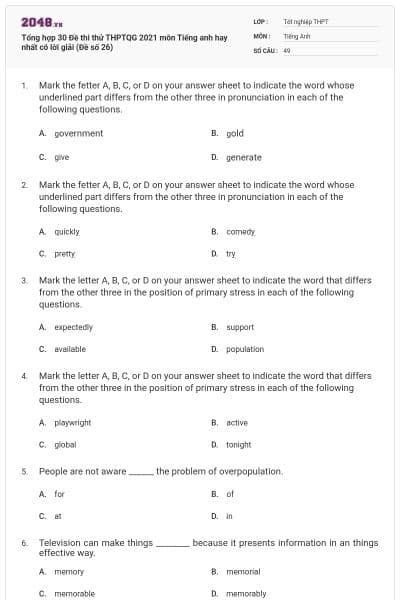
Mark the fetter A, B, C, or D on your answer sheet to indicate the word whose underlined part differs from the other three in pronunciation in each of the following questions.
government
gold
give
generate
Đáp án D
Kiến thức về phát âm
A. government /’gʌvərnməmt/ B. gold /goʊld/
C. give /giv/ D. generate /’dʒenəreɪt/
=> Phương án D có phần gạch chân được phát âm là /dʒ/, các phương án còn lại được phát âm là /g/.
Mark the fetter A, B, C, or D on your answer sheet to indicate the word whose underlined part differs from the other three in pronunciation in each of the following questions.
quickly
comedy
pretty
try
Đáp án D
Kiến thức về phát âm
A. quickly /’kwɪkli/ B. comedy /'kɒmɪdi/
C. pretty /'prɪti/ D. try /traɪ/
=> Phương án D có phần gạch chân được phát âm là /ai/, các phương án còn lại được phát âm là /i/.
Mark the letter A, B, C, or D on your answer sheet to indicate the word that differs from the other three in the position of primary stress in each of the following questions.
expectedly
support
available
population
Đáp án D
Kiến thức về trọng âm
A. expectedly /iks’pektidli/: từ này trọng âm rơi vào âm tiết thứ hai. Vì theo quy tắc đuôi -ly và -ed không ảnh hưởng đến trọng âm của từ và trọng âm rơi vào phần kết thúc với nhiều hơn một phụ âm /kt/.
B. support /sə'pɔ:t/: từ này trọng âm rơi vào âm tiết thứ hai. Vì theo quy tắc trọng âm không rơi vào âm /ə/ và trọng âm rơi vào nguyên âm dài /ɔ:/.
C. available /ə'veɪləb(ə)l/: từ này trọng âm rơi vào âm tiết thứ hai. Vi theo quy tắc trọng âm không rơi vào đuôi —able và âm /ə/.
D. population /pɒpjʊ’leɪ∫(ə)n/: từ này trọng âm rơi vào âm tiết thứ ba. Vì theo quy tắc đuôi -ion làm trọng âm rơi vào trước âm đó.
=> Phương án D có trọng âm rơi vào âm tiết thứ ba, các phương án còn lại có trọng âm rơi vào âm tiết thứ hai.
Mark the letter A, B, C, or D on your answer sheet to indicate the word that differs from the other three in the position of primary stress in each of the following questions.
playwright
active
global
tonight
Đáp án D
Kiến thức về trọng âm
A. playwright /’pleɪraɪt/: từ này trọng âm rơi vào âm tiết thứ nhất. Vì theo quy tắc danh từ ghép thì trọng âm rơi vào từ đầu.
B. active /'æktiv/: từ này trọng âm rơi vào âm tiết thứ nhất. Vì theo quy tắc đuôi –ive làm trọng âm rơi vào trước âm đó.
C. global /’gloubl/: từ này trọng âm rơi vào âm tiết thứ nhất. Vì theo quy tắc đuôi –al không ảnh hưởng đến trọng âm của từ.
D. tonight /tə'nait/: từ này trọng âm rơi vào âm tiết thứ hai. Vì theo quy tắc trọng âm không rơi vào âm /ə/ và trọng âm rơi vào nguyên âm đôi /ai/.
=> Phương án D có trọng âm rơi vào âm tiết thứ hai, các phương án còn lại có trọng âm rơi vào âm tiết thứ nhất.
People are not aware ______ the problem of overpopulation.
for
of
at
in
Đáp án B
Kiến thức về giới từ
- to be aware of st: ý thức về cái gì
Tạm dịch: Con người không ý thức được về vấn đề bùng nổ dân số.
Television can make things ________ because it presents information in an things effective way.
memory
memorial
memorable
memorably
Đáp án C
Kiến thức về từ loại
A. memory /'meməri/(n): kỉ niệm
B. memorial /mə’mɔ:riəl/(a/n): để kỉ niệm, để ghi nhớ/ đài kỉ niệm
C. memorable / ’memərəbl/ (a): không thể quên được, dễ nhớ
D. memorably /’memərəbli/(adv): đáng ghi nhớ
Ta có cấu trúc: make st + adj => Đáp án là C
Tạm dịch: Ti vi làm mọi thứ trở lên dễ nhớ bởi vì nó tái hiện thông tin theo những cách rất hiệu quả.
Some scientists say that there are enough resources to ______ 8 billion people.
provide
distribute
raise
support
Đáp án D
Kiến thức về từ vựng
A. provide /prə'vaid/ (v): cung cấp
B. distribute /dis'tribju:t/ (v): phân phối, phân phát
C. raise /reiz/ (v): nâng lên, giơ lên
D. support /sə’pɔ:t/ (v): nuôi dưỡng, chống đỡ, ủng hộ
Tạm dịch: Một số nhà khoa học nói rằng có đủ tài nguyên để nuôi sống 8 tỉ người.
______ the flood has receded, people can move back into their homes.
Now that
Due to
Although
So that
Đáp án A
Kiến thức về liên từ
A. Now that = because = seeing that + clause: bởi vi
B. Due to = on account of = owning to = as a result of: because of+ cụm danh từ/Ving: bởi vì
C. Although + clause: mặc dù
D. So that/in order that + clause = in order to/so as to/to + V: để mà
Tạm dịch: Bởi vì nước lũ đã rút nên mọi người có thể quay trở về nhà mình.
John and Karen persuaded me ________ the conference.
attending
attended
to attend
to have attended
Đáp án C
Kiến thức về cấu trúc
Persuade + sb + to V: thuyết phục ai làm gì
Tạm dich: John và Karen thuyết phục tôi tham dự buổi hội nghị.
The world work is developing very quickly. If you don't self-learn continuously, we will not ______ social movements.
put up with
keep up with
get on with
deal with
Đáp án B
Kiến thức về cụm động từ
A. put up with: chịu đựng ai hoặc cái gì đấy B. keep up with: bắt kịp với
C. get on with: thân thiện (với ai), ăn ý (với ai) D. deal with: giải quyết cái gì
Tạm dịch: Công việc của thế giới đang phát triển rất nhanh. Nếu bạn không tự học liên tục, chúng ta sẽ không theo kịp các chuyển động của xã hội.
I wish you ______ me a new one instead of having it _______ as you did.
had given/repaired
gave/to repair
would give/to repair
had given/to be repaired
Đáp án A
Kiến thức về câu ước và thể nhở vả
- Trong câu là ước cho một việc trong quá khứ, cấu trúc wish cho quá khứ: wish + S + quá khứ hoàn thành
- Cấu trúc have sth done: có cái gì được làm (bởi ai đó, bản thân mình không làm)
Tạm dịch: Tôi ước rằng bạn đã cho tôi một cái mới thay vì sửa chữa nó như bạn đã làm.
The more you practise your English, _________.
Faster you learn.
the faster will you learn.
You will learn faster.
the faster you will learn.
Đáp án D
Kiến thức về so sánh
Cấu trúc so sánh càng…thì càng…:
The + dạng so sánh hơn của tính/trạng từ + mệnh đề, the + dạng so sánh hơn của tính/trạng từ + mệnh đề. => Loại A/C
Đáp án B không đúng vì đã đảo “will" lên trước chủ ngữ.
Tạm dịch: Bạn càng luyện tập tiếng Anh, bạn sẽ càng học nhanh hơn.
China is one of the most _______ populated areas in the world.
wastefully
perfectly
densely
completely
Đáp án C
Kiến thức về từ vựng
A. wastefully /'wəɪstfəl/ (adv): hoang phí, lãng phí
B. perfectly /’pə:fiktli/ (adv): một cách hoàn toàn, hoàn hảo
C. densely /'densli/ (adv): dày đặc, đông đúc
D. completely /kəm'pli:tli/ (adv): hoàn toàn, đầy đủ, toàn vẹn
Tạm dịch: Trung Quốc là một trung những quốc gia đông dân nhất thế giới.
We have had a 2% _______ in salary this year, which is higher than it used to be.
decrease
deflation
increase
inflation
Đáp án C
Kiến thức về từ vựng
A. decrease /’di:kri:s/ (n), decrease /dɪ'kri:s/ (v): giảm
B. deflation /di'flei∫ən/ (n): sự giảm phát
C. increase /ɪn'kri:s/ (v), increase /’ɪηkri:s/ (n): tăng lên
D. inflation /ɪn'fieɪ∫n/ (n): sự lạm phát
Tạm dịch: Năm nay chúng tôi đã được tăng 2% lương, nó cao hơn so với trước kia.
Which channel do you ______ to someone who likes animals?
suggest
recommend
tell
talk
Đáp án B
Kiến thức về cấu trúc ngữ pháp
A. suggest + ving: gợi ý làm gì B. recommend st to sh: giới thiệu cái gì cho ai
C. tell sh about st: kể với ai về cái gì D. talk with sb: nói chuyện với ai
Tạm dịch: Kênh tivi nào bạn giới thiệu cho người thích động vật?
A ______ is a film with factual information, often about a problem in society.
love story film
soap opera
documentary
drama
Đáp án C
Kiến thức về từ vựng
A. love story film: phim tâm lí tình cảm
B. soap opera: loạt phim (kịch) nhiều kỳ trên truyền hình, truyền thanh ủy mị, sướt mướt (như) soap
C. documentary: phim tài liệu
D. drama: kịch
Tạm dịch: Phim tài liệu là một loại phim với những thông tin có thực, thường là về một vấn đề trong xã hội.
Mark the letter A, it C, or D on your answer sheet to indicate the word(s) CLOSEST in meaning to the underlined word (s) in each of the following questions.
A US man with a large online following in Vietnam has caused widespread anger, and faces possible criminal charges, over a Facebook post thought to have insulted a military hero.
embarrassed
offended
confused
depressed
Đáp án B
Từ đồng nghĩa
Tạm dịch: Một người đàn ông Hoa Kỳ có số lượng người theo dõi online lớn ở Việt Nam đã gây ra sự giận dữ rộng khắp, và đối mặt với những cáo buộc hình sự có thể, vì một bài đăng trên Facebook được cho là xúc phạm một vị anh hùng quân đội.
=> insult /ɪn'sʌlt/ (v): lăng mạ, sỉ nhục
A. embarrass /im’bærəs/ (v): làm lúng túng, làm bối rối
B. offend /ə’fend/ (v): xúc phạm, làm mất lòng
C. confuse /kən'fju:z/ (v): làm lúng túng, làm đảo lộn
D. depress /di’pres/ (v): làm chán nản, làm phiền muộn
=>Đảp án B (insult = offend)
Mark the letter A, it C, or D on your answer sheet to indicate the word(s) CLOSEST in meaning to the underlined word (s) in each of the following questions.
The population growth trends to increase in developing countries and decline in developed ones.
grow
fall
increase
gain
Đáp án B
Từ đồng nghĩa
Tạm dịch: Gia tăng dân số có khuynh hướng tăng lên ở các quốc gia đang phát triển và giảm ở những nước phát triển => decline (v): giảm = B. fall
A. grow = C. increase (v): tăng lên D. gain (v): đạt được
Mark the letter A, B, C, or D on your answer sheet to indicate the word(s) OPPOSITE in meaning to the underlined word(s) in each of the following questions.
As a newspaper reporter, she always wanted to get information at first hand.
indirectly
directly
easily
slowly
Đáp án A
Từ trái nghĩa
Tạm dịch: Là một phóng viên báo chí, cô ấy luôn muốn nhận được thông tin một cách trực tiếp
=> At first hand: trực tiếp
A. Indirectly (adv): một cách gián tiếp B. Directly (adv): trực tiếp
C. Easily (adv): dễ dàng D. Slowly (adv): chậm rãi
=> Đáp án A (at first hand >< indirectly)
Mark the letter A, B, C, or D on your answer sheet to indicate the word(s) OPPOSITE in meaning to the underlined word(s) in each of the following questions.
The world population is now widely distributed all over the planet.
extended
reduced
scattered
gathered
Đáp án D
Từ trái nghĩa
Tạm dịch: Dân số thế giới đang phân bố rộng khắp cả hành tinh.
=> distribute (v): phân bố
A. extended: mở rộng B. reduced: giảm
C. scattered: rải rác D. gathered: tụ tập
Mark the letter A, B, C, or D on your answer sheet to indicate the sentence that best completes each of the following exchanges.
Tung: "Your shoes are terrific, Tuan. The colour quite suits you."
Tuan: " ______ "
Really?
Do you like them?
You must be kidding. My shirt is nice, isn't it?
I'm glad you like them.
Đáp án D
Tình huống giao tiếp
Tạm dịch:
Tung: “Giày của cậu trông tuyệt quá, Tuấn. Màu sắc hợp cậu phết đấy."
Tuan: “__________________. ”
A. Thật chứ?
B. Cậu thích chúng không?
C. Cậu chắc đang đùa. Áo của tôi đẹp đúng không?
D. Tôi rất vui vì cậu thích chúng.
Mark the letter A, B, C, or D on your answer sheet to indicate the sentence that best completes each of the following exchanges.
Lan: "Would you say the Great Wall is among the seven man-made wonders of the world?"
Trang: "________"
That's the least I could do.
Do you think so, too?
There's no doubt about that.
It was created by ancient Chinese people, wasn't it?
Đáp án C
Tình huống giao tiếp
Tạm dịch:
Lan: “Cậu có nghĩ là Vạn Lý Trường Thành là một trong 7 kỳ quan nhân tạo của thế giới không?"
Trang: “___________.”
A. Đó là điều nhỏ nhất tớ có thể làm được.
B. Cậu có nghĩ như vậy không?
C. Không còn nghi ngờ gì về điều đó cả.
D. Có phải nó được tạo ra bởi những người Hoa Cổ?
Read the following passage and mark the letter A, B, C, or D on your answer sheet to indicate the correct word or phrase that best fits each of the numbered blanks from 23 to 27.
SOCIAL NETWORK
A 16-year-old girl from Essex has been sacked after describing her job as boring on the social networking website, Facebook. The teenager, who had been working (23) ____ an administrative assistant at a marketing company for just three weeks, didn't feel very enthusiastic about the duties she was asked to do. (24) _____ of moaning to her friends she decided to express her thoughts on her Facebook page to a colleague, who (25) _____ the boss's attention to it. He immediately fired her on the (26) _____ that her public display of dissatisfaction made it impossible for her to continue working for the company. She later told newspapers she had been treated totally unfairly, especially as she hadn't even mentioned the company's name. She claimed she's been perfectly happy with her job and that her lighthearted comments shouldn't (27) _____ taken seriously. A spokesperson from a workers' union said the incident demonstrated two things: firstly, that people need to protect their privacy online and secondly, that employers should be less sensitive to criticism.
Điền vào ô 23.
for
as
like
at
Đáp án B
CHỦ ĐỀ MASS MEDIA
Work + as + nghề nghiệp: làm nghề gì
Tạm dịch:
“The teenager, who had been working (23) ______ an administrative assistant at a marketing company for just three weeks, didn’t feel very enthusiastic about the duties she was asked to do."
(Cô gái - người đã từng làm trợ lý hành chính tại một công ty tiếp thị chỉ trong ba tuần, đã không cảm thấy rất nhiệt tình về những nhiệm vụ mà cô được yẻu cầu phải làm)
Read the following passage and mark the letter A, B, C, or D on your answer sheet to indicate the correct word or phrase that best fits each of the numbered blanks from 23 to 27.
SOCIAL NETWORK
A 16-year-old girl from Essex has been sacked after describing her job as boring on the social networking website, Facebook. The teenager, who had been working (23) ____ an administrative assistant at a marketing company for just three weeks, didn't feel very enthusiastic about the duties she was asked to do. (24) _____ of moaning to her friends she decided to express her thoughts on her Facebook page to a colleague, who (25) _____ the boss's attention to it. He immediately fired her on the (26) _____ that her public display of dissatisfaction made it impossible for her to continue working for the company. She later told newspapers she had been treated totally unfairly, especially as she hadn't even mentioned the company's name. She claimed she's been perfectly happy with her job and that her lighthearted comments shouldn't (27) _____ taken seriously. A spokesperson from a workers' union said the incident demonstrated two things: firstly, that people need to protect their privacy online and secondly, that employers should be less sensitive to criticism.
Điền vào ô 24.
Due
Regardless
Instead
In spite
Đáp án C
Kiến thức về liên từ
A. due to: bởi vì B. regardless of: bất kể
C. instead of: thay vì D. in spite of: despite: mặc dù
Tạm dịch:
“(24)_______ of moaning to her friends she decided to express her thoughts on her Facebook page to a colleague...”
(Thay vì phàn nàn với bạn bè của mình, cô quyết định thể hiện suy nghĩ của mình trên trang Facebook về một đồng nghiệp...)
Read the following passage and mark the letter A, B, C, or D on your answer sheet to indicate the correct word or phrase that best fits each of the numbered blanks from 23 to 27.
SOCIAL NETWORK
A 16-year-old girl from Essex has been sacked after describing her job as boring on the social networking website, Facebook. The teenager, who had been working (23) ____ an administrative assistant at a marketing company for just three weeks, didn't feel very enthusiastic about the duties she was asked to do. (24) _____ of moaning to her friends she decided to express her thoughts on her Facebook page to a colleague, who (25) _____ the boss's attention to it. He immediately fired her on the (26) _____ that her public display of dissatisfaction made it impossible for her to continue working for the company. She later told newspapers she had been treated totally unfairly, especially as she hadn't even mentioned the company's name. She claimed she's been perfectly happy with her job and that her lighthearted comments shouldn't (27) _____ taken seriously. A spokesperson from a workers' union said the incident demonstrated two things: firstly, that people need to protect their privacy online and secondly, that employers should be less sensitive to criticism.
Điền vào ô 25.
got
caught
paid
drew
Đáp án D
Kiến thức về cụm từ cố định
Draw one’s attention to...: thu hút sự chú ý của ai tới...
Tạm dịch:
"lnstead of moaning to her friends she decided to express her thoughts on her Facebook page to a colleague, who (25)________ the boss’s attention to it."
(Thay vì phàn nàn với bạn bè của mình, cô quyết định thể hiện suy nghĩ của mình trên trang Facebook về một đồng nghiệp, người đã thu hút sự chú ý của ông chủ vào nó.)
Read the following passage and mark the letter A, B, C, or D on your answer sheet to indicate the correct word or phrase that best fits each of the numbered blanks from 23 to 27.
SOCIAL NETWORK
A 16-year-old girl from Essex has been sacked after describing her job as boring on the social networking website, Facebook. The teenager, who had been working (23) ____ an administrative assistant at a marketing company for just three weeks, didn't feel very enthusiastic about the duties she was asked to do. (24) _____ of moaning to her friends she decided to express her thoughts on her Facebook page to a colleague, who (25) _____ the boss's attention to it. He immediately fired her on the (26) _____ that her public display of dissatisfaction made it impossible for her to continue working for the company. She later told newspapers she had been treated totally unfairly, especially as she hadn't even mentioned the company's name. She claimed she's been perfectly happy with her job and that her lighthearted comments shouldn't (27) _____ taken seriously. A spokesperson from a workers' union said the incident demonstrated two things: firstly, that people need to protect their privacy online and secondly, that employers should be less sensitive to criticism.
Điền vào ô 26.
terms
condition
grounds
basis
Đáp án C
Kiến thức về cụm từ cố định
A. term (n): khái niệm B. condition (n): điều kiện
C. grounds (n): nền tảng D. basis (n): cơ bản
On the grounds that...: trên nền tăng..., với lí do là...
Tạm dịch:
“He immediately fired her on the (26)______ that her public display of dissatisfaction made it impossible for her to continue working for the company.”
(Ông ta ngay lập tức đuổi việc cô ấy vì việc cô ấy thế hiện sự không hài lòng trên mạng xã hội khiến cô ta không thể tiếp tục làm việc cho công ty.)
Read the following passage and mark the letter A, B, C, or D on your answer sheet to indicate the correct word or phrase that best fits each of the numbered blanks from 23 to 27.
SOCIAL NETWORK
A 16-year-old girl from Essex has been sacked after describing her job as boring on the social networking website, Facebook. The teenager, who had been working (23) ____ an administrative assistant at a marketing company for just three weeks, didn't feel very enthusiastic about the duties she was asked to do. (24) _____ of moaning to her friends she decided to express her thoughts on her Facebook page to a colleague, who (25) _____ the boss's attention to it. He immediately fired her on the (26) _____ that her public display of dissatisfaction made it impossible for her to continue working for the company. She later told newspapers she had been treated totally unfairly, especially as she hadn't even mentioned the company's name. She claimed she's been perfectly happy with her job and that her lighthearted comments shouldn't (27) _____ taken seriously. A spokesperson from a workers' union said the incident demonstrated two things: firstly, that people need to protect their privacy online and secondly, that employers should be less sensitive to criticism.
Điền vào ô 27.
to be
have been
be
have
Đáp án B
Kiến thức động từ khuyết thiếu
Cấu trúc " shouldn’t+ have + VPZ” nghĩa là: đã không nên làm gì
Tạm dịch:
“She claimed she's been perfectly happy with her job and that her light-hearted comments shouldn’t (27)_______ taken seriously.”
(Cô cho rằng cô ấy hoàn toàn hải lòng với công việc của mình và những lời bình luận của cô ấy không nên được hiểu là nghiêm túc.)
Dịch bài
Một cô gái 16 tuổi đến từ Essex đã bị sa thải sau khi nói công việc của cô rất nhàm chán trên trang mạng xã hội, Facebook. Cô gái người đã từng làm trợ lý hành chính tại một công ty tiếp thị chỉ trong ba tuần, đã không cảm thấy nhiệt huyết với những nhiệm vụ mà cô được yêu cầu phải làm. Thay vì phàn nàn với bạn bè của mình, cô quyết định thể hiện suy nghĩ của mình trên trang Facebook về một đồng nghiệp, người đã thu hút sự chú ý của ông chủ vào nó. Ông ta ngay lập tức đuổi việc cô ấy vì việc cô ấy thế hiện sự không hài lông trên mạng xã hội khiến cô ta không thể tiếp tục làm việc cho công ty. Cô cho rằng cô ấy hoàn toàn hài lòng với công việc của mình và những lời bình luận của cô ấy không nên được hiểu là nghiêm túc. Một phát ngôn viên của một công đoàn cho biết vụ việc đã chứng mình hai điều: thứ nhất là mọi người cần bảo vệ quyền riêng tư của mình trên mạng và thứ hai là các ông chủ nên bớt nhạy cảm với những lời chỉ trích.
Read the following passage and mark the letter A, B, C, or D on your answer sheet to indicate the correct answer to each of the questions from 28 to 34.
China - Missing Women
In China the growing difference between the genders is giving signals of alarm to Government authorities. According to the latest census figures, 119 boys are born for every 100 girls. [A] This striking difference is expected to shoot up by the year 2020 with almost 40 million unsettled bachelors. This distribution of the social ecology would create havoc in the future. The social leaders are trying to pressurize the masses into producing more females. The Government has embarked on policies extending innumerable incentives to the families bearing girls.
Monetary support, free education, guaranteed employment is being gifted to parents who gift the country with a girl child. The Government is trying to persuade people to suppress their personal preferences and regulate their community behavior according to the new blueprint to stimulate the girl ratio. [B] Sometimes the Government tries to woo them and sometimes it uses stein policies to force them into it
Consequent to the population explosion, the Government introduced, in the 80's, one child policy in China. Any additional pregnancy had to be terminated. This was aimed to put a check on the teeming millions. [C] The policy had no relation to extermination of girl child in the womb. But the policymakers had no idea about its long term impact. People, with a patriarchic mindset, came up with their preference for a single male child. The idea of a happy family became 'parents with a single male child'.
The Chinese culture has always promoted sons over daughters because the society has been dominated by males. In villages, where hard work is needed to sustain the agriculture, a boy is always preferable due to his superior physical strength compared to that of a girl. [D] In such circumstances, looking forward to a male baby seems justified. If people have to limit their families, it is obvious they would prefer a boy over a girl child. This problem has been accentuated by the use of ultrasound scanning which helps determine the sex of the fetus. This technology has played a crucial role in creating gender imbalance.
The word "havoc" in paragraph 1 is closest in meaning to ?
ordinary problem
great destruction and trouble
serious dispute
an infectious disease
Đáp án B
CHỦ ĐỀ POPULATION
Từ “havoc” trong đoạn 1 gần nghĩa nhất với ___________.
A. vấn đề bất thường B. hủy hoại lớn và rắc rối
C. tranh chấp nghiêm trọng D. một bệnh truyền nhiễm
“havoc” = great destruction and trouble: tan phá, huỷ hoại nghiêm trọng
Dựa vào ngữ cảnh của câu sau:
“This distribution of the social ecology would create havoc in the future.”
(Sự phân bố này của hệ sinh thái xă hội sẽ gây ra sự tàn phá trong tương lai.)
Read the following passage and mark the letter A, B, C, or D on your answer sheet to indicate the correct answer to each of the questions from 28 to 34.
China - Missing Women
In China the growing difference between the genders is giving signals of alarm to Government authorities. According to the latest census figures, 119 boys are born for every 100 girls. [A] This striking difference is expected to shoot up by the year 2020 with almost 40 million unsettled bachelors. This distribution of the social ecology would create havoc in the future. The social leaders are trying to pressurize the masses into producing more females. The Government has embarked on policies extending innumerable incentives to the families bearing girls.
Monetary support, free education, guaranteed employment is being gifted to parents who gift the country with a girl child. The Government is trying to persuade people to suppress their personal preferences and regulate their community behavior according to the new blueprint to stimulate the girl ratio. [B] Sometimes the Government tries to woo them and sometimes it uses stein policies to force them into it
Consequent to the population explosion, the Government introduced, in the 80's, one child policy in China. Any additional pregnancy had to be terminated. This was aimed to put a check on the teeming millions. [C] The policy had no relation to extermination of girl child in the womb. But the policymakers had no idea about its long term impact. People, with a patriarchic mindset, came up with their preference for a single male child. The idea of a happy family became 'parents with a single male child'.
The Chinese culture has always promoted sons over daughters because the society has been dominated by males. In villages, where hard work is needed to sustain the agriculture, a boy is always preferable due to his superior physical strength compared to that of a girl. [D] In such circumstances, looking forward to a male baby seems justified. If people have to limit their families, it is obvious they would prefer a boy over a girl child. This problem has been accentuated by the use of ultrasound scanning which helps determine the sex of the fetus. This technology has played a crucial role in creating gender imbalance.
What is the main first of paragraph 1?
Government is providing incentives to girls.
Government is trying to decipher implications of the census records.
Government is devising polices to undermine the position of boys in the society.
Government is extending incentives to encourage parents with single girls
Đáp án D
Nội dung chính của đoạn 1 là gì?
A. Chính phủ đang tạo ra các ưu đãi cho trẻ em gái.
B. Chính phủ đang cố gắng để giải mà các hàm ý của các hồ sơ điều tra dân số.
C. Chính phủ đang xây dựng các chính sách để làm suy yếu vị trí của con trai trong xã hội.
D. Chinh phủ đang mở rộng ưu đãi để khuyến khích cha mẹ có con gái.
Thông tin:
“The Government has embarked on policies extending innumerable incentives to the families bearing girls. Monetary support, free education, guaranteed employment is being gifted to parents who gift the country with a girl child.” (Chính phủ đã bắt tay vào các chính sách mở rộng vô số ưu đãi cho các gia đình có con gái. Hỗ trợ tiền tệ, giáo dục miễn phí, công việc được bảo đảm đang được tặng cho các cha me có con gái.)
Read the following passage and mark the letter A, B, C, or D on your answer sheet to indicate the correct answer to each of the questions from 28 to 34.
China - Missing Women
In China the growing difference between the genders is giving signals of alarm to Government authorities. According to the latest census figures, 119 boys are born for every 100 girls. [A] This striking difference is expected to shoot up by the year 2020 with almost 40 million unsettled bachelors. This distribution of the social ecology would create havoc in the future. The social leaders are trying to pressurize the masses into producing more females. The Government has embarked on policies extending innumerable incentives to the families bearing girls.
Monetary support, free education, guaranteed employment is being gifted to parents who gift the country with a girl child. The Government is trying to persuade people to suppress their personal preferences and regulate their community behavior according to the new blueprint to stimulate the girl ratio. [B] Sometimes the Government tries to woo them and sometimes it uses stein policies to force them into it
Consequent to the population explosion, the Government introduced, in the 80's, one child policy in China. Any additional pregnancy had to be terminated. This was aimed to put a check on the teeming millions. [C] The policy had no relation to extermination of girl child in the womb. But the policymakers had no idea about its long term impact. People, with a patriarchic mindset, came up with their preference for a single male child. The idea of a happy family became 'parents with a single male child'.
The Chinese culture has always promoted sons over daughters because the society has been dominated by males. In villages, where hard work is needed to sustain the agriculture, a boy is always preferable due to his superior physical strength compared to that of a girl. [D] In such circumstances, looking forward to a male baby seems justified. If people have to limit their families, it is obvious they would prefer a boy over a girl child. This problem has been accentuated by the use of ultrasound scanning which helps determine the sex of the fetus. This technology has played a crucial role in creating gender imbalance.
What is the "blueprint" as discussed in paragraph 1
It is a list of rules for the Chinese people to follow to maintain population control.
It is a rough plan for regulating community behavior.
It is the Government's plan containing details of regulations and incentives to improve the girl child ratio.
It is a printed guide for conduct rules governing sex ratio
Đáp án C
“Kế hoạch chi tiết” như đã thảo luận trong đoạn 1 là gì?
A. Đó là một danh sach các quy tắc để người dân Trung Quốc làm theo để duy tri kiểm soát dân số.
B. Đó là một kế hoạch sơ bộ để điều chỉnh hành vi của cộng đồng.
C. Chính sách của Chính phủ bao gồm chi tiết về các quy định và khuyến khích để cải thiện tỷ lệ trẻ em gái.
D. Đó là hướng dẫn được in ra để thực hiện các quy tắc về tỷ lệ giới tính.
Read the following passage and mark the letter A, B, C, or D on your answer sheet to indicate the correct answer to each of the questions from 28 to 34.
China - Missing Women
In China the growing difference between the genders is giving signals of alarm to Government authorities. According to the latest census figures, 119 boys are born for every 100 girls. [A] This striking difference is expected to shoot up by the year 2020 with almost 40 million unsettled bachelors. This distribution of the social ecology would create havoc in the future. The social leaders are trying to pressurize the masses into producing more females. The Government has embarked on policies extending innumerable incentives to the families bearing girls.
Monetary support, free education, guaranteed employment is being gifted to parents who gift the country with a girl child. The Government is trying to persuade people to suppress their personal preferences and regulate their community behavior according to the new blueprint to stimulate the girl ratio. [B] Sometimes the Government tries to woo them and sometimes it uses stein policies to force them into it
Consequent to the population explosion, the Government introduced, in the 80's, one child policy in China. Any additional pregnancy had to be terminated. This was aimed to put a check on the teeming millions. [C] The policy had no relation to extermination of girl child in the womb. But the policymakers had no idea about its long term impact. People, with a patriarchic mindset, came up with their preference for a single male child. The idea of a happy family became 'parents with a single male child'.
The Chinese culture has always promoted sons over daughters because the society has been dominated by males. In villages, where hard work is needed to sustain the agriculture, a boy is always preferable due to his superior physical strength compared to that of a girl. [D] In such circumstances, looking forward to a male baby seems justified. If people have to limit their families, it is obvious they would prefer a boy over a girl child. This problem has been accentuated by the use of ultrasound scanning which helps determine the sex of the fetus. This technology has played a crucial role in creating gender imbalance.
The word "teeming" in paragraph 2 is closest in meaning to
overflowing
female population
couples
general population
Đáp án A
Từ “teeming” trong đoạn 2 gần nhất có nghĩa là________?
A. đầy tràn B. dân số nữ
C. cặp vợ chồng D. dân số nói chung
am dịch
Dựa vào ngữ cảnh của câu:
“Consequent to the population explosion, the Government introduced, in the 80’s, one child policy in China. Any additional pregnancy had to be terminated. This was aimed to put a check on the teeming millions.”
(Kết quả của bùng nổ dân số, vào những năm 80, chính phủ đã giới thiệu chính sách một con ở Trung Quốc. Bất kỳ thai kỳ bổ sung nào cũng phải chấm dứt. Điều này nhằm mục đích kìm nén hàng triệu người đông đúc.)
=> "teeming" = overflowing: đông đúc, nhiều, tràn đầy
Read the following passage and mark the letter A, B, C, or D on your answer sheet to indicate the correct answer to each of the questions from 28 to 34.
China - Missing Women
In China the growing difference between the genders is giving signals of alarm to Government authorities. According to the latest census figures, 119 boys are born for every 100 girls. [A] This striking difference is expected to shoot up by the year 2020 with almost 40 million unsettled bachelors. This distribution of the social ecology would create havoc in the future. The social leaders are trying to pressurize the masses into producing more females. The Government has embarked on policies extending innumerable incentives to the families bearing girls.
Monetary support, free education, guaranteed employment is being gifted to parents who gift the country with a girl child. The Government is trying to persuade people to suppress their personal preferences and regulate their community behavior according to the new blueprint to stimulate the girl ratio. [B] Sometimes the Government tries to woo them and sometimes it uses stein policies to force them into it
Consequent to the population explosion, the Government introduced, in the 80's, one child policy in China. Any additional pregnancy had to be terminated. This was aimed to put a check on the teeming millions. [C] The policy had no relation to extermination of girl child in the womb. But the policymakers had no idea about its long term impact. People, with a patriarchic mindset, came up with their preference for a single male child. The idea of a happy family became 'parents with a single male child'.
The Chinese culture has always promoted sons over daughters because the society has been dominated by males. In villages, where hard work is needed to sustain the agriculture, a boy is always preferable due to his superior physical strength compared to that of a girl. [D] In such circumstances, looking forward to a male baby seems justified. If people have to limit their families, it is obvious they would prefer a boy over a girl child. This problem has been accentuated by the use of ultrasound scanning which helps determine the sex of the fetus. This technology has played a crucial role in creating gender imbalance.
What was the vision behind the government's policy discussed in paragraph 2?
The vision about China with women at top positions in the government
The vision for China to control its burgeoning population in near future
The vision about a female dominated society
The vision that Chinese young men and women would find life partners among themselves
Đáp án B
Tầm nhìn phía sau chính sách của chính phủ được thảo luận trong đoạn 2 là?
A. Tầm nhìn về Trung Quốc với phụ nữ ở các vị trí hàng đầu trong chính phủ.
B. Tầm nhìn cho Trung Quốc để kiểm soát dân số đang phát triển trong tương lai gần.
C. Tầm nhìn về một xã hội phụ nữ thống trị.
D. Tầm nhìn mà các thanh thiếu niên nam nữ Trung Quốc sẽ tìm được bạn đời.
Read the following passage and mark the letter A, B, C, or D on your answer sheet to indicate the correct answer to each of the questions from 28 to 34.
China - Missing Women
In China the growing difference between the genders is giving signals of alarm to Government authorities. According to the latest census figures, 119 boys are born for every 100 girls. [A] This striking difference is expected to shoot up by the year 2020 with almost 40 million unsettled bachelors. This distribution of the social ecology would create havoc in the future. The social leaders are trying to pressurize the masses into producing more females. The Government has embarked on policies extending innumerable incentives to the families bearing girls.
Monetary support, free education, guaranteed employment is being gifted to parents who gift the country with a girl child. The Government is trying to persuade people to suppress their personal preferences and regulate their community behavior according to the new blueprint to stimulate the girl ratio. [B] Sometimes the Government tries to woo them and sometimes it uses stein policies to force them into it
Consequent to the population explosion, the Government introduced, in the 80's, one child policy in China. Any additional pregnancy had to be terminated. This was aimed to put a check on the teeming millions. [C] The policy had no relation to extermination of girl child in the womb. But the policymakers had no idea about its long term impact. People, with a patriarchic mindset, came up with their preference for a single male child. The idea of a happy family became 'parents with a single male child'.
The Chinese culture has always promoted sons over daughters because the society has been dominated by males. In villages, where hard work is needed to sustain the agriculture, a boy is always preferable due to his superior physical strength compared to that of a girl. [D] In such circumstances, looking forward to a male baby seems justified. If people have to limit their families, it is obvious they would prefer a boy over a girl child. This problem has been accentuated by the use of ultrasound scanning which helps determine the sex of the fetus. This technology has played a crucial role in creating gender imbalance.
Which of the following is NOT correct about the one child policy in China?
Each Chinese family was allowed to have only one child,
Although the additional pregnancy was a girl child, it also had to be terminated.
The one child policy was introduced by the Chinese government in the 1980s.
With the purpose of controlling the population explosion, the Government introduced one child policy in China.
Đáp án B
Điều nào dưới đây không đúng về chính sách một con ở Trung Quốc?
A. Mỗi gia đình ở Trung Quốc chỉ được phép có một con.
B. Dù thai kì bổ sung có là một bé gái thì cũng phải bị loại bỏ.
C. Chính sách một con được giới thiệu bởi chính phủ Trung Quốc vào những năm 1980.
D. Với mục đích kiểm soát sự bùng nổ dân số, chính phủ đã áp dụng chính sách một con ở Trung Quốc.
Căn cứ vào thông tin sau:
“Any additional pregnancy had to be terminated. This was aimed to put a check on the teeming millions. The policy had no relation to extermination of girl child in the womb." (Bất kỳ thai kỳ bổ sung nào cũng phải chấm dứt. Điều này nhằm mục đích kìm nén hàng triệu người đông đúc. Chính sách này không có liên quan đến việc loại bỏ đứa con gái trong bụng mẹ.)
Read the following passage and mark the letter A, B, C, or D on your answer sheet to indicate the correct answer to each of the questions from 35 to 42.
Overpopulation, the situation of having large numbers of people with too few resources and too little space, is closely associated with poverty. It can result from high population density, or from low amounts of resources, or from both. Excessively high population densities put stress on available resources. Only a certain number of people can be supported on a given area of land, and that number depends on how much food and other resources the land can provide. In countries where people live primarily by means of simple farming, gardening, herding, hunting, and gathering, even large areas of land can support only small numbers of people because these labour intensive subsistence activities produce only small amounts of food.
In developed countries such as the United States, Japan, and the countries of Western Europe, overpopulation generally is not considered a major cause of poverty. These countries produce large quantitics of food through mechanized farming, which depends on commercial fertilizers, large-scale irrigation, and agricultural machinery. This form of production provides enough food to support the high densities of people in metropolitan areas.
A country's level of poverty can depend greatly on its mix of population density and agricultural productivity. Bangladesh, for example, has one of the world's highest population densities, with 1,147 persons per sq km. A large majority of the people of Bangladesh engage in low - productivity manual farming, which contributes to the country's extremely high level of poverty. Some of the smaller countries in Western Europe, such as the Netherlands and Belgium, have high population densities as well. These countries practise mechanized farming and are involved in high-tech industries, however, and therefore have high standards of living.
At the other end of the spectrum, many countries in sub-Saharan Africa have population densities of less than 30 persons per sq km. Many people in these countries practise manual subsistence farming; these countries also have infertile land, and lack the economic resources and technology to boost productivity. As a consequence, these nations are very poor. The United Slates has both relatively low population density and high agricultural productivity; it is one of the world's wealthiest nations.
High birth rates contribute to overpopulation in many developing countries. Children are assets to many poor families because the provide labour, usually for farming. Cultural norms in traditionally rural societies commonly sanction the value of large families. Also, the governments of developing countries often provide little or no support, financial or political, for family planning; even people who wish to keep their families small have difficulty doing so. For all these reasons, developing countries lend to have high rates of population growth.
Which of the following is given a definition in paragraph 1?
Overpopulation
Population density
Simple farming
Poverty
Đáp án A
Chủ đề POPULATION (Trích đề THPTQG 2015)
Trong đoạn văn 1, cái nào dưới đây được đưa ra định nghĩa?
A. Bùng nổ dân số B. Mật độ dân số
C. Canh tác thủ công D. Nghèo đói
Căn cứ vào câu đầu tiên của đoạn văn: “Overpopulation, the situation of having large numbers of people with too few resources and too little space, is closely associated with poverty.” ( Bùng nổ dân số, một tình huống xảy ra khi có rất nhiều người nhưng lại với quá ít tài nguyên và chỗ ở, có liên hệ mật thiết đến đói nghèo.) => Bùng nổ dân số là từ được định nghĩa => Đáp án A
Read the following passage and mark the letter A, B, C, or D on your answer sheet to indicate the correct answer to each of the questions from 35 to 42.
Overpopulation, the situation of having large numbers of people with too few resources and too little space, is closely associated with poverty. It can result from high population density, or from low amounts of resources, or from both. Excessively high population densities put stress on available resources. Only a certain number of people can be supported on a given area of land, and that number depends on how much food and other resources the land can provide. In countries where people live primarily by means of simple farming, gardening, herding, hunting, and gathering, even large areas of land can support only small numbers of people because these labour intensive subsistence activities produce only small amounts of food.
In developed countries such as the United States, Japan, and the countries of Western Europe, overpopulation generally is not considered a major cause of poverty. These countries produce large quantitics of food through mechanized farming, which depends on commercial fertilizers, large-scale irrigation, and agricultural machinery. This form of production provides enough food to support the high densities of people in metropolitan areas.
A country's level of poverty can depend greatly on its mix of population density and agricultural productivity. Bangladesh, for example, has one of the world's highest population densities, with 1,147 persons per sq km. A large majority of the people of Bangladesh engage in low - productivity manual farming, which contributes to the country's extremely high level of poverty. Some of the smaller countries in Western Europe, such as the Netherlands and Belgium, have high population densities as well. These countries practise mechanized farming and are involved in high-tech industries, however, and therefore have high standards of living.
At the other end of the spectrum, many countries in sub-Saharan Africa have population densities of less than 30 persons per sq km. Many people in these countries practise manual subsistence farming; these countries also have infertile land, and lack the economic resources and technology to boost productivity. As a consequence, these nations are very poor. The United Slates has both relatively low population density and high agricultural productivity; it is one of the world's wealthiest nations.
High birth rates contribute to overpopulation in many developing countries. Children are assets to many poor families because the provide labour, usually for farming. Cultural norms in traditionally rural societies commonly sanction the value of large families. Also, the governments of developing countries often provide little or no support, financial or political, for family planning; even people who wish to keep their families small have difficulty doing so. For all these reasons, developing countries lend to have high rates of population growth.
What will suffer when there are excessively high population densities?
Available resources
Skilled labor
Farming methods
Land area
Đáp án A
Điều gì sẽ bị ảnh hưởng khi mật độ dân số vượt quá cao?
A. Nguồn tài nguyên sẵn có B. Lao động có tay nghề
C. Phương pháp canh tác D. Diện tích đất
Căn cứ vào thông tin sau: “|Excessively high population densities put stress on available resources.” (Mật độ dân số vượt quá cao gây áp lực đến nguồn tài nguyên sẵn có.)
=> Đáp án A
Read the following passage and mark the letter A, B, C, or D on your answer sheet to indicate the correct answer to each of the questions from 35 to 42.
Overpopulation, the situation of having large numbers of people with too few resources and too little space, is closely associated with poverty. It can result from high population density, or from low amounts of resources, or from both. Excessively high population densities put stress on available resources. Only a certain number of people can be supported on a given area of land, and that number depends on how much food and other resources the land can provide. In countries where people live primarily by means of simple farming, gardening, herding, hunting, and gathering, even large areas of land can support only small numbers of people because these labour intensive subsistence activities produce only small amounts of food.
In developed countries such as the United States, Japan, and the countries of Western Europe, overpopulation generally is not considered a major cause of poverty. These countries produce large quantitics of food through mechanized farming, which depends on commercial fertilizers, large-scale irrigation, and agricultural machinery. This form of production provides enough food to support the high densities of people in metropolitan areas.
A country's level of poverty can depend greatly on its mix of population density and agricultural productivity. Bangladesh, for example, has one of the world's highest population densities, with 1,147 persons per sq km. A large majority of the people of Bangladesh engage in low - productivity manual farming, which contributes to the country's extremely high level of poverty. Some of the smaller countries in Western Europe, such as the Netherlands and Belgium, have high population densities as well. These countries practise mechanized farming and are involved in high-tech industries, however, and therefore have high standards of living.
At the other end of the spectrum, many countries in sub-Saharan Africa have population densities of less than 30 persons per sq km. Many people in these countries practise manual subsistence farming; these countries also have infertile land, and lack the economic resources and technology to boost productivity. As a consequence, these nations are very poor. The United Slates has both relatively low population density and high agricultural productivity; it is one of the world's wealthiest nations.
High birth rates contribute to overpopulation in many developing countries. Children are assets to many poor families because the provide labour, usually for farming. Cultural norms in traditionally rural societies commonly sanction the value of large families. Also, the governments of developing countries often provide little or no support, financial or political, for family planning; even people who wish to keep their families small have difficulty doing so. For all these reasons, developing countries lend to have high rates of population growth.
The phrase "that number" in paragraph 1 refers to the number of _______.
people
densities
resources
countries
Đáp án A
Cụm từ “ that number” trong đoạn văn số 1 ám chỉ tới số tượng __________.
A. người B. mật do C. nguồn tài nguyên D. các quốc gia
Căn cứ vào câu có chứa cụm từ đó: “Only a certain number of people can be supported on a given area of land, and that number depends on how much food and other resources the land can provide.” (Chỉ một số tượng người nhất định có thể sống được trên một diện tích đất có sẵn và số người đó phụ thuộc vào khả năng vùng đất đó có thể cung cấp được bao nhiều lương thực và tài nguyên.
Read the following passage and mark the letter A, B, C, or D on your answer sheet to indicate the correct answer to each of the questions from 35 to 42.
Overpopulation, the situation of having large numbers of people with too few resources and too little space, is closely associated with poverty. It can result from high population density, or from low amounts of resources, or from both. Excessively high population densities put stress on available resources. Only a certain number of people can be supported on a given area of land, and that number depends on how much food and other resources the land can provide. In countries where people live primarily by means of simple farming, gardening, herding, hunting, and gathering, even large areas of land can support only small numbers of people because these labour intensive subsistence activities produce only small amounts of food.
In developed countries such as the United States, Japan, and the countries of Western Europe, overpopulation generally is not considered a major cause of poverty. These countries produce large quantitics of food through mechanized farming, which depends on commercial fertilizers, large-scale irrigation, and agricultural machinery. This form of production provides enough food to support the high densities of people in metropolitan areas.
A country's level of poverty can depend greatly on its mix of population density and agricultural productivity. Bangladesh, for example, has one of the world's highest population densities, with 1,147 persons per sq km. A large majority of the people of Bangladesh engage in low - productivity manual farming, which contributes to the country's extremely high level of poverty. Some of the smaller countries in Western Europe, such as the Netherlands and Belgium, have high population densities as well. These countries practise mechanized farming and are involved in high-tech industries, however, and therefore have high standards of living.
At the other end of the spectrum, many countries in sub-Saharan Africa have population densities of less than 30 persons per sq km. Many people in these countries practise manual subsistence farming; these countries also have infertile land, and lack the economic resources and technology to boost productivity. As a consequence, these nations are very poor. The United Slates has both relatively low population density and high agricultural productivity; it is one of the world's wealthiest nations.
High birth rates contribute to overpopulation in many developing countries. Children are assets to many poor families because the provide labour, usually for farming. Cultural norms in traditionally rural societies commonly sanction the value of large families. Also, the governments of developing countries often provide little or no support, financial or political, for family planning; even people who wish to keep their families small have difficulty doing so. For all these reasons, developing countries lend to have high rates of population growth.
In certain countries, large areas of land can only yield small amounts of food because _______.
there is a lack of mechanization
there are small numbers of labourers
there is on abundance of resources
there is no shortage of skilled labour
Đáp án A
Ở một số quốc gia nhất định, những vùng đất rộng lớn chỉ có thể cho ra một lượng lương thực nhỏ bởi vì __________ .
A. thiếu sự cơ giới hóa B. có ít lao động
C. có nhiều tài nguyên D. thiếu lao động có tay nghề
Căn cứ vào thông tin sau trong đoạn văn: “ln countries where people live primarily by means of simple fanning, gardening, herding, hunting, and gathering, even large areas of land can support only small numbers of people because these labour intensive subsistence activities produce only small amounts of food.” (Ở những quốc gia nơi mà con người sống chủ yếu bằng phương thức canh tác thô sơ như làm vườn, săn bắt, thu lượm, thì thậm chí trên một diện tích đất đai rộng lớn cũng chỉ có thể nuôi sống được một số tượng ít người bởi vì hoạt động sản xuất này chỉ tạo ra một lượng thực phẩm nhỏ.)
Read the following passage and mark the letter A, B, C, or D on your answer sheet to indicate the correct answer to each of the questions from 35 to 42.
Overpopulation, the situation of having large numbers of people with too few resources and too little space, is closely associated with poverty. It can result from high population density, or from low amounts of resources, or from both. Excessively high population densities put stress on available resources. Only a certain number of people can be supported on a given area of land, and that number depends on how much food and other resources the land can provide. In countries where people live primarily by means of simple farming, gardening, herding, hunting, and gathering, even large areas of land can support only small numbers of people because these labour intensive subsistence activities produce only small amounts of food.
In developed countries such as the United States, Japan, and the countries of Western Europe, overpopulation generally is not considered a major cause of poverty. These countries produce large quantitics of food through mechanized farming, which depends on commercial fertilizers, large-scale irrigation, and agricultural machinery. This form of production provides enough food to support the high densities of people in metropolitan areas.
A country's level of poverty can depend greatly on its mix of population density and agricultural productivity. Bangladesh, for example, has one of the world's highest population densities, with 1,147 persons per sq km. A large majority of the people of Bangladesh engage in low - productivity manual farming, which contributes to the country's extremely high level of poverty. Some of the smaller countries in Western Europe, such as the Netherlands and Belgium, have high population densities as well. These countries practise mechanized farming and are involved in high-tech industries, however, and therefore have high standards of living.
At the other end of the spectrum, many countries in sub-Saharan Africa have population densities of less than 30 persons per sq km. Many people in these countries practise manual subsistence farming; these countries also have infertile land, and lack the economic resources and technology to boost productivity. As a consequence, these nations are very poor. The United Slates has both relatively low population density and high agricultural productivity; it is one of the world's wealthiest nations.
High birth rates contribute to overpopulation in many developing countries. Children are assets to many poor families because the provide labour, usually for farming. Cultural norms in traditionally rural societies commonly sanction the value of large families. Also, the governments of developing countries often provide little or no support, financial or political, for family planning; even people who wish to keep their families small have difficulty doing so. For all these reasons, developing countries lend to have high rates of population growth.
Bangladesh is a country where the level of poverty depends greatly on _______.
its population density only
both population density and agricultural productivity
population density in metropolitan areas
its high agricultural productivity
Đáp án B
Bangladesh Id một quốc gia nơi mà mức độ nghèo tùy thuộc cơ bản vào ___________.
A. chỉ mật độ dân số của nó
B. cả mật độ dân số lẫn năng suất nông nghiệp
C. mật độ dân số ở những khu vực trung tâm
D. năng suất nông nghiệp cao
Căn cứ vào thông tin sau trong đoạn văn: “A country's level of poverty can depend greatly on its mix of population density and agricultural productivity. Bangladesh, for example...” (Mức độ nghèo của một quốc gia phụ thuộc chủ yếu vào mật độ dân số và năng suất lao động của nó. Bangladesh là một ví dụ...)
Read the following passage and mark the letter A, B, C, or D on your answer sheet to indicate the correct answer to each of the questions from 35 to 42.
Overpopulation, the situation of having large numbers of people with too few resources and too little space, is closely associated with poverty. It can result from high population density, or from low amounts of resources, or from both. Excessively high population densities put stress on available resources. Only a certain number of people can be supported on a given area of land, and that number depends on how much food and other resources the land can provide. In countries where people live primarily by means of simple farming, gardening, herding, hunting, and gathering, even large areas of land can support only small numbers of people because these labour intensive subsistence activities produce only small amounts of food.
In developed countries such as the United States, Japan, and the countries of Western Europe, overpopulation generally is not considered a major cause of poverty. These countries produce large quantitics of food through mechanized farming, which depends on commercial fertilizers, large-scale irrigation, and agricultural machinery. This form of production provides enough food to support the high densities of people in metropolitan areas.
A country's level of poverty can depend greatly on its mix of population density and agricultural productivity. Bangladesh, for example, has one of the world's highest population densities, with 1,147 persons per sq km. A large majority of the people of Bangladesh engage in low - productivity manual farming, which contributes to the country's extremely high level of poverty. Some of the smaller countries in Western Europe, such as the Netherlands and Belgium, have high population densities as well. These countries practise mechanized farming and are involved in high-tech industries, however, and therefore have high standards of living.
At the other end of the spectrum, many countries in sub-Saharan Africa have population densities of less than 30 persons per sq km. Many people in these countries practise manual subsistence farming; these countries also have infertile land, and lack the economic resources and technology to boost productivity. As a consequence, these nations are very poor. The United Slates has both relatively low population density and high agricultural productivity; it is one of the world's wealthiest nations.
High birth rates contribute to overpopulation in many developing countries. Children are assets to many poor families because the provide labour, usually for farming. Cultural norms in traditionally rural societies commonly sanction the value of large families. Also, the governments of developing countries often provide little or no support, financial or political, for family planning; even people who wish to keep their families small have difficulty doing so. For all these reasons, developing countries lend to have high rates of population growth.
The word "infertile" in paragraph 4 probably means _______.
disused
impossible
unproductive
inaccessible
Đáp án C
Từ “infertile” trong đoạn văn số 4 có thể có nghĩa là ________.
A. không còn dùng đến nữa B. không thể
C. không màu mỡ D. không thể tới gần được
Dựa vào ngữ cảnh của câu sau: “Many people in these countries practise manual subsistence farming; these countries also have infertile land, and lack the economic resources and technology to boost productivity. (Nhiều người ở những quốc gia này sinh sống bằng phương thức canh tác thuần nông; những quốc gia này cũng có đất không còn màu mỡ và thiếu các nguồn lực kinh tế và công nghệ để thúc đẩy năng suất)
Read the following passage and mark the letter A, B, C, or D on your answer sheet to indicate the correct answer to each of the questions from 35 to 42.
Overpopulation, the situation of having large numbers of people with too few resources and too little space, is closely associated with poverty. It can result from high population density, or from low amounts of resources, or from both. Excessively high population densities put stress on available resources. Only a certain number of people can be supported on a given area of land, and that number depends on how much food and other resources the land can provide. In countries where people live primarily by means of simple farming, gardening, herding, hunting, and gathering, even large areas of land can support only small numbers of people because these labour intensive subsistence activities produce only small amounts of food.
In developed countries such as the United States, Japan, and the countries of Western Europe, overpopulation generally is not considered a major cause of poverty. These countries produce large quantitics of food through mechanized farming, which depends on commercial fertilizers, large-scale irrigation, and agricultural machinery. This form of production provides enough food to support the high densities of people in metropolitan areas.
A country's level of poverty can depend greatly on its mix of population density and agricultural productivity. Bangladesh, for example, has one of the world's highest population densities, with 1,147 persons per sq km. A large majority of the people of Bangladesh engage in low - productivity manual farming, which contributes to the country's extremely high level of poverty. Some of the smaller countries in Western Europe, such as the Netherlands and Belgium, have high population densities as well. These countries practise mechanized farming and are involved in high-tech industries, however, and therefore have high standards of living.
At the other end of the spectrum, many countries in sub-Saharan Africa have population densities of less than 30 persons per sq km. Many people in these countries practise manual subsistence farming; these countries also have infertile land, and lack the economic resources and technology to boost productivity. As a consequence, these nations are very poor. The United Slates has both relatively low population density and high agricultural productivity; it is one of the world's wealthiest nations.
High birth rates contribute to overpopulation in many developing countries. Children are assets to many poor families because the provide labour, usually for farming. Cultural norms in traditionally rural societies commonly sanction the value of large families. Also, the governments of developing countries often provide little or no support, financial or political, for family planning; even people who wish to keep their families small have difficulty doing so. For all these reasons, developing countries lend to have high rates of population growth.
Which of the following is a contributor to overpopulation in many developing countries?
High-tech facilities
Economic resources
Sufficient financial support
High birth rate
Đáp án D
Cái nào sau đây là yếu tổ dẫn tới bùng nổ dân số ở các nước đang phát triển?
A. Cơ sở vật chất công nghệ cao B. Nguồn lực kinh tế
C. Đủ hỗ trợ về tài chính D. Tỉ lệ sinh cao
Căn cứ vào câu đầu của đoạn cuối:
"High birth rates contribute to overpopulation in many developing countries.”
(Tỉ lệ sinh cao dẫn tới bùng nổ dân số ở nhiều quốc gia đang phát triển)
Read the following passage and mark the letter A, B, C, or D on your answer sheet to indicate the correct answer to each of the questions from 35 to 42.
Overpopulation, the situation of having large numbers of people with too few resources and too little space, is closely associated with poverty. It can result from high population density, or from low amounts of resources, or from both. Excessively high population densities put stress on available resources. Only a certain number of people can be supported on a given area of land, and that number depends on how much food and other resources the land can provide. In countries where people live primarily by means of simple farming, gardening, herding, hunting, and gathering, even large areas of land can support only small numbers of people because these labour intensive subsistence activities produce only small amounts of food.
In developed countries such as the United States, Japan, and the countries of Western Europe, overpopulation generally is not considered a major cause of poverty. These countries produce large quantitics of food through mechanized farming, which depends on commercial fertilizers, large-scale irrigation, and agricultural machinery. This form of production provides enough food to support the high densities of people in metropolitan areas.
A country's level of poverty can depend greatly on its mix of population density and agricultural productivity. Bangladesh, for example, has one of the world's highest population densities, with 1,147 persons per sq km. A large majority of the people of Bangladesh engage in low - productivity manual farming, which contributes to the country's extremely high level of poverty. Some of the smaller countries in Western Europe, such as the Netherlands and Belgium, have high population densities as well. These countries practise mechanized farming and are involved in high-tech industries, however, and therefore have high standards of living.
At the other end of the spectrum, many countries in sub-Saharan Africa have population densities of less than 30 persons per sq km. Many people in these countries practise manual subsistence farming; these countries also have infertile land, and lack the economic resources and technology to boost productivity. As a consequence, these nations are very poor. The United Slates has both relatively low population density and high agricultural productivity; it is one of the world's wealthiest nations.
High birth rates contribute to overpopulation in many developing countries. Children are assets to many poor families because the provide labour, usually for farming. Cultural norms in traditionally rural societies commonly sanction the value of large families. Also, the governments of developing countries often provide little or no support, financial or political, for family planning; even people who wish to keep their families small have difficulty doing so. For all these reasons, developing countries lend to have high rates of population growth.
Which of the following could be the best title for the passage?
High Birth Rate and its Consequences
Overpopulation; A Cause of Poverty
Overpopulation: A Worldwide Problem
Poverty in Developing Countries
Đáp án B
Cái nào dưới đây có thể là chủ đề thích hợp nhất cho đoạn văn này?
A. Tỉ lệ sinh cao và những hậu quả của nó
B. Bùng nổ dân số: Nguyên nhân của đói nghèo
C. Bùng nổ dân số: Một vấn đề toàn cầu
D. Đói nghèo ở các quốc gia đang phát triển
Tạm dịch
Bùng nổ dân số, tình trạng có rất nhiều người trong khi có quá ít tài nguyên và không gian, gắn liền với đói nghèo. Nó có thể là kết quả của mật độ dân số cao, hoặc từ các nguồn tài nguyên ít ỏi, hoặc từ cả hai. Mật độ dân số tăng cao đặt áp lực lên các nguồn lực sẵn có. Chỉ có một số người nhất định có thể được hỗ trợ trên một diện tích đất nhất định và số đó phụ thuộc vào lượng thức ăn và các nguồn tài nguyên khác mà đất có thể cung cấp. Ở những quốc gia mà người dân sống chủ yếu bằng phương pháp canh tác đơn giản, làm vườn, chăn thả gia súc, săn bắt và thu hái, thậm chí điện tích đất rộng chỉ có thể hỗ trợ cho một số lượng nhỏ người dân bởi vì các hoạt động sản xuất cần nhiều lao động này chỉ sản xuất một lượng nhỏ lương thực.
Ở các nước phát triển như Hoa Kỳ, Nhật Bản, và các nước Tây Âu, bùng nổ dân số thường không được coi là nguyên nhân chính của đói nghèo. Các nước này sản xuất số lượng lớn thực phẩm thông qua nông nghiệp cơ giới hóa, phụ thuộc vào phân bón thương mại, thủy lợi quy mô lớn và máy móc nông nghiệp. Hình thức sản xuất này cung cấp đủ thức ăn để hỗ trợ mật độ cao của người dân ở các khu vực đô thị.
Mức nghèo đói của một quốc gia có thể phụ thuộc rất nhiều vào việc kết hợp mật độ dân số và năng suất nông nghiệp. Ví dụ, Bangladesh là một trong những mật độ dân số cao nhất thế giới, với 1.147 người trên mỗi km vuông. Đa số người Bangladesh tham gia vào sản xuất nông nghiệp thủ công năng suất thấp, khiến cho mức nghèo đói của đất nước này rất cao. Một số nước nhỏ hơn ở Tây Âu, như Hà Lan và Bỉ, có mật độ dân số cao. Các nước này thực hiện nông nghiệp cơ giới hóa và tham gia vào các ngành công nghệ cao, tuy nhiên, và do đó có mức sống cao.
Ở đầu cuối của quang phổ, nhiều quốc gia ở châu Phi Vang ha Sahara có mật độ dân số dưới 30 người trên mỗi km vuông. Nhiều người ở những nước này thực hiện canh tác tự cung tự cấp; những nước này cũng có đất đai kém cỏi, thiếu nguồn lực kinh tế và công nghệ để tăng năng suất. Hậu quả là các quốc gia này rất nghèo. Hoa Kỳ có mật độ dân số tương đối thấp và năng suất nông nghiệp cao; nó là một trong những quốc gia giàu có nhất thế giới.
Tỷ lệ sinh cao làm tăng dân số ở nhiều nước đang phat triển. Trẻ em là tài sản của nhiều gia đình nghèo vì họ cung cấp lao động, thường là cho nông nghiệp. Các chuẩn mực văn hoá trong các xã hội truyền thống ở nông thôn thường tuân theo giá trị của các gia đình lớn. Ngoài ra, các chính phủ của các nước đang phát triển thường cung cấp ít hoặc không hỗ trợ, tài chính hay chính trị cho kế hoạch hóa gia đình; ngay cả những người muốn giữ cho gia đình họ ít con cũng gặp khó khăn trong việc làm việc đó. Vì tất cả những lý do này, các nước đang phat triển có xu hướng có tỷ lệ tăng dân số cao.
Mark the letter A, B, C, or D on your answer sheet to indicate the underlined part that needs correction in each of the following questions.
The Oxford Dictionary is well known for including many different meanings of words and to give real examples.
The
well known
meanings
to give
Đáp án D
Kiến thức cấu trúc song hành
Ở đây, cụm từ "include …” và "give…" song hành với nhau nên phải có cấu trúc ngữ pháp giống nhau
=> Đáp án D (to give => giving)
Tạm dịch: Từ điển Oxford được biết đến vì có rất nhiều nghĩa khác nhau của từ và đưa ra những ví dụ thực tế.
Mark the letter A, B, C, or D on your answer sheet to indicate the underlined part that needs correction in each of the following questions.
All the candidates for the scholarship will be equally treated aarding of their sex, age, or nationality.
candidates
scholarship
regarding
nationality
Đáp án C
Kiến thức về cụm từ cố định
regardless of something: bất chấp, bất kể cái gì
=> Đáp án C (regarding => regardless)
Tạm dịch: Tất cả các ứng viên cho học bổng sẽ được đối xử bình đẳng bất kể giới tính, tuổi, hoặc quốc tịch.
Mark the letter A, B, C, or D on your answer sheet to indicate the underlined part that needs correction in each of the following questions.
The assumption that smoking has bad effects on our health have been proved.
The
that
effects on
have
Đáp án D
Kiến thức sự hòa hợp giữa chủ ngữ và động từ
Ở đây, chủ ngữ của động từ “have” là “the assumption” => động từ chia ở dạng số ít.
=> Đáp án D (have => has]
Tạm dịch: Giả định rằng hút thuốc là có ảnh hưởng xấu đến sức khoẻ của chúng ta đã được chứng minh.
Mark the letter A, B, C, or D on your answer sheet to indicate the sentence that is closest in meaning to each of the following questions
I really regret that you haven't told me about her family.
If only you would tell me about her family.
If only I didn't regret that you hadn't told me about her family.
If only you had told me about her family.
If only you hadn't told me about her family.
Đáp án C
Kiến thức về thức giả định
If only + S+ Ved/V(cột 2) ( chia thì quá khứ đơn): ước cho hiện tại
If only + S+ had +VP2: ước cho quá khứ.
Tạm dịch: Tôi thực sự tiếc vì bạn chưa kể cho tôi về gia đình cô ấy.
= Giá mà bạn kể cho tôi về gia đình cô ấy.
Mark the letter A, B, C, or D on your answer sheet to indicate the sentence that is closest in meaning to each of the following questions.
I don't think Max broke your vase because he wasn't here then.
Max wouldn't have broken your vase because he wasn't here then,
Max was likely to break your vase because he wasn't here then.
Max can't have broken your vase because he wasn't here then.
Max wasn't able to break your vase because he wasn't here then.
Đáp án C
Kiến thức về động từ khuyết thiếu
Can't + have + Vp2: diễn tả những sự việc không thể đã xảy ra vì có căn cứ, cơ sở rõ ràng.
Đề bài: Tôi không nghĩ Maz đã làm vỡ lọ hoa của bạn vì anh ấy không ở đó.
A. Max sẽ không làm vỡ lo hoa của bạn vì anh ấy không ở đó.
B. Max có khả năng làm vỡ họ hoa của bạn vì anh ấy không ở đây
C. Max không thể làm vỡ lọ hoa của bạn được vì anh ấy không ở đấy.
D. Max không thể làm vỡ lọ hoa của bạn vì anh ta không ở đấy.
Mark the letter A, B, C, or D on your answer sheet to indicate the sentence that is closest in meaning to each of the following questions.
" I say again. This is the most important assignment of the semester", the professor said.
The professor confirmed that that was the most important assighnment of the semester.
The professor informed that that was the most important assighnment of the semester.
The professor threatened that that was the most important assighnment of the semester.
The professor replied that that was the most important assighnment of the semester.
Đáp án A
Kiến thức về câu tường thuật
Đề bài: “Tôi nói lại. Đây là nhiệm vụ quan trọng nhất của học kỳ”, giáo sư cho biết
A. Giáo sư khẳng định rằng đó là nhiệm vụ quan trọng nhất của học kỳ.
B. Giáo sư thông báo rằng đó là nhiệm vụ quan trọng nhất của học kỳ.
C. Giáo sư đe dọa rằng đó là nhiệm vụ quan trọng nhất của học kỳ.
D. Giáo sư trả lời rằng đó là nhiệm vụ quan trọng nhất của học kỳ.
Mark the letter A, B, C, or 19 on your answer sheet to indicate the sentence that best combines each of sentences in the following questions.
My uncle is a businessman. He was ranked the wealthiest of the country.
My uncle is a businessman, ranking the weathiest of the country.
A businessman, my uncle, was ranked the the weathiest of the country.
My uncle, a businessman, was ranked the weathiest of the country.
A businessman, who is my uncle, was ranked the weathiest of the country.
Đáp án C
Kiến thức về mệnh đề quan hệ
Đề bài: Chú tôi là một doanh nhân. Ông được xếp hạng là người giàu có nhất cả nước.
A. Chú tôi là một doanh nhân, xếp hạng là người giàu có nhất cả nước.
B. Một doanh nhân, chú của tôi, được xếp hạng không đồng nhất của đất nước
C. Chú của tôi, một doanh nhân, được xếp hạng là người giàu có nhất cả nước.
D. Một doanh nhân, người mà là chú của tôi, được xếp hạng là người giàu có nhất cả nước.
Mark the letter A, B, C, or 19 on your answer sheet to indicate the sentence that best combines each of sentences in the following questions.
She tried very hard to pass the driving test She could hardly pass it
Although she didn't try hard to pass the driving test, she could pass it.
She tried very hard, so she passed the driving test satisfactorily.
No matter how hard she tried, she could hardly pass the driving test.
Despite being able to pass the driving test, she didn't pass it.
Đáp án C
Kiến thức về liên từ
Đề bài: Cô đã cố gắng rất nhiều để vượt qua bài kiểm tra lái xe. Cô ấy khó có thể vượt qua nó.
A. Mặc dù cô không cố gắng vượt qua bài kiểm tra lái xe, cô có thế vượt qua nó.
B. Cô rất cố gắng, vì vậy cô đã vượt qua bài kiểm tra lái xe một cách thỏa đáng.
C. Dù có cố gắng thế nào, cô khó có thể vượt qua được bài kiểm tra lái xe.
D. Mặc dù có thể vượt qua được bài kiểm tra lái xe, cô ấy đã không vượt qua.