Tổng hợp 30 Đề thi thử THPTQG 2021 môn Tiếng anh hay nhất có lời giải (Đề số 22)
50 câu hỏi
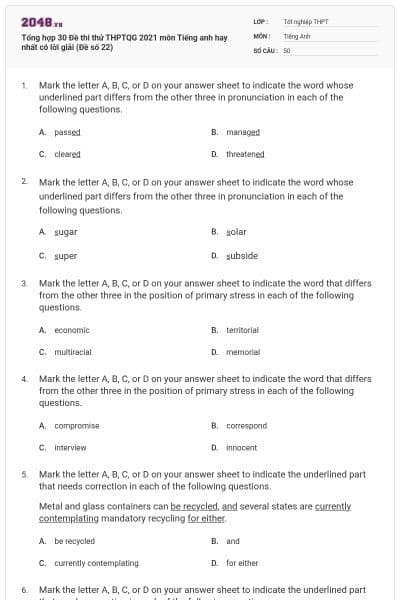
Mark the letter A, B, C, or D on your answer sheet to indicate the word whose underlined part differs from the other three in pronunciation in each of the following questions.
passed
managed
cleared
threatened
Đáp án A
Âm /ed/ trong từ passed được phát âm là /t/, trong các từ còn lại được phát âm là /d/
Mark the letter A, B, C, or D on your answer sheet to indicate the word whose underlined part differs from the other three in pronunciation in each of the following questions.
sugar
solar
super
subside
Đáp án A
Âm /s/ trong sugar được phát âm là /ʃ/, trong các từ còn lại được phát âm là /s/
Mark the letter A, B, C, or D on your answer sheet to indicate the word that differs from the other three in the position of primary stress in each of the following questions.
economic
territorial
multiracial
memorial
Đáp án D
Trọng âm chính của từ memorial rơi vào âm thứ 2, các từ còn lại có trọng âm chính rơi vào âm thứ 3
Mark the letter A, B, C, or D on your answer sheet to indicate the word that differs from the other three in the position of primary stress in each of the following questions.
compromise
correspond
interview
innocent
Đáp án B
Trọng âm chính cuả từ correspond rơi vào âm thứ 3, các từ còn lại có trọng âm chính rơi vào âm thứ 1
Mark the letter A, B, C, or D on your answer sheet to indicate the underlined part that needs correction in each of the following questions.
Metal and glass containers can be recycled, and several states are currently contemplating mandatory recycling for either.
be recycled
and
currently contemplating
for either
Đáp án D
For either => for both
Tạm dịch: Các đồ chứa bằng kính và thuỷ tinh có thể tái chế và một số quốc gia hiện tại đang xem xét việc tái chế bắt buộc cho cả 2 loại này.
Mark the letter A, B, C, or D on your answer sheet to indicate the underlined part that needs correction in each of the following questions.
The Concorde can fly across the Atlantic without re-fueling and carrying 11 tons of freight.
across
without
carrying
of freight
Đáp án C
Carrying => carry. Theo cấu trúc song hành thì giữa động từ can fly ….and carry
Tạm dịch: Máy bay Concorde có thể bay ngang qua Đại Tây Dương mà không cần phải nạp thêm nhiên liệu giữa chặng và có thể tải được trọng lượng hàng đến 11 tấn
Mark the letter A, B, C, or D on your answer sheet to indicate the underlined part that needs correction in each of the following questions.
Usually the climate in mountainous areas becomes much windy at higher altitudes.
Usually
the
much windy
at higher
Đáp án C
Much windy => much windier
Tạm dịch: Thường thì thời tiết ở vùng núi trở nên lạnh hợn ở các vùng cao
The number of homeless people after the flood _____ dramatically.
are increasing
has increased
increase
had increased
Đáp án B
Cần phải phân biệt: A number of + plural N + V (plural): một số lượng cái gì/ The number of + plural N + V (singular): số lượng cái gì. Trong câu cần sử dụng hiện tại hoàn thành diễn tả hành động xảy ra trong quá khứ và vẫn còn tiếp diễn đến hiện tại. Phương án A và C vừa sai thì vừa chia động từ sai, phương án D sử dụng sai thì
John _____ this task yesterday morning, but I did it for him. He owes me a thank-you.
must have completed
should have completed
could have completed
may have completed
Đáp án B
Cấu trúc Modal verb + have + PP: chỉ suy đoán trong quá khứ
- Must have done: chắc chắn đã xảy ra (gần 100% chắc chắn)
- Should have done: đáng lẽ đã nên xảy ra (nhưng sự thật là không xảy ra
- Could have done: co thể xảy ra (chỉ khả năng của con người, khoảng 80% chắc chắn)
- May have done: có thể xảy ra (chỉ sự việc, khoảng 80% chắc chắn)
Tạm dịch: John đáng lý nên làm xong bài vào sáng qua nhưng tôi đã làm cho anh ấy. Anh ấy nợ tôi một lời cảm ơn
The man who was driving the truck would not admit that he had been at fault, and _____.
neither had the other driver
neither would the other driver
neither the other driver
the other driver neither
Đáp án B
Cấu trúc “đồng tình” với việc gì đó ở dạng phủ định:
- Neither + trợ động từ + S hoặc S + trợ động từ + not + either
Tạm dịch: người đàn ông lái xe tải không thừa nhận rằng anh ta đã mắc lỗi và cả những tài xế khác cũng vậy (cũng không thừa nhận mình mắc lỗi)
No one cares about the starving people _____.
whose aid is intended for
whom the aid is intended
that the aid is intended for
for the aid is intended
Đáp án C
C: starving people cần giúp đỡ nên A (sự giúp đỡ của những người đói ăn) không phù hợp về nghĩa, B thiếu for, D: không đúng về mặt ngữ pháp
Not all historical sites that are found _____.
highly publicized
of high publicity
to be highly publicized
are highly publicized
Đáp án D
D: câu thiếu động từ chính
_____ are unpleasant, but it will be nice when we get into the new house
Removals
Movements
Removements
Moves
Đáp án A
Việc dời đi thật là phiền phức nhưng mọi chuyện sẽ tôt hơn khi chúng ta đến nơi ở mới
The _____ horse ran away from the fire.
fright
frightful
frightened
frightening
Đáp án C
(bị làm cho hoảng sợ)
Con ngựa hoảng sợ đã chạy xa khỏi đám lửa
The polar bear’s _____ depends on its ability to catch fish.
survival
survive
surviving
survivor
Đáp án A
Chỗ trống cần điện là một danh từ vì theo sau sở hữu cách
Survival (n) : sự tồn tại, sự sống sót. Survive (v) : sống sót, tồn tại. Surviving là động từ thêm ing. Survivor (n) : người sống sót
Tạm dịch : Sự tồn tại của gấu Bắc Cực phụ thuộc vào khả năng bắt cá của nó
It is very important for a firm or a company to keep _____ the changes in the market.
pace of
track about
touch with
up with
Đáp án D
up with. Cấu trúc: keep up with sth = bắt kịp
Các lựa chọn khác sai cấu trúc
We couldn’t help laughing when he took _____ his teacher so well
up
over
off
out
Đáp án C
She went _____ a bad cold just before Christmas.
through
over
in for
down with
Đáp án D
Mrs. Granny is completely deaf. You’ll have to _____ allowance for her
bring
take
make
find
Đáp án: C
Giải thích:
make allowances for: chiếu cố, thông cảm cho
Dịch: Bà bị điếc hoàn toàn. Bạn sẽ phải thông cảm cho bà.
Hurry up, or they _____ serving meals by the time we get to the restaurant.
stop
will have stoppe
are stopping
will stop
Đáp án B
Whatever we expect from _____ future, it is noted that progress has never moved in straight lines.
a
an
the
some
Đáp án C
Mạo từ the luôn đi trước danh từ future: the future: tương lai
Mark the letter A, B, C, or D on your answer sheet to indicate the most suitable response to complete each of the following exchanges.
“Your parents must be proud of your result at school.” – “_________”
Sorry to hear that.
Thanks. It’s certainly encouraging.
Of course.
I am glad you like it.
Đáp án B
“Bố mẹ bạn chắc chắn phải rất tự hào về kết quả của bạn ở trường” => đây là một lời khen
Đáp lại là: Cảm ơn nhé. Điều đó động viên tôi rất nhiều
Các phương án còn lại là: A. Thật đáng tiếc khi nghe được điều đó. C. Đương nhiên rồi. D. Tôi rất vui vì bạn thích nó.
Mark the letter A, B, C, or D on your answer sheet to indicate the most suitable response to complete each of the following exchanges.
- “ _______ .”
- “Never mind, better luck next time.”
I’ve broken your precious vase .
I have a lot on my mind.
I couldn’t keep my mind on work.
I didn’t get the vacant position.
Đáp án: D
Giải thích:
Dịch:
A. Tôi vừa làm vỡ cái bình hoa quý giá của bạn.
B. Tôi có nhiều suy nghĩ trong đầu.
C. Tôi không thể cho công việc vào đầu.
D. Tôi không đỗ vị trí trống đó.
“Đừng lo, lần sau sẽ may hơn mà.”
Dựa vào nghĩa, chọn đáp án D.
Mark the letter A, B, C, or D on your answer sheet to indicate the word(s) CLOSEST in meaning to the underlined word(s) in each of the following questions.
We spent the entire day looking for a new apartment.
all long day
the long day
day after day
all day long
Đáp án D
The entire day ≈ all day long: suốt ngày, cả ngày
Tạm dịch: Chúng tôi dành cả ngày để tìm kiếm căn hộ mới
Mark the letter A, B, C, or D on your answer sheet to indicate the word(s) CLOSEST in meaning to the underlined word(s) in each of the following questions.
Biogas can be utilized for electricity production, cooking, space heating, water heating and process heating.
sparing
generation
increase
reformation
Đáp án B
Production ≈ generation (n): sự sản xuất (nhiệt điện)
Sparing (adj): tiết kiệm
Increase (v): tăng
Reformation (n): sự cải tổ
Tạm dịch: Khí biogas có thể được dùng để sản xuất điện, nấu ăn, sưởi ấm nhà, làm nóng nước và sưởi ấm công nghiệp
Mark the letter A, B, C, or D on your answer sheet to indicate the word(s) OPPOSITE in meaning to the underlined word(s) in each of the following questions.
Doctors have been criticized for their indiscriminate use of antibiotics.
discipline
selective
wholesale
unconscious
Đáp án B
indiscriminate : không phân biệt, bừa bãi
A. có kỷ luật
B. có chọn lựa
C. buôn sỉ, hàng loạt
D. bất tỉnh
Dịch nghĩa:Các bác sĩ đã bị phê bình về việc sử dụng kháng sinh bừa bãi
Mark the letter A, B, C, or D on your answer sheet to indicate the word(s) OPPOSITE in meaning to the underlined word(s) in each of the following questions.
Slavery was abolished in the US in the 19th century.
instituted
eradicated
eliminated
required
Đáp án A
Abolish (v) ≈ eradicate (v) ≈ eliminate (v): thủ tiêu, bãi bỏ, huỷ bỏ ≠ institute (v): thành lập
Tạm dịch: Chế độ nô lệ đã được bỏ ở Mỹ vào thế kỷ thứ 19
Mark the letter A, B, C, or D on your answer sheet to indicate the sentence that is closest in meaning to each of the following questions.
If you need my advice, I would forget about buying a new house.
If I were you, I did not buy a new house.
If I were you, I would not bought a new house.
If I were you, I hadn’t bought a new house
If I were you, I would not buy a new house.
Đáp án D
Cấu gốc: “Nếu bạn cần lời khuyên của tôi, tôi sẽ quên ngay việc mua một ngôi nhà mới”
A. Sai cấu trúc ngữ pháp câu điều kiên loại 2 vì mệnh đề chính phải chia ở dạng would + V (bare)
B. Sai cấu trúc ngữ pháp câu điều kiên loại 2 vì mệnh đề chính phải chia ở dạng would + V (bare)
C. Sai cấu trúc ngữ pháp câu điều kiên loại 2 vì mệnh đề chính phải chia ở dạng would + V (bare)
D. Nếu tôi là bạn, tôi sẽ không mua một ngôi nhà mới à sát nghĩa với câu gốc
Mark the letter A, B, C, or D on your answer sheet to indicate the sentence that is closest in meaning to each of the following questions.
He said: “I’m sorry I didn’t reply to the letter.”
He apologized for not to reply to the letter.
He apologized for not to replying to the letter.
He apologized for didn’t reply to the letter.
He apologized for not replying to the letter.
Đáp án D
Câu tường thuật đặc biệt cho câu xin lỗi: apologized for not + Ving
Mark the letter A, B, C, or D on your answer sheet to indicate the sentence that is closest in meaning to each of the following questions.
It’s no use trying to persuade Tom to change his mind
There’s no point to try to persuade Tom to change his mind.
It’s worth trying to persuade Tom to change his mind.
It’s useful trying to persuade Tom to change his mind.
It’s a waste of time trying to persuade Tom to change his mind.
Đáp án D
Câu gốc: “Thật vô ích để cố gắng thuyết phục Tom thay đổi ý nghĩ của anh ấy”
A. Cụm từ đúng phải là: “there’s no point in + V_ing”: thật vô ích để làm gì
B. Đáng để cố gắng thuyết phục Tom thay đổi ý nghĩ của anh ấy
C. Sai cấu trúc ngữ pháp vì sau tính từ useful động từ phải ở dạng to inf
D. Thật là lãng phí thời gian để cố gắng thuyết phục Tom thay đổi ý nghĩ của anh ấy
Mark the letter A, B, C, or D on your answer sheet to indicate the sentence that best combines each pair of sentences in the following questions.
I’d suggest that we avoid telling any scary stories with Janet around. She’s a bit unstable and could get hysterical.
Janet has trouble keeping her emotions under control, especially when she is told frightening stories.
Since Janet is somewhat unbalanced, the only way to make her laugh is by telling stories, but we should avoid scary ones as they might cause her to panic.
It is no fun to tell frightening stories to Janet, who is not very stable mentally, because she only laughs instead of getting scared.
Janet is somewhat mentally unbalanced and might easily become uncontrollably emotional, so let’s not tell frightening stories in her presence.
Đáp án D
Câu gốc: “tôi đề nghị rằng chúng ta nên tránh việc kể các câu chuyện đáng sợ khi Janet ở quanh. Cô ấy thì hơi không ổn định và có thể bị kích động
A. Janet có vấn đề với việc kiểm soát tình cảm của cô ấy, đặc biệt là khi cô ấy được kể các câu chuyện đáng sợ -> không sát nghĩa với câu gốc
B. Bởi vì Janet hơi không cân bằng được, nên cách duy nhất để làm cô ấy cười là bằng cách kể chuyện, nhưng chúng ta nên tránh những câu chuyện đáng sợ vì chúng có thể làm cô ấy hoảng sợ -> không sát nghĩa với câu gốc
C. Không có gì thú vị khi kể các câu chuyện đáng sợ cho janet, người mà không ổn định về thần kinh, vì cô ấy chỉ cưới thay vì cảm thấy sợ -> không sát nghĩa với câu gốc
D. Janet hơi không cân bằng được thần kinh và có thể dễ bị mất kiểm soát, vì vậy chúng ta không nên kể những câu chuyện đáng sợ khi có mặt cô ấy -> sát nghĩa với câu gốc
Mark the letter A, B, C, or D on your answer sheet to indicate the sentence that best combines each pair of sentences in the following questions.
We chose to find a place for the night. We found the bad weather very inconvenient.
Bad weather was approaching, so we started to look for a place to stay.
The bad weather prevented us from driving any further.
Seeing that the bad weather had set in, we decided to find somewhere to spend the night.
Because the climate was so severe, we were worried about what we’d do at night
Đáp án C
Câu gốc: “Chúng tôi lựa chọn tìm một nơi qua đêm nay. Chúng tôi thấy thời tiết xấu không được thuận lợi lắm
A. Thời tiết xấu đang tiến đến, vì vậy chúng tôi đã bắt đầu tìm chỗ để ở
B. Thời tiết xấu ngăn chúng tôi đi xa hơn
C. Nhận thấy thời tiết xấu đang hình thành, chúng tôi đã quyết định tìm nơi nào đó để nghỉ qua đêm
D. Bởi vì khí hậu quá khắc nghiệt, chúng tôi lo lắng về việc chúng tôi sẽ làm vào buổi tối.
Read the following passage and mark the letter A, B, C, or D on your answer sheet to indicate the correct word or phrase that best fits each of the numbered blanks from 33 to 37.
ENGLISH SPEELING
Why does English spelling have a reputation for being difficult? English was first written down when Christian monks came to England in Anglo-Saxon (33) ______. They used the 23 letters of Latin to write down the sounds of Anglo-Saxon speech as they heard it. However, English has a (34) _____ range of basic sounds (over 40) than Latin. The alphabet was too small, and so combinations of letters were needed to express the different sounds. Inevitably, there were inconsistencies in the way that letters were combined.
With the Norman invasion of England, the English language was put at risk. English survived, but the spelling of many English words changed to follow French (35) _____, and many French words were introduced into the language. The result was more irregularity.
When the printing press was invented in the fifteenth century, many early printers of English texts spoke other first languages. They made little effort to respect English spelling. Although one of the shortterm (36) _____ of printing was to produce a number of variant spellings, in the long term it created fixed spellings. People became used to seeing words spelt in the same way. Rules were drawn up, and dictionaries were put together which printers and writers could refer to. However, spoken English was not fixed and continued to change slowly - just as it still does now. Letters that were sounded in the Anglo- Saxon period, like the 'k' in 'knife', now became (37) _____. Also, the pronunciation of vowels then had little in common with how they sound now, but the way they are spelt hasn't changed. No wonder, then, that it is often difficult to see the link between sound and spelling.
Điền vào ô 33.
centuries
times
ages
years
Đáp án B
Times (n): thời kỳ, thời đại
Anglo-Saxon times: thời kỳ Anglo Saxon
Tạm dịch: Tiếng Anh lần đầu được viết ra là khi các thầy tu người Cơ Đốc đến nước Anh vào thời kỳ Anglo Saxon
Read the following passage and mark the letter A, B, C, or D on your answer sheet to indicate the correct word or phrase that best fits each of the numbered blanks from 33 to 37.
ENGLISH SPEELING
Why does English spelling have a reputation for being difficult? English was first written down when Christian monks came to England in Anglo-Saxon (33) ______. They used the 23 letters of Latin to write down the sounds of Anglo-Saxon speech as they heard it. However, English has a (34) _____ range of basic sounds (over 40) than Latin. The alphabet was too small, and so combinations of letters were needed to express the different sounds. Inevitably, there were inconsistencies in the way that letters were combined.
With the Norman invasion of England, the English language was put at risk. English survived, but the spelling of many English words changed to follow French (35) _____, and many French words were introduced into the language. The result was more irregularity.
When the printing press was invented in the fifteenth century, many early printers of English texts spoke other first languages. They made little effort to respect English spelling. Although one of the shortterm (36) _____ of printing was to produce a number of variant spellings, in the long term it created fixed spellings. People became used to seeing words spelt in the same way. Rules were drawn up, and dictionaries were put together which printers and writers could refer to. However, spoken English was not fixed and continued to change slowly - just as it still does now. Letters that were sounded in the Anglo- Saxon period, like the 'k' in 'knife', now became (37) _____. Also, the pronunciation of vowels then had little in common with how they sound now, but the way they are spelt hasn't changed. No wonder, then, that it is often difficult to see the link between sound and spelling.
Điền vào ô 34.
longer
deeper
thicker
wide
Đáp án D
A wide range of : đủ loại, một loạt, nhiều. Câu sử dụng so sánh hơn của wid
Read the following passage and mark the letter A, B, C, or D on your answer sheet to indicate the correct word or phrase that best fits each of the numbered blanks from 33 to 37.
ENGLISH SPEELING
Why does English spelling have a reputation for being difficult? English was first written down when Christian monks came to England in Anglo-Saxon (33) ______. They used the 23 letters of Latin to write down the sounds of Anglo-Saxon speech as they heard it. However, English has a (34) _____ range of basic sounds (over 40) than Latin. The alphabet was too small, and so combinations of letters were needed to express the different sounds. Inevitably, there were inconsistencies in the way that letters were combined.
With the Norman invasion of England, the English language was put at risk. English survived, but the spelling of many English words changed to follow French (35) _____, and many French words were introduced into the language. The result was more irregularity.
When the printing press was invented in the fifteenth century, many early printers of English texts spoke other first languages. They made little effort to respect English spelling. Although one of the shortterm (36) _____ of printing was to produce a number of variant spellings, in the long term it created fixed spellings. People became used to seeing words spelt in the same way. Rules were drawn up, and dictionaries were put together which printers and writers could refer to. However, spoken English was not fixed and continued to change slowly - just as it still does now. Letters that were sounded in the Anglo- Saxon period, like the 'k' in 'knife', now became (37) _____. Also, the pronunciation of vowels then had little in common with how they sound now, but the way they are spelt hasn't changed. No wonder, then, that it is often difficult to see the link between sound and spelling.
Điền vào ô 35.
types
guides
plans
patterns
Đáp án D
Pattern (n) : kiểu, mẫu
Tạm dịch : chính tả của nhiều từ tiếng Anh đã thay đổi theo kiểu cách của tiếng Pháp
Read the following passage and mark the letter A, B, C, or D on your answer sheet to indicate the correct word or phrase that best fits each of the numbered blanks from 33 to 37.
ENGLISH SPEELING
Why does English spelling have a reputation for being difficult? English was first written down when Christian monks came to England in Anglo-Saxon (33) ______. They used the 23 letters of Latin to write down the sounds of Anglo-Saxon speech as they heard it. However, English has a (34) _____ range of basic sounds (over 40) than Latin. The alphabet was too small, and so combinations of letters were needed to express the different sounds. Inevitably, there were inconsistencies in the way that letters were combined.
With the Norman invasion of England, the English language was put at risk. English survived, but the spelling of many English words changed to follow French (35) _____, and many French words were introduced into the language. The result was more irregularity.
When the printing press was invented in the fifteenth century, many early printers of English texts spoke other first languages. They made little effort to respect English spelling. Although one of the shortterm (36) _____ of printing was to produce a number of variant spellings, in the long term it created fixed spellings. People became used to seeing words spelt in the same way. Rules were drawn up, and dictionaries were put together which printers and writers could refer to. However, spoken English was not fixed and continued to change slowly - just as it still does now. Letters that were sounded in the Anglo- Saxon period, like the 'k' in 'knife', now became (37) _____. Also, the pronunciation of vowels then had little in common with how they sound now, but the way they are spelt hasn't changed. No wonder, then, that it is often difficult to see the link between sound and spelling.
Điền vào ô 36.
conclusions
actions
meanings
effects
Đáp án D
Effect (n) : ảnh hưởng, tác động
Tạm dịch : mặc dù một trong những tác động ngắn hạn của in ấn là để sản xuất một số cách viết biến thể nhưng về lâu dài nó tạo ra cách viết cố định
Read the following passage and mark the letter A, B, C, or D on your answer sheet to indicate the correct word or phrase that best fits each of the numbered blanks from 33 to 37.
ENGLISH SPEELING
Why does English spelling have a reputation for being difficult? English was first written down when Christian monks came to England in Anglo-Saxon (33) ______. They used the 23 letters of Latin to write down the sounds of Anglo-Saxon speech as they heard it. However, English has a (34) _____ range of basic sounds (over 40) than Latin. The alphabet was too small, and so combinations of letters were needed to express the different sounds. Inevitably, there were inconsistencies in the way that letters were combined.
With the Norman invasion of England, the English language was put at risk. English survived, but the spelling of many English words changed to follow French (35) _____, and many French words were introduced into the language. The result was more irregularity.
When the printing press was invented in the fifteenth century, many early printers of English texts spoke other first languages. They made little effort to respect English spelling. Although one of the shortterm (36) _____ of printing was to produce a number of variant spellings, in the long term it created fixed spellings. People became used to seeing words spelt in the same way. Rules were drawn up, and dictionaries were put together which printers and writers could refer to. However, spoken English was not fixed and continued to change slowly - just as it still does now. Letters that were sounded in the Anglo- Saxon period, like the 'k' in 'knife', now became (37) _____. Also, the pronunciation of vowels then had little in common with how they sound now, but the way they are spelt hasn't changed. No wonder, then, that it is often difficult to see the link between sound and spelling.
Điền vào ô 37.
silen
dumb
quite
speechless
Đáp án A
Silent (adj) : câm (âm câm)
Tạm dịch : các chữ cái được phát âm trong thời kỳ Anglo – Saxon, như âm ‘k’ trong ‘knife’ giờ lại thành âm câm
Read the following passage and mark the letter A, B, C, or D on your answer sheet to indicate the correct answer to each of the questions from 38 to 42.
HISTORY OF THE HELICOPTER
Although first flight generally attributed to a fixed-wing aircraft, the helicopter actually represents the first style of flight envisioned by humans. The ancient Chinese developed a toy that rose upward when spun rapidly. As early as the mid-sixteenth century, the great Italian inventor Leonardo da Vinci had drawn a prototype for the machine that we now know as the helicopter.
Early in the twentieth century, a great deal of experimentation and revision was taking place with regard to helicopter flight. The well-known phrase “two steps forward and one step back” provided an apt descriptor for early flight development. Uneven lift, known as dissymmetry, caused the early helicopters to flip over and confounded the inventors until the creation of the swash-plate; this allowed the rotor blade angles to be changed so that lift would be equal on each side of the shaft.
On November 13, 1907, the French pioneer Paul Cornu made history by lifting a twin-rotor helicopter into the air for a few seconds without ground assistance. Several models followed without significance until in 1924 when another French pioneer, Etienne Oehmichen, became the first to fly a helicopter for one kilometer. It was a historic flight of 7 minutes and 40 seconds. By 1936, solutions have been found to many of the problems with helicopter flight.
With the introduction of the German Focke-Wulf Fw 61, the first practical helicopter became a reality.
What is the topic of the passage?
Which aircraft was the first to fly.
Aircraft design in the 20th century.
The development of the helicopter.
The invention of the swash plate.
Đáp án C
Chủ đề của đoạn văn nói về “the development of the helicopter”: sự phát triển của máy bay trực thăng
Read the following passage and mark the letter A, B, C, or D on your answer sheet to indicate the correct answer to each of the questions from 38 to 42.
HISTORY OF THE HELICOPTER
Although first flight generally attributed to a fixed-wing aircraft, the helicopter actually represents the first style of flight envisioned by humans. The ancient Chinese developed a toy that rose upward when spun rapidly. As early as the mid-sixteenth century, the great Italian inventor Leonardo da Vinci had drawn a prototype for the machine that we now know as the helicopter.
Early in the twentieth century, a great deal of experimentation and revision was taking place with regard to helicopter flight. The well-known phrase “two steps forward and one step back” provided an apt descriptor for early flight development. Uneven lift, known as dissymmetry, caused the early helicopters to flip over and confounded the inventors until the creation of the swash-plate; this allowed the rotor blade angles to be changed so that lift would be equal on each side of the shaft.
On November 13, 1907, the French pioneer Paul Cornu made history by lifting a twin-rotor helicopter into the air for a few seconds without ground assistance. Several models followed without significance until in 1924 when another French pioneer, Etienne Oehmichen, became the first to fly a helicopter for one kilometer. It was a historic flight of 7 minutes and 40 seconds. By 1936, solutions have been found to many of the problems with helicopter flight.
With the introduction of the German Focke-Wulf Fw 61, the first practical helicopter became a reality.
Why was “dissymmetry” important to the early pioneers of helicopter flight?
It was an effect that caused helicopter to crash.
It equalized lift on each side of the central shaft.
It allowed helicopters to lift from the ground.
It allowed the rotor blade angles to be altered.
Đáp án A
Tại sao “tính không đối xứng” lại quan trọng với những chiếc máy bay trực thăng trước đây
Đáp án nằm ở dòng 3, 4 và 5 đoạn 2: “Uneven lift, known as dissymmetry, caused the early helicopters to flip over and confounded the inventors until the creation of the swash-plate; this allowed the rotor blade angles to be changed so that lift would be equal on each side of the shaft.”
Read the following passage and mark the letter A, B, C, or D on your answer sheet to indicate the correct answer to each of the questions from 38 to 42.
HISTORY OF THE HELICOPTER
Although first flight generally attributed to a fixed-wing aircraft, the helicopter actually represents the first style of flight envisioned by humans. The ancient Chinese developed a toy that rose upward when spun rapidly. As early as the mid-sixteenth century, the great Italian inventor Leonardo da Vinci had drawn a prototype for the machine that we now know as the helicopter.
Early in the twentieth century, a great deal of experimentation and revision was taking place with regard to helicopter flight. The well-known phrase “two steps forward and one step back” provided an apt descriptor for early flight development. Uneven lift, known as dissymmetry, caused the early helicopters to flip over and confounded the inventors until the creation of the swash-plate; this allowed the rotor blade angles to be changed so that lift would be equal on each side of the shaft.
On November 13, 1907, the French pioneer Paul Cornu made history by lifting a twin-rotor helicopter into the air for a few seconds without ground assistance. Several models followed without significance until in 1924 when another French pioneer, Etienne Oehmichen, became the first to fly a helicopter for one kilometer. It was a historic flight of 7 minutes and 40 seconds. By 1936, solutions have been found to many of the problems with helicopter flight.
With the introduction of the German Focke-Wulf Fw 61, the first practical helicopter became a reality.
Why was Paul Cornu’s flight important?
It was the first practical helicopter flight.
It lasted 7 minutes and 40 seconds.
It was the first time a helicopter lifted into the air without ground assistance.
It was the first time a helicopter lifted into the air.
Đáp án C
Đáp án nằm ở dòng 1 + 2 đoạn 3: “On November 13, 1907, the French pioneer Paul Cornu made history by lifting a twin-rotor helicopter into the air for a few seconds without ground assistance”
Read the following passage and mark the letter A, B, C, or D on your answer sheet to indicate the correct answer to each of the questions from 38 to 42.
HISTORY OF THE HELICOPTER
Although first flight generally attributed to a fixed-wing aircraft, the helicopter actually represents the first style of flight envisioned by humans. The ancient Chinese developed a toy that rose upward when spun rapidly. As early as the mid-sixteenth century, the great Italian inventor Leonardo da Vinci had drawn a prototype for the machine that we now know as the helicopter.
Early in the twentieth century, a great deal of experimentation and revision was taking place with regard to helicopter flight. The well-known phrase “two steps forward and one step back” provided an apt descriptor for early flight development. Uneven lift, known as dissymmetry, caused the early helicopters to flip over and confounded the inventors until the creation of the swash-plate; this allowed the rotor blade angles to be changed so that lift would be equal on each side of the shaft.
On November 13, 1907, the French pioneer Paul Cornu made history by lifting a twin-rotor helicopter into the air for a few seconds without ground assistance. Several models followed without significance until in 1924 when another French pioneer, Etienne Oehmichen, became the first to fly a helicopter for one kilometer. It was a historic flight of 7 minutes and 40 seconds. By 1936, solutions have been found to many of the problems with helicopter flight.
With the introduction of the German Focke-Wulf Fw 61, the first practical helicopter became a reality.
Why is it important that lift be equal on both sides of the helicopter shaft?
If there is more lift on one side, the helicopter will flip.
Equal lift means that the helicopter will be faster.
Dissymmetry of lift makes helicopters fly well.
It allows the rotor blade angles to be changed.
Đáp án B
Đáp án nằm ở dòng 3, 4 và 5 đoạn 2: “Uneven lift, known as dissymmetry, caused the early helicopters to flip over and confounded the inventors until the creation of the swash-plate; this allowed the rotor blade angles to be changed so that lift would be equal on each side of the shaft.”
Read the following passage and mark the letter A, B, C, or D on your answer sheet to indicate the correct answer to each of the questions from 38 to 42.
HISTORY OF THE HELICOPTER
Although first flight generally attributed to a fixed-wing aircraft, the helicopter actually represents the first style of flight envisioned by humans. The ancient Chinese developed a toy that rose upward when spun rapidly. As early as the mid-sixteenth century, the great Italian inventor Leonardo da Vinci had drawn a prototype for the machine that we now know as the helicopter.
Early in the twentieth century, a great deal of experimentation and revision was taking place with regard to helicopter flight. The well-known phrase “two steps forward and one step back” provided an apt descriptor for early flight development. Uneven lift, known as dissymmetry, caused the early helicopters to flip over and confounded the inventors until the creation of the swash-plate; this allowed the rotor blade angles to be changed so that lift would be equal on each side of the shaft.
On November 13, 1907, the French pioneer Paul Cornu made history by lifting a twin-rotor helicopter into the air for a few seconds without ground assistance. Several models followed without significance until in 1924 when another French pioneer, Etienne Oehmichen, became the first to fly a helicopter for one kilometer. It was a historic flight of 7 minutes and 40 seconds. By 1936, solutions have been found to many of the problems with helicopter flight.
With the introduction of the German Focke-Wulf Fw 61, the first practical helicopter became a reality.
The word “envisioned” in paragraph 1 is closet in meaning to _____.
imagined
perfected
experienced
taught
Đáp án A
Envisioned ≈ imagined: mường tượng, hình dung
Read the following passage on transport, and mark the letter A, B, C, or D on your answer sheet to indicate the correct answer to each of the questions from 43 to 50.
“The economic history of the United States”, one scholar has written, “is the history of the rise and development of the capitalistic system”. The colonists of the eighteenth century pushed forward what those of the seventeenth century have begun: the expansion and elaboration of an economy born in the great age of capitalist expansion.
Our excellent natural resources paved the way for the development of abundant capital to increase our growth. Capital includes the tools – such as: machines, vehicles, and buildings – that makes the outputs of labor and resources more valuable. But it also includes the funds necessary to buy those tools. If a society had to consume everything it produced just to stay alive, nothing could be put aside to increase future productions. But if a farmer can grow more corn than his family needs to eat, he can use the surplus as seed to increase the next crop, or to feed workers who build tractors. This process of capital accumulation was aided in the American economy by our cultural heritage. Saving played an important role in the European tradition. It contributed to American’s motivation to put something aside today for the tools to buy tomorrow.
The great bulk of the accumulated wealth of America, as distinguished from what was consumed, was derived either directly or indirectly from trade. Though some manufacturing existed, its role in the accumulation of capital was negligible. A merchant class of opulent proportions was already visible in the seaboard cities, its wealth as the obvious consequence of shrewd and resourceful management of the carrying trade. Even the rich planters of tidewater Virginia and the rice coast of South Carolina finally depended for their genteel way of life upon the ships and merchants who sold their tobacco and rice in the markets of Europe. As colonial production rose and trade expanded, a business community emerged in the colonies, linking the provinces by lines of trade and identity of interest.
With what subject is this passage mainly concerned?
Geography
Finance
Economics
Culture
Đáp án C
Câu trả lời ở đầu đoạn. "The economic history of the United States", one scholar has written, "is the history of the rise and development of the capitalistic system".
Read the following passage on transport, and mark the letter A, B, C, or D on your answer sheet to indicate the correct answer to each of the questions from 43 to 50.
“The economic history of the United States”, one scholar has written, “is the history of the rise and development of the capitalistic system”. The colonists of the eighteenth century pushed forward what those of the seventeenth century have begun: the expansion and elaboration of an economy born in the great age of capitalist expansion.
Our excellent natural resources paved the way for the development of abundant capital to increase our growth. Capital includes the tools – such as: machines, vehicles, and buildings – that makes the outputs of labor and resources more valuable. But it also includes the funds necessary to buy those tools. If a society had to consume everything it produced just to stay alive, nothing could be put aside to increase future productions. But if a farmer can grow more corn than his family needs to eat, he can use the surplus as seed to increase the next crop, or to feed workers who build tractors. This process of capital accumulation was aided in the American economy by our cultural heritage. Saving played an important role in the European tradition. It contributed to American’s motivation to put something aside today for the tools to buy tomorrow.
The great bulk of the accumulated wealth of America, as distinguished from what was consumed, was derived either directly or indirectly from trade. Though some manufacturing existed, its role in the accumulation of capital was negligible. A merchant class of opulent proportions was already visible in the seaboard cities, its wealth as the obvious consequence of shrewd and resourceful management of the carrying trade. Even the rich planters of tidewater Virginia and the rice coast of South Carolina finally depended for their genteel way of life upon the ships and merchants who sold their tobacco and rice in the markets of Europe. As colonial production rose and trade expanded, a business community emerged in the colonies, linking the provinces by lines of trade and identity of interest.
The phrase “paved the way” in the second paragraph is closest in meaning to ______.
paid for
supported
accumulated
resembled
Đáp án B
Paved the way ≈ supported: mở đường cho, chuẩn bị cho
Read the following passage on transport, and mark the letter A, B, C, or D on your answer sheet to indicate the correct answer to each of the questions from 43 to 50.
“The economic history of the United States”, one scholar has written, “is the history of the rise and development of the capitalistic system”. The colonists of the eighteenth century pushed forward what those of the seventeenth century have begun: the expansion and elaboration of an economy born in the great age of capitalist expansion.
Our excellent natural resources paved the way for the development of abundant capital to increase our growth. Capital includes the tools – such as: machines, vehicles, and buildings – that makes the outputs of labor and resources more valuable. But it also includes the funds necessary to buy those tools. If a society had to consume everything it produced just to stay alive, nothing could be put aside to increase future productions. But if a farmer can grow more corn than his family needs to eat, he can use the surplus as seed to increase the next crop, or to feed workers who build tractors. This process of capital accumulation was aided in the American economy by our cultural heritage. Saving played an important role in the European tradition. It contributed to American’s motivation to put something aside today for the tools to buy tomorrow.
The great bulk of the accumulated wealth of America, as distinguished from what was consumed, was derived either directly or indirectly from trade. Though some manufacturing existed, its role in the accumulation of capital was negligible. A merchant class of opulent proportions was already visible in the seaboard cities, its wealth as the obvious consequence of shrewd and resourceful management of the carrying trade. Even the rich planters of tidewater Virginia and the rice coast of South Carolina finally depended for their genteel way of life upon the ships and merchants who sold their tobacco and rice in the markets of Europe. As colonial production rose and trade expanded, a business community emerged in the colonies, linking the provinces by lines of trade and identity of interest.
It can be inferred from the passage that the European ancestors of early Americans ______.
sent many tools to America
taught their skills to their offspring
were accustomed to saving
were good farmers
Đáp án C
Thông tin trong đoạn: “This process of capital accumulation was aided in the American economy by our cultural heritage. Saving played an important role in the European tradition.”
Read the following passage on transport, and mark the letter A, B, C, or D on your answer sheet to indicate the correct answer to each of the questions from 43 to 50.
“The economic history of the United States”, one scholar has written, “is the history of the rise and development of the capitalistic system”. The colonists of the eighteenth century pushed forward what those of the seventeenth century have begun: the expansion and elaboration of an economy born in the great age of capitalist expansion.
Our excellent natural resources paved the way for the development of abundant capital to increase our growth. Capital includes the tools – such as: machines, vehicles, and buildings – that makes the outputs of labor and resources more valuable. But it also includes the funds necessary to buy those tools. If a society had to consume everything it produced just to stay alive, nothing could be put aside to increase future productions. But if a farmer can grow more corn than his family needs to eat, he can use the surplus as seed to increase the next crop, or to feed workers who build tractors. This process of capital accumulation was aided in the American economy by our cultural heritage. Saving played an important role in the European tradition. It contributed to American’s motivation to put something aside today for the tools to buy tomorrow.
The great bulk of the accumulated wealth of America, as distinguished from what was consumed, was derived either directly or indirectly from trade. Though some manufacturing existed, its role in the accumulation of capital was negligible. A merchant class of opulent proportions was already visible in the seaboard cities, its wealth as the obvious consequence of shrewd and resourceful management of the carrying trade. Even the rich planters of tidewater Virginia and the rice coast of South Carolina finally depended for their genteel way of life upon the ships and merchants who sold their tobacco and rice in the markets of Europe. As colonial production rose and trade expanded, a business community emerged in the colonies, linking the provinces by lines of trade and identity of interest.
According to the passage, which of the following would lead to accumulating capital?
Training workers who produce goods.
Studying the culture history of the country.
Consuming what is produced.
Planting more of a crop than what is needed.
Đáp án D
Thông tin ở đoạn sau: If a society had to consume everything it produced just to stay alive, nothing could be put aside to increase future productions. But if a farmer can grow more corn than his family needs to eat, he can use the surplus as seed to increase the next crop, or to feed workers who build tractors. This process of capital accumulation was aided in the American economy by our cultural heritage.
Read the following passage on transport, and mark the letter A, B, C, or D on your answer sheet to indicate the correct answer to each of the questions from 43 to 50.
“The economic history of the United States”, one scholar has written, “is the history of the rise and development of the capitalistic system”. The colonists of the eighteenth century pushed forward what those of the seventeenth century have begun: the expansion and elaboration of an economy born in the great age of capitalist expansion.
Our excellent natural resources paved the way for the development of abundant capital to increase our growth. Capital includes the tools – such as: machines, vehicles, and buildings – that makes the outputs of labor and resources more valuable. But it also includes the funds necessary to buy those tools. If a society had to consume everything it produced just to stay alive, nothing could be put aside to increase future productions. But if a farmer can grow more corn than his family needs to eat, he can use the surplus as seed to increase the next crop, or to feed workers who build tractors. This process of capital accumulation was aided in the American economy by our cultural heritage. Saving played an important role in the European tradition. It contributed to American’s motivation to put something aside today for the tools to buy tomorrow.
The great bulk of the accumulated wealth of America, as distinguished from what was consumed, was derived either directly or indirectly from trade. Though some manufacturing existed, its role in the accumulation of capital was negligible. A merchant class of opulent proportions was already visible in the seaboard cities, its wealth as the obvious consequence of shrewd and resourceful management of the carrying trade. Even the rich planters of tidewater Virginia and the rice coast of South Carolina finally depended for their genteel way of life upon the ships and merchants who sold their tobacco and rice in the markets of Europe. As colonial production rose and trade expanded, a business community emerged in the colonies, linking the provinces by lines of trade and identity of interest.
The word “it” in the third sentence of paragraph 2 refers to _____.
growth
resource
labor
capital
Đáp án D
Đáp án là capital: vốn
Read the following passage on transport, and mark the letter A, B, C, or D on your answer sheet to indicate the correct answer to each of the questions from 43 to 50.
“The economic history of the United States”, one scholar has written, “is the history of the rise and development of the capitalistic system”. The colonists of the eighteenth century pushed forward what those of the seventeenth century have begun: the expansion and elaboration of an economy born in the great age of capitalist expansion.
Our excellent natural resources paved the way for the development of abundant capital to increase our growth. Capital includes the tools – such as: machines, vehicles, and buildings – that makes the outputs of labor and resources more valuable. But it also includes the funds necessary to buy those tools. If a society had to consume everything it produced just to stay alive, nothing could be put aside to increase future productions. But if a farmer can grow more corn than his family needs to eat, he can use the surplus as seed to increase the next crop, or to feed workers who build tractors. This process of capital accumulation was aided in the American economy by our cultural heritage. Saving played an important role in the European tradition. It contributed to American’s motivation to put something aside today for the tools to buy tomorrow.
The great bulk of the accumulated wealth of America, as distinguished from what was consumed, was derived either directly or indirectly from trade. Though some manufacturing existed, its role in the accumulation of capital was negligible. A merchant class of opulent proportions was already visible in the seaboard cities, its wealth as the obvious consequence of shrewd and resourceful management of the carrying trade. Even the rich planters of tidewater Virginia and the rice coast of South Carolina finally depended for their genteel way of life upon the ships and merchants who sold their tobacco and rice in the markets of Europe. As colonial production rose and trade expanded, a business community emerged in the colonies, linking the provinces by lines of trade and identity of interest.
According to the passage, capital includes all of the following EXCEPT _____.
factories
tractors
money
workers
Đáp án D
Thông tin cũng ở đoạn: Capital includes the tools – such as: machines, vehicles, and buildings – that makes the outputs of labor and resources more valuable. But it also includes the funds necessary to buy those tools.
Read the following passage on transport, and mark the letter A, B, C, or D on your answer sheet to indicate the correct answer to each of the questions from 43 to 50.
“The economic history of the United States”, one scholar has written, “is the history of the rise and development of the capitalistic system”. The colonists of the eighteenth century pushed forward what those of the seventeenth century have begun: the expansion and elaboration of an economy born in the great age of capitalist expansion.
Our excellent natural resources paved the way for the development of abundant capital to increase our growth. Capital includes the tools – such as: machines, vehicles, and buildings – that makes the outputs of labor and resources more valuable. But it also includes the funds necessary to buy those tools. If a society had to consume everything it produced just to stay alive, nothing could be put aside to increase future productions. But if a farmer can grow more corn than his family needs to eat, he can use the surplus as seed to increase the next crop, or to feed workers who build tractors. This process of capital accumulation was aided in the American economy by our cultural heritage. Saving played an important role in the European tradition. It contributed to American’s motivation to put something aside today for the tools to buy tomorrow.
The great bulk of the accumulated wealth of America, as distinguished from what was consumed, was derived either directly or indirectly from trade. Though some manufacturing existed, its role in the accumulation of capital was negligible. A merchant class of opulent proportions was already visible in the seaboard cities, its wealth as the obvious consequence of shrewd and resourceful management of the carrying trade. Even the rich planters of tidewater Virginia and the rice coast of South Carolina finally depended for their genteel way of life upon the ships and merchants who sold their tobacco and rice in the markets of Europe. As colonial production rose and trade expanded, a business community emerged in the colonies, linking the provinces by lines of trade and identity of interest.
According to the passage, the emergence of a business community in the colonies was a result of _____.
efficient saving
the immigration
the success of production and trade
the existence of manufacturing
Đáp án C
Thông tin ở đoạn sau: As colonial production rose and trade expanded, a business community emerged in the colonies, linking the provinces by lines of trade and identity of interest.
Read the following passage on transport, and mark the letter A, B, C, or D on your answer sheet to indicate the correct answer to each of the questions from 43 to 50.
“The economic history of the United States”, one scholar has written, “is the history of the rise and development of the capitalistic system”. The colonists of the eighteenth century pushed forward what those of the seventeenth century have begun: the expansion and elaboration of an economy born in the great age of capitalist expansion.
Our excellent natural resources paved the way for the development of abundant capital to increase our growth. Capital includes the tools – such as: machines, vehicles, and buildings – that makes the outputs of labor and resources more valuable. But it also includes the funds necessary to buy those tools. If a society had to consume everything it produced just to stay alive, nothing could be put aside to increase future productions. But if a farmer can grow more corn than his family needs to eat, he can use the surplus as seed to increase the next crop, or to feed workers who build tractors. This process of capital accumulation was aided in the American economy by our cultural heritage. Saving played an important role in the European tradition. It contributed to American’s motivation to put something aside today for the tools to buy tomorrow.
The great bulk of the accumulated wealth of America, as distinguished from what was consumed, was derived either directly or indirectly from trade. Though some manufacturing existed, its role in the accumulation of capital was negligible. A merchant class of opulent proportions was already visible in the seaboard cities, its wealth as the obvious consequence of shrewd and resourceful management of the carrying trade. Even the rich planters of tidewater Virginia and the rice coast of South Carolina finally depended for their genteel way of life upon the ships and merchants who sold their tobacco and rice in the markets of Europe. As colonial production rose and trade expanded, a business community emerged in the colonies, linking the provinces by lines of trade and identity of interest.
The phrase “put aside” in the second paragraph is closet in meaning to _____.
hidden
saved
reviewed
consumed
Đáp án B
To put aside ≈ to save: đề dành, dành dụm