KỲ THI THỬ THPT QUỐC GIA NĂM 2019 MÔN TIẾNG ANH(P20)
64 câu hỏi
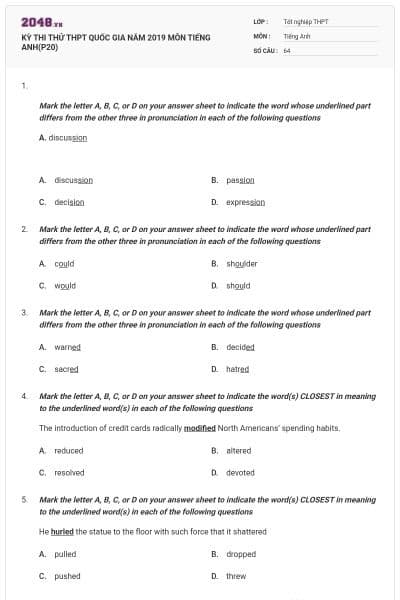
Mark the letter A, B, C, or D on your answer sheet to indicate the word whose underlined part differs from the other three in pronunciation in each of the following questions
A. discussion
discussion
passion
decision
expression
Đáp án : C
“sion” trong “decision” phát âm là /ʒn/, trong các từ còn lại phát âm là /∫n/
Mark the letter A, B, C, or D on your answer sheet to indicate the word whose underlined part differs from the other three in pronunciation in each of the following questions
could
shoulder
would
should
Đáp án : B
“ou” trong “shoulder” phát âm là /ou/, trong các từ còn lại phát âm là /u/
Mark the letter A, B, C, or D on your answer sheet to indicate the word whose underlined part differs from the other three in pronunciation in each of the following questions
warned
decided
sacred
hatred
Đáp án : A
“ed” sau âm /n/ phát âm là /d/, sau đuôi /d/ phát âm là /id/; “scared” và “hatred” là trường hợp đặc biệt mà “ed” phát âm là /id/
Mark the letter A, B, C, or D on your answer sheet to indicate the word(s) CLOSEST in meaning to the underlined word(s) in each of the following questions
The introduction of credit cards radically modified North Americans’ spending habits.
reduced
altered
resolved
devoted
Đáp án : B
Modify = sửa chữa, làm thay đổi. Alter = thay đổi. Reduce = giảm bớt. Resolve = hòa tan. Devote = cống hiến
Mark the letter A, B, C, or D on your answer sheet to indicate the word(s) CLOSEST in meaning to the underlined word(s) in each of the following questions
He hurled the statue to the floor with such force that it shattered
pulled
dropped
pushed
threw
Đáp án : D
Hurl = quăng, ném. Throw = ném, vứt. Pull = kéo. Drop = rơi. Push = đẩy
Mark the letter A, B, C, or D on your answer sheet to indicate the word(s) CLOSEST in meaning to the underlined word(s) in each of the following questions
According to Freud, dreams can be interpreted as the fulfillment of wishes
attainment
completion
performance
conclusion
Đáp án : B
Fulfillment = sự hoàn thiện, sự thực hiện. Completion = sự hoàn thành. Attainment = sự đạt được. Performance = màn biểu diễn. Conclusion = kết luận
He _______ in me on the understanding that I wouldn’t tell anyone else
confided
confessed
confined
disclosed
Đáp án: A
Giải thích:
Kiến thức: Từ vựng
A. confide (v): giãi bày, kể chuyện thầm kín
B. confess (v): thú nhận
C. confine (v): hạn chế/kìm hãm
D. disclose (v): hé lộ
confide in somebody: tâm sự với ai vì thấy rằng họ có thể tin tưởng được
Dịch: Anh ấy giãi bày với tôi vì hiểu rằng tôi sẽ không nói cho ai khác nữa.
That’s the trouble with the night shift. It _______ your private life too mu
breaks through
breaks up
breaks into
breaks in
Đáp án : C
Break into = đột nhập vào, can dự vào trái phép. Break through = tạo bước ngoặt, bước đột phá. Break up = chia tay; nghỉ giữa giờ. Break in something = cắt ngang
They were _______ for smuggling jewellery into the country
arrested
judged
warned
accused
Đáp án : A
Arrest = bắt giữ. Judge = đánh giá, xét xử. Warn = cảnh báo. Accuse = buộc t
The construction of the new road is _______ winning the support of local presidents
dependent on
thanks to
reliant on
responsible for
Đáp án : A
Be dependent on somebody/something = phụ thuộc vào ai, cái gì
Wood floats on water because it is _______ water.
the less dense as
less dense than
not as much density than
of lesser density as
Đáp án: B
Giải thích:
So sánh kém: S + be + less + adj + than + N = … kém… hơn
Dịch: Gỗ nổi trên mặt nước vì nó nhẹ hơn nước.
500 years ago the average human _______ was about 40 years
life cycle
life length
lifetime
life-span
Đáp án : D
Life-span = tuổi thọ
Why don’t they _______ their attention on scrutinizing the evidence instead of questioning the passers-by?
attract
draw
focus
devote
Đáp án: C
Giải thích:
Kiến thức: Từ vựng
A. attract attention: thu hút sự chú ý
B. draw attention to: hướng sự thu hút tới
C. focus (attention) on something: tập trung sự chú ý vào
D. devote attention to something: tập trung vào
Dựa vào nghĩa, chọn C.
Dịch: Tại sao họ không tập trung chú ý vào việc nghiên cứu bằng chứng thay vì hỏi những người qua đường?
The exquisite antique bottle was carved _______ marble
by
from
at
about
Đáp án : B
Carve = khắc. Was carved from something = được khắc nên từ cái gì. Marble = đá hoa, đá cẩm thạch
– “How about giving me a hand?” – “_______.”
I promise
No, not yet
Sure. I’d be glad to help
You’re welcome
Đáp án : C
Give somebody a hand = giúp đỡ ai. -> Người hỏi hỏi xem người đáp có thể giúp mình không. Người đáp nói: Chắc chắn rồi. Tôi rất vui khi được giúp bạn
Could you stand _______ for me and teach my English class tomorrow morning, John?
up
in
out
down
Đáp án: B
Giải thích:
stand in for somebody: thay thế ai
Dịch: John, anh có thể thay tôi dạy lớp tiếng Anh vào sáng mai được không?
Laura: “What a lovely house you have!” Maria: “_______.”
I think so
I feel very excited
Thank you. Hope you will drop in
Of course not, it’s not costly
Đáp án : C
What a/an + adj + N + S +be/V! Là hình thức câu cảm thán. Laura có ý khen: Thật là một ngôi nhà đáng yêu mà bạn có. Trước lời khen, Maria cám ơn và hy vọng Laura sẽ lại ghé chơi nhà mình
I’ve got a terrible hangover. If only I _______ that fourth bottle of wine
wouldn’t drink
didn’t drink
don’t drink
hadn’t drunk
Đáp án : D
Câu điều ước trái ngược với quá khứ (việc uống rượu là đã xảy ra trong quá khứ) : If only + S + had (not) + past participle
She _______ to the airport like that. The plane was delayed by several hours
couldn’t have rushed
wouldn’t have rushed
needn’t have rushed
mustn’t have rushed
Đáp án : C
Needn’t have + past participle = đáng lẽ không cần làm gì trong quá khứ, nhưng lại làm thừa. Couldn’t have + past participle = chắc chắn không thể làm gì đó trong quá khứ
He will be very upset if you _______ his offer of help.
turn from
turn against
turn down
turn away
Đáp án : C
Turn down something = từ chối, bác bỏ ý kiến của ai. Offer (n) = sự ngỏ ý
_______ in astronomy, the discovery of Uranus was by accident
Alike many finds
It was like many finds
Many alike finds
Like many finds
Đáp án : D
Like something/somebody = như là ai/cái gì. Like many finds in astronomy = giống như những phát hiện trong ngành vũ trụ. Alike = như nhau ≈ equally -> đặt cuối cụm từ
_______ from San Diego to the Mexican border
Not far
There is not far
Few miles
It’s not far
Đáp án : D
Câu đề bài thiếu chủ ngữ và động từ -> chỗ trống phải chứa chủ ngữ và động từ. There + is/are + (a/an) N (s/es) = có… -> chỉ sự tồn tại. It is + khoảng cách + from + somewhere + to + somewhere = chỗ này cách chỗ khác bao xa. Far from something = cách xa
The medicine made me feel dizzy. I felt as though the room _______ around and around
spins
is spinning
would be spinning
were spinning
Đáp án : D
Feel as though + clause = cảm giác như thể là… Spin around = quay tròn xung quanh. Việc uống thuốc và việc cảm thấy căn phòng quay đã xảy ra trong quá khứ -> việc quay tròn đã đang xảy ra tại một thời điểm trong quá khứ -> chia ở quá khứ tiếp diễn
The band is planning to go on _______ in Europe and Asia next year
tour
travel
trip
circuit
Đáp án : A
Go on tour = đi một tua ( một tua lưu diễn quanh châu Âu và châu Á). Travel = đi lại. Trip = đi chơi. Circuit = gánh xiếc
She has just bought _______.
a Swiss beautiful brand-new watch
a Swiss brand-new beautiful watch
a brand-new beautiful Swiss watch
a beautiful brand-new Swiss watch
Đáp án : D
Quy tắc sắp xếp các tính từ: OPSACOM: Opinion (beautiful) – Price – Size/shape – Age (brandnew = mới toanh) – Color – Origin (Swiss)– Material => beautiful brand-new Swiss
Read the following passage and mark the letter A, B, C, or D on your answer sheet to indicate the correct word or phrase that best fits each of the numbered blanks.
OWNING A PET
The joys and tribulations of being a pet owner! During our lifetime most of us have some experience of either owning a pet or being in (26) _______ contact with someone who does. Is there such a thing as “the ideal pet”? If so what characterizes the ideal pet? Various (27) _______ influence one’s choice of pet, from your reasons for getting a pet to your lifestyle. For example, although quite a few pets are relatively cheap to buy, the cost of (28) _______ can be considerable. Everything must be (29) _______ into account, from food and bedding, to vaccinations and veterinary bills. You must be prepared to (30) _______ time on your pet, which involves shopping for it, cleaning and feeding it. Pets can be demanding and a big responsibility. Are you prepared to exercise and (31) _______ an animal or do you prefer a more independent pet? How much spare room do you have? Is it right to lock an energetic animal into a (32) _______ space? Do you live near a busy road which may threaten the life of your pet? Pets (33) _______ as turtles and goldfish can be cheap and convenient, but if you prefer affectionate pets, a friendly cat or dog would be more (34) _______. People get pets for a number of reasons, for company, security or to teach responsibility to children. Pets can be affectionate and loyal and an excellent source of company as long as you know what pet (35) _______ you and your lifestyle.
Điền vào ô 26
tight
narrow
near
close
Đáp án : D
Be in close contact with somebody = quan hệ gần gũi, thân thiết với ai
Read the following passage and mark the letter A, B, C, or D on your answer sheet to indicate the correct word or phrase that best fits each of the numbered blanks.
OWNING A PET
The joys and tribulations of being a pet owner! During our lifetime most of us have some experience of either owning a pet or being in (26) _______ contact with someone who does. Is there such a thing as “the ideal pet”? If so what characterizes the ideal pet? Various (27) _______ influence one’s choice of pet, from your reasons for getting a pet to your lifestyle. For example, although quite a few pets are relatively cheap to buy, the cost of (28) _______ can be considerable. Everything must be (29) _______ into account, from food and bedding, to vaccinations and veterinary bills. You must be prepared to (30) _______ time on your pet, which involves shopping for it, cleaning and feeding it. Pets can be demanding and a big responsibility. Are you prepared to exercise and (31) _______ an animal or do you prefer a more independent pet? How much spare room do you have? Is it right to lock an energetic animal into a (32) _______ space? Do you live near a busy road which may threaten the life of your pet? Pets (33) _______ as turtles and goldfish can be cheap and convenient, but if you prefer affectionate pets, a friendly cat or dog would be more (34) _______. People get pets for a number of reasons, for company, security or to teach responsibility to children. Pets can be affectionate and loyal and an excellent source of company as long as you know what pet (35) _______ you and your lifestyle.
Điền vào ô 27
factors
facets
points
elements
Đáp án : A
Factor = yếu tố. Facet = khía cạnh. Point = điểm. Element = thành phần, nhân tố
Read the following passage and mark the letter A, B, C, or D on your answer sheet to indicate the correct word or phrase that best fits each of the numbered blanks.
OWNING A PET
The joys and tribulations of being a pet owner! During our lifetime most of us have some experience of either owning a pet or being in (26) _______ contact with someone who does. Is there such a thing as “the ideal pet”? If so what characterizes the ideal pet? Various (27) _______ influence one’s choice of pet, from your reasons for getting a pet to your lifestyle. For example, although quite a few pets are relatively cheap to buy, the cost of (28) _______ can be considerable. Everything must be (29) _______ into account, from food and bedding, to vaccinations and veterinary bills. You must be prepared to (30) _______ time on your pet, which involves shopping for it, cleaning and feeding it. Pets can be demanding and a big responsibility. Are you prepared to exercise and (31) _______ an animal or do you prefer a more independent pet? How much spare room do you have? Is it right to lock an energetic animal into a (32) _______ space? Do you live near a busy road which may threaten the life of your pet? Pets (33) _______ as turtles and goldfish can be cheap and convenient, but if you prefer affectionate pets, a friendly cat or dog would be more (34) _______. People get pets for a number of reasons, for company, security or to teach responsibility to children. Pets can be affectionate and loyal and an excellent source of company as long as you know what pet (35) _______ you and your lifestyle.
Điền vào ô 28
maintenance
upbringing
raising
upkeep
Đáp án : D
Upkeep = sự bảo dưỡng. Maintenance = sự duy trì. Upbringing = sự nuôi dưỡng. Raising = sự đưa lên, chăn nuôi
Read the following passage and mark the letter A, B, C, or D on your answer sheet to indicate the correct word or phrase that best fits each of the numbered blanks.
OWNING A PET
The joys and tribulations of being a pet owner! During our lifetime most of us have some experience of either owning a pet or being in (26) _______ contact with someone who does. Is there such a thing as “the ideal pet”? If so what characterizes the ideal pet? Various (27) _______ influence one’s choice of pet, from your reasons for getting a pet to your lifestyle. For example, although quite a few pets are relatively cheap to buy, the cost of (28) _______ can be considerable. Everything must be (29) _______ into account, from food and bedding, to vaccinations and veterinary bills. You must be prepared to (30) _______ time on your pet, which involves shopping for it, cleaning and feeding it. Pets can be demanding and a big responsibility. Are you prepared to exercise and (31) _______ an animal or do you prefer a more independent pet? How much spare room do you have? Is it right to lock an energetic animal into a (32) _______ space? Do you live near a busy road which may threaten the life of your pet? Pets (33) _______ as turtles and goldfish can be cheap and convenient, but if you prefer affectionate pets, a friendly cat or dog would be more (34) _______. People get pets for a number of reasons, for company, security or to teach responsibility to children. Pets can be affectionate and loyal and an excellent source of company as long as you know what pet (35) _______ you and your lifestyle.
Điền vào ô 29
held
considering
kept
taken
Đáp án : D
Take something into account = tính đến, đưa vào xem xét. Everything must be taken into account = mọi thứ phải được tính đến
Read the following passage and mark the letter A, B, C, or D on your answer sheet to indicate the correct word or phrase that best fits each of the numbered blanks.
OWNING A PET
The joys and tribulations of being a pet owner! During our lifetime most of us have some experience of either owning a pet or being in (26) _______ contact with someone who does. Is there such a thing as “the ideal pet”? If so what characterizes the ideal pet? Various (27) _______ influence one’s choice of pet, from your reasons for getting a pet to your lifestyle. For example, although quite a few pets are relatively cheap to buy, the cost of (28) _______ can be considerable. Everything must be (29) _______ into account, from food and bedding, to vaccinations and veterinary bills. You must be prepared to (30) _______ time on your pet, which involves shopping for it, cleaning and feeding it. Pets can be demanding and a big responsibility. Are you prepared to exercise and (31) _______ an animal or do you prefer a more independent pet? How much spare room do you have? Is it right to lock an energetic animal into a (32) _______ space? Do you live near a busy road which may threaten the life of your pet? Pets (33) _______ as turtles and goldfish can be cheap and convenient, but if you prefer affectionate pets, a friendly cat or dog would be more (34) _______. People get pets for a number of reasons, for company, security or to teach responsibility to children. Pets can be affectionate and loyal and an excellent source of company as long as you know what pet (35) _______ you and your lifestyle.
Điền vào ô 30
waste
occupy
take
spend
Đáp án : D
Spend time on something/Ving = dành thời gian cho cái gì, việc gì
Read the following passage and mark the letter A, B, C, or D on your answer sheet to indicate the correct word or phrase that best fits each of the numbered blanks.
OWNING A PET
The joys and tribulations of being a pet owner! During our lifetime most of us have some experience of either owning a pet or being in (26) _______ contact with someone who does. Is there such a thing as “the ideal pet”? If so what characterizes the ideal pet? Various (27) _______ influence one’s choice of pet, from your reasons for getting a pet to your lifestyle. For example, although quite a few pets are relatively cheap to buy, the cost of (28) _______ can be considerable. Everything must be (29) _______ into account, from food and bedding, to vaccinations and veterinary bills. You must be prepared to (30) _______ time on your pet, which involves shopping for it, cleaning and feeding it. Pets can be demanding and a big responsibility. Are you prepared to exercise and (31) _______ an animal or do you prefer a more independent pet? How much spare room do you have? Is it right to lock an energetic animal into a (32) _______ space? Do you live near a busy road which may threaten the life of your pet? Pets (33) _______ as turtles and goldfish can be cheap and convenient, but if you prefer affectionate pets, a friendly cat or dog would be more (34) _______. People get pets for a number of reasons, for company, security or to teach responsibility to children. Pets can be affectionate and loyal and an excellent source of company as long as you know what pet (35) _______ you and your lifestyle.
Điền vào ô 31
household
housekeep
housework
housetrain
Đáp án : D
Housetrain = huấn luyện để biết cư xử đúng trong nhà. Household = hộ gia đình (n); trong gia đình (adj). Housework = việc nhà
Read the following passage and mark the letter A, B, C, or D on your answer sheet to indicate the correct word or phrase that best fits each of the numbered blanks.
OWNING A PET
The joys and tribulations of being a pet owner! During our lifetime most of us have some experience of either owning a pet or being in (26) _______ contact with someone who does. Is there such a thing as “the ideal pet”? If so what characterizes the ideal pet? Various (27) _______ influence one’s choice of pet, from your reasons for getting a pet to your lifestyle. For example, although quite a few pets are relatively cheap to buy, the cost of (28) _______ can be considerable. Everything must be (29) _______ into account, from food and bedding, to vaccinations and veterinary bills. You must be prepared to (30) _______ time on your pet, which involves shopping for it, cleaning and feeding it. Pets can be demanding and a big responsibility. Are you prepared to exercise and (31) _______ an animal or do you prefer a more independent pet? How much spare room do you have? Is it right to lock an energetic animal into a (32) _______ space? Do you live near a busy road which may threaten the life of your pet? Pets (33) _______ as turtles and goldfish can be cheap and convenient, but if you prefer affectionate pets, a friendly cat or dog would be more (34) _______. People get pets for a number of reasons, for company, security or to teach responsibility to children. Pets can be affectionate and loyal and an excellent source of company as long as you know what pet (35) _______ you and your lifestyle.
Điền vào ô 32
reduced
detained
closed
confined
Đáp án : D
Confined = bị giới hạn, không rộng rãi, thoải mái. Reduce = giảm. Detain = cản trở. Close = đóng
Read the following passage and mark the letter A, B, C, or D on your answer sheet to indicate the correct word or phrase that best fits each of the numbered blanks.
OWNING A PET
The joys and tribulations of being a pet owner! During our lifetime most of us have some experience of either owning a pet or being in (26) _______ contact with someone who does. Is there such a thing as “the ideal pet”? If so what characterizes the ideal pet? Various (27) _______ influence one’s choice of pet, from your reasons for getting a pet to your lifestyle. For example, although quite a few pets are relatively cheap to buy, the cost of (28) _______ can be considerable. Everything must be (29) _______ into account, from food and bedding, to vaccinations and veterinary bills. You must be prepared to (30) _______ time on your pet, which involves shopping for it, cleaning and feeding it. Pets can be demanding and a big responsibility. Are you prepared to exercise and (31) _______ an animal or do you prefer a more independent pet? How much spare room do you have? Is it right to lock an energetic animal into a (32) _______ space? Do you live near a busy road which may threaten the life of your pet? Pets (33) _______ as turtles and goldfish can be cheap and convenient, but if you prefer affectionate pets, a friendly cat or dog would be more (34) _______. People get pets for a number of reasons, for company, security or to teach responsibility to children. Pets can be affectionate and loyal and an excellent source of company as long as you know what pet (35) _______ you and your lifestyle.
Điền vào ô 33
much
such
for
so
Đáp án : B
Such as + N/Ving = ví dụ như là… -> liệt kê
Read the following passage and mark the letter A, B, C, or D on your answer sheet to indicate the correct word or phrase that best fits each of the numbered blanks.
OWNING A PET
The joys and tribulations of being a pet owner! During our lifetime most of us have some experience of either owning a pet or being in (26) _______ contact with someone who does. Is there such a thing as “the ideal pet”? If so what characterizes the ideal pet? Various (27) _______ influence one’s choice of pet, from your reasons for getting a pet to your lifestyle. For example, although quite a few pets are relatively cheap to buy, the cost of (28) _______ can be considerable. Everything must be (29) _______ into account, from food and bedding, to vaccinations and veterinary bills. You must be prepared to (30) _______ time on your pet, which involves shopping for it, cleaning and feeding it. Pets can be demanding and a big responsibility. Are you prepared to exercise and (31) _______ an animal or do you prefer a more independent pet? How much spare room do you have? Is it right to lock an energetic animal into a (32) _______ space? Do you live near a busy road which may threaten the life of your pet? Pets (33) _______ as turtles and goldfish can be cheap and convenient, but if you prefer affectionate pets, a friendly cat or dog would be more (34) _______. People get pets for a number of reasons, for company, security or to teach responsibility to children. Pets can be affectionate and loyal and an excellent source of company as long as you know what pet (35) _______ you and your lifestyle.
Điền vào ô 34
likely
suited
appropriate
good
Đáp án : C
Appropriate = thích hợp, hợp lí. Likely = có vẻ như, có thể. Suited = phù hợp với cái gì. Good = tốt
Read the following passage and mark the letter A, B, C, or D on your answer sheet to indicate the correct word or phrase that best fits each of the numbered blanks.
OWNING A PET
The joys and tribulations of being a pet owner! During our lifetime most of us have some experience of either owning a pet or being in (26) _______ contact with someone who does. Is there such a thing as “the ideal pet”? If so what characterizes the ideal pet? Various (27) _______ influence one’s choice of pet, from your reasons for getting a pet to your lifestyle. For example, although quite a few pets are relatively cheap to buy, the cost of (28) _______ can be considerable. Everything must be (29) _______ into account, from food and bedding, to vaccinations and veterinary bills. You must be prepared to (30) _______ time on your pet, which involves shopping for it, cleaning and feeding it. Pets can be demanding and a big responsibility. Are you prepared to exercise and (31) _______ an animal or do you prefer a more independent pet? How much spare room do you have? Is it right to lock an energetic animal into a (32) _______ space? Do you live near a busy road which may threaten the life of your pet? Pets (33) _______ as turtles and goldfish can be cheap and convenient, but if you prefer affectionate pets, a friendly cat or dog would be more (34) _______. People get pets for a number of reasons, for company, security or to teach responsibility to children. Pets can be affectionate and loyal and an excellent source of company as long as you know what pet (35) _______ you and your lifestyle.
Điền vào ô 35
suits
matches
fits
goes with
Đáp án : A
Suit = hợp với. Match = ghép nối thành một cặp, một chiếc. Fit = vừa vặn về kích cỡ. Go with = đi với cái gì
Mark the letter A, B, C or D on your answer sheet to indicate the underlined part that needs correction in each of the following questions
(A) When the chemicals (B) inside a cell (C) no longer produce ions, the cell stops (D) to function.
When
inside
no longer
to function.
Đáp án : D
Stop Ving = dừng việc làm gì lại. Stop to V = dừng lại để làm việc gì khác
Mark the letter A, B, C or D on your answer sheet to indicate the underlined part that needs correction in each of the following questions
(A) One or the other of the secretaries (B) have to attend the meeting. But (C) both of them are reluctant (D) to do so.
One or the othe
have to
both of them
o do so
Đáp án : B
Chủ ngữ là S1 or S2 thì động từ chia theo S2. Ở đây chủ ngữ là : one or the other = một hoặc là một người khác -> động từ chia theo “the other” – chỉ số ít -> động từ chính phải chia: has to
Mark the letter A, B, C or D on your answer sheet to indicate the underlined part that needs correction in each of the following questions
(A) The populace was (B) so terrified of the tornado that (C) however town she visited she found (D) villages deserted of inhabitants and livestock
The
so terrified
however
villages deserte
Đáp án : C
However = tuy nhiên. Sửa thành: every. Every town she visited she found …= thị trấn nào cô ấy ghé thăm cô ấy cũng thấy…
Mark the letter A, B, C or D on your answer sheet to indicate the underlined part that needs correction in each of the following questions
Although I didn’t (A) personally see who was responsible (B) for this mess, (C) but I think I can (D) make a guess
personally
for
but I
make
Đáp án : C
Câu đã có “Although” thì không dùng “but”. Although + clause, clause = mặc dù…, …. But = nhưng
Mark the letter A, B, C or D on your answer sheet to indicate the underlined part that needs correction in each of the following questions
What surprised me most (A) was that he (B) kept smiling even after (C) so many insults (D) directing at him.
was that
kept smiling
so
directing
Đáp án : D
Even after + mệnh đề. = thậm chí sau khi. Ở câu đề bài, sau “even after” là một cụm danh từ, không có động từ. Sửa D -> directed (động từ chia thì quá khứ). So many insults directed at him = quá nhiều lời xúc phạm hướng vào anh ta
Read the following passage and mark the letter A, B, C, or D on your answer sheet to indicate the correct answer to each of the questions.
Most forms of property are concrete and tangible, such as houses, cars, furniture or anything else that is included in one’s possessions. Other forms of property can be intangible and copyright deals with intangible forms of property. Copyright is a legal protection extended to authors of creative works, for example, books, magazine articles, maps, films, plays, television shows, software, paintings, photographs, music, choreography in dance and all other forms of intellectual or artistic property.
Although the purpose of artistic property is usually public use and enjoyment, copyright establishes the ownership of the creator. When a person buys a copyrighted magazine, it belongs to this individual as a tangible object. However, the authors of the magazine articles own the research and the writing that went into creating the articles. The right to make and sell or give away copies of books or articles belongs to the authors, publishers, or other individuals or organizations that hold the copyright. To copy an entire book or a part of it, permission must be received from the copyright owner, who will most likely expect to be paid.
Copyright law distinguishes between different types of intellectual property. Music may be played by anyone after it is published. However, if it is performed for profit, the performers need to pay a fee, called a royalty. A similar principle applies to performances of songs and plays. On the other hand, names, ideas, and book titles are accepted. Ideas do not become copyrighted property until they are published in a book, a painting or a musical work. Almost all artistic work created before the 20th century is not copyrighted because it was created before the copyright law was passed.
The two common ways of infringing upon the copyright are plagiarism and piracy. Plagiarizing the work of another person means passing it off as one’s own. The word plagiarism is derived from the Latin plagiarus, which means “abductor”. Piracy may be an act of one person, but, in many cases, it is a joint effort of several people who reproduce copyrighted material and sell it for profit without paying royalties to the creator. Technological innovations have made piracy easy and anyone can duplicate a motion picture on videotape, a computer program, or a book. Video cassette recorders can be used by practically anyone to copy movies and television programs, and copying software has become almost as easy as copying a book. Large companies zealously monitor their copyrights for slogans, advertisements, and brand names, protected by a trademark.
What does the passage mainly discuss?
Legal rights of property owners
Legal ownership of creative work
Examples of copyright piracy
Copying creating work for profit
Đáp án : B
Bài văn nói về “copyright” (= bản quyền), danh từ này được lặp lại trong tất cả các đoạn. Legal ownership of creative work = sự sở hữu theo luật pháp của những tác phẩm trí tuệ
Read the following passage and mark the letter A, B, C, or D on your answer sheet to indicate the correct answer to each of the questions.
Most forms of property are concrete and tangible, such as houses, cars, furniture or anything else that is included in one’s possessions. Other forms of property can be intangible and copyright deals with intangible forms of property. Copyright is a legal protection extended to authors of creative works, for example, books, magazine articles, maps, films, plays, television shows, software, paintings, photographs, music, choreography in dance and all other forms of intellectual or artistic property.
Although the purpose of artistic property is usually public use and enjoyment, copyright establishes the ownership of the creator. When a person buys a copyrighted magazine, it belongs to this individual as a tangible object. However, the authors of the magazine articles own the research and the writing that went into creating the articles. The right to make and sell or give away copies of books or articles belongs to the authors, publishers, or other individuals or organizations that hold the copyright. To copy an entire book or a part of it, permission must be received from the copyright owner, who will most likely expect to be paid.
Copyright law distinguishes between different types of intellectual property. Music may be played by anyone after it is published. However, if it is performed for profit, the performers need to pay a fee, called a royalty. A similar principle applies to performances of songs and plays. On the other hand, names, ideas, and book titles are accepted. Ideas do not become copyrighted property until they are published in a book, a painting or a musical work. Almost all artistic work created before the 20th century is not copyrighted because it was created before the copyright law was passed.
The two common ways of infringing upon the copyright are plagiarism and piracy. Plagiarizing the work of another person means passing it off as one’s own. The word plagiarism is derived from the Latin plagiarus, which means “abductor”. Piracy may be an act of one person, but, in many cases, it is a joint effort of several people who reproduce copyrighted material and sell it for profit without paying royalties to the creator. Technological innovations have made piracy easy and anyone can duplicate a motion picture on videotape, a computer program, or a book. Video cassette recorders can be used by practically anyone to copy movies and television programs, and copying software has become almost as easy as copying a book. Large companies zealously monitor their copyrights for slogans, advertisements, and brand names, protected by a trademark.
The word “extended” in paragraph 1 is closest in meaning to _______.
explicated
exposed
guaranteed
granted
Đáp án : D
Extend to N = mở rộng cho đối tượng nào; dành cho đối tượng nào. Grant something to somebody = trao cái gì cho ai
Read the following passage and mark the letter A, B, C, or D on your answer sheet to indicate the correct answer to each of the questions.
Most forms of property are concrete and tangible, such as houses, cars, furniture or anything else that is included in one’s possessions. Other forms of property can be intangible and copyright deals with intangible forms of property. Copyright is a legal protection extended to authors of creative works, for example, books, magazine articles, maps, films, plays, television shows, software, paintings, photographs, music, choreography in dance and all other forms of intellectual or artistic property.
Although the purpose of artistic property is usually public use and enjoyment, copyright establishes the ownership of the creator. When a person buys a copyrighted magazine, it belongs to this individual as a tangible object. However, the authors of the magazine articles own the research and the writing that went into creating the articles. The right to make and sell or give away copies of books or articles belongs to the authors, publishers, or other individuals or organizations that hold the copyright. To copy an entire book or a part of it, permission must be received from the copyright owner, who will most likely expect to be paid.
Copyright law distinguishes between different types of intellectual property. Music may be played by anyone after it is published. However, if it is performed for profit, the performers need to pay a fee, called a royalty. A similar principle applies to performances of songs and plays. On the other hand, names, ideas, and book titles are accepted. Ideas do not become copyrighted property until they are published in a book, a painting or a musical work. Almost all artistic work created before the 20th century is not copyrighted because it was created before the copyright law was passed.
The two common ways of infringing upon the copyright are plagiarism and piracy. Plagiarizing the work of another person means passing it off as one’s own. The word plagiarism is derived from the Latin plagiarus, which means “abductor”. Piracy may be an act of one person, but, in many cases, it is a joint effort of several people who reproduce copyrighted material and sell it for profit without paying royalties to the creator. Technological innovations have made piracy easy and anyone can duplicate a motion picture on videotape, a computer program, or a book. Video cassette recorders can be used by practically anyone to copy movies and television programs, and copying software has become almost as easy as copying a book. Large companies zealously monitor their copyrights for slogans, advertisements, and brand names, protected by a trademark.
It can be inferred from the passage that copyright law is intended to protect _______.
paintings and photographs from theft
the creator’s ability to profit from the work
the user’s ability to enjoy an artistic work
computer software and videos from being copied
Đáp án : B
Câu cuối đoạn 2: To copy an entire book or a part of it, permission must be received from the copyright owner, who will most likely expect to be paid ---> để sao chép một cuốn sách hoặc một phần, phải được sự cho phép từ người giữ bản quyền người được kì vọng là sẽ được trả phí -> luật bản quyền bảo vệ khả năng thu lợi nhuận từ sáng tác của tác giả
Read the following passage and mark the letter A, B, C, or D on your answer sheet to indicate the correct answer to each of the questions.
Most forms of property are concrete and tangible, such as houses, cars, furniture or anything else that is included in one’s possessions. Other forms of property can be intangible and copyright deals with intangible forms of property. Copyright is a legal protection extended to authors of creative works, for example, books, magazine articles, maps, films, plays, television shows, software, paintings, photographs, music, choreography in dance and all other forms of intellectual or artistic property.
Although the purpose of artistic property is usually public use and enjoyment, copyright establishes the ownership of the creator. When a person buys a copyrighted magazine, it belongs to this individual as a tangible object. However, the authors of the magazine articles own the research and the writing that went into creating the articles. The right to make and sell or give away copies of books or articles belongs to the authors, publishers, or other individuals or organizations that hold the copyright. To copy an entire book or a part of it, permission must be received from the copyright owner, who will most likely expect to be paid.
Copyright law distinguishes between different types of intellectual property. Music may be played by anyone after it is published. However, if it is performed for profit, the performers need to pay a fee, called a royalty. A similar principle applies to performances of songs and plays. On the other hand, names, ideas, and book titles are accepted. Ideas do not become copyrighted property until they are published in a book, a painting or a musical work. Almost all artistic work created before the 20th century is not copyrighted because it was created before the copyright law was passed.
The two common ways of infringing upon the copyright are plagiarism and piracy. Plagiarizing the work of another person means passing it off as one’s own. The word plagiarism is derived from the Latin plagiarus, which means “abductor”. Piracy may be an act of one person, but, in many cases, it is a joint effort of several people who reproduce copyrighted material and sell it for profit without paying royalties to the creator. Technological innovations have made piracy easy and anyone can duplicate a motion picture on videotape, a computer program, or a book. Video cassette recorders can be used by practically anyone to copy movies and television programs, and copying software has become almost as easy as copying a book. Large companies zealously monitor their copyrights for slogans, advertisements, and brand names, protected by a trademark.
The word “principle” in paragraph 3 is closest in meaning to _______.
crucial point
cardinal role
fundamental rule
formidable force
Đáp án : C
Principle = nguyên tắc. Fundamental rule = quy tắc cơ bản
Read the following passage and mark the letter A, B, C, or D on your answer sheet to indicate the correct answer to each of the questions.
Most forms of property are concrete and tangible, such as houses, cars, furniture or anything else that is included in one’s possessions. Other forms of property can be intangible and copyright deals with intangible forms of property. Copyright is a legal protection extended to authors of creative works, for example, books, magazine articles, maps, films, plays, television shows, software, paintings, photographs, music, choreography in dance and all other forms of intellectual or artistic property.
Although the purpose of artistic property is usually public use and enjoyment, copyright establishes the ownership of the creator. When a person buys a copyrighted magazine, it belongs to this individual as a tangible object. However, the authors of the magazine articles own the research and the writing that went into creating the articles. The right to make and sell or give away copies of books or articles belongs to the authors, publishers, or other individuals or organizations that hold the copyright. To copy an entire book or a part of it, permission must be received from the copyright owner, who will most likely expect to be paid.
Copyright law distinguishes between different types of intellectual property. Music may be played by anyone after it is published. However, if it is performed for profit, the performers need to pay a fee, called a royalty. A similar principle applies to performances of songs and plays. On the other hand, names, ideas, and book titles are accepted. Ideas do not become copyrighted property until they are published in a book, a painting or a musical work. Almost all artistic work created before the 20th century is not copyrighted because it was created before the copyright law was passed.
The two common ways of infringing upon the copyright are plagiarism and piracy. Plagiarizing the work of another person means passing it off as one’s own. The word plagiarism is derived from the Latin plagiarus, which means “abductor”. Piracy may be an act of one person, but, in many cases, it is a joint effort of several people who reproduce copyrighted material and sell it for profit without paying royalties to the creator. Technological innovations have made piracy easy and anyone can duplicate a motion picture on videotape, a computer program, or a book. Video cassette recorders can be used by practically anyone to copy movies and television programs, and copying software has become almost as easy as copying a book. Large companies zealously monitor their copyrights for slogans, advertisements, and brand names, protected by a trademark.
Which of the following properties is NOT mentioned as protected by copyright?
printed medium
paintings and maps
music and plays
scientific discoveries
Đáp án : D
Từ dòng 3 đoạn 1: Copyright is a legal protection extended to authors of creative works, for example, books, magazine articles, maps, films, plays, television shows, software, paintings, photographs, music, choreography in dance and all other forms of intellectual or artistic property.-> không nhắc tới “scientific discoveries” = những phát hiện khoa học
Read the following passage and mark the letter A, B, C, or D on your answer sheet to indicate the correct answer to each of the questions.
Most forms of property are concrete and tangible, such as houses, cars, furniture or anything else that is included in one’s possessions. Other forms of property can be intangible and copyright deals with intangible forms of property. Copyright is a legal protection extended to authors of creative works, for example, books, magazine articles, maps, films, plays, television shows, software, paintings, photographs, music, choreography in dance and all other forms of intellectual or artistic property.
Although the purpose of artistic property is usually public use and enjoyment, copyright establishes the ownership of the creator. When a person buys a copyrighted magazine, it belongs to this individual as a tangible object. However, the authors of the magazine articles own the research and the writing that went into creating the articles. The right to make and sell or give away copies of books or articles belongs to the authors, publishers, or other individuals or organizations that hold the copyright. To copy an entire book or a part of it, permission must be received from the copyright owner, who will most likely expect to be paid.
Copyright law distinguishes between different types of intellectual property. Music may be played by anyone after it is published. However, if it is performed for profit, the performers need to pay a fee, called a royalty. A similar principle applies to performances of songs and plays. On the other hand, names, ideas, and book titles are accepted. Ideas do not become copyrighted property until they are published in a book, a painting or a musical work. Almost all artistic work created before the 20th century is not copyrighted because it was created before the copyright law was passed.
The two common ways of infringing upon the copyright are plagiarism and piracy. Plagiarizing the work of another person means passing it off as one’s own. The word plagiarism is derived from the Latin plagiarus, which means “abductor”. Piracy may be an act of one person, but, in many cases, it is a joint effort of several people who reproduce copyrighted material and sell it for profit without paying royalties to the creator. Technological innovations have made piracy easy and anyone can duplicate a motion picture on videotape, a computer program, or a book. Video cassette recorders can be used by practically anyone to copy movies and television programs, and copying software has become almost as easy as copying a book. Large companies zealously monitor their copyrights for slogans, advertisements, and brand names, protected by a trademark.
It can be inferred from the passage that it is legal if _______.
two drawings, created by two different artists, have the same images
two books, written by two different authors, have the same titles
two songs, written by two different composers, have the same melody
two plays, created by two different playwrights, have the same plot and characters
Đáp án : B
Từ dòng 3 đoạn 3: On the other hand, names, ideas, and book titles are accepted -> tên gọi, ý tưởng và tựa đề thì được phép -> hai quyển sách khác nhau viết bởi hai tác giả khác nhau nhưng vẫn có thể có cùng nhan đề
Read the following passage and mark the letter A, B, C, or D on your answer sheet to indicate the correct answer to each of the questions.
Most forms of property are concrete and tangible, such as houses, cars, furniture or anything else that is included in one’s possessions. Other forms of property can be intangible and copyright deals with intangible forms of property. Copyright is a legal protection extended to authors of creative works, for example, books, magazine articles, maps, films, plays, television shows, software, paintings, photographs, music, choreography in dance and all other forms of intellectual or artistic property.
Although the purpose of artistic property is usually public use and enjoyment, copyright establishes the ownership of the creator. When a person buys a copyrighted magazine, it belongs to this individual as a tangible object. However, the authors of the magazine articles own the research and the writing that went into creating the articles. The right to make and sell or give away copies of books or articles belongs to the authors, publishers, or other individuals or organizations that hold the copyright. To copy an entire book or a part of it, permission must be received from the copyright owner, who will most likely expect to be paid.
Copyright law distinguishes between different types of intellectual property. Music may be played by anyone after it is published. However, if it is performed for profit, the performers need to pay a fee, called a royalty. A similar principle applies to performances of songs and plays. On the other hand, names, ideas, and book titles are accepted. Ideas do not become copyrighted property until they are published in a book, a painting or a musical work. Almost all artistic work created before the 20th century is not copyrighted because it was created before the copyright law was passed.
The two common ways of infringing upon the copyright are plagiarism and piracy. Plagiarizing the work of another person means passing it off as one’s own. The word plagiarism is derived from the Latin plagiarus, which means “abductor”. Piracy may be an act of one person, but, in many cases, it is a joint effort of several people who reproduce copyrighted material and sell it for profit without paying royalties to the creator. Technological innovations have made piracy easy and anyone can duplicate a motion picture on videotape, a computer program, or a book. Video cassette recorders can be used by practically anyone to copy movies and television programs, and copying software has become almost as easy as copying a book. Large companies zealously monitor their copyrights for slogans, advertisements, and brand names, protected by a trademark.
With which of the following statements is the author most likely to agree?
Teachers are not allowed to make copies of published materials for use by their students
Plays written in the 16th century cannot be performed in theaters without permission
Singers can publicly sing only the songs for which they wrote the music and the lyrics
It is illegal to make photographs when sightseeing or traveling
Đáp án : A
Từ dòng 4 đoạn 2: The right to make and sell or give away copies of books or articles belongs to the authors, publishers, or other individuals or organizations that hold the copyright -> quyền tạo và bán, cho đi bản sao của sách hay bài viết thuộc về nhà xuất bản hoặc các tổ chức, cá nhân nắm giữ bản quyền -> giáo viên không được phép sao chép tài liệu đã xuất bản cho học sinh sử dụng
Read the following passage and mark the letter A, B, C, or D on your answer sheet to indicate the correct answer to each of the questions.
Most forms of property are concrete and tangible, such as houses, cars, furniture or anything else that is included in one’s possessions. Other forms of property can be intangible and copyright deals with intangible forms of property. Copyright is a legal protection extended to authors of creative works, for example, books, magazine articles, maps, films, plays, television shows, software, paintings, photographs, music, choreography in dance and all other forms of intellectual or artistic property.
Although the purpose of artistic property is usually public use and enjoyment, copyright establishes the ownership of the creator. When a person buys a copyrighted magazine, it belongs to this individual as a tangible object. However, the authors of the magazine articles own the research and the writing that went into creating the articles. The right to make and sell or give away copies of books or articles belongs to the authors, publishers, or other individuals or organizations that hold the copyright. To copy an entire book or a part of it, permission must be received from the copyright owner, who will most likely expect to be paid.
Copyright law distinguishes between different types of intellectual property. Music may be played by anyone after it is published. However, if it is performed for profit, the performers need to pay a fee, called a royalty. A similar principle applies to performances of songs and plays. On the other hand, names, ideas, and book titles are accepted. Ideas do not become copyrighted property until they are published in a book, a painting or a musical work. Almost all artistic work created before the 20th century is not copyrighted because it was created before the copyright law was passed.
The two common ways of infringing upon the copyright are plagiarism and piracy. Plagiarizing the work of another person means passing it off as one’s own. The word plagiarism is derived from the Latin plagiarus, which means “abductor”. Piracy may be an act of one person, but, in many cases, it is a joint effort of several people who reproduce copyrighted material and sell it for profit without paying royalties to the creator. Technological innovations have made piracy easy and anyone can duplicate a motion picture on videotape, a computer program, or a book. Video cassette recorders can be used by practically anyone to copy movies and television programs, and copying software has become almost as easy as copying a book. Large companies zealously monitor their copyrights for slogans, advertisements, and brand names, protected by a trademark.
The phrase “infringing upon” in paragraph is closest in meaning to _______.
impinging upon
inducting for
violating
abhorring
Đáp án : C
Infringe upon something = vi phạm, xâm phạm vào cái gì. Violate = vi phạm, phạm pháp
Read the following passage and mark the letter A, B, C, or D on your answer sheet to indicate the correct answer to each of the questions.
Most forms of property are concrete and tangible, such as houses, cars, furniture or anything else that is included in one’s possessions. Other forms of property can be intangible and copyright deals with intangible forms of property. Copyright is a legal protection extended to authors of creative works, for example, books, magazine articles, maps, films, plays, television shows, software, paintings, photographs, music, choreography in dance and all other forms of intellectual or artistic property.
Although the purpose of artistic property is usually public use and enjoyment, copyright establishes the ownership of the creator. When a person buys a copyrighted magazine, it belongs to this individual as a tangible object. However, the authors of the magazine articles own the research and the writing that went into creating the articles. The right to make and sell or give away copies of books or articles belongs to the authors, publishers, or other individuals or organizations that hold the copyright. To copy an entire book or a part of it, permission must be received from the copyright owner, who will most likely expect to be paid.
Copyright law distinguishes between different types of intellectual property. Music may be played by anyone after it is published. However, if it is performed for profit, the performers need to pay a fee, called a royalty. A similar principle applies to performances of songs and plays. On the other hand, names, ideas, and book titles are accepted. Ideas do not become copyrighted property until they are published in a book, a painting or a musical work. Almost all artistic work created before the 20th century is not copyrighted because it was created before the copyright law was passed.
The two common ways of infringing upon the copyright are plagiarism and piracy. Plagiarizing the work of another person means passing it off as one’s own. The word plagiarism is derived from the Latin plagiarus, which means “abductor”. Piracy may be an act of one person, but, in many cases, it is a joint effort of several people who reproduce copyrighted material and sell it for profit without paying royalties to the creator. Technological innovations have made piracy easy and anyone can duplicate a motion picture on videotape, a computer program, or a book. Video cassette recorders can be used by practically anyone to copy movies and television programs, and copying software has become almost as easy as copying a book. Large companies zealously monitor their copyrights for slogans, advertisements, and brand names, protected by a trademark.
The purpose of copyright law is most comparable with the purpose of which of the following?
A law against theft
A law against smoking
A school policy
A household rule
Đáp án : A
Ngay từ đầu đoạn 4: The two common ways of infringing upon the copyright are plagiarism and piracy = có 2 cách thông thường để vi phạm bản quyền đó là ăn cắp và sao chép bất hợp pháp. -----> Việc ăn cắp là do kẻ cắp; nói cách khác luật bảo vệ bản quyền cũng giống luật chống lại tội phạm
Read the following passage and mark the letter A, B, C, or D on your answer sheet to indicate the correct answer to each of the questions.
Most forms of property are concrete and tangible, such as houses, cars, furniture or anything else that is included in one’s possessions. Other forms of property can be intangible and copyright deals with intangible forms of property. Copyright is a legal protection extended to authors of creative works, for example, books, magazine articles, maps, films, plays, television shows, software, paintings, photographs, music, choreography in dance and all other forms of intellectual or artistic property.
Although the purpose of artistic property is usually public use and enjoyment, copyright establishes the ownership of the creator. When a person buys a copyrighted magazine, it belongs to this individual as a tangible object. However, the authors of the magazine articles own the research and the writing that went into creating the articles. The right to make and sell or give away copies of books or articles belongs to the authors, publishers, or other individuals or organizations that hold the copyright. To copy an entire book or a part of it, permission must be received from the copyright owner, who will most likely expect to be paid.
Copyright law distinguishes between different types of intellectual property. Music may be played by anyone after it is published. However, if it is performed for profit, the performers need to pay a fee, called a royalty. A similar principle applies to performances of songs and plays. On the other hand, names, ideas, and book titles are accepted. Ideas do not become copyrighted property until they are published in a book, a painting or a musical work. Almost all artistic work created before the 20th century is not copyrighted because it was created before the copyright law was passed.
The two common ways of infringing upon the copyright are plagiarism and piracy. Plagiarizing the work of another person means passing it off as one’s own. The word plagiarism is derived from the Latin plagiarus, which means “abductor”. Piracy may be an act of one person, but, in many cases, it is a joint effort of several people who reproduce copyrighted material and sell it for profit without paying royalties to the creator. Technological innovations have made piracy easy and anyone can duplicate a motion picture on videotape, a computer program, or a book. Video cassette recorders can be used by practically anyone to copy movies and television programs, and copying software has become almost as easy as copying a book. Large companies zealously monitor their copyrights for slogans, advertisements, and brand names, protected by a trademark.
According to the passage, copyright law is _______.
meticulously observed
routinely ignored
frequently debated
zealously enforced
Đáp án : B
Các dẫn chứng được liệt kê từ dòng 5 đoạn cuối: Technological innovations have made piracy easy and anyone can duplicate a motion picture on videotape, a computer program, or a book. Video cassette recorders can be used by practically anyone to copy movies and television programs, and copying software has become almost as easy as copying a book. -> ai cũng có thể sao chép ảnh động trong một đoạn video, một chương trình ti vi, một cuốn sách… tất cả dễ dàng như sao chép một cuốn sách -> việc sao chép này đã quá bình thường, chính là do luật bản quyền đã bị lờ đi hàng ngày
Mark the letter A, B, C, or D on your answer sheet to indicate the word that differs from the other three in the position of primary stress in each of the following questions
maximum
determine
marvellous
compliment
Đáp án : B
Trọng âm của từ này rơi vào âm tiết thứ 2, các từ còn lại rơi vào âm tiết thứ 1
Mark the letter A, B, C, or D on your answer sheet to indicate the word that differs from the other three in the position of primary stress in each of the following questions
intervention
pessimistic
centenarian
vulnerable
Đáp án : D
Trọng âm của từ này rơi vào âm tiết thứ 1, các từ còn lại rơi vào âm tiết thứ 3
Mark the letter A, B, C, or D on your answer sheet to indicate the word(s) OPPOSITE in meaning to the underlined word(s) in each of the following questions
Jenny was afraid because the dog sounded fierce
cruel
gentle
untamed
malevolent
Đáp án : B
Fierce = dữ tợn. Cruel = độc ác. Gentle = hiền lành, dịu dàng
Mark the letter A, B, C, or D on your answer sheet to indicate the word(s) OPPOSITE in meaning to the underlined word(s) in each of the following questions
This kind of dress is becoming outmoded. If I were you, I wouldn’t dress it up at the party.
fashionable
realistic
unfashionable
attractive
Đáp án : A
Outmoded = lỗi thời = unfashionable >< fashionable = hợp thời trang
Read the following passage and mark the letter A, B, C, or D on your answer sheet to indicate the correct answer to each of the questions.
It is estimated that over 99 percent of all species that ever existed have become extinct. What causes extinction? When a species is no longer adapted to a changed environment, it may perish. The exact causes of a species’ death vary from situation to situation. Rapid ecological change may render an environment hostile to a species. For example, temperatures may change and a species may not be adapted. Food resources may be affected by environmental changes, which will then cause problems for a species requiring these resources. Other species may become better adapted to an environment, resulting in competition and, ultimately, in the death of a species.
The fossil record reveals that extinction has occurred throughout the history of Earth. Recent analyses have also revealed that on some occasions many species became extinct at the same time - a mass extinction. One of the best-known examples of mass extinction occurred 65 million years ago with the demise of dinosaurs and many other forms of life. Perhaps the largest mass extinction was the one that occurred 225 million years ago, when approximately 95 percent of all species died. Mass extinctions can be caused by a relatively rapid change in the environment and can be worsened by the close interrelationship of many species. If, for example, something were to happen to destroy much of the plankton in the oceans, then the oxygen content of Earth would drop, even affect organisms not living in the oceans. Such a change would probably lead to a mass extinction.
One interesting, and controversial, finding is that extinctions during the past 250 million years have tended to be more intense every 26 million years. The periodic extinction might be due to intersection of the earth’s orbit with a cloud of comets, but this theory is purely speculative. Some researchers have also speculated that extinction may often be random. That is, certain species may be eliminated and others may survive for no particular reason. A species’ survival may have nothing to do with its ability or inability to adapt. If so, some of revolutionary history may reflect a sequence of essentially random events.
The word “it” refers to _______.
species
99 percent
extinction
environment
Đáp án : A
When a species is no longer adapted to a changed environment, it may perish = khi một loài không còn có khả năng thích nghi với một môi trường biến đổi, nó có thể chết ----> nó chính là một loài; it = species
Read the following passage and mark the letter A, B, C, or D on your answer sheet to indicate the correct answer to each of the questions.
It is estimated that over 99 percent of all species that ever existed have become extinct. What causes extinction? When a species is no longer adapted to a changed environment, it may perish. The exact causes of a species’ death vary from situation to situation. Rapid ecological change may render an environment hostile to a species. For example, temperatures may change and a species may not be adapted. Food resources may be affected by environmental changes, which will then cause problems for a species requiring these resources. Other species may become better adapted to an environment, resulting in competition and, ultimately, in the death of a species.
The fossil record reveals that extinction has occurred throughout the history of Earth. Recent analyses have also revealed that on some occasions many species became extinct at the same time - a mass extinction. One of the best-known examples of mass extinction occurred 65 million years ago with the demise of dinosaurs and many other forms of life. Perhaps the largest mass extinction was the one that occurred 225 million years ago, when approximately 95 percent of all species died. Mass extinctions can be caused by a relatively rapid change in the environment and can be worsened by the close interrelationship of many species. If, for example, something were to happen to destroy much of the plankton in the oceans, then the oxygen content of Earth would drop, even affect organisms not living in the oceans. Such a change would probably lead to a mass extinction.
One interesting, and controversial, finding is that extinctions during the past 250 million years have tended to be more intense every 26 million years. The periodic extinction might be due to intersection of the earth’s orbit with a cloud of comets, but this theory is purely speculative. Some researchers have also speculated that extinction may often be random. That is, certain species may be eliminated and others may survive for no particular reason. A species’ survival may have nothing to do with its ability or inability to adapt. If so, some of revolutionary history may reflect a sequence of essentially random events.
The word “ultimately” is closest meaning to _______.
exceptionally
eventually
unfortunately
dramatically
Đáp án : B
Eventually = cuối cùng thì = ultimately. Exceptionally = ngoại trừ; một cách đặc biệt. Unfortunately = không may thay. Dramatically = một lượng đáng kể, một cách kịch tính
Read the following passage and mark the letter A, B, C, or D on your answer sheet to indicate the correct answer to each of the questions.
It is estimated that over 99 percent of all species that ever existed have become extinct. What causes extinction? When a species is no longer adapted to a changed environment, it may perish. The exact causes of a species’ death vary from situation to situation. Rapid ecological change may render an environment hostile to a species. For example, temperatures may change and a species may not be adapted. Food resources may be affected by environmental changes, which will then cause problems for a species requiring these resources. Other species may become better adapted to an environment, resulting in competition and, ultimately, in the death of a species.
The fossil record reveals that extinction has occurred throughout the history of Earth. Recent analyses have also revealed that on some occasions many species became extinct at the same time - a mass extinction. One of the best-known examples of mass extinction occurred 65 million years ago with the demise of dinosaurs and many other forms of life. Perhaps the largest mass extinction was the one that occurred 225 million years ago, when approximately 95 percent of all species died. Mass extinctions can be caused by a relatively rapid change in the environment and can be worsened by the close interrelationship of many species. If, for example, something were to happen to destroy much of the plankton in the oceans, then the oxygen content of Earth would drop, even affect organisms not living in the oceans. Such a change would probably lead to a mass extinction.
One interesting, and controversial, finding is that extinctions during the past 250 million years have tended to be more intense every 26 million years. The periodic extinction might be due to intersection of the earth’s orbit with a cloud of comets, but this theory is purely speculative. Some researchers have also speculated that extinction may often be random. That is, certain species may be eliminated and others may survive for no particular reason. A species’ survival may have nothing to do with its ability or inability to adapt. If so, some of revolutionary history may reflect a sequence of essentially random events.
What does the author say in paragraph 1 regarding most species in Earth’s history?
They have remained basically unchanged from their original forms.
They have caused rapid change in the environment.
They are no longer in existence.
They have been able to adapt to ecological changes.
Đáp án : C
No longer in existence = không còn tồn tại. Ngay câu đầu tiên của bài: It is estimated that over 99 percent of all species that ever existed have become extinct = người ta ước lượng rằng hơn 99% các loài động vật từng tồn tại đã trở nên tuyệt chủng
Read the following passage and mark the letter A, B, C, or D on your answer sheet to indicate the correct answer to each of the questions.
It is estimated that over 99 percent of all species that ever existed have become extinct. What causes extinction? When a species is no longer adapted to a changed environment, it may perish. The exact causes of a species’ death vary from situation to situation. Rapid ecological change may render an environment hostile to a species. For example, temperatures may change and a species may not be adapted. Food resources may be affected by environmental changes, which will then cause problems for a species requiring these resources. Other species may become better adapted to an environment, resulting in competition and, ultimately, in the death of a species.
The fossil record reveals that extinction has occurred throughout the history of Earth. Recent analyses have also revealed that on some occasions many species became extinct at the same time - a mass extinction. One of the best-known examples of mass extinction occurred 65 million years ago with the demise of dinosaurs and many other forms of life. Perhaps the largest mass extinction was the one that occurred 225 million years ago, when approximately 95 percent of all species died. Mass extinctions can be caused by a relatively rapid change in the environment and can be worsened by the close interrelationship of many species. If, for example, something were to happen to destroy much of the plankton in the oceans, then the oxygen content of Earth would drop, even affect organisms not living in the oceans. Such a change would probably lead to a mass extinction.
One interesting, and controversial, finding is that extinctions during the past 250 million years have tended to be more intense every 26 million years. The periodic extinction might be due to intersection of the earth’s orbit with a cloud of comets, but this theory is purely speculative. Some researchers have also speculated that extinction may often be random. That is, certain species may be eliminated and others may survive for no particular reason. A species’ survival may have nothing to do with its ability or inability to adapt. If so, some of revolutionary history may reflect a sequence of essentially random events.
Which of the following is NOT mentioned in paragraph 1 as resulting from rapid ecological change?
Temperature changes
Introduction of new species
Competition among species
Availability of food resources
Đáp án : B
Từ dòng 3 đoạn 1: Rapid ecological change may render an environment hostile to a species. For example, temperatures may change and a species may not be adapted. Food resources may be affected by environmental changes, which will then cause problems for a species requiring these resources. Other species may become better adapted to an environment, resulting in competition -> các đáp án đều được nhắc tới trừ đáp án B
Read the following passage and mark the letter A, B, C, or D on your answer sheet to indicate the correct answer to each of the questions.
It is estimated that over 99 percent of all species that ever existed have become extinct. What causes extinction? When a species is no longer adapted to a changed environment, it may perish. The exact causes of a species’ death vary from situation to situation. Rapid ecological change may render an environment hostile to a species. For example, temperatures may change and a species may not be adapted. Food resources may be affected by environmental changes, which will then cause problems for a species requiring these resources. Other species may become better adapted to an environment, resulting in competition and, ultimately, in the death of a species.
The fossil record reveals that extinction has occurred throughout the history of Earth. Recent analyses have also revealed that on some occasions many species became extinct at the same time - a mass extinction. One of the best-known examples of mass extinction occurred 65 million years ago with the demise of dinosaurs and many other forms of life. Perhaps the largest mass extinction was the one that occurred 225 million years ago, when approximately 95 percent of all species died. Mass extinctions can be caused by a relatively rapid change in the environment and can be worsened by the close interrelationship of many species. If, for example, something were to happen to destroy much of the plankton in the oceans, then the oxygen content of Earth would drop, even affect organisms not living in the oceans. Such a change would probably lead to a mass extinction.
One interesting, and controversial, finding is that extinctions during the past 250 million years have tended to be more intense every 26 million years. The periodic extinction might be due to intersection of the earth’s orbit with a cloud of comets, but this theory is purely speculative. Some researchers have also speculated that extinction may often be random. That is, certain species may be eliminated and others may survive for no particular reason. A species’ survival may have nothing to do with its ability or inability to adapt. If so, some of revolutionary history may reflect a sequence of essentially random events.
The word “demise” is closest in meaning to _______.
recovery
change
death
help
Đáp án : C
Demise = cho thuê, để lại, chết. Death = cái chết
Read the following passage and mark the letter A, B, C, or D on your answer sheet to indicate the correct answer to each of the questions.
It is estimated that over 99 percent of all species that ever existed have become extinct. What causes extinction? When a species is no longer adapted to a changed environment, it may perish. The exact causes of a species’ death vary from situation to situation. Rapid ecological change may render an environment hostile to a species. For example, temperatures may change and a species may not be adapted. Food resources may be affected by environmental changes, which will then cause problems for a species requiring these resources. Other species may become better adapted to an environment, resulting in competition and, ultimately, in the death of a species.
The fossil record reveals that extinction has occurred throughout the history of Earth. Recent analyses have also revealed that on some occasions many species became extinct at the same time - a mass extinction. One of the best-known examples of mass extinction occurred 65 million years ago with the demise of dinosaurs and many other forms of life. Perhaps the largest mass extinction was the one that occurred 225 million years ago, when approximately 95 percent of all species died. Mass extinctions can be caused by a relatively rapid change in the environment and can be worsened by the close interrelationship of many species. If, for example, something were to happen to destroy much of the plankton in the oceans, then the oxygen content of Earth would drop, even affect organisms not living in the oceans. Such a change would probably lead to a mass extinction.
One interesting, and controversial, finding is that extinctions during the past 250 million years have tended to be more intense every 26 million years. The periodic extinction might be due to intersection of the earth’s orbit with a cloud of comets, but this theory is purely speculative. Some researchers have also speculated that extinction may often be random. That is, certain species may be eliminated and others may survive for no particular reason. A species’ survival may have nothing to do with its ability or inability to adapt. If so, some of revolutionary history may reflect a sequence of essentially random events.
Why is “plankton” mentioned?
To illustrate a comparison between organisms that live on the land and those that live in the ocean
To point out that certain species could never become extinct.
To emphasize the importance of food resources in preventing mass extinction.
To demonstrate the interdependence of different species
Đáp án : D
Đặt từ này trong ngữ cảnh đoạn văn: Mass extinctions can be caused by a relatively rapid change in the environment and can be worsened by the close interrelationship of many species. If, for example, something were to happen to destroy much of the plankton in the oceans => sự hủy diệt quy mô lớn có thể xảy ra do sự thay đổi khá nhanh trong môi trường và có thể xấu hơn nữa bởi mối quan hệ tương tác giữa các loài. Sau đó đoạn văn đưa ra ví dụ (for example) về loài sinh vật phù du (plankton) biến mất có thể làm giảm lượng ô-xi, ảnh hưởng đến sinh vật khác -----> Plankton được đưa ra để minh họa về mối quan hệ tương tác giữa các loài
Read the following passage and mark the letter A, B, C, or D on your answer sheet to indicate the correct answer to each of the questions.
It is estimated that over 99 percent of all species that ever existed have become extinct. What causes extinction? When a species is no longer adapted to a changed environment, it may perish. The exact causes of a species’ death vary from situation to situation. Rapid ecological change may render an environment hostile to a species. For example, temperatures may change and a species may not be adapted. Food resources may be affected by environmental changes, which will then cause problems for a species requiring these resources. Other species may become better adapted to an environment, resulting in competition and, ultimately, in the death of a species.
The fossil record reveals that extinction has occurred throughout the history of Earth. Recent analyses have also revealed that on some occasions many species became extinct at the same time - a mass extinction. One of the best-known examples of mass extinction occurred 65 million years ago with the demise of dinosaurs and many other forms of life. Perhaps the largest mass extinction was the one that occurred 225 million years ago, when approximately 95 percent of all species died. Mass extinctions can be caused by a relatively rapid change in the environment and can be worsened by the close interrelationship of many species. If, for example, something were to happen to destroy much of the plankton in the oceans, then the oxygen content of Earth would drop, even affect organisms not living in the oceans. Such a change would probably lead to a mass extinction.
One interesting, and controversial, finding is that extinctions during the past 250 million years have tended to be more intense every 26 million years. The periodic extinction might be due to intersection of the earth’s orbit with a cloud of comets, but this theory is purely speculative. Some researchers have also speculated that extinction may often be random. That is, certain species may be eliminated and others may survive for no particular reason. A species’ survival may have nothing to do with its ability or inability to adapt. If so, some of revolutionary history may reflect a sequence of essentially random events.
According to paragraph 2, evidence from fossils suggests that _______.
extinction of species has occurred from time to time throughout Earth’s history
there has been only one mass extinction in Earth’s history
extinctions on Earth have generally been massive
dinosaurs became extinct much earlier than scientists originally believed
Đáp án : A
Dòng đầu đoạn 2: The fossil record reveals that extinction has occurred throughout the history of Earth -> dữ liệu từ hóa thạch cho thấy sự tuyệt chủng đã và đang xảy ra xuyên suốt lịch sử Trái đất
Read the following passage and mark the letter A, B, C, or D on your answer sheet to indicate the correct answer to each of the questions.
It is estimated that over 99 percent of all species that ever existed have become extinct. What causes extinction? When a species is no longer adapted to a changed environment, it may perish. The exact causes of a species’ death vary from situation to situation. Rapid ecological change may render an environment hostile to a species. For example, temperatures may change and a species may not be adapted. Food resources may be affected by environmental changes, which will then cause problems for a species requiring these resources. Other species may become better adapted to an environment, resulting in competition and, ultimately, in the death of a species.
The fossil record reveals that extinction has occurred throughout the history of Earth. Recent analyses have also revealed that on some occasions many species became extinct at the same time - a mass extinction. One of the best-known examples of mass extinction occurred 65 million years ago with the demise of dinosaurs and many other forms of life. Perhaps the largest mass extinction was the one that occurred 225 million years ago, when approximately 95 percent of all species died. Mass extinctions can be caused by a relatively rapid change in the environment and can be worsened by the close interrelationship of many species. If, for example, something were to happen to destroy much of the plankton in the oceans, then the oxygen content of Earth would drop, even affect organisms not living in the oceans. Such a change would probably lead to a mass extinction.
One interesting, and controversial, finding is that extinctions during the past 250 million years have tended to be more intense every 26 million years. The periodic extinction might be due to intersection of the earth’s orbit with a cloud of comets, but this theory is purely speculative. Some researchers have also speculated that extinction may often be random. That is, certain species may be eliminated and others may survive for no particular reason. A species’ survival may have nothing to do with its ability or inability to adapt. If so, some of revolutionary history may reflect a sequence of essentially random events.
The word “finding” is closest in meaning to _______.
research method
ongoing experiment
scientific discovery
published information
Đáp án : C
Finding = sự phát hiện. Scientific discovery = sự khám phá mang tính khoa học
Read the following passage and mark the letter A, B, C, or D on your answer sheet to indicate the correct answer to each of the questions.
It is estimated that over 99 percent of all species that ever existed have become extinct. What causes extinction? When a species is no longer adapted to a changed environment, it may perish. The exact causes of a species’ death vary from situation to situation. Rapid ecological change may render an environment hostile to a species. For example, temperatures may change and a species may not be adapted. Food resources may be affected by environmental changes, which will then cause problems for a species requiring these resources. Other species may become better adapted to an environment, resulting in competition and, ultimately, in the death of a species.
The fossil record reveals that extinction has occurred throughout the history of Earth. Recent analyses have also revealed that on some occasions many species became extinct at the same time - a mass extinction. One of the best-known examples of mass extinction occurred 65 million years ago with the demise of dinosaurs and many other forms of life. Perhaps the largest mass extinction was the one that occurred 225 million years ago, when approximately 95 percent of all species died. Mass extinctions can be caused by a relatively rapid change in the environment and can be worsened by the close interrelationship of many species. If, for example, something were to happen to destroy much of the plankton in the oceans, then the oxygen content of Earth would drop, even affect organisms not living in the oceans. Such a change would probably lead to a mass extinction.
One interesting, and controversial, finding is that extinctions during the past 250 million years have tended to be more intense every 26 million years. The periodic extinction might be due to intersection of the earth’s orbit with a cloud of comets, but this theory is purely speculative. Some researchers have also speculated that extinction may often be random. That is, certain species may be eliminated and others may survive for no particular reason. A species’ survival may have nothing to do with its ability or inability to adapt. If so, some of revolutionary history may reflect a sequence of essentially random events.
Which of the following can be inferred from the theory of periodic extinction mentioned in paragraph 3?
The theory is no longer seriously considered.
evidence to support the theory has recently been found.
Most scientists believe the theory to be accurate.
Many scientists could be expected to disagree with it.
Đáp án : D
Đầu đoạn cuối: One interesting, and controversial finding is that extinctions during the past 250 million years have tended to be more intense every 26 million years. The periodic extinction… is purely speculative -> phát hiện gây tranh gãi rằng sự tuyệt chủng 250 triệu năm qua cứ 26 triệu năm một lần sẽ gay gắt hơn. Thuyết tuyệt chủng theo giai đoạn này chỉ là suy đoán ---> nhiều nhà khoa học không đồng ý
Read the following passage and mark the letter A, B, C, or D on your answer sheet to indicate the correct answer to each of the questions.
It is estimated that over 99 percent of all species that ever existed have become extinct. What causes extinction? When a species is no longer adapted to a changed environment, it may perish. The exact causes of a species’ death vary from situation to situation. Rapid ecological change may render an environment hostile to a species. For example, temperatures may change and a species may not be adapted. Food resources may be affected by environmental changes, which will then cause problems for a species requiring these resources. Other species may become better adapted to an environment, resulting in competition and, ultimately, in the death of a species.
The fossil record reveals that extinction has occurred throughout the history of Earth. Recent analyses have also revealed that on some occasions many species became extinct at the same time - a mass extinction. One of the best-known examples of mass extinction occurred 65 million years ago with the demise of dinosaurs and many other forms of life. Perhaps the largest mass extinction was the one that occurred 225 million years ago, when approximately 95 percent of all species died. Mass extinctions can be caused by a relatively rapid change in the environment and can be worsened by the close interrelationship of many species. If, for example, something were to happen to destroy much of the plankton in the oceans, then the oxygen content of Earth would drop, even affect organisms not living in the oceans. Such a change would probably lead to a mass extinction.
One interesting, and controversial, finding is that extinctions during the past 250 million years have tended to be more intense every 26 million years. The periodic extinction might be due to intersection of the earth’s orbit with a cloud of comets, but this theory is purely speculative. Some researchers have also speculated that extinction may often be random. That is, certain species may be eliminated and others may survive for no particular reason. A species’ survival may have nothing to do with its ability or inability to adapt. If so, some of revolutionary history may reflect a sequence of essentially random events.
In paragraph 3, the author makes which of the following statements about a species’ survival?
It may depend on chance events.
It reflects the interrelationship of many species.
It does not vary greatly from species to species
It is associated with astronomical conditions.
Đáp án : A
Dòng 8 đoạn cuối : A species’ survival may have nothing to do with its ability or inability to adapt. If so, some of revolutionary history may reflect a sequence of essentially random events. -> sự sống sót của một loài có thể không liên quan tới khả năng thích nghi của chúng….mà liên quan tới những sự kiện ngẫu nhiên