KỲ THI THỬ THPT QUỐC GIA NĂM 2019 MÔN TIẾNG ANH(P15)
64 câu hỏi
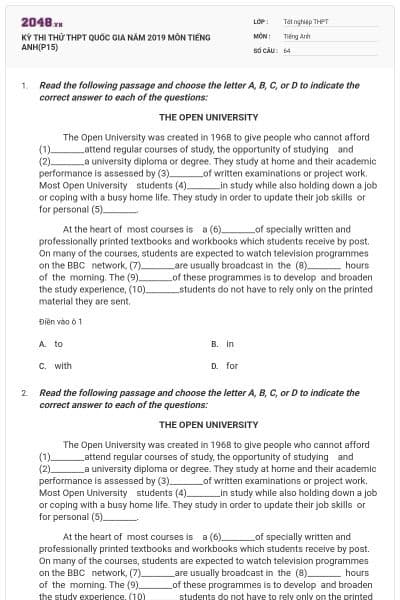
Read the following passage and choose the letter A, B, C, or D to indicate the correct answer to each of the questions:
THE OPEN UNIVERSITY
The Open University was created in 1968 to give people who cannot afford (1)________attend regular courses of study, the opportunity of studying and (2)________a university diploma or degree. They study at home and their academic performance is assessed by (3)________of written examinations or project work. Most Open University students (4)________in study while also holding down a job or coping with a busy home life. They study in order to update their job skills or for personal (5)________.
At the heart of most courses is a (6)________of specially written and professionally printed textbooks and workbooks which students receive by post. On many of the courses, students are expected to watch television programmes on the BBC network, (7)________are usually broadcast in the (8)________ hours of the morning. The (9)________of these programmes is to develop and broaden the study experience, (10)________students do not have to rely only on the printed material they are sent.
Điền vào ô 1
to
in
with
for
Đáp án : A
Afford to V = có khả năng chi trả cho việc gì
Read the following passage and choose the letter A, B, C, or D to indicate the correct answer to each of the questions:
THE OPEN UNIVERSITY
The Open University was created in 1968 to give people who cannot afford (1)________attend regular courses of study, the opportunity of studying and (2)________a university diploma or degree. They study at home and their academic performance is assessed by (3)________of written examinations or project work. Most Open University students (4)________in study while also holding down a job or coping with a busy home life. They study in order to update their job skills or for personal (5)________.
At the heart of most courses is a (6)________of specially written and professionally printed textbooks and workbooks which students receive by post. On many of the courses, students are expected to watch television programmes on the BBC network, (7)________are usually broadcast in the (8)________ hours of the morning. The (9)________of these programmes is to develop and broaden the study experience, (10)________students do not have to rely only on the printed material they are sent.
Điền vào ô 2
obtain
to obtain
obtained
obtaining
Đáp án : D
Trước và sau “and” phải cùng một loại từ. Trước nó là Ving thì sau nó cũng phải là Ving
Read the following passage and choose the letter A, B, C, or D to indicate the correct answer to each of the questions:
THE OPEN UNIVERSITY
The Open University was created in 1968 to give people who cannot afford (1)________attend regular courses of study, the opportunity of studying and (2)________a university diploma or degree. They study at home and their academic performance is assessed by (3)________of written examinations or project work. Most Open University students (4)________in study while also holding down a job or coping with a busy home life. They study in order to update their job skills or for personal (5)________.
At the heart of most courses is a (6)________of specially written and professionally printed textbooks and workbooks which students receive by post. On many of the courses, students are expected to watch television programmes on the BBC network, (7)________are usually broadcast in the (8)________ hours of the morning. The (9)________of these programmes is to develop and broaden the study experience, (10)________students do not have to rely only on the printed material they are sent.
Điền vào ô 3
means
method
route
system
Đáp án : A
By means of = bằng phương tiện, cách thức gì
Read the following passage and choose the letter A, B, C, or D to indicate the correct answer to each of the questions:
THE OPEN UNIVERSITY
The Open University was created in 1968 to give people who cannot afford (1)________attend regular courses of study, the opportunity of studying and (2)________a university diploma or degree. They study at home and their academic performance is assessed by (3)________of written examinations or project work. Most Open University students (4)________in study while also holding down a job or coping with a busy home life. They study in order to update their job skills or for personal (5)________.
At the heart of most courses is a (6)________of specially written and professionally printed textbooks and workbooks which students receive by post. On many of the courses, students are expected to watch television programmes on the BBC network, (7)________are usually broadcast in the (8)________ hours of the morning. The (9)________of these programmes is to develop and broaden the study experience, (10)________students do not have to rely only on the printed material they are sent.
Điền vào ô 4
fit
take
put
join
Đáp án : D
Join in something = tham gia vào cái gì
Read the following passage and choose the letter A, B, C, or D to indicate the correct answer to each of the questions:
THE OPEN UNIVERSITY
The Open University was created in 1968 to give people who cannot afford (1)________attend regular courses of study, the opportunity of studying and (2)________a university diploma or degree. They study at home and their academic performance is assessed by (3)________of written examinations or project work. Most Open University students (4)________in study while also holding down a job or coping with a busy home life. They study in order to update their job skills or for personal (5)________.
At the heart of most courses is a (6)________of specially written and professionally printed textbooks and workbooks which students receive by post. On many of the courses, students are expected to watch television programmes on the BBC network, (7)________are usually broadcast in the (8)________ hours of the morning. The (9)________of these programmes is to develop and broaden the study experience, (10)________students do not have to rely only on the printed material they are sent.
Điền vào ô 5
satisfying
satisfaction
satisfactory
satisfied
Đáp án : B
Tính từ đứng trước danh từ để bổ nghĩa cho danh từ đó. Personal đứng trước danh từ satisfaction , có nghĩa là sự thỏa mãn mang tính cá nhân
Read the following passage and choose the letter A, B, C, or D to indicate the correct answer to each of the questions:
THE OPEN UNIVERSITY
The Open University was created in 1968 to give people who cannot afford (1)________attend regular courses of study, the opportunity of studying and (2)________a university diploma or degree. They study at home and their academic performance is assessed by (3)________of written examinations or project work. Most Open University students (4)________in study while also holding down a job or coping with a busy home life. They study in order to update their job skills or for personal (5)________.
At the heart of most courses is a (6)________of specially written and professionally printed textbooks and workbooks which students receive by post. On many of the courses, students are expected to watch television programmes on the BBC network, (7)________are usually broadcast in the (8)________ hours of the morning. The (9)________of these programmes is to develop and broaden the study experience, (10)________students do not have to rely only on the printed material they are sent.
Điền vào ô 6
club
heap
set
unit
Đáp án : C
A set of N (số nhiều) = một chuỗi, một loạt. Club = câu lạc bộ. heap = đống. unit = đơn vị
Read the following passage and choose the letter A, B, C, or D to indicate the correct answer to each of the questions:
THE OPEN UNIVERSITY
The Open University was created in 1968 to give people who cannot afford (1)________attend regular courses of study, the opportunity of studying and (2)________a university diploma or degree. They study at home and their academic performance is assessed by (3)________of written examinations or project work. Most Open University students (4)________in study while also holding down a job or coping with a busy home life. They study in order to update their job skills or for personal (5)________.
At the heart of most courses is a (6)________of specially written and professionally printed textbooks and workbooks which students receive by post. On many of the courses, students are expected to watch television programmes on the BBC network, (7)________are usually broadcast in the (8)________ hours of the morning. The (9)________of these programmes is to develop and broaden the study experience, (10)________students do not have to rely only on the printed material they are sent.
Điền vào ô 7
what
which
who
that
Đáp án : B
Đại từ quan hệ có thể đứng sau dấu phẩy và bổ nghĩa cho danh từ chỉ vật (network) là “which”
Read the following passage and choose the letter A, B, C, or D to indicate the correct answer to each of the questions:
THE OPEN UNIVERSITY
The Open University was created in 1968 to give people who cannot afford (1)________attend regular courses of study, the opportunity of studying and (2)________a university diploma or degree. They study at home and their academic performance is assessed by (3)________of written examinations or project work. Most Open University students (4)________in study while also holding down a job or coping with a busy home life. They study in order to update their job skills or for personal (5)________.
At the heart of most courses is a (6)________of specially written and professionally printed textbooks and workbooks which students receive by post. On many of the courses, students are expected to watch television programmes on the BBC network, (7)________are usually broadcast in the (8)________ hours of the morning. The (9)________of these programmes is to develop and broaden the study experience, (10)________students do not have to rely only on the printed material they are sent.
Điền vào ô 8
first
early
initial
starting
Đáp án : B
Early hours = những giờ đầu tiên, sáng sớm
Read the following passage and choose the letter A, B, C, or D to indicate the correct answer to each of the questions:
THE OPEN UNIVERSITY
The Open University was created in 1968 to give people who cannot afford (1)________attend regular courses of study, the opportunity of studying and (2)________a university diploma or degree. They study at home and their academic performance is assessed by (3)________of written examinations or project work. Most Open University students (4)________in study while also holding down a job or coping with a busy home life. They study in order to update their job skills or for personal (5)________.
At the heart of most courses is a (6)________of specially written and professionally printed textbooks and workbooks which students receive by post. On many of the courses, students are expected to watch television programmes on the BBC network, (7)________are usually broadcast in the (8)________ hours of the morning. The (9)________of these programmes is to develop and broaden the study experience, (10)________students do not have to rely only on the printed material they are sent.
Điền vào ô 9
end
aim
reason
cause
Đáp án : B
Aim = mục tiêu. End = kết thúc. Reason = nguyên nhân. Cause = lí do tác động
Read the following passage and choose the letter A, B, C, or D to indicate the correct answer to each of the questions:
THE OPEN UNIVERSITY
The Open University was created in 1968 to give people who cannot afford (1)________attend regular courses of study, the opportunity of studying and (2)________a university diploma or degree. They study at home and their academic performance is assessed by (3)________of written examinations or project work. Most Open University students (4)________in study while also holding down a job or coping with a busy home life. They study in order to update their job skills or for personal (5)________.
At the heart of most courses is a (6)________of specially written and professionally printed textbooks and workbooks which students receive by post. On many of the courses, students are expected to watch television programmes on the BBC network, (7)________are usually broadcast in the (8)________ hours of the morning. The (9)________of these programmes is to develop and broaden the study experience, (10)________students do not have to rely only on the printed material they are sent.
Điền vào ô 10
although
however
even though
so that
Đáp án : D
So that = để mà. Although = even though = mặc dù. However = tuy nhiên
Mark the letter A, B, C, or D on your answer sheet to indicate the word or phrase that is CLOSET in meaning to the underlined part in each of the following questions
I didn't think his comments were very appropriate at the time
right
correct
exact
suitable
Đáp án : D
Appropriate = chính xác, phù hợp, chuẩn. Suitable = phù hợp. Exact = chính xác, không sai dữ liệu. Right = đúng. Correct = đúng, không có lỗi sai
Mark the letter A, B, C, or D on your answer sheet to indicate the word or phrase that is CLOSET in meaning to the underlined part in each of the following questions
Professor Smith was very interested in the diversity of cultures all over the world
difference
changes
conservation
variety
Đáp án : D
Diversity = sự đa dạng ≈ variety. Changes = những thay đổi. Conservation = việc bảo tồn. Difference = sự khác biệt
Mark the letter A, B, C, or D on your answer sheet to indicate the word or phrase that is CLOSET in meaning to the underlined part in each of the following questions
When you are in a restaurant, you can raise your hand slightly to show that you need assistance.
food
help
bill
menu
Đáp án : B
Assistance = sự trợ giúp, hỗ trợ. Help = sự giúp đỡ. Bill = hóa đơn. Menu = thực đơn, bảng lựa chọn. food = thực phẩm
Choose the word whose main stress is placed differently from that of the others:
majority
ceremony
maintain
engage
Đáp án : B
Trọng âm của từ này rơi vào âm tiết thứ 1, các từ còn lại rơi vào âm tiết thứ 2
Choose the word whose main stress is placed differently from that of the others:
A. examination B. sociology C. university D. geographical
examination
sociology
university
geographical
Đáp án : A
Trọng âm của từ này rơi vào âm tiết thứ 4, các từ còn lại rơi vào âm tiết thứ 3
Choose the word whose main stress is placed differently from that of the others:
sacrifice
romantic
marriage
conical
Đáp án : B
Trọng âm của từ này rơi vào âm tiết thứ 2, các từ còn lại rơi vào âm tiết thứ 1
Choose the word which has the underlined part pronounced differently from that of the rest:
cooked
wicked
looked
picked
Đáp án : B
“ed” đứng sau âm /k/ thường phát âm là /t/, đối với từ “wicked” là trường hợp đặc biệt, phát âm là /id/
Choose the word which has the underlined part pronounced differently from that of the rest:
rises
fixes
likes
matches
Đáp án : C
Đuôi “s” sau âm /k/ phát âm là /s/, sau các đuôi /s, ∫, t∫/ phát âm là /z/
Read the following passage and choose the letter A, B, C, or D to indicate the correct answer to each of the questions:
EDUCATION IN THE FUTURE
Education is another area of social life in which information technology is changing the way we communicate. Today's college students may not simply sit in a lecture or a library to learn about their field. Through their computers and the wonders of virtual reality they can participate in lifelike simulated experiences. Consider the following scenario of the future of education made possible through developments in information technology.
For children over the age of 10, daily attendance at schools is not compulsory. Some of the older children attend school only once or twice weekly to get tutorial support or instruction from a teacher. For the most part, pupils are encouraged to work online from home. Students must complete a minimum number of study hours per year; however, they may make up these hours by studying at home at times that suit their family schedule. They can log on early or late in the day and even join live classes in other countries. In order to ensure that each student is learning adequately, computer software will automatically monitor the number of hours a week each student studies on-line as well as that students' learning materials and assessment activities. Reports will be available for parents and teachers. The software can then identify the best learning activities and condition for each individual student and generate similar activities. It can also identify areas of weak achievement and produce special programs adjusted to the students' needs.
: How many times are children who are older than 10 required to go to school weekly?
notime
three times
four times
once or twice
Đáp án : D
Từ đầu đoạn 2: For children over the age of 10, daily attendance at schools is not compulsory. Some of the older children attend school only once or twice weekly to get tutorial support or instruction from a teacher -> việc đi học hàng ngày là không bắt buộc, chỉ cần đến trường 1 hoặc 2 lần mỗi tuần
Read the following passage and choose the letter A, B, C, or D to indicate the correct answer to each of the questions:
EDUCATION IN THE FUTURE
Education is another area of social life in which information technology is changing the way we communicate. Today's college students may not simply sit in a lecture or a library to learn about their field. Through their computers and the wonders of virtual reality they can participate in lifelike simulated experiences. Consider the following scenario of the future of education made possible through developments in information technology.
For children over the age of 10, daily attendance at schools is not compulsory. Some of the older children attend school only once or twice weekly to get tutorial support or instruction from a teacher. For the most part, pupils are encouraged to work online from home. Students must complete a minimum number of study hours per year; however, they may make up these hours by studying at home at times that suit their family schedule. They can log on early or late in the day and even join live classes in other countries. In order to ensure that each student is learning adequately, computer software will automatically monitor the number of hours a week each student studies on-line as well as that students' learning materials and assessment activities. Reports will be available for parents and teachers. The software can then identify the best learning activities and condition for each individual student and generate similar activities. It can also identify areas of weak achievement and produce special programs adjusted to the students' needs.
The pronoun "it" in paragraph 1 refers to_____________
thesoftware
learning activities
learning activities
individual student
Đáp án : A
“it” là để cho danh từ số ít chỉ vật ở vế trước: phần mềm có thể nhận dạng những hoạt động và điều kiện học tốt nhất cho mỗi học sinh và tạo ra những hoạt động nhỏ. Nó cũng có thể nhận dạng…. => “nó” chính là “phần mềm” = software
Read the following passage and choose the letter A, B, C, or D to indicate the correct answer to each of the questions:
EDUCATION IN THE FUTURE
Education is another area of social life in which information technology is changing the way we communicate. Today's college students may not simply sit in a lecture or a library to learn about their field. Through their computers and the wonders of virtual reality they can participate in lifelike simulated experiences. Consider the following scenario of the future of education made possible through developments in information technology.
For children over the age of 10, daily attendance at schools is not compulsory. Some of the older children attend school only once or twice weekly to get tutorial support or instruction from a teacher. For the most part, pupils are encouraged to work online from home. Students must complete a minimum number of study hours per year; however, they may make up these hours by studying at home at times that suit their family schedule. They can log on early or late in the day and even join live classes in other countries. In order to ensure that each student is learning adequately, computer software will automatically monitor the number of hours a week each student studies on-line as well as that students' learning materials and assessment activities. Reports will be available for parents and teachers. The software can then identify the best learning activities and condition for each individual student and generate similar activities. It can also identify areas of weak achievement and produce special programs adjusted to the students' needs.
What is NOT MENTIONED as a benefit of information technology to the students?
Students' learning time won't be monitored
Students' weak achievement can be identified.
Students can learn at times that suit their schedule
Students can stay at home to learn
Đáp án : A
Từ dòng 6 đoạn 2: In order to ensure that each student is learning adequately, computer software will automatically monitor the number of hours a week each student studies on-line as well as that students' learning materials and assessment activities -> phần mềm máy tính tự động kiểm soát số giờ học mỗi tuần -> lượng thời gian học vẫn bị kiểm soát
Read the following passage and choose the letter A, B, C, or D to indicate the correct answer to each of the questions:
EDUCATION IN THE FUTURE
Education is another area of social life in which information technology is changing the way we communicate. Today's college students may not simply sit in a lecture or a library to learn about their field. Through their computers and the wonders of virtual reality they can participate in lifelike simulated experiences. Consider the following scenario of the future of education made possible through developments in information technology.
For children over the age of 10, daily attendance at schools is not compulsory. Some of the older children attend school only once or twice weekly to get tutorial support or instruction from a teacher. For the most part, pupils are encouraged to work online from home. Students must complete a minimum number of study hours per year; however, they may make up these hours by studying at home at times that suit their family schedule. They can log on early or late in the day and even join live classes in other countries. In order to ensure that each student is learning adequately, computer software will automatically monitor the number of hours a week each student studies on-line as well as that students' learning materials and assessment activities. Reports will be available for parents and teachers. The software can then identify the best learning activities and condition for each individual student and generate similar activities. It can also identify areas of weak achievement and produce special programs adjusted to the students' needs.
What CAN'T the software do?
Monitor the time thestudents learn
Find out the best activities for the students
Identify weaknesses of the students
Design materials for the students
Đáp án : D
Các đáp án A, B, C đều lần lượt được nhắc tới trong: dòng 7 đoạn 2 (computer software will automatically monitor the number of hours a week each student studies on-line ->A ); dòng 9 đoạn 2 (The software can then identify the best learning activities – B); dòng cuối (It can also identify areas of weak achievement). => chỉ D không được nhắc tới. Phần mềm có thể đưa ra chương trình thích hợp, chứ không thể thiết kế tài liệu học
Read the following passage and choose the letter A, B, C, or D to indicate the correct answer to each of the questions:
EDUCATION IN THE FUTURE
Education is another area of social life in which information technology is changing the way we communicate. Today's college students may not simply sit in a lecture or a library to learn about their field. Through their computers and the wonders of virtual reality they can participate in lifelike simulated experiences. Consider the following scenario of the future of education made possible through developments in information technology.
For children over the age of 10, daily attendance at schools is not compulsory. Some of the older children attend school only once or twice weekly to get tutorial support or instruction from a teacher. For the most part, pupils are encouraged to work online from home. Students must complete a minimum number of study hours per year; however, they may make up these hours by studying at home at times that suit their family schedule. They can log on early or late in the day and even join live classes in other countries. In order to ensure that each student is learning adequately, computer software will automatically monitor the number of hours a week each student studies on-line as well as that students' learning materials and assessment activities. Reports will be available for parents and teachers. The software can then identify the best learning activities and condition for each individual student and generate similar activities. It can also identify areas of weak achievement and produce special programs adjusted to the students' needs.
What is the topic of the passage?
The effect of information technology on education
Computer software will make sure students learn at home
Students can know about their weak aspects to focus.
students don't have to go to school any more
Đáp án : A
Ngay từ tên đề bài: giáo dục trong tương lai -> gợi mở hướng đi mới cho giáo dục. Đó là từ việc áp dụng công nghệ thông tin (Education is another area of social life in which information technology is changing the way we communicate)
Read the following passage and choose the letter A, B, C, or D to indicate the correct answer to each of the questions:
EDUCATION IN THE FUTURE
Education is another area of social life in which information technology is changing the way we communicate. Today's college students may not simply sit in a lecture or a library to learn about their field. Through their computers and the wonders of virtual reality they can participate in lifelike simulated experiences. Consider the following scenario of the future of education made possible through developments in information technology.
For children over the age of 10, daily attendance at schools is not compulsory. Some of the older children attend school only once or twice weekly to get tutorial support or instruction from a teacher. For the most part, pupils are encouraged to work online from home. Students must complete a minimum number of study hours per year; however, they may make up these hours by studying at home at times that suit their family schedule. They can log on early or late in the day and even join live classes in other countries. In order to ensure that each student is learning adequately, computer software will automatically monitor the number of hours a week each student studies on-line as well as that students' learning materials and assessment activities. Reports will be available for parents and teachers. The software can then identify the best learning activities and condition for each individual student and generate similar activities. It can also identify areas of weak achievement and produce special programs adjusted to the students' needs.
The word suit in the passage mostly means_________?
enhance
show up
fit
disturb
Đáp án : C
Suit = phù hợp với ≈ fit
Read the following passage and choose the letter A, B, C, or D to indicate the correct answer to each of the questions:
EDUCATION IN THE FUTURE
Education is another area of social life in which information technology is changing the way we communicate. Today's college students may not simply sit in a lecture or a library to learn about their field. Through their computers and the wonders of virtual reality they can participate in lifelike simulated experiences. Consider the following scenario of the future of education made possible through developments in information technology.
For children over the age of 10, daily attendance at schools is not compulsory. Some of the older children attend school only once or twice weekly to get tutorial support or instruction from a teacher. For the most part, pupils are encouraged to work online from home. Students must complete a minimum number of study hours per year; however, they may make up these hours by studying at home at times that suit their family schedule. They can log on early or late in the day and even join live classes in other countries. In order to ensure that each student is learning adequately, computer software will automatically monitor the number of hours a week each student studies on-line as well as that students' learning materials and assessment activities. Reports will be available for parents and teachers. The software can then identify the best learning activities and condition for each individual student and generate similar activities. It can also identify areas of weak achievement and produce special programs adjusted to the students' needs.
The pronoun "They" in paragraph 1 refers to_____________
collegestudents
The computers
the wonders of virtual reality
The lectures
Đáp án : A
“they” là chỉ danh từ số nhiều đứng trước. Trước đó “they” cũng được nhắc tới qua tính từ sở hữu “their” (máy tính của họ). Vế trước: sinh viên ngày nay không chỉ đơn giản ngồi học ở giảng đường hay thư viện. Thông qua các máy tính của họ…. => “họ” là “sinh viên”
Read the following passage and choose the letter A, B, C, or D to indicate the correct answer to each of the questions:
EDUCATION IN THE FUTURE
Education is another area of social life in which information technology is changing the way we communicate. Today's college students may not simply sit in a lecture or a library to learn about their field. Through their computers and the wonders of virtual reality they can participate in lifelike simulated experiences. Consider the following scenario of the future of education made possible through developments in information technology.
For children over the age of 10, daily attendance at schools is not compulsory. Some of the older children attend school only once or twice weekly to get tutorial support or instruction from a teacher. For the most part, pupils are encouraged to work online from home. Students must complete a minimum number of study hours per year; however, they may make up these hours by studying at home at times that suit their family schedule. They can log on early or late in the day and even join live classes in other countries. In order to ensure that each student is learning adequately, computer software will automatically monitor the number of hours a week each student studies on-line as well as that students' learning materials and assessment activities. Reports will be available for parents and teachers. The software can then identify the best learning activities and condition for each individual student and generate similar activities. It can also identify areas of weak achievement and produce special programs adjusted to the students' needs.
Who/What counts the number of hours per week that students spend learning?
Parents
Teacher
Computer software
Virtual reality
Đáp án : C
Dòng 7 đoạn 2: computer software will automatically monitor the number of hours a week each student studies on-line
Read the following passage and choose the letter A, B, C, or D to indicate the correct answer to each of the questions:
EDUCATION IN THE FUTURE
Education is another area of social life in which information technology is changing the way we communicate. Today's college students may not simply sit in a lecture or a library to learn about their field. Through their computers and the wonders of virtual reality they can participate in lifelike simulated experiences. Consider the following scenario of the future of education made possible through developments in information technology.
For children over the age of 10, daily attendance at schools is not compulsory. Some of the older children attend school only once or twice weekly to get tutorial support or instruction from a teacher. For the most part, pupils are encouraged to work online from home. Students must complete a minimum number of study hours per year; however, they may make up these hours by studying at home at times that suit their family schedule. They can log on early or late in the day and even join live classes in other countries. In order to ensure that each student is learning adequately, computer software will automatically monitor the number of hours a week each student studies on-line as well as that students' learning materials and assessment activities. Reports will be available for parents and teachers. The software can then identify the best learning activities and condition for each individual student and generate similar activities. It can also identify areas of weak achievement and produce special programs adjusted to the students' needs.
The word adequately in the passage mostly means_______?
suficiently
significantly
consequently
Suitably
Đáp án : A
Adequately (adv) = một cách đầy đủ, một cách thích hợp. sufficiently (Adv) = một cách đầy đủ
Read the following passage and choose the letter A, B, C, or D to indicate the correct answer to each of the questions:
EDUCATION IN THE FUTURE
Education is another area of social life in which information technology is changing the way we communicate. Today's college students may not simply sit in a lecture or a library to learn about their field. Through their computers and the wonders of virtual reality they can participate in lifelike simulated experiences. Consider the following scenario of the future of education made possible through developments in information technology.
For children over the age of 10, daily attendance at schools is not compulsory. Some of the older children attend school only once or twice weekly to get tutorial support or instruction from a teacher. For the most part, pupils are encouraged to work online from home. Students must complete a minimum number of study hours per year; however, they may make up these hours by studying at home at times that suit their family schedule. They can log on early or late in the day and even join live classes in other countries. In order to ensure that each student is learning adequately, computer software will automatically monitor the number of hours a week each student studies on-line as well as that students' learning materials and assessment activities. Reports will be available for parents and teachers. The software can then identify the best learning activities and condition for each individual student and generate similar activities. It can also identify areas of weak achievement and produce special programs adjusted to the students' needs.
The word encouraged in the passage mostly means_________?
Suggested
Allowed
Permitted
Stimulated
Đáp án : D
Encourage = khuyến khích. Stimulate = thúc đẩy. suggest = gợi ý. Allow = cho phép ≈ permit
Mark the letter A, B, C, or D on your answer sheet to indicate the underlined part that needs correction in each of the following questions
I'll make some sandwiches before I'll leave for work
I'llleave
for work
I'll make
some sandwiches before
Đáp án : A
Mệnh đề thời gian (sau “before, when, after…”) khi dùng để chỉ hành động sẽ xảy ra thì luôn chia ở hiện tại đơn. A -> I leave
Mark the letter A, B, C, or D on your answer sheet to indicate the underlined part that needs correction in each of the following questions
The reason why he's not feeling very well is simple - he's ate too much as usual.
is simple
he's not feeling
he's ate
as usual
Đáp án : C
Động từ “eat” có dạng quá khứ là “ate”, và dạng quá khứ phân từ là “eaten”. C -> he’s eaten
Mark the letter A, B, C, or D on your answer sheet to indicate the underlined part that needs correction in each of the following questions
Where I am living now is convenient for work because I don't have travel far
for work becauseI don't
is convenient
have travel far
Where I am
Đáp án : C
Nơi tôi đang sống hiện tại rất tiện cho công việc vì tôi không phải di chuyển xa. Việc “không phải” do khách quan được diễn đạt bằng từ “don’t have to V”. Sửa C -> have to travel far
Mark the letter A, B, C, or D on your answer sheet to indicate the underlined part that needs correction in each of the following questions
She washes her hair at least six time a week
time
at least six
washes her hair
a week
Đáp án : A
Để chỉ số lần từ 3 trở lên, ta dùng: số lần + times. A -> times
Mark the letter A, B, C, or D on your answer sheet to indicate the underlined part that needs correction in each of the following questions
Mary found it hard to concentrate on her work because the noise
because the noise
it hard
work
to concentrate
Đáp án : A
Because + mệnh đề. Because of + N/Ving. Sửa A -> because of the noise
Read the following passage and choose the letter A, B, C, or D to indicate the correct answer to each of the questions:
Esperanto is what is called a planned, or artificial language. It was created more than a century ago by Polish eye doctor Ludwik Lazar Zamenhof. Zamenhof believed that a common language would help to alleviate some of the misunderstandings among cultures.
In Zamenhofs first attempt at a universal language, he tried to create a language that was as uncomplicated as possible. This first language included words such as ab, ac, ba, eb, be, and ce. This did not result in a workable language in that these monosyllabic words. though short, were not easy to understand or to retain
Next, Zamenhof tried a different way of constructing a simplified language. He made the words in his language sound like words that people already knew, but he simplified the grammar tremendously. One example of how he simplified the language can be seen in the suffixes: all nouns in this language end in 0, as in the noun amiko, which means "friend," and all adjectives end in -a, as in the adjective bela, which means "pretty." Another example of the simplified language can be seen in the prefix mal-, which makes a word opposite in meaning; the word malamiko therefore means "enemy," and the word malbela therefore means "ugly" in Zamenhofs language.
In 1887, Zamenhof wrote a description of this language and published it. He used a pen name, Dr. Esperanto, when signing the book. He selected the name Esperanto because this word means "a person who hopes" in his language. Esperanto clubs began popping up throughout Europe and by1905, Esperanto had spread from Europe to America and Asia.
In 1905, the First World Congress of Esperanto took place in France, with approximately 700 attendees from 20 different countries. Congresses were held annually for nine years, and 4,000 attendees were registered for the Tenth World Esperanto Congress scheduled for 1914, when World War I erupted and forced its cancellation.
Esperanto has had its ups and downs in the period since World War I. Today, years after it was introduced, it is estimated that perhaps a quarter of a million people are fluent in it. This may seem like a large number, but it is really quite small when compared with the billion English speakers and billion Mandarin Chinese speakers in today's world. Current advocates would like to see its use grow considerably and are taking steps to try to make this happen
The expression "popping up" in the fourth paragraph could best be replaced by________.
shouting
leaping
leaping
opening
Đáp án : D
Pop up = xuất hiện bất ngờ. Open = mở, bắt đầu. Shout = hét. Leap = nhảy cóc. Hide = ẩn, trốn
Read the following passage and choose the letter A, B, C, or D to indicate the correct answer to each of the questions:
Esperanto is what is called a planned, or artificial language. It was created more than a century ago by Polish eye doctor Ludwik Lazar Zamenhof. Zamenhof believed that a common language would help to alleviate some of the misunderstandings among cultures.
In Zamenhofs first attempt at a universal language, he tried to create a language that was as uncomplicated as possible. This first language included words such as ab, ac, ba, eb, be, and ce. This did not result in a workable language in that these monosyllabic words. though short, were not easy to understand or to retain
Next, Zamenhof tried a different way of constructing a simplified language. He made the words in his language sound like words that people already knew, but he simplified the grammar tremendously. One example of how he simplified the language can be seen in the suffixes: all nouns in this language end in 0, as in the noun amiko, which means "friend," and all adjectives end in -a, as in the adjective bela, which means "pretty." Another example of the simplified language can be seen in the prefix mal-, which makes a word opposite in meaning; the word malamiko therefore means "enemy," and the word malbela therefore means "ugly" in Zamenhofs language.
In 1887, Zamenhof wrote a description of this language and published it. He used a pen name, Dr. Esperanto, when signing the book. He selected the name Esperanto because this word means "a person who hopes" in his language. Esperanto clubs began popping up throughout Europe and by1905, Esperanto had spread from Europe to America and Asia.
In 1905, the First World Congress of Esperanto took place in France, with approximately 700 attendees from 20 different countries. Congresses were held annually for nine years, and 4,000 attendees were registered for the Tenth World Esperanto Congress scheduled for 1914, when World War I erupted and forced its cancellation.
Esperanto has had its ups and downs in the period since World War I. Today, years after it was introduced, it is estimated that perhaps a quarter of a million people are fluent in it. This may seem like a large number, but it is really quite small when compared with the billion English speakers and billion Mandarin Chinese speakers in today's world. Current advocates would like to see its use grow considerably and are taking steps to try to make this happen
It can be inferred from the passage that the Third World Congress of Esperanto took place in_________
1905
1907
1913
1909
Đáp án : B
Trong đoạn 5: In 1905, the First World Congress of Esperanto took place -> lần đầu là năm 1905.Ở dòng 2: Congresses were held annually -> tổ chức hàng năm => lần thứ 3 là vào 1907
Read the following passage and choose the letter A, B, C, or D to indicate the correct answer to each of the questions:
Esperanto is what is called a planned, or artificial language. It was created more than a century ago by Polish eye doctor Ludwik Lazar Zamenhof. Zamenhof believed that a common language would help to alleviate some of the misunderstandings among cultures.
In Zamenhofs first attempt at a universal language, he tried to create a language that was as uncomplicated as possible. This first language included words such as ab, ac, ba, eb, be, and ce. This did not result in a workable language in that these monosyllabic words. though short, were not easy to understand or to retain
Next, Zamenhof tried a different way of constructing a simplified language. He made the words in his language sound like words that people already knew, but he simplified the grammar tremendously. One example of how he simplified the language can be seen in the suffixes: all nouns in this language end in 0, as in the noun amiko, which means "friend," and all adjectives end in -a, as in the adjective bela, which means "pretty." Another example of the simplified language can be seen in the prefix mal-, which makes a word opposite in meaning; the word malamiko therefore means "enemy," and the word malbela therefore means "ugly" in Zamenhofs language.
In 1887, Zamenhof wrote a description of this language and published it. He used a pen name, Dr. Esperanto, when signing the book. He selected the name Esperanto because this word means "a person who hopes" in his language. Esperanto clubs began popping up throughout Europe and by1905, Esperanto had spread from Europe to America and Asia.
In 1905, the First World Congress of Esperanto took place in France, with approximately 700 attendees from 20 different countries. Congresses were held annually for nine years, and 4,000 attendees were registered for the Tenth World Esperanto Congress scheduled for 1914, when World War I erupted and forced its cancellation.
Esperanto has had its ups and downs in the period since World War I. Today, years after it was introduced, it is estimated that perhaps a quarter of a million people are fluent in it. This may seem like a large number, but it is really quite small when compared with the billion English speakers and billion Mandarin Chinese speakers in today's world. Current advocates would like to see its use grow considerably and are taking steps to try to make this happen
This passage would most likely be assigned reading in a course on________
Englishgrammar
applied linguistics
world government
European history
Đáp án : B
Bài văn nói về “Esperanto” – quốc tế ngữ -> bài văn có thể nằm trong chương trình học về ngôn ngữ học
Read the following passage and choose the letter A, B, C, or D to indicate the correct answer to each of the questions:
Esperanto is what is called a planned, or artificial language. It was created more than a century ago by Polish eye doctor Ludwik Lazar Zamenhof. Zamenhof believed that a common language would help to alleviate some of the misunderstandings among cultures.
In Zamenhofs first attempt at a universal language, he tried to create a language that was as uncomplicated as possible. This first language included words such as ab, ac, ba, eb, be, and ce. This did not result in a workable language in that these monosyllabic words. though short, were not easy to understand or to retain
Next, Zamenhof tried a different way of constructing a simplified language. He made the words in his language sound like words that people already knew, but he simplified the grammar tremendously. One example of how he simplified the language can be seen in the suffixes: all nouns in this language end in 0, as in the noun amiko, which means "friend," and all adjectives end in -a, as in the adjective bela, which means "pretty." Another example of the simplified language can be seen in the prefix mal-, which makes a word opposite in meaning; the word malamiko therefore means "enemy," and the word malbela therefore means "ugly" in Zamenhofs language.
In 1887, Zamenhof wrote a description of this language and published it. He used a pen name, Dr. Esperanto, when signing the book. He selected the name Esperanto because this word means "a person who hopes" in his language. Esperanto clubs began popping up throughout Europe and by1905, Esperanto had spread from Europe to America and Asia.
In 1905, the First World Congress of Esperanto took place in France, with approximately 700 attendees from 20 different countries. Congresses were held annually for nine years, and 4,000 attendees were registered for the Tenth World Esperanto Congress scheduled for 1914, when World War I erupted and forced its cancellation.
Esperanto has had its ups and downs in the period since World War I. Today, years after it was introduced, it is estimated that perhaps a quarter of a million people are fluent in it. This may seem like a large number, but it is really quite small when compared with the billion English speakers and billion Mandarin Chinese speakers in today's world. Current advocates would like to see its use grow considerably and are taking steps to try to make this happen
Which paragraph describes the predecessor to Esperanto?
The second paragraph
The first paragraph
The third paragraph
The last paragraph
Đáp án : A
Đoạn thứ 2 kể về loại ngôn ngữ quốc tế đầu tiên mà Zamemhofs nỗ lực tạo ra sao cho dễ hiểu. Đoạn 3 nói về việc Zamemhof cố xây dựng một ngôn ngữ khác mà sau này ông đặt tên là Esperanto (đoạn 4) -> ngôn ngữ tiền đề ra đời trước Esperanto được nhắc tới trong đoạn 2
Read the following passage and choose the letter A, B, C, or D to indicate the correct answer to each of the questions:
Esperanto is what is called a planned, or artificial language. It was created more than a century ago by Polish eye doctor Ludwik Lazar Zamenhof. Zamenhof believed that a common language would help to alleviate some of the misunderstandings among cultures.
In Zamenhofs first attempt at a universal language, he tried to create a language that was as uncomplicated as possible. This first language included words such as ab, ac, ba, eb, be, and ce. This did not result in a workable language in that these monosyllabic words. though short, were not easy to understand or to retain
Next, Zamenhof tried a different way of constructing a simplified language. He made the words in his language sound like words that people already knew, but he simplified the grammar tremendously. One example of how he simplified the language can be seen in the suffixes: all nouns in this language end in 0, as in the noun amiko, which means "friend," and all adjectives end in -a, as in the adjective bela, which means "pretty." Another example of the simplified language can be seen in the prefix mal-, which makes a word opposite in meaning; the word malamiko therefore means "enemy," and the word malbela therefore means "ugly" in Zamenhofs language.
In 1887, Zamenhof wrote a description of this language and published it. He used a pen name, Dr. Esperanto, when signing the book. He selected the name Esperanto because this word means "a person who hopes" in his language. Esperanto clubs began popping up throughout Europe and by1905, Esperanto had spread from Europe to America and Asia.
In 1905, the First World Congress of Esperanto took place in France, with approximately 700 attendees from 20 different countries. Congresses were held annually for nine years, and 4,000 attendees were registered for the Tenth World Esperanto Congress scheduled for 1914, when World War I erupted and forced its cancellation.
Esperanto has had its ups and downs in the period since World War I. Today, years after it was introduced, it is estimated that perhaps a quarter of a million people are fluent in it. This may seem like a large number, but it is really quite small when compared with the billion English speakers and billion Mandarin Chinese speakers in today's world. Current advocates would like to see its use grow considerably and are taking steps to try to make this happen
According to the passage, Zamenhof wanted to create a universal language________.
to provide a morecomplex language
to build a name for himself
to resolve cultural differences
to create one world culture
Đáp án : C
Từ dòng 2: Zamenhof believed that a common language would help to alleviate some of the misunderstandings among cultures -> giảm sự hiểu nhầm giữa các nền văn hóa ≈ giải quyết những khác biệt văn hóa
Read the following passage and choose the letter A, B, C, or D to indicate the correct answer to each of the questions:
Esperanto is what is called a planned, or artificial language. It was created more than a century ago by Polish eye doctor Ludwik Lazar Zamenhof. Zamenhof believed that a common language would help to alleviate some of the misunderstandings among cultures.
In Zamenhofs first attempt at a universal language, he tried to create a language that was as uncomplicated as possible. This first language included words such as ab, ac, ba, eb, be, and ce. This did not result in a workable language in that these monosyllabic words. though short, were not easy to understand or to retain
Next, Zamenhof tried a different way of constructing a simplified language. He made the words in his language sound like words that people already knew, but he simplified the grammar tremendously. One example of how he simplified the language can be seen in the suffixes: all nouns in this language end in 0, as in the noun amiko, which means "friend," and all adjectives end in -a, as in the adjective bela, which means "pretty." Another example of the simplified language can be seen in the prefix mal-, which makes a word opposite in meaning; the word malamiko therefore means "enemy," and the word malbela therefore means "ugly" in Zamenhofs language.
In 1887, Zamenhof wrote a description of this language and published it. He used a pen name, Dr. Esperanto, when signing the book. He selected the name Esperanto because this word means "a person who hopes" in his language. Esperanto clubs began popping up throughout Europe and by1905, Esperanto had spread from Europe to America and Asia.
In 1905, the First World Congress of Esperanto took place in France, with approximately 700 attendees from 20 different countries. Congresses were held annually for nine years, and 4,000 attendees were registered for the Tenth World Esperanto Congress scheduled for 1914, when World War I erupted and forced its cancellation.
Esperanto has had its ups and downs in the period since World War I. Today, years after it was introduced, it is estimated that perhaps a quarter of a million people are fluent in it. This may seem like a large number, but it is really quite small when compared with the billion English speakers and billion Mandarin Chinese speakers in today's world. Current advocates would like to see its use grow considerably and are taking steps to try to make this happen
According to the passage, what happened to the Tenth World Esperanto Congress?
Ithad 4,000 attendees
It was scheduled for 1915
It had attendees from 20 countries
It never took place
Đáp án : D
Trong đoạn 3, từ dòng 3: the Tenth World Esperanto Congress scheduled for 1914, when World War I erupted and forced its cancellation -> đại hội bị hủy vì thế chiến 1 nổ ra
Read the following passage and choose the letter A, B, C, or D to indicate the correct answer to each of the questions:
Esperanto is what is called a planned, or artificial language. It was created more than a century ago by Polish eye doctor Ludwik Lazar Zamenhof. Zamenhof believed that a common language would help to alleviate some of the misunderstandings among cultures.
In Zamenhofs first attempt at a universal language, he tried to create a language that was as uncomplicated as possible. This first language included words such as ab, ac, ba, eb, be, and ce. This did not result in a workable language in that these monosyllabic words. though short, were not easy to understand or to retain
Next, Zamenhof tried a different way of constructing a simplified language. He made the words in his language sound like words that people already knew, but he simplified the grammar tremendously. One example of how he simplified the language can be seen in the suffixes: all nouns in this language end in 0, as in the noun amiko, which means "friend," and all adjectives end in -a, as in the adjective bela, which means "pretty." Another example of the simplified language can be seen in the prefix mal-, which makes a word opposite in meaning; the word malamiko therefore means "enemy," and the word malbela therefore means "ugly" in Zamenhofs language.
In 1887, Zamenhof wrote a description of this language and published it. He used a pen name, Dr. Esperanto, when signing the book. He selected the name Esperanto because this word means "a person who hopes" in his language. Esperanto clubs began popping up throughout Europe and by1905, Esperanto had spread from Europe to America and Asia.
In 1905, the First World Congress of Esperanto took place in France, with approximately 700 attendees from 20 different countries. Congresses were held annually for nine years, and 4,000 attendees were registered for the Tenth World Esperanto Congress scheduled for 1914, when World War I erupted and forced its cancellation.
Esperanto has had its ups and downs in the period since World War I. Today, years after it was introduced, it is estimated that perhaps a quarter of a million people are fluent in it. This may seem like a large number, but it is really quite small when compared with the billion English speakers and billion Mandarin Chinese speakers in today's world. Current advocates would like to see its use grow considerably and are taking steps to try to make this happen
The topic of this passage is_____________
using language to communicate internationally
how language can be improved
a language developed in the last few years
one man's efforts to create a universal language
Đáp án : D
Xuyên suốt bài văn là những nỗ lực tạo ra một ngôn ngữ chung cho quốc tế của bác sĩ nhãn khoa Zamemhof
Read the following passage and choose the letter A, B, C, or D to indicate the correct answer to each of the questions:
Esperanto is what is called a planned, or artificial language. It was created more than a century ago by Polish eye doctor Ludwik Lazar Zamenhof. Zamenhof believed that a common language would help to alleviate some of the misunderstandings among cultures.
In Zamenhofs first attempt at a universal language, he tried to create a language that was as uncomplicated as possible. This first language included words such as ab, ac, ba, eb, be, and ce. This did not result in a workable language in that these monosyllabic words. though short, were not easy to understand or to retain
Next, Zamenhof tried a different way of constructing a simplified language. He made the words in his language sound like words that people already knew, but he simplified the grammar tremendously. One example of how he simplified the language can be seen in the suffixes: all nouns in this language end in 0, as in the noun amiko, which means "friend," and all adjectives end in -a, as in the adjective bela, which means "pretty." Another example of the simplified language can be seen in the prefix mal-, which makes a word opposite in meaning; the word malamiko therefore means "enemy," and the word malbela therefore means "ugly" in Zamenhofs language.
In 1887, Zamenhof wrote a description of this language and published it. He used a pen name, Dr. Esperanto, when signing the book. He selected the name Esperanto because this word means "a person who hopes" in his language. Esperanto clubs began popping up throughout Europe and by1905, Esperanto had spread from Europe to America and Asia.
In 1905, the First World Congress of Esperanto took place in France, with approximately 700 attendees from 20 different countries. Congresses were held annually for nine years, and 4,000 attendees were registered for the Tenth World Esperanto Congress scheduled for 1914, when World War I erupted and forced its cancellation.
Esperanto has had its ups and downs in the period since World War I. Today, years after it was introduced, it is estimated that perhaps a quarter of a million people are fluent in it. This may seem like a large number, but it is really quite small when compared with the billion English speakers and billion Mandarin Chinese speakers in today's world. Current advocates would like to see its use grow considerably and are taking steps to try to make this happen
It can be inferred from the passage that the Esperanto word malespera means_____
hopelessness
hopeful
hopeless
hope
Đáp án : C
Dòng 2 đoạn 4: He selected the name Esperanto because this word means "a person who hopes" in his language -> “Esperanto” là người có hi vọng. Dòng 4 đoạn 3: all adjectives end in –a -> tính từ kết thúc là “a” ; hay “espera”= có hi vọng. Ở dòng 6 đoạn 3: the prefix mal-, which makes a word opposite in meaning -> tiền tố “mal” tạo nghĩa đối lập => “malespera” = không có hi vọng
Read the following passage and choose the letter A, B, C, or D to indicate the correct answer to each of the questions:
Esperanto is what is called a planned, or artificial language. It was created more than a century ago by Polish eye doctor Ludwik Lazar Zamenhof. Zamenhof believed that a common language would help to alleviate some of the misunderstandings among cultures.
In Zamenhofs first attempt at a universal language, he tried to create a language that was as uncomplicated as possible. This first language included words such as ab, ac, ba, eb, be, and ce. This did not result in a workable language in that these monosyllabic words. though short, were not easy to understand or to retain
Next, Zamenhof tried a different way of constructing a simplified language. He made the words in his language sound like words that people already knew, but he simplified the grammar tremendously. One example of how he simplified the language can be seen in the suffixes: all nouns in this language end in 0, as in the noun amiko, which means "friend," and all adjectives end in -a, as in the adjective bela, which means "pretty." Another example of the simplified language can be seen in the prefix mal-, which makes a word opposite in meaning; the word malamiko therefore means "enemy," and the word malbela therefore means "ugly" in Zamenhofs language.
In 1887, Zamenhof wrote a description of this language and published it. He used a pen name, Dr. Esperanto, when signing the book. He selected the name Esperanto because this word means "a person who hopes" in his language. Esperanto clubs began popping up throughout Europe and by1905, Esperanto had spread from Europe to America and Asia.
In 1905, the First World Congress of Esperanto took place in France, with approximately 700 attendees from 20 different countries. Congresses were held annually for nine years, and 4,000 attendees were registered for the Tenth World Esperanto Congress scheduled for 1914, when World War I erupted and forced its cancellation.
Esperanto has had its ups and downs in the period since World War I. Today, years after it was introduced, it is estimated that perhaps a quarter of a million people are fluent in it. This may seem like a large number, but it is really quite small when compared with the billion English speakers and billion Mandarin Chinese speakers in today's world. Current advocates would like to see its use grow considerably and are taking steps to try to make this happen
The expression "ups and downs" in the last paragraph is closed in meaning to_______
takeoffs and landings
highs and lows
floors and ceilings
tops and bottoms
Đáp án : B
Highs and lows = lúc lên, lúc xuống, sóng gió thăng trầm ≈ ups and downs
Read the following passage and choose the letter A, B, C, or D to indicate the correct answer to each of the questions:
Esperanto is what is called a planned, or artificial language. It was created more than a century ago by Polish eye doctor Ludwik Lazar Zamenhof. Zamenhof believed that a common language would help to alleviate some of the misunderstandings among cultures.
In Zamenhofs first attempt at a universal language, he tried to create a language that was as uncomplicated as possible. This first language included words such as ab, ac, ba, eb, be, and ce. This did not result in a workable language in that these monosyllabic words. though short, were not easy to understand or to retain
Next, Zamenhof tried a different way of constructing a simplified language. He made the words in his language sound like words that people already knew, but he simplified the grammar tremendously. One example of how he simplified the language can be seen in the suffixes: all nouns in this language end in 0, as in the noun amiko, which means "friend," and all adjectives end in -a, as in the adjective bela, which means "pretty." Another example of the simplified language can be seen in the prefix mal-, which makes a word opposite in meaning; the word malamiko therefore means "enemy," and the word malbela therefore means "ugly" in Zamenhofs language.
In 1887, Zamenhof wrote a description of this language and published it. He used a pen name, Dr. Esperanto, when signing the book. He selected the name Esperanto because this word means "a person who hopes" in his language. Esperanto clubs began popping up throughout Europe and by1905, Esperanto had spread from Europe to America and Asia.
In 1905, the First World Congress of Esperanto took place in France, with approximately 700 attendees from 20 different countries. Congresses were held annually for nine years, and 4,000 attendees were registered for the Tenth World Esperanto Congress scheduled for 1914, when World War I erupted and forced its cancellation.
Esperanto has had its ups and downs in the period since World War I. Today, years after it was introduced, it is estimated that perhaps a quarter of a million people are fluent in it. This may seem like a large number, but it is really quite small when compared with the billion English speakers and billion Mandarin Chinese speakers in today's world. Current advocates would like to see its use grow considerably and are taking steps to try to make this happen
The paragraph following the passage most likely discusses_______
another of Zamenhofs accomplishment
the disadvantages of usi:1g an artificial language
how current supporters of Esperanto are encouraging its growth
attempts to reconvene the World Congress of Esperanto in the 1920s
Đáp án : C
Câu kết: những người ủng hộ gần đây muốn chứng kiến sự sử dụng nó trở nên rộng rãi và họ đang hành động để khiến điều này thành hiện thực -> đoạn sau có thể nói về phương hướng hành động mà những người ủng hộ đang làm để khiến ngôn ngữ này phổ biến
The advanced students are selected to take part________the annual International Olympic Competition
at
for
from
in
Đáp án : D
Take part in something = tham gia cái gì
It was__________simple a question that everyone answered it correctly
such
so
very
too
Đáp án : B
So + adj/adv + (a/an) + N + that + mệnh đề = such + (a/an) + adj + N + that + mệnh đề = quá… đến mức mà
The man said that he___________the following day
wouldreturn
returned
will return
had returned
Đáp án : A
Trong câu trực tiếp người đàn ông nói: I will return tomorrow (thì tương lai đơn chỉ hành động sẽ diễn ra, một lời hứa). Khi tường thuật lại, động từ phải lùi thời: will -> would
We always feel__________and secure in our family
safeguard
safely
safe
safety
Đáp án : C
Sau “and” là tính từ “secure” (= bảo đảm) thì trước nó cũng phải là tính từ, safe (Adj) = an toàn
"He didn't understand it." - " ___________."
So did I
Neither did I
Was he?
I did too
Đáp án : B
Người nói nói ý phủ định: anh ta không hiểu nó. Để nói tôi cũng không, có thể dùng: Neither + trợ động từ (did) + I. So did I ≈ I did too -> đều để đáp lại ý khẳng định
_______________the manager's suggestions were reasonable, the supervisor agreed with them.
Until
Although
Even though
Because
Đáp án : D
Because = bởi vì. Although = Even though = mặc dù. Until = cho tới khi
She accepted that she had acted_________________and mistakenly, which broke up her marriage.
wisely
romantically
unwisely
attractively
Đáp án: C
Giải thích:
Kiến thức: Từ vựng
A. wisely (adv): một cách khôn ngoan
B. romantically (adv): một cách lãng mạn
C. unwisely (adv): một cách ngu xuẩn, không khôn ngoan
D. attractively (adv): một cách cuốn hút
Dựa vào nghĩa, chọn C.
Dịch: Bà thừa nhận rằng bà đã hành động thiếu sáng suốt và sai lầm, điều này đã làm tan vỡ cuộc hôn nhân của bà.
Mary asked me whether I_____________the football match on TV the day before
watch
had watched
have watched
would watch
Đáp án : B
Mary hỏi xem tôi đã từng xem trận bóng đá trên TV hôm trước đó chưa -> viêc xem trận bóng là ý hỏi từ trước đó, trước hành động hỏi “asked” – một hành động trong quá khứ -> động từ xem “watch” phải chia ở quá khứ hoàn thành
My mother is the first__________up and the last__________to bed
getting- to go
to get- going
to get- to go
getting- going
Đáp án : C
The first/last + to V = đối tượng đầu tiên/cuối cùng làm việc gì
_________includes our posture, facial expressions and gestures
Verbal
Communication
Body language
Signal
Đáp án : C
Body language = ngôn ngữ cơ thể. Verbal = dùng lời nói. Communication = giao tiếp. signal = tín hiệu
When I__________to the party, Tom and David_________, and John_________
was coming/ had danced/ singing
have come/ are dancing/ is singing
had come/ are dancing/ is singing
came/ were dancing/ was singing
Đáp án : D
Khi tôi đến bữa tiệc thì Tom, David đang nhảy, John đang hát -> sự việc đã xảy ra nên động từ chia ở quá khứ đơn. Trong đó, việc nhảy và hát đang diễn ra tại thời điểm tôi đến -> quá khứ tiếp diễn
English, Maths and Science are_____________subjects in the national curriculum in England.
core
public
supportive
independent
Đáp án : A
Core (adj) = trọng tâm. Public (Adj) = công khai. Supportive (Adj) = mang tính ủng hộ, hỗ trợ. Independent (adj) = độc lập
Fee-paying schools, often called "independent schools" or "_______schools"
public
primary
state
secondary
Đáp án : A
Ở Anh, Public school = trường độc lập, trường tư ≈ independent/private school. Private school = trường công
A: " How much sugar do you want in your coffee?" B: "________"
Somuch
Too much
Not much
Little bit
Đáp án : C
Người hỏi hỏi xem người đáp muốn pha bao nhiêu đường vào cà phê. Not much = không nhiều. so much = rất nhiều. too much = quá nhiều, quá mức cần thiết. a little bit = một chút (không dùng “little bit”)
I must thank the man from___________I got the present
whom
that
who
which
Đáp án : A
Đại từ quan hệ chỉ người (the man) có thể đi với giới từ (from) là “whom”
Members of your family have very close relationship with each other,_________?
havethey
do they
haven't they
don't they
Đáp án : D
Động từ chính là “have” -> câu hỏi đuôi chứa trợ động từ số nhiều dạng phủ định thời hiện tại đơn don’t
________in the diet is especially important for vegetarians
They obtain enough protein
Obtaining enough protein
By obtaining enough protein
Enough protein is obtained
Đáp án : B
Ving có thể đứng đầu câu làm chủ ngữ, chỉ một hành động gì đó
The telephone_________by Alexander Graham Bell
inventing
being invented
was invented
invented
Đáp án : C
Điện thoại đã được phát minh… -> việc phát minh là bị động thời quá khứ
A: Thanks very much for your help. B "___________."
that's right
You're welcome
Yes, please
never mind
Đáp án : B
You’re welcome (= bạn luôn được chào đón, tôi sẵn lòng giúp bạn) là câu đáp lại lời cám ơn
Mark the letter A, B, C, or D on your answer sheet to indicate the word or phrase that is OPPOSITE in meaning to the underlined part in each of the following questions
If you are at a loose end this weekend, I will show you round the city.
reluctant
free
confident
busy
Đáp án : D
At a loose end = rảnh rỗi
Mark the letter A, B, C, or D on your answer sheet to indicate the word or phrase that is OPPOSITE in meaning to the underlined part in each of the following questions
The government has decided that the publication of the report would be "contrary tothe public interest".
unpleasant
despicable
agreeable
urbane
Đáp án: C
Giải thích:
Kiến thức: Cụm từ - Từ trái nghĩa
contrary to: trái với, đối lập với
A. unpleasant (adj): khó chịu, không dễ chịu
B. despicable (adj): đáng khinh, hèn hạ
C. agreeable (adj): đồng thuận, tán thành, có lợi
D. urbane (adj): lịch sự, tao nhã
→ contrary to >< agreeable
Dịch: Chính phủ đã quyết định rằng việc công bố báo cáo này không có lợi cho lợi ích chung.