Kỳ thi thử thpt quốc gia lần 1 năm 2019 môn Tiếng Anh cực hay có lời giải(Đề 9)
64 câu hỏi
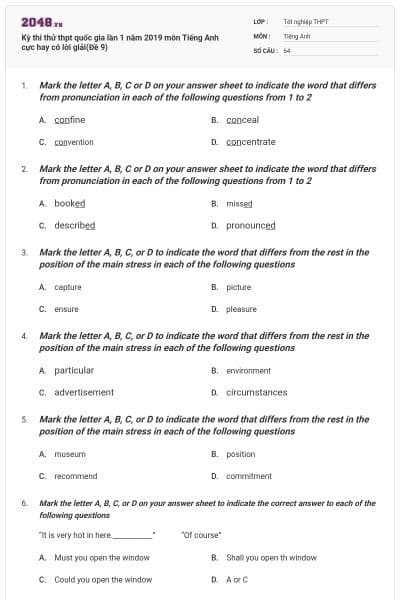
Mark the letter A, B, C or D on your answer sheet to indicate the word that differs from pronunciation in each of the following questions from 1 to 2
confine
conceal
convention
concentrate
Đáp án : D
“con” trong “concentrate” phát âm là /kɒn/, trong các từ còn lại phát âm là /kən/
Mark the letter A, B, C or D on your answer sheet to indicate the word that differs from pronunciation in each of the following questions from 1 to 2
booked
missed
described
pronounced
Đáp án : C
“ed” sau âm /b/ phát âm là /d/, sau các âm /s/,/∫/,/k/ phát âm là /t/
Mark the letter A, B, C, or D to indicate the word that differs from the rest in the position of the main stress in each of the following questions
capture
picture
ensure
pleasure
Đáp án : C
Trọng âm của từ này rơi vào âm tiết thứ 2, các từ còn lại rơi vào âm tiết thứ 1
Mark the letter A, B, C, or D to indicate the word that differs from the rest in the position of the main stress in each of the following questions
particular
environment
advertisement
circumstances
Đáp án : D
Trọng âm của từ này rơi vào âm tiết thứ 1, các từ còn lại rơi vào âm tiết thứ 2
Mark the letter A, B, C, or D to indicate the word that differs from the rest in the position of the main stress in each of the following questions
museum
position
recommend
commitment
Đáp án : C
Trọng âm của từ này rơi vào âm tiết thứ 1, các từ còn lại rơi vào âm tiết thứ 2
Mark the letter A, B, C, or D on your answer sheet to indicate the correct answer to each of the following questions
“It is very hot in here.___________” “Of course”
Must you open the window
Shall you open th window
Could you open the window
A or C
Đáp án: C
Giải thích:
Câu hỏi: "It is very hot in here. ___________?"
→ Đây là câu đề nghị nhờ vả lịch sự, nên ta dùng:
Could you + V (nguyên thể) để nhờ ai đó làm gì một cách lịch sự.
→ "Could you open the window?" nghĩa là: Bạn có thể mở cửa sổ được không?
Đáp lại là “Of course.” → phù hợp với lời đề nghị/nhờ vả.
Xét các đáp án khác:
A. Must you open the window → mang nghĩa “Bạn có bắt buộc phải mở cửa sổ không?” – không phù hợp.
B. Shall you open the window → sai ngữ pháp, vì "shall" không dùng với "you" trong câu đề nghị. (Đúng cấu trúc: Shall I... ?)
Dịch:
“Trời nóng quá ở đây. Bạn có thể mở cửa sổ được không?”
“Tất nhiên rồi.”
Mark the letter A, B, C, or D on your answer sheet to indicate the correct answer to each of the following questions
I can't imagine____________anywhere except here
studying
to study
study
that I study
Đáp án : A
Imagine Ving = tưởng tượng ra việc làm gì
Mark the letter A, B, C, or D on your answer sheet to indicate the correct answer to each of the following questions
When Tet holiday comes, Vietnamese people often feel inclined to ________ their houses.
do up
do in
do through
do over
Đáp án: D
Kiến thức: Cụm động từ
A. do up something: sửa chữa và trang trí nhà cửa
B. do in something: làm tổn thương một phần cơ thể
C. không có “do through something”
D. do over something: dọn dẹp hoặc trang trí lại cái gì
Dựa vào nghĩa câu, chọn D.
Dịch: Mỗi khi Tết đến, người Việt thường có xu hướng dọn dẹp lại nhà cửa.
Mark the letter A, B, C, or D on your answer sheet to indicate the correct answer to each of the following questions
My director is angry with me . I didn't do all the work I ____________last week
should have done
may have done
need to have done
must have done
Đáp án : A
Should have done = đáng lẽ nên làm gì trong quá khứ nhưng đã không làm. Must have done = chắc chắn đã làm gì trong quá khứ, dự đoán có cơ sở. may have done = có lẽ, có thể đã làm gì trong quá khứ
Mark the letter A, B, C, or D on your answer sheet to indicate the correct answer to each of the following questions
There is __________in my bed room
an old square wooden table
a square wooden old table
a square old wooden table
an old wooden square table
Đáp án: A
Giải thích:
Kiến thức: Trật tự tính từ trong cụm danh từ
Khi có nhiều tính từ cùng đứng trước 1 danh từ, sắp xếp chúng theo thứ tự: OSASCOMP + N. Trong đó:
O – opinion: quan điểm
S – size: kích thước
A – age: độ tuổi (mới, cũ, trẻ, già,...)
S – shape: hình dạng
C – color: màu sắc
O – origin: nguồn gốc
M - material: chất liệu
P - purpose: mục đích
Ta có:
square: hình vuông => shape
old: cổ => age
wooden: bằng gỗ => material
Vậy thứ tự là: old square wooden, chọn A.
Dịch: Có một chiếc bàn gỗ vuông cũ trong phòng ngủ của tôi.
Mark the letter A, B, C, or D on your answer sheet to indicate the correct answer to each of the following questions
The boy __________went to the hospital to ask for doctor's help
whose sick sister
whose sister sicked
who his sister is sick
whose sister was sick
Đáp án : D
Chị của cậu ta bị ốm -> từ cần bổ nghĩa là tính từ sở hữu “của cậu ta” , dùng đại từ “whose”. Sick (Adj) = ốm. Việc bị ốm lại là quá khứ : was sick
Mark the letter A, B, C, or D on your answer sheet to indicate the correct answer to each of the following questions
____________the phone rang later that night did Tom remember the appoinment.
No sooner
Only
Not until
Just before
Đáp án : C
Câu đảo ngữ nhấn mạnh thì quá khứ: Not until + mệnh đề + did/could + S + V (không chia) = ai đó đã không làm gì cho tới khi điều gì xảy ra
Mark the letter A, B, C, or D on your answer sheet to indicate the correct answer to each of the following questions
Our project was successful ________ its practicality
in terms of
with a view to
regardless
on behalf of
Đáp án : A
In terms of = về vấn đề gì, về mặt gì. Practicality = tính thực tế.
Mark the letter A, B, C, or D on your answer sheet to indicate the correct answer to each of the following questions
__________is the existence of a large number of different kinds of animals and plants which make a balanced environment
extinction
biodiversity
habitat
conservation
Đáp án : B
Biodiversity = sự đa đạng sinh học. extinction = sự tuyệt chủng. habitat = môi trường sống. Conservation = sự bảo tồn
Mark the letter A, B, C, or D on your answer sheet to indicate the correct answer to each of the following questions
- Kate: “ How lovely your cats are!” - David: “ ____________”
Really? They are
Thank you, it is nice of you to say so
Can you say it again
I love them, too
Đáp án : B
How + adj + S+ be! là hình thức câu cảm thán. Ở đây là câu cảm thán mang tính khen ngợi: Những con mèo của bạn thật là đáng yêu quá ! -> Đáp lại David cần cảm ơn
Mark the letter A, B, C, or D on your answer sheet to indicate the correct answer to each of the following questions
He managed to keep his job_________the manager had threatened to sack him
therefore
although
unless
despite
Đáp án : B
Although + mệnh đề = mặc dù = Despite + N/Ving. Therefore = vì thế. Unless = trừ khi
Mark the letter A, B, C, or D on your answer sheet to indicate the correct answer to each of the following questions
Peter was ejected after committing five personal _________ in water sport game yesterday.
mistakes
faults
fouls
errors
Đáp án: C
Giải thích:
Kiến thức: Từ vựng
A. mistake (n): nhầm lẫn, sai lầm
B. fault (n): thiếu sót, khuyết điểm; lỗi (trách nhiệm về một sai lầm)
C. foul (n): phạm luật, phạm lỗi trong thể thao
D. error (n): sai sót kỹ thuật
Dựa vào nghĩa câu, chọn C.
Dịch: Peter đã bị đuổi ra sau khi phạm năm lỗi cá nhân trong môn thể thao dưới nước ngày hôm qua.
Mark the letter A, B, C, or D on your answer sheet to indicate the correct answer to each of the following questions
She ran ________ an interesting article about fashion while she was reading the newspaper.
after
cross
away
out
Đáp án : B
Run across something/somebody = tình cờ phát hiện, gặp ai
Mark the letter A, B, C, or D on your answer sheet to indicate the correct answer to each of the following questions
It’s essential that every student ________ all the lectures
lose touch with
make room for
pay attention to
take notice of
Đáp án : B
Cấu trúc giả định: It is + tính từ thể hiện sự cần thiết, cấp bách (important, necessary, essential,…) + (that) + S + (should) + V(không chia)
Mark the letter A, B, C, or D on your answer sheet to indicate the correct answer to each of the following questions
You have to move this box to __________ the new television set
lose touch with
make room for
pay attention to
take notice of
Đáp án : B
Make room for something/somebody = tạo chỗ trống cho ai/cái gì
Mark the letter A, B, C, or D on your answer sheet to indicate the correct answer to each of the following questions
It’s a secret. You _________ let anyone know about it
mustn’t
needn’t
mightn’t
may not
Đáp án : A
Mustn’t + V = cấm không được phép làm gì. Needn’t = không cần thiết làm gì. Mightn’t ≈ may not = có lẽ không làm gì
Mark the letter A, B, C, or D on your answer sheet to indicate the correct answer to each of the following questions
The singer was _______________ on the piano by her sister
discarded
accompanied
performed
played
Đáp án : B
Be accompanied by somebody/something = được kèm theo bởi ai/cái gì
Mark the letter A, B, C, or D on your answer sheet to indicate the correct answer to each of the following questions
It is possible ______ may assist some trees in saving water in the winter
to lose leaves
that the loss of leaves
the leaves are lost
when leaves have lost
Đáp án : B
It is possible that + mệnh đề = có lẽ là điều gì xảy ra. Đằng sau chỗ trống đã có động từ chính “may assist”, nên chỉ còn thiếu chủ ngữ của mệnh đề này – cụm dang từ “the loss of leaves”
Mark the letter A, B, C, or D on your answer sheet to indicate the correct answer to each of the following questions
Although my village is not far away from the city centre , we had no ______ until recently.
electric
electricity
electrical
electrify
Đáp án : B
No + danh từ/cụm danh từ. no electricity = không có điện
Mark the letter A, B, C, or D on your answer sheet to indicate the word or phrase that is CLOSEST in meaning to the underlined part in each of the following questions
Today’s scientists have overcome many of the challenges of the depth by using more sophisticated tools
complicated
worldly
experienced
aware
Đáp án : A
Sophisticated = phức tạp, tinh tế công nghệ cao ≈ complicated
Mark the letter A, B, C, or D on your answer sheet to indicate the word or phrase that is CLOSEST in meaning to the underlined part in each of the following questions
We went away on holiday last week, but it rained day in day out
every single day
every other day
every second day
every two days
Đáp án : B
Day in day out = suốt nhiều ngày trời, hết ngày này sang ngày khác. every single day = lặp đi lặp lại những thứ giống nhau hàng ngày. Every other day = cách ngày một. Every two days = cứ 2 ngày một lần
Mark the letter A, B, C, or D on your answer sheet to indicate the word or phrase that is CLOSEST in meaning to the underlined part in each of the following questions
We can use either verbal or non – verbal forms of communication.
using gesture
using speech
using verbs
using facial expressions
Đáp án : B
Verbal = bằng lời nói. ≈ using speech
Mark the letter A, B, C, or D on your answer sheet to indicate the word or phrase that is CLOSEST in meaning to the underlined part in each of the following questions
Each year about fifty hundred species of plants and animals are already being eliminated.
dropped
removed
kicked
tossed
Đáp án : B
Eliminate = loại bỏ, phá hủy. Remove = loại ra, tháo bỏ
Mark the letter A, B, C, or D on your answer sheet to indicate the word or phrase that is CLOSEST in meaning to the underlined part in each of the following questions
The unmanned U.S space probe Mariner 9 sent back over 7,000 photos of Mars
circulated
transmitted
conveyed
submitted
Đáp án : B
Send back = gửi lại (tàu vũ trụ gửi lại hơn 7000 bức ảnh). Transmit = truyền phát tín hiệu
Mark the letter A, B, C, or D on your answer sheet to show the underlined part that needs correction
Musical comedies, as (A) an American form of entertainment (B), often take its (C) subjects from America’s present or (D) past
as
entertainment
its
or
Đáp án: C
Giải thích:
Đối tượng sở hữu các “subjects” ở đây là “musical comedies” – danh từ số nhiều.
Sửa: its → their
Dịch: Phim hài ca nhạc, với tư cách là một hình thức giải trí của Mỹ, thường lấy chủ đề từ hiện tại hoặc quá khứ của nước Mỹ.
Mark the letter A, B, C, or D on your answer sheet to show the underlined part that needs correction
Of(A) all seashore plants, seaweeds are best able to tolerate long periods out of water, followed by long periods covering by water
Of
best
by
covering
Đáp án : D
Tảo biển là loài chịu thiếu nước giỏi nhất, theo sau là những giai đoạn dài bị che phủ bởi nước -> việc che phủ là bị động: covered
Mark the letter A, B, C, or D on your answer sheet to show the underlined part that needs correction
Although not(A) widely sold, that book is considered to be best book on the subject.
not
sold
best
the
Đáp án : C
So sánh hơn nhất cần mạo từ “the” đứng trước -> the best book
Mark the letter A, B, C, or D on your answer sheet to show the underlined part that needs correction
Because(A) his sickness he didn’t take part in the English competition held last Sunday
Because
he
take
held
Đáp án : A
Because of + N = Because + mệnh đề = bởi vì. Ở đây là bởi vì căn bệnh (danh từ) -> because of
Mark the letter A, B, C, or D on your answer sheet to show the underlined part that needs correction
I found my new(A) contact lenses strangely at first, but I got used to them in the end
my new
strangely
got used
in the end
Đáp án : B
Find something + adj = thấy cái gì thế nào. Sửa B -> strange
Read the following passage and mark the latter A, B, C or D on your answer sheet to indicate the word or phrase that best fits each of the numbered blanks . Fill in the appropriate word in question 35
Why is it that many teenagers have the energy to play computer games until late at night but can’t find the energy to get out of bed (35) ________ for school? According to a new report, today’s generation of children are in danger of getting so (36)_______ sleep that they are putting their mental and physical health at (37)_______. Adults can easily survive on seven to eight hours’ sleep a night, (38)_______teenagers require nine or ten hours. According to medical experts, one in five youngsters (39)________ anything between two and five hours’ sleep a night less than their parents did at their age.
This (40) _____ serious questions about whether lack of sleep is affecting children’s ability to concentrate at school. The connection between sleep deprivation and lapses in memory, impaired reaction time and poor concentration is well (41) _______. Research has shown that losing as little as half an hour’s sleep a night can have profound effects (42) ______how children perform the next day. A good night’s sleep is also crucial for teenagers because it is while they are asleep (43)______ they release a hormone that is essential for their ‘growth spurt’ (the period during teenage years when the body grows at a rapid rate). It’s true that they can, to some (44) ______, catch up on sleep at weekends, but that won’t help them when they are dropping off to sleep in class on a Friday afternoon.
By Tim Falla and Paul A.Davies, Solutions Advanced. OUP
behind time
about time
in time
at time
Đáp án : C
In time = đúng giờ
Read the following passage and mark the latter A, B, C or D on your answer sheet to indicate the word or phrase that best fits each of the numbered blanks . Fill in the appropriate word in question 36
Why is it that many teenagers have the energy to play computer games until late at night but can’t find the energy to get out of bed (35) ________ for school? According to a new report, today’s generation of children are in danger of getting so (36)_______ sleep that they are putting their mental and physical health at (37)_______. Adults can easily survive on seven to eight hours’ sleep a night, (38)_______teenagers require nine or ten hours. According to medical experts, one in five youngsters (39)________ anything between two and five hours’ sleep a night less than their parents did at their age.
This (40) _____ serious questions about whether lack of sleep is affecting children’s ability to concentrate at school. The connection between sleep deprivation and lapses in memory, impaired reaction time and poor concentration is well (41) _______. Research has shown that losing as little as half an hour’s sleep a night can have profound effects (42) ______how children perform the next day. A good night’s sleep is also crucial for teenagers because it is while they are asleep (43)______ they release a hormone that is essential for their ‘growth spurt’ (the period during teenage years when the body grows at a rapid rate). It’s true that they can, to some (44) ______, catch up on sleep at weekends, but that won’t help them when they are dropping off to sleep in class on a Friday afternoon.
By Tim Falla and Paul A.Davies, Solutions Advanced. OUP
few
less
much
little
Đáp án : D
Little + N (không đếm được) = một ít gì đó
Read the following passage and mark the latter A, B, C or D on your answer sheet to indicate the word or phrase that best fits each of the numbered blanks . Fill in the appropriate word in question 37
Why is it that many teenagers have the energy to play computer games until late at night but can’t find the energy to get out of bed (35) ________ for school? According to a new report, today’s generation of children are in danger of getting so (36)_______ sleep that they are putting their mental and physical health at (37)_______. Adults can easily survive on seven to eight hours’ sleep a night, (38)_______teenagers require nine or ten hours. According to medical experts, one in five youngsters (39)________ anything between two and five hours’ sleep a night less than their parents did at their age.
This (40) _____ serious questions about whether lack of sleep is affecting children’s ability to concentrate at school. The connection between sleep deprivation and lapses in memory, impaired reaction time and poor concentration is well (41) _______. Research has shown that losing as little as half an hour’s sleep a night can have profound effects (42) ______how children perform the next day. A good night’s sleep is also crucial for teenagers because it is while they are asleep (43)______ they release a hormone that is essential for their ‘growth spurt’ (the period during teenage years when the body grows at a rapid rate). It’s true that they can, to some (44) ______, catch up on sleep at weekends, but that won’t help them when they are dropping off to sleep in class on a Friday afternoon.
By Tim Falla and Paul A.Davies, Solutions Advanced. OUP
jeopardy
threat
risk
danger
Đáp án : C
Put something at risk = đưa cái gì vào tầm nguy hiểm
Read the following passage and mark the latter A, B, C or D on your answer sheet to indicate the word or phrase that best fits each of the numbered blanks . Fill in the appropriate word in question 38
Why is it that many teenagers have the energy to play computer games until late at night but can’t find the energy to get out of bed (35) ________ for school? According to a new report, today’s generation of children are in danger of getting so (36)_______ sleep that they are putting their mental and physical health at (37)_______. Adults can easily survive on seven to eight hours’ sleep a night, (38)_______teenagers require nine or ten hours. According to medical experts, one in five youngsters (39)________ anything between two and five hours’ sleep a night less than their parents did at their age.
This (40) _____ serious questions about whether lack of sleep is affecting children’s ability to concentrate at school. The connection between sleep deprivation and lapses in memory, impaired reaction time and poor concentration is well (41) _______. Research has shown that losing as little as half an hour’s sleep a night can have profound effects (42) ______how children perform the next day. A good night’s sleep is also crucial for teenagers because it is while they are asleep (43)______ they release a hormone that is essential for their ‘growth spurt’ (the period during teenage years when the body grows at a rapid rate). It’s true that they can, to some (44) ______, catch up on sleep at weekends, but that won’t help them when they are dropping off to sleep in class on a Friday afternoon.
By Tim Falla and Paul A.Davies, Solutions Advanced. OUP
or
because
whereas
so
Đáp án : C
Whereas = trong khi đó. Or = hoặc. because = bởi vì. So = vì thế
Read the following passage and mark the latter A, B, C or D on your answer sheet to indicate the word or phrase that best fits each of the numbered blanks . Fill in the appropriate word in question 39
Why is it that many teenagers have the energy to play computer games until late at night but can’t find the energy to get out of bed (35) ________ for school? According to a new report, today’s generation of children are in danger of getting so (36)_______ sleep that they are putting their mental and physical health at (37)_______. Adults can easily survive on seven to eight hours’ sleep a night, (38)_______teenagers require nine or ten hours. According to medical experts, one in five youngsters (39)________ anything between two and five hours’ sleep a night less than their parents did at their age.
This (40) _____ serious questions about whether lack of sleep is affecting children’s ability to concentrate at school. The connection between sleep deprivation and lapses in memory, impaired reaction time and poor concentration is well (41) _______. Research has shown that losing as little as half an hour’s sleep a night can have profound effects (42) ______how children perform the next day. A good night’s sleep is also crucial for teenagers because it is while they are asleep (43)______ they release a hormone that is essential for their ‘growth spurt’ (the period during teenage years when the body grows at a rapid rate). It’s true that they can, to some (44) ______, catch up on sleep at weekends, but that won’t help them when they are dropping off to sleep in class on a Friday afternoon.
By Tim Falla and Paul A.Davies, Solutions Advanced. OUP
puts
gets
brings
makes
Đáp án : B
Get = đạt được, có được. put = đặt. Bring = mang tới. Make = tạo ra, làm
Read the following passage and mark the latter A, B, C or D on your answer sheet to indicate the word or phrase that best fits each of the numbered blanks . Fill in the appropriate word in question 40
Why is it that many teenagers have the energy to play computer games until late at night but can’t find the energy to get out of bed (35) ________ for school? According to a new report, today’s generation of children are in danger of getting so (36)_______ sleep that they are putting their mental and physical health at (37)_______. Adults can easily survive on seven to eight hours’ sleep a night, (38)_______teenagers require nine or ten hours. According to medical experts, one in five youngsters (39)________ anything between two and five hours’ sleep a night less than their parents did at their age.
This (40) _____ serious questions about whether lack of sleep is affecting children’s ability to concentrate at school. The connection between sleep deprivation and lapses in memory, impaired reaction time and poor concentration is well (41) _______. Research has shown that losing as little as half an hour’s sleep a night can have profound effects (42) ______how children perform the next day. A good night’s sleep is also crucial for teenagers because it is while they are asleep (43)______ they release a hormone that is essential for their ‘growth spurt’ (the period during teenage years when the body grows at a rapid rate). It’s true that they can, to some (44) ______, catch up on sleep at weekends, but that won’t help them when they are dropping off to sleep in class on a Friday afternoon.
By Tim Falla and Paul A.Davies, Solutions Advanced. OUP
raises
rises
results
comes
Đáp án : A
Raise a question = đặt ra một câu hỏi
Read the following passage and mark the latter A, B, C or D on your answer sheet to indicate the word or phrase that best fits each of the numbered blanks . Fill in the appropriate word in question 41
Why is it that many teenagers have the energy to play computer games until late at night but can’t find the energy to get out of bed (35) ________ for school? According to a new report, today’s generation of children are in danger of getting so (36)_______ sleep that they are putting their mental and physical health at (37)_______. Adults can easily survive on seven to eight hours’ sleep a night, (38)_______teenagers require nine or ten hours. According to medical experts, one in five youngsters (39)________ anything between two and five hours’ sleep a night less than their parents did at their age.
This (40) _____ serious questions about whether lack of sleep is affecting children’s ability to concentrate at school. The connection between sleep deprivation and lapses in memory, impaired reaction time and poor concentration is well (41) _______. Research has shown that losing as little as half an hour’s sleep a night can have profound effects (42) ______how children perform the next day. A good night’s sleep is also crucial for teenagers because it is while they are asleep (43)______ they release a hormone that is essential for their ‘growth spurt’ (the period during teenage years when the body grows at a rapid rate). It’s true that they can, to some (44) ______, catch up on sleep at weekends, but that won’t help them when they are dropping off to sleep in class on a Friday afternoon.
By Tim Falla and Paul A.Davies, Solutions Advanced. OUP
organized
arranged
established
acquired
Đáp án : C
Be established = được thiết lập. organize = tổ chức. arrange = thu xếp. acquire = đạt được
Read the following passage and mark the latter A, B, C or D on your answer sheet to indicate the word or phrase that best fits each of the numbered blanks . Fill in the appropriate word in question 42
Why is it that many teenagers have the energy to play computer games until late at night but can’t find the energy to get out of bed (35) ________ for school? According to a new report, today’s generation of children are in danger of getting so (36)_______ sleep that they are putting their mental and physical health at (37)_______. Adults can easily survive on seven to eight hours’ sleep a night, (38)_______teenagers require nine or ten hours. According to medical experts, one in five youngsters (39)________ anything between two and five hours’ sleep a night less than their parents did at their age.
This (40) _____ serious questions about whether lack of sleep is affecting children’s ability to concentrate at school. The connection between sleep deprivation and lapses in memory, impaired reaction time and poor concentration is well (41) _______. Research has shown that losing as little as half an hour’s sleep a night can have profound effects (42) ______how children perform the next day. A good night’s sleep is also crucial for teenagers because it is while they are asleep (43)______ they release a hormone that is essential for their ‘growth spurt’ (the period during teenage years when the body grows at a rapid rate). It’s true that they can, to some (44) ______, catch up on sleep at weekends, but that won’t help them when they are dropping off to sleep in class on a Friday afternoon.
By Tim Falla and Paul A.Davies, Solutions Advanced. OUP
in
on
toa
at
Đáp án : B
Have an effect on somebody/something = gây ảnh hưởng với ai/cái gì
Read the following passage and mark the latter A, B, C or D on your answer sheet to indicate the word or phrase that best fits each of the numbered blanks . Fill in the appropriate word in question 43
Why is it that many teenagers have the energy to play computer games until late at night but can’t find the energy to get out of bed (35) ________ for school? According to a new report, today’s generation of children are in danger of getting so (36)_______ sleep that they are putting their mental and physical health at (37)_______. Adults can easily survive on seven to eight hours’ sleep a night, (38)_______teenagers require nine or ten hours. According to medical experts, one in five youngsters (39)________ anything between two and five hours’ sleep a night less than their parents did at their age.
This (40) _____ serious questions about whether lack of sleep is affecting children’s ability to concentrate at school. The connection between sleep deprivation and lapses in memory, impaired reaction time and poor concentration is well (41) _______. Research has shown that losing as little as half an hour’s sleep a night can have profound effects (42) ______how children perform the next day. A good night’s sleep is also crucial for teenagers because it is while they are asleep (43)______ they release a hormone that is essential for their ‘growth spurt’ (the period during teenage years when the body grows at a rapid rate). It’s true that they can, to some (44) ______, catch up on sleep at weekends, but that won’t help them when they are dropping off to sleep in class on a Friday afternoon.
By Tim Falla and Paul A.Davies, Solutions Advanced. OUP
at which
which
where
that
Đáp án : D
Cấu trúc câu chẻ nhấn mạnh: It is +… + that + mệnh đề = chính là …. mà điều gì xảy ra
Read the following passage and mark the latter A, B, C or D on your answer sheet to indicate the word or phrase that best fits each of the numbered blanks . Fill in the appropriate word in question 44
Why is it that many teenagers have the energy to play computer games until late at night but can’t find the energy to get out of bed (35) ________ for school? According to a new report, today’s generation of children are in danger of getting so (36)_______ sleep that they are putting their mental and physical health at (37)_______. Adults can easily survive on seven to eight hours’ sleep a night, (38)_______teenagers require nine or ten hours. According to medical experts, one in five youngsters (39)________ anything between two and five hours’ sleep a night less than their parents did at their age.
This (40) _____ serious questions about whether lack of sleep is affecting children’s ability to concentrate at school. The connection between sleep deprivation and lapses in memory, impaired reaction time and poor concentration is well (41) _______. Research has shown that losing as little as half an hour’s sleep a night can have profound effects (42) ______how children perform the next day. A good night’s sleep is also crucial for teenagers because it is while they are asleep (43)______ they release a hormone that is essential for their ‘growth spurt’ (the period during teenage years when the body grows at a rapid rate). It’s true that they can, to some (44) ______, catch up on sleep at weekends, but that won’t help them when they are dropping off to sleep in class on a Friday afternoon.
By Tim Falla and Paul A.Davies, Solutions Advanced. OUP
rate
extent
level
point
Đáp án : B
To some extent = ở một mức độ nào đó
Read the following passage and mark the letter A, B, C, or D on your answer sheet to indicate the correct answer to each of the questions .
Why is it that flying to New York from London will leave you feeling less tired than flying to London from New York? The answer may be a clear case of biology not being able to keep up with technology. Deep inside the brain there is a “clock” that governs every aspect of the body’s functioning: sleep and wake cycles, levels of alertness, performance, mood, hormone levels, digestion, body temperature and so on. It regulates all of these functions on a 24-hour basis and is called the circadian clock (from the Latin, circa “about” + dies “day”).
This body clock programmes us to be sleepy twice a day, between 3-5 a.m and again between 3-5 p.m. Afternoon tea and siesta times are all cultural responses to our natural biological sleepiness in the afternoon. One of the major causes of the travelers’ malady known as jet lag is the non-alignment of a person’s internal body clock with clocks in the external world. Crossing different time zones confuses the circadian clock, which then has to adjust to the new time and patterns of light and activity. To make matters more complex, not all internal body functions adjust at the same rate. So your sleep/wake may adjust to a new time zone at one rate, while your temperature adjusts at a different pace. Your digestion may be on a different schedule altogether.
Though we live in a 24-hour day, the natural tendency of the body clock is to extend our day beyond 24 hours. It is contrary to our biological programming to shrink our day. That is why travelling in a westward direction is more body-clock friendly than flying east. NASA studies of long haul pilots showed that westward travel was associated with significantly better sleep quantity and quality than eastward flights. When flying west, you are “extending” your day, thus travelling in the natural direction of your internal clock. Flying eastward will involve “shrinking” or reducing your day and is in direct opposition to your internal clock’s natural tendency.
One of the more common complaints of travelers is that their sleep becomes disrupted. There are many reasons for this: Changing time zones and schedules, changing light and activity levels, trying to sleep when your body clock is programmed to be awake, disruption of the internal circadian clock and working longer hours. Sleep loss, jet lag and fatigue can seriously affect our ability to function well. Judgment and decision-making can be reduced by 50%, attention by 75 percent, memory by 20 percent and communication by 30 percent. It is often suggested that you adjust your watch as soon as you board a plane, supposedly to try to help you adjust to your destination’s schedule as soon as you arrive. But it can take the body clock several days to several weeks to fully adjust to a new time zone.
The main function of the body clock is to_________
govern all the body’s responses.
regulate the body’s functions.
help us sleep
help us adapt to a 24-hour cycle
Đáp án : B
Từ dòng 3: there is a “clock” that governs every aspect of the body’s functioning -> đồng hồ sinh học điều tiết mọi khía cạnh của chức năng cơ thể, hay nói cách khác, điều hòa các chức năng của cơ thể
Read the following passage and mark the letter A, B, C, or D on your answer sheet to indicate the correct answer to each of the questions .
Why is it that flying to New York from London will leave you feeling less tired than flying to London from New York? The answer may be a clear case of biology not being able to keep up with technology. Deep inside the brain there is a “clock” that governs every aspect of the body’s functioning: sleep and wake cycles, levels of alertness, performance, mood, hormone levels, digestion, body temperature and so on. It regulates all of these functions on a 24-hour basis and is called the circadian clock (from the Latin, circa “about” + dies “day”).
This body clock programmes us to be sleepy twice a day, between 3-5 a.m and again between 3-5 p.m. Afternoon tea and siesta times are all cultural responses to our natural biological sleepiness in the afternoon. One of the major causes of the travelers’ malady known as jet lag is the non-alignment of a person’s internal body clock with clocks in the external world. Crossing different time zones confuses the circadian clock, which then has to adjust to the new time and patterns of light and activity. To make matters more complex, not all internal body functions adjust at the same rate. So your sleep/wake may adjust to a new time zone at one rate, while your temperature adjusts at a different pace. Your digestion may be on a different schedule altogether.
Though we live in a 24-hour day, the natural tendency of the body clock is to extend our day beyond 24 hours. It is contrary to our biological programming to shrink our day. That is why travelling in a westward direction is more body-clock friendly than flying east. NASA studies of long haul pilots showed that westward travel was associated with significantly better sleep quantity and quality than eastward flights. When flying west, you are “extending” your day, thus travelling in the natural direction of your internal clock. Flying eastward will involve “shrinking” or reducing your day and is in direct opposition to your internal clock’s natural tendency.
One of the more common complaints of travelers is that their sleep becomes disrupted. There are many reasons for this: Changing time zones and schedules, changing light and activity levels, trying to sleep when your body clock is programmed to be awake, disruption of the internal circadian clock and working longer hours. Sleep loss, jet lag and fatigue can seriously affect our ability to function well. Judgment and decision-making can be reduced by 50%, attention by 75 percent, memory by 20 percent and communication by 30 percent. It is often suggested that you adjust your watch as soon as you board a plane, supposedly to try to help you adjust to your destination’s schedule as soon as you arrive. But it can take the body clock several days to several weeks to fully adjust to a new time zone.
The word “It” refers to_________
the programme
the body clock
the function
the brain
Đáp án : B
Dịch từ câu trước: sâu bên trong não bộ có một chiếc đồng hồ điều tiết mọi khía cạnh của chức năng cơ thể: ngủ ….vân vân. Nó điều hòa tất cả các hoạt động này -> nó chính là đồng hồ sinh học. It = the body clock
Read the following passage and mark the letter A, B, C, or D on your answer sheet to indicate the correct answer to each of the questions .
Why is it that flying to New York from London will leave you feeling less tired than flying to London from New York? The answer may be a clear case of biology not being able to keep up with technology. Deep inside the brain there is a “clock” that governs every aspect of the body’s functioning: sleep and wake cycles, levels of alertness, performance, mood, hormone levels, digestion, body temperature and so on. It regulates all of these functions on a 24-hour basis and is called the circadian clock (from the Latin, circa “about” + dies “day”).
This body clock programmes us to be sleepy twice a day, between 3-5 a.m and again between 3-5 p.m. Afternoon tea and siesta times are all cultural responses to our natural biological sleepiness in the afternoon. One of the major causes of the travelers’ malady known as jet lag is the non-alignment of a person’s internal body clock with clocks in the external world. Crossing different time zones confuses the circadian clock, which then has to adjust to the new time and patterns of light and activity. To make matters more complex, not all internal body functions adjust at the same rate. So your sleep/wake may adjust to a new time zone at one rate, while your temperature adjusts at a different pace. Your digestion may be on a different schedule altogether.
Though we live in a 24-hour day, the natural tendency of the body clock is to extend our day beyond 24 hours. It is contrary to our biological programming to shrink our day. That is why travelling in a westward direction is more body-clock friendly than flying east. NASA studies of long haul pilots showed that westward travel was associated with significantly better sleep quantity and quality than eastward flights. When flying west, you are “extending” your day, thus travelling in the natural direction of your internal clock. Flying eastward will involve “shrinking” or reducing your day and is in direct opposition to your internal clock’s natural tendency.
One of the more common complaints of travelers is that their sleep becomes disrupted. There are many reasons for this: Changing time zones and schedules, changing light and activity levels, trying to sleep when your body clock is programmed to be awake, disruption of the internal circadian clock and working longer hours. Sleep loss, jet lag and fatigue can seriously affect our ability to function well. Judgment and decision-making can be reduced by 50%, attention by 75 percent, memory by 20 percent and communication by 30 percent. It is often suggested that you adjust your watch as soon as you board a plane, supposedly to try to help you adjust to your destination’s schedule as soon as you arrive. But it can take the body clock several days to several weeks to fully adjust to a new time zone.
Jet lag _________
makes our body clock operate badly.
causes our body clock to change.
extends the hours of our body clock.
upsets our body’s rhythms.
Đáp án : D
Từ dòng 3 đoạn 2: One of the major causes of the travelers’ malady known as jet lag is the non-alignment of a person’s internal body clock with clocks in the external world -> một trong những nguyên nhân chính gây các căn bệnh của du khách như sự mệt mỏi sau chuyến bay là sự không phù hợp giữa đồng hồ sinh học bên trong của một người với giờ giấc bên ngoài thế giới ----> Jet lag gây đảo lộn nhịp điệu cơ thể
Read the following passage and mark the letter A, B, C, or D on your answer sheet to indicate the correct answer to each of the questions .
Why is it that flying to New York from London will leave you feeling less tired than flying to London from New York? The answer may be a clear case of biology not being able to keep up with technology. Deep inside the brain there is a “clock” that governs every aspect of the body’s functioning: sleep and wake cycles, levels of alertness, performance, mood, hormone levels, digestion, body temperature and so on. It regulates all of these functions on a 24-hour basis and is called the circadian clock (from the Latin, circa “about” + dies “day”).
This body clock programmes us to be sleepy twice a day, between 3-5 a.m and again between 3-5 p.m. Afternoon tea and siesta times are all cultural responses to our natural biological sleepiness in the afternoon. One of the major causes of the travelers’ malady known as jet lag is the non-alignment of a person’s internal body clock with clocks in the external world. Crossing different time zones confuses the circadian clock, which then has to adjust to the new time and patterns of light and activity. To make matters more complex, not all internal body functions adjust at the same rate. So your sleep/wake may adjust to a new time zone at one rate, while your temperature adjusts at a different pace. Your digestion may be on a different schedule altogether.
Though we live in a 24-hour day, the natural tendency of the body clock is to extend our day beyond 24 hours. It is contrary to our biological programming to shrink our day. That is why travelling in a westward direction is more body-clock friendly than flying east. NASA studies of long haul pilots showed that westward travel was associated with significantly better sleep quantity and quality than eastward flights. When flying west, you are “extending” your day, thus travelling in the natural direction of your internal clock. Flying eastward will involve “shrinking” or reducing your day and is in direct opposition to your internal clock’s natural tendency.
One of the more common complaints of travelers is that their sleep becomes disrupted. There are many reasons for this: Changing time zones and schedules, changing light and activity levels, trying to sleep when your body clock is programmed to be awake, disruption of the internal circadian clock and working longer hours. Sleep loss, jet lag and fatigue can seriously affect our ability to function well. Judgment and decision-making can be reduced by 50%, attention by 75 percent, memory by 20 percent and communication by 30 percent. It is often suggested that you adjust your watch as soon as you board a plane, supposedly to try to help you adjust to your destination’s schedule as soon as you arrive. But it can take the body clock several days to several weeks to fully adjust to a new time zone.
The word “malady” is closest in meaning to
illness
bore
thought
feeling
Đáp án : A
Malady = sự ốm yếu, bệnh tật
Read the following passage and mark the letter A, B, C, or D on your answer sheet to indicate the correct answer to each of the questions .
Why is it that flying to New York from London will leave you feeling less tired than flying to London from New York? The answer may be a clear case of biology not being able to keep up with technology. Deep inside the brain there is a “clock” that governs every aspect of the body’s functioning: sleep and wake cycles, levels of alertness, performance, mood, hormone levels, digestion, body temperature and so on. It regulates all of these functions on a 24-hour basis and is called the circadian clock (from the Latin, circa “about” + dies “day”).
This body clock programmes us to be sleepy twice a day, between 3-5 a.m and again between 3-5 p.m. Afternoon tea and siesta times are all cultural responses to our natural biological sleepiness in the afternoon. One of the major causes of the travelers’ malady known as jet lag is the non-alignment of a person’s internal body clock with clocks in the external world. Crossing different time zones confuses the circadian clock, which then has to adjust to the new time and patterns of light and activity. To make matters more complex, not all internal body functions adjust at the same rate. So your sleep/wake may adjust to a new time zone at one rate, while your temperature adjusts at a different pace. Your digestion may be on a different schedule altogether.
Though we live in a 24-hour day, the natural tendency of the body clock is to extend our day beyond 24 hours. It is contrary to our biological programming to shrink our day. That is why travelling in a westward direction is more body-clock friendly than flying east. NASA studies of long haul pilots showed that westward travel was associated with significantly better sleep quantity and quality than eastward flights. When flying west, you are “extending” your day, thus travelling in the natural direction of your internal clock. Flying eastward will involve “shrinking” or reducing your day and is in direct opposition to your internal clock’s natural tendency.
One of the more common complaints of travelers is that their sleep becomes disrupted. There are many reasons for this: Changing time zones and schedules, changing light and activity levels, trying to sleep when your body clock is programmed to be awake, disruption of the internal circadian clock and working longer hours. Sleep loss, jet lag and fatigue can seriously affect our ability to function well. Judgment and decision-making can be reduced by 50%, attention by 75 percent, memory by 20 percent and communication by 30 percent. It is often suggested that you adjust your watch as soon as you board a plane, supposedly to try to help you adjust to your destination’s schedule as soon as you arrive. But it can take the body clock several days to several weeks to fully adjust to a new time zone.
The direction you fly in_________
helps you sleep better.
alters your body’s natural rhythms.
affects the degree of jet lag.
extends or shrinks your body clock.
Đáp án : C
Dòng thứ 3 đoạn 3: travelling in a westward direction is more body-clock friendly than flying east -> bay về phía đông thì hợp với đồng hồ sinh học hơn bay về phía tây -> hướng bay ảnh hưởng tới mức độ mệt sau bay
Read the following passage and mark the letter A, B, C, or D on your answer sheet to indicate the correct answer to each of the questions .
Why is it that flying to New York from London will leave you feeling less tired than flying to London from New York? The answer may be a clear case of biology not being able to keep up with technology. Deep inside the brain there is a “clock” that governs every aspect of the body’s functioning: sleep and wake cycles, levels of alertness, performance, mood, hormone levels, digestion, body temperature and so on. It regulates all of these functions on a 24-hour basis and is called the circadian clock (from the Latin, circa “about” + dies “day”).
This body clock programmes us to be sleepy twice a day, between 3-5 a.m and again between 3-5 p.m. Afternoon tea and siesta times are all cultural responses to our natural biological sleepiness in the afternoon. One of the major causes of the travelers’ malady known as jet lag is the non-alignment of a person’s internal body clock with clocks in the external world. Crossing different time zones confuses the circadian clock, which then has to adjust to the new time and patterns of light and activity. To make matters more complex, not all internal body functions adjust at the same rate. So your sleep/wake may adjust to a new time zone at one rate, while your temperature adjusts at a different pace. Your digestion may be on a different schedule altogether.
Though we live in a 24-hour day, the natural tendency of the body clock is to extend our day beyond 24 hours. It is contrary to our biological programming to shrink our day. That is why travelling in a westward direction is more body-clock friendly than flying east. NASA studies of long haul pilots showed that westward travel was associated with significantly better sleep quantity and quality than eastward flights. When flying west, you are “extending” your day, thus travelling in the natural direction of your internal clock. Flying eastward will involve “shrinking” or reducing your day and is in direct opposition to your internal clock’s natural tendency.
One of the more common complaints of travelers is that their sleep becomes disrupted. There are many reasons for this: Changing time zones and schedules, changing light and activity levels, trying to sleep when your body clock is programmed to be awake, disruption of the internal circadian clock and working longer hours. Sleep loss, jet lag and fatigue can seriously affect our ability to function well. Judgment and decision-making can be reduced by 50%, attention by 75 percent, memory by 20 percent and communication by 30 percent. It is often suggested that you adjust your watch as soon as you board a plane, supposedly to try to help you adjust to your destination’s schedule as soon as you arrive. But it can take the body clock several days to several weeks to fully adjust to a new time zone.
According to the article, _________
various factors stop us sleeping when we fly.
travelers complain about the negative effects of flying.
flying seriously affects your judgment and decision-making.
jet lag can affect different abilities differently
Đáp án : D
Từ dòng 6 đoạn 2: not all internal body functions adjust at the same rate -> không phải tất cả các chức năng cơ thể điều chỉnh ở mức độ giống nhau, đồng hồ sinh học của các bộ phận là khác nhau, “jet lag” vì thế mà gây ảnh hưởng tới các chức năng khác nhau
Read the following passage and mark the letter A, B, C, or D on your answer sheet to
indicate the correct answer to each of the questions .
Why is it that flying to New York from London will leave you feeling less tired than flying to London from New York? The answer may be a clear case of biology not being able to keep up with technology. Deep inside the brain there is a “clock” that governs every aspect of the body’s functioning: sleep and wake cycles, levels of alertness, performance, mood, hormone levels, digestion, body temperature and so on. It regulates all of these functions on a 24-hour basis and is called the circadian clock (from the Latin, circa “about” + dies “day”).
This body clock programmes us to be sleepy twice a day, between 3-5 a.m and again between 3-5 p.m. Afternoon tea and siesta times are all cultural responses to our natural biological sleepiness in the afternoon. One of the major causes of the travelers’ malady known as jet lag is the non-alignment of a person’s internal body clock with clocks in the external world. Crossing different time zones confuses the circadian clock, which then has to adjust to the new time and patterns of light and activity. To make matters more complex, not all internal body functions adjust at the same rate. So your sleep/wake may adjust to a new time zone at one rate, while your temperature adjusts at a different pace. Your digestion may be on a different schedule altogether.
Though we live in a 24-hour day, the natural tendency of the body clock is to extend our day beyond 24 hours. It is contrary to our biological programming to shrink our day. That is why travelling in a westward direction is more body-clock friendly than flying east. NASA studies of long haul pilots showed that westward travel was associated with significantly better sleep quantity and quality than eastward flights. When flying west, you are “extending” your day, thus travelling in the natural direction of your internal clock. Flying eastward will involve “shrinking” or reducing your day and is in direct opposition to your internal clock’s natural tendency.
One of the more common complaints of travelers is that their sleep becomes disrupted. There are many reasons for this: Changing time zones and schedules, changing light and activity levels, trying to sleep when your body clock is programmed to be awake, disruption of the internal circadian clock and working longer hours. Sleep loss, jet lag and fatigue can seriously affect our ability to function well. Judgment and decision-making can be reduced by 50%, attention by 75 percent, memory by 20 percent and communication by 30 percent. It is often suggested that you adjust your watch as soon as you board a plane, supposedly to try to help you adjust to your destination’s schedule as soon as you arrive. But it can take the body clock several days to several weeks to fully adjust to a new time zone.
On the subject of avoiding jet lag the article_________
makes no suggestions.
says there is nothing you can do.
proposes gradually adjusting your body clock.
suggests changing the time on your watch.
Đáp án : A
Bài văn không đưa ra lời gợi ý cụ thể nào để tránh mỏi mệt sau chuyến bay
Read the following passage and mark the letter A, B, C, or D on your answer sheet to indicate the correct answer to each of the questions .
Why is it that flying to New York from London will leave you feeling less tired than flying to London from New York? The answer may be a clear case of biology not being able to keep up with technology. Deep inside the brain there is a “clock” that governs every aspect of the body’s functioning: sleep and wake cycles, levels of alertness, performance, mood, hormone levels, digestion, body temperature and so on. It regulates all of these functions on a 24-hour basis and is called the circadian clock (from the Latin, circa “about” + dies “day”).
This body clock programmes us to be sleepy twice a day, between 3-5 a.m and again between 3-5 p.m. Afternoon tea and siesta times are all cultural responses to our natural biological sleepiness in the afternoon. One of the major causes of the travelers’ malady known as jet lag is the non-alignment of a person’s internal body clock with clocks in the external world. Crossing different time zones confuses the circadian clock, which then has to adjust to the new time and patterns of light and activity. To make matters more complex, not all internal body functions adjust at the same rate. So your sleep/wake may adjust to a new time zone at one rate, while your temperature adjusts at a different pace. Your digestion may be on a different schedule altogether.
Though we live in a 24-hour day, the natural tendency of the body clock is to extend our day beyond 24 hours. It is contrary to our biological programming to shrink our day. That is why travelling in a westward direction is more body-clock friendly than flying east. NASA studies of long haul pilots showed that westward travel was associated with significantly better sleep quantity and quality than eastward flights. When flying west, you are “extending” your day, thus travelling in the natural direction of your internal clock. Flying eastward will involve “shrinking” or reducing your day and is in direct opposition to your internal clock’s natural tendency.
One of the more common complaints of travelers is that their sleep becomes disrupted. There are many reasons for this: Changing time zones and schedules, changing light and activity levels, trying to sleep when your body clock is programmed to be awake, disruption of the internal circadian clock and working longer hours. Sleep loss, jet lag and fatigue can seriously affect our ability to function well. Judgment and decision-making can be reduced by 50%, attention by 75 percent, memory by 20 percent and communication by 30 percent. It is often suggested that you adjust your watch as soon as you board a plane, supposedly to try to help you adjust to your destination’s schedule as soon as you arrive. But it can take the body clock several days to several weeks to fully adjust to a new time zone.
According to the author, which of the following reasons disrupt travelers’ sleep?
Travelers try to sleep between 3-5 p.m.
Travelers’ attention is reduced by 75 percent.
The traveler’s internal circadian clock has to adjust to patterns of light and activity.
Travelers fly in the natural direction of their internal clock
Đáp án : C
Từ đầu đoạn cuối: One of the more common complaints of travelers is that their sleep becomes disrupted. There are many reasons for this: …, changing light and activity levels, … -> một trong những lí do gây rối loạn giấc ngủ là thay đổi trọng lượng và mức độ hoạt động
Read the following passage and mark the letter A, B, C, or D on your answer sheet to indicate the correct answer to each of the questions .
Why is it that flying to New York from London will leave you feeling less tired than flying to London from New York? The answer may be a clear case of biology not being able to keep up with technology. Deep inside the brain there is a “clock” that governs every aspect of the body’s functioning: sleep and wake cycles, levels of alertness, performance, mood, hormone levels, digestion, body temperature and so on. It regulates all of these functions on a 24-hour basis and is called the circadian clock (from the Latin, circa “about” + dies “day”).
This body clock programmes us to be sleepy twice a day, between 3-5 a.m and again between 3-5 p.m. Afternoon tea and siesta times are all cultural responses to our natural biological sleepiness in the afternoon. One of the major causes of the travelers’ malady known as jet lag is the non-alignment of a person’s internal body clock with clocks in the external world. Crossing different time zones confuses the circadian clock, which then has to adjust to the new time and patterns of light and activity. To make matters more complex, not all internal body functions adjust at the same rate. So your sleep/wake may adjust to a new time zone at one rate, while your temperature adjusts at a different pace. Your digestion may be on a different schedule altogether.
Though we live in a 24-hour day, the natural tendency of the body clock is to extend our day beyond 24 hours. It is contrary to our biological programming to shrink our day. That is why travelling in a westward direction is more body-clock friendly than flying east. NASA studies of long haul pilots showed that westward travel was associated with significantly better sleep quantity and quality than eastward flights. When flying west, you are “extending” your day, thus travelling in the natural direction of your internal clock. Flying eastward will involve “shrinking” or reducing your day and is in direct opposition to your internal clock’s natural tendency.
One of the more common complaints of travelers is that their sleep becomes disrupted. There are many reasons for this: Changing time zones and schedules, changing light and activity levels, trying to sleep when your body clock is programmed to be awake, disruption of the internal circadian clock and working longer hours. Sleep loss, jet lag and fatigue can seriously affect our ability to function well. Judgment and decision-making can be reduced by 50%, attention by 75 percent, memory by 20 percent and communication by 30 percent. It is often suggested that you adjust your watch as soon as you board a plane, supposedly to try to help you adjust to your destination’s schedule as soon as you arrive. But it can take the body clock several days to several weeks to fully adjust to a new time zone.
It can be inferred from the passage that_________
travelers have to spend more money flying westward than eastward.
there are more travelers in westward flights than in eastward ones.
westward travelers become friendlier than eastward ones.
travelers do not sleep as well in eastward flights as in westward ones.
Đáp án : D
Từ cuối dòng 3 đoạn 3: NASA studies of long haul pilots showed that westward travel was associated with significantly better sleep quantity and quality than eastward flights. -> bay về phía đông thường dễ ngủ hơn và lâu hơn so với những chuyến bay về phía tây
Read the following passage and mark the letter A, B, C, or D on your answer sheet to indicate the correct answer to each of the questions .
Why is it that flying to New York from London will leave you feeling less tired than flying to London from New York? The answer may be a clear case of biology not being able to keep up with technology. Deep inside the brain there is a “clock” that governs every aspect of the body’s functioning: sleep and wake cycles, levels of alertness, performance, mood, hormone levels, digestion, body temperature and so on. It regulates all of these functions on a 24-hour basis and is called the circadian clock (from the Latin, circa “about” + dies “day”).
This body clock programmes us to be sleepy twice a day, between 3-5 a.m and again between 3-5 p.m. Afternoon tea and siesta times are all cultural responses to our natural biological sleepiness in the afternoon. One of the major causes of the travelers’ malady known as jet lag is the non-alignment of a person’s internal body clock with clocks in the external world. Crossing different time zones confuses the circadian clock, which then has to adjust to the new time and patterns of light and activity. To make matters more complex, not all internal body functions adjust at the same rate. So your sleep/wake may adjust to a new time zone at one rate, while your temperature adjusts at a different pace. Your digestion may be on a different schedule altogether.
Though we live in a 24-hour day, the natural tendency of the body clock is to extend our day beyond 24 hours. It is contrary to our biological programming to shrink our day. That is why travelling in a westward direction is more body-clock friendly than flying east. NASA studies of long haul pilots showed that westward travel was associated with significantly better sleep quantity and quality than eastward flights. When flying west, you are “extending” your day, thus travelling in the natural direction of your internal clock. Flying eastward will involve “shrinking” or reducing your day and is in direct opposition to your internal clock’s natural tendency.
One of the more common complaints of travelers is that their sleep becomes disrupted. There are many reasons for this: Changing time zones and schedules, changing light and activity levels, trying to sleep when your body clock is programmed to be awake, disruption of the internal circadian clock and working longer hours. Sleep loss, jet lag and fatigue can seriously affect our ability to function well. Judgment and decision-making can be reduced by 50%, attention by 75 percent, memory by 20 percent and communication by 30 percent. It is often suggested that you adjust your watch as soon as you board a plane, supposedly to try to help you adjust to your destination’s schedule as soon as you arrive. But it can take the body clock several days to several weeks to fully adjust to a new time zone.
The word “fatigue” is closest in meaning to_________
obsession
exhaustion
sleeplessness
frustration
Đáp án : B
Fatigue = sự mệt nhọc. Exhaustion = sự mệt mỏi, kiệt sức
Read the following passage and mark the letter A, B, C or D on your answer sheet to indicate the correct answer to each of the following questions
The ability to conduct electricity is one of the key properties of a metal. Other solid material such as silicon can conduct electricity but only effectively at certain temperatures. Also, some substances such as salt (sodium chloride) can conduct when molten or when dissolved in water. The ability of metals to conduct electricity is due to how their atoms bond together. In order to bond together the metal atoms lose at least one of their outermost electrons. This leaves the metal atoms with a positive charge and they are now strictly ions. The lost electrons are free to move in what are known as a sea of electrons. Since the electrons are negatively charged they attract the ions and this is what keeps the structure together.
An electric current is a flow of charge and since the electrons in the sea of electrons are free to move they can be made to flow in one direction when a source of electrical energy such as a battery is connected to the metal. Hence we have an electric current flowing through the wire, and this is what makes metals such good conductors of electricity. The only other common solid conducting material that pencil users are likely to encounter is graphite (what the ‘lead’ of a pencil is made from). Graphite is a form of carbon and again the carbon atoms bond in such a way that there is a sea of electrons that can be made to flow as an electric current. Likewise, if we have an ionic substance like salt we can make the electrically charged ions flow to create a current but only when those ions are free to move, either when the substance is a liquid or dissolved in water. In its solid state an ionic substance like salt cannot conduct electricity as its charged ions cannot flow. Freshwater Aquarium Fish
Playlist Freshwater Aquarium Fish
Electrical insulators are substances that cannot conduct electricity well either, because they contain no charged particles or any charged particles they might contain do not flow easily. Water itself is a poor conductor or electricity as it does not contain a significant amount of fully charged particles (the ends of a water molecule are partly charged but overall the molecule is neutral). However, most water we encounter does contain dissolved charged particles, so it will be more conductive than pure water. Many of the problems that occur when touching electrical devices with wet hands result from the ever-present salt that is left on our skin through perspiration and it dissolves in the water to make it more conductive.
By Helena Gillespie and Rob Gillespie. Science for Primary School Teacher. OUP
Electrical conductivity is
one of the most important properties of metals
one of the key properties of most solid materials
impossible for any substance when it is dissolved in water
completely impossible for silicon
Đáp án : A
Ngay dòng đầu tiên: The ability to conduct electricity is one of the key properties of a metal
Read the following passage and mark the letter A, B, C or D on your answer sheet to indicate the correct answer to each of the following questions
The ability to conduct electricity is one of the key properties of a metal. Other solid material such as silicon can conduct electricity but only effectively at certain temperatures. Also, some substances such as salt (sodium chloride) can conduct when molten or when dissolved in water. The ability of metals to conduct electricity is due to how their atoms bond together. In order to bond together the metal atoms lose at least one of their outermost electrons. This leaves the metal atoms with a positive charge and they are now strictly ions. The lost electrons are free to move in what are known as a sea of electrons. Since the electrons are negatively charged they attract the ions and this is what keeps the structure together.
An electric current is a flow of charge and since the electrons in the sea of electrons are free to move they can be made to flow in one direction when a source of electrical energy such as a battery is connected to the metal. Hence we have an electric current flowing through the wire, and this is what makes metals such good conductors of electricity. The only other common solid conducting material that pencil users are likely to encounter is graphite (what the ‘lead’ of a pencil is made from). Graphite is a form of carbon and again the carbon atoms bond in such a way that there is a sea of electrons that can be made to flow as an electric current. Likewise, if we have an ionic substance like salt we can make the electrically charged ions flow to create a current but only when those ions are free to move, either when the substance is a liquid or dissolved in water. In its solid state an ionic substance like salt cannot conduct electricity as its charged ions cannot flow. Freshwater Aquarium Fish
Playlist Freshwater Aquarium Fish
Electrical insulators are substances that cannot conduct electricity well either, because they contain no charged particles or any charged particles they might contain do not flow easily. Water itself is a poor conductor or electricity as it does not contain a significant amount of fully charged particles (the ends of a water molecule are partly charged but overall the molecule is neutral). However, most water we encounter does contain dissolved charged particles, so it will be more conductive than pure water. Many of the problems that occur when touching electrical devices with wet hands result from the ever-present salt that is left on our skin through perspiration and it dissolves in the water to make it more conductive.
By Helena Gillespie and Rob Gillespie. Science for Primary School Teacher. OUP
According to the passage, a metal can conduct electricity due to
the absence of free electrons
its atoms with a positive charge
the way its atoms bond together
the loss of one electron in the core of its atoms
Đáp án : C
Từ cuối dòng 3: The ability of metals to conduct electricity is due to how their atoms bond together (= bởi cách các phân tử gắn kết với nhau)
Read the following passage and mark the letter A, B, C or D on your answer sheet to indicate the correct answer to each of the following questions
The ability to conduct electricity is one of the key properties of a metal. Other solid material such as silicon can conduct electricity but only effectively at certain temperatures. Also, some substances such as salt (sodium chloride) can conduct when molten or when dissolved in water. The ability of metals to conduct electricity is due to how their atoms bond together. In order to bond together the metal atoms lose at least one of their outermost electrons. This leaves the metal atoms with a positive charge and they are now strictly ions. The lost electrons are free to move in what are known as a sea of electrons. Since the electrons are negatively charged they attract the ions and this is what keeps the structure together.
An electric current is a flow of charge and since the electrons in the sea of electrons are free to move they can be made to flow in one direction when a source of electrical energy such as a battery is connected to the metal. Hence we have an electric current flowing through the wire, and this is what makes metals such good conductors of electricity. The only other common solid conducting material that pencil users are likely to encounter is graphite (what the ‘lead’ of a pencil is made from). Graphite is a form of carbon and again the carbon atoms bond in such a way that there is a sea of electrons that can be made to flow as an electric current. Likewise, if we have an ionic substance like salt we can make the electrically charged ions flow to create a current but only when those ions are free to move, either when the substance is a liquid or dissolved in water. In its solid state an ionic substance like salt cannot conduct electricity as its charged ions cannot flow. Freshwater Aquarium Fish
Playlist Freshwater Aquarium Fish
Electrical insulators are substances that cannot conduct electricity well either, because they contain no charged particles or any charged particles they might contain do not flow easily. Water itself is a poor conductor or electricity as it does not contain a significant amount of fully charged particles (the ends of a water molecule are partly charged but overall the molecule is neutral). However, most water we encounter does contain dissolved charged particles, so it will be more conductive than pure water. Many of the problems that occur when touching electrical devices with wet hands result from the ever-present salt that is left on our skin through perspiration and it dissolves in the water to make it more conductive.
By Helena Gillespie and Rob Gillespie. Science for Primary School Teacher. OUP
The word “outermost” in paragraph 1 mostly means
the lightest
nearest to the inside
furthest from the inside
the heaviest
Đáp án : C
Outermost = ngoài cùng. furthest from the inside = ở xa nhất so với bên trong
Read the following passage and mark the letter A, B, C or D on your answer sheet to indicate the correct answer to each of the following questions
The ability to conduct electricity is one of the key properties of a metal. Other solid material such as silicon can conduct electricity but only effectively at certain temperatures. Also, some substances such as salt (sodium chloride) can conduct when molten or when dissolved in water. The ability of metals to conduct electricity is due to how their atoms bond together. In order to bond together the metal atoms lose at least one of their outermost electrons. This leaves the metal atoms with a positive charge and they are now strictly ions. The lost electrons are free to move in what are known as a sea of electrons. Since the electrons are negatively charged they attract the ions and this is what keeps the structure together.
An electric current is a flow of charge and since the electrons in the sea of electrons are free to move they can be made to flow in one direction when a source of electrical energy such as a battery is connected to the metal. Hence we have an electric current flowing through the wire, and this is what makes metals such good conductors of electricity. The only other common solid conducting material that pencil users are likely to encounter is graphite (what the ‘lead’ of a pencil is made from). Graphite is a form of carbon and again the carbon atoms bond in such a way that there is a sea of electrons that can be made to flow as an electric current. Likewise, if we have an ionic substance like salt we can make the electrically charged ions flow to create a current but only when those ions are free to move, either when the substance is a liquid or dissolved in water. In its solid state an ionic substance like salt cannot conduct electricity as its charged ions cannot flow. Freshwater Aquarium Fish
Playlist Freshwater Aquarium Fish
Electrical insulators are substances that cannot conduct electricity well either, because they contain no charged particles or any charged particles they might contain do not flow easily. Water itself is a poor conductor or electricity as it does not contain a significant amount of fully charged particles (the ends of a water molecule are partly charged but overall the molecule is neutral). However, most water we encounter does contain dissolved charged particles, so it will be more conductive than pure water. Many of the problems that occur when touching electrical devices with wet hands result from the ever-present salt that is left on our skin through perspiration and it dissolves in the water to make it more conductive.
By Helena Gillespie and Rob Gillespie. Science for Primary School Teacher. OUP
The atoms of a metal can bond together because
the lost electrons cannot move freely in the sea of electrons
electrons can flow in a single direction
they lose all of electrons
negatively charged electrons attract positive ions
Đáp án : D
Từ dòng 4: In order to bond together the metal atoms lose at least one of their outermost electrons. This leaves the metal atoms with a positive charge and they are now strictly ions. ... Since the electrons are negatively charged they attract the ions and this is what keeps the structure together. -> để gắn kết với nhau, các nguyên tử kim loại mất ít nhất một trong những electron ngoài cùng, khiến cho nguyên tử mang điện tích dương, trở thành các ion thực sự… vì các electron mang điện tích âm, chúng hút những ion và điều này tạo nên cấu trúc bền vững -----> các nguyên tử gắn kết vì các electron mang điện tích âm hút ion dương
Read the following passage and mark the letter A, B, C or D on your answer sheet to indicate the correct answer to each of the following questions
The ability to conduct electricity is one of the key properties of a metal. Other solid material such as silicon can conduct electricity but only effectively at certain temperatures. Also, some substances such as salt (sodium chloride) can conduct when molten or when dissolved in water. The ability of metals to conduct electricity is due to how their atoms bond together. In order to bond together the metal atoms lose at least one of their outermost electrons. This leaves the metal atoms with a positive charge and they are now strictly ions. The lost electrons are free to move in what are known as a sea of electrons. Since the electrons are negatively charged they attract the ions and this is what keeps the structure together.
An electric current is a flow of charge and since the electrons in the sea of electrons are free to move they can be made to flow in one direction when a source of electrical energy such as a battery is connected to the metal. Hence we have an electric current flowing through the wire, and this is what makes metals such good conductors of electricity. The only other common solid conducting material that pencil users are likely to encounter is graphite (what the ‘lead’ of a pencil is made from). Graphite is a form of carbon and again the carbon atoms bond in such a way that there is a sea of electrons that can be made to flow as an electric current. Likewise, if we have an ionic substance like salt we can make the electrically charged ions flow to create a current but only when those ions are free to move, either when the substance is a liquid or dissolved in water. In its solid state an ionic substance like salt cannot conduct electricity as its charged ions cannot flow. Freshwater Aquarium Fish
Playlist Freshwater Aquarium Fish
Electrical insulators are substances that cannot conduct electricity well either, because they contain no charged particles or any charged particles they might contain do not flow easily. Water itself is a poor conductor or electricity as it does not contain a significant amount of fully charged particles (the ends of a water molecule are partly charged but overall the molecule is neutral). However, most water we encounter does contain dissolved charged particles, so it will be more conductive than pure water. Many of the problems that occur when touching electrical devices with wet hands result from the ever-present salt that is left on our skin through perspiration and it dissolves in the water to make it more conductive.
By Helena Gillespie and Rob Gillespie. Science for Primary School Teacher. OUP
Salt in its solid state is not able to conduct electricity because .
it has free electrons
its charged ions can flow easily
it cannot create any charge ions
it charged ions are not free to move
Đáp án : D
Cuối đoạn 2: In its solid state an ionic substance like salt cannot conduct electricity as its charged ions cannot flow.
Read the following passage and mark the letter A, B, C or D on your answer sheet to indicate the correct answer to each of the following questions
The ability to conduct electricity is one of the key properties of a metal. Other solid material such as silicon can conduct electricity but only effectively at certain temperatures. Also, some substances such as salt (sodium chloride) can conduct when molten or when dissolved in water. The ability of metals to conduct electricity is due to how their atoms bond together. In order to bond together the metal atoms lose at least one of their outermost electrons. This leaves the metal atoms with a positive charge and they are now strictly ions. The lost electrons are free to move in what are known as a sea of electrons. Since the electrons are negatively charged they attract the ions and this is what keeps the structure together.
An electric current is a flow of charge and since the electrons in the sea of electrons are free to move they can be made to flow in one direction when a source of electrical energy such as a battery is connected to the metal. Hence we have an electric current flowing through the wire, and this is what makes metals such good conductors of electricity. The only other common solid conducting material that pencil users are likely to encounter is graphite (what the ‘lead’ of a pencil is made from). Graphite is a form of carbon and again the carbon atoms bond in such a way that there is a sea of electrons that can be made to flow as an electric current. Likewise, if we have an ionic substance like salt we can make the electrically charged ions flow to create a current but only when those ions are free to move, either when the substance is a liquid or dissolved in water. In its solid state an ionic substance like salt cannot conduct electricity as its charged ions cannot flow. Freshwater Aquarium Fish
Playlist Freshwater Aquarium Fish
Electrical insulators are substances that cannot conduct electricity well either, because they contain no charged particles or any charged particles they might contain do not flow easily. Water itself is a poor conductor or electricity as it does not contain a significant amount of fully charged particles (the ends of a water molecule are partly charged but overall the molecule is neutral). However, most water we encounter does contain dissolved charged particles, so it will be more conductive than pure water. Many of the problems that occur when touching electrical devices with wet hands result from the ever-present salt that is left on our skin through perspiration and it dissolves in the water to make it more conductive.
By Helena Gillespie and Rob Gillespie. Science for Primary School Teacher. OUP
The word “they” in paragraph 3 refers to
charged ions
electric currents
charged particles
electrical insulator
Đáp án : D
Xét cả câu: Electrical insulators are substances that cannot conduct electricity well either, because they contain no charged particles or any charged particles they might contain do not flow easily = các chất cách điện là các chất không thể dẫn điện tốt, bởi vì chúng không chứa các hạt mang điện hay các hạt mang điện mà chúng có thể chứa không di chuyển dễ dàng -à chúng chính là “các chất cách điện”
Read the following passage and mark the letter A, B, C or D on your answer sheet to indicate the correct answer to each of the following questions
The ability to conduct electricity is one of the key properties of a metal. Other solid material such as silicon can conduct electricity but only effectively at certain temperatures. Also, some substances such as salt (sodium chloride) can conduct when molten or when dissolved in water. The ability of metals to conduct electricity is due to how their atoms bond together. In order to bond together the metal atoms lose at least one of their outermost electrons. This leaves the metal atoms with a positive charge and they are now strictly ions. The lost electrons are free to move in what are known as a sea of electrons. Since the electrons are negatively charged they attract the ions and this is what keeps the structure together.
An electric current is a flow of charge and since the electrons in the sea of electrons are free to move they can be made to flow in one direction when a source of electrical energy such as a battery is connected to the metal. Hence we have an electric current flowing through the wire, and this is what makes metals such good conductors of electricity. The only other common solid conducting material that pencil users are likely to encounter is graphite (what the ‘lead’ of a pencil is made from). Graphite is a form of carbon and again the carbon atoms bond in such a way that there is a sea of electrons that can be made to flow as an electric current. Likewise, if we have an ionic substance like salt we can make the electrically charged ions flow to create a current but only when those ions are free to move, either when the substance is a liquid or dissolved in water. In its solid state an ionic substance like salt cannot conduct electricity as its charged ions cannot flow. Freshwater Aquarium Fish
Playlist Freshwater Aquarium Fish
Electrical insulators are substances that cannot conduct electricity well either, because they contain no charged particles or any charged particles they might contain do not flow easily. Water itself is a poor conductor or electricity as it does not contain a significant amount of fully charged particles (the ends of a water molecule are partly charged but overall the molecule is neutral). However, most water we encounter does contain dissolved charged particles, so it will be more conductive than pure water. Many of the problems that occur when touching electrical devices with wet hands result from the ever-present salt that is left on our skin through perspiration and it dissolves in the water to make it more conductive.
By Helena Gillespie and Rob Gillespie. Science for Primary School Teacher. OUP
Water is a poor conductor because it contains
no positive or negative electric charge
only a small amount of fully charged particles
only a positive electric charge
only a negative electric charge
Đáp án : B
Câu 2 đoạn cuối: Water itself is a poor conductor or electricity as it does not contain a significant amount of fully charged particles (không chứa đủ lượng hạt mang điện cần thiết)
Read the following passage and mark the letter A, B, C or D on your answer sheet to indicate the correct answer to each of the following questions
The ability to conduct electricity is one of the key properties of a metal. Other solid material such as silicon can conduct electricity but only effectively at certain temperatures. Also, some substances such as salt (sodium chloride) can conduct when molten or when dissolved in water. The ability of metals to conduct electricity is due to how their atoms bond together. In order to bond together the metal atoms lose at least one of their outermost electrons. This leaves the metal atoms with a positive charge and they are now strictly ions. The lost electrons are free to move in what are known as a sea of electrons. Since the electrons are negatively charged they attract the ions and this is what keeps the structure together.
An electric current is a flow of charge and since the electrons in the sea of electrons are free to move they can be made to flow in one direction when a source of electrical energy such as a battery is connected to the metal. Hence we have an electric current flowing through the wire, and this is what makes metals such good conductors of electricity. The only other common solid conducting material that pencil users are likely to encounter is graphite (what the ‘lead’ of a pencil is made from). Graphite is a form of carbon and again the carbon atoms bond in such a way that there is a sea of electrons that can be made to flow as an electric current. Likewise, if we have an ionic substance like salt we can make the electrically charged ions flow to create a current but only when those ions are free to move, either when the substance is a liquid or dissolved in water. In its solid state an ionic substance like salt cannot conduct electricity as its charged ions cannot flow. Freshwater Aquarium Fish
Playlist Freshwater Aquarium Fish
Electrical insulators are substances that cannot conduct electricity well either, because they contain no charged particles or any charged particles they might contain do not flow easily. Water itself is a poor conductor or electricity as it does not contain a significant amount of fully charged particles (the ends of a water molecule are partly charged but overall the molecule is neutral). However, most water we encounter does contain dissolved charged particles, so it will be more conductive than pure water. Many of the problems that occur when touching electrical devices with wet hands result from the ever-present salt that is left on our skin through perspiration and it dissolves in the water to make it more conductive.
By Helena Gillespie and Rob Gillespie. Science for Primary School Teacher. OUP
We can have problems when touching electrical devices with wet hands because .
the eater itself is a good conductor of electricity
the water dissolves the salt on our skin and becomes more conductive
the water contains too many neutral molecules
the water containing no charged particles makes it more conductive
Đáp án : B
Câu cuối: Many of the problems that occur when touching electrical devices with wet hands result from the ever-present salt that is left on our skin through perspiration and it dissolves in the water to make it more conductive -> muối từ mồ hôi trên da chúng ta hòa tan trong nước khiến nước dẫn điện hơn
Read the following passage and mark the letter A, B, C or D on your answer sheet to indicate the correct answer to each of the following questions
The ability to conduct electricity is one of the key properties of a metal. Other solid material such as silicon can conduct electricity but only effectively at certain temperatures. Also, some substances such as salt (sodium chloride) can conduct when molten or when dissolved in water. The ability of metals to conduct electricity is due to how their atoms bond together. In order to bond together the metal atoms lose at least one of their outermost electrons. This leaves the metal atoms with a positive charge and they are now strictly ions. The lost electrons are free to move in what are known as a sea of electrons. Since the electrons are negatively charged they attract the ions and this is what keeps the structure together.
An electric current is a flow of charge and since the electrons in the sea of electrons are free to move they can be made to flow in one direction when a source of electrical energy such as a battery is connected to the metal. Hence we have an electric current flowing through the wire, and this is what makes metals such good conductors of electricity. The only other common solid conducting material that pencil users are likely to encounter is graphite (what the ‘lead’ of a pencil is made from). Graphite is a form of carbon and again the carbon atoms bond in such a way that there is a sea of electrons that can be made to flow as an electric current. Likewise, if we have an ionic substance like salt we can make the electrically charged ions flow to create a current but only when those ions are free to move, either when the substance is a liquid or dissolved in water. In its solid state an ionic substance like salt cannot conduct electricity as its charged ions cannot flow. Freshwater Aquarium Fish
Playlist Freshwater Aquarium Fish
Electrical insulators are substances that cannot conduct electricity well either, because they contain no charged particles or any charged particles they might contain do not flow easily. Water itself is a poor conductor or electricity as it does not contain a significant amount of fully charged particles (the ends of a water molecule are partly charged but overall the molecule is neutral). However, most water we encounter does contain dissolved charged particles, so it will be more conductive than pure water. Many of the problems that occur when touching electrical devices with wet hands result from the ever-present salt that is left on our skin through perspiration and it dissolves in the water to make it more conductive.
By Helena Gillespie and Rob Gillespie. Science for Primary School Teacher. OUP
Which of the following is NOT true according to the passage?
Pure water is much more conductive than most water we encounter every day.
Graphite is a common solid substance that can conduct electricity.
Salt can conduct electricity when it is molten or dissolved.
Some materials are more conductive than others.
Đáp án : A
Dòng 5 đoạn cuối: most water we encounter does contain dissolved charged particles, so it will be more conductive than pure water -> nước chứa các phần tử mang điện không hòa tan dẫn điện hơn nước nguyên chất
Read the following passage and mark the letter A, B, C or D on your answer sheet to indicate the correct answer to each of the following questions
The ability to conduct electricity is one of the key properties of a metal. Other solid material such as silicon can conduct electricity but only effectively at certain temperatures. Also, some substances such as salt (sodium chloride) can conduct when molten or when dissolved in water. The ability of metals to conduct electricity is due to how their atoms bond together. In order to bond together the metal atoms lose at least one of their outermost electrons. This leaves the metal atoms with a positive charge and they are now strictly ions. The lost electrons are free to move in what are known as a sea of electrons. Since the electrons are negatively charged they attract the ions and this is what keeps the structure together.
An electric current is a flow of charge and since the electrons in the sea of electrons are free to move they can be made to flow in one direction when a source of electrical energy such as a battery is connected to the metal. Hence we have an electric current flowing through the wire, and this is what makes metals such good conductors of electricity. The only other common solid conducting material that pencil users are likely to encounter is graphite (what the ‘lead’ of a pencil is made from). Graphite is a form of carbon and again the carbon atoms bond in such a way that there is a sea of electrons that can be made to flow as an electric current. Likewise, if we have an ionic substance like salt we can make the electrically charged ions flow to create a current but only when those ions are free to move, either when the substance is a liquid or dissolved in water. In its solid state an ionic substance like salt cannot conduct electricity as its charged ions cannot flow. Freshwater Aquarium Fish
Playlist Freshwater Aquarium Fish
Electrical insulators are substances that cannot conduct electricity well either, because they contain no charged particles or any charged particles they might contain do not flow easily. Water itself is a poor conductor or electricity as it does not contain a significant amount of fully charged particles (the ends of a water molecule are partly charged but overall the molecule is neutral). However, most water we encounter does contain dissolved charged particles, so it will be more conductive than pure water. Many of the problems that occur when touching electrical devices with wet hands result from the ever-present salt that is left on our skin through perspiration and it dissolves in the water to make it more conductive.
By Helena Gillespie and Rob Gillespie. Science for Primary School Teacher. OUP
Which of the following could best serve as the title of the passage?
Electrical Energy
Electrical Devices
Electrical Insulators
Electrical Conductivity
Đáp án : D
Cả bài nói về khả năng dẫn điện, từ đặc tính dẫn điện của kim loại, các chất dẫn điện kém như nước, tới các chất cách điện