Kỳ thi thử thpt quốc gia lần 1 năm 2019 môn Tiếng Anh cực hay có lời giải(Đề 5)
64 câu hỏi
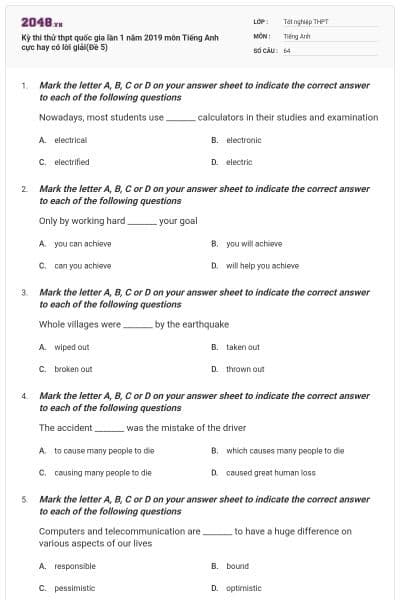
Mark the letter A, B, C or D on your answer sheet to indicate the correct answer to each of the following questions
Nowadays, most students use _______ calculators in their studies and examination
electrical
electronic
electrified
electric
Đáp án : B
Electronic = được tạo ra hoặc hoạt động bởi dòng điện tử. Electronic calculators = các máy tính điện tử (bỏ túi). Electrical = thuộc về điện, ngành điện. electric = chạy bằng điện, tạo ra điện
Mark the letter A, B, C or D on your answer sheet to indicate the correct answer to each of the following questions
Only by working hard _______ your goal
you can achieve
you will achieve
can you achieve
will help you achieve
Đáp án : C
Cấu trúc đảo ngữ: Only by + Ving, can/do/does/will/did..+ S + V (không chia) = chỉ bằng cách làm gì, ai đó mới có thể …
Mark the letter A, B, C or D on your answer sheet to indicate the correct answer to each of the following questions
Whole villages were _______ by the earthquake
wiped out
taken out
broken out
thrown out
Đáp án : A
Wipe out = phá hủy, xóa sổ. Were wiped out = đã bị xóa sổ. Break out = nổ ra, bùng nổ. take out = đưa ra ngoài, tẩy ra, rút hết sức lực, nhận được
Mark the letter A, B, C or D on your answer sheet to indicate the correct answer to each of the following questions
The accident _______ was the mistake of the driver
to cause many people to die
which causes many people to die
causing many people to die
caused great human loss
Đáp án : C
Ving đứng sau danh từ có thể là hình thức rút gọn mệnh đề quan hệ mang nghĩa chủ động. Cause + N + to V = khiến cho ai/cái gì phải làm gì. The accident causing many people to die = the accident which caused many people to die (động từ “caused” thì quá khứ đơn) = vụ tai nạn mà đã khiến cho nhiều người chết
Mark the letter A, B, C or D on your answer sheet to indicate the correct answer to each of the following questions
Computers and telecommunication are _______ to have a huge difference on various aspects of our lives
responsible
bound
pessimistic
optimistic
Đáp án : B
Be bound to V = chắc chắn sẽ làm gì
Mark the letter A, B, C or D on your answer sheet to indicate the correct answer to each of the following questions
_______, Miss Universe 2015 host Steve Harvey wrongfully declared Miss Colombia the winner when she was the first runner – up.
Regrettably
Fortunately
Consequently
Accordingly
Đáp án : A
Regrettably = một cách đáng tiếc. fortunately = một cách may mắn. consequently = hệ quả là. Accordingly = theo đó
Mark the letter A, B, C or D on your answer sheet to indicate the correct answer to each of the following questions
Consumers should boycott all products _______ have involved the use of child labour.
whose manufacture
whose manufacturers
which manufacture
who manufacture
Đáp án : B
Whose + N là đại từ quan hệ bổ nghĩa cho sự sở hữu của danh từ đứng trước. Manufacture (V) = sản xuất. Manufacturer (N) = nhà sản xuất. Products whose manufacturers … = các sản phẩm mà các nhà sản xuất của chúng
Mark the letter A, B, C or D on your answer sheet to indicate the correct answer to each of the following questions
After she had _______ leisurely dinner downstairs, Julia played _______ piano for _______ while
the/the/the
a/0/a
a/ the/ a
a/ the/ the
Đáp án : C
Had a leisurely dinner downstairs = có một bữa tới thảnh thơi ở tầng dưới -> danh từ ở đây là “dinner”. Chơi một nhạc cụ nào đó = play + the + tên nhạc cụ. For a while (cụm từ) = trong một lúc
Mark the letter A, B, C or D on your answer sheet to indicate the correct answer to each of the following questions
Ms. Thuy teaches disabled children. She sometimes finds her job _______.
exhaust
exhausted
exhausting
exhaustive
Đáp án : C
Find something + adj = thấy cái gì thế nào. Adj này để bổ nghĩa cho something. Exhausting = gây ra sự mệt mỏi. Exhausted = bị mệt mỏi. Finds her job exhausting = thấy nghề của mình gây ra sự mệt mỏi
Mark the letter A, B, C or D on your answer sheet to indicate the correct answer to each of the following questions
If the sea biodiversity were not maintained, marine life _______ at stake
would be
shall be
wouldn’t have been
will be
Đáp án : A
Câu điều kiện loại 2, giả định điều không có thật trong hiện tại: If + S + V-ed/were…, S + would/might/could + V
Mark the letter A, B, C or D on your answer sheet to indicate the correct answer to each of the following questions
Researchers at the University of Illinois have found out _______.
a little amazing old Chinese cup
an old amazing Chinese little cup
an old Chinese amazing little cup
an amazing little old Chinese cup
Đáp án : D
Quy tắc sắp xếp các tính từ: OPSACOM: Opinion (amazing)– Price – Size/shape (little) – Age (old) – Color – Original (Chinese) – Material => an amazing little old Chinese cup
Mark the letter A, B, C or D on your answer sheet to indicate the correct answer to each of the following questions
Many lists of “Wonders of the World” _______ during the Middle Ages
are said to exist
are said to have existed
said to be existed
said to exist
Đáp án : B
Cấu trúc câu bị động: S + is/are+ said/thought/believed + to have + past participle = ai được cho là đã làm điều gì từ trước đó, trong quá khứ
Mark the letter A, B, C or D on your answer sheet to indicate the correct answer to each of the following questions
Doctors advise _______ too many hours working on the computer. It ‘s very bad for your eyes.
not to spend
not being spent
not spend
not spending
Đáp án : D
Advise (not) Ving = advise somebody (not) to V = khuyên ai (không ) nên làm gì
Mark the letter A, B, C or D on your answer sheet to indicate the correct answer to each of the following questions
Ms. Linda is definitely _______.
the more generous of all my teacher
the most generous teacher we have ever met
one of the most generous we’ve met
more generous as all
Đáp án : B
Thông thường: the + most adj (so sánh hơn nhất )/first/last + N + mệnh đề quan hệ thời hiện tại hoàn thành = … nhất mà ai từng được… The most generous teacher we have ever met = giáo viên hào phóng nhất mà tôi từng gặp
Mark the letter A, B, C or D on your answer sheet to indicate the correct answer to each of the following questions
Ann: “ Shall we eat out tonight?” David: “-_______”
That’s a great idea
That’s understandable
It’s very kind of you to invite me
You are very welcome.
Đáp án : A
Shall we + V..? là cấu trúc gợi ý làm việc gì. Khi Ann gợi ý đi ăn tối, David đồng ý bằng cách nói: Đó là một ý hay đấy! Đáp án B = Điều đó có thể hiểu được. Đáp án C = bạn thật tốt khi mời tôi. Đáp án D = bạn luôn được chào mừng, không có gì đâu (đáp lời cám ơn)
Mark the letter A, B, C or D on your answer sheet to indicate the correct answer to each of the following questions
In the future, cars will still be _______ us, but, instead of petrol, they will run _______ anything from electricity to methane gas
for/by
for/ on
with/by
with/on
Đáp án : D
Be with somebody = ở với ai. Run on something = chạy bằng nguyên liệu gì
Mark the letter A, B, C or D on your answer sheet to indicate the correct answer to each of the following questions
John said that he _______ her since they _______
hasn’t met – graduated
hadn’t met – had graduated
hasn’t met – have graduated
hadn’t met – graduated
Đáp án : B
John vẫn chưa gặp nhau kể từ khi tốt nghiệp -> hasn’t met her since they graduate. Khi tường thuật lại, động từ phải lùi thời, hiện tại hoàn thành, quá khứ đơn -> quá khứ hoàn thành: hadn’t met – had graduated
Mark the letter A, B, C or D on your answer sheet to indicate the correct answer to each of the following questions
Daisy: “ Would you mind getting me a cup of coffee?” -John: “ _______”
Cream and sugar, please
No, thanks
I never drink coffee
It’s my pleasure
Đáp án : D
Would you mind Ving …? = bạn có thể làm điều gì đó giúp tôi được không? -> câu nhờ vả. Daisy nhờ John lấy cho cốc cà phê. It is my pleasure (cách đáp lịch sự) = điều đó là niềm vui của tôi. Đáp án A = làm ơn cho kem và đường. Đáp án B = không, cám ơn (lời từ chối). Đáp án C = tôi không bao giờ uống cà phê
Mark the letter A, B, C or D on your answer sheet to indicate the correct answer to each of the following questions
Thomas Edison _______ many new appliances using electricity during his long career.
who invented
inventing
invented
was invented
Đáp án : C
Câu này chưa có động từ -> Chỗ trống chứa động từ có chia. Việc Ê-đi-xơn phát minh là việc đã xảy ra hoàn toàn trong quá khứ -> chia ở quá khứ đơn
Mark the letter A, B, C or D on your answer sheet to indicate the world(s) OPPOSITE in meaning to the underlined word(s) in each of the following questions
A frightening number of illiterate students are graduating from college
able to enjoy winter sports
inflexible
able to read and write
unable to pass an examination in reading and writing
Đáp án : D
Illiterate = biết đọc, viết = able to read and write. Đáp án D = không thể qua kì kiểm tra đọc và viết
Mark the letter A, B, C or D on your answer sheet to indicate the world(s) OPPOSITE in meaning to the underlined word(s) in each of the following questions
In England, schooling is mandatory for all children from the age of 5 to 16.
obligatory
voluntary
compulsory
advisory
Đáp án : B
Mandatory = bắt buộc = compulsory
Read the following passage and mark the letter A, B, C or D on your answer sheet to indicate the correct answer to each of the question.
Life expectancy is the period of time that a person can expect to live. Life expectancy varies greatly between genders and cultures. It used to be that women had a lower life expectancy than men (1 in every 4 women died in childbirth), but now they live an average of four to five years longer than men. Life expectancy has been increasing rapidly over the last centuries. With the advent of such modern miracles as sewers, medicine and a greater understanding of how diseases are spread, our life expectancy has increased by 25 – 30 years.
In developing countries like Swaziland, where there is a high HIV/AIDS rate, life expectancy is as low as 32,6 years. In developed countries like Australia, life expectancy rates as high as 81 years. There are an increasing number of factors which can cancel out the disadvantages you have. The one that we are looking at now is how your career can affect your life expectancy. Choosing the wrong career can result in a shorter life!
If you want your career to positively influence your life expectancy, you have to be made of money. That’s right. Rich people in wealthy areas of England and France live 10 years longer than the people in poorer areas. Having a successful career has its drawbacks, too if the result of hard work its stress.
Stress can lead to a number of psychological disorders such as depression, anxiety, fatigue, tension and aggression. These conditions may result in a lack of concentration and an increase in serious injuries at work. They can also lead to high blood pressure and heart attacks which seriously affect life expectancy.
If you are worried that your job might decrease your life expectancy, you probably need to avoid careers on “dangerous jobs” list such as timber cutters, pilots, construction workers, roofer, truck drivers.
So if you don’t want to kick the bucket at an early age, choose a career in something other than timber cutting, but above all, remember to relax.
From Pre-Essence Reading by Rachel Lee, Longman
According to the passage, all of the following are true EXCEPT _______.
Our life expectancy has increased by 25 – 30 years because there are fewer wars today.
In the past, women’s life expectancy was lower than that of men.
Life expectancy varies greatly depending on genders and cultures
There has been a dramatic increase in average life expectancy over the last centuries
Đáp án : A
Câu cuối đoạn 1: With the advent of such modern miracles as sewers, medicine and a greater understanding of how diseases are spread, our life expectancy has increased by 25 – 30 years -> với sự xuất hiện của những phép màu hiện đại như khâu, thuốc và sự hiểu biết rộng hơn về sự lan truyền bệnh tật, tuổi thọ của chúng ta đã tăng 25 – 30 năm -> không phải do ít chiến tranh
Read the following passage and mark the letter A, B, C or D on your answer sheet to indicate the correct answer to each of the question.
Life expectancy is the period of time that a person can expect to live. Life expectancy varies greatly between genders and cultures. It used to be that women had a lower life expectancy than men (1 in every 4 women died in childbirth), but now they live an average of four to five years longer than men. Life expectancy has been increasing rapidly over the last centuries. With the advent of such modern miracles as sewers, medicine and a greater understanding of how diseases are spread, our life expectancy has increased by 25 – 30 years.
In developing countries like Swaziland, where there is a high HIV/AIDS rate, life expectancy is as low as 32,6 years. In developed countries like Australia, life expectancy rates as high as 81 years. There are an increasing number of factors which can cancel out the disadvantages you have. The one that we are looking at now is how your career can affect your life expectancy. Choosing the wrong career can result in a shorter life!
If you want your career to positively influence your life expectancy, you have to be made of money. That’s right. Rich people in wealthy areas of England and France live 10 years longer than the people in poorer areas. Having a successful career has its drawbacks, too if the result of hard work its stress.
Stress can lead to a number of psychological disorders such as depression, anxiety, fatigue, tension and aggression. These conditions may result in a lack of concentration and an increase in serious injuries at work. They can also lead to high blood pressure and heart attacks which seriously affect life expectancy.
If you are worried that your job might decrease your life expectancy, you probably need to avoid careers on “dangerous jobs” list such as timber cutters, pilots, construction workers, roofer, truck drivers.
So if you don’t want to kick the bucket at an early age, choose a career in something other than timber cutting, but above all, remember to relax.
From Pre-Essence Reading by Rachel Lee, Longman
The average life expectancy is 32,6 years in _______.
Swaziland
France
Australia
England
Đáp án : A
Câu đầu đoạn 2: In developing countries like Swaziland, where there is a high HIV/AIDS rate, life expectancy is as low as 32,6 years -> ở các đất nước đang phát triển như Swaziland … tuổi thọ chỉ ở mức 32.6 năm
Read the following passage and mark the letter A, B, C or D on your answer sheet to indicate the correct answer to each of the question.
Life expectancy is the period of time that a person can expect to live. Life expectancy varies greatly between genders and cultures. It used to be that women had a lower life expectancy than men (1 in every 4 women died in childbirth), but now they live an average of four to five years longer than men. Life expectancy has been increasing rapidly over the last centuries. With the advent of such modern miracles as sewers, medicine and a greater understanding of how diseases are spread, our life expectancy has increased by 25 – 30 years.
In developing countries like Swaziland, where there is a high HIV/AIDS rate, life expectancy is as low as 32,6 years. In developed countries like Australia, life expectancy rates as high as 81 years. There are an increasing number of factors which can cancel out the disadvantages you have. The one that we are looking at now is how your career can affect your life expectancy. Choosing the wrong career can result in a shorter life!
If you want your career to positively influence your life expectancy, you have to be made of money. That’s right. Rich people in wealthy areas of England and France live 10 years longer than the people in poorer areas. Having a successful career has its drawbacks, too if the result of hard work its stress.
Stress can lead to a number of psychological disorders such as depression, anxiety, fatigue, tension and aggression. These conditions may result in a lack of concentration and an increase in serious injuries at work. They can also lead to high blood pressure and heart attacks which seriously affect life expectancy.
If you are worried that your job might decrease your life expectancy, you probably need to avoid careers on “dangerous jobs” list such as timber cutters, pilots, construction workers, roofer, truck drivers.
So if you don’t want to kick the bucket at an early age, choose a career in something other than timber cutting, but above all, remember to relax.
From Pre-Essence Reading by Rachel Lee, Longman
Why does an increase in stress lead to an increase in workplace accidents?
Workers like to take sick leave and stay home.
It leads to a decrease in concentration and depression.
Workers don’t care as much about their jobs.
Workers are too busy to observe safety regulations.
Đáp án : B
Đầu đoạn 4: Stress can lead to a number of psychological disorders such as depression, anxiety, fatigue, tension and aggression. These conditions may result in a lack of concentration and an increase in serious injuries at work
Read the following passage and mark the letter A, B, C or D on your answer sheet to indicate the correct answer to each of the question.
Life expectancy is the period of time that a person can expect to live. Life expectancy varies greatly between genders and cultures. It used to be that women had a lower life expectancy than men (1 in every 4 women died in childbirth), but now they live an average of four to five years longer than men. Life expectancy has been increasing rapidly over the last centuries. With the advent of such modern miracles as sewers, medicine and a greater understanding of how diseases are spread, our life expectancy has increased by 25 – 30 years.
In developing countries like Swaziland, where there is a high HIV/AIDS rate, life expectancy is as low as 32,6 years. In developed countries like Australia, life expectancy rates as high as 81 years. There are an increasing number of factors which can cancel out the disadvantages you have. The one that we are looking at now is how your career can affect your life expectancy. Choosing the wrong career can result in a shorter life!
If you want your career to positively influence your life expectancy, you have to be made of money. That’s right. Rich people in wealthy areas of England and France live 10 years longer than the people in poorer areas. Having a successful career has its drawbacks, too if the result of hard work its stress.
Stress can lead to a number of psychological disorders such as depression, anxiety, fatigue, tension and aggression. These conditions may result in a lack of concentration and an increase in serious injuries at work. They can also lead to high blood pressure and heart attacks which seriously affect life expectancy.
If you are worried that your job might decrease your life expectancy, you probably need to avoid careers on “dangerous jobs” list such as timber cutters, pilots, construction workers, roofer, truck drivers.
So if you don’t want to kick the bucket at an early age, choose a career in something other than timber cutting, but above all, remember to relax.
From Pre-Essence Reading by Rachel Lee, Longman
According to the passage, which of following is true if you have a successful career?
You can buy an expensive car
Your life expectancy increases by a decade
You can afford to exercise and eat well
You can spend most of your day in an office
Đáp án : B
Dòng 2 đoạn 3: Rich people in wealthy areas of England and France live 10 years longer than the people in poorer areas -> người giàu có ở Anh Quốc và Pháp sống lâu hơn 10 năm so với người ở những vùng nghèo khó ≈ nếu có sự nghiệp thành công thì tuổi thọ tăng lên một thập kỉ
Read the following passage and mark the letter A, B, C or D on your answer sheet to indicate the correct answer to each of the question.
Life expectancy is the period of time that a person can expect to live. Life expectancy varies greatly between genders and cultures. It used to be that women had a lower life expectancy than men (1 in every 4 women died in childbirth), but now they live an average of four to five years longer than men. Life expectancy has been increasing rapidly over the last centuries. With the advent of such modern miracles as sewers, medicine and a greater understanding of how diseases are spread, our life expectancy has increased by 25 – 30 years.
In developing countries like Swaziland, where there is a high HIV/AIDS rate, life expectancy is as low as 32,6 years. In developed countries like Australia, life expectancy rates as high as 81 years. There are an increasing number of factors which can cancel out the disadvantages you have. The one that we are looking at now is how your career can affect your life expectancy. Choosing the wrong career can result in a shorter life!
If you want your career to positively influence your life expectancy, you have to be made of money. That’s right. Rich people in wealthy areas of England and France live 10 years longer than the people in poorer areas. Having a successful career has its drawbacks, too if the result of hard work its stress.
Stress can lead to a number of psychological disorders such as depression, anxiety, fatigue, tension and aggression. These conditions may result in a lack of concentration and an increase in serious injuries at work. They can also lead to high blood pressure and heart attacks which seriously affect life expectancy.
If you are worried that your job might decrease your life expectancy, you probably need to avoid careers on “dangerous jobs” list such as timber cutters, pilots, construction workers, roofer, truck drivers.
So if you don’t want to kick the bucket at an early age, choose a career in something other than timber cutting, but above all, remember to relax.
From Pre-Essence Reading by Rachel Lee, Longman
It can be inferred from the paragraph 3 that the disadvantage of a successful career is that _______.
You won’t have to take a job on the “dangerous jobs” list
You are at the greater risk of being a victim of crime
There is a high number of work – related injuries
You are more likely to be under stress.
Đáp án : D
Cuối đoạn 3, đầu đoạn 4: Having a successful career has its drawbacks, too if the result of hard work its stress. Stress can lead to a number of psychological disorders ... These conditions may result … serious injuries at work. -> Sự nghiệp thành công có thể kèm theo áp lực cao, dẫn đến rối loạn thần kinh, gây nên những chấn thương nghiêm trọng
Read the following passage and mark the letter A, B, C or D on your answer sheet to indicate the correct answer to each of the question.
Life expectancy is the period of time that a person can expect to live. Life expectancy varies greatly between genders and cultures. It used to be that women had a lower life expectancy than men (1 in every 4 women died in childbirth), but now they live an average of four to five years longer than men. Life expectancy has been increasing rapidly over the last centuries. With the advent of such modern miracles as sewers, medicine and a greater understanding of how diseases are spread, our life expectancy has increased by 25 – 30 years.
In developing countries like Swaziland, where there is a high HIV/AIDS rate, life expectancy is as low as 32,6 years. In developed countries like Australia, life expectancy rates as high as 81 years. There are an increasing number of factors which can cancel out the disadvantages you have. The one that we are looking at now is how your career can affect your life expectancy. Choosing the wrong career can result in a shorter life!
If you want your career to positively influence your life expectancy, you have to be made of money. That’s right. Rich people in wealthy areas of England and France live 10 years longer than the people in poorer areas. Having a successful career has its drawbacks, too if the result of hard work its stress.
Stress can lead to a number of psychological disorders such as depression, anxiety, fatigue, tension and aggression. These conditions may result in a lack of concentration and an increase in serious injuries at work. They can also lead to high blood pressure and heart attacks which seriously affect life expectancy.
If you are worried that your job might decrease your life expectancy, you probably need to avoid careers on “dangerous jobs” list such as timber cutters, pilots, construction workers, roofer, truck drivers.
So if you don’t want to kick the bucket at an early age, choose a career in something other than timber cutting, but above all, remember to relax.
From Pre-Essence Reading by Rachel Lee, Longman
Why does the author think that you should remember to relax?
Because stress can decrease your life expectancy
Because relaxing will make you feel better
Because relaxing will improve your career
Because you have completed the reading
Đáp án : A
Cả đoạn 4 nói về tác hại của stress,và cuối cùng, tác hại mạnh nhất là:They can also lead to high blood pressure and heart attacks which seriously affect life expectancy-> dẫn đến cao huyết áp, đau tim và ảnh hưởng nghiêm trọng tới tuổi thọ
Read the following passage and mark the letter A, B, C or D on your answer sheet to indicate the correct answer to each of the question.
Life expectancy is the period of time that a person can expect to live. Life expectancy varies greatly between genders and cultures. It used to be that women had a lower life expectancy than men (1 in every 4 women died in childbirth), but now they live an average of four to five years longer than men. Life expectancy has been increasing rapidly over the last centuries. With the advent of such modern miracles as sewers, medicine and a greater understanding of how diseases are spread, our life expectancy has increased by 25 – 30 years.
In developing countries like Swaziland, where there is a high HIV/AIDS rate, life expectancy is as low as 32,6 years. In developed countries like Australia, life expectancy rates as high as 81 years. There are an increasing number of factors which can cancel out the disadvantages you have. The one that we are looking at now is how your career can affect your life expectancy. Choosing the wrong career can result in a shorter life!
If you want your career to positively influence your life expectancy, you have to be made of money. That’s right. Rich people in wealthy areas of England and France live 10 years longer than the people in poorer areas. Having a successful career has its drawbacks, too if the result of hard work its stress.
Stress can lead to a number of psychological disorders such as depression, anxiety, fatigue, tension and aggression. These conditions may result in a lack of concentration and an increase in serious injuries at work. They can also lead to high blood pressure and heart attacks which seriously affect life expectancy.
If you are worried that your job might decrease your life expectancy, you probably need to avoid careers on “dangerous jobs” list such as timber cutters, pilots, construction workers, roofer, truck drivers.
So if you don’t want to kick the bucket at an early age, choose a career in something other than timber cutting, but above all, remember to relax.
From Pre-Essence Reading by Rachel Lee, Longman
The phrase “kick the bucket” in the passage is closest in meaning to “_______”
die
relax
live
succeed
Đáp án : A
Kick the bucket = die = qua đời
Read the following passage and mark the letter A, B, C or D on your answer sheet to indicate the correct answer to each of the question.
Life expectancy is the period of time that a person can expect to live. Life expectancy varies greatly between genders and cultures. It used to be that women had a lower life expectancy than men (1 in every 4 women died in childbirth), but now they live an average of four to five years longer than men. Life expectancy has been increasing rapidly over the last centuries. With the advent of such modern miracles as sewers, medicine and a greater understanding of how diseases are spread, our life expectancy has increased by 25 – 30 years.
In developing countries like Swaziland, where there is a high HIV/AIDS rate, life expectancy is as low as 32,6 years. In developed countries like Australia, life expectancy rates as high as 81 years. There are an increasing number of factors which can cancel out the disadvantages you have. The one that we are looking at now is how your career can affect your life expectancy. Choosing the wrong career can result in a shorter life!
If you want your career to positively influence your life expectancy, you have to be made of money. That’s right. Rich people in wealthy areas of England and France live 10 years longer than the people in poorer areas. Having a successful career has its drawbacks, too if the result of hard work its stress.
Stress can lead to a number of psychological disorders such as depression, anxiety, fatigue, tension and aggression. These conditions may result in a lack of concentration and an increase in serious injuries at work. They can also lead to high blood pressure and heart attacks which seriously affect life expectancy.
If you are worried that your job might decrease your life expectancy, you probably need to avoid careers on “dangerous jobs” list such as timber cutters, pilots, construction workers, roofer, truck drivers.
So if you don’t want to kick the bucket at an early age, choose a career in something other than timber cutting, but above all, remember to relax.
From Pre-Essence Reading by Rachel Lee, Longman
What is the main idea of the 1st paragraph?
Stress negatively affects life expectancy
Making a bad career choice will make your life shorter
Life expectancy has increased greatly over the last few centuries
Stress results in lower life expectancy
Đáp án : C
Đoạn 1 nói về tuổi thọ của con người đã và đang thay đổi, cụ thể là theo hướng sống lâu hơn. điều này được khẳng định trong dòng 4: Life expectancy has been increasing rapidly over the last centuries
Read the following passage and mark the letter A, B, C or D on your answer sheet to indicate the correct answer to each of the question.
Life expectancy is the period of time that a person can expect to live. Life expectancy varies greatly between genders and cultures. It used to be that women had a lower life expectancy than men (1 in every 4 women died in childbirth), but now they live an average of four to five years longer than men. Life expectancy has been increasing rapidly over the last centuries. With the advent of such modern miracles as sewers, medicine and a greater understanding of how diseases are spread, our life expectancy has increased by 25 – 30 years.
In developing countries like Swaziland, where there is a high HIV/AIDS rate, life expectancy is as low as 32,6 years. In developed countries like Australia, life expectancy rates as high as 81 years. There are an increasing number of factors which can cancel out the disadvantages you have. The one that we are looking at now is how your career can affect your life expectancy. Choosing the wrong career can result in a shorter life!
If you want your career to positively influence your life expectancy, you have to be made of money. That’s right. Rich people in wealthy areas of England and France live 10 years longer than the people in poorer areas. Having a successful career has its drawbacks, too if the result of hard work its stress.
Stress can lead to a number of psychological disorders such as depression, anxiety, fatigue, tension and aggression. These conditions may result in a lack of concentration and an increase in serious injuries at work. They can also lead to high blood pressure and heart attacks which seriously affect life expectancy.
If you are worried that your job might decrease your life expectancy, you probably need to avoid careers on “dangerous jobs” list such as timber cutters, pilots, construction workers, roofer, truck drivers.
So if you don’t want to kick the bucket at an early age, choose a career in something other than timber cutting, but above all, remember to relax.
From Pre-Essence Reading by Rachel Lee, Longman
The word “They” in bold in paragraph 1 refers to _______.
cultures
genders
women
woman
Đáp án : C
Dịch cả câu( It used to be… than men) = Phụ nữ từng có tuổi thọ thấp hơn đàn ông (cứ 4 phụ nữ thì có 1 người chết khi sinh con), nhưng ngày nay, họ sống lâu hơn 4 hoặc 5 năm so với đàn ông -> Họ chính là chỉ “phụ nữ”
Read the following passage and mark the letter A, B, C or D on your answer sheet to indicate the correct answer to each of the question.
Life expectancy is the period of time that a person can expect to live. Life expectancy varies greatly between genders and cultures. It used to be that women had a lower life expectancy than men (1 in every 4 women died in childbirth), but now they live an average of four to five years longer than men. Life expectancy has been increasing rapidly over the last centuries. With the advent of such modern miracles as sewers, medicine and a greater understanding of how diseases are spread, our life expectancy has increased by 25 – 30 years.
In developing countries like Swaziland, where there is a high HIV/AIDS rate, life expectancy is as low as 32,6 years. In developed countries like Australia, life expectancy rates as high as 81 years. There are an increasing number of factors which can cancel out the disadvantages you have. The one that we are looking at now is how your career can affect your life expectancy. Choosing the wrong career can result in a shorter life!
If you want your career to positively influence your life expectancy, you have to be made of money. That’s right. Rich people in wealthy areas of England and France live 10 years longer than the people in poorer areas. Having a successful career has its drawbacks, too if the result of hard work its stress.
Stress can lead to a number of psychological disorders such as depression, anxiety, fatigue, tension and aggression. These conditions may result in a lack of concentration and an increase in serious injuries at work. They can also lead to high blood pressure and heart attacks which seriously affect life expectancy.
If you are worried that your job might decrease your life expectancy, you probably need to avoid careers on “dangerous jobs” list such as timber cutters, pilots, construction workers, roofer, truck drivers.
So if you don’t want to kick the bucket at an early age, choose a career in something other than timber cutting, but above all, remember to relax.
From Pre-Essence Reading by Rachel Lee, Longman
The passage mainly discusses _______
The definition of life expectancy
The comparison of life expectancy between women and men
The importance of a successful career
The effects of a career on one’s life expectancy
Đáp án : D
Đoạn 2 đã bắt đầu đi vào phân tích các yếu tố ảnh hưởng tới tuổi thọ, mà chủ yếu là yếu tố công việc (career). Sự ảnh hưởng của công việc tới tuổi thọ được phân tích về cả hướng tích cực và tiêu cực
Mark the letter A, B, C or D on your answer sheet to indicate the word whose underlined part differs from the other three in pronunciation in each of the following questions
welcome
comfortable
accompany
compulsory
Đáp án : C
“o” trong “accompany” phát âm là /∧/, trong các từ còn lại phát âm là /ə/
Mark the letter A, B, C or D on your answer sheet to indicate the word whose underlined part differs from the other three in pronunciation in each of the following questions
produced
laughed
explained
finished
Đáp án : C
“ed” sau âm /n/ phát âm là /d/, sau các âm /∫/, /f/, /s/ phát âm là /t/
Mark the letter A, B, C or D on your answer sheet to indicate the word that differs from the other three in the position of primary stress in each of the following questions.
illegal
domestic
creative
marvelous
Đáp án : D
Trọng âm của từ này rơi vào âm tiết thứ 1, các từ còn lại rơi vào âm tiết thứ 2
Mark the letter A, B, C or D on your answer sheet to indicate the word(s) CLOSET in meaning to the underlined word(s) in each of the following questions.
Bacteria can be both detrimental and helpful to humans, depending on the specific type and effect.
useful
fatal
productive
harmful
Đáp án : D
Detrimental = bất lợi, gây nhiều thiệt hại. Harmful = độc hại, bất lợi
Đáp án : D
Trọng âm của từ này (với nghĩa danh từ) rơi vào âm tiết thứ 1, các từ còn lại rơi vào âm tiết thứ 2
expand
maintain
approach
comment
Đáp án : D
Trọng âm của từ này (với nghĩa danh từ) rơi vào âm tiết thứ 1, các từ còn lại rơi vào âm tiết thứ 2
Mark the letter A, B, C or D on your answer sheet to indicate the word that differs from the other three in the position of primary stress in each of the following questions.
maximum
certificate
investment
inhabitant
Đáp án : A
Trọng âm của từ này rơi vào âm tiết thứ 1, các từ còn lại rơi vào âm tiết thứ 2
Mark the letter A, B, C or D on your answer sheet to indicate the word(s) CLOSET in meaning to the underlined word(s) in each of the following questions.
When you see your teacher approaching you, a slight wage to attract his attention is appropriate.
catching sight of
pointing at
coming nearer to
looking up to
Đáp án : C
Approach = tiến tới gần, tiếp cận = coming nearer to something. Catch sight of = bắt gặp cảnh gì. Point at = chỉ vào. Look up to somebody = tôn trọng ai
Mark the letter A, B, C or D on your answer sheet to indicate the word(s) CLOSET in meaning to the underlined word(s) in each of the following questions.
Helen Keller, blind and deaf from an early age, developed her sense of smell so finely that she could identify friends by their personal odors
classify
recognize
describe
communicate with
Đáp án : B
Identity = nhận dạng. recognize = nhận ra. Classify = phân loại. describe = miêu tả. communicate with = giao tiếp với
Read the following passage and mark the letter A, B, C or D on your answer sheet to indicate the correct answer to each of the questions.
New surveys suggest that the technological tools we use to make our lives easier are killing our leisure time. We are working longer hours, taking fewer and shorter vacations (and when we do go away, we take our cell phones, PDAs, and laptops along). And, we are more stressed than ever as increased use of e-mail, voice mail, cell phones, and the Internet is destroying any idea of privacy and leisure.
Since the Industrial Revolution, people have assumed that new labor-saving devices would free them from the burdens of the workplace and give them more time to grow intellectually, creatively, and socially exploring the arts, keeping up with current events, spending more time with friends and family, and even just 'goofing off'.
But here we are at the start of the 21st century, enjoying one of the greatest technological boom times in human history, and nothing could be further from the truth. The very tools that were supposed to liberate us have bound us to our work and study in ways that were inconceivable just a few years ago. It would seem that technology almost never does what we expect.
In 'the old days', the lines between work and leisure time were markedly clearer. People left their offices at a predictable time, were often completely disconnected from and out of touch with their jobs as they traveled to and from work, and were off-duty once they were home. That is no longer true. In today's highly competitive job market, employers demand increased productivity, expecting workers to put in longer hours and to keep in touch almost constantly via fax, cell phones, e-mail, or other communications devices. As a result, employees feel the need to check in on what is going on at the office, even on days off. They feel pressured to work after hours just to catch up on everything they have to do. Workers work harder and longer, change their work tasks more frequently, and have more and more reasons to worry about job security.
Bosses, colleagues, family members, lovers, and friends expect instant responses to voice mail and e-mail messages. Even college students have become bound to their desks by an environment in which faculty, friends, and other members of the college community increasingly do their work online. Studies of time spent on instant messaging services would probably show staggering use.
This is not what technology was supposed to be doing for us. New technologies, from genetic research to the Internet, offer all sorts of benefits and opportunities. But, when new tools make life more difficult and stressful rather than easier and more meaningful - and we are, as a society, barely conscious of it - then something has gone seriously awry, both with our expectations for technology and our understanding of how it should benefit us.
From “Summit 1” by Joan Saslow & Allen Ascher
According to the first three paragraphs, technological tools that were designed to make our lives easier _______.
have turned out to do us more harm than good
have brought us complete happiness.
have not interfered with our privacy
have fully met our expectations
Đáp án : A
Từ câu đầu tiên: New surveys suggest that the technological tools we use to make our lives easier are killing our leisure time -> những cuộc khảo sát mới cho thấy những công cụ ta sử dụng tưởng như làm cuộc sống trở nên dễ dàng hơn thực ra đang giết chết khoảng thời gian rảnh rỗi của chúng ta
Read the following passage and mark the letter A, B, C or D on your answer sheet to indicate the correct answer to each of the questions.
New surveys suggest that the technological tools we use to make our lives easier are killing our leisure time. We are working longer hours, taking fewer and shorter vacations (and when we do go away, we take our cell phones, PDAs, and laptops along). And, we are more stressed than ever as increased use of e-mail, voice mail, cell phones, and the Internet is destroying any idea of privacy and leisure.
Since the Industrial Revolution, people have assumed that new labor-saving devices would free them from the burdens of the workplace and give them more time to grow intellectually, creatively, and socially exploring the arts, keeping up with current events, spending more time with friends and family, and even just 'goofing off'.
But here we are at the start of the 21st century, enjoying one of the greatest technological boom times in human history, and nothing could be further from the truth. The very tools that were supposed to liberate us have bound us to our work and study in ways that were inconceivable just a few years ago. It would seem that technology almost never does what we expect.
In 'the old days', the lines between work and leisure time were markedly clearer. People left their offices at a predictable time, were often completely disconnected from and out of touch with their jobs as they traveled to and from work, and were off-duty once they were home. That is no longer true. In today's highly competitive job market, employers demand increased productivity, expecting workers to put in longer hours and to keep in touch almost constantly via fax, cell phones, e-mail, or other communications devices. As a result, employees feel the need to check in on what is going on at the office, even on days off. They feel pressured to work after hours just to catch up on everything they have to do. Workers work harder and longer, change their work tasks more frequently, and have more and more reasons to worry about job security.
Bosses, colleagues, family members, lovers, and friends expect instant responses to voice mail and e-mail messages. Even college students have become bound to their desks by an environment in which faculty, friends, and other members of the college community increasingly do their work online. Studies of time spent on instant messaging services would probably show staggering use.
This is not what technology was supposed to be doing for us. New technologies, from genetic research to the Internet, offer all sorts of benefits and opportunities. But, when new tools make life more difficult and stressful rather than easier and more meaningful - and we are, as a society, barely conscious of it - then something has gone seriously awry, both with our expectations for technology and our understanding of how it should benefit us.
From “Summit 1” by Joan Saslow & Allen Ascher
This passage has probably been taken from_______.
a political journal
an advertisement
a science review
a fashion magazine
Đáp án : C
Bài văn phân tích mặt trái của các phương tiện công nghệ -> dễ bắt gặp trong các bản đánh giá khoa học (= a science review). A political journal = báo chính trị. An advertisement = một quảng cáo. A fashion magazine= tạp chí thời trang
Read the following passage and mark the letter A, B, C or D on your answer sheet to indicate the correct answer to each of the questions.
New surveys suggest that the technological tools we use to make our lives easier are killing our leisure time. We are working longer hours, taking fewer and shorter vacations (and when we do go away, we take our cell phones, PDAs, and laptops along). And, we are more stressed than ever as increased use of e-mail, voice mail, cell phones, and the Internet is destroying any idea of privacy and leisure.
Since the Industrial Revolution, people have assumed that new labor-saving devices would free them from the burdens of the workplace and give them more time to grow intellectually, creatively, and socially exploring the arts, keeping up with current events, spending more time with friends and family, and even just 'goofing off'.
But here we are at the start of the 21st century, enjoying one of the greatest technological boom times in human history, and nothing could be further from the truth. The very tools that were supposed to liberate us have bound us to our work and study in ways that were inconceivable just a few years ago. It would seem that technology almost never does what we expect.
In 'the old days', the lines between work and leisure time were markedly clearer. People left their offices at a predictable time, were often completely disconnected from and out of touch with their jobs as they traveled to and from work, and were off-duty once they were home. That is no longer true. In today's highly competitive job market, employers demand increased productivity, expecting workers to put in longer hours and to keep in touch almost constantly via fax, cell phones, e-mail, or other communications devices. As a result, employees feel the need to check in on what is going on at the office, even on days off. They feel pressured to work after hours just to catch up on everything they have to do. Workers work harder and longer, change their work tasks more frequently, and have more and more reasons to worry about job security.
Bosses, colleagues, family members, lovers, and friends expect instant responses to voice mail and e-mail messages. Even college students have become bound to their desks by an environment in which faculty, friends, and other members of the college community increasingly do their work online. Studies of time spent on instant messaging services would probably show staggering use.
This is not what technology was supposed to be doing for us. New technologies, from genetic research to the Internet, offer all sorts of benefits and opportunities. But, when new tools make life more difficult and stressful rather than easier and more meaningful - and we are, as a society, barely conscious of it - then something has gone seriously awry, both with our expectations for technology and our understanding of how it should benefit us.
From “Summit 1” by Joan Saslow & Allen Ascher
The word “They” in the fourth paragraph refers to _______.
tasks
employees
employers
Workers
Đáp án : B
Dịch từ câu trước: As a result … pressured = kết quả là những nhân viên cảm thấy cần phải kiểm tra xem điều gì đang xảy ra ở cơ quan, kể cả trong những ngày nghỉ. Họ cảm thấy bị áp lực … -> Họ chính là chỉ các nhân viên
Read the following passage and mark the letter A, B, C or D on your answer sheet to indicate the correct answer to each of the questions.
New surveys suggest that the technological tools we use to make our lives easier are killing our leisure time. We are working longer hours, taking fewer and shorter vacations (and when we do go away, we take our cell phones, PDAs, and laptops along). And, we are more stressed than ever as increased use of e-mail, voice mail, cell phones, and the Internet is destroying any idea of privacy and leisure.
Since the Industrial Revolution, people have assumed that new labor-saving devices would free them from the burdens of the workplace and give them more time to grow intellectually, creatively, and socially exploring the arts, keeping up with current events, spending more time with friends and family, and even just 'goofing off'.
But here we are at the start of the 21st century, enjoying one of the greatest technological boom times in human history, and nothing could be further from the truth. The very tools that were supposed to liberate us have bound us to our work and study in ways that were inconceivable just a few years ago. It would seem that technology almost never does what we expect.
In 'the old days', the lines between work and leisure time were markedly clearer. People left their offices at a predictable time, were often completely disconnected from and out of touch with their jobs as they traveled to and from work, and were off-duty once they were home. That is no longer true. In today's highly competitive job market, employers demand increased productivity, expecting workers to put in longer hours and to keep in touch almost constantly via fax, cell phones, e-mail, or other communications devices. As a result, employees feel the need to check in on what is going on at the office, even on days off. They feel pressured to work after hours just to catch up on everything they have to do. Workers work harder and longer, change their work tasks more frequently, and have more and more reasons to worry about job security.
Bosses, colleagues, family members, lovers, and friends expect instant responses to voice mail and e-mail messages. Even college students have become bound to their desks by an environment in which faculty, friends, and other members of the college community increasingly do their work online. Studies of time spent on instant messaging services would probably show staggering use.
This is not what technology was supposed to be doing for us. New technologies, from genetic research to the Internet, offer all sorts of benefits and opportunities. But, when new tools make life more difficult and stressful rather than easier and more meaningful - and we are, as a society, barely conscious of it - then something has gone seriously awry, both with our expectations for technology and our understanding of how it should benefit us.
From “Summit 1” by Joan Saslow & Allen Ascher
It can be inferred from the fourth paragraph that_______.
life is more relaxing with cell phones and other technological devices
employers are more demanding and have efficient means to monitor employees
it is compulsory that employees go to the office, even on days off
employees have more freedom thanks to the technological advances
Đáp án : B
Từ dòng 4 đoạn 4: employers demand increased productivity, expecting workers to put in longer hours and to keep in touch almost constantly via fax, cell phones, e-mail, or other communications devices. -> các chủ sử dụng lao động yêu cầu năng suất cao hơn. kì vọng công nhân làm việc lâu hơn và giữ liên lạc gần như liên tục qua fax, điện thoại, thư điện tử hay công cụ liên lạc khác. ----> yêu cầu nhiều hơn và có những công cụ quản lí hiệu quả hơn (fax, điện thoại…)
Read the following passage and mark the letter A, B, C or D on your answer sheet to indicate the correct answer to each of the questions.
New surveys suggest that the technological tools we use to make our lives easier are killing our leisure time. We are working longer hours, taking fewer and shorter vacations (and when we do go away, we take our cell phones, PDAs, and laptops along). And, we are more stressed than ever as increased use of e-mail, voice mail, cell phones, and the Internet is destroying any idea of privacy and leisure.
Since the Industrial Revolution, people have assumed that new labor-saving devices would free them from the burdens of the workplace and give them more time to grow intellectually, creatively, and socially exploring the arts, keeping up with current events, spending more time with friends and family, and even just 'goofing off'.
But here we are at the start of the 21st century, enjoying one of the greatest technological boom times in human history, and nothing could be further from the truth. The very tools that were supposed to liberate us have bound us to our work and study in ways that were inconceivable just a few years ago. It would seem that technology almost never does what we expect.
In 'the old days', the lines between work and leisure time were markedly clearer. People left their offices at a predictable time, were often completely disconnected from and out of touch with their jobs as they traveled to and from work, and were off-duty once they were home. That is no longer true. In today's highly competitive job market, employers demand increased productivity, expecting workers to put in longer hours and to keep in touch almost constantly via fax, cell phones, e-mail, or other communications devices. As a result, employees feel the need to check in on what is going on at the office, even on days off. They feel pressured to work after hours just to catch up on everything they have to do. Workers work harder and longer, change their work tasks more frequently, and have more and more reasons to worry about job security.
Bosses, colleagues, family members, lovers, and friends expect instant responses to voice mail and e-mail messages. Even college students have become bound to their desks by an environment in which faculty, friends, and other members of the college community increasingly do their work online. Studies of time spent on instant messaging services would probably show staggering use.
This is not what technology was supposed to be doing for us. New technologies, from genetic research to the Internet, offer all sorts of benefits and opportunities. But, when new tools make life more difficult and stressful rather than easier and more meaningful - and we are, as a society, barely conscious of it - then something has gone seriously awry, both with our expectations for technology and our understanding of how it should benefit us.
From “Summit 1” by Joan Saslow & Allen Ascher
The word “inconceivable” in the passage is closest in meaning to “_______”.
unforgettable
foreseeable
unimaginable
predictable
Đáp án : C
Inconceivable = không thể hiểu được, không mường tượng ra được. Unimaginable = không thể tưởng tượng được
Read the following passage and mark the letter A, B, C or D on your answer sheet to indicate the correct answer to each of the questions.
New surveys suggest that the technological tools we use to make our lives easier are killing our leisure time. We are working longer hours, taking fewer and shorter vacations (and when we do go away, we take our cell phones, PDAs, and laptops along). And, we are more stressed than ever as increased use of e-mail, voice mail, cell phones, and the Internet is destroying any idea of privacy and leisure.
Since the Industrial Revolution, people have assumed that new labor-saving devices would free them from the burdens of the workplace and give them more time to grow intellectually, creatively, and socially exploring the arts, keeping up with current events, spending more time with friends and family, and even just 'goofing off'.
But here we are at the start of the 21st century, enjoying one of the greatest technological boom times in human history, and nothing could be further from the truth. The very tools that were supposed to liberate us have bound us to our work and study in ways that were inconceivable just a few years ago. It would seem that technology almost never does what we expect.
In 'the old days', the lines between work and leisure time were markedly clearer. People left their offices at a predictable time, were often completely disconnected from and out of touch with their jobs as they traveled to and from work, and were off-duty once they were home. That is no longer true. In today's highly competitive job market, employers demand increased productivity, expecting workers to put in longer hours and to keep in touch almost constantly via fax, cell phones, e-mail, or other communications devices. As a result, employees feel the need to check in on what is going on at the office, even on days off. They feel pressured to work after hours just to catch up on everything they have to do. Workers work harder and longer, change their work tasks more frequently, and have more and more reasons to worry about job security.
Bosses, colleagues, family members, lovers, and friends expect instant responses to voice mail and e-mail messages. Even college students have become bound to their desks by an environment in which faculty, friends, and other members of the college community increasingly do their work online. Studies of time spent on instant messaging services would probably show staggering use.
This is not what technology was supposed to be doing for us. New technologies, from genetic research to the Internet, offer all sorts of benefits and opportunities. But, when new tools make life more difficult and stressful rather than easier and more meaningful - and we are, as a society, barely conscious of it - then something has gone seriously awry, both with our expectations for technology and our understanding of how it should benefit us.
From “Summit 1” by Joan Saslow & Allen Ascher
Which of following is true, according to the passage?
Employees were supposed to make technology do what they expected.
People now enjoy greater freedom thanks to the technological boom.
Students used to have to study more about technological advances.
People have more opportunities to get access to technological applications.
Đáp án : D
Đoạn 4 chỉ ra rằng: trước kia nhân viên hết giờ làm ở một thời gian cố định và về nhà là không còn nhiệm vụ gì; ngày nay các quản lí yêu cầu cao hơn, quản lí nhân viên qua các phương tiện liên lạc hiện đại (fax, điện thoại, thư điện tử…) ----> con người này nay có nhiều cơ hội tiếp cận với những ứng dụng công nghệ
Read the following passage and mark the letter A, B, C or D on your answer sheet to indicate the correct answer to each of the questions.
New surveys suggest that the technological tools we use to make our lives easier are killing our leisure time. We are working longer hours, taking fewer and shorter vacations (and when we do go away, we take our cell phones, PDAs, and laptops along). And, we are more stressed than ever as increased use of e-mail, voice mail, cell phones, and the Internet is destroying any idea of privacy and leisure.
Since the Industrial Revolution, people have assumed that new labor-saving devices would free them from the burdens of the workplace and give them more time to grow intellectually, creatively, and socially exploring the arts, keeping up with current events, spending more time with friends and family, and even just 'goofing off'.
But here we are at the start of the 21st century, enjoying one of the greatest technological boom times in human history, and nothing could be further from the truth. The very tools that were supposed to liberate us have bound us to our work and study in ways that were inconceivable just a few years ago. It would seem that technology almost never does what we expect.
In 'the old days', the lines between work and leisure time were markedly clearer. People left their offices at a predictable time, were often completely disconnected from and out of touch with their jobs as they traveled to and from work, and were off-duty once they were home. That is no longer true. In today's highly competitive job market, employers demand increased productivity, expecting workers to put in longer hours and to keep in touch almost constantly via fax, cell phones, e-mail, or other communications devices. As a result, employees feel the need to check in on what is going on at the office, even on days off. They feel pressured to work after hours just to catch up on everything they have to do. Workers work harder and longer, change their work tasks more frequently, and have more and more reasons to worry about job security.
Bosses, colleagues, family members, lovers, and friends expect instant responses to voice mail and e-mail messages. Even college students have become bound to their desks by an environment in which faculty, friends, and other members of the college community increasingly do their work online. Studies of time spent on instant messaging services would probably show staggering use.
This is not what technology was supposed to be doing for us. New technologies, from genetic research to the Internet, offer all sorts of benefits and opportunities. But, when new tools make life more difficult and stressful rather than easier and more meaningful - and we are, as a society, barely conscious of it - then something has gone seriously awry, both with our expectations for technology and our understanding of how it should benefit us.
From “Summit 1” by Joan Saslow & Allen Ascher
Which of the following could best serve as the title of the passage?
Expectations and Plain Reality
Research on the Roles of Computers
Benefits of Technology
Changes at the Workplace
Đáp án : A
Bài văn chỉ ra mặt tiêu cực của các ứng dụng công nghệ ngày nay -> nhan đề phù hợp là: Expectations and Plain Reality = những kì vọng và thực thế đơn điệu
Read the following passage and mark the letter A, B, C or D on your answer sheet to indicate the correct answer to each of the questions.
New surveys suggest that the technological tools we use to make our lives easier are killing our leisure time. We are working longer hours, taking fewer and shorter vacations (and when we do go away, we take our cell phones, PDAs, and laptops along). And, we are more stressed than ever as increased use of e-mail, voice mail, cell phones, and the Internet is destroying any idea of privacy and leisure.
Since the Industrial Revolution, people have assumed that new labor-saving devices would free them from the burdens of the workplace and give them more time to grow intellectually, creatively, and socially exploring the arts, keeping up with current events, spending more time with friends and family, and even just 'goofing off'.
But here we are at the start of the 21st century, enjoying one of the greatest technological boom times in human history, and nothing could be further from the truth. The very tools that were supposed to liberate us have bound us to our work and study in ways that were inconceivable just a few years ago. It would seem that technology almost never does what we expect.
In 'the old days', the lines between work and leisure time were markedly clearer. People left their offices at a predictable time, were often completely disconnected from and out of touch with their jobs as they traveled to and from work, and were off-duty once they were home. That is no longer true. In today's highly competitive job market, employers demand increased productivity, expecting workers to put in longer hours and to keep in touch almost constantly via fax, cell phones, e-mail, or other communications devices. As a result, employees feel the need to check in on what is going on at the office, even on days off. They feel pressured to work after hours just to catch up on everything they have to do. Workers work harder and longer, change their work tasks more frequently, and have more and more reasons to worry about job security.
Bosses, colleagues, family members, lovers, and friends expect instant responses to voice mail and e-mail messages. Even college students have become bound to their desks by an environment in which faculty, friends, and other members of the college community increasingly do their work online. Studies of time spent on instant messaging services would probably show staggering use.
This is not what technology was supposed to be doing for us. New technologies, from genetic research to the Internet, offer all sorts of benefits and opportunities. But, when new tools make life more difficult and stressful rather than easier and more meaningful - and we are, as a society, barely conscious of it - then something has gone seriously awry, both with our expectations for technology and our understanding of how it should benefit us.
From “Summit 1” by Joan Saslow & Allen Ascher
Which of the following could be the main idea of the fifth paragraph?
The coming of new technological advances has spoiled family and social relationships.
New technological advances have reduced work performance.
New technological applications are wise entertainment choices of our modern time.
New technological advances have added more stress to daily life.
Đáp án : D
Đoạn 5 đề cập tới việc các đồng nghiệp, thành viên gia đình, người yêu, bạn bè luôn liên lạc liên tục với nhau qua các tin nhắn thoại, thư điện tử; thậm chí cả các sinh viên cũng làm việc nhóm trực tuyến -> mọi mối quan hệ cần liên lạc liên tục -> gây stress cho cuộc sống
Read the following passage and mark the letter A, B, C or D on your answer sheet to indicate the correct answer to each of the questions.
New surveys suggest that the technological tools we use to make our lives easier are killing our leisure time. We are working longer hours, taking fewer and shorter vacations (and when we do go away, we take our cell phones, PDAs, and laptops along). And, we are more stressed than ever as increased use of e-mail, voice mail, cell phones, and the Internet is destroying any idea of privacy and leisure.
Since the Industrial Revolution, people have assumed that new labor-saving devices would free them from the burdens of the workplace and give them more time to grow intellectually, creatively, and socially exploring the arts, keeping up with current events, spending more time with friends and family, and even just 'goofing off'.
But here we are at the start of the 21st century, enjoying one of the greatest technological boom times in human history, and nothing could be further from the truth. The very tools that were supposed to liberate us have bound us to our work and study in ways that were inconceivable just a few years ago. It would seem that technology almost never does what we expect.
In 'the old days', the lines between work and leisure time were markedly clearer. People left their offices at a predictable time, were often completely disconnected from and out of touch with their jobs as they traveled to and from work, and were off-duty once they were home. That is no longer true. In today's highly competitive job market, employers demand increased productivity, expecting workers to put in longer hours and to keep in touch almost constantly via fax, cell phones, e-mail, or other communications devices. As a result, employees feel the need to check in on what is going on at the office, even on days off. They feel pressured to work after hours just to catch up on everything they have to do. Workers work harder and longer, change their work tasks more frequently, and have more and more reasons to worry about job security.
Bosses, colleagues, family members, lovers, and friends expect instant responses to voice mail and e-mail messages. Even college students have become bound to their desks by an environment in which faculty, friends, and other members of the college community increasingly do their work online. Studies of time spent on instant messaging services would probably show staggering use.
This is not what technology was supposed to be doing for us. New technologies, from genetic research to the Internet, offer all sorts of benefits and opportunities. But, when new tools make life more difficult and stressful rather than easier and more meaningful - and we are, as a society, barely conscious of it - then something has gone seriously awry, both with our expectations for technology and our understanding of how it should benefit us.
From “Summit 1” by Joan Saslow & Allen Ascher
Which of the following is NOT true about technological tools, according to new surveys?
They are being increasingly used
They are used even during vacations.
They bring more leisure to our life
They make our life more stressful.
Đáp án : C
Dòng đầu: New surveys suggest that the technological tools we use to make our lives easier are killing our leisure time. -> các phương tiện công nghệ giết chết khoảng thời gian rảnh rỗi của chúng ta, chứ không phải mang lại sự rảnh rỗi
Read the following passage and mark the letter A, B, C or D on your answer sheet to indicate the correct answer to each of the questions.
New surveys suggest that the technological tools we use to make our lives easier are killing our leisure time. We are working longer hours, taking fewer and shorter vacations (and when we do go away, we take our cell phones, PDAs, and laptops along). And, we are more stressed than ever as increased use of e-mail, voice mail, cell phones, and the Internet is destroying any idea of privacy and leisure.
Since the Industrial Revolution, people have assumed that new labor-saving devices would free them from the burdens of the workplace and give them more time to grow intellectually, creatively, and socially exploring the arts, keeping up with current events, spending more time with friends and family, and even just 'goofing off'.
But here we are at the start of the 21st century, enjoying one of the greatest technological boom times in human history, and nothing could be further from the truth. The very tools that were supposed to liberate us have bound us to our work and study in ways that were inconceivable just a few years ago. It would seem that technology almost never does what we expect.
In 'the old days', the lines between work and leisure time were markedly clearer. People left their offices at a predictable time, were often completely disconnected from and out of touch with their jobs as they traveled to and from work, and were off-duty once they were home. That is no longer true. In today's highly competitive job market, employers demand increased productivity, expecting workers to put in longer hours and to keep in touch almost constantly via fax, cell phones, e-mail, or other communications devices. As a result, employees feel the need to check in on what is going on at the office, even on days off. They feel pressured to work after hours just to catch up on everything they have to do. Workers work harder and longer, change their work tasks more frequently, and have more and more reasons to worry about job security.
Bosses, colleagues, family members, lovers, and friends expect instant responses to voice mail and e-mail messages. Even college students have become bound to their desks by an environment in which faculty, friends, and other members of the college community increasingly do their work online. Studies of time spent on instant messaging services would probably show staggering use.
This is not what technology was supposed to be doing for us. New technologies, from genetic research to the Internet, offer all sorts of benefits and opportunities. But, when new tools make life more difficult and stressful rather than easier and more meaningful - and we are, as a society, barely conscious of it - then something has gone seriously awry, both with our expectations for technology and our understanding of how it should benefit us.
From “Summit 1” by Joan Saslow & Allen Ascher
With phrase “at a predictable time”, the author implies that _______.
people were unable to foresee their working hours.
people wanted to be completely disconnected from their work.
people used to have more time and privacy after work
people had to predict the time they were allowed to leave offices
Đáp án : C
At a predictable time = vào thời điểm có thể đoán trước được -> ở đây có nghĩa là (hết giờ làm việc) ở một thời điểm cố định. Ngày nay, thời gian về nhà vẫn có thể phải làm việc -> Người ta từng có nhiều thời gian và sự riêng tư hơn sau giờ làm việc
Mark the letter A, B, C or D on your answer sheet to indicate the underlined part that needs correction in each of the following questions
Some (A) of the agricultural practices (B) used today (C) is responsible for (D) fostering desertification.
of
used
is
fostering
Đáp án : C
Chủ ngữ ở đây là “Some of the agricultural practices” (một số sự thực hiện mang tính nông nghiệp) -> danh từ số nhiều -> động từ “be” phải là “are”, không phải “is”
Mark the letter A, B, C or D on your answer sheet to indicate the underlined part that needs correction in each of the following questions
The (A) principles used in air – conditioning are (B) basically the same as (C) those used by the human body to cool (D) himself.
principles
basically
those
himself
Đáp án : D
D -> itself. Từ này bổ nghĩa cho từ “human body”. Dịch: những nguyên tắc dùng trong điều hòa về cơ bản giống những nguyên tắc được sử dụng bởi cơ thể người để tự làm mát chính nó (nó = cơ thể người)
Mark the letter A, B, C or D on your answer sheet to indicate the underlined part that needs correction in each of the following questions
When you are writing (A) or speaking English, (B) it is important to use language (C) that included both men and women (D) equally the same.
or speaking
it is
that
equally the same
Đáp án : D
Equally = một cách công bằng, đồng đều. The same = giống nhau, tương tự. 2 tự này không đặt cạnh nhau, chỉ chọn 1 trong 2
Mark the letter A, B, C or D on your answer sheet to indicate the underlined part that needs correction in each of the following questions
must be treated.(A) Some underground water is (B) enough safe to drink, (C) but all the surface water (D) must be treated.
Some
enough safe
but
must be treated.
Đáp án: B
Giải thích:
Tính từ đứng trước “enough”.
S + be + adj + enough + (for somebody) to V = …đủ… để (ai đó) làm gì.
Sửa: enough safe → safe enough
Dịch: Một số nước ngầm đủ an toàn để uống, nhưng tất cả nước bề mặt phải được xử lý.
Mark the letter A, B, C or D on your answer sheet to indicate the underlined part that needs correction in each of the following questions
Many places of (A) history, scientific, (B) cultural, or scenic importance (C) have been designated (D) national monuments.
history
cultural
have been
national
Đáp án : A
Sau “of” các tính từ đang được liệt kê để bổ nghĩa cho danh từ “importance”. Sau dấu phẩy là các tính từ (scientific, cultural, scenic) thì trước nó cũng là tính từ : historical
Read the following passage and mark the letter A, B, C or D on your answer sheet to indicate correct word or phrase that best fits each of the numbered blanks. Fill in the appropriate word in question 55
The first question we might ask is: What can you learn in college that will help you in being an employee? The schools teach (55) _______ many things of value to the future accountant, doctor or electrician. Do they also teach anything of value to the future employee? Yes, they teach the one thing that it is perhaps most valuable for the future employee (56)_______. But very few students bother to learn it. This basic skill is the ability to organize and express ideas in writing and in speaking. This means that your success as an employee will depend on your ability to communicate with people and to (57) _______ your own thoughts and ideas to them so they will (58) _______ understand what you are driving and be persuaded.
Of course, skill in expression is not enough (59) _______ itself. You must have something to say in the first place. The effectiveness of your job depends (60) _______ your ability to make other people understand your work as they do on the quality of the work itself.
Expressing one’s thoughts is one skill that the school can (61) _______ teach. The foundations for skill in expression have to be (62) _______ early: an interest in and an ear (63) _______ language; experience in organizing ideas and data, in brushing aside the irrelevant, and above all the habit of verbal expression. If you do not these foundations (64) _______ your school years, you may never have an opportunity again.
a great
large
a large
great
Đáp án : A
Bản thân từ “many” nghĩa là nhiều. Để nhấn mạnh mức độ rất nhiều ta có thể dùng: a great many
Read the following passage and mark the letter A, B, C or D on your answer sheet to indicate correct word or phrase that best fits each of the numbered blanks. Fill in the appropriate word in question 56
The first question we might ask is: What can you learn in college that will help you in being an employee? The schools teach (55) _______ many things of value to the future accountant, doctor or electrician. Do they also teach anything of value to the future employee? Yes, they teach the one thing that it is perhaps most valuable for the future employee (56)_______. But very few students bother to learn it. This basic skill is the ability to organize and express ideas in writing and in speaking. This means that your success as an employee will depend on your ability to communicate with people and to (57) _______ your own thoughts and ideas to them so they will (58) _______ understand what you are driving and be persuaded.
Of course, skill in expression is not enough (59) _______ itself. You must have something to say in the first place. The effectiveness of your job depends (60) _______ your ability to make other people understand your work as they do on the quality of the work itself.
Expressing one’s thoughts is one skill that the school can (61) _______ teach. The foundations for skill in expression have to be (62) _______ early: an interest in and an ear (63) _______ language; experience in organizing ideas and data, in brushing aside the irrelevant, and above all the habit of verbal expression. If you do not these foundations (64) _______ your school years, you may never have an opportunity again.
to know
how to know
knowing
of knowing
Đáp án : A
It + is/was + adj + (for somebody) to V = đó là thế nào (đối với ai đó) để làm việc gì. it is perhaps most valuable for the future employee to know = có thể đó là điều giá trị nhất để những nhân viên tương lai biết
Read the following passage and mark the letter A, B, C or D on your answer sheet to indicate correct word or phrase that best fits each of the numbered blanks. Fill in the appropriate word in question 57
The first question we might ask is: What can you learn in college that will help you in being an employee? The schools teach (55) _______ many things of value to the future accountant, doctor or electrician. Do they also teach anything of value to the future employee? Yes, they teach the one thing that it is perhaps most valuable for the future employee (56)_______. But very few students bother to learn it. This basic skill is the ability to organize and express ideas in writing and in speaking. This means that your success as an employee will depend on your ability to communicate with people and to (57) _______ your own thoughts and ideas to them so they will (58) _______ understand what you are driving and be persuaded.
Of course, skill in expression is not enough (59) _______ itself. You must have something to say in the first place. The effectiveness of your job depends (60) _______ your ability to make other people understand your work as they do on the quality of the work itself.
Expressing one’s thoughts is one skill that the school can (61) _______ teach. The foundations for skill in expression have to be (62) _______ early: an interest in and an ear (63) _______ language; experience in organizing ideas and data, in brushing aside the irrelevant, and above all the habit of verbal expression. If you do not these foundations (64) _______ your school years, you may never have an opportunity again.
transfer
present
interpret
represent
Đáp án : B
Present = trình bày, thể hiện
Read the following passage and mark the letter A, B, C or D on your answer sheet to indicate correct word or phrase that best fits each of the numbered blanks. Fill in the appropriate word in question 58
The first question we might ask is: What can you learn in college that will help you in being an employee? The schools teach (55) _______ many things of value to the future accountant, doctor or electrician. Do they also teach anything of value to the future employee? Yes, they teach the one thing that it is perhaps most valuable for the future employee (56)_______. But very few students bother to learn it. This basic skill is the ability to organize and express ideas in writing and in speaking. This means that your success as an employee will depend on your ability to communicate with people and to (57) _______ your own thoughts and ideas to them so they will (58) _______ understand what you are driving and be persuaded.
Of course, skill in expression is not enough (59) _______ itself. You must have something to say in the first place. The effectiveness of your job depends (60) _______ your ability to make other people understand your work as they do on the quality of the work itself.
Expressing one’s thoughts is one skill that the school can (61) _______ teach. The foundations for skill in expression have to be (62) _______ early: an interest in and an ear (63) _______ language; experience in organizing ideas and data, in brushing aside the irrelevant, and above all the habit of verbal expression. If you do not these foundations (64) _______ your school years, you may never have an opportunity again.
both
as well
either
not
Đáp án : A
Both … and… = vừa … và vừa… They will both understand what you are driving and be persuaded. = học sẽ vừa hiểu điều bạn đang nhắm tới và vừa bị thuyết phục
Read the following passage and mark the letter A, B, C or D on your answer sheet to indicate correct word or phrase that best fits each of the numbered blanks. Fill in the appropriate word in question 59
The first question we might ask is: What can you learn in college that will help you in being an employee? The schools teach (55) _______ many things of value to the future accountant, doctor or electrician. Do they also teach anything of value to the future employee? Yes, they teach the one thing that it is perhaps most valuable for the future employee (56)_______. But very few students bother to learn it. This basic skill is the ability to organize and express ideas in writing and in speaking. This means that your success as an employee will depend on your ability to communicate with people and to (57) _______ your own thoughts and ideas to them so they will (58) _______ understand what you are driving and be persuaded.
Of course, skill in expression is not enough (59) _______ itself. You must have something to say in the first place. The effectiveness of your job depends (60) _______ your ability to make other people understand your work as they do on the quality of the work itself.
Expressing one’s thoughts is one skill that the school can (61) _______ teach. The foundations for skill in expression have to be (62) _______ early: an interest in and an ear (63) _______ language; experience in organizing ideas and data, in brushing aside the irrelevant, and above all the habit of verbal expression. If you do not these foundations (64) _______ your school years, you may never have an opportunity again.
on
by
in
for
Đáp án : B
By itself = một mình nó. Dịch: dĩ nhiên là chỉ mình kĩ năng trong việc thể hiện, bày tỏ là không đủ
Read the following passage and mark the letter A, B, C or D on your answer sheet to indicate correct word or phrase that best fits each of the numbered blanks. Fill in the appropriate word in question 60
The first question we might ask is: What can you learn in college that will help you in being an employee? The schools teach (55) _______ many things of value to the future accountant, doctor or electrician. Do they also teach anything of value to the future employee? Yes, they teach the one thing that it is perhaps most valuable for the future employee (56)_______. But very few students bother to learn it. This basic skill is the ability to organize and express ideas in writing and in speaking. This means that your success as an employee will depend on your ability to communicate with people and to (57) _______ your own thoughts and ideas to them so they will (58) _______ understand what you are driving and be persuaded.
Of course, skill in expression is not enough (59) _______ itself. You must have something to say in the first place. The effectiveness of your job depends (60) _______ your ability to make other people understand your work as they do on the quality of the work itself.
Expressing one’s thoughts is one skill that the school can (61) _______ teach. The foundations for skill in expression have to be (62) _______ early: an interest in and an ear (63) _______ language; experience in organizing ideas and data, in brushing aside the irrelevant, and above all the habit of verbal expression. If you do not these foundations (64) _______ your school years, you may never have an opportunity again.
on most
much on
most on
on much
Đáp án : B
Depend on something = phụ thuộc vào cái gì. Depend much on = phụ thuộc nhiều vào…
Read the following passage and mark the letter A, B, C or D on your answer sheet to indicate correct word or phrase that best fits each of the numbered blanks. Fill in the appropriate word in question 61
The first question we might ask is: What can you learn in college that will help you in being an employee? The schools teach (55) _______ many things of value to the future accountant, doctor or electrician. Do they also teach anything of value to the future employee? Yes, they teach the one thing that it is perhaps most valuable for the future employee (56)_______. But very few students bother to learn it. This basic skill is the ability to organize and express ideas in writing and in speaking. This means that your success as an employee will depend on your ability to communicate with people and to (57) _______ your own thoughts and ideas to them so they will (58) _______ understand what you are driving and be persuaded.
Of course, skill in expression is not enough (59) _______ itself. You must have something to say in the first place. The effectiveness of your job depends (60) _______ your ability to make other people understand your work as they do on the quality of the work itself.
Expressing one’s thoughts is one skill that the school can (61) _______ teach. The foundations for skill in expression have to be (62) _______ early: an interest in and an ear (63) _______ language; experience in organizing ideas and data, in brushing aside the irrelevant, and above all the habit of verbal expression. If you do not these foundations (64) _______ your school years, you may never have an opportunity again.
truly
really
quite
hardly
Đáp án : B
Really = thật sự. Truly = một cách đúng sự thực. Quite = khá là. Hardly = hiếm khi
Read the following passage and mark the letter A, B, C or D on your answer sheet to indicate correct word or phrase that best fits each of the numbered blanks. Fill in the appropriate word in question 62
The first question we might ask is: What can you learn in college that will help you in being an employee? The schools teach (55) _______ many things of value to the future accountant, doctor or electrician. Do they also teach anything of value to the future employee? Yes, they teach the one thing that it is perhaps most valuable for the future employee (56)_______. But very few students bother to learn it. This basic skill is the ability to organize and express ideas in writing and in speaking. This means that your success as an employee will depend on your ability to communicate with people and to (57) _______ your own thoughts and ideas to them so they will (58) _______ understand what you are driving and be persuaded.
Of course, skill in expression is not enough (59) _______ itself. You must have something to say in the first place. The effectiveness of your job depends (60) _______ your ability to make other people understand your work as they do on the quality of the work itself.
Expressing one’s thoughts is one skill that the school can (61) _______ teach. The foundations for skill in expression have to be (62) _______ early: an interest in and an ear (63) _______ language; experience in organizing ideas and data, in brushing aside the irrelevant, and above all the habit of verbal expression. If you do not these foundations (64) _______ your school years, you may never have an opportunity again.
lied
lain
lay
laid
Đáp án : D
Lay foundation (for something) = đặt nền móng cho cái gì. The foundations … have to be laid early = nền tảng cho kĩ năng trình bày cần được đặt nền móng từ sớm
Read the following passage and mark the letter A, B, C or D on your answer sheet to indicate correct word or phrase that best fits each of the numbered blanks. Fill in the appropriate word in question 63
The first question we might ask is: What can you learn in college that will help you in being an employee? The schools teach (55) _______ many things of value to the future accountant, doctor or electrician. Do they also teach anything of value to the future employee? Yes, they teach the one thing that it is perhaps most valuable for the future employee (56)_______. But very few students bother to learn it. This basic skill is the ability to organize and express ideas in writing and in speaking. This means that your success as an employee will depend on your ability to communicate with people and to (57) _______ your own thoughts and ideas to them so they will (58) _______ understand what you are driving and be persuaded.
Of course, skill in expression is not enough (59) _______ itself. You must have something to say in the first place. The effectiveness of your job depends (60) _______ your ability to make other people understand your work as they do on the quality of the work itself.
Expressing one’s thoughts is one skill that the school can (61) _______ teach. The foundations for skill in expression have to be (62) _______ early: an interest in and an ear (63) _______ language; experience in organizing ideas and data, in brushing aside the irrelevant, and above all the habit of verbal expression. If you do not these foundations (64) _______ your school years, you may never have an opportunity again.
in
by
if
for
Đáp án : D
An ear for something = khả năng lắng nghe cái gì
Read the following passage and mark the letter A, B, C or D on your answer sheet to indicate correct word or phrase that best fits each of the numbered blanks. Fill in the appropriate word in question 64
The first question we might ask is: What can you learn in college that will help you in being an employee? The schools teach (55) _______ many things of value to the future accountant, doctor or electrician. Do they also teach anything of value to the future employee? Yes, they teach the one thing that it is perhaps most valuable for the future employee (56)_______. But very few students bother to learn it. This basic skill is the ability to organize and express ideas in writing and in speaking. This means that your success as an employee will depend on your ability to communicate with people and to (57) _______ your own thoughts and ideas to them so they will (58) _______ understand what you are driving and be persuaded.
Of course, skill in expression is not enough (59) _______ itself. You must have something to say in the first place. The effectiveness of your job depends (60) _______ your ability to make other people understand your work as they do on the quality of the work itself.
Expressing one’s thoughts is one skill that the school can (61) _______ teach. The foundations for skill in expression have to be (62) _______ early: an interest in and an ear (63) _______ language; experience in organizing ideas and data, in brushing aside the irrelevant, and above all the habit of verbal expression. If you do not these foundations (64) _______ your school years, you may never have an opportunity again.
when
for
of
during
Đáp án : D
During + something = trong suốt khoảng thời gian gì. When + mệnh đề/Ving = trong khi (ai) làm gì