Kỳ thi thử thpt quốc gia lần 1 năm 2019 môn Tiếng Anh cực hay có lời giải(Đề 28)
50 câu hỏi
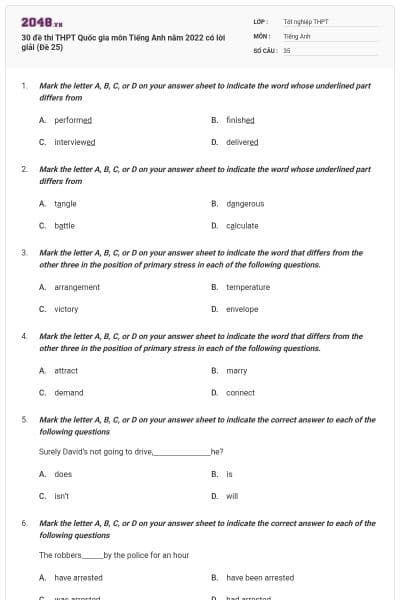
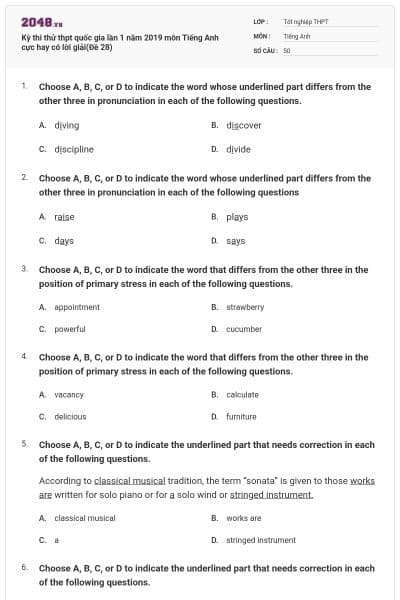
Choose A, B, C, or D to indicate the word whose underlined part differs from the other three in pronunciation in each of the following questions.
diving
discover
discipline
divide
Đáp án A
diving /ˈdaɪvɪŋ/
discover/dɪˈskʌvər/
discipline/ˈdɪsəplən/
divide /dɪˈvaɪd/
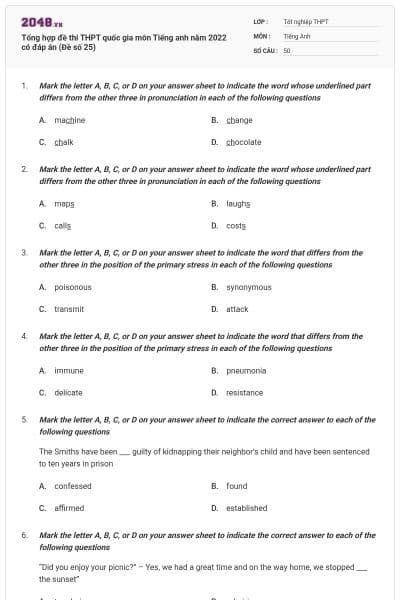
Choose A, B, C, or D to indicate the word whose underlined part differs from the other three in pronunciation in each of the following questions
raise
plays
days
says
Đáp án D
raise /reɪz/
plays /pleɪz/
days /deɪz/
says /sɛz/
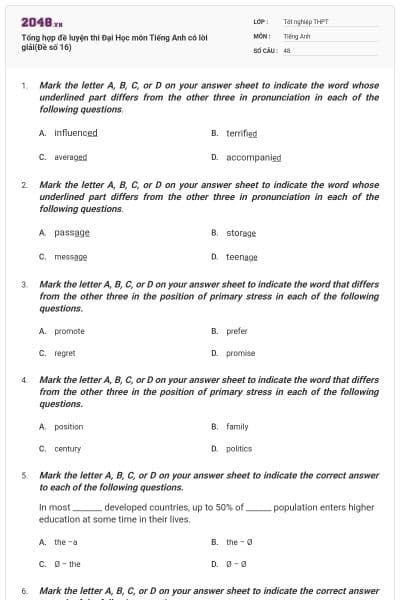
Choose A, B, C, or D to indicate the word that differs from the other three in the position of primary stress in each of the following questions.
appointment
strawberry
powerful
cucumber
Đáp án A
appointment /əˈpɔɪntmənt/
strawberry /ˈstrɔˌbɛri/
powerful /ˈpaʊərfəl/
cucumber /ˈkjukəmbər/
Choose A, B, C, or D to indicate the word that differs from the other three in the position of primary stress in each of the following questions.
vacancy
calculate
delicious
furniture
Đáp án C
vacancy /ˈveɪkənsi/
calculate /ˈkælkjəˌleɪt/
delicious /dɪˈlɪʃəs/
furniture /ˈfɜrnɪʧər/
Choose A, B, C, or D to indicate the underlined part that needs correction in each of the following questions.
According to classical musical tradition, the term “sonata” is given to those works are written for solo piano or for a solo wind or stringed instrument.
classical musical
works are
a
stringed instrument
Đáp án B
works are => works to be
Choose A, B, C, or D to indicate the underlined part that needs correction in each of the following questions.
Although assemblage has been a part of art for centuries, its appearance in the West as a serious art form is quite fairly recent.
has been
a part of
its appearance
quite fairly
Đáp án D
quite fairly => quite fair
Choose A, B, C, or D to indicate the underlined part that needs correction in each of the following questions.
If she can’t keep up payments she risks to lose her home, as thousands of families have done
keep up
to lose
as thousands
have done
Đáp án B
to lose => losing
Mark the letter A, B, C, or D on your answer sheet to indicate the correct answer to each of the following questions.
He will never forget the day ________ he met his wife
where
that
when
which
Đáp án C
Mark the letter A, B, C, or D on your answer sheet to indicate the correct answer to each of the following questions.
He often tells the children _______ when they play water sports
be careful
not be careless
to be careful
to be careful with
Đáp án C
Câu tường thuật dạng câu mệnh lệnh
Mark the letter A, B, C, or D on your answer sheet to indicate the correct answer to each of the following questions.
There will be _______ jobs for people because some robots will do the same jobs as people.
fewer
less
much
many
Đáp án A
Mark the letter A, B, C, or D on your answer sheet to indicate the correct answer to each of the following questions.
Ha Noi is cold this time ______. You need ______ warm clothes if you go there
of the year – to pack
of year – packing
of year – pack
of year – to pack
Đáp án: D
Giải thích:
Cụm từ:
this time of year: thời gian này trong năm
need to V: cần làm gì (chủ động)
need V-ing: cần được làm gì (bị động)
Kết hợp lại, chọn D.
Dịch: Hà Nội thời điểm này lạnh. Bạn cần mang theo quần áo ấm nếu đến đó.
Mark the letter A, B, C, or D on your answer sheet to indicate the correct answer to each of the following questions.
Despite his interest in art, he studied ________ engineering in college.
mechanistic
mechanical
mechanically
mechanism
Đáp án B
Mark the letter A, B, C, or D on your answer sheet to indicate the correct answer to each of the following questions.
________ what is the most important point of an issue will allow you to make a better decision.
Understanding
Understand
Understood
To understand
Đáp án A
Mark the letter A, B, C, or D on your answer sheet to indicate the correct answer to each of the following questions.
Shaking hands is the ________ way of greeting business counterparts in Europe
convenient
absolute
practical
customary
Đáp án D
Convenient: thoải mái
Absolute: hoàn toàn, tuyệt đối
Practical: thực hành, thực tế
Customary: phong tục
Mark the letter A, B, C, or D on your answer sheet to indicate the correct answer to each of the following questions.
As soon as you buy a car, it starts falling in ______.
price
value
cost
worth
Đáp án: B
Giải thích:
Fall in value: sụt giá
Dịch: Ngay sau khi bạn mua xe ô tô, nó bắt đầu sụt giá.
Mark the letter A, B, C, or D on your answer sheet to indicate the correct answer to each of the following questions.
Bill and Ted ______ each other straight away and became firm friends.
took after
held together
took to
let in
Đáp án C
Mark the letter A, B, C, or D on your answer sheet to indicate the correct answer to each of the following questions.
New ways have to be found to _______ of waste materials and poisonous gases so that we can have cleaner surroundings.
deal
remove
do
dispose
Đáp án D
Dispose of sb/sth: giải quyết vấn đề gì
Mark the letter A, B, C, or D on your answer sheet to indicate the correct answer to each of the following questions.
The goal is to make higher education available to everyone who is willing and capable ________ his financial situation.
with reference to
owing to
regardless of
in terms of
Đáp án C
A. ví dụ như
B. do, vì
C. bất kể
D. về mặt, xét về
Mark the letter A, B, C, or D on your answer sheet to indicate the correct answer to each of the following questions.
His parents object strongly _______ his playing too much computer games.
at
to
in
against
Đáp án B
Object to do sth: phản đối làm việc gì
Mark the letter A, B, C or D on your answer sheet to indicate the most suitable response to complete each of the following exchanges.
Two friends Peter and Linda are talking about pet.
- Peter: “Well, cats are very good at catching mice around the house.”
- Linda: “______.”
Nothing more to say
You can say that again
Yes, I hope so
No, dogs are very good, too
Đáp án B
A. Không còn gì để nói
B. Tôi đồng ý với bạn
C. Vâng, tôi hy vọng như vậy
D. Không, chó cũng rất tốt
Mark the letter A, B, C or D on your answer sheet to indicate the most suitable response to complete each of the following exchanges.
- "Guess what! I’ve just got invited to my teacher's house for dinner!"
- “ __________”
Oh, how nice
Really? I don't think so
Well done
What's that?
Đáp án A
A. Ồ, thật tuyệt
B. Thật sao? Tôi không nghĩ vậy
C. Làm tốt lắm
D. Cái gì thế?
Choose A, B, C, or D to indicate the word(s) CLOSEST in meaning to the underlined word(s) in the following questions.
The politician tried to arouse the crowd, but most of them were indifferent to his argument.
similar to
sympathetic to
uninterested in
deaf to
Đáp án D
A. Giống
B. Đồng cảm với
C. Không thích
D. Không muốn nghe
Choose A, B, C, or D to indicate the word(s) CLOSEST in meaning to the underlined word(s) in the following questions.
I missed two assignments. I must make them up by the end of this week.
hand them in
do them twice
compensate for them
go over them
Đáp án C
Choose A, B, C, or D to indicate the word(s) OPPOSITE in meaning to the underlined word(s) in each of the following questions.
He was one of the most outstanding performers at the live show last night.
easy- looking
humble
well- known
impressive
Đáp án B
A. Ưa nhìn
B. Khiêm tốn, bình thường
C. Nổi tiếng
D. Ấn tượng
Choose A, B, C, or D to indicate the word(s) OPPOSITE in meaning to the underlined word(s) in each of the following questions.
Advanced students need to be aware of the importance of collocation.
of high level
of great importance
of low level
reputation
Đáp án C
A. ở trình độ cao
B. rất quan trọng
C. ở trình độ thấp
D. sự nổi danh, danh tiếng
Mark the letter A, B, C, or D on your answer sheet to indicate the sentence that is closest in meaning to each of the following questions.
He behaved so recklessly, so he would be disqualified from keeping his last job
If he hadn’t behaved so recklessly, he hadn’t quit his last job
Without his reckless behavior, he would have lost his last job
Had he not behaved so recklessly, he wouldn’t have been fired from his last job
He didn’t quit his job because he knew that he had behaved so recklessly
Đáp án C
Anh ta cư xử rất liều lĩnh, vì vậy anh ta sẽ bị loại khỏi việc giữ công việc cuối cùng của mình
A. Sai cấu trúc câu điều kiện
B. Nếu không có hành vi liều lĩnh của mình, anh sẽ mất công việc cuối cùng của mình
C. Nếu anh ta không cư xử quá liều lĩnh, anh ta sẽ không bị sa thải khỏi công việc cuối cùng của mình
D. Anh ấy đã không bỏ công việc của mình bởi vì anh ấy biết rằng anh ấy đã cư xử rất liều lĩnh
Mark the letter A, B, C, or D on your answer sheet to indicate the sentence that is closest in meaning to each of the following questions.
I can’t stand his talking foolishly when everybody talks about something in a serious way.
Everybody talks seriously when he talks foolishly
I don’t mind his talking foolishly when everybody talks seriously
I can’t understand what he talks when people talk foolishly
I hate him talking foolishly when people talk seriously
Đáp án D
Tôi không thể chịu được cách nói chuyện dại dột của anh ta khi mọi người nói về điều gì đó nghiêm túc.
A. Mọi người đều nói nghiêm túc khi anh ta nói một cách dại dột
B. Tôi không ngại nói chuyện ngu ngốc khi mọi người nói nghiêm túc
C. Tôi không thể hiểu những gì anh ấy nói khi mọi người nói chuyện ngu ngốc
D. Tôi ghét anh ta nói chuyện ngu ngốc khi mọi người nói nghiêm túc
Mark the letter A, B, C, or D on your answer sheet to indicate the sentence that is closest in meaning to each of the following questions.
“If I were you, I wouldn’t read the job advertisement and position description carelessly.” Helen said.
Helen recommended that I take no notice of the job advertisement and position description
Helen advised me on reading the job advertisement and position description carelessly.
Helen advised me against reading the job advertisement and position description carelessly
I was blamed for not reading the job advertisement and position description carefully by Helen.
Đáp án C
“Nếu tôi là bạn, tôi sẽ không đọc quảng cáo việc làm và mô tả vị trí một cách bất bất cẩn.” Helen nói.
A. Helen khuyên tôi không chú ý đến quảng cáo việc làm và mô tả vị trí
B. Helen khuyên tôi đọc quảng cáo việc làm và mô tả vị trí một cách bất cẩn.
C. Helen khuyên tôi không nên đọc quảng cáo việc làm và mô tả vị trí một cách bất cẩn
D. Tôi bị đổ lỗi vì không đọc quảng cáo việc làm và mô tả vị trí cẩn thận bởi Helen
Mark the letter A, B, C, or D on your answer sheet to indicate the sentence that best combines each pair of sentences in the following questions.
The holiday was so expensive. We could only afford five days.
It was such an expensive holiday that we could only afford five days.
The holiday was dirt cheap, so we could afford more than five days.
So expensive was a five-day holiday that we could hardly afford it.
A five-day holiday wasn’t cheap, so we couldn’t afford it.
Đáp án A
Mark the letter A, B, C, or D on your answer sheet to indicate the sentence that best combines each pair of sentences in the following questions.
The basketball team knew they lost the match. They soon started to blame each other.
As soon as they blamed each other, the basketball team knew they lost the match.
No sooner had the basketball team started to blame each other than they knew they lost the match.
Not only did the basketball team lose the match but they blamed each other as well.
Hardly had the basketball team known they lost the match when they started to blame each other
Đáp án D
Read the following passage and choose A, B, C, or D to indicate the correct word or phrase that best fits each of the following blanks. Fill in the appropriate word in question 31
The growth of population has its problems as we shall see. As there are more and more mouths (31)_____, there comes a great strain (32)_____ the resources of a country; this is real in the case of developing countries with the result they are unable to push ahead economically. As food is not sufficient there is chronic malnutrition in these countries especially in women and children resulting in weaker population (33)_____ would only economically be a drain on the country as their productive years will be short. As health and education are the State's (34)_____, they affect the country's finances. So in developing countries health and illiteracy continue to be the problem. The unwieldy growth of population leads to the problem of housing and sanitation. In many countries the slums are a (35)_____ to the eyes. Slums grow round big cities and are found with all the drawbacks. These are the areas of disease, filth and crime.
to be fed
to feed
for feeding
fed
Đáp án B
Read the following passage and choose A, B, C, or D to indicate the correct word or phrase that best fits each of the following blanks. Fill in the appropriate word in question 31
The growth of population has its problems as we shall see. As there are more and more mouths (31)_____, there comes a great strain (32)_____ the resources of a country; this is real in the case of developing countries with the result they are unable to push ahead economically. As food is not sufficient there is chronic malnutrition in these countries especially in women and children resulting in weaker population (33)_____ would only economically be a drain on the country as their productive years will be short. As health and education are the State's (34)_____, they affect the country's finances. So in developing countries health and illiteracy continue to be the problem. The unwieldy growth of population leads to the problem of housing and sanitation. In many countries the slums are a (35)_____ to the eyes. Slums grow round big cities and are found with all the drawbacks. These are the areas of disease, filth and crime.
to
for
down
to
Đáp án D
Read the following passage and choose A, B, C, or D to indicate the correct word or phrase that best fits each of the following blanks. Fill in the appropriate word in question 33
The growth of population has its problems as we shall see. As there are more and more mouths (31)_____, there comes a great strain (32)_____ the resources of a country; this is real in the case of developing countries with the result they are unable to push ahead economically. As food is not sufficient there is chronic malnutrition in these countries especially in women and children resulting in weaker population (33)_____ would only economically be a drain on the country as their productive years will be short. As health and education are the State's (34)_____, they affect the country's finances. So in developing countries health and illiteracy continue to be the problem. The unwieldy growth of population leads to the problem of housing and sanitation. In many countries the slums are a (35)_____ to the eyes. Slums grow round big cities and are found with all the drawbacks. These are the areas of disease, filth and crime.
which
what
who
those
Đáp án A
Read the following passage and choose A, B, C, or D to indicate the correct word or phrase that best fits each of the following blanks. Fill in the appropriate word in question 34
The growth of population has its problems as we shall see. As there are more and more mouths (31)_____, there comes a great strain (32)_____ the resources of a country; this is real in the case of developing countries with the result they are unable to push ahead economically. As food is not sufficient there is chronic malnutrition in these countries especially in women and children resulting in weaker population (33)_____ would only economically be a drain on the country as their productive years will be short. As health and education are the State's (34)_____, they affect the country's finances. So in developing countries health and illiteracy continue to be the problem. The unwieldy growth of population leads to the problem of housing and sanitation. In many countries the slums are a (35)_____ to the eyes. Slums grow round big cities and are found with all the drawbacks. These are the areas of disease, filth and crime.
problem
job
affair
work
Đáp án A
Read the following passage and choose A, B, C, or D to indicate the correct word or phrase that best fits each of the following blanks. Fill in the appropriate word in question 35
The growth of population has its problems as we shall see. As there are more and more mouths (31)_____, there comes a great strain (32)_____ the resources of a country; this is real in the case of developing countries with the result they are unable to push ahead economically. As food is not sufficient there is chronic malnutrition in these countries especially in women and children resulting in weaker population (33)_____ would only economically be a drain on the country as their productive years will be short. As health and education are the State's (34)_____, they affect the country's finances. So in developing countries health and illiteracy continue to be the problem. The unwieldy growth of population leads to the problem of housing and sanitation. In many countries the slums are a (35)_____ to the eyes. Slums grow round big cities and are found with all the drawbacks. These are the areas of disease, filth and crime.
pain
sore
hurt
wound
Đáp án B
A sore to the eyes: không hay để nhìn vào
Read the following passage and mark the letter A, B, C, or D on your answer sheet to indicate the correct answer to each of the questions from 36 to 42.
They call Jamaica the "Island in the sun" and that is my memory of it. Of sunshine, warmth and abundant fruit that was growing everywhere, and of love. There were two sisters ahead of me in the family, and though of course I didn't know it, there was an exciting talk of emigration, possibly to Canada but more usually to England, the land of opportunity. I guess that plans were already being made when I was born, for a year or so later my Dad left for London. Two years after that my mum went as well and my sisters and I were left in the care of my grandmother.
Emigrating to better yourself was a dream for most Jamaicans, a dream many were determined to fulfill. Families were close and grandmothers were an important part of the family. So, when the mass emigrations began, it seemed perfectly right and natural for them to take over the running of families left behind.
Grandmothers are often strict, but usually also spoil you. She ran the family like a military operation: each of us, no matter how young, had our tasks. Every morning, before we went to school, we all had to take a bucket appropriate to our size and run a relay from the communal tap to the barrels until they are full. My sisters had to sweep the yard before they went to school. My grandmother would give orders to the eldest and these were passed down- as I got older I found this particularly annoying! But I can tell you, no one avoided their duties.
My Dad came over from England to see how we were getting on . He talked to us about the new country, about snow, about the huge city, and we all wanted to know more, to see what it was like. I didn't know it at that time., but he had come to prepare us for the move to England. Six months later my grandmother told me that I was going to join my parents and that she, too, was emigrating.
London was strange and disappointing. There was no gold on the pavements, as the stories in Jaimaica had indicated. The roads were busy, the buildings were grey and dull, with many tall, high-rise blocks. It was totally unlike Jamaica, the houses all small and packed close together. In my grandmother's house I had a big bedroom, here I had to share.
Then came the biggest shock: snow. While flakes came out of the sky and Dad smiled, pointed and said: "That's snow!" I rushed outside, looked up and opened my mouth to let the flakes drop in. The snow settled on my tongue and it was so cold that I cried. My toes lost all feeling. As my shoes and socks got wet and frozen, there came an excruciating pain and I cried with the intensity of it. I didn't know what was happening to me.
The writer says that when he was very young ________.
he was upset because his parents left
he was very keen to go to England
his parents had decided to leave
his parents changed their plans
Đáp án C
Nhà văn nói rằng khi ông còn rất trẻ ________.
There were two sisters ahead of me inthe family, and though of course I didn't know it, there was an exciting talk of emigration, possibly to Canada but more usually to England, the land of opportunity. I guess that plans werealready being made when I was born,
A. ông ấy rất buồn vì cha mẹ anh ấy đã bỏ đi
B. ông ấy rất muốn đi Anh
C. cha mẹ ông đã quyết định rời đi
D. cha mẹ của ông đã thay đổi kế hoạch của họ
Read the following passage and mark the letter A, B, C, or D on your answer sheet to indicate the correct answer to each of the questions from 36 to 42.
They call Jamaica the "Island in the sun" and that is my memory of it. Of sunshine, warmth and abundant fruit that was growing everywhere, and of love. There were two sisters ahead of me in the family, and though of course I didn't know it, there was an exciting talk of emigration, possibly to Canada but more usually to England, the land of opportunity. I guess that plans were already being made when I was born, for a year or so later my Dad left for London. Two years after that my mum went as well and my sisters and I were left in the care of my grandmother.
Emigrating to better yourself was a dream for most Jamaicans, a dream many were determined to fulfill. Families were close and grandmothers were an important part of the family. So, when the mass emigrations began, it seemed perfectly right and natural for them to take over the running of families left behind.
Grandmothers are often strict, but usually also spoil you. She ran the family like a military operation: each of us, no matter how young, had our tasks. Every morning, before we went to school, we all had to take a bucket appropriate to our size and run a relay from the communal tap to the barrels until they are full. My sisters had to sweep the yard before they went to school. My grandmother would give orders to the eldest and these were passed down- as I got older I found this particularly annoying! But I can tell you, no one avoided their duties.
My Dad came over from England to see how we were getting on . He talked to us about the new country, about snow, about the huge city, and we all wanted to know more, to see what it was like. I didn't know it at that time., but he had come to prepare us for the move to England. Six months later my grandmother told me that I was going to join my parents and that she, too, was emigrating.
London was strange and disappointing. There was no gold on the pavements, as the stories in Jaimaica had indicated. The roads were busy, the buildings were grey and dull, with many tall, high-rise blocks. It was totally unlike Jamaica, the houses all small and packed close together. In my grandmother's house I had a big bedroom, here I had to share.
Then came the biggest shock: snow. While flakes came out of the sky and Dad smiled, pointed and said: "That's snow!" I rushed outside, looked up and opened my mouth to let the flakes drop in. The snow settled on my tongue and it was so cold that I cried. My toes lost all feeling. As my shoes and socks got wet and frozen, there came an excruciating pain and I cried with the intensity of it. I didn't know what was happening to me.
According to the writer, many people from Jamaica at that time ________.
wanted to be free from responsibility
wanted to improve their standard of living
had ambitions that were unrealistic
dislike the country they came from
Đáp án D
Nhiều người Jamaica vào thời điểm đó:
Emigrating to better yourself was a dream for most Jamaicans, a dream many were determined to fulfill.
A. muốn được tự do khỏi trách nhiệm
B. muốn cải thiện mức sống của họ
C. có tham vọng không thực tế
D. không thích đất nước họ sinh ra
Read the following passage and mark the letter A, B, C, or D on your answer sheet to indicate the correct answer to each of the questions from 36 to 42.
They call Jamaica the "Island in the sun" and that is my memory of it. Of sunshine, warmth and abundant fruit that was growing everywhere, and of love. There were two sisters ahead of me in the family, and though of course I didn't know it, there was an exciting talk of emigration, possibly to Canada but more usually to England, the land of opportunity. I guess that plans were already being made when I was born, for a year or so later my Dad left for London. Two years after that my mum went as well and my sisters and I were left in the care of my grandmother.
Emigrating to better yourself was a dream for most Jamaicans, a dream many were determined to fulfill. Families were close and grandmothers were an important part of the family. So, when the mass emigrations began, it seemed perfectly right and natural for them to take over the running of families left behind.
Grandmothers are often strict, but usually also spoil you. She ran the family like a military operation: each of us, no matter how young, had our tasks. Every morning, before we went to school, we all had to take a bucket appropriate to our size and run a relay from the communal tap to the barrels until they are full. My sisters had to sweep the yard before they went to school. My grandmother would give orders to the eldest and these were passed down- as I got older I found this particularly annoying! But I can tell you, no one avoided their duties.
My Dad came over from England to see how we were getting on . He talked to us about the new country, about snow, about the huge city, and we all wanted to know more, to see what it was like. I didn't know it at that time., but he had come to prepare us for the move to England. Six months later my grandmother told me that I was going to join my parents and that she, too, was emigrating.
London was strange and disappointing. There was no gold on the pavements, as the stories in Jaimaica had indicated. The roads were busy, the buildings were grey and dull, with many tall, high-rise blocks. It was totally unlike Jamaica, the houses all small and packed close together. In my grandmother's house I had a big bedroom, here I had to share.
Then came the biggest shock: snow. While flakes came out of the sky and Dad smiled, pointed and said: "That's snow!" I rushed outside, looked up and opened my mouth to let the flakes drop in. The snow settled on my tongue and it was so cold that I cried. My toes lost all feeling. As my shoes and socks got wet and frozen, there came an excruciating pain and I cried with the intensity of it. I didn't know what was happening to me.
What does "this" in the third paragraph refer to
being told what to do by his sisters
having to sweep the yard before school
having to do duties he found difficult
being given orders by his grandmother
Đáp án A
"This" trong đoạn thứ ba là gì?
My grandmother would give orders to the eldest and these were passed down- as I got older I found this particularly annoying!
A. được bảo làm gì bởi các chị em của mình
B. phải quét sân trước khi đi học
C. phải làm nhiệm vụ mà anh thấy khó khăn
D. nhận được lệnh của bà ngoại
Read the following passage and mark the letter A, B, C, or D on your answer sheet to indicate the correct answer to each of the questions from 36 to 42.
They call Jamaica the "Island in the sun" and that is my memory of it. Of sunshine, warmth and abundant fruit that was growing everywhere, and of love. There were two sisters ahead of me in the family, and though of course I didn't know it, there was an exciting talk of emigration, possibly to Canada but more usually to England, the land of opportunity. I guess that plans were already being made when I was born, for a year or so later my Dad left for London. Two years after that my mum went as well and my sisters and I were left in the care of my grandmother.
Emigrating to better yourself was a dream for most Jamaicans, a dream many were determined to fulfill. Families were close and grandmothers were an important part of the family. So, when the mass emigrations began, it seemed perfectly right and natural for them to take over the running of families left behind.
Grandmothers are often strict, but usually also spoil you. She ran the family like a military operation: each of us, no matter how young, had our tasks. Every morning, before we went to school, we all had to take a bucket appropriate to our size and run a relay from the communal tap to the barrels until they are full. My sisters had to sweep the yard before they went to school. My grandmother would give orders to the eldest and these were passed down- as I got older I found this particularly annoying! But I can tell you, no one avoided their duties.
My Dad came over from England to see how we were getting on . He talked to us about the new country, about snow, about the huge city, and we all wanted to know more, to see what it was like. I didn't know it at that time., but he had come to prepare us for the move to England. Six months later my grandmother told me that I was going to join my parents and that she, too, was emigrating.
London was strange and disappointing. There was no gold on the pavements, as the stories in Jaimaica had indicated. The roads were busy, the buildings were grey and dull, with many tall, high-rise blocks. It was totally unlike Jamaica, the houses all small and packed close together. In my grandmother's house I had a big bedroom, here I had to share.
Then came the biggest shock: snow. While flakes came out of the sky and Dad smiled, pointed and said: "That's snow!" I rushed outside, looked up and opened my mouth to let the flakes drop in. The snow settled on my tongue and it was so cold that I cried. My toes lost all feeling. As my shoes and socks got wet and frozen, there came an excruciating pain and I cried with the intensity of it. I didn't know what was happening to me.
What happened when the writer's father came?
His father didn't tell him why he had come
He didn't know how to react to his father
His father told him things that were untrue
He felt eager about what his father told him
Đáp án A
Điều gì đã xảy ra khi cha của nhà văn đến?
A. Cha ông không nói cho ông biết tại sao ông lại đến
B. Ông ta không biết phản ứng với cha mình như thế nào
C. Cha ông nói với ông những điều không đúng sự thật
D. Ông cảm thấy háo hức về những gì cha ông đã nói với ông
Read the following passage and mark the letter A, B, C, or D on your answer sheet to indicate the correct answer to each of the questions from 36 to 42.
They call Jamaica the "Island in the sun" and that is my memory of it. Of sunshine, warmth and abundant fruit that was growing everywhere, and of love. There were two sisters ahead of me in the family, and though of course I didn't know it, there was an exciting talk of emigration, possibly to Canada but more usually to England, the land of opportunity. I guess that plans were already being made when I was born, for a year or so later my Dad left for London. Two years after that my mum went as well and my sisters and I were left in the care of my grandmother.
Emigrating to better yourself was a dream for most Jamaicans, a dream many were determined to fulfill. Families were close and grandmothers were an important part of the family. So, when the mass emigrations began, it seemed perfectly right and natural for them to take over the running of families left behind.
Grandmothers are often strict, but usually also spoil you. She ran the family like a military operation: each of us, no matter how young, had our tasks. Every morning, before we went to school, we all had to take a bucket appropriate to our size and run a relay from the communal tap to the barrels until they are full. My sisters had to sweep the yard before they went to school. My grandmother would give orders to the eldest and these were passed down- as I got older I found this particularly annoying! But I can tell you, no one avoided their duties.
My Dad came over from England to see how we were getting on . He talked to us about the new country, about snow, about the huge city, and we all wanted to know more, to see what it was like. I didn't know it at that time., but he had come to prepare us for the move to England. Six months later my grandmother told me that I was going to join my parents and that she, too, was emigrating.
London was strange and disappointing. There was no gold on the pavements, as the stories in Jaimaica had indicated. The roads were busy, the buildings were grey and dull, with many tall, high-rise blocks. It was totally unlike Jamaica, the houses all small and packed close together. In my grandmother's house I had a big bedroom, here I had to share.
Then came the biggest shock: snow. While flakes came out of the sky and Dad smiled, pointed and said: "That's snow!" I rushed outside, looked up and opened my mouth to let the flakes drop in. The snow settled on my tongue and it was so cold that I cried. My toes lost all feeling. As my shoes and socks got wet and frozen, there came an excruciating pain and I cried with the intensity of it. I didn't know what was happening to me.
When the writer first went to London, he was disappointed because ________.
it was smaller than he expected
he had been given a false impression of it
he had to spend a lot of time on his own
his new surroundings frightened him
Đáp án B
Khi nhà văn đầu tiên đến London, ông đã thất vọng vì:
A. nó nhỏ hơn ông mong đợi
B. ông ta đã bị ấn tượng sai về nó
C. ông ta phải dành nhiều thời gian cho riêng mình
D. môi trường xung quanh mới khiến ông sợ hãi
Read the following passage and mark the letter A, B, C, or D on your answer sheet to indicate the correct answer to each of the questions from 36 to 42.
They call Jamaica the "Island in the sun" and that is my memory of it. Of sunshine, warmth and abundant fruit that was growing everywhere, and of love. There were two sisters ahead of me in the family, and though of course I didn't know it, there was an exciting talk of emigration, possibly to Canada but more usually to England, the land of opportunity. I guess that plans were already being made when I was born, for a year or so later my Dad left for London. Two years after that my mum went as well and my sisters and I were left in the care of my grandmother.
Emigrating to better yourself was a dream for most Jamaicans, a dream many were determined to fulfill. Families were close and grandmothers were an important part of the family. So, when the mass emigrations began, it seemed perfectly right and natural for them to take over the running of families left behind.
Grandmothers are often strict, but usually also spoil you. She ran the family like a military operation: each of us, no matter how young, had our tasks. Every morning, before we went to school, we all had to take a bucket appropriate to our size and run a relay from the communal tap to the barrels until they are full. My sisters had to sweep the yard before they went to school. My grandmother would give orders to the eldest and these were passed down- as I got older I found this particularly annoying! But I can tell you, no one avoided their duties.
My Dad came over from England to see how we were getting on . He talked to us about the new country, about snow, about the huge city, and we all wanted to know more, to see what it was like. I didn't know it at that time., but he had come to prepare us for the move to England. Six months later my grandmother told me that I was going to join my parents and that she, too, was emigrating.
London was strange and disappointing. There was no gold on the pavements, as the stories in Jaimaica had indicated. The roads were busy, the buildings were grey and dull, with many tall, high-rise blocks. It was totally unlike Jamaica, the houses all small and packed close together. In my grandmother's house I had a big bedroom, here I had to share.
Then came the biggest shock: snow. While flakes came out of the sky and Dad smiled, pointed and said: "That's snow!" I rushed outside, looked up and opened my mouth to let the flakes drop in. The snow settled on my tongue and it was so cold that I cried. My toes lost all feeling. As my shoes and socks got wet and frozen, there came an excruciating pain and I cried with the intensity of it. I didn't know what was happening to me.
The word "excruciating" in the last paragraph means ________.
painful
rather painful
extremely painful
painless
Đáp án C
Từ "excruciating" trong đoạn cuối có nghĩa là:
A. đau
B. khá đau đớn
C. vô cùng đau đớn
D. không đau
Read the following passage and mark the letter A, B, C, or D on your answer sheet to indicate the correct answer to each of the questions from 36 to 42.
They call Jamaica the "Island in the sun" and that is my memory of it. Of sunshine, warmth and abundant fruit that was growing everywhere, and of love. There were two sisters ahead of me in the family, and though of course I didn't know it, there was an exciting talk of emigration, possibly to Canada but more usually to England, the land of opportunity. I guess that plans were already being made when I was born, for a year or so later my Dad left for London. Two years after that my mum went as well and my sisters and I were left in the care of my grandmother.
Emigrating to better yourself was a dream for most Jamaicans, a dream many were determined to fulfill. Families were close and grandmothers were an important part of the family. So, when the mass emigrations began, it seemed perfectly right and natural for them to take over the running of families left behind.
Grandmothers are often strict, but usually also spoil you. She ran the family like a military operation: each of us, no matter how young, had our tasks. Every morning, before we went to school, we all had to take a bucket appropriate to our size and run a relay from the communal tap to the barrels until they are full. My sisters had to sweep the yard before they went to school. My grandmother would give orders to the eldest and these were passed down- as I got older I found this particularly annoying! But I can tell you, no one avoided their duties.
My Dad came over from England to see how we were getting on . He talked to us about the new country, about snow, about the huge city, and we all wanted to know more, to see what it was like. I didn't know it at that time., but he had come to prepare us for the move to England. Six months later my grandmother told me that I was going to join my parents and that she, too, was emigrating.
London was strange and disappointing. There was no gold on the pavements, as the stories in Jaimaica had indicated. The roads were busy, the buildings were grey and dull, with many tall, high-rise blocks. It was totally unlike Jamaica, the houses all small and packed close together. In my grandmother's house I had a big bedroom, here I had to share.
Then came the biggest shock: snow. While flakes came out of the sky and Dad smiled, pointed and said: "That's snow!" I rushed outside, looked up and opened my mouth to let the flakes drop in. The snow settled on my tongue and it was so cold that I cried. My toes lost all feeling. As my shoes and socks got wet and frozen, there came an excruciating pain and I cried with the intensity of it. I didn't know what was happening to me.
Which of the following would be the best title for this passage?
From Sun to Snow
A strange childhood
Hard times
Too many changes
Đáp án C
Điều nào sau đây sẽ là tiêu đề tốt nhất cho đoạn văn này?
A. Từ mặt trời tới tuyết
B. Một thời thơ ấu kì lạ
C. Thời gian khó khăn
D. Quá nhiều thay đổi
Read the following passage and mark the letter A, B, C or D on your answer sheet to choose the best answer for each of the question from 43- 50
Staggering tasks confronted the people of the United States, North and South when the Civil War ended. About a million and a half soldiers from both sides had to be demobilized, readjusted to civilian life, and reabsorbed by the devastated economy.
Civil government also had to be put back on a peacetime basis and interference from the military had to be stopped. The desperate plight of the South has eclipsed the fact that reconstruction had to be undertaken also in the North, though less spectacularly. Industries had to adjust to peacetime conditions; factories had to be retooled for civilian needs.
Financial problems loomed large in both the North and the South. The national debt had shot up from a modest $65 million in 1861, the year the war started, to nearly $3 billion in 1865, the year the war ended. This was a colossal sum for those days but one that a prudent government could pay. At the same time, war taxes had to be reduced to less burdensome levels.
Physical devastation caused by invading armies, chiefly in the South and border states, had to be repaired. This Herculean task was ultimately completed, but with discouraging slowness.
Other important questions needed answering. What would be the future of the four million Black people who were freed from slavery? On what basis were the Southern states to be brought back into the Union?
What of the Southern leaders, all of whom were liable to charges of treason? One of these leaders, Jefferson Davis, president of the Southern Confederacy, was the subject of an insulting popular Northern song, “Hang Jeff Davis from a Sour Apple Tree,” and even children sang it. Davis was temporarily chained in his prison cell during the early days of his two-year imprisonment. But he and the other Southern leaders were finally released, partly because it was unlikely that a jury from Virginia, a Southern Confederate state, would convict them. All the leaders were finally pardoned by President Johnson in 1868 in an effort to help reconstruction efforts proceed with as little bitterness as possible.
What does the passage mainly discuss?
Wartime expenditures
Problems facing the United States after the war
Methods of repairing the damage caused by the war
The results of government efforts to revive the economy
Đáp án B
Đoạn văn chủ yếu thảo luận là gì?
A. Chi tiêu thời chiến
B. Các vấn đề phải đối mặt với Hoa Kỳ sau chiến tranh
C. Phương pháp sửa chữa thiệt hại do chiến tranh gây ra
D. Kết quả của các nỗ lực của chính phủ để làm sống lại nền kinh tế
Read the following passage and mark the letter A, B, C or D on your answer sheet to choose the best answer for each of the question from 43- 50
Staggering tasks confronted the people of the United States, North and South when the Civil War ended. About a million and a half soldiers from both sides had to be demobilized, readjusted to civilian life, and reabsorbed by the devastated economy.
Civil government also had to be put back on a peacetime basis and interference from the military had to be stopped. The desperate plight of the South has eclipsed the fact that reconstruction had to be undertaken also in the North, though less spectacularly. Industries had to adjust to peacetime conditions; factories had to be retooled for civilian needs.
Financial problems loomed large in both the North and the South. The national debt had shot up from a modest $65 million in 1861, the year the war started, to nearly $3 billion in 1865, the year the war ended. This was a colossal sum for those days but one that a prudent government could pay. At the same time, war taxes had to be reduced to less burdensome levels.
Physical devastation caused by invading armies, chiefly in the South and border states, had to be repaired. This Herculean task was ultimately completed, but with discouraging slowness.
Other important questions needed answering. What would be the future of the four million Black people who were freed from slavery? On what basis were the Southern states to be brought back into the Union?
What of the Southern leaders, all of whom were liable to charges of treason? One of these leaders, Jefferson Davis, president of the Southern Confederacy, was the subject of an insulting popular Northern song, “Hang Jeff Davis from a Sour Apple Tree,” and even children sang it. Davis was temporarily chained in his prison cell during the early days of his two-year imprisonment. But he and the other Southern leaders were finally released, partly because it was unlikely that a jury from Virginia, a Southern Confederate state, would convict them. All the leaders were finally pardoned by President Johnson in 1868 in an effort to help reconstruction efforts proceed with as little bitterness as possible.
The word “devastated” in line 3 is closest in meaning to ______.
developing
ruined
complicated
fragile
Đáp án B
Từ "evastated" trong dòng 3 gần nghĩa với:
A. đang phát triển
B. bị hủy hoại
C. phức tạp
D. mong manh
Read the following passage and mark the letter A, B, C or D on your answer sheet to choose the best answer for each of the question from 43- 50
Staggering tasks confronted the people of the United States, North and South when the Civil War ended. About a million and a half soldiers from both sides had to be demobilized, readjusted to civilian life, and reabsorbed by the devastated economy.
Civil government also had to be put back on a peacetime basis and interference from the military had to be stopped. The desperate plight of the South has eclipsed the fact that reconstruction had to be undertaken also in the North, though less spectacularly. Industries had to adjust to peacetime conditions; factories had to be retooled for civilian needs.
Financial problems loomed large in both the North and the South. The national debt had shot up from a modest $65 million in 1861, the year the war started, to nearly $3 billion in 1865, the year the war ended. This was a colossal sum for those days but one that a prudent government could pay. At the same time, war taxes had to be reduced to less burdensome levels.
Physical devastation caused by invading armies, chiefly in the South and border states, had to be repaired. This Herculean task was ultimately completed, but with discouraging slowness.
Other important questions needed answering. What would be the future of the four million Black people who were freed from slavery? On what basis were the Southern states to be brought back into the Union?
What of the Southern leaders, all of whom were liable to charges of treason? One of these leaders, Jefferson Davis, president of the Southern Confederacy, was the subject of an insulting popular Northern song, “Hang Jeff Davis from a Sour Apple Tree,” and even children sang it. Davis was temporarily chained in his prison cell during the early days of his two-year imprisonment. But he and the other Southern leaders were finally released, partly because it was unlikely that a jury from Virginia, a Southern Confederate state, would convict them. All the leaders were finally pardoned by President Johnson in 1868 in an effort to help reconstruction efforts proceed with as little bitterness as possible.
According to the passage, which of the following statements about the damage in the South is correct?
It was worse than in the North
The cost was less than expected
It was centered in the border states
It was remedied rather quickly
Đáp án D
Câu nào sau đây về thiệt hại trong miền Nam là chính xác?
A. Tệ hơn ở miền Bắc
B. Chi phí thấp hơn dự kiến
C. Nó tập trung ở các bang biên giới
D. Nó đã được khắc phục khá nhanh chóng
Read the following passage and mark the letter A, B, C or D on your answer sheet to choose the best answer for each of the question from 43- 50
Staggering tasks confronted the people of the United States, North and South when the Civil War ended. About a million and a half soldiers from both sides had to be demobilized, readjusted to civilian life, and reabsorbed by the devastated economy.
Civil government also had to be put back on a peacetime basis and interference from the military had to be stopped. The desperate plight of the South has eclipsed the fact that reconstruction had to be undertaken also in the North, though less spectacularly. Industries had to adjust to peacetime conditions; factories had to be retooled for civilian needs.
Financial problems loomed large in both the North and the South. The national debt had shot up from a modest $65 million in 1861, the year the war started, to nearly $3 billion in 1865, the year the war ended. This was a colossal sum for those days but one that a prudent government could pay. At the same time, war taxes had to be reduced to less burdensome levels.
Physical devastation caused by invading armies, chiefly in the South and border states, had to be repaired. This Herculean task was ultimately completed, but with discouraging slowness.
Other important questions needed answering. What would be the future of the four million Black people who were freed from slavery? On what basis were the Southern states to be brought back into the Union?
What of the Southern leaders, all of whom were liable to charges of treason? One of these leaders, Jefferson Davis, president of the Southern Confederacy, was the subject of an insulting popular Northern song, “Hang Jeff Davis from a Sour Apple Tree,” and even children sang it. Davis was temporarily chained in his prison cell during the early days of his two-year imprisonment. But he and the other Southern leaders were finally released, partly because it was unlikely that a jury from Virginia, a Southern Confederate state, would convict them. All the leaders were finally pardoned by President Johnson in 1868 in an effort to help reconstruction efforts proceed with as little bitterness as possible.
The passage refers to all of the following as necessary steps following the Civil War EXCEPT______
helping soldiers readjust
restructuring industry
returning government to normal
increasing taxes
Đáp án D
Đoạn văn đề cập đến tất cả những điều sau đây khi các bước cần thiết sau Chiến tranh trừ:
A. giúp người lính trở về cuộc sống bình thường
B. tái cơ cấu công nghiệp
C. trả lại chính phủ cho bình thường
D. tăng thuế
Read the following passage and mark the letter A, B, C or D on your answer sheet to choose the best answer for each of the question from 43- 50
Staggering tasks confronted the people of the United States, North and South when the Civil War ended. About a million and a half soldiers from both sides had to be demobilized, readjusted to civilian life, and reabsorbed by the devastated economy.
Civil government also had to be put back on a peacetime basis and interference from the military had to be stopped. The desperate plight of the South has eclipsed the fact that reconstruction had to be undertaken also in the North, though less spectacularly. Industries had to adjust to peacetime conditions; factories had to be retooled for civilian needs.
Financial problems loomed large in both the North and the South. The national debt had shot up from a modest $65 million in 1861, the year the war started, to nearly $3 billion in 1865, the year the war ended. This was a colossal sum for those days but one that a prudent government could pay. At the same time, war taxes had to be reduced to less burdensome levels.
Physical devastation caused by invading armies, chiefly in the South and border states, had to be repaired. This Herculean task was ultimately completed, but with discouraging slowness.
Other important questions needed answering. What would be the future of the four million Black people who were freed from slavery? On what basis were the Southern states to be brought back into the Union?
What of the Southern leaders, all of whom were liable to charges of treason? One of these leaders, Jefferson Davis, president of the Southern Confederacy, was the subject of an insulting popular Northern song, “Hang Jeff Davis from a Sour Apple Tree,” and even children sang it. Davis was temporarily chained in his prison cell during the early days of his two-year imprisonment. But he and the other Southern leaders were finally released, partly because it was unlikely that a jury from Virginia, a Southern Confederate state, would convict them. All the leaders were finally pardoned by President Johnson in 1868 in an effort to help reconstruction efforts proceed with as little bitterness as possible.
Why does the author mention a popular song?
To give an example of a Northern attitude towards the South
To illustrate the Northern love of music
To emphasize the cultural differences between the North and the South
To compare the Northern and Southern presidents
Đáp án A
Tại sao tác giả đề cập đến một bài hát nổi tiếng?
A. Đưa ra một ví dụ về thái độ phía Bắc đối với miền Nam
B. Để minh họa cho tình yêu âm nhạc miền Bắc
C. Để nhấn mạnh sự khác biệt văn hóa giữa miền Bắc và miền Nam
D. So sánh các chủ tịch miền Bắc và miền Nam
Read the following passage and mark the letter A, B, C or D on your answer sheet to choose the best answer for each of the question from 43- 50
Staggering tasks confronted the people of the United States, North and South when the Civil War ended. About a million and a half soldiers from both sides had to be demobilized, readjusted to civilian life, and reabsorbed by the devastated economy.
Civil government also had to be put back on a peacetime basis and interference from the military had to be stopped. The desperate plight of the South has eclipsed the fact that reconstruction had to be undertaken also in the North, though less spectacularly. Industries had to adjust to peacetime conditions; factories had to be retooled for civilian needs.
Financial problems loomed large in both the North and the South. The national debt had shot up from a modest $65 million in 1861, the year the war started, to nearly $3 billion in 1865, the year the war ended. This was a colossal sum for those days but one that a prudent government could pay. At the same time, war taxes had to be reduced to less burdensome levels.
Physical devastation caused by invading armies, chiefly in the South and border states, had to be repaired. This Herculean task was ultimately completed, but with discouraging slowness.
Other important questions needed answering. What would be the future of the four million Black people who were freed from slavery? On what basis were the Southern states to be brought back into the Union?
What of the Southern leaders, all of whom were liable to charges of treason? One of these leaders, Jefferson Davis, president of the Southern Confederacy, was the subject of an insulting popular Northern song, “Hang Jeff Davis from a Sour Apple Tree,” and even children sang it. Davis was temporarily chained in his prison cell during the early days of his two-year imprisonment. But he and the other Southern leaders were finally released, partly because it was unlikely that a jury from Virginia, a Southern Confederate state, would convict them. All the leaders were finally pardoned by President Johnson in 1868 in an effort to help reconstruction efforts proceed with as little bitterness as possible.
The word “them” in line 20 refers to ______.
charges
leader
days
irons
Đáp án A
Từ "họ" trong dòng 20 đề cập đến:
A. chi phí
B. lãnh đạo
C. ngày
D. súng lục
Read the following passage and mark the letter A, B, C or D on your answer
sheet to choose the best answer for each of the question from 43- 50
Staggering tasks confronted the people of the United States, North and South when the Civil War ended. About a million and a half soldiers from both sides had to be demobilized, readjusted to civilian life, and reabsorbed by the devastated economy.
Civil government also had to be put back on a peacetime basis and interference from the military had to be stopped. The desperate plight of the South has eclipsed the fact that reconstruction had to be undertaken also in the North, though less spectacularly. Industries had to adjust to peacetime conditions; factories had to be retooled for civilian needs.
Financial problems loomed large in both the North and the South. The national debt had shot up from a modest $65 million in 1861, the year the war started, to nearly $3 billion in 1865, the year the war ended. This was a colossal sum for those days but one that a prudent government could pay. At the same time, war taxes had to be reduced to less burdensome levels.
Physical devastation caused by invading armies, chiefly in the South and border states, had to be repaired. This Herculean task was ultimately completed, but with discouraging slowness.
Other important questions needed answering. What would be the future of the four million Black people who were freed from slavery? On what basis were the Southern states to be brought back into the Union?
What of the Southern leaders, all of whom were liable to charges of treason? One of these leaders, Jefferson Davis, president of the Southern Confederacy, was the subject of an insulting popular Northern song, “Hang Jeff Davis from a Sour Apple Tree,” and even children sang it. Davis was temporarily chained in his prison cell during the early days of his two-year imprisonment. But he and the other Southern leaders were finally released, partly because it was unlikely that a jury from Virginia, a Southern Confederate state, would convict them. All the leaders were finally pardoned by President Johnson in 1868 in an effort to help reconstruction efforts proceed with as little bitterness as possible.
Which of the following can be inferred from the phrase “…it was unlikely that a jury from Virginia, a Southern Confederate state, would convict them”?
Virginians felt betrayed by Jefferson Davis
A popular song insulted Virginia
Virginians were loyal to their leaders
All of the Virginia military leaders had been put in chains
Đáp án C
Điều nào sau đây có thể được suy ra từ cụm từ “… không chắc rằng bồi thẩm đoàn từ Virginia, một miền Nam miền Nam, sẽ kết án họ ”?
A. Virginians cảm thấy bị phản bội bởi Jefferson Davis
B. Một bài hát nổi tiếng xúc phạm Virginia
C. Virginians đã trung thành với các nhà lãnh đạo của họ
D. Tất cả các nhà lãnh đạo quân đội Virginia đã được đưa vào chuỗi
Read the following passage and mark the letter A, B, C or D on your answer sheet to choose the best answer for each of the question from 43- 50
Staggering tasks confronted the people of the United States, North and South when the Civil War ended. About a million and a half soldiers from both sides had to be demobilized, readjusted to civilian life, and reabsorbed by the devastated economy.
Civil government also had to be put back on a peacetime basis and interference from the military had to be stopped. The desperate plight of the South has eclipsed the fact that reconstruction had to be undertaken also in the North, though less spectacularly. Industries had to adjust to peacetime conditions; factories had to be retooled for civilian needs.
Financial problems loomed large in both the North and the South. The national debt had shot up from a modest $65 million in 1861, the year the war started, to nearly $3 billion in 1865, the year the war ended. This was a colossal sum for those days but one that a prudent government could pay. At the same time, war taxes had to be reduced to less burdensome levels.
Physical devastation caused by invading armies, chiefly in the South and border states, had to be repaired. This Herculean task was ultimately completed, but with discouraging slowness.
Other important questions needed answering. What would be the future of the four million Black people who were freed from slavery? On what basis were the Southern states to be brought back into the Union?
What of the Southern leaders, all of whom were liable to charges of treason? One of these leaders, Jefferson Davis, president of the Southern Confederacy, was the subject of an insulting popular Northern song, “Hang Jeff Davis from a Sour Apple Tree,” and even children sang it. Davis was temporarily chained in his prison cell during the early days of his two-year imprisonment. But he and the other Southern leaders were finally released, partly because it was unlikely that a jury from Virginia, a Southern Confederate state, would convict them. All the leaders were finally pardoned by President Johnson in 1868 in an effort to help reconstruction efforts proceed with as little bitterness as possible.
It can be inferred from the passage that President Johnson pardoned the Southern leaders in order to _________.
raise money for the North
repair the physical damage in the South
prevent Northern leaders from punishing more Southerners
help the nation recover from the war
Đáp án D
Có thể suy ra từ đoạn văn mà Tổng thống Johnson đã tha thứ cho miền Nam các nhà lãnh đạo để:
A. quyên tiền cho miền Bắc
B. sửa chữa thiệt hại vật chất ở miền Nam
C. ngăn cản các nhà lãnh đạo miền Bắc trừng phạt nhiều người miền Nam hơn
D. giúp quốc gia hồi phục sau chiến tranh