Kỳ thi thử thpt quốc gia lần 1 năm 2019 môn Tiếng Anh cực hay có lời giải(Đề 24)
50 câu hỏi
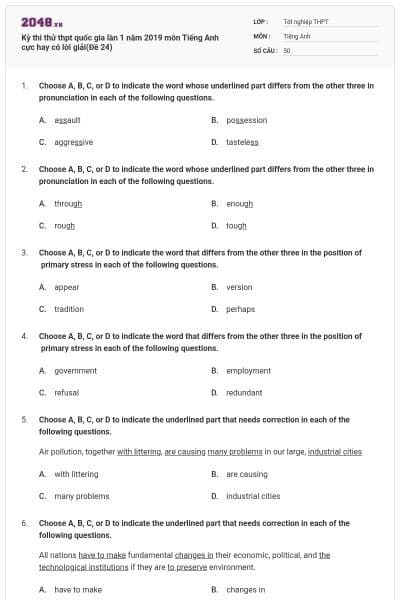
Choose A, B, C, or D to indicate the word whose underlined part differs from the other three in pronunciation in each of the following questions.
assault
possession
aggressive
tasteless
Đáp án B
assault/əˈsɔlt/
possession/pəˈzɛʃən/
aggressive/əˈgrɛsɪv/
tasteless/ˈteɪstləs/
Choose A, B, C, or D to indicate the word whose underlined part differs from the other three in pronunciation in each of the following questions.
through
enough
rough
tough
Đáp án A
through | /θru/ |
|
enough /ɪˈnʌf/
rough /rʌf/
tough /tʌf/
Choose A, B, C, or D to indicate the word that differs from the other three in the position of primary stress in each of the following questions.
appear
version
tradition
perhaps
Đáp án B
appear/əˈpɪr/
version/ˈvɜrʒən/
tradition/trəˈdɪʃən/
perhaps/pərˈhæps/
Choose A, B, C, or D to indicate the word that differs from the other three in the position of primary stress in each of the following questions.
government
employment
refusal
redundant
Đáp án B
Redundant | /rɪˈdʌndənt/ |
Government /ˈgʌvərmənt/
Employment /ɛmˈplɔɪmənt/
Refusal /rəˈfjuzəl/
Choose A, B, C, or D to indicate the underlined part that needs correction in each of the following questions.
Air pollution, together with littering, are causing many problems in our large, industrial cities
with littering
are causing
many problems
industrial cities
Đáp án B
Are causing => is causing
Choose A, B, C, or D to indicate the underlined part that needs correction in each of the following questions.
All nations have to make fundamental changes in their economic, political, and the technological institutions if they are to preserve environment.
have to make
changes in
the technological institutions
to preserve
Đáp án: C
Giải thích:
Trước và sau “and” là liệt kê, nên các từ phải có dạng giống nhau → bỏ mạo từ “the”.
Sửa: the technological institutions → technological institutions
Dịch: Tất cả các quốc gia có thể phải thực hiện những thay đổi căn bản trong các học viện kinh tế, chính trị, công nghệ nếu họ muốn bảo vệ môi trường.
Choose A, B, C, or D to indicate the underlined part that needs correction in each of the following questions.
It is important that the patient stays in bed until he fully recovers from the operation.
important
stays
until
operation
Đáp án B
Stays => stay
Mark the letter A, B, C, or D on your answer sheet to indicate the correct answer to each of the following questions.
I’m having problems with David. He _______ me up in the middle of the night and ______ me his troubles.
has called/told
has been calling/telling
is calling/ telling
called/ told
Đáp án A
Mark the letter A, B, C, or D on your answer sheet to indicate the correct answer to each of the following questions.
Spider monkeys are the best climbers in the jungle, _____ they do not have thumbs.
nevertheless
for
despite
although
Đáp án D
Mark the letter A, B, C, or D on your answer sheet to indicate the correct answer to each of the following questions.
A man ______ helping police with their interview.
was reported to have
was reported to have been
reports to be
reported to have been
Đáp án: B
Giải thích:
Câu tường thuật dạng bị động:
Chủ động: People say/think/report + S + V +…
Bị động: S + be said/thought/reported to + V hoặc to have V3/-ed
Dịch: Một người đàn ông đã được báo cáo là đã giúp cảnh sát thực hiện cuộc phỏng vấn của họ.
Mark the letter A, B, C, or D on your answer sheet to indicate the correct answer to each of the following questions.
Vietnam is ______ the top exporters of rice.
in
of
between
among
Đáp án B
Mark the letter A, B, C, or D on your answer sheet to indicate the correct answer to each of the following questions.
If you need ______ information, please phone me.
far
farther
furthest
further
Đáp án D
Farther: khoảng cách vật lý
Further: cả khoảng cách vật lý lẫn khoảng cách trừu tượng
Mark the letter A, B, C, or D on your answer sheet to indicate the correct answer to each of the following questions.
He______ a cold sweat because he was too scary of this dog.
broke out in
broke up with
came down with
got out of
Đáp án C
Break out in spots: phát ban
Break up (with sb): kết thúc , tuyệt giao với ai
Come down with sth: ốm
Get out of sth: tránh làm việc gì
Mark the letter A, B, C, or D on your answer sheet to indicate the correct answer to each of the following questions.
His flat looks so _______ that it is difficult to believe he had just had a party last night.
safe and sound
sick and tired
spick and span
by and large
Đáp án C
Safe and sound: an toàn
Spick and span: sạch sẽ gọn gàng
By and large: nhìn chung
Mark the letter A, B, C, or D on your answer sheet to indicate the correct answer to each of the following questions.
_____ in 1776 that the Declaration of Independence was signed.
It was
There was
There
It
Đáp án A
Mark the letter A, B, C, or D on your answer sheet to indicate the correct answer to each of the following questions.
Americans account ______ 12% of the US population.
for
with
of
0
Đáp án A
Account for: gopf phần, chiếm 1 phần
Mark the letter A, B, C, or D on your answer sheet to indicate the correct answer to each of the following questions.
We are _____ no obligation to change goods which were not purchased here.
under
at
with
to
Đáp án: A
Giải thích:
Kiến thức: Giới từ
under no obligation: không có nghĩa vụ
Dịch: Chúng tôi không có nghĩa vụ phải đổi những hàng hóa không được mua ở đây.
Mark the letter A, B, C, or D on your answer sheet to indicate the correct answer to each of the following questions.
Last night’s concert did not ______ our expectations
catch up with
come up to
stand in for
look up to
Đáp án B
Catch up with sb: theo kịp ai đó
Come up to sth: đạt tiêu chuẩn
Stand in for sb: thay thế ai
Look up to sb: kính trọng, tôn trọng ai
Mark the letter A, B, C, or D on your answer sheet to indicate the correct answer to each of the following questions.
In 1736, the number of poor people in Boston receiving public assistance _____ about 4,000
was
were
it was
they were
Đáp án B
Mark the letter A, B, C or D on your answer sheet to indicate the most suitable response to
complete each of the following exchanges.
Hung was invited to Hoa’s party. He wants to thank her for the lovely party. Choose the most
suitable response to fill in the blank in the following exchange.
- Hung: “Thank you very much for a lovely party.”
- Hoa: “________”.
Thanks
Have a good day
You are welcome
Cheers
Đáp án C
A. Cảm ơn
B. Chúc một ngày tốt lành
C. Bạn được chào đón
D. Chúc mừng
Mark the letter A, B, C or D on your answer sheet to indicate the most suitable response to
complete each of the following exchanges.
Student:” Could you help me to fax this report?”
Librarian: ”__________”
Sorry I have no idea
It’s very kind of you to say so
What rubbish! I don’t think it’s helpful
Certainly. What’s the fax number?
Đáp án D
A. Xin lỗi tôi không có ý tưởng
B. Rất tốt khi bạn nói vậy
C. Những gì rác rưởi! Tôi không nghĩ nó hữu ích
D. Chắc chắn rồi. Số fax là gì?
Choose A, B, C, or D to indicate the word(s) CLOSEST in meaning to the underlined word(s) in the following questions.
As all of us cannot be available today, let's put off the discussion till later.
present for the event
scheduled for the event
arranged for the event
appointed for the event
Đáp án D
A. trình bày cho sự kiện
B. đã lên kế hoạch cho sự kiện
C. sắp xếp cho sự kiện
D. hẹn giờ cho sự kiện
Choose A, B, C, or D to indicate the word(s) CLOSEST in meaning to the underlined word(s) in the following questions.
The medical community continues to make progress in the fight against cancer
treat bettet
expect more
do better
speed
Đáp án C
A. điều trị tốt hơn
B. mong đợi nhiều hơn
C. làm tốt hơn
D. tốc độ
Choose A, B, C, or D to indicate the word(s) OPPOSITE in meaning to the underlined word(s) in each of the following questions.
There has been insufficient rainfall over the past two years, and farmers are having trouble.
adequate
unsatisfactory
abundant
dominant
Đáp án A
A. đầy đủ
B. không đạt yêu cầu
C. dồi dào
D. chi phối
Choose A, B, C, or D to indicate the word(s) OPPOSITE in meaning to the underlined word(s) in each of the following questions.
They have not made any effort to integrate with the local community.
put together
connect
cooperate
separate
Đáp án D
A. đặt lại với nhau
B. kết nối
C. hợp tác
D. riêng biệt
Mark the letter A, B, C, or D on your answer sheet to indicate the sentence that is closest in meaning to each of the following questions.
“Congratulations! You’ve won the scholarship,” he said .
He said that congratulations! I had won the scholarship.
He said I had won the scholarship and he congratulated
He congratulated me on having won the scholarship.
He congratulated me of winning the scholarship.
Đáp án: C
Giải thích:
Kiến thức: Câu gián tiếp
Khi chuyển sang câu tường thuật, ta cần:
Biến lời chúc mừng thành động từ congratulate
Cấu trúc: congratulate + someone + on + V-ing / having + P2
Vì hành động “won the scholarship” đã xảy ra trước thời điểm nói → dùng having won
Xét các đáp án:
A. "congratulations! I had won" – sai vì vẫn giữ nguyên câu cảm thán, không phù hợp cấu trúc câu tường thuật.
B. Không đầy đủ câu, thiếu tân ngữ của động từ "congratulated", cấu trúc lủng củng.
C. He congratulated me on having won the scholarship – đúng cấu trúc, đúng thì.
D. "congratulated me of" – sai giới từ, phải là on, không phải of.
Dựa vào cấu trúc congratulate sb on doing sth, chọn C.
Dịch: Anh ấy chúc mừng tôi vì đã giành được học bổng.
Mark the letter A, B, C, or D on your answer sheet to indicate the sentence that is closest in meaning to each of the following questions.
He dislikes people asking him about his job.
Asking him about his job is disliked.
He dislikes being asked about his job.
His job is disliked asking about.
People are disliked asking about his job.
Đáp án B
Mark the letter A, B, C, or D on your answer sheet to indicate the sentence that is closest in meaning to each of the following questions.
Let’s start our journey or we’ll be late.
If we start our journey, we won’t be late.
Unless we start our journey, we won’t be late.
If we don’t start our journey, we’ll be late.
We would be late if we didn’t start our journey.
Đáp án B
Hãy bắt đầu chuyến đi hoặc chúng tôi sẽ đến trễ.
A. Nếu chúng ta bắt đầu chuyến đi, chúng ta sẽ không đến trễ.
B. Trừ khi chúng ta bắt đầu đi, chúng ta sẽ không đến trễ.
C. Nếu chúng ta không bắt đầu đi, chúng ta sẽ đến trễ
D. Chúng tôi đã đến trễ nếu chúng tôi không bắt đầu đi.
Mark the letter A, B, C, or D on your answer sheet to indicate the sentence that best combines each pair of sentences in the following questions.
Mary knew how busy I was. She offered to help me.
Because Mary knew my business, she offered to help me.
Knowing how busy I was, Mary offered to help me.
Mary knew how I was busy and offered to help me.
Having known how busy I was, Mary offered to help me.
Đáp án C
Mark the letter A, B, C, or D on your answer sheet to indicate the sentence that best combines each pair of sentences in the following questions.
Animals can’t speak our language. They can’t tell us when they are unhappy or annoyed.
If animals could speak, they would be able to tell us when they are unhappy or annoyed.
One day we could speak animals’ language and know when they are happy or annoyed.
We don’t know when animals are unhappy or annoyed because we don’t know their language.
We don’t understand animals because we can’t speak their language.
Đáp án C
Read the following passage and choose A, B, C, or D to indicate the correct word or phrase that best fits each of the following blanks. Fill in the appropriate word in question 31
The reality of an interview is never as bad as your fears. For some reason people imagine the interviewer is going to jump on every tiny mistake they (31)________. In truth, the interviewer is as keen for the meeting to go well as you are. It is what makes his or her job enjoyable.
The secret of a good interview is preparing for it. What you wear is always important as it creates the first impression. So (32)________ neatly, but comfortably. Make sure that you can deal with anything you are asked. Prepare for questions that are certain to come up, for example: Why do you want to become a nurse? What is the most important quality a good nurse should have? Apart from nursing, what other careers have you considered? What are your interest and hobbies?
Answer the questions fully and precisely. For instance, if one of your interests is reading, be prepared to talk about the sort of books you like. (33)________, do not learn all your answers off (34)________ heart. The interviewer wants to meet a human being, not a robot. Remember, the interviewer is genuinely interested in you, so the more you relax and are yourself, the more (35) ________ you are to succeed.
make
do
perform
have
Đáp án A
Read the following passage and choose A, B, C, or D to indicate the correct word or phrase that best fits each of the following blanks. Fill in the appropriate word in question 32
The reality of an interview is never as bad as your fears. For some reason people imagine the interviewer is going to jump on every tiny mistake they (31)________. In truth, the interviewer is as keen for the meeting to go well as you are. It is what makes his or her job enjoyable.
The secret of a good interview is preparing for it. What you wear is always important as it creates the first impression. So (32)________ neatly, but comfortably. Make sure that you can deal with anything you are asked. Prepare for questions that are certain to come up, for example: Why do you want to become a nurse? What is the most important quality a good nurse should have? Apart from nursing, what other careers have you considered? What are your interest and hobbies?
Answer the questions fully and precisely. For instance, if one of your interests is reading, be prepared to talk about the sort of books you like. (33)________, do not learn all your answers off (34)________ heart. The interviewer wants to meet a human being, not a robot. Remember, the interviewer is genuinely interested in you, so the more you relax and are yourself, the more (35) ________ you are to succeed.
wear
dress
put on
have on
Đáp án A
Read the following passage and choose A, B, C, or D to indicate the correct word or phrase that best fits each of the following blanks. Fill in the appropriate word in question 33
The reality of an interview is never as bad as your fears. For some reason people imagine the interviewer is going to jump on every tiny mistake they (31)________. In truth, the interviewer is as keen for the meeting to go well as you are. It is what makes his or her job enjoyable.
The secret of a good interview is preparing for it. What you wear is always important as it creates the first impression. So (32)________ neatly, but comfortably. Make sure that you can deal with anything you are asked. Prepare for questions that are certain to come up, for example: Why do you want to become a nurse? What is the most important quality a good nurse should have? Apart from nursing, what other careers have you considered? What are your interest and hobbies?
Answer the questions fully and precisely. For instance, if one of your interests is reading, be prepared to talk about the sort of books you like. (33)________, do not learn all your answers off (34)________ heart. The interviewer wants to meet a human being, not a robot. Remember, the interviewer is genuinely interested in you, so the more you relax and are yourself, the more (35) ________ you are to succeed.
However
Although
Despite
Therefore
Đáp án A
Read the following passage and choose A, B, C, or D to indicate the correct word or phrase that best fits each of the following blanks. Fill in the appropriate word in question 34
The reality of an interview is never as bad as your fears. For some reason people imagine the interviewer is going to jump on every tiny mistake they (31)________. In truth, the interviewer is as keen for the meeting to go well as you are. It is what makes his or her job enjoyable.
The secret of a good interview is preparing for it. What you wear is always important as it creates the first impression. So (32)________ neatly, but comfortably. Make sure that you can deal with anything you are asked. Prepare for questions that are certain to come up, for example: Why do you want to become a nurse? What is the most important quality a good nurse should have? Apart from nursing, what other careers have you considered? What are your interest and hobbies?
Answer the questions fully and precisely. For instance, if one of your interests is reading, be prepared to talk about the sort of books you like. (33)________, do not learn all your answers off (34)________ heart. The interviewer wants to meet a human being, not a robot. Remember, the interviewer is genuinely interested in you, so the more you relax and are yourself, the more (35) ________ you are to succeed.
at
by
in
on
Đáp án B
By heart: thuộc lòng
Read the following passage and choose A, B, C, or D to indicate the correct word or phrase that best fits each of the following blanks. Fill in the appropriate word in question 31
The reality of an interview is never as bad as your fears. For some reason people imagine the interviewer is going to jump on every tiny mistake they (31)________. In truth, the interviewer is as keen for the meeting to go well as you are. It is what makes his or her job enjoyable.
The secret of a good interview is preparing for it. What you wear is always important as it creates the first impression. So (32)________ neatly, but comfortably. Make sure that you can deal with anything you are asked. Prepare for questions that are certain to come up, for example: Why do you want to become a nurse? What is the most important quality a good nurse should have? Apart from nursing, what other careers have you considered? What are your interest and hobbies?
Answer the questions fully and precisely. For instance, if one of your interests is reading, be prepared to talk about the sort of books you like. (33)________, do not learn all your answers off (34)________ heart. The interviewer wants to meet a human being, not a robot. Remember, the interviewer is genuinely interested in you, so the more you relax and are yourself, the more (35) ________ you are to succeed.
easy
possible
likely
probable
Đáp án B
Read the following passage and mark the letter A, B, C, or D on your answer sheet to indicate the correct answer to each of the questions from 36 to 42.
It is hard to get any agreement on the precise meaning of the term "social class". In everyday life, people tend to have a different approach to those they consider their equals from which they assume with people they consider higher or lower than themselves in social scale. The criteria we use to 'place' a new acquaintance, however, are a complex mixture of factors. Dress, way of speaking, area of residence in a given city or province, education and manners all play a part.
In ancient civilizations, the Sumerian, for example, which flourished in the lower Euphrates valley from 2000 to 5000 B.C. social differences were based on birth, status or rank, rather than on wealth. Four main classes were recognized. These were the rulers, the priestly administrators, the freemen (such as craftsmen, merchants or farmers) and the slaves.
In Greece, after the sixth-century B.C., there was a growing conflict between the peasants and the aristocrats, and a gradual decrease in the power of the aristocracy when a kind of ‘middle class’ of traders and skilled workers grew up. The population of Athens, for example, was divided into three main classes which were politically and legally distinct. About one-third of the total population was slaves, who did not count politically at all, a fact often forgotten by those who praise Athens as the nursery of democracy. The next main group consisted of resident foreigners, the, ‘metics’ who were freemen, though they too were allowed no share in political life. The third group was the powerful body of ‘citizens”, who were themselves divided into sub-classes.
In the later Middle Ages, however, the development of a money economy and the growth of cities and trade led to the rise of another class, the ‘burghers’ or city merchants and mayors. These were the predecessors of the modern middle classes. Gradually high office and occupation assumed importance in determining social position, as it became more and more possible for a person born to one station in life to move to another. This change affected the towns more than the country areas, where remnants of feudalism lasted much longer.
According to the passage, we evaluate other people's social position by ________ .
questioning them in great details
their dress, manners, area of residence and other factors
finding out how much their salary is
the kind of job they do
Đáp án B
Chúng tôi đánh giá vị trí xã hội của người khác bằng cách:
The criteria we use to 'place' a new acquaintance, however, are a complex mixture of factors. Dress, way of speaking, area of residence in a given city or province, education and manners all play a part.
A. hỏi họ những chi tiết tuyệt vời
B. trang phục, cách cư xử, khu vực cư trú và các yếu tố khác
C. tìm ra mức lương của họ là bao nhiêu
D. loại công việc họ làm
Read the following passage and mark the letter A, B, C, or D on your answer sheet to indicate the correct answer to each of the questions from 36 to 42.
It is hard to get any agreement on the precise meaning of the term "social class". In everyday life, people tend to have a different approach to those they consider their equals from which they assume with people they consider higher or lower than themselves in social scale. The criteria we use to 'place' a new acquaintance, however, are a complex mixture of factors. Dress, way of speaking, area of residence in a given city or province, education and manners all play a part.
In ancient civilizations, the Sumerian, for example, which flourished in the lower Euphrates valley from 2000 to 5000 B.C. social differences were based on birth, status or rank, rather than on wealth. Four main classes were recognized. These were the rulers, the priestly administrators, the freemen (such as craftsmen, merchants or farmers) and the slaves.
In Greece, after the sixth-century B.C., there was a growing conflict between the peasants and the aristocrats, and a gradual decrease in the power of the aristocracy when a kind of ‘middle class’ of traders and skilled workers grew up. The population of Athens, for example, was divided into three main classes which were politically and legally distinct. About one-third of the total population was slaves, who did not count politically at all, a fact often forgotten by those who praise Athens as the nursery of democracy. The next main group consisted of resident foreigners, the, ‘metics’ who were freemen, though they too were allowed no share in political life. The third group was the powerful body of ‘citizens”, who were themselves divided into sub-classes.
In the later Middle Ages, however, the development of a money economy and the growth of cities and trade led to the rise of another class, the ‘burghers’ or city merchants and mayors. These were the predecessors of the modern middle classes. Gradually high office and occupation assumed importance in determining social position, as it became more and more possible for a person born to one station in life to move to another. This change affected the towns more than the country areas, where remnants of feudalism lasted much longer.
The word "criteria" in the first paragraph is closest in meaning to ________ .
characteristics
words
standards of judgment
criticisms
Đáp án C
Từ " criteria " trong đoạn đầu tiên có ý nghĩa gần nghĩa với:
A. đặc điểm
B. từ
C. tiêu chuẩn phán xét
D. phê bình
Read the following passage and mark the letter A, B, C, or D on your answer sheet to indicate the correct answer to each of the questions from 36 to 42.
It is hard to get any agreement on the precise meaning of the term "social class". In everyday life, people tend to have a different approach to those they consider their equals from which they assume with people they consider higher or lower than themselves in social scale. The criteria we use to 'place' a new acquaintance, however, are a complex mixture of factors. Dress, way of speaking, area of residence in a given city or province, education and manners all play a part.
In ancient civilizations, the Sumerian, for example, which flourished in the lower Euphrates valley from 2000 to 5000 B.C. social differences were based on birth, status or rank, rather than on wealth. Four main classes were recognized. These were the rulers, the priestly administrators, the freemen (such as craftsmen, merchants or farmers) and the slaves.
In Greece, after the sixth-century B.C., there was a growing conflict between the peasants and the aristocrats, and a gradual decrease in the power of the aristocracy when a kind of ‘middle class’ of traders and skilled workers grew up. The population of Athens, for example, was divided into three main classes which were politically and legally distinct. About one-third of the total population was slaves, who did not count politically at all, a fact often forgotten by those who praise Athens as the nursery of democracy. The next main group consisted of resident foreigners, the, ‘metics’ who were freemen, though they too were allowed no share in political life. The third group was the powerful body of ‘citizens”, who were themselves divided into sub-classes.
In the later Middle Ages, however, the development of a money economy and the growth of cities and trade led to the rise of another class, the ‘burghers’ or city merchants and mayors. These were the predecessors of the modern middle classes. Gradually high office and occupation assumed importance in determining social position, as it became more and more possible for a person born to one station in life to move to another. This change affected the towns more than the country areas, where remnants of feudalism lasted much longer.
The word “which” in the paragraph 2 refers to ______.
ancient civilizations
Sumerian
example
Euphrates valley
Đáp án B
Từ “which” trong đoạn 2 đề cập đến:
A. nền văn minh cổ đại
B. Sumerian
C. ví dụ
D. Euphrates valley
Read the following passage and mark the letter A, B, C, or D on your answer sheet to indicate the correct answer to each of the questions from 36 to 42.
It is hard to get any agreement on the precise meaning of the term "social class". In everyday life, people tend to have a different approach to those they consider their equals from which they assume with people they consider higher or lower than themselves in social scale. The criteria we use to 'place' a new acquaintance, however, are a complex mixture of factors. Dress, way of speaking, area of residence in a given city or province, education and manners all play a part.
In ancient civilizations, the Sumerian, for example, which flourished in the lower Euphrates valley from 2000 to 5000 B.C. social differences were based on birth, status or rank, rather than on wealth. Four main classes were recognized. These were the rulers, the priestly administrators, the freemen (such as craftsmen, merchants or farmers) and the slaves.
In Greece, after the sixth-century B.C., there was a growing conflict between the peasants and the aristocrats, and a gradual decrease in the power of the aristocracy when a kind of ‘middle class’ of traders and skilled workers grew up. The population of Athens, for example, was divided into three main classes which were politically and legally distinct. About one-third of the total population was slaves, who did not count politically at all, a fact often forgotten by those who praise Athens as the nursery of democracy. The next main group consisted of resident foreigners, the, ‘metics’ who were freemen, though they too were allowed no share in political life. The third group was the powerful body of ‘citizens”, who were themselves divided into sub-classes.
In the later Middle Ages, however, the development of a money economy and the growth of cities and trade led to the rise of another class, the ‘burghers’ or city merchants and mayors. These were the predecessors of the modern middle classes. Gradually high office and occupation assumed importance in determining social position, as it became more and more possible for a person born to one station in life to move to another. This change affected the towns more than the country areas, where remnants of feudalism lasted much longer.
The decline of the Greek aristocracy's power in the sixth century B.C ________ .
caused international conflicts in the area
coincided with the rise of a new "middle class" of traders and peasants
was assisted by a rise in the number of slaves
lasted for only a short time
Đáp án B
Sự suy giảm quyền lực quý tộc Hy Lạp trong thế kỷ thứ sáu trước Công Nguyên:
In Greece, after the sixth-century B.C., there was a growing conflict between the peasants and
the aristocrats, and a gradual decrease in the power of the aristocracy when a kind of ‘middle
class’ of traders and skilled workers grew up.
A. gây ra xung đột quốc tế trong khu vực
B. trùng hợp với sự nổi lên của một "tầng lớp trung lưu" mới của các thương lái và nông dân
C. được hỗ trợ bởi sự gia tăng số lượng nô lệ
D. chỉ kéo dài trong một thời gian ngắn
Read the following passage and mark the letter A, B, C, or D on your answer sheet to indicate the correct answer to each of the questions from 36 to 42.
It is hard to get any agreement on the precise meaning of the term "social class". In everyday life, people tend to have a different approach to those they consider their equals from which they assume with people they consider higher or lower than themselves in social scale. The criteria we use to 'place' a new acquaintance, however, are a complex mixture of factors. Dress, way of speaking, area of residence in a given city or province, education and manners all play a part.
In ancient civilizations, the Sumerian, for example, which flourished in the lower Euphrates valley from 2000 to 5000 B.C. social differences were based on birth, status or rank, rather than on wealth. Four main classes were recognized. These were the rulers, the priestly administrators, the freemen (such as craftsmen, merchants or farmers) and the slaves.
In Greece, after the sixth-century B.C., there was a growing conflict between the peasants and the aristocrats, and a gradual decrease in the power of the aristocracy when a kind of ‘middle class’ of traders and skilled workers grew up. The population of Athens, for example, was divided into three main classes which were politically and legally distinct. About one-third of the total population was slaves, who did not count politically at all, a fact often forgotten by those who praise Athens as the nursery of democracy. The next main group consisted of resident foreigners, the, ‘metics’ who were freemen, though they too were allowed no share in political life. The third group was the powerful body of ‘citizens”, who were themselves divided into sub-classes.
In the later Middle Ages, however, the development of a money economy and the growth of cities and trade led to the rise of another class, the ‘burghers’ or city merchants and mayors. These were the predecessors of the modern middle classes. Gradually high office and occupation assumed importance in determining social position, as it became more and more possible for a person born to one station in life to move to another. This change affected the towns more than the country areas, where remnants of feudalism lasted much longer.
Athens is often praised as the nursery of democracy ________.
even though slaves were allowed to vote
because its three main classes were politically and legally distinct.
in spite of its heavy dependence on slave labor
because even very young children could vote
Đáp án B
Athens thường được ca ngợi là vườn ươm của nền dân chủ ________.
The population of Athens, for example, was divided into three main classes which were
politically and legally distinct. About one-third of the total population was slaves, who did not count politically at all, a fact often forgotten by those who praise Athens as the nursery of democracy.
A. mặc dù nô lệ được phép bỏ phiếu
B. bởi vì ba lớp chính của nó có sự khác biệt về mặt chính trị và pháp lý.
C. mặc dù phụ thuộc nặng nề vào lao động nô lệ
D. bởi vì ngay cả trẻ nhỏ cũng có thể bầu cử
Read the following passage and mark the letter A, B, C, or D on your answer sheet to indicate the correct answer to each of the questions from 36 to 42.
It is hard to get any agreement on the precise meaning of the term "social class". In everyday life, people tend to have a different approach to those they consider their equals from which they assume with people they consider higher or lower than themselves in social scale. The criteria we use to 'place' a new acquaintance, however, are a complex mixture of factors. Dress, way of speaking, area of residence in a given city or province, education and manners all play a part.
In ancient civilizations, the Sumerian, for example, which flourished in the lower Euphrates valley from 2000 to 5000 B.C. social differences were based on birth, status or rank, rather than on wealth. Four main classes were recognized. These were the rulers, the priestly administrators, the freemen (such as craftsmen, merchants or farmers) and the slaves.
In Greece, after the sixth-century B.C., there was a growing conflict between the peasants and the aristocrats, and a gradual decrease in the power of the aristocracy when a kind of ‘middle class’ of traders and skilled workers grew up. The population of Athens, for example, was divided into three main classes which were politically and legally distinct. About one-third of the total population was slaves, who did not count politically at all, a fact often forgotten by those who praise Athens as the nursery of democracy. The next main group consisted of resident foreigners, the, ‘metics’ who were freemen, though they too were allowed no share in political life. The third group was the powerful body of ‘citizens”, who were themselves divided into sub-classes.
In the later Middle Ages, however, the development of a money economy and the growth of cities and trade led to the rise of another class, the ‘burghers’ or city merchants and mayors. These were the predecessors of the modern middle classes. Gradually high office and occupation assumed importance in determining social position, as it became more and more possible for a person born to one station in life to move to another. This change affected the towns more than the country areas, where remnants of feudalism lasted much longer.
The word "predecessors" in the last paragraph is closest in meaning to ________.
supporters
descendants
ancestors
authorities
Đáp án C
Từ " predecessors " trong đoạn cuối cùng có ý nghĩa gần nhất với ________.
A. người ủng hộ
B. con cháu
C. tổ tiên
D. cơ quan chức năng
Read the following passage and mark the letter A, B, C, or D on your answer sheet to indicate the correct answer to each of the questions from 36 to 42.
It is hard to get any agreement on the precise meaning of the term "social class". In everyday life, people tend to have a different approach to those they consider their equals from which they assume with people they consider higher or lower than themselves in social scale. The criteria we use to 'place' a new acquaintance, however, are a complex mixture of factors. Dress, way of speaking, area of residence in a given city or province, education and manners all play a part.
In ancient civilizations, the Sumerian, for example, which flourished in the lower Euphrates valley from 2000 to 5000 B.C. social differences were based on birth, status or rank, rather than on wealth. Four main classes were recognized. These were the rulers, the priestly administrators, the freemen (such as craftsmen, merchants or farmers) and the slaves.
In Greece, after the sixth-century B.C., there was a growing conflict between the peasants and the aristocrats, and a gradual decrease in the power of the aristocracy when a kind of ‘middle class’ of traders and skilled workers grew up. The population of Athens, for example, was divided into three main classes which were politically and legally distinct. About one-third of the total population was slaves, who did not count politically at all, a fact often forgotten by those who praise Athens as the nursery of democracy. The next main group consisted of resident foreigners, the, ‘metics’ who were freemen, though they too were allowed no share in political life. The third group was the powerful body of ‘citizens”, who were themselves divided into sub-classes.
In the later Middle Ages, however, the development of a money economy and the growth of cities and trade led to the rise of another class, the ‘burghers’ or city merchants and mayors. These were the predecessors of the modern middle classes. Gradually high office and occupation assumed importance in determining social position, as it became more and more possible for a person born to one station in life to move to another. This change affected the towns more than the country areas, where remnants of feudalism lasted much longer.
The passage is mainly about ________.
the human history
the modern society
the division of social classes in the ancient world
the social life in ancient Greece
Đáp án C
Chủ đề chính của đoạn văn là:
A. lịch sử nhân loại
B. xã hội hiện đại
C. sự phân chia các tầng lớp xã hội trong thế giới cổ đại
D. đời sống xã hội ở Hy Lạp cổ đại
Read the following passage and mark the letter A, B, C or D on your answer sheet to choose the best answer for each of the question from 43- 50
The National Automobile Show in New York has been one of the top auto shows in the United States since 1900. On November 3 of that year, about 8,000 people looked over the “horseless carriages.” It was the opening day and the first opportunity for the automobile industry to show off its wares to a large crowd; however, the black-tie audience treated the occasion more as a social affair than as a sales extravaganza. It was also on the first day of this show that William McKinley became the first U.S. president to ride in a car.
The automobile was not invented in the United States. That distinction belongs to Germany. Nicolaus Otto built the first practical internal-combustion engine there in 1876. Then, German engineer Karl Benz built what are regarded as the first modern automobiles in the mid-1880s. But the United States pioneered the merchandising of the automobile. The auto show proved to be an effective means of getting the public excited about automotive products.
By happenstance, the number of people at the first New York show equaled the entire car population of the United States at that time. In 1900, 10 million bicycles and an unknown number of horse-drawn carriages provided the prime means of personal transportation. Only about 4,000 cars were assembled in the United States in 1900, and only a quarter of those were gasoline powered. The rest ran on steam or electricity.
After viewing the cars made by forty car makers, the show’s audience favored electric cars because they were quiet. The risk of a boiler explosion turned people away from steamers, and the gasoline-powered cars produced smelly fumes. The Duryea Motor Wagon Company, which launched the American auto industry in 1895, offered a fragrant additive designed to mask the smells of the naphtha that it burned. Many of the 1900 models were cumbersome—the Gasmobile, the Franklin, and the Orient, for example, steered with a tiller like a boat instead of with a steering wheel. None of them was equipped with an automatic starter.
These early model cars were practically handmade and were not very dependable. They were basically toys of the well-to-do. In fact, Woodrow Wilson, then a professor at Princeton University and later President of the United States, predicted that automobiles would cause conflict between the wealthy and the poor. However, among the exhibitors at the 1900 show was a young engineer named Henry Ford. But before the end of the decade, he would revolutionize the automobile industry with his Model T Ford. The Model T, first produced in 1909, featured a standardized design and a streamlined method of production—the assembly line. Its lower costs made it available to the mass market.
Cars at the 1900 show ranged in price from $1,000 to $1,500, or roughly $14,000 to $21,000 in today’s prices. By 1913, the Model T was selling for less than $300, and soon the price would drop even further. “I will build cars for the multitudes,” Ford said, and he kept his promise.
The passage implies that the audience viewed the 1900 National Automobile Show primarily as a(n) ______
formal social occasion.
chance to buy automobiles at low prices
opportunity to learn how to drive
chance to invest in one of thirty-two automobile manufacturers
Đáp án A
Đoạn văn cho rằng khán giả đã xem Triển lãm ô tô quốc gia 1900 chủ yếu là một:
carriages.” It was the opening day and the first opportunity for the automobile industry to show off its wares to a large crowd; however, the black-tie audience treated the occasion more as a social affair than as a sales extravaganza.
A. buổi lễ trang trọng mang tính chất xã hội
B. cơ hội mua ô tô với giá thấp
C. cơ hội học cách lái xe
D. cơ hội đầu tư vào một trong ba mươi hai nhà sản xuất ô tô
Read the following passage and mark the letter A, B, C or D on your answer
sheet to choose the best answer for each of the question from 43- 50
The National Automobile Show in New York has been one of the top auto shows in the United States since 1900. On November 3 of that year, about 8,000 people looked over the “horseless carriages.” It was the opening day and the first opportunity for the automobile industry to show off its wares to a large crowd; however, the black-tie audience treated the occasion more as a social affair than as a sales extravaganza. It was also on the first day of this show that William McKinley became the first U.S. president to ride in a car.
The automobile was not invented in the United States. That distinction belongs to Germany. Nicolaus Otto built the first practical internal-combustion engine there in 1876. Then, German engineer Karl Benz built what are regarded as the first modern automobiles in the mid-1880s. But the United States pioneered the merchandising of the automobile. The auto show proved to be an effective means of getting the public excited about automotive products.
By happenstance, the number of people at the first New York show equaled the entire car population of the United States at that time. In 1900, 10 million bicycles and an unknown number of horse-drawn carriages provided the prime means of personal transportation. Only about 4,000 cars were assembled in the United States in 1900, and only a quarter of those were gasoline powered. The rest ran on steam or electricity.
After viewing the cars made by forty car makers, the show’s audience favored electric cars because they were quiet. The risk of a boiler explosion turned people away from steamers, and the gasoline-powered cars produced smelly fumes. The Duryea Motor Wagon Company, which launched the American auto industry in 1895, offered a fragrant additive designed to mask the smells of the naphtha that it burned. Many of the 1900 models were cumbersome—the Gasmobile, the Franklin, and the Orient, for example, steered with a tiller like a boat instead of with a steering wheel. None of them was equipped with an automatic starter.
These early model cars were practically handmade and were not very dependable. They were basically toys of the well-to-do. In fact, Woodrow Wilson, then a professor at Princeton University and later President of the United States, predicted that automobiles would cause conflict between the wealthy and the poor. However, among the exhibitors at the 1900 show was a young engineer named Henry Ford. But before the end of the decade, he would revolutionize the automobile industry with his Model T Ford. The Model T, first produced in 1909, featured a standardized design and a streamlined method of production—the assembly line. Its lower costs made it available to the mass market.
Cars at the 1900 show ranged in price from $1,000 to $1,500, or roughly $14,000 to $21,000 in today’s prices. By 1913, the Model T was selling for less than $300, and soon the price would drop even further. “I will build cars for the multitudes,” Ford said, and he kept his promise.
According to the passage, who developed the first modern car?
Karl Benz
Nikolaus Otto
William McKinley
Henry Ford
Đáp án A
Người đã phát triển chiếc xe hiện đại đầu tiên?
Karl Benz built what are regarded as the first modern automobiles in the mid-1880s
A. Karl Benz
B. Nikolaus Otto
C. William McKinley
D. Henry Ford
Read the following passage and mark the letter A, B, C or D on your answer sheet to choose the best answer for each of the question from 43- 50
The National Automobile Show in New York has been one of the top auto shows in the United States since 1900. On November 3 of that year, about 8,000 people looked over the “horseless carriages.” It was the opening day and the first opportunity for the automobile industry to show off its wares to a large crowd; however, the black-tie audience treated the occasion more as a social affair than as a sales extravaganza. It was also on the first day of this show that William McKinley became the first U.S. president to ride in a car.
The automobile was not invented in the United States. That distinction belongs to Germany. Nicolaus Otto built the first practical internal-combustion engine there in 1876. Then, German engineer Karl Benz built what are regarded as the first modern automobiles in the mid-1880s. But the United States pioneered the merchandising of the automobile. The auto show proved to be an effective means of getting the public excited about automotive products.
By happenstance, the number of people at the first New York show equaled the entire car population of the United States at that time. In 1900, 10 million bicycles and an unknown number of horse-drawn carriages provided the prime means of personal transportation. Only about 4,000 cars were assembled in the United States in 1900, and only a quarter of those were gasoline powered. The rest ran on steam or electricity.
After viewing the cars made by forty car makers, the show’s audience favored electric cars because they were quiet. The risk of a boiler explosion turned people away from steamers, and the gasoline-powered cars produced smelly fumes. The Duryea Motor Wagon Company, which launched the American auto industry in 1895, offered a fragrant additive designed to mask the smells of the naphtha that it burned. Many of the 1900 models were cumbersome—the Gasmobile, the Franklin, and the Orient, for example, steered with a tiller like a boat instead of with a steering wheel. None of them was equipped with an automatic starter.
These early model cars were practically handmade and were not very dependable. They were basically toys of the well-to-do. In fact, Woodrow Wilson, then a professor at Princeton University and later President of the United States, predicted that automobiles would cause conflict between the wealthy and the poor. However, among the exhibitors at the 1900 show was a young engineer named Henry Ford. But before the end of the decade, he would revolutionize the automobile industry with his Model T Ford. The Model T, first produced in 1909, featured a standardized design and a streamlined method of production—the assembly line. Its lower costs made it available to the mass market.
Cars at the 1900 show ranged in price from $1,000 to $1,500, or roughly $14,000 to $21,000 in today’s prices. By 1913, the Model T was selling for less than $300, and soon the price would drop even further. “I will build cars for the multitudes,” Ford said, and he kept his promise.
Approximately how many cars were there in the United States in 1900?
4,000
8,000
10 million
An unknown number
Đáp án A
Có khoảng bao nhiêu chiếc xe ở Hoa Kỳ vào năm 1900?
Only about 4,000 cars were assembled in the United States in 1900,
A. 4,000
B. 8.000
C. 10 triệu
D. Một số không xác định
Read the following passage and mark the letter A, B, C or D on your answer sheet to choose the best answer for each of the question from 43- 50
The National Automobile Show in New York has been one of the top auto shows in the United States since 1900. On November 3 of that year, about 8,000 people looked over the “horseless carriages.” It was the opening day and the first opportunity for the automobile industry to show off its wares to a large crowd; however, the black-tie audience treated the occasion more as a social affair than as a sales extravaganza. It was also on the first day of this show that William McKinley became the first U.S. president to ride in a car.
The automobile was not invented in the United States. That distinction belongs to Germany. Nicolaus Otto built the first practical internal-combustion engine there in 1876. Then, German engineer Karl Benz built what are regarded as the first modern automobiles in the mid-1880s. But the United States pioneered the merchandising of the automobile. The auto show proved to be an effective means of getting the public excited about automotive products.
By happenstance, the number of people at the first New York show equaled the entire car population of the United States at that time. In 1900, 10 million bicycles and an unknown number of horse-drawn carriages provided the prime means of personal transportation. Only about 4,000 cars were assembled in the United States in 1900, and only a quarter of those were gasoline powered. The rest ran on steam or electricity.
After viewing the cars made by forty car makers, the show’s audience favored electric cars because they were quiet. The risk of a boiler explosion turned people away from steamers, and the gasoline-powered cars produced smelly fumes. The Duryea Motor Wagon Company, which launched the American auto industry in 1895, offered a fragrant additive designed to mask the smells of the naphtha that it burned. Many of the 1900 models were cumbersome—the Gasmobile, the Franklin, and the Orient, for example, steered with a tiller like a boat instead of with a steering wheel. None of them was equipped with an automatic starter.
These early model cars were practically handmade and were not very dependable. They were basically toys of the well-to-do. In fact, Woodrow Wilson, then a professor at Princeton University and later President of the United States, predicted that automobiles would cause conflict between the wealthy and the poor. However, among the exhibitors at the 1900 show was a young engineer named Henry Ford. But before the end of the decade, he would revolutionize the automobile industry with his Model T Ford. The Model T, first produced in 1909, featured a standardized design and a streamlined method of production—the assembly line. Its lower costs made it available to the mass market.
Cars at the 1900 show ranged in price from $1,000 to $1,500, or roughly $14,000 to $21,000 in today’s prices. By 1913, the Model T was selling for less than $300, and soon the price would drop even further. “I will build cars for the multitudes,” Ford said, and he kept his promise.
The phrase “by happenstance” in paragraph 3 is closest in meaning to________.
Generally
For example
Coincidentally
By design
Đáp án C
Cụm từ “by happenstance” trong đoạn 3 gần nghĩa với:
A. Nói chung
B. Ví dụ
C. Thật trùng hợp
D. Theo thiết kế
Read the following passage and mark the letter A, B, C or D on your answer sheet to choose the best answer for each of the question from 43- 50
The National Automobile Show in New York has been one of the top auto shows in the United States since 1900. On November 3 of that year, about 8,000 people looked over the “horseless carriages.” It was the opening day and the first opportunity for the automobile industry to show off its wares to a large crowd; however, the black-tie audience treated the occasion more as a social affair than as a sales extravaganza. It was also on the first day of this show that William McKinley became the first U.S. president to ride in a car.
The automobile was not invented in the United States. That distinction belongs to Germany. Nicolaus Otto built the first practical internal-combustion engine there in 1876. Then, German engineer Karl Benz built what are regarded as the first modern automobiles in the mid-1880s. But the United States pioneered the merchandising of the automobile. The auto show proved to be an effective means of getting the public excited about automotive products.
By happenstance, the number of people at the first New York show equaled the entire car population of the United States at that time. In 1900, 10 million bicycles and an unknown number of horse-drawn carriages provided the prime means of personal transportation. Only about 4,000 cars were assembled in the United States in 1900, and only a quarter of those were gasoline powered. The rest ran on steam or electricity.
After viewing the cars made by forty car makers, the show’s audience favored electric cars because they were quiet. The risk of a boiler explosion turned people away from steamers, and the gasoline-powered cars produced smelly fumes. The Duryea Motor Wagon Company, which launched the American auto industry in 1895, offered a fragrant additive designed to mask the smells of the naphtha that it burned. Many of the 1900 models were cumbersome—the Gasmobile, the Franklin, and the Orient, for example, steered with a tiller like a boat instead of with a steering wheel. None of them was equipped with an automatic starter.
These early model cars were practically handmade and were not very dependable. They were basically toys of the well-to-do. In fact, Woodrow Wilson, then a professor at Princeton University and later President of the United States, predicted that automobiles would cause conflict between the wealthy and the poor. However, among the exhibitors at the 1900 show was a young engineer named Henry Ford. But before the end of the decade, he would revolutionize the automobile industry with his Model T Ford. The Model T, first produced in 1909, featured a standardized design and a streamlined method of production—the assembly line. Its lower costs made it available to the mass market.
Cars at the 1900 show ranged in price from $1,000 to $1,500, or roughly $14,000 to $21,000 in today’s prices. By 1913, the Model T was selling for less than $300, and soon the price would drop even further. “I will build cars for the multitudes,” Ford said, and he kept his promise.
The word “they” in the paragraph 2 refers to ________.
car makers
model cars
audience
electric cars
Đáp án D
Từ “họ” trong đoạn 2 đề cập đến ________.
A. nhà sản xuất ô tô
B. mẫu xe ô tô
C. đối tượng
D. xe điện
Read the following passage and mark the letter A, B, C or D on your answer sheet to choose the best answer for each of the question from 43- 50
The National Automobile Show in New York has been one of the top auto shows in the United States since 1900. On November 3 of that year, about 8,000 people looked over the “horseless carriages.” It was the opening day and the first opportunity for the automobile industry to show off its wares to a large crowd; however, the black-tie audience treated the occasion more as a social affair than as a sales extravaganza. It was also on the first day of this show that William McKinley became the first U.S. president to ride in a car.
The automobile was not invented in the United States. That distinction belongs to Germany. Nicolaus Otto built the first practical internal-combustion engine there in 1876. Then, German engineer Karl Benz built what are regarded as the first modern automobiles in the mid-1880s. But the United States pioneered the merchandising of the automobile. The auto show proved to be an effective means of getting the public excited about automotive products.
By happenstance, the number of people at the first New York show equaled the entire car population of the United States at that time. In 1900, 10 million bicycles and an unknown number of horse-drawn carriages provided the prime means of personal transportation. Only about 4,000 cars were assembled in the United States in 1900, and only a quarter of those were gasoline powered. The rest ran on steam or electricity.
After viewing the cars made by forty car makers, the show’s audience favored electric cars because they were quiet. The risk of a boiler explosion turned people away from steamers, and the gasoline-powered cars produced smelly fumes. The Duryea Motor Wagon Company, which launched the American auto industry in 1895, offered a fragrant additive designed to mask the smells of the naphtha that it burned. Many of the 1900 models were cumbersome—the Gasmobile, the Franklin, and the Orient, for example, steered with a tiller like a boat instead of with a steering wheel. None of them was equipped with an automatic starter.
These early model cars were practically handmade and were not very dependable. They were basically toys of the well-to-do. In fact, Woodrow Wilson, then a professor at Princeton University and later President of the United States, predicted that automobiles would cause conflict between the wealthy and the poor. However, among the exhibitors at the 1900 show was a young engineer named Henry Ford. But before the end of the decade, he would revolutionize the automobile industry with his Model T Ford. The Model T, first produced in 1909, featured a standardized design and a streamlined method of production—the assembly line. Its lower costs made it available to the mass market.
Cars at the 1900 show ranged in price from $1,000 to $1,500, or roughly $14,000 to $21,000 in today’s prices. By 1913, the Model T was selling for less than $300, and soon the price would drop even further. “I will build cars for the multitudes,” Ford said, and he kept his promise.
Approximately how many of the cars assembled in the year 1900 were gasoline powered?
32
1,000
2,000
4,000
Đáp án B
Khoảng bao nhiêu chiếc xe lắp ráp trong năm 1900 chạy bằng xăng?
Only about 4,000 cars were assembled in the United States in 1900, and only a quarter of those were gasoline powered.
Read the following passage and mark the letter A, B, C or D on your answer sheet to choose the best answer for each of the question from 43- 50
The National Automobile Show in New York has been one of the top auto shows in the United States since 1900. On November 3 of that year, about 8,000 people looked over the “horseless carriages.” It was the opening day and the first opportunity for the automobile industry to show off its wares to a large crowd; however, the black-tie audience treated the occasion more as a social affair than as a sales extravaganza. It was also on the first day of this show that William McKinley became the first U.S. president to ride in a car.
The automobile was not invented in the United States. That distinction belongs to Germany. Nicolaus Otto built the first practical internal-combustion engine there in 1876. Then, German engineer Karl Benz built what are regarded as the first modern automobiles in the mid-1880s. But the United States pioneered the merchandising of the automobile. The auto show proved to be an effective means of getting the public excited about automotive products.
By happenstance, the number of people at the first New York show equaled the entire car population of the United States at that time. In 1900, 10 million bicycles and an unknown number of horse-drawn carriages provided the prime means of personal transportation. Only about 4,000 cars were assembled in the United States in 1900, and only a quarter of those were gasoline powered. The rest ran on steam or electricity.
After viewing the cars made by forty car makers, the show’s audience favored electric cars because they were quiet. The risk of a boiler explosion turned people away from steamers, and the gasoline-powered cars produced smelly fumes. The Duryea Motor Wagon Company, which launched the American auto industry in 1895, offered a fragrant additive designed to mask the smells of the naphtha that it burned. Many of the 1900 models were cumbersome—the Gasmobile, the Franklin, and the Orient, for example, steered with a tiller like a boat instead of with a steering wheel. None of them was equipped with an automatic starter.
These early model cars were practically handmade and were not very dependable. They were basically toys of the well-to-do. In fact, Woodrow Wilson, then a professor at Princeton University and later President of the United States, predicted that automobiles would cause conflict between the wealthy and the poor. However, among the exhibitors at the 1900 show was a young engineer named Henry Ford. But before the end of the decade, he would revolutionize the automobile industry with his Model T Ford. The Model T, first produced in 1909, featured a standardized design and a streamlined method of production—the assembly line. Its lower costs made it available to the mass market.
Cars at the 1900 show ranged in price from $1,000 to $1,500, or roughly $14,000 to $21,000 in today’s prices. By 1913, the Model T was selling for less than $300, and soon the price would drop even further. “I will build cars for the multitudes,” Ford said, and he kept his promise.
Which of the following is NOT mentioned in the passage as steering with a tiller rather than with a steering wheel?
A Franklin
A Gasmobile
An Orient
A Duryea
Đáp án D
Điều nào sau đây KHÔNG được đề cập trong đoạn văn như một bánh lái thay vì với một tay lái?
Many of the 1900 models were cumbersome - the Gasmobile, the Franklin, and the Orient, for example, steered with a tiller like a boat instead of with a steering wheel.
Read the following passage and mark the letter A, B, C or D on your answer sheet to choose the best answer for each of the question from 43- 50
The National Automobile Show in New York has been one of the top auto shows in the United States since 1900. On November 3 of that year, about 8,000 people looked over the “horseless carriages.” It was the opening day and the first opportunity for the automobile industry to show off its wares to a large crowd; however, the black-tie audience treated the occasion more as a social affair than as a sales extravaganza. It was also on the first day of this show that William McKinley became the first U.S. president to ride in a car.
The automobile was not invented in the United States. That distinction belongs to Germany. Nicolaus Otto built the first practical internal-combustion engine there in 1876. Then, German engineer Karl Benz built what are regarded as the first modern automobiles in the mid-1880s. But the United States pioneered the merchandising of the automobile. The auto show proved to be an effective means of getting the public excited about automotive products.
By happenstance, the number of people at the first New York show equaled the entire car population of the United States at that time. In 1900, 10 million bicycles and an unknown number of horse-drawn carriages provided the prime means of personal transportation. Only about 4,000 cars were assembled in the United States in 1900, and only a quarter of those were gasoline powered. The rest ran on steam or electricity.
After viewing the cars made by forty car makers, the show’s audience favored electric cars because they were quiet. The risk of a boiler explosion turned people away from steamers, and the gasoline-powered cars produced smelly fumes. The Duryea Motor Wagon Company, which launched the American auto industry in 1895, offered a fragrant additive designed to mask the smells of the naphtha that it burned. Many of the 1900 models were cumbersome—the Gasmobile, the Franklin, and the Orient, for example, steered with a tiller like a boat instead of with a steering wheel. None of them was equipped with an automatic starter.
These early model cars were practically handmade and were not very dependable. They were basically toys of the well-to-do. In fact, Woodrow Wilson, then a professor at Princeton University and later President of the United States, predicted that automobiles would cause conflict between the wealthy and the poor. However, among the exhibitors at the 1900 show was a young engineer named Henry Ford. But before the end of the decade, he would revolutionize the automobile industry with his Model T Ford. The Model T, first produced in 1909, featured a standardized design and a streamlined method of production—the assembly line. Its lower costs made it available to the mass market.
Cars at the 1900 show ranged in price from $1,000 to $1,500, or roughly $14,000 to $21,000 in today’s prices. By 1913, the Model T was selling for less than $300, and soon the price would drop even further. “I will build cars for the multitudes,” Ford said, and he kept his promise.
What was the highest price asked for a car at the 1900 National Automobile Show in the dollars of that time?
$300
$1,500
$14,000
$21,000
Đáp án B
Giá cao nhất được yêu cầu cho một chiếc xe tại Triển lãm ô tô quốc gia 1900 là gì?
bằng đô la của thời gian đó?
Cars at the 1900 show ranged in price from $1,000 to $1,500