Kỳ thi thử thpt quốc gia lần 1 năm 2019 môn Tiếng Anh cực hay có lời giải(Đề 22)
50 câu hỏi
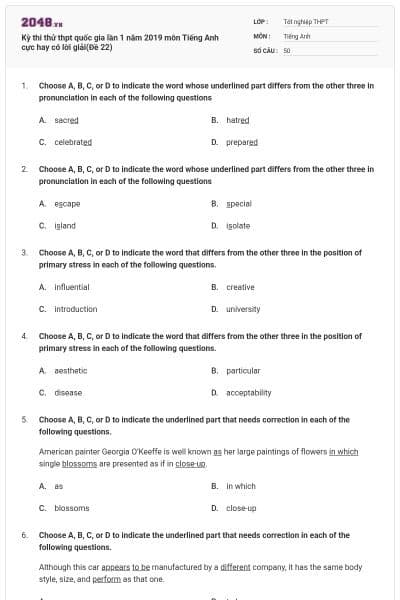
Choose A, B, C, or D to indicate the word whose underlined part differs from the other three in pronunciation in each of the following questions
sacred
hatred
celebrated
prepared
Đáp án D
Sacred /seɪkrəd/
Hatred /ˈheɪtrəd/
Celebrated /ˈsɛləˌbreɪtid/
Prepared /priˈpɛrd/
Choose A, B, C, or D to indicate the word whose underlined part differs from the other three in pronunciation in each of the following questions
escape
special
island
isolate
Đáp án C
Escape /ɪˈskeɪp/
Special /ˈspɛʃəl/
Island /ˈaɪlənd/
Isolate /ˈaɪsəˌleɪt/
Choose A, B, C, or D to indicate the word that differs from the other three in the position of primary stress in each of the following questions.
influential
creative
introduction
university
Đáp án B
Influential /ˌɪnfluˈɛnʃəl/
Creative /kriˈeɪtɪv/
Introduction /ˌɪntrəˈdʌkʃn/
University /ˌjunəˈvɜrsəti/
Choose A, B, C, or D to indicate the word that differs from the other three in the position of primary stress in each of the following questions.
aesthetic
particular
disease
acceptability
Đáp án D
Aesthetic /ɛˈsθɛtɪk/
Particular /pɑr’tikjulər/
Disease /dɪˈziz/
Acceptability /əkˌsɛptəˈbɪləti/
Choose A, B, C, or D to indicate the underlined part that needs correction in each of the following questions.
American painter Georgia O’Keeffe is well known as her large paintings of flowers in which single blossoms are presented as if in close-up.
as
in which
blossoms
close-up
Đáp án A
As => for
Choose A, B, C, or D to indicate the underlined part that needs correction in each of the following questions.
Although this car appears to be manufactured by a different company, it has the same body style, size, and perform as that one.
appears
to be
different
perform
Đáp án D
Choose A, B, C, or D to indicate the underlined part that needs correction in each of the following questions.
Although her severe pain, she tried to walk to the auditorium to attend the meeting.
Although
severe
to walk
to attend
Đáp án A
Although => despite
Mark the letter A, B, C, or D on your answer sheet to indicate the correct answer to each of the following questions.
Luckily, by the time we got there, the painting ______
didn’t sell
hadn’t been sold
wasn’t sold
hadn’t sold
Đáp án B
Mark the letter A, B, C, or D on your answer sheet to indicate the correct answer to each of the following questions.
I remember _______ the letter a few days before going on holiday.
to receive
to have received
received
receiving
Đáp án D
Remember doing sth: nhớ đã làm gì mà không làm
Mark the letter A, B, C, or D on your answer sheet to indicate the correct answer to each of the following questions.
Two grams of butter _________ in this recipe.
is needed
need
are needed
needs
Đáp án A
“Two grams of butter” là chỉ con số => thể bị động
Mark the letter A, B, C, or D on your answer sheet to indicate the correct answer to each of the following questions.
There is one person to ________ I owe more than I can say.
whom
who
that
whose
Đáp án A
Mark the letter A, B, C, or D on your answer sheet to indicate the correct answer to each of the following questions.
Had you known that the river was dangerous, he _______ to swim across it.
would have tried
would try
will not try
wouldn’t have tried
Đáp án D
Câu điều kiện loại 3 ở dạng đảo ngữ
Mark the letter A, B, C, or D on your answer sheet to indicate the correct answer to each of the following questions.
Humans depend on species ________ to provide food, clean air and water.
seperation
division
diversity
difference
Đáp án:
Giải thích: C
Kiến thức: Từ vựng
A. separation (n): sự phân tách, chia cắt
B. division (n): sự phân chia
C. diversity (n): sự đa dạng
D.difference (n): sự khác biệt
Dựa vào nghĩa, chọn C.
Dịch: Con người phụ thuộc vào sự đa dạng loài để cung cấp thực phẩm, không khí sạch và nước.
Mark the letter A, B, C, or D on your answer sheet to indicate the correct answer to each of the following questions.
My car is quite _______ .
economical
economic
economics
economy
Đáp án A
Vị trí cần điền cần một tính từ
Mark the letter A, B, C, or D on your answer sheet to indicate the correct answer to each of the following questions.
In order to avoid boredom, the most important thing is to keep oneself ______
occupation
occupied
occupational
preoccupied
Đáp án B
Mark the letter A, B, C, or D on your answer sheet to indicate the correct answer to each of the following questions.
Don’t be impatient ! I ‘m sure he will turn ________ on time
up
round
on
off
Đáp án A
Turn up: xảy ra, đến
Turn off: tắt
Turn round: thay đổi
Turn on: bật
Mark the letter A, B, C, or D on your answer sheet to indicate the correct answer to each of the following questions.
You’d better _____ animal fat if you want to lower your cholesterol.
cut off
put away
cut down on
put up with
Đáp án C
Cut off: dừng cung cấp cái gì
Put away: ăn nhiều
Cut down on: giảm bớt
Put up with: chịu đựng
Mark the letter A, B, C, or D on your answer sheet to indicate the correct answer to each of the following questions.
Our project was successful ________ its practicality.
in terms of
with a view to
regardless
on behalf of
Đáp án A
In term of: chủ đề bàn luận
With a view to doing sth: mục đích làm gì đó
On behlaf of sb: đại diện
Reguardless: mặc dù
Mark the letter A, B, C, or D on your answer sheet to indicate the correct answer to each of the following questions.
In the middle of the blue river__________.
does a tiny violet flower emerge
did a tiny violet flower emerge
emerge a tiny violet flower
emerged a tiny violet flower
Đáp án D
Mark the letter A, B, C or D on your answer sheet to indicate the most suitable response to
complete each of the following exchanges.
“Let me drive you home.” “ ___________”
No problem.
Don’t worry. I’m all right.
I usually drive home at five.
It’s me.
Đáp án B
A. Không sao cả.
B. Đừng lo lắng. Tôi ổn.
C. Tôi thường lái xe về nhà lúc năm giờ.
D. Đó là tôi.
Mark the letter A, B, C or D on your answer sheet to indicate the most suitable response to
complete each of the following exchanges.
When you see your friend off, you say ‘ _______ !’
Lucky you
Have a good journey
Good night
See you later
Đáp án B
Khi bạn của bạn ra đi, bạn nói ‘_______!’
A. may mắn bạn
B. Có một hành trình tốt
C. Chúc ngủ ngon
D. Hẹn gặp lại sau
Choose A, B, C, or D to indicate the word(s) CLOSEST in meaning to the underlined word(s) in the following questions.
John wants to buy a new car, so he starts setting aside a small part of his monthly earnings.
using up
putting out
spending on
saving up
Đáp án D
Use up; dùng hết
Put out: tắt đèn
Save up; tiết kiệm
Choose A, B, C, or D to indicate the word(s) CLOSEST in meaning to the underlined word(s) in the following questions.
The works of such men as the English philosophers John Locke and Thomas Hobbes helped pave the way for academic freedom in the modern sense.
terminate
prevent
initiate
lighten
Đáp án: C
Giải thích:
Kiến thức: Từ vựng – Từ đồng nghĩa
pave the way: mở đường
Xét các đáp án:
A. terminate (v): chấm dứt
B. prevent (v): ngăn cản
C. initiate (v): bắt đầu
D. lighten (v): làm sáng tỏ
=> pave the way = initiate
Dịch: Các tác phẩm của những triết gia người Anh như John Locke và Thomas Hobbes đã giúp mở đường cho tự do học thuật theo nghĩa hiện đại.
Choose A, B, C, or D to indicate the word(s) OPPOSITE in meaning to the underlined word(s) in each of the following questions.
Fruit and vegetables grew in abundance on the island. The islanders even exported the surplus.
excess
large quantity
small quantity
sufficiency
Đáp án C
excess: dư thừa
large quantity: số lượng lớn
small quantity: số lượng nhỏ
sufficiency: đầy đủ
Choose A, B, C, or D to indicate the word(s) OPPOSITE in meaning to the underlined word(s) in each of the following questions.
Televisions are a standard feature in most hotel rooms.
abnormal
common
customary
typical
Đáp án A
abnormal: bất thường
common: phổ biến
customary: phong tục
typical: điển hình
Mark the letter A, B, C, or D on your answer sheet to indicate the sentence that is closest in meaning to each of the following questions.
She said it had nothing to do with me.
She told me that it was none of my business.
She told me that it had done nothing for me.
She said I did nothing about it.
She said she had done nothing for me.
Đáp án A
Mark the letter A, B, C, or D on your answer sheet to indicate the sentence that is closest in meaning to each of the following questions.
Members are reminded that they are responsible for any damage caused by their guests.
If your guests break anything, you’ll have to pay.
If guests are hurt, members have to look after them.
Please don’t let guests make too much noise.
Please remember to look after guests very politely.
Đáp án A
Các thành viên được nhắc nhở rằng họ chịu trách nhiệm cho bất kỳ thiệt hại nào gây ra từ phía khách hàng của họ.
A. Nếu khách của bạn phá vỡ bất cứ điều gì, bạn sẽ phải trả tiền.
B. Nếu khách bị thương, các thành viên phải chăm sóc họ.
C. Xin đừng để khách gây ra quá nhiều tiếng ồn.
D. Hãy nhớ chăm sóc khách rất lịch sự.
Mark the letter A, B, C, or D on your answer sheet to indicate the sentence that is closest in meaning to each of the following questions.
This material is suitable for students of eighteen years and up.
The material may be suitable for students of over eighteen years of age
This material is suitable for students who are over eighteen.
Only 18-year-old students will find this material suitable.
Students of eighteen years and over can use this material.
Đáp án D
Tài liệu này phù hợp cho sinh viên từ 18 tuổi trở lên.
A. Các tài liệu có thể phù hợp cho sinh viên trên mười tám tuổi.
B. Tài liệu này phù hợp với những sinh viên trên 18 tuổi.
C. Chỉ những học sinh 18 tuổi mới thấy tài liệu này phù hợp.
D. Học sinh từ mười tám tuổi trở lên có thể sử dụng tài liệu này.
Mark the letter A, B, C, or D on your answer sheet to indicate the sentence that best combines each pair of sentences in the following questions.
There is an important difference between humans and chimpanzees. Chimpanzees walk on four legs.
There is an important difference between humans and chimpanzees that walk on four legs.
Chimpanzees walk on four legs, so they are importantly different from humans.
An important difference between humans and chimpanzees is that chimpanzees walk on four legs.
There are important differences between humans and chimpanzees one of which is that chimpanzees walk on four legs.
Đáp án C
Mark the letter A, B, C, or D on your answer sheet to indicate the sentence that best combines each pair of sentences in the following questions.
There were over two hundred people at Carl's trial, most of whom believed that he was not guilty of the crime.
Carl had not committed the crime, and so more than 200 people came to his trial to show their support.
The majority of more than 200 people at Carl's trial didn't think that he had committed the crime.
Over 200 people coming to Carl's trial must have influenced the fact that he was not found guilty of the crime.
When it was announced that Carl had been found not guilty of the crime, there were over 200 people in the audience at his trial.
Đáp án B
Read the following passage and choose A, B, C, or D to indicate the correct word or phrase that best fits each of the following blanks. Fill in the appropriate word in question 31
Voluntary work is work that you do not get paid for and usually involves doing things to help other people, especially the elderly or the sick or working on (31)______ of a charity or similar organization. Most charitable organizations rely on unpaid volunteers, and thousands of Americans and British people give many hours of their time to doing some form of social work or organizing fund- raising events to support the work. Volunteering is especially popular in the US and the reasons this may be found in (32)______ American values such as the Protestant work ethic, the idea that work improves the person who does it, and the belief that people can change their condition if they try hard enough.
In the US young people over 18 can take part in AmeriCorps, a government program that (33)______ them to work as volunteers for a period of time, with the promise of help in paying for their education later. Older Americans who do not work may spend much of their free time volunteering.
In Britain a lot of voluntary work is directed towards supporting the country’s social services. The WRVS and other organizations run a meals on wheels service in many parts of Britain, provide hot meals for old people who are (34)______ to cook for themselves. The nationwide Citizens Advice Bureau, which offers free advice to the public on a wide range of issues, is run mainly by volunteers, and the Blood Transfusion Service relies on voluntary blood donors to give blood for use in hospitals. Political parties use volunteers at election time, and Churches depend on volunteers to (35) _______ building clean.
behalf
basic
account
ground
Đáp án A
On behalf of sb: đại diện
On account of: vì
Read the following passage and choose A, B, C, or D to indicate the correct word or phrase that best fits each of the following blanks. Fill in the appropriate word in question 32
Voluntary work is work that you do not get paid for and usually involves doing things to help other people, especially the elderly or the sick or working on (31)______ of a charity or similar organization. Most charitable organizations rely on unpaid volunteers, and thousands of Americans and British people give many hours of their time to doing some form of social work or organizing fund- raising events to support the work. Volunteering is especially popular in the US and the reasons this may be found in (32)______ American values such as the Protestant work ethic, the idea that work improves the person who does it, and the belief that people can change their condition if they try hard enough.
In the US young people over 18 can take part in AmeriCorps, a government program that (33)______ them to work as volunteers for a period of time, with the promise of help in paying for their education later. Older Americans who do not work may spend much of their free time volunteering.
In Britain a lot of voluntary work is directed towards supporting the country’s social services. The WRVS and other organizations run a meals on wheels service in many parts of Britain, provide hot meals for old people who are (34)______ to cook for themselves. The nationwide Citizens Advice Bureau, which offers free advice to the public on a wide range of issues, is run mainly by volunteers, and the Blood Transfusion Service relies on voluntary blood donors to give blood for use in hospitals. Political parties use volunteers at election time, and Churches depend on volunteers to (35) _______ building clean.
core
primary
top
essential
Đáp án A
In core: từ tận bên trong
Read the following passage and choose A, B, C, or D to indicate the correct word or phrase that best fits each of the following blanks. Fill in the appropriate word in question 33
Voluntary work is work that you do not get paid for and usually involves doing things to help other people, especially the elderly or the sick or working on (31)______ of a charity or similar organization. Most charitable organizations rely on unpaid volunteers, and thousands of Americans and British people give many hours of their time to doing some form of social work or organizing fund- raising events to support the work. Volunteering is especially popular in the US and the reasons this may be found in (32)______ American values such as the Protestant work ethic, the idea that work improves the person who does it, and the belief that people can change their condition if they try hard enough.
In the US young people over 18 can take part in AmeriCorps, a government program that (33)______ them to work as volunteers for a period of time, with the promise of help in paying for their education later. Older Americans who do not work may spend much of their free time volunteering.
In Britain a lot of voluntary work is directed towards supporting the country’s social services. The WRVS and other organizations run a meals on wheels service in many parts of Britain, provide hot meals for old people who are (34)______ to cook for themselves. The nationwide Citizens Advice Bureau, which offers free advice to the public on a wide range of issues, is run mainly by volunteers, and the Blood Transfusion Service relies on voluntary blood donors to give blood for use in hospitals. Political parties use volunteers at election time, and Churches depend on volunteers to (35) _______ building clean.
commissions
guides
encourages
demands
Đáp án C
A. hoa hồng (bóng)
B. hướng dẫn
C. khuyến khích
D. nhu cầu
Read the following passage and choose A, B, C, or D to indicate the correct word or phrase that best fits each of the following blanks. Fill in the appropriate word in question 34
Voluntary work is work that you do not get paid for and usually involves doing things to help other people, especially the elderly or the sick or working on (31)______ of a charity or similar organization. Most charitable organizations rely on unpaid volunteers, and thousands of Americans and British people give many hours of their time to doing some form of social work or organizing fund- raising events to support the work. Volunteering is especially popular in the US and the reasons this may be found in (32)______ American values such as the Protestant work ethic, the idea that work improves the person who does it, and the belief that people can change their condition if they try hard enough.
In the US young people over 18 can take part in AmeriCorps, a government program that (33)______ them to work as volunteers for a period of time, with the promise of help in paying for their education later. Older Americans who do not work may spend much of their free time volunteering.
In Britain a lot of voluntary work is directed towards supporting the country’s social services. The WRVS and other organizations run a meals on wheels service in many parts of Britain, provide hot meals for old people who are (34)______ to cook for themselves. The nationwide Citizens Advice Bureau, which offers free advice to the public on a wide range of issues, is run mainly by volunteers, and the Blood Transfusion Service relies on voluntary blood donors to give blood for use in hospitals. Political parties use volunteers at election time, and Churches depend on volunteers to (35) _______ building clean.
incapable
unable
enabled
offering
Đáp án B
A. không có khả năng
B. không thể
C. có thể, có khả năng
D. cung cấp
Read the following passage and choose A, B, C, or D to indicate the correct word or phrase that best fits each of the following blanks. Fill in the appropriate word in question 35
Voluntary work is work that you do not get paid for and usually involves doing things to help other people, especially the elderly or the sick or working on (31)______ of a charity or similar organization. Most charitable organizations rely on unpaid volunteers, and thousands of Americans and British people give many hours of their time to doing some form of social work or organizing fund- raising events to support the work. Volunteering is especially popular in the US and the reasons this may be found in (32)______ American values such as the Protestant work ethic, the idea that work improves the person who does it, and the belief that people can change their condition if they try hard enough.
In the US young people over 18 can take part in AmeriCorps, a government program that (33)______ them to work as volunteers for a period of time, with the promise of help in paying for their education later. Older Americans who do not work may spend much of their free time volunteering.
In Britain a lot of voluntary work is directed towards supporting the country’s social services. The WRVS and other organizations run a meals on wheels service in many parts of Britain, provide hot meals for old people who are (34)______ to cook for themselves. The nationwide Citizens Advice Bureau, which offers free advice to the public on a wide range of issues, is run mainly by volunteers, and the Blood Transfusion Service relies on voluntary blood donors to give blood for use in hospitals. Political parties use volunteers at election time, and Churches depend on volunteers to (35) _______ building clean.
stay
keep
help
get
Đáp án B
Read the following passage and mark the letter A, B, C, or D on your answer sheet to indicate the correct answer to each of the questions from 36 to 42.
We live in a world of tired, sleep deprived people. In his book Counting Sheep, Paul Martin – a behavioural biologist – describes a society which is just too busy to sleep and which does not give sleeping the importance it deserves.
Modern society has invented reasons not to sleep. We are now a 24/7 society where shops and services must be available all hours. We spend longer hours at work than we used to, and more time getting to work. Mobile phones and email allow us to stay in touch round the clock and late-night TV and the Internet tempt us away from our beds. When we need more time for work or pleasure, the easy solution is to sleep less. The average adult sleeps only 6.2 hours a night during the week, whereas research shows that most people need eight or even eight and a half hours’ sleep to feel at their best. Nowadays, many people have got used to sleeping less than they need and they live in an almost permanent state of ‘sleep debt’.
Until the invention of the electric light in 1879 our daily cycle of sleep used to depend on the hours of daylight. People would get up with the sun and go to bed at nightfall. But nowadays our hours of sleep are mainly determined by our working hours (or our social life) and most people are woken up artificially by an alarm clock. During the day caffeine, the world’s most popular drug, helps to keep us awake. 75% of the world’s population habitually consume caffeine, which up to a point masks the symptoms of sleep deprivation.
What does a chronic lack of sleep do to us? As well as making us irritable and unhappy as humans, it also reduces our motivation and ability to work. This has serious implications for society in general. Doctors, for example, are often chronically sleep deprived, especially when they are on ‘night call’, and may get less than three hours’ sleep. Lack of sleep can seriously impair their mood, judgment, and ability to take decisions. Tired engineers, in the early hours of the morning, made a series of mistakes with catastrophic results. On our roads and motorways lack of sleep kills thousands of people every year. Tests show that a tired driver can be just as dangerous as a drunken driver. However, driving when drunk is against the law but driving when exhausted isn’t. As Paul Martin says, it is very ironic that we admire people who function on very little sleep instead of criticizing them for being irresponsible. Our world would be a much safer, happier place if everyone, whatever their job, slept eight hours a night.
New English File Upper-intermediate by Clive Oxenden and Christina Latham-Koenig, OUP
The phrase “round the clock” in the second paragraph is similar in meaning to______.
surrounded with clocks
all day and night
during the daytime
having a round clock
Đáp án B
Cụm từ "round the clock" trong đoạn thứ hai cũng tương tự như:
A. bao quanh với đồng hồ
B. cả ngày lẫn đêm
C. vào ban ngày
D. có một chiếc đồng hồ tròn
Read the following passage and mark the letter A, B, C, or D on your answer sheet to indicate the correct answer to each of the questions from 36 to 42.
We live in a world of tired, sleep deprived people. In his book Counting Sheep, Paul Martin – a behavioural biologist – describes a society which is just too busy to sleep and which does not give sleeping the importance it deserves.
Modern society has invented reasons not to sleep. We are now a 24/7 society where shops and services must be available all hours. We spend longer hours at work than we used to, and more time getting to work. Mobile phones and email allow us to stay in touch round the clock and late-night TV and the Internet tempt us away from our beds. When we need more time for work or pleasure, the easy solution is to sleep less. The average adult sleeps only 6.2 hours a night during the week, whereas research shows that most people need eight or even eight and a half hours’ sleep to feel at their best. Nowadays, many people have got used to sleeping less than they need and they live in an almost permanent state of ‘sleep debt’.
Until the invention of the electric light in 1879 our daily cycle of sleep used to depend on the hours of daylight. People would get up with the sun and go to bed at nightfall. But nowadays our hours of sleep are mainly determined by our working hours (or our social life) and most people are woken up artificially by an alarm clock. During the day caffeine, the world’s most popular drug, helps to keep us awake. 75% of the world’s population habitually consume caffeine, which up to a point masks the symptoms of sleep deprivation.
What does a chronic lack of sleep do to us? As well as making us irritable and unhappy as humans, it also reduces our motivation and ability to work. This has serious implications for society in general. Doctors, for example, are often chronically sleep deprived, especially when they are on ‘night call’, and may get less than three hours’ sleep. Lack of sleep can seriously impair their mood, judgment, and ability to take decisions. Tired engineers, in the early hours of the morning, made a series of mistakes with catastrophic results. On our roads and motorways lack of sleep kills thousands of people every year. Tests show that a tired driver can be just as dangerous as a drunken driver. However, driving when drunk is against the law but driving when exhausted isn’t. As Paul Martin says, it is very ironic that we admire people who function on very little sleep instead of criticizing them for being irresponsible. Our world would be a much safer, happier place if everyone, whatever their job, slept eight hours a night.
New English File Upper-intermediate by Clive Oxenden and Christina Latham-Koenig, OUP
The writer mentions the Internet in the passage as______.
a temptation that prevents us from sleeping
an easy solution to sleep deprivation
an ineffective means of communication
a factor that is not related to sleep deprivation
Đáp án A
Nhà văn đề cập đến Internet như:
A. một sự cám dỗ ngăn cản chúng ta ngủ
B. một giải pháp dễ dàng để thiếu ngủ
C. một phương tiện giao tiếp không hiệu quả
D. một yếu tố không liên quan đến thiếu ngủ
Read the following passage and mark the letter A, B, C, or D on your answer sheet to indicate the correct answer to each of the questions from 36 to 42.
We live in a world of tired, sleep deprived people. In his book Counting Sheep, Paul Martin – a behavioural biologist – describes a society which is just too busy to sleep and which does not give sleeping the importance it deserves.
Modern society has invented reasons not to sleep. We are now a 24/7 society where shops and services must be available all hours. We spend longer hours at work than we used to, and more time getting to work. Mobile phones and email allow us to stay in touch round the clock and late-night TV and the Internet tempt us away from our beds. When we need more time for work or pleasure, the easy solution is to sleep less. The average adult sleeps only 6.2 hours a night during the week, whereas research shows that most people need eight or even eight and a half hours’ sleep to feel at their best. Nowadays, many people have got used to sleeping less than they need and they live in an almost permanent state of ‘sleep debt’.
Until the invention of the electric light in 1879 our daily cycle of sleep used to depend on the hours of daylight. People would get up with the sun and go to bed at nightfall. But nowadays our hours of sleep are mainly determined by our working hours (or our social life) and most people are woken up artificially by an alarm clock. During the day caffeine, the world’s most popular drug, helps to keep us awake. 75% of the world’s population habitually consume caffeine, which up to a point masks the symptoms of sleep deprivation.
What does a chronic lack of sleep do to us? As well as making us irritable and unhappy as humans, it also reduces our motivation and ability to work. This has serious implications for society in general. Doctors, for example, are often chronically sleep deprived, especially when they are on ‘night call’, and may get less than three hours’ sleep. Lack of sleep can seriously impair their mood, judgment, and ability to take decisions. Tired engineers, in the early hours of the morning, made a series of mistakes with catastrophic results. On our roads and motorways lack of sleep kills thousands of people every year. Tests show that a tired driver can be just as dangerous as a drunken driver. However, driving when drunk is against the law but driving when exhausted isn’t. As Paul Martin says, it is very ironic that we admire people who function on very little sleep instead of criticizing them for being irresponsible. Our world would be a much safer, happier place if everyone, whatever their job, slept eight hours a night.
New English File Upper-intermediate by Clive Oxenden and Christina Latham-Koenig, OUP
According to the third paragraph, which of the following statements is NOT TRUE?
Our social life has no influence on our hours of sleep.
The sun obviously determined our daily routines.
The electric light was invented in the 19th century.
The electric light has changed our daily cycle of sleep.
Đáp án A
câu nào sau đây KHÔNG THẬT?
A. Đời sống xã hội của chúng ta không ảnh hưởng đến giấc ngủ của chúng ta.
B. Mặt trời rõ ràng đã xác định thói quen hàng ngày của chúng tôi.
C. Ánh sáng điện được phát minh vào thế kỷ 19.
D. Ánh sáng điện đã thay đổi chu kỳ ngủ hàng ngày của chúng ta
Read the following passage and mark the letter A, B, C, or D on your answer sheet to indicate the correct answer to each of the questions from 36 to 42.
We live in a world of tired, sleep deprived people. In his book Counting Sheep, Paul Martin – a behavioural biologist – describes a society which is just too busy to sleep and which does not give sleeping the importance it deserves.
Modern society has invented reasons not to sleep. We are now a 24/7 society where shops and services must be available all hours. We spend longer hours at work than we used to, and more time getting to work. Mobile phones and email allow us to stay in touch round the clock and late-night TV and the Internet tempt us away from our beds. When we need more time for work or pleasure, the easy solution is to sleep less. The average adult sleeps only 6.2 hours a night during the week, whereas research shows that most people need eight or even eight and a half hours’ sleep to feel at their best. Nowadays, many people have got used to sleeping less than they need and they live in an almost permanent state of ‘sleep debt’.
Until the invention of the electric light in 1879 our daily cycle of sleep used to depend on the hours of daylight. People would get up with the sun and go to bed at nightfall. But nowadays our hours of sleep are mainly determined by our working hours (or our social life) and most people are woken up artificially by an alarm clock. During the day caffeine, the world’s most popular drug, helps to keep us awake. 75% of the world’s population habitually consume caffeine, which up to a point masks the symptoms of sleep deprivation.
What does a chronic lack of sleep do to us? As well as making us irritable and unhappy as humans, it also reduces our motivation and ability to work. This has serious implications for society in general. Doctors, for example, are often chronically sleep deprived, especially when they are on ‘night call’, and may get less than three hours’ sleep. Lack of sleep can seriously impair their mood, judgment, and ability to take decisions. Tired engineers, in the early hours of the morning, made a series of mistakes with catastrophic results. On our roads and motorways lack of sleep kills thousands of people every year. Tests show that a tired driver can be just as dangerous as a drunken driver. However, driving when drunk is against the law but driving when exhausted isn’t. As Paul Martin says, it is very ironic that we admire people who function on very little sleep instead of criticizing them for being irresponsible. Our world would be a much safer, happier place if everyone, whatever their job, slept eight hours a night.
New English File Upper-intermediate by Clive Oxenden and Christina Latham-Koenig, OUP
The word “which” in the third paragraph refers to______.
reaching a point
masking the symptoms
the world’s population
caffeine consumption
Đáp án D
Từ “which” trong đoạn thứ ba đề cập đến:
A. đạt đến một điểm
B. che giấu các triệu chứng
C. dân số thế giới
D. tiêu thụ caffeine
Read the following passage and mark the letter A, B, C, or D on your answer sheet to indicate the correct answer to each of the questions from 36 to 42.
We live in a world of tired, sleep deprived people. In his book Counting Sheep, Paul Martin – a behavioural biologist – describes a society which is just too busy to sleep and which does not give sleeping the importance it deserves.
Modern society has invented reasons not to sleep. We are now a 24/7 society where shops and services must be available all hours. We spend longer hours at work than we used to, and more time getting to work. Mobile phones and email allow us to stay in touch round the clock and late-night TV and the Internet tempt us away from our beds. When we need more time for work or pleasure, the easy solution is to sleep less. The average adult sleeps only 6.2 hours a night during the week, whereas research shows that most people need eight or even eight and a half hours’ sleep to feel at their best. Nowadays, many people have got used to sleeping less than they need and they live in an almost permanent state of ‘sleep debt’.
Until the invention of the electric light in 1879 our daily cycle of sleep used to depend on the hours of daylight. People would get up with the sun and go to bed at nightfall. But nowadays our hours of sleep are mainly determined by our working hours (or our social life) and most people are woken up artificially by an alarm clock. During the day caffeine, the world’s most popular drug, helps to keep us awake. 75% of the world’s population habitually consume caffeine, which up to a point masks the symptoms of sleep deprivation.
What does a chronic lack of sleep do to us? As well as making us irritable and unhappy as humans, it also reduces our motivation and ability to work. This has serious implications for society in general. Doctors, for example, are often chronically sleep deprived, especially when they are on ‘night call’, and may get less than three hours’ sleep. Lack of sleep can seriously impair their mood, judgment, and ability to take decisions. Tired engineers, in the early hours of the morning, made a series of mistakes with catastrophic results. On our roads and motorways lack of sleep kills thousands of people every year. Tests show that a tired driver can be just as dangerous as a drunken driver. However, driving when drunk is against the law but driving when exhausted isn’t. As Paul Martin says, it is very ironic that we admire people who function on very little sleep instead of criticizing them for being irresponsible. Our world would be a much safer, happier place if everyone, whatever their job, slept eight hours a night.
New English File Upper-intermediate by Clive Oxenden and Christina Latham-Koenig, OUP
Which of the following would the writer of the passage approve of?
Our world would be a much safer place without drinkers.
Both drunken drivers and sleep-deprived people should be criticized.
There is no point in criticizing irresponsible people in our society.
We certainly can function well even when we hardly sleep.
Đáp án B
Tác giả muốn nói lên điều gì?
A. Thế giới của chúng ta sẽ là một nơi an toàn hơn nhiều mà không có người uống rượu.
B. Cả người lái xe say rượu và người bị mất ngủ nên bị chỉ trích.8
C. Không có điểm chỉ trích những người vô trách nhiệm trong xã hội chúng ta.
D. Chúng tôi chắc chắn có thể hoạt động tốt ngay cả khi chúng tôi hầu như không ngủ.
Read the following passage and mark the letter A, B, C, or D on your answer sheet to indicate the correct answer to each of the questions from 36 to 42.
We live in a world of tired, sleep deprived people. In his book Counting Sheep, Paul Martin – a behavioural biologist – describes a society which is just too busy to sleep and which does not give sleeping the importance it deserves.
Modern society has invented reasons not to sleep. We are now a 24/7 society where shops and services must be available all hours. We spend longer hours at work than we used to, and more time getting to work. Mobile phones and email allow us to stay in touch round the clock and late-night TV and the Internet tempt us away from our beds. When we need more time for work or pleasure, the easy solution is to sleep less. The average adult sleeps only 6.2 hours a night during the week, whereas research shows that most people need eight or even eight and a half hours’ sleep to feel at their best. Nowadays, many people have got used to sleeping less than they need and they live in an almost permanent state of ‘sleep debt’.
Until the invention of the electric light in 1879 our daily cycle of sleep used to depend on the hours of daylight. People would get up with the sun and go to bed at nightfall. But nowadays our hours of sleep are mainly determined by our working hours (or our social life) and most people are woken up artificially by an alarm clock. During the day caffeine, the world’s most popular drug, helps to keep us awake. 75% of the world’s population habitually consume caffeine, which up to a point masks the symptoms of sleep deprivation.
What does a chronic lack of sleep do to us? As well as making us irritable and unhappy as humans, it also reduces our motivation and ability to work. This has serious implications for society in general. Doctors, for example, are often chronically sleep deprived, especially when they are on ‘night call’, and may get less than three hours’ sleep. Lack of sleep can seriously impair their mood, judgment, and ability to take decisions. Tired engineers, in the early hours of the morning, made a series of mistakes with catastrophic results. On our roads and motorways lack of sleep kills thousands of people every year. Tests show that a tired driver can be just as dangerous as a drunken driver. However, driving when drunk is against the law but driving when exhausted isn’t. As Paul Martin says, it is very ironic that we admire people who function on very little sleep instead of criticizing them for being irresponsible. Our world would be a much safer, happier place if everyone, whatever their job, slept eight hours a night.
New English File Upper-intermediate by Clive Oxenden and Christina Latham-Koenig, OUP
All of the following are mentioned as those whose performance is affected by ‘sleep debt’ EXCEPT_____.
doctors
drivers
biologists
engineers
Đáp án C
Tất cả những điều sau đây được đề cập là những người có hiệu suất bị ảnh hưởng bởi “sleep debt” trừ:
A. bác sĩ
B. tài xế
C. sinh vật học
D. kỹ sư
Read the following passage and mark the letter A, B, C, or D on your answer sheet to indicate the correct answer to each of the questions from 36 to 42.
We live in a world of tired, sleep deprived people. In his book Counting Sheep, Paul Martin – a behavioural biologist – describes a society which is just too busy to sleep and which does not give sleeping the importance it deserves.
Modern society has invented reasons not to sleep. We are now a 24/7 society where shops and services must be available all hours. We spend longer hours at work than we used to, and more time getting to work. Mobile phones and email allow us to stay in touch round the clock and late-night TV and the Internet tempt us away from our beds. When we need more time for work or pleasure, the easy solution is to sleep less. The average adult sleeps only 6.2 hours a night during the week, whereas research shows that most people need eight or even eight and a half hours’ sleep to feel at their best. Nowadays, many people have got used to sleeping less than they need and they live in an almost permanent state of ‘sleep debt’.
Until the invention of the electric light in 1879 our daily cycle of sleep used to depend on the hours of daylight. People would get up with the sun and go to bed at nightfall. But nowadays our hours of sleep are mainly determined by our working hours (or our social life) and most people are woken up artificially by an alarm clock. During the day caffeine, the world’s most popular drug, helps to keep us awake. 75% of the world’s population habitually consume caffeine, which up to a point masks the symptoms of sleep deprivation.
What does a chronic lack of sleep do to us? As well as making us irritable and unhappy as humans, it also reduces our motivation and ability to work. This has serious implications for society in general. Doctors, for example, are often chronically sleep deprived, especially when they are on ‘night call’, and may get less than three hours’ sleep. Lack of sleep can seriously impair their mood, judgment, and ability to take decisions. Tired engineers, in the early hours of the morning, made a series of mistakes with catastrophic results. On our roads and motorways lack of sleep kills thousands of people every year. Tests show that a tired driver can be just as dangerous as a drunken driver. However, driving when drunk is against the law but driving when exhausted isn’t. As Paul Martin says, it is very ironic that we admire people who function on very little sleep instead of criticizing them for being irresponsible. Our world would be a much safer, happier place if everyone, whatever their job, slept eight hours a night.
New English File Upper-intermediate by Clive Oxenden and Christina Latham-Koenig, OUP
Which of the following could best serve as the title of the passage?
Accident Prevention: Urgent!
Sleep Deprivation: Causes and Effects
A Society of Sleepless People
A Well-known Biologist
Đáp án B
Điều nào sau đây có thể là tiêu đề của đoạn văn?
A. Phòng chống tai nạn: Khẩn cấp!
B. Thiếu ngủ: Nguyên nhân và hiệu ứng
C. Một xã hội của những người không ngủ
D. Một nhà sinh vật học nổi tiếng
Read the following passage and mark the letter A, B, C or D on your answer sheet to choose the best answer for each of the question from 43- 50
American movies create myths about college life in the United States. These stories are entertaining, but they are not true. You have to look beyond Hollywood movies to understand what college is really like.
Thanks to the movies, many people believe that college students party and socialize more than they study. Movies almost never show students working hard in class or in the library. Instead, movies show them eating, talking, hanging out, or dancing to loud music at wild parties. While it is true that American students have the freedom to participate in activities, they also have academic responsibilities. In order to succeed, they have to attend classes and study hard.
Another movie myth is that athletics is the only important extracurricular activity. In fact, there is a wide variety of nonacademic activities on campus such as special clubs, service organizations, art, and theater programs. This variety allows students to choose what interests them. Even more important, after graduation, students’ résumés look better to employers if they list a few extracurricular activities.
Most students in the movies can easily afford higher education. If only this were true! While it is true that some American college students are wealthy, most are from families with moderate incomes. Up to 80% of them get some type of financial aid. Students from middle and lower-income families often work part-time throughout their college years. There is one thing that many college students have in common, but it is not something you will see in the movies. They have parents who think higher education is a priority, a necessary and important part of their children's lives.
Movies about college life usually have characters that are extreme in some way: super athletic, super intelligent, super wealthy, super glamorous, etc. Movies use these stereotypes, along with other myths of romance and adventure because audiences like going to movies that include these elements. Of course, real college students are not like movie characters at all.
So the next time you want a taste of the college experience, do not go to the movies. Look at some college websites or brochures instead. Take a walk around your local college campus. Visit a few classes. True, you may not be able to see the same people or exciting action you will see in the movies, but you can be sure that there are plenty of academic adventures going on all around you!
Which of the following is true according to the passage?
American students do not like to watch Hollywood movies.
You should see college movies to understand college life.
American colleges in the movies are not like those in reality.
Movies about college life are similar to life and fun to watch.
Đáp án C
Điều nào sau đây là đúng?
A. Sinh viên Mỹ không thích xem phim Hollywood.
B. Bạn nên xem phim đại học để hiểu cuộc sống đại học.
C. Các trường đại học Mỹ trong các bộ phim không giống như những người trong thực tế.
D. Phim về cuộc sống đại học tương tự như cuộc sống và niềm vui để xem.
Read the following passage and mark the letter A, B, C or D on your answer sheet to choose the best answer for each of the question from 43- 50
American movies create myths about college life in the United States. These stories are entertaining, but they are not true. You have to look beyond Hollywood movies to understand what college is really like.
Thanks to the movies, many people believe that college students party and socialize more than they study. Movies almost never show students working hard in class or in the library. Instead, movies show them eating, talking, hanging out, or dancing to loud music at wild parties. While it is true that American students have the freedom to participate in activities, they also have academic responsibilities. In order to succeed, they have to attend classes and study hard.
Another movie myth is that athletics is the only important extracurricular activity. In fact, there is a wide variety of nonacademic activities on campus such as special clubs, service organizations, art, and theater programs. This variety allows students to choose what interests them. Even more important, after graduation, students’ résumés look better to employers if they list a few extracurricular activities.
Most students in the movies can easily afford higher education. If only this were true! While it is true that some American college students are wealthy, most are from families with moderate incomes. Up to 80% of them get some type of financial aid. Students from middle and lower-income families often work part-time throughout their college years. There is one thing that many college students have in common, but it is not something you will see in the movies. They have parents who think higher education is a priority, a necessary and important part of their children's lives.
Movies about college life usually have characters that are extreme in some way: super athletic, super intelligent, super wealthy, super glamorous, etc. Movies use these stereotypes, along with other myths of romance and adventure because audiences like going to movies that include these elements. Of course, real college students are not like movie characters at all.
So the next time you want a taste of the college experience, do not go to the movies. Look at some college websites or brochures instead. Take a walk around your local college campus. Visit a few classes. True, you may not be able to see the same people or exciting action you will see in the movies, but you can be sure that there are plenty of academic adventures going on all around you!
Which of the following is NOT true?
There is a wide choice of extracurricular activities for college students.
Extracurricular activities are of no importance to employers.
Not all extracurricular activities are students’ academic responsibilities.
Learning is not only part of students’ college life.
Đáp án B
Điều nào sau đây KHÔNG đúng?
A. Có nhiều lựa chọn các hoạt động ngoại khóa cho sinh viên đại học.
B. Các hoạt động ngoại khóa không quan trọng đối với người sử dụng lao động.
C. Không phải tất cả các hoạt động ngoại khóa đều là trách nhiệm học tập của học sinh.
D. Học tập không chỉ là một phần của cuộc sống đại học của học sinh.
Read the following passage and mark the letter A, B, C or D on your answer sheet to choose the best answer for each of the question from 43- 50
American movies create myths about college life in the United States. These stories are entertaining, but they are not true. You have to look beyond Hollywood movies to understand what college is really like.
Thanks to the movies, many people believe that college students party and socialize more than they study. Movies almost never show students working hard in class or in the library. Instead, movies show them eating, talking, hanging out, or dancing to loud music at wild parties. While it is true that American students have the freedom to participate in activities, they also have academic responsibilities. In order to succeed, they have to attend classes and study hard.
Another movie myth is that athletics is the only important extracurricular activity. In fact, there is a wide variety of nonacademic activities on campus such as special clubs, service organizations, art, and theater programs. This variety allows students to choose what interests them. Even more important, after graduation, students’ résumés look better to employers if they list a few extracurricular activities.
Most students in the movies can easily afford higher education. If only this were true! While it is true that some American college students are wealthy, most are from families with moderate incomes. Up to 80% of them get some type of financial aid. Students from middle and lower-income families often work part-time throughout their college years. There is one thing that many college students have in common, but it is not something you will see in the movies. They have parents who think higher education is a priority, a necessary and important part of their children's lives.
Movies about college life usually have characters that are extreme in some way: super athletic, super intelligent, super wealthy, super glamorous, etc. Movies use these stereotypes, along with other myths of romance and adventure because audiences like going to movies that include these elements. Of course, real college students are not like movie characters at all.
So the next time you want a taste of the college experience, do not go to the movies. Look at some college websites or brochures instead. Take a walk around your local college campus. Visit a few classes. True, you may not be able to see the same people or exciting action you will see in the movies, but you can be sure that there are plenty of academic adventures going on all around you!
The word “they” in the third paragraph refers to ______.
activities
résumés
employers
students
Đáp án B
Từ “they” trong đoạn thứ ba đề cập đến:
A. hoạt động
B. résumés (CV) hồ sơ xin việc
C. nhà tuyển dụng
D. sinh viên
Read the following passage and mark the letter A, B, C or D on your answer sheet to choose the best answer for each of the question from 43- 50
American movies create myths about college life in the United States. These stories are entertaining, but they are not true. You have to look beyond Hollywood movies to understand what college is really like.
Thanks to the movies, many people believe that college students party and socialize more than they study. Movies almost never show students working hard in class or in the library. Instead, movies show them eating, talking, hanging out, or dancing to loud music at wild parties. While it is true that American students have the freedom to participate in activities, they also have academic responsibilities. In order to succeed, they have to attend classes and study hard.
Another movie myth is that athletics is the only important extracurricular activity. In fact, there is a wide variety of nonacademic activities on campus such as special clubs, service organizations, art, and theater programs. This variety allows students to choose what interests them. Even more important, after graduation, students’ résumés look better to employers if they list a few extracurricular activities.
Most students in the movies can easily afford higher education. If only this were true! While it is true that some American college students are wealthy, most are from families with moderate incomes. Up to 80% of them get some type of financial aid. Students from middle and lower-income families often work part-time throughout their college years. There is one thing that many college students have in common, but it is not something you will see in the movies. They have parents who think higher education is a priority, a necessary and important part of their children's lives.
Movies about college life usually have characters that are extreme in some way: super athletic, super intelligent, super wealthy, super glamorous, etc. Movies use these stereotypes, along with other myths of romance and adventure because audiences like going to movies that include these elements. Of course, real college students are not like movie characters at all.
So the next time you want a taste of the college experience, do not go to the movies. Look at some college websites or brochures instead. Take a walk around your local college campus. Visit a few classes. True, you may not be able to see the same people or exciting action you will see in the movies, but you can be sure that there are plenty of academic adventures going on all around you!
The word “moderate” in the fourth paragraph is closest in meaning to “______”.
not steady
sensible
unlimited
not high
Đáp án D
Từ “moderate” trong đoạn thứ tư gần nghĩa với:
A. không ổn định
B. hợp lý
C. không giới hạn
D. không cao
Read the following passage and mark the letter A, B, C or D on your answer sheet to choose the best answer for each of the question from 43- 50
American movies create myths about college life in the United States. These stories are entertaining, but they are not true. You have to look beyond Hollywood movies to understand what college is really like.
Thanks to the movies, many people believe that college students party and socialize more than they study. Movies almost never show students working hard in class or in the library. Instead, movies show them eating, talking, hanging out, or dancing to loud music at wild parties. While it is true that American students have the freedom to participate in activities, they also have academic responsibilities. In order to succeed, they have to attend classes and study hard.
Another movie myth is that athletics is the only important extracurricular activity. In fact, there is a wide variety of nonacademic activities on campus such as special clubs, service organizations, art, and theater programs. This variety allows students to choose what interests them. Even more important, after graduation, students’ résumés look better to employers if they list a few extracurricular activities.
Most students in the movies can easily afford higher education. If only this were true! While it is true that some American college students are wealthy, most are from families with moderate incomes. Up to 80% of them get some type of financial aid. Students from middle and lower-income families often work part-time throughout their college years. There is one thing that many college students have in common, but it is not something you will see in the movies. They have parents who think higher education is a priority, a necessary and important part of their children's lives.
Movies about college life usually have characters that are extreme in some way: super athletic, super intelligent, super wealthy, super glamorous, etc. Movies use these stereotypes, along with other myths of romance and adventure because audiences like going to movies that include these elements. Of course, real college students are not like movie characters at all.
So the next time you want a taste of the college experience, do not go to the movies. Look at some college websites or brochures instead. Take a walk around your local college campus. Visit a few classes. True, you may not be able to see the same people or exciting action you will see in the movies, but you can be sure that there are plenty of academic adventures going on all around you!
Which of the following is NOT mentioned in the passage?
Most college students’ families are not well-off.
All college students have to work part-time.
It is important for students to get higher education.
Most students in the movies can afford college expenses.
Đáp án B
Điều nào sau đây KHÔNG được đề cập trong đoạn văn?
A. Hầu hết các gia đình sinh viên đại học đều không tốt.
B. Tất cả sinh viên đại học phải làm việc bán thời gian.
C. Điều quan trọng là học sinh phải học cao hơn.
D. Hầu hết các sinh viên trong các bộ phim có thể đủ khả năng chi phí đại học.
Read the following passage and mark the letter A, B, C or D on your answer sheet to choose the best answer for each of the question from 43- 50
American movies create myths about college life in the United States. These stories are entertaining, but they are not true. You have to look beyond Hollywood movies to understand what college is really like.
Thanks to the movies, many people believe that college students party and socialize more than they study. Movies almost never show students working hard in class or in the library. Instead, movies show them eating, talking, hanging out, or dancing to loud music at wild parties. While it is true that American students have the freedom to participate in activities, they also have academic responsibilities. In order to succeed, they have to attend classes and study hard.
Another movie myth is that athletics is the only important extracurricular activity. In fact, there is a wide variety of nonacademic activities on campus such as special clubs, service organizations, art, and theater programs. This variety allows students to choose what interests them. Even more important, after graduation, students’ résumés look better to employers if they list a few extracurricular activities.
Most students in the movies can easily afford higher education. If only this were true! While it is true that some American college students are wealthy, most are from families with moderate incomes. Up to 80% of them get some type of financial aid. Students from middle and lower-income families often work part-time throughout their college years. There is one thing that many college students have in common, but it is not something you will see in the movies. They have parents who think higher education is a priority, a necessary and important part of their children's lives.
Movies about college life usually have characters that are extreme in some way: super athletic, super intelligent, super wealthy, super glamorous, etc. Movies use these stereotypes, along with other myths of romance and adventure because audiences like going to movies that include these elements. Of course, real college students are not like movie characters at all.
So the next time you want a taste of the college experience, do not go to the movies. Look at some college websites or brochures instead. Take a walk around your local college campus. Visit a few classes. True, you may not be able to see the same people or exciting action you will see in the movies, but you can be sure that there are plenty of academic adventures going on all around you!
American parents believe in ______.
the necessity of higher education in their children's lives
the quality of their children's college lives
the extracurricular activities that help ensure their children’s jobs
how movie-makers describe American college life
Đáp án A
Cha mẹ người Mỹ tin vào:
A. sự cần thiết của giáo dục đại học trong cuộc sống của trẻ em
B. chất lượng cuộc sống đại học của con em họ10
C. các hoạt động ngoại khóa giúp đảm bảo công việc của con cái họ
D. cách các nhà làm phim mô tả cuộc sống đại học Mỹ
Read the following passage and mark the letter A, B, C or D on your answer sheet to choose the best answer for each of the question from 43- 50
American movies create myths about college life in the United States. These stories are entertaining, but they are not true. You have to look beyond Hollywood movies to understand what college is really like.
Thanks to the movies, many people believe that college students party and socialize more than they study. Movies almost never show students working hard in class or in the library. Instead, movies show them eating, talking, hanging out, or dancing to loud music at wild parties. While it is true that American students have the freedom to participate in activities, they also have academic responsibilities. In order to succeed, they have to attend classes and study hard.
Another movie myth is that athletics is the only important extracurricular activity. In fact, there is a wide variety of nonacademic activities on campus such as special clubs, service organizations, art, and theater programs. This variety allows students to choose what interests them. Even more important, after graduation, students’ résumés look better to employers if they list a few extracurricular activities.
Most students in the movies can easily afford higher education. If only this were true! While it is true that some American college students are wealthy, most are from families with moderate incomes. Up to 80% of them get some type of financial aid. Students from middle and lower-income families often work part-time throughout their college years. There is one thing that many college students have in common, but it is not something you will see in the movies. They have parents who think higher education is a priority, a necessary and important part of their children's lives.
Movies about college life usually have characters that are extreme in some way: super athletic, super intelligent, super wealthy, super glamorous, etc. Movies use these stereotypes, along with other myths of romance and adventure because audiences like going to movies that include these elements. Of course, real college students are not like movie characters at all.
So the next time you want a taste of the college experience, do not go to the movies. Look at some college websites or brochures instead. Take a walk around your local college campus. Visit a few classes. True, you may not be able to see the same people or exciting action you will see in the movies, but you can be sure that there are plenty of academic adventures going on all around you!
Many American students have to work part-time throughout their college years because ______.
they are not allowed to work full-time
their parents force them to
they can earn money for their expenses
they want to gain experience
Đáp án C
Nhiều sinh viên Mỹ phải làm việc bán thời gian trong suốt năm đại học của họ bởi vì:
A. họ không được phép làm việc toàn thời gian
B. cha mẹ của họ buộc họ phải
C. họ có thể kiếm tiền cho chi phí của họ
D. họ muốn có được kinh nghiệm
Read the following passage and mark the letter A, B, C or D on your answer sheet to choose the best answer for each of the question from 43- 50
American movies create myths about college life in the United States. These stories are entertaining, but they are not true. You have to look beyond Hollywood movies to understand what college is really like.
Thanks to the movies, many people believe that college students party and socialize more than they study. Movies almost never show students working hard in class or in the library. Instead, movies show them eating, talking, hanging out, or dancing to loud music at wild parties. While it is true that American students have the freedom to participate in activities, they also have academic responsibilities. In order to succeed, they have to attend classes and study hard.
Another movie myth is that athletics is the only important extracurricular activity. In fact, there is a wide variety of nonacademic activities on campus such as special clubs, service organizations, art, and theater programs. This variety allows students to choose what interests them. Even more important, after graduation, students’ résumés look better to employers if they list a few extracurricular activities.
Most students in the movies can easily afford higher education. If only this were true! While it is true that some American college students are wealthy, most are from families with moderate incomes. Up to 80% of them get some type of financial aid. Students from middle and lower-income families often work part-time throughout their college years. There is one thing that many college students have in common, but it is not something you will see in the movies. They have parents who think higher education is a priority, a necessary and important part of their children's lives.
Movies about college life usually have characters that are extreme in some way: super athletic, super intelligent, super wealthy, super glamorous, etc. Movies use these stereotypes, along with other myths of romance and adventure because audiences like going to movies that include these elements. Of course, real college students are not like movie characters at all.
So the next time you want a taste of the college experience, do not go to the movies. Look at some college websites or brochures instead. Take a walk around your local college campus. Visit a few classes. True, you may not be able to see the same people or exciting action you will see in the movies, but you can be sure that there are plenty of academic adventures going on all around you!
Which of the following could best serve as the title of the passage?
Extracurricular Activities and Job Opportunities
American College Life and the Movies
Hollywood Movies: The Best About College Life
Going to College: The Only Way to Succeed in Life
Đáp án B
Điều nào sau đây có thể làm tiêu đề của đoạn văn?
A. Các hoạt động ngoại khóa và cơ hội việc làm
B. Cuộc sống đại học Mỹ và phim ảnh
C. Phim Hollywood: điều tuyệt nhất về cuộc sống đại học
D. Đi học đại học: Con đường duy nhất để thành công trong cuộc sống