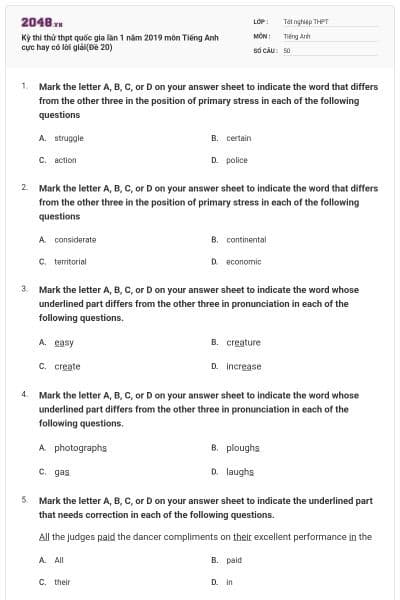
Kỳ thi thử thpt quốc gia lần 1 năm 2019 môn Tiếng Anh cực hay có lời giải(Đề 20)
50 câu hỏi
Mark the letter A, B, C, or D on your answer sheet to indicate the word that differs from the other three in the position of primary stress in each of the following questions
struggle
certain
action
police
Đáp án D
struggle | ˈstrʌgl |
certain | ˈsɜːtn |
action | ˈækʃ(ə)n |
police | pəˈliːs |
Mark the letter A, B, C, or D on your answer sheet to indicate the word that differs from the other three in the position of primary stress in each of the following questions
considerate
continental
territorial
economic
Đáp án A
considerate | kənˈsɪdərɪt |
continental | ˌkɒntɪˈnɛntl |
territorial | ˌtɛrɪˈtɔːrɪəl |
economic | ˌiːkəˈnɒmɪk |
Mark the letter A, B, C, or D on your answer sheet to indicate the word whose underlined part differs from the other three in pronunciation in each of the following questions.
easy
creature
create
increase
Đáp án C
easy/ˈizi/
creature/ˈkriʧər/
createkri/ˈeɪt/
increase/ˈɪnˌkris/
Mark the letter A, B, C, or D on your answer sheet to indicate the word whose underlined part differs from the other three in pronunciation in each of the following questions.
photographs
ploughs
gas
laughs
Đáp án B
photographs | ˈfoʊtəˌgræfs |
ploughs | plaʊz |
gas | gæs |
laughs | læfs |
Mark the letter A, B, C, or D on your answer sheet to indicate the underlined part that needs correction in each of the following questions.
All the judges paid the dancer compliments on their excellent performance in the
All
paid
their
in
Đáp án C
Their => her/his
Mark the letter A, B, C, or D on your answer sheet to indicate the underlined part that needs correction in each of the following questions.
Overpopulation is a short way to lead to poor, illiteracy and social evils.
Overpopulation
short way
poor
illiteracy
Đáp án: C
Giải thích:
Cấu trúc: lead to something: dẫn tới cái gì
poor (adj): nghèo nàn
povery (n): cái nghèo, nạn đói
Sửa: poor → poverty
Dịch: Dân số quá đông là con đường ngắn nhất dẫn đến nạn đói, nạn mù chữ và tệ nạn xã hội.
Mark the letter A, B, C, or D on your answer sheet to indicate the underlined part that needs correction in each of the following questions.
To save energy, all the lights should be turned off before going out.
To save
should
turned off
going out
Đáp án D
Before + Ving chỉ khi 2 mệnh đề cùng chủ ngữ, chủ ngữ của mệnh đề chính là “all the lights”
Mark the letter A, B, C, or D on your answer sheet to indicate the correct answer to each of the following questions.
My grandfather _______ for this company for over thirty years and then retired.
worked
works
is working
has worked
Đáp án A
“Then retired” được dùng ở thì quá khứ
-> hành động “work for this company” xảy ra trong quá khứ
Mark the letter A, B, C, or D on your answer sheet to indicate the correct answer to each of the following questions.
More and more investors are pouring ______money into food and beverage start-ups.
an
the
a
Ø
Đáp án D
“money” không đếm được
Mark the letter A, B, C, or D on your answer sheet to indicate the correct answer to each of the following questions.
Paul has just sold his _______ car and intends to buy a new one.
black old Japanese
Japanese old black
old black Japanese
old Japanese black
Đáp án C
OSACOMP = Opinion, Size,Shape, Age, Color, Origin and Material.
Old = Age
Black = Color,
Origin = Japanese
Mark the letter A, B, C, or D on your answer sheet to indicate the correct answer to each of the following questions.
When asked about their preference for movies, many young people say that they are in favor ________ science fiction.
for
of
in
with
Đáp án B
to be in favour of something/somebody: ủng hộ ai hoặc cái gì, trong trường hợp này có thể được hiểu với nghĩa
Mark the letter A, B, C, or D on your answer sheet to indicate the correct answer to each of the following questions.
The larger the area of forest is destroyed, _________
the most frequent natural disasters are
the most frequently natural disasters occur
the more frequent are natural disasters
the more frequently natural disasters occur
Đáp án D
So sánh hơn + mệnh đề: Càng...thì càng... Đáp án C tuy đúng cấu trúc nhưng nghĩa không hợp lí, Thiên tai xảy ra thường xuyên chứ không “là thường xuyên”
Mark the letter A, B, C, or D on your answer sheet to indicate the correct answer to each of the following questions.
The rumors go that Jack will be arrested.He is said _______ a bloody robbery.
to have taken part in
to have joined in
to join in
to take part in
Đáp án: A
Giải thích:
Cấu trúc : take part in = join: tham gia tham dự
Loại 2 đáp án B và C vì “join in”.
Ta có: S + be + thought/ said/ supposed... + to V/to have VpII
Dùng “to V” nếu không có sự chênh lệch về thì, hành động ở hiện tại/tương lai
Dùng “to have VpII” nếu có sự chệnh lệch về thì, hành động đã xảy ra
Ở đây ta thấy hành động “take part in” đã xảy ra, nên dùng A.
Dịch: Có tin đồn rằng Jack sẽ bị bắt. Người ta nói rằng anh ta đã tham gia vào một vụ cướp đẫm máu.
Mark the letter A, B, C, or D on your answer sheet to indicate the correct answer to each of the following questions.
Each nation has many people who ______ take care of others.
volunteers
volunteer
voluntary
voluntarily
Đáp án D
Mark the letter A, B, C, or D on your answer sheet to indicate the correct answer to each of the following questions.
Mr. Brown has kindly agreed to spare us some of his ______time to answer our questions.
valuable
worthy
costly
beneficial
Đáp án A
valuable: quý giá
worthy: đáng (nỗ lực cố gắng)
costly: đắt đỏ, chỉ giá cả
benificial: lợi ích, có lợi
Mark the letter A, B, C, or D on your answer sheet to indicate the correct answer to each of the following questions.
It’s hard to __________on less than a million a month.
make a mess
make up your mind
make ends meet
make a fuss
Đáp án C
Make ends meet: kiếm (đủ) sống.
Make up your mind: đưa ra quyết định
Make a mess of sth: làm hỏng cái gì
Make a fussn of sb: đối xử tốt với ai đó
“less than a million a month” : ít hơn 1 triệu 1 tháng -> ý nói về tài chính
Mark the letter A, B, C, or D on your answer sheet to indicate the correct answer to each of the following questions.
Mr. Dawson was given the award in _______ of his services to the hospital.
spite
charge
recognition
sight
Đáp án C
In charge of: chịu trách nhiệm cho việc gì
Mark the letter A, B, C, or D on your answer sheet to indicate the correct answer to each of the following questions.
When the manager of our company retires, the deputy manager will ______that position.
stand for
take over
catch on
hold on
Đáp án: B
Giải thích:
Kiến thức: Cụm động từ
A. stand for: đại diện cho, là viết tắt của
B. take over: chiếm lấy, đảm nhiệm thay, tiếp quản
C. catch on: trở nên phổ biến
D. hold on: chờ
Dựa vào nghĩa, chọn B.
Dịch: Khi giám đốc công ty chúng tôi nghỉ hưu, phó giám đốc sẽ tiếp quản vị trí đó.
Mark the letter A, B, C, or D on your answer sheet to indicate the correct answer to each of the following questions.
I think I should have _______ your mother while I was passing.
dropped in on
come up with
got on with
run into
Đáp án A
Come up with = nảy ra (ý tưởng,…)
Drop in = ghé qua (không có báo trước)
Get on with = bắt đầu hoặc tiếp tục làm việc
Run into = tình cờ gặp mặt
Mark the letter A, B, C, or D on your answer sheet to indicate the most suitable response to complete each of the following exchanges.
Liz is telling Andrew about her first novel.
Liz. "Guess what? My first novel has just been published.
" Andrew. "____________"
It's my pleasure.
Congratulations!
Better luck next time!
It's very kind of you.
Đáp án B
A. Đó là niềm vui của tôi.
B. Xin chúc mừng!
C. Chúc may mắn lần tới!
D. Nó rất tốt.
Mark the letter A, B, C, or D on your answer sheet to indicate the most suitable response to complete each of the following exchanges.
Mrs. Smith and her students are visiting the zoo.
Mike. "Can I feed the gorilla, Mrs. Smith?"
Mrs. Smith. "______”.The sign says 'No feeding the animals'."
Of course you can
I don't think it works
I'm sure about that
I'm afraid not
Đáp án D
A. Tất nhiên bạn có thể
B. Tôi không nghĩ rằng nó hoạt động
C. Tôi chắc chắn về điều đó
D. Tôi không sợ
Mark the letter A, B, C, or D on your answer sheet to indicate the word or phrase that is CLOSEST in meaning to the underlined part in each of the following questions.
The place has rapidly evolved from a small fishing community into a thriving tourist resort.
developed
generated
created
increased
Đáp án A
Developed: phát triển
Generated: tạo ra
Created: sáng tạo
Increased: tăng cao
Mark the letter A, B, C, or D on your answer sheet to indicate the word or phrase that is CLOSEST in meaning to the underlined part in each of the following questions.
I'm sure he will be home and dry in the interview because he has good qualifications and wide experience.
be unsuccessful
be satisfied
be successful
be unsatisfied
Đáp án C
Unsuccessful: không thành công
Satisfied: hài lòng
Successful: thành công
Unsatisfied: không hài lòng
Mark the letter A, B, C, or D on your answer sheet to indicate the word or phrase that is OPPOSITE in meaning to the underlined part in each of the following questions.
Don't tell Jane anything about the surprise party for Jack. She has got a big mouth.
can't eat a lot
hates parties
talks too much
can keep secrets
Đáp án D
Big mouth: nhiều chuyện, không thể giữ bios mật bất cứ chuyện gì
Mark the letter A, B, C, or D on your answer sheet to indicate the word or phrase that is OPPOSITE in meaning to the underlined part in each of the following questions.
He usually stays in peace in stressful situations but this time he really lost his head.
kept calm
excited
lost his temper
lost touch
Đáp án A
Lost sb’s head = lost sb’s temper = tức giận
Keep calm: bình tĩnh
Lost touch: mất liên lạc
Mark the letter A, B, C, or D on your answer sheet to indicate the sentence that is closest in meaning to each of the following questions.
“It was your fault. You broke my windows,” said the woman to him.
The woman insisted him on breaking her windows.
The woman advised him to break her windows.
The woman told him to break her windows.
The woman blamed him for having broken her windows.
Đáp án D
"Đó là lỗi của anh. Anh đã phá vỡ cửa sổ của tôi, "người phụ nữ nói với anh ta.
A. Người phụ nữ khăng khăng đòi anh phá cửa sổ.
B. Người phụ nữ khuyên anh ta phá cửa sổ của cô.
C. Người phụ nữ nói với anh ta để phá vỡ cửa sổ của cô.
D. Người phụ nữ đổ lỗi cho anh vì đã phá vỡ cửa sổ của cô.
Mark the letter A, B, C, or D on your answer sheet to indicate the sentence that is closest in meaning to each of the following questions.
After I had written my composition, I handed it to my teacher.
Writing the composition, I handed it to my teacher.
Having written my composition, I handed it to my teacher.
Handing the composition, I had written my composition
Handed the composition to my teacher, I wrote it.
Đáp án B
Sau khi tôi viết bài viết của mình, tôi đưa nó cho giáo viên của mình.
A, C, D sai thì của câu
Mark the letter A, B, C, or D on your answer sheet to indicate the sentence that is closest in meaning to each of the following questions.
They were late for the meeting because of the heavy snow.
If it snowed heavily, they would be late for the meeting.
Had it not snowed heavily, they would have been late for the meeting.
But for the heavy snow, they wouldn't have been late for the meeting.
If it didn't snow heavily, they wouldn't be late for the meeting.
Đáp án C
Họ đã đến trễ cho cuộc họp vì tuyết rơi nhiều.
A. Nếu tuyết rơi nhiều, họ sẽ đến trễ cho cuộc họp.
B. Nếu nó không bị tuyết rơi, họ sẽ bị trễ cuộc họp.
C. Nếu không vì tuyết rơi nhiều, họ sẽ không bị trễ cuộc họp.
D. Nếu tuyết không rơi nhiều, họ sẽ không đến trễ cho cuộc họp.
Mark the letter A, B, C, or D on your answer sheet to indicate the sentence that best combines each pair of sentences in the following questions.
The government have established some wildlife reserves. They want to protect endangered species.
Whether the government have established some wildlife reserves or not, endangered species are still protected.
Endangered species can't be protected although the government have established some wildlife reserves.
The government have established some wildlife reserves so that endangered species can be protected.
If the government established some wildlife reserves, they would be able to protect endangered species.
Đáp án C
Mark the letter A, B, C, or D on your answer sheet to indicate the sentence that best combines each pair of sentences in the following questions.
He was suspected of stealing credit cards. The police have investigated him for days.
He has been investigated for days, suspected to have stolen credit cards.
Suspecting to have stolen credit cards, he has been investigated for days.
Having suspected of stealing credit cards, he has been investigated for days.
Suspected of stealing credit cards, he has been investigated for days.
Đáp án D
Read the following passage and mark the letter A, B, C, or D on your answer sheet to indicate the correct word or phrase that best fits each of the numbered blanks from 31 to 35. Fill in the appropriate word in question 31
All relationships go through difficult times. In the past, when married couples had problems they usually didn’t (31) _________. They had to either (32) _________ with each other or continue to live together in an unhappy relationship. Getting divorced wasn’t an option for most people due to economic and social reasons. Some people believe that this wasn’t such a bad thing. They say that relationships require hard work and (33) _________. “If a relationship is going to last a lifetime, you have to keep working at it,” says Doreen, who is celebrating her fiftieth wedding anniversary this year. “It isn’t all roses and romance. No one perfect all of the time. These days young people give up when there’s the (34) _________ argument.” Experts agree that communication is key. The most important thing is to keep talking. How many times have you heard yourself say to somebody, “If only you’d listen!” or “I wish you wouldn’t do that!” The truth is, the (35) ______ couples talk, the better their relationship can be.
grow up
split up
chat up
make up
Đáp án B
Grow up: lớn lên
Split up: cắt bỏ mối quan hệ, tuyệt giao
Chat up: tán tỉnh
Make up: trang điểm
Read the following passage and mark the letter A, B, C, or D on your answer sheet to indicate the correct word or phrase that best fits each of the numbered blanks from 31 to 35. Fill in the appropriate word in question 32
All relationships go through difficult times. In the past, when married couples had problems they usually didn’t (31) _________. They had to either (32) _________ with each other or continue to live together in an unhappy relationship. Getting divorced wasn’t an option for most people due to economic and social reasons. Some people believe that this wasn’t such a bad thing. They say that relationships require hard work and (33) _________. “If a relationship is going to last a lifetime, you have to keep working at it,” says Doreen, who is celebrating her fiftieth wedding anniversary this year. “It isn’t all roses and romance. No one perfect all of the time. These days young people give up when there’s the (34) _________ argument.” Experts agree that communication is key. The most important thing is to keep talking. How many times have you heard yourself say to somebody, “If only you’d listen!” or “I wish you wouldn’t do that!” The truth is, the (35) ______ couples talk, the better their relationship can be.
get on
go out
get back
fall out
Đáp án A
Get on: tiếp tục phải làm việc gì
Go out: ra ngoài
Get back: quay lại
Fall out: cãi nhau
Read the following passage and mark the letter A, B, C, or D on your answer sheet to indicate the correct word or phrase that best fits each of the numbered blanks from 31 to 35. Fill in the appropriate word in question 33
All relationships go through difficult times. In the past, when married couples had problems they usually didn’t (31) _________. They had to either (32) _________ with each other or continue to live together in an unhappy relationship. Getting divorced wasn’t an option for most people due to economic and social reasons. Some people believe that this wasn’t such a bad thing. They say that relationships require hard work and (33) _________. “If a relationship is going to last a lifetime, you have to keep working at it,” says Doreen, who is celebrating her fiftieth wedding anniversary this year. “It isn’t all roses and romance. No one perfect all of the time. These days young people give up when there’s the (34) _________ argument.” Experts agree that communication is key. The most important thing is to keep talking. How many times have you heard yourself say to somebody, “If only you’d listen!” or “I wish you wouldn’t do that!” The truth is, the (35) ______ couples talk, the better their relationship can be.
agreement
argument
achievement
commitment
Đáp án D
Agreement: sự đồng ý
Argument: sự tranh cãi
Achievement: sự đạt được
Commitment: cam kết
Read the following passage and mark the letter A, B, C, or D on your answer sheet to indicate the correct word or phrase that best fits each of the numbered blanks from 31 to 35. Fill in the appropriate word in question 34
All relationships go through difficult times. In the past, when married couples had problems they usually didn’t (31) _________. They had to either (32) _________ with each other or continue to live together in an unhappy relationship. Getting divorced wasn’t an option for most people due to economic and social reasons. Some people believe that this wasn’t such a bad thing. They say that relationships require hard work and (33) _________. “If a relationship is going to last a lifetime, you have to keep working at it,” says Doreen, who is celebrating her fiftieth wedding anniversary this year. “It isn’t all roses and romance. No one perfect all of the time. These days young people give up when there’s the (34) _________ argument.” Experts agree that communication is key. The most important thing is to keep talking. How many times have you heard yourself say to somebody, “If only you’d listen!” or “I wish you wouldn’t do that!” The truth is, the (35) ______ couples talk, the better their relationship can be.
smallest
slightest
most violent
most controversial
Đáp án B
Smallest: nhỏ nhất
Slightest: nhẹ nhất
Most violent: bạo lực nhất
Most controversial: gây tranh cãi nhiều nhất
Read the following passage and mark the letter A, B, C, or D on your answer sheet to indicate the correct word or phrase that best fits each of the numbered blanks from 31 to 35. Fill in the appropriate word in question 35
All relationships go through difficult times. In the past, when married couples had problems they usually didn’t (31) _________. They had to either (32) _________ with each other or continue to live together in an unhappy relationship. Getting divorced wasn’t an option for most people due to economic and social reasons. Some people believe that this wasn’t such a bad thing. They say that relationships require hard work and (33) _________. “If a relationship is going to last a lifetime, you have to keep working at it,” says Doreen, who is celebrating her fiftieth wedding anniversary this year. “It isn’t all roses and romance. No one perfect all of the time. These days young people give up when there’s the (34) _________ argument.” Experts agree that communication is key. The most important thing is to keep talking. How many times have you heard yourself say to somebody, “If only you’d listen!” or “I wish you wouldn’t do that!” The truth is, the (35) ______ couples talk, the better their relationship can be.
more
fewer
less
least
Đáp án A
Câu so sánh “càng… càng…”
Read the following passage and mark the letter A, B, C, or D on your answer sheet to indicate the correct answer to each of the questions
Ambient divers are, unlike divers who go underwater in submersible vehicles of pressure resistant suits, exposed to the pressure and temperature of the surrounding ambient water. Of all types of diving, the oldest and simplest is free diving. Free divers may use no equipment at all, but most use a face mask, foot fins, and a snorkel. Under the surface, free divers must hold their breath. Most free divers can only descend 30 to 40 feet, but some skilled divers can go as deep as 100 feet.
Scuba diving provides greater range than free diving. The word scuba stands for self-contained underwater breathing apparatus. Scuba divers wear metal tanks with compressed air or other breathing gases. When using open-circuit equipment, a scuba diver simply breathes air form the tank through a hose and releases the exhaled air into the water. A closed-circuit breathing device, also called a rebreather, filters out carbon dioxide and other harmful gases and automatically adds oxygen. This enables the diver to breathe the same air over and over. In surface-supplied diving, divers wear helmets and waterproof canvas suits. Today, sophiticated plastic helmets have replaced the heavy copper helmets used in the past.These divers get their air from a hose connected to compressors on a boat. Surface-supplied divers can go deeper than any other type of ambient diver.
Ambient divers are ones who_____
can descend to extreme depths
use submersible vehicles
use no equipment
are exposed to the surrounding water
Đáp án C
Thợ lặn trong bờ là những người:
A. có thể xuống đến độ sâu cực đoan
B. sử dụng xe chìm
C. không sử dụng thiết bị
D. được tiếp xúc với nước xung quanh
Read the following passage and mark the letter A, B, C, or D on your answer sheet to indicate the correct answer to each of the questions
Ambient divers are, unlike divers who go underwater in submersible vehicles of pressure resistant suits, exposed to the pressure and temperature of the surrounding ambient water. Of all types of diving, the oldest and simplest is free diving. Free divers may use no equipment at all, but most use a face mask, foot fins, and a snorkel. Under the surface, free divers must hold their breath. Most free divers can only descend 30 to 40 feet, but some skilled divers can go as deep as 100 feet.
Scuba diving provides greater range than free diving. The word scuba stands for self-contained underwater breathing apparatus. Scuba divers wear metal tanks with compressed air or other breathing gases. When using open-circuit equipment, a scuba diver simply breathes air form the tank through a hose and releases the exhaled air into the water. A closed-circuit breathing device, also called a rebreather, filters out carbon dioxide and other harmful gases and automatically adds oxygen. This enables the diver to breathe the same air over and over. In surface-supplied diving, divers wear helmets and waterproof canvas suits. Today, sophiticated plastic helmets have replaced the heavy copper helmets used in the past.These divers get their air from a hose connected to compressors on a boat. Surface-supplied divers can go deeper than any other type of ambient diver.
According to the passage, a free diver may use any of the following EXCEPT______
a rebreather
a snorkel
foot fins
a mask
Đáp án A
Thợ lặn tự do có thể sử dụng bất kì cái gì trừ cái nào sau đây
A. một bình oxi
B. một ống thở
C. vây chân
D. mặt nạ
Read the following passage and mark the letter A, B, C, or D on your answer sheet to indicate the correct answer to each of the questions
Ambient divers are, unlike divers who go underwater in submersible vehicles of pressure resistant suits, exposed to the pressure and temperature of the surrounding ambient water. Of all types of diving, the oldest and simplest is free diving. Free divers may use no equipment at all, but most use a face mask, foot fins, and a snorkel. Under the surface, free divers must hold their breath. Most free divers can only descend 30 to 40 feet, but some skilled divers can go as deep as 100 feet.
Scuba diving provides greater range than free diving. The word scuba stands for self-contained underwater breathing apparatus. Scuba divers wear metal tanks with compressed air or other breathing gases. When using open-circuit equipment, a scuba diver simply breathes air form the tank through a hose and releases the exhaled air into the water. A closed-circuit breathing device, also called a rebreather, filters out carbon dioxide and other harmful gases and automatically adds oxygen. This enables the diver to breathe the same air over and over. In surface-supplied diving, divers wear helmets and waterproof canvas suits. Today, sophiticated plastic helmets have replaced the heavy copper helmets used in the past.These divers get their air from a hose connected to compressors on a boat. Surface-supplied divers can go deeper than any other type of ambient diver.
According to the passage, the maximum depth for free divers is around ______
40 feet
100 feet
200 feet
1,000 feet
Đáp án B
Read the following passage and mark the letter A, B, C, or D on your answer sheet to indicate the correct answer to each of the questions
Ambient divers are, unlike divers who go underwater in submersible vehicles of pressure resistant suits, exposed to the pressure and temperature of the surrounding ambient water. Of all types of diving, the oldest and simplest is free diving. Free divers may use no equipment at all, but most use a face mask, foot fins, and a snorkel. Under the surface, free divers must hold their breath. Most free divers can only descend 30 to 40 feet, but some skilled divers can go as deep as 100 feet.
Scuba diving provides greater range than free diving. The word scuba stands for self-contained underwater breathing apparatus. Scuba divers wear metal tanks with compressed air or other breathing gases. When using open-circuit equipment, a scuba diver simply breathes air form the tank through a hose and releases the exhaled air into the water. A closed-circuit breathing device, also called a rebreather, filters out carbon dioxide and other harmful gases and automatically adds oxygen. This enables the diver to breathe the same air over and over. In surface-supplied diving, divers wear helmets and waterproof canvas suits. Today, sophiticated plastic helmets have replaced the heavy copper helmets used in the past.These divers get their air from a hose connected to compressors on a boat. Surface-supplied divers can go deeper than any other type of ambient diver.
When using closed-circuit devices, divers_______
exhale air into the water
hold their breath
breathe the same air over and over
receive air from the surface
Đáp án C
Khi sử dụng thiết bị lặn, thợ lặn:
A. thở ra không khí trong nước
B. nín thở
C. hít thở nhiều lần
D. nhận không khí từ bề mặt
Read the following passage and mark the letter A, B, C, or D on your answer sheet to indicate the correct answer to each of the questions
Ambient divers are, unlike divers who go underwater in submersible vehicles of pressure resistant suits, exposed to the pressure and temperature of the surrounding ambient water. Of all types of diving, the oldest and simplest is free diving. Free divers may use no equipment at all, but most use a face mask, foot fins, and a snorkel. Under the surface, free divers must hold their breath. Most free divers can only descend 30 to 40 feet, but some skilled divers can go as deep as 100 feet.
Scuba diving provides greater range than free diving. The word scuba stands for self-contained underwater breathing apparatus. Scuba divers wear metal tanks with compressed air or other breathing gases. When using open-circuit equipment, a scuba diver simply breathes air form the tank through a hose and releases the exhaled air into the water. A closed-circuit breathing device, also called a rebreather, filters out carbon dioxide and other harmful gases and automatically adds oxygen. This enables the diver to breathe the same air over and over. In surface-supplied diving, divers wear helmets and waterproof canvas suits. Today, sophiticated plastic helmets have replaced the heavy copper helmets used in the past.These divers get their air from a hose connected to compressors on a boat. Surface-supplied divers can go deeper than any other type of ambient diver.
What does the word “descend” in the paragraph probably mean?
move to a lower level
climb to a higher place
swim on the river bed
go up and down slowly
Đáp án A
Từ " descend" trong đoạn văn có thể có nghĩa là gì?
A. chuyển sang chỗ thấp hơn
B. leo lên một nơi cao hơn
C. bơi trên lòng sông
D. đi lên và xuống chậm
Read the following passage and mark the letter A, B, C, or D on your answer sheet to indicate the correct answer to each of the questions
Ambient divers are, unlike divers who go underwater in submersible vehicles of pressure resistant suits, exposed to the pressure and temperature of the surrounding ambient water. Of all types of diving, the oldest and simplest is free diving. Free divers may use no equipment at all, but most use a face mask, foot fins, and a snorkel. Under the surface, free divers must hold their breath. Most free divers can only descend 30 to 40 feet, but some skilled divers can go as deep as 100 feet.
Scuba diving provides greater range than free diving. The word scuba stands for self-contained underwater breathing apparatus. Scuba divers wear metal tanks with compressed air or other breathing gases. When using open-circuit equipment, a scuba diver simply breathes air form the tank through a hose and releases the exhaled air into the water. A closed-circuit breathing device, also called a rebreather, filters out carbon dioxide and other harmful gases and automatically adds oxygen. This enables the diver to breathe the same air over and over. In surface-supplied diving, divers wear helmets and waterproof canvas suits. Today, sophiticated plastic helmets have replaced the heavy copper helmets used in the past.These divers get their air from a hose connected to compressors on a boat. Surface-supplied divers can go deeper than any other type of ambient diver.
The word “This” in bold in paragraph 2 refers to_________.
filtering out carbon dioxide
adding oxygen
exhaling air into the water
filtering out harmful gases and adding oxygen.
Đáp án D
Từ "This" in đậm trong đoạn 2 đề cập đến:
A. lọc ra carbon dioxide
B. thêm oxy
C. thở ra không khí vào trong nước
D. lọc ra khí độc hại và thêm oxy.
Read the following passage and mark the letter A, B, C, or D on your answer sheet to indicate the correct answer to each of the questions
Ambient divers are, unlike divers who go underwater in submersible vehicles of pressure resistant suits, exposed to the pressure and temperature of the surrounding ambient water. Of all types of diving, the oldest and simplest is free diving. Free divers may use no equipment at all, but most use a face mask, foot fins, and a snorkel. Under the surface, free divers must hold their breath. Most free divers can only descend 30 to 40 feet, but some skilled divers can go as deep as 100 feet.
Scuba diving provides greater range than free diving. The word scuba stands for self-contained underwater breathing apparatus. Scuba divers wear metal tanks with compressed air or other breathing gases. When using open-circuit equipment, a scuba diver simply breathes air form the tank through a hose and releases the exhaled air into the water. A closed-circuit breathing device, also called a rebreather, filters out carbon dioxide and other harmful gases and automatically adds oxygen. This enables the diver to breathe the same air over and over. In surface-supplied diving, divers wear helmets and waterproof canvas suits. Today, sophiticated plastic helmets have replaced the heavy copper helmets used in the past.These divers get their air from a hose connected to compressors on a boat. Surface-supplied divers can go deeper than any other type of ambient diver.
What are the helmets that surface-supplied divers use today made from, according to the passage?
glass
copper
plastic
canvas
Đáp án C
Mũ bảo hiểm mà các thợ lặn cung cấp bề mặt sử dụng ngày nay được sản xuất là gì, theo đoạn văn?
Một ly
B. đồng
C. nhựa
D. canvas
Read the following passage and mark the letter A, B, C, or D on your answer sheet to indicate the correct answer to each of the questions from 43 to 50
There are a number of natural disasters that can strike across the globe. Two that are frequently linked to one another are earthquakes and tsunamis. Both of them can cause a great amount of devastation when they hit. However, tsunamis are the direct result of earthquakes and cannot happen without them.
The Earth has three main parts. They are the crust, the mantle, and the core. The crust is the outer layer of the Earth. It is not a single piece of land. Instead, it is comprised of a number of plates. There are a few enormous plates and many smaller ones. These plates essentially rest upon the mantle, which is fluid. As a result, the plates are in constant
– yet slow – motion. The plates may move away from or toward other plates. In some cases, they collide violently with the plates adjoining them. The movement of the plates causes tension in the rock. Over a long time, this tension may build up. When it is released, an earthquake happens.Tens of thousands of earthquakes happen every year. The vast majority are so small that only scientific instruments can perceive them. Others are powerful enough that people can feel them, yet they cause little harm or damage. More powerful earthquakes, however, can cause buildings, bridges, and other structures to collapse. They may additionally injure and skill thousands of people and might even cause the land to change it appearance.
Since most of the Earth’s surface is water, numerous earthquakes happen beneath the planet’s oceans. Underwater earthquakes cause the seafloor to move. This results in the displacement of water in the ocean. When this occurs, a tsunami may form. This is a wave that forms on the surface and moves in all directions from the place where the earthquake happened. A tsunami moves extremely quickly and can travel thousnads of kilometres. As it approaches land, the water near the coast gets sucked out to sea. This causes the tsunamis to increase in height. Minutes later, the tsunami arrives. A large tsunami – one more than ten meters in height – can travel far inland. As it does that, it can flood the land, destroy human settlements, and kill large numbers of people
Which of the following statements does paragraph 1 support?
A tsunami happens in tandem with an earthquake.
The most severe type of natural disaster is an earthquake.
Earthquakes cause more destruction than tsunamis.
Earthquakes frequently take place after tsunamis do.
Đáp án A
Câu nào sau đây được nói đến ở đoạn 1?
A. Một cơn sóng thần xảy ra song song với một trận động đất.
B. Loại thiên tai nghiêm trọng nhất là một trận động đất.
C. Động đất gây ra nhiều sự hủy diệt hơn sóng thần.
D. Động đất thường xuyên xảy ra sau khi sóng thần làm.
Read the following passage and mark the letter A, B, C, or D on your answer sheet to indicate the correct answer to each of the questions from 43 to 50
There are a number of natural disasters that can strike across the globe. Two that are frequently linked to one another are earthquakes and tsunamis. Both of them can cause a great amount of devastation when they hit. However, tsunamis are the direct result of earthquakes and cannot happen without them.
The Earth has three main parts. They are the crust, the mantle, and the core. The crust is the outer layer of the Earth. It is not a single piece of land. Instead, it is comprised of a number of plates. There are a few enormous plates and many smaller ones. These plates essentially rest upon the mantle, which is fluid. As a result, the plates are in constant
– yet slow – motion. The plates may move away from or toward other plates. In some cases, they collide violently with the plates adjoining them. The movement of the plates causes tension in the rock. Over a long time, this tension may build up. When it is released, an earthquake happens.Tens of thousands of earthquakes happen every year. The vast majority are so small that only scientific instruments can perceive them. Others are powerful enough that people can feel them, yet they cause little harm or damage. More powerful earthquakes, however, can cause buildings, bridges, and other structures to collapse. They may additionally injure and skill thousands of people and might even cause the land to change it appearance.
Since most of the Earth’s surface is water, numerous earthquakes happen beneath the planet’s oceans. Underwater earthquakes cause the seafloor to move. This results in the displacement of water in the ocean. When this occurs, a tsunami may form. This is a wave that forms on the surface and moves in all directions from the place where the earthquake happened. A tsunami moves extremely quickly and can travel thousnads of kilometres. As it approaches land, the water near the coast gets sucked out to sea. This causes the tsunamis to increase in height. Minutes later, the tsunami arrives. A large tsunami – one more than ten meters in height – can travel far inland. As it does that, it can flood the land, destroy human settlements, and kill large numbers of people
The word “it” in the first paragraph refers to_____
The core
The crust
The Earth
The mantle
Đáp án B
Từ "it" trong đoạn đầu tiên đề cập đến:
A. Lõi
B. Lớp vỏ
C. Trái đất
D. Lớp phủ
Read the following passage and mark the letter A, B, C, or D on your answer sheet to indicate the correct answer to each of the questions from 43 to 50
There are a number of natural disasters that can strike across the globe. Two that are frequently linked to one another are earthquakes and tsunamis. Both of them can cause a great amount of devastation when they hit. However, tsunamis are the direct result of earthquakes and cannot happen without them.
The Earth has three main parts. They are the crust, the mantle, and the core. The crust is the outer layer of the Earth. It is not a single piece of land. Instead, it is comprised of a number of plates. There are a few enormous plates and many smaller ones. These plates essentially rest upon the mantle, which is fluid. As a result, the plates are in constant
– yet slow – motion. The plates may move away from or toward other plates. In some cases, they collide violently with the plates adjoining them. The movement of the plates causes tension in the rock. Over a long time, this tension may build up. When it is released, an earthquake happens.Tens of thousands of earthquakes happen every year. The vast majority are so small that only scientific instruments can perceive them. Others are powerful enough that people can feel them, yet they cause little harm or damage. More powerful earthquakes, however, can cause buildings, bridges, and other structures to collapse. They may additionally injure and skill thousands of people and might even cause the land to change it appearance.
Since most of the Earth’s surface is water, numerous earthquakes happen beneath the planet’s oceans. Underwater earthquakes cause the seafloor to move. This results in the displacement of water in the ocean. When this occurs, a tsunami may form. This is a wave that forms on the surface and moves in all directions from the place where the earthquake happened. A tsunami moves extremely quickly and can travel thousnads of kilometres. As it approaches land, the water near the coast gets sucked out to sea. This causes the tsunamis to increase in height. Minutes later, the tsunami arrives. A large tsunami – one more than ten meters in height – can travel far inland. As it does that, it can flood the land, destroy human settlements, and kill large numbers of people
What is the passage mainly about?
When earthquakes are the most likely to happen.
What kind of damage natural disasters can cause.
How earthquakes and tsunamis occur.
Why tsunamis are deadlier than earthquakes.
Đáp án C
Ý chính của bài là gì?
A. Khi động đất có nhiều khả năng xảy ra nhất.
B. Loại thiên tai gây hại nào có thể gây ra.
C. Làm thế nào động đất và sóng thần xảy ra.
D. Tại sao sóng thần đáng sợ hơn động đất.
Read the following passage and mark the letter A, B, C, or D on your answer sheet to indicate the correct answer to each of the questions from 43 to 50
There are a number of natural disasters that can strike across the globe. Two that are frequently linked to one another are earthquakes and tsunamis. Both of them can cause a great amount of devastation when they hit. However, tsunamis are the direct result of earthquakes and cannot happen without them.
The Earth has three main parts. They are the crust, the mantle, and the core. The crust is the outer layer of the Earth. It is not a single piece of land. Instead, it is comprised of a number of plates. There are a few enormous plates and many smaller ones. These plates essentially rest upon the mantle, which is fluid. As a result, the plates are in constant
– yet slow – motion. The plates may move away from or toward other plates. In some cases, they collide violently with the plates adjoining them. The movement of the plates causes tension in the rock. Over a long time, this tension may build up. When it is released, an earthquake happens.Tens of thousands of earthquakes happen every year. The vast majority are so small that only scientific instruments can perceive them. Others are powerful enough that people can feel them, yet they cause little harm or damage. More powerful earthquakes, however, can cause buildings, bridges, and other structures to collapse. They may additionally injure and skill thousands of people and might even cause the land to change it appearance.
Since most of the Earth’s surface is water, numerous earthquakes happen beneath the planet’s oceans. Underwater earthquakes cause the seafloor to move. This results in the displacement of water in the ocean. When this occurs, a tsunami may form. This is a wave that forms on the surface and moves in all directions from the place where the earthquake happened. A tsunami moves extremely quickly and can travel thousnads of kilometres. As it approaches land, the water near the coast gets sucked out to sea. This causes the tsunamis to increase in height. Minutes later, the tsunami arrives. A large tsunami – one more than ten meters in height – can travel far inland. As it does that, it can flood the land, destroy human settlements, and kill large numbers of people
The word “adjoining” in bold in paragraph 2 is closest in meaning to________.
residing
approaching
bordering
appearing
Đáp án C
Từ “adjoining” được in đậm ở đoạn 2 gần nghĩa với:
A. cư trú
B. tiếp cận
C. giáp
D. xuất hiện
Read the following passage and mark the letter A, B, C, or D on your answer sheet to indicate the correct answer to each of the questions from 43 to 50
There are a number of natural disasters that can strike across the globe. Two that are frequently linked to one another are earthquakes and tsunamis. Both of them can cause a great amount of devastation when they hit. However, tsunamis are the direct result of earthquakes and cannot happen without them.
The Earth has three main parts. They are the crust, the mantle, and the core. The crust is the outer layer of the Earth. It is not a single piece of land. Instead, it is comprised of a number of plates. There are a few enormous plates and many smaller ones. These plates essentially rest upon the mantle, which is fluid. As a result, the plates are in constant
– yet slow – motion. The plates may move away from or toward other plates. In some cases, they collide violently with the plates adjoining them. The movement of the plates causes tension in the rock. Over a long time, this tension may build up. When it is released, an earthquake happens.Tens of thousands of earthquakes happen every year. The vast majority are so small that only scientific instruments can perceive them. Others are powerful enough that people can feel them, yet they cause little harm or damage. More powerful earthquakes, however, can cause buildings, bridges, and other structures to collapse. They may additionally injure and skill thousands of people and might even cause the land to change it appearance.
Since most of the Earth’s surface is water, numerous earthquakes happen beneath the planet’s oceans. Underwater earthquakes cause the seafloor to move. This results in the displacement of water in the ocean. When this occurs, a tsunami may form. This is a wave that forms on the surface and moves in all directions from the place where the earthquake happened. A tsunami moves extremely quickly and can travel thousnads of kilometres. As it approaches land, the water near the coast gets sucked out to sea. This causes the tsunamis to increase in height. Minutes later, the tsunami arrives. A large tsunami – one more than ten meters in height – can travel far inland. As it does that, it can flood the land, destroy human settlements, and kill large numbers of people
The word “perceive” in bold in paragraph 3 is closest in meaning to________.
detect
prevent
comprehend
locate
Đáp án A
Từ “perceive” được in đậm trong đoạn 3 gần nghĩa với:
A. phát hiện
B. ngăn chặn
C. thấu hiểu
D. xác định vị trí
Read the following passage and mark the letter A, B, C, or D on your answer sheet to indicate the correct answer to each of the questions from 43 to 50
There are a number of natural disasters that can strike across the globe. Two that are frequently linked to one another are earthquakes and tsunamis. Both of them can cause a great amount of devastation when they hit. However, tsunamis are the direct result of earthquakes and cannot happen without them.
The Earth has three main parts. They are the crust, the mantle, and the core. The crust is the outer layer of the Earth. It is not a single piece of land. Instead, it is comprised of a number of plates. There are a few enormous plates and many smaller ones. These plates essentially rest upon the mantle, which is fluid. As a result, the plates are in constant
– yet slow – motion. The plates may move away from or toward other plates. In some cases, they collide violently with the plates adjoining them. The movement of the plates causes tension in the rock. Over a long time, this tension may build up. When it is released, an earthquake happens.Tens of thousands of earthquakes happen every year. The vast majority are so small that only scientific instruments can perceive them. Others are powerful enough that people can feel them, yet they cause little harm or damage. More powerful earthquakes, however, can cause buildings, bridges, and other structures to collapse. They may additionally injure and skill thousands of people and might even cause the land to change it appearance.
Since most of the Earth’s surface is water, numerous earthquakes happen beneath the planet’s oceans. Underwater earthquakes cause the seafloor to move. This results in the displacement of water in the ocean. When this occurs, a tsunami may form. This is a wave that forms on the surface and moves in all directions from the place where the earthquake happened. A tsunami moves extremely quickly and can travel thousnads of kilometres. As it approaches land, the water near the coast gets sucked out to sea. This causes the tsunamis to increase in height. Minutes later, the tsunami arrives. A large tsunami – one more than ten meters in height – can travel far inland. As it does that, it can flood the land, destroy human settlements, and kill large numbers of people
Which of the following is true regarding the crust?
It is the smallest of the Earth’s three layers
It is thicker on land than it is under the water.
There many separate pieces that make it up
The mantle beneath it keeps it from moving too
Đáp án C
Điều nào sau đây là đúng về lớp vỏ?
A. Đây là lớp nhỏ nhất trong ba lớp của Trái Đất
B. Nó dày hơn trên đất hơn là dưới nước.
C. Có nhiều phần riêng biệt tạo nên
D. Lớp phủ bên dưới nó ngăn nó không di chuyển
Read the following passage and mark the letter A, B, C, or D on your answer sheet to indicate the correct answer to each of the questions from 43 to 50
There are a number of natural disasters that can strike across the globe. Two that are frequently linked to one another are earthquakes and tsunamis. Both of them can cause a great amount of devastation when they hit. However, tsunamis are the direct result of earthquakes and cannot happen without them.
The Earth has three main parts. They are the crust, the mantle, and the core. The crust is the outer layer of the Earth. It is not a single piece of land. Instead, it is comprised of a number of plates. There are a few enormous plates and many smaller ones. These plates essentially rest upon the mantle, which is fluid. As a result, the plates are in constant
– yet slow – motion. The plates may move away from or toward other plates. In some cases, they collide violently with the plates adjoining them. The movement of the plates causes tension in the rock. Over a long time, this tension may build up. When it is released, an earthquake happens.Tens of thousands of earthquakes happen every year. The vast majority are so small that only scientific instruments can perceive them. Others are powerful enough that people can feel them, yet they cause little harm or damage. More powerful earthquakes, however, can cause buildings, bridges, and other structures to collapse. They may additionally injure and skill thousands of people and might even cause the land to change it appearance.
Since most of the Earth’s surface is water, numerous earthquakes happen beneath the planet’s oceans. Underwater earthquakes cause the seafloor to move. This results in the displacement of water in the ocean. When this occurs, a tsunami may form. This is a wave that forms on the surface and moves in all directions from the place where the earthquake happened. A tsunami moves extremely quickly and can travel thousnads of kilometres. As it approaches land, the water near the coast gets sucked out to sea. This causes the tsunamis to increase in height. Minutes later, the tsunami arrives. A large tsunami – one more than ten meters in height – can travel far inland. As it does that, it can flood the land, destroy human settlements, and kill large numbers of people
Based on the passage, what is probably true about tsunamis?
They kill more people each year than earthquakes.
They are able to move as fast as the speed of sound.
They cannot damage ships sailing on the ocean.
They can be deadly to people standing near shore.
Đáp án D
Điều gì có lẽ đúng về sóng thần?
A. Chúng giết nhiều người hơn mỗi năm so với động đất.
B. Chúng có thể di chuyển nhanh như tốc độ của âm thanh.
C. Chúng không thể làm hỏng tàu thuyền trên đại dương.
D. Chúng có thể gây tử vong cho những người đứng gần bờ.
Read the following passage and mark the letter A, B, C, or D on your answer sheet to indicate the correct answer to each of the questions from 43 to 50
There are a number of natural disasters that can strike across the globe. Two that are frequently linked to one another are earthquakes and tsunamis. Both of them can cause a great amount of devastation when they hit. However, tsunamis are the direct result of earthquakes and cannot happen without them.
The Earth has three main parts. They are the crust, the mantle, and the core. The crust is the outer layer of the Earth. It is not a single piece of land. Instead, it is comprised of a number of plates. There are a few enormous plates and many smaller ones. These plates essentially rest upon the mantle, which is fluid. As a result, the plates are in constant
– yet slow – motion. The plates may move away from or toward other plates. In some cases, they collide violently with the plates adjoining them. The movement of the plates causes tension in the rock. Over a long time, this tension may build up. When it is released, an earthquake happens.Tens of thousands of earthquakes happen every year. The vast majority are so small that only scientific instruments can perceive them. Others are powerful enough that people can feel them, yet they cause little harm or damage. More powerful earthquakes, however, can cause buildings, bridges, and other structures to collapse. They may additionally injure and skill thousands of people and might even cause the land to change it appearance.
Since most of the Earth’s surface is water, numerous earthquakes happen beneath the planet’s oceans. Underwater earthquakes cause the seafloor to move. This results in the displacement of water in the ocean. When this occurs, a tsunami may form. This is a wave that forms on the surface and moves in all directions from the place where the earthquake happened. A tsunami moves extremely quickly and can travel thousnads of kilometres. As it approaches land, the water near the coast gets sucked out to sea. This causes the tsunamis to increase in height. Minutes later, the tsunami arrives. A large tsunami – one more than ten meters in height – can travel far inland. As it does that, it can flood the land, destroy human settlements, and kill large numbers of people
Which of the following is NOT mentioned in paragraph 3 about earthquakes?
How severe the majority of them are
What kind of damage they can cause
How often powerful ones take place
How many people they typically kill
Đáp án C
Điều nào sau đây KHÔNG được đề cập trong đoạn 3 về động đất?
A. Mức độ nghiêm trọng của của chúng như thế nào
B. Chúng có thể gây ra thiệt hại gì
C. Làm thế nào để một trận động đất mạnh diễn ra
D. Có bao nhiêu người thiệt mạng trong thiên tai