Kỳ thi thử thpt quốc gia lần 1 năm 2019 môn Tiếng Anh cực hay có lời giải(Đề 2)
64 câu hỏi
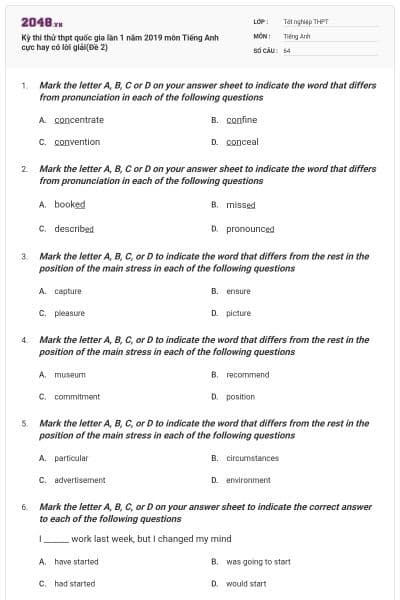
Mark the letter A, B, C or D on your answer sheet to indicate the word that differs from pronunciation in each of the following questions
concentrate
confine
convention
conceal
Đáp án : A
“con” trong “convention” phát âm là /kͻn/, trong các từ còn lại phát âm là /kən/
Mark the letter A, B, C or D on your answer sheet to indicate the word that differs from pronunciation in each of the following questions
booked
missed
described
pronounced
Đáp án : C
“ed” sau đuôi /b/ phát âm là /d/, sau các âm /k/, /∫/, /s/ phát âm là /t/
Mark the letter A, B, C, or D to indicate the word that differs from the rest in the position of the main stress in each of the following questions
capture
ensure
pleasure
picture
Đáp án : B
Trọng âm của từ này rơi vào âm tiết thứ 2, các từ còn lại rơi vào âm tiết thứ 1
Mark the letter A, B, C, or D to indicate the word that differs from the rest in the position of the main stress in each of the following questions
museum
recommend
commitment
position
Đáp án : B
Trọng âm của từ này rơi vào âm tiết thứ 1, các từ còn lại rơi vào âm tiết thứ 2
Mark the letter A, B, C, or D to indicate the word that differs from the rest in the position of the main stress in each of the following questions
particular
circumstances
advertisement
environment
Đáp án : B
Trọng âm của từ này rơi vào âm tiết thứ 1, các từ còn lại rơi vào âm tiết thứ 2
Mark the letter A, B, C, or D on your answer sheet to indicate the correct answer to each of the following questions
I ______ work last week, but I changed my mind
have started
was going to start
had started
would start
Đáp án : B
Was/were + going + to V = đang (định) làm gì trong quá khứ. Change one’s mind = thay đổi quyết định
Mark the letter A, B, C, or D on your answer sheet to indicate the correct answer to each of the following questions
He came ______ a lot of criticism for the remarks he made in a television interview
out of
in for
off
over
Đáp án : B
Come in for something = nhận được, vấp phải cái gì (tiêu cực). Criticism = sự chỉ trích, phê bình
Mark the letter A, B, C, or D on your answer sheet to indicate the correct answer to each of the following questions
When she died, she gave _________ all her money to a charity for cats
off
on
away
out
Đáp án : C
Give something away = cho đi. Dịch: khi cô ấy chết, cô ấy đem hết tiền cho một hội từ thiện vì loài mèo
Mark the letter A, B, C, or D on your answer sheet to indicate the correct answer to each of the following questions
Anna is holding her shopping bag with one hand and turning the door handle with ______.
the other
another
others
other
Đáp án : A
The other = cái còn lại, trừ cái đã được nhắc tới (tay còn lại). Another = một cái khác, không xác định. Others = những đối tượng khác. Other (adj) = khác
Mark the letter A, B, C, or D on your answer sheet to indicate the correct answer to each of the following questions
This is valuable _________ chair which dates back to the eighteeth century
traditional
old-fashioned
antique
ancient
Đáp án : C
Antique (adj) = cổ đại (đồ cổ). Traditional (adj) = thuộc về truyền thống. Old – fashioned (adj) = cũ, lạc hậu. Ancient (adj) = cổ xưa
Mark the letter A, B, C, or D on your answer sheet to indicate the correct answer to each of the following questions
“What’s the matter? You don’t look very well.” – “I feel a little _____________.”
under the weather
out of the blue
out of order
under the impression
Đáp án : A
Under the weather = không khỏe, bị ốm. Out of the blue = bất ngờ. Out of order = lộn xộn. Under the impression + (of/that….) = có ấn tượng là…
Mark the letter A, B, C, or D to indicate the word that differs from the rest in the position of the main stress in each of the following questions
There's a good film _______ town
in on
on in
at
over
Đáp án : B
Đối với phim ảnh thì: Be on = đang được chiếu. There’s a good film on in town = đang có một bộ phim hay được chiếu trong thị trấn
Mark the letter A, B, C, or D on your answer sheet to indicate the correct answer to each of the following questions
Now that Susan has moved to the country, her visits to see in the city are________
between few and far
far and betwwen
between and far
few and far between
Đáp án : D
Few and far between = lẻ tẻ, rời rạc, ít khi
Mark the letter A, B, C, or D on your answer sheet to indicate the correct answer to each of the following questions
It is a ___________ .
blue polyester sleeping bag
polyester sleeping blue bag
blue sleeping polyester bag
sleeping blue polyester bag
Đáp án : A
Sleeping bag = túi ngủ. Quy tắc sắp xếp các tính từ: OPSACOM: Opinion– Price – Size/shape – Age – Color (blue) – Original – Material (polyester) => blue polyester sleeping bag
Mark the letter A, B, C, or D on your answer sheet to indicate the correct answer to each of the following questions
Where is he? He should __________ at home hours ago
were
had been
be
have been
Đáp án : D
Should have + past participle = đáng lẽ nên làm gì trong quá khứ, nhưng đã không làm
Mark the letter A, B, C, or D on your answer sheet to indicate the correct answer to each of the following questions
I never read ________ newspapers during the week, but I buy ______Observer every Sunday and I read it in ________bed.
the / the / no article
the / a / the
no article / the / no article
a / a / the
Đáp án : C
Newspapers = những quyển báo -> danh từ số nhiều, bất kì, không xác định, không dùng “a/an” hay “the”. Observer là tên tờ báo nên cần “the” đằng trước. In bed = ở trên giường nói chung
Mark the letter A, B, C, or D on your answer sheet to indicate the correct answer to each of the following questions
_______ imaginative stories about the origin of the game of chess.
Of the many
Many of the
There are many
Many
Đáp án : C
Đằng sau chỗ trống là cụm danh từ -> câu thiếu chủ ngữ và động từ : there are + Ns = có những thứ gì đó
Mark the letter A, B, C, or D on your answer sheet to indicate the correct answer to each of the following questions
In a formal interview, it is essential to maintain good eye _______ with the interviewers.
touch
link
contact
connection
Đáp án : C
Eye contact = giao tiếp bằng mắt. Touch = sự chạm, động vào. Link = sự kết nối. Connection = sự kết nối, liên quan
Mark the letter A, B, C, or D on your answer sheet to indicate the correct answer to each of the following questions
Oil shale is a soft, fine-grained sedimentary rock _______ oil and natural gas are obtained.
is from
from which
from
is which
Đáp án : B
Obtain something from something = đạt được cái gì từ cái gì. Giới từ (from) trong mệnh đề đảo lên đứng sau danh từ cần bổ nghĩa (rock) thì phải đứng trước đại từ quan hệ dùng để bổ nghĩa (which). Rock which oil and natural gas are obtained = loại đá mà dầu và khí ga tự nhiên xuất phát từ đó
Mark the letter A, B, C, or D on your answer sheet to indicate the correct answer to each of the following questions
The government was finally ______ by a minor scandal.
taken down
brought down
put back
pulled down
Đáp án : B
Bring something down = lật đổ cái gì. Take something down = bỏ cái gì đó xuống. Pull something down = kéo đổ cái gì, phá hủy (một tòa nhà). Put something back = để lại chỗ cũ
Mark the letter A, B, C, or D on your answer sheet to indicate the correct answer to each of the following questions
Ann: “Do you need any help?” Kate: “______.”
No, thanks. I can manage
I haven’t got a clue
That’s all for now
That’s fine by me
Đáp án : A
Ann hỏi xem Kate có cần giúp đỡ không. Để từ chối một cách lịch sự, Kate nói: không cảm ơn; tôi có thể tự xoay sở
Mark the letter A, B, C, or D on your answer sheet to indicate the correct answer to each of the following questions
Unfortunately, the company closed down because it couldn’t keep ________ with rapidly changing technology
speed
fast
time
pace
Đáp án : D
Keep pace with = bắt kịp với cái gì
Mark the letter A, B, C, or D on your answer sheet to indicate the correct answer to each of the following questions
I ______ with my aunt when I am on holiday inHo Chi Minh Citynext month.
will have been staying
stay
will be staying
will have stayed
Đáp án : C
Will be Ving = sẽ đang làm việc gì tại một thời điểm trong tương lai
Mark the letter A, B, C, or D on your answer sheet to indicate the correct answer to each of the following questions
Never before _______ such a wonderful child
I saw
have I seen
I had seen
I have seen
Đáp án : B
Never before = chưa từng trước đây -> dấu hiệu của thì hiện tại hoàn thành, chỉ việc đã và đang xảy ra. Đảo ngữ: Never before + have/has + S + past participle = ai đó chưa từng làm việc gì trước đây
Mark the letter A,B,C or D on your sheet to indicate the word(s) SIMILAR in meaning to the underlined words in each of the following sentences
I hope to have the privilege of working with them again
right
favor
honor
advantage
Đáp án : C
Have the privilege of N/Ving = có đặc ân, đặc quyền được làm gì. Honor = niềm vinh dự đặc biệt
Mark the letter A,B,C or D on your sheet to indicate the word(s) SIMILAR in meaning to the underlined words in each of the following sentences
Many scientists agree that global warming poses great threats to all species on Earth.
irritations
annoyances
fears
risks
Đáp án: D
Giải thích:
Kiến thức: Từ vựng – Từ đồng nghĩa
threats (n): mối đe dọa
Xét các đáp án:
A. irritations (n): sự khó chịu
B. annoyances (n): sự phiền toái
C. fears (n): sự sợ hãi
D. risks (n): rủi ro, nguy cơ
=> threats = risks
Dịch: Nhiều nhà khoa học đồng ý rằng sự nóng lên toàn cầu gây ra mối đe dọa lớn đối với mọi loài trên Trái Đất.
Mark the letter A,B,C or D on your sheet to indicate the word(s) SIMILAR in meaning to the underlined words in each of the following sentences
The works of such men as the English philosophers John Locke and Thomas Hobbes helped pave the way for academic freedom in the modern sense
prevent
terminate
lighten
initiate
Đáp án : D
Pave the way for = mở đường cho cái gì. Initiate = tiên khởi, bắt đầu
Mark the letter A, B, C, or D on your answer sheet to indicate the word (s) OPPOSITE in meaning to the underlined word(s) in each of the following sentences
Population growth rates vary among regions and even among countries within the same region.
restrain
fluctuate
remain unstable
stay unchanged
Đáp án : D
Vary = thay đổi đa dạng, phong phú. Stay unchanged = duy trì, không thay đổi
Mark the letter A, B, C, or D on your answer sheet to indicate the word (s) OPPOSITE in meaning to the underlined word(s) in each of the following sentences
In some countries, the disease burden could be prevented through environmental improvements.
something to entertain
something sad
something enjoyable
something to suffer
Đáp án : C
Burden = gánh nặng. Something enjoyable = cái gì đó thú vị
Choose the option among A, B, C, D which needs correcting to make a complete sentence
The camp on the inhospitable, (A) mosquito-infested banks of the River Sekonyer, was (B) set up to track the primates and (C) learn from their habitat, (D) diet and behavior
mosquito-infested
set up
learn from
diet and behavior
Đáp án : D
Learn from = học hỏi từ đâu. Learn about = học hỏi về vấn đề gì. D -> learn abouT
Choose the option among A, B, C, D which needs correcting to make a complete sentence
(A) After writing it, the essay must (B) be duplicated by the student himself and handed (C) into the department secretary before the end of the month.
After writing it
be
into
the end of
Đáp án : C
Đầu câu là : After + Ving, thì chủ ngữ phải là đối tượng thực hiện hành động Ving. Ở đây, bài luận “the essay” không thể viết “writing” được -> sửa thành bị động: sau khi được viết, bài luận … -> after being written
Choose the option among A, B, C, D which needs correcting to make a complete sentence
Professor Jones (A) said that a good way (B) to improve your language (C) are learning (D) to practise it.
said
to improve
are
to practise
Đáp án: C
Giải thích:
Chủ ngữ “a good way to imprive your language” là chủ ngữ số ít, nên dùng “is”.
Sửa: are → is
Dịch: Giáo sư Jones nói rằng cách tốt nhất để cải thiện ngôn ngữ của bạn là học cách thực hành nó.
Choose the option among A, B, C, D which needs correcting to make a complete sentence
Abraham Lincoln's (A) boyhood home resembled (B) that of many other mid-western pioneers with its (C) dirt floor, sleeping loft, and (D) crude fireplace.
boyhood home
that
dirt floor
crude fireplace
Đáp án : D
Dịch: ngôi nhà thời thơ ấu của Abraham Lincoln giống những ngôi nhà của những người phía Trung Tây khác… Sự so sánh giống là giữa ngôi nhà với những ngôi nhà của nhiều người -> phải là those (những đối tượng khác – số nhiều), không phải that
Choose the option among A, B, C, D which needs correcting to make a complete sentence
A (A) smile can be observed, described, and reliably (B) identify; it can also be elicited and manipulated under (C) experimental (D) conditions
smile
identify
experimental
conditions
Đáp án : D
Các quá khứ phân từ đang được liệt kê một loại trong câu bị động, sau “and” cũng phải là quá khứ phân từ với ý bị động -> be observed, described, and reliably identified = được quan sát, được mô tả và được nhận dạng một cách đáng tin
Read the following passage and mark the letter A, B, C or D on your answer sheet to indicate the correct answer to each of the questions.
The term “art deco” has come to encompass three distinct but related design trends of the 1920’s and 1930’s. The first was what is frequently referred to as “zigzag moderne” – the exotically ornamental style of such skyscrapers as the Chrysler Building in New York City and related structures such as the Paramount Theater in Oakland, California. The word “zigzag” alludes to the geometric and stylized ornamentation of zigzags, angular patterns, abstracted plant and animal motifs, sunbursts, astrological imagery, formalized fountains, and related themes that were applied in mosaic relief and mural form to the exterior and interior of the buildings. Many of these buildings were shaped in the ziggurat form, a design resembling an ancient Mesopotamian temple tower that recedes in progressively smaller stages to the summit, creating a staircase-like effect.
The second manifestation of art deco was the 1930’s “streamlined moderne” style—a Futuristic-looking aerodynamic style of rounded corners and horizontal bands known as “speed stripes.” In architecture, these elements were frequently accompanied by round windows, extensive use of glass block, and flat rooftops.
The third style, referred to as “international stripped classicism” also came to the forefront during the Depression, a period of severe economic difficult in the 1930’s. This was a more conservative style, blending a simplified modernistic style with a more austere form of geometric and stylized relief sculpture and other ornament, including interior murals. May buildings in this style were erected nationwide through government programs during the Depression .
Although art deco in its many forms was largely perceived as thoroughly modern, it was strongly influenced by the decorative arts movements that immediately preceded it. For example, like “art nouveau” (1890-1910), art deco also used plant motifs, but regularized the forms into abstracted repetitive patterns rather than presenting them as flowing, asymmetrical foliage, Like the Viennese craftspeople of the Wiener Werkstatte, art deco designers worked with exotic materials, geometricized shapes, and colorfully ornate patterns. Furthermore, like the artisans of the Arts and Crafts Movement inEnglandand theUnited States, art deep practitioners considered it their mission to transform the domestic environment through well-designed furniture and household accessories.
What aspect of art deco does the passage mainly discuss?
The influence of art deco on the design of furniture and household accessories
Ways in which government programs encouraged the development of art deco
Reasons for the popularity of art deco inNew York andCalifornia
Architectural manifestations of art deco during the 1920’s and 1930’s
Đáp án : D
Ngay từ đầu, đoạn văn đã đề cập: The term “art deco” has come to encompass three distinct but related design trends of the 1920’s and 1930’s -> 3 xu hướng thiết kế trang trí trong những năm 1920, 1930. Sau đó các khuynh hướng trang trí kiến trúc này tiếp tục được phân tích trong các đoạn sau
Read the following passage and mark the letter A, B, C or D on your answer sheet to indicate the correct answer to each of the questions.
The term “art deco” has come to encompass three distinct but related design trends of the 1920’s and 1930’s. The first was what is frequently referred to as “zigzag moderne” – the exotically ornamental style of such skyscrapers as the Chrysler Building in New York City and related structures such as the Paramount Theater in Oakland, California. The word “zigzag” alludes to the geometric and stylized ornamentation of zigzags, angular patterns, abstracted plant and animal motifs, sunbursts, astrological imagery, formalized fountains, and related themes that were applied in mosaic relief and mural form to the exterior and interior of the buildings. Many of these buildings were shaped in the ziggurat form, a design resembling an ancient Mesopotamian temple tower that recedes in progressively smaller stages to the summit, creating a staircase-like effect.
The second manifestation of art deco was the 1930’s “streamlined moderne” style—a Futuristic-looking aerodynamic style of rounded corners and horizontal bands known as “speed stripes.” In architecture, these elements were frequently accompanied by round windows, extensive use of glass block, and flat rooftops.
The third style, referred to as “international stripped classicism” also came to the forefront during the Depression, a period of severe economic difficult in the 1930’s. This was a more conservative style, blending a simplified modernistic style with a more austere form of geometric and stylized relief sculpture and other ornament, including interior murals. May buildings in this style were erected nationwide through government programs during the Depression .
Although art deco in its many forms was largely perceived as thoroughly modern, it was strongly influenced by the decorative arts movements that immediately preceded it. For example, like “art nouveau” (1890-1910), art deco also used plant motifs, but regularized the forms into abstracted repetitive patterns rather than presenting them as flowing, asymmetrical foliage, Like the Viennese craftspeople of the Wiener Werkstatte, art deco designers worked with exotic materials, geometricized shapes, and colorfully ornate patterns. Furthermore, like the artisans of the Arts and Crafts Movement inEnglandand theUnited States, art deep practitioners considered it their mission to transform the domestic environment through well-designed furniture and household accessories.
The word “encompass” in line 1 is closest in meaning to ___________ .
include
Enhance
separate
replace
Đáp án : A
Encompass = bao gồm, chứa đựng ≈ include
Read the following passage and mark the letter A, B, C or D on your answer sheet to indicate the correct answer to each of the questions.
The term “art deco” has come to encompass three distinct but related design trends of the 1920’s and 1930’s. The first was what is frequently referred to as “zigzag moderne” – the exotically ornamental style of such skyscrapers as the Chrysler Building in New York City and related structures such as the Paramount Theater in Oakland, California. The word “zigzag” alludes to the geometric and stylized ornamentation of zigzags, angular patterns, abstracted plant and animal motifs, sunbursts, astrological imagery, formalized fountains, and related themes that were applied in mosaic relief and mural form to the exterior and interior of the buildings. Many of these buildings were shaped in the ziggurat form, a design resembling an ancient Mesopotamian temple tower that recedes in progressively smaller stages to the summit, creating a staircase-like effect.
The second manifestation of art deco was the 1930’s “streamlined moderne” style—a Futuristic-looking aerodynamic style of rounded corners and horizontal bands known as “speed stripes.” In architecture, these elements were frequently accompanied by round windows, extensive use of glass block, and flat rooftops.
The third style, referred to as “international stripped classicism” also came to the forefront during the Depression, a period of severe economic difficult in the 1930’s. This was a more conservative style, blending a simplified modernistic style with a more austere form of geometric and stylized relief sculpture and other ornament, including interior murals. May buildings in this style were erected nationwide through government programs during the Depression .
Although art deco in its many forms was largely perceived as thoroughly modern, it was strongly influenced by the decorative arts movements that immediately preceded it. For example, like “art nouveau” (1890-1910), art deco also used plant motifs, but regularized the forms into abstracted repetitive patterns rather than presenting them as flowing, asymmetrical foliage, Like the Viennese craftspeople of the Wiener Werkstatte, art deco designers worked with exotic materials, geometricized shapes, and colorfully ornate patterns. Furthermore, like the artisans of the Arts and Crafts Movement inEnglandand theUnited States, art deep practitioners considered it their mission to transform the domestic environment through well-designed furniture and household accessories.
The phrase “The first” in line 2 refers to __________
the 1920’s and 1930’s
design trends
the term “art deco”
Skyscrapers
Đáp án : B
Dịch câu đầu: từ “art deco” đã trở nên bao gộp ba khuynh hướng thiết kế khác biệt nhưng liên quan tới nhau ở giai đoạn 1920, 1930. Cái đầu tiên chính là ….. => đối tượng đầu tiên (the first) tác giả muốn nói tới là xu hướng thiết kế đầu tiên = the first design trend
Read the following passage and mark the letter A, B, C or D on your answer sheet to indicate the correct answer to each of the questions.
The term “art deco” has come to encompass three distinct but related design trends of the 1920’s and 1930’s. The first was what is frequently referred to as “zigzag moderne” – the exotically ornamental style of such skyscrapers as the Chrysler Building in New York City and related structures such as the Paramount Theater in Oakland, California. The word “zigzag” alludes to the geometric and stylized ornamentation of zigzags, angular patterns, abstracted plant and animal motifs, sunbursts, astrological imagery, formalized fountains, and related themes that were applied in mosaic relief and mural form to the exterior and interior of the buildings. Many of these buildings were shaped in the ziggurat form, a design resembling an ancient Mesopotamian temple tower that recedes in progressively smaller stages to the summit, creating a staircase-like effect.
The second manifestation of art deco was the 1930’s “streamlined moderne” style—a Futuristic-looking aerodynamic style of rounded corners and horizontal bands known as “speed stripes.” In architecture, these elements were frequently accompanied by round windows, extensive use of glass block, and flat rooftops.
The third style, referred to as “international stripped classicism” also came to the forefront during the Depression, a period of severe economic difficult in the 1930’s. This was a more conservative style, blending a simplified modernistic style with a more austere form of geometric and stylized relief sculpture and other ornament, including interior murals. May buildings in this style were erected nationwide through government programs during the Depression .
Although art deco in its many forms was largely perceived as thoroughly modern, it was strongly influenced by the decorative arts movements that immediately preceded it. For example, like “art nouveau” (1890-1910), art deco also used plant motifs, but regularized the forms into abstracted repetitive patterns rather than presenting them as flowing, asymmetrical foliage, Like the Viennese craftspeople of the Wiener Werkstatte, art deco designers worked with exotic materials, geometricized shapes, and colorfully ornate patterns. Furthermore, like the artisans of the Arts and Crafts Movement inEnglandand theUnited States, art deep practitioners considered it their mission to transform the domestic environment through well-designed furniture and household accessories.
In line 8, the author mentions “an ancient Mesopotamian temple tower” in order to __________ .
emphasize the extent of architectural advances
explain the differences between ancient and modern architectural steles
describe the exterior shape of certain “art deco” buildings
argue for a return to more traditional architectural design
Đáp án : C
Many of these buildings were shaped in the ziggurat form, a design resembling an ancient Mesopotamian temple tower = rất nhiều trong số những tòa nhà này được dựng theo dạng chữ chi, một thiết kế giống với một chùa tháp cổ vùng Lưỡng Hà -> chùa tháp cổ vùng Lưỡng Hà được nhắc đến để miêu tả hình dạng bề ngoài của một số tòa nhà
Read the following passage and mark the letter A, B, C or D on your answer sheet to indicate the correct answer to each of the questions.
The term “art deco” has come to encompass three distinct but related design trends of the 1920’s and 1930’s. The first was what is frequently referred to as “zigzag moderne” – the exotically ornamental style of such skyscrapers as the Chrysler Building in New York City and related structures such as the Paramount Theater in Oakland, California. The word “zigzag” alludes to the geometric and stylized ornamentation of zigzags, angular patterns, abstracted plant and animal motifs, sunbursts, astrological imagery, formalized fountains, and related themes that were applied in mosaic relief and mural form to the exterior and interior of the buildings. Many of these buildings were shaped in the ziggurat form, a design resembling an ancient Mesopotamian temple tower that recedes in progressively smaller stages to the summit, creating a staircase-like effect.
The second manifestation of art deco was the 1930’s “streamlined moderne” style—a Futuristic-looking aerodynamic style of rounded corners and horizontal bands known as “speed stripes.” In architecture, these elements were frequently accompanied by round windows, extensive use of glass block, and flat rooftops.
The third style, referred to as “international stripped classicism” also came to the forefront during the Depression, a period of severe economic difficult in the 1930’s. This was a more conservative style, blending a simplified modernistic style with a more austere form of geometric and stylized relief sculpture and other ornament, including interior murals. May buildings in this style were erected nationwide through government programs during the Depression .
Although art deco in its many forms was largely perceived as thoroughly modern, it was strongly influenced by the decorative arts movements that immediately preceded it. For example, like “art nouveau” (1890-1910), art deco also used plant motifs, but regularized the forms into abstracted repetitive patterns rather than presenting them as flowing, asymmetrical foliage, Like the Viennese craftspeople of the Wiener Werkstatte, art deco designers worked with exotic materials, geometricized shapes, and colorfully ornate patterns. Furthermore, like the artisans of the Arts and Crafts Movement inEnglandand theUnited States, art deep practitioners considered it their mission to transform the domestic environment through well-designed furniture and household accessories.
The streamlined moderne style is characterized by all of the following EXCEPT ___________ .
animal motifs
“speed stripes”
round windows
flat roofs
Đáp án : A
Đoạn thứ 2 nói về “streamlined moderne” style —a Futuristic-looking aerodynamic style of rounded corners and horizontal bands known as “speed stripes.” In architecture, these elements were frequently accompanied by round windows, extensive use of glass block, and flat rooftops -> B, C , D đều lần lượt được nhắc tới
Read the following passage and mark the letter A, B, C or D on your answer sheet to indicate the correct answer to each of the questions.
The term “art deco” has come to encompass three distinct but related design trends of the 1920’s and 1930’s. The first was what is frequently referred to as “zigzag moderne” – the exotically ornamental style of such skyscrapers as the Chrysler Building in New York City and related structures such as the Paramount Theater in Oakland, California. The word “zigzag” alludes to the geometric and stylized ornamentation of zigzags, angular patterns, abstracted plant and animal motifs, sunbursts, astrological imagery, formalized fountains, and related themes that were applied in mosaic relief and mural form to the exterior and interior of the buildings. Many of these buildings were shaped in the ziggurat form, a design resembling an ancient Mesopotamian temple tower that recedes in progressively smaller stages to the summit, creating a staircase-like effect.
The second manifestation of art deco was the 1930’s “streamlined moderne” style—a Futuristic-looking aerodynamic style of rounded corners and horizontal bands known as “speed stripes.” In architecture, these elements were frequently accompanied by round windows, extensive use of glass block, and flat rooftops.
The third style, referred to as “international stripped classicism” also came to the forefront during the Depression, a period of severe economic difficult in the 1930’s. This was a more conservative style, blending a simplified modernistic style with a more austere form of geometric and stylized relief sculpture and other ornament, including interior murals. May buildings in this style were erected nationwide through government programs during the Depression .
Although art deco in its many forms was largely perceived as thoroughly modern, it was strongly influenced by the decorative arts movements that immediately preceded it. For example, like “art nouveau” (1890-1910), art deco also used plant motifs, but regularized the forms into abstracted repetitive patterns rather than presenting them as flowing, asymmetrical foliage, Like the Viennese craftspeople of the Wiener Werkstatte, art deco designers worked with exotic materials, geometricized shapes, and colorfully ornate patterns. Furthermore, like the artisans of the Arts and Crafts Movement inEnglandand theUnited States, art deep practitioners considered it their mission to transform the domestic environment through well-designed furniture and household accessories.
The phrase “came to the forefront” in line 15 is closest in meaning to _________ .
went through a process
grew in complexity
changed its approach
became important
Đáp án : D
Came to the forefront = được xếp lên hàng đầu -> trở nên quan trọng
Read the following passage and mark the letter A, B, C or D on your answer sheet to indicate the correct answer to each of the questions.
The term “art deco” has come to encompass three distinct but related design trends of the 1920’s and 1930’s. The first was what is frequently referred to as “zigzag moderne” – the exotically ornamental style of such skyscrapers as the Chrysler Building in New York City and related structures such as the Paramount Theater in Oakland, California. The word “zigzag” alludes to the geometric and stylized ornamentation of zigzags, angular patterns, abstracted plant and animal motifs, sunbursts, astrological imagery, formalized fountains, and related themes that were applied in mosaic relief and mural form to the exterior and interior of the buildings. Many of these buildings were shaped in the ziggurat form, a design resembling an ancient Mesopotamian temple tower that recedes in progressively smaller stages to the summit, creating a staircase-like effect.
The second manifestation of art deco was the 1930’s “streamlined moderne” style—a Futuristic-looking aerodynamic style of rounded corners and horizontal bands known as “speed stripes.” In architecture, these elements were frequently accompanied by round windows, extensive use of glass block, and flat rooftops.
The third style, referred to as “international stripped classicism” also came to the forefront during the Depression, a period of severe economic difficult in the 1930’s. This was a more conservative style, blending a simplified modernistic style with a more austere form of geometric and stylized relief sculpture and other ornament, including interior murals. May buildings in this style were erected nationwide through government programs during the Depression .
Although art deco in its many forms was largely perceived as thoroughly modern, it was strongly influenced by the decorative arts movements that immediately preceded it. For example, like “art nouveau” (1890-1910), art deco also used plant motifs, but regularized the forms into abstracted repetitive patterns rather than presenting them as flowing, asymmetrical foliage, Like the Viennese craftspeople of the Wiener Werkstatte, art deco designers worked with exotic materials, geometricized shapes, and colorfully ornate patterns. Furthermore, like the artisans of the Arts and Crafts Movement inEnglandand theUnited States, art deep practitioners considered it their mission to transform the domestic environment through well-designed furniture and household accessories.
According to the passage, which of the following statements most accurately describes the relationship between art deco and art nouveau?
Art deco became important in theUnited Stateswhile art nouveau became popular inEngland.
Art nouveau preceded art deco and influenced it.
They were art forms that competed with each other for government support during the depression era.
They were essentially the same art form.
Đáp án : B
Đầu đoạn cuối: Although art deco in its many forms was largely perceived as thoroughly modern, it was strongly influenced by the decorative arts movements that immediately preceded it. For example, like “art nouveau” (1890-1910), art deco also used plant motifs -> “art deco” bị ảnh hưởng mạnh mẽ bởi xu hướng nghệ thuật đi trước nó, ví dụ như là “art nouveau”
Read the following passage and mark the letter A, B, C or D on your answer sheet to indicate the correct answer to each of the questions.
The term “art deco” has come to encompass three distinct but related design trends of the 1920’s and 1930’s. The first was what is frequently referred to as “zigzag moderne” – the exotically ornamental style of such skyscrapers as the Chrysler Building in New York City and related structures such as the Paramount Theater in Oakland, California. The word “zigzag” alludes to the geometric and stylized ornamentation of zigzags, angular patterns, abstracted plant and animal motifs, sunbursts, astrological imagery, formalized fountains, and related themes that were applied in mosaic relief and mural form to the exterior and interior of the buildings. Many of these buildings were shaped in the ziggurat form, a design resembling an ancient Mesopotamian temple tower that recedes in progressively smaller stages to the summit, creating a staircase-like effect.
The second manifestation of art deco was the 1930’s “streamlined moderne” style—a Futuristic-looking aerodynamic style of rounded corners and horizontal bands known as “speed stripes.” In architecture, these elements were frequently accompanied by round windows, extensive use of glass block, and flat rooftops.
The third style, referred to as “international stripped classicism” also came to the forefront during the Depression, a period of severe economic difficult in the 1930’s. This was a more conservative style, blending a simplified modernistic style with a more austere form of geometric and stylized relief sculpture and other ornament, including interior murals. May buildings in this style were erected nationwide through government programs during the Depression .
Although art deco in its many forms was largely perceived as thoroughly modern, it was strongly influenced by the decorative arts movements that immediately preceded it. For example, like “art nouveau” (1890-1910), art deco also used plant motifs, but regularized the forms into abstracted repetitive patterns rather than presenting them as flowing, asymmetrical foliage, Like the Viennese craftspeople of the Wiener Werkstatte, art deco designers worked with exotic materials, geometricized shapes, and colorfully ornate patterns. Furthermore, like the artisans of the Arts and Crafts Movement inEnglandand theUnited States, art deep practitioners considered it their mission to transform the domestic environment through well-designed furniture and household accessories.
According to the passage, a building having an especially ornate appearance would most probably have been designed in the style of ____________ .
classical modern
zigzag modern
streamlined moderne
the Arts and Crafts Movement
Đáp án : B
Từ dòng 2 đoạn 1: The first was what is frequently referred to as “zigzag moderne” – the exotically ornamental style of such skyscrapers -> khuynh hướng “zizag modern” là một phong cách giàu tính trang trí độc đáo, kì lạ; nhấn mạnh vào các trang trí hình khối và phong cách (geometric and stylized ornamentation) -> một tòa nhà với vẻ ngoài trang trí cầu kì là kiểu “zigzag moderne”
Read the following passage and mark the letter A, B, C or D on your answer sheet to indicate the correct answer to each of the questions.
The term “art deco” has come to encompass three distinct but related design trends of the 1920’s and 1930’s. The first was what is frequently referred to as “zigzag moderne” – the exotically ornamental style of such skyscrapers as the Chrysler Building in New York City and related structures such as the Paramount Theater in Oakland, California. The word “zigzag” alludes to the geometric and stylized ornamentation of zigzags, angular patterns, abstracted plant and animal motifs, sunbursts, astrological imagery, formalized fountains, and related themes that were applied in mosaic relief and mural form to the exterior and interior of the buildings. Many of these buildings were shaped in the ziggurat form, a design resembling an ancient Mesopotamian temple tower that recedes in progressively smaller stages to the summit, creating a staircase-like effect.
The second manifestation of art deco was the 1930’s “streamlined moderne” style—a Futuristic-looking aerodynamic style of rounded corners and horizontal bands known as “speed stripes.” In architecture, these elements were frequently accompanied by round windows, extensive use of glass block, and flat rooftops.
The third style, referred to as “international stripped classicism” also came to the forefront during the Depression, a period of severe economic difficult in the 1930’s. This was a more conservative style, blending a simplified modernistic style with a more austere form of geometric and stylized relief sculpture and other ornament, including interior murals. May buildings in this style were erected nationwide through government programs during the Depression .
Although art deco in its many forms was largely perceived as thoroughly modern, it was strongly influenced by the decorative arts movements that immediately preceded it. For example, like “art nouveau” (1890-1910), art deco also used plant motifs, but regularized the forms into abstracted repetitive patterns rather than presenting them as flowing, asymmetrical foliage, Like the Viennese craftspeople of the Wiener Werkstatte, art deco designers worked with exotic materials, geometricized shapes, and colorfully ornate patterns. Furthermore, like the artisans of the Arts and Crafts Movement inEnglandand theUnited States, art deep practitioners considered it their mission to transform the domestic environment through well-designed furniture and household accessories.
According to the passage, which of the following design trends is known by more than one name ?
Arts and Crafts Movement
International stripped classicism
Streamlined modern
Zigzag modern
Đáp án : C
Theo đoạn 3: “international stripped classicism” không chỉ là một phong trào lưu bảo thủ, nó là một sự pha trộn phong cách hiện đại đơn giản với một dạng đơn thuần của điêu khắc và các trang trí (This was a more conservative style, blending a simplified modernistic style with a more austere form of geometric and stylized relief sculpture and other ornament, including interior murals) -> không chỉ là một cái tên đơn thuần
Read the following passage and mark the letter A, B, C or D on your answer sheet to indicate the correct answer to each of the questions.
The term “art deco” has come to encompass three distinct but related design trends of the 1920’s and 1930’s. The first was what is frequently referred to as “zigzag moderne” – the exotically ornamental style of such skyscrapers as the Chrysler Building in New York City and related structures such as the Paramount Theater in Oakland, California. The word “zigzag” alludes to the geometric and stylized ornamentation of zigzags, angular patterns, abstracted plant and animal motifs, sunbursts, astrological imagery, formalized fountains, and related themes that were applied in mosaic relief and mural form to the exterior and interior of the buildings. Many of these buildings were shaped in the ziggurat form, a design resembling an ancient Mesopotamian temple tower that recedes in progressively smaller stages to the summit, creating a staircase-like effect.
The second manifestation of art deco was the 1930’s “streamlined moderne” style—a Futuristic-looking aerodynamic style of rounded corners and horizontal bands known as “speed stripes.” In architecture, these elements were frequently accompanied by round windows, extensive use of glass block, and flat rooftops.
The third style, referred to as “international stripped classicism” also came to the forefront during the Depression, a period of severe economic difficult in the 1930’s. This was a more conservative style, blending a simplified modernistic style with a more austere form of geometric and stylized relief sculpture and other ornament, including interior murals. May buildings in this style were erected nationwide through government programs during the Depression .
Although art deco in its many forms was largely perceived as thoroughly modern, it was strongly influenced by the decorative arts movements that immediately preceded it. For example, like “art nouveau” (1890-1910), art deco also used plant motifs, but regularized the forms into abstracted repetitive patterns rather than presenting them as flowing, asymmetrical foliage, Like the Viennese craftspeople of the Wiener Werkstatte, art deco designers worked with exotic materials, geometricized shapes, and colorfully ornate patterns. Furthermore, like the artisans of the Arts and Crafts Movement inEnglandand theUnited States, art deep practitioners considered it their mission to transform the domestic environment through well-designed furniture and household accessories.
The passage is primarily developed as _____________
an analysis of various trends within an artistic movement
the historical chronology of a movement
an argument of the advantages of one artistic form over another
a description of specific buildings that became famous for their unusual beauty
Đáp án : A
Bài văn này nói về “art deco” thông qua việc phân tích các xu hướng, trào lưu trang trí kiến trúc với 3 xu hướng chính “zigzag moderne” “streamlined moderne” “international stripped classicism”
Read the following passage and mark the letter A, B, C, or D on your answer sheet to indicate the correct word for each of the blanks. Fill in the appropriate word in question 45
British families started going on holiday to the seaside around the middle of the 19th century. The invention of the railways (45) ____ this possible. The first holidaymakers were quite rich and went for their health and education. The seaside was a place to be (46) ____ of illness, and doctors recommended bathing in the sea and drinking sea water. Also to (47) ____ their knowledge, families attended concerts and read books from the library.
At that time, ordinary working people had very little time (48) ____ work. However, in 1871, the government introduced four ‘Banking Holiday’ - national holiday days. This (49) ____ people to have a day or two out, which now and then gave them a taste for leisure and the seaside. At first, they went on day-trips, taking (50) ____ of special cheap tickets on the railways. By the 1880s, rising incomes (51) ____ that many ordinary workers and their families could have a week’s holiday at the seaside. Rail fares were reduced and cheap hotels were built to (52) ____ them. Holidaymakers enjoyed being idle, sitting on the beach, bathing in the sea, and eating ice-cream. Cheap entertainment was (53) ____ offer and holidaymakers went to have fun.
Today the English seaside (54) ____ popular, with more than 18 million holidays taken there each year.
got
had
let
made
Đáp án : D
Make something + adj = làm cái gì trở nên thế nào. Make this possible =khiến điều này trở nên khả thi
Read the following passage and mark the letter A, B, C, or D on your answer sheet to indicate the correct word for each of the blanks. Fill in the appropriate word in question 46
British families started going on holiday to the seaside around the middle of the 19th century. The invention of the railways (45) ____ this possible. The first holidaymakers were quite rich and went for their health and education. The seaside was a place to be (46) ____ of illness, and doctors recommended bathing in the sea and drinking sea water. Also to (47) ____ their knowledge, families attended concerts and read books from the library.
At that time, ordinary working people had very little time (48) ____ work. However, in 1871, the government introduced four ‘Banking Holiday’ - national holiday days. This (49) ____ people to have a day or two out, which now and then gave them a taste for leisure and the seaside. At first, they went on day-trips, taking (50) ____ of special cheap tickets on the railways. By the 1880s, rising incomes (51) ____ that many ordinary workers and their families could have a week’s holiday at the seaside. Rail fares were reduced and cheap hotels were built to (52) ____ them. Holidaymakers enjoyed being idle, sitting on the beach, bathing in the sea, and eating ice-cream. Cheap entertainment was (53) ____ offer and holidaymakers went to have fun.
Today the English seaside (54) ____ popular, with more than 18 million holidays taken there each year.
recovered
improved
cured
remedied
Đáp án : C
Cure somebody of something = chữa (ai) khỏi bệnh gì
Read the following passage and mark the letter A, B, C, or D on your answer sheet to indicate the correct word for each of the blanks. Fill in the appropriate word in question 47
British families started going on holiday to the seaside around the middle of the 19th century. The invention of the railways (45) ____ this possible. The first holidaymakers were quite rich and went for their health and education. The seaside was a place to be (46) ____ of illness, and doctors recommended bathing in the sea and drinking sea water. Also to (47) ____ their knowledge, families attended concerts and read books from the library.
At that time, ordinary working people had very little time (48) ____ work. However, in 1871, the government introduced four ‘Banking Holiday’ - national holiday days. This (49) ____ people to have a day or two out, which now and then gave them a taste for leisure and the seaside. At first, they went on day-trips, taking (50) ____ of special cheap tickets on the railways. By the 1880s, rising incomes (51) ____ that many ordinary workers and their families could have a week’s holiday at the seaside. Rail fares were reduced and cheap hotels were built to (52) ____ them. Holidaymakers enjoyed being idle, sitting on the beach, bathing in the sea, and eating ice-cream. Cheap entertainment was (53) ____ offer and holidaymakers went to have fun.
Today the English seaside (54) ____ popular, with more than 18 million holidays taken there each year.
add
increase
raise
spread
Đáp án : B
Increase = làm tăng cái gì. Increase knowledge = làm tăng vốn hiểu biết. Add = thêm, bổ sung. Raise = nuôi, mọc lên, tăng lên. Spread = trải ra
Read the following passage and mark the letter A, B, C, or D on your answer sheet to indicate the correct word for each of the blanks. Fill in the appropriate word in question 48
British families started going on holiday to the seaside around the middle of the 19th century. The invention of the railways (45) ____ this possible. The first holidaymakers were quite rich and went for their health and education. The seaside was a place to be (46) ____ of illness, and doctors recommended bathing in the sea and drinking sea water. Also to (47) ____ their knowledge, families attended concerts and read books from the library.
At that time, ordinary working people had very little time (48) ____ work. However, in 1871, the government introduced four ‘Banking Holiday’ - national holiday days. This (49) ____ people to have a day or two out, which now and then gave them a taste for leisure and the seaside. At first, they went on day-trips, taking (50) ____ of special cheap tickets on the railways. By the 1880s, rising incomes (51) ____ that many ordinary workers and their families could have a week’s holiday at the seaside. Rail fares were reduced and cheap hotels were built to (52) ____ them. Holidaymakers enjoyed being idle, sitting on the beach, bathing in the sea, and eating ice-cream. Cheap entertainment was (53) ____ offer and holidaymakers went to have fun.
Today the English seaside (54) ____ popular, with more than 18 million holidays taken there each year.
from
out
off
away
Đáp án : C
Off = tắt, nghỉ. Off work = nghỉ, không làm việc. Off school = nghỉ học
Read the following passage and mark the letter A, B, C, or D on your answer sheet to indicate the correct word for each of the blanks. Fill in the appropriate word in question 49
British families started going on holiday to the seaside around the middle of the 19th century. The invention of the railways (45) ____ this possible. The first holidaymakers were quite rich and went for their health and education. The seaside was a place to be (46) ____ of illness, and doctors recommended bathing in the sea and drinking sea water. Also to (47) ____ their knowledge, families attended concerts and read books from the library.
At that time, ordinary working people had very little time (48) ____ work. However, in 1871, the government introduced four ‘Banking Holiday’ - national holiday days. This (49) ____ people to have a day or two out, which now and then gave them a taste for leisure and the seaside. At first, they went on day-trips, taking (50) ____ of special cheap tickets on the railways. By the 1880s, rising incomes (51) ____ that many ordinary workers and their families could have a week’s holiday at the seaside. Rail fares were reduced and cheap hotels were built to (52) ____ them. Holidaymakers enjoyed being idle, sitting on the beach, bathing in the sea, and eating ice-cream. Cheap entertainment was (53) ____ offer and holidaymakers went to have fun.
Today the English seaside (54) ____ popular, with more than 18 million holidays taken there each year.
allowed
provided
opened
offered
Đáp án : A
Allow somebody to V = cho phép ai làm gì
Read the following passage and mark the letter A, B, C, or D on your answer sheet to indicate the correct word for each of the blanks. Fill in the appropriate word in question 50
British families started going on holiday to the seaside around the middle of the 19th century. The invention of the railways (45) ____ this possible. The first holidaymakers were quite rich and went for their health and education. The seaside was a place to be (46) ____ of illness, and doctors recommended bathing in the sea and drinking sea water. Also to (47) ____ their knowledge, families attended concerts and read books from the library.
At that time, ordinary working people had very little time (48) ____ work. However, in 1871, the government introduced four ‘Banking Holiday’ - national holiday days. This (49) ____ people to have a day or two out, which now and then gave them a taste for leisure and the seaside. At first, they went on day-trips, taking (50) ____ of special cheap tickets on the railways. By the 1880s, rising incomes (51) ____ that many ordinary workers and their families could have a week’s holiday at the seaside. Rail fares were reduced and cheap hotels were built to (52) ____ them. Holidaymakers enjoyed being idle, sitting on the beach, bathing in the sea, and eating ice-cream. Cheap entertainment was (53) ____ offer and holidaymakers went to have fun.
Today the English seaside (54) ____ popular, with more than 18 million holidays taken there each year.
opportunity
advantage
profit
benefit
Đáp án : B
Take advantage of something = tận dụng cái gì
Read the following passage and mark the letter A, B, C, or D on your answer sheet to indicate the correct word for each of the blanks. Fill in the appropriate word in question 51
British families started going on holiday to the seaside around the middle of the 19th century. The invention of the railways (45) ____ this possible. The first holidaymakers were quite rich and went for their health and education. The seaside was a place to be (46) ____ of illness, and doctors recommended bathing in the sea and drinking sea water. Also to (47) ____ their knowledge, families attended concerts and read books from the library.
At that time, ordinary working people had very little time (48) ____ work. However, in 1871, the government introduced four ‘Banking Holiday’ - national holiday days. This (49) ____ people to have a day or two out, which now and then gave them a taste for leisure and the seaside. At first, they went on day-trips, taking (50) ____ of special cheap tickets on the railways. By the 1880s, rising incomes (51) ____ that many ordinary workers and their families could have a week’s holiday at the seaside. Rail fares were reduced and cheap hotels were built to (52) ____ them. Holidaymakers enjoyed being idle, sitting on the beach, bathing in the sea, and eating ice-cream. Cheap entertainment was (53) ____ offer and holidaymakers went to have fun.
Today the English seaside (54) ____ popular, with more than 18 million holidays taken there each year.
meant
resulted
produced
caused
Đáp án : A
Mean (that)… = có nghĩa là… Result in something/Ving = gây ra cái gì. Produce = sản xuất. Cause something = gây ra cái gì
Read the following passage and mark the letter A, B, C, or D on your answer sheet to indicate the correct word for each of the blanks. Fill in the appropriate word in question 52
British families started going on holiday to the seaside around the middle of the 19th century. The invention of the railways (45) ____ this possible. The first holidaymakers were quite rich and went for their health and education. The seaside was a place to be (46) ____ of illness, and doctors recommended bathing in the sea and drinking sea water. Also to (47) ____ their knowledge, families attended concerts and read books from the library.
At that time, ordinary working people had very little time (48) ____ work. However, in 1871, the government introduced four ‘Banking Holiday’ - national holiday days. This (49) ____ people to have a day or two out, which now and then gave them a taste for leisure and the seaside. At first, they went on day-trips, taking (50) ____ of special cheap tickets on the railways. By the 1880s, rising incomes (51) ____ that many ordinary workers and their families could have a week’s holiday at the seaside. Rail fares were reduced and cheap hotels were built to (52) ____ them. Holidaymakers enjoyed being idle, sitting on the beach, bathing in the sea, and eating ice-cream. Cheap entertainment was (53) ____ offer and holidaymakers went to have fun.
Today the English seaside (54) ____ popular, with more than 18 million holidays taken there each year.
board
accommodate
lodge
cater
Đáp án : B
Accommodate somebody = cung cấp nơi ăn, chốn ở cho ai
Read the following passage and mark the letter A, B, C, or D on your answer sheet to indicate the correct word for each of the blanks. Fill in the appropriate word in question 53
British families started going on holiday to the seaside around the middle of the 19th century. The invention of the railways (45) ____ this possible. The first holidaymakers were quite rich and went for their health and education. The seaside was a place to be (46) ____ of illness, and doctors recommended bathing in the sea and drinking sea water. Also to (47) ____ their knowledge, families attended concerts and read books from the library.
At that time, ordinary working people had very little time (48) ____ work. However, in 1871, the government introduced four ‘Banking Holiday’ - national holiday days. This (49) ____ people to have a day or two out, which now and then gave them a taste for leisure and the seaside. At first, they went on day-trips, taking (50) ____ of special cheap tickets on the railways. By the 1880s, rising incomes (51) ____ that many ordinary workers and their families could have a week’s holiday at the seaside. Rail fares were reduced and cheap hotels were built to (52) ____ them. Holidaymakers enjoyed being idle, sitting on the beach, bathing in the sea, and eating ice-cream. Cheap entertainment was (53) ____ offer and holidaymakers went to have fun.
Today the English seaside (54) ____ popular, with more than 18 million holidays taken there each year.
on
to
in
for
Đáp án : A
Be on offer = để bán giảm giá, sẵn có để dùng
Read the following passage and mark the letter A, B, C, or D on your answer sheet to indicate the correct word for each of the blanks. Fill in the appropriate word in question 54
British families started going on holiday to the seaside around the middle of the 19th century. The invention of the railways (45) ____ this possible. The first holidaymakers were quite rich and went for their health and education. The seaside was a place to be (46) ____ of illness, and doctors recommended bathing in the sea and drinking sea water. Also to (47) ____ their knowledge, families attended concerts and read books from the library.
At that time, ordinary working people had very little time (48) ____ work. However, in 1871, the government introduced four ‘Banking Holiday’ - national holiday days. This (49) ____ people to have a day or two out, which now and then gave them a taste for leisure and the seaside. At first, they went on day-trips, taking (50) ____ of special cheap tickets on the railways. By the 1880s, rising incomes (51) ____ that many ordinary workers and their families could have a week’s holiday at the seaside. Rail fares were reduced and cheap hotels were built to (52) ____ them. Holidaymakers enjoyed being idle, sitting on the beach, bathing in the sea, and eating ice-cream. Cheap entertainment was (53) ____ offer and holidaymakers went to have fun.
Today the English seaside (54) ____ popular, with more than 18 million holidays taken there each year.
stays
continues
lasts
remains
Đáp án : D
Remain + adj = duy trì ở tình trạng nào
Read the following passage and mark the letter A, B, C or D on your answer sheet to indicate the correct answer to each of the questions .
An air pollutant is defined as a compound added directly or indirectly by humans to the atmosphere in such quantities as to affect humans, animals, vegetation, or materials adversely. Air pollution requires a very flexible definition that permits continuous change. When the first air pollution laws were established inEngland in the fourteenth century, air pollutants were limited to compounds that could be seen or smelled - a far cry from the extensive list of harmful substances known today. As technology has developed and knowledge of the health aspects of various chemicals has increased, the list of air pollutants has lengthened. In the future, even water vapor might be considered an air pollutant under certain conditions.
Many of the more important air pollutants, such as sulfur oxides, carbon monoxide, and nitrogen oxides, are found in nature. As the Earth developed, the concentration of these pollutants was altered by various chemical reactions; they became components in biogeochemical cycles. These serve as an air purification scheme by allowing the compounds to move from the air to the water or soil. On a global basis, nature's output of these compounds dwarfs that resulting from human activities.
However, human production usually occurs in a localized area, such as a city. In such a region, human output may be dominant and may temporarily overload the natural purification scheme of the cycles. The result is an increased concentration of noxious chemicals in the air. The concentrations at which the adverse effects appear will be greater than the concentrations that the pollutants would have in the absence of human activities. The actual concentration need not be large for a substance to be a pollutant; in fact, the numerical value tells us little until we know how much of an increase this represents over the concentration that would occur naturally in the area. For example, sulfur dioxide has detectable health effects at 0.08 parts per million (ppm), which is about 400 times its natural level. Carbon monoxide, however, has a natural level of 0.1 ppm and is not usually a pollutant until its level reaches about 15 ppm.
What does the passage mainly discuss?
What constitutes an air pollutant
The economic impact of air pollution.
How much harm air pollutants can cause.
The effects of compounds added to the atmosphere
Đáp án : A
Bài văn nói về các chất gây ô nhiễm môi trường, từ việc đánh giá ô nhiễm môi trường thay đổi theo thời gian đến nồng độ các chất ô nhiễm
Read the following passage and mark the letter A, B, C or D on your answer sheet to indicate the correct answer to each of the questions .
An air pollutant is defined as a compound added directly or indirectly by humans to the atmosphere in such quantities as to affect humans, animals, vegetation, or materials adversely. Air pollution requires a very flexible definition that permits continuous change. When the first air pollution laws were established inEngland in the fourteenth century, air pollutants were limited to compounds that could be seen or smelled - a far cry from the extensive list of harmful substances known today. As technology has developed and knowledge of the health aspects of various chemicals has increased, the list of air pollutants has lengthened. In the future, even water vapor might be considered an air pollutant under certain conditions.
Many of the more important air pollutants, such as sulfur oxides, carbon monoxide, and nitrogen oxides, are found in nature. As the Earth developed, the concentration of these pollutants was altered by various chemical reactions; they became components in biogeochemical cycles. These serve as an air purification scheme by allowing the compounds to move from the air to the water or soil. On a global basis, nature's output of these compounds dwarfs that resulting from human activities.
However, human production usually occurs in a localized area, such as a city. In such a region, human output may be dominant and may temporarily overload the natural purification scheme of the cycles. The result is an increased concentration of noxious chemicals in the air. The concentrations at which the adverse effects appear will be greater than the concentrations that the pollutants would have in the absence of human activities. The actual concentration need not be large for a substance to be a pollutant; in fact, the numerical value tells us little until we know how much of an increase this represents over the concentration that would occur naturally in the area. For example, sulfur dioxide has detectable health effects at 0.08 parts per million (ppm), which is about 400 times its natural level. Carbon monoxide, however, has a natural level of 0.1 ppm and is not usually a pollutant until its level reaches about 15 ppm.
The word "adversely" in the first paragraph is closest in meaning to _______.
admittedly
quickly
considerably
negatively
Đáp án : D
“adversely” = một cách tiêu cực, có hại. Negatively = một cách tiêu cực, phủ định
Read the following passage and mark the letter A, B, C or D on your answer sheet to indicate the correct answer to each of the questions .
An air pollutant is defined as a compound added directly or indirectly by humans to the atmosphere in such quantities as to affect humans, animals, vegetation, or materials adversely. Air pollution requires a very flexible definition that permits continuous change. When the first air pollution laws were established inEngland in the fourteenth century, air pollutants were limited to compounds that could be seen or smelled - a far cry from the extensive list of harmful substances known today. As technology has developed and knowledge of the health aspects of various chemicals has increased, the list of air pollutants has lengthened. In the future, even water vapor might be considered an air pollutant under certain conditions.
Many of the more important air pollutants, such as sulfur oxides, carbon monoxide, and nitrogen oxides, are found in nature. As the Earth developed, the concentration of these pollutants was altered by various chemical reactions; they became components in biogeochemical cycles. These serve as an air purification scheme by allowing the compounds to move from the air to the water or soil. On a global basis, nature's output of these compounds dwarfs that resulting from human activities.
However, human production usually occurs in a localized area, such as a city. In such a region, human output may be dominant and may temporarily overload the natural purification scheme of the cycles. The result is an increased concentration of noxious chemicals in the air. The concentrations at which the adverse effects appear will be greater than the concentrations that the pollutants would have in the absence of human activities. The actual concentration need not be large for a substance to be a pollutant; in fact, the numerical value tells us little until we know how much of an increase this represents over the concentration that would occur naturally in the area. For example, sulfur dioxide has detectable health effects at 0.08 parts per million (ppm), which is about 400 times its natural level. Carbon monoxide, however, has a natural level of 0.1 ppm and is not usually a pollutant until its level reaches about 15 ppm.
It can be inferred from the first paragraph that _______.
water vapor is an air pollutant in localized areas
the definition of air pollution will continue to change
most air pollutants today can be seen or smelled
a substance becomes an air pollutant only in cities
Đáp án : B
Từ dòng 3 đoạn đầu: Air pollution requires a very flexible definition that permits continuous change = sự ô nhiễm môi trường đòi hỏi một định nghĩa rất linh hoạt, cho phép sự thay đổi mang tính tiếp diễn -> định nghĩa về ô nhiễm môi trường còn có thể thay đổi
Read the following passage and mark the letter A, B, C or D on your answer sheet to indicate the correct answer to each of the questions .
An air pollutant is defined as a compound added directly or indirectly by humans to the atmosphere in such quantities as to affect humans, animals, vegetation, or materials adversely. Air pollution requires a very flexible definition that permits continuous change. When the first air pollution laws were established inEngland in the fourteenth century, air pollutants were limited to compounds that could be seen or smelled - a far cry from the extensive list of harmful substances known today. As technology has developed and knowledge of the health aspects of various chemicals has increased, the list of air pollutants has lengthened. In the future, even water vapor might be considered an air pollutant under certain conditions.
Many of the more important air pollutants, such as sulfur oxides, carbon monoxide, and nitrogen oxides, are found in nature. As the Earth developed, the concentration of these pollutants was altered by various chemical reactions; they became components in biogeochemical cycles. These serve as an air purification scheme by allowing the compounds to move from the air to the water or soil. On a global basis, nature's output of these compounds dwarfs that resulting from human activities.
However, human production usually occurs in a localized area, such as a city. In such a region, human output may be dominant and may temporarily overload the natural purification scheme of the cycles. The result is an increased concentration of noxious chemicals in the air. The concentrations at which the adverse effects appear will be greater than the concentrations that the pollutants would have in the absence of human activities. The actual concentration need not be large for a substance to be a pollutant; in fact, the numerical value tells us little until we know how much of an increase this represents over the concentration that would occur naturally in the area. For example, sulfur dioxide has detectable health effects at 0.08 parts per million (ppm), which is about 400 times its natural level. Carbon monoxide, however, has a natural level of 0.1 ppm and is not usually a pollutant until its level reaches about 15 ppm.
The word "These" in the second paragraph is closest in meaning to_.
the components in biogeochemical cycles
the various chemical reactions
the pollutants from the developing Earth
the compounds moved to the water
Đáp án : A
Đặt từ này trong toàn bộ ngữ cảnh, từ dòng 2 đoạn 2: As the Earth developed, the concentration of these pollutants was altered by various chemical reactions; they became components in biogeochemical cycles. These serve as an air purification scheme -> khi trái đất phát triển, nồng độ các chất ô nhiễm bị thay đổi bởi nhiều phản ứng hóa học; chúng trở thành các thành phần trong chu trình sinh hóa học. Những chất này đóng vai trò như một sự phối hợp làm sạch không khí => những chất này = chúng = chất ô nhiễm mà đã trở thành các thành phần trong chu trình sinh hóa học -> these = they = the components in biogeochemical cycles
Read the following passage and mark the letter A, B, C or D on your answer sheet to indicate the correct answer to each of the questions .
An air pollutant is defined as a compound added directly or indirectly by humans to the atmosphere in such quantities as to affect humans, animals, vegetation, or materials adversely. Air pollution requires a very flexible definition that permits continuous change. When the first air pollution laws were established inEngland in the fourteenth century, air pollutants were limited to compounds that could be seen or smelled - a far cry from the extensive list of harmful substances known today. As technology has developed and knowledge of the health aspects of various chemicals has increased, the list of air pollutants has lengthened. In the future, even water vapor might be considered an air pollutant under certain conditions.
Many of the more important air pollutants, such as sulfur oxides, carbon monoxide, and nitrogen oxides, are found in nature. As the Earth developed, the concentration of these pollutants was altered by various chemical reactions; they became components in biogeochemical cycles. These serve as an air purification scheme by allowing the compounds to move from the air to the water or soil. On a global basis, nature's output of these compounds dwarfs that resulting from human activities.
However, human production usually occurs in a localized area, such as a city. In such a region, human output may be dominant and may temporarily overload the natural purification scheme of the cycles. The result is an increased concentration of noxious chemicals in the air. The concentrations at which the adverse effects appear will be greater than the concentrations that the pollutants would have in the absence of human activities. The actual concentration need not be large for a substance to be a pollutant; in fact, the numerical value tells us little until we know how much of an increase this represents over the concentration that would occur naturally in the area. For example, sulfur dioxide has detectable health effects at 0.08 parts per million (ppm), which is about 400 times its natural level. Carbon monoxide, however, has a natural level of 0.1 ppm and is not usually a pollutant until its level reaches about 15 ppm.
For which of the following reasons can natural pollutants play an important role in controlling air pollution?
They function as part of a purification process.
They occur in greater quantities than other pollutants.
They have existed since the Earth developed
They are less harmful to living beings than other pollutants.
Đáp án : A
Cũng từ câu hỏi trước, vai trò của các chất ô nhiễm tự nhiên được nhắc tới trong dòng 3 đoạn 2: These serve as an air purification scheme = Những chất này đóng vai trò như một sự phối hợp làm sạch không khí
Read the following passage and mark the letter A, B, C or D on your answer sheet to indicate the correct answer to each of the questions .
An air pollutant is defined as a compound added directly or indirectly by humans to the atmosphere in such quantities as to affect humans, animals, vegetation, or materials adversely. Air pollution requires a very flexible definition that permits continuous change. When the first air pollution laws were established inEngland in the fourteenth century, air pollutants were limited to compounds that could be seen or smelled - a far cry from the extensive list of harmful substances known today. As technology has developed and knowledge of the health aspects of various chemicals has increased, the list of air pollutants has lengthened. In the future, even water vapor might be considered an air pollutant under certain conditions.
Many of the more important air pollutants, such as sulfur oxides, carbon monoxide, and nitrogen oxides, are found in nature. As the Earth developed, the concentration of these pollutants was altered by various chemical reactions; they became components in biogeochemical cycles. These serve as an air purification scheme by allowing the compounds to move from the air to the water or soil. On a global basis, nature's output of these compounds dwarfs that resulting from human activities.
However, human production usually occurs in a localized area, such as a city. In such a region, human output may be dominant and may temporarily overload the natural purification scheme of the cycles. The result is an increased concentration of noxious chemicals in the air. The concentrations at which the adverse effects appear will be greater than the concentrations that the pollutants would have in the absence of human activities. The actual concentration need not be large for a substance to be a pollutant; in fact, the numerical value tells us little until we know how much of an increase this represents over the concentration that would occur naturally in the area. For example, sulfur dioxide has detectable health effects at 0.08 parts per million (ppm), which is about 400 times its natural level. Carbon monoxide, however, has a natural level of 0.1 ppm and is not usually a pollutant until its level reaches about 15 ppm.
According to the passage, human-generated air pollution in localized regions _______.
will damage areas outside of the localized regions
will react harmfully with natural pollutants
can be dwarfed by nature's output of pollutants
can overwhelm the natural system that removes pollutants
Đáp án : D
Trong 2 câu đầu đoạn 3: However, human production usually occurs in a localized area, such as a city. In such a region, human output may be dominant and may temporarily overload the natural purification scheme of the cycles. -> sản phầm của con người ở những vùng địa phương có thể lấn át và tạm thời vượt quá khả năng tự làm sạch tự nhiên
Read the following passage and mark the letter A, B, C or D on your answer sheet to indicate the correct answer to each of the questions .
An air pollutant is defined as a compound added directly or indirectly by humans to the atmosphere in such quantities as to affect humans, animals, vegetation, or materials adversely. Air pollution requires a very flexible definition that permits continuous change. When the first air pollution laws were established inEngland in the fourteenth century, air pollutants were limited to compounds that could be seen or smelled - a far cry from the extensive list of harmful substances known today. As technology has developed and knowledge of the health aspects of various chemicals has increased, the list of air pollutants has lengthened. In the future, even water vapor might be considered an air pollutant under certain conditions.
Many of the more important air pollutants, such as sulfur oxides, carbon monoxide, and nitrogen oxides, are found in nature. As the Earth developed, the concentration of these pollutants was altered by various chemical reactions; they became components in biogeochemical cycles. These serve as an air purification scheme by allowing the compounds to move from the air to the water or soil. On a global basis, nature's output of these compounds dwarfs that resulting from human activities.
However, human production usually occurs in a localized area, such as a city. In such a region, human output may be dominant and may temporarily overload the natural purification scheme of the cycles. The result is an increased concentration of noxious chemicals in the air. The concentrations at which the adverse effects appear will be greater than the concentrations that the pollutants would have in the absence of human activities. The actual concentration need not be large for a substance to be a pollutant; in fact, the numerical value tells us little until we know how much of an increase this represents over the concentration that would occur naturally in the area. For example, sulfur dioxide has detectable health effects at 0.08 parts per million (ppm), which is about 400 times its natural level. Carbon monoxide, however, has a natural level of 0.1 ppm and is not usually a pollutant until its level reaches about 15 ppm.
The word "localized" in the third paragraph is closest in meaning to _______.
circled
encircled
surrounded
specified
Đáp án : D
Localize = địa phương hóa, cục bộ, mang tính khu vực. Specify = chỉ định rõ, cụ thể
Read the following passage and mark the letter A, B, C or D on your answer sheet to indicate the correct answer to each of the questions .
An air pollutant is defined as a compound added directly or indirectly by humans to the atmosphere in such quantities as to affect humans, animals, vegetation, or materials adversely. Air pollution requires a very flexible definition that permits continuous change. When the first air pollution laws were established inEngland in the fourteenth century, air pollutants were limited to compounds that could be seen or smelled - a far cry from the extensive list of harmful substances known today. As technology has developed and knowledge of the health aspects of various chemicals has increased, the list of air pollutants has lengthened. In the future, even water vapor might be considered an air pollutant under certain conditions.
Many of the more important air pollutants, such as sulfur oxides, carbon monoxide, and nitrogen oxides, are found in nature. As the Earth developed, the concentration of these pollutants was altered by various chemical reactions; they became components in biogeochemical cycles. These serve as an air purification scheme by allowing the compounds to move from the air to the water or soil. On a global basis, nature's output of these compounds dwarfs that resulting from human activities.
However, human production usually occurs in a localized area, such as a city. In such a region, human output may be dominant and may temporarily overload the natural purification scheme of the cycles. The result is an increased concentration of noxious chemicals in the air. The concentrations at which the adverse effects appear will be greater than the concentrations that the pollutants would have in the absence of human activities. The actual concentration need not be large for a substance to be a pollutant; in fact, the numerical value tells us little until we know how much of an increase this represents over the concentration that would occur naturally in the area. For example, sulfur dioxide has detectable health effects at 0.08 parts per million (ppm), which is about 400 times its natural level. Carbon monoxide, however, has a natural level of 0.1 ppm and is not usually a pollutant until its level reaches about 15 ppm.
According to the passage, the numerical value of the concentration level of a substance is only useful if _______.
the natural level is also known
it can be calculated quickly
it is in a localized area
the other substances in the area are known
Đáp án : A
Từ dòng 6 đoạn 3: the numerical value tells us little until we know how much of an increase this represents over the concentration that would occur naturally in the area -> những giá trị về con số chỉ cho chúng ta nhiều ý nghĩa khi ta biết được mức độ gia tăng hơn so với nồng độ tự nhiên của khu vực; nghĩa là cũng phải biết được nồng độ tự nhiên
Read the following passage and mark the letter A, B, C or D on your answer sheet to indicate the correct answer to each of the questions .
An air pollutant is defined as a compound added directly or indirectly by humans to the atmosphere in such quantities as to affect humans, animals, vegetation, or materials adversely. Air pollution requires a very flexible definition that permits continuous change. When the first air pollution laws were established inEngland in the fourteenth century, air pollutants were limited to compounds that could be seen or smelled - a far cry from the extensive list of harmful substances known today. As technology has developed and knowledge of the health aspects of various chemicals has increased, the list of air pollutants has lengthened. In the future, even water vapor might be considered an air pollutant under certain conditions.
Many of the more important air pollutants, such as sulfur oxides, carbon monoxide, and nitrogen oxides, are found in nature. As the Earth developed, the concentration of these pollutants was altered by various chemical reactions; they became components in biogeochemical cycles. These serve as an air purification scheme by allowing the compounds to move from the air to the water or soil. On a global basis, nature's output of these compounds dwarfs that resulting from human activities.
However, human production usually occurs in a localized area, such as a city. In such a region, human output may be dominant and may temporarily overload the natural purification scheme of the cycles. The result is an increased concentration of noxious chemicals in the air. The concentrations at which the adverse effects appear will be greater than the concentrations that the pollutants would have in the absence of human activities. The actual concentration need not be large for a substance to be a pollutant; in fact, the numerical value tells us little until we know how much of an increase this represents over the concentration that would occur naturally in the area. For example, sulfur dioxide has detectable health effects at 0.08 parts per million (ppm), which is about 400 times its natural level. Carbon monoxide, however, has a natural level of 0.1 ppm and is not usually a pollutant until its level reaches about 15 ppm.
The word "detectable" in the third paragraph is closest in meaning to_________.
beneficial
special
measurable
separable
Đáp án : C
Detectable = có thể khám phá được, tìm hiểu được, ở đây là con số. Measurable = có thể đo được
Read the following passage and mark the letter A, B, C or D on your answer sheet to indicate the correct answer to each of the questions .
An air pollutant is defined as a compound added directly or indirectly by humans to the atmosphere in such quantities as to affect humans, animals, vegetation, or materials adversely. Air pollution requires a very flexible definition that permits continuous change. When the first air pollution laws were established inEngland in the fourteenth century, air pollutants were limited to compounds that could be seen or smelled - a far cry from the extensive list of harmful substances known today. As technology has developed and knowledge of the health aspects of various chemicals has increased, the list of air pollutants has lengthened. In the future, even water vapor might be considered an air pollutant under certain conditions.
Many of the more important air pollutants, such as sulfur oxides, carbon monoxide, and nitrogen oxides, are found in nature. As the Earth developed, the concentration of these pollutants was altered by various chemical reactions; they became components in biogeochemical cycles. These serve as an air purification scheme by allowing the compounds to move from the air to the water or soil. On a global basis, nature's output of these compounds dwarfs that resulting from human activities.
However, human production usually occurs in a localized area, such as a city. In such a region, human output may be dominant and may temporarily overload the natural purification scheme of the cycles. The result is an increased concentration of noxious chemicals in the air. The concentrations at which the adverse effects appear will be greater than the concentrations that the pollutants would have in the absence of human activities. The actual concentration need not be large for a substance to be a pollutant; in fact, the numerical value tells us little until we know how much of an increase this represents over the concentration that would occur naturally in the area. For example, sulfur dioxide has detectable health effects at 0.08 parts per million (ppm), which is about 400 times its natural level. Carbon monoxide, however, has a natural level of 0.1 ppm and is not usually a pollutant until its level reaches about 15 ppm.
Which of the following is best supported by the passage?
Human activities have been effective in reducing air pollution.
Scientists should be consulted in order to establish uniform limits for all air pollutants.
One of the most important steps in preserving natural lands is to better enforce air pollution laws.
To effectively control pollution, local government should regularly review their air pollution laws.
Đáp án : A
Từ dòng 4 đoạn 3: The concentrations at which the adverse effects appear will be greater than the concentrations that the pollutants would have in the absence of human activities -> mức nồng độ gây ảnh hưởng xấu sẽ lớn hơn nồng độ các chất ô nhiễm khi thiếu vắng hoạt động con người -> hoạt động của con người làm giảm mức nồng độ các chất ô nhiễm môi trường gây hại -> hoạt động động của con người có hiệu quả trong việc giảm ô nhiễm môi trường