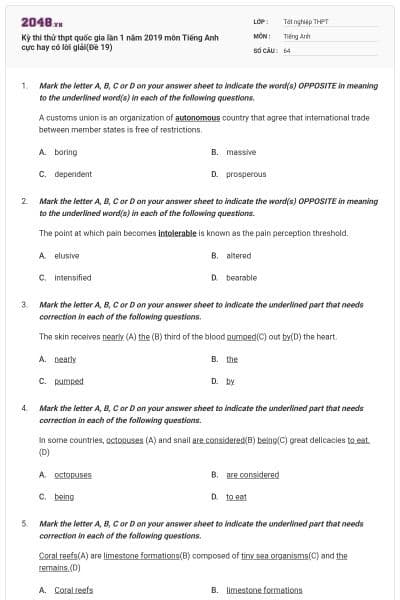
Kỳ thi thử thpt quốc gia lần 1 năm 2019 môn Tiếng Anh cực hay có lời giải(Đề 19)
64 câu hỏi
boring
massive
dependent
prosperous
Chọn C
“autonomous”: existing or acting separately from other things or people (tự trị, độc lập)
Trái nghĩa là “dependent”: phụ thuộc vào, không độc lập
elusive
altered
intensified
bearable
Chọn D
“intolerable”: không thể chịu nổi
Trái nghĩa là “bearable”: có thể chịu được
nearly
the
pumped
by
Chọn B
“the” -> “one”. “one third”: một phần ba (1/3)
Nếu là the third (chỉ thứ tự) thì phía sau phải có thêm một danh từ nữa
octopuses
are considered
being
to eat
Chọn C
“being” -> “to be”
Cấu trúc “consider to be/to do st”: cân nhắc, được cân nhắc như là/làm gì
Coral reefs
limestone formations
tiny sea organisms
the remains
Chọn D
“the remains” -> “their remains”. Nếu dùng là the remains thì trong câu không rõ nghĩa, “their remains” là chỉ “tiny sea organisms’ remains”
likely
has
own
by
Chọn B
“has” -> “will have had”. Phía sau có trạng từ chỉ thời gian “by 2050” cho nên thì trong câu phải dùng là tương lai hoàn thành (diễn tả hành động xảy ra trước một thời điểm hoặc một hành động khác trong tương lai)
animal origin
greatest
amounts
do foods of
Chọn B
So sánh nhất: the adj+est hoặc the most adj
advantage
creation
source
problem
Chọn A
“boon” = “advantage”: điều có lợi, lợi ích
is especially important
explains an effect of previous information
is not essential
contradicts the previous information
Chọn C
“Incidentally”: tiện thể, tình cờ, phụ, không quan trọng

Học thông minh hơn mỗi ngày
Xem toàn bộ 64 câu hỏi và nhiều hơn nữa với tài khoản miễn phí
They contributed to the building of the Roman Empire
They allowed trade to be conducted more simply
They were invented in Asia Minor
They were always made of gold in ancient times
Chọn D
Thông tin:
- the Roman Empire was built on silver and gold coins (đoạn 3 - A. They contributed to the building of the Roman Empire)
- A farmer could trade his produce for the fish obtained by a fisherman or the cloth produced by a weaver (đoạn đầu tiên - B. They allowed trade to be conducted more simply). Tiền giúp trao đổi, thương mại được diễn ra dễ dàng hơn
- Coins are said to have been invented by the Lydians, a people of Asia Minor (đoạn 2 - C. They were invented in Asia Minor)
Chỉ có đáp án D. They were always made of gold in ancient times là không đúng, tiền có thể làm bằng vàng hoặc bạc (silver or gold) chứ không phải lúc nào cũng làm bằng vàng
[4]
[3]
[1]
[2]
Chọn A
Phía trước đã đề cập: “Coins are still with us, though they are now little more than tokens made of non-precious metals.” Hiện nay thì tiền thường được làm bằng các loại kim loại không giá trị. Tiếp đó là đến câu: “The United States gave up minting silver dollars in 1935, and in 1965 eliminated silver in American coins completely.” (US vào năm 1965 đã loại bỏ bạc ra khỏi tiền xu – loại bỏ kim loại có giá trị)
People still use barter because of poor social conditions or as an extra, unofficial activity
The barter system sometimes reappears as a sideline activity in places experiencing social disturbances
The barter system is used only informally in harmonious places, but as the main form of economic activity in troubled lands
Bartering has always been common in both times of trouble and times of peace.
Chọn A
Even today the barter system tends to come back into style in places suffering from social breakdown, or as an informal sideline activity in more harmonious lands. (ngày nay hệ thống trao đổi hàng hoá có khuynh hướng quay trở lại ở một số nơi tồn tại sự suy yếu xã hội, hoặc như một hoạt động phụ ở những vùng đất hoà hợp hơn)
Câu này đồng nghĩa với A. People still use barter because of poor social conditions or as an extra, unofficial activity (Mọi người vẫn sử dụng hệ thống trao đổi hàng bởi vì điều kiện xã hội còn kém hoặc như 1 hoạt động thêm vào, không chính thức)
They were ruled by King Croesus in the sixth century B.C
they are considered the inventors of coins
they made coins made of electrum
they were the first to use precious metals as money
Chọn D
Thông tin:
- The scheme was refined by King Croesus, ruler of Lydia from 560 to 546 BCE (A. They were ruled by King Croesus in the sixth century B.C)
- Coins are said to have been invented by the Lydians, a people of Asia Minor (B. they are considered the inventors of coins)
- They used stamped ingots of "electrum", a naturally occurring amalgam of silver and gold.( C. they made coins made of electrum)
Chỉ có D. they were the first to use precious metals as money là không được nhắc đến
making it in large numbers
putting less silver or gold in it
using it for state expenditures
lowering its value
Chọn B
Thông tin: “By the end of his reign, the silver content of Roman coins had shrunk by 10%.” (THành phần bạc trong tiền xu Roman giảm 10%) = putting less silver or gold in it
It was used before the invention of money
It involved trading one type of good for another
It was problematic because of disagreement over value
It has not been used since ancient times
Chọn D
Thông tin ngay ở câu đầu tiên của bài: “The ancestor of the monetary system is of course the barter system.” (Tổ tiên của hệ thống tiền tệ là hệ thống trao đổi hàng hoá)
Vì thế câu It has not been used since ancient times (hệ thống trao đổi không được sử dụng từ thời xa xưa) là sai.
Gold and silver coins have little value today
Gold and silver coins are rarely used as money today
Coins used today do not differ much from coins of the past
Most coins today have little buying power
Chọn B
THông tin ở câu cuối bài: “Few countries still use silver or gold coins as anything other than collector's items.” (Rất ít quốc gia còn sử dụng tiền xu từ bạc hoặc vàng….) = Gold and silver coins are rarely used as money today (vàng bạc rất hiếm được sử dụng như tiền tệ ngày nay)
lengthy
simple
troublesome
familiar
Chọn C
“vexing” = “troublesome”: làm bực mình, làm phật ý,làm khó chịu
important
commitment
applicant
together
Chọn C
Phần C trọng âm rơi vào âm tiết thứ nhất, còn lại là thứ 2
necessity
professional
appropriate
economics
Chọn D
Phần D trọng âm rơi vào âm tiết thứ 3, còn lại là thứ 2
introduce
official
understand
Vietnamese
Chọn B
Phần B trọng âm rơi vào âm tiết thứ 2, còn lại là thứ 3
Do you think really so?
That’s very nice of you to say so
Really? I’m not sure about it, actually.
Thanks a lot.
Chọn D
What a beautiful skirt you are wearing! It matches your blouse: Chiếc váy bạn đang mặc thật đẹp! Nó thật hợp với chiếc sơ-mi.
Lời đáp cho lời khen là “Thanks a lot” – Cám ơn rất nhiều
intends
is intended
intent
are intended
Chọn D
Vì chủ ngữ là vật nên câu được chia ở dạng bị động, ngoài ra, chủ ngữ là “goods” – số nhiều nên động từ to be phù hợp là are
decoration
decorate
decorative
decorates
Chọn C
Ở đây ta cần một tính từ. “decorative” là tính từ, nghĩa: để trang trí, trang hoàng
give in
give up
put up
put off
Chọn D
“put off”: hoãn lại, làm chậm lại
are needed to
need
while needing
needs it
Chọn A
Chủ ngữ là vật nên câu được chia ở dạng bị động, chủ ngữ số nhiều (materials) nên động từ to be là are
must have given
must give
might have given
C
You might have given me a hand! = You didn’t give me a hand (bạn đã có thể giúp đỡ tôi = bạn đã không giúp đỡ tôi)
can’t have given
Chọn C
You might have given me a hand! = You didn’t give me a hand (bạn đã có thể giúp đỡ tôi = bạn đã không giúp đỡ tôi)
they evaluate
the evaluation
he evaluates
evaluate
Chọn A
Câu sử dụng ở thì hiện tại đơn, chủ ngữ + động từ
brain whose
brain that
brainless
brain’s
Chọn D
“brain’s activity”: hoạt động của não
Không dùng brain whose activity vì nếu như vậy thì trong câu sẽ thiếu hẳn 1 vế
to gather
together
to gathering
gathering
Chọn D
Cấu trúc “spend time (on) st/doing st”: dành thời gian vào cái gì/làm việc gì
came a strange procession
a strange procession came
did a strange procession come
came to a strange procession
Chọn A
Cấu trúc đảo ngữ chỉ địa điểm, vị trí hay sự chuyển động: không đảo các trợ động từ (như did, had…) như nhiều cấu trúc đảo ngữ khác, mà trực tiếp đảo động từ lên
come across
come up against
come in for
come up with
Chọn C
C cấu trúc “come in for st”: là mục tiêu của việc gì, nhận lĩnh cái gì, lôi cuốn cái gì
O;the;the
O;O;a
The;O;a
The; the;O
Chọn B
Safety và work không có mạo từ phía trước.
“a major concern”: 1 vấn đề quan tâm chính
is that
isn’t it
is it
isn’t that
Chọn B
Câu hỏi đuôi ở thì hiện tại, phía trước là câu khẳng định nên câu hỏi đuôi là phủ định. Chủ ngữ là that -> câu hỏi đuôi đúng là isn’t it (chứ không dùng that)
are found
finding for them
found
founded them
Chọn A
Đây là câu bị động, chủ ngữ là số nhiều (Many cultures, religions and languages) nên động từ to be phù hợp là are
where
in that
who
how
Chọn A
“where” là mệnh đề quan hệ, thay thế cho “booths”
will be
would be
am
would have been
Chọn B
Câu điều kiện hỗn hợp (giữa loại 3 và loại 2)
“If + mệnh đề quá khứ hoàn thành, S+would/could…+V+…”
looser the fabric
loose fabric
loose fabric is
fabric has loose
Chọn A
Cấu trúc so sánh càng…càng…: the more (adj+er)…., the more (adj+er)….
big really old green
really old big green
really big green old
really big old green
Chọn D
“really” là trạng từ, đứng trước tính từ
Vị trí của tính từ:
Size (big) + Age (old) + Color (green)
that delivers
whose delivery
which delivers
who delivers
Chọn C
“which” là mệnh đề quan hệ, được thay thế cho “An organism”
[3]
[4]
[1]
[2]
Chọn A
Phía sau có đề cập: “Indeed, this was a great influence upon the history of the modern movement in America, but Hopper later claimed that its effect on him was minimal.” (đó là sự ảnh hưởng rất lớn đến lịch sử sự vận động hiện đại ở Mỹ, nhưng sau đó Hopper khẳng định rằng tác động của nó đối với ông rất nhỏ”
Vì thế câu “It is not entirely clear how much influence the trip had on him.” Là phù hợp khi đứng trước câu này
Hopper’s growh as an artist
the themes in Hopper’s paintings
Hopper’s trip to study in Paris
the length of time that Hopper studied at art school
Chọn A
Bài viết nói về quá trình phát triển của Hopper như một hoạ sĩ (chào đời, quá trình học tập, những thành tựu trong hội hoạ)
It did not have a significant impact on his work
It may have had a major influence on his career
It included Robert Henri as a companion
It was the most exciting moment of his life
Chọn A
THông tin ở câu cuối bài: “but Hopper later claimed that its effect on him was minimal.” (Hopper khẳng định rằng tác động của nó đối với ông rất nhỏ) = It did not have a significant impact on his work
a chronological order of events in Hopper’s life
a comparison of the advantages and disadvantages of different art styles
a definition of realist painting
a listing of the different stages in becoming a realist painter
Chọn A
Tiến trình của bài đọc được sắp xếp theo trình tự thời gian của những sự việc xảy ra trong đời Hopper, từ khi sinh ra, lớn lên, học tập, rồi trở thành hoạ sĩ được biết đến
the New York School of Illustrating and New York School of Art
the chief instructor at New York School of Art
William Merritt Chase and Edward Hopper
Chọn B
Cuối đoạn 2 có nói: “where he bacame familiar with many leading figures such as William Merritt Chase and Robert Henri” (…các nhân vật dẫn đầu như William Merritt Chase and Robert Henri) vì thế, many leading figures là chỉ William Merritt Chase and Robert Henri
happiness
thoughts of the past
loneliness
hatred
Chọn C
Có thể thấy trong công việc Hopper khá cô đơn, khi mà “Hopper was slow to develop compared with other young artists of that time” Hopper hoàn toàn độc lập/đơn độc so với các hoạ sĩ cùng thời
An artist pulls a theme out of thin air
An artist’s work reflects his/her life
Something doesn’t have an effect on an art
There is no method to art
Chọn B
Trước câu đó đã nói: “The man’s the work” (Con người chính là công việc) Vì thế “Something doesn’t come out of nothing.” Là muốn nói về sự ảnh hưởng của công việc đối với cuộc sống của một người
hated
wanted
enjoyed
feared
Chọn B
“long” = “want” (v): mong muốn, khao khát được…
the themes of solitude and introspection in Hopper’s paintings
Hopper’s grades in art school
the works of Chase and Henri
Hopper’s life after Paris
Chọn D
Đoạn cuối của đoạn văn này nói về chuyến đi đến Paris của Hopper và những ảnh hưởng của nó. Vì thế, đoạn văn tiếp sau đoạn văn này có thể nói về cuộc đời Hopper sau chuyến Paris
being America’s best known realist painter
attending the New York School of Illustrating
attending the New York School of Art
studying in Paris
Chọn C
Sự kiện quan trọng nhất đối với Hopper là attending the New York School of Art
Vì “the New York School of Art, where he bacame familiar with many leading figures such as William Merritt Chase and Robert Henri, founders of American Realism.” Đây là nơi Hopper quen thuộc với những nhân vật dẫn đầu – thành lập trường phái hiện thực Mỹ
goods
weighs
lakes
metres
Chọn C
A./z/ B./z/ C./s/ D./z/
camel
dramatic
Brazil
contrary
Chọn A
A./ᴂ/ B./ə/ C. /ə/ D. /ə/
shouted
announced
called
told
Chọn B
“announce”: công bố, thông báo
“shout”: kêu la, la hét
“call”: gọi
“tell”: bảo, nói rằng
taken
looked
carried
made
Chọn C
Cụm “carry out”: tiến hành (một thí nghiệm, khảo sát,…)
that
who
where
whom
Chọn A
Cấu trúc nhấn mạnh “It is…that…”
Thành phần này có hoặc bỏ đi đều không ảnh hưởng đến nghĩa của câu
depending
discussing
suggesting
according
Chọn D
“according to st/sb”: theo như ai/cái gì
when
which
while
what
Chọn B
“which” là mệnh đề quan hệ, thay thế cho the antioxidant lycopene ở phía trước
to
on
as
from
Chọn C
“as a health food suppplement”: như là phần bổ sung thực phẩm có lợi cho sức khoẻ
more
well
good
better
Chọn B
Phía trước có động từ work, vì thế ở đây nên dùng một trạng từ
“well” là trạng từ của good
must
would
should
did
Chọn C
“should”: nên
Chuyên gia tin rằng con người nên sử dụng…
on
for
to
of
Chọn D
“the risk of…”: mối nguy hại, nguy cơ của…
experience
inspect
expect
direct
Chọn C
“expect”: mong đợi
Chúng ta không nên mong đợi giải pháp dễ dàng cho một vấn đề phức tạp
clashes with the colors around it
differs from the color of its selting
contrasts with its surroundings
looks the same as its environment
Chọn D
“conform to” = “looks the same as its environment”: hợp với (hợp với môi trường xung quanh)
progressive
delicate
praised
attractive
Chọn A
“advanced” = “progressive”: tiến bộ, tiến triển
destroyed
banned
avoid
advanced
Chọn B
“forbidden” = “banned”: bị cấm, bị ngăn cản
Bạn có thích hoạt động này không?
Hãy lưu hoặc chia sẻ nội dung này đến mọi người.
Gợi ý cho bạn

Ý tưởng của bạn, bài học của bạn
Tự thiết kế đề thi, bài giảng hoặc flashcard theo cách riêng.

Học liệu phổ biến Tốt nghiệp THPT
Tốt nghiệp THPT
Bài tập vừa sức, đúng lớp
Chọn nội dung phù hợp và tạo hoạt động cho lớp của bạn.