Kỳ thi thử thpt quốc gia lần 1 năm 2019 môn Tiếng Anh cực hay có lời giải(Đề 17)
64 câu hỏi
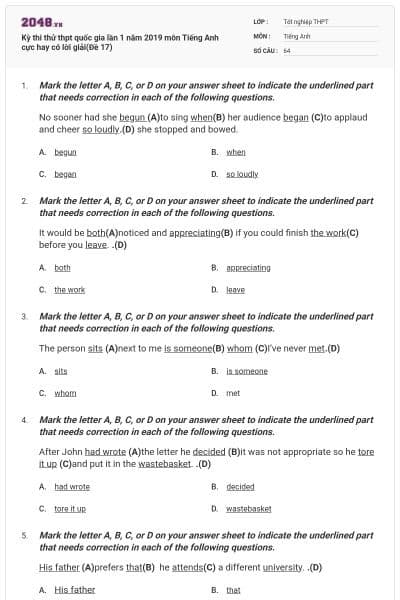
Mark the letter A, B, C, or D on your answer sheet to indicate the underlined part that needs correction in each of the following questions.
No sooner had she begun (A)to sing when(B) her audience began (C)to applaud and cheer so loudly.(D) she stopped and bowed.
begun
when
began
so loudly
Chọn B
Cấu trúc: no sooner… than…: ngay khi … thì… Nên sửa “when:-> “than”.
Mark the letter A, B, C, or D on your answer sheet to indicate the underlined part that needs correction in each of the following questions.
It would be both(A)noticed and appreciating(B) if you could finish the work(C) before you leave. .(D)
both
appreciating
the work
leave
Chọn B
Các từ điền vào trong cấu trúc Both…and… phải cùng dạng nên sửa “appreciating”-> “appreciated”. Cách giải thích khác là về đầu “It would be” thì động từ sau nó phải ở dạng bị động PP.
Mark the letter A, B, C, or D on your answer sheet to indicate the underlined part that needs correction in each of the following questions.
The person sits (A)next to me is someone(B) whom (C)I’ve never met.(D)
sits
is someone
whom
met
Chọn A
“The person sits next to me is someone” vế này của câu thiếu chủ ngữ cho động từ “sits” nên có 2 cách sửa là “sits” -> “who sits”->”sitting” (dạng rút gọn mệnh đề quan hệ dạng chủ động).
Mark the letter A, B, C, or D on your answer sheet to indicate the underlined part that needs correction in each of the following questions.
After John had wrote (A)the letter he decided (B)it was not appropriate so he tore it up (C)and put it in the wastebasket. .(D)
had wrote
decided
tore it up
wastebasket
Chọn A
Sau “after” dùng “had” -> quá khứ hoàn thành nên từ “wrote” sai-> “had written”.
Mark the letter A, B, C, or D on your answer sheet to indicate the underlined part that needs correction in each of the following questions.
His father (A)prefers that(B) he attends(C) a different university. .(D)
His father
that
attends
university
Chọn C
Cấu trúc: prefer that+ S+ Vbare: thích ai làm gì hơn. Nên “attends”-> “attend”.
Read the following passage and choose the letter A, B, C or D on your answer sheet to indicate the correct answer to each of the questions from 6 to 15.
The education of dead people has a long history. In the past, some educators preferred to teach sign language, a method of communicating with one’s hands, while others emphasized trying to teach deaf people to speak.The first known teacher of the deaf was Pedro Ponce De Leon, a Benedictine monk, who tutored children of the nobility in the 1570s. He had some success in teaching deaf children to speak and write. A former pupil of his indicated that Ponce de Leon used both a manual Alphabet and oral methods. France was one of the leaders in education of the deaf. There, around 1600, Juan Bonet and Manuel Ramirez de carrion worked with a young child who had lost his hearing. Bonet later wrote and published the first book on teaching the deaf. Bonet taught his pupil a signed alphabet that is very close to the one 6 used today in the United States. In 1775 in Paris, Abbe Charles Michel de I'Epee founded a free school for deaf pupils that taught sign language. Over the school for deaf people that taught sign language. Over the next several decades, this school's method of teaching students sign language became famous as the "French method".In America, the first school for deaf students was not founded Until April 15, 1817, probably because that was when an American city had a concentration of people large enough to sustain a permanent institution. Thomas Gallaudet founded this first school, the American Asylum for the education of the Deaf and Dumb, located in Hartford, Connecticut, and now called the American School for the Deaf. Gallaudet hired a deaf French man, Laurent Clerc, to teach at his school. Clerc created the sign language system used in the school, and trained many of the first teachers in his techniques. Hence Clerc was one of the most influential educators in early American deaf education.In 1857, Edward Minor Gallaudet, a son of Thomas Gallaudet, became principal of the Columbia Institution for the Deaf and Dumb in Washington, D.C, which eventually became Gallaudet college, the only liberal arts institution for the deaf. Edward Gallaudet advocated a combination of oral and manual methods of deaf education.
What is the main topic of this passage?
The “French” method of educating deaf students
The oral method of deaf education
Gallaudet College
The history of deaf education Question
Chọn D
Dựa vào câu đầu tiên của bài “The education of dead people has a long history.” Giáo dục cho người điếc có 1 lịch sử dài. Các câu sau chứng minh ý đó.
Read the following passage and choose the letter A, B, C or D on your answer sheet to indicate the correct answer to each of the questions from 6 to 15.
The education of dead people has a long history. In the past, some educators preferred to teach sign language, a method of communicating with one’s hands, while others emphasized trying to teach deaf people to speak.The first known teacher of the deaf was Pedro Ponce De Leon, a Benedictine monk, who tutored children of the nobility in the 1570s. He had some success in teaching deaf children to speak and write. A former pupil of his indicated that Ponce de Leon used both a manual Alphabet and oral methods. France was one of the leaders in education of the deaf. There, around 1600, Juan Bonet and Manuel Ramirez de carrion worked with a young child who had lost his hearing. Bonet later wrote and published the first book on teaching the deaf. Bonet taught his pupil a signed alphabet that is very close to the one 6 used today in the United States. In 1775 in Paris, Abbe Charles Michel de I'Epee founded a free school for deaf pupils that taught sign language. Over the school for deaf people that taught sign language. Over the next several decades, this school's method of teaching students sign language became famous as the "French method".In America, the first school for deaf students was not founded Until April 15, 1817, probably because that was when an American city had a concentration of people large enough to sustain a permanent institution. Thomas Gallaudet founded this first school, the American Asylum for the education of the Deaf and Dumb, located in Hartford, Connecticut, and now called the American School for the Deaf. Gallaudet hired a deaf French man, Laurent Clerc, to teach at his school. Clerc created the sign language system used in the school, and trained many of the first teachers in his techniques. Hence Clerc was one of the most influential educators in early American deaf education.In 1857, Edward Minor Gallaudet, a son of Thomas Gallaudet, became principal of the Columbia Institution for the Deaf and Dumb in Washington, D.C, which eventually became Gallaudet college, the only liberal arts institution for the deaf. Edward Gallaudet advocated a combination of oral and manual methods of deaf education.
Why is Pedro Ponce de Leon mentioned?
He was the first known teacher of the deaf.
He advocated a combination of oral and manual methods?
He taught a manual alphabet similar to the one used today in the United States.
He was an influential educator at Gallaudet College.
Chọn A
Dựa vào câu đầu đoạn 2 “The first known teacher of the deaf was Pedro Ponce De Leon” người được coi như thầy giáo đầu tiên cho người mù là Pedro Ponce De Leon.
Read the following passage and choose the letter A, B, C or D on your answer sheet to indicate the correct answer to each of the questions from 6 to 15.
The education of dead people has a long history. In the past, some educators preferred to teach sign language, a method of communicating with one’s hands, while others emphasized trying to teach deaf people to speak.The first known teacher of the deaf was Pedro Ponce De Leon, a Benedictine monk, who tutored children of the nobility in the 1570s. He had some success in teaching deaf children to speak and write. A former pupil of his indicated that Ponce de Leon used both a manual Alphabet and oral methods. France was one of the leaders in education of the deaf. There, around 1600, Juan Bonet and Manuel Ramirez de carrion worked with a young child who had lost his hearing. Bonet later wrote and published the first book on teaching the deaf. Bonet taught his pupil a signed alphabet that is very close to the one 6 used today in the United States. In 1775 in Paris, Abbe Charles Michel de I'Epee founded a free school for deaf pupils that taught sign language. Over the school for deaf people that taught sign language. Over the next several decades, this school's method of teaching students sign language became famous as the "French method".In America, the first school for deaf students was not founded Until April 15, 1817, probably because that was when an American city had a concentration of people large enough to sustain a permanent institution. Thomas Gallaudet founded this first school, the American Asylum for the education of the Deaf and Dumb, located in Hartford, Connecticut, and now called the American School for the Deaf. Gallaudet hired a deaf French man, Laurent Clerc, to teach at his school. Clerc created the sign language system used in the school, and trained many of the first teachers in his techniques. Hence Clerc was one of the most influential educators in early American deaf education.In 1857, Edward Minor Gallaudet, a son of Thomas Gallaudet, became principal of the Columbia Institution for the Deaf and Dumb in Washington, D.C, which eventually became Gallaudet college, the only liberal arts institution for the deaf. Edward Gallaudet advocated a combination of oral and manual methods of deaf education.
The word “tutored” in line 3 is closest in meaning to which of the following?
taught
supported
led
encouraged
Chọn A
Read the following passage and choose the letter A, B, C or D on your answer sheet to indicate the correct answer to each of the questions from 6 to 15.
The education of dead people has a long history. In the past, some educators preferred to teach sign language, a method of communicating with one’s hands, while others emphasized trying to teach deaf people to speak.The first known teacher of the deaf was Pedro Ponce De Leon, a Benedictine monk, who tutored children of the nobility in the 1570s. He had some success in teaching deaf children to speak and write. A former pupil of his indicated that Ponce de Leon used both a manual Alphabet and oral methods. France was one of the leaders in education of the deaf. There, around 1600, Juan Bonet and Manuel Ramirez de carrion worked with a young child who had lost his hearing. Bonet later wrote and published the first book on teaching the deaf. Bonet taught his pupil a signed alphabet that is very close to the one 6 used today in the United States. In 1775 in Paris, Abbe Charles Michel de I'Epee founded a free school for deaf pupils that taught sign language. Over the school for deaf people that taught sign language. Over the next several decades, this school's method of teaching students sign language became famous as the "French method".In America, the first school for deaf students was not founded Until April 15, 1817, probably because that was when an American city had a concentration of people large enough to sustain a permanent institution. Thomas Gallaudet founded this first school, the American Asylum for the education of the Deaf and Dumb, located in Hartford, Connecticut, and now called the American School for the Deaf. Gallaudet hired a deaf French man, Laurent Clerc, to teach at his school. Clerc created the sign language system used in the school, and trained many of the first teachers in his techniques. Hence Clerc was one of the most influential educators in early American deaf education.In 1857, Edward Minor Gallaudet, a son of Thomas Gallaudet, became principal of the Columbia Institution for the Deaf and Dumb in Washington, D.C, which eventually became Gallaudet college, the only liberal arts institution for the deaf. Edward Gallaudet advocated a combination of oral and manual methods of deaf education.
“This school’s method” in line 11 refers to which school?
Ponce de Leon’s school
Charles Michel de I'Epee’s school
Gallaudet College
Laurent Clerc’s school
Chọn B
Câu trước đó ói về việc Abbe Charles Michel de I'Epee thành lập trường dạy cho người mù ngôn ngữ ký hiệu -> nói về trường học của Abbe.
Read the following passage and choose the letter A, B, C or D on your answer sheet to indicate the correct answer to each of the questions from 6 to 15.
The education of dead people has a long history. In the past, some educators preferred to teach sign language, a method of communicating with one’s hands, while others emphasized trying to teach deaf people to speak.The first known teacher of the deaf was Pedro Ponce De Leon, a Benedictine monk, who tutored children of the nobility in the 1570s. He had some success in teaching deaf children to speak and write. A former pupil of his indicated that Ponce de Leon used both a manual Alphabet and oral methods. France was one of the leaders in education of the deaf. There, around 1600, Juan Bonet and Manuel Ramirez de carrion worked with a young child who had lost his hearing. Bonet later wrote and published the first book on teaching the deaf. Bonet taught his pupil a signed alphabet that is very close to the one 6 used today in the United States. In 1775 in Paris, Abbe Charles Michel de I'Epee founded a free school for deaf pupils that taught sign language. Over the school for deaf people that taught sign language. Over the next several decades, this school's method of teaching students sign language became famous as the "French method".In America, the first school for deaf students was not founded Until April 15, 1817, probably because that was when an American city had a concentration of people large enough to sustain a permanent institution. Thomas Gallaudet founded this first school, the American Asylum for the education of the Deaf and Dumb, located in Hartford, Connecticut, and now called the American School for the Deaf. Gallaudet hired a deaf French man, Laurent Clerc, to teach at his school. Clerc created the sign language system used in the school, and trained many of the first teachers in his techniques. Hence Clerc was one of the most influential educators in early American deaf education.In 1857, Edward Minor Gallaudet, a son of Thomas Gallaudet, became principal of the Columbia Institution for the Deaf and Dumb in Washington, D.C, which eventually became Gallaudet college, the only liberal arts institution for the deaf. Edward Gallaudet advocated a combination of oral and manual methods of deaf education.
According to the passage, what was the principal achievement of Juan Boner?
He taught sign language at a free school
He was the first to combine oral and manual methods
He wrote the first book on educating the deaf.
He opened the first American school for the deaf.
Chọn C
Dòng 2 đoạn 3 “Bonet later wrote and published the first book on teaching the deaf” Bonet viết và xuất bản cuốn sách đầu tiên cho người điếc.
Read the following passage and choose the letter A, B, C or D on your answer sheet to indicate the correct answer to each of the questions from 6 to 15.
The education of dead people has a long history. In the past, some educators preferred to teach sign language, a method of communicating with one’s hands, while others emphasized trying to teach deaf people to speak.The first known teacher of the deaf was Pedro Ponce De Leon, a Benedictine monk, who tutored children of the nobility in the 1570s. He had some success in teaching deaf children to speak and write. A former pupil of his indicated that Ponce de Leon used both a manual Alphabet and oral methods. France was one of the leaders in education of the deaf. There, around 1600, Juan Bonet and Manuel Ramirez de carrion worked with a young child who had lost his hearing. Bonet later wrote and published the first book on teaching the deaf. Bonet taught his pupil a signed alphabet that is very close to the one 6 used today in the United States. In 1775 in Paris, Abbe Charles Michel de I'Epee founded a free school for deaf pupils that taught sign language. Over the school for deaf people that taught sign language. Over the next several decades, this school's method of teaching students sign language became famous as the "French method".In America, the first school for deaf students was not founded Until April 15, 1817, probably because that was when an American city had a concentration of people large enough to sustain a permanent institution. Thomas Gallaudet founded this first school, the American Asylum for the education of the Deaf and Dumb, located in Hartford, Connecticut, and now called the American School for the Deaf. Gallaudet hired a deaf French man, Laurent Clerc, to teach at his school. Clerc created the sign language system used in the school, and trained many of the first teachers in his techniques. Hence Clerc was one of the most influential educators in early American deaf education.In 1857, Edward Minor Gallaudet, a son of Thomas Gallaudet, became principal of the Columbia Institution for the Deaf and Dumb in Washington, D.C, which eventually became Gallaudet college, the only liberal arts institution for the deaf. Edward Gallaudet advocated a combination of oral and manual methods of deaf education.
The word “institution” in bold in paragraph 4 refers to______.
a large group of people
a method of teaching
a hospital
a school
Chọn D
Institution = học viện, school= trường học.
Read the following passage and choose the letter A, B, C or D on your answer sheet to indicate the correct answer to each of the questions from 6 to 15.
The education of dead people has a long history. In the past, some educators preferred to teach sign language, a method of communicating with one’s hands, while others emphasized trying to teach deaf people to speak.The first known teacher of the deaf was Pedro Ponce De Leon, a Benedictine monk, who tutored children of the nobility in the 1570s. He had some success in teaching deaf children to speak and write. A former pupil of his indicated that Ponce de Leon used both a manual Alphabet and oral methods. France was one of the leaders in education of the deaf. There, around 1600, Juan Bonet and Manuel Ramirez de carrion worked with a young child who had lost his hearing. Bonet later wrote and published the first book on teaching the deaf. Bonet taught his pupil a signed alphabet that is very close to the one 6 used today in the United States. In 1775 in Paris, Abbe Charles Michel de I'Epee founded a free school for deaf pupils that taught sign language. Over the school for deaf people that taught sign language. Over the next several decades, this school's method of teaching students sign language became famous as the "French method".In America, the first school for deaf students was not founded Until April 15, 1817, probably because that was when an American city had a concentration of people large enough to sustain a permanent institution. Thomas Gallaudet founded this first school, the American Asylum for the education of the Deaf and Dumb, located in Hartford, Connecticut, and now called the American School for the Deaf. Gallaudet hired a deaf French man, Laurent Clerc, to teach at his school. Clerc created the sign language system used in the school, and trained many of the first teachers in his techniques. Hence Clerc was one of the most influential educators in early American deaf education.In 1857, Edward Minor Gallaudet, a son of Thomas Gallaudet, became principal of the Columbia Institution for the Deaf and Dumb in Washington, D.C, which eventually became Gallaudet college, the only liberal arts institution for the deaf. Edward Gallaudet advocated a combination of oral and manual methods of deaf education.
Why does the author suggest that the first school for the deaf was opened in 1817?
because the president ordered it.
because they want to use the French method.
because there was a considerable population of deaf people.
because Laurent Clerc was a great teacher.
Chọn C
Dựa vào câu “when an American city had a concentration of people large enough to sustain a permanent institution”: khi một thành phố ở Mỹ có đủ người để duy trì một học viện. -> những người điếc có cộng đồng đủ lớn.
Read the following passage and choose the letter A, B, C or D on your answer sheet to indicate the correct answer to each of the questions from 6 to 15.
The education of dead people has a long history. In the past, some educators preferred to teach sign language, a method of communicating with one’s hands, while others emphasized trying to teach deaf people to speak.The first known teacher of the deaf was Pedro Ponce De Leon, a Benedictine monk, who tutored children of the nobility in the 1570s. He had some success in teaching deaf children to speak and write. A former pupil of his indicated that Ponce de Leon used both a manual Alphabet and oral methods. France was one of the leaders in education of the deaf. There, around 1600, Juan Bonet and Manuel Ramirez de carrion worked with a young child who had lost his hearing. Bonet later wrote and published the first book on teaching the deaf. Bonet taught his pupil a signed alphabet that is very close to the one 6 used today in the United States. In 1775 in Paris, Abbe Charles Michel de I'Epee founded a free school for deaf pupils that taught sign language. Over the school for deaf people that taught sign language. Over the next several decades, this school's method of teaching students sign language became famous as the "French method".In America, the first school for deaf students was not founded Until April 15, 1817, probably because that was when an American city had a concentration of people large enough to sustain a permanent institution. Thomas Gallaudet founded this first school, the American Asylum for the education of the Deaf and Dumb, located in Hartford, Connecticut, and now called the American School for the Deaf. Gallaudet hired a deaf French man, Laurent Clerc, to teach at his school. Clerc created the sign language system used in the school, and trained many of the first teachers in his techniques. Hence Clerc was one of the most influential educators in early American deaf education.In 1857, Edward Minor Gallaudet, a son of Thomas Gallaudet, became principal of the Columbia Institution for the Deaf and Dumb in Washington, D.C, which eventually became Gallaudet college, the only liberal arts institution for the deaf. Edward Gallaudet advocated a combination of oral and manual methods of deaf education.
The word “influential” in bold in paragraph 4 means _____.
convincing
positive
important
noticeable
Chọn B
Influential= có sức ảnh hưởng, important= quan trọng, convivcing= có sức thuyết phục, positive = chắc chắn, noticeable= đáng chú ý.
Read the following passage and choose the letter A, B, C or D on your answer sheet to indicate the correct answer to each of the questions from 6 to 15.
The education of dead people has a long history. In the past, some educators preferred to teach sign language, a method of communicating with one’s hands, while others emphasized trying to teach deaf people to speak.The first known teacher of the deaf was Pedro Ponce De Leon, a Benedictine monk, who tutored children of the nobility in the 1570s. He had some success in teaching deaf children to speak and write. A former pupil of his indicated that Ponce de Leon used both a manual Alphabet and oral methods. France was one of the leaders in education of the deaf. There, around 1600, Juan Bonet and Manuel Ramirez de carrion worked with a young child who had lost his hearing. Bonet later wrote and published the first book on teaching the deaf. Bonet taught his pupil a signed alphabet that is very close to the one 6 used today in the United States. In 1775 in Paris, Abbe Charles Michel de I'Epee founded a free school for deaf pupils that taught sign language. Over the school for deaf people that taught sign language. Over the next several decades, this school's method of teaching students sign language became famous as the "French method".In America, the first school for deaf students was not founded Until April 15, 1817, probably because that was when an American city had a concentration of people large enough to sustain a permanent institution. Thomas Gallaudet founded this first school, the American Asylum for the education of the Deaf and Dumb, located in Hartford, Connecticut, and now called the American School for the Deaf. Gallaudet hired a deaf French man, Laurent Clerc, to teach at his school. Clerc created the sign language system used in the school, and trained many of the first teachers in his techniques. Hence Clerc was one of the most influential educators in early American deaf education.In 1857, Edward Minor Gallaudet, a son of Thomas Gallaudet, became principal of the Columbia Institution for the Deaf and Dumb in Washington, D.C, which eventually became Gallaudet college, the only liberal arts institution for the deaf. Edward Gallaudet advocated a combination of oral and manual methods of deaf education.
What is the distinction of Gallaudet College?
It is the first school to use the French method.
It used a combination of a manual alphabet and oral methods.
It is only the liberal arts college for deaf students.
It is located in Washington D.C.
Chọn C
Dựa vào dòng 3 đoạn 4 “Gallaudet college, the only liberal arts institution for the deaf.” Cao đẳng Gallaudet, viện nghệ thuật chuyên sâu duy nhất cho người điếc.
Read the following passage and choose the letter A, B, C or D on your answer sheet to indicate the correct answer to each of the questions from 6 to 15.
The education of dead people has a long history. In the past, some educators preferred to teach sign language, a method of communicating with one’s hands, while others emphasized trying to teach deaf people to speak.The first known teacher of the deaf was Pedro Ponce De Leon, a Benedictine monk, who tutored children of the nobility in the 1570s. He had some success in teaching deaf children to speak and write. A former pupil of his indicated that Ponce de Leon used both a manual Alphabet and oral methods. France was one of the leaders in education of the deaf. There, around 1600, Juan Bonet and Manuel Ramirez de carrion worked with a young child who had lost his hearing. Bonet later wrote and published the first book on teaching the deaf. Bonet taught his pupil a signed alphabet that is very close to the one 6 used today in the United States. In 1775 in Paris, Abbe Charles Michel de I'Epee founded a free school for deaf pupils that taught sign language. Over the school for deaf people that taught sign language. Over the next several decades, this school's method of teaching students sign language became famous as the "French method".In America, the first school for deaf students was not founded Until April 15, 1817, probably because that was when an American city had a concentration of people large enough to sustain a permanent institution. Thomas Gallaudet founded this first school, the American Asylum for the education of the Deaf and Dumb, located in Hartford, Connecticut, and now called the American School for the Deaf. Gallaudet hired a deaf French man, Laurent Clerc, to teach at his school. Clerc created the sign language system used in the school, and trained many of the first teachers in his techniques. Hence Clerc was one of the most influential educators in early American deaf education.In 1857, Edward Minor Gallaudet, a son of Thomas Gallaudet, became principal of the Columbia Institution for the Deaf and Dumb in Washington, D.C, which eventually became Gallaudet college, the only liberal arts institution for the deaf. Edward Gallaudet advocated a combination of oral and manual methods of deaf education.
“Advocated” in bold in the last paragraph is closest in meaning to which of the following?
predicted
dominated
classified
promoted
Chọn D
Advocate= ủng hộ, promote=đẩy mạnh, predicte= đoán trước, donate= quyên góp, classified= phân loại. Câu cuối bài: Edward đã tán thành việc kết hợp miệng và tay để dạy trẻ -> thay từ “promote” sẽ phù hợp nhất.
Mark the letter A, B, C, or D on your answer sheet to indicate the word whose underlined part differs from the other three in pronunciation in each of the following questions.
package
passable
gadget
magnet
Chọn B
“a” trong từ “passable” phát âm là /a:/, trong các từ còn lại là /æ/.
Mark the letter A, B, C, or D on your answer sheet to indicate the word whose underlined part differs from the other three in pronunciation in each of the following questions.
walks
begins
helps
cuts
Chọn B
“s” trong từ “begins” phát âm là /z/, trong các từ còn lại là /s/.
Read the following passage and choose the letter A, B, C or D on your answer sheet to indicate the correct word or phrase the best fits each of the number blanks. Fill in the appropriate word in question 18
A NIGHTMARE OF NOISE
Accordingto a recent TV program, noise pollution is becoming an increasingly serious problem. Background noise such as (18)_____, police sirens and aeroplanes is growing year by year, and complaints to the police are becoming more and more (19)_____. However, for people like Mary Norman, who lives close to London Heathrow airport, the situation is particularly bad. “It’s becoming very difficult to (20)_____ a normal family life,’ she told an interviewer, ‘because the planes start first thing in the morning. They make a terrible noise, as you can imagine, and it (21)_____ on all day long. Of course I have complained about it but nobody takes any notice. I’m fed (22)_____ with living here, but unfortunately I can’t afford to move.”
Researchers believe that the problem is getting worse. They have found that people who are exposed to high levels of noise become (23)_____ aggressive. Take the case of Henry Wilson, who was (24)_____ mad by a neighbor who insisted on playing his music at full volume. One night, he finally lost his (25)_____. After being forced to listen to heavy metal songs for hours, he burst into his neighbor’s house, poured petrol all over the carpets and (26)_____ to set fire to the place.
When he finally appeared in court, the judge was surprisingly understanding. He (27)_____ to send him to jail, saying that he had suffered enough.
circulation
congestion
traffic
transport
Chọn C
Circulation=sự tuần hoàn, congestion= tắc nghẽn, traffic=giao thông, transport= chuyên chở. “Background noise such as _____, police sirens and aeroplanes”: nguồn gốc tiếng ồn bao gồm …., còi cảnh sát và máy bay. -> Giao thông gây ra tiếng ồn.
Read the following passage and choose the letter A, B, C or D on your answer sheet to indicate the correct word or phrase the best fits each of the number blanks. Fill in the appropriate word in question 19
A NIGHTMARE OF NOISE
Accordingto a recent TV program, noise pollution is becoming an increasingly serious problem. Background noise such as (18)_____, police sirens and aeroplanes is growing year by year, and complaints to the police are becoming more and more (19)_____. However, for people like Mary Norman, who lives close to London Heathrow airport, the situation is particularly bad. “It’s becoming very difficult to (20)_____ a normal family life,’ she told an interviewer, ‘because the planes start first thing in the morning. They make a terrible noise, as you can imagine, and it (21)_____ on all day long. Of course I have complained about it but nobody takes any notice. I’m fed (22)_____ with living here, but unfortunately I can’t afford to move.”
Researchers believe that the problem is getting worse. They have found that people who are exposed to high levels of noise become (23)_____ aggressive. Take the case of Henry Wilson, who was (24)_____ mad by a neighbor who insisted on playing his music at full volume. One night, he finally lost his (25)_____. After being forced to listen to heavy metal songs for hours, he burst into his neighbor’s house, poured petrol all over the carpets and (26)_____ to set fire to the place.
When he finally appeared in court, the judge was surprisingly understanding. He (27)_____ to send him to jail, saying that he had suffered enough.
often
repeat
frequent
continual
Chọn C
Become + adj-> “frequently”. Dịch: những lời phàn nàn với cảnh sát ngày càng thường xuyen hơn. Các từ còn lại không hợp nghĩa, often (phó từ), repeated= lặp lại, continual= tiếp diễn.
Read the following passage and choose the letter A, B, C or D on your answer sheet to indicate the correct word or phrase the best fits each of the number blanks. Fill in the appropriate word in question 20
A NIGHTMARE OF NOISE
Accordingto a recent TV program, noise pollution is becoming an increasingly serious problem. Background noise such as (18)_____, police sirens and aeroplanes is growing year by year, and complaints to the police are becoming more and more (19)_____. However, for people like Mary Norman, who lives close to London Heathrow airport, the situation is particularly bad. “It’s becoming very difficult to (20)_____ a normal family life,’ she told an interviewer, ‘because the planes start first thing in the morning. They make a terrible noise, as you can imagine, and it (21)_____ on all day long. Of course I have complained about it but nobody takes any notice. I’m fed (22)_____ with living here, but unfortunately I can’t afford to move.”
Researchers believe that the problem is getting worse. They have found that people who are exposed to high levels of noise become (23)_____ aggressive. Take the case of Henry Wilson, who was (24)_____ mad by a neighbor who insisted on playing his music at full volume. One night, he finally lost his (25)_____. After being forced to listen to heavy metal songs for hours, he burst into his neighbor’s house, poured petrol all over the carpets and (26)_____ to set fire to the place.
When he finally appeared in court, the judge was surprisingly understanding. He (27)_____ to send him to jail, saying that he had suffered enough.
lead
take
hold
guide
Chọn A
Lead= sống, trải qua.->: lead a normal family life: sống một cuộc sống gia đình bình thường.
Read the following passage and choose the letter A, B, C or D on your answer sheet to indicate the correct word or phrase the best fits each of the number blanks. Fill in the appropriate word in question 21
A NIGHTMARE OF NOISE
Accordingto a recent TV program, noise pollution is becoming an increasingly serious problem. Background noise such as (18)_____, police sirens and aeroplanes is growing year by year, and complaints to the police are becoming more and more (19)_____. However, for people like Mary Norman, who lives close to London Heathrow airport, the situation is particularly bad. “It’s becoming very difficult to (20)_____ a normal family life,’ she told an interviewer, ‘because the planes start first thing in the morning. They make a terrible noise, as you can imagine, and it (21)_____ on all day long. Of course I have complained about it but nobody takes any notice. I’m fed (22)_____ with living here, but unfortunately I can’t afford to move.”
Researchers believe that the problem is getting worse. They have found that people who are exposed to high levels of noise become (23)_____ aggressive. Take the case of Henry Wilson, who was (24)_____ mad by a neighbor who insisted on playing his music at full volume. One night, he finally lost his (25)_____. After being forced to listen to heavy metal songs for hours, he burst into his neighbor’s house, poured petrol all over the carpets and (26)_____ to set fire to the place.
When he finally appeared in court, the judge was surprisingly understanding. He (27)_____ to send him to jail, saying that he had suffered enough.
spends
goes
lasts
continues
Chọn B
Go on= tiếp diễn, các từ còn lại không kết hợp với giới từ “on”.
Read the following passage and choose the letter A, B, C or D on your answer sheet to indicate the correct word or phrase the best fits each of the number blanks. Fill in the appropriate word in question 22
A NIGHTMARE OF NOISE
Accordingto a recent TV program, noise pollution is becoming an increasingly serious problem. Background noise such as (18)_____, police sirens and aeroplanes is growing year by year, and complaints to the police are becoming more and more (19)_____. However, for people like Mary Norman, who lives close to London Heathrow airport, the situation is particularly bad. “It’s becoming very difficult to (20)_____ a normal family life,’ she told an interviewer, ‘because the planes start first thing in the morning. They make a terrible noise, as you can imagine, and it (21)_____ on all day long. Of course I have complained about it but nobody takes any notice. I’m fed (22)_____ with living here, but unfortunately I can’t afford to move.”
Researchers believe that the problem is getting worse. They have found that people who are exposed to high levels of noise become (23)_____ aggressive. Take the case of Henry Wilson, who was (24)_____ mad by a neighbor who insisted on playing his music at full volume. One night, he finally lost his (25)_____. After being forced to listen to heavy metal songs for hours, he burst into his neighbor’s house, poured petrol all over the carpets and (26)_____ to set fire to the place.
When he finally appeared in court, the judge was surprisingly understanding. He (27)_____ to send him to jail, saying that he had suffered enough.
up with
in on
about with
out of
Chọn A
Cấu trúc: tobe+ fed up with: chán ngấy.
Read the following passage and choose the letter A, B, C or D on your answer sheet to indicate the correct word or phrase the best fits each of the number blanks. Fill in the appropriate word in question 23
A NIGHTMARE OF NOISE
Accordingto a recent TV program, noise pollution is becoming an increasingly serious problem. Background noise such as (18)_____, police sirens and aeroplanes is growing year by year, and complaints to the police are becoming more and more (19)_____. However, for people like Mary Norman, who lives close to London Heathrow airport, the situation is particularly bad. “It’s becoming very difficult to (20)_____ a normal family life,’ she told an interviewer, ‘because the planes start first thing in the morning. They make a terrible noise, as you can imagine, and it (21)_____ on all day long. Of course I have complained about it but nobody takes any notice. I’m fed (22)_____ with living here, but unfortunately I can’t afford to move.”
Researchers believe that the problem is getting worse. They have found that people who are exposed to high levels of noise become (23)_____ aggressive. Take the case of Henry Wilson, who was (24)_____ mad by a neighbor who insisted on playing his music at full volume. One night, he finally lost his (25)_____. After being forced to listen to heavy metal songs for hours, he burst into his neighbor’s house, poured petrol all over the carpets and (26)_____ to set fire to the place.
When he finally appeared in court, the judge was surprisingly understanding. He (27)_____ to send him to jail, saying that he had suffered enough.
much
many
most
more
Chọn D
Become more+ adj: trở lên… hơn,dạng giống câu 19.
Read the following passage and choose the letter A, B, C or D on your answer sheet to indicate the correct word or phrase the best fits each of the number blanks. Fill in the appropriate word in question 24
A NIGHTMARE OF NOISE
Accordingto a recent TV program, noise pollution is becoming an increasingly serious problem. Background noise such as (18)_____, police sirens and aeroplanes is growing year by year, and complaints to the police are becoming more and more (19)_____. However, for people like Mary Norman, who lives close to London Heathrow airport, the situation is particularly bad. “It’s becoming very difficult to (20)_____ a normal family life,’ she told an interviewer, ‘because the planes start first thing in the morning. They make a terrible noise, as you can imagine, and it (21)_____ on all day long. Of course I have complained about it but nobody takes any notice. I’m fed (22)_____ with living here, but unfortunately I can’t afford to move.”
Researchers believe that the problem is getting worse. They have found that people who are exposed to high levels of noise become (23)_____ aggressive. Take the case of Henry Wilson, who was (24)_____ mad by a neighbor who insisted on playing his music at full volume. One night, he finally lost his (25)_____. After being forced to listen to heavy metal songs for hours, he burst into his neighbor’s house, poured petrol all over the carpets and (26)_____ to set fire to the place.
When he finally appeared in court, the judge was surprisingly understanding. He (27)_____ to send him to jail, saying that he had suffered enough.
turned
forced
pushed
driven
Chọn D
Dạng chủ động: drive sbd mad. Bị động: Tobe driven mad: bị làm cho phát điên.
Read the following passage and choose the letter A, B, C or D on your answer sheet to indicate the correct word or phrase the best fits each of the number blanks. Fill in the appropriate word in question 25
A NIGHTMARE OF NOISE
Accordingto a recent TV program, noise pollution is becoming an increasingly serious problem. Background noise such as (18)_____, police sirens and aeroplanes is growing year by year, and complaints to the police are becoming more and more (19)_____. However, for people like Mary Norman, who lives close to London Heathrow airport, the situation is particularly bad. “It’s becoming very difficult to (20)_____ a normal family life,’ she told an interviewer, ‘because the planes start first thing in the morning. They make a terrible noise, as you can imagine, and it (21)_____ on all day long. Of course I have complained about it but nobody takes any notice. I’m fed (22)_____ with living here, but unfortunately I can’t afford to move.”
Researchers believe that the problem is getting worse. They have found that people who are exposed to high levels of noise become (23)_____ aggressive. Take the case of Henry Wilson, who was (24)_____ mad by a neighbor who insisted on playing his music at full volume. One night, he finally lost his (25)_____. After being forced to listen to heavy metal songs for hours, he burst into his neighbor’s house, poured petrol all over the carpets and (26)_____ to set fire to the place.
When he finally appeared in court, the judge was surprisingly understanding. He (27)_____ to send him to jail, saying that he had suffered enough.
mood
calm
temper
humor
Chọn C
Cấu trúc: lose one’s temper: mất bình tĩnh.
Read the following passage and choose the letter A, B, C or D on your answer sheet to indicate the correct word or phrase the best fits each of the number blanks. Fill in the appropriate word in question 26
A NIGHTMARE OF NOISE
Accordingto a recent TV program, noise pollution is becoming an increasingly serious problem. Background noise such as (18)_____, police sirens and aeroplanes is growing year by year, and complaints to the police are becoming more and more (19)_____. However, for people like Mary Norman, who lives close to London Heathrow airport, the situation is particularly bad. “It’s becoming very difficult to (20)_____ a normal family life,’ she told an interviewer, ‘because the planes start first thing in the morning. They make a terrible noise, as you can imagine, and it (21)_____ on all day long. Of course I have complained about it but nobody takes any notice. I’m fed (22)_____ with living here, but unfortunately I can’t afford to move.”
Researchers believe that the problem is getting worse. They have found that people who are exposed to high levels of noise become (23)_____ aggressive. Take the case of Henry Wilson, who was (24)_____ mad by a neighbor who insisted on playing his music at full volume. One night, he finally lost his (25)_____. After being forced to listen to heavy metal songs for hours, he burst into his neighbor’s house, poured petrol all over the carpets and (26)_____ to set fire to the place.
When he finally appeared in court, the judge was surprisingly understanding. He (27)_____ to send him to jail, saying that he had suffered enough.
agreed
promised
warned
threatened
Chọn D
Threaten + to V: đe dọa làm gì. Dịch: Sau khi buộc phải nghe hàng giờ loại nhạc nặng, anh ấy xông vào nhà hàng xóm, đổ xăng quanh thảm và đe dọa đốt nhà.
Read the following passage and choose the letter A, B, C or D on your answer sheet to indicate the correct word or phrase the best fits each of the number blanks. Fill in the appropriate word in question 27
A NIGHTMARE OF NOISE
Accordingto a recent TV program, noise pollution is becoming an increasingly serious problem. Background noise such as (18)_____, police sirens and aeroplanes is growing year by year, and complaints to the police are becoming more and more (19)_____. However, for people like Mary Norman, who lives close to London Heathrow airport, the situation is particularly bad. “It’s becoming very difficult to (20)_____ a normal family life,’ she told an interviewer, ‘because the planes start first thing in the morning. They make a terrible noise, as you can imagine, and it (21)_____ on all day long. Of course I have complained about it but nobody takes any notice. I’m fed (22)_____ with living here, but unfortunately I can’t afford to move.”
Researchers believe that the problem is getting worse. They have found that people who are exposed to high levels of noise become (23)_____ aggressive. Take the case of Henry Wilson, who was (24)_____ mad by a neighbor who insisted on playing his music at full volume. One night, he finally lost his (25)_____. After being forced to listen to heavy metal songs for hours, he burst into his neighbor’s house, poured petrol all over the carpets and (26)_____ to set fire to the place.
When he finally appeared in court, the judge was surprisingly understanding. He (27)_____ to send him to jail, saying that he had suffered enough.
refused
objected
denial
avoided
Chọn A
Refuse + to V: từ chối làm gì. Dịch: anh ấy từ chối việc bị gửi đến tù vì đã chịu đựng quá nhiều.
Mark the letter A, B, C, or D on your answer sheet to indicate the word that differs from the other three in the position of primary stress in each of the following questions.
apply
persuade
offer
reduce
Chọn C
Trọng âm của từ này rời vào âm tiết thứ nhất, các từ còn lại rơi vào âm tiết thứ hai.
Mark the letter A, B, C, or D on your answer sheet to indicate the word that differs from the other three in the position of primary stress in each of the following questions.
character
wonderful
publisher
understand
Chọn D
Trọng âm của từ này rời vào âm tiết thứ ba, các từ còn lại rơi vào âm tiết thứ nhất.
Mark the letter A, B, C, or D on your answer sheet to indicate the word that differs from the other three in the position of primary stress in each of the following questions.
librarian
announce
environment
realistic
Chọn D
Trọng âm của từ này rời vào âm tiết thứ ba, các từ còn lại rơi vào âm tiết thứ hai.
Mark the letter A, B, C, or D on your answer sheet to indicate the word(s) OPPOSITE in meaning to the underlined word(s) in each of the following questions.
You’re better speed up if you want to get there in time.
turn down
slow down
put down
lie down
Chọn B
Speed up >< slow down: chậm lại. turn down= vặn nhỏ lại, lie down= cam chịu.
Mark the letter A, B, C, or D on your answer sheet to indicate the word(s) OPPOSITE in meaning to the underlined word(s) in each of the following questions.
My aunt is very generous old woman. She has given most of her wealth to a charity organization.
amicable
kind
mean
hospitable
Chọn C
Generous>< mean: ích kỷ. amicable= thân thiện, kind= tốt bụng, hospitable= mến khách.
Read the following passage and choose the letter A, B, C or D on your answer sheet to indicate the correct answer to each of the questions from 33 to 42.
A useful definition of an air pollutant is a compound added directly or indirectly by humans to the atmosphere in such quantities as to affect humans, animals, vegetations, or materials adversely. Air pollution requires a very flexible definition that permits continuous change. When the first air pollution laws were established in England in the fourteenth century, air pollutants were limited to compounds that could be seen or smelled-a far cry from the extensive list of harmful substances known today. As technology has developed and knowledge of the health aspects of various chemicals has increased, the list of air pollutants has lengthened. In the future, even water vapor might be considered an air pollutant under certain conditions. Many of the more important air pollutants, such as sulfur oxides, carbon monoxide, and nitrogen oxides, are found in nature. As the Earth developed, the concentrations of these pollutants were altered by various chemical reactions; they became components in biogeochemical cycle. These serve as an air purification scheme by allowing the compounds to move from the air to the water or soil on a global basis, nature's output of these compounds dwarfs that resulting form human activities. However, human production usually occurs in a localized area, such as a city. In this localized regions, human output may be dominant and may temporarily overload the natural purification scheme of the cycle. The result is an increased concentration of noxious chemicals in the air. The concentrations at which the adverse effects appear will be greater than the concentrations that the pollutants would have in the absence of human activities. The actual concentration need not be large for a substance to be a pollutant; in fact the numerical value tells us little until we know how much of an increase this represents over the concentration that would occur naturally in the area. For example, sulfur dioxide has detectable health effects at 0.08 parts per million (ppm), which is about 400 times its natural level. Carbon monoxide, however, has a natural level of 0.1 ppm and is not usually a pollutant until its level reaches about 15 ppm.
What does the passage mainly discuss?
The economic impact of air pollution
What constitutes an air pollutant
How much harm air pollutants can cause
The effects of compounds added to the atmosphere
Chọn B
Nội dung đáp án B là: cấu tạo của chất gây ô nhiễm môi trường. Dựa vào: “A useful definition of an air pollutant”, “Many of the more important air pollutants”, “The actual concentration need not be large for a substance to be a pollutant”.
Read the following passage and choose the letter A, B, C or D on your answer sheet to indicate the correct answer to each of the questions from 33 to 42.
A useful definition of an air pollutant is a compound added directly or indirectly by humans to the atmosphere in such quantities as to affect humans, animals, vegetations, or materials adversely. Air pollution requires a very flexible definition that permits continuous change. When the first air pollution laws were established in England in the fourteenth century, air pollutants were limited to compounds that could be seen or smelled-a far cry from the extensive list of harmful substances known today. As technology has developed and knowledge of the health aspects of various chemicals has increased, the list of air pollutants has lengthened. In the future, even water vapor might be considered an air pollutant under certain conditions. Many of the more important air pollutants, such as sulfur oxides, carbon monoxide, and nitrogen oxides, are found in nature. As the Earth developed, the concentrations of these pollutants were altered by various chemical reactions; they became components in biogeochemical cycle. These serve as an air purification scheme by allowing the compounds to move from the air to the water or soil on a global basis, nature's output of these compounds dwarfs that resulting form human activities. However, human production usually occurs in a localized area, such as a city. In this localized regions, human output may be dominant and may temporarily overload the natural purification scheme of the cycle. The result is an increased concentration of noxious chemicals in the air. The concentrations at which the adverse effects appear will be greater than the concentrations that the pollutants would have in the absence of human activities. The actual concentration need not be large for a substance to be a pollutant; in fact the numerical value tells us little until we know how much of an increase this represents over the concentration that would occur naturally in the area. For example, sulfur dioxide has detectable health effects at 0.08 parts per million (ppm), which is about 400 times its natural level. Carbon monoxide, however, has a natural level of 0.1 ppm and is not usually a pollutant until its level reaches about 15 ppm.
The word "adversely" is closest in meaning to _____.
admittedly
negatively
quickly
considerably
Chọn B
adversely = negatively = bất lợi, admittedly= có thể chấp nhận, quickly= nhanh, considerable= đáng xem xét.
Read the following passage and choose the letter A, B, C or D on your answer sheet to indicate the correct answer to each of the questions from 33 to 42.
A useful definition of an air pollutant is a compound added directly or indirectly by humans to the atmosphere in such quantities as to affect humans, animals, vegetations, or materials adversely. Air pollution requires a very flexible definition that permits continuous change. When the first air pollution laws were established in England in the fourteenth century, air pollutants were limited to compounds that could be seen or smelled-a far cry from the extensive list of harmful substances known today. As technology has developed and knowledge of the health aspects of various chemicals has increased, the list of air pollutants has lengthened. In the future, even water vapor might be considered an air pollutant under certain conditions. Many of the more important air pollutants, such as sulfur oxides, carbon monoxide, and nitrogen oxides, are found in nature. As the Earth developed, the concentrations of these pollutants were altered by various chemical reactions; they became components in biogeochemical cycle. These serve as an air purification scheme by allowing the compounds to move from the air to the water or soil on a global basis, nature's output of these compounds dwarfs that resulting form human activities. However, human production usually occurs in a localized area, such as a city. In this localized regions, human output may be dominant and may temporarily overload the natural purification scheme of the cycle. The result is an increased concentration of noxious chemicals in the air. The concentrations at which the adverse effects appear will be greater than the concentrations that the pollutants would have in the absence of human activities. The actual concentration need not be large for a substance to be a pollutant; in fact the numerical value tells us little until we know how much of an increase this represents over the concentration that would occur naturally in the area. For example, sulfur dioxide has detectable health effects at 0.08 parts per million (ppm), which is about 400 times its natural level. Carbon monoxide, however, has a natural level of 0.1 ppm and is not usually a pollutant until its level reaches about 15 ppm.
It can be inferred from the first paragraph that
water vapor is an air pollutant in localized areas
most air pollutants today can be seen or smelled
the definition of air pollution will continue to change
a substance becomes an air pollutant only in cities
Chọn C
Câu 2 đoạn 1: “Air pollution requires a very flexible definition that permits continuous change” ô nhiễm không khí yêu cầu 1 định nghĩa phức tạp cho pháp sự thay đổi.
Read the following passage and choose the letter A, B, C or D on your answer sheet to indicate the correct answer to each of the questions from 33 to 42.
A useful definition of an air pollutant is a compound added directly or indirectly by humans to the atmosphere in such quantities as to affect humans, animals, vegetations, or materials adversely. Air pollution requires a very flexible definition that permits continuous change. When the first air pollution laws were established in England in the fourteenth century, air pollutants were limited to compounds that could be seen or smelled-a far cry from the extensive list of harmful substances known today. As technology has developed and knowledge of the health aspects of various chemicals has increased, the list of air pollutants has lengthened. In the future, even water vapor might be considered an air pollutant under certain conditions. Many of the more important air pollutants, such as sulfur oxides, carbon monoxide, and nitrogen oxides, are found in nature. As the Earth developed, the concentrations of these pollutants were altered by various chemical reactions; they became components in biogeochemical cycle. These serve as an air purification scheme by allowing the compounds to move from the air to the water or soil on a global basis, nature's output of these compounds dwarfs that resulting form human activities. However, human production usually occurs in a localized area, such as a city. In this localized regions, human output may be dominant and may temporarily overload the natural purification scheme of the cycle. The result is an increased concentration of noxious chemicals in the air. The concentrations at which the adverse effects appear will be greater than the concentrations that the pollutants would have in the absence of human activities. The actual concentration need not be large for a substance to be a pollutant; in fact the numerical value tells us little until we know how much of an increase this represents over the concentration that would occur naturally in the area. For example, sulfur dioxide has detectable health effects at 0.08 parts per million (ppm), which is about 400 times its natural level. Carbon monoxide, however, has a natural level of 0.1 ppm and is not usually a pollutant until its level reaches about 15 ppm.
The word "altered" in paragraph 2 is closest in meaning to _____.
eliminated
caused
slowed
changed
Chọn D
Alter= change: thay đổi, eliminate= loại ra, cause= gây ra, slow= làm chậm.
Read the following passage and choose the letter A, B, C or D on your answer sheet to indicate the correct answer to each of the questions from 33 to 42.
A useful definition of an air pollutant is a compound added directly or indirectly by humans to the atmosphere in such quantities as to affect humans, animals, vegetations, or materials adversely. Air pollution requires a very flexible definition that permits continuous change. When the first air pollution laws were established in England in the fourteenth century, air pollutants were limited to compounds that could be seen or smelled-a far cry from the extensive list of harmful substances known today. As technology has developed and knowledge of the health aspects of various chemicals has increased, the list of air pollutants has lengthened. In the future, even water vapor might be considered an air pollutant under certain conditions. Many of the more important air pollutants, such as sulfur oxides, carbon monoxide, and nitrogen oxides, are found in nature. As the Earth developed, the concentrations of these pollutants were altered by various chemical reactions; they became components in biogeochemical cycle. These serve as an air purification scheme by allowing the compounds to move from the air to the water or soil on a global basis, nature's output of these compounds dwarfs that resulting form human activities. However, human production usually occurs in a localized area, such as a city. In this localized regions, human output may be dominant and may temporarily overload the natural purification scheme of the cycle. The result is an increased concentration of noxious chemicals in the air. The concentrations at which the adverse effects appear will be greater than the concentrations that the pollutants would have in the absence of human activities. The actual concentration need not be large for a substance to be a pollutant; in fact the numerical value tells us little until we know how much of an increase this represents over the concentration that would occur naturally in the area. For example, sulfur dioxide has detectable health effects at 0.08 parts per million (ppm), which is about 400 times its natural level. Carbon monoxide, however, has a natural level of 0.1 ppm and is not usually a pollutant until its level reaches about 15 ppm.
Natural pollutants can play an important role in controlling air pollution for which of the following reasons?
They function as part of a purification process.
They occur in greater quantities than other pollutants.
They are less harmful to living beings than are other pollutants.
They have existed since the Earth developed.
Chọn A
Dòng 4 đoạn 2 “These serve as an air purification scheme”: chúng phục vụ như 1 kết hợp làm sạch-> quá trình làm sạch.
Read the following passage and choose the letter A, B, C or D on your answer sheet to indicate the correct answer to each of the questions from 33 to 42.
A useful definition of an air pollutant is a compound added directly or indirectly by humans to the atmosphere in such quantities as to affect humans, animals, vegetations, or materials adversely. Air pollution requires a very flexible definition that permits continuous change. When the first air pollution laws were established in England in the fourteenth century, air pollutants were limited to compounds that could be seen or smelled-a far cry from the extensive list of harmful substances known today. As technology has developed and knowledge of the health aspects of various chemicals has increased, the list of air pollutants has lengthened. In the future, even water vapor might be considered an air pollutant under certain conditions. Many of the more important air pollutants, such as sulfur oxides, carbon monoxide, and nitrogen oxides, are found in nature. As the Earth developed, the concentrations of these pollutants were altered by various chemical reactions; they became components in biogeochemical cycle. These serve as an air purification scheme by allowing the compounds to move from the air to the water or soil on a global basis, nature's output of these compounds dwarfs that resulting form human activities. However, human production usually occurs in a localized area, such as a city. In this localized regions, human output may be dominant and may temporarily overload the natural purification scheme of the cycle. The result is an increased concentration of noxious chemicals in the air. The concentrations at which the adverse effects appear will be greater than the concentrations that the pollutants would have in the absence of human activities. The actual concentration need not be large for a substance to be a pollutant; in fact the numerical value tells us little until we know how much of an increase this represents over the concentration that would occur naturally in the area. For example, sulfur dioxide has detectable health effects at 0.08 parts per million (ppm), which is about 400 times its natural level. Carbon monoxide, however, has a natural level of 0.1 ppm and is not usually a pollutant until its level reaches about 15 ppm.
According to the passage, which of the following is true about human-generated air pollution in localized regions?
It can be dwarfed by nature's output of pollutants in the localized region.
It can overwhelm the natural system that removes pollutants.
It will damage areas outside of the localized regions.
It will react harmfully with naturally occurring pollutants.
Chọn B
Dựa vào câu 1 đoạn 4 “human output may be dominant and may temporarily overload the natural purification scheme of the cycle” rác thải của con người có thể quá tải với cơ chế làm sạch tự nhiên. -> nó lấn át hệ sinh thái tự nhiên cái mà làm sạch chất ô nhiếm.
Read the following passage and choose the letter A, B, C or D on your answer sheet to indicate the correct answer to each of the questions from 33 to 42.
A useful definition of an air pollutant is a compound added directly or indirectly by humans to the atmosphere in such quantities as to affect humans, animals, vegetations, or materials adversely. Air pollution requires a very flexible definition that permits continuous change. When the first air pollution laws were established in England in the fourteenth century, air pollutants were limited to compounds that could be seen or smelled-a far cry from the extensive list of harmful substances known today. As technology has developed and knowledge of the health aspects of various chemicals has increased, the list of air pollutants has lengthened. In the future, even water vapor might be considered an air pollutant under certain conditions. Many of the more important air pollutants, such as sulfur oxides, carbon monoxide, and nitrogen oxides, are found in nature. As the Earth developed, the concentrations of these pollutants were altered by various chemical reactions; they became components in biogeochemical cycle. These serve as an air purification scheme by allowing the compounds to move from the air to the water or soil on a global basis, nature's output of these compounds dwarfs that resulting form human activities. However, human production usually occurs in a localized area, such as a city. In this localized regions, human output may be dominant and may temporarily overload the natural purification scheme of the cycle. The result is an increased concentration of noxious chemicals in the air. The concentrations at which the adverse effects appear will be greater than the concentrations that the pollutants would have in the absence of human activities. The actual concentration need not be large for a substance to be a pollutant; in fact the numerical value tells us little until we know how much of an increase this represents over the concentration that would occur naturally in the area. For example, sulfur dioxide has detectable health effects at 0.08 parts per million (ppm), which is about 400 times its natural level. Carbon monoxide, however, has a natural level of 0.1 ppm and is not usually a pollutant until its level reaches about 15 ppm.
The word "noxious' is closest in meaning to _____.
harmful
noticeable
extensive
weak
Chọn A
Noxious= harmful= độc hại, noticeable= đáng chú ý, extensive= nhiều, weak= yếu.
Read the following passage and choose the letter A, B, C or D on your answer sheet to indicate the correct answer to each of the questions from 33 to 42.
A useful definition of an air pollutant is a compound added directly or indirectly by humans to the atmosphere in such quantities as to affect humans, animals, vegetations, or materials adversely. Air pollution requires a very flexible definition that permits continuous change. When the first air pollution laws were established in England in the fourteenth century, air pollutants were limited to compounds that could be seen or smelled-a far cry from the extensive list of harmful substances known today. As technology has developed and knowledge of the health aspects of various chemicals has increased, the list of air pollutants has lengthened. In the future, even water vapor might be considered an air pollutant under certain conditions. Many of the more important air pollutants, such as sulfur oxides, carbon monoxide, and nitrogen oxides, are found in nature. As the Earth developed, the concentrations of these pollutants were altered by various chemical reactions; they became components in biogeochemical cycle. These serve as an air purification scheme by allowing the compounds to move from the air to the water or soil on a global basis, nature's output of these compounds dwarfs that resulting form human activities. However, human production usually occurs in a localized area, such as a city. In this localized regions, human output may be dominant and may temporarily overload the natural purification scheme of the cycle. The result is an increased concentration of noxious chemicals in the air. The concentrations at which the adverse effects appear will be greater than the concentrations that the pollutants would have in the absence of human activities. The actual concentration need not be large for a substance to be a pollutant; in fact the numerical value tells us little until we know how much of an increase this represents over the concentration that would occur naturally in the area. For example, sulfur dioxide has detectable health effects at 0.08 parts per million (ppm), which is about 400 times its natural level. Carbon monoxide, however, has a natural level of 0.1 ppm and is not usually a pollutant until its level reaches about 15 ppm.
According to the passage, the numerical valued of the concentration level of a substance is only useful if_____.
the other substances in the area are known
it is in a localized area
the naturally occurring level is also known
it can be calculated quickly
Chọn C
Dựa vào câu 4 đoạn 4 “in fact the numerical value tells us little until we know how much of an increase this represents over the concentration that would occur naturally in the area” trên thực tế, chỉ số chỉ có ý nghĩa cho tới khi chúng ta nhận ra sự gia tăng tiêu biểu quá nồng độ tự nhiên.
Read the following passage and choose the letter A, B, C or D on your answer sheet to indicate the correct answer to each of the questions from 33 to 42.
A useful definition of an air pollutant is a compound added directly or indirectly by humans to the atmosphere in such quantities as to affect humans, animals, vegetations, or materials adversely. Air pollution requires a very flexible definition that permits continuous change. When the first air pollution laws were established in England in the fourteenth century, air pollutants were limited to compounds that could be seen or smelled-a far cry from the extensive list of harmful substances known today. As technology has developed and knowledge of the health aspects of various chemicals has increased, the list of air pollutants has lengthened. In the future, even water vapor might be considered an air pollutant under certain conditions. Many of the more important air pollutants, such as sulfur oxides, carbon monoxide, and nitrogen oxides, are found in nature. As the Earth developed, the concentrations of these pollutants were altered by various chemical reactions; they became components in biogeochemical cycle. These serve as an air purification scheme by allowing the compounds to move from the air to the water or soil on a global basis, nature's output of these compounds dwarfs that resulting form human activities. However, human production usually occurs in a localized area, such as a city. In this localized regions, human output may be dominant and may temporarily overload the natural purification scheme of the cycle. The result is an increased concentration of noxious chemicals in the air. The concentrations at which the adverse effects appear will be greater than the concentrations that the pollutants would have in the absence of human activities. The actual concentration need not be large for a substance to be a pollutant; in fact the numerical value tells us little until we know how much of an increase this represents over the concentration that would occur naturally in the area. For example, sulfur dioxide has detectable health effects at 0.08 parts per million (ppm), which is about 400 times its natural level. Carbon monoxide, however, has a natural level of 0.1 ppm and is not usually a pollutant until its level reaches about 15 ppm.
The word "detectable" is closest in meaning to _____.
beneficial
special
measurable
separable
Chọn C
Detectable= có thể nhận ra= measurable, beneficial= có lợi, special= đặc biết, separable= có thể tách rời.
Read the following passage and choose the letter A, B, C or D on your answer sheet to indicate the correct answer to each of the questions from 33 to 42.
A useful definition of an air pollutant is a compound added directly or indirectly by humans to the atmosphere in such quantities as to affect humans, animals, vegetations, or materials adversely. Air pollution requires a very flexible definition that permits continuous change. When the first air pollution laws were established in England in the fourteenth century, air pollutants were limited to compounds that could be seen or smelled-a far cry from the extensive list of harmful substances known today. As technology has developed and knowledge of the health aspects of various chemicals has increased, the list of air pollutants has lengthened. In the future, even water vapor might be considered an air pollutant under certain conditions. Many of the more important air pollutants, such as sulfur oxides, carbon monoxide, and nitrogen oxides, are found in nature. As the Earth developed, the concentrations of these pollutants were altered by various chemical reactions; they became components in biogeochemical cycle. These serve as an air purification scheme by allowing the compounds to move from the air to the water or soil on a global basis, nature's output of these compounds dwarfs that resulting form human activities. However, human production usually occurs in a localized area, such as a city. In this localized regions, human output may be dominant and may temporarily overload the natural purification scheme of the cycle. The result is an increased concentration of noxious chemicals in the air. The concentrations at which the adverse effects appear will be greater than the concentrations that the pollutants would have in the absence of human activities. The actual concentration need not be large for a substance to be a pollutant; in fact the numerical value tells us little until we know how much of an increase this represents over the concentration that would occur naturally in the area. For example, sulfur dioxide has detectable health effects at 0.08 parts per million (ppm), which is about 400 times its natural level. Carbon monoxide, however, has a natural level of 0.1 ppm and is not usually a pollutant until its level reaches about 15 ppm.
Which of the following is best supported by the passage?
To effectively control pollution local government should regularly review their air pollution laws.
One of the most important steps in preserving natural lands is to better enforce air pollution laws.
Scientists should be consulted in order to establish uniform limits for all air pollutants.
Human activities have been effective in reducing air pollution.
Chọn D
Câu 1 đoạn 1 “compound added directly or indirectly by humans to the atmosphere” phức hợp của việc tác động trực tiếp hay gián tiếp đến không khí. -> hành động của con người ảnh hưởng đến việc giảm ô nhiễm không khí.
Mark the letter A, B, C, or D on your answer sheet to indicate the word(s) CLOSEST in meaning to the underlined word(s) in each of the following questions.
To the naked eye, this silk appears to be smooth, but under the microscope, cultivated silk fiber looks coarse.
strong
rough
stiff
refined
Chọn B
Coarse= thô, rough= xù xì, strong= chắc chắn, stiff = cứng, refined= trong, sạch.
Mark the letter A, B, C, or D on your answer sheet to indicate the word(s) CLOSEST in meaning to the underlined word(s) in each of the following questions.
Industrial cities appeared after the full development of industrial capitalism in the core nation- stages of the eighteenth century.
beneficial
special
measurable
separable
Chọn A
Core= cốt lõi, central= trung tâm, advanced= tiên tiến, important= quan trọng, chief= chính.
Mark the letter A, B, C, or D on your answer sheet to indicate the word(s) CLOSEST in meaning to the underlined word(s) in each of the following questions.
The different appearance of animals is chiefly superficial; the diverse variety of known forms can be assorted among only a half -dozen basic body plans.
recognized
acknowledged
different
critical
Chọn C
Diverse= different= khác biệt, recognized = nhận ra, acknowledged= hiểu biết, critical= chỉ trích.
Mark the letter A, B, C, or D on your answer sheet to indicate the correct answer to each of the following questions.
Thomas Malthus claimed that disease, war, famine, and _____ act as checks on population growth.
moral restraining
morally restrain
by moral restraint
moral restraint
Chọn D
Trước và sau “and” các từ được liệt kê có cùng từ loại-> cần tìm 1 danh từ -> moral restraint: gò bó tinh thần.
Mark the letter A, B, C, or D on your answer sheet to indicate the correct answer to each of the following questions.
Peter: “Is this your first trip to the Far East?” John: “_________”.
No, I come here quite often
No, this is my first trip
Yes, but I don’t like this area
No, I’ve never been to the Far East before.
Chọn A
Peter: “ Đây là chuyến đi đầu tiên của bạn đến Far East phải không?” -> Peter gặp John ở Far East lần đầu và hỏi câu này ->có 2 trường hợp có thể xảy ra. Một là đúng như dự đoán của Peter, hai là đến nhiều lần rồi. -> Chỉ có đáp án A là đúng nhất.
Mark the letter A, B, C, or D on your answer sheet to indicate the correct answer to each of the following questions.
Mt. Everest,_______, is in th Himalayas.
that is the highest mountain in the world
is the highest mountain in the world
the highest mountain in the world
the highest mountain in the world which is
Chọn C
Cấu trúc so sánh hơn nhất với tình từ ngắn: The + adj_est+ N.
Mark the letter A, B, C, or D on your answer sheet to indicate the correct answer to each of the following questions.
After twenty years collecting stamps, Mike ______ interested in them.
is not longer
no longer
no longer is
is no longer
Chọn D
Cấu trúc: tobe + no longer: không còn …nữa
Mark the letter A, B, C, or D on your answer sheet to indicate the correct answer to each of the following questions.
______ other mammals, whales do not have a sense of smell.
Not like
Unlike
Unlikely
Dislike
Chọn B
Unlike (prep)= không giống, khác với đứng đầu câu có chức năng như 1 liên từ.
Mark the letter A, B, C, or D on your answer sheet to indicate the correct answer to each of the following questions.
______ in 1607, Jamestown in Virginia was the first settlement in the New World.
Found
It was found
Founding
To be found
Chọn A
Chủ ngữ của câu là Jamestown là 1 địa danh, không phải người -> PP: rút gọn mệnh đề dạng bị động.
Mark the letter A, B, C, or D on your answer sheet to indicate the correct answer to each of the following questions.
The film is a time travel adventure and I found it very entertaining though my companion felt that it ______ a bit.
passed by
dragged on
held up
dated back
Chọn B
Dịch: bộ phim là 1 chuyến du hành thời gian và tôi cảm thấy nó rất giải trí nhưng bạn tôi lại thấy nó hơi …. -> từ chỉ sự trái ngược với entertaining>< dragged on= dài dòng chắn ngắt.
Mark the letter A, B, C, or D on your answer sheet to indicate the correct answer to each of the following questions.
Jane: “Sorry.” Tom: “__________.”
I don’t mind
It doesn’t matter
Really
All right
Chọn B
Jane: xin lỗi -> trả lời mang sự tha thứ -> không sao đâu -> B
Mark the letter A, B, C, or D on your answer sheet to indicate the correct answer to each of the following questions.
I was looking for my brother and I ran ______ him a block from the library.
over
onto
into
around
Chọn C
Run into= tình cờ gặp, run over= tràn qua.
Mark the letter A, B, C, or D on your answer sheet to indicate the correct answer to each of the following questions.
The teacher was worried about the play her young class was putting on for the parents fortunately, everything ______ off without any problems.
took
passed
walked
called
Chọn B
Pass off= diễn ra, take off= xóa bỏ, walk off= bỏ đi, call off= trì hoãn.
Mark the letter A, B, C, or D on your answer sheet to indicate the correct answer to each of the following questions.
_______, tobacco farmers had not yet felt its effect.
Though a campaign against smoking
That there was a campaign against smoking
Even though there was a campaign against smoking
There was a campaign against smoking
Chọn C
Dịch: _____, những người trồng thuốc lá vẫn chưa thấy ảnh hưởng của nó. -> mệnh đề chỉ sự trái ngược -> (even) though+ S + V -> chỉ có đáp án C là đúng cấu trúc.
Mark the letter A, B, C, or D on your answer sheet to indicate the correct answer to each of the following questions.
This is the second time that you have been here, _______?
Isn’t it
haven’t you
don’t you
isn’t this
Đáp án: A
Giải thích:
Kiến thức: Câu hỏi đuôi
Ta xác định chủ ngữ của mệnh đề chính là “This”, động từ chính là “is”.
Mệnh đề chính chia động từ ở thể khẳng định nên phần câu hỏi đuôi phải chia ở thể phủ định.
Cấu trúc: S + is/ are…, isn’t/ aren’t + S?
Chủ ngữ là “This” nên đại từ chủ ngữ tương ứng ở phần câu hỏi đuôi là “it”.
→ This is the second time that you have been here, isn't it?
Dịch: Đây là lần thứ hai mà cậu đến đây, phải không?
Mark the letter A, B, C, or D on your answer sheet to indicate the correct answer to each of the following questions.
_______ more help, I could call my neighbor.
Needed
Should I need
I have needed
I should need
Chọn B
Đảo ngữ với câu điều kiện loại 1: Should + S+ Vnt, S+ will/would/ could+ Vnt.
Mark the letter A, B, C, or D on your answer sheet to indicate the correct answer to each of the following questions.
John, the boy who sat beside me in class, used to wear _____ shirt to school.
an old cotton white
a white cotton old
a cotton old white
an old white cotton
Chọn D
Trật tự tính từ : OpSASCOMP+ N trong đó : Op= opinion, Size, Age, Shape, Color,Origin, Material, Purpose.
Mark the letter A, B, C, or D on your answer sheet to indicate the correct answer to each of the following questions.
Ralph Waldo Emerson’s belief ______ the individual freedom of all people greatly influenced later American thinkers.
as of
on
in
as in
Chọn C
Belief in= tin tưởng vào.
Mark the letter A, B, C, or D on your answer sheet to indicate the correct answer to each of the following questions.
The accused denied ______ in the vicinity of the murder scene.
to have ever been
have ever been
having been ever
ever having been
Chọn C
Deny+ N/Ving-> loại đáp án A,B. Trạng từ “even” độc lập nên đứng trước động từ thường “been” -> Loại C.
Mark the letter A, B, C, or D on your answer sheet to indicate the correct answer to each of the following questions.
Jack didn’t like driving on the freeways, but after a while he ______ it.
used to
got used to
had been gotten used to
will be getting used to
Chọn B
Cấu trúc: get used to+ N/Ving: quen dần với việc gì.
Mark the letter A, B, C, or D on your answer sheet to indicate the correct answer to each of the following questions.
_______ most brilliant Greek inventor war Archimedes, who lived about 2250 years ago.
The
One of the
As the
Of the
Chọn A
Cấu trúc so sánh hơn nhất với tình từ dài: The + most + adj+ N.
Mark the letter A, B, C, or D on your answer sheet to indicate the correct answer to each of the following questions.
I wish you ______ making that noise. It’s bothering me.
would stop
are going to stop
stop
can stop
Chọn A
Câu ước loại 2 dùng để ước những điều không xảy ra ở hiện tại và cũng để phàn nàn về 1 việc ở hiện tại : S+ wish+ S+ would+Vnt.