Kỳ thi thử thpt quốc gia lần 1 năm 2019 môn Tiếng Anh cực hay có lời giải(Đề 16)
64 câu hỏi
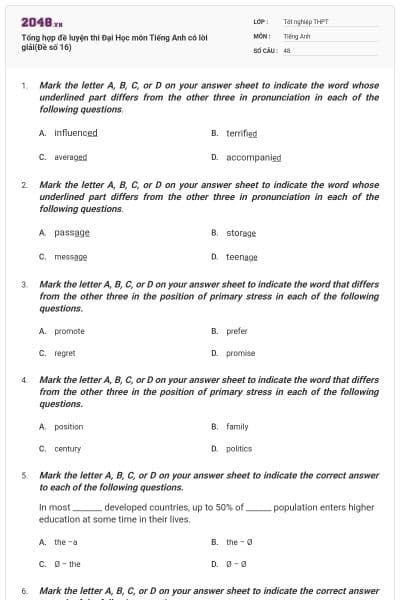
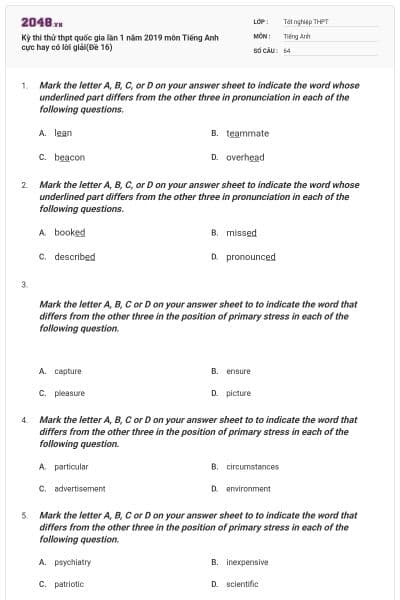
Mark the letter A, B, C, or D on your answer sheet to indicate the word whose underlined part differs from the other three in pronunciation in each of the following questions.
lean
teammate
beacon
overhead
Chọn D
A./i:/ B./i:/ C./i:/ D./e/
Mark the letter A, B, C, or D on your answer sheet to indicate the word whose underlined part differs from the other three in pronunciation in each of the following questions.
booked
missed
described
pronounced
Chọn C
A./t/ B./t/ C./d/ D./t/
Mark the letter A, B, C or D on your answer sheet to to indicate the word that differs from the other three in the position of primary stress in each of the following question.
capture
ensure
pleasure
picture
Chọn B
Phần B trọng âm rơi vào âm tiết thứ 2, còn lại là thứ nhất
Mark the letter A, B, C or D on your answer sheet to to indicate the word that differs from the other three in the position of primary stress in each of the following question.
particular
circumstances
advertisement
environment
Chọn B
Phần B trọng âm rơi vào âm tiết thứ nhất, còn lại là thứ 2
Mark the letter A, B, C or D on your answer sheet to to indicate the word that differs from the other three in the position of primary stress in each of the following question.
psychiatry
inexpensive
patriotic
scientific
Chọn A
Phần A trọng âm rơi vào âm tiết thứ 2, còn lại là thứ 3
Mark the letter A, B, C, or D on your answer sheet to indicate the underlined part that needs correction in each of the following questions.
Children enjoy telling and listening (A) to ghosts stories, (B) especially (C) on Halloween night. (D)
telling and listening
ghosts stories
especially
Halloween night
Đáp án: B
Giải thích:
Danh từ ghép "ghost story" phải ở dạng "ghost stories" (không thêm "s" vào "ghost").
Sửa: ghosts stories → ghost stories
Dịch: Trẻ em thích kể và nghe những câu chuyện ma, đặc biệt là vào đêm Halloween.
Mark the letter A, B, C, or D on your answer sheet to indicate the underlined part that needs correction in each of the following questions.
We had better to review (A) this chapter carefully (B) because we will (C) have some (D) questions on it on our test tomorrow.
to review
carefully
will
some
Đáp án: A
Giải thích:
had better V: tốt hơn là nên làm gì
Sửa: to review → review
Dịch: Chúng ta nên xem lại bài học này thật kỹ vì sẽ có một số câu hỏi về nó.
Mark the letter A, B, C, or D on your answer sheet to indicate the underlined part that needs correction in each of the following questions.
Professor Jones said (A) that a good way to improve (B) your language are (C) learning to practise (D) it.
said
to improve
are
to practise
Đáp án: C
Giải thích:
Chủ ngữ “a good way to imprive your language” là chủ ngữ số ít, nên dùng “is”.
Sửa: are → is
Dịch: Giáo sư Jones nói rằng cách tốt nhất để cải thiện ngôn ngữ của bạn là học cách thực hành nó.
Mark the letter A, B, C, or D on your answer sheet to indicate the underlined part that needs correction in each of the following questions.
Helen likes to listen to music, (A) to go to the cinema,(B) to chat on the phone (C) and going shopping. (D)
likes to listen to music
to go to the cinema
to chat on the phone
goingshopping
Chọn D
“going shopping” -> “to go shopping”, 3 vế trước đều sử dụng cấu trúc “like to do st” nên vế này cũng phải sử dụng cấu trúc đó
Mark the letter A, B, C, or D on your answer sheet to indicate the underlined part that needs correction in each of the following questions.
Many (A) people have found the monotonous (B) buzzing of the vuvuzela in the 2010-World-Cup (C) matches so annoyed. (D)
Many
monotonous
2010-World-Cup
so annoyed
Chọn D
“so annoyed” -> “so annoying”, “annoyed” là dùng chỉ cảm xúc, cảm giác, còn khi sử dụng để miêu tả đặc điểm của sự vật sự việc ta sử dụng annoying. Câu này đang nói đến đặc điểm của the monotonous buzzing of the vuvuzela nên ta sử dụng annoying
Mark the letter A, B, C or D on your answer sheet to indicate the correct answer to each of the following questions.
People _________can speak English can be understood in many countries.
whose
who
whom
which
Chọn B
“who” là mệnh xđề quan hệ thay thế cho người. Trong câu này nó thay thế cho “people” ở phía trước
Mark the letter A, B, C or D on your answer sheet to indicate the correct answer to each of the following questions.
If she ________ sick, she would have gone out with me to the party.
wasn’t
hadn’t been
hasn’t been
weren’t
Chọn B
Câu điều kiện loại 3: “IF+mệnh đề ở thì quá khứ hoàn thành, S +would/could+have+ động từ phân từ II+…”
Mark the letter A, B, C or D on your answer sheet to indicate the correct answer to each of the following questions.
________you do better work than this, you won't pass the exam
If
Although
When
Unless
Chọn D
Unless (trừ khi) = If…not
Mark the letter A, B, C or D on your answer sheet to indicate the correct answer to each of the following questions.
Nam’s score on the test is the highest in the class; he _________ hard last night.
should have studied
may have to study
must have studied
could have studied
Chọn C
“must have done st”: nhận định một việc đã xảy ra trong quá khứ
Mark the letter A, B, C or D on your answer sheet to indicate the correct answer to each of the following questions.
The government travel health advisory body recommends that pregnant women should “consider _________ travel” to areas where Zika outbreaks are currently reported.
to avoid
avoiding
being avoided
avoid
Chọn B
Cấu trúc “consider doing st”: cân nhắc việc làm gì
Mark the letter A, B, C or D on your answer sheet to indicate the correct answer to each of the following questions.
I’d prefer to do it _________ myself, because other people make me nervous.
on
in
by
at
Chọn C
“by oneself”: tự ai đó. “by myself”: tự mình
Mark the letter A, B, C or D on your answer sheet to indicate the correct answer to each of the following questions.
After John _________ a rough outline of the model, he will begin painting.
had drawn
has drawn
has been drawn
is drawing
Chọn B
Thì hiện tại hoàn thành, diễn tả một hành động bắt đầu từ trong quá khứ và kéo dài đến hiện tại, có thể để lại kết quả ở hiện tại
Mark the letter A, B, C or D on your answer sheet to indicate the correct answer to each of the following questions.
To our surprise, the so-called cheap shop was ________ was expected.
as twice as expensive
expensive as twice as
twice as expensive as
as expensive as twice
Chọn C
Cấu trúc so sánh gấp số lần: once/twice…+ as+….+as
Mark the letter A, B, C or D on your answer sheet to indicate the correct answer to each of the following questions.
The picture is _________; the thief will be most disappointed when he tries to sell it
invalid
priceless
worthless
unprofitable
Chọn C
Nên phân biệt với “priceless”: vô giá, rất giá trị
Mark the letter A, B, C or D on your answer sheet to indicate the correct answer to each of the following questions.
We regret to tell you that the materials you have ordered are ________
out of work
out of stock
out of order.
out of reach
Chọn B
Nên phân biệt với “priceless”: vô giá, rất giá trị
Mark the letter A, B, C or D on your answer sheet to indicate the correct answer to each of the following questions.
Sir Bobby Charton scored so many goals for Manchester United that no players of the club have ________ him so far.
come up with
caught up with
put up with
look up to
Chọn B
Cấu trúc “catch up with sb”: đuổi kịp ai
Mark the letter A, B, C or D on your answer sheet to indicate the correct answer to each of the following questions.
We bought some __________
old lovely German glasses
German old lovely glasses
German lovely old glasses
lovely old German glasses
Chọn D
Thứ tự đúng của tính từ:
Opinion (lovely) + Age (old) + Origin (German) + noun (glasses)
Mark the letter A, B, C or D on your answer sheet to indicate the correct answer to each of the following questions.
Toxic chemicals in the air and land, contaminated water and increased water temperatures have also driven many spices to the verge _________ extinction.
for
in
to
of
Chọn D
“on (to) the verge of st”: sắp, suýt, gần
Mark the letter A, B, C or D on your answer sheet to indicate the correct answer to each of the following questions.
If you run _________Nam, give him my best wishes.
over
up
into
to
Chọn C
Cấu trúc “run into sb”: tình cờ gặp ai đó
Mark the letter A, B, C or D on your answer sheet to indicate the correct answer to each of the following questions.
The primary causes of species extinction result _________habitat destruction, commercial exploitation and pollution.
in
of
for
from
Đáp án: D
Giải thích:
Kiến thức: Giới từ
Cấu trúc:
result from: là kết quả từ việc…
result in: dẫn tới kết quả là
Dựa vào nghĩa, chọn D.
Dịch: Nguyên nhân chính dẫn đến sự tuyệt chủng của các loài là do môi trường sống bị phá hủy, khai thác thương mại và ô nhiễm.
Mark the letter A, B, C or D on your answer sheet to indicate the correct answer to each of the following questions.
________successful 'hydrogen bomb' test when many countries reacted with condemnation and suspicion
Hardly North Korea had claimed
Hardly had North Korea claimed
No sooner North Korea had claimed
No sooner had North Korea claimed
Chọn B
Cấu trúc đảo ngữ với Hardly: “Hardly +had +S + động từ phân từ II+…+when+ mệnh đề ở thì quá khứ đơn”
Mark the letter A, B, C or D on your answer sheet to indicate the correct answer to each of the following questions.
People who suffer from lung _________ should not smoke.
disease
sickness
illness
ill health
Chọn C
“illness”: bệnh
Nên phân biệt với sickness: tình trạng không khoẻ mạnh của cơ thể. “illness” thường đi kèm với căn bệnh cụ thể như (lung, cancer), sickness thường đi kèm với nguyên nhân (home sickness, sleeping sickness…)
Mark the letter A, B, C or D on your answer sheet to indicate the correct answer to each of the following questions.
Nga: “Do you think that we should use public transportation to protect our environment?” Nam: “ _________”
Yes, it’s an absurd idea.
Well, that’s very surprising.
Of course not. You bet !
There’s no doubt about it
Chọn D
- Do you think that we should use public transportation to protect our environment? (Cậu có nghĩ rằng chúng ta nên sử dụng các loại hình giao thông công cộng để bảo vệ môi trường không?)
- There’s no doubt about it (Không có nghi ngờ gì về điều đó cả = Chắc chắn rồi)
Mark the letter A, B, C or D on your answer sheet to indicate the correct answer to each of the following questions.
“ Happy New Year! “ “_________”
Thank you, I am very happy to hear that.
Thank you, I am too.
Thank you, the same to you.
Thank you. I wish you a happy birthday.
Chọn C
- Happy New Year! (Chúc mừng năm mới!)
- Thank you, the same to you. (Cám ơn, cậu cũng vậy nhé)
Mark the letter A, B, C or D on your answer sheet to indicate the word(s)CLOSEST in meaning to the underlined word(s) in each of the following questions.
Lack of water and nutrients has impeded the growth of these cherry tomato plants.
promoted
assisted
realized
prevented
Chọn D
“impede” = “prevent”: cản trở, ngăn trở
Mark the letter A, B, C or D on your answer sheet to indicate the word(s)CLOSEST in meaning to the underlined word(s) in each of the following questions.
I take my hat off to all those people who worked hard to get the contract.
respect
discourage
detest
dislike
Chọn A
Cụm “take my hat off to” = “respect”: tôn trọng, kính trọng
Mark the letter A, B, C or D on your answer sheet to indicate the word(s)CLOSEST in meaning to the underlined word(s) in each of the following questions.
The sale of drugs is controlled by law in most countries.
permitted
restricted
illegal
bindinga
Chọn B
“controlled by law” = “restricted”: bị giới hạn, bị kiểm soát
Read the following passage and mark the letter A, B, C, or D on your answer sheet to indicate the correct word or phrase that best fits each of the numbered blanks from 33 to 42. Fill in the appropriate word in question 33
TRAFFIC LIGHTS
The first traffic signal was invented by a railway signaling engineer. It was installed (33) ___ the Houses of Parliament in 1868. It (34)_____ like any railway signal of the time, and was operated by gas. (35) ____, it exploded and killed a policeman, and the accident discouraged further development until cars became common.
(36) ____ traffic lights are an American invention. Red – green systems were installed in Cleveland in 1914. Three - color signals, operated (37) _____ hanz d from a tower in the (38) _____ of the street, were installed in New York in 1918. The first lights of this type to (39) ____ in Britain were in London, on the junction between St. James’s Street and Piccadilly, in 1925. Automatic signals were installed (40) ____ year later.
In the past, traffic lights were special. In New York, some lights had a statue on top. In Los Angeles the lights did not just change silently, but would ring bells to (41) _____ the sleeping motorists of the 1930s. These are gone and have been (42) ____ by standard models which are universally adopted.
outside
out
out of
outdoors
Chọn A
“outside”: bên ngoài, mặt ngoài (một toà nhà
Read the following passage and mark the letter A, B, C, or D on your answer sheet to indicate the correct word or phrase that best fits each of the numbered blanks from 33 to 42. Fill in the appropriate word in question 34
TRAFFIC LIGHTS
The first traffic signal was invented by a railway signaling engineer. It was installed (33) ___ the Houses of Parliament in 1868. It (34)_____ like any railway signal of the time, and was operated by gas. (35) ____, it exploded and killed a policeman, and the accident discouraged further development until cars became common.
(36) ____ traffic lights are an American invention. Red – green systems were installed in Cleveland in 1914. Three - color signals, operated (37) _____ hanz d from a tower in the (38) _____ of the street, were installed in New York in 1918. The first lights of this type to (39) ____ in Britain were in London, on the junction between St. James’s Street and Piccadilly, in 1925. Automatic signals were installed (40) ____ year later.
In the past, traffic lights were special. In New York, some lights had a statue on top. In Los Angeles the lights did not just change silently, but would ring bells to (41) _____ the sleeping motorists of the 1930s. These are gone and have been (42) ____ by standard models which are universally adopted.
resembled
looked
showed
seemed
Chọn B
“look like”: nhìn giống như…
Read the following passage and mark the letter A, B, C, or D on your answer sheet to indicate the correct word or phrase that best fits each of the numbered blanks from 33 to 42. Fill in the appropriate word in question 35
TRAFFIC LIGHTS
The first traffic signal was invented by a railway signaling engineer. It was installed (33) ___ the Houses of Parliament in 1868. It (34)_____ like any railway signal of the time, and was operated by gas. (35) ____, it exploded and killed a policeman, and the accident discouraged further development until cars became common.
(36) ____ traffic lights are an American invention. Red – green systems were installed in Cleveland in 1914. Three - color signals, operated (37) _____ hanz d from a tower in the (38) _____ of the street, were installed in New York in 1918. The first lights of this type to (39) ____ in Britain were in London, on the junction between St. James’s Street and Piccadilly, in 1925. Automatic signals were installed (40) ____ year later.
In the past, traffic lights were special. In New York, some lights had a statue on top. In Los Angeles the lights did not just change silently, but would ring bells to (41) _____ the sleeping motorists of the 1930s. These are gone and have been (42) ____ by standard models which are universally adopted.
However
Therefore
Although
Despite
Chọn A
“However”: tuy nhiên – tác dụng liên kết giữa 2 câu hoặc giữa các vế trong cùng một câu
Read the following passage and mark the letter A, B, C, or D on your answer sheet to indicate the correct word or phrase that best fits each of the numbered blanks from 33 to 42. Fill in the appropriate word in question 36
TRAFFIC LIGHTS
The first traffic signal was invented by a railway signaling engineer. It was installed (33) ___ the Houses of Parliament in 1868. It (34)_____ like any railway signal of the time, and was operated by gas. (35) ____, it exploded and killed a policeman, and the accident discouraged further development until cars became common.
(36) ____ traffic lights are an American invention. Red – green systems were installed in Cleveland in 1914. Three - color signals, operated (37) _____ hanz d from a tower in the (38) _____ of the street, were installed in New York in 1918. The first lights of this type to (39) ____ in Britain were in London, on the junction between St. James’s Street and Piccadilly, in 1925. Automatic signals were installed (40) ____ year later.
In the past, traffic lights were special. In New York, some lights had a statue on top. In Los Angeles the lights did not just change silently, but would ring bells to (41) _____ the sleeping motorists of the 1930s. These are gone and have been (42) ____ by standard models which are universally adopted.
New
Recent
Modern
Late
Chọn C
“modern traffic lights”: đèn giao thông hiện đại
Read the following passage and mark the letter A, B, C, or D on your answer sheet to indicate the correct word or phrase that best fits each of the numbered blanks from 33 to 42. Fill in the appropriate word in question 37
TRAFFIC LIGHTS
The first traffic signal was invented by a railway signaling engineer. It was installed (33) ___ the Houses of Parliament in 1868. It (34)_____ like any railway signal of the time, and was operated by gas. (35) ____, it exploded and killed a policeman, and the accident discouraged further development until cars became common.
(36) ____ traffic lights are an American invention. Red – green systems were installed in Cleveland in 1914. Three - color signals, operated (37) _____ hanz d from a tower in the (38) _____ of the street, were installed in New York in 1918. The first lights of this type to (39) ____ in Britain were in London, on the junction between St. James’s Street and Piccadilly, in 1925. Automatic signals were installed (40) ____ year later.
In the past, traffic lights were special. In New York, some lights had a statue on top. In Los Angeles the lights did not just change silently, but would ring bells to (41) _____ the sleeping motorists of the 1930s. These are gone and have been (42) ____ by standard models which are universally adopted.
by
with
through
in
Chọn A
Trong câu bị động, by someone: (thực hiện) bởi ai đó
Read the following passage and mark the letter A, B, C, or D on your answer sheet to indicate the correct word or phrase that best fits each of the numbered blanks from 33 to 42. Fill in the appropriate word in question 38
TRAFFIC LIGHTS
The first traffic signal was invented by a railway signaling engineer. It was installed (33) ___ the Houses of Parliament in 1868. It (34)_____ like any railway signal of the time, and was operated by gas. (35) ____, it exploded and killed a policeman, and the accident discouraged further development until cars became common.
(36) ____ traffic lights are an American invention. Red – green systems were installed in Cleveland in 1914. Three - color signals, operated (37) _____ hanz d from a tower in the (38) _____ of the street, were installed in New York in 1918. The first lights of this type to (39) ____ in Britain were in London, on the junction between St. James’s Street and Piccadilly, in 1925. Automatic signals were installed (40) ____ year later.
In the past, traffic lights were special. In New York, some lights had a statue on top. In Los Angeles the lights did not just change silently, but would ring bells to (41) _____ the sleeping motorists of the 1930s. These are gone and have been (42) ____ by standard models which are universally adopted.
middle
heart
focus
halfway
Chọn A
“in the middle of st”: ở giữa của cái gì
Read the following passage and mark the letter A, B, C, or D on your answer sheet to indicate the correct word or phrase that best fits each of the numbered blanks from 33 to 42. Fill in the appropriate word in question 39
TRAFFIC LIGHTS
The first traffic signal was invented by a railway signaling engineer. It was installed (33) ___ the Houses of Parliament in 1868. It (34)_____ like any railway signal of the time, and was operated by gas. (35) ____, it exploded and killed a policeman, and the accident discouraged further development until cars became common.
(36) ____ traffic lights are an American invention. Red – green systems were installed in Cleveland in 1914. Three - color signals, operated (37) _____ hanz d from a tower in the (38) _____ of the street, were installed in New York in 1918. The first lights of this type to (39) ____ in Britain were in London, on the junction between St. James’s Street and Piccadilly, in 1925. Automatic signals were installed (40) ____ year later.
In the past, traffic lights were special. In New York, some lights had a statue on top. In Los Angeles the lights did not just change silently, but would ring bells to (41) _____ the sleeping motorists of the 1930s. These are gone and have been (42) ____ by standard models which are universally adopted.
show
appear
happen
become
Chọn B
“appear”: xuất hiện
“show”: bộc lộ, thể hiện
“happen”: diễn ra
“become”: trở thành
Read the following passage and mark the letter A, B, C, or D on your answer sheet to indicate the correct word or phrase that best fits each of the numbered blanks from 33 to 42. Fill in the appropriate word in question 40
TRAFFIC LIGHTS
The first traffic signal was invented by a railway signaling engineer. It was installed (33) ___ the Houses of Parliament in 1868. It (34)_____ like any railway signal of the time, and was operated by gas. (35) ____, it exploded and killed a policeman, and the accident discouraged further development until cars became common.
(36) ____ traffic lights are an American invention. Red – green systems were installed in Cleveland in 1914. Three - color signals, operated (37) _____ hanz d from a tower in the (38) _____ of the street, were installed in New York in 1918. The first lights of this type to (39) ____ in Britain were in London, on the junction between St. James’s Street and Piccadilly, in 1925. Automatic signals were installed (40) ____ year later.
In the past, traffic lights were special. In New York, some lights had a statue on top. In Los Angeles the lights did not just change silently, but would ring bells to (41) _____ the sleeping motorists of the 1930s. These are gone and have been (42) ____ by standard models which are universally adopted.
a
in the
in a
the
Chọn A
Ở đây dùng mạo từ a, với nghĩa là “một” (a year later – một năm sau đó)
Read the following passage and mark the letter A, B, C, or D on your answer sheet to indicate the correct word or phrase that best fits each of the numbered blanks from 33 to 42. Fill in the appropriate word in question 41
TRAFFIC LIGHTS
The first traffic signal was invented by a railway signaling engineer. It was installed (33) ___ the Houses of Parliament in 1868. It (34)_____ like any railway signal of the time, and was operated by gas. (35) ____, it exploded and killed a policeman, and the accident discouraged further development until cars became common.
(36) ____ traffic lights are an American invention. Red – green systems were installed in Cleveland in 1914. Three - color signals, operated (37) _____ hanz d from a tower in the (38) _____ of the street, were installed in New York in 1918. The first lights of this type to (39) ____ in Britain were in London, on the junction between St. James’s Street and Piccadilly, in 1925. Automatic signals were installed (40) ____ year later.
In the past, traffic lights were special. In New York, some lights had a statue on top. In Los Angeles the lights did not just change silently, but would ring bells to (41) _____ the sleeping motorists of the 1930s. These are gone and have been (42) ____ by standard models which are universally adopted.
rise
raise
wake
get up
Chọn C
“wake”: đánh thức, phía sau có đề cập the sleeping motorists, nên dùng động từ “wake” là phù hợp
Read the following passage and mark the letter A, B, C, or D on your answer sheet to indicate the correct word or phrase that best fits each of the numbered blanks from 33 to 42. Fill in the appropriate word in question 42
TRAFFIC LIGHTS
The first traffic signal was invented by a railway signaling engineer. It was installed (33) ___ the Houses of Parliament in 1868. It (34)_____ like any railway signal of the time, and was operated by gas. (35) ____, it exploded and killed a policeman, and the accident discouraged further development until cars became common.
(36) ____ traffic lights are an American invention. Red – green systems were installed in Cleveland in 1914. Three - color signals, operated (37) _____ hanz d from a tower in the (38) _____ of the street, were installed in New York in 1918. The first lights of this type to (39) ____ in Britain were in London, on the junction between St. James’s Street and Piccadilly, in 1925. Automatic signals were installed (40) ____ year later.
In the past, traffic lights were special. In New York, some lights had a statue on top. In Los Angeles the lights did not just change silently, but would ring bells to (41) _____ the sleeping motorists of the 1930s. These are gone and have been (42) ____ by standard models which are universally adopted.
reproduced
replaced
removed
remained
Chọn B
“replace”: thay thế
“remove”: chuyển, thay đổi
“remain”: tồn tại, giữ vững
“reproduce”: sao lại, in sao
Read the following passage and mark the letter A, B, C, or D on your answer sheet to indicate the correct answer to each of the questions.
Human Nutrition is the study of how food affects the health and survival of the human body. Human beings require food to grow, reproduce, and maintain good health. Without food, our bodies could not stay warm, build or repair tissue, or maintain the heartbeat. Eating the right foods can help us avoid certain diseases or recover faster when illness occurs. These and other important functions are fueled by chemical substances in our food called nutrients. Nutrients are classified as carbohydrates, proteins, fats, vitamins, minerals, and water.
When we eat a meal, nutrients are released from food through digestion. Digestion begins in the mouth by the action of chewing and the chemical activity of saliva, a watery fluid that contains enzymes, certain proteins that help break down food. Further digestion occurs as food travels through the stomach and the small intestine, where digestive enzymes and acids liquefy food and muscle contractions push it along the digestive tract. Nutrients are absorbed from the inside of the small intestine into the bloodstream and carried to the sites in the body where they are needed. At these sites, several chemical reactions occur, which ensures the growth and function of body tissues. The parts of foods that are not absorbed continue to move down the intestinal tract and are eliminated from the body as feces.
Once digested, carbohydrates, proteins, and fats provide the body with the energy it needs to maintain its many functions. Scientists measure this energy in kilocalories, the amount of energy needed to raise one kilogram of water one degree Celsius. In nutrition discussions, scientists use the term calorie instead of kilocalorie as the standard unit of measure in nutrition.
Nutrients are classified as essential or nonessential. Nonessential nutrients are manufactured in the body and do not need to be obtained from food. Examples include cholesterol, a fatlike substance present in all animal cells. Essential nutrients must be obtained from food sources, because the body either does not produce them or produces them in amounts too small to maintain growth and health. Essential nutrients include water, carbohydrates, proteins, fats, vitamins, and minerals.
An individual needs varying amounts of each essential nutrient, depending upon such factors as gender and age. Specific health conditions, such as pregnancy, breast-feeding, illness, or drug use, make unusual demands on the body and increase its need for nutrients. Dietary guidelines, which take many of these factors into account, provide general guidance in meeting daily nutritional needs.
From “Human Nutrition” by Worthington-Roberts, Bonnie, Microsoft ® Student 2009.
The first paragraph mainly discusses ______.
chemical substances in our food
a variety of essential nutrients to human beings
the importance of food to human beings
the study of human nutrition
Chọn C
Thông tin ở 3 câu đầu tiên đoạn đầu: “Human Nutrition is the study of how food affects the health and survival of the human body. Human beings require food to grow, reproduce, and maintain good health. Without food, our bodies could not stay warm, build or repair tissue, or maintain the heartbeat.”
Read the following passage and mark the letter A, B, C, or D on your answer sheet to indicate the correct answer to each of the questions.
Human Nutrition is the study of how food affects the health and survival of the human body. Human beings require food to grow, reproduce, and maintain good health. Without food, our bodies could not stay warm, build or repair tissue, or maintain the heartbeat. Eating the right foods can help us avoid certain diseases or recover faster when illness occurs. These and other important functions are fueled by chemical substances in our food called nutrients. Nutrients are classified as carbohydrates, proteins, fats, vitamins, minerals, and water.
When we eat a meal, nutrients are released from food through digestion. Digestion begins in the mouth by the action of chewing and the chemical activity of saliva, a watery fluid that contains enzymes, certain proteins that help break down food. Further digestion occurs as food travels through the stomach and the small intestine, where digestive enzymes and acids liquefy food and muscle contractions push it along the digestive tract. Nutrients are absorbed from the inside of the small intestine into the bloodstream and carried to the sites in the body where they are needed. At these sites, several chemical reactions occur, which ensures the growth and function of body tissues. The parts of foods that are not absorbed continue to move down the intestinal tract and are eliminated from the body as feces.
Once digested, carbohydrates, proteins, and fats provide the body with the energy it needs to maintain its many functions. Scientists measure this energy in kilocalories, the amount of energy needed to raise one kilogram of water one degree Celsius. In nutrition discussions, scientists use the term calorie instead of kilocalorie as the standard unit of measure in nutrition.
Nutrients are classified as essential or nonessential. Nonessential nutrients are manufactured in the body and do not need to be obtained from food. Examples include cholesterol, a fatlike substance present in all animal cells. Essential nutrients must be obtained from food sources, because the body either does not produce them or produces them in amounts too small to maintain growth and health. Essential nutrients include water, carbohydrates, proteins, fats, vitamins, and minerals.
An individual needs varying amounts of each essential nutrient, depending upon such factors as gender and age. Specific health conditions, such as pregnancy, breast-feeding, illness, or drug use, make unusual demands on the body and increase its need for nutrients. Dietary guidelines, which take many of these factors into account, provide general guidance in meeting daily nutritional needs.
From “Human Nutrition” by Worthington-Roberts, Bonnie, Microsoft ® Student 2009.
The word “released” in the second paragraph mostly means “ ”
refused
produced
expressed
renewed
Chọn B
“release” = “produce”: thả ra, giải phóng
Read the following passage and mark the letter A, B, C, or D on your answer sheet to indicate the correct answer to each of the questions.
Human Nutrition is the study of how food affects the health and survival of the human body. Human beings require food to grow, reproduce, and maintain good health. Without food, our bodies could not stay warm, build or repair tissue, or maintain the heartbeat. Eating the right foods can help us avoid certain diseases or recover faster when illness occurs. These and other important functions are fueled by chemical substances in our food called nutrients. Nutrients are classified as carbohydrates, proteins, fats, vitamins, minerals, and water.
When we eat a meal, nutrients are released from food through digestion. Digestion begins in the mouth by the action of chewing and the chemical activity of saliva, a watery fluid that contains enzymes, certain proteins that help break down food. Further digestion occurs as food travels through the stomach and the small intestine, where digestive enzymes and acids liquefy food and muscle contractions push it along the digestive tract. Nutrients are absorbed from the inside of the small intestine into the bloodstream and carried to the sites in the body where they are needed. At these sites, several chemical reactions occur, which ensures the growth and function of body tissues. The parts of foods that are not absorbed continue to move down the intestinal tract and are eliminated from the body as feces.
Once digested, carbohydrates, proteins, and fats provide the body with the energy it needs to maintain its many functions. Scientists measure this energy in kilocalories, the amount of energy needed to raise one kilogram of water one degree Celsius. In nutrition discussions, scientists use the term calorie instead of kilocalorie as the standard unit of measure in nutrition.
Nutrients are classified as essential or nonessential. Nonessential nutrients are manufactured in the body and do not need to be obtained from food. Examples include cholesterol, a fatlike substance present in all animal cells. Essential nutrients must be obtained from food sources, because the body either does not produce them or produces them in amounts too small to maintain growth and health. Essential nutrients include water, carbohydrates, proteins, fats, vitamins, and minerals.
An individual needs varying amounts of each essential nutrient, depending upon such factors as gender and age. Specific health conditions, such as pregnancy, breast-feeding, illness, or drug use, make unusual demands on the body and increase its need for nutrients. Dietary guidelines, which take many of these factors into account, provide general guidance in meeting daily nutritional needs.
From “Human Nutrition” by Worthington-Roberts, Bonnie, Microsoft ® Student 2009.
Which of the following is NOT true about the process of digestion
The small intestine covers the whole digestive system.
The small intestine helps the body absorb nutrients.
Nutrients are carried to different sites in the body
Saliva plays an important role in the first stage of digestion
Chọn A
Thông tin:
- Nutrients are absorbed from the inside of the small intestine into the bloodstream (B. The small intestine helps the body absorb nutrients.)
- Nutrients are ….carried to the sites in the body where they are needed. (C. Nutrients are carried to different sites in the body)
- Digestion begins in the mouth by the action of chewing and the chemical activity of saliva (D. Saliva plays an important role in the first stage of digestion)
Chỉ có phần A là không được nhắc đến
Read the following passage and mark the letter A, B, C, or D on your answer sheet to indicate the correct answer to each of the questions.
Human Nutrition is the study of how food affects the health and survival of the human body. Human beings require food to grow, reproduce, and maintain good health. Without food, our bodies could not stay warm, build or repair tissue, or maintain the heartbeat. Eating the right foods can help us avoid certain diseases or recover faster when illness occurs. These and other important functions are fueled by chemical substances in our food called nutrients. Nutrients are classified as carbohydrates, proteins, fats, vitamins, minerals, and water.
When we eat a meal, nutrients are released from food through digestion. Digestion begins in the mouth by the action of chewing and the chemical activity of saliva, a watery fluid that contains enzymes, certain proteins that help break down food. Further digestion occurs as food travels through the stomach and the small intestine, where digestive enzymes and acids liquefy food and muscle contractions push it along the digestive tract. Nutrients are absorbed from the inside of the small intestine into the bloodstream and carried to the sites in the body where they are needed. At these sites, several chemical reactions occur, which ensures the growth and function of body tissues. The parts of foods that are not absorbed continue to move down the intestinal tract and are eliminated from the body as feces.
Once digested, carbohydrates, proteins, and fats provide the body with the energy it needs to maintain its many functions. Scientists measure this energy in kilocalories, the amount of energy needed to raise one kilogram of water one degree Celsius. In nutrition discussions, scientists use the term calorie instead of kilocalorie as the standard unit of measure in nutrition.
Nutrients are classified as essential or nonessential. Nonessential nutrients are manufactured in the body and do not need to be obtained from food. Examples include cholesterol, a fatlike substance present in all animal cells. Essential nutrients must be obtained from food sources, because the body either does not produce them or produces them in amounts too small to maintain growth and health. Essential nutrients include water, carbohydrates, proteins, fats, vitamins, and minerals.
An individual needs varying amounts of each essential nutrient, depending upon such factors as gender and age. Specific health conditions, such as pregnancy, breast-feeding, illness, or drug use, make unusual demands on the body and increase its need for nutrients. Dietary guidelines, which take many of these factors into account, provide general guidance in meeting daily nutritional needs.
From “Human Nutrition” by Worthington-Roberts, Bonnie, Microsoft ® Student 2009.
The word “maintain” in the paragraph is closest meaning to “ ”
obtain
provide
keep performing
carry on making
Chọn C
“maintain” = “keep performing”: tiếp tục, duy trì hoạt động
Read the following passage and mark the letter A, B, C, or D on your answer sheet to indicate the correct answer to each of the questions.
Human Nutrition is the study of how food affects the health and survival of the human body. Human beings require food to grow, reproduce, and maintain good health. Without food, our bodies could not stay warm, build or repair tissue, or maintain the heartbeat. Eating the right foods can help us avoid certain diseases or recover faster when illness occurs. These and other important functions are fueled by chemical substances in our food called nutrients. Nutrients are classified as carbohydrates, proteins, fats, vitamins, minerals, and water.
When we eat a meal, nutrients are released from food through digestion. Digestion begins in the mouth by the action of chewing and the chemical activity of saliva, a watery fluid that contains enzymes, certain proteins that help break down food. Further digestion occurs as food travels through the stomach and the small intestine, where digestive enzymes and acids liquefy food and muscle contractions push it along the digestive tract. Nutrients are absorbed from the inside of the small intestine into the bloodstream and carried to the sites in the body where they are needed. At these sites, several chemical reactions occur, which ensures the growth and function of body tissues. The parts of foods that are not absorbed continue to move down the intestinal tract and are eliminated from the body as feces.
Once digested, carbohydrates, proteins, and fats provide the body with the energy it needs to maintain its many functions. Scientists measure this energy in kilocalories, the amount of energy needed to raise one kilogram of water one degree Celsius. In nutrition discussions, scientists use the term calorie instead of kilocalorie as the standard unit of measure in nutrition.
Nutrients are classified as essential or nonessential. Nonessential nutrients are manufactured in the body and do not need to be obtained from food. Examples include cholesterol, a fatlike substance present in all animal cells. Essential nutrients must be obtained from food sources, because the body either does not produce them or produces them in amounts too small to maintain growth and health. Essential nutrients include water, carbohydrates, proteins, fats, vitamins, and minerals.
An individual needs varying amounts of each essential nutrient, depending upon such factors as gender and age. Specific health conditions, such as pregnancy, breast-feeding, illness, or drug use, make unusual demands on the body and increase its need for nutrients. Dietary guidelines, which take many of these factors into account, provide general guidance in meeting daily nutritional needs.
From “Human Nutrition” by Worthington-Roberts, Bonnie, Microsoft ® Student 2009.
According to the passage, nutrients are absorbed ______.
over the whole body
in the mouth
in the stomach
in the small intestine
Chọn D
Thông tin ở đoạn 2: “Nutrients are absorbed from the inside of the small intestine”
Read the following passage and mark the letter A, B, C, or D on your answer sheet to indicate the correct answer to each of the questions.
Human Nutrition is the study of how food affects the health and survival of the human body. Human beings require food to grow, reproduce, and maintain good health. Without food, our bodies could not stay warm, build or repair tissue, or maintain the heartbeat. Eating the right foods can help us avoid certain diseases or recover faster when illness occurs. These and other important functions are fueled by chemical substances in our food called nutrients. Nutrients are classified as carbohydrates, proteins, fats, vitamins, minerals, and water.
When we eat a meal, nutrients are released from food through digestion. Digestion begins in the mouth by the action of chewing and the chemical activity of saliva, a watery fluid that contains enzymes, certain proteins that help break down food. Further digestion occurs as food travels through the stomach and the small intestine, where digestive enzymes and acids liquefy food and muscle contractions push it along the digestive tract. Nutrients are absorbed from the inside of the small intestine into the bloodstream and carried to the sites in the body where they are needed. At these sites, several chemical reactions occur, which ensures the growth and function of body tissues. The parts of foods that are not absorbed continue to move down the intestinal tract and are eliminated from the body as feces.
Once digested, carbohydrates, proteins, and fats provide the body with the energy it needs to maintain its many functions. Scientists measure this energy in kilocalories, the amount of energy needed to raise one kilogram of water one degree Celsius. In nutrition discussions, scientists use the term calorie instead of kilocalorie as the standard unit of measure in nutrition.
Nutrients are classified as essential or nonessential. Nonessential nutrients are manufactured in the body and do not need to be obtained from food. Examples include cholesterol, a fatlike substance present in all animal cells. Essential nutrients must be obtained from food sources, because the body either does not produce them or produces them in amounts too small to maintain growth and health. Essential nutrients include water, carbohydrates, proteins, fats, vitamins, and minerals.
An individual needs varying amounts of each essential nutrient, depending upon such factors as gender and age. Specific health conditions, such as pregnancy, breast-feeding, illness, or drug use, make unusual demands on the body and increase its need for nutrients. Dietary guidelines, which take many of these factors into account, provide general guidance in meeting daily nutritional needs.
From “Human Nutrition” by Worthington-Roberts, Bonnie, Microsoft ® Student 2009.
According to the passage, which of the following provides energy for the body?
Proteins, fats, and minerals
Carbohydrates, proteins, and fats
Carbohydrates, minerals, and water
Proteins, vitamins, and carbohydrates
Chọn B
Thông tin ở câu đầu tiên đoạn 3: “Once digested, carbohydrates, proteins, and fats provide the body with the energy..”
Read the following passage and mark the letter A, B, C, or D on your answer sheet to indicate the correct answer to each of the questions.
Human Nutrition is the study of how food affects the health and survival of the human body. Human beings require food to grow, reproduce, and maintain good health. Without food, our bodies could not stay warm, build or repair tissue, or maintain the heartbeat. Eating the right foods can help us avoid certain diseases or recover faster when illness occurs. These and other important functions are fueled by chemical substances in our food called nutrients. Nutrients are classified as carbohydrates, proteins, fats, vitamins, minerals, and water.
When we eat a meal, nutrients are released from food through digestion. Digestion begins in the mouth by the action of chewing and the chemical activity of saliva, a watery fluid that contains enzymes, certain proteins that help break down food. Further digestion occurs as food travels through the stomach and the small intestine, where digestive enzymes and acids liquefy food and muscle contractions push it along the digestive tract. Nutrients are absorbed from the inside of the small intestine into the bloodstream and carried to the sites in the body where they are needed. At these sites, several chemical reactions occur, which ensures the growth and function of body tissues. The parts of foods that are not absorbed continue to move down the intestinal tract and are eliminated from the body as feces.
Once digested, carbohydrates, proteins, and fats provide the body with the energy it needs to maintain its many functions. Scientists measure this energy in kilocalories, the amount of energy needed to raise one kilogram of water one degree Celsius. In nutrition discussions, scientists use the term calorie instead of kilocalorie as the standard unit of measure in nutrition.
Nutrients are classified as essential or nonessential. Nonessential nutrients are manufactured in the body and do not need to be obtained from food. Examples include cholesterol, a fatlike substance present in all animal cells. Essential nutrients must be obtained from food sources, because the body either does not produce them or produces them in amounts too small to maintain growth and health. Essential nutrients include water, carbohydrates, proteins, fats, vitamins, and minerals.
An individual needs varying amounts of each essential nutrient, depending upon such factors as gender and age. Specific health conditions, such as pregnancy, breast-feeding, illness, or drug use, make unusual demands on the body and increase its need for nutrients. Dietary guidelines, which take many of these factors into account, provide general guidance in meeting daily nutritional needs.
From “Human Nutrition” by Worthington-Roberts, Bonnie, Microsoft ® Student 2009.
In nutrition discussions, the standard unit used to measure nutrients is ________.
kilocalorie
kilogram
calorie
gram
Chọn C
Thông tin ở câu cuối đoạn 3: “In nutrition discussions, scientists use the term calorie instead of kilocalorie as the standard unit of measure in nutrition.”
Read the following passage and mark the letter A, B, C, or D on your answer sheet to indicate the correct answer to each of the questions.
Human Nutrition is the study of how food affects the health and survival of the human body. Human beings require food to grow, reproduce, and maintain good health. Without food, our bodies could not stay warm, build or repair tissue, or maintain the heartbeat. Eating the right foods can help us avoid certain diseases or recover faster when illness occurs. These and other important functions are fueled by chemical substances in our food called nutrients. Nutrients are classified as carbohydrates, proteins, fats, vitamins, minerals, and water.
When we eat a meal, nutrients are released from food through digestion. Digestion begins in the mouth by the action of chewing and the chemical activity of saliva, a watery fluid that contains enzymes, certain proteins that help break down food. Further digestion occurs as food travels through the stomach and the small intestine, where digestive enzymes and acids liquefy food and muscle contractions push it along the digestive tract. Nutrients are absorbed from the inside of the small intestine into the bloodstream and carried to the sites in the body where they are needed. At these sites, several chemical reactions occur, which ensures the growth and function of body tissues. The parts of foods that are not absorbed continue to move down the intestinal tract and are eliminated from the body as feces.
Once digested, carbohydrates, proteins, and fats provide the body with the energy it needs to maintain its many functions. Scientists measure this energy in kilocalories, the amount of energy needed to raise one kilogram of water one degree Celsius. In nutrition discussions, scientists use the term calorie instead of kilocalorie as the standard unit of measure in nutrition.
Nutrients are classified as essential or nonessential. Nonessential nutrients are manufactured in the body and do not need to be obtained from food. Examples include cholesterol, a fatlike substance present in all animal cells. Essential nutrients must be obtained from food sources, because the body either does not produce them or produces them in amounts too small to maintain growth and health. Essential nutrients include water, carbohydrates, proteins, fats, vitamins, and minerals.
An individual needs varying amounts of each essential nutrient, depending upon such factors as gender and age. Specific health conditions, such as pregnancy, breast-feeding, illness, or drug use, make unusual demands on the body and increase its need for nutrients. Dietary guidelines, which take many of these factors into account, provide general guidance in meeting daily nutritional needs.
From “Human Nutrition” by Worthington-Roberts, Bonnie, Microsoft ® Student 2009.
general guidance
unusual demands
dietary guidelines
nutritional needs
Chọn C
“which” được thay thế cho “dietary guidelines” ở ngay trước dấu phảy
Read the following passage and mark the letter A, B, C, or D on your answer sheet to indicate the correct answer to each of the questions.
Human Nutrition is the study of how food affects the health and survival of the human body. Human beings require food to grow, reproduce, and maintain good health. Without food, our bodies could not stay warm, build or repair tissue, or maintain the heartbeat. Eating the right foods can help us avoid certain diseases or recover faster when illness occurs. These and other important functions are fueled by chemical substances in our food called nutrients. Nutrients are classified as carbohydrates, proteins, fats, vitamins, minerals, and water.
When we eat a meal, nutrients are released from food through digestion. Digestion begins in the mouth by the action of chewing and the chemical activity of saliva, a watery fluid that contains enzymes, certain proteins that help break down food. Further digestion occurs as food travels through the stomach and the small intestine, where digestive enzymes and acids liquefy food and muscle contractions push it along the digestive tract. Nutrients are absorbed from the inside of the small intestine into the bloodstream and carried to the sites in the body where they are needed. At these sites, several chemical reactions occur, which ensures the growth and function of body tissues. The parts of foods that are not absorbed continue to move down the intestinal tract and are eliminated from the body as feces.
Once digested, carbohydrates, proteins, and fats provide the body with the energy it needs to maintain its many functions. Scientists measure this energy in kilocalories, the amount of energy needed to raise one kilogram of water one degree Celsius. In nutrition discussions, scientists use the term calorie instead of kilocalorie as the standard unit of measure in nutrition.
Nutrients are classified as essential or nonessential. Nonessential nutrients are manufactured in the body and do not need to be obtained from food. Examples include cholesterol, a fatlike substance present in all animal cells. Essential nutrients must be obtained from food sources, because the body either does not produce them or produces them in amounts too small to maintain growth and health. Essential nutrients include water, carbohydrates, proteins, fats, vitamins, and minerals.
An individual needs varying amounts of each essential nutrient, depending upon such factors as gender and age. Specific health conditions, such as pregnancy, breast-feeding, illness, or drug use, make unusual demands on the body and increase its need for nutrients. Dietary guidelines, which take many of these factors into account, provide general guidance in meeting daily nutritional needs.
From “Human Nutrition” by Worthington-Roberts, Bonnie, Microsoft ® Student 2009.
Which of the following is NOT mentioned in the passage?
Classification of nutrients
The body’s need of nutrients
The effects of food on the body
Food sources from animals
Chọn D
Food sources from animals không được nhắc đến trong câu, còn những đáp án còn lại đã được đề cập ở những câu hỏi trước
Read the following passage and mark the letter A, B, C, or D on your answer sheet to indicate the correct answer to each of the questions.
Human Nutrition is the study of how food affects the health and survival of the human body. Human beings require food to grow, reproduce, and maintain good health. Without food, our bodies could not stay warm, build or repair tissue, or maintain the heartbeat. Eating the right foods can help us avoid certain diseases or recover faster when illness occurs. These and other important functions are fueled by chemical substances in our food called nutrients. Nutrients are classified as carbohydrates, proteins, fats, vitamins, minerals, and water.
When we eat a meal, nutrients are released from food through digestion. Digestion begins in the mouth by the action of chewing and the chemical activity of saliva, a watery fluid that contains enzymes, certain proteins that help break down food. Further digestion occurs as food travels through the stomach and the small intestine, where digestive enzymes and acids liquefy food and muscle contractions push it along the digestive tract. Nutrients are absorbed from the inside of the small intestine into the bloodstream and carried to the sites in the body where they are needed. At these sites, several chemical reactions occur, which ensures the growth and function of body tissues. The parts of foods that are not absorbed continue to move down the intestinal tract and are eliminated from the body as feces.
Once digested, carbohydrates, proteins, and fats provide the body with the energy it needs to maintain its many functions. Scientists measure this energy in kilocalories, the amount of energy needed to raise one kilogram of water one degree Celsius. In nutrition discussions, scientists use the term calorie instead of kilocalorie as the standard unit of measure in nutrition.
Nutrients are classified as essential or nonessential. Nonessential nutrients are manufactured in the body and do not need to be obtained from food. Examples include cholesterol, a fatlike substance present in all animal cells. Essential nutrients must be obtained from food sources, because the body either does not produce them or produces them in amounts too small to maintain growth and health. Essential nutrients include water, carbohydrates, proteins, fats, vitamins, and minerals.
An individual needs varying amounts of each essential nutrient, depending upon such factors as gender and age. Specific health conditions, such as pregnancy, breast-feeding, illness, or drug use, make unusual demands on the body and increase its need for nutrients. Dietary guidelines, which take many of these factors into account, provide general guidance in meeting daily nutritional needs.
From “Human Nutrition” by Worthington-Roberts, Bonnie, Microsoft ® Student 2009.
Through the passage, the author provides the readers with _______.
instructions
some information
some proposal
orders
Chọn B
Bài đọc tác giả đã cung cấp đến cho người đọc nhiều thông tin về thức ăn, thức ăn có lợi như thế nào, cách tiêu hoá thức ăn…
Mark the letter A, B, C, or D on your answer sheet to indicate the word(s) OPPOSITE in meaning to the underlined word(s) in each of the following questions.
She is a very generousold woman. She has given most of her wealth to a charity organization.
mean
kind
hospitable
amicable
Chọn A
“generous”: hào phóng, trái nghĩa là “mean”: bần tiện, bủn xỉn
Mark the letter A, B, C, or D on your answer sheet to indicate the word(s) OPPOSITE in meaning to the underlined word(s) in each of the following questions.
After five days on trial, the court found him innocent of the crime and he was released.
guilty
naive
benevolent
innovative
Chọn A
“innocent”: vô tội, trái nghĩa là “guilty”: có tội
Read the following passage and mark the letter A, B, C, or D on your answer sheet to indicate the correct answer to each of the questions.
Very few people in the modern world obtain their food supply by hunting and gathering in the natural environment surrounding their homes. This method of harvesting from nature's provision is the oldest known subsistence strategy and has been practised for at least the last two million years. It was, indeed, the only way to obtain food until rudimentary farming and the domestication of wild animals were introduced about 10,000 years ago.
Because hunter-gatherers have fared poorly in comparison with their agricultural cousins, their numbers have dwindled, and they have been forced to live in marginal environments, such as deserts and arctic wastelands. In higher latitudes, the shorter growing seasons have restricted the availability of plant life. Such conditions have caused a greater dependence on hunting, and on fishing along the coasts and waterways. The abundance of vegetation in the lower latitudes of the tropics, on the other hand, has provided a greater opportunity for gathering a variety of plants. In short, the environmental differences have restricted the diet and have limited possibilities for the development of subsistence societies.
Contemporary hunter-gatherers may help us understand our prehistoric ancestors. We know from the observation of modern hunter-gatherers in both Africa and Alaska that a society based on hunting and gathering must be very mobile. While the entire community camps in a central location, a smaller party harvests the food within a reasonable distance from the camp. When the food in the area has become exhausted, the community moves on to exploit another site. We also notice seasonal migration patterns evolving for most hunter-gatherers, along with a strict division of labor between the sexes. These patterns of behavior may be similar to those practised by mankind during the Paleolithic Period.
A typical feature of both modern and prehistoric hunter-gatherers is that ____________.
they don't have a healthy and balanced diet
they live in the forests for all their life
they don't have a strong sense of community
they often change their living places
Chọn D
Thông tin ở câu đầu tiên của đoạn 2: “Because hunter-gatherers have fared poorly in comparison with their agricultural cousins, their numbers have dwindled, and they have been forced to live in marginal environments”
Read the following passage and mark the letter A, B, C, or D on your answer sheet to indicate the correct answer to each of the questions.
Very few people in the modern world obtain their food supply by hunting and gathering in the natural environment surrounding their homes. This method of harvesting from nature's provision is the oldest known subsistence strategy and has been practised for at least the last two million years. It was, indeed, the only way to obtain food until rudimentary farming and the domestication of wild animals were introduced about 10,000 years ago.
Because hunter-gatherers have fared poorly in comparison with their agricultural cousins, their numbers have dwindled, and they have been forced to live in marginal environments, such as deserts and arctic wastelands. In higher latitudes, the shorter growing seasons have restricted the availability of plant life. Such conditions have caused a greater dependence on hunting, and on fishing along the coasts and waterways. The abundance of vegetation in the lower latitudes of the tropics, on the other hand, has provided a greater opportunity for gathering a variety of plants. In short, the environmental differences have restricted the diet and have limited possibilities for the development of subsistence societies.
Contemporary hunter-gatherers may help us understand our prehistoric ancestors. We know from the observation of modern hunter-gatherers in both Africa and Alaska that a society based on hunting and gathering must be very mobile. While the entire community camps in a central location, a smaller party harvests the food within a reasonable distance from the camp. When the food in the area has become exhausted, the community moves on to exploit another site. We also notice seasonal migration patterns evolving for most hunter-gatherers, along with a strict division of labor between the sexes. These patterns of behavior may be similar to those practised by mankind during the Paleolithic Period.
The word "marginal" in the second paragraph is closest in meaning to ____________.
suburban
disadvantaged
forgotten
abandoned
Chọn B
“marginal” = “disadvantaged”: không có lợi, nhiều đặc tính bất lợi
Read the following passage and mark the letter A, B, C, or D on your answer sheet to indicate the correct answer to each of the questions.
Very few people in the modern world obtain their food supply by hunting and gathering in the natural environment surrounding their homes. This method of harvesting from nature's provision is the oldest known subsistence strategy and has been practised for at least the last two million years. It was, indeed, the only way to obtain food until rudimentary farming and the domestication of wild animals were introduced about 10,000 years ago.
Because hunter-gatherers have fared poorly in comparison with their agricultural cousins, their numbers have dwindled, and they have been forced to live in marginal environments, such as deserts and arctic wastelands. In higher latitudes, the shorter growing seasons have restricted the availability of plant life. Such conditions have caused a greater dependence on hunting, and on fishing along the coasts and waterways. The abundance of vegetation in the lower latitudes of the tropics, on the other hand, has provided a greater opportunity for gathering a variety of plants. In short, the environmental differences have restricted the diet and have limited possibilities for the development of subsistence societies.
Contemporary hunter-gatherers may help us understand our prehistoric ancestors. We know from the observation of modern hunter-gatherers in both Africa and Alaska that a society based on hunting and gathering must be very mobile. While the entire community camps in a central location, a smaller party harvests the food within a reasonable distance from the camp. When the food in the area has become exhausted, the community moves on to exploit another site. We also notice seasonal migration patterns evolving for most hunter-gatherers, along with a strict division of labor between the sexes. These patterns of behavior may be similar to those practised by mankind during the Paleolithic Period.
According to the passage, studies of contemporary subsistence societies can provide a _________.
deeper insight into the dry-land farming
further understanding of modern subsistence societies
broader vision of prehistoric natural environments
further understanding of prehistoric times
Chọn D
Thông tin ở câu đầu tiên của đoạn 3: “Contemporary hunter-gatherers may help us understand our prehistoric ancestors.”
Read the following passage and mark the letter A, B, C, or D on your answer sheet to indicate the correct answer to each of the questions.
Very few people in the modern world obtain their food supply by hunting and gathering in the natural environment surrounding their homes. This method of harvesting from nature's provision is the oldest known subsistence strategy and has been practised for at least the last two million years. It was, indeed, the only way to obtain food until rudimentary farming and the domestication of wild animals were introduced about 10,000 years ago.
Because hunter-gatherers have fared poorly in comparison with their agricultural cousins, their numbers have dwindled, and they have been forced to live in marginal environments, such as deserts and arctic wastelands. In higher latitudes, the shorter growing seasons have restricted the availability of plant life. Such conditions have caused a greater dependence on hunting, and on fishing along the coasts and waterways. The abundance of vegetation in the lower latitudes of the tropics, on the other hand, has provided a greater opportunity for gathering a variety of plants. In short, the environmental differences have restricted the diet and have limited possibilities for the development of subsistence societies.
Contemporary hunter-gatherers may help us understand our prehistoric ancestors. We know from the observation of modern hunter-gatherers in both Africa and Alaska that a society based on hunting and gathering must be very mobile. While the entire community camps in a central location, a smaller party harvests the food within a reasonable distance from the camp. When the food in the area has become exhausted, the community moves on to exploit another site. We also notice seasonal migration patterns evolving for most hunter-gatherers, along with a strict division of labor between the sexes. These patterns of behavior may be similar to those practised by mankind during the Paleolithic Period.
According to the passage, subsistence societies depend mainly on ____________.
agricultural products
nature's provision
farming methods
hunter-gatherers' tools
Chọn B
Thông tin ở đoạn 3: “that a society based on hunting and gathering must be very mobile. While the entire community camps in a central location, a smaller party harvests the food within a reasonable distance from the camp. When the food in the area has become exhausted, the community moves on to exploit another site.”
Read the following passage and mark the letter A, B, C, or D on your answer sheet to indicate the correct answer to each of the questions.
Very few people in the modern world obtain their food supply by hunting and gathering in the natural environment surrounding their homes. This method of harvesting from nature's provision is the oldest known subsistence strategy and has been practised for at least the last two million years. It was, indeed, the only way to obtain food until rudimentary farming and the domestication of wild animals were introduced about 10,000 years ago.
Because hunter-gatherers have fared poorly in comparison with their agricultural cousins, their numbers have dwindled, and they have been forced to live in marginal environments, such as deserts and arctic wastelands. In higher latitudes, the shorter growing seasons have restricted the availability of plant life. Such conditions have caused a greater dependence on hunting, and on fishing along the coasts and waterways. The abundance of vegetation in the lower latitudes of the tropics, on the other hand, has provided a greater opportunity for gathering a variety of plants. In short, the environmental differences have restricted the diet and have limited possibilities for the development of subsistence societies.
Contemporary hunter-gatherers may help us understand our prehistoric ancestors. We know from the observation of modern hunter-gatherers in both Africa and Alaska that a society based on hunting and gathering must be very mobile. While the entire community camps in a central location, a smaller party harvests the food within a reasonable distance from the camp. When the food in the area has become exhausted, the community moves on to exploit another site. We also notice seasonal migration patterns evolving for most hunter-gatherers, along with a strict division of labor between the sexes. These patterns of behavior may be similar to those practised by mankind during the Paleolithic Period.
According to the author, most contemporary and prehistoric hunter-gatherers share ___________.
only the way of duty division
some restricted daily rules
some methods of production
some patterns of behavior
Chọn D
Thông tin ở câu cuối cùng của bài: “These patterns of behavior may be similar to those practised by mankind during the Paleolithic Period.”
Read the following passage and mark the letter A, B, C, or D on your answer sheet to indicate the correct answer to each of the questions.
Very few people in the modern world obtain their food supply by hunting and gathering in the natural environment surrounding their homes. This method of harvesting from nature's provision is the oldest known subsistence strategy and has been practised for at least the last two million years. It was, indeed, the only way to obtain food until rudimentary farming and the domestication of wild animals were introduced about 10,000 years ago.
Because hunter-gatherers have fared poorly in comparison with their agricultural cousins, their numbers have dwindled, and they have been forced to live in marginal environments, such as deserts and arctic wastelands. In higher latitudes, the shorter growing seasons have restricted the availability of plant life. Such conditions have caused a greater dependence on hunting, and on fishing along the coasts and waterways. The abundance of vegetation in the lower latitudes of the tropics, on the other hand, has provided a greater opportunity for gathering a variety of plants. In short, the environmental differences have restricted the diet and have limited possibilities for the development of subsistence societies.
Contemporary hunter-gatherers may help us understand our prehistoric ancestors. We know from the observation of modern hunter-gatherers in both Africa and Alaska that a society based on hunting and gathering must be very mobile. While the entire community camps in a central location, a smaller party harvests the food within a reasonable distance from the camp. When the food in the area has become exhausted, the community moves on to exploit another site. We also notice seasonal migration patterns evolving for most hunter-gatherers, along with a strict division of labor between the sexes. These patterns of behavior may be similar to those practised by mankind during the Paleolithic Period.
Which of the following would serve as the best title of the passage?
Hunter-gatherers: Always on the Move
Evolution of Humans' Farming Methods
Hunter-gatherers and Subsistence Societies
A Brief History of Subsistence Farming
Chọn C
Hunter-gatherers and Subsistence Societies. Đoạn 2 nói về Hunter-gatherers và đoạn 3 nói về Subsistence Societies
Read the following passage and mark the letter A, B, C, or D on your answer sheet to indicate the correct answer to each of the questions.
Very few people in the modern world obtain their food supply by hunting and gathering in the natural environment surrounding their homes. This method of harvesting from nature's provision is the oldest known subsistence strategy and has been practised for at least the last two million years. It was, indeed, the only way to obtain food until rudimentary farming and the domestication of wild animals were introduced about 10,000 years ago.
Because hunter-gatherers have fared poorly in comparison with their agricultural cousins, their numbers have dwindled, and they have been forced to live in marginal environments, such as deserts and arctic wastelands. In higher latitudes, the shorter growing seasons have restricted the availability of plant life. Such conditions have caused a greater dependence on hunting, and on fishing along the coasts and waterways. The abundance of vegetation in the lower latitudes of the tropics, on the other hand, has provided a greater opportunity for gathering a variety of plants. In short, the environmental differences have restricted the diet and have limited possibilities for the development of subsistence societies.
Contemporary hunter-gatherers may help us understand our prehistoric ancestors. We know from the observation of modern hunter-gatherers in both Africa and Alaska that a society based on hunting and gathering must be very mobile. While the entire community camps in a central location, a smaller party harvests the food within a reasonable distance from the camp. When the food in the area has become exhausted, the community moves on to exploit another site. We also notice seasonal migration patterns evolving for most hunter-gatherers, along with a strict division of labor between the sexes. These patterns of behavior may be similar to those practised by mankind during the Paleolithic Period.
In the lower latitudes of the tropics, hunter- gatherers ____________.
have better food gathering from nature
live along the coasts and waterways for fishing
harvest shorter seasonal crops
can free themselves from hunting
Chọn A
Thông tin ở đoạn 2: “The abundance of vegetation in the lower latitudes of the tropics, on the other hand, has provided a greater opportunity for gathering a variety of plants.”
Read the following passage and mark the letter A, B, C, or D on your answer sheet to indicate the correct answer to each of the questions.
Very few people in the modern world obtain their food supply by hunting and gathering in the natural environment surrounding their homes. This method of harvesting from nature's provision is the oldest known subsistence strategy and has been practised for at least the last two million years. It was, indeed, the only way to obtain food until rudimentary farming and the domestication of wild animals were introduced about 10,000 years ago.
Because hunter-gatherers have fared poorly in comparison with their agricultural cousins, their numbers have dwindled, and they have been forced to live in marginal environments, such as deserts and arctic wastelands. In higher latitudes, the shorter growing seasons have restricted the availability of plant life. Such conditions have caused a greater dependence on hunting, and on fishing along the coasts and waterways. The abundance of vegetation in the lower latitudes of the tropics, on the other hand, has provided a greater opportunity for gathering a variety of plants. In short, the environmental differences have restricted the diet and have limited possibilities for the development of subsistence societies.
Contemporary hunter-gatherers may help us understand our prehistoric ancestors. We know from the observation of modern hunter-gatherers in both Africa and Alaska that a society based on hunting and gathering must be very mobile. While the entire community camps in a central location, a smaller party harvests the food within a reasonable distance from the camp. When the food in the area has become exhausted, the community moves on to exploit another site. We also notice seasonal migration patterns evolving for most hunter-gatherers, along with a strict division of labor between the sexes. These patterns of behavior may be similar to those practised by mankind during the Paleolithic Period.
According to the passage, which of the following is NOT mentioned?
The environmental differences produce no effect on subsistence societies.
Hunting or fishing develops where there are no or short growing seasons.
The number of hunter-gatherers decreases where farming is convenient.
Harvesting from the natural environment had existed long before farming was taken up.
Chọn A
Thông tin:
- In short, the environmental differences have restricted the diet and have limited possibilities for the development of subsistence societies.
Vì thế, câu A. The environmental differences produce no effect on subsistence societies. Là không chính xác
Read the following passage and mark the letter A, B, C, or D on your answer sheet to indicate the correct answer to each of the questions.
Very few people in the modern world obtain their food supply by hunting and gathering in the natural environment surrounding their homes. This method of harvesting from nature's provision is the oldest known subsistence strategy and has been practised for at least the last two million years. It was, indeed, the only way to obtain food until rudimentary farming and the domestication of wild animals were introduced about 10,000 years ago.
Because hunter-gatherers have fared poorly in comparison with their agricultural cousins, their numbers have dwindled, and they have been forced to live in marginal environments, such as deserts and arctic wastelands. In higher latitudes, the shorter growing seasons have restricted the availability of plant life. Such conditions have caused a greater dependence on hunting, and on fishing along the coasts and waterways. The abundance of vegetation in the lower latitudes of the tropics, on the other hand, has provided a greater opportunity for gathering a variety of plants. In short, the environmental differences have restricted the diet and have limited possibilities for the development of subsistence societies.
Contemporary hunter-gatherers may help us understand our prehistoric ancestors. We know from the observation of modern hunter-gatherers in both Africa and Alaska that a society based on hunting and gathering must be very mobile. While the entire community camps in a central location, a smaller party harvests the food within a reasonable distance from the camp. When the food in the area has become exhausted, the community moves on to exploit another site. We also notice seasonal migration patterns evolving for most hunter-gatherers, along with a strict division of labor between the sexes. These patterns of behavior may be similar to those practised by mankind during the Paleolithic Period.
The word "conditions" in the second paragraph refers to ____________.
the situations in which hunter-gatherers hardly find anything to eat
the places where plenty of animals and fish can be found
the environments where it is not favorable for vegetation to grow
the situations in which hunter-gatherers can grow some crops
Chọn C
“conditions” được thay thế cho: “In higher latitudes, the shorter growing seasons have restricted the availability of plant life.” (=C. the environments where it is not favorable for vegetation to grow)
Read the following passage and mark the letter A, B, C, or D on your answer sheet to indicate the correct answer to each of the questions.
Very few people in the modern world obtain their food supply by hunting and gathering in the natural environment surrounding their homes. This method of harvesting from nature's provision is the oldest known subsistence strategy and has been practised for at least the last two million years. It was, indeed, the only way to obtain food until rudimentary farming and the domestication of wild animals were introduced about 10,000 years ago.
Because hunter-gatherers have fared poorly in comparison with their agricultural cousins, their numbers have dwindled, and they have been forced to live in marginal environments, such as deserts and arctic wastelands. In higher latitudes, the shorter growing seasons have restricted the availability of plant life. Such conditions have caused a greater dependence on hunting, and on fishing along the coasts and waterways. The abundance of vegetation in the lower latitudes of the tropics, on the other hand, has provided a greater opportunity for gathering a variety of plants. In short, the environmental differences have restricted the diet and have limited possibilities for the development of subsistence societies.
Contemporary hunter-gatherers may help us understand our prehistoric ancestors. We know from the observation of modern hunter-gatherers in both Africa and Alaska that a society based on hunting and gathering must be very mobile. While the entire community camps in a central location, a smaller party harvests the food within a reasonable distance from the camp. When the food in the area has become exhausted, the community moves on to exploit another site. We also notice seasonal migration patterns evolving for most hunter-gatherers, along with a strict division of labor between the sexes. These patterns of behavior may be similar to those practised by mankind during the Paleolithic Period.
The word "domestication" in the first paragraph mostly means ____________.
making wild animals used to living with and working for humans
adapting animals to suit a new working environment
hatching and raising new species of wild animals in the home
teaching animals to do a particular job or activity in the home
Chọn A
"domestication" nghĩa là “làm quen với việc nhà, thuần hoá “động vật” trong câu: “the only way to obtain food until rudimentary farming and the domestication of wild animals were introduced about 10,000 years ago.” (making wild animals used to living with and working for humans)