Kỳ thi thử thpt quốc gia lần 1 năm 2019 môn Tiếng Anh cực hay có lời giải(Đề 12)
64 câu hỏi
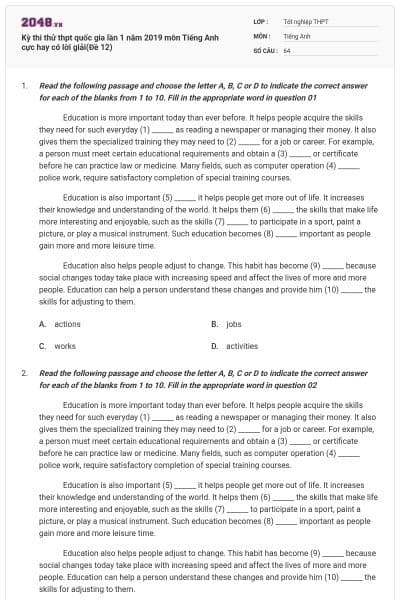
Read the following passage and choose the letter A, B, C or D to indicate the correct answer for each of the blanks from 1 to 10. Fill in the appropriate word in question 01
Education is more important today than ever before. It helps people acquire the skills they need for such everyday (1) ______ as reading a newspaper or managing their money. It also gives them the specialized training they may need to (2) ______ for a job or career. For example, a person must meet certain educational requirements and obtain a (3) ______ or certificate before he can practice law or medicine. Many fields, such as computer operation (4) ______ police work, require satisfactory completion of special training courses.
Education is also important (5) ______ it helps people get more out of life. It increases their knowledge and understanding of the world. It helps them (6) ______ the skills that make life more interesting and enjoyable, such as the skills (7) ______ to participate in a sport, paint a picture, or play a musical instrument. Such education becomes (8) ______ important as people gain more and more leisure time.
Education also helps people adjust to change. This habit has become (9) ______ because social changes today take place with increasing speed and affect the lives of more and more people. Education can help a person understand these changes and provide him (10) ______ the skills for adjusting to them.
actions
jobs
works
activities
Đáp án : D
Dịch câu 2: Nó giúp con người đạt được các kỹ năng họ cần cho ___ mỗi ngày như đọc báo, quản lý tiền bạc. Từ cần điền là “activities”= hoạt động, các từ khác : jobs = works= công việc, actions= hành động.
Read the following passage and choose the letter A, B, C or D to indicate the correct answer for each of the blanks from 1 to 10. Fill in the appropriate word in question 02
Education is more important today than ever before. It helps people acquire the skills they need for such everyday (1) ______ as reading a newspaper or managing their money. It also gives them the specialized training they may need to (2) ______ for a job or career. For example, a person must meet certain educational requirements and obtain a (3) ______ or certificate before he can practice law or medicine. Many fields, such as computer operation (4) ______ police work, require satisfactory completion of special training courses.
Education is also important (5) ______ it helps people get more out of life. It increases their knowledge and understanding of the world. It helps them (6) ______ the skills that make life more interesting and enjoyable, such as the skills (7) ______ to participate in a sport, paint a picture, or play a musical instrument. Such education becomes (8) ______ important as people gain more and more leisure time.
Education also helps people adjust to change. This habit has become (9) ______ because social changes today take place with increasing speed and affect the lives of more and more people. Education can help a person understand these changes and provide him (10) ______ the skills for adjusting to them.
work
make
prepare
do
Đáp án : C
Chọn từ phù hợp với giới từ “for”. Prepare for= chuẩn bị cho, work for= làm việc cho, do for someone= giúp ai đó. -> chọn từ “Prepare”. Dịch: Họ cần để chuẩn bị cho 1 công việc hoặc nghề nghiệp.
Read the following passage and choose the letter A, B, C or D to indicate the correct answer for each of the blanks from 1 to 10. Fill in the appropriate word in question 03
Education is more important today than ever before. It helps people acquire the skills they need for such everyday (1) ______ as reading a newspaper or managing their money. It also gives them the specialized training they may need to (2) ______ for a job or career. For example, a person must meet certain educational requirements and obtain a (3) ______ or certificate before he can practice law or medicine. Many fields, such as computer operation (4) ______ police work, require satisfactory completion of special training courses.
Education is also important (5) ______ it helps people get more out of life. It increases their knowledge and understanding of the world. It helps them (6) ______ the skills that make life more interesting and enjoyable, such as the skills (7) ______ to participate in a sport, paint a picture, or play a musical instrument. Such education becomes (8) ______ important as people gain more and more leisure time.
Education also helps people adjust to change. This habit has become (9) ______ because social changes today take place with increasing speed and affect the lives of more and more people. Education can help a person understand these changes and provide him (10) ______ the skills for adjusting to them.
paper
license
diploma
card
Đáp án : B
Paper= giấy, license= giấy cấp phép, diploma= bằng, card= thẻ. Dịch: Cần giấy phép hoặc văn bằng trước khi họ được hành nghề như luật, y khoa. -> chọn từ “license”.
Read the following passage and choose the letter A, B, C or D to indicate the correct answer for each of the blanks from 1 to 10. Fill in the appropriate word in question 04
Education is more important today than ever before. It helps people acquire the skills they need for such everyday (1) ______ as reading a newspaper or managing their money. It also gives them the specialized training they may need to (2) ______ for a job or career. For example, a person must meet certain educational requirements and obtain a (3) ______ or certificate before he can practice law or medicine. Many fields, such as computer operation (4) ______ police work, require satisfactory completion of special training courses.
Education is also important (5) ______ it helps people get more out of life. It increases their knowledge and understanding of the world. It helps them (6) ______ the skills that make life more interesting and enjoyable, such as the skills (7) ______ to participate in a sport, paint a picture, or play a musical instrument. Such education becomes (8) ______ important as people gain more and more leisure time.
Education also helps people adjust to change. This habit has become (9) ______ because social changes today take place with increasing speed and affect the lives of more and more people. Education can help a person understand these changes and provide him (10) ______ the skills for adjusting to them.
or else
because of
or
otherwise
Đáp án : C
Sau từ “ such as” là 2 danh từ mang tính liệt kê-> cần liên từ kết hợp để nối chúng -> “or”.
Read the following passage and choose the letter A, B, C or D to indicate the correct answer for each of the blanks from 1 to 10. Fill in the appropriate word in question 05
Education is more important today than ever before. It helps people acquire the skills they need for such everyday (1) ______ as reading a newspaper or managing their money. It also gives them the specialized training they may need to (2) ______ for a job or career. For example, a person must meet certain educational requirements and obtain a (3) ______ or certificate before he can practice law or medicine. Many fields, such as computer operation (4) ______ police work, require satisfactory completion of special training courses.
Education is also important (5) ______ it helps people get more out of life. It increases their knowledge and understanding of the world. It helps them (6) ______ the skills that make life more interesting and enjoyable, such as the skills (7) ______ to participate in a sport, paint a picture, or play a musical instrument. Such education becomes (8) ______ important as people gain more and more leisure time.
Education also helps people adjust to change. This habit has become (9) ______ because social changes today take place with increasing speed and affect the lives of more and more people. Education can help a person understand these changes and provide him (10) ______ the skills for adjusting to them.
therefore
despite
although
becaus
Đáp án : D
Dịch : Giáo dụng cũng quan trọng___ nó giúp con người hiểu biết hơn về cuộc sống. Chọn từ có nghĩa phù hợp: “because” : bởi vì. “therefore”= vậy nên, although= despite= mặc dù.
Read the following passage and choose the letter A, B, C or D to indicate the correct answer for each of the blanks from 1 to 10. Fill in the appropriate word in question 06
Education is more important today than ever before. It helps people acquire the skills they need for such everyday (1) ______ as reading a newspaper or managing their money. It also gives them the specialized training they may need to (2) ______ for a job or career. For example, a person must meet certain educational requirements and obtain a (3) ______ or certificate before he can practice law or medicine. Many fields, such as computer operation (4) ______ police work, require satisfactory completion of special training courses.
Education is also important (5) ______ it helps people get more out of life. It increases their knowledge and understanding of the world. It helps them (6) ______ the skills that make life more interesting and enjoyable, such as the skills (7) ______ to participate in a sport, paint a picture, or play a musical instrument. Such education becomes (8) ______ important as people gain more and more leisure time.
Education also helps people adjust to change. This habit has become (9) ______ because social changes today take place with increasing speed and affect the lives of more and more people. Education can help a person understand these changes and provide him (10) ______ the skills for adjusting to them.
reach
acquire
construct
require
Đáp án : B
It helps them__ the skills tương tự câu ở đoạn một “It helps people acquire the skills…” -> chọn từ “acquire” = đạt được. “Reach”= với tới, construct= xây dựng, require= yêu cầu.
Read the following passage and choose the letter A, B, C or D to indicate the correct answer for each of the blanks from 1 to 10. Fill in the appropriate word in question 07
Education is more important today than ever before. It helps people acquire the skills they need for such everyday (1) ______ as reading a newspaper or managing their money. It also gives them the specialized training they may need to (2) ______ for a job or career. For example, a person must meet certain educational requirements and obtain a (3) ______ or certificate before he can practice law or medicine. Many fields, such as computer operation (4) ______ police work, require satisfactory completion of special training courses.
Education is also important (5) ______ it helps people get more out of life. It increases their knowledge and understanding of the world. It helps them (6) ______ the skills that make life more interesting and enjoyable, such as the skills (7) ______ to participate in a sport, paint a picture, or play a musical instrument. Such education becomes (8) ______ important as people gain more and more leisure time.
Education also helps people adjust to change. This habit has become (9) ______ because social changes today take place with increasing speed and affect the lives of more and more people. Education can help a person understand these changes and provide him (10) ______ the skills for adjusting to them.
able
capable
needed
ordered
Đáp án : C
“ Such as skills___ to participate in…” Sau “skills” là mệnh đề bổ nghĩa cho nó, nên không thể dùng tính từ “able” và “capatable”; “needed” = cần thiết, “required” = yêu cầu: là dạng rút gọn mệnh đề quan hệ dang bị động. -> chọn “needed” có nghĩa phù hợp cần điền.
Read the following passage and choose the letter A, B, C or D to indicate the correct answer for each of the blanks from 1 to 10. Fill in the appropriate word in question 08
Education is more important today than ever before. It helps people acquire the skills they need for such everyday (1) ______ as reading a newspaper or managing their money. It also gives them the specialized training they may need to (2) ______ for a job or career. For example, a person must meet certain educational requirements and obtain a (3) ______ or certificate before he can practice law or medicine. Many fields, such as computer operation (4) ______ police work, require satisfactory completion of special training courses.
Education is also important (5) ______ it helps people get more out of life. It increases their knowledge and understanding of the world. It helps them (6) ______ the skills that make life more interesting and enjoyable, such as the skills (7) ______ to participate in a sport, paint a picture, or play a musical instrument. Such education becomes (8) ______ important as people gain more and more leisure time.
Education also helps people adjust to change. This habit has become (9) ______ because social changes today take place with increasing speed and affect the lives of more and more people. Education can help a person understand these changes and provide him (10) ______ the skills for adjusting to them.
seriously
excessively
vitally
increasingly
Đáp án : D
“Seriously”= nghiêm trọng, “excessively”= thái quá, “vitally”= vô cùng, “increasingly”= ngày càng. Ghi nhớ cụm từ: “become increasingly+ adj”.
Read the following passage and choose the letter A, B, C or D to indicate the correct answer for each of the blanks from 1 to 10. Fill in the appropriate word in question 09
Education is more important today than ever before. It helps people acquire the skills they need for such everyday (1) ______ as reading a newspaper or managing their money. It also gives them the specialized training they may need to (2) ______ for a job or career. For example, a person must meet certain educational requirements and obtain a (3) ______ or certificate before he can practice law or medicine. Many fields, such as computer operation (4) ______ police work, require satisfactory completion of special training courses.
Education is also important (5) ______ it helps people get more out of life. It increases their knowledge and understanding of the world. It helps them (6) ______ the skills that make life more interesting and enjoyable, such as the skills (7) ______ to participate in a sport, paint a picture, or play a musical instrument. Such education becomes (8) ______ important as people gain more and more leisure time.
Education also helps people adjust to change. This habit has become (9) ______ because social changes today take place with increasing speed and affect the lives of more and more people. Education can help a person understand these changes and provide him (10) ______ the skills for adjusting to them.
necessary
major
primary
critical
Đáp án : A
“Necessary”= cần thiết, “major”= trọng đại, “primary”= căn bản, “critical”= chỉ trích. Dịch: giáo dục giúp con người thích nghi với sự thay đổi-> chỉ ra tác dụng tích cực của giáo dục, nên chọn được từ “necessary”.
Read the following passage and choose the letter A, B, C or D to indicate the correct answer for each of the blanks from 1 to 10. Fill in the appropriate word in question 10
Education is more important today than ever before. It helps people acquire the skills they need for such everyday (1) ______ as reading a newspaper or managing their money. It also gives them the specialized training they may need to (2) ______ for a job or career. For example, a person must meet certain educational requirements and obtain a (3) ______ or certificate before he can practice law or medicine. Many fields, such as computer operation (4) ______ police work, require satisfactory completion of special training courses.
Education is also important (5) ______ it helps people get more out of life. It increases their knowledge and understanding of the world. It helps them (6) ______ the skills that make life more interesting and enjoyable, such as the skills (7) ______ to participate in a sport, paint a picture, or play a musical instrument. Such education becomes (8) ______ important as people gain more and more leisure time.
Education also helps people adjust to change. This habit has become (9) ______ because social changes today take place with increasing speed and affect the lives of more and more people. Education can help a person understand these changes and provide him (10) ______ the skills for adjusting to them.
for
with
on
in
Đáp án : B
Cấu trúc: provide+ someone+ with something= cung cấp cái gì cho ai.
Read the following passage and choose the letter A, B, C or D to indicate the correct answer to each of the questions from 11 to 20.
Although speech is generally accepted as the most advanced form of communication, there are many ways of communicating without using words. In every known culture, signals, signs, symbols, and gestures are commonly utilized as instruments of communication. There is a great deal of agreement among communication scientists as to what each of these methods is and how each differs from the others. For instance, the basic function of any signal is to impinge upon the environment in such a way that it attracts attention, as, for example, the dots and dashes that can be applied in a telegraph circuit. Coded to refer to speech, the potential for communication through these dots and dashes—short and long intervals as the circuit is broken—is very great. Less adaptable to the codification of words, signs also contain agreed upon meaning; that is, they convey information in and of themselves. Two examples are the hexagonal red sign that conveys the meaning of stop, and the red and white swirled pole outside a shop that communicates the meaning of barber.
Symbols are more difficult to describe than either signals or signs because of their intricate relationship with the receiver’s culture perceptions. In some cultures, applauding in a theater provides performers with an auditory symbol of approval. In other cultures, if done in unison, applauding can be a symbol of the audience’s discontent with the performance. Gestures such as weaving and handshaking also communicate certain culture messages.
Although signals, signs, symbols, and gestures are very useful, they also have a major disadvantage in communication. They usually do not allow ideas to be shared without the sender being directly adjacent to the receiver. Without an exchange of ideas, interaction comes to a halt. As a result, means of communication intended to be used across long distances and extended periods must be based upon speech. To radio, television, and the telephone, one must add fax, paging systems, electronic mail, and the internet, and no one doubts but that there are more means of communication on the horizon.
Which of the following would be the best title for the passage?
Communication
Signs and Signals
Speech
Gestures
Đáp án : A
Câu đầu đoạn 1: ” Although speech is generally accepted as the most advanced form of communication…”, câu đầu đoạn 3:” Although signals, signs, symbols, and gestures are very useful, they also have a major disadvantage in communication”-> “signs and signals”, “gestures” và “speech” đều là các dạng của “communication” và trong bài xuất hiện nhiều lần từ “communication”.
Read the following passage and choose the letter A, B, C or D to indicate the correct answer to each of the questions from 11 to 20.
Although speech is generally accepted as the most advanced form of communication, there are many ways of communicating without using words. In every known culture, signals, signs, symbols, and gestures are commonly utilized as instruments of communication. There is a great deal of agreement among communication scientists as to what each of these methods is and how each differs from the others. For instance, the basic function of any signal is to impinge upon the environment in such a way that it attracts attention, as, for example, the dots and dashes that can be applied in a telegraph circuit. Coded to refer to speech, the potential for communication through these dots and dashes—short and long intervals as the circuit is broken—is very great. Less adaptable to the codification of words, signs also contain agreed upon meaning; that is, they convey information in and of themselves. Two examples are the hexagonal red sign that conveys the meaning of stop, and the red and white swirled pole outside a shop that communicates the meaning of barber.
Symbols are more difficult to describe than either signals or signs because of their intricate relationship with the receiver’s culture perceptions. In some cultures, applauding in a theater provides performers with an auditory symbol of approval. In other cultures, if done in unison, applauding can be a symbol of the audience’s discontent with the performance. Gestures such as weaving and handshaking also communicate certain culture messages.
Although signals, signs, symbols, and gestures are very useful, they also have a major disadvantage in communication. They usually do not allow ideas to be shared without the sender being directly adjacent to the receiver. Without an exchange of ideas, interaction comes to a halt. As a result, means of communication intended to be used across long distances and extended periods must be based upon speech. To radio, television, and the telephone, one must add fax, paging systems, electronic mail, and the internet, and no one doubts but that there are more means of communication on the horizon.
What does the author say about speech?
It is the only true form of communication
It is necessary for communication to occur
It is the most advanced form of communication
It is dependent upon the advances made by inventors
Đáp án : C
Câu đầu đoạn 1:” Although speech is generally accepted as the most advanced form of communication,” -> đáp án C đúng, “ there are many ways of communicating without using words.” Có nhiều cách giao tiếp không dùng từ ngữ-> loại đáp án A,B. Đáp án D không được đề cập trong bài.
Read the following passage and choose the letter A, B, C or D to indicate the correct answer to each of the questions from 11 to 20.
Although speech is generally accepted as the most advanced form of communication, there are many ways of communicating without using words. In every known culture, signals, signs, symbols, and gestures are commonly utilized as instruments of communication. There is a great deal of agreement among communication scientists as to what each of these methods is and how each differs from the others. For instance, the basic function of any signal is to impinge upon the environment in such a way that it attracts attention, as, for example, the dots and dashes that can be applied in a telegraph circuit. Coded to refer to speech, the potential for communication through these dots and dashes—short and long intervals as the circuit is broken—is very great. Less adaptable to the codification of words, signs also contain agreed upon meaning; that is, they convey information in and of themselves. Two examples are the hexagonal red sign that conveys the meaning of stop, and the red and white swirled pole outside a shop that communicates the meaning of barber.
Symbols are more difficult to describe than either signals or signs because of their intricate relationship with the receiver’s culture perceptions. In some cultures, applauding in a theater provides performers with an auditory symbol of approval. In other cultures, if done in unison, applauding can be a symbol of the audience’s discontent with the performance. Gestures such as weaving and handshaking also communicate certain culture messages.
Although signals, signs, symbols, and gestures are very useful, they also have a major disadvantage in communication. They usually do not allow ideas to be shared without the sender being directly adjacent to the receiver. Without an exchange of ideas, interaction comes to a halt. As a result, means of communication intended to be used across long distances and extended periods must be based upon speech. To radio, television, and the telephone, one must add fax, paging systems, electronic mail, and the internet, and no one doubts but that there are more means of communication on the horizon.
The phrase impinge upon in paragraph 1 is closest in meaning to ______.
prohibit
intrude
improve
vary
Đáp án : B
“Impinge upon”= ảnh hưởng, “prohibit”= cấm đoán, “intrude”= xâm nhập, “improve”= cải thiện, “vary”= thay đổi.
Read the following passage and choose the letter A, B, C or D to indicate the correct answer to each of the questions from 11 to 20.
Although speech is generally accepted as the most advanced form of communication, there are many ways of communicating without using words. In every known culture, signals, signs, symbols, and gestures are commonly utilized as instruments of communication. There is a great deal of agreement among communication scientists as to what each of these methods is and how each differs from the others. For instance, the basic function of any signal is to impinge upon the environment in such a way that it attracts attention, as, for example, the dots and dashes that can be applied in a telegraph circuit. Coded to refer to speech, the potential for communication through these dots and dashes—short and long intervals as the circuit is broken—is very great. Less adaptable to the codification of words, signs also contain agreed upon meaning; that is, they convey information in and of themselves. Two examples are the hexagonal red sign that conveys the meaning of stop, and the red and white swirled pole outside a shop that communicates the meaning of barber.
Symbols are more difficult to describe than either signals or signs because of their intricate relationship with the receiver’s culture perceptions. In some cultures, applauding in a theater provides performers with an auditory symbol of approval. In other cultures, if done in unison, applauding can be a symbol of the audience’s discontent with the performance. Gestures such as weaving and handshaking also communicate certain culture messages.
Although signals, signs, symbols, and gestures are very useful, they also have a major disadvantage in communication. They usually do not allow ideas to be shared without the sender being directly adjacent to the receiver. Without an exchange of ideas, interaction comes to a halt. As a result, means of communication intended to be used across long distances and extended periods must be based upon speech. To radio, television, and the telephone, one must add fax, paging systems, electronic mail, and the internet, and no one doubts but that there are more means of communication on the horizon.
The word it in paragraph 1 refers to ______.
signal
function
environment
way
Đáp án : A
Dịch cả câu: Chức năng cơ bản của bất kỳ tín hiệu nào là ảnh hưởng đến môi trường theo cách nó thu hút sự chú ý -> “it” là nó-> tín hiệu.
Read the following passage and choose the letter A, B, C or D to indicate the correct answer to each of the questions from 11 to 20.
Although speech is generally accepted as the most advanced form of communication, there are many ways of communicating without using words. In every known culture, signals, signs, symbols, and gestures are commonly utilized as instruments of communication. There is a great deal of agreement among communication scientists as to what each of these methods is and how each differs from the others. For instance, the basic function of any signal is to impinge upon the environment in such a way that it attracts attention, as, for example, the dots and dashes that can be applied in a telegraph circuit. Coded to refer to speech, the potential for communication through these dots and dashes—short and long intervals as the circuit is broken—is very great. Less adaptable to the codification of words, signs also contain agreed upon meaning; that is, they convey information in and of themselves. Two examples are the hexagonal red sign that conveys the meaning of stop, and the red and white swirled pole outside a shop that communicates the meaning of barber.
Symbols are more difficult to describe than either signals or signs because of their intricate relationship with the receiver’s culture perceptions. In some cultures, applauding in a theater provides performers with an auditory symbol of approval. In other cultures, if done in unison, applauding can be a symbol of the audience’s discontent with the performance. Gestures such as weaving and handshaking also communicate certain culture messages.
Although signals, signs, symbols, and gestures are very useful, they also have a major disadvantage in communication. They usually do not allow ideas to be shared without the sender being directly adjacent to the receiver. Without an exchange of ideas, interaction comes to a halt. As a result, means of communication intended to be used across long distances and extended periods must be based upon speech. To radio, television, and the telephone, one must add fax, paging systems, electronic mail, and the internet, and no one doubts but that there are more means of communication on the horizon.
The word potential in paragraph 1 could best be replaced by ______.
organization
possibility
range
advantage
Đáp án : B
“Potential”= tiềm năng, “organization”= tổ chức, “possibility”=khả năng, “range”=phạm vi, “advantage”= lợi thế.
Read the following passage and choose the letter A, B, C or D to indicate the correct answer to each of the questions from 11 to 20.
Although speech is generally accepted as the most advanced form of communication, there are many ways of communicating without using words. In every known culture, signals, signs, symbols, and gestures are commonly utilized as instruments of communication. There is a great deal of agreement among communication scientists as to what each of these methods is and how each differs from the others. For instance, the basic function of any signal is to impinge upon the environment in such a way that it attracts attention, as, for example, the dots and dashes that can be applied in a telegraph circuit. Coded to refer to speech, the potential for communication through these dots and dashes—short and long intervals as the circuit is broken—is very great. Less adaptable to the codification of words, signs also contain agreed upon meaning; that is, they convey information in and of themselves. Two examples are the hexagonal red sign that conveys the meaning of stop, and the red and white swirled pole outside a shop that communicates the meaning of barber.
Symbols are more difficult to describe than either signals or signs because of their intricate relationship with the receiver’s culture perceptions. In some cultures, applauding in a theater provides performers with an auditory symbol of approval. In other cultures, if done in unison, applauding can be a symbol of the audience’s discontent with the performance. Gestures such as weaving and handshaking also communicate certain culture messages.
Although signals, signs, symbols, and gestures are very useful, they also have a major disadvantage in communication. They usually do not allow ideas to be shared without the sender being directly adjacent to the receiver. Without an exchange of ideas, interaction comes to a halt. As a result, means of communication intended to be used across long distances and extended periods must be based upon speech. To radio, television, and the telephone, one must add fax, paging systems, electronic mail, and the internet, and no one doubts but that there are more means of communication on the horizon.
The word themselves in paragraph 1 refers to ______.
information
intervals
words
signs
Đáp án : D
“signs also contain agreed upon meaning; that is, they convey information in and of themselves”-> “signs”= “they”-> “themselves”
Read the following passage and choose the letter A, B, C or D to indicate the correct answer to each of the questions from 11 to 20.
Although speech is generally accepted as the most advanced form of communication, there are many ways of communicating without using words. In every known culture, signals, signs, symbols, and gestures are commonly utilized as instruments of communication. There is a great deal of agreement among communication scientists as to what each of these methods is and how each differs from the others. For instance, the basic function of any signal is to impinge upon the environment in such a way that it attracts attention, as, for example, the dots and dashes that can be applied in a telegraph circuit. Coded to refer to speech, the potential for communication through these dots and dashes—short and long intervals as the circuit is broken—is very great. Less adaptable to the codification of words, signs also contain agreed upon meaning; that is, they convey information in and of themselves. Two examples are the hexagonal red sign that conveys the meaning of stop, and the red and white swirled pole outside a shop that communicates the meaning of barber.
Symbols are more difficult to describe than either signals or signs because of their intricate relationship with the receiver’s culture perceptions. In some cultures, applauding in a theater provides performers with an auditory symbol of approval. In other cultures, if done in unison, applauding can be a symbol of the audience’s discontent with the performance. Gestures such as weaving and handshaking also communicate certain culture messages.
Although signals, signs, symbols, and gestures are very useful, they also have a major disadvantage in communication. They usually do not allow ideas to be shared without the sender being directly adjacent to the receiver. Without an exchange of ideas, interaction comes to a halt. As a result, means of communication intended to be used across long distances and extended periods must be based upon speech. To radio, television, and the telephone, one must add fax, paging systems, electronic mail, and the internet, and no one doubts but that there are more means of communication on the horizon.
sentence in paragraph 1 defines the function of a signal?
Sentence 2
Sentence 3
Sentence 1
Sentence 4
Đáp án : D
Câu 4 đoạn 1: ”… , the basic function of any signal is to impinge upon the environment in such a way that it attracts attention,…” dịch: Chức năng cơ bản của bất kỳ tín hiệu nào là ảnh hưởng đến môi trường theo cách nó thu hút sự chú ý…
Read the following passage and choose the letter A, B, C or D to indicate the correct answer to each of the questions from 11 to 20.
Although speech is generally accepted as the most advanced form of communication, there are many ways of communicating without using words. In every known culture, signals, signs, symbols, and gestures are commonly utilized as instruments of communication. There is a great deal of agreement among communication scientists as to what each of these methods is and how each differs from the others. For instance, the basic function of any signal is to impinge upon the environment in such a way that it attracts attention, as, for example, the dots and dashes that can be applied in a telegraph circuit. Coded to refer to speech, the potential for communication through these dots and dashes—short and long intervals as the circuit is broken—is very great. Less adaptable to the codification of words, signs also contain agreed upon meaning; that is, they convey information in and of themselves. Two examples are the hexagonal red sign that conveys the meaning of stop, and the red and white swirled pole outside a shop that communicates the meaning of barber.
Symbols are more difficult to describe than either signals or signs because of their intricate relationship with the receiver’s culture perceptions. In some cultures, applauding in a theater provides performers with an auditory symbol of approval. In other cultures, if done in unison, applauding can be a symbol of the audience’s discontent with the performance. Gestures such as weaving and handshaking also communicate certain culture messages.
Although signals, signs, symbols, and gestures are very useful, they also have a major disadvantage in communication. They usually do not allow ideas to be shared without the sender being directly adjacent to the receiver. Without an exchange of ideas, interaction comes to a halt. As a result, means of communication intended to be used across long distances and extended periods must be based upon speech. To radio, television, and the telephone, one must add fax, paging systems, electronic mail, and the internet, and no one doubts but that there are more means of communication on the horizon.
The word intricate in paragraph 2 could be best replaced by which of the following?
uncertain
complicated
historical
inefficient
Đáp án : B
“Intricate”= “complicated”= phức tạp, “uncertain”= không chắc chắn, “historical”= thuộc về lịch sử, “inefficient”= không hiệu quả. Dịch câu 1 đoạn 2: biểu tượng khó khăn hơn để mô tả hơn tín hiệu hoặc dấu hiệu vì của phức tạp của mối quan hệ với văn hóa của người nhận. Dựa vào từ “difficult”-> “complicate”
Read the following passage and choose the letter A, B, C or D to indicate the correct answer to each of the questions from 11 to 20.
Although speech is generally accepted as the most advanced form of communication, there are many ways of communicating without using words. In every known culture, signals, signs, symbols, and gestures are commonly utilized as instruments of communication. There is a great deal of agreement among communication scientists as to what each of these methods is and how each differs from the others. For instance, the basic function of any signal is to impinge upon the environment in such a way that it attracts attention, as, for example, the dots and dashes that can be applied in a telegraph circuit. Coded to refer to speech, the potential for communication through these dots and dashes—short and long intervals as the circuit is broken—is very great. Less adaptable to the codification of words, signs also contain agreed upon meaning; that is, they convey information in and of themselves. Two examples are the hexagonal red sign that conveys the meaning of stop, and the red and white swirled pole outside a shop that communicates the meaning of barber.
Symbols are more difficult to describe than either signals or signs because of their intricate relationship with the receiver’s culture perceptions. In some cultures, applauding in a theater provides performers with an auditory symbol of approval. In other cultures, if done in unison, applauding can be a symbol of the audience’s discontent with the performance. Gestures such as weaving and handshaking also communicate certain culture messages.
Although signals, signs, symbols, and gestures are very useful, they also have a major disadvantage in communication. They usually do not allow ideas to be shared without the sender being directly adjacent to the receiver. Without an exchange of ideas, interaction comes to a halt. As a result, means of communication intended to be used across long distances and extended periods must be based upon speech. To radio, television, and the telephone, one must add fax, paging systems, electronic mail, and the internet, and no one doubts but that there are more means of communication on the horizon.
Applauding was cited as an example of ______.
a gesture
a signal
a symbol
a sign
Đáp án : C
“applauding can be a symbol of the audience’s discontent” dịch: vỗ tay có thể là biểu tượng của sự bất mãn của khán giả -> Chọn đáp án “a symbol”
Read the following passage and choose the letter A, B, C or D to indicate the correct answer to each of the questions from 11 to 20.
Although speech is generally accepted as the most advanced form of communication, there are many ways of communicating without using words. In every known culture, signals, signs, symbols, and gestures are commonly utilized as instruments of communication. There is a great deal of agreement among communication scientists as to what each of these methods is and how each differs from the others. For instance, the basic function of any signal is to impinge upon the environment in such a way that it attracts attention, as, for example, the dots and dashes that can be applied in a telegraph circuit. Coded to refer to speech, the potential for communication through these dots and dashes—short and long intervals as the circuit is broken—is very great. Less adaptable to the codification of words, signs also contain agreed upon meaning; that is, they convey information in and of themselves. Two examples are the hexagonal red sign that conveys the meaning of stop, and the red and white swirled pole outside a shop that communicates the meaning of barber.
Symbols are more difficult to describe than either signals or signs because of their intricate relationship with the receiver’s culture perceptions. In some cultures, applauding in a theater provides performers with an auditory symbol of approval. In other cultures, if done in unison, applauding can be a symbol of the audience’s discontent with the performance. Gestures such as weaving and handshaking also communicate certain culture messages.
Although signals, signs, symbols, and gestures are very useful, they also have a major disadvantage in communication. They usually do not allow ideas to be shared without the sender being directly adjacent to the receiver. Without an exchange of ideas, interaction comes to a halt. As a result, means of communication intended to be used across long distances and extended periods must be based upon speech. To radio, television, and the telephone, one must add fax, paging systems, electronic mail, and the internet, and no one doubts but that there are more means of communication on the horizon.
Why were the telephone, radio, and TV invented?
People wanted new forms of entertainment.
People were unable to understand signs, symbols, and signals.
People wanted to communicate across long distance.
People believed that signs, signals, and symbols were obsolete.
Đáp án : C
“means of communication intended to be used across long distances and extended periods” dịch: các phương tiện giao tiếp được dùng để truyền tải xa hơn và rộng hơn.
Choose the best option A, B, C or D to complete each of the sentences from 21 to 39.
When I last saw him, he ______ in London.
is living
has lived
was living
has been living
Đáp án: C
Giải thích:
Kiến thức: Sự phối hợp về thì của động từ
Thì quá khứ đơn và quá khứ tiếp diễn kết hợp trong câu: Diễn tả hành động đang xảy ra trong quá khứ thì một hành động khác xen vào, hành động đang xảy ra chi thì quá khứ tiếp diễn, hành động xen vào chia thì quá khứ đơn
Cấu trúc: S + was/ were + V_ing + when + S + Ved/bqt
Dịch: Khi tôi gặp anh ta, anh ta đang sống ở London.
Choose the best option A, B, C or D to complete each of the sentences from 21 to 39.
The firemen did well ______ their preparation for catastrophic gas explosions.
although
because
despite
because of
Đáp án: D
Giải thích:
A. although + mệnh đề: mặc dù
B. because + mệnh đề: bởi vì
C. despite + cụm danh từ/V-ing: mặc cho
D. because of + cụm danh từ/V-ing: bởi vì
Phía sau vị trí cần tìm là cụm danh từ, loại A và B.
Dựa vào nghĩa câu, chọn D.
Dịch: Lính cứu hỏa đã làm tốt vì đã chuẩn bị sẵn sàng để ứng phó với các vụ nổ khí gas thảm khốc.
Choose the best option A, B, C or D to complete each of the sentences from 21 to 39.
Jack Ma or Ma Yun, ______ parents are traditional musician-storytellers, is the founder and executive chairman of Alibaba Group, a family of highly successful Internet-based businesses.
that
whom
who
whose
Đáp án : D
“Ma Yun,___ parents” ‘whose” là đại từ quan hệ duy nhất đứng giữa 2 danh từ.
Choose the best option A, B, C or D to complete each of the sentences from 21 to 39.
You ______ take your umbrella along with you today. The weatherman on the news said there's a storm north of here and it ______ rain later on this afternoon.
might / can
must / may
should / might
should / must
Đáp án : C
Vế 1 là lời khuyên->”should”, vế 2 là dự đoán 1 điều có thề xảy ra->” may”hoặc “might”=> should/might.
Choose the best option A, B, C or D to complete each of the sentences from 21 to 39.
Everyone on the roller coaster, including Martha and Angie, ______ that the hot dogs, onion rings, funnel cake, and cotton candy will stay down during the twisting ride to come.
hope
hopes
hoped
hoping
Đáp án : B
Chọn thì của động từ phù hợp với chủ ngữ số ít “everyone”-> hopes.
Choose the best option A, B, C or D to complete each of the sentences from 21 to 39.
Considering how little they’ve got in common, it’s surprising how well they ______ together.
get through
get on
get down
get up
Đáp án : B
Cụm từ : get on well- hòa hợp. Dịch: Xét đến rất ít điểm chung mà họ có, thật ngạc nhiên họ có thể hòa hợp như vậy.
Choose the best option A, B, C or D to complete each of the sentences from 21 to 39.
We are ______ no obligation to change goods which were not purchased here.
to
at
with
under
Đáp án: D
Giải thích:
Kiến thức: Giới từ
under no obligation: không có nghĩa vụ
Dịch: Chúng tôi không có nghĩa vụ phải đổi những hàng hóa không được mua ở đây.
Choose the best option A, B, C or D to complete each of the sentences from 21 to 39.
We can’t even walk in the storm. Let’s wait in the hallway where we’ll be ______ the strong winds until things quiet down.
protecting from
protected from
protected by
protecting by
Đáp án : B
Cấu trúc: Protect + someone/something + from/ against: bảo vệ ai/ cái khòi khỏi. Dịch: Chúng ta không thể đi bộ trong cơn bão. Hãy đợi ở hành lang nơi chúng ta được bảo vệ khỏi gió lớn… -> họ được “hallway” bảo vệ-> bị động-> “protected from”.
Choose the best option A, B, C or D to complete each of the sentences from 21 to 39.
Where’s that ______ dress that your grandma gave you?
long pink silk lovely
pink long lovely silk
lovely long pink silk
lovely pink long silk
Đáp án : C
Trật tự tính từ: Opinion- Size- Age- Shape- Color- Origin- Material- Purpose + N.
Choose the best option A, B, C or D to complete each of the sentences from 21 to 39.
“Sorry, I was late again this morning.” – “______.”
Yes, I know
Well, don’t let it happen again
It’s OK
No problem
Đáp án : B
Dịch: “xin lỗi tôi lại đến muộn sáng nay” à trả lời “Đừng để nó xảy ra lần nữa nhé”
Choose the best option A, B, C or D to complete each of the sentences from 21 to 39.
He was ______ when I had those problems and said whatever I did he would stand by me.
exciting
supportive
busy
dull
Đáp án B
A. exciting = hào hứng
B. supportive = khích lệ
C. busy= bận rộn
D. dull = chậm hiểu.
Dịch: Anh ấy luôn ủng hộ khi tôi gặp khó khăn và nói rằng bất cứ điều gì tôi làm, anh ấy sẽ đứng về phía tôi.
Choose the best option A, B, C or D to complete each of the sentences from 21 to 39.
All the cereal grains ______ grow on the prairies and plains of the United States.
but for rice
excepting rice
but rice
except the rice
Đáp án : C
“but for”= if… not, “but”= “except”: ngoại trừ, “exceipting”: rút gọn mệnh đề dạng chủ động-> loại A, B, “rice’ là nói chung về thóc, không được thêm “the”-> loại D.
Choose the best option A, B, C or D to complete each of the sentences from 21 to 39.
“______?” – “Yeah, down this street, on the left.”
Would you like to go by train
Is this a train station
Is there a station near here
How often does the train come
Đáp án : C
Trả lời: “ Vâng, cuối con đường, bên tay trái” -> chỉ đường-> hỏi đường-> Có nhà ga nào ở gần đây không?
Choose the best option A, B, C or D to complete each of the sentences from 21 to 39.
If you say you are using a word ______, you mean you are choosing it after thinking about it very carefully.
advisor
advisedly
advisory
advice
Đáp án : B
“You are using a word…” sau động từ cần 1 trạng từ bổ nghĩa cho nó-> advisedly= thận trọng
Choose the best option A, B, C or D to complete each of the sentences from 21 to 39.
There are ten pieces of fruit in my basket. One is an orange, one is a grape and ______ is an apple.
others
the other
the others
another
Đáp án : D
Others= những cái khác, The other= cái còn lại, The others= những cái còn lại, Another= một cái khác. Có 10 loại hoa quả trong giỏ. Một loại có một quả cam, một loại quả nhỏ và một loại nữa có một quả táo (ở đây không kể hết các loại quả có trong giỏ). Ta không sử dụng others và the others vì sau 2 từ này động từ theo sau phải chia số nhiều. the other không phù hợp về mặt nghĩa. -> Chọn đáp án D.
Choose the best option A, B, C or D to complete each of the sentences from 21 to 39.
In some countries, on moral ______ that education should not be taxed, there is no tax on books.
idea
principle
reason
concept
Đáp án : B
Idea= ý tưởng, Principle= nguyên lý, reason= lý do, Concept= quan niệm. Cụm từ cần nhớ: “ Moral principle”= nguyên lý đạo đức.
Choose the best option A, B, C or D to complete each of the sentences from 21 to 39.
Unless Ray ______ here soon, I’m going to leave because I’m getting bored.
won’t get
will get
doesn’t get
gets
Đáp án : D
Dấu hiệu: “unless”= if ..not…, “I’m going to leave”->câu điều kiện loại 1: If S+ V hiện tại, S+ will/can/tobe going to+ V mà sau “unless” khong dùng động từ dạng phủ định=> “gets”
Choose the best option A, B, C or D to complete each of the sentences from 21 to 39.
It doesn't matter to me one way or another, but I wish you would at least ______ an effort at seeing his side of it.
make
do
doing
making
Đáp án : A
Make an effort= cố gắng. Câu ước loại 1: S+ wish+ S+ would+ V: ước những điều có thể xảy ra ở hiện tại, tương lai.
Choose the best option A, B, C or D to complete each of the sentences from 21 to 39.
At first he didn’t agree, but in the end we managed to bring him ______ to our point of view.
over
up
back
round
Đáp án : D
Bring over= mang đến chô khác, bring up= nuôi lớn, bring back= mang trở lại, bring someone rough ( to sth)= làm thay đôir ý kiến.
Mark the letter A, B, C, or D on your answer sheet to indicate the word that differs from the other three in the position of primary stress in each of the following questions.
defend
swallow
social
wildlife
Đáp án : A
Trọng âm của từ này rơi vào âm thứ hai, các từ còn lại trọng âm rơi vào âm thứ nhất.
Mark the letter A, B, C, or D on your answer sheet to indicate the word that differs from the other three in the position of primary stress in each of the following questions.
involvement
applicant
installing
disaster
Đáp án : B
Trọng âm của từ này rơi vào âm thứ nhất , các từ còn lại trọng âm rơi vào âm thứ hai.
Mark the letter A, B, C, or D on your answer sheet to indicate the word that differs from the other three in the position of primary stress in each of the following questions.
eradicate
alternative
secondary
minority
Đáp án : C
Trọng âm của từ này rơi vào âm thứ nhất , các từ còn lại trọng âm rơi vào âm thứ hai .
Mark the letter A, B, C, or D on your answer sheet to indicate the word whose underlined part differs from the other three in pronunciation in each of the following questions.
combine
determine
discipline
examine
Đáp án : A
“ine” trong từ “combine” phát âm là /ain/, trong các từ còn lại là /in/
Mark the letter A, B, C, or D on your answer sheet to indicate the word whose underlined part differs from the other three in pronunciation in each of the following questions.
imagines
motorbikes
cultures
involves
Đáp án : B
“es” trong từ “motorbikes” phát âm là /s/, trong các từ còn lại là /z/.
Mark the letter A, B, C, or D on your answer sheet to indicate the underlined part that needs correction in each of the following questions.
All nations may have to make (A) fundamental changes (B) in their economic, political, and the technological institutions (C) if they are to preserve (D) environment.
have to make
changes
the technological institutions
to preserve
Đáp án : C
Trước và sau”and” là liệt kê, nên các từ phải có dạng giống nhau-> bỏ mạo từ “the”.
Mark the letter A, B, C, or D on your answer sheet to indicate the underlined part that needs correction in each of the following questions.
The closer(A) it gets to December 21, the first day of winter(B) , the short(C) the days become(D) .
The closer
of winter
short
become
Đáp án : C
So sánh kép với tính từ ngắn: The+ adj-er+ S+ V, the+ adj-er+ S+V. Chuyển “short” thành ‘shorter”.
Mark the letter A, B, C, or D on your answer sheet to indicate the underlined part that needs correction in each of the following questions.
Jim must(A) have asked for(B) help instead of trying(C) to do it himself(D) .
must
for
trying
himself
Đáp án : A
Must have+ PP: phỏng đoán điều đã xảy ra trong quá khứ. Dịch: Tom hẳn đã nhờ giúp đỡ thay vì tự làm một mình-> không hợp lý: đã có sự giúp đỡ thì không gọi là tự làm-> should have+ PP: nên làm gì nhưng đã không làm.
Mark the letter A, B, C, or D on your answer sheet to indicate the underlined part that needs correction in each of the following questions.
The Golden Gate, painting(A) a bright red-orange called(B) "International Orange", requires repainting(C) every year because of(D) the salty, corrosive air.
painting
called
repainting
because of(
Đáp án : A
“The Golden Gate” là một vật -> bị động-> Painting=> Painted.
Mark the letter A, B, C, or D on your answer sheet to indicate the underlined part that needs correction in each of the following questions.
At least three-quarters(A) of that book on famous(B) Americans are(C) about people who lived(D) in the nineteenth century.
three-quarters
famous
are
lived
Đáp án : C
Chủ ngữ số ít “the book” nên tobe chia theo ngôi số ít, “are”-> “is”.
Mark the letter A, B, C, or D on your answer sheet to indicate the word(s) CLOSEST in meaning to the underlined word(s) in each of the following questions.
Whenever problems come up, we discuss them frankly and find solutions quickly.
arrive
clean
encounter
happen
Đáp án : D
Come up= xảy đến, arrive= đến, clean= sạch sẽ, encounter= chạm trán, happen= xảy ra. Chọn từ “happen” vì nó mang nghĩa trừu tượng như từ “ come up”.
Mark the letter A, B, C, or D on your answer sheet to indicate the word(s) CLOSEST in meaning to the underlined word(s) in each of the following questions.
Adversereviews in the New York press may greatly change the prospects of a new Broadway production.
subversive
additional
encouraging
unfavorable
Đáp án : D
Adverse= đối lập, subversive = lật đổ, additional= thêm vào, encouraging= khuyến khích, unfavorable= bất lợi.
Mark the letter A, B, C, or D on your answer sheet to indicate the word(s) CLOSEST in meaning to the underlined word(s) in each of the following questions.
Engineers are still trying to come up with a commercially viable replacement for internal-combustion engines.
feasible
accessible
desirable
derivable
Đáp án : A
Viable= feasible = có thể làm được, accessible= có thể tiếp cận, desirable= bãi bỏ, derivable= có thể suy luận.
Mark the letter A, B, C, or D on your answer sheet to indicate the word(s) OPPOSITE in meaning to the underlined word(s) in each of the following questions.
I have a modestlittle glass fish tank where I keep a variety of small fish.
moderate
limited
conceited
excessive
Đáp án : D
Modest = vừa phải, moderate= hợp thời trang, limited= hạn chế, excessive= quá, thừa
Mark the letter A, B, C, or D on your answer sheet to indicate the word(s) OPPOSITE in meaning to the underlined word(s) in each of the following questions.
During the five-decade history the Asian Games have been advancing in all aspects.
holding to
holding back
holding at
holding by
Đáp án : B
Advancing= tiến bộ, hold to= hold by=giữ lời, hold back= duy trì, hold at= giữ khoảng cách.
Read the following passage and choose the letter A, B, C or D to indicate the correct answer to each of the questions from 55 to 64.
A number of factors related to the voice reveal the personality of the speaker. The first is the broad area of communication, which includes imparting information by use of language, communicating with a group or an individual and specialized communication through performance. A person conveys thoughts and ideas through choice of words, by a tone of voice that is pleasant or unpleasant, gentle or harsh, by the rhythm that is inherent within the language itself, and by speech rhythms that are flowing and regular or uneven and hesitant, and finally, by the pitch and melody of the utterance. When speaking before a group, a person's tone may indicate uncertainty or fright, confidence or calm. At interpersonal levels, the tone may reflect ideas and feelings over and above the words chosen, or may believe them. Here the participant’s tone can consciously or unconsciously reflect intuitive sympathy or antipathy, lack of concern or interest, fatigue, anxiety, enthusiasm or excitement, all of which are .usually discernible by the acute listener. Public performance is a manner of communication that is highly specialized with its own techniques for obtaining effects by voice and /or gesture. The motivation derived from the text, and in the case of singing, the music, in combination with the performer's skills, personality, and ability to create empathy will determine the success of artistic, political, or pedagogic communication.
Second, the voice gives psychological clues to a person's self-image, perception of others, and emotional health. Self-image can be indicated by a tone of voice that is confident, pretentious, shy, aggressive, outgoing, or exuberant, to name only a few personality traits. Also the sound may give a clue to the facade or mask of that person, for example, a shy person hiding behind an overconfident front. How a speaker perceives the listener's receptiveness, interest, or sympathy in any given conversation can drastically alter the tone of presentation, by encouraging or discouraging the speaker. Emotional health is evidenced in the voice by free and melodic sounds of the happy, by constricted and harsh sound of the angry, and by dull and lethargic qualities of the depressed.
What does the passage mainly discuss?
The connection between voice and personality
Communication styles
The function of the voice in performance
The production of speech
Đáp án : A
Câu đầu tiên: "A number of factors related to the voice reveal the personality of the speaker." Dịch: rất nhiều yếu tố liên quan đến giọng nói bộc lộ tính cách của người nói. Đây là câu chủ đề của bài. “the first”, “the second” là để chứng minh luận điểm.
Read the following passage and choose the letter A, B, C or D to indicate the correct answer to each of the questions from 55 to 64.
A number of factors related to the voice reveal the personality of the speaker. The first is the broad area of communication, which includes imparting information by use of language, communicating with a group or an individual and specialized communication through performance. A person conveys thoughts and ideas through choice of words, by a tone of voice that is pleasant or unpleasant, gentle or harsh, by the rhythm that is inherent within the language itself, and by speech rhythms that are flowing and regular or uneven and hesitant, and finally, by the pitch and melody of the utterance. When speaking before a group, a person's tone may indicate uncertainty or fright, confidence or calm. At interpersonal levels, the tone may reflect ideas and feelings over and above the words chosen, or may believe them. Here the participant’s tone can consciously or unconsciously reflect intuitive sympathy or antipathy, lack of concern or interest, fatigue, anxiety, enthusiasm or excitement, all of which are .usually discernible by the acute listener. Public performance is a manner of communication that is highly specialized with its own techniques for obtaining effects by voice and /or gesture. The motivation derived from the text, and in the case of singing, the music, in combination with the performer's skills, personality, and ability to create empathy will determine the success of artistic, political, or pedagogic communication.
Second, the voice gives psychological clues to a person's self-image, perception of others, and emotional health. Self-image can be indicated by a tone of voice that is confident, pretentious, shy, aggressive, outgoing, or exuberant, to name only a few personality traits. Also the sound may give a clue to the facade or mask of that person, for example, a shy person hiding behind an overconfident front. How a speaker perceives the listener's receptiveness, interest, or sympathy in any given conversation can drastically alter the tone of presentation, by encouraging or discouraging the speaker. Emotional health is evidenced in the voice by free and melodic sounds of the happy, by constricted and harsh sound of the angry, and by dull and lethargic qualities of the depressed.
What does the author mean by saying that: "At interpersonal levels, the tone may reflect ideas and feelings over and above the words chosen"?
Feelings are more difficult to express than ideas.
Feelings are expressed with different words than ideas are.
A high tone of voice reflects an emotional communication.
The tone of voice can carry information beyond the meaning of words.
Đáp án : D
Dịch: Ở mức độ cá nhân, giọng điệu có thể phản ánh ý tưởng và cảm xúc lên trên cả những từ được sử dụng. -> Chọn D : Giọng điệu của lời nói có thể mang thông tin xa hơn ý nghĩa của từ.
Read the following passage and choose the letter A, B, C or D to indicate the correct answer to each of the questions from 55 to 64.
A number of factors related to the voice reveal the personality of the speaker. The first is the broad area of communication, which includes imparting information by use of language, communicating with a group or an individual and specialized communication through performance. A person conveys thoughts and ideas through choice of words, by a tone of voice that is pleasant or unpleasant, gentle or harsh, by the rhythm that is inherent within the language itself, and by speech rhythms that are flowing and regular or uneven and hesitant, and finally, by the pitch and melody of the utterance. When speaking before a group, a person's tone may indicate uncertainty or fright, confidence or calm. At interpersonal levels, the tone may reflect ideas and feelings over and above the words chosen, or may believe them. Here the participant’s tone can consciously or unconsciously reflect intuitive sympathy or antipathy, lack of concern or interest, fatigue, anxiety, enthusiasm or excitement, all of which are .usually discernible by the acute listener. Public performance is a manner of communication that is highly specialized with its own techniques for obtaining effects by voice and /or gesture. The motivation derived from the text, and in the case of singing, the music, in combination with the performer's skills, personality, and ability to create empathy will determine the success of artistic, political, or pedagogic communication.
Second, the voice gives psychological clues to a person's self-image, perception of others, and emotional health. Self-image can be indicated by a tone of voice that is confident, pretentious, shy, aggressive, outgoing, or exuberant, to name only a few personality traits. Also the sound may give a clue to the facade or mask of that person, for example, a shy person hiding behind an overconfident front. How a speaker perceives the listener's receptiveness, interest, or sympathy in any given conversation can drastically alter the tone of presentation, by encouraging or discouraging the speaker. Emotional health is evidenced in the voice by free and melodic sounds of the happy, by constricted and harsh sound of the angry, and by dull and lethargic qualities of the depressed.
The word Here in line 9 refers to ______.
interpersonal interactions
the tone
ideas and feelings
words chosen
Đáp án : A
Dựa vào câu trước câu có từ “here” -> chọn từ mang tính tổng quát và hợp lý nhất: interpersonal reaction= tương tác giữa các cá nhân.
Read the following passage and choose the letter A, B, C or D to indicate the correct answer to each of the questions from 55 to 64.
A number of factors related to the voice reveal the personality of the speaker. The first is the broad area of communication, which includes imparting information by use of language, communicating with a group or an individual and specialized communication through performance. A person conveys thoughts and ideas through choice of words, by a tone of voice that is pleasant or unpleasant, gentle or harsh, by the rhythm that is inherent within the language itself, and by speech rhythms that are flowing and regular or uneven and hesitant, and finally, by the pitch and melody of the utterance. When speaking before a group, a person's tone may indicate uncertainty or fright, confidence or calm. At interpersonal levels, the tone may reflect ideas and feelings over and above the words chosen, or may believe them. Here the participant’s tone can consciously or unconsciously reflect intuitive sympathy or antipathy, lack of concern or interest, fatigue, anxiety, enthusiasm or excitement, all of which are .usually discernible by the acute listener. Public performance is a manner of communication that is highly specialized with its own techniques for obtaining effects by voice and /or gesture. The motivation derived from the text, and in the case of singing, the music, in combination with the performer's skills, personality, and ability to create empathy will determine the success of artistic, political, or pedagogic communication.
Second, the voice gives psychological clues to a person's self-image, perception of others, and emotional health. Self-image can be indicated by a tone of voice that is confident, pretentious, shy, aggressive, outgoing, or exuberant, to name only a few personality traits. Also the sound may give a clue to the facade or mask of that person, for example, a shy person hiding behind an overconfident front. How a speaker perceives the listener's receptiveness, interest, or sympathy in any given conversation can drastically alter the tone of presentation, by encouraging or discouraging the speaker. Emotional health is evidenced in the voice by free and melodic sounds of the happy, by constricted and harsh sound of the angry, and by dull and lethargic qualities of the depressed.
The word derived in line 13 is closest in meaning to______.
obtained
prepared
registered
discussed
Đáp án : A
Derived = suy ra, obtained= thu được, prepared= chuẩn bị, registered= đăng ký, discussed= thảo luận.
Read the following passage and choose the letter A, B, C or D to indicate the correct answer to each of the questions from 55 to 64.
A number of factors related to the voice reveal the personality of the speaker. The first is the broad area of communication, which includes imparting information by use of language, communicating with a group or an individual and specialized communication through performance. A person conveys thoughts and ideas through choice of words, by a tone of voice that is pleasant or unpleasant, gentle or harsh, by the rhythm that is inherent within the language itself, and by speech rhythms that are flowing and regular or uneven and hesitant, and finally, by the pitch and melody of the utterance. When speaking before a group, a person's tone may indicate uncertainty or fright, confidence or calm. At interpersonal levels, the tone may reflect ideas and feelings over and above the words chosen, or may believe them. Here the participant’s tone can consciously or unconsciously reflect intuitive sympathy or antipathy, lack of concern or interest, fatigue, anxiety, enthusiasm or excitement, all of which are .usually discernible by the acute listener. Public performance is a manner of communication that is highly specialized with its own techniques for obtaining effects by voice and /or gesture. The motivation derived from the text, and in the case of singing, the music, in combination with the performer's skills, personality, and ability to create empathy will determine the success of artistic, political, or pedagogic communication.
Second, the voice gives psychological clues to a person's self-image, perception of others, and emotional health. Self-image can be indicated by a tone of voice that is confident, pretentious, shy, aggressive, outgoing, or exuberant, to name only a few personality traits. Also the sound may give a clue to the facade or mask of that person, for example, a shy person hiding behind an overconfident front. How a speaker perceives the listener's receptiveness, interest, or sympathy in any given conversation can drastically alter the tone of presentation, by encouraging or discouraging the speaker. Emotional health is evidenced in the voice by free and melodic sounds of the happy, by constricted and harsh sound of the angry, and by dull and lethargic qualities of the depressed.
Why does the author mention "artistic, political, or pedagogic communication" in line 15?
To contrast them to singing
As examples of public performance
As examples of basic styles of communication
To introduce the idea of self-image
Đáp án : C
"artistic, political, or pedagogic communication" là: tính nghệ thuật, tính chính trị, tính sư phạm của giao tiếp-> các ví dụ về loại hình giao tiếp.
Read the following passage and choose the letter A, B, C or D to indicate the correct answer to each of the questions from 55 to 64.
A number of factors related to the voice reveal the personality of the speaker. The first is the broad area of communication, which includes imparting information by use of language, communicating with a group or an individual and specialized communication through performance. A person conveys thoughts and ideas through choice of words, by a tone of voice that is pleasant or unpleasant, gentle or harsh, by the rhythm that is inherent within the language itself, and by speech rhythms that are flowing and regular or uneven and hesitant, and finally, by the pitch and melody of the utterance. When speaking before a group, a person's tone may indicate uncertainty or fright, confidence or calm. At interpersonal levels, the tone may reflect ideas and feelings over and above the words chosen, or may believe them. Here the participant’s tone can consciously or unconsciously reflect intuitive sympathy or antipathy, lack of concern or interest, fatigue, anxiety, enthusiasm or excitement, all of which are .usually discernible by the acute listener. Public performance is a manner of communication that is highly specialized with its own techniques for obtaining effects by voice and /or gesture. The motivation derived from the text, and in the case of singing, the music, in combination with the performer's skills, personality, and ability to create empathy will determine the success of artistic, political, or pedagogic communication.
Second, the voice gives psychological clues to a person's self-image, perception of others, and emotional health. Self-image can be indicated by a tone of voice that is confident, pretentious, shy, aggressive, outgoing, or exuberant, to name only a few personality traits. Also the sound may give a clue to the facade or mask of that person, for example, a shy person hiding behind an overconfident front. How a speaker perceives the listener's receptiveness, interest, or sympathy in any given conversation can drastically alter the tone of presentation, by encouraging or discouraging the speaker. Emotional health is evidenced in the voice by free and melodic sounds of the happy, by constricted and harsh sound of the angry, and by dull and lethargic qualities of the depressed.
According to the passage, an exuberant tone of voice may be an indication of a person's ______.
personality
general physical health
ability to communicate
vocal quality
Đáp án : A
Dựa vào câu: "Self-image can be indicated by a tone of voice…” Dịch: Hình ảnh cá nhân có thể biểu thị bởi giọng điệu. ->”personality” = tính cách.
Read the following passage and choose the letter A, B, C or D to indicate the correct answer to each of the questions from 55 to 64.
A number of factors related to the voice reveal the personality of the speaker. The first is the broad area of communication, which includes imparting information by use of language, communicating with a group or an individual and specialized communication through performance. A person conveys thoughts and ideas through choice of words, by a tone of voice that is pleasant or unpleasant, gentle or harsh, by the rhythm that is inherent within the language itself, and by speech rhythms that are flowing and regular or uneven and hesitant, and finally, by the pitch and melody of the utterance. When speaking before a group, a person's tone may indicate uncertainty or fright, confidence or calm. At interpersonal levels, the tone may reflect ideas and feelings over and above the words chosen, or may believe them. Here the participant’s tone can consciously or unconsciously reflect intuitive sympathy or antipathy, lack of concern or interest, fatigue, anxiety, enthusiasm or excitement, all of which are .usually discernible by the acute listener. Public performance is a manner of communication that is highly specialized with its own techniques for obtaining effects by voice and /or gesture. The motivation derived from the text, and in the case of singing, the music, in combination with the performer's skills, personality, and ability to create empathy will determine the success of artistic, political, or pedagogic communication.
Second, the voice gives psychological clues to a person's self-image, perception of others, and emotional health. Self-image can be indicated by a tone of voice that is confident, pretentious, shy, aggressive, outgoing, or exuberant, to name only a few personality traits. Also the sound may give a clue to the facade or mask of that person, for example, a shy person hiding behind an overconfident front. How a speaker perceives the listener's receptiveness, interest, or sympathy in any given conversation can drastically alter the tone of presentation, by encouraging or discouraging the speaker. Emotional health is evidenced in the voice by free and melodic sounds of the happy, by constricted and harsh sound of the angry, and by dull and lethargic qualities of the depressed.
According to the passage, an overconfident front may hide ______.
shyness
hostility
friendliness
strength
Đáp án : A
Dựa vào câu "a shy person hiding behind an overconfident front" Dịch : 1 người nhút nhát ẩn giấu sau sự tự tin thái quá => “shyness”
Read the following passage and choose the letter A, B, C or D to indicate the correct answer to each of the questions from 55 to 64.
A number of factors related to the voice reveal the personality of the speaker. The first is the broad area of communication, which includes imparting information by use of language, communicating with a group or an individual and specialized communication through performance. A person conveys thoughts and ideas through choice of words, by a tone of voice that is pleasant or unpleasant, gentle or harsh, by the rhythm that is inherent within the language itself, and by speech rhythms that are flowing and regular or uneven and hesitant, and finally, by the pitch and melody of the utterance. When speaking before a group, a person's tone may indicate uncertainty or fright, confidence or calm. At interpersonal levels, the tone may reflect ideas and feelings over and above the words chosen, or may believe them. Here the participant’s tone can consciously or unconsciously reflect intuitive sympathy or antipathy, lack of concern or interest, fatigue, anxiety, enthusiasm or excitement, all of which are .usually discernible by the acute listener. Public performance is a manner of communication that is highly specialized with its own techniques for obtaining effects by voice and /or gesture. The motivation derived from the text, and in the case of singing, the music, in combination with the performer's skills, personality, and ability to create empathy will determine the success of artistic, political, or pedagogic communication.
Second, the voice gives psychological clues to a person's self-image, perception of others, and emotional health. Self-image can be indicated by a tone of voice that is confident, pretentious, shy, aggressive, outgoing, or exuberant, to name only a few personality traits. Also the sound may give a clue to the facade or mask of that person, for example, a shy person hiding behind an overconfident front. How a speaker perceives the listener's receptiveness, interest, or sympathy in any given conversation can drastically alter the tone of presentation, by encouraging or discouraging the speaker. Emotional health is evidenced in the voice by free and melodic sounds of the happy, by constricted and harsh sound of the angry, and by dull and lethargic qualities of the depressed.
The word drastically in line 21 is closest in meaning to ______.
severely
exactly
frequently
easily
Đáp án : A
Drastically = severely= mạnh mẽ, exactly= chính xác, frequently= thường xuyên, easily= dễ dàng
Read the following passage and choose the letter A, B, C or D to indicate the correct answer to each of the questions from 55 to 64.
A number of factors related to the voice reveal the personality of the speaker. The first is the broad area of communication, which includes imparting information by use of language, communicating with a group or an individual and specialized communication through performance. A person conveys thoughts and ideas through choice of words, by a tone of voice that is pleasant or unpleasant, gentle or harsh, by the rhythm that is inherent within the language itself, and by speech rhythms that are flowing and regular or uneven and hesitant, and finally, by the pitch and melody of the utterance. When speaking before a group, a person's tone may indicate uncertainty or fright, confidence or calm. At interpersonal levels, the tone may reflect ideas and feelings over and above the words chosen, or may believe them. Here the participant’s tone can consciously or unconsciously reflect intuitive sympathy or antipathy, lack of concern or interest, fatigue, anxiety, enthusiasm or excitement, all of which are .usually discernible by the acute listener. Public performance is a manner of communication that is highly specialized with its own techniques for obtaining effects by voice and /or gesture. The motivation derived from the text, and in the case of singing, the music, in combination with the performer's skills, personality, and ability to create empathy will determine the success of artistic, political, or pedagogic communication.
Second, the voice gives psychological clues to a person's self-image, perception of others, and emotional health. Self-image can be indicated by a tone of voice that is confident, pretentious, shy, aggressive, outgoing, or exuberant, to name only a few personality traits. Also the sound may give a clue to the facade or mask of that person, for example, a shy person hiding behind an overconfident front. How a speaker perceives the listener's receptiveness, interest, or sympathy in any given conversation can drastically alter the tone of presentation, by encouraging or discouraging the speaker. Emotional health is evidenced in the voice by free and melodic sounds of the happy, by constricted and harsh sound of the angry, and by dull and lethargic qualities of the depressed.
The word evidenced in line 22 is closest in meaning to ______.
exaggerated
repeated
questioned
indicated
Đáp án : D
Evidenced= chứng minh, exaggerated= phóng đại, repeated= lặp lại, questioned= nghi vấn, indicated= biểu thị.
Read the following passage and choose the letter A, B, C or D to indicate the correct answer to each of the questions from 55 to 64.
A number of factors related to the voice reveal the personality of the speaker. The first is the broad area of communication, which includes imparting information by use of language, communicating with a group or an individual and specialized communication through performance. A person conveys thoughts and ideas through choice of words, by a tone of voice that is pleasant or unpleasant, gentle or harsh, by the rhythm that is inherent within the language itself, and by speech rhythms that are flowing and regular or uneven and hesitant, and finally, by the pitch and melody of the utterance. When speaking before a group, a person's tone may indicate uncertainty or fright, confidence or calm. At interpersonal levels, the tone may reflect ideas and feelings over and above the words chosen, or may believe them. Here the participant’s tone can consciously or unconsciously reflect intuitive sympathy or antipathy, lack of concern or interest, fatigue, anxiety, enthusiasm or excitement, all of which are .usually discernible by the acute listener. Public performance is a manner of communication that is highly specialized with its own techniques for obtaining effects by voice and /or gesture. The motivation derived from the text, and in the case of singing, the music, in combination with the performer's skills, personality, and ability to create empathy will determine the success of artistic, political, or pedagogic communication.
Second, the voice gives psychological clues to a person's self-image, perception of others, and emotional health. Self-image can be indicated by a tone of voice that is confident, pretentious, shy, aggressive, outgoing, or exuberant, to name only a few personality traits. Also the sound may give a clue to the facade or mask of that person, for example, a shy person hiding behind an overconfident front. How a speaker perceives the listener's receptiveness, interest, or sympathy in any given conversation can drastically alter the tone of presentation, by encouraging or discouraging the speaker. Emotional health is evidenced in the voice by free and melodic sounds of the happy, by constricted and harsh sound of the angry, and by dull and lethargic qualities of the depressed.
According to the passage, what does a constricted and harsh voice indicate?
anger
depression
boredom
lethargy
Đáp án : A
Dựa vào câu cuối bài” by constricted and harsh sound of the angry”dịch : bởi âm thanh gay gắt và khó nghe của sự giận giữ.