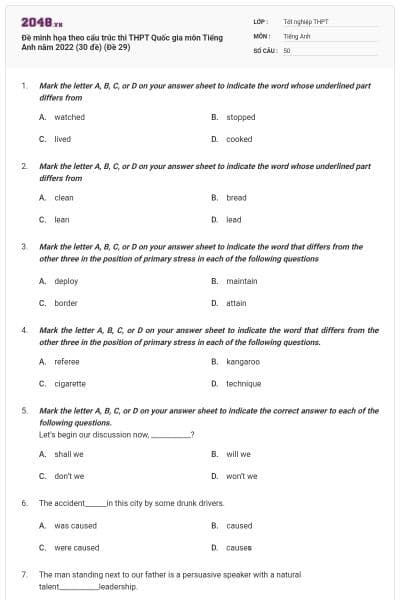
Kỳ thi thử thpt quốc gia lần 1 năm 2019 môn Tiếng Anh cực hay có lời giải(Đề 11)
64 câu hỏi
experienced
worked
watched
arrived
Đáp án : D
A. /t/ B. /t/ C. /t/ D. /d/
bought
caught
ought
laughed
Đáp án : D
A. /ɔ:/ B. /ɔ:/ C. /ɔ:/ D. /ʌ/
suspicious
popular
easily seen
beautiful
Đáp án : C
“noticeble” (adj) = “easily seen”: dễ nhận thấy, rõ rệt
read
translate
display
consider
Đáp án : D
“regard…as” = “consider…as”: coi như, xem như là…
in a similar take
in a similar find
in a similar situation
in a similar case
Đáp án : C
“in the same boat” = “in a similar situation”: cùng cảnh ngộ, cùng trong một tình cảnh, câu này giống nghĩa như câu nói “cùng hội cùng thuyền” trong tiếng Việt.
By listening to explanations from skilled people
By making mistakes and having them corrected
By asking a great many questions
By copying what other people do
Đáp án : D
Thông tin: “children learn all the other things they learn to do without being taught – to talk, run, climb, whistle, ride a bicycle – compare their own performances with those of more skilled people, and slowly make the needed changes.”
Chúng sẽ so sánh bản thân với những người giỏi hơn, để từ đó có những thay đổi cần thiết cho bản thân
basically the same as learning other skills
more important than other skills
basically different from learning adult skills
not really important skills
Đáp án : A
Các hoạt động “to talk, run, climb, whistle, ride a bicycle” đều được đánh giá giống như học các kỹ năng khác
other people
their own work
children
a child
Đáp án : D
“He” được thay thế cho từ “A child” ở câu thứ 2: “A child learning to talk does not learn by being corrected all the time.”
They encourage children to copy from one another
They point out children’s mistakes to them
They allow children to mark their own work
They give children correct answers
Đáp án : B
Thông tin ở câu: “in school we never give a child a chance to find out his mistakes for himself, let alone correct them.” Giáo viên thường chỉ ra những sai sót cho trẻ, đây là điều tác giả nghĩ giáo viên không nên làm

Học thông minh hơn mỗi ngày
Xem toàn bộ 64 câu hỏi và nhiều hơn nữa với tài khoản miễn phí
skills
things
performances
changes
Đáp án : C
“those” được thay thế cho từ “performances” trong cụm “their own performances” ở phía trước
Talking, climbing and whistling
Reading, talking and hearing
Running, walking and playing
Talking, running and skiing
Đáp án : A
Thông tin ở câu: “they learn to do without being taught – to talk, run, climb, whistle, ride a bicycle”. Đáp án là: “Talking, climbing and whistling”
parents
the children themselves
teachers
educated persons
Đáp án : B
Thông tin ở cuối đoạn 2: “let the children learn what all educated persons must someday learn, how to measure their own understanding, how to know what they know or do not know.” Quá trình của trẻ nên được đánh giá bởi chính bản thân chúng
comfortable
competitive
complex
compliment
Đáp án : C
“complicated” = “complex” (adj): phức tạp, rắc rối
dramatic
imperative
important
necessarily
Đáp án : C
“essential” = “important” (adj): quan trọng, thiết yếu, cần thiết
Thật ra, “essential” cũng đồng nghĩa với “necessary”, nhưng đáp án D lại là một trạng từ “necessarily” nên không thể chọn D
unable to think for themselves
too independent of others
unable to use basic skills
too critical of themselves
Đáp án : A
Đây là ý rút ra từ toàn bộ bài đọc. Tác giả sợ rằng, trẻ sẽ trở thành người mà không thể nghĩ cho bản thân, vì cứ được người lớn chỉ ra những sai sót và dạy cách sửa…Trẻ không tự mình làm được mọi việc. Tác giả đã đề cập: “let the children learn what all educated persons must someday learn, how to measure their own understanding, how to know what they know or do not know.” Hãy để trẻ tự suy nghĩ cho bản thân và làm mọi việc
recommend
fortunately
entertain
disappear
Đáp án : B
Phần B trọng âm rơi vào âm tiết thứ nhất, còn lại là thứ 3
survive
fashionable
palace
memory
Đáp án : A
Phần A trọng âm rơi vào âm tiết thứ 2, còn lại là thứ nhất
telephone
question
impossible
beautiful
Đáp án : C
Phần C trọng âm rơi vào âm tiết thứ 2, còn lại là thứ nhất
What I told her
were
to
most of
Đáp án : B
“were” -> “was”. Chủ ngữ trong câu này là “What I told her” – là danh từ số ít, vì thế chia động từ to be là “was”
about average
with
other students
the
Đáp án : D
“other students” -> other students’ (thêm dấu sở hữu cách) hoặc “those of other students”. Đối tượng so sánh ở đây không phải là Jack với những học sinh khác, mà là thành tích/sự biểu diễn của Jack với thành tích/sự biểu diễn của những học sinh khác.
common
not
but
and wax
Đáp án : A
“common” -> “commonly”. Phía trước có động từ tobe, phía sau có động từ dạng phân từ II, nên Ở đây ta cần một trạng từ
too
that
to camp
overnight
Đáp án : A
“too” -> “so”. Cấu trúc “so..that” (cấu trúc nhấn mạnh): …đến mức mà…: Họ mệt đến mức phải tìm nơi cắm trại nghỉ qua đêm
that
are contributing
services
to
Đáp án : A
“that” -> which. “that” không bao giờ được dùng sau dấu phảy. “which” thay thế cho cả vế phía trước dấu phảy
whose
whom
that
B and C are correct
Đáp án : B
“whom” được thay thế cho “My relative”. “whom” được thay thế cho tân ngữ, vì câu này có thể hiểu “you met My relative yesterday” (My relative đóng vai trò là tân ngữ)
"that" không bao giờ đứng sau dấu phảy, vì thế không thể chọn C hay D
would ring
rang
had rung
was ringing
Đáp án : C
“when” ở đây được dịch là “thì”. Tôi bấm chuông 3 lần thì anh ta mới trả lời. Hành động bấm chuông xảy ra trước, vì thế ta chia ở thì quá khứ hoàn thành: ‘had rung’
would be
would have been
will be
wouldn’t be
Đáp án : B
Câu điều kiện loại 3, vế sau được chia theo cấu trúc “would/could/…+have+quá khứ phân từ II”
are going to go
will be going
would go
went
Đáp án : D
Cấu trúc “it’s time/ it’s high time + S + did something” : đến lúc ai làm việc gì
to be telling
telling
to tell
to have told
Đáp án : B
Cấu trúc “regret” + doing something: hối hận, hối tiếc làm gì
cut
set
take
break
Đáp án : A
“cut off”: cắt nguồn cung cấp, chặn đứt
nothing we couldn’t do
anything we could do
nothing we could do
something could do
Đáp án : C
“There was nothing we could do”: Chúng ta không thể làm gì được cả. Câu này mang nghĩa phủ định, vì thế không thể dùng “anything we could do” hay “something could do” hoặc “nothing we couldn’t do” vì chúng đều có nghĩa khẳng định
do you know
you will know
you know
will you know
Đáp án : D
Đảo ngữ với “Only when”, đảo “will” lên trước, sau đó đến chủ ngữ, rồi đến động từ
although
as long as
or else
despite
Đáp án : B
“as long as”: miễn là. Bạn có thể đi nơi nào bạn muốn miễn là phải trở lại trước khi trời tối
included
collected
enclosed
composed
Đáp án : A
“include”: bao gồm, ở đây chúng ta chia bị động với “are included”: được bao gồm, các loại phí này được bao gồm trong giá của chuyến nghỉ này
round
through
forward
after
Đáp án : C
Cấu trúc “look forward to” + doing something: mong đợi, mong ngóng làm gì
Sure, take your time
Let’s discuss that some time
Don’t change your mind, please
The party begins at 2 pm
Đáp án : A
“Sure, take your time.”: Chắc chắn rồi, cứ từ từ. Ở đây có thể hiểu là “take your time to change clothes”
glow
beam
ray
shine
Đáp án : A
“glow of satisfaction” : sự hài lòng, sự thoả mãn
appoint
appointing
appointed
appointment
Đáp án : D
Phía trước có mạo từ “an” và tính từ “ early” nên ở đây ta cần một danh từ. Đáp án “appointment”
part
majority
mass
number
Đáp án : D
“A number of” +…: Một số lượng (của cái gì)
a few
little
few
a little
Đáp án : B
“fuel” là danh từ không đếm được, vì thế, phải dùng “little” hoặc “a little”.
“a little” là nghĩa là ít, nhưng vẫn có thể đủ dùng
“little” là ít, dường như không đủ dùng
Vì thế, phía sau mới có câu: “Therefore, we had to stop midway to fill some”
will we
shall we
shouldn't we
should we
Đáp án : B
Nếu phía trước có “Let’s…” thì câu hỏi đuôi chắc chắn luôn là “shall we?”
hasn’t wasted
hadn't wasted
wouldn’t waste
didn’t waste
Đáp án : C
“wish” + “would/wouldn’t do something” :ước tương lai sẽ làm/không làm gì
Yes, I don’t
No, I do. I like it a lot
It’s nice
Yes, I love it
Đáp án : D
Trong tiếng anh, Yes là đồng ý, phía sau là một câu khẳng định, No cũng tương tự, khác với văn nói của tiếng Việt.
Vì thế, đáp án A và B là sai, Đáp án đúng là D “Yes, I love it”
The movement of glaciers
Icebergs as a source of fresh water
Future water shortages
The future of the world's rivers
Đáp án : B
Đoạn văn nói về icebergs như một nguồn nước sạch, trong đoạn 1 có “obtaining fresh water from iceberg…”, đoạn 2 có “Three-quarters of the Earth's fresh water supply…”, đoạn cuối có “the water they could provide….”
Cách tạo ra icebergs, hướng trôi của icebergs,… cũng được nhắc đến trong bài
anhydrous
fruitful
remote
distant
Đáp án : A
“arid” =” anhydrous”: khô cằn, khô khan (đất, khí hậu)
an iceberg that is towed
obtaining fresh water from icebergs
the population of arid areas
real life
Đáp án : B
“it” được thay thế cho “obtaining fresh water from iceberg” trong câu: “The concept of obtaining fresh water from iceberg that is towed to populated areas and arid regions of the world was once treated as a joke more appropriate to cartoons than real life.”
oceans
rivers
glaciers
reservoirs
Đáp án : C
Thông tin ở câu cuối đoạn 1: “Glaciers are a possible source of fresh water that has been overlooked until recently.”
pulls
waves
weather
flows of water
Đáp án : D
“currents” = “flows of water”: dòng, luồng chảy của nước
They break off from glaciers
Seawater freezes
Rivers freeze
Small pieces of floating ice converge
Đáp án : A
Thông tin ở đoạn 3: “Icebergs are not like sea ice, which is formed when the sea itself freezes; rather, they are formed entirely on land, breaking off when glaciers spread over the sea.”
Towing icebergs to dry areas is economically possible
Desalination of water is the best way to obtain drinking water
Using water from icebergs is a very short-term solution to water shortages
Icebergs could not be towed very far before they would melt
Đáp án : A
Thông tin: “As they drift away from the polar region, icebergs sometimes move mysteriously in a direction opposite to the wind, pulled by subsurface currents.” Vì thế, icebergs hoàn toàn có thể trôi đến những vùng khô cằn hơn
(A)
(B)
(C)
(D)
Đáp án : C
Phía trước đề cập đến thực tế về sự trôi nổi của icebergs: “Because they melt more slowly than smaller pieces of ice, icebergs have been known to drift as far north as 35 degrees south of the equator in the Atlantic Ocean.” Vì thế Câu in đậm phù hợp nhất khi được nối tiếp ở đây
the volume
the water
the iceberg
the towing
Đáp án : B
“that” được thay thế cho “the water” trong câu “the water they could provide would be far cheaper ..”
The prevention of rapid melting iceberg
The filtering water and the funneling it to shore in a large amount
The purifying the fresh water and carrying it to shore
The prevention of rapid melting and the funneling to shore in great volume
Đáp án : D
Thông tin ở câu đầu tiên đoạn cuối: “The difficulty arises in other technical matters, such as the prevention of rapid melting in warmer climates and the funneling of fresh water to shore in great volume.”
willing
keen
eager
enthusiastic
Đáp án : C
“eager for something” hoặc “eager to do something”: háo hức, mong đợi về cái gì
found out
came across
dealt with
reached
Đáp án : B
“come across”: gặp tình cờ
as
same as
such as
like
Đáp án : A
“see” somebody/something as…: nhìn nhận ai/cái gì như…
By
At
On
In
Đáp án : A
“see” somebody/something as…: nhìn nhận ai/cái gì như…
very
quite
far
so
Đáp án : C
“far/much more” dùng để nhấn mạnh hơn khi so sánh
experience
skills
qualities
qualifications
Đáp án : A
“camping experience”: kinh nghiệm về cắm trại, vế sau có đề cập “as I used to go camping with my dog on my school holidays.”
investigating
detecting
researching
exploring
Đáp án : D
“explore” :khám phá. “spend” +doing something, vì thế nên ta chọn “exploring”
watching
looking
noticing
observing
Đáp án : B
“look at”: quan sát, nhìn, không chọn “observe” hay “watch” vì 2 từ này không có giới từ đi kèm, “notice” thì không phù hợp về nghĩa
sets
swarms
bunches
flocks
Đáp án : D
“bird” đi với danh từ chỉ số lượng là “flock”: đàn
fly
flying
flew
flight
Đáp án : C
Động từ fly được chia quá khứ “flew”, vì phía trước có “disappeared” (dạng quá khứ)
remain unstable
fluctuate
restrain
stay unchanged
Đáp án : D
“vary”(v): thay đổi, biến đổi. Trái nghĩa là “stay unchanged” (giữ nguyên)
clear
obvious
insignificant
thin
Đáp án : C
“huge” (adj): to lớn, vĩ đại, trái nghĩa là “insignificant” (không đáng kể, tầm thường)
Bạn có thích hoạt động này không?
Hãy lưu hoặc chia sẻ nội dung này đến mọi người.
Gợi ý cho bạn

Ý tưởng của bạn, bài học của bạn
Tự thiết kế đề thi, bài giảng hoặc flashcard theo cách riêng.



Học liệu phổ biến Tốt nghiệp THPT
Tốt nghiệp THPT
Bài tập vừa sức, đúng lớp
Chọn nội dung phù hợp và tạo hoạt động cho lớp của bạn.