Kỳ thi thử thpt quốc gia lần 1 năm 2019 môn Tiếng Anh cực hay có lời giải(Đề 10)
64 câu hỏi
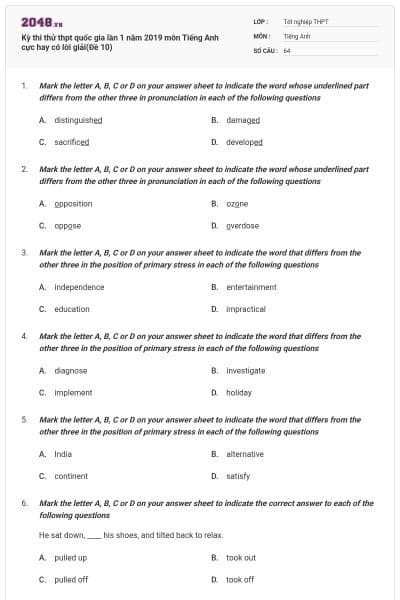
Mark the letter A, B, C or D on your answer sheet to indicate the word whose underlined part differs from the other three in pronunciation in each of the following questions
distinguished
damaged
sacrificed
developed
Đáp án : B
A./t/ B./d/ C./t/ D./t/
Mark the letter A, B, C or D on your answer sheet to indicate the word whose underlined part differs from the other three in pronunciation in each of the following questions
opposition
ozone
oppose
overdose
Đáp án : A
A./ɒ/ B./əʊ/ C. /əʊ/ D. /əʊ/
Mark the letter A, B, C or D on your answer sheet to indicate the word that differs from the other three in the position of primary stress in each of the following questions
independence
entertainment
education
impractical
Đáp án : D
Phần D trọng âm ở âm tiết thứ 2, còn lại là thứ 3
Mark the letter A, B, C or D on your answer sheet to indicate the word that differs from the other three in the position of primary stress in each of the following questions
diagnose
investigate
implement
holiday
Đáp án : B
Phần B trọng âm ở âm tiết thứ 2, còn lại là thứ nhất
Mark the letter A, B, C or D on your answer sheet to indicate the word that differs from the other three in the position of primary stress in each of the following questions
India
alternative
continent
satisfy
Đáp án : B
Phần B trọng âm ở âm tiết thứ 2, còn lại là thứ nhất
Mark the letter A, B, C or D on your answer sheet to indicate the correct answer to each of the following questions
He sat down, ____ his shoes, and tilted back to relax.
pulled up
took out
pulled off
took off
Đáp án : D
“take off something/take something off”: cởi bỏ cái gì
Mark the letter A, B, C or D on your answer sheet to indicate the correct answer to each of the following questions
Microwaves are used for cooking, telecommunications, and ___.
medical diagnosing
medical diagnosis
diagnosed medically
to diagnose medically
Đáp án : B
Phía trước có xuất hiện “cooking, telecommunications” là những danh từ, vì thế ở đây cũng cần 1 danh từ. “diagnosis” là danh từ, “medical” là tính từ bổ nghĩa
Mark the letter A, B, C or D on your answer sheet to indicate the correct answer to each of the following questions
I couldn’t ____ them when we climbed the mountain.
keep out of
keep on with
keep up with
keep away from
Đáp án : C
“keep up with somebody”: đuổi kịp ai
Mark the letter A, B, C or D on your answer sheet to indicate the correct answer to each of the following questions
The director retired early ____ ill-health.
on behalf of
in front of
on account of
ahead of
Đáp án : C
“on account of” = “because of” : bởi vì (+noun/noun phrase)
Mark the letter A, B, C or D on your answer sheet to indicate the correct answer to each of the following questions
Mary cannot afford tuition ____ for studying abroad.
finance
fine
fee
pension
Đáp án : C
“fee”: học phí, lệ phí
“finance”: tài chính
“fine”: tiền phạt
“pension”: tiền lương hưu, tiền trợ cấp
Mark the letter A, B, C or D on your answer sheet to indicate the correct answer to each of the following questions
The disappearance of one or several species may result in the loss of ___.
biodiversity
biochemistry
biography
biology
Đáp án : A
Phía trước có đề cập đến “species” vì thế phía sau sẽ nói về “biodiversity” (đa dạng sinh học)
Mark the letter A, B, C or D on your answer sheet to indicate the correct answer to each of the following questions
She won the award for ____ her whole life to looking after the poor.
causing
attracting
paying
devoting
Đáp án: D
Giải thích:
cause (v): gây ra
attract (v): thu hút
pay (v): chi trả
devote (v): cống hiến
Cấu trúc “devote one’s time to doing something”: cống hiến thời gian để làm việc gì
Dựa vào nghĩa, chọn D.
Dịch: Bà ấy đã giành được giải thưởng vì đã cống hiến cả cuộc đời mình để chăm sóc người nghèo.
Mark the letter A, B, C or D on your answer sheet to indicate the correct answer to each of the following questions
It seems impossible to ____ terrorism in the world.
put stop to
stop at
put an end to
put an end of
Đáp án : C
Cụm “put an end to something/doing something”: chấm dứt, kết thúc cái gì/làm việc gì
Mark the letter A, B, C or D on your answer sheet to indicate the correct answer to each of the following questions
Many organizations have been set up and funds have been ____.
risen
bought
raised
raise
Đáp án : C
Cụm “put an end to something/doing something”: chấm dứt, kết thúc cái gì/làm việc gì
Mark the letter A, B, C or D on your answer sheet to indicate the correct answer to each of the following questions
What university will you take an _____ examination into?
attendance
entry
entrance
admission
Đáp án : C
“entrance examination”: kỳ thi đầu vào
Mark the letter A, B, C or D on your answer sheet to indicate the correct answer to each of the following questions
A: “I regret ____ so much trouble.” - B: “Well. Let’s forget all about that.”
to have caused
caused
to cause
having caused
Đáp án : D
Cấu trúc “regret + doing something”: hối hận, hối tiếc làm gì
Mark the letter A, B, C or D on your answer sheet to indicate the correct answer to each of the following questions
I wish I ____ the party last night so early.
don't leave
didn't leave
haven't leave
hadn't left
Đáp án : D
“wish + thì quá khứ phân từ” dùng để thể hiện mong ước về 1 việc trong quá khứ
Mark the letter A, B, C or D on your answer sheet to indicate the correct answer to each of the following questions
They ____ great difficulty saving up money for a house.
achieved
incurred
found
had
Đáp án : D
Cấu trúc “have difficulty (in) doing something”: gặp khó khăn trong việc làm gì
Mark the letter A, B, C or D on your answer sheet to indicate the correct answer to each of the following questions
A: “Would you like to have dinner with me?” - B: “_____”.
Yes, it is
Yes, so do I
Yes, I'd love to
I'm very happy
Đáp án : C
Lời đáp khá quen thuộc khi nhận được lời mời/lời gợi ý: “Yes, I’d love to”
Mark the letter A, B, C or D on your answer sheet to indicate the correct answer to each of the following questions
He wanted to know where _____.
I had been
had I been
did I been
I been going
Đáp án : A
Đây là câu tương tự như câu gián tiếp, thì quá khứ chuyển thành thì quá khứ hoàn thành (had been), ở đây không dùng “had I been” vì đây không phải câu hỏi, cũng không phải câu đảo ngữ, đơn giản là một câu trần thuật khẳng định
Mark the letter A, B, C or D on your answer sheet to indicate the correct answer to each of the following questions
“No parking.” _ This sign means ______.
There’s not enough space for parking here
You can’t go to the park here
There is no park here.
You are not allowed to park your car here
Đáp án : D
“No parking.” = “You are not allowed to park your car here”: Không được đỗ xe tại đây. “park” danh từ là công viên, động từ là đỗ xe
Mark the letter A, B, C or D on your answer sheet to indicate the correct answer to each of the following questions
Minh and Cuong were badly injured in the last match, so ____ can play in this match.
none of them
neither of them
either of them
both of them
Đáp án : B
“neither of them”: không ai trong số họ (trong số 2 người)
ở đây chọn “neither of them” mà không chọn “none of them” vì “neither” dùng với 2 chủ thể (Minh and Cuong), “none of them” cũng đúng nhưng chính xác hơn là “neither of them”
Mark the letter A, B, C or D on your answer sheet to indicate the correct answer to each of the following questions
A: “Would you mind opening the door?” B: “_____”
Yes, certainly
No, thanks
Not at all
Yes, of course
Đáp án : C
Nếu trả lời là Yes, người ta sẽ hiểu là người được hỏi cảm thấy phiền (mind), vì thế đáp án là “Not at all” (Không sao/Không phiền gì cả)
Mark the letter A, B, C or D on your answer sheet to indicate the correct answer to each of the following questions
It was raining, _____ we cancelled the trip to the beach.
so
although
but
because
Đáp án : A
Nguyên nhân – kết quả: Trời mưa, nên (so) chúng tôi huỷ chuyến đi biển
Mark the letter A, B, C or D on your answer sheet to indicate the correct answer to each of the following questions
That science book ____ again and again.
is worthy reading
is worth to read
is worth reading
is worth being read
Đáp án : C
Cấu trúc “to be worth doing”: đáng/có giá trị trong việc làm gì
Mark the letter A, B, C or D on your answer sheet to indicate the word(s) CLOSEST in meaning to the underlined word(s) in each of the following questions
The trouble with Frank is that he never turns up on time for the meeting.
tests
arrives
delays
takes after
Đáp án: B
Giải thích:
Kiến thức: Từ vựng
turn up: xuất hiện, tới
Xét các đáp án:
test (v): kiểm tra
arrive (v): đến
delay (v): dời lịch, hoãn
take after (v): giống (ai về ngoại hình)
Dựa vào nghĩa, chọn B.
Dịch: Vấn đề với Frank là anh ấy không bao giờ đến đúng giờ trong một cuộc họp.
Mark the letter A, B, C or D on your answer sheet to indicate the word(s) CLOSEST in meaning to the underlined word(s) in each of the following questions
Childbearing is the women’s most wonderful role.
having no child
educating a child
bring up a child
giving birth to a baby
Đáp án : D
“childbearing” = “give birth to a baby” : sinh con
Mark the letter A, B, C or D on your answer sheet to indicate the word(s) CLOSEST in meaning to the underlined word(s) in each of the following questions
He was one of the most outstanding performers at the live show last night
impressive
well-known
easy-looking
important
Đáp án : A
“outstanding” = “impressive”: nổi bật, ấn tượng
Mark the letter A, B, C or D on your answer sheet to indicate the word(s) CLOSEST in meaning to the underlined word(s) in each of the following questions
The 1923 earthquake in Japan killed about 200,000 people and left countless wounded and homeless.
imprisoned
injured
poor
suffered
Đáp án: B
Giải thích:
Kiến thức: Từ vựng – Từ đồng nghĩa
wounded: bị thương
Xét các đáp án:
A. imprisoned: bị cầm tù
B. injured: bị thương
C. poor: nghèo
D. suffered: đau khổ
→ wounded = injured
Dịch: Trận động đất năm 1923 ở Nhật Bản đã giết chết khoảng 200.000 người và khiến vô số người bị thương và mất nhà cửa.
Mark the letter A, B, C or D on your answer sheet to indicate the word(s) CLOSEST in meaning to the underlined word(s) in each of the following questions
The Red Cross gives medical aid and other help to victims of major disasters such as floods, earthquakes, epidemics and famines.
shortage of water
serious droughts
serious shortage of food
poverty
Đáp án : C
“famine” = “serious shortage of food”: nạn đói, thiếu đồ ăn trầm trọng
Mark the letter A, B, C or D on your answer sheet to indicate the underlined part that needs correction in each of the following questions
Sharks can detect (A) minute electrical (B) discharges coming (C) from its prey. (D)
can detect
electrical
coming
its prey
Đáp án : D
Đáp án D “its prey” -> “their prey” vì chủ ngữ là “Sharks” (số nhiều)
Mark the letter A, B, C or D on your answer sheet to indicate the underlined part that needs correction in each of the following questions
Sydney Laniar achieved (A) fame both as a (B) poet or (C) a symphony musician. (D)
achieved
as a
or
musician
Đáp án : C
“or” -> “and” . “both something and something”: cả 2 cái gì đó
Mark the letter A, B, C or D on your answer sheet to indicate the underlined part that needs correction in each of the following questions
Ceramic can be harder, light (A), and more resistant (B) to heat (C) than metals. (D)
light
resistant
heat
metals
Đáp án : A
“light” -> “lighter”. Các tính từ phía trước và phía sau đều được chia trong trạng so sánh, vì thế phải sửa thành lighter
Mark the letter A, B, C or D on your answer sheet to indicate the underlined part that needs correction in each of the following questions
Mold is extremely (A) destruction (B) to books (C) in a library. (D)
extremely
destruction
books
a library
Đáp án : B
“destruction” - > “destructive”, phía trước có động từ to be và trạng từ, vì thế ở đây ta cần một tính từ (destructive)
Read the following passage and mark the letter A, B, C or D on your answer sheet to indicate the correct answer to each of the questions.
Geographers say that what defines a place are four properties: soil, climate, altitude, and aspect, or attitude to the Sun. Florida’s ancient scrub demonstrates this principle. Its soil is pure silica, so barren it supports only lichens as ground cover. (It does, however, sustain a sand- swimming lizard that cannot live where there is moisture or plant matter the soil.) Its climate, despite more than 50 inches of annual rainfall, is blistering desert plant life it can sustain is only the xerophytic, the quintessentially dry. Its altitude is a mere couple of hundred feet, but it is high ground on a peninsula elsewhere close to sea level, and its drainage is so critical that a difference of inches in elevation can bring major changes in its plant communities. Its aspect is flat, direct, brutal – and subtropical. Florida’s surrounding lushness cannot impinge on its desert scrubbiness.
This does not sound like an attractive place. It does not look much like one either; Shrubby little oaks, clumps of scraggly bushes, prickly pear, thorns, and tangles. “It appear Said one early naturalist,” to desire to display the result of the misery through which it has Passed and is passing.” By our narrow standards, scrub is not beautiful; neither does it meet our selfish utilitarian needs. Even the name is an epithet, a synonym for the stunted, the scruffy, the insignificant, what is beautiful about such a place?
The most important remaining patches of scrub lie along the Lake Wales Ridge, a chain of paleoislands running for a hundred miles down the center of Florida, in most places less than ten miles wide. It is relict seashore, tossed up millions of years ago when ocean levels were higher and the rest of the peninsula was submerged. That ancient emergence is precisely what makes Lake Wales Ridge so precious: it has remained unsubmerged, its ecosystems essentially undisturbed, since the Miocene era. As a result, it has gathered to itself one of the largest collections of rare organisms in the world. Only about 75 plant species survive there, but at least 30 of these are found nowhere else on Earth.
What does the passage mainly discuss?
How geographers define a place
The characteristics of Florida’s ancient scrub
An early naturalist’s opinion of Florida
The history of the Lake Wales Ridge
Đáp án : B
Sau câu mở bài, tác giả đã nhắc đến: “Florida’s ancient scrub demonstrates this principle.” Và các câu và các đoạn tiếp theo đã làm rõ hơn về “The characteristics of Florida’s ancient scrub”
Read the following passage and mark the letter A, B, C or D on your answer sheet to indicate the correct answer to each of the questions.
Geographers say that what defines a place are four properties: soil, climate, altitude, and aspect, or attitude to the Sun. Florida’s ancient scrub demonstrates this principle. Its soil is pure silica, so barren it supports only lichens as ground cover. (It does, however, sustain a sand- swimming lizard that cannot live where there is moisture or plant matter the soil.) Its climate, despite more than 50 inches of annual rainfall, is blistering desert plant life it can sustain is only the xerophytic, the quintessentially dry. Its altitude is a mere couple of hundred feet, but it is high ground on a peninsula elsewhere close to sea level, and its drainage is so critical that a difference of inches in elevation can bring major changes in its plant communities. Its aspect is flat, direct, brutal – and subtropical. Florida’s surrounding lushness cannot impinge on its desert scrubbiness.
This does not sound like an attractive place. It does not look much like one either; Shrubby little oaks, clumps of scraggly bushes, prickly pear, thorns, and tangles. “It appear Said one early naturalist,” to desire to display the result of the misery through which it has Passed and is passing.” By our narrow standards, scrub is not beautiful; neither does it meet our selfish utilitarian needs. Even the name is an epithet, a synonym for the stunted, the scruffy, the insignificant, what is beautiful about such a place?
The most important remaining patches of scrub lie along the Lake Wales Ridge, a chain of paleoislands running for a hundred miles down the center of Florida, in most places less than ten miles wide. It is relict seashore, tossed up millions of years ago when ocean levels were higher and the rest of the peninsula was submerged. That ancient emergence is precisely what makes Lake Wales Ridge so precious: it has remained unsubmerged, its ecosystems essentially undisturbed, since the Miocene era. As a result, it has gathered to itself one of the largest collections of rare organisms in the world. Only about 75 plant species survive there, but at least 30 of these are found nowhere else on Earth.
The author mentions all of the following as factors that define a place EXCEPT ___.
life-forms
aspect
soil
altitude
Đáp án : B
Sau câu mở bài, tác giả đã nhắc đến: “Florida’s ancient scrub demonstrates this principle.” Và các câu và các đoạn tiếp theo đã làm rõ hơn về “The characteristics of Florida’s ancient scrub”
Read the following passage and mark the letter A, B, C or D on your answer sheet to indicate the correct answer to each of the questions.
Geographers say that what defines a place are four properties: soil, climate, altitude, and aspect, or attitude to the Sun. Florida’s ancient scrub demonstrates this principle. Its soil is pure silica, so barren it supports only lichens as ground cover. (It does, however, sustain a sand- swimming lizard that cannot live where there is moisture or plant matter the soil.) Its climate, despite more than 50 inches of annual rainfall, is blistering desert plant life it can sustain is only the xerophytic, the quintessentially dry. Its altitude is a mere couple of hundred feet, but it is high ground on a peninsula elsewhere close to sea level, and its drainage is so critical that a difference of inches in elevation can bring major changes in its plant communities. Its aspect is flat, direct, brutal – and subtropical. Florida’s surrounding lushness cannot impinge on its desert scrubbiness.
This does not sound like an attractive place. It does not look much like one either; Shrubby little oaks, clumps of scraggly bushes, prickly pear, thorns, and tangles. “It appear Said one early naturalist,” to desire to display the result of the misery through which it has Passed and is passing.” By our narrow standards, scrub is not beautiful; neither does it meet our selfish utilitarian needs. Even the name is an epithet, a synonym for the stunted, the scruffy, the insignificant, what is beautiful about such a place?
The most important remaining patches of scrub lie along the Lake Wales Ridge, a chain of paleoislands running for a hundred miles down the center of Florida, in most places less than ten miles wide. It is relict seashore, tossed up millions of years ago when ocean levels were higher and the rest of the peninsula was submerged. That ancient emergence is precisely what makes Lake Wales Ridge so precious: it has remained unsubmerged, its ecosystems essentially undisturbed, since the Miocene era. As a result, it has gathered to itself one of the largest collections of rare organisms in the world. Only about 75 plant species survive there, but at least 30 of these are found nowhere else on Earth.
It can be inferred from the passage that soil composed of silica _________.
provides food for many kinds of lizards
is found only in Florida
nourishes many kinds of ground cover
does not hold moisture
Đáp án : D
Thông tin ở câu: “It does, however, sustain a sand- swimming lizard that cannot live where there is moisture or plant matter the soil.”
Read the following passage and mark the letter A, B, C or D on your answer sheet to indicate the correct answer to each of the questions.
Geographers say that what defines a place are four properties: soil, climate, altitude, and aspect, or attitude to the Sun. Florida’s ancient scrub demonstrates this principle. Its soil is pure silica, so barren it supports only lichens as ground cover. (It does, however, sustain a sand- swimming lizard that cannot live where there is moisture or plant matter the soil.) Its climate, despite more than 50 inches of annual rainfall, is blistering desert plant life it can sustain is only the xerophytic, the quintessentially dry. Its altitude is a mere couple of hundred feet, but it is high ground on a peninsula elsewhere close to sea level, and its drainage is so critical that a difference of inches in elevation can bring major changes in its plant communities. Its aspect is flat, direct, brutal – and subtropical. Florida’s surrounding lushness cannot impinge on its desert scrubbiness.
This does not sound like an attractive place. It does not look much like one either; Shrubby little oaks, clumps of scraggly bushes, prickly pear, thorns, and tangles. “It appear Said one early naturalist,” to desire to display the result of the misery through which it has Passed and is passing.” By our narrow standards, scrub is not beautiful; neither does it meet our selfish utilitarian needs. Even the name is an epithet, a synonym for the stunted, the scruffy, the insignificant, what is beautiful about such a place?
The most important remaining patches of scrub lie along the Lake Wales Ridge, a chain of paleoislands running for a hundred miles down the center of Florida, in most places less than ten miles wide. It is relict seashore, tossed up millions of years ago when ocean levels were higher and the rest of the peninsula was submerged. That ancient emergence is precisely what makes Lake Wales Ridge so precious: it has remained unsubmerged, its ecosystems essentially undisturbed, since the Miocene era. As a result, it has gathered to itself one of the largest collections of rare organisms in the world. Only about 75 plant species survive there, but at least 30 of these are found nowhere else on Earth.
The word “sustain” in line 5 is closets in meaning to _______.
support
select
store
stain
Đáp án : A
“sustain” = “support”: nâng đỡ, chống đỡ, duy trì
Read the following passage and mark the letter A, B, C or D on your answer sheet to indicate the correct answer to each of the questions.
Geographers say that what defines a place are four properties: soil, climate, altitude, and aspect, or attitude to the Sun. Florida’s ancient scrub demonstrates this principle. Its soil is pure silica, so barren it supports only lichens as ground cover. (It does, however, sustain a sand- swimming lizard that cannot live where there is moisture or plant matter the soil.) Its climate, despite more than 50 inches of annual rainfall, is blistering desert plant life it can sustain is only the xerophytic, the quintessentially dry. Its altitude is a mere couple of hundred feet, but it is high ground on a peninsula elsewhere close to sea level, and its drainage is so critical that a difference of inches in elevation can bring major changes in its plant communities. Its aspect is flat, direct, brutal – and subtropical. Florida’s surrounding lushness cannot impinge on its desert scrubbiness.
This does not sound like an attractive place. It does not look much like one either; Shrubby little oaks, clumps of scraggly bushes, prickly pear, thorns, and tangles. “It appear Said one early naturalist,” to desire to display the result of the misery through which it has Passed and is passing.” By our narrow standards, scrub is not beautiful; neither does it meet our selfish utilitarian needs. Even the name is an epithet, a synonym for the stunted, the scruffy, the insignificant, what is beautiful about such a place?
The most important remaining patches of scrub lie along the Lake Wales Ridge, a chain of paleoislands running for a hundred miles down the center of Florida, in most places less than ten miles wide. It is relict seashore, tossed up millions of years ago when ocean levels were higher and the rest of the peninsula was submerged. That ancient emergence is precisely what makes Lake Wales Ridge so precious: it has remained unsubmerged, its ecosystems essentially undisturbed, since the Miocene era. As a result, it has gathered to itself one of the largest collections of rare organisms in the world. Only about 75 plant species survive there, but at least 30 of these are found nowhere else on Earth.
The author mentions the prickly pear (line 11) as an example of ______.
valuable fruit-bearing plants of the scrub area
unattractive plant life of the scrub area
a pant discovered by an early naturalist
plant life that is extremely are
Đáp án : B
Thông tin ở câu đầu đoạn 2: “This does not sound like an attractive place. It does not look much like one either….”
Read the following passage and mark the letter A, B, C or D on your answer sheet to indicate the correct answer to each of the questions.
Geographers say that what defines a place are four properties: soil, climate, altitude, and aspect, or attitude to the Sun. Florida’s ancient scrub demonstrates this principle. Its soil is pure silica, so barren it supports only lichens as ground cover. (It does, however, sustain a sand- swimming lizard that cannot live where there is moisture or plant matter the soil.) Its climate, despite more than 50 inches of annual rainfall, is blistering desert plant life it can sustain is only the xerophytic, the quintessentially dry. Its altitude is a mere couple of hundred feet, but it is high ground on a peninsula elsewhere close to sea level, and its drainage is so critical that a difference of inches in elevation can bring major changes in its plant communities. Its aspect is flat, direct, brutal – and subtropical. Florida’s surrounding lushness cannot impinge on its desert scrubbiness.
This does not sound like an attractive place. It does not look much like one either; Shrubby little oaks, clumps of scraggly bushes, prickly pear, thorns, and tangles. “It appear Said one early naturalist,” to desire to display the result of the misery through which it has Passed and is passing.” By our narrow standards, scrub is not beautiful; neither does it meet our selfish utilitarian needs. Even the name is an epithet, a synonym for the stunted, the scruffy, the insignificant, what is beautiful about such a place?
The most important remaining patches of scrub lie along the Lake Wales Ridge, a chain of paleoislands running for a hundred miles down the center of Florida, in most places less than ten miles wide. It is relict seashore, tossed up millions of years ago when ocean levels were higher and the rest of the peninsula was submerged. That ancient emergence is precisely what makes Lake Wales Ridge so precious: it has remained unsubmerged, its ecosystems essentially undisturbed, since the Miocene era. As a result, it has gathered to itself one of the largest collections of rare organisms in the world. Only about 75 plant species survive there, but at least 30 of these are found nowhere else on Earth.
The author suggests that human standards of beauty are _______.
idealistic
limited
tolerant
defensible
Đáp án : B
THông tin ở câu thứ 3 đoạn 2: “By our narrow standards, scrub is not beautiful…”
Read the following passage and mark the letter A, B, C or D on your answer sheet to indicate the correct answer to each of the questions.
Geographers say that what defines a place are four properties: soil, climate, altitude, and aspect, or attitude to the Sun. Florida’s ancient scrub demonstrates this principle. Its soil is pure silica, so barren it supports only lichens as ground cover. (It does, however, sustain a sand- swimming lizard that cannot live where there is moisture or plant matter the soil.) Its climate, despite more than 50 inches of annual rainfall, is blistering desert plant life it can sustain is only the xerophytic, the quintessentially dry. Its altitude is a mere couple of hundred feet, but it is high ground on a peninsula elsewhere close to sea level, and its drainage is so critical that a difference of inches in elevation can bring major changes in its plant communities. Its aspect is flat, direct, brutal – and subtropical. Florida’s surrounding lushness cannot impinge on its desert scrubbiness.
This does not sound like an attractive place. It does not look much like one either; Shrubby little oaks, clumps of scraggly bushes, prickly pear, thorns, and tangles. “It appear Said one early naturalist,” to desire to display the result of the misery through which it has Passed and is passing.” By our narrow standards, scrub is not beautiful; neither does it meet our selfish utilitarian needs. Even the name is an epithet, a synonym for the stunted, the scruffy, the insignificant, what is beautiful about such a place?
The most important remaining patches of scrub lie along the Lake Wales Ridge, a chain of paleoislands running for a hundred miles down the center of Florida, in most places less than ten miles wide. It is relict seashore, tossed up millions of years ago when ocean levels were higher and the rest of the peninsula was submerged. That ancient emergence is precisely what makes Lake Wales Ridge so precious: it has remained unsubmerged, its ecosystems essentially undisturbed, since the Miocene era. As a result, it has gathered to itself one of the largest collections of rare organisms in the world. Only about 75 plant species survive there, but at least 30 of these are found nowhere else on Earth.
The word “insignificant” in line 14 is closest in meaning to ?
inappropriate
unimportant
immature
undisturbed
Đáp án : B
“insignificant” = “unimportant”: không đáng kể, không quan trọng, không nổi bật
Read the following passage and mark the letter A, B, C or D on your answer sheet to indicate the correct answer to each of the questions.
Geographers say that what defines a place are four properties: soil, climate, altitude, and aspect, or attitude to the Sun. Florida’s ancient scrub demonstrates this principle. Its soil is pure silica, so barren it supports only lichens as ground cover. (It does, however, sustain a sand- swimming lizard that cannot live where there is moisture or plant matter the soil.) Its climate, despite more than 50 inches of annual rainfall, is blistering desert plant life it can sustain is only the xerophytic, the quintessentially dry. Its altitude is a mere couple of hundred feet, but it is high ground on a peninsula elsewhere close to sea level, and its drainage is so critical that a difference of inches in elevation can bring major changes in its plant communities. Its aspect is flat, direct, brutal – and subtropical. Florida’s surrounding lushness cannot impinge on its desert scrubbiness.
This does not sound like an attractive place. It does not look much like one either; Shrubby little oaks, clumps of scraggly bushes, prickly pear, thorns, and tangles. “It appear Said one early naturalist,” to desire to display the result of the misery through which it has Passed and is passing.” By our narrow standards, scrub is not beautiful; neither does it meet our selfish utilitarian needs. Even the name is an epithet, a synonym for the stunted, the scruffy, the insignificant, what is beautiful about such a place?
The most important remaining patches of scrub lie along the Lake Wales Ridge, a chain of paleoislands running for a hundred miles down the center of Florida, in most places less than ten miles wide. It is relict seashore, tossed up millions of years ago when ocean levels were higher and the rest of the peninsula was submerged. That ancient emergence is precisely what makes Lake Wales Ridge so precious: it has remained unsubmerged, its ecosystems essentially undisturbed, since the Miocene era. As a result, it has gathered to itself one of the largest collections of rare organisms in the world. Only about 75 plant species survive there, but at least 30 of these are found nowhere else on Earth.
According to the passage, why is the Lake Wales Ridge valuable?
It has ecosystems that have long remained unchanged.
It is less than ten miles wide.
It was originally submerged in the ocean.
It is located near the seashore.
Đáp án : A
THông tin ở đoạn số 3: “….it has remained unsubmerged, its ecosystems essentially undisturbed, since the Miocene era.”
Read the following passage and mark the letter A, B, C or D on your answer sheet to indicate the correct answer to each of the questions.
Geographers say that what defines a place are four properties: soil, climate, altitude, and aspect, or attitude to the Sun. Florida’s ancient scrub demonstrates this principle. Its soil is pure silica, so barren it supports only lichens as ground cover. (It does, however, sustain a sand- swimming lizard that cannot live where there is moisture or plant matter the soil.) Its climate, despite more than 50 inches of annual rainfall, is blistering desert plant life it can sustain is only the xerophytic, the quintessentially dry. Its altitude is a mere couple of hundred feet, but it is high ground on a peninsula elsewhere close to sea level, and its drainage is so critical that a difference of inches in elevation can bring major changes in its plant communities. Its aspect is flat, direct, brutal – and subtropical. Florida’s surrounding lushness cannot impinge on its desert scrubbiness.
This does not sound like an attractive place. It does not look much like one either; Shrubby little oaks, clumps of scraggly bushes, prickly pear, thorns, and tangles. “It appear Said one early naturalist,” to desire to display the result of the misery through which it has Passed and is passing.” By our narrow standards, scrub is not beautiful; neither does it meet our selfish utilitarian needs. Even the name is an epithet, a synonym for the stunted, the scruffy, the insignificant, what is beautiful about such a place?
The most important remaining patches of scrub lie along the Lake Wales Ridge, a chain of paleoislands running for a hundred miles down the center of Florida, in most places less than ten miles wide. It is relict seashore, tossed up millions of years ago when ocean levels were higher and the rest of the peninsula was submerged. That ancient emergence is precisely what makes Lake Wales Ridge so precious: it has remained unsubmerged, its ecosystems essentially undisturbed, since the Miocene era. As a result, it has gathered to itself one of the largest collections of rare organisms in the world. Only about 75 plant species survive there, but at least 30 of these are found nowhere else on Earth.
The word “it” in line 21 refer to ______.
the Lake Wales Ridge
the peninsula
Florida
the Miocene era
Đáp án : B
“it” thay thế cho “the peninsula” trong câu: “It is relict seashore, tossed up millions of years ago when ocean levels were higher and the rest of the peninsula was submerged.”
Read the following passage and mark the letter A, B, C or D on your answer sheet to indicate the correct answer to each of the questions.
Geographers say that what defines a place are four properties: soil, climate, altitude, and aspect, or attitude to the Sun. Florida’s ancient scrub demonstrates this principle. Its soil is pure silica, so barren it supports only lichens as ground cover. (It does, however, sustain a sand- swimming lizard that cannot live where there is moisture or plant matter the soil.) Its climate, despite more than 50 inches of annual rainfall, is blistering desert plant life it can sustain is only the xerophytic, the quintessentially dry. Its altitude is a mere couple of hundred feet, but it is high ground on a peninsula elsewhere close to sea level, and its drainage is so critical that a difference of inches in elevation can bring major changes in its plant communities. Its aspect is flat, direct, brutal – and subtropical. Florida’s surrounding lushness cannot impinge on its desert scrubbiness.
This does not sound like an attractive place. It does not look much like one either; Shrubby little oaks, clumps of scraggly bushes, prickly pear, thorns, and tangles. “It appear Said one early naturalist,” to desire to display the result of the misery through which it has Passed and is passing.” By our narrow standards, scrub is not beautiful; neither does it meet our selfish utilitarian needs. Even the name is an epithet, a synonym for the stunted, the scruffy, the insignificant, what is beautiful about such a place?
The most important remaining patches of scrub lie along the Lake Wales Ridge, a chain of paleoislands running for a hundred miles down the center of Florida, in most places less than ten miles wide. It is relict seashore, tossed up millions of years ago when ocean levels were higher and the rest of the peninsula was submerged. That ancient emergence is precisely what makes Lake Wales Ridge so precious: it has remained unsubmerged, its ecosystems essentially undisturbed, since the Miocene era. As a result, it has gathered to itself one of the largest collections of rare organisms in the world. Only about 75 plant species survive there, but at least 30 of these are found nowhere else on Earth.
The passage probably continues with a discussion of _______.
the unique plants found on the Lake Wales
geographers who study Florida’s scrub
the climate of the Lake Wales Ridge
ancient scrub found in other areas of the country
Đáp án : A
Cuối đoạn văn là câu: “Only about 75 plant species survive there, but at least 30 of these are found nowhere else on Earth.” Vì thế có thể đoạn sau này sẽ nói về: “the unique plants found on the Lake Wales”
Read the following passage and mark the letter A, B, C or D on your answer sheet to indicate the correct answer to each of the questions
Most people can remember a phone number for up to thirty seconds. When this short amount of time elapses, however, the numbers are erased from the memory. How did the information get there in the first place? Information that makes its way to the short term memory (STM) does so via the sensory storage area. The brain has a filter which only allows stimuli that is of immediate interest to pass on to the STM, also known as the working memory.
There is much debate about the capacity and duration of the short term memory. The most accepted theory comes from George A. Miller, a cognitive psychologist who suggested that humans can remember approximately seven chunks of information. A chunk is defined as a meaningful unit of information, such as a word or name rather than just a letter or number. Modern theorists suggest that one can increase the capacity of the short term memory by chunking, or classifying similar information together. By organizing information, one can optimize the STM, and improve the chances of a memory being passed on to long term storage.
When making a conscious effort to memorize something, such as information for an exam, many people engage in "rote rehearsal". By repeating something over and over again, one is able to keep a memory alive. Unfortunately, this type of memory maintenance only succeeds if there are no interruptions. As soon as a person stops rehearsing the information, it has the tendency to disappear.
When a pen and paper are not handy, people often attempt to remember a phone number by repeating it aloud. If the doorbell rings or the dog barks to come in before a person has the opportunity to make a phone call, he will likely forget the number instantly. Therefore, rote rehearsal is not an efficient way to pass information from the short term to long term memory. A better way is to practice "elaborate rehearsal". This involves assigning semantic meaning to a piece of information so that it can be filed along with other pre-existing long term memories.
Encoding information semantically also makes it more retrievable. Retrieving information can be done by recognition or recall. Humans can easily recall memories that are stored in the long term memory and used often; however, if a memory seems to be forgotten, it may eventually be retrieved by prompting.
The more cues a person is given (such as pictures), the more likely a memory can be retrieved. This is why multiple choice tests are often used for subjects that require a lot of memorization.
According to the passage, how do memories get transferred to the STM?
They are filtered from the sensory storage area.
They revert from the long term memory.
They get chunked when they enter the brain.
They enter via the nervous system.
Đáp án : A
Thông tin ở câu số 4 đoạn 1: “Information that makes its way to the short term memory (STM) does so via the sensory storage area.”
Read the following passage and mark the letter A, B, C or D on your answer sheet to indicate the correct answer to each of the questions
Most people can remember a phone number for up to thirty seconds. When this short amount of time elapses, however, the numbers are erased from the memory. How did the information get there in the first place? Information that makes its way to the short term memory (STM) does so via the sensory storage area. The brain has a filter which only allows stimuli that is of immediate interest to pass on to the STM, also known as the working memory.
There is much debate about the capacity and duration of the short term memory. The most accepted theory comes from George A. Miller, a cognitive psychologist who suggested that humans can remember approximately seven chunks of information. A chunk is defined as a meaningful unit of information, such as a word or name rather than just a letter or number. Modern theorists suggest that one can increase the capacity of the short term memory by chunking, or classifying similar information together. By organizing information, one can optimize the STM, and improve the chances of a memory being passed on to long term storage.
When making a conscious effort to memorize something, such as information for an exam, many people engage in "rote rehearsal". By repeating something over and over again, one is able to keep a memory alive. Unfortunately, this type of memory maintenance only succeeds if there are no interruptions. As soon as a person stops rehearsing the information, it has the tendency to disappear.
When a pen and paper are not handy, people often attempt to remember a phone number by repeating it aloud. If the doorbell rings or the dog barks to come in before a person has the opportunity to make a phone call, he will likely forget the number instantly. Therefore, rote rehearsal is not an efficient way to pass information from the short term to long term memory. A better way is to practice "elaborate rehearsal". This involves assigning semantic meaning to a piece of information so that it can be filed along with other pre-existing long term memories.
Encoding information semantically also makes it more retrievable. Retrieving information can be done by recognition or recall. Humans can easily recall memories that are stored in the long term memory and used often; however, if a memory seems to be forgotten, it may eventually be retrieved by prompting.
The more cues a person is given (such as pictures), the more likely a memory can be retrieved. This is why multiple choice tests are often used for subjects that require a lot of memorization.
The word elapses in paragraph 1 is closest in meaning to:
continues
adds up
passes
appears
Đáp án : C
“elapse” = “pass”: trôi qua (thường nói về thời gian)
Read the following passage and mark the letter A, B, C or D on your answer sheet to indicate the correct answer to each of the questions
Most people can remember a phone number for up to thirty seconds. When this short amount of time elapses, however, the numbers are erased from the memory. How did the information get there in the first place? Information that makes its way to the short term memory (STM) does so via the sensory storage area. The brain has a filter which only allows stimuli that is of immediate interest to pass on to the STM, also known as the working memory.
There is much debate about the capacity and duration of the short term memory. The most accepted theory comes from George A. Miller, a cognitive psychologist who suggested that humans can remember approximately seven chunks of information. A chunk is defined as a meaningful unit of information, such as a word or name rather than just a letter or number. Modern theorists suggest that one can increase the capacity of the short term memory by chunking, or classifying similar information together. By organizing information, one can optimize the STM, and improve the chances of a memory being passed on to long term storage.
When making a conscious effort to memorize something, such as information for an exam, many people engage in "rote rehearsal". By repeating something over and over again, one is able to keep a memory alive. Unfortunately, this type of memory maintenance only succeeds if there are no interruptions. As soon as a person stops rehearsing the information, it has the tendency to disappear.
When a pen and paper are not handy, people often attempt to remember a phone number by repeating it aloud. If the doorbell rings or the dog barks to come in before a person has the opportunity to make a phone call, he will likely forget the number instantly. Therefore, rote rehearsal is not an efficient way to pass information from the short term to long term memory. A better way is to practice "elaborate rehearsal". This involves assigning semantic meaning to a piece of information so that it can be filed along with other pre-existing long term memories.
Encoding information semantically also makes it more retrievable. Retrieving information can be done by recognition or recall. Humans can easily recall memories that are stored in the long term memory and used often; however, if a memory seems to be forgotten, it may eventually be retrieved by prompting.
The more cues a person is given (such as pictures), the more likely a memory can be retrieved. This is why multiple choice tests are often used for subjects that require a lot of memorization.
All of the following are mentioned as places in which memories are stored EXCEPT the_______.
STM
sensory storage area
maintenance area
long term memory
Đáp án : C
“STM”, “sensory storage area” và “long term memory” đều được nhắc đến trong bài:
- Information that makes its way to the short term memory (STM) does so via the sensory storage area. (đoạn 1)
- By organizing information, one can optimize the STM, and improve the chances of a memory being passed on to long term storage. (cuối đoạn 2)
Read the following passage and mark the letter A, B, C or D on your answer sheet to indicate the correct answer to each of the questions
Most people can remember a phone number for up to thirty seconds. When this short amount of time elapses, however, the numbers are erased from the memory. How did the information get there in the first place? Information that makes its way to the short term memory (STM) does so via the sensory storage area. The brain has a filter which only allows stimuli that is of immediate interest to pass on to the STM, also known as the working memory.
There is much debate about the capacity and duration of the short term memory. The most accepted theory comes from George A. Miller, a cognitive psychologist who suggested that humans can remember approximately seven chunks of information. A chunk is defined as a meaningful unit of information, such as a word or name rather than just a letter or number. Modern theorists suggest that one can increase the capacity of the short term memory by chunking, or classifying similar information together. By organizing information, one can optimize the STM, and improve the chances of a memory being passed on to long term storage.
When making a conscious effort to memorize something, such as information for an exam, many people engage in "rote rehearsal". By repeating something over and over again, one is able to keep a memory alive. Unfortunately, this type of memory maintenance only succeeds if there are no interruptions. As soon as a person stops rehearsing the information, it has the tendency to disappear.
When a pen and paper are not handy, people often attempt to remember a phone number by repeating it aloud. If the doorbell rings or the dog barks to come in before a person has the opportunity to make a phone call, he will likely forget the number instantly. Therefore, rote rehearsal is not an efficient way to pass information from the short term to long term memory. A better way is to practice "elaborate rehearsal". This involves assigning semantic meaning to a piece of information so that it can be filed along with other pre-existing long term memories.
Encoding information semantically also makes it more retrievable. Retrieving information can be done by recognition or recall. Humans can easily recall memories that are stored in the long term memory and used often; however, if a memory seems to be forgotten, it may eventually be retrieved by prompting.
The more cues a person is given (such as pictures), the more likely a memory can be retrieved. This is why multiple choice tests are often used for subjects that require a lot of memorization.
Why does the author mention a dog's bark?
To give an example of a type of memory
To provide a type of interruption
To prove that dogs have better memories than humans
To compare another sound that is loud like a doorbell
Đáp án : B
THông tin: “If the doorbell rings or the dog barks to come in before a person has the opportunity to make a phone call, he will likely forget the number instantly.” Tức là: “a type of interruption”
Read the following passage and mark the letter A, B, C or D on your answer sheet to indicate the correct answer to each of the questions
Most people can remember a phone number for up to thirty seconds. When this short amount of time elapses, however, the numbers are erased from the memory. How did the information get there in the first place? Information that makes its way to the short term memory (STM) does so via the sensory storage area. The brain has a filter which only allows stimuli that is of immediate interest to pass on to the STM, also known as the working memory.
There is much debate about the capacity and duration of the short term memory. The most accepted theory comes from George A. Miller, a cognitive psychologist who suggested that humans can remember approximately seven chunks of information. A chunk is defined as a meaningful unit of information, such as a word or name rather than just a letter or number. Modern theorists suggest that one can increase the capacity of the short term memory by chunking, or classifying similar information together. By organizing information, one can optimize the STM, and improve the chances of a memory being passed on to long term storage.
When making a conscious effort to memorize something, such as information for an exam, many people engage in "rote rehearsal". By repeating something over and over again, one is able to keep a memory alive. Unfortunately, this type of memory maintenance only succeeds if there are no interruptions. As soon as a person stops rehearsing the information, it has the tendency to disappear.
When a pen and paper are not handy, people often attempt to remember a phone number by repeating it aloud. If the doorbell rings or the dog barks to come in before a person has the opportunity to make a phone call, he will likely forget the number instantly. Therefore, rote rehearsal is not an efficient way to pass information from the short term to long term memory. A better way is to practice "elaborate rehearsal". This involves assigning semantic meaning to a piece of information so that it can be filed along with other pre-existing long term memories.
Encoding information semantically also makes it more retrievable. Retrieving information can be done by recognition or recall. Humans can easily recall memories that are stored in the long term memory and used often; however, if a memory seems to be forgotten, it may eventually be retrieved by prompting.
The more cues a person is given (such as pictures), the more likely a memory can be retrieved. This is why multiple choice tests are often used for subjects that require a lot of memorization.
How do theorists believe a person can remember more information in a short time?
By repeating it
By drawing it
By organizing it
By giving it a name
Đáp án : C
THông tin ở cuối đoạn 2: “By organizing information, one can optimize the STM, and improve the chances of a memory being passed on to long term storage.”
Read the following passage and mark the letter A, B, C or D on your answer sheet to indicate the correct answer to each of the questions
Most people can remember a phone number for up to thirty seconds. When this short amount of time elapses, however, the numbers are erased from the memory. How did the information get there in the first place? Information that makes its way to the short term memory (STM) does so via the sensory storage area. The brain has a filter which only allows stimuli that is of immediate interest to pass on to the STM, also known as the working memory.
There is much debate about the capacity and duration of the short term memory. The most accepted theory comes from George A. Miller, a cognitive psychologist who suggested that humans can remember approximately seven chunks of information. A chunk is defined as a meaningful unit of information, such as a word or name rather than just a letter or number. Modern theorists suggest that one can increase the capacity of the short term memory by chunking, or classifying similar information together. By organizing information, one can optimize the STM, and improve the chances of a memory being passed on to long term storage.
When making a conscious effort to memorize something, such as information for an exam, many people engage in "rote rehearsal". By repeating something over and over again, one is able to keep a memory alive. Unfortunately, this type of memory maintenance only succeeds if there are no interruptions. As soon as a person stops rehearsing the information, it has the tendency to disappear.
When a pen and paper are not handy, people often attempt to remember a phone number by repeating it aloud. If the doorbell rings or the dog barks to come in before a person has the opportunity to make a phone call, he will likely forget the number instantly. Therefore, rote rehearsal is not an efficient way to pass information from the short term to long term memory. A better way is to practice "elaborate rehearsal". This involves assigning semantic meaning to a piece of information so that it can be filed along with other pre-existing long term memories.
Encoding information semantically also makes it more retrievable. Retrieving information can be done by recognition or recall. Humans can easily recall memories that are stored in the long term memory and used often; however, if a memory seems to be forgotten, it may eventually be retrieved by prompting.
The more cues a person is given (such as pictures), the more likely a memory can be retrieved. This is why multiple choice tests are often used for subjects that require a lot of memorization.
The author believes that rote rotation is________.
more efficient than chunking
an unnecessary interruption
the best way to remember something
ineffective in the long run
Đáp án : A
THông tin:
- many people engage in "rote rehearsal". By repeating something over and over again, one is able to keep a memory alive.
- one can increase the capacity of the short term memory by chunking…
Vì thế có thể thấy “rote rotation” hiệu suất cao hơn “chunking”
Read the following passage and mark the letter A, B, C or D on your answer sheet to indicate the correct answer to each of the questions
Most people can remember a phone number for up to thirty seconds. When this short amount of time elapses, however, the numbers are erased from the memory. How did the information get there in the first place? Information that makes its way to the short term memory (STM) does so via the sensory storage area. The brain has a filter which only allows stimuli that is of immediate interest to pass on to the STM, also known as the working memory.
There is much debate about the capacity and duration of the short term memory. The most accepted theory comes from George A. Miller, a cognitive psychologist who suggested that humans can remember approximately seven chunks of information. A chunk is defined as a meaningful unit of information, such as a word or name rather than just a letter or number. Modern theorists suggest that one can increase the capacity of the short term memory by chunking, or classifying similar information together. By organizing information, one can optimize the STM, and improve the chances of a memory being passed on to long term storage.
When making a conscious effort to memorize something, such as information for an exam, many people engage in "rote rehearsal". By repeating something over and over again, one is able to keep a memory alive. Unfortunately, this type of memory maintenance only succeeds if there are no interruptions. As soon as a person stops rehearsing the information, it has the tendency to disappear.
When a pen and paper are not handy, people often attempt to remember a phone number by repeating it aloud. If the doorbell rings or the dog barks to come in before a person has the opportunity to make a phone call, he will likely forget the number instantly. Therefore, rote rehearsal is not an efficient way to pass information from the short term to long term memory. A better way is to practice "elaborate rehearsal". This involves assigning semantic meaning to a piece of information so that it can be filed along with other pre-existing long term memories.
Encoding information semantically also makes it more retrievable. Retrieving information can be done by recognition or recall. Humans can easily recall memories that are stored in the long term memory and used often; however, if a memory seems to be forgotten, it may eventually be retrieved by prompting.
The more cues a person is given (such as pictures), the more likely a memory can be retrieved. This is why multiple choice tests are often used for subjects that require a lot of memorization.
The word “it” in the last paragraph refers to______.
STM
information
encoding
semantics
Đáp án : B
“it” được thay thế cho “information” trong vế trước: “Encoding information semantically also makes it more retrievable.”
Read the following passage and mark the letter A, B, C or D on your answer sheet to indicate the correct answer to each of the questions
Most people can remember a phone number for up to thirty seconds. When this short amount of time elapses, however, the numbers are erased from the memory. How did the information get there in the first place? Information that makes its way to the short term memory (STM) does so via the sensory storage area. The brain has a filter which only allows stimuli that is of immediate interest to pass on to the STM, also known as the working memory.
There is much debate about the capacity and duration of the short term memory. The most accepted theory comes from George A. Miller, a cognitive psychologist who suggested that humans can remember approximately seven chunks of information. A chunk is defined as a meaningful unit of information, such as a word or name rather than just a letter or number. Modern theorists suggest that one can increase the capacity of the short term memory by chunking, or classifying similar information together. By organizing information, one can optimize the STM, and improve the chances of a memory being passed on to long term storage.
When making a conscious effort to memorize something, such as information for an exam, many people engage in "rote rehearsal". By repeating something over and over again, one is able to keep a memory alive. Unfortunately, this type of memory maintenance only succeeds if there are no interruptions. As soon as a person stops rehearsing the information, it has the tendency to disappear.
When a pen and paper are not handy, people often attempt to remember a phone number by repeating it aloud. If the doorbell rings or the dog barks to come in before a person has the opportunity to make a phone call, he will likely forget the number instantly. Therefore, rote rehearsal is not an efficient way to pass information from the short term to long term memory. A better way is to practice "elaborate rehearsal". This involves assigning semantic meaning to a piece of information so that it can be filed along with other pre-existing long term memories.
Encoding information semantically also makes it more retrievable. Retrieving information can be done by recognition or recall. Humans can easily recall memories that are stored in the long term memory and used often; however, if a memory seems to be forgotten, it may eventually be retrieved by prompting.
The more cues a person is given (such as pictures), the more likely a memory can be retrieved. This is why multiple choice tests are often used for subjects that require a lot of memorization.
The word elaborate in paragraph 3 is closest in meaning to_____.
pretty
regular
complex
efficient
Đáp án : C
“elaborate” = “complex”: tỉ mỉ, công phu, phức tạp
Read the following passage and mark the letter A, B, C or D on your answer sheet to indicate the correct answer to each of the questions
Most people can remember a phone number for up to thirty seconds. When this short amount of time elapses, however, the numbers are erased from the memory. How did the information get there in the first place? Information that makes its way to the short term memory (STM) does so via the sensory storage area. The brain has a filter which only allows stimuli that is of immediate interest to pass on to the STM, also known as the working memory.
There is much debate about the capacity and duration of the short term memory. The most accepted theory comes from George A. Miller, a cognitive psychologist who suggested that humans can remember approximately seven chunks of information. A chunk is defined as a meaningful unit of information, such as a word or name rather than just a letter or number. Modern theorists suggest that one can increase the capacity of the short term memory by chunking, or classifying similar information together. By organizing information, one can optimize the STM, and improve the chances of a memory being passed on to long term storage.
When making a conscious effort to memorize something, such as information for an exam, many people engage in "rote rehearsal". By repeating something over and over again, one is able to keep a memory alive. Unfortunately, this type of memory maintenance only succeeds if there are no interruptions. As soon as a person stops rehearsing the information, it has the tendency to disappear.
When a pen and paper are not handy, people often attempt to remember a phone number by repeating it aloud. If the doorbell rings or the dog barks to come in before a person has the opportunity to make a phone call, he will likely forget the number instantly. Therefore, rote rehearsal is not an efficient way to pass information from the short term to long term memory. A better way is to practice "elaborate rehearsal". This involves assigning semantic meaning to a piece of information so that it can be filed along with other pre-existing long term memories.
Encoding information semantically also makes it more retrievable. Retrieving information can be done by recognition or recall. Humans can easily recall memories that are stored in the long term memory and used often; however, if a memory seems to be forgotten, it may eventually be retrieved by prompting.
The more cues a person is given (such as pictures), the more likely a memory can be retrieved. This is why multiple choice tests are often used for subjects that require a lot of memorization.
Which of the following is NOT supported by the passage?
Cues help people to recognize information.
A memory is kept alive through constant repetition.
The working memory is the same as the short term memory.
Multiple choice exams are the most difficult.
Đáp án : D
Trong bài chỉ viết: “multiple choice tests are often used for subjects that require a lot of memorization.” Chứ không đồng nghĩa rằng: “Multiple choice exams are the most difficult.”
Read the following passage and mark the letter A, B, C or D on your answer sheet to indicate the correct answer to each of the questions
Most people can remember a phone number for up to thirty seconds. When this short amount of time elapses, however, the numbers are erased from the memory. How did the information get there in the first place? Information that makes its way to the short term memory (STM) does so via the sensory storage area. The brain has a filter which only allows stimuli that is of immediate interest to pass on to the STM, also known as the working memory.
There is much debate about the capacity and duration of the short term memory. The most accepted theory comes from George A. Miller, a cognitive psychologist who suggested that humans can remember approximately seven chunks of information. A chunk is defined as a meaningful unit of information, such as a word or name rather than just a letter or number. Modern theorists suggest that one can increase the capacity of the short term memory by chunking, or classifying similar information together. By organizing information, one can optimize the STM, and improve the chances of a memory being passed on to long term storage.
When making a conscious effort to memorize something, such as information for an exam, many people engage in "rote rehearsal". By repeating something over and over again, one is able to keep a memory alive. Unfortunately, this type of memory maintenance only succeeds if there are no interruptions. As soon as a person stops rehearsing the information, it has the tendency to disappear.
When a pen and paper are not handy, people often attempt to remember a phone number by repeating it aloud. If the doorbell rings or the dog barks to come in before a person has the opportunity to make a phone call, he will likely forget the number instantly. Therefore, rote rehearsal is not an efficient way to pass information from the short term to long term memory. A better way is to practice "elaborate rehearsal". This involves assigning semantic meaning to a piece of information so that it can be filed along with other pre-existing long term memories.
Encoding information semantically also makes it more retrievable. Retrieving information can be done by recognition or recall. Humans can easily recall memories that are stored in the long term memory and used often; however, if a memory seems to be forgotten, it may eventually be retrieved by prompting.
The more cues a person is given (such as pictures), the more likely a memory can be retrieved. This is why multiple choice tests are often used for subjects that require a lot of memorization.
The word cues in the passage is closest in meaning to_______.
tests
images
questions
clues
Đáp án : D
“cue” = ”clue”: dấu hiệu, cảnh báo (ví dụ như 1 từ, 1 cụm từ, bức tranh,…nào đó có khả năng làm dấu hiệu)
Read the following passage and mark the letter A, B, C or D on your answer sheet to indicate the correct word or phrase that best fits each of the numbered blanks from 55 to 64. Fill in the appropriate word in question 55
The UK Government ensures that all schools in the UK(55)_______ certain standards, and this includes independent schools as well as those that are (56)_______ by the Government. All qualifications are awarded by national agencies accredited by the Qualification and Curriculum Authority (QCA), (57)_______ the quality of the qualifications you will gain is guaranteed.
At many independent schools inEngland, you will be encouraged to take part (58)_______ extracurricular activities to develop your hobbies and learn new skills, and you may be encouraged to take graded music exams (59)_______ by the Associated Board of the Royal Schools of Music. The exam grades gained from these are widely accepted toward university entry (60)_______ .
Independent schools do not usually offer vocationally focused qualifications but if you are (61)_______ in these qualifications, you can find out more in the 'career-based and pre-university qualifications' section.
` The (62)_______ you pay to attend independent school, include your course fees, accommodation and may include some or all extracurricular activities. Fees (63)_______ from school to school and are at the discretion of the institution; there are no national standards. You should expect to pay a minimum of £8,000 per year and fees can be (64)_______ high as £25,000.
notice
look
see
meet
Đáp án : D
“meet standard”: đạt được tiêu chuẩn
Read the following passage and mark the letter A, B, C or D on your answer sheet to indicate the correct word or phrase that best fits each of the numbered blanks from 55 to 64. Fill in the appropriate word in question 56
The UK Government ensures that all schools in the UK(55)_______ certain standards, and this includes independent schools as well as those that are (56)_______ by the Government. All qualifications are awarded by national agencies accredited by the Qualification and Curriculum Authority (QCA), (57)_______ the quality of the qualifications you will gain is guaranteed.
At many independent schools inEngland, you will be encouraged to take part (58)_______ extracurricular activities to develop your hobbies and learn new skills, and you may be encouraged to take graded music exams (59)_______ by the Associated Board of the Royal Schools of Music. The exam grades gained from these are widely accepted toward university entry (60)_______ .
Independent schools do not usually offer vocationally focused qualifications but if you are (61)_______ in these qualifications, you can find out more in the 'career-based and pre-university qualifications' section.
` The (62)_______ you pay to attend independent school, include your course fees, accommodation and may include some or all extracurricular activities. Fees (63)_______ from school to school and are at the discretion of the institution; there are no national standards. You should expect to pay a minimum of £8,000 per year and fees can be (64)_______ high as £25,000.
run
shown
worked
indicated
Đáp án : A
“run” ở đây có nghĩa là điều hành, vận hành, quản lý,…
Read the following passage and mark the letter A, B, C or D on your answer sheet to indicate the correct word or phrase that best fits each of the numbered blanks from 55 to 64. Fill in the appropriate word in question 57
The UK Government ensures that all schools in the UK(55)_______ certain standards, and this includes independent schools as well as those that are (56)_______ by the Government. All qualifications are awarded by national agencies accredited by the Qualification and Curriculum Authority (QCA), (57)_______ the quality of the qualifications you will gain is guaranteed.
At many independent schools inEngland, you will be encouraged to take part (58)_______ extracurricular activities to develop your hobbies and learn new skills, and you may be encouraged to take graded music exams (59)_______ by the Associated Board of the Royal Schools of Music. The exam grades gained from these are widely accepted toward university entry (60)_______ .
Independent schools do not usually offer vocationally focused qualifications but if you are (61)_______ in these qualifications, you can find out more in the 'career-based and pre-university qualifications' section.
` The (62)_______ you pay to attend independent school, include your course fees, accommodation and may include some or all extracurricular activities. Fees (63)_______ from school to school and are at the discretion of the institution; there are no national standards. You should expect to pay a minimum of £8,000 per year and fees can be (64)_______ high as £25,000.
if
because
although
so
Đáp án : D
Chất lượng được đảm bảo bởi Qualification and Curriculum Authority, cho nên (so) chất lượng bạn đạt được sẽ được cam kết đảm bảo
Read the following passage and mark the letter A, B, C or D on your answer sheet to indicate the correct word or phrase that best fits each of the numbered blanks from 55 to 64. Fill in the appropriate word in question 58
The UK Government ensures that all schools in the UK(55)_______ certain standards, and this includes independent schools as well as those that are (56)_______ by the Government. All qualifications are awarded by national agencies accredited by the Qualification and Curriculum Authority (QCA), (57)_______ the quality of the qualifications you will gain is guaranteed.
At many independent schools inEngland, you will be encouraged to take part (58)_______ extracurricular activities to develop your hobbies and learn new skills, and you may be encouraged to take graded music exams (59)_______ by the Associated Board of the Royal Schools of Music. The exam grades gained from these are widely accepted toward university entry (60)_______ .
Independent schools do not usually offer vocationally focused qualifications but if you are (61)_______ in these qualifications, you can find out more in the 'career-based and pre-university qualifications' section.
` The (62)_______ you pay to attend independent school, include your course fees, accommodation and may include some or all extracurricular activities. Fees (63)_______ from school to school and are at the discretion of the institution; there are no national standards. You should expect to pay a minimum of £8,000 per year and fees can be (64)_______ high as £25,000.
for
on
in
into
Đáp án : C
“take part in something/doing something”: tham gia vào cái gì/làm cái gì
Read the following passage and mark the letter A, B, C or D on your answer sheet to indicate the correct word or phrase that best fits each of the numbered blanks from 55 to 64. Fill in the appropriate word in question 59
The UK Government ensures that all schools in the UK(55)_______ certain standards, and this includes independent schools as well as those that are (56)_______ by the Government. All qualifications are awarded by national agencies accredited by the Qualification and Curriculum Authority (QCA), (57)_______ the quality of the qualifications you will gain is guaranteed.
At many independent schools inEngland, you will be encouraged to take part (58)_______ extracurricular activities to develop your hobbies and learn new skills, and you may be encouraged to take graded music exams (59)_______ by the Associated Board of the Royal Schools of Music. The exam grades gained from these are widely accepted toward university entry (60)_______ .
Independent schools do not usually offer vocationally focused qualifications but if you are (61)_______ in these qualifications, you can find out more in the 'career-based and pre-university qualifications' section.
` The (62)_______ you pay to attend independent school, include your course fees, accommodation and may include some or all extracurricular activities. Fees (63)_______ from school to school and are at the discretion of the institution; there are no national standards. You should expect to pay a minimum of £8,000 per year and fees can be (64)_______ high as £25,000.
offering
offer
to offer
offered
Đáp án : D
Câu này ta có thể hiểu là “you may be encouraged to take graded music exams (which are) offered by…”
Read the following passage and mark the letter A, B, C or D on your answer sheet to indicate the correct word or phrase that best fits each of the numbered blanks from 55 to 64. Fill in the appropriate word in question 60
The UK Government ensures that all schools in the UK(55)_______ certain standards, and this includes independent schools as well as those that are (56)_______ by the Government. All qualifications are awarded by national agencies accredited by the Qualification and Curriculum Authority (QCA), (57)_______ the quality of the qualifications you will gain is guaranteed.
At many independent schools inEngland, you will be encouraged to take part (58)_______ extracurricular activities to develop your hobbies and learn new skills, and you may be encouraged to take graded music exams (59)_______ by the Associated Board of the Royal Schools of Music. The exam grades gained from these are widely accepted toward university entry (60)_______ .
Independent schools do not usually offer vocationally focused qualifications but if you are (61)_______ in these qualifications, you can find out more in the 'career-based and pre-university qualifications' section.
` The (62)_______ you pay to attend independent school, include your course fees, accommodation and may include some or all extracurricular activities. Fees (63)_______ from school to school and are at the discretion of the institution; there are no national standards. You should expect to pay a minimum of £8,000 per year and fees can be (64)_______ high as £25,000.
requirements
troubles
problems
questions
Đáp án : A
“entry requirement”: yêu cầu đầu vào (khi vào trường)
Read the following passage and mark the letter A, B, C or D on your answer sheet to indicate the correct word or phrase that best fits each of the numbered blanks from 55 to 64. Fill in the appropriate word in question 61
The UK Government ensures that all schools in the UK(55)_______ certain standards, and this includes independent schools as well as those that are (56)_______ by the Government. All qualifications are awarded by national agencies accredited by the Qualification and Curriculum Authority (QCA), (57)_______ the quality of the qualifications you will gain is guaranteed.
At many independent schools inEngland, you will be encouraged to take part (58)_______ extracurricular activities to develop your hobbies and learn new skills, and you may be encouraged to take graded music exams (59)_______ by the Associated Board of the Royal Schools of Music. The exam grades gained from these are widely accepted toward university entry (60)_______ .
Independent schools do not usually offer vocationally focused qualifications but if you are (61)_______ in these qualifications, you can find out more in the 'career-based and pre-university qualifications' section.
` The (62)_______ you pay to attend independent school, include your course fees, accommodation and may include some or all extracurricular activities. Fees (63)_______ from school to school and are at the discretion of the institution; there are no national standards. You should expect to pay a minimum of £8,000 per year and fees can be (64)_______ high as £25,000.
worried
excited
interested
concerned
Đáp án : C
Cấu trúc “to be interested in something/doing something”: có hứng thú/thích thú với cái gì/làm cái gì
Read the following passage and mark the letter A, B, C or D on your answer sheet to indicate the correct word or phrase that best fits each of the numbered blanks from 55 to 64. Fill in the appropriate word in question 62
The UK Government ensures that all schools in the UK(55)_______ certain standards, and this includes independent schools as well as those that are (56)_______ by the Government. All qualifications are awarded by national agencies accredited by the Qualification and Curriculum Authority (QCA), (57)_______ the quality of the qualifications you will gain is guaranteed.
At many independent schools inEngland, you will be encouraged to take part (58)_______ extracurricular activities to develop your hobbies and learn new skills, and you may be encouraged to take graded music exams (59)_______ by the Associated Board of the Royal Schools of Music. The exam grades gained from these are widely accepted toward university entry (60)_______ .
Independent schools do not usually offer vocationally focused qualifications but if you are (61)_______ in these qualifications, you can find out more in the 'career-based and pre-university qualifications' section.
` The (62)_______ you pay to attend independent school, include your course fees, accommodation and may include some or all extracurricular activities. Fees (63)_______ from school to school and are at the discretion of the institution; there are no national standards. You should expect to pay a minimum of £8,000 per year and fees can be (64)_______ high as £25,000.
fees
funds
donations
bills
Đáp án : A
“fee”: học phí, lệ phí
“fund”: quỹ
“donation” quyên góp
“bill”: hoá đơn
Read the following passage and mark the letter A, B, C or D on your answer sheet to indicate the correct word or phrase that best fits each of the numbered blanks from 55 to 64. Fill in the appropriate word in question 63
The UK Government ensures that all schools in the UK(55)_______ certain standards, and this includes independent schools as well as those that are (56)_______ by the Government. All qualifications are awarded by national agencies accredited by the Qualification and Curriculum Authority (QCA), (57)_______ the quality of the qualifications you will gain is guaranteed.
At many independent schools inEngland, you will be encouraged to take part (58)_______ extracurricular activities to develop your hobbies and learn new skills, and you may be encouraged to take graded music exams (59)_______ by the Associated Board of the Royal Schools of Music. The exam grades gained from these are widely accepted toward university entry (60)_______ .
Independent schools do not usually offer vocationally focused qualifications but if you are (61)_______ in these qualifications, you can find out more in the 'career-based and pre-university qualifications' section.
` The (62)_______ you pay to attend independent school, include your course fees, accommodation and may include some or all extracurricular activities. Fees (63)_______ from school to school and are at the discretion of the institution; there are no national standards. You should expect to pay a minimum of £8,000 per year and fees can be (64)_______ high as £25,000.
vary
exchange
transfer
interfere
Đáp án : A
“vary”: thay đổi, biến đổi
Read the following passage and mark the letter A, B, C or D on your answer sheet to indicate the correct word or phrase that best fits each of the numbered blanks from 55 to 64. Fill in the appropriate word in question 64
The UK Government ensures that all schools in the UK(55)_______ certain standards, and this includes independent schools as well as those that are (56)_______ by the Government. All qualifications are awarded by national agencies accredited by the Qualification and Curriculum Authority (QCA), (57)_______ the quality of the qualifications you will gain is guaranteed.
At many independent schools inEngland, you will be encouraged to take part (58)_______ extracurricular activities to develop your hobbies and learn new skills, and you may be encouraged to take graded music exams (59)_______ by the Associated Board of the Royal Schools of Music. The exam grades gained from these are widely accepted toward university entry (60)_______ .
Independent schools do not usually offer vocationally focused qualifications but if you are (61)_______ in these qualifications, you can find out more in the 'career-based and pre-university qualifications' section.
` The (62)_______ you pay to attend independent school, include your course fees, accommodation and may include some or all extracurricular activities. Fees (63)_______ from school to school and are at the discretion of the institution; there are no national standards. You should expect to pay a minimum of £8,000 per year and fees can be (64)_______ high as £25,000.
far
as
much
more
Đáp án : B
Cấu trúc so sánh bằng: “as + adj + as”