Kỳ thi thử thpt quốc gia lần 1 năm 2019 môn Tiếng Anh cực hay có lời giải(Đề 1)
64 câu hỏi
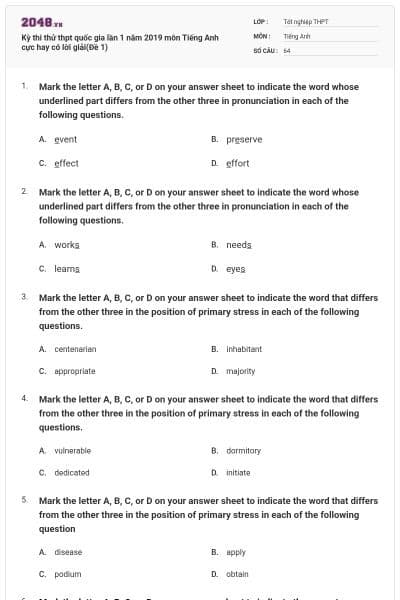
Mark the letter A, B, C, or D on your answer sheet to indicate the word whose underlined part differs from the other three in pronunciation in each of the following questions.
event
preserve
effect
effort
Đáp án : D
effort : e phát âm là /e/, còn lại e phát âm là /i/
Mark the letter A, B, C, or D on your answer sheet to indicate the word whose underlined part differs from the other three in pronunciation in each of the following questions.
works
needs
learns
eyes
Đáp án : A
works : s phát âm là /s/, còn lại phát âm là /z/
Mark the letter A, B, C, or D on your answer sheet to indicate the word that differs from the other three in the position of primary stress in each of the following questions.
centenarian
inhabitant
appropriate
majority
Đáp án : A
centenarian trọng âm rơi vào âm tiết thứ 3, còn lại là âm tiết t2
Mark the letter A, B, C, or D on your answer sheet to indicate the word that differs from the other three in the position of primary stress in each of the following questions.
vulnerable
dormitory
dedicated
initiate
Đáp án : D
initiate trọng âm rơi vào âm tiết thứ 2, còn lại là âm tiết t1
Mark the letter A, B, C, or D on your answer sheet to indicate the word that differs from the other three in the position of primary stress in each of the following question
disease
apply
podium
obtain
Đáp án : C
podium trọng âm rơi vào âm tiết thứ 1, còn lại rơi vào âm tiết t2
Mark the letter A, B, C, or D on your answer sheet to indicate the correct answer to each of the following questions.
Nha Trang, ______last year, is excellent for holiday-makers.
visited
we visited
that we visited
which we visited
Đáp án : D
Đại từ quan hệ thay thế cho tân ngữ trong MĐQH không xác định -> không lược bỏ ĐTQH, không dùng “that” -> bỏ A, B, C, chọn D
Mark the letter A, B, C, or D on your answer sheet to indicate the correct answer to each of the following questions.
I don’t mind_____waiting for a few minutes
being kept
being
to be kept
keeping
Đáp án : A
mind + Ving, và câu này phải chia bị động => mind + being + Ved/PP
Mark the letter A, B, C, or D on your answer sheet to indicate the correct answer to each of the following questions.
You ______out last night. I called several times but nobody answered the phone.
should have been
must have been
must be
can be
Đáp án : B
Câu phỏng đoán trong quá khứ : Chắc hẳn bạn đã ở ngoài tối qua. Tôi đã gọi rất nhiều lần nhưng không ai nhấc máy.
Có dấu hiệu là câu sau -> mức độ chắc chắn cao. -> dùng cấu trúc must have + Ved/PP
Mark the letter A, B, C, or D on your answer sheet to indicate the correct answer to each of the following questions.
He devoted most of his time ______after his little brothers and sisters.
to looking
looking
look
to look
Đáp án : A
to devote one’s time to Ving : dành thời gian cho việc gì
Mark the letter A, B, C, or D on your answer sheet to indicate the correct answer to each of the following questions.
“Don’t fail to send your parents my regards.” ~ “________________.”
It’s my pleasure
You’re welcome
Good ideas, thanks
Thanks, I will
Đáp án: D
Giải thích:
Kiến thức: Tình huống giao tiếp
Dịch:
“Đừng quên gửi lời hỏi thăm của tôi đến bố mẹ bạn nhé.”
~ “________________.”
A. Rất vui được phục vụ bạn
B. Không có gì
C. Ý tưởng hay, cảm ơn
D. Cảm ơn, tôi sẽ gửi lời
Dựa vào nghĩa, chọn D.
Mark the letter A, B, C, or D on your answer sheet to indicate the correct answer to each of the following questions.
The polar bear’s _____depends on its ability to catch fish.
surviving
survivor
survival
survive
Đáp án : C
Cần 1 Danh từ nghĩa là sự sống
Mark the letter A, B, C, or D on your answer sheet to indicate the correct answer to each of the following questions.
You are not allowed to drive your car in the city centre at rush hours _____there is too much traffic then.
because
in spite of
because of
although
Đáp án : A
2 mệnh đề mang nghĩa nguyên nhân kết quả -> loại B, D. mà “there is too much traffic then” là 1 mệnh đề nên chọn A
Mark the letter A, B, C, or D on your answer sheet to indicate the correct answer to each of the following questions.
If it hadn’t been for your laziness, you_____the exams.
could pass
could have passed
must have passed
had passed
Đáp án : B
Phỏng đoán về hành động trong quá khứ, câu này mang nghĩa: “nếu k vì sự lười biếng của bạn, bạn đã có thể vượt qua kì thi”
-> không phải phỏng đoán chắc chắn mà là việc đã có thể xảy ra trong QK -> chọn B
Mark the letter A, B, C, or D on your answer sheet to indicate the correct answer to each of the following questions.
Jack ______be so bad-tempered; I wonder if he’s got problems.
didn’t use to
isn’t use to
wouldn’t
isn’t used to
Đáp án : A
Ý câu này là Jack trước đây chưa từng như thế -> dùng cấu trúc didn’t use to + V
Lưu ý: tobe used to + Ving : quen với việc gì
Mark the letter A, B, C, or D on your answer sheet to indicate the correct answer to each of the following questions.
We expected her at nine but she finally______at midnight.
turned up
came off
came to
Đáp án : A
chọn theo nghĩa: Chúng tôi mong cô ấy đến lúc 9h, nhưng cuối cùng cô ấy xuất hiện lúc nửa đêm.
Turn up: xuất hiện, come off : rời ra, come to: được hưởng,…, turn out: hóa raD. turned out
Đáp án : A
chọn theo nghĩa: Chúng tôi mong cô ấy đến lúc 9h, nhưng cuối cùng cô ấy xuất hiện lúc nửa đêm.
Turn up: xuất hiện, come off : rời ra, come to: được hưởng,…, turn out: hóa ra
Mark the letter A, B, C, or D on your answer sheet to indicate the correct answer to each of the following questions.
The judge _____him fifty dollars for parking his car illegally
punished
fined
charged
ordered
Đáp án : B
Câu này là: hội đồng phạt anh ta 50 đô vì đỗ xe sai luật
Cấu trúc: Fine sb + money
punish something (by/with something) phạt ai bằng cái gì, charge: đòi trả , order: yêu cầu
Mark the letter A, B, C, or D on your answer sheet to indicate the correct answer to each of the following questions.
The purpose of a labour union is to improve the working conditions, ______, and pay of its members.
jobs are secure
to be secure
the job’s security
job security
Đáp án : D
Cụm từ: job security: an toàn trong công việc
Mark the letter A, B, C, or D on your answer sheet to indicate the correct answer to each of the following questions.
It is very important for a firm or a company to____changes in the market.
keep track with
keep pace with
keep pace of
keep in touch with
Đáp án : B
Điều đó là rất quân trọng cho 1 công ty khi bắt kịp với những thay đổi trong thị trường.
Keep pace with: theo kịp ai, cái gì ; keep track of: theo dõi thông tin mới nhất ; keep in touch with: giữ liên lạc với
Mark the letter A, B, C, or D on your answer sheet to indicate the correct answer to each of the following questions.
No sooner____at the bus stop____the bus came.
he had arrived/ than
had he arrived/ than
he had arrived/ when
had he arrived/ when
Đáp án : B
Cấu trúc No sooner had + S + Ved/ PP + than + clause : vừa mới……..thì
Mark the letter A, B, C, or D on your answer sheet to indicate the correct answer to each of the following questions.
_____the temperature, _______water turns into steam.
The higher/ the fast
Higher/ faster the
The higher/ the faster
The more higher/ the faster
Đáp án : C
Cấu trúc : so sánh kép: the + adj + er hoặc more + adj…., the + adj +er hoặc more + adj…. : càng …..càng
High và fast đều là adj ngắn
Mark the letter A, B, C, or D on your answer sheet to indicate the correct answer to each of the following questions.
Having passed the entrance exam, _____go away for a holiday.
his parents allow him
he is allowed to
he is allowing to
his parents allow him to
Đáp án : B
Having + PP….., S + V…: 2 mệnh đề cùng chủ ngữ
ở đây, người vượt qua kì thi là anh ấy, nên S của mệnh đề 2 là “he”
Lưu ý: cấu trúc tobe allowed to V : được cho phép làm gì
Mark the letter A, B, C, or D on your answer sheet to indicate the correct answer to each of the following questions.
Neither Tom nor his brothers ______ willing to help their mother with the housework.
are
is
has been
was
Đáp án: A
Giải thích:
Neither A nor B + V: động từ chia theo chủ ngữ B.
Ở đây “his brothers” (các anh em trai của cậu ấy) là chủ ngữ số nhiều, chọn đáp án A.
Dịch: Cả Tom hay các anh em trai của cậu ấy đều không sẵn lòng giúp mẹ làm việc nhà.
Mark the letter A, B, C, or D on your answer sheet to indicate the correct answer to each of the following questions.
“More coffee? Anybody?” ~ « ______________ »
Yes, please
It’s right I think
I don’t agree, I’m afraid
I’d love to
Đáp án : A
“Thêm chút café nữa chứ? Ai nào? “ (Lời mời)
Đáp lại là “Yes, please” nghĩa là “Vâng, xin hãy cho tôi 1 ít”
Mark the letter A, B, C, or D on your answer sheet to indicate the correct answer to each of the following questions.
The diesel engine was named_____its inventor Rudolf Diesel.
for
following
after
to
Đáp án : C
Tobe named after sb: được đặt tên theo ai
Mark the letter A, B, C, or D on your answer sheet to indicate the word or phrase that is CLOSEST in meaning to the underlined part in each of the followings.
It is very discourteous to intrude during someone’s conversation.
interrupt
find fault
disagree
leave quickly
Đáp án : A
Intrude: thâm nhập , ở đây dùng vơi nghĩa ngắt lời = interrupt
Mark the letter A, B, C, or D on your answer sheet to indicate the word or phrase that is CLOSEST in meaning to the underlined part in each of the followings.
In certain type of poisoning, you should immediately give large quantities of soapy or salty water in order to induce vomiting
control
stop
cause
clean
Đáp án : C
Induce = cause: gây ra
Mark the letter A, B, C, or D on your answer sheet to indicate the word or phrase that is CLOSEST in meaning to the underlined part in each of the followings.
It is useless to attempt to flee from every danger: some risks must be taken.
run away
hesitate
hide oneself
protect oneself
Đáp án : A
Flee = run away : lẩn trốn
Mark the letter A, B, C, or D on your answer sheet to show the underlined part that needs correction.
(A) Some studies show that (B) young babies prefer the (c) smell of milk to (D) those of other liquids.
Some studies
young babies
smell
those
Đáp án : D
Those => that : dùng để thay thế cho N số ít “the smell” đã được nhắc đến ở trước trong so sánh hơn
Mark the letter A, B, C, or D on your answer sheet to show the underlined part that needs correction.
Although caffeine is a (A) moderately habit-forming drug, coffee is not (B) regarded as (C) harmfully to the average (D) healthy adult.
moderately habit-forming
regarded as
harmfully to
healthy
Đáp án : C
Harmfully to => harmful to : do cấu trúc “tobe regarded as + N/adj : được xem như là”
Mark the letter A, B, C, or D on your answer sheet to show the underlined part that needs correction.
Mountains have helped (A) to protect the Swiss (B) from invaders, and indeed, Switzerland (C) has remained at peace while other European nations (D) engaging in war.
to protect
from invaders
has remained at peace
engaging in war
Đáp án : D
engaging in war => was engaging in war : đang tham gia vào chiến tranh
Mark the letter A, B, C, or D on your answer sheet to show the underlined part that needs correction.
(A) Each year, tourists from (B) all over the world travel to Poland (C) to visit (D) a birthplace of Frederic Chopin.
Each year
all over the world
to visit
a birthplac
Đáp án : D
A birthplace => the birthplace : nơi sinh : N xác định nên dùng mạo từ xác định “the”
Mark the letter A, B, C, or D on your answer sheet to show the underlined part that needs correction.
Political science, (A) alike the (B) other social (C) sciences, is not (D) an exact science.
alike
other
sciences
an exact
Đáp án : A
Alike => like : cần 1 giới từ nghĩa là “giống như” chứ không phải adj
Mark the letter A, B, C, or D on your answer sheet to indicate the word or phrase that is OPPOSITE in meaning to the underlined part in each of the followings.
The noise is so faint that it was impossible to be sure what it was or even where it came from
general
indistinct
frightening
loud
Đáp án : D
Faint: yếu ớt >< loud: to lớn, mạnh mẽ
Mark the letter A, B, C, or D on your answer sheet to indicate the word or phrase that is OPPOSITE in meaning to the underlined part in each of the followings.
The kids persisted with their soccer game even though recess was over.
insisted on
continued in spite
resisted of
stopped
Đáp án : D
Persist : khăng khăng, bền bỉ >< stop : dừng
Read the following passage and mark the letter A, B, C or D on your answer sheet to indicate the correct answer to each of the questions.
As the twentieth century began, the importance of formal education in the United States increased. The frontier had mostly disappeared and by 1910 most Americans lived in towns and cities. Industrialization and the bureaucratization of economic life combined with a new emphasis upon credentials and expertise to make schooling increasingly important for economic and social mobility. Increasingly, too, schools were viewed as the most important means of integrating immigrants into American society.
The arrival of a great wave of southern and eastern European immigrants at the turn of the century coincided with and contributed to an enormous expansion of formal schooling. By 1920 schooling to age fourteen or beyond was compulsory in most states, and the school year was greatly lengthened. Kindergartens, vacation schools, extracurricular activities, and vocational education and counseling extended the influence of public schools over the lives of students, many of whom in the larger industrial cities were the children of immigrants. Classes for adult immigrants were sponsored by public schools, corporations, unions, churches, settlement houses, and other agencies.
Reformers early in the twentieth century suggested that education programs should suit the needs of specific populations. Immigrant women were once such population. Schools tried to educate young women so they could occupy productive places in the urban industrial economy, and one place many educators considered appropriate for women was the home.
Although looking after the house and family was familiar to immigrant women, American education gave homemaking a new definition. In preindustrial economies, homemaking had meant the production as well as the consumption of goods, and it commonly included income-producing activities both inside and outside the home, in the highly industrialized early-twentieth-century United States, however, overproduction rather than scarcity was becoming a problem. Thus, the ideal American homemaker was viewed as a consumer rather than a producer. Schools trained women to be consumer homemakers cooking, shopping, decorating, and caring for children “efficiently” in their own homes, or if economic necessity demanded, as employees in the homes of others. Subsequent reforms have made these notions seem quite out-of-date.
The paragraph preceding the whole reading passage probably discusses _____.
the urbanization in the United States in the nineteen century.
the most important means of integrating immigrants into American society in the nineteen century.
the industrialization and the bureaucratization of economic life the United States in the nineteen century.
the formal schooling in the United States in the nineteen century.
Đáp án : D
Câu này hỏi về đoạn văn phía trước bài văn => dựa vào nội dung câu đầu tiên của đoạn 1: As the twentieth century began, the importance of formal education in the United States increased. Nghĩa là: Khi thế kỉ 12 bắt đầu, tầm quan trọng của giảo dục chính thức ở nước Mỹ tăng => đoạn đó cũng cần có nội dung liên quan đến formal education => chọn D
Read the following passage and mark the letter A, B, C or D on your answer sheet to indicate the correct answer to each of the questions.
As the twentieth century began, the importance of formal education in the United States increased. The frontier had mostly disappeared and by 1910 most Americans lived in towns and cities. Industrialization and the bureaucratization of economic life combined with a new emphasis upon credentials and expertise to make schooling increasingly important for economic and social mobility. Increasingly, too, schools were viewed as the most important means of integrating immigrants into American society.
The arrival of a great wave of southern and eastern European immigrants at the turn of the century coincided with and contributed to an enormous expansion of formal schooling. By 1920 schooling to age fourteen or beyond was compulsory in most states, and the school year was greatly lengthened. Kindergartens, vacation schools, extracurricular activities, and vocational education and counseling extended the influence of public schools over the lives of students, many of whom in the larger industrial cities were the children of immigrants. Classes for adult immigrants were sponsored by public schools, corporations, unions, churches, settlement houses, and other agencies.
Reformers early in the twentieth century suggested that education programs should suit the needs of specific populations. Immigrant women were once such population. Schools tried to educate young women so they could occupy productive places in the urban industrial economy, and one place many educators considered appropriate for women was the home.
Although looking after the house and family was familiar to immigrant women, American education gave homemaking a new definition. In preindustrial economies, homemaking had meant the production as well as the consumption of goods, and it commonly included income-producing activities both inside and outside the home, in the highly industrialized early-twentieth-century United States, however, overproduction rather than scarcity was becoming a problem. Thus, the ideal American homemaker was viewed as a consumer rather than a producer. Schools trained women to be consumer homemakers cooking, shopping, decorating, and caring for children “efficiently” in their own homes, or if economic necessity demanded, as employees in the homes of others. Subsequent reforms have made these notions seem quite out-of-date.
It can be inferred from paragraph 1 that one important factor in the increasing importance of education in the United States was _____.
the growing number of schools in frontier communities
the increased urbanization of the entire country
the expanding economic problems of schools
an increase in the number of trained teachers
Đáp án : B
Suy ra từ : Industrialization and the bureaucratization of economic life combined with a new emphasis upon credentials and expertise to make schooling increasingly important for economic and social mobility nghĩa là : công nghiệp và quan liêu hóa của kinh tế đã kết hợp với sự nhấn mạnh về sự ủy nhiệm và thông thạo để làm cho việc học ngày càng quan trọng cho kinh tế và sự biến chuyển của xã hội.
Read the following passage and mark the letter A, B, C or D on your answer sheet to indicate the correct answer to each of the questions.
As the twentieth century began, the importance of formal education in the United States increased. The frontier had mostly disappeared and by 1910 most Americans lived in towns and cities. Industrialization and the bureaucratization of economic life combined with a new emphasis upon credentials and expertise to make schooling increasingly important for economic and social mobility. Increasingly, too, schools were viewed as the most important means of integrating immigrants into American society.
The arrival of a great wave of southern and eastern European immigrants at the turn of the century coincided with and contributed to an enormous expansion of formal schooling. By 1920 schooling to age fourteen or beyond was compulsory in most states, and the school year was greatly lengthened. Kindergartens, vacation schools, extracurricular activities, and vocational education and counseling extended the influence of public schools over the lives of students, many of whom in the larger industrial cities were the children of immigrants. Classes for adult immigrants were sponsored by public schools, corporations, unions, churches, settlement houses, and other agencies.
Reformers early in the twentieth century suggested that education programs should suit the needs of specific populations. Immigrant women were once such population. Schools tried to educate young women so they could occupy productive places in the urban industrial economy, and one place many educators considered appropriate for women was the home.
Although looking after the house and family was familiar to immigrant women, American education gave homemaking a new definition. In preindustrial economies, homemaking had meant the production as well as the consumption of goods, and it commonly included income-producing activities both inside and outside the home, in the highly industrialized early-twentieth-century United States, however, overproduction rather than scarcity was becoming a problem. Thus, the ideal American homemaker was viewed as a consumer rather than a producer. Schools trained women to be consumer homemakers cooking, shopping, decorating, and caring for children “efficiently” in their own homes, or if economic necessity demanded, as employees in the homes of others. Subsequent reforms have made these notions seem quite out-of-date.
The word “means” in bold type is closest in meaning to _____.
qualifications
advantages
probability
method
Đáp án : D
Means = method : phương pháp
Read the following passage and mark the letter A, B, C or D on your answer sheet to indicate the correct answer to each of the questions.
As the twentieth century began, the importance of formal education in the United States increased. The frontier had mostly disappeared and by 1910 most Americans lived in towns and cities. Industrialization and the bureaucratization of economic life combined with a new emphasis upon credentials and expertise to make schooling increasingly important for economic and social mobility. Increasingly, too, schools were viewed as the most important means of integrating immigrants into American society.
The arrival of a great wave of southern and eastern European immigrants at the turn of the century coincided with and contributed to an enormous expansion of formal schooling. By 1920 schooling to age fourteen or beyond was compulsory in most states, and the school year was greatly lengthened. Kindergartens, vacation schools, extracurricular activities, and vocational education and counseling extended the influence of public schools over the lives of students, many of whom in the larger industrial cities were the children of immigrants. Classes for adult immigrants were sponsored by public schools, corporations, unions, churches, settlement houses, and other agencies.
Reformers early in the twentieth century suggested that education programs should suit the needs of specific populations. Immigrant women were once such population. Schools tried to educate young women so they could occupy productive places in the urban industrial economy, and one place many educators considered appropriate for women was the home.
Although looking after the house and family was familiar to immigrant women, American education gave homemaking a new definition. In preindustrial economies, homemaking had meant the production as well as the consumption of goods, and it commonly included income-producing activities both inside and outside the home, in the highly industrialized early-twentieth-century United States, however, overproduction rather than scarcity was becoming a problem. Thus, the ideal American homemaker was viewed as a consumer rather than a producer. Schools trained women to be consumer homemakers cooking, shopping, decorating, and caring for children “efficiently” in their own homes, or if economic necessity demanded, as employees in the homes of others. Subsequent reforms have made these notions seem quite out-of-date.
The phrase “coincided with” in bold type is closest in meaning to _____.
began to grow rapidly
happened at the same time as
ensured the success of
was influenced by
Đáp án : B
coincided with : trùng hợp với
Read the following passage and mark the letter A, B, C or D on your answer sheet to indicate the correct answer to each of the questions.
As the twentieth century began, the importance of formal education in the United States increased. The frontier had mostly disappeared and by 1910 most Americans lived in towns and cities. Industrialization and the bureaucratization of economic life combined with a new emphasis upon credentials and expertise to make schooling increasingly important for economic and social mobility. Increasingly, too, schools were viewed as the most important means of integrating immigrants into American society.
The arrival of a great wave of southern and eastern European immigrants at the turn of the century coincided with and contributed to an enormous expansion of formal schooling. By 1920 schooling to age fourteen or beyond was compulsory in most states, and the school year was greatly lengthened. Kindergartens, vacation schools, extracurricular activities, and vocational education and counseling extended the influence of public schools over the lives of students, many of whom in the larger industrial cities were the children of immigrants. Classes for adult immigrants were sponsored by public schools, corporations, unions, churches, settlement houses, and other agencies.
Reformers early in the twentieth century suggested that education programs should suit the needs of specific populations. Immigrant women were once such population. Schools tried to educate young women so they could occupy productive places in the urban industrial economy, and one place many educators considered appropriate for women was the home.
Although looking after the house and family was familiar to immigrant women, American education gave homemaking a new definition. In preindustrial economies, homemaking had meant the production as well as the consumption of goods, and it commonly included income-producing activities both inside and outside the home, in the highly industrialized early-twentieth-century United States, however, overproduction rather than scarcity was becoming a problem. Thus, the ideal American homemaker was viewed as a consumer rather than a producer. Schools trained women to be consumer homemakers cooking, shopping, decorating, and caring for children “efficiently” in their own homes, or if economic necessity demanded, as employees in the homes of others. Subsequent reforms have made these notions seem quite out-of-date.
According to the passage, one important change in United States education by the 1920’s was that _____.
adults and children studied in the same classes
most places required children to attend school
the amount of time spent on formal education was limited
new regulations were imposed on nontraditional education
Đáp án : B
Suy ra từ: By 1920 schooling to age fourteen or beyond was compulsory in most states, and the school year was greatly lengthened, nghĩa là: đến năm 1920, việc học đến tuổi 14 hoặc hơn là bắt buộc ở hầu hết các bang, và năm học được kéo dài hơn.
Read the following passage and mark the letter A, B, C or D on your answer sheet to indicate the correct answer to each of the questions.
As the twentieth century began, the importance of formal education in the United States increased. The frontier had mostly disappeared and by 1910 most Americans lived in towns and cities. Industrialization and the bureaucratization of economic life combined with a new emphasis upon credentials and expertise to make schooling increasingly important for economic and social mobility. Increasingly, too, schools were viewed as the most important means of integrating immigrants into American society.
The arrival of a great wave of southern and eastern European immigrants at the turn of the century coincided with and contributed to an enormous expansion of formal schooling. By 1920 schooling to age fourteen or beyond was compulsory in most states, and the school year was greatly lengthened. Kindergartens, vacation schools, extracurricular activities, and vocational education and counseling extended the influence of public schools over the lives of students, many of whom in the larger industrial cities were the children of immigrants. Classes for adult immigrants were sponsored by public schools, corporations, unions, churches, settlement houses, and other agencies.
Reformers early in the twentieth century suggested that education programs should suit the needs of specific populations. Immigrant women were once such population. Schools tried to educate young women so they could occupy productive places in the urban industrial economy, and one place many educators considered appropriate for women was the home.
Although looking after the house and family was familiar to immigrant women, American education gave homemaking a new definition. In preindustrial economies, homemaking had meant the production as well as the consumption of goods, and it commonly included income-producing activities both inside and outside the home, in the highly industrialized early-twentieth-century United States, however, overproduction rather than scarcity was becoming a problem. Thus, the ideal American homemaker was viewed as a consumer rather than a producer. Schools trained women to be consumer homemakers cooking, shopping, decorating, and caring for children “efficiently” in their own homes, or if economic necessity demanded, as employees in the homes of others. Subsequent reforms have made these notions seem quite out-of-date.
“Vacation schools and extracurricular activities” are mentioned in paragraph 2 to illustrate _____.
alternatives to formal education provided by public schools
the increased impact of public schools on students
activities that competed to attract new immigrants to their programs.
the importance of educational changes
Đáp án : C
Kindergartens, vacation schools, extracurricular activities, and vocational education and counseling extended the influence of public schools over the lives of students, many of whom in the larger industrial cities were the children of immigrants. Nghĩa là: mẫu giáo, những kì nghỉ ở trường, những hoạt động ngoại khóa, và giáo dục nghề nghiệp và việc cố vấn đã mở rộng mức ảnh hưởng của trường học công trong cuộc sống của học sinh, rất nhiều em trong số đó ở những đô thị công nghiệp rộng hơn là trẻ em di cư.
Read the following passage and mark the letter A, B, C or D on your answer sheet to indicate the correct answer to each of the questions.
As the twentieth century began, the importance of formal education in the United States increased. The frontier had mostly disappeared and by 1910 most Americans lived in towns and cities. Industrialization and the bureaucratization of economic life combined with a new emphasis upon credentials and expertise to make schooling increasingly important for economic and social mobility. Increasingly, too, schools were viewed as the most important means of integrating immigrants into American society.
The arrival of a great wave of southern and eastern European immigrants at the turn of the century coincided with and contributed to an enormous expansion of formal schooling. By 1920 schooling to age fourteen or beyond was compulsory in most states, and the school year was greatly lengthened. Kindergartens, vacation schools, extracurricular activities, and vocational education and counseling extended the influence of public schools over the lives of students, many of whom in the larger industrial cities were the children of immigrants. Classes for adult immigrants were sponsored by public schools, corporations, unions, churches, settlement houses, and other agencies.
Reformers early in the twentieth century suggested that education programs should suit the needs of specific populations. Immigrant women were once such population. Schools tried to educate young women so they could occupy productive places in the urban industrial economy, and one place many educators considered appropriate for women was the home.
Although looking after the house and family was familiar to immigrant women, American education gave homemaking a new definition. In preindustrial economies, homemaking had meant the production as well as the consumption of goods, and it commonly included income-producing activities both inside and outside the home, in the highly industrialized early-twentieth-century United States, however, overproduction rather than scarcity was becoming a problem. Thus, the ideal American homemaker was viewed as a consumer rather than a producer. Schools trained women to be consumer homemakers cooking, shopping, decorating, and caring for children “efficiently” in their own homes, or if economic necessity demanded, as employees in the homes of others. Subsequent reforms have made these notions seem quite out-of-date.
According to the passage, early-twentieth century education reformers believed that _____.
special programs should be set up in frontier communities to modernize them
different groups needed different kinds of education
more women should be involved in education and industry
corporations and other organizations damaged educational progress
Đáp án : B
Đoạn 3: Reformers early in the twentieth century suggested that education programs should suit the needs of specific populations. Nghĩa là : những nhà cải cách đầu TK 20 nói rằng chương trình giáo dục nên phù hợp với nhu cầu của từng người cụ thể
Read the following passage and mark the letter A, B, C or D on your answer sheet to indicate the correct answer to each of the questions.
As the twentieth century began, the importance of formal education in the United States increased. The frontier had mostly disappeared and by 1910 most Americans lived in towns and cities. Industrialization and the bureaucratization of economic life combined with a new emphasis upon credentials and expertise to make schooling increasingly important for economic and social mobility. Increasingly, too, schools were viewed as the most important means of integrating immigrants into American society.
The arrival of a great wave of southern and eastern European immigrants at the turn of the century coincided with and contributed to an enormous expansion of formal schooling. By 1920 schooling to age fourteen or beyond was compulsory in most states, and the school year was greatly lengthened. Kindergartens, vacation schools, extracurricular activities, and vocational education and counseling extended the influence of public schools over the lives of students, many of whom in the larger industrial cities were the children of immigrants. Classes for adult immigrants were sponsored by public schools, corporations, unions, churches, settlement houses, and other agencies.
Reformers early in the twentieth century suggested that education programs should suit the needs of specific populations. Immigrant women were once such population. Schools tried to educate young women so they could occupy productive places in the urban industrial economy, and one place many educators considered appropriate for women was the home.
Although looking after the house and family was familiar to immigrant women, American education gave homemaking a new definition. In preindustrial economies, homemaking had meant the production as well as the consumption of goods, and it commonly included income-producing activities both inside and outside the home, in the highly industrialized early-twentieth-century United States, however, overproduction rather than scarcity was becoming a problem. Thus, the ideal American homemaker was viewed as a consumer rather than a producer. Schools trained women to be consumer homemakers cooking, shopping, decorating, and caring for children “efficiently” in their own homes, or if economic necessity demanded, as employees in the homes of others. Subsequent reforms have made these notions seem quite out-of-date.
The word “it” in bold type refers to _____.
homemaking
education
consumption
production
Đáp án : A
In preindustrial economies, homemaking had meant the production as well as the consumption of goods, and it commonly included income-producing activities both inside and outside the home Nghĩa là: “trong những nền kinh tế tiền công nghiệp, nội trợ nghĩa là sự sản xuất cũng như tiêu dùng hàng hóa, và nó thường bao gồm hoạt động tạo ra thu nhập cả trong lẫn ngoài gia đình.
=> nó là cái đề cập ở trước, là homemaking
Read the following passage and mark the letter A, B, C or D on your answer sheet to indicate the correct answer to each of the questions.
As the twentieth century began, the importance of formal education in the United States increased. The frontier had mostly disappeared and by 1910 most Americans lived in towns and cities. Industrialization and the bureaucratization of economic life combined with a new emphasis upon credentials and expertise to make schooling increasingly important for economic and social mobility. Increasingly, too, schools were viewed as the most important means of integrating immigrants into American society.
The arrival of a great wave of southern and eastern European immigrants at the turn of the century coincided with and contributed to an enormous expansion of formal schooling. By 1920 schooling to age fourteen or beyond was compulsory in most states, and the school year was greatly lengthened. Kindergartens, vacation schools, extracurricular activities, and vocational education and counseling extended the influence of public schools over the lives of students, many of whom in the larger industrial cities were the children of immigrants. Classes for adult immigrants were sponsored by public schools, corporations, unions, churches, settlement houses, and other agencies.
Reformers early in the twentieth century suggested that education programs should suit the needs of specific populations. Immigrant women were once such population. Schools tried to educate young women so they could occupy productive places in the urban industrial economy, and one place many educators considered appropriate for women was the home.
Although looking after the house and family was familiar to immigrant women, American education gave homemaking a new definition. In preindustrial economies, homemaking had meant the production as well as the consumption of goods, and it commonly included income-producing activities both inside and outside the home, in the highly industrialized early-twentieth-century United States, however, overproduction rather than scarcity was becoming a problem. Thus, the ideal American homemaker was viewed as a consumer rather than a producer. Schools trained women to be consumer homemakers cooking, shopping, decorating, and caring for children “efficiently” in their own homes, or if economic necessity demanded, as employees in the homes of others. Subsequent reforms have made these notions seem quite out-of-date.
Women were trained to be consumer homemakers as a result of _____.
income-producing activities in the highly industrialized early-twentieth-century United States
overproduction in the highly industrialized early-twentieth-century United States
scarcity in the highly industrialized early-twentieth-century United States
economic necessity in the highly industrialized early-twentieth-century United States
Đáp án : B
Suy ra từ:
“in the highly industrialized early-twentieth-century United States, however, overproduction rather than scarcity was becoming a problem. Thus, the ideal American homemaker was viewed as a consumer rather than a producer” nghĩa là, Ở nước công nghiệp cao như Mỹ đầu thế kỉ 20, tuy nhiên, sản xuất thừa chứ không phải khan hiếm đã trở thành 1 vấn đề. Do đó, người nội trợ lý tưởng ở Mỹ được xem như là 1 người tiêu dùng chứ k phải người sản xuất
Read the following passage and mark the letter A, B, C or D on your answer sheet to indicate the correct answer to each of the questions.
As the twentieth century began, the importance of formal education in the United States increased. The frontier had mostly disappeared and by 1910 most Americans lived in towns and cities. Industrialization and the bureaucratization of economic life combined with a new emphasis upon credentials and expertise to make schooling increasingly important for economic and social mobility. Increasingly, too, schools were viewed as the most important means of integrating immigrants into American society.
The arrival of a great wave of southern and eastern European immigrants at the turn of the century coincided with and contributed to an enormous expansion of formal schooling. By 1920 schooling to age fourteen or beyond was compulsory in most states, and the school year was greatly lengthened. Kindergartens, vacation schools, extracurricular activities, and vocational education and counseling extended the influence of public schools over the lives of students, many of whom in the larger industrial cities were the children of immigrants. Classes for adult immigrants were sponsored by public schools, corporations, unions, churches, settlement houses, and other agencies.
Reformers early in the twentieth century suggested that education programs should suit the needs of specific populations. Immigrant women were once such population. Schools tried to educate young women so they could occupy productive places in the urban industrial economy, and one place many educators considered appropriate for women was the home.
Although looking after the house and family was familiar to immigrant women, American education gave homemaking a new definition. In preindustrial economies, homemaking had meant the production as well as the consumption of goods, and it commonly included income-producing activities both inside and outside the home, in the highly industrialized early-twentieth-century United States, however, overproduction rather than scarcity was becoming a problem. Thus, the ideal American homemaker was viewed as a consumer rather than a producer. Schools trained women to be consumer homemakers cooking, shopping, decorating, and caring for children “efficiently” in their own homes, or if economic necessity demanded, as employees in the homes of others. Subsequent reforms have made these notions seem quite out-of-date.
Which paragraph mentions the importance of abilities and experience in formal schooling?
Paragraph 4
Paragraph 3
Paragraph 2
Paragraph 1
Đáp án : D
Đ1: schooling increasingly important for economic and social mobility. Increasingly, too, schools were viewed as the most important means of integrating immigrants into American society.
Read the following passage and mark the letter A,B,C or D on your answer sheet to indicate the correct word or phrase for each of blanks. Fill in the appropriate word in question 45
When you read something in a foreign language, you frequently come across words you do not (45)______ understand. Sometimes you (46)______ the meaning in a dictionary and sometimes you guess. The strategy you adopt depends very much upon the (47)______of accuracy you require and the time at your disposal. If you are the sort of person who tends to turn to the dictionary frequently, it is (48)_______remembering that every dictionary has its limitations. Each definition is only an approximation and one builds up an accurate picture of the meaning of a word only after meeting it in a (49)__________of contexts. It is also important to recognize the special dangers of dictionaries that translate from English into your native language and vice versa. If you must use a dictionary, it is usually far safer to (50)________an English- English dictionary. In most exams you are not permitted to use a dictionary. (51)__________you are allowed to use one, it is very time- consuming to look up words, and time in exams is usually limited. You are, (52)______, forced to guess the meaning of unfamiliar words. When you come across unknown words in an exam text, it is very easy to panic. However, if you develop efficient techniques for guessing the meaning, you will(53)__________a number of possible problems and help yourself to understand far more of the text than you at first likely. Two strategies which may help you guess the meaning of a word are: using contextual clues, both within the sentence and outside, and making uses (54)_____ clues derived from the formation of the word.
totally
wholly
fully
complete
Đáp án : C
Cần 1 adv => loại D
Ý A,,B,C đều nghĩa là hoàn toàn tuy nhiên trong bài có từ “understand” nên phải dùng fully
Read the following passage and mark the letter A,B,C or D on your answer sheet to indicate the correct word or phrase for each of blanks. Fill in the appropriate word in question 46
When you read something in a foreign language, you frequently come across words you do not (45)______ understand. Sometimes you (46)______ the meaning in a dictionary and sometimes you guess. The strategy you adopt depends very much upon the (47)______of accuracy you require and the time at your disposal. If you are the sort of person who tends to turn to the dictionary frequently, it is (48)_______remembering that every dictionary has its limitations. Each definition is only an approximation and one builds up an accurate picture of the meaning of a word only after meeting it in a (49)__________of contexts. It is also important to recognize the special dangers of dictionaries that translate from English into your native language and vice versa. If you must use a dictionary, it is usually far safer to (50)________an English- English dictionary. In most exams you are not permitted to use a dictionary. (51)__________you are allowed to use one, it is very time- consuming to look up words, and time in exams is usually limited. You are, (52)______, forced to guess the meaning of unfamiliar words. When you come across unknown words in an exam text, it is very easy to panic. However, if you develop efficient techniques for guessing the meaning, you will(53)__________a number of possible problems and help yourself to understand far more of the text than you at first likely. Two strategies which may help you guess the meaning of a word are: using contextual clues, both within the sentence and outside, and making uses (54)_____ clues derived from the formation of the word.
examine
inspect
check
control
Đáp án : C
Chọn theo nghĩa: kiểm tra nghĩa trong từ điển “check the meaning in a dictionary”
Read the following passage and mark the letter A,B,C or D on your answer sheet to indicate the correct word or phrase for each of blanks. Fill in the appropriate word in question 47
When you read something in a foreign language, you frequently come across words you do not (45)______ understand. Sometimes you (46)______ the meaning in a dictionary and sometimes you guess. The strategy you adopt depends very much upon the (47)______of accuracy you require and the time at your disposal. If you are the sort of person who tends to turn to the dictionary frequently, it is (48)_______remembering that every dictionary has its limitations. Each definition is only an approximation and one builds up an accurate picture of the meaning of a word only after meeting it in a (49)__________of contexts. It is also important to recognize the special dangers of dictionaries that translate from English into your native language and vice versa. If you must use a dictionary, it is usually far safer to (50)________an English- English dictionary. In most exams you are not permitted to use a dictionary. (51)__________you are allowed to use one, it is very time- consuming to look up words, and time in exams is usually limited. You are, (52)______, forced to guess the meaning of unfamiliar words. When you come across unknown words in an exam text, it is very easy to panic. However, if you develop efficient techniques for guessing the meaning, you will(53)__________a number of possible problems and help yourself to understand far more of the text than you at first likely. Two strategies which may help you guess the meaning of a word are: using contextual clues, both within the sentence and outside, and making uses (54)_____ clues derived from the formation of the word.
degree
level
extent
range
Đáp án : A
Chọn theo nghĩa: degree: mức độ, level: trình độ, extent: phạm vi, range: dãy
Read the following passage and mark the letter A,B,C or D on your answer sheet to indicate the correct word or phrase for each of blanks. Fill in the appropriate word in question 48
When you read something in a foreign language, you frequently come across words you do not (45)______ understand. Sometimes you (46)______ the meaning in a dictionary and sometimes you guess. The strategy you adopt depends very much upon the (47)______of accuracy you require and the time at your disposal. If you are the sort of person who tends to turn to the dictionary frequently, it is (48)_______remembering that every dictionary has its limitations. Each definition is only an approximation and one builds up an accurate picture of the meaning of a word only after meeting it in a (49)__________of contexts. It is also important to recognize the special dangers of dictionaries that translate from English into your native language and vice versa. If you must use a dictionary, it is usually far safer to (50)________an English- English dictionary. In most exams you are not permitted to use a dictionary. (51)__________you are allowed to use one, it is very time- consuming to look up words, and time in exams is usually limited. You are, (52)______, forced to guess the meaning of unfamiliar words. When you come across unknown words in an exam text, it is very easy to panic. However, if you develop efficient techniques for guessing the meaning, you will(53)__________a number of possible problems and help yourself to understand far more of the text than you at first likely. Two strategies which may help you guess the meaning of a word are: using contextual clues, both within the sentence and outside, and making uses (54)_____ clues derived from the formation of the word.
valuable
worth
vital
essential
Đáp án : B
It is worth + Ving: đáng để làm gì
Read the following passage and mark the letter A,B,C or D on your answer sheet to indicate the correct word or phrase for each of blanks. Fill in the appropriate word in question 49
When you read something in a foreign language, you frequently come across words you do not (45)______ understand. Sometimes you (46)______ the meaning in a dictionary and sometimes you guess. The strategy you adopt depends very much upon the (47)______of accuracy you require and the time at your disposal. If you are the sort of person who tends to turn to the dictionary frequently, it is (48)_______remembering that every dictionary has its limitations. Each definition is only an approximation and one builds up an accurate picture of the meaning of a word only after meeting it in a (49)__________of contexts. It is also important to recognize the special dangers of dictionaries that translate from English into your native language and vice versa. If you must use a dictionary, it is usually far safer to (50)________an English- English dictionary. In most exams you are not permitted to use a dictionary. (51)__________you are allowed to use one, it is very time- consuming to look up words, and time in exams is usually limited. You are, (52)______, forced to guess the meaning of unfamiliar words. When you come across unknown words in an exam text, it is very easy to panic. However, if you develop efficient techniques for guessing the meaning, you will(53)__________a number of possible problems and help yourself to understand far more of the text than you at first likely. Two strategies which may help you guess the meaning of a word are: using contextual clues, both within the sentence and outside, and making uses (54)_____ clues derived from the formation of the word.
diversity
multiple
variety
variation
Đáp án : C
A variety of + N (số nhiều) = a lot of
Read the following passage and mark the letter A,B,C or D on your answer sheet to indicate the correct word or phrase for each of blanks. Fill in the appropriate word in question 50
When you read something in a foreign language, you frequently come across words you do not (45)______ understand. Sometimes you (46)______ the meaning in a dictionary and sometimes you guess. The strategy you adopt depends very much upon the (47)______of accuracy you require and the time at your disposal. If you are the sort of person who tends to turn to the dictionary frequently, it is (48)_______remembering that every dictionary has its limitations. Each definition is only an approximation and one builds up an accurate picture of the meaning of a word only after meeting it in a (49)__________of contexts. It is also important to recognize the special dangers of dictionaries that translate from English into your native language and vice versa. If you must use a dictionary, it is usually far safer to (50)________an English- English dictionary. In most exams you are not permitted to use a dictionary. (51)__________you are allowed to use one, it is very time- consuming to look up words, and time in exams is usually limited. You are, (52)______, forced to guess the meaning of unfamiliar words. When you come across unknown words in an exam text, it is very easy to panic. However, if you develop efficient techniques for guessing the meaning, you will(53)__________a number of possible problems and help yourself to understand far more of the text than you at first likely. Two strategies which may help you guess the meaning of a word are: using contextual clues, both within the sentence and outside, and making uses (54)_____ clues derived from the formation of the word.
consult
inquire
survey
infer
Đáp án : A
Chọn theo nghĩa: consult : tham khảo, inquire: yêu cầu, survey: cuộc điều tra, infer: suy ra
Read the following passage and mark the letter A,B,C or D on your answer sheet to indicate the correct word or phrase for each of blanks. Fill in the appropriate word in question 51
When you read something in a foreign language, you frequently come across words you do not (45)______ understand. Sometimes you (46)______ the meaning in a dictionary and sometimes you guess. The strategy you adopt depends very much upon the (47)______of accuracy you require and the time at your disposal. If you are the sort of person who tends to turn to the dictionary frequently, it is (48)_______remembering that every dictionary has its limitations. Each definition is only an approximation and one builds up an accurate picture of the meaning of a word only after meeting it in a (49)__________of contexts. It is also important to recognize the special dangers of dictionaries that translate from English into your native language and vice versa. If you must use a dictionary, it is usually far safer to (50)________an English- English dictionary. In most exams you are not permitted to use a dictionary. (51)__________you are allowed to use one, it is very time- consuming to look up words, and time in exams is usually limited. You are, (52)______, forced to guess the meaning of unfamiliar words. When you come across unknown words in an exam text, it is very easy to panic. However, if you develop efficient techniques for guessing the meaning, you will(53)__________a number of possible problems and help yourself to understand far more of the text than you at first likely. Two strategies which may help you guess the meaning of a word are: using contextual clues, both within the sentence and outside, and making uses (54)_____ clues derived from the formation of the word.
Provided
Even if
In case
Although
Đáp án : B
Chọn theo nghĩa: even if: ngay cả khi, provided: miễn là, in case: trong trường hợp, although: mặc dù
Read the following passage and mark the letter A,B,C or D on your answer sheet to indicate the correct word or phrase for each of blanks. Fill in the appropriate word in question 52
When you read something in a foreign language, you frequently come across words you do not (45)______ understand. Sometimes you (46)______ the meaning in a dictionary and sometimes you guess. The strategy you adopt depends very much upon the (47)______of accuracy you require and the time at your disposal. If you are the sort of person who tends to turn to the dictionary frequently, it is (48)_______remembering that every dictionary has its limitations. Each definition is only an approximation and one builds up an accurate picture of the meaning of a word only after meeting it in a (49)__________of contexts. It is also important to recognize the special dangers of dictionaries that translate from English into your native language and vice versa. If you must use a dictionary, it is usually far safer to (50)________an English- English dictionary. In most exams you are not permitted to use a dictionary. (51)__________you are allowed to use one, it is very time- consuming to look up words, and time in exams is usually limited. You are, (52)______, forced to guess the meaning of unfamiliar words. When you come across unknown words in an exam text, it is very easy to panic. However, if you develop efficient techniques for guessing the meaning, you will(53)__________a number of possible problems and help yourself to understand far more of the text than you at first likely. Two strategies which may help you guess the meaning of a word are: using contextual clues, both within the sentence and outside, and making uses (54)_____ clues derived from the formation of the word.
but
however
so that
therefore
Đáp án : D
Câu này là kết quả của câu trên => chọn D
Read the following passage and mark the letter A,B,C or D on your answer sheet to indicate the correct word or phrase for each of blanks. Fill in the appropriate word in question 53
When you read something in a foreign language, you frequently come across words you do not (45)______ understand. Sometimes you (46)______ the meaning in a dictionary and sometimes you guess. The strategy you adopt depends very much upon the (47)______of accuracy you require and the time at your disposal. If you are the sort of person who tends to turn to the dictionary frequently, it is (48)_______remembering that every dictionary has its limitations. Each definition is only an approximation and one builds up an accurate picture of the meaning of a word only after meeting it in a (49)__________of contexts. It is also important to recognize the special dangers of dictionaries that translate from English into your native language and vice versa. If you must use a dictionary, it is usually far safer to (50)________an English- English dictionary. In most exams you are not permitted to use a dictionary. (51)__________you are allowed to use one, it is very time- consuming to look up words, and time in exams is usually limited. You are, (52)______, forced to guess the meaning of unfamiliar words. When you come across unknown words in an exam text, it is very easy to panic. However, if you develop efficient techniques for guessing the meaning, you will(53)__________a number of possible problems and help yourself to understand far more of the text than you at first likely. Two strategies which may help you guess the meaning of a word are: using contextual clues, both within the sentence and outside, and making uses (54)_____ clues derived from the formation of the word.
overcome
surpass
get on
go over
Đáp án : A
Chọn theo nghĩa: overcome : vượt qua (thường là khó khăn, vấn đề), surpass: vượt trôi, get on: làm gì đó, go over = revise
Read the following passage and mark the letter A,B,C or D on your answer sheet to indicate the correct word or phrase for each of blanks. Fill in the appropriate word in question 54
When you read something in a foreign language, you frequently come across words you do not (45)______ understand. Sometimes you (46)______ the meaning in a dictionary and sometimes you guess. The strategy you adopt depends very much upon the (47)______of accuracy you require and the time at your disposal. If you are the sort of person who tends to turn to the dictionary frequently, it is (48)_______remembering that every dictionary has its limitations. Each definition is only an approximation and one builds up an accurate picture of the meaning of a word only after meeting it in a (49)__________of contexts. It is also important to recognize the special dangers of dictionaries that translate from English into your native language and vice versa. If you must use a dictionary, it is usually far safer to (50)________an English- English dictionary. In most exams you are not permitted to use a dictionary. (51)__________you are allowed to use one, it is very time- consuming to look up words, and time in exams is usually limited. You are, (52)______, forced to guess the meaning of unfamiliar words. When you come across unknown words in an exam text, it is very easy to panic. However, if you develop efficient techniques for guessing the meaning, you will(53)__________a number of possible problems and help yourself to understand far more of the text than you at first likely. Two strategies which may help you guess the meaning of a word are: using contextual clues, both within the sentence and outside, and making uses (54)_____ clues derived from the formation of the word.
on
about
of
with
Đáp án : C
Make use of: tận dụng
Read the following passage and mark the letter A, B, C on your answer sheet to indicate the correct answer to each of the questions.
The art world
One of the major problems in the art world is how to distinguish and promote an artist. In effect, a market must be created for an artist to be successful. The practice of signing and numbering individual prints was introduced by James Abbott McNeill Whistler, the nineteenth - century artist best known for the painting of his mother, called “Arrangement in Grey and Black”, but known to most of us as “ Whistler’s Mother”. Whistler’s brother - in - law, Sir Francis Seymour Haden, a less well - known artist, had speculated that collectors might find prints more attractive if they knew that they were only a limited number of copies produced. By signing the work in pencil, an artist could guarantee and personalize each print.
As soon as Whistler and Haden began the practice of signing and numbering their prints, their work began to increase in value. When other artists noticed that the signed prints commanded higher prices, they began copying the procedure.
Although most prints are signed on the right - hand side in the margin below the image, the placement of the signature is a matter of personal choice. Indeed, prints have been signed within the image, in any of the margins, or even on the reverse side of the print. Wherever the artist elects to sign it, a signed print is still valued above an unsigned one, even in the same edition.
Which of the following would be a better title for the passage?
Whistler’s Mother
The Practice of Signing Prints
Copying Limited Edition Prints
Whistler’s Greatest Works
Đáp án : B
Toàn bài nói về việc kí vào những bức tranh của các nghệ sĩ
Read the following passage and mark the letter A, B, C on your answer sheet to indicate the correct answer to each of the questions.
The art world
One of the major problems in the art world is how to distinguish and promote an artist. In effect, a market must be created for an artist to be successful. The practice of signing and numbering individual prints was introduced by James Abbott McNeill Whistler, the nineteenth - century artist best known for the painting of his mother, called “Arrangement in Grey and Black”, but known to most of us as “ Whistler’s Mother”. Whistler’s brother - in - law, Sir Francis Seymour Haden, a less well - known artist, had speculated that collectors might find prints more attractive if they knew that they were only a limited number of copies produced. By signing the work in pencil, an artist could guarantee and personalize each print.
As soon as Whistler and Haden began the practice of signing and numbering their prints, their work began to increase in value. When other artists noticed that the signed prints commanded higher prices, they began copying the procedure.
Although most prints are signed on the right - hand side in the margin below the image, the placement of the signature is a matter of personal choice. Indeed, prints have been signed within the image, in any of the margins, or even on the reverse side of the print. Wherever the artist elects to sign it, a signed print is still valued above an unsigned one, even in the same edition.
What made Whistler’s work more valuable?
His brother - in - law’s prints.
His fame as an artist
His painting of his mother
His signature on the prints
Đáp án : D
Suy ra từ Đ1: collectors might find prints more attractive if they knew that they were only a limited number of copies produced. By signing the work in pencil, an artist could guarantee and personalize each print. Nghĩa là : những nhà thu thâp sẽ thấy những bức tranh hấp dẫn hơn nếu họ biết rằng số lượng của chúng có hạn. bằng việc ký tên vào tác phẩm bằng bút chì, 1người nghệ sĩ có thể đảm bảo và cá nhân hóa mỗi bức tranh.
Read the following passage and mark the letter A, B, C on your answer sheet to indicate the correct answer to each of the questions.
The art world
One of the major problems in the art world is how to distinguish and promote an artist. In effect, a market must be created for an artist to be successful. The practice of signing and numbering individual prints was introduced by James Abbott McNeill Whistler, the nineteenth - century artist best known for the painting of his mother, called “Arrangement in Grey and Black”, but known to most of us as “ Whistler’s Mother”. Whistler’s brother - in - law, Sir Francis Seymour Haden, a less well - known artist, had speculated that collectors might find prints more attractive if they knew that they were only a limited number of copies produced. By signing the work in pencil, an artist could guarantee and personalize each print.
As soon as Whistler and Haden began the practice of signing and numbering their prints, their work began to increase in value. When other artists noticed that the signed prints commanded higher prices, they began copying the procedure.
Although most prints are signed on the right - hand side in the margin below the image, the placement of the signature is a matter of personal choice. Indeed, prints have been signed within the image, in any of the margins, or even on the reverse side of the print. Wherever the artist elects to sign it, a signed print is still valued above an unsigned one, even in the same edition.
The word “speculated” in bold type could best be replaced by_____.
denied
announced
guessed
noticed
Đáp án : C
Speculate = guess : phỏng đoán
Read the following passage and mark the letter A, B, C on your answer sheet to indicate the correct answer to each of the questions.
The art world
One of the major problems in the art world is how to distinguish and promote an artist. In effect, a market must be created for an artist to be successful. The practice of signing and numbering individual prints was introduced by James Abbott McNeill Whistler, the nineteenth - century artist best known for the painting of his mother, called “Arrangement in Grey and Black”, but known to most of us as “ Whistler’s Mother”. Whistler’s brother - in - law, Sir Francis Seymour Haden, a less well - known artist, had speculated that collectors might find prints more attractive if they knew that they were only a limited number of copies produced. By signing the work in pencil, an artist could guarantee and personalize each print.
As soon as Whistler and Haden began the practice of signing and numbering their prints, their work began to increase in value. When other artists noticed that the signed prints commanded higher prices, they began copying the procedure.
Although most prints are signed on the right - hand side in the margin below the image, the placement of the signature is a matter of personal choice. Indeed, prints have been signed within the image, in any of the margins, or even on the reverse side of the print. Wherever the artist elects to sign it, a signed print is still valued above an unsigned one, even in the same edition.
The word “ distinguish” in bold type is closest in meaning to______.
make improvements
accept changes
recognize differences
allow exceptions
Đáp án : C
Distinguish : phân biệt
Read the following passage and mark the letter A, B, C on your answer sheet to indicate the correct answer to each of the questions.
The art world
One of the major problems in the art world is how to distinguish and promote an artist. In effect, a market must be created for an artist to be successful. The practice of signing and numbering individual prints was introduced by James Abbott McNeill Whistler, the nineteenth - century artist best known for the painting of his mother, called “Arrangement in Grey and Black”, but known to most of us as “ Whistler’s Mother”. Whistler’s brother - in - law, Sir Francis Seymour Haden, a less well - known artist, had speculated that collectors might find prints more attractive if they knew that they were only a limited number of copies produced. By signing the work in pencil, an artist could guarantee and personalize each print.
As soon as Whistler and Haden began the practice of signing and numbering their prints, their work began to increase in value. When other artists noticed that the signed prints commanded higher prices, they began copying the procedure.
Although most prints are signed on the right - hand side in the margin below the image, the placement of the signature is a matter of personal choice. Indeed, prints have been signed within the image, in any of the margins, or even on the reverse side of the print. Wherever the artist elects to sign it, a signed print is still valued above an unsigned one, even in the same edition.
The word “it” in bold type refers to______.
the same edition
the reverse side
a print
the image
Đáp án : C
Indeed, prints have been signed within the image, in any of the margins, or even on the reverse side of the print. Wherever the artist elects to sign it,…Nghĩa là: Thực tế, những bức tranh đã được kí trong 1 hình ảnh ở bất cứ lề nào, hoặc thậm chí ở mặt kia cuả bức tranh. Bất cứ khi nào người nghệ sĩ chọn kí nó ,….=> it là bức tranh
Read the following passage and mark the letter A, B, C on your answer sheet to indicate the correct answer to each of the questions.
The art world
One of the major problems in the art world is how to distinguish and promote an artist. In effect, a market must be created for an artist to be successful. The practice of signing and numbering individual prints was introduced by James Abbott McNeill Whistler, the nineteenth - century artist best known for the painting of his mother, called “Arrangement in Grey and Black”, but known to most of us as “ Whistler’s Mother”. Whistler’s brother - in - law, Sir Francis Seymour Haden, a less well - known artist, had speculated that collectors might find prints more attractive if they knew that they were only a limited number of copies produced. By signing the work in pencil, an artist could guarantee and personalize each print.
As soon as Whistler and Haden began the practice of signing and numbering their prints, their work began to increase in value. When other artists noticed that the signed prints commanded higher prices, they began copying the procedure.
Although most prints are signed on the right - hand side in the margin below the image, the placement of the signature is a matter of personal choice. Indeed, prints have been signed within the image, in any of the margins, or even on the reverse side of the print. Wherever the artist elects to sign it, a signed print is still valued above an unsigned one, even in the same edition.
Where in the passage does the author indicate where an artist’s signature might be found on a work?
Lines 14-15
Lines 6-7
Lines 9-10
Lines 11-13
Đáp án : D
Đ3: Although most prints are signed on the right - hand side in the margin below the image, the placement of the signature is a matter of personal choice. Indeed, prints have been signed within the image, in any of the margins, or even on the reverse side of the print
Read the following passage and mark the letter A, B, C on your answer sheet to indicate the correct answer to each of the questions.
The art world
One of the major problems in the art world is how to distinguish and promote an artist. In effect, a market must be created for an artist to be successful. The practice of signing and numbering individual prints was introduced by James Abbott McNeill Whistler, the nineteenth - century artist best known for the painting of his mother, called “Arrangement in Grey and Black”, but known to most of us as “ Whistler’s Mother”. Whistler’s brother - in - law, Sir Francis Seymour Haden, a less well - known artist, had speculated that collectors might find prints more attractive if they knew that they were only a limited number of copies produced. By signing the work in pencil, an artist could guarantee and personalize each print.
As soon as Whistler and Haden began the practice of signing and numbering their prints, their work began to increase in value. When other artists noticed that the signed prints commanded higher prices, they began copying the procedure.
Although most prints are signed on the right - hand side in the margin below the image, the placement of the signature is a matter of personal choice. Indeed, prints have been signed within the image, in any of the margins, or even on the reverse side of the print. Wherever the artist elects to sign it, a signed print is still valued above an unsigned one, even in the same edition.
What does the author mean by the statement: “As soon as Whistler and Haden began the practice of signing and numbering their prints, their work began to increase in value” ?
The signatures became more valuable than the prints
Many copies of the prints were made.
The prints that were signed and numbered were worth more.
The signing and numbering of prints was not very popular
Đáp án : C
Câu này nghĩa là: Ngay sau khi Whistler và Haden bắt đầu kí và đánh số bức tranh của mình, tác phẩm của họ bắt đầu có giá trị tăng lên
Read the following passage and mark the letter A, B, C on your answer sheet to indicate the correct answer to each of the questions.
The art world
One of the major problems in the art world is how to distinguish and promote an artist. In effect, a market must be created for an artist to be successful. The practice of signing and numbering individual prints was introduced by James Abbott McNeill Whistler, the nineteenth - century artist best known for the painting of his mother, called “Arrangement in Grey and Black”, but known to most of us as “ Whistler’s Mother”. Whistler’s brother - in - law, Sir Francis Seymour Haden, a less well - known artist, had speculated that collectors might find prints more attractive if they knew that they were only a limited number of copies produced. By signing the work in pencil, an artist could guarantee and personalize each print.
As soon as Whistler and Haden began the practice of signing and numbering their prints, their work began to increase in value. When other artists noticed that the signed prints commanded higher prices, they began copying the procedure.
Although most prints are signed on the right - hand side in the margin below the image, the placement of the signature is a matter of personal choice. Indeed, prints have been signed within the image, in any of the margins, or even on the reverse side of the print. Wherever the artist elects to sign it, a signed print is still valued above an unsigned one, even in the same edition.
What was true about the painting of Whistler’s mother?
Its title was “Arrangement in Grey and Black”
It was a completely new method of painting.
It was painted by Sir Francis Seymour Haden.
It was not one of Whistler’s best paintings.
Đáp án : A
Suy ra từ Đ1: the nineteenth - century artist best known for the painting of his mother, called “Arrangement in Grey and Black”, but known to most of us as “ Whistler’s Mother”, nghĩa là : nghệ sĩ TK 19 được biết đến vì bức tranh về mẹ, được gọi là: “Arrangement in Grey and Black”, nhưng hầu như thường được gọi là “Whistler’s Mother”
Read the following passage and mark the letter A, B, C on your answer sheet to indicate the correct answer to each of the questions.
The art world
One of the major problems in the art world is how to distinguish and promote an artist. In effect, a market must be created for an artist to be successful. The practice of signing and numbering individual prints was introduced by James Abbott McNeill Whistler, the nineteenth - century artist best known for the painting of his mother, called “Arrangement in Grey and Black”, but known to most of us as “ Whistler’s Mother”. Whistler’s brother - in - law, Sir Francis Seymour Haden, a less well - known artist, had speculated that collectors might find prints more attractive if they knew that they were only a limited number of copies produced. By signing the work in pencil, an artist could guarantee and personalize each print.
As soon as Whistler and Haden began the practice of signing and numbering their prints, their work began to increase in value. When other artists noticed that the signed prints commanded higher prices, they began copying the procedure.
Although most prints are signed on the right - hand side in the margin below the image, the placement of the signature is a matter of personal choice. Indeed, prints have been signed within the image, in any of the margins, or even on the reverse side of the print. Wherever the artist elects to sign it, a signed print is still valued above an unsigned one, even in the same edition.
The author mentions all of the following as reasons why a collector prefers a signed print EXCEPT.
it guarantees the print’s authenticity
it encourages higher prices for the print
it limits the number of copies of the print
it makes the print more personal
Đáp án : B
Đ1: collectors might find prints more attractive if they knew that they were only a limited number of copies produced. By signing the work in pencil, an artist could guarantee and personalize each print.
Chữ kí đảm bảo: số lượng có hạn các bức tranh, đảm ảo bức tranh là hàng thật và đảm bảo tính cá nhân, sự sở hữu của tác giả đối vs bức tranh
Read the following passage and mark the letter A, B, C on your answer sheet to indicate the correct answer to each of the questions.
The art world
One of the major problems in the art world is how to distinguish and promote an artist. In effect, a market must be created for an artist to be successful. The practice of signing and numbering individual prints was introduced by James Abbott McNeill Whistler, the nineteenth - century artist best known for the painting of his mother, called “Arrangement in Grey and Black”, but known to most of us as “ Whistler’s Mother”. Whistler’s brother - in - law, Sir Francis Seymour Haden, a less well - known artist, had speculated that collectors might find prints more attractive if they knew that they were only a limited number of copies produced. By signing the work in pencil, an artist could guarantee and personalize each print.
As soon as Whistler and Haden began the practice of signing and numbering their prints, their work began to increase in value. When other artists noticed that the signed prints commanded higher prices, they began copying the procedure.
Although most prints are signed on the right - hand side in the margin below the image, the placement of the signature is a matter of personal choice. Indeed, prints have been signed within the image, in any of the margins, or even on the reverse side of the print. Wherever the artist elects to sign it, a signed print is still valued above an unsigned one, even in the same edition.
It can be inferred from the passage that artists number their prints_______.
as an accounting procedure
at the same place on each of the prints
to guarantee a limited edition
when the buyer requests it
Đáp án : C
Đ1: collectors might find prints more attractive if they knew that they were only a limited number of copies produced. Nghĩa là những chữ kí trên các bức tranh cho thấy rằng những bức tranh là có hạn