Đề thi Tiếng Anh 10 Thí điểm Học kì 1 có đáp án (Đề 2)
40 câu hỏi
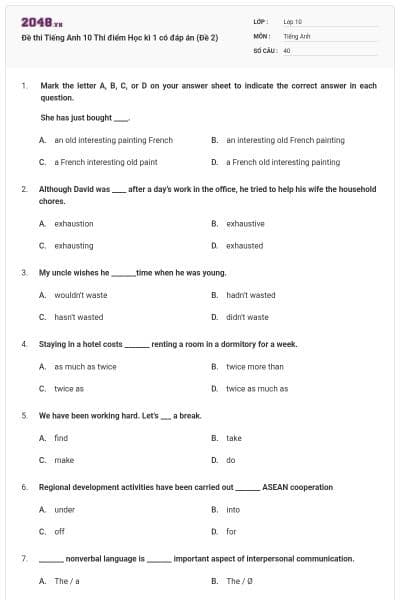
Mark the letter A, B, C, or D on your answer sheet to indicate the correct answer in each question.
She has just bought ____.
an old interesting painting French
an interesting old French painting
a French interesting old paint
a French old interesting painting
Đáp án: B
Giải thích: Thứ tự tính từ trong cụm danh từ: Opinion – Size – Age – Shape – Color – Origin – Material – Purpose
Dịch: Cô ấy vừa mua một bức tranh cổ của Pháp rất thú vị
Although David was ____ after a day’s work in the office, he tried to help his wife the household chores.
exhaustion
exhaustive
exhausting
exhausted
Đáp án: D
Giải thích: Vị trí cần tính từ ở dạng bị động
Dịch: Mặc dù đã mệt mỏi sau một ngày làm việc ở văn phòng, David vẫn cố gắng giúp vợ việc nhà.
My uncle wishes he _______time when he was young.
wouldn't waste
hadn't wasted
hasn't wasted
didn't waste
Đáp án: B
Giải thích: Điều ước trong quá khứ nên lùi thì quà khứ đơn thành quá khứ hoàn thành
Dịch: Chú của tôi ước ông ấy đã không lãng phí thời gian khi còn trẻ
Staying in a hotel costs _______ renting a room in a dormitory for a week.
as much as twice
twice more than
twice as
twice as much as
Đáp án: D
Giải thích: So sánh gấp số lần: số lần + as + adj +as
Dịch: Ở khách sạn đắt gấp đôi thuê phòng ở kí túc trong 1 tuần
We have been working hard. Let’s ___ a break.
find
take
make
do
Đáp án: B
Giải thích: Take a break: nghỉ ngơi
Dịch: Chúng ta đã làm việc chăm chỉ rồi. Nghỉ ngơi thôi.
Regional development activities have been carried out _______ ASEAN cooperation
under
into
off
for
Đáp án: A
Dịch: Các hoạt động phát triển khu vực đã được thực hiện trong khuôn khổ hợp tác ASEAN
_______ nonverbal language is _______ important aspect of interpersonal communication.
The / a
The / Ø
Ø / an
A / the
Đáp án: C
Are there any interesting ____in the paper?
news
new
pieces of news
piece of news
Đáp án: C
Giải thích: Câu hỏi là “Are there” nên danh từ phải ở dạng đếm được số nhiều
Dịch: Có tin tức thú vị nào trên báo không?
UNESCO was established to encourage _______ among nations in the areas of education, science, culture, and communication.
workforce
independence
employment
collaboration
Đáp án: D
Giải thích:
Kiến thức: Từ vựng
A. workforce (n): lực lượng lao động
B. independence (n): nền độc lập, sự độc lập
C. employment (n): việc làm
D. collaboration (n): sự hợp tác
Dựa vào nghĩa câu, chọn D.
Dịch: UNESCO được thành lập nhằm khuyến khích sự hợp tác giữa các quốc gia trong các lĩnh vực giáo dục, khoa học, văn hóa và truyền thông.
Only when you grow up _________ the truth.
will you know
do you know
you will know
you know
Đáp án: A
Giải thích: Cấu trúc đảo ngữ với “only when”
Dịch: Chỉ khi bạn lớn bạn mới biết sự thật
" If I hadn't practiced when I was young," he says," I __________able to play now."
won't be
would be
wouldn't have been
wouldn't be
Đáp án: D
Giải thích: Câu điều kiện kết hợp loại 2 và loại 3
Dịch: "Nếu tôi không tập luyện khi còn trẻ," anh ấy nói, "Tôi sẽ không thể thi đấu bây giờ."
There were a lot people at the party, only few of ____ I had met before.
them
who
whom
whose
Đáp án: C
Giải thích: Ô trống cần đại từ quan hệ thay thế tân ngữ
Dịch: Có rất nhiều người trong bữa tiệc, chỉ có vài người trong số họ đã gặp trước đây.
Mark the letter A, B, C, or D on your answer sheet to indicate the word that is OPPOSITE in meaning to the underlined word(s) in each of the following questions.
The consequences of the typhoon were disastrous due to the lack of pre-cautionary measures.
beneficial
damaging
physical
severe
Đáp án: A
Giải thích: Disastrous (tai hại) >< beneficial (có lợi)
Dịch: Hậu quả của cơn bão rất thảm khốc do không có các biện pháp phòng ngừa trước.
Mark the letter A, B, C, or D on your answer sheet to indicate the word that is OPPOSITE in meaning to the underlined word(s) in each of the following questions.
Vietnam’s admission to the World Trade Organization (WTO) has promoted its trade relations with other countries.
restricted
boosted
expanded
balanced
Đáp án: A
Giải thích: Promoted (nâng cao) >< restricted (hạn chế)
Dịch: Việc Việt Nam gia nhập Tổ chức Thương mại Thế giới (WTO) đã thúc đẩy quan hệ thương mại với các nước khác.
Mark the letter A, B, C or D on your answer sheet to indicate the most suitable response to complete each of the following exchanges.
Cindy wanted to drive her best friend to have dinner at an Italian restaurant but her car couldn't start. Therefore, she had to borrow one from Nancy.
- Cindy: "Would you mind lending me your car?"
- Nancy: "_______________."
Great
Yes. Here it is
Yes, let's
No, not at all.
Đáp án: D
Giải thích:
Kiến thức: Tình huống giao tiếp
Dịch: Cindy muốn lái xe đưa bạn thân của mình đi ăn tối tại một nhà hàng Ý nhưng xe của cô ấy không nổ máy được. Do đó, cô ấy phải mượn xe của Nancy.
- Cindy: "Bạn có phiền cho mình mượn xe của bạn không?"
- Nancy: "_______________."
A. Tuyệt
B. Vâng. Đây rồi
C. Được, cùng làm thôi
D. Không phiền tí nào cả
Dựa vào nghĩa, chọn D.
Minh and Lan are talking about Minh’s boyfriend
.-Minh: “If only I hadn’t lent him all my money!” - Lan: “_______”
Well, it’s no use crying over spilt milk.
I’m afraid. That’s what you did.
All right. You’ll be OK soon.
Sorry, I can’t help.
Đáp án: A
Dịch:
Minh và Lan đang nói về bạn trai của Minh
- Minh: “Giá như em đừng cho anh ấy vay hết tiền!” - Lan: "Chà, khóc vì sữa đổ cũng chẳng ích gì."
My brother tried very hard to past the driving test. He could hardly pass it.
No matter how hard my brother tried, he could hardly pass the driving test.
Although my brother didn’t try hard to past the driving test, he could pass it.
Despite being able to pass the driving test, my brother didn’t pass it.
My brother tried very hard, so he passed the driving test satisfactorily.
Đáp án: A
Dịch:
Anh trai tôi đã rất cố gắng để vượt qua kỳ thi sát hạch lái xe. Anh khó có thể vượt qua nó.
A. Dù anh tôi có cố gắng thế nào, anh ấy cũng khó có thể vượt qua kỳ thi sát hạch lái xe.
B. Mặc dù anh trai tôi đã không cố gắng để vượt qua bài kiểm tra lái xe, nhưng anh ấy có thể vượt qua nó.
C. Mặc dù có thể vượt qua bài kiểm tra lái xe, nhưng anh trai tôi đã không vượt qua nó.
D. Anh trai tôi đã rất cố gắng nên đã vượt qua kỳ thi sát hạch lái xe một cách xuất sắc.
Ann jogs every morning. It is very good for her health.
Ann jogs every morning and it is very good for her health.
Ann jogs every morning, which is very good for her health.
Ann jogs every morning and then it is very good for her health.
Ann jogs every morning that it is very good for her health.
Đáp án: B
Dịch:
Ann chạy bộ mỗi sáng. Nó rất tốt cho sức khỏe của cô ấy.
A. Ann chạy bộ mỗi sáng và điều đó rất tốt cho sức khỏe của cô ấy.
B. Ann chạy bộ mỗi sáng, điều này rất tốt cho sức khỏe của cô ấy.
C. Ann chạy bộ mỗi sáng và sau đó rất tốt cho sức khỏe của cô ấy.
D. Ann chạy bộ mỗi sáng rất tốt cho sức khỏe của cô ấy.
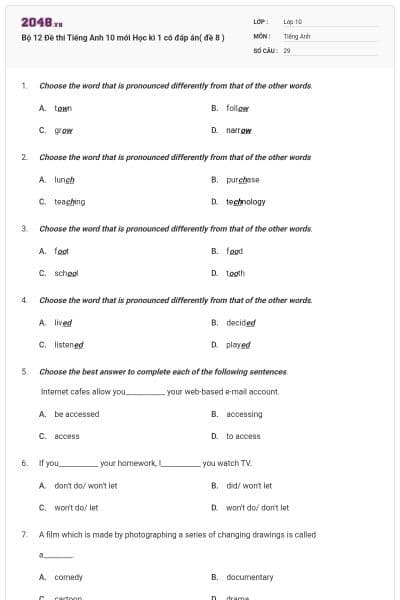
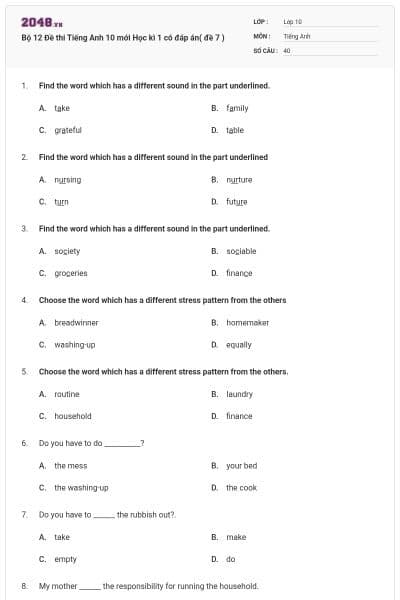
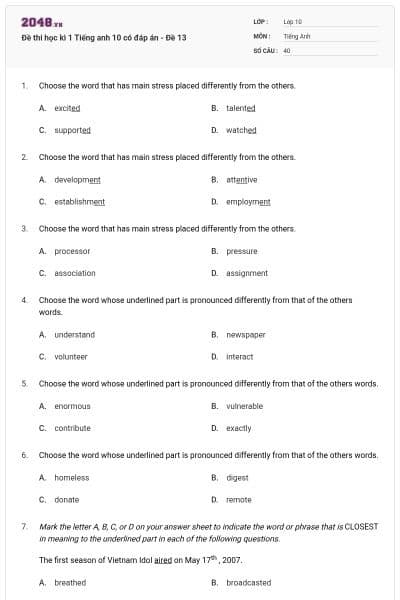
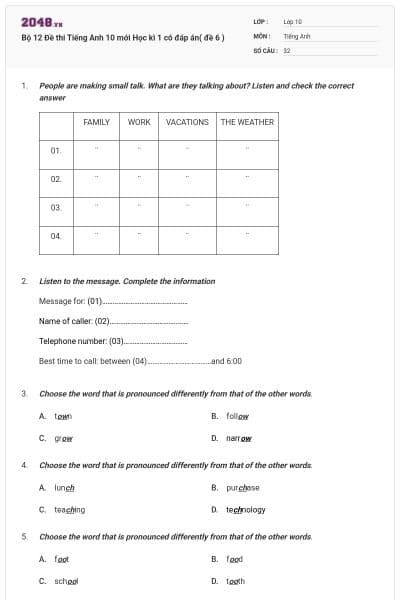
Mark the letter A, B, C, or D on your answer sheet to indicate the word whose underlined part differs from the other three in pronunciation in each of the following questions.
pushed
pleased
punched
packed
Đáp án: C
Đáp án C phát âm là /d/ các đáp án còn lại phát âm là /t/
Mark the letter A, B, C, or D on your answer sheet to indicate the word whose underlined part differs from the other three in pronunciation in each of the following questions.
amuses
raises
blouses
pleases
Đáp án: C
Đáp án C phát âm là /es/ các đáp án còn lại phát âm là /z/
Mark the letter A, B, C, or D on your answer sheet to indicate the word that differs from the rest in the position of main stress in each of the following questions.
compliment
prediction
dependence
disastrous
Đáp án: A
Đáp án A trọng âm số 1, các đáp án còn lại trọng âm số 2
Mark the letter A, B, C, or D on your answer sheet to indicate the word that differs from the rest in the position of main stress in each of the following questions.
ambitious
applicant
essential
performance
Đáp án: B
Đáp án B trọng âm số 1, các đáp án còn lại trọng âm số 2
Read the following passage and mark the letter A, B, C, or D on your answer sheet to indicate the correct answer to each of the questions
Coincident with concerns about the accelerating loss of species and habitats has been growing appreciation of the importance of biological diversity, the number of species in a particular ecosystem, to the health of the Earth and human well-being. Much has been written about the diversity of terrestrial organisms, particularly the exceptionally rich life associated with tropical rain-forest habitats. Relatively little has been said, however, about diversity of life in the sea even though coral reef systems are comparable to rain forests in terms of richness of life.
An alien exploring Earth would probably give priority to the planet’s dominants, most-distinctive feature - the ocean. Humans have a bias toward land that sometimes gets in the way of truly examining global issues. Seen from far away, it is easy to realize that landmasses occupy only one-third of the Earth’s surface. Given that two thirds of the Earth’s surface is water and that marine life lives at all levels of the ocean, the total three-dimensional living space of the ocean is perhaps 100 times greater than that of land and contains more than 90 percent of all life on Earth even though the ocean has fewer distinct species.
The fact that half of the known species are thought to inhabit the world’s rain forests does not seem surprising, considering the huge number of insects that comprise the bulk of the species. One scientist found many different species of ants in just one tree from a rain forest. While every species is different from every other species, their genetic makeup constrains them to be insects and to share similar characteristics with 750,000 species of insects. If basic, broad categories such as phyla and classes are given more emphasis than differentiating between species, then the greatest diversity of life is unquestionably the sea. Nearly every major type of plant and animal has some representation there .To appreciate fully the diversity and abundance of life in the sea, it helps to think small. Every spoonful of ocean water contains life, on the order of 100 to 100,000 bacterial cells plus assorted microscopic plants and animals, including larvae of organisms ranging from sponges and corals to starfish and clams and much more.
Question: The word “there” in paragraph 3 refers to ______.
the Earth’s surface
the sea
a tre
the rain forests
Đáp án: B
Giải thích: Dựa vào câu: If basic, broad categories such as phyla and classes are given more emphasis than differentiating between species, then the greatest diversity of life is unquestionably the sea. Nearly every major type of plant and animal has some representation there (đoạn 3)
Dịch: Nếu các phân loại cơ bản, rộng lớn như phyla và các lớp được chú trọng hơn là phân biệt giữa các loài, thì sự đa dạng lớn nhất của sự sống chắc chắn là biển. Gần như mọi loại động thực vật chính đều có một số đại diện ở đó
Read the following passage and mark the letter A, B, C, or D on your answer sheet to indicate the correct answer to each of the questions
Coincident with concerns about the accelerating loss of species and habitats has been growing appreciation of the importance of biological diversity, the number of species in a particular ecosystem, to the health of the Earth and human well-being. Much has been written about the diversity of terrestrial organisms, particularly the exceptionally rich life associated with tropical rain-forest habitats. Relatively little has been said, however, about diversity of life in the sea even though coral reef systems are comparable to rain forests in terms of richness of life.
An alien exploring Earth would probably give priority to the planet’s dominants, most-distinctive feature - the ocean. Humans have a bias toward land that sometimes gets in the way of truly examining global issues. Seen from far away, it is easy to realize that landmasses occupy only one-third of the Earth’s surface. Given that two thirds of the Earth’s surface is water and that marine life lives at all levels of the ocean, the total three-dimensional living space of the ocean is perhaps 100 times greater than that of land and contains more than 90 percent of all life on Earth even though the ocean has fewer distinct species.
The fact that half of the known species are thought to inhabit the world’s rain forests does not seem surprising, considering the huge number of insects that comprise the bulk of the species. One scientist found many different species of ants in just one tree from a rain forest. While every species is different from every other species, their genetic makeup constrains them to be insects and to share similar characteristics with 750,000 species of insects. If basic, broad categories such as phyla and classes are given more emphasis than differentiating between species, then the greatest diversity of life is unquestionably the sea. Nearly every major type of plant and animal has some representation there .To appreciate fully the diversity and abundance of life in the sea, it helps to think small. Every spoonful of ocean water contains life, on the order of 100 to 100,000 bacterial cells plus assorted microscopic plants and animals, including larvae of organisms ranging from sponges and corals to starfish and clams and much more.
Question: The word “bias” in paragraph 2 is closest in meaning to ______.
prejudice
concern
disadvantage
attitude
Đáp án: A
Giải thích: bias = prejudice (thành kiến)
Read the following passage and mark the letter A, B, C, or D on your answer sheet to indicate the correct answer to each of the questions
Coincident with concerns about the accelerating loss of species and habitats has been growing appreciation of the importance of biological diversity, the number of species in a particular ecosystem, to the health of the Earth and human well-being. Much has been written about the diversity of terrestrial organisms, particularly the exceptionally rich life associated with tropical rain-forest habitats. Relatively little has been said, however, about diversity of life in the sea even though coral reef systems are comparable to rain forests in terms of richness of life.
An alien exploring Earth would probably give priority to the planet’s dominants, most-distinctive feature - the ocean. Humans have a bias toward land that sometimes gets in the way of truly examining global issues. Seen from far away, it is easy to realize that landmasses occupy only one-third of the Earth’s surface. Given that two thirds of the Earth’s surface is water and that marine life lives at all levels of the ocean, the total three-dimensional living space of the ocean is perhaps 100 times greater than that of land and contains more than 90 percent of all life on Earth even though the ocean has fewer distinct species.
The fact that half of the known species are thought to inhabit the world’s rain forests does not seem surprising, considering the huge number of insects that comprise the bulk of the species. One scientist found many different species of ants in just one tree from a rain forest. While every species is different from every other species, their genetic makeup constrains them to be insects and to share similar characteristics with 750,000 species of insects. If basic, broad categories such as phyla and classes are given more emphasis than differentiating between species, then the greatest diversity of life is unquestionably the sea. Nearly every major type of plant and animal has some representation there .To appreciate fully the diversity and abundance of life in the sea, it helps to think small. Every spoonful of ocean water contains life, on the order of 100 to 100,000 bacterial cells plus assorted microscopic plants and animals, including larvae of organisms ranging from sponges and corals to starfish and clams and much more.
Question: Which of the following conclusions is supported by the passage?
Ocean life is highly adaptive.
More attention needs to be paid to preserving ocean species and habitats.
Ocean life is primarily composed of plants.
The sea is highly resistant to the damage done by pollutants
Đáp án: B
Giải thích: Bài văn đưa ra kết luận: Cần phải chú ý nhiều hơn đến việc bảo tồn các loài và sinh cảnh đại dương.
Read the following passage and mark the letter A, B, C, or D on your answer sheet to indicate the correct answer to each of the questions
Coincident with concerns about the accelerating loss of species and habitats has been growing appreciation of the importance of biological diversity, the number of species in a particular ecosystem, to the health of the Earth and human well-being. Much has been written about the diversity of terrestrial organisms, particularly the exceptionally rich life associated with tropical rain-forest habitats. Relatively little has been said, however, about diversity of life in the sea even though coral reef systems are comparable to rain forests in terms of richness of life.
An alien exploring Earth would probably give priority to the planet’s dominants, most-distinctive feature - the ocean. Humans have a bias toward land that sometimes gets in the way of truly examining global issues. Seen from far away, it is easy to realize that landmasses occupy only one-third of the Earth’s surface. Given that two thirds of the Earth’s surface is water and that marine life lives at all levels of the ocean, the total three-dimensional living space of the ocean is perhaps 100 times greater than that of land and contains more than 90 percent of all life on Earth even though the ocean has fewer distinct species.
The fact that half of the known species are thought to inhabit the world’s rain forests does not seem surprising, considering the huge number of insects that comprise the bulk of the species. One scientist found many different species of ants in just one tree from a rain forest. While every species is different from every other species, their genetic makeup constrains them to be insects and to share similar characteristics with 750,000 species of insects. If basic, broad categories such as phyla and classes are given more emphasis than differentiating between species, then the greatest diversity of life is unquestionably the sea. Nearly every major type of plant and animal has some representation there .To appreciate fully the diversity and abundance of life in the sea, it helps to think small. Every spoonful of ocean water contains life, on the order of 100 to 100,000 bacterial cells plus assorted microscopic plants and animals, including larvae of organisms ranging from sponges and corals to starfish and clams and much more.
Question: Why does the author compare rain forests and coral reefs?
They are approximately the same size.
Both have many different forms of life.
They share many similar species.
Most of their inhabitants require water.
Đáp án: B
Giải thích: Dựa vào câu: Relatively little has been said, however, about diversity of life in the sea even though coral reef systems are comparable to rain forests in terms of richness of life. (đoạn 1)
Dịch: Tuy nhiên, tương đối ít người ta nói về sự đa dạng của sự sống ở biển mặc dù hệ thống rạn san hô có thể so sánh với rừng mưa về mức độ phong phú của sự sống.
Read the following passage and mark the letter A, B, C, or D on your answer sheet to indicate the correct answer to each of the questions
Coincident with concerns about the accelerating loss of species and habitats has been growing appreciation of the importance of biological diversity, the number of species in a particular ecosystem, to the health of the Earth and human well-being. Much has been written about the diversity of terrestrial organisms, particularly the exceptionally rich life associated with tropical rain-forest habitats. Relatively little has been said, however, about diversity of life in the sea even though coral reef systems are comparable to rain forests in terms of richness of life.
An alien exploring Earth would probably give priority to the planet’s dominants, most-distinctive feature - the ocean. Humans have a bias toward land that sometimes gets in the way of truly examining global issues. Seen from far away, it is easy to realize that landmasses occupy only one-third of the Earth’s surface. Given that two thirds of the Earth’s surface is water and that marine life lives at all levels of the ocean, the total three-dimensional living space of the ocean is perhaps 100 times greater than that of land and contains more than 90 percent of all life on Earth even though the ocean has fewer distinct species.
The fact that half of the known species are thought to inhabit the world’s rain forests does not seem surprising, considering the huge number of insects that comprise the bulk of the species. One scientist found many different species of ants in just one tree from a rain forest. While every species is different from every other species, their genetic makeup constrains them to be insects and to share similar characteristics with 750,000 species of insects. If basic, broad categories such as phyla and classes are given more emphasis than differentiating between species, then the greatest diversity of life is unquestionably the sea. Nearly every major type of plant and animal has some representation there .To appreciate fully the diversity and abundance of life in the sea, it helps to think small. Every spoonful of ocean water contains life, on the order of 100 to 100,000 bacterial cells plus assorted microscopic plants and animals, including larvae of organisms ranging from sponges and corals to starfish and clams and much more.
Question: The passage suggests that most rain forest species are ______.
birds
bacteria
mammals
insects
Đáp án: D
Giải thích: Dựa vào câu: The fact that half of the known species are thought to inhabit the world’s rain forests does not seem surprising, considering the huge number of insects that comprise the bulk of the species.
Dịch: Thực tế là một nửa số loài đã biết được cho là sinh sống trong các khu rừng nhiệt đới trên thế giới dường như không có gì đáng ngạc nhiên, khi xem xét số lượng côn trùng khổng lồ bao gồm phần lớn các loài.
Read the following passage and mark the letter A, B, C, or D on your answer sheet to indicate the correct answer to each of the questions
Coincident with concerns about the accelerating loss of species and habitats has been growing appreciation of the importance of biological diversity, the number of species in a particular ecosystem, to the health of the Earth and human well-being. Much has been written about the diversity of terrestrial organisms, particularly the exceptionally rich life associated with tropical rain-forest habitats. Relatively little has been said, however, about diversity of life in the sea even though coral reef systems are comparable to rain forests in terms of richness of life.
An alien exploring Earth would probably give priority to the planet’s dominants, most-distinctive feature - the ocean. Humans have a bias toward land that sometimes gets in the way of truly examining global issues. Seen from far away, it is easy to realize that landmasses occupy only one-third of the Earth’s surface. Given that two thirds of the Earth’s surface is water and that marine life lives at all levels of the ocean, the total three-dimensional living space of the ocean is perhaps 100 times greater than that of land and contains more than 90 percent of all life on Earth even though the ocean has fewer distinct species.
The fact that half of the known species are thought to inhabit the world’s rain forests does not seem surprising, considering the huge number of insects that comprise the bulk of the species. One scientist found many different species of ants in just one tree from a rain forest. While every species is different from every other species, their genetic makeup constrains them to be insects and to share similar characteristics with 750,000 species of insects. If basic, broad categories such as phyla and classes are given more emphasis than differentiating between species, then the greatest diversity of life is unquestionably the sea. Nearly every major type of plant and animal has some representation there .To appreciate fully the diversity and abundance of life in the sea, it helps to think small. Every spoonful of ocean water contains life, on the order of 100 to 100,000 bacterial cells plus assorted microscopic plants and animals, including larvae of organisms ranging from sponges and corals to starfish and clams and much more.
Question: Which of the following is true about the ocean according to the passage?
It’s 100 times greater than land.
It contains more species than land.
It contains a vast majority of life on Earth.
It occupies one-third of the Earth’s surface.
Đáp án: C
Giải thích: Dựa vào câu: Given that two thirds of the Earth’s surface is water (đoạn 2)
Dịch: Cho rằng 2/3 bề mặt Trái đất là nước ….
Read the following passage and mark the letter A, B, C, or D on your answer sheet to indicate the correct answer to each of the questions
Coincident with concerns about the accelerating loss of species and habitats has been growing appreciation of the importance of biological diversity, the number of species in a particular ecosystem, to the health of the Earth and human well-being. Much has been written about the diversity of terrestrial organisms, particularly the exceptionally rich life associated with tropical rain-forest habitats. Relatively little has been said, however, about diversity of life in the sea even though coral reef systems are comparable to rain forests in terms of richness of life.
An alien exploring Earth would probably give priority to the planet’s dominants, most-distinctive feature - the ocean. Humans have a bias toward land that sometimes gets in the way of truly examining global issues. Seen from far away, it is easy to realize that landmasses occupy only one-third of the Earth’s surface. Given that two thirds of the Earth’s surface is water and that marine life lives at all levels of the ocean, the total three-dimensional living space of the ocean is perhaps 100 times greater than that of land and contains more than 90 percent of all life on Earth even though the ocean has fewer distinct species.
The fact that half of the known species are thought to inhabit the world’s rain forests does not seem surprising, considering the huge number of insects that comprise the bulk of the species. One scientist found many different species of ants in just one tree from a rain forest. While every species is different from every other species, their genetic makeup constrains them to be insects and to share similar characteristics with 750,000 species of insects. If basic, broad categories such as phyla and classes are given more emphasis than differentiating between species, then the greatest diversity of life is unquestionably the sea. Nearly every major type of plant and animal has some representation there .To appreciate fully the diversity and abundance of life in the sea, it helps to think small. Every spoonful of ocean water contains life, on the order of 100 to 100,000 bacterial cells plus assorted microscopic plants and animals, including larvae of organisms ranging from sponges and corals to starfish and clams and much more.
Question: The author argues that there is more diversity of life in the sea than in the rain forests because ______.
there are too many insects to make meaningful distinctions
marine life-forms reproduce at a faster rate
more phyla and classes of life are represented in the sea
many insect species are too small to divide into categories
Đáp án: C
Giải thích:
If basic, broad categories such as phyla and classes are given more emphasis than differentiating between species, then the greatest diversity of life is unquestionably the sea. (đoạn 3)
Dịch: Nếu các phân loại cơ bản, rộng lớn như phyla và các lớp được chú trọng hơn là phân biệt giữa các loài, thì sự đa dạng lớn nhất của sự sống chắc chắn là biển.
Read the following passage and mark the letter A, B, C, or D on your answer sheet to indicate the correct answer to each of the questions.
Reading to oneself is a modern activity which was almost unknown to the scholars of the classical and medieval worlds, while during the fifteenth century the term “reading” undoubtedly meant reading aloud. Only during the nineteenth century did silent reading become commonplace.
One should be wary, however, of assuming that silent reading came about simply because reading aloud was a distraction to others. Examinations of factors related to the historical development of silent reading have revealed that it became the usual mode of reading for most adults mainly because the tasks themselves changed in character.
The last century saw a steady gradual increase in literacy and thus in the number of readers. As the number of readers increased, the number of potential listeners declined and thus there was some reduction in the need to read aloud. As reading for the benefit of listeners grew less common, came the flourishing of reading as a private activity in such public places as libraries, railway carriages and offices, where reading aloud would cause distraction to other readers.
Towards the end of the century, there was still considerable argument over whether books should be used for information or treated respectfully and over whether the reading of materials such as newspapers was in some way mentally weakening. Indeed, this argument remains with us still in education. However, whatever its virtues, the old shared literacy culture had gone and were replaced by the printed mass media on the one hand and by books and periodicals for a specialized readership on the other.
By the end of the twentieth century, students were being recommended to adopt attitudes to books and to use reading skills which were inappropriate, if not impossible, for the oral reader. The social, cultural and technological changes in the century had greatly altered what the term “reading” implied
Question: The phrase “a specialized readership” in paragraph 4 mostly means “_________”.
a status for readers specialized in mass media
a requirement for readers in a particular area of knowledge
a reading volume for particular professionals
a limited number of readers in a particular area of knowledge
Đáp án: D
Read the following passage and mark the letter A, B, C, or D on your answer sheet to indicate the correct answer to each of the questions.
Reading to oneself is a modern activity which was almost unknown to the scholars of the classical and medieval worlds, while during the fifteenth century the term “reading” undoubtedly meant reading aloud. Only during the nineteenth century did silent reading become commonplace.
One should be wary, however, of assuming that silent reading came about simply because reading aloud was a distraction to others. Examinations of factors related to the historical development of silent reading have revealed that it became the usual mode of reading for most adults mainly because the tasks themselves changed in character.
The last century saw a steady gradual increase in literacy and thus in the number of readers. As the number of readers increased, the number of potential listeners declined and thus there was some reduction in the need to read aloud. As reading for the benefit of listeners grew less common, came the flourishing of reading as a private activity in such public places as libraries, railway carriages and offices, where reading aloud would cause distraction to other readers.
Towards the end of the century, there was still considerable argument over whether books should be used for information or treated respectfully and over whether the reading of materials such as newspapers was in some way mentally weakening. Indeed, this argument remains with us still in education. However, whatever its virtues, the old shared literacy culture had gone and were replaced by the printed mass media on the one hand and by books and periodicals for a specialized readership on the other.
By the end of the twentieth century, students were being recommended to adopt attitudes to books and to use reading skills which were inappropriate, if not impossible, for the oral reader. The social, cultural and technological changes in the century had greatly altered what the term “reading” implied
Question: The development of silent reading during the last century indicated_________.
an increase in the number of books
a change in the status of literate people
an increase in the average age of readers
a change in the nature of reading
Đáp án: D
Giải thích: Dựa vào câu: Examinations of factors related to the historical development of silent reading have revealed that it became the usual mode of reading for most adults mainly because the tasks themselves changed in character. (đoạn 2)
Dịch: Việc kiểm tra các yếu tố liên quan đến sự phát triển lịch sử của đọc sách cho thấy rằng nó đã trở thành phương thức đọc thông thường của hầu hết người lớn chủ yếu là do bản thân các nhiệm vụ đã thay đổi về tính cách.
Read the following passage and mark the letter A, B, C, or D on your answer sheet to indicate the correct answer to each of the questions.
Reading to oneself is a modern activity which was almost unknown to the scholars of the classical and medieval worlds, while during the fifteenth century the term “reading” undoubtedly meant reading aloud. Only during the nineteenth century did silent reading become commonplace.
One should be wary, however, of assuming that silent reading came about simply because reading aloud was a distraction to others. Examinations of factors related to the historical development of silent reading have revealed that it became the usual mode of reading for most adults mainly because the tasks themselves changed in character.
The last century saw a steady gradual increase in literacy and thus in the number of readers. As the number of readers increased, the number of potential listeners declined and thus there was some reduction in the need to read aloud. As reading for the benefit of listeners grew less common, came the flourishing of reading as a private activity in such public places as libraries, railway carriages and offices, where reading aloud would cause distraction to other readers.
Towards the end of the century, there was still considerable argument over whether books should be used for information or treated respectfully and over whether the reading of materials such as newspapers was in some way mentally weakening. Indeed, this argument remains with us still in education. However, whatever its virtues, the old shared literacy culture had gone and were replaced by the printed mass media on the one hand and by books and periodicals for a specialized readership on the other.
By the end of the twentieth century, students were being recommended to adopt attitudes to books and to use reading skills which were inappropriate, if not impossible, for the oral reader. The social, cultural and technological changes in the century had greatly altered what the term “reading” implied
Question: Reading aloud was more common in the medieval world because_________.
silent reading had not been discovered
people relied on reading for entertainment
few people could read to themselves
there were few places available for private reading
Đáp án: C
Giải thích: Dựa vào câu: Reading to oneself is a modern activity which was almost unknown to the scholars of the classical and medieval worlds, while during the fifteenth century the term “reading” undoubtedly meant reading aloud. (đoạn 1)
Dịch: Đọc cho chính mình là một hoạt động hiện đại hầu như không được các học giả của thế giới cổ điển và trung cổ biết đến, trong khi trong thế kỷ XV, thuật ngữ “đọc” chắc chắn có nghĩa là đọc to.
Read the following passage and mark the letter A, B, C, or D on your answer sheet to indicate the correct answer to each of the questions.
Reading to oneself is a modern activity which was almost unknown to the scholars of the classical and medieval worlds, while during the fifteenth century the term “reading” undoubtedly meant reading aloud. Only during the nineteenth century did silent reading become commonplace.
One should be wary, however, of assuming that silent reading came about simply because reading aloud was a distraction to others. Examinations of factors related to the historical development of silent reading have revealed that it became the usual mode of reading for most adults mainly because the tasks themselves changed in character.
The last century saw a steady gradual increase in literacy and thus in the number of readers. As the number of readers increased, the number of potential listeners declined and thus there was some reduction in the need to read aloud. As reading for the benefit of listeners grew less common, came the flourishing of reading as a private activity in such public places as libraries, railway carriages and offices, where reading aloud would cause distraction to other readers.
Towards the end of the century, there was still considerable argument over whether books should be used for information or treated respectfully and over whether the reading of materials such as newspapers was in some way mentally weakening. Indeed, this argument remains with us still in education. However, whatever its virtues, the old shared literacy culture had gone and were replaced by the printed mass media on the one hand and by books and periodicals for a specialized readership on the other.
By the end of the twentieth century, students were being recommended to adopt attitudes to books and to use reading skills which were inappropriate, if not impossible, for the oral reader. The social, cultural and technological changes in the century had greatly altered what the term “reading” implied
Question: All of the following might be the factors that affected the continuation of the old shared literacy culture EXCEPT _____.
the printed mass media
the specialized readership
the inappropriate reading skills
the diversity of reading materials
Đáp án: C
Read the following passage and mark the letter A, B, C, or D on your answer sheet to indicate the correct answer to each of the questions.
Reading to oneself is a modern activity which was almost unknown to the scholars of the classical and medieval worlds, while during the fifteenth century the term “reading” undoubtedly meant reading aloud. Only during the nineteenth century did silent reading become commonplace.
One should be wary, however, of assuming that silent reading came about simply because reading aloud was a distraction to others. Examinations of factors related to the historical development of silent reading have revealed that it became the usual mode of reading for most adults mainly because the tasks themselves changed in character.
The last century saw a steady gradual increase in literacy and thus in the number of readers. As the number of readers increased, the number of potential listeners declined and thus there was some reduction in the need to read aloud. As reading for the benefit of listeners grew less common, came the flourishing of reading as a private activity in such public places as libraries, railway carriages and offices, where reading aloud would cause distraction to other readers.
Towards the end of the century, there was still considerable argument over whether books should be used for information or treated respectfully and over whether the reading of materials such as newspapers was in some way mentally weakening. Indeed, this argument remains with us still in education. However, whatever its virtues, the old shared literacy culture had gone and were replaced by the printed mass media on the one hand and by books and periodicals for a specialized readership on the other.
By the end of the twentieth century, students were being recommended to adopt attitudes to books and to use reading skills which were inappropriate, if not impossible, for the oral reader. The social, cultural and technological changes in the century had greatly altered what the term “reading” implied
Question: The word “commonplace” in the first paragraph mostly means “_________”.
for everybody’s use
most preferable
attracting attention
widely used
Đáp án: D
Giải thích: Commonplace = widely used (thông dụng)
Read the following passage and mark the letter A, B, C, or D on your answer sheet to indicate the correct answer to each of the questions.
Reading to oneself is a modern activity which was almost unknown to the scholars of the classical and medieval worlds, while during the fifteenth century the term “reading” undoubtedly meant reading aloud. Only during the nineteenth century did silent reading become commonplace.
One should be wary, however, of assuming that silent reading came about simply because reading aloud was a distraction to others. Examinations of factors related to the historical development of silent reading have revealed that it became the usual mode of reading for most adults mainly because the tasks themselves changed in character.
The last century saw a steady gradual increase in literacy and thus in the number of readers. As the number of readers increased, the number of potential listeners declined and thus there was some reduction in the need to read aloud. As reading for the benefit of listeners grew less common, came the flourishing of reading as a private activity in such public places as libraries, railway carriages and offices, where reading aloud would cause distraction to other readers.
Towards the end of the century, there was still considerable argument over whether books should be used for information or treated respectfully and over whether the reading of materials such as newspapers was in some way mentally weakening. Indeed, this argument remains with us still in education. However, whatever its virtues, the old shared literacy culture had gone and were replaced by the printed mass media on the one hand and by books and periodicals for a specialized readership on the other.
By the end of the twentieth century, students were being recommended to adopt attitudes to books and to use reading skills which were inappropriate, if not impossible, for the oral reader. The social, cultural and technological changes in the century had greatly altered what the term “reading” implied
Question: The writer of this passage is attempting to_________.
change people’s attitudes to reading
explain how reading habits have developed
encourage the growth of reading
show how reading methods have improved
Đáp án: B
Giải thích: Tác giả đã cố giải thích thói quen đọc đã thay đổi như thế nào
Read the following passage and mark the letter A, B, C, or D on your answer sheet to indicate the correct answer to each of the questions.
Reading to oneself is a modern activity which was almost unknown to the scholars of the classical and medieval worlds, while during the fifteenth century the term “reading” undoubtedly meant reading aloud. Only during the nineteenth century did silent reading become commonplace.
One should be wary, however, of assuming that silent reading came about simply because reading aloud was a distraction to others. Examinations of factors related to the historical development of silent reading have revealed that it became the usual mode of reading for most adults mainly because the tasks themselves changed in character.
The last century saw a steady gradual increase in literacy and thus in the number of readers. As the number of readers increased, the number of potential listeners declined and thus there was some reduction in the need to read aloud. As reading for the benefit of listeners grew less common, came the flourishing of reading as a private activity in such public places as libraries, railway carriages and offices, where reading aloud would cause distraction to other readers.
Towards the end of the century, there was still considerable argument over whether books should be used for information or treated respectfully and over whether the reading of materials such as newspapers was in some way mentally weakening. Indeed, this argument remains with us still in education. However, whatever its virtues, the old shared literacy culture had gone and were replaced by the printed mass media on the one hand and by books and periodicals for a specialized readership on the other.
By the end of the twentieth century, students were being recommended to adopt attitudes to books and to use reading skills which were inappropriate, if not impossible, for the oral reader. The social, cultural and technological changes in the century had greatly altered what the term “reading” implied
Question: It can be inferred that the emergence of the mass media and specialised reading materials was an indication of_________.
an improvement of printing techniques
an alteration in educationalists’ attitudes
a change in the readers’ interest
a decline of standards of literacy
Đáp án: C
Giải thích: Dựa vào câu: However, whatever its virtues, the old shared literacy culture had gone and were replaced by the printed mass media on the one hand and by books and periodicals for a specialized readership on the other. (đoạn 4)
Dịch: Tuy nhiên, bất kể đặc điểm của nó là gì, văn hóa đọc viết chia sẻ cũ đã biến mất và được thay thế bằng các phương tiện thông tin đại chúng in ấn, mặt khác là sách và tạp chí dành cho độc giả chuyên biệt.
Read the following passage and mark the letter A, B, C, or D on your answer sheet to indicate the correct answer to each of the questions.
Reading to oneself is a modern activity which was almost unknown to the scholars of the classical and medieval worlds, while during the fifteenth century the term “reading” undoubtedly meant reading aloud. Only during the nineteenth century did silent reading become commonplace.
One should be wary, however, of assuming that silent reading came about simply because reading aloud was a distraction to others. Examinations of factors related to the historical development of silent reading have revealed that it became the usual mode of reading for most adults mainly because the tasks themselves changed in character.
The last century saw a steady gradual increase in literacy and thus in the number of readers. As the number of readers increased, the number of potential listeners declined and thus there was some reduction in the need to read aloud. As reading for the benefit of listeners grew less common, came the flourishing of reading as a private activity in such public places as libraries, railway carriages and offices, where reading aloud would cause distraction to other readers.
Towards the end of the century, there was still considerable argument over whether books should be used for information or treated respectfully and over whether the reading of materials such as newspapers was in some way mentally weakening. Indeed, this argument remains with us still in education. However, whatever its virtues, the old shared literacy culture had gone and were replaced by the printed mass media on the one hand and by books and periodicals for a specialized readership on the other.
By the end of the twentieth century, students were being recommended to adopt attitudes to books and to use reading skills which were inappropriate, if not impossible, for the oral reader. The social, cultural and technological changes in the century had greatly altered what the term “reading” implied
Question: Which of the following statements is NOT TRUE according to the passage?
Reading aloud was more common in the past than it is today.
The decline of reading aloud was wholly due to its distracting effect.
Not all printed mass media was appropriate for reading aloud.
The change in reading habits was partly due to the social, cultural and technological changes.
Đáp án: B
Mark the letter A, B, C, or D on your answer sheet to indicate the sentence that is closest in meaning to the sentence given in each of the following questions.
You can look up this word in the dictionary.
There are a lot of words in the dictionary for you to look at.
You can find the meaning of this word in the dictionary.
You should buy this dictionary to find the word you need.
The dictionary contains a lot of words except the one you need.
Đáp án: B
Dịch
Bạn có thể tra từ này trong từ điển.
A. Có rất nhiều từ trong từ điển để bạn tra cứu.
B. Bạn có thể tìm nghĩa của từ này trong từ điển.
C. Bạn nên mua từ điển này để tìm từ bạn cần.
D. Từ điển chứa rất nhiều từ ngoại trừ từ mà bạn cần.
You must never take your helmet off while you are riding a motorcycle.
When you are riding a motorcycle, wearing a helmet is not a must.
You needn't wear a helmet whenever you are riding a motorcycle.
Helmets must be worn at all times when you are riding a motorcycle.
If you are riding a motorcycle, you needn't wear a helmet.'
Đáp án: C
Giải thích:
Dịch: Bạn không bao giờ được tháo mũ bảo hiểm khi đang lái xe máy.
A. Khi bạn đang lái xe máy, việc đội mũ bảo hiểm không phải là điều bắt buộc.
B. Bạn không cần phải đội mũ bảo hiểm bất cứ khi nào bạn đang lái xe máy.
C. Phải đội mũ bảo hiểm mọi lúc khi bạn đang lái xe máy.
D. Nếu bạn đang lái xe máy, bạn không cần phải đội mũ bảo hiểm.
Dựa vào nghĩa, chọn C.
It was a mistake of you to lose your passport.
You shouldn't have lost your passport.
Your passport must be lost.
There must be a mistake in your passport.
You needn't have brought your passport.
Đáp án: A
Dịch:
Đó là một sai lầm của bạn khi làm mất hộ chiếu của bạn.
A. Bạn không nên làm mất hộ chiếu của mình.
B. Hộ chiếu của bạn phải bị mất.
C. Phải có sai sót trong hộ chiếu của bạn.
D. Bạn không cần phải mang theo hộ chiếu.